八年级下册英语 Unit 9 知识点与语法精讲精练
词汇梳理
(一)完成单词梳理:
名词:1. amusemen t 娱乐;游戏 2. camer a 照相机 3. invention 发明;发明
物
4. toile t 坐便器;厕所 5. performanc e 表演;演出 6. them e 主
题
7. rid e 供骑乘的游乐设施 8. provinc e 省份 9. fo x 狐狸
10. equato r 赤道 11. spring 春天 12. location 地点;位
置
动词:1. inven t 发明;创造 2. encourag e 鼓励 3. collec t 收集;采
集
代词:1. itsel f (it的反身代词)它自己
副词:1. somewher e 在某处;到某处 2. simply 仅仅;只;不过 3. mostly 主要地;通
常
数词:1. thousan d 一千
连词:1. whethe r 不管……(还是);是否 2. wheneve r 在任何……的时候;无论何
时
形容词:1. unbelievabl e 难以置信的;不真实的 2. rapi d 迅速的;快速的
3. unusua l 特别的;不寻常的 4. socia l 社会的
5. peacefu l 和平的;安宁的 6. perfec t 完美的;完全的
7. saf e 安全的;无危险的
兼类词:1. progres s (v/n)进步;进展
2. Germa n (adj)德国的;德语的;德国人的(n)德语;德国人
3. fea r (v/n)害怕;惧怕 4. Indian (adj)印度的(n)印度
人
5. Japanes e (adj)日本的;日本人的;日语的(n)日本人;日语(二)词汇变形小结:
1. invent 发明(v.) →__invention__ (n.)发明;发明物 →___inventor___ (n.)发明家
2. believe 相信(v.) →__believable__ (adj.)可信的→__unbelievable__ (adj.)难以置信的;不真实的
3. rapid 迅速的(adj.) →___rapidly____ (adv.)迅速地
4. usual 平常的(adj.) →___usually____ (adv.)通常 →___unusual___ (adj.)不寻常的
5. encourage 鼓励(v.) →_encouragement_ (n.)鼓励
6. society 社会(n.) →___social____ (adj.)社会的
7. peace 和平(n.) →__peaceful___ (adj.)和平的 →__peacefully__ (adv.)和平地
8. perform 表演(v.) →__performance__ (n.)表演;演出
9. perfect 完美的;完全的(adj.) →___perfectly____ (adv.)完美地;完全地
10. collect 收集;采集(v.) →___collection___ (n.)收集;收藏品 →___collector___ (n.)收集者;收藏家
11. German德语;德国人;德国的(n./adj.) →___Germans___ (复数) →___Germany____ (n.)德国
12. safe 安全的(adj.) →___safely____ (adv.)安全地 →____safety____ (n.)安全
13. simple 简单的(adj.) →___simply____ (adv.)仅仅;只;不过
14. India 印度(n.) →___Indian_____ (adj./n.)印度的;印度人
15. Japan 日本(n.)→___Japanese___ (adj./n.)日本的;日本人→___Japanese___ (复数)
16. fox 狐狸(n.)→____foxes_____ (复数)
17. most 大多数的(adj.)→___mostly____ (adv.)主要地;通常
【练一练】用所给词的适当形式填空
1. They plan to go to the zoo to see ____foxes_____ (fox) this weekend.
2. Because of losing the job, he lived much __ more simply __ (simple) than before.
3. On weekends, we ___mostly_____ (most) go out for a trip or vacation.
4. It is strange that Nick always does ___unusual____ (usual) things.
5. Blue is a ___peaceful____ (peace) color. People often feel quiet in blue rooms.
6. It’s __unbelievable___ (believe) that he passed the exam without working hard.
7. Team sports help to develop a child’s ___social_____ (society) skills.
8. Our teachers often tell us the importance of ___safety_____ (safe).
9. What do you think is the greatest ___invention___ ( invent) of the twentieth century?
10. They are from Germany. They are ___Germans___ (German).
11. These ___Indians____ (India) like Chinese food very much.
12. Lily’s father has a large ___collection____ (collect) of old coins.
13. There are two ___cameras____ (camera) on that table. Are they yours?14. The little monkey is looking at ___itself_____ (it) in the mirror.
15. Look, there are three ___Japanese____ (Japan) over there.
(三)短语攻关:
amusemen t par k 游乐场 lear n abou t 了解
lea d t o 导致 mak e progres s 取得进步
encourag e sb . t o d o sth . 鼓励某人做某事 te a ar t 茶艺
te a se t 茶具 thin k abou t 考虑
a coupl e o f 两个;一对;几个 tak e a rid e 兜风
thousand s o f 数以千计的;许许多多的 tak e a holida y 度假
On the one hand...on the other hand.. .一方面…另一方面… al l yea r roun d 全年
b e clos e t o 靠近 b e fa r from 远离
知识点梳理
1. Let’s go somewhere different today. 今天咱们去不同的地方吧。
【用法详解】somewhere different意为“不同的地方”。形容词修饰something、anything等不定代词或
somewhere、anywhere等不定副词时,应该放在这些不定代词或不定副词的 后面 (前面/后面)。
Eg.I want to go somewhere relaxing this summer. 今年夏天我想去个令人放松的地方。
Is there anything new in today’s newspaper? 今天的报纸有新的东西吗?
【即学即用】
1.—Where would you like to go for your next holiday?
—I’m thinking about going ____D___.
A. warm anywhere B. warm somewhere C. anywhere warm D. somewhere
warm
2.—Where are you going on vacation this summer?
—I’m going ___A____.
A. somewhere different B. anywhere different C. different somewhere D. different
anywhere3.—Would you like ___A____ for our party?
—Sure. Let's make a plan first.
A. something special B. special something C . anything special D. special
anything
2. It’s really interesting, isn’t it? 它真的很有趣,不是吗?
【用法详解】重点:这是一个反意疑问句,反意疑问句的结构为:
肯定的陈述句 + 否定的附加问句(be动词/助动词/情态动词+主 “前 肯 后 否
语) ”
否定的陈述句 + 肯定的附加问句(be动词/助动词/情态动词+主 “前 否 后 肯
语) ”
Eg.You are from Australia, aren't you?
肯定 否定
Jack doesn't live in Guilin, does he?
否定 肯定
【注意】反意疑问句前后两部分的主语在人称和数方面要保持一致,be动词、助动词或情态动词也要保持
一致。
Eg.She doesn’t like shopping, does she? 她不喜欢购物,是吗?
He can’t speak French, can he? 他不会说法语,对吗?
【拓展延伸】
(1)反意疑问句的回答: ① 答语都要与事实情况一致。
② 肯定回答:Yes, 主语+肯定结构.
否定回答:No, 主语+否定结构.
③ 当陈述部分是否定句时,答语中的Yes译为“不”,No译为“是”.
Eg. --- You don’t like classical music, do you ?
--- Yes, I do. / No, I don’t.
不,我喜欢。 / 是的,我不喜欢。
(2)陈述句部分含有nothing、never、hardly等表示否定意义的词时,附加疑问句用肯定形式。
Eg.You hardly understand me, do you? 你几乎不理解我,是吗?
【即学即用】
1.Mike’s new camera was lost during his visit in Tibet, ___C____?
A. was it B.was he C. wasn’t it D. wasn’t he2.Mr. Smith had an important meeting just now, ___C____?
A.did he B.had he C.didn’t he D.hadn’t he
3.—You haven’t visited the Palace Museum, have you?
—___A____ How I wish to visit it some day!
A.No, I haven’t. B.Yes, I haven’t. C.Yes, I have.
4.Jean knew nothing about the news until her aunt told her, ___B____?
A.didn’t she B.did she C.didn’t Jean
3. We put up a tent and cooked outside. 我们搭起帐篷并在外面做饭。
【用法详解】put up意为“搭起;建造”,为“动词+副词”型短语。名词作宾语时,可放在动词和副词
之间或副词后面;代词作宾语时,只能置于动词和副词之间。
Eg.They are putting up several new buildings in that block. 他们正在那个街区建几幢新楼房。
【拓展延伸】put up的其他含义:
(1)张贴:We’d better put up a notice here. 我们最好在这儿贴一张通知。
(2)举起;拾起:Please put up your hand if you have any question. 如果你有任何问题,请举手。
4. They have information about different computers and who invented them. 它们有关于不同的计算
机及其发明者的信息。
【用法详解】invent动词,意为“发明;创造”。其名词形式是 inventio n ,意为“发明”; invento r
意为“发明家”。
Eg.Can you tell me who invented the telephone? 你能告诉我是谁发明了电话吗?
Edison was one of the great inventors in the world. During his lifetime, he had lots of inventions. 爱
迪生是世界上伟大的发明家之一。他一生中有很多发明。
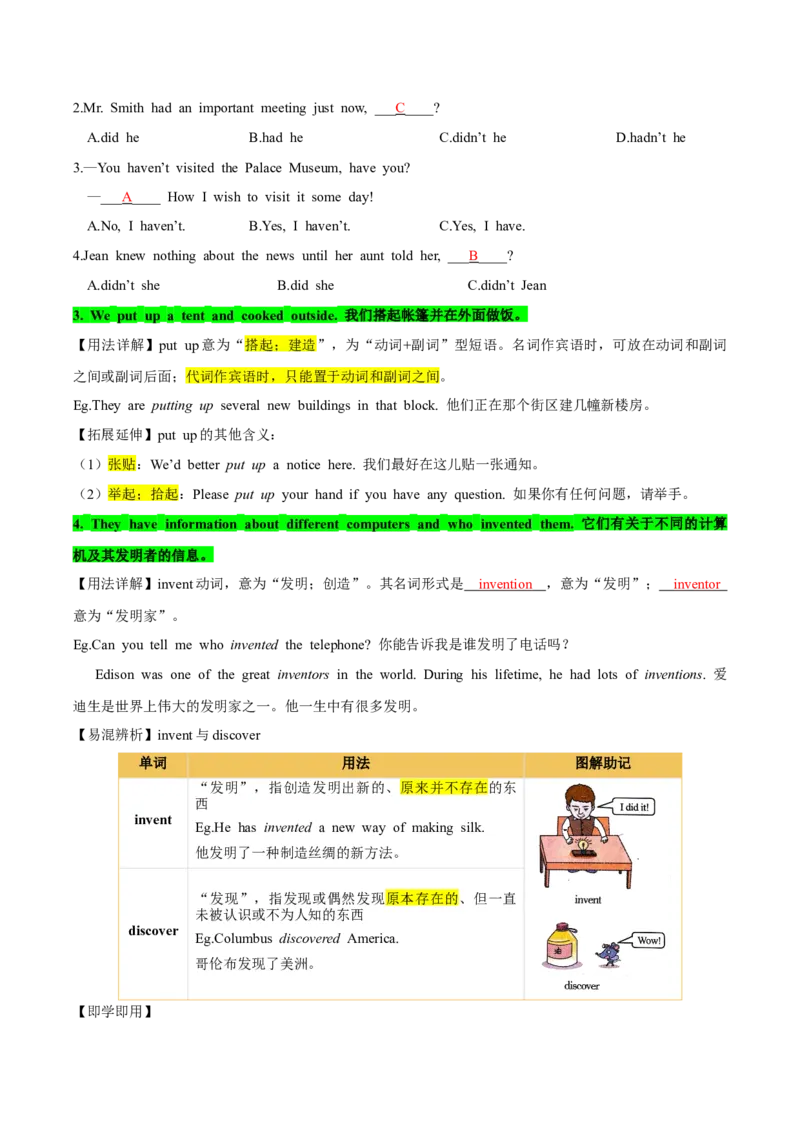
【易混辨析】invent与discover
单词 用法 图解助记
“发明”,指创造发明出新的、原来并不存在的东
西
invent
Eg.He has invented a new way of making silk.
他发明了一种制造丝绸的新方法。
“发现”,指发现或偶然发现原本存在的、但一直
未被认识或不为人知的东西
discover
Eg.Columbus discovered America.
哥伦布发现了美洲。
【即学即用】1.—Who ___A____ the computer?
—Sorry, I've no idea. But it has changed the world greatly.
A. invented B. discovered C. made D.
played
2.Could you please tell us about the four great __inventions__ (invent) of China?
3.I think the computer is one of the most helpful __inventions__ (invent) in our life.
5. It also encourages governments and social groups to think about ways to improve toilets in the
future. 它还鼓励政府和社会团体思考将来改善厕所的方法。
【用法详解】知识点1: encourage及物动词,意为“鼓励;支持”,常用结构: encourag e sb . to do
sth . “鼓励某人做某事”。名词形式为encouragement“鼓励”。
Eg.His teacher encouraged him to study harder. 他的老师鼓励他要更加努力学习。
知识点2: social形容词,意为“社会的”,其名词形式为 societ y ,意为“社会”。
Eg.I hope to be a famous social worker. 我希望成为一名著名的社会工作者。
We’re working hard for the development of society. 我们在努力工作以促进社会的发展。
【即学即用】
1. Our English teacher encourages us ___A____ part in all kinds of after—class activities.
A. to take B. take C. taking D. took
2.The teacher encouraged us ___B____ up a tent by ourselves when we camped in the mountains.
A.put B.to put C.putting D.puts
3.Parents should try to encourage their children ___C____ things by themselves.
A.do B.done C.to do D.doing
4.Smoking in public is still a ___social____ (society) problem.
6. For thousands of tourists from China, this small island in Southeast Asia is a wonderful and safe
place to take a holiday.对于来自中国的数以千计的游客来说,东南亚的这个小岛是一个极好且安全的度
假的地方。
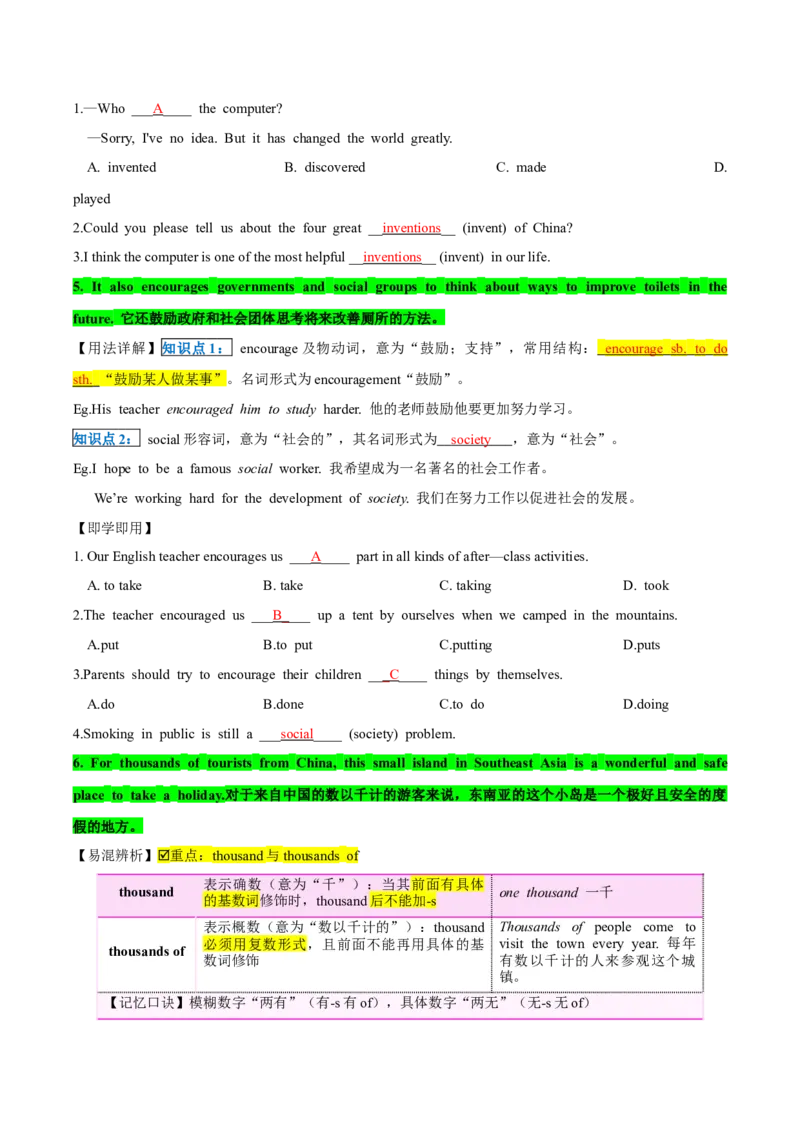
【易混辨析】重点:thousand与thousands of
表示确数(意为“千”):当其前面有具体
thousand one thousand 一千
的基数词修饰时,thousand后不能加-s
表示概数(意为“数以千计的”):thousand Thousands of people come to
必须用复数形式,且前面不能再用具体的基 visit the town every year. 每年
thousands of
数词修饰 有数以千计的人来参观这个城
镇。
【记忆口诀】模糊数字“两有”(有-s有of),具体数字“两无”(无-s无of)【拓展延伸】与thousand用法类似的还有hundred(百)、million(百万)和billion(十亿)等。
【即学即用】
1.The big earthquake left ___B____ people homeless.
A. two thousands B. thousands of C. two thousands of D. two thousand
of
2.There are two ___A____ workers shouting in the square.
A.thousand B. thousands C. thousands of D. thousand of
3.We gave away ___B____ books to the school library last year.
A.six thousands B.six thousand C.six thousands of D.six thousand of
7. On the one hand, more than three quarters of the population are Chinese...On the other hand,
Singapore is an English-speaking country...一方面,超过四分之三的人是华裔……另一方面,新加坡是一
个说英语的国家……
【用法详解】知识点1: on the one hand...on the other hand...意为“一方面……另一方面……”,引出
不同的,尤指对立的观点、思想等。
Eg.On the one hand this activity makes people happy. On the other hand people have to afford too much
money while doing it.一方面这个活动让人们快乐;另一方面做这个活动时人们不得不花掉太多的钱。
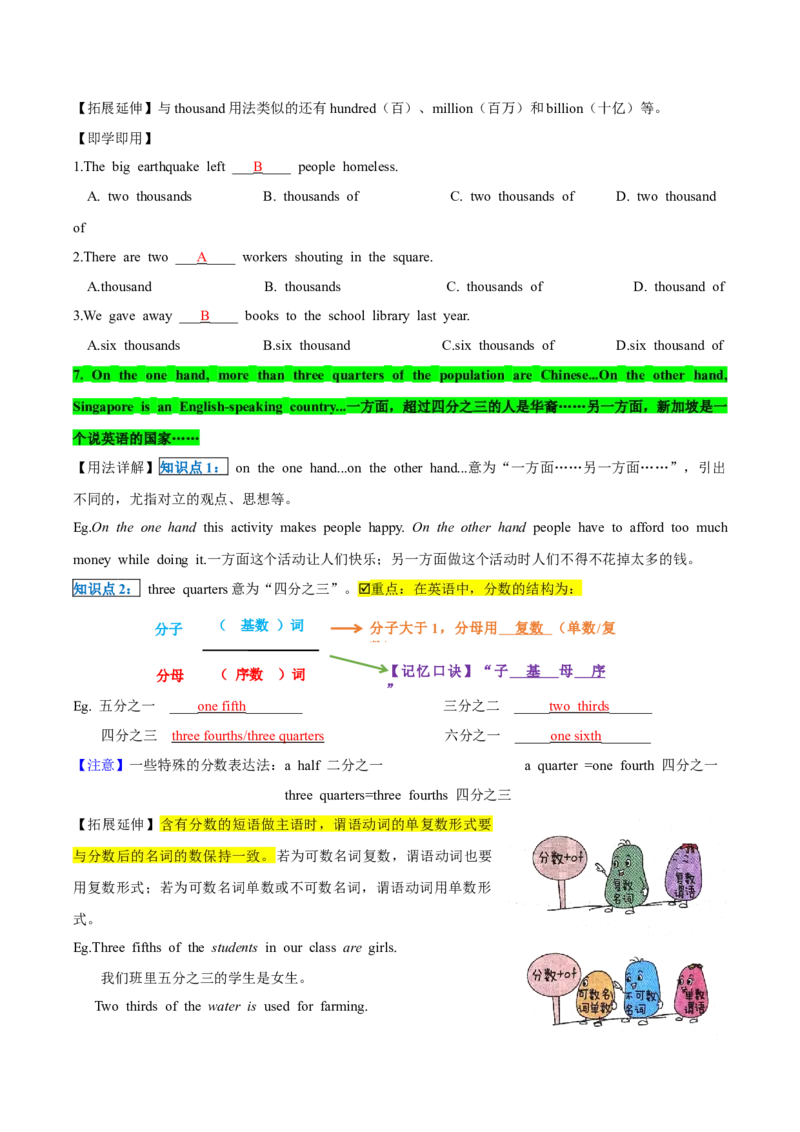
知识点2: three quarters意为“四分之三”。重点:在英语中,分数的结构为:
分子 ( 基数 )词 分子大于1,分母用 复数 (单数/复
数)
分母 ( 序数 )词 【记忆口诀】“子 基 母 序
”
Eg. 五分之一 ____one fifth________ 三分之二 _____ two third s ______
四分之三 three fourths/three quarters 六分之一 _____one sixth_______
【注意】一些特殊的分数表达法:a half 二分之一 a quarter =one fourth 四分之一
three quarters=three fourths 四分之三
【拓展延伸】含有分数的短语做主语时,谓语动词的单复数形式要
与分数后的名词的数保持一致。若为可数名词复数,谓语动词也要
用复数形式;若为可数名词单数或不可数名词,谓语动词用单数形
式。
Eg.Three fifths of the students in our class are girls.
我们班里五分之三的学生是女生。
Two thirds of the water is used for farming.三分之二的水被用于灌溉农田。
【即学即用】
1.___D____ of the students in Class 6 have lunch at school.
A. Two fifth B. One thirds C. Three fifth D. Three quarters
2.On the one hand, the old lady has little money. ____C____, she is hurt badly, so she needs our help.
A.On another hand B. In the other hand C. On the other hand D. In another hand
3.According to a survey, four out of five women do housework at home, but only ____D_____ of men
would do it.
A.four fifth B.four fifths C.two fifth D.two fifths
4.Three fifths of the students in No. 2 Middle School ____A____ going to go to Nanjing for the Study
Trip(研学旅行)next month.
A.are B.is C.be D.were
5.____B____ of the teachers in our school _________ women.
A.Three fourth; is B.Three fourths; are C.Three fourth; are D.Three
fourths; is
6.Three quarters of the population _____are______ (be) Chinese in Singapore.
7.About seventy percent of the population in this city ______are_____ (be) farmers.
8. Whether you like Indian food, Western food or Japanese food, you’ll find it all in Singapore! 无
论你是喜欢印度食物、西方食物还是日本食物,在新加坡你都会找到!
【用法详解】whether连词,意为“不管……(还是);或者……(或者)”,可与or(not)连用,引导
让步状语从句。
Eg. Whether it is cloudy or rainy tomorrow, I’ll go camping.不管明天是阴天还是下雨天,我都要去野营。
Whether you like it or not, you’ll have to do it.不管你喜欢还是不喜欢,你将必须做这件事。
【拓展延伸】whether用作连词,还可意为“是否”,引导宾语从句,有时可与if互换。
Eg.He asked whether/if we wanted a drink. 他问我们是否想喝一杯。
【即学即用】
1.—How long does it take to get to the airport?
—For forty minutes. But it’s foggy today. I’m not sure ___A____ the highway will be closed soon.
Let’s set off earlier.
A. whether B. when C. how D. why
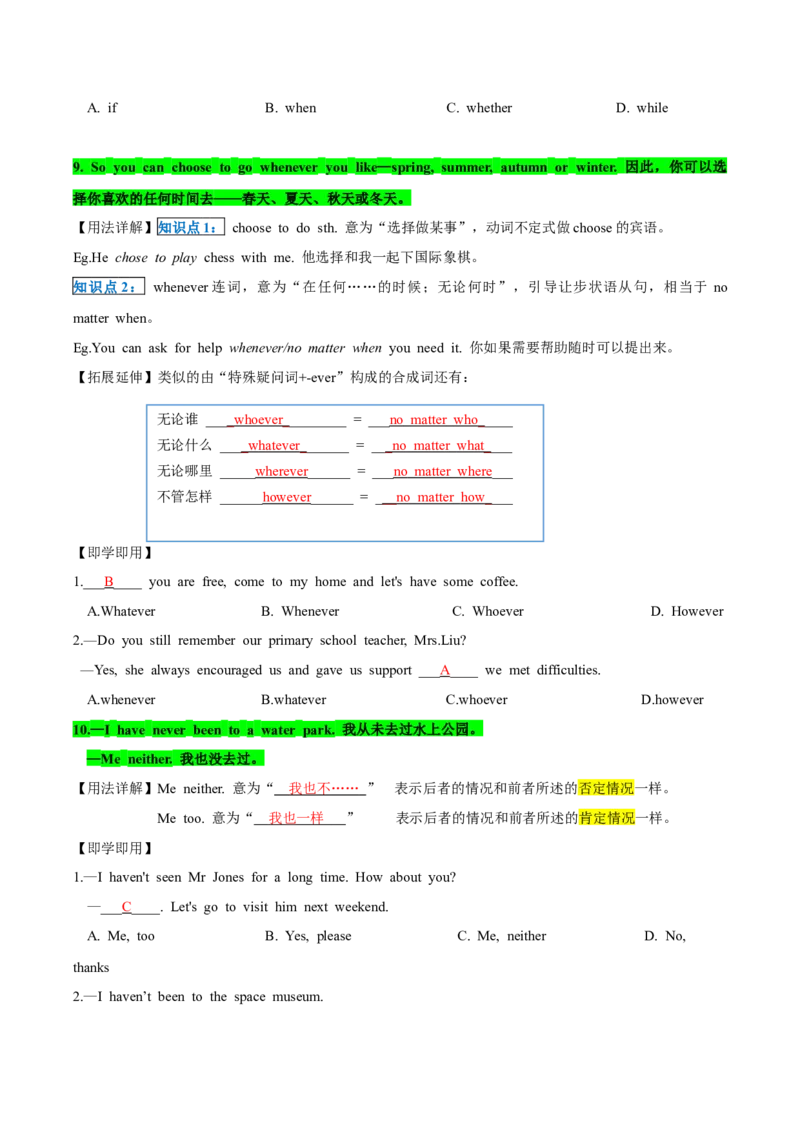
2.I don't know ___C____ or not be will come this afternoon.A. if B. when C. whether D. while
9. So you can choose to go whenever you like—spring, summer, autumn or winter. 因此,你可以选
择你喜欢的任何时间去——春天、夏天、秋天或冬天。
【用法详解】知识点1: choose to do sth. 意为“选择做某事”,动词不定式做choose的宾语。
Eg.He chose to play chess with me. 他选择和我一起下国际象棋。
知识点2: whenever连词,意为“在任何……的时候;无论何时”,引导让步状语从句,相当于 no
matter when。
Eg.You can ask for help whenever/no matter when you need it. 你如果需要帮助随时可以提出来。
【拓展延伸】类似的由“特殊疑问词+-ever”构成的合成词还有:
无论谁 ___ _ whoever _ ________ = ___ no matter who _ ____
无论什么 ___ _ whatever _ ______ = __ _ no matter what _ ___
无论哪里 _____wherever______ = ___ no matter where ___
不管怎样 ______however______ = _ __ no matter how _ ___
【即学即用】
1.___B____ you are free, come to my home and let's have some coffee.
A.Whatever B. Whenever C. Whoever D. However
2.—Do you still remember our primary school teacher, Mrs.Liu?
—Yes, she always encouraged us and gave us support ___A____ we met difficulties.
A.whenever B.whatever C.whoever D.however
10.—I have never been to a water park. 我从未去过水上公园。
—Me neither. 我也没去过。
【用法详解】Me neither. 意为“ 我也不…… ” 表示后者的情况和前者所述的否定情况一样。
Me too. 意为“ 我也一样 ” 表示后者的情况和前者所述的肯定情况一样。
【即学即用】
1.—I haven't seen Mr Jones for a long time. How about you?
—___C____. Let's go to visit him next weekend.
A. Me, too B. Yes, please C. Me, neither D. No,
thanks
2.—I haven’t been to the space museum.—___D____.
A. So do I B. Me too C. Neither do I D. Me
neither
课堂小测
一、单项选择
1.What ___B____ unusual school trip we had! I will never forget it.
A. a B.an C. the D. /
2.Your home is so close ___B____ the post office that you can walk there.
A.from B.to C./ D.with
3.During the earthquake, three ___A____ houses got broken and ________ people became homeless.
A.thousand; thousands of B.thousands; thousands of
C.thousand; thousands D.thousands of; thousands of
4.—Would you please tell me ___A____ in today’s newspaper?
—Sorry, I haven t read it yet.
A.something important B.important something
C.anything important D.important anything
5.—There is nothing left in the fridge, ___C____?
—________. Let's go to the supermarket to buy some.
A.is there; Yes B.isn't there; Yes C.is there; No D.isn't there;
No
6.With the help of my math teacher, I made some ___C____ in math.
A. decisions B. mistakes C. progress D. plans
7.Many foreigners came to our school last week,including three ___C____ and four ________.
A.German; American B.Germans; American
C.Germans; Americans D.German; Americans
8.—I have never tasted Indian food. How about you, Annie?
—___B____. It's said to be very hot.
A.Me, too B.Me neither C.So have I D.Neither did I
9.—Why is our government encouraging young couples ___B____ more than one child?—I think it is because of the aging of population (人口老龄化).
A. have B. to have
C. had D. to having
10.The song I Believe I Can Fly tells us that believing in ___C____ is very important.
A. themselves B. itself
C. ourselves D. yourselves
11.They had a map with them, so they didn’t have any problem ___D____ the hotel.
A.find B.finds C.found D.finding
12.The exam is over and results will be ___C____on Friday afternoon.
A.put down B.put off C.put up D.put away
13.There are about ___C____ students in our school and about ________ of them are children of migrant workers.
A. three hundreds; three-fourth B. three hundred; three-fourth
C. three hundred; three-fourths D. three hundred of; three-fourths
14.We will meet with a lot of things in our lives, Whether they are easy ___C____ hard,we must face them.
A.and B.but C.or D.so
15.Jack is crazy about music. ___B____ I see him, he is always listening to it.
A.Whatever B.Whenever C.Whoever D.However
二、用所给词的适当形式填空
1. Green Park is a relaxing and ___peaceful____ (peace) place near a river.
2. You've got 2,000 yuan within one day. It's quite __unbelievable__ (believable).
3. I like watching the children's __performances_ (perform). I think some of them are very interesting.
4. The monkey was looking at ___itself______ (it) in the mirror in surprise.
5. There are three ___Indians____ (India) speaking English at the gate of the zoo.
6. You can ___simply____ (simple) speak Putonghua if you travel in Singapore.
7. My teacher often encourages me in my dream ___ to become _ __(become) a singer.
8. I saw some ___Germans____ (Germany) dancing in the street the day before yesterday.
9. For our ____safety_____ (safe), we must follow the traffic rules on the way to school.
10. -Mom, one third of the apples ____have_____ (have) gone bad.
-We’d better eat up the rest as soon as possible.
三、完形填空
Have you ever been to an amusement park? There is an amusement park in the center of my city. I think it iswonderful and exciting.
I visited the amusement park with my parents this summer. I 1 it was a sunny day. A long line of people
were waiting to buy tickets. Most people brought 2 with them: they wanted to take some photos. Inside of the
amusement park were many wonderful rides 3 water rides, a roller coaster (过山车) and sightseeing trains.
My parents 4 sightseeing trains that carried passengers around the amusement park. 5 felt very relaxed.
I liked water rides. You can't imagine how excited you feel 6 you travel through the water. The roller coaster
was very 7 with adults and kids. A lot of people were waiting to get on. But some of them 8 stand up
after getting off the roller coaster!
We had a 9 day and I would love to visit the amusement park again. It was a perfect 1 0 to spend
your day with your family.
( A )1. A. remember B. consider C. imagine D. believe
( B )2. A. tickets B. cameras C. foods D. pictures
( D )3. A. instead of B. according to C. as well as D. such as
( B )4. A. fixed B. liked C. invented D. collected
( C )5. A. He B. He C. They D. We
( C )6. A. if B. though C. unless D. because
( B )7. A. rapid B. popular C. dangerous D. strange
( D )8. A. shouldn't B. needn't C. mustn't D. couldn't
( A )9. A. fun B. terrible C. hard D. quiet
( D )10. A. story B. time C. fact D. place
四、阅读理解
If a teacher asks, “What does the word ‘March’ mean?”, most students would not say it is the name of a month
or a way of walking. They would say it is the name of a car! This is the power of advertising.
Every day, we watch or read all kinds of advertisements on TV, at the train stations, in newspapers and
magazines, and even on buses and subways.
Advertisements have become part of our lives and we don’t even feel them. The advertisements give us some
advice about goods(商品) and services(服务). We can make our best choices by some advertisements. For the
sellers, the advertisements for their products can make more people know their goods, and make their sales go up
very quickly.
But there are also many disadvantages to advertisements. Too many advertisements waste our time.
Sometimes, people have to meet the advertisements that they don’t like. On the other hand, some of the
advertisements are bad, giving people wrong information and planning to cheat(欺骗) people who are want tosolve(解决) their problems.
In short, advertisements are the magical things!
( D ) 1. From the passage we can learn that _______.
A. few students say "March" is the name of a car
B. people watch or read all kinds of advertisements on holidays
C. not too many advertisements waste our time now
D. some advertisements give people wrong information
( C ) 2. What does the underlined word "magazine”mean in Chinese?
A. 漫画 B. 手册 C. 杂志 D. 说明书
( A ) 3. It can be concluded (from the passage) that ________.
A. the advertisement can be found in our life easily
B. the advertisement can change the meaning of a word
C. the advertisement can make the goods much better than before
D. everyone likes watching the advertisements
( C ) 4. Which of the following is NOT true according to the passage?
A. There are all kinds of advertisements on TV, on buses and subways.
B. The advertisements give us some suggestions about goods and services.
C. There are few disadvantages to advertisements in our daily life.
D. People could meet the bad advertisements though they don’t like them.
( D ) 5. This passage mainly tells us ______________.
A. advertisements have become all of our lives
B. the advertisements make the sales go up very quickly
C. some of the advertisements are bad
D. advertisements are the magical things
五、根据汉语意思完成下列句子。
1.The weather here is warm __ _all year round ___.(全年)
2.__ Thousands of _____ students came to the hall for the hero's speech yesterday.(数以千计的)
3.My grandpa has rich _____ tea art ______ knowledge.(茶艺)
4.__ Three fourths/Three quarters ___of students have gone to the amusement park.(四分之三)
5.On the one hand, he doesn’t want to work hard, __ on the other hand ___, he wants to be successful.
(另一方面)
语法精讲现在完成时(二)
一、现在完成时表示经历的用法
表示经历的词汇 用法说明 示例
have/has been to 表示去过某地,可以与 never、 Mr.Smith has ever been to China three
(去过) ever、just、once等连用 times. 史密斯先生曾去过中国三次。
常用于现在完成时的一般疑问句 Have you ever visited the Palace
ever(曾经) 中,放在主语之后、过去分词之前 Museum?
你曾参观过故宫博物院吗?
表示否定,用在助动词have/has之 —I have never been to Hong Kong.
never(从没) 后,过去分词之前。表示否定的简
短回答可以用neither —Me neither. 我也没去过。
二、have/has been to、have/has gone to与have/has been in的用法区别
比较项目 用法说明 图解助记
意为“ 去过某地 ”,表示去过某地,
have/has 现在已经回来了,通常与表示次数等的状语
been to 连用,如 twice、several times、ever 或
never等
意为“ 去了某地 ”,表示到某地去
have/has
了,强调说话时去某地的人不在场(可能在
gone to
途中,也可能已到达)
have/has 意为“在某地待了多久”,in后面接表示地
been in 点的名词,通常与一段时间连用
Eg.She has been to Europe twice. 她去过欧洲两次。(已经回来了)
—Where is Jim? 吉姆在哪里?
—He has gone to England. 他去英国了。(现在不在这里)
I have been in China for two years. 我已经在中国待了两年了。
【拓展延伸】若have/has been to或have/has gone to后接here、there、home等副词时,则省略介词to。
Eg.He has gone home. 他回家去了。
语法小测
一、单项选择
1.—Have you ___A____ been to our town before?
—No, it's the first time I ________ here.A.ever; have come B.never; come C.ever; came D.never; came
2.—May I speak to Mr.Green?
—Sorry, he ___B____ Hong Kong. He ________ back in a week.
A. has been to;will come B. has gone to;will come
C. has been to; has come D. has gone to; has come
3.—Anna, have you ___D____ seen China’s Got Talent(中国达人秀)?
—Of course. I ________ it last weekend.
A.never; saw B.ever; have seen C.never; have seen D.ever; saw
4.—How many times ___D____ Carl ________ to the Great Walls.
—Only once.
A. does; go B. did; go C. has; gone D. has;been
5.—Have you ___A____ visited the Terracotta Army, Nina?
—No, I've ________ visited it.
A. ever; never B. never; ever C. ever;
ever D. never; never
6.—Can you speak Chinese, Steve?
—Yes only a little. I ___C____ China for only two months.
A.come B.have gone to C.have been in D.came
7.-When will your sister go to England?
-She ___D____ London since four months ago.
A.went to B.has gone to C. has been to D.has been in
8.As an exchange student, Alan ___B____ Qiqihar for one and a half years.
A. has been to B. has been in C. has gone to D. has gone
9.—Have you ever been to Guilin?
—Yes. I ___D____ there four months ago.
A. have been B. have gone C. had been D. went
10.Bruce ___B____ how to use a computer. He ________ a computer of his own. He ________ it two years ago.
A. learns; will get; bought B. is learning; has got; bought
C. learned; has got; bought D.is learning; got; has bought
11.—Do you know where Miss Li is?
—Oh, she ___B____ Beijing and she ________ to Shanghai tomorrow.A.has been to; will go B.has gone to; will go
C.has been to; came D.has gone to; came
12.—Would you like to go to the water park with me?
—Sorry, I ___D____ there many times.
A. have gone B. have gone to C. have been to D. have been
13.—Have you ever been to Disneyland?
—No, ___C____. I hope I can go there next year.
A.always B.ever C.never D.often
14.—I ___C____ you in Harry's Restaurant last night.
—No, it wasn't me. I have never ________ there.
A.saw; gone B.have seen; gone C.saw; been D.have seen;
been
15.Mr.Green isn’t at home. He ___B____ London on business. He will be back in two days.
A.has been to B.has gone to C.has been in D.is going
to
二、按要求完成句子,每空一词
1.They have ever been to an English-speaking country. (改为一般疑问句)
__Have__ they ever ___been__ to an English-speaking country?
2.His father has been to America twice. (对划线部分提问)
__How__ __many__ __times__ has his father __been__ to America?
3.Mr. Li has been a teacher for ten years . (对画线部分提问)
__How__ ___long__ ___has___ Mr. Li __been___ a teacher?
4.She's never been to the water park before. (改为反意疑问句)
She's never been to the water park before, ___has___ ___she___?
5.They have been to Australia. (改为否定句)
They __ haven ’ t _ __been___ to Australia.
三、语法填空
Have you ever been to Singapore? For thousands of Chinese tourists, this is 1._____an_____ island
that is wonderful and small in Southeast. It is a safe place to take a holiday. On the one hand, more
than three quarters of the population 2.____are_____ (be) Chinese, so you can 3.___simply____ (simple)speak Putonghua. On the other hand, Singapore is an English-speaking country, so it’s a good place
4.__ to practice __ (practice) your English!
Maybe you fear that you'll find nothing good to eat when you travel. However, in Singapore, you
won't have any problem 5.___getting___ (get) a lot of food from China. It's also an excellent place to try
new food. 6.__Whether___ you like Indian food, Western food or Japanese food, you’ll find it all in
Singapore!
Have you ever 7.___heard____ (hear) of the Night Safari? There is a Night Safari in Singapore. It
might seem strange to go to a zoo when it s dark. That s because a lot of animals only wake up at
night, during the daytime they probably are asleep. You can watch animals in a 8._ more natural _ (natural)
environment than in a normal zoo. One great thing about Singapore is that the temperature is almost the
same all year round. This is because the island is so close 9._____to_____ the equator. So you can
choose 10.___ to go _____ (go) whenever you like-spring, summer, autumn or winter. Of course, it’s not
far from China!
四、书面表达
旅行能让我们感受到自然的魅力、历史的积淀和文化的传承。每个人在旅行中都有很多的收获和不同
的体会。某个英文网站正在开展主题为“An Unforgettable Place I Have Been to”的征文活动,请用英语
写一篇短文投稿,谈谈你去过的一个难忘的地方,你在那里做了什么,以及它令人难忘的原因。
要求:语句通顺,意思连贯,书写规范,词数70词左右。
An Unforgettable Place I Have Been to
____________________________________________________________________________________________
____________________________________________________________________________________________
____________________________________________________________________________________________
____________________________________________________________________________________________
____________________________________________________________________________________________
____________________________________________________________________________________________
____________________________________________________________________________________________
____________________________________________________________________________________________
____________________________________________________________________________________________
____________________________________________________________________________________________
【参考范文】An Unforgettable Place I Have Been to
I have been to many places these years. An unforgettable place I have been to is Guangzhou.
Last year, I went to Guangzhou in the summer vacation. When we got there, we started to hang out
on the street. The first thing was to find something to eat. There were so many delicious snacks. It was
hard for us to choose what to eat, so we planned to eat as much as we can. After we finished eating,
we went to go shopping. Guangzhou is famous for the foreign trade and its clothes are fashionable and
cheap. At last, we bought many clothes.
This trip was so unforgettable to me because Guangzhou is the paradise of food and shopping. We
really enjoyed ourselves during the trip.