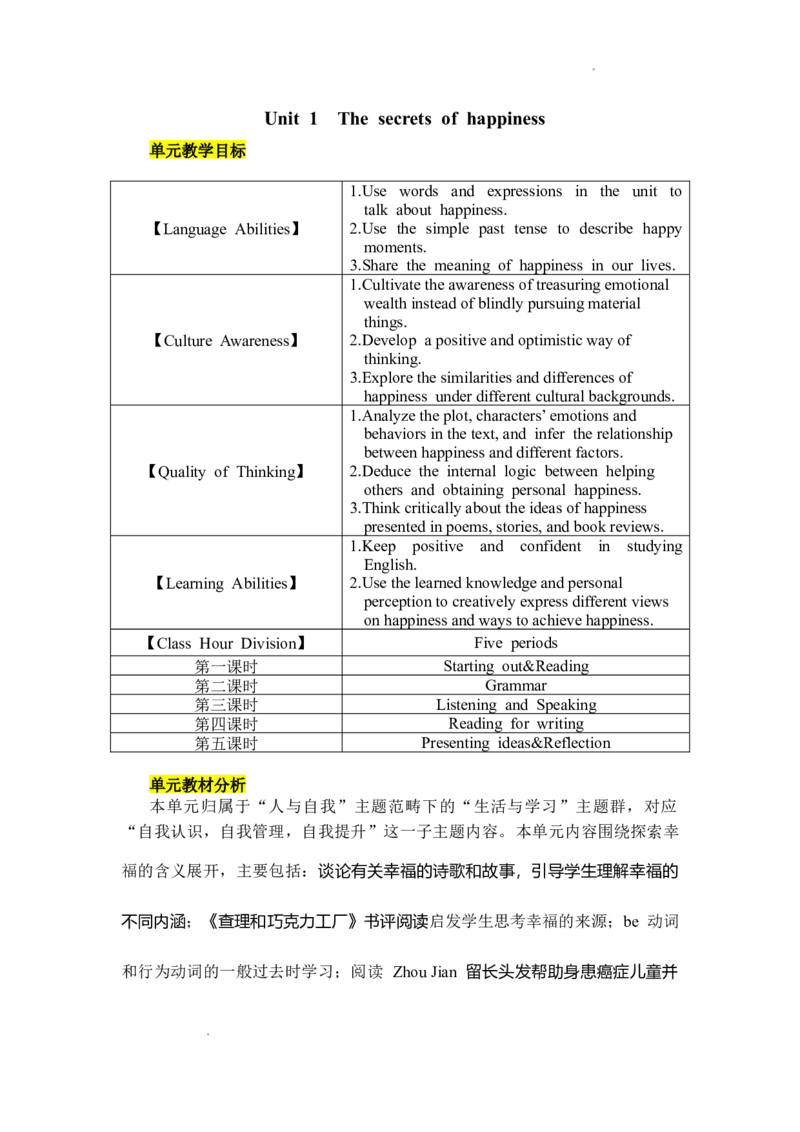
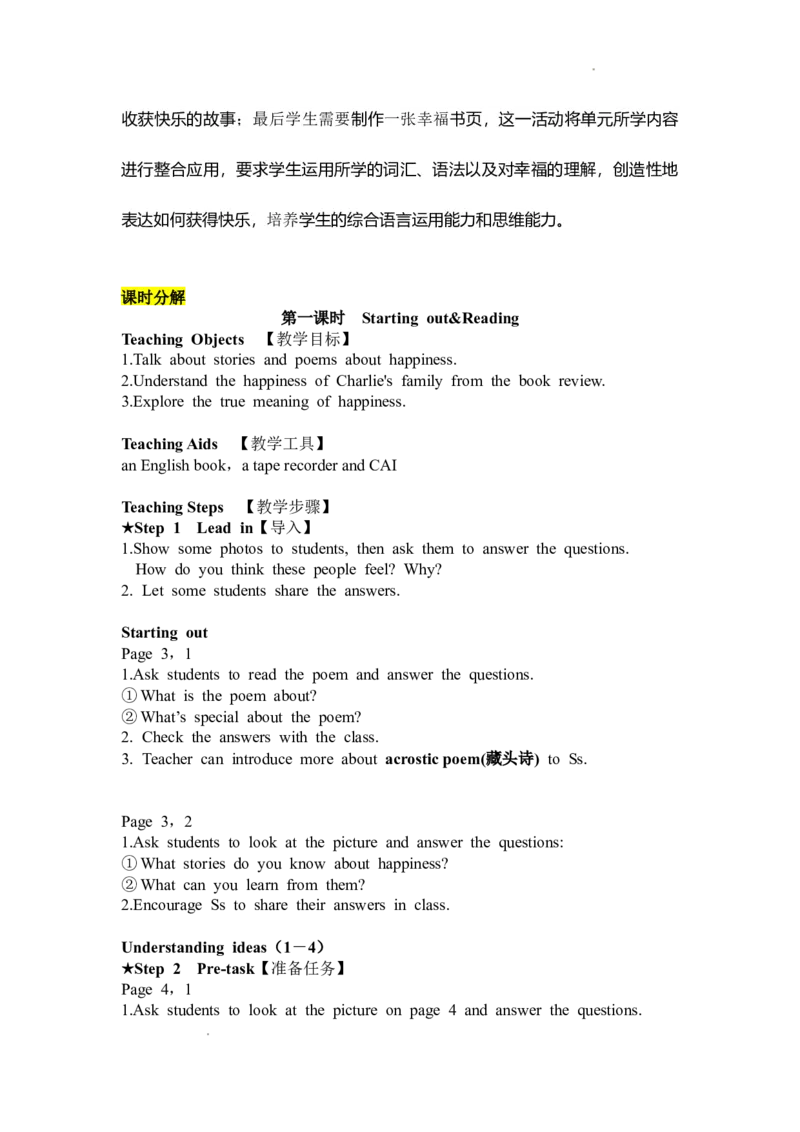
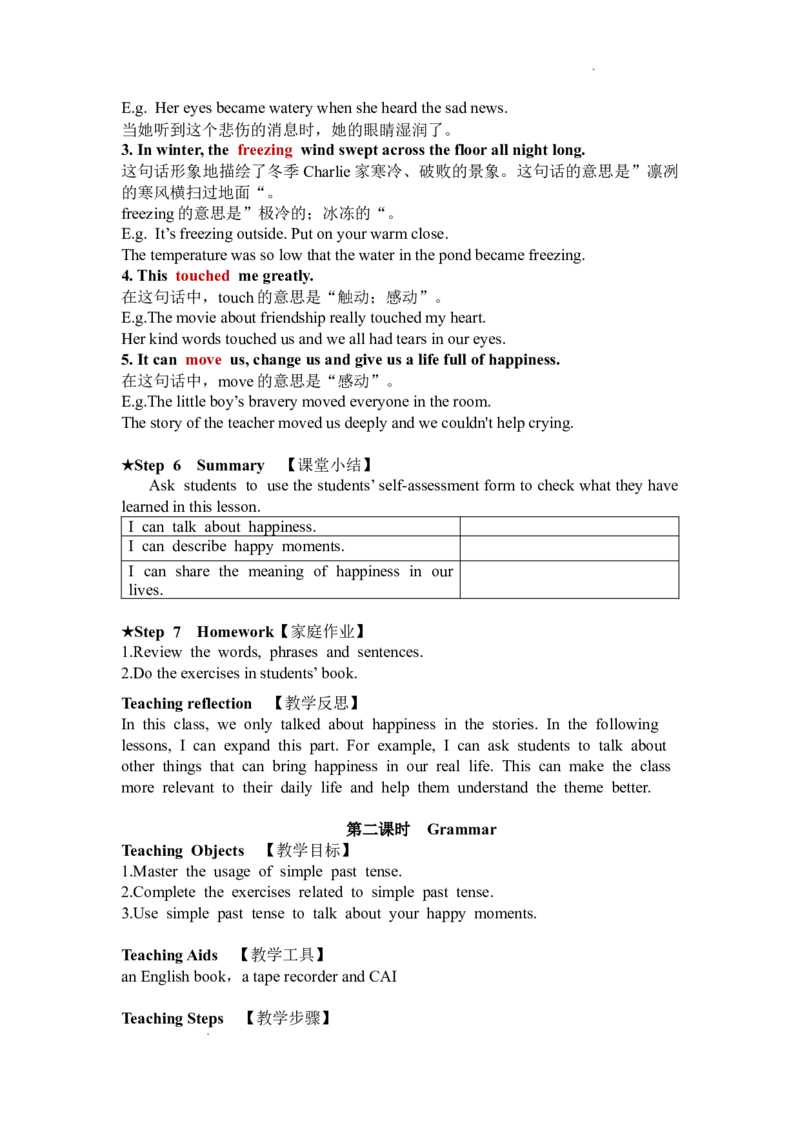
Unit 1 The secrets of happiness
单元教学目标
1.Use words and expressions in the unit to
talk about happiness.
【Language Abilities】 2.Use the simple past tense to describe happy
moments.
3.Share the meaning of happiness in our lives.
1.Cultivate the awareness of treasuring emotional
wealth instead of blindly pursuing material
things.
【Culture Awareness】 2.Develop a positive and optimistic way of
thinking.
3.Explore the similarities and differences of
happiness under different cultural backgrounds.
1.Analyze the plot, characters’ emotions and
behaviors in the text, and infer the relationship
between happiness and different factors.
【Quality of Thinking】 2.Deduce the internal logic between helping
others and obtaining personal happiness.
3.Think critically about the ideas of happiness
presented in poems, stories, and book reviews.
1.Keep positive and confident in studying
English.
【Learning Abilities】 2.Use the learned knowledge and personal
perception to creatively express different views
on happiness and ways to achieve happiness.
【Class Hour Division】 Five periods
第一课时 Starting out&Reading
第二课时 Grammar
第三课时 Listening and Speaking
第四课时 Reading for writing
第五课时 Presenting ideas&Reflection
单元教材分析
本单元归属于“人与自我”主题范畴下的“生活与学习”主题群,对应
“自我认识,自我管理,自我提升”这一子主题内容。本单元内容围绕探索幸
福的含义展开,主要包括:谈论有关幸福的诗歌和故事,引导学生理解幸福的
不同内涵;《查理和巧克力工厂》书评阅读启发学生思考幸福的来源;be 动词
和行为动词的一般过去时学习;阅读 Zhou Jian 留长头发帮助身患癌症儿童并
学科网(北京)股份有限公司收获快乐的故事;最后学生需要制作一张幸福书页,这一活动将单元所学内容
进行整合应用,要求学生运用所学的词汇、语法以及对幸福的理解,创造性地
表达如何获得快乐,培养学生的综合语言运用能力和思维能力。
课时分解
第一课时 Starting out&Reading
Teaching Objects 【教学目标】
1.Talk about stories and poems about happiness.
2.Understand the happiness of Charlie's family from the book review.
3.Explore the true meaning of happiness.
Teaching Aids 【教学工具】
an English book,a tape recorder and CAI
Teaching Steps 【教学步骤】
★Step 1 Lead in【导入】
1.Show some photos to students, then ask them to answer the questions.
How do you think these people feel? Why?
2. Let some students share the answers.
Starting out
Page 3,1
1.Ask students to read the poem and answer the questions.
①What is the poem about?
②What’s special about the poem?
2. Check the answers with the class.
3. Teacher can introduce more about acrostic poem(藏头诗) to Ss.
Page 3,2
1.Ask students to look at the picture and answer the questions:
①What stories do you know about happiness?
②What can you learn from them?
2.Encourage Ss to share their answers in class.
Understanding ideas(1-4)
★Step 2 Pre-task【准备任务】
Page 4,1
1.Ask students to look at the picture on page 4 and answer the questions.
学科网(北京)股份有限公司①What can you see in the picture?
②Do you think everyone is happy?
③What do you think makes them happy?
2.Show the following words and expression to help the students.
small house family together poor love
the only bed key to happiness happy place
3.Ask students to share the answers with the class.
★Step 3 While-task【过程任务】
Page 4,2
1.Ask students to read the book review and check their answers.
2.Share the right answers with the class.
Page 6,3
1.Show the three titles for the review to students and encourage Ss to translate
them.
2.Ask students to choose the best title for the review and share their reasons.
3.Represent the right answer and explain the reason.
Page 6,4
1.Ask students to complete the thinking map with the words and expressions
from the passage.
2.Check the answers with the class.
★Step 4 Post-task【后续任务】
Page 6, Think and share
1.Ask students to think about the following questions:
①Do you agree that “happiness comes from things like money”?
② What do you think the words of Oscar Wilde in the last paragraph of the
passage mean?
2.Give some prompts to the students.
3.Let some students share their answers.
★Step 5 Language points 【语言要点】
1. But I kept going over the exciting story in my mind.
go over是一个常见的短语,它的用法和意义相对广泛。在这句话中,它的意思
是“复习;重温”。
E.g. I always go over my notes just before I go into an exam.
go over还可以表示“仔细检查”。
E.g. Go over the exam paper once more.
2. They always ate watery cabbage soup for dinner.
watery的意思是“水的;含水的;水分多的”。
E.g. The soup is watery. It doesn’t have much taste.
这汤太稀了,没什么味道。
学科网(北京)股份有限公司E.g. Her eyes became watery when she heard the sad news.
当她听到这个悲伤的消息时,她的眼睛湿润了。
3. In winter, the freezing wind swept across the floor all night long.
这句话形象地描绘了冬季Charlie家寒冷、破败的景象。这句话的意思是”凛冽
的寒风横扫过地面“。
freezing的意思是”极冷的;冰冻的“。
E.g. It’s freezing outside. Put on your warm close.
The temperature was so low that the water in the pond became freezing.
4. This touched me greatly.
在这句话中,touch的意思是“触动;感动”。
E.g.The movie about friendship really touched my heart.
Her kind words touched us and we all had tears in our eyes.
5. It can move us, change us and give us a life full of happiness.
在这句话中,move的意思是“感动”。
E.g.The little boy’s bravery moved everyone in the room.
The story of the teacher moved us deeply and we couldn't help crying.
★Step 6 Summary 【课堂小结】
Ask students to use the students’ self-assessment form to check what they have
learned in this lesson.
I can talk about happiness.
I can describe happy moments.
I can share the meaning of happiness in our
lives.
★Step 7 Homework【家庭作业】
1.Review the words, phrases and sentences.
2.Do the exercises in students’ book.
Teaching reflection 【教学反思】
In this class, we only talked about happiness in the stories. In the following
lessons, I can expand this part. For example, I can ask students to talk about
other things that can bring happiness in our real life. This can make the class
more relevant to their daily life and help them understand the theme better.
第二课时 Grammar
Teaching Objects 【教学目标】
1.Master the usage of simple past tense.
2.Complete the exercises related to simple past tense.
3.Use simple past tense to talk about your happy moments.
Teaching Aids 【教学工具】
an English book,a tape recorder and CAI
Teaching Steps 【教学步骤】
学科网(北京)股份有限公司★Step 1 Lead in【情景导入】
1.Show the following sentences to students and ask them to pay attention
to the bold words.
The book was full of magic.
The family never had enough food.
To my surprise, the family were happy together.
2.Lead to the grammar simple past tense.
Understanding ideas(5—8)
★Step 2 Pre-task【过程任务】
Page 7, 5
1.Ask students to find more sentences with these structures in the reading
passage.
2.Let some students say their answers.
3.Check the answers with the class as follows.
E.g.But I kept going over the exciting story in my mind.
Charlie’s home was a small house at the side of a big town.
They always ate watery cabbage soup for dinner.
★Step 3 Grammar focus learning【语法学习】
1.Write the verbs in the simple past tense on blackboard. Ask students if they
know the original forms of these verbs.
2.Teach students how verbs change to the simple past tense.
规则动词的变化
构成法 例词
一般加-ed work
—
worke
d
以e结尾的词加-d live—
lived
以“辅音字母+y”结尾的词,改y为i,再加-ed cry—
cried
以“元音字母+y”结尾的词,直接加-ed play—
played
以重读闭音节或r音结尾,末尾只有一个辅音字母的词,要双写这个 stop—
辅音字母,再加-ed stoppe
d
prefer
—
preferr
ed
be动词的一般过去式
学科网(北京)股份有限公司主语 一般现在时
I was
he, she, it was
you were
we, they were
3.Ask students to underline the time expressions for the past.
常用语一般过去时句子中的时间状语:
yesterday, two days ago, the day before yesterday, last year, the other day,
once upon a time, just now, in the old days, when I was ... years old, last
weekend, a week ago, ...
4.Teach students the sentence structures of the simple past tense.
(1)行为动词的一般过去时
①肯定句:主语+动词的过去式+其他
E.g. He had a good time yesterday.
②否定句:主语+did not+动词原形+其他
E.g. We did not (=didn’t) have a good time yesterday.
③一般疑问句:Did+主语+动词原形+其他?
E.g. —Did he go there?
—Yes, he did. / No, he didn’t.
④特殊疑问句:疑问词+一般疑问句?
E.g. —When did you get up this morning?
—I got up at 6 o’clock.
(2)be动词的一般过去时
①肯定句:主语+be动词的过去式(was/were)+其他
E.g. I was very tired last night.
②否定句:主语+be动词的过去式(was/were)+not+其他
E.g. Mike wasn’t at school this morning.
③一般疑问句:be动词的过去式(Was/Were)+主语+其他
E.g. —Was she a teacher?
—Yes, she was. / No, she wasn’t.
④特殊疑问句:疑问词+一般疑问句?
学科网(北京)股份有限公司E.g. —Where were you yesterday morning?
—I was at school.
★Step 4 While-task【过程任务】
Page 7,6
1.Ask students to complete the sentences with the correct form of the verbs in
brackets.
2.Let students share answers with the class.
Page 7,7
1.Ask students to complete the post with the correct form of the verbs in
brackets.
2.Check the answers with the class.
★Step 5 Post-task【后续任务】
Page 8,8
1.Ask students to work in pairs and then ask them to answer the question: Do
you think love can make us happy?
2. Ask students to talk about their experience.
3.Show the thinking map on the book and ask them to use the words and
expressions from the reading passage and the useful expressions to help them
to organize their ideas.
Useful expressions:
I kept going over ... in my mind.
That made him/her feel...
To my surprise, ...
This touched me greatly.
From this, I learnt ...
I believe that...
Love is the key to happiness.
4. Choose some students to share their writings.
★Step 6 Summary 【课堂小结】
Ask students to use the students’ self-assessment form to check what they have
learned in this lesson.
I can master the usage of simple past
tense.
I can complete the exercises related to
simple past tense.
I can use simple past tense to talk about
my happy moments.
★Step 7 Homework【家庭作业】
1.Review the words, phrases and sentences.
学科网(北京)股份有限公司2.Do the exercises in students’ book.
Teaching reflection 【教学反思】
I found that some students with poor English foundation still had problems with
the simple past tense. They might be confused about the irregular verb forms. For
example, when they met words like “go —went” or “see—saw”, they made mistakes
easily. In the future, I will give these students more special practice on irregular verbs.
I can make some cards with the original form of the verbs on one side and the simple
past form on the other side. Let them practice more often to help them remember these
forms better.
第三课时 Listening and Speaking
Teaching Objects 【教学目标】
1.Understand the listening material and grasp the key information.
2.Pronounce /əʊ/, /aʊ/ correctly and remember the letters and letter
combinations that represent them.
3.Talk about what you have learnt about staying positive in this section.
Teaching Aids 【教学工具】
an English book,a tape recorder and CAI
Teaching Steps 【教学步骤】
★Step 1 Lead in【情景导入】
1.Show the picture on page 9 to students, and then ask them to answer the
following questions.
What can you see in the picture?
How do you describe the glass of water?
2.Let some students share the answers with the class.
3.Show the two kinds of opinions to students. Some people always look on
the bright side of life.They expect good things to happen. Other people often
believe that bad things will happen.
★Step 2 Pre-task【准备任务】
1.Show two groups of contrasting pictures. For the first group of pictures: one is a
colorful rainbow stretching across the sky under the bright sunshine, and the other is a
gloomy and damp street on a rainy day. For the second group of pictures: one is a
birthday party with delicious food and laughing people, and the other is a messy scene
after the party.
2.Point at the pictures and ask the students, “Look at these pictures. What do
you see in the first picture of each group? What about the second one? Which
one do you like better?”
3.Guide the students to answer, for example, “I see a rainbow in the first
one. It's beautiful. I see a wet street in the second one. It's not nice.”
4.Then continue to ask, “Do you think different people may have different
feelings about these pictures? Why?” Through such a discussion, it will
学科网(北京)股份有限公司naturally lead to the topic of seeing life scenes in a positive or negative way,
laying a good foundation for the subsequent course content.
★Step 3 While-task【过程任务】
Page 9,1
1.Ask students to listen to the radio programme and choose the main idea.
2.Check the answers with the class.
Page 10,2
1.Ask students to listen to the radio programme again and complete the blanks.
2.Check the answers with the class.
Page 11,3
1.Show the table to students, and ask them to guess what may be filled in the
blanks.
2.Ask students to listen to the talk and complete the notes.
3.Let some students say their answers.
4.Check the answers with the class.
Page 11,3
1.Ask students to listen again and talk about how Dr Zheng gives examples in
his talk.
2.Tell students the way to give examples. For example, we can use take... for
example, like and such as to introduce examples.
★Step 4 Post-task【后续任务】
Phonetics in use
1.Let students read the words on page 9 freely, and then ask them to pay attention
to the bold letters and find the similarities of pronunciation in each column.
2.Play the recording and ask students to repeat them.
3.Tell the pronunciation of /əʊ/ and /aʊ/ .
4.Have students read the words together.
5.If possible, provide more target language materials for students to practise.
Page 11,4
1.Ask students to work in pairs and share their advice for leading a happier
life.
2.Show an example to students.
3.Let students talk about what they have learnt about staying positive in this
section.
★Step 5 Summary 【课堂小结】
Ask students to use the students’ self-assessment form to check what they have
学科网(北京)股份有限公司learned in this lesson.
I can learn to listen for an experience
analysis.
I can pronounce /əʊ/, /aʊ/ correctly and
remember the related letters and letter
combinations.
I can talk about what I have learnt about
staying positive in this section.
★Step 6 Homework【家庭作业】
1.Review the words, phrases and sentences.
2.Do the exercises in students’ book.
Teaching reflection 【教学反思】
In this period, we should ask the students to grasp the key words to complete the
listening tasks. In addition, we should encourage them to talk about what they have
learnt about staying positive in this section.
第四课时 Reading for writing
Teaching Objects 【教学目标】
1. Find out why Zhou Jian keeps his hair long and what happiness he gets;
2. Analyze how the author makes the story vivid;
3. Write a story about feeling happy through helping others.
Teaching Aids 【教学工具】
an English book,a tape recorder and CAI
Teaching Steps 【教学步骤】
★Step 1 Lead in【情景导入】
Show some pictures about helping others and ask Ss to observe how the help
giver feel. Elicit Ss to find that it’ s happy to help others.
★Step 2 Pre-task【准备任务】
Page 12,1
1.Let students look at the pictures and predict what the passage is about.
2.Show some words and expressions to help students.
For example, keep hair long happiness grow smile help others
doing good laugh at cut it short
3.Ask students to share their guesses with the class.
★Step 3 While-task【过程任务】
Page 13,2
1.Ask students to read the passage and see if their guesses were right.
2.Check the right answer with the class.
学科网(北京)股份有限公司Page 14,3
1.Ask students to read the passage and complete the notes with the words and
expressions from the passage.
2.Let some students say their answers.
3.Check the answers with the class.
Page 14,4
1.Ask students to answer the questions.
①What do you think “hope grew together with his hair” mean?
②What will Zhou Jian do to “grow happiness again”?
③Why does the writer use the words of Plato in the last paragraph?
2.Let some students say their answers.
3.Check the answers with the class.
★Step 4 Post-task【后续任务】
Page 14,Think and share
1.Ask students to think and share:
①How do you feel when you read the letter in the passage?
②What can you learn from the passage?
2.Give students some prompts.
3.Let some students share their answers and check the answers with them.
Page 15,5
1.Ask students to write a short paragraph about feeling happy through helping
others.
2.Give them some prompts.Ask them to do as follows.
①Write your answers to the following questions.
When and where does the story happen?
Who is the main character of the story?
What does he/she do and what challenge(s) does he/she face?
How does he/ she react to the challenge(s)?
What does he/ she feel?
②Organise your ideas by answering the following questions.
③Check your paragraph as follows.
Did you include characters, a setting and event(s)?
Did you use the words from the reading passage?
Did you give your opinions about the secrets of happiness?
3.Ask some students to share their stories with the class.
★Step 5 Language points 【语言要点】
1. Zhou Jian’s hat blew off.
blew off的原形是blow off,在这句话中意思是“吹掉,吹走”。
E.g. The strong wind blew off my hat when I was walking on the playground.
2. His long hair waved in the air.
学科网(北京)股份有限公司wave在这句话中作动词,意思是“飘扬,飘动”。
E.g. The colorful flags waved in the gentle breeze ( 微 风 ) on the school
playground.
3. “Just one month!” he said to himself.
say to oneself的意思是“对自己说”。
E.g. She said to herself, “You can do it.”
4. People often talked about his long hair behind his back. Sometimes they laughed
at him.
behind one’s back的意思是“在某人背后,背地里”。
E.g.Don’t speak ill of others behind their backs.不要在背后说人坏话。
laugh at的意思是“嘲笑,取笑”。
E.g. You shouldn’t laugh at others’ failures.
5. But he never felt any shame.
shame在这句话中作名词,意思是“丢脸;耻辱”。
E.g. Losing the game in such an easy way was a great shame for our team.
6. Day after day, hope grew together with his hair.
day after day的意思是“日复一日,天天地”。
E.g. Our team is working hard day after day to ensure the success of this project.为了
确保这个项目的成功,我们团队日复一日地努力工作。
7. He took off his hat and his hair fell around his shoulders.
took off的原形是take off,意思是“脱下,脱掉”。
E.g. He took off his clothes and got into the shower.
★Step 6 Summary 【课堂小结】
Ask students to use the students' self-assessment form to check what they have
learned in this lesson.
I can know Zhou Jian’s behaviour that
helps kids with cancer.
I can understand happiness springs from
doing good and helping others.
I can write a short story about feeling
happy through helping others.
★Step 7 Homework【家庭作业】
1.Review the words and sentences.
2.Do the exercises in students’ book.
Teaching reflection 【教学反思】
In class, we need to guide the students to use the knowledge to complete the
reading tasks. This lesson is a bit difficult and has a lot of important phrases and
sentences. Therefore, we should pay attention to adjusting the difficulty. The activities
and questions for this lesson need to be designed in advance so that students can follow
the teacher’s thought. In this way, they will have more interest and confidence in learning
English.
学科网(北京)股份有限公司第五课时 Presenting ideas&Reflection
Teaching Objects 【教学目标】
1.Make a book page about ways to be happy.
2.Talk about your understanding about happiness.
Teaching Aids 【教学工具】
an English book,a tape recorder and CAI
Teaching Steps 【教学步骤】
★Step 1 Lead in【情景导入】
Hello, boys and girls! How are you feeling today? Are you happy, sad, or
just so - so?(微笑着询问学生,用简单的表情和手势辅助理解)Let's see.
Raise your hand if you're happy.(观察举手情况)Oh, some of you are happy.
That's great! Now, I have a big question for you all. What makes you happy?
(稍作停顿,等待学生思考)
We can talk one by one. You can just say one or two simple words. For example,
you can say “toys” if playing with toys makes you happy.(给出示例,在黑板上写
下 “toys”)Now, let's start.(邀请几位学生回答,把他们说的关键词写在黑板上
如 “friends”“games”“ice - cream” 等)
★Step 2 Pre-task【准备任务】
Look at all these things on the blackboard. They are all different, but they have
something in common. They can bring us happiness. Today, we are going to make a
book page. And this book page is all about ways to be happy. We'll write down more
things like these and make it beautiful.(指着黑板上的单词,然后拿出一张做好的
示例书页展示给学生看)Are you excited? Let's begin!
★Step 3 While-task【过程任务】
1.Ask students to work in groups. Search for information about ways to be
happy. Then decide which ways you will include in your book page. Consider
the following aspects:
①What makes you happy?
②How can we help others be happy?
③What is your advice for unhappy people?
2.Let students organise their ideas with the help of the outline on page 16 and
write your book page.
3.Ask them to use the language tips on page 16 or find useful expressions or
sentences from this unit.
4.Ask some students to practise and present their book pages to the class.
★Step 4 Post-task【后续任务】
1.Ask students to vote on the best three book pages and the best three
presentations.
2.Ask students to talk about what they have understood more about what makes
学科网(北京)股份有限公司as the following mind map.
What are the secrets of happiness?
Love Staying positive Helping others
3.Ask students to check whether they have achieved their learning goals.
4.Let students write down what they still need to improve.
★Step 5 Summary 【课堂小结】
Ask students to use the students’ self-assessment form to check what they have
learned in this lesson.
I can make a book page about ways to
be happy.
I can talk about what I understand about
what makes you happy.
★Step 6 Homework【家庭作业】
1.Review the words,phrases and sentences.
2.Do the exercises in students’ book.
Teaching reflection 【教学反思】
In this class, I clearly told the students that the task of this class was to make a book
page about ways to be happy. And I also showed them an example. This made the
students have a clear understanding of the activity. Quite a few students showed great
interest and were eager to start making their own book pages, which helped to improve
their classroom participation.
Unit 2 Go for it!
单元教学目标
1.Use words and expressions in the unit to
talk about sports.
【Language Abilities】 2.Use indefinite pronouns to tell stories of
sports lovers.
3.Describe the role of sports in your life.
1.Understand the diversity of sports cultures.
2.Appreciate and learn the sporting spirits.
【Culture Awareness】 3.Understand the importance of sports in
society.
4.Respect the origins and development of sports.
1.Summarize the influence of persistence, strategy,
teamwork and other factors on performance in
【Quality of Thinking】 sports competitions.
2.Cultivate the thinking habit of extracting key
information from specific sports events and
学科网(北京)股份有限公司systematically concluding it.
1.Guide students in critical reflection of their
studying methods.
【Learning Abilities】 2.Students will master effective communication
and cooperation skills in English learning
groups.
【Class Hour Division】 Five periods
第一课时 Starting out&Reading
第二课时 Grammar
第三课时 Listening and Speaking
第四课时 Reading for writing
第五课时 Presenting ideas&Reflection
单元教材分析
本单元归属于“人与社会”主题范畴下的“文学、艺术与体育”主题群,
对应“日常体育活动,重大体育赛事,体育精神”这一子主题内容。本单元内
容围绕谈论运动展开,主要包括:关于常见运动项目的讨论;阅读张顺参加
2022 年北京马拉松比赛的事迹以及 2022 年女子足球亚洲杯比赛相关内容;聚
焦不定代词的用法,将其融入体育话题情境,帮助学生掌握在描述体育相关概
念时的准确表达;通过学校广播站对游泳冠军Tim Simons的采访,了解Tim学
习游泳的故事;制作运动瞬间海报,要求学生运用所学体育知识和语言表达,
结合自身创意,培养综合语言运用能力和跨学科思维能力。
本单元教材通过丰富多样的内容和形式,将语言学习与体育运动主题紧密
结合。从文化层面来看,它向学生传递了体育运动所承载的积极向上的价值观
念、多元的文化内涵以及对人类社会发展的重要意义。从语言学习角度而言,
在真实有趣的体育情境中,学生能够提高词汇量、语法运用能力、听说读写各
项技能,为学生提供了全面发展语言能力的机会,有助于培养学生积极健康的
生活方式和国际视野。
课时分解
学科网(北京)股份有限公司第一课时 Starting out&Reading
Teaching Objects 【教学目标】
1.Talk about sports using words and expressions in this unit.
2.Perceive the sporting spirits in the story.
Teaching Aids 【教学工具】
an English book,a tape recorder and CAI
Teaching Steps 【教学步骤】
★Step 1 Lead in【导入】
Show the picture of different sports items and ask Ss to talk about the
following questions:
1. What sports do you like or often do?
2. How do you feel when you do the sport?
Starting out
Page 19,1
1.Show the five pictures to students, then ask them to answer the questions.
①What sports can you see in the pictures?
② How do you like these sports?
③What sport do you like best? Why?
2.Let some students share the answers, the teacher can make some supplements
if necessary.
Page 19,2
1.Ask students to look at the picture and answer the questions:
①Do you know the origin of some sports?
②Can you share one with the class?
2.Show some videos to help students. Such as the origin of table tennis, the
origin of basketball and the origin of marathon running.
3.Let some students share the answers, the teacher can make some supplements
if necessary.
Understanding ideas(1-4)
★Step 2 Pre-task【准备任务】
Page 20,1
1.Show the pictures on page 20 to students and ask them to describe them.
2.Let Ss read the following words and expressions and match each picture
with them.
cheer finishing line fall behind train
3.Then use the words and expressions to enrich their descriptions.
★Step 3 While-task【过程任务】
Page 20,2
1.Ask students to read the passage and answer the question.What is amazing
学科网(北京)股份有限公司about the old man?
2.Check the right answer with the class.
Page 20,3
1.Ask students to choose the writer’s purpose of writing this passage.
2.Check the answer with the class.
3.T can explain the benefits of understanding the writer’s writing purpose.
Page 20,4
1.Ask students to complete the notes with the words and expressions from the
passage.
2.Check the answers with the class.
★Step 4 Post-task【后续任务】
Page 22, Think and share
1.Ask students to think about the following questions:
①What do you think the title mean?
②What can you learn from Zhang Shun?
2.For the first question, the teacher can give some prompts to the students.
3.Let some students share their answers, the teacher can make some
supplements if necessary.
★Step 5 Language points【语言要点】
1. All of them held their breath. Would he make it?
(1)hold one's breath 意为“屏住呼吸; 屏息静气”,在这里表示“紧张地等待,
焦急地盼望”的氛围。
E.g. When the ball was in midair, we all held our breath.当球在半空中时,我们都屏
住了呼吸。
【拓展】breath的其他常用短语:
take a deep breath 深呼吸
out of breath 喘不过气
catch one’s breath 喘息;缓口气
take one’s breath away 使某人惊叹
(2)make it 在句中意为“取得成功”
e.g. The actor wasn't famous at all a few years ago, but now he's really made it. 几年
前这位演员一点都不出名,但现在他很成功。
2.For years, he trained every morning in the park. He filled over 30 notebooks
with his running records.
(1)fill... with sth表示“用某物充满……,用某物填满……”。
E.g. He filled his room with books.他的房间里堆满了书。
(2)be full of... 表示“充满……”
学科网(北京)股份有限公司E.g. His room is full of books.他的房间里堆满了书。
★Step 6 Summary 【课堂小结】
Ask students to use the students’ self-assessment form to check what they have
learned in this lesson.
I can talk about sports using words and
expressions in this unit.
I can perceive the sporting spirits in the
story.
★Step 7 Homework【家庭作业】
1.Review the words, phrases and sentences.
2.Do the exercises in students’ book.
Teaching reflection 【教学反思】
This inspiring story has greatly attracted the students’ attention. The
classroom atmosphere is active, and the students can actively participate in the
discussion. During the reading process, students can perceive the character’s
spirits gradually and think about what they can learn from him. It can help
students develop their thinking abilities.
第二课时 Grammar
Teaching Objects 【教学目标】
1.Master the usage of indefinite pronouns.
2.Complete the exercises related to indefinite pronouns.
3.Use indefinite pronouns to tell a story of a sports lover.
Teaching Aids 【教学工具】
an English book,a tape recorder and CAI
Teaching Steps 【教学步骤】
★Step 1 Lead in【情景导入】
1.Show the following sentences to students and ask them to pay attention to
the bold words.
All of them held their breath.
Either choice seemed fine for someone at his age. But Zhang chose
neither of them.
None of his family members worried or tried to stop him.
2.Lead to the grammar indefinite pronouns.
Understanding ideas(5—8)
★Step 2 Grammar focus learning【语法学习】
不指明代替任何特定名词的代词叫不定代词。
常见的不定代词有:all,either,none,neither,both。
1.all 表示 “全体;一切”,可以指代可数名词复数或不可数名词。
学科网(北京)股份有限公司E.g. All the students are here.(所有的学生都在这儿。这里指代可数名词复数
students)
All the water is clean.(所有的水都是干净的。这里指代不可数名词
water)
2.either 表示 “(两者之中)任何一个”,指代可数名词单数。
E.g.You can take either book.(你可以拿两本书中的任何一本。这里指代可数名
词单数 book)
3.none 表示 “(三者或三者以上)都不”,指代可数名词复数或不可数名词。
E.g.None of the answers is/are correct.(这些答案没有一个是正确的。这里
answers 是可数名词复数,指代它;也可以用于指代不可数名词,
E.g. None of the money is mine. 钱没有一点是我的)。
4.neither表示 “(两者)都不”,指代可数名词单数。
E.g. Neither book is interesting.(这两本书都没有意思。这里指代可数名词单数
book)。
5.both表示 “两者都”,指代可数名词复数。
E.g. Both boys are my brothers.(这两个男孩都是我的兄弟。这里指代可数名
词复数 boys)。
★Step 3 While-task【过程任务】
Page 23,6
1.Ask students to match the pictures with the words.Then make a sentence
with each word.
2.Let students share answers with the class.The teacher can make some
supplements if necessary.
Page 23,7
1.Ask students to complete the passage using all, both, either, neither or none.
2.Check the answers with the class.
★Step 4 Post-task【后续任务】
Page 24,8
1.Ask students to work in pairs and then ask them to tell the story of a sports
lovers.
2.Ask them to use the words and expressions from the reading passage and
show the thinking map on the book to students.
Who is he/she?
What sport does he/she play?
Sports
lover What challenge does he/she meet?
How does he/she get through it?
What can you learn from him/her?
3.Show the useful expressions to help them to organize their ideas.
Useful expressions:
... enjoys / loves playing...
学科网(北京)股份有限公司 He/She trained hard for...
He/She met the challenge of...
To ... or to ... Either seemed ...
But he/ she chose...
I can learn ... from him/her.
4.Choose some students to share their answers.
★Step 5 Summary 【课堂小结】
Ask students to use the students’ self-assessment form to check what they have
learned in this lesson.
I can master the usage of indefinite
pronouns.
I can complete the exercises related to
indefinite pronouns.
I can use indefinite pronouns to tell a
story of a sports lover.
★Step 6 Homework【家庭作业】
1.Review the words, phrases and sentences.
2.Do the exercises in students’ book.
Teaching reflection 【教学反思】
Some students were still confused about the differences between “either” and
“neither” in this class, so the comparative explanation should be strengthened. The
exercise forms were a bit boring and needed more interactivity and fun. The time control
in the story - telling part was poor, making the following content rushed.In the next
teaching session, I will strengthen the comparison of easily confused points and design
diversified exercises, such as group competitions. And I will arrange the time
reasonably to enable students to fully participate in story creation and master the usage
of indefinite pronouns better.
第三课时 Listening and Speaking
Teaching Objects 【教学目标】
1.Know how to carry out an effective conversation using positive replies.
2.Pronounce /iə/, /eə/ /, /ʊə/ correctly and remember the letters and letter
combinations that represent them.
3.Talk about what you have learnt about sports and health in this section.
Teaching Aids 【教学工具】
an English book,a tape recorder and CAI
Teaching Steps 【教学步骤】
★Step 1 Lead in【情景导入】
1.Show the picture on page 25 to students, and then ask them to answer the
following questions.Then share answers.
学科网(北京)股份有限公司 What can you see in the picture?
What are they doing?
2.Let Ss have a free talk about the following questions:
Do you have the habit of exercising regularly?
What sports do you often do or like?
How often do you do the sport?
How do you feel after doing the sport?
★Step 2 Pre-task【准备任务】
Ask students to look at the picture and guess what it is and what it says. The
teacher can give some prompts.
★Step 3 While-task【过程任务】
Page 25,1
1.Ask students to listen to the radio programme and choose the main idea.
2.Check the answer with the class.
Page 26,2
1.Ask students to listen to the radio programme again and complete the news
report.
2.Check the answers with the class.
Page 27,3
1.Show the interview to students, and ask them to guess what may be filled in
the blanks.
2.Ask students to listen and complete the interview.
3.Let some students say their answers.
4.Check the answers with the class.
Page 27,3
1.Ask students to listen again and talk about how the interviewer gives
positive replies.
2.Tell students the way to give positive replies. For example, we can say
expressions like That’s great to hear, or Wonderful. The teacher can give more
supplements.
★Step 4 Post-task【后续任务】
Phonetics in use
1.Let students read the words on page 25 freely, and then ask them to pay attention to
the bold letters and find the similarities of pronunciation in each column.
2.Play the recording and ask students to repeat them.
3.Tell the pronunciation of /iə/, /eə/ /and /ʊə/ .
4.Have students read the words together.
学科网(北京)股份有限公司5.If possible, provide more target language materials for students to practise.
Page 27,4
1.Ask students to work in pairs and choose a sport and talk about their
experiences.
2.Show an example to students.
3.Let students talk about what they have learnt about sports and health in this
section.
★Step 5 Summary 【课堂小结】
Ask students to use the students’ self-assessment form to check what they have
learned in this lesson.
I can know how to carry out an effective
conversation using positive replies.
I can pronounce /iə/, /eə/ /, /ʊə/ correctly
and remember the letters and letter
combinations that represent them.
I can talk about what I have learnt about
sports and health in this section.
★Step 6 Homework【家庭作业】
1.Review the words, phrases and sentences.
2.Do the exercises in students’ book.
Teaching reflection 【教学反思】
In this period, when I asked students to talk about their sports experiences, some
of them didn't want to join. I had few ways to guide them because I overlooked
the different speaking abilities of different students. When discussing the
relationship between sports and health, students didn't understand much. I should
prepare more language materials for them to learn better. In the future, I will make
better guiding ways. I will make the discussion topics more interesting and design
different tasks for different students so that every student can do better in listening
and speaking practice.
第四课时 Reading for writing
Teaching Objects 【教学目标】
1. Learn about the stories and spirits of China women’s football team;
2. Find out why the team is called “The Steel Roses of China”;
3. Talk about the benefits of team sports;
4. Write about a sports team according to the outline.
Teaching Aids 【教学工具】
an English book,a tape recorder and CAI
Teaching Steps 【教学步骤】
★Step 1 Lead in【情景导入】
学科网(北京)股份有限公司Show a video about the The 2022 Women's Asian Cup final and ask students
grasp some basic information about the match.
★Step 2 Pre-task【准备任务】
Page 28,1
1.Show the pictures on page 28 to students, then ask them to describe them.
2.Show some words and expressions to help students.
For example, fight, hard work, football team, courage, never give up
3.Ask students to share their answers with the class.
★Step 3 While-task【过程任务】
Page 29,2
1. Ask students to read the passage and answer the question.
What was the result of the 2022 Women’s Asian Cup final?
2.Ask students to share their answers with the class.
3.Check the right answer with the class.
Page 30,3
1.Ask students to read the passage and complete the notes with the words and
expressions from the passage.
2.Let some students say their answers.
3.Check the answers with the class.
Page 30,4
1.Ask students to answer the questions.
①What does “lost heart” mean?
②What does “first” mean?
③Why is the team “close to many people’s hearts”?
2.Let some students say their answers.
3.Check the answers with the class.
★Step 4 Post-task【后续任务】
Page 30,Think and share
1.Ask students to think and share:
①Why do you think people call the team the Steel Roses?
②Do you want to play a team sport? Why or why not?
2.Give students some prompts.
3.Let some students share their answers and check the answers with them.
Page 31,5
1.Ask students to write a short paragraph about a sports team.
2.Give them some prompts.Ask them to do as follows.
①Think of some sports teams.Choose one to write about.
②Organise your ideas by answering the following questions.
学科网(北京)股份有限公司 Name of the team
Their history/story
Their spirit
Your comments
③Check your paragraph as follows.
Did you include all the ideas?
Did you use the words and expressions from the reading passage?
Did you give your opinion about the team?
3.Ask some students to share their paragraph with the class.
★Step 5 Language points 【语言要点】
1. I became fit and strong.
(1)fit adj.健壮的,健康的
E.g. She tries to keep fit by jogging everyday.
(2)fit还可以指“适当的,恰当的”
E.g. This is not a fit place for you to live.
(3)fit还可以作动词,指“合适,合身”
E.g. That jacket fits you perfectly.
2. The 2022 Women's Asian Cup final was a difficult match.
(1)final n.决赛
E.g. The men's basketball final will be on Sunday.
(2)final还可以指“期末考试;结业考试”
E.g. When is your chemistry final?
(3)final 还可以作形容词,指“最后的;最终的”
E.g. What’s your final choice?
3. But she paid no attention to the pain and continued to play.
(1)pay attention 认真看;仔细听; 用心思考
pay attention to 对……注意
E.g.Please pay attention to what I am saying.
(2)continue v. 继续;延续
continue to do sth. 继续做某事
continue doing sth. 持续不断地做某事
E.g.After answering the phone, he continued to read his book.接完电话后,他继续
看书。
The rain continued falling all night.雨整夜下个不停。
4. However, the players never gave up. They took every chance to learn and
improve.
take every chance to...可以理解为“抓住每一个机会去……”。
5. There are still many difficulties ahead. But they will rise to every challenge,
学科网(北京)股份有限公司thanks to their shining spirits.
rise to every challenge 表示“应对每一个挑战”,也可表达为 rise to the
challenge。
E.g. His team rose to the challenge.他的团队挺身迎接挑战。
★Step 6 Summary 【课堂小结】
Ask students to use the students’ self-assessment form to check what they have
learned in this lesson.
I can understand the main idea from the
passage.
I can understand the spirits of the Steel
Roses.
I can write a short paragraph about a
sports team.
★Step 7 Homework【家庭作业】
1.Review the words and sentences.
2.Do the exercises in students’ book.
Teaching reflection 【教学反思】
In class, we need to guide the students to use the knowledge to complete the
reading tasks. This lesson is a bit difficult and has a lot of important phrases and
sentences. Therefore, we should pay attention to adjusting the difficulty. The activities
and questions for this lesson need to be designed in advance so that students can follow
the teacher’s thought. In this way, they will have more interest and confidence in learning
English.
第五课时 Presenting ideas&Reflection
Teaching Objects 【教学目标】
1.Make a poster of a sports moment.
2.Talk about what you understand about the importance of sports.
Teaching Aids 【教学工具】
an English book,a tape recorder and CAI
Teaching Steps 【教学步骤】
★Step 1 Lead in【情景导入】
1.Show a wonderful collection video of sports events to students.Then ask them to
answer the questions.
What sports moments impressed you most?
How did you feel when you watched them?
2.Ask students to share the answers with the class.
★Step 2 Pre-task【准备任务】
Choose some sports moments that impressed students most and ask Ss to
学科网(北京)股份有限公司describe these moments.
★Step 3 While-task【过程任务】
1.Ask students to work in groups. Search for information about sports
moments. They can be about famous sportspeople or people around you. Take
a group vote to decide on the event for your poster.
swimming basketball football
running table tennis any other sport
2.Let students organise their ideas with the help of the outline on page 32 and
make their poster.
3.Ask them to use the language tips on page 32 or find useful expressions or
sentences from this unit.
4.Ask some students to practise and present their poster to the class.
★Step 4 Post-task【后续任务】
1.Ask students to vote on the best three posters and the best three presentations.
2.Ask students to talk about what they have understood more about the
importance of sports as the following mind map.
Importance of sports
Sports give us enjoyment Doing sports makes us healthy. Sporting
spirits inspire us.
3.Ask students to check whether they have achieved their learning goals.
4.Let students write down what they still need to improve.
★Step 5 Summary 【课堂小结】
Ask students to use the students’ self-assessment form to check what they have
learned in this lesson.
I can make a poster of a sports moment.
I can talk about what I understand more
about the importance of sports.
★Step 6 Homework【家庭作业】
1.Review the words,phrases and sentences.
2.Do the exercises in students’ book.
Teaching reflection 【教学反思】
During the group presentation, the students were very excited. Each group had
many ideas to share. So this part took more time than we thought. Then, the students
didn't have enough time to make posters. Some groups couldn't finish all the details of
the posters. The final presentation was also a bit too quick. In the future, we need to
control the time of each part better or make more flexible plans to adjust the time.
Unit 3 Food matters
学科网(北京)股份有限公司单元教学目标
1.Use words and expressions in the unit to
talk about food.
2.Use linking verbs to describe your favourite
【Language Abilities】
food.
3.Describe the relationship between food and
our lives.
1. Know about Chinese traditional food and
dishes and understand the feelings and
culture behind them.
【Culture Awareness】 2. Understand the exchanges and development
of similar food in different countries.
3. Improve the awareness and ability of cross-
cultural communication in food.
1.Develop the ability of critical thinking about
if the food is healthy or not.
2.Improve students' comprehensive application
【Quality of Thinking】
of multiple thinking methods to analyze
problems and formulate strategies in complex
cultural situations.
1.Students can find ways to learn English about food
cultures by themselves.
【Learning Abilities】 2. In class activities, students can work with others
and then think about what they did well and what
they can do better.
【Class Hour Division】 Five periods
第一课时 Starting out&Reading
第二课时 Grammar
第三课时 Listening and Speaking
第四课时 Reading for writing
第五课时 Presenting ideas&Reflection
单元教材分析
本单元归属于“人与社会”主题范畴下的“历史、社会与文化”主题群,
对应“跨文化沟通与交流,语言与文化”这一子主题内容,还涉及了“人与自
我”主题范畴下的“饮食与健康”。本单元围绕食物展开。首先是对各种各样
食物的介绍,让学生了解丰富的食物种类。其次有一篇《美味的记忆》的阅读,
内容是作者妈妈做的美食勾起作者温暖回忆,体现食物与情感的联系。语法部
学科网(北京)股份有限公司分重点是连系动词用法,并且要求学生写自己最喜爱食物的博客。听力部分围
绕食物和健康的关系展开讨论。还有关于跨越国界食物的阅读,之后学生需要
选择其中一种进行写作。最后,学生要制作一份自己最喜欢食物的情况说明书,
通过这些内容全面提升学生在食物相关话题方面的知识、理解与表达能力。
本单元围绕食物展开多维度的学习,告诉人们食物能够唤起人们对亲人的
回忆,成为情感联系的重要载体。强调合理饮食对身体健康的重要性,同时食
物充当了文化沟通的桥梁,促进了不同文化之间的交流与融合。
课时分解
第一课时 Starting out&Reading
Teaching Objects 【教学目标】
1.Talk about different kinds of food.
2.Learn about the writer’s favourite food memories.
3.Share your food memories.
Teaching Aids 【教学工具】
an English book,a tape recorder and CAI
Teaching Steps 【教学步骤】
★Step 1 Lead in【导入】
1.Show some photos to students, then ask them to answer the questions.
How do you feel about the picture?
2.Let some students share their feelings.
Starting out
Page 34,1
1.Show the pictures on page 35 to students, then ask them to match them
with the words and expression.
2.Then ask students to say what they know about these foods.
Page 34,2
1.Ask students to look at the picture and answer the questions:
①What is a signature dish?
学科网(北京)股份有限公司②What do you think is China’s signature dish?
2.Ask students to share the answers, the teacher can make some supplements if
necessary.
Understanding ideas(1-4)
★Step 2 Pre-task【准备任务】
Page 36,1
1.Show the pictures on page 36 to students and ask them to match them with
the words and expressions as follows.
dumpling porridge green onion carrot hen
pork mutton tofu beef thousand-year-old egg
2.Check the answers` with the class.
★Step 3 While-task【过程任务】
Page 36,2
1.Ask students to read the passage and answer the question.What’s the writer’s
favourite food memory?
2.Check the right answer with the class.
Page 38,3
1.Ask students to choose another suitable title for the passage and explain the
reason.
2.Check the answer with the class.
Page 38,4
1.Ask students to complete the notes with the words and expressions from the
passage.
2.Check the answers with the class.
★Step 4 Post-task【后续任务】
Page 38, Think and share
1.Ask students to think about the following questions:
① Do you think there's a strong connection between the writer and his / her
mother? Find sentences to prove your idea.
②Do you have similar food memories? Share them with the class.
2.Give some prompts to the students.
3.Let some students share their answers.
★Step 5 Language points 【语言要点】
1. The taste and smell of a certain food can often bring back memories.某种食
物的味道和气味常常能唤起回忆。
bring back意为“使想起(回忆起)”。
E.g. This film brought back a lot of happy memories.这部电影唤起了许多美好的回
学科网(北京)股份有限公司忆。
My trip to France brought back all my old French-speaking skills.法国之行让我重新
拾起了之前放下的法语口语。
2. Sometimes, it’s sweet eight-treasure porridge. Other times, it's porridge with
pork and thousand-year-old eggs.有时是香甜的八宝粥,有时是皮蛋瘦肉粥。
(1) eight-treasure porridge指“八宝粥”,又名“腊八粥”,是中国传统节日“腊
八节”的食品,由多种食材熬制而成。“腊八粥”的传统食材包括大米、小米、
江米、黄米、红枣、莲子、栗子等和各种豆类。
(2) thousand-year-old egg 指“皮蛋”,又称“松花蛋”。外国人初到中国不知
“皮蛋”为何物,认为它一定是储存了很长时间才变黑,所以英语又称之为
“千年蛋”。
★Step 6 Summary 【课堂小结】
Ask students to use the students’ self-assessment form to check what they have
learned in this lesson.
I can talk about different kinds of food.
I can learn about the writer’s favourite food
memories.
I can share my food memories.
★Step 7 Homework【家庭作业】
1.Review the words, phrases and sentences.
2.Do the exercises in students’ book.
Teaching reflection 【教学反思】
The topic of the class is so interesting that all students are engaged in the
class activities well.They can use what they have learned positively to share
their memories and opinions.But when it comes to the deep understanding of
the passage, they still had some problems.
第二课时 Grammar
Teaching Objects 【教学目标】
1.Master the usage of linking verbs.
2.Complete the exercises related to linking verbs.
3.Use linking verbs to write a blog about your favourite food.
Teaching Aids 【教学工具】
an English book,a tape recorder and CAI
Teaching Steps 【教学步骤】
★Step 1 Lead in【情景导入】
1.Show the following sentences to students and ask them to pay attention to
the bold words.
Each kind of porridge tastes great in its own way.
学科网(北京)股份有限公司 The old days still feel so sweet in my heart.
2.Lead to the grammar linking verbs.
Understanding ideas(5—8)
★Step 2 Grammar focus learning【语法学习】
连系动词
一、概念
连系动词是连接主语和表语的动词。它不能独立存在,后面必须跟表语一起构
成谓语,表示主语的身份、类别、特征、状态等。(无被动形式)
二、系动词的分类
1.表示状态的连系动词。常见be动词各种形式。
例1: I am an English teacher.我是一名英语老师。
例2:The old woman was a beauty. 这位老妇人曾经是一位美人。
2.表示感官的连系动词。常见 feel(感觉起来),look(看起来),smell(闻起
来),sound(听起来),taste(尝起来).
例1:This song sounds great.这首歌听起来很棒。
例2:These flowers smell pleasant.这些花闻起来让人愉悦。
3.表示变化的连系动词。常见有:become(变成),grow(逐渐变得),turn(变成),
fall(进入),get(变成),go(变为)。主要用来表示主语的变化。
例1:Finally, they became friends.最后他们成为了朋友。
例2:Her taste have changed as she's grown older.她的品味随着年龄的增长改变了。
学科网(北京)股份有限公司4.表示表象的连系动词。主要有seem(好像),appear(好像)。
例:He seemed disappointed when he was refused.被拒绝后他看起来很失望。
5.表示终止的连系动词。主要有prove(证明是),turn out(证明是,结果是)等。
例:The medicine turned out highly effective.该药疗效显著。
6.表示持续的连系动词。主要有keep(保持),remain(依然),stay(维持)等。
例:He always keeps silent at the meeting.开会时他总是保持沉默。
★Step 3 While-task【过程任务】
Page 39,6
1.Show the words on page 39 to students, then ask them to put the words in
correct order.
2.Let students share answers with the class.
Page 39,7
1.Show the notes on page 39 to students and make sure they understand the
meanings of these bold words.
2.Ask students to read the notes and circle the correct words.
3.Check the answers with the class.
★Step 4 Post-task【后续任务】
Page 40,8
1.Ask students to write a blog about their favourite food. Use the words and
expressions from the reading passage and the Useful expressions to help you.
2.Make sure students understand the outline and write the blog based on it.
My food blog
About What's your favourite food?
What does it taste / smell / look like?
How does it make you feel?
Recipe What do you need to cook it?
Ingredients
Steps How do you cook it?
Step 1:
学科网(北京)股份有限公司Step 2:
Step 3:
Step 4:
3.Show the useful expressions to help them to organize their ideas.
Useful expressions:
My favourite food is...
For me, ... is the best food in the world.
The taste and smell of... can often...
Cut... into...
Add... to...
Wait... minutes until...
4.Choose some students to share their blogs.
★Step 5 Summary 【课堂小结】
Ask students to use the students’ self-assessment form to check what they have
learned in this lesson.
I can master the usage of linking verbs.
I can complete the exercises related to
linking verbs.
I can use linking verbs to write a blog
about my favourite food.
★Step 6 Homework【家庭作业】
1.Review the words, phrases and sentences.
2.Do the exercises in students’ book.
Teaching reflection 【教学反思】
In this period, I combined grammar explanation with exercise practice
and writing tasks to make the classroom content rich and diverse. The setting
of exercises can consolidate students' usage of sensory verbs in a timely
manner. For example, asking students to circle the correct words in sentences
effectively tests their understanding of the knowledge points. The task of
writing a blog about their favorite food enables students to apply sensory verbs
to practical expressions, which not only improves their grammar application
ability but also cultivates certain writing ability and creativity. Judging from
the classroom feedback, many students can properly use sensory verbs to
describe the appearance, smell and taste of food in blog writing.
第三课时 Listening and Speaking
Teaching Objects 【教学目标】
1.Understand the listening material and get the key information.
2. Pronounce /p/, /b/, /t/, /d/ correctly and remember the letters and letter
combinations that represent them.
3.Talk about what you have learnt about food and health in this section.
学科网(北京)股份有限公司Teaching Aids 【教学工具】
an English book,a tape recorder and CAI
Teaching Steps 【教学步骤】
★Step 1 Lead in【情景导入】
1.Show the picture on page 41 to students, and then ask them to answer the
following questions.
What foods can you see in the picture?
2.Let some students share the answers with the class.
★Step 2 Pre-task【准备任务】
Around 2,000 years ago, Huangdi Neijing mentioned the importance of a
balanced diet. The book suggested people eat different foods. In modern times,
the first dietary guidelines came out in 1968 by the Swedish government.
★Step 3 While-task【过程任务】
Page 41,1
1.Ask students to listen to the conversation and choose the main idea.
2.Check the answers with the class.
Page 42,2
1.Ask students to listen again and complete the table.
2.Check the answers with the class.
Page 43,3
1.Show the interview to students, and ask them to guess what may be filled in
the blanks.
2.Ask students to listen to the interview and complete the interview.
3.Let some students say their answers.
4.Check the answers with the class.
Page 43,3
1.Ask students to listen again and talk about how Dr Yi corrects false
information.
2.Tell students the way to correct false information. For example, we can use
phrases such as In fact, or Actually.
★Step 4 Post-task【后续任务】
Phonetics in use
1.Let students read the words on page 41 freely, and then ask them to pay attention to
the bold letters and find the similarities of pronunciation in each column.
2.Play the recording and ask students to repeat them.
3.Tell the pronunciation of /p/, /b/, /t/, /d/.
学科网(北京)股份有限公司4.Have students read the words together.
5.If possible, provide more target language materials for students to practise.
Page 43,4
1.Ask students to work in pairs and choose a healthy eating tip and talk about
them.
2.Show an example to students.
3.Let students talk about what they have learnt about food and health in this
section.
★Step 5 Summary 【课堂小结】
Ask students to use the students’ self-assessment form to check what they have
learned in this lesson.
I can get the key information through
listening.
I can pronounce /p/, /b/, /t/, /d/ correctly
and remember the letters and letter
combinations that represent them.
I can talk about what I have learnt about
food and health in this section.
★Step 6 Homework【家庭作业】
1.Review the words, phrases and sentences.
2.Do the exercises in students’ book.
Teaching reflection 【教学反思】
Some students had difficulties in following the listening part and extracting key
information. Therefore, it would be advisable to design some pre-listening tasks to assist
these students in performing better during the listening activities. To enhance students'
understanding of food and health, I ought to supply additional materials for them to
have in-depth discussions. This approach can not only improve students' comprehension
but also enliven the classroom atmosphere.
第四课时 Reading for writing
Teaching Objects 【教学目标】
1. Know about the development history of ice cream and some similar foods
of different countries.
2. Respect and appreciate the different food cultures.
3. Write a short paragraph about a food across borders.
Teaching Aids 【教学工具】
an English book,a tape recorder and CAI
学科网(北京)股份有限公司Teaching Steps 【教学步骤】
★Step 1 Lead in【情景导入】
Ask students to talk about their favorite food freely, then answer the questions.
Do you like ice cream?
Have you ever eaten roujiamo?
★Step 2 Pre-task【准备任务】
Page 44,1
1.Show the pictures on page 44 and page 45 to students, then ask them to
answer the following questions.
①What foods can you see?
②What’s their relationship with cultures?
2.Show the expressions to help students.
Stone pancake
Chinese hamburger
A bridge between cultures
ice cream
3.Ask students to share their answers with the class.
★Step 3 While-task【过程任务】
Page 44,2
1.Ask students to read the passage, then answer the question.
What did Marco Polo do?
2.Ask students to share their answers with the class.
3.Check the right answer with the class.
Page 46,3
1.Ask students to read the passage and complete the table with the words and
expressions from the passage.
2.Let some students say their answers.
3.Check the answers with the class.
Page 46,4
1.Ask students to answer the questions.
① What does “ this sweet treat” mean? Why does the writer use this
expression?
②What is the meaning of “The rest is history!”?
③What is the writer trying to say in the last sentence of the passage?
2.Let some students say their answers.
3.Check the answers with the class.
★Step 4 Post-task【后续任务】
Page 46,Think and share
1.Ask students to think and share:
学科网(北京)股份有限公司① Why do you think Marco Polo brought the idea of ice cream back to
Europe?
②Do you agree that food is a bridge between cultures? Why or why not?
2.Give students some prompts.
3.Let some students share their answers and make evaluation.
Page 47,5
1.Ask students to write a short paragraph about a food across borders.
2.Give them some prompts.Ask them to do as follows.
①Think of some foods across borders.Choose one of them to write about.
②Organise your ideas by answering the following questions.
What is the food?
Where did it come from?
Where did it go?
Why is it popular in different countries?
③Check your paragraph as follows.
Did you answer all the questions above?
Did you use the expressions from the reading passage?
Did you give your opinion about food and culture?
3.Ask some students to share their paragraph with the class.
★Step 5 Language points 【语言要点】
1. Many people see it as a Western dessert.许多人认为它是西式甜点。
see... as...意为“认为……是……,把……看作……”。
E.g.I see the event as a challenge.我把这个活动看成是一个挑战。
I see him as a good friend.我视他为好朋友。
2. In the Yuan Dynasty, Marco Polo tasted binglao and carried the idea all the
way back to Europe.元朝时,Marco Polo品尝到了冰酪,并把这个美食的点子一
路带回了欧洲。
(1) all the way back 表示“全程;一直”,all the way 后也可跟 down / across /
through等词表示同样的含义。
E.g.Did you really run all the way across? 你真的是一路跑过去的吗?
(2)马可·波罗(Marco Polo)是意大利旅行家、商人。其代表作《马可·波罗游记》
记述了他在中国的所见所闻,在欧洲流传甚广,激起了欧洲人对东方的向往,
对新航路的开辟产生了巨大的影响。
3.People often compare roujiamo to hamburgers, a symbol of American food.
人们经常将肉夹馍和美国的代表食物汉堡包做类比。
compare... to...意为“把……比作……”。
E.g.In the novel, the author compares life to a journey.在这本小说中,作者把人生
比作一场旅行。
学科网(北京)股份有限公司★Step 6 Summary 【课堂小结】
Ask students to use the students’ self-assessment form to check what they have
learned in this lesson.
I can know the development history of
ice cream.
I can understand that food is a bridge
between cultures.
I can write a short paragraph about a
food across borders.
★Step 7 Homework【家庭作业】
1.Review the words and sentences.
2.Do the exercises in students’ book.
Teaching reflection 【教学反思】
This lesson has both good and bad points.The good part is that the reading material
was interesting. Students liked the history of ice-cream and other content. They
understood well, which helped with writing. The class was lively. During group talks
about similar dishes in different cultures, students were active and understood that food
connects cultures.But some students had writing problems. They didn't know how to
describe food across borders. They also made many spelling and grammar mistakes.
This means I didn't guide writing well and didn't think enough about weak students.To
improve that, next time I'll add a step to guide writing ideas. I'll give more examples
and frameworks. Also, I'll make students practice words and grammar more to help
them write better and do reading - writing tasks better.
第五课时 Presenting ideas&Reflection
Teaching Objects 【教学目标】
1.Make a fact sheet about your favourite food.
2.Talk about your understanding about the importance of food.
Teaching Aids 【教学工具】
an English book,a tape recorder and CAI
Teaching Steps 【教学步骤】
★Step 1 Lead in【情景导入】
1.Show a wonderful collection video of delicious food in our country to students.
2.Show some wonderful pictures of food to students.
3.Ask students to answer the following question.
If one day there was only one food left in the world, what would you
want it to be?
4.Share your food stories with the class.
★Step 2 Pre-task【准备任务】
1.Show some fact sheets to students, then ask them to answer the question.
学科网(北京)股份有限公司What are they?
2.Look at all these things on the blackboard. They are all different, but they have
something in common. They are fact sheets. Today, we are going to make a fact sheet
about your favourite food.
★Step 3 While-task【过程任务】
1.Ask students to think about their favourite food and search for information.
look taste place
history and culture health benefits
2.Let students organise their ideas with the help of the outline on page 48 and
write their fact sheet.
3.Ask them to use the language tips on page 48 or find useful expressions or
sentences from this unit.
4.Ask some students to practise and present their fact sheet to the class.
★Step 4 Post-task【后续任务】
1.Ask students to vote on the best three fact sheets and the best three
presentations.
2.Ask students to talk about what they have understood more about the
importance of food as the following mind map.
Food matters
Food bears our A balances diet makes Food bridges
cultures.
happy memories. us healthy.
3.Ask students to check whether they have achieved their learning goals.
4.Let students write down what they still need to improve.
★Step 5 Summary 【课堂小结】
Ask students to use the students’ self-assessment form to check what they have
learned in this lesson.
I can make a fact sheet about your
favourite food.
I can talk about what you understand
about the importance of food.
★Step 6 Homework【家庭作业】
1.Review the words,phrases and sentences.
2.Do the exercises in students’ book.
Teaching reflection 【教学反思】
In this class, I used different ways to lead in the topic. For example, I shared my
food stories, showed food videos and pictures, and we also did role -playing. These
ways got the students' attention and made them interested in the theme. From what I
saw in class, the students took part in the discussions actively. Their eyes showed they
学科网(北京)股份有限公司were excited to explore their favorite foods. This made a good environment for the
project later.
Unit 4 The art of having fun
单元教学目标
1.Use words and expressions in the unit to
talk about activities for fun.
【Language Abilities】 2.Use imperatives to talk about benefits of
having fun.
3.Describe the good and bad of fun activities.
1.Learn about entertainment in ancient times
and
different countries, and feel the diversity and
inheritance of cultures.
【Culture Awareness】
2.Get to know some fun Guinness World
Records.
3.Learn about life stories of celebrities and
what they have gained from having fun.
1.Learn to think rationally.
2.Think critically about the downsides of
【Quality of Thinking】 excessive electronic entertainment.
3.Think about how to have fun in a balanced
way.
1.Get key information from different passages.
【Learning Abilities】 2.Be able to actively cooperate with others in
learning activities and complete learning tasks.
【Class Hour Division】 Five periods
第一课时 Starting out&Reading
第二课时 Grammar
第三课时 Listening and Speaking
第四课时 Reading for writing
第五课时 Presenting ideas&Reflection
单元教材分析
本单元的主题属于“人与自我”范畴,归属于“生活与学习”主题群,涉
及到“学习与生活的自我管理”这个子主题内容。本单元围绕娱乐活动展开深
入探讨,内容包含古代与现代,以及不同国家的娱乐形式,同时涉及娱乐的重
要性、过度娱乐的弊端,以及如何将兴趣转化为职业等多方面内容。本单元旨
学科网(北京)股份有限公司在引导学生深入思考娱乐在生活里所有具有的价值和意义,助力学生树立正确
的娱乐观念,学会平衡电子娱乐与真实世界之间的关系,进而推动个人的全面
发展。
课时分解
第一课时 Starting out&Reading
Teaching Objects 【教学目标】
1.Talk about popular activities in ancient times and in Poland.
2.Analyze the structure and understand the detailed information of the passage.
3.Understand the importance of having fun in life.
Teaching Aids 【教学工具】
an English book,a tape recorder and CAI
Teaching Steps 【教学步骤】
★Step 1 Lead in【导入】
1.Show the photo on page 50 to students, then ask them to answer the
question:
What does the picture show?
2.Let some students share the answers.
Starting out
Page 51,1
1.Show the picture on page 51 to students, then ask them to answer the
questions.
①What activities did ancient people do for fun?
②Which activities is the most interesting one to you?
2.Ask students to share the answers with the class, the teacher can make some
supplements if necessary.
Page 51,2
1.Show the survey results to students, then ask them to pay attention to the
title.
2.Ask students to look at the survey results and answer the questions:
①What can you learn from the survey results?
②Do you enjoy any of these activities? What are they?
2.Ask students to share the answers, the teacher can make some supplements if
necessary.
Understanding ideas(1-4)
学科网(北京)股份有限公司★Step 2 Pre-task【准备任务】
Page 52,1
1.Show the title “All work and no play makes Jack a dull boy” to students,
then ask them to predict what the passage is about.
2.Show some expressions to help students.
have fun a moment of joy lift sb’s spirits feel youthful
bring people closer enjoy life
3.Ask students to share the answers with the class, the teacher can make some
supplements if necessary.
★Step 3 While-task【过程任务】
Page 53,2
1.Ask students to read the passage and check if they made right predictions.
2.Check the answer with the class.
Page 54,3
1.Ask students to choose another suitable title for the passage.
2.Check the answer with the class.
Page 54,4
1.Ask students to complete the chart with the words and expressions from the
passage.
2.Check the answers with the class.
★Step 4 Post-task【后续任务】
Page 54, Think and share
1.Ask students to think about the following questions:
①Why does the writer use the island example in the first paragraph?
②Do you agree with George Bernard Shaw? Why or why not?
③What do you think “No one is an island.” mean?
2.Give some prompts to students.
3.Let some students share their answers.
4.Check the answers with the class.
★Step 5 Language points 【语言要点】
1. Fun can do away with bad feelings and lift our spirits.娱乐可以消除不良情
绪、提振精神。
(1) do away with意为“摆脱,废除”。
E.g.We should do away with the rule.我们应该废除这条规则。
(2) lift sb's spirits意为“使某人开心起来,使某人振奋”。
E.g.The warm morning sunshine lifted her spirits.早晨温暖的阳光使她精神为之一振
2. As George Bernard Shaw once said, “We don’t stop playing because we grow
学科网(北京)股份有限公司old; we grow old because we stop playing.”
正如George Bernard Shaw曾经说过的: “我们不是因为变老了才停止玩耍,而
是因为不再玩耍才变老。”
萧伯纳(George Bernard Shaw)是爱尔兰剧作家、评论家和社会改革者。其代表作
包括《伤心之家》《皮格马利翁》等。
3. Research also shows that fun brings people closer.研究也表明,娱乐活动能
拉近人与人之间的距离。
句型research shows that...表示“研究表明……”,常用于学术文章、新闻报道或
正式语境中。
E.g.Research has shown that students learn best when they are actively engaged in the
learning process.研究表明,当学生们主动投入到学习过程中时,他们的学习效果
最好。
★Step 6 Summary 【课堂小结】
Ask students to use the students’ self-assessment form to check what they have
learned in this lesson.
I can talk about all kinds of activities for
fun.
I understand the structure and content of this
passage.
I can understand the importance of having
fun in life.
★Step 7 Homework【家庭作业】
1.Review the words, phrases and sentences.
2.Do the exercises in students’ book.
Teaching reflection 【教学反思】
Most students showed interest in the topic. However, for some students
with weaker English foundations, the reading might have been a bit
challenging. In the future, I could provide more visual aids and simpler
explanations to help them better understand. Also, group discussions could be
encouraged more to develop their confidence in expressing ideas. Overall, it
was a good start to make students aware of the significance of having fun.
第二课时 Grammar
Teaching Objects 【教学目标】
1.Master the usage of imperatives.
2.Complete the exercises related to imperatives.
3.Use imperatives to talk about the importance of having fun.
Teaching Aids 【教学工具】
学科网(北京)股份有限公司an English book,a tape recorder and CAI
Teaching Steps 【教学步骤】
★Step 1 Lead in【情景导入】
1.Show the following sentence to students and ask them to pay attention to the
bold words.
Imagine staying on an island alone.
Don’t forget to take some time out to have fun and enjoy life!
2.Lead to the grammar imperatives.
3.Ask students to find more sentences with these structures in the reading
passage.
4.Check the answers with the class.
Understanding ideas(5—8)
★Step 2 Grammar focus learning【语法学习】
祈使句
一、概念
用来表示请求、命令、叮嘱、建议等的句子叫祈使句。祈使句的谓语动词
用原形,句子没有主语,句末使用感叹号或者句号。
E.g. Open the door quickly!快打开门!
二、用法
1.祈使句的肯定句。
(1)以系动词be开头的祈使句。
这种句式的结构是:Be动词+其它成分(形容词、名词或介词短语等)
E.g. Be quiet / quick!
Be a good student! Be careful when crossing the street.
(2)以实义动词开头的祈使句。
这种祈使句的常用结构为:行为动词原形+其它成分。
E.g. Come in,please!请进!
Stand up, please. =Please stand up.请起立。
(3)let句型。
这种祈使句的常用结构为:Let's/let us+动词原形;或者是Let+宾语+其他。
E.g. Let's play football!我们一起踢足球吧!
Let me help you.让我来帮你。
2.祈使句的否定句.
(1) Don't +动词原形。
E.g. Don't be careless.别粗心。
Don't be late again.不要再迟到。
Don't let them play with fire.别让他们玩火。
Don't look at your books.不要看书。
(2)Let引导的祈使句的否定形式。
a. Let's ( Let sb. )+ not+动词原形。
E.g. Let's not say anything about it. 对于这件事,咱们什么也别说。
Let them not play with fire.别让他们玩火。
b. Don't+ let+宾语+动词原形+其他。
学科网(北京)股份有限公司E.g. Don't let Jim do that.别让吉姆做那事。
Don't let us go, please.请不要让我们走。
★Step 3 While-task【过程任务】
Page 55,6
1.Ask students to complete the instructions with the verbs in brackets. Use
don’t appropriately.
2.Check the answers with the class.
Page 55,7
1.Show the poster on page 55 to students and make sure they understand the
poster.
2.Ask students to complete the poster with the verbs in the box. Use don’t
appropriately.
3.Check the answers with the class.
★Step 4 Post-task【后续任务】
Page 56,8
1.Ask students to work in pairs. Then talk about the importance of having fun.
2.Show the expressions from the reading passage and the Useful expressions to
help the students.
Fun can...
Fun also...
Research shows that fun...
Having fun is a good way to...
Remember that...
Don't forget...
★Step 5 Summary 【课堂小结】
Ask students to use the students’ self-assessment form to check what they have
learned in this lesson.
I can master the usage of imperatives.
I can complete the exercises related to
imperatives.
I can use imperatives to talk about the
importance of having fun.
★Step 6 Homework【家庭作业】
1.Review the words, phrases and sentences.
2.Do the exercises in students’ book.
Teaching reflection 【教学反思】
In this class, we learned how to use imperative sentences. The students
were kind of interested, but it was a little hard for those with a weaker base.
学科网(北京)股份有限公司The two exercises were helpful for their practice. The task of talking about the
good sides of having fun with imperative sentences was a nice way to use
what they learned. But some students had trouble saying what they thought.
Next timse, I'll give more guided practice and cheer them on to help them get
better.
第三课时 Listening and Speaking
Teaching Objects 【教学目标】
1.Understand the listening material and get detailed information of it.
2.Pronounce /k/, /g/, /f/, /v/ correctly and remember the letters and letter
combination that represent them.
3.Talk about what you have learnt about how to make an interest into a
lifelong career in this section.
Teaching Aids 【教学工具】
an English book,a tape recorder and CAI
Teaching Steps 【教学步骤】
★Step 1 Lead in【情景导入】
1.Show the picture on page 57 to students, and then ask them to answer the
following questions:
Do you like this insect?
Can you guess what this insect is?
What’s the name of the certificate?
What’s the certificate about?
2.Let some students share the answers with the class.
★Step 2 Pre-task【准备任务】
Guinness World Records started in 1955. It covers achievements like the quickest
marathon time or the biggest mosquito. Many records are fun. Many people around the
world enjoy learning about these records.
★Step 3 While-task【过程任务】
Page 57,1
1.Ask students to listen to the news report and choose the main idea.
2.Check the answers with the class.
Page 58,2
1.Ask students to listen again and complete the introduction to Zhao Li.
2.Check the answers with the class.
Page 59,3
1.Show the interview to students, then ask them to guess what may be filled
in the blanks.
学科网(北京)股份有限公司2.Ask students to listen to the interview and complete the notes.
3.Let some students say their answers.
4.Check the answers with the class.
Page 59,3
1.Ask students to listen again and talk about how the interviewer changes the
subject.
2.Tell students the way to use guiding language.
★Step 4 Post-task【后续任务】
Page 59,4
1.Introduce Walt Disney and Huang Yongyu to students. Help students to find
out what they get from having fun.
2.Ask students to work in pairs. Talk about either Walt Disney or Huang
Yongyu or someone you know about what he/she gets from having fun.
3.Let students talk about what they have learnt about how to make an interest
into a lifelong career.
Phonetics in use
1.Let students read the words on page 57 freely, and then ask them to pay attention to
the bold letters.
2.Play the recording and ask students to repeat them.
3.Tell students the pronunciation of /k/, /g/, /f/, /v/.
4.Ask students to practise by giving them more words containing these four
pronunciations.
★Step 5 Summary 【课堂小结】
Ask students to use the students’ self-assessment form to check what they have
learned in this lesson.
I can understand the listening material
and get detailed information of it.
I can pronounce /k/, /g/, /f/, /v/ correctly
and remember the letters and letter
combination that represent them.
I can talk about what I have learnt about
how to make an interest into a lifelong
career in this section.
★Step 6 Homework【家庭作业】
1.Review the words, phrases and sentences.
2.Do the exercises in students’ book.
Teaching reflection 【教学反思】
The teaching goals of this listening class were mostly reached. By getting students to
find out Zhao Li's achievements and details from the interview, their listening skill was
学科网(北京)股份有限公司practiced. But there were problems. Some students had a hard time with difficult details.
When leading them to talk about making interests into lifelong jobs, the interaction
wasn't great. Next time, we should get ready for the hard parts of the listening first. For
example, we can give students more time to think, or add some discussion examples
to make them more interested. These methods will make teaching better and help
students understand the listening and the topic more easily.
第四课时 Reading for writing
Teaching Objects 【教学目标】
1.Talk about the “time-eating monsters” in your life, such as video games,
social media, and TV shows.
2.Know how the time-eating monster affect people’s lives.
3.Write a short paragraph about not having fun properly.
Teaching Aids 【教学工具】
an English book,a tape recorder and CAI
Teaching Steps 【教学步骤】
★Step 1 Lead in【情景导入】
Ask students to answer the question:
What activities do you usually do in your spare time?
★Step 2 Pre-task【准备任务】
Page 60,1
1.Show the pictures of exercise 1 on page 60 to students, then ask them to
answer the following questions.
①What activities can you see in the pictures?
②How much time do you spend on these activities each week?
③How may they affect your life?
2.Show the expressions to help students.
social media TV shows miss out
get lost in eat away one's time
3.Ask students to share their answers with the class.
★Step 3 While-task【过程任务】
Page 60,2
1.Ask students to read the passage, then answer the question.
How does the time-eating monster affect people's lives?
2.Ask students to share their answers with the class.
3.Check the right answer with the class.
Page 62,3
1.Ask students to read the passage and complete the notes with the words and
expressions from the passage.
学科网(北京)股份有限公司2.Let some students say their answers.
3.Check the answers with the class.
Page 62,4
1.Ask students to answer the questions.
①Why does the writer describe the problem as “the time-eating monster”?
②What other expressions can you think of to describe the problem?
2.Let some students say their answers.
3.Check the answers with the class.
★Step 4 Post-task【后续任务】
Page 62,Think and share
1.Ask students to think and share:
①Which “time-eating monsters” might be in people’s pockets, in their living
rooms, or on their desks?
②Why do you think we like these “time-eating monsters” so much?
③Do you think people spend more time on these “monsters” nowadays?Why
or why not?
2.Give students some prompts.
3.Let some students share their answers and check the answers with them.
Page 63,5
1.Ask students to write a short paragraph about not having fun properly.
2.Give them some prompts.Ask them to answer the questions.
What fun activity do you like to do?
When you don’t have fun properly, how can it be harmful?
What can you do to solve the problem?
3.Ask students to write their paragraph with the help of the questions.
4.Ask students to check their paragraph as follows:
Did you include problems and solutions?
Did you use the expressions from the reading passage?
Did you give your opinion about having fun properly?
5.Ask some students to share their paragraph with the class.
★Step 5 Language points 【语言要点】
1.The time-eating monster吞噬时间的怪兽
本文使用了比喻的修辞手法,将游戏、社交媒体和电视节目这些生活中非常容
易让人沉迷的事物比喻为怪兽,因为它们占据了我们生活中的大量时间。通过
比喻的修辞手法,文章显得更生动形象,读者能更加直观地认识到过度沉迷于
屏幕的危害,从而以更加理智和健康的方式去享受生活,并勇敢地与这个“吞
噬时间的怪兽”抗争。
2. But soon the monster takes over.但是很快,这个怪兽就会控制我们。
take over意为“接管,取得对……的控制”。
学科网(北京)股份有限公司E.g.Can you take over the cooking while I walk the dog?我遛狗时你能把饭做了吗?
In the novel, robots take over the world.在这部小说中,机器人控制了整个世界。
3. We become couch potatoes with sore necks and dry eyes.我们变成了脖子酸
痛、眼睛干涩的电视迷。
couch potato是一个固定表达,意为“老泡在电视机前的人”。
E.g.I don't want to be a couch potato on my days off. I want to do something active.
我不想在休息日当一个电视迷。我想做一些积极的事情。
4.We miss out on sweet moments with loved ones. We are deaf to the real
world.
我们错过了与亲人在一起的甜蜜时刻。我们对现实世界充耳不闻。
miss out意为“错失机会”,后面常跟on表示某个具体的机会。
E.g.He narrowly missed out on the world record.他险些打破世界纪录。
be deaf to sth.意为“不愿听某事,不肯听取某事”,通常用于形容忽视的状态。
E.g.It's not right to be deaf to his advice.不听他的建议是不对的。
★Step 6 Summary 【课堂小结】
Ask students to use the students’ self-assessment form to check what they have
learned in this lesson.
I can talk about the "time-eating
monsters" that exist in my life, like
video games, social media, and TV
shows.
I know how the time-eating monster
affect people’s lives.
I can write a short paragraph about not
having fun properly.
★Step 7 Homework【家庭作业】
1.Review the words and sentences.
2.Do the exercises in students’ book.
Teaching reflection 【教学反思】
In this English class, most students understood the passage. They knew what it
was and its effects. But some weak students had trouble with new words. When writing
about not having fun right, some didn't know where to start. Next time, I'll teach new
words better before reading. For writing, I'll give more examples and sentence patterns.
Also, I'll get students to share ideas to make the class more active and better for their
learning.
第五课时 Presenting ideas&Reflection
Teaching Objects 【教学目标】
1.Make a report on fun activities.
学科网(北京)股份有限公司2.Talk about what you understand about what fun means.
Teaching Aids 【教学工具】
an English book, a tape recorder and CAI
Teaching Steps 【教学步骤】
★Step 1 Lead in【情景导入】
1.Show some pictures about fun activities to students, then ask them to answer
the question.
What activities are they doing?
★Step 2 Pre-task【准备任务】
1.Show some reports to students, then ask them to answer the question.
What are they?
2.Look at all these things on the blackboard. They are all different, but they have
something in common. They are reports. Today, we are going to make a report on fun
activities.
★Step 3 While-task【过程任务】
1.Ask students to work in groups, then think about the fun activities they and
their friends do after school or at the weekend. At last, create their survey to
include the following points.
What activities do you do?
How often do you do them?
Why do you like them?
2.Let students organise their ideas with the help of the outline on page 64 and
report on the results of their surveys.
3.Ask them to use the language tips on page 64 or find useful expressions or
sentences from this unit.
4.Ask some students to practise and present their report to the class.
★Step 4 Post-task【后续任务】
1.Ask students to vote on the best three reports and the best three presentations.
2.Ask students to talk about what they have understood more about what fun
means to them as the following mind map.
What does fun mean to us?
Having fun has An interest can turn We need to have
fun in
many benefits. into a lifelong career . a(n) prope r way.
3.Ask students to check whether they have achieved their learning goals.
4.Let students write down what they still need to improve.
★Step 5 Summary 【课堂小结】
学科网(北京)股份有限公司Ask students to use the students’ self-assessment form to check what they have
learned in this lesson.
I can make a report on fun activities.
I can talk about my understanding about
what fun means.
★Step 6 Homework【家庭作业】
1.Review the words, phrases and sentences.
2.Do the exercises in students’ book.
Teaching reflection 【教学反思】
Students showed great interests to this project class. They had lots of ideas
about fun things to do. But some students had a hard time putting their
thoughts together to make a nice report. Next time, I need to give more clear
guidance at the start, for example, showing them some sample reports. Also, I
should watch the group work more closely to make sure all students join in
actively. We should have more time for students to look at each other's work
and give feedback. That way, they can learn from each other and make their
reports better. All in all, it was a good start, but there's still room for getting
better.
Unit 5 Amazing nature
单元教学目标
1.Use words and expressions in the unit to
talk about natural wonders.
【Language Abilities】 2.Use comparatives and superlatives to describe
natural places.
3.Explain the importance of natural world.
1.Cultivate students’ curiosity and love for nature.
【Culture Awareness】 2.Develop students' awareness of protecting the
environment.
1.Develop students’ ability to observe and
summarize through describing the colours of
【Quality of Thinking】 their hometowns.
2.Think critically about the effects of human
activities on nature.
1.Students can cooperate with the teacher and
think actively in class.
【Learning Abilities】
2.Students know how to interrupt others
politely during the conversation.
【Class Hour Division】 Five periods
第一课时 Starting out&Reading
第二课时 Grammar
第三课时 Listening and Speaking
学科网(北京)股份有限公司第四课时 Reading for writing
第五课时 Presenting ideas&Reflection
单元教材分析
本单元的话题属于“人与自然”范畴,归属于“自然生态与环境保护”这
两个子主题群,涉及到“身边的自然现象与生态环境 ”与“热爱与敬畏自然,
与自然和谐共生”这些子主题内容。本单元围绕神奇的自然展开,旨在通过介
绍家乡的景观和各种令人惊叹的动物,让学生感受到自然的壮美与神奇。同时,
本单元也通过介绍正在消失的自然奇观唤起学生对自然的保护意识。本单元以
形容词比较级和最高级语法为依托,借助阅读、听力、写作以及制作自然奇观
海报等学习任务,深化学生对神奇自然的憧憬与欣赏之情,强化其保护自然的
责任意识,引导学生在领略自然之美的同时,积极践行人与自然和谐共生的理
念。
课时分解
第一课时 Starting out&Reading
Teaching Objects 【教学目标】
1.Talk about different kinds of natural wonders.
2.Get key information about the natural landscape of the Tibetan Plateau.
3.Develop students’ love for their hometown.
Teaching Aids 【教学工具】
an English book,a tape recorder and CAI
Teaching Steps 【教学步骤】
★Step 1 Lead in【导入】
1.Show the photos on page 66 and 67 to students, then ask them to answer
the questions.
What can you see in the pictures?
How do they make you feel?
2.Let some students share the answers.
学科网(北京)股份有限公司Starting out
Page 67,1
1.Show the picture in exercise 1 to students, then ask them to answer the
questions.
①What facts about nature do you know?
②Which one do you find the most interesting?
2.Then ask students to share the answers with the class.
Page 67,2
1.Show the poems to students, and make sure they understand the meanings.
2.Ask students to read the poems and answer the questions:
① What in nature do they describe? What is special about each natural
wonder?
② Can you think of other famous works describing natural wonders? Share
them
with the class.
3.Ask students to share the answers, the teacher can make some supplements if
necessary.
Understanding ideas(1-4)
★Step 2 Pre-task【准备任务】
Page 68,1
1.Ask students to look at the pictures and answer the questions.
①What can you see in the pictures? What colour are they?
②How do you feel about them?
2.Show some expressions to help students.
clean soft nature calm cloud mountain
sky river lake grassland field
3.Ask students to share the answers with the class, the teacher can make some
supplements if necessary.
★Step 3 While-task【过程任务】
Page 68,2
1.Ask students to read the passage and find out the writer’s favourite colour.
2.Check the answer with the class.
Page 70,3
1.Ask students to answer the question.
Where are you most likely to find the passage?
2.Check the answer with the class.
Page 70,4
1.Ask students to complete the chart with the words and expressions from the
学科网(北京)股份有限公司passage.
2.Check the answers with the class.
★Step 4 Post-task【后续任务】
Page 70, Think and share
1.Ask students to think about the following questions:
①What does the writer compare the clouds to? What about the mountains and
the sky?
② What three colours will you use to describe your hometown? Give reasons
for your choices.
2.Give some prompts to the students.
3.Let some students share their answers.
4.Check the answers with the class.
★Step 5 Language points 【语言要点】
1.My hometown is on the Qinghai-Tibet Plateau.我的家乡在青藏高原。
青藏高原是世界最高、最年轻的高原,有“世界屋脊"之称。青藏高原绝大部分
位于中国境内。中国境内部分包括西藏自治区全部,以及青海省、新疆维吾尔
自治区、甘肃省、四川省、云南省的部分地区,约占中国陆地总面积的四分之
一。
2.It is famous for the world's highest mountain.它因拥有世界上最高的山而闻名
be famous for...意为“因……出名,以……闻名”,后跟名词或动词的-ing形式。
E.g.Italy is famous for its food.意大利以其美食闻名。
The old man is famous for telling interesting folktales. 这位老人因讲述有趣的
民间故事而闻名。
3.The colour white meets your eyes all around.白色随处可见。
meet your eyes是固定短语,意为“进入眼帘”,其中your可以根据人称进行替
换。
E.g.A beautiful painting met our eyes as we entered the room.我们进屋时看到了一
幅美丽的画。
4. There are a hundred kinds of blue in the water.水中有一百种蓝色。
句子中a hundred kinds of blue是一个夸张的表达方式,用来强调水的颜色变化丰
富。这个句子生动地体现了作者对家乡的湖泊和河流的热爱。
5.Trains are running through the plateau.火车在高原上穿行。
run through sth.意为“贯穿于某事物之中”。
E.g.A small river runs through my village.一条小河流经我们村。
此外,run through sth.也意为“复习,反复练习;排练;快速地读(看,解释)某事
物”。
学科网(北京)股份有限公司E.g.I need to run through my notes before the exam.我需要在考试前复习下我的笔记
Briefly, he ran through details of the events.他简单地介绍了活动的细节。
6. I'm proud to say that I'm from one of the most beautiful places in the world.
我为自己来自世界上最美丽的地方之一而感到骄傲。
be proud to do sth表示“对做某事而感到骄傲”。
E.g.She was proud to have finished the marathon.她为自己完成了马拉松而感到骄傲
He is proud to be part of such a great team.他为自己是这个优秀团队中的一员而感
到骄傲。
★Step 6 Summary 【课堂小结】
Ask students to use the students’ self-assessment form to check what they have
learned in this lesson.
I can talk about different kinds of natural
wonders.
I can get key information about the natural
landscape of the Tibetan Plateau.
I can find out the beauty of my hometown.
★Step 7 Homework【家庭作业】
1.Review the words, phrases and sentences.
2.Do the exercises in students’ book.
Teaching reflection 【教学反思】
When teaching this reading, it's nice to guide students to enjoy the beauty of the
Qinghai-Tibet Plateau. Pictures can help them understand the text scenery easily. But
there are issues. In vocabulary teaching, some students are weak in geographical words.
We need more practice. For reading skills, students can find key information but don't
understand deeply. We should ask more fun questions to make them get the author's
love for his/her hometown. More classroom interaction is needed too, so students can
share about their own hometowns.
第二课时 Grammar
Teaching Objects 【教学目标】
1.Master the usage of comparatives and superlatives.
2.Complete the exercises related to comparatives and superlatives.
3.Talk about the most beautiful natural place in your opinion.
Teaching Aids 【教学工具】
an English book,a tape recorder and CAI
Teaching Steps 【教学步骤】
★Step 1 Lead in【情景导入】
1.Show the following sentence to students and ask them to pay attention to the
bold words.
学科网(北京)股份有限公司 It is famous for the world's highest mountain.
But this area is also full of the most amazing colours in nature.
The plateau is quieter than the big cities.
2.Lead to the grammar comparatives and superlatives.
3.Ask students to find more sentences with these structures in the reading
passage.
4.Check the answers with the class.
Understanding ideas(5—8)
★Step 2 Grammar focus learning【语法学习】
比较级和最高级
一、含义
形容词的原级用来描述一个/类人或事物,不表示比较;比较级表示两个/类
人或事物之间的比较;最高级表示三个/类或以上人或事物之间的比较。
二、构成方式
1.单音节词及少数双音节词都以在后面加词尾-er, -est的方式构成比较级和最高
级,构成方式如下:
情况 加法 例词
一般情况 直接加词尾 small smaller smallest
以e结尾的词 加-r,及-st brave braver bravest
large larger largest
以“辅音+y”结尾的词 变y为i,再加词尾 busy busier busiest
happy happier happiest
以一个辅音字母结尾 将该辅音字母双写,再加 hot hotter hottest
的词 词尾 big bigger biggest
2.其他双音节词及多音节词都以在前面加more和most的方式构成比较级和最高
级,如:
原级 比较级 最高级
careful more careful most careful
active more active most active
likely more likely most likely
difficult more difficult most difficult
beautiful more beautiful most beautiful
effective more effective most effective
3.less和least也可用来构成比较级和最高级,表示“较/最不......”:
原级 比较级 最高级
careful less careful least careful
selfish less selfish least selfish
dangerous less dangerous least dangerous
necessary less necessary least necessary
4.不规则的比较级和最高级形式
原级 比较级 最高级
good, well better best
学科网(北京)股份有限公司bad worse worst
much, many more most
little less least
far farther, further farthest, furthest
old older, elder oldest, eldest
★Step 3 While-task【过程任务】
Page 71,6
1.Ask students to read the sentences, then complete the facts about wonders in
China.
2.Check the answers with the class.
Page 71,7
1.Show the passage on page 71 to students and make sure they understand the
passage.
2.Ask students to complete the passage with the correct form of the words in
brackets.
3.Check the answers with the class.
★Step 4 Post-task【后续任务】
Page 72,8
1.Ask students to work in pairs. Then complete the thinking map about the
most beautiful natural place in your opinion.
2.Show the words from the reading passage and the Useful expressions to help
the students.
What is its name?
Where is it?
What is it like?
Why do you like it?
★Step 5 Summary 【课堂小结】
Ask students to use the students’ self-assessment form to check what they have
learned in this lesson.
I can master the usage of comparatives
and superlatives.
I can complete the exercises related to
comparatives and superlatives.
I can talk about the most beautiful
natural place in my opinion.
★Step 6 Homework【家庭作业】
1.Review the words, phrases and sentences.
2.Do the exercises in students’ book.
Teaching reflection 【教学反思】
学科网(北京)股份有限公司When teaching the comparative and superlative degrees, a lot of students
understood the basic rules by looking at example sentences and making simple
comparisons. Using real objects and pictures made it easier for them to use the
grammar.
However, there were some problems. The exercises we had were too similar. Some
students still made mistakes when they had to use the grammar in more difficult
sentences. We should add more exercises that are like things they see every day. Also,
some students didn't talk or participate much. We need to get every student to practice
more so that they can really learn this grammar well.
第三课时 Listening and Speaking
Teaching Objects 【教学目标】
1.Understand the listening material and get the detailed information of it.
2.Learn some knowledge about amazing animals.
3.Pronounce /s/, /z/, /θ/, /ð/ correctly and remember the letters and letter
combinations
that represent them.
Teaching Aids 【教学工具】
an English book,a tape recorder and CAI
Teaching Steps 【教学步骤】
★Step 1 Lead in【情景导入】
1.Show the pictures on page 73 to students, and then ask them to answer the
following questions.
Do you know what they are?
Which natural history museum do you like best?
2.Let some students share the answers with the class.
★Step 2 Pre-task【准备任务】
You can learn about natural wonders at natural history museums.The National
Natural History Museum of China, the American Museum of Natural History, and the
Natural History Museum in London are among the most famous ones in the world.
★Step 3 While-task【过程任务】
Page 74,1
1.Ask students to listen to the ad and choose the main idea.
2.Check the answer with the class.
Page 74,2
1.Ask students to listen to the conversation and complete the poster.
2.Check the answers with the class.
Page 74,3
1.Show the fact file to students, and ask them to complete it.
学科网(北京)股份有限公司2.Ask students to listen to the conversation and complete it.
3.Let some students say their answers.
4.Check the answers with the class.
Page 74,3
1.Ask students to listen again and talk about how the visitors ask the guide
questions.
2.Tell students the way to interrupt politely. For example, they can use phrases
such as Excuse me... and Sorry.
★Step 4 Post-task【后续任务】
Page 74,4
1.Ask students to work in groups and ask and answer about amazing life.
2.Show an example to students.
3.Let students talk about what they have learnt about amazing life in this
section.
Phonetics in use
1.Let students read the words on page 73, and then ask them to pay attention to the
bold letters.
2.Play the recording and ask students to repeat them.
3.Tell students the pronunciation of /s/, /z/, /θ/ and /ð/.
4.Have students read the words together.
5.If possible, provide more words with the pronunciation of /s/, /z/, /θ/ and /ð/
to students.
★Step 5 Summary 【课堂小结】
Ask students to use the students’ self-assessment form to check what they have
learned in this lesson.
I can understand the listening material.
I learnt some knowledge about amazing
animals.
I can pronounce /s/, /z/, /θ/, /ð/ correctly
and remember the letters and letter
combinations that represent them.
★Step 6 Homework【家庭作业】
1.Review the words, phrases and sentences.
2.Do the exercises in students’ book.
Teaching reflection 【教学反思】
In this class, students learnt about some amazing lives in nature by listening.
But there were problems. First, we should ask more questions to help students
guess what they'll hear. In the talking part, some students didn't say much. We
学科网(北京)股份有限公司should make it more fun and give them more help. Also, we didn't review
special words well. Later, we can have a word review to help students
remember these words better and make teaching better.
第四课时 Reading for writing
Teaching Objects 【教学目标】
1.Learn about the problems that some natural wonders face.
2.Explore what people should do to save the natural wonders.
3.Write a short paragraph of another natural wonder crying for help.
Teaching Aids 【教学工具】
an English book,a tape recorder and CAI
Teaching Steps 【教学步骤】
★Step 1 Lead in【情景导入】
1.Play a wonderful video clip of some natural wonders to students.
2.Ask students to answer the following question:
Which of the natural wonders you saw in the video impressed you the
most?
3.Let students to share the answers.
★Step 2 Pre-task【准备任务】
Page 76,1
1.Show the pictures on page 76 to students, then ask them to match the words
and expression with the pictures of the natural wonders.
2.Ask students to share their answers with the class.
★Step 3 While-task【过程任务】
Page 76,2
1.Ask students to read the passage, then answer the question.
What problem do the different natural wonders share?
2.Ask students to share their answers with the class.
3.Check the answers with the class.
Page 78,3
1.Ask students to read the passage and complete the table with the words and
expressions from the passage.
2.Let some students say their answers.
3.Check the answers with the class.
Page 78,4
1.Ask students to answer the questions.
①Who is speaking in each paragraph?
②Are the natural wonders really crying?
学科网(北京)股份有限公司③What feeling does this way of writing give you?
2.Let some students say their answers.
3.Check the answers with the class.
★Step 4 Post-task【后续任务】
Page 78,Think and share
1.Ask students to think and share:
① What is the world like in Frozen and Waterworld? Why does the writer
mention the two films?
②Why is it important to stop these natural wonders from disappearing?
2.Give students some prompts.
3.Let some students share their answers and check the answers with them.
Page 79,5
1.Ask students to write a short paragraph of another natural wonder crying for
help.
2.Give students some prompts. Ask them to do as follows:
① Ask students to think of some natural wonders with problems. Choose one
to write about. You can consider the following:
The North Pole the South Pole Victoria Falls
The Amazon River the Great Barrier Reef
②Ask students to answer the following questions:
Which natural wonder do you choose?
What is it like?
What problem does it face?
What should people do?
③ Ask students to write the short paragraph in the first person with the help
of the above questions.
④Ask students to check their paragraph as follows.
Did you include all the information in the boxes?
Did you use the words and expressions from the reading passage?
Did you point out the importance of protecting nature?
⑤Ask some students to share their paragraph with the class.
★Step 5 Language points 【语言要点】
1.Natural wonders crying aloud for help“大声呼救”的自然奇观。
(1)cry在这里意为“喊叫”,cry for help则意为“呼救”。标题中crying aloud
for help采用了拟人的修辞手法,呼应了正文中自然奇观正在消失的情形,表达
了强烈的情感,引发共鸣。
cry for...还可以表示“需要……,亟需……”。
E.g.The disaster-stricken area is crying for help.灾区迫切需要援助。
(2)本文大量使用了拟人的修辞手法,如:标题中自然奇观在“大声呼救”;文中
的I'm not a sea but a lake, I'm the rain forest of Madagascar.和I'm a glacier at
学科网(北京)股份有限公司the....第一人称的使用使文章读起来像是这些自然奇观的自我介绍,有一种这些
自然奇观和人类面对面谈话的感觉,这使文章更具生动性和感染力,也使读者
更能身临其境地感受到环境问题的严重性。
2. Take less water, or I'll dry up within the next 100 years.少抽些水吧,不然用
不了一百年我就干涸了。
(1)句中的or用作并列连词,意为“否则,要不然”的意思,后面跟的句子往往
表示一种不好的结果。
E.g.Wear your jacket or you'll catch a cold.穿上夹克,要不你会感冒的。
Walk faster or we'll be late. 走快一点,不然我们就迟到了。
(2) dry up意为“干涸;(供应等)耗尽,枯竭”。
E.g.As the climate changed, the lake began to dry up.随着气候变化,这个湖开始干
涸。
★Step 6 Summary 【课堂小结】
Ask students to use the students’ self-assessment form to check what they have
learned in this lesson.
I know the problems that some natural
wonders face.
I know what people should do to save
the natural wonders.
I can write a short paragraph of another
natural wonder crying for help.
★Step 7 Homework【家庭作业】
1.Review the words and sentences.
2.Do the exercises in students’ book.
Teaching reflection 【教学反思】
This reading lesson about protecting natural wonders had its pros and cons. The theme
was fine, fitting students’ level and making them think of nature. The video clip and the
pictures successfully got students' attention in the class.
But there were also problems. Time wasn’t well managed. Group discussion took a
long time, and students were lack of the background knowledge of the natural wonders
mentioned in the passage. Next time, I will plan the time better. And I will introduce
more background knowledge to students.
第五课时 Presenting ideas&Reflection
Teaching Objects 【教学目标】
1.Make a poster about a natural wonder.
2.Talk about what you understand about wonderful nature.
学科网(北京)股份有限公司Teaching Aids 【教学工具】
an English book, a tape recorder and CAI
Teaching Steps 【教学步骤】
★Step 1 Lead in【情景导入】
1.Show some pictures about natural wonders to students, then ask them to
answer the question.
What are these?
2.Lead to natural wonders.
★Step 2 Pre-task【准备任务】
Show some pictures of natural wonders around the world. Introduce a little
about each of the natural wonders.
★Step 3 While-task【过程任务】
1.Ask students to work in groups. Search for information about natural
wonders. Take a group vote to decide on the natural wonder for your poster.
Where is the natural wonder?
What is it like?
What is special about it?
What problems does it face?
What should we do to protect it?
2.Let students organise their ideas with the help of the outline on page 80 and
make their posters.
3.Ask them to use the language tips on page 80 or useful expressions or
sentences from this unit in their posters.
4.Ask some students to practise and present their poster to the class.
★Step 4 Post-task【后续任务】
1.Ask students to vote on the best three posters and the best three presentations.
2.Ask students to talk about what they have understood more about wonderful
nature.
How should we understand nature?
Nature is Nature is full Nature needs
beautiful. of wonder. our help.
3.Ask students to check whether they have achieved their learning goals.
4.Let students write down what they still need to improve.
★Step 5 Summary 【课堂小结】
Ask students to use the students’ self-assessment form to check what they have
learned in this lesson.
I can make a poster about a natural
wonder.
学科网(北京)股份有限公司I can talk about what I understand about
wonderful nature.
★Step 6 Homework【家庭作业】
1.Review the words,phrases and sentences.
2.Do the exercises in students’ book.
Teaching reflection 【教学反思】
This project had good points. The topic made students creative and interested. They
showed their ideas in the posters. Skills such as getting information, designing, and
working in a team got better. Also, students became more aware of protecting the
environment. But there were problems. At that time, it took too long to collect
information at the beginning, so it ended too quickly, and the quality of the posters was
not very good. I didn't use many different resources to help students get more
information. The way of judging a poster was too simple. I only looked at how nice
the posters were, but didn't think about other things. To make it better, I will make
better preparations next class and I will judge the posters in different ways.
Unit 6 Hitting the road
单元教学目标
1.Use words and expressions in the unit to
talk about travel.
【Language Abilities】
2.Use as... as to describe travel experiences.
3.Explain the meaning of travel.
1.Explore the regional cultures of different
cities
both in China and around the world.
【Culture Awareness】
2.Know about Xu Xiake and his famous book
Xu Xiake’s Travel Notes.
3.Learn some famous quotes about travel.
1.Think reasonably when making a travel plan.
2.Develop the ability of making comparison
【Quality of Thinking】
when comparing the regional cultures of
different cities.
1.Cultivate students’ ability of creative thinking
and personalized expression.
2.In class activities, students can work with
【Learning Abilities】
others and think about what they did well
and what they can do better.
2
【Class Hour Division】 Five periods
第一课时 Starting out&Reading
第二课时 Grammar
第三课时 Listening and Speaking
学科网(北京)股份有限公司第四课时 Reading for writing
第五课时 Presenting ideas&Reflection
单元教材分析
本单元的话题属于“人与社会”这个范畴,归属于“历史、社会与文化”
这个主题群,涉及到“中外名胜古迹的相关知识和游览体验”这一子主题内容。
本单元围绕旅行展开,内容丰富多元。本单元不仅呈现了诸多有关旅行的名言
警句及书籍,还呈现了四川火锅体验与三星堆探秘,以及徐霞客的传奇游历等
阅读篇章。同时,本单元设置了相关语法知识(比较级和 as...as 用法)的学习,
并通过聆听视频博主的旅游生活记录锻炼听力。本单元旨在全方位引领学生深
入领略旅行文化的魅力,在学习过程中切实提升语言运用技能、培养批判性思
维与综合实践能力,激发学生对探索未知世界的热情与向往,为其打开一扇通
往多元文化与广阔天地的知识之窗。
课时分解
第一课时 Starting out&Reading
Teaching Objects 【教学目标】
1.Talk about quotes and books about travel.
2.Know the writer’s “hot” experience and “cool” experience in Sichuan
province.
3.Understand the special food culture and important cultural site of Sichuan
province.
Teaching Aids 【教学工具】
an English book,a tape recorder and CAI
Teaching Steps 【教学步骤】
★Step 1 Lead in【导入】
1.Show the photo on page 82 to students, then ask them to answer the
question.
学科网(北京)股份有限公司 What can you see in the picture?
2.Let some students share the answers.
Starting out
Page 83,1
1.Show the quotes on page 83 to students, then make sure they understand the
meanings.
2.Ask students to read the quotes and answer the questions.
①What does each quote say about travel?
②Which quote do you agree with most?
3.Then ask students to share the answers with the class.
Page 83,2
1.Show the book on page 83 to students, and ask them to answer the
questions.
①Do you know the book Around the World in Eighty Days?
②What do you think of the ways they travelled?
Tip: Teacher can introduce Around the World in Eighty Days to students as
follows:
Around the World in Eighty Days is an exciting adventure story. The main
character Phileas Fogg makes a bet that he can travel around the world in just
80 days. With his servant Passepartout, he sets off by train, ship and more.
They face storms, delays and all kinds of troubles. But they don't give up.
Along the way, they see amazing places and meet different people. It's a
journey full of surprises. This journey shows us a big wonderful world. It's
easy to follow and will surely make you want to join their thrilling adventure!
Understanding ideas(1-4)
★Step 2 Pre-task【准备任务】
Page 84,1
1.Ask students to look at the pictures and answer the questions.
①What can you see in the pictures?
②What do you expect from a trip?
2.Show some expressions to help students.
food museum hot cool fun
3.Ask students to share the answers with the class, the teacher can make some
supplements if necessary.
★Step 3 While-task【过程任务】
Page 85,2
1.Ask students to read the passage and answer the question: What did the
writer eat and see?
2.Check the answers with the class.
学科网(北京)股份有限公司Page 86,3
1.Ask students to tick the ideas in the passage.
2.Check the answers with the class.
Page 86,4
1.Ask students to complete the chart with the words and expressions from the
passage.
2.Check the answers with the class.
★Step 4 Post-task【后续任务】
Page 86, Think and share
1.Ask students to think about the following questions:
①What do you think the title mean?
②Would you like to travel in Sichuan? Why or why not?
2.Give some prompts to the students.
3.Let some students share their answers.
★Step 5 Language points 【语言要点】
1. I just couldn’t wait to try Sichuan hot pot.我迫不及待地想要试一试四川火
锅。
can't wait to do表示“迫不及待地想要做”。
E.g.She can't wait to start her new job.她迫不及待地想要开始新的工作。
2. When in China, do as the Chinese do.在中国,就按照中国人的方式去做。
本句改编自谚语When in Rome, do as the Romans do,意为“入乡随俗”。
E.g.—Are you sure we should eat this with our hands? 你确定我们要用手拿着吃吗?
—Why not? When in Rome, do as the Romans do.当然,入乡随俗嘛。
3. Surprisingly, I started to enjoy the taste. And cooking hot pot was just as fun
as eating it!令人意外的是,我开始喜欢这个味道了。而且,我发现煮火锅和吃
火锅一样有趣!
surprisingly意为“惊人地,使人吃惊地,出人意料地”,常出现在句首,用于
表达一种令人意外的感觉。
E.g.Surprisingly, he got a very good job.令人惊讶的是,他找到了一份很好的工作。
4.After lunch, things went from really hot to totally cool—we went to the new
Sanxingdui Museum!午饭后,我们去参观了三星堆博物馆新馆。这里既凉爽又
酷,和之前(火锅店)的热辣截然不同。
(1)这个句子中,hot和cool两个词都使用了双关的修辞手法。hot既体现了火锅
店的热闹场景,又体现了火锅的辣。cool既体现了三星堆博物馆新馆的凉爽,
也体现了展览内容令人印象深刻。
(2)三星堆博物馆位于四川省广汉市三星堆遗址东北角。三星堆是我国西南地区
迄今所知规模最大、延续时间最长、出土文物最丰富的先秦时期遗址。遗址内
学科网(北京)股份有限公司的古城面积约 3.6平方千米,盛极于距今 3,000多年的商代中晚期,被誉为 20
世纪
人类最重大的考古发现之一。
5. I'm really looking forward to the rest of my trip around China!我真的很期
待接下来的中国之旅!
look forward to意为“(兴奋地)期待,盼望”,后面常跟名词或动词的-ing形式。
E.g.I look forward to meeting you.我期待着与你见面。
★Step 6 Summary 【课堂小结】
Ask students to use the students’ self-assessment form to check what they have
learned in this lesson.
I can talk about quotes and books about
travel.
I can retell the writer’s travel experience in
Sichuan province.
I know the special food and important
cultural site in Sichuan province.
★Step 7 Homework【家庭作业】
1.Review the words, phrases and sentences.
2.Do the exercises in students’ book.
Teaching reflection 【教学反思】
In this lesson, there were good and bad points. The good point was that the
pictures made students interested in the passage. But some problems happened. I
didn’t teach new words well. Besides, I didn't notice some students’ reading difficulties.
Next time, I will teach the words better and I will help students understand the
passage better.
第二课时 Grammar
Teaching Objects 【教学目标】
1.Master the usage of comparative and peer comparisons.
2.Complete the exercises related to comparatives and peer comparisons.
3.Discuss fun things to do while travelling.
Teaching Aids 【教学工具】
an English book,a tape recorder and CAI
Teaching Steps 【教学步骤】
★Step 1 Lead in【情景导入】
1.Show the following sentence to students and ask them to pay attention to the
bold words.
The food was much hotter than I expected.
And cooking hot pot was just as fun as eating it!
学科网(北京)股份有限公司2.Lead to the grammar comparatives and peer comparisons.
3.Ask students to find more sentences with these structures in the reading
passage.
4.Check the answers with the class.
Understanding ideas(5—8)
★Step 2 Grammar focus learning【语法学习】
as...as的用法
一、含义
as...as...的意思是“和……一样……”,表示双方某方面程度相同,用于同级比
较。
E.g. Li Lei runs as quickly as Li Ming.
Li Lei is as tall as Li Ming.
二、构成
1.实义动词+as+副词原级+as...
E.g.Li Lei runs as quickly as Li Ming.
2.连系动词+as+形容词原级+as...
E.g.Li Lei is as tall as Li Ming.
★Step 3 While-task【过程任务】
Page 87,6
1.Ask students to rewrite the sentences using (more/ less)... than or as... as.
2.Check the answers with the class.
Page 87,7
1.Show the postcard on page 87 to students and make sure they understand
the postcard.
2.Ask students to complete the postcard using as... as or (more)... than.
3.Check the answers with the class.
★Step 4 Post-task【后续任务】
Page 88,8
1.Ask students to work in pairs. Discuss fun things to do while travelling. Put
them in the thinking map. Use the words from the reading passage and the
Useful expressions to help you.
2.Show the Useful expressions to help the students.
... is much... than...
Surprisingly, I started to enjoy...
... is just as fun as...
I tried... and went to...
I'm really looking forward to...
学科网(北京)股份有限公司★Step 5 Summary 【课堂小结】
Ask students to use the students’ self-assessment form to check what they have
learned in this lesson.
I can master the usage of comparative
and peer comparisons.
I can complete the exercises related to
comparatives and peer comparisons.
I can discuss fun things to do while
travelling.
★Step 6 Homework【家庭作业】
1.Review the words, phrases and sentences.
2.Do the exercises in students’ book.
Teaching reflection 【教学反思】
In this grammar class, students can master the usage of “as...as” trough
exercises. However, during the teaching process, I found that the exercises were
too dull. In the discussion part, some students were quiet. Next time, I will add
some exercises that relate to the real-life situations. And I will give students
more help during the discussion part.
第三课时 Listening and Speaking
Teaching Objects 【教学目标】
1.Understand the listening material and get detailed information of it.
2.Learn to listen for specific information and express surprise.
2.Pronounce /ʃ/, /ʒ/, /dʒ/, /tʃ/ correctly and remember the letters and letter
combinations that represent them.
Teaching Aids 【教学工具】
an English book,a tape recorder and CAI
Teaching Steps 【教学步骤】
★Step 1 Lead in【情景导入】
1.Show the pictures on page 89 to students, and then ask them to answer the
following question:
What is the woman doing?
2.Let some students share the answers with the class.
★Step 2 Pre-task【准备任务】
A vlog is a blog in the form of a video. It's a popular way of sharing information
and experiences. People sharing vlogs online are called vloggers.
★Step 3 While-task【过程任务】
学科网(北京)股份有限公司Page 89,1
1.Ask students to listen to the speech and choose the correct situation.
2.Check the answer with the class.
Page 90,2
1.Ask students to listen again and complete the personal homepage.
2.Check the answers with the class.
Page 91,3
1.Ask students to listen to the vlog and complete the notes.
2.Let some students say their answers.
3.Check the answers with the class.
Page 91,3
1.Ask students to listen again and talk about how Jack expresses surprise.
2.Tell students the way to express surprise. For example, if you hear
something positive, you can use expressions such as Really? or Amazing! If
you hear something negative, you can use expressions such as Oh dear! or
How awful!.
★Step 4 Post-task【后续任务】
Page 91,4
1.Ask students to work in pairs. Talk about their favourite kind of travelling
and share what they can learn from it.
2.Show an example to students.
3.Invite some groups of students to role play their conversations.
Phonetics in use
1.Let students read the words on page 89, and then ask them to pay attention to the
bold letters.
2.Play the recording and ask students to repeat them.
3.Tell students the pronunciation of /ʃ/, /z/, /dʒ/, /tʃ/.
4.Have students read the words together.
5.If possible, provide more materials for students to practise.
★Step 5 Summary 【课堂小结】
Ask students to use the students’ self-assessment form to check what they have
learned in this lesson.
I can understand the listening material
and get detailed information of it.
I can learn to listen for specific
information and express surprise.
I can pronounce /ʃ/, /ʒ/, /dʒ/, /tʃ/
correctly and remember the letters and
学科网(北京)股份有限公司letter combinations that represent them.
★Step 6 Homework【家庭作业】
1.Review the words, phrases and sentences.
2.Do the exercises in students’ book.
Teaching reflection 【教学反思】
In this listening and speaking class, students listened to a vlogger’s travel experience
and discussed the relationship between traveling and learning. However, the listening
material was a bit difficult for some students with a weak foundation, and they had
trouble catching key information. Also, in the discussion part, students’ language
expressions were limited. Next time, I should choose simpler listening texts and give
more sentence patterns and vocabulary before discussion to help students express more
freely and improve their listening and speaking skills.
第四课时 Reading for writing
Teaching Objects 【教学目标】
1.Understand the experiences of Xu Xiake.
2.Know how to introduce a famous person.
3.Write a short introduction to another great traveller.
Teaching Aids 【教学工具】
an English book,a tape recorder and CAI
Teaching Steps 【教学步骤】
★Step 1 Lead in【情景导入】
1.First, ask some students whether they like traveling, then let some students
share their unforgettable travel experience with the class.
2.Tell students that they are going to meet one of the most famous travelers in
Chinese history.
★Step 2 Pre-task【准备任务】
Page 92,1
1.Show the photo of Xu Xiake to students, then ask them to guess the
answers to following questions:
①Who is he?
②What is the person’s experiences?
2.Show the words and expression to help students.
traveller walk through seas and mountains
geographical discovery explore climb
3.Ask students to share their answers with the class.
★Step 3 While-task【过程任务】
Page 93,2
学科网(北京)股份有限公司1.Ask students to read the passage and check if they answered the questions in
exercise 1 correct.
2.Ask students to share their answers with the class.
3.Check the right answer with the class.
Page 94,3
1.Ask students to read the passage and complete the chart with the words and
expressions from the passage.
2.Let some students say their answers.
3.Check the answers with the class.
★Step 4 Post-task【后续任务】
Page 94,Think and share
1.Ask students to think and share:
①What do you think of Xu Xiake?
②Do you want to be someone like Xu Xiake?
2.Give students some prompts.
3.Let some students share their answers and check the answers with them.
Page 94,4
1.Ask students to answer the questions.
①Why does the writer start from Xu Xiake's last year?
②Why does the writer mention Tiandu Peak and Lianhua Peak?
③Can you think of another title for the passage?
2.Let some students say their answers.
3.Check the answers with the class.
Page 95,5
1.Ask students to write a short introduction to another great traveller.
2.Give students some prompts.Ask them to do as follows.
①Ask students to plan their introduction by answering the following questions.
Who is this person?
Why is this person famous?
What are this person’s achievements?
What’s people’s comment on this person?
What’s your opinion on this person?
②Ask students to write their introduction as a paragraph with the help of the
questions.
③Ask students to check their introduction as follows.
Did you cover the key information about the traveller?
Did you use the words and expressions from the reading passage?
Did you give their opinion on the great traveller?
⑤Ask some students to share their short introduction with the class.
学科网(北京)股份有限公司★Step 5 Language points 【语言要点】
1.From an early age, Xu dreamed of visiting China’s seas and mountains.
(1)dream作动词,含义为 “梦想;幻想;想象”。
常用结构是“dream of doing sth.” 或 “dream that...” 可用于表达 “梦想
做某事” 或 “梦想 / 幻想(某事会发生)”。
E.g.He dreams of owning a big house.
She dreamed that she would marry a prince.
(2)dream作名词,含义为 “梦;睡梦”。
常用搭配有 “have a dream”,意思是 “做梦”。
E.g. I had a strange dream last night.(我昨晚做了一个奇怪的梦。)
“in a dream” 表示 “在梦中”。
E.g.She saw her long - lost friend in a dream.
2.At 22, he set out on his life’s journey.22岁时,他开始了自己一生的旅程。
set out on sth.意为“开始做某事”。
E.g.They set out on a journey to the South Pole.他们开始了前往南极的旅程。
★Step 6 Summary 【课堂小结】
Ask students to use the students’ self-assessment form to check what they have
learned in this lesson.
I can understand the experiences of Xu
Xiake.
I know how to introduce a famous
person.
I can write a short introduction to another
great traveller.
★Step 7 Homework【家庭作业】
1.Review the words and sentences.
2.Do the exercises in students’ book.
Teaching reflection 【教学反思】
In this class, students learned about Xu Xiake. The good side is that various teaching
methods were used, like reading comprehension and writing practice. However, some
students may find the text difficult due to its historical context. Next time, more
background knowledge could be provided at the beginning. Also, group discussions
could be added to encourage students to share their thoughts on Xu Xiake's adventurous
spirit, making the learning process more engaging.
第五课时 Presenting ideas&Reflection
学科网(北京)股份有限公司Teaching Objects 【教学目标】
1.Make a travel plan.
2.Talk about what you understand about the meaning of travel.
Teaching Aids 【教学工具】
an English book, a tape recorder and CAI
Teaching Steps 【教学步骤】
★Step 1 Lead in【情景导入】
1.Show photos of beautiful scenery or popular places in your city or town.
2.Ask students if they can recognize all the places in the photos.
★Step 2 Pre-task【准备任务】
Tell students that they have a friend, and the friend is coming to visit their
city/town. They need to plan a one-day trip for the friend.
★Step 3 While-task【过程任务】
1.Ask students to work in groups. Search for information for places of interest.
Then make a one-day travel plan in your city/town for a foreign friend. Take
a group vote to decide on the activities.
What are the activities?
Why did you choose them?
What can your friend get from the trip?
2.Let students organise their ideas with the help of the outline on page 96 and
create their travel plan.
3.Ask them to use the language tips on page 96 or find useful expressions or
sentences from this unit.
4.Ask some students to practise and present their travel plan to the class.
★Step 4 Post-task【后续任务】
1.Ask students to vote on the best three travel plans and the best three
presentations.
2.Ask students to talk about what they have understood about the meaning of
travel.
What can travel bring us?
Travel gives us Travel helps us Spirit of great
travellers
new experiences. understand the world. inspires us .
3.Ask students to check whether they have achieved their learning goals.
4.Let students write down what they still need to improve.
★Step 5 Summary 【课堂小结】
Ask students to use the students’ self-assessment form to check what they have
学科网(北京)股份有限公司learned in this lesson.
I can make a travel plan.
I can talk about what I understand about
the meaning of travel.
★Step 6 Homework【家庭作业】
1.Review the words, phrases and sentences.
2.Do the exercises in students’ book.
Teaching reflection 【教学反思】
In this project class, students showed great interest. However, some students found it
hard to start due to limited vocabulary. Next time, I will provide more relevant words
at first. Also, group work went well but some groups took too much time. I should better
control the time. Overall, it was a meaningful activity for students to learn about travel
plan, and I will improve the teaching method for better results.
学科网(北京)股份有限公司