学校:___________姓名:___________班级:___________考号:___________
期中复习之语法填空 20 篇
(名校名题及押题预测)
说明:此专题分三个难度层次,基础入门训练<进阶拓展训练< 能力综合实践,老师根据学生实际情
况进行针对性难度训练。
基础入门训练7篇
(23-24八年级下·河北石家庄·期中)根据语境,填写单词适当形式让句子完整。
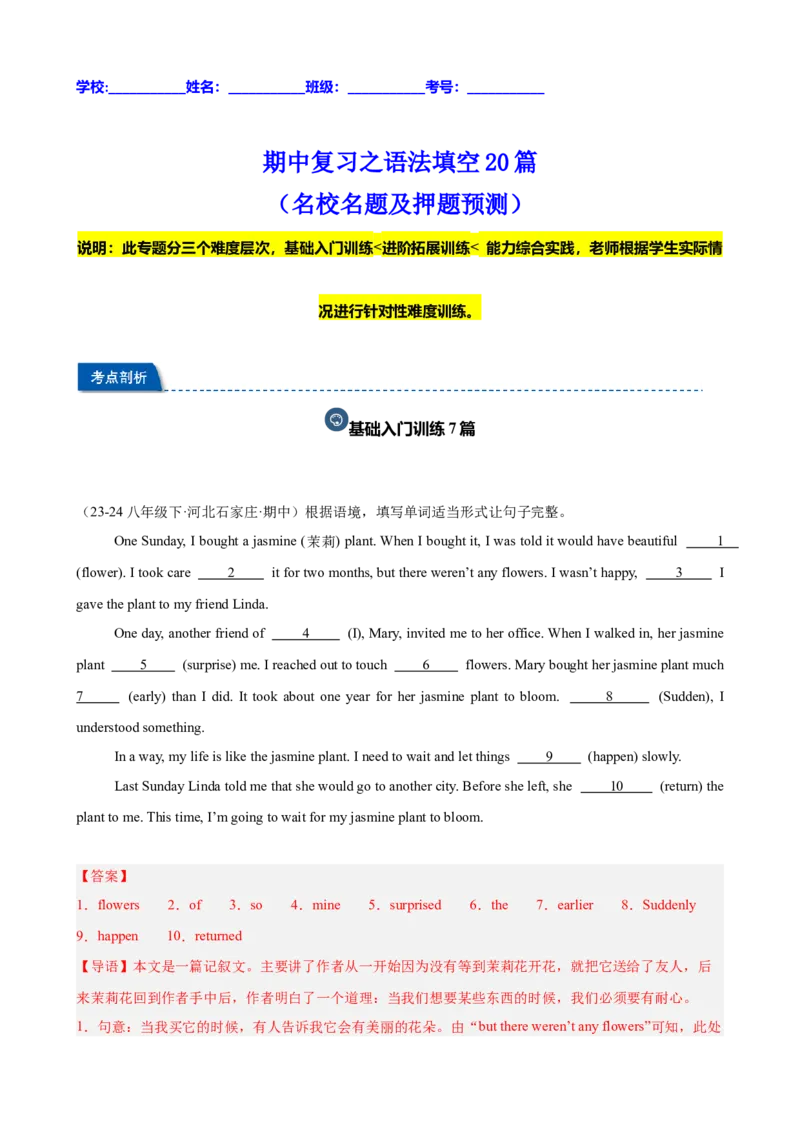
One Sunday, I bought a jasmine (茉莉) plant. When I bought it, I was told it would have beautiful 1
(flower). I took care 2 it for two months, but there weren’t any flowers. I wasn’t happy, 3 I
gave the plant to my friend Linda.
One day, another friend of 4 (I), Mary, invited me to her office. When I walked in, her jasmine
plant 5 (surprise) me. I reached out to touch 6 flowers. Mary bought her jasmine plant much
7 (early) than I did. It took about one year for her jasmine plant to bloom. 8 (Sudden), I
understood something.
In a way, my life is like the jasmine plant. I need to wait and let things 9 (happen) slowly.
Last Sunday Linda told me that she would go to another city. Before she left, she 10 (return) the
plant to me. This time, I’m going to wait for my jasmine plant to bloom.
【答案】
1.flowers 2.of 3.so 4.mine 5.surprised 6.the 7.earlier 8.Suddenly
9.happen 10.returned
【导语】本文是一篇记叙文。主要讲了作者从一开始因为没有等到茉莉花开花,就把它送给了友人,后
来茉莉花回到作者手中后,作者明白了一个道理:当我们想要某些东西的时候,我们必须要有耐心。
1.句意:当我买它的时候,有人告诉我它会有美丽的花朵。由“but there weren’t any flowers”可知,此处应用名词复数形式,指很多花。故填flowers。
2.句意:我照顾了它两个月,但是没有花。take care of“照顾”,固定搭配。故填of。
3.句意:我不高兴,所以我把植物给了我的朋友琳达。由“I wasn’t happy,…I gave the plant to my friend
Linda”可知,此处是前因后果,空后强调的是结果,应用so“因此”来连接。故填so。
4.句意:有一天,我的另一个朋友玛丽邀请我去她的办公室。由“another friend of…”可知,此处应用名
词性物主代词,表示我的一个朋友。故填mine。
5.句意:当我走进去的时候,她的茉莉花让我大吃一惊。由“When I walked in”可知,句子为一般过去
时,动词应用过去式。故填surprised。
6.句意:我伸手去摸那些花。此处特指Mary的茉莉花,所以设空处填写定冠词the。故填the。
7.句意:玛丽买茉莉花的时间比我早得多。由“than”可知,此处应填写early的比较级形式。故填
earlier。
8.句意:突然之间,我明白了一些东西。设空处位于句首且其后用逗号隔开,所以应填写副词形式修饰
整个句子,位于句首字母s大写。故填Suddenly。
9.句意:我需要等待,让事情慢慢发生。let sb. do sth.“让某人做某事”,所以此处用动词原形。故填
happen。
10.句意:在她离开之前,她把植物还给了我。由“she left”可知,本句时态为一般过去时,所以动词应
用过去式。故填returned。
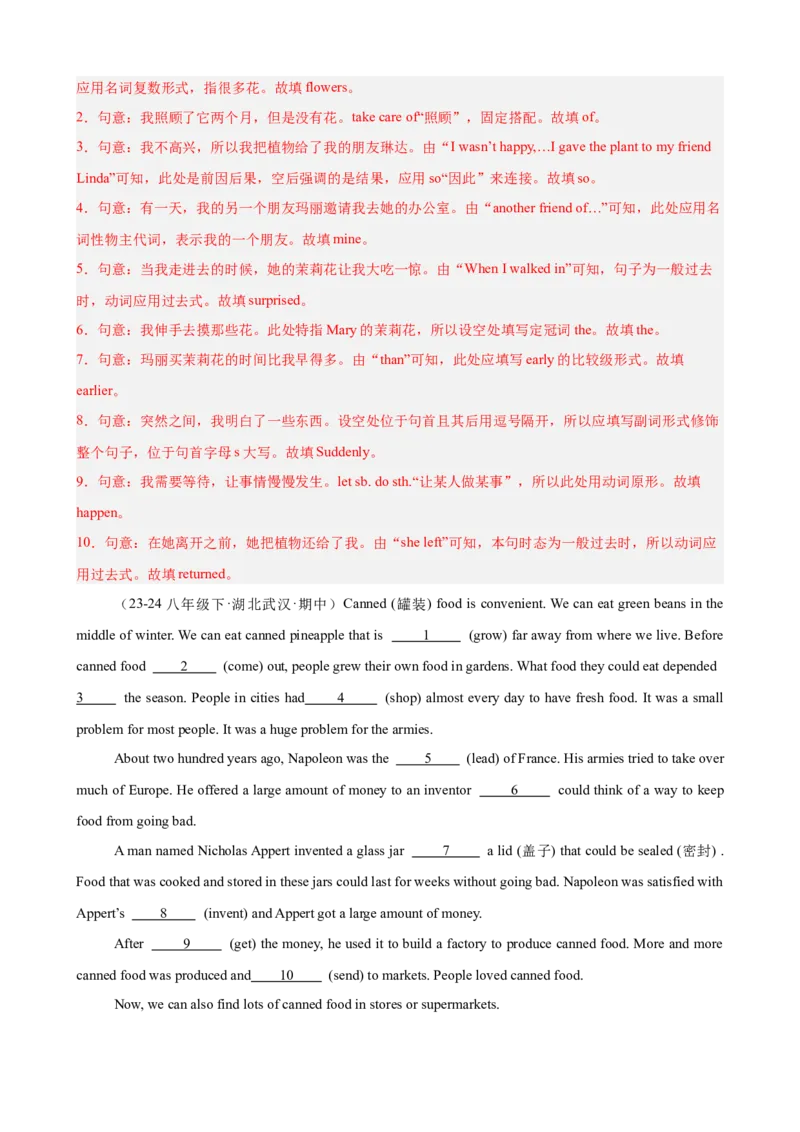
(23-24八年级下·湖北武汉·期中)Canned (罐装) food is convenient. We can eat green beans in the
middle of winter. We can eat canned pineapple that is 1 (grow) far away from where we live. Before
canned food 2 (come) out, people grew their own food in gardens. What food they could eat depended
3 the season. People in cities had 4 (shop) almost every day to have fresh food. It was a small
problem for most people. It was a huge problem for the armies.
About two hundred years ago, Napoleon was the 5 (lead) of France. His armies tried to take over
much of Europe. He offered a large amount of money to an inventor 6 could think of a way to keep
food from going bad.
A man named Nicholas Appert invented a glass jar 7 a lid (盖子) that could be sealed (密封) .
Food that was cooked and stored in these jars could last for weeks without going bad. Napoleon was satisfied with
Appert’s 8 (invent) and Appert got a large amount of money.
After 9 (get) the money, he used it to build a factory to produce canned food. More and more
canned food was produced and 10 (send) to markets. People loved canned food.
Now, we can also find lots of canned food in stores or supermarkets.【答案】
1.grown 2.came 3.on 4.to shop 5.leader 6.who/that 7.with 8.
invention 9.getting 10.sent
【导语】本文主要介绍了罐装食品的发展历史。
1.句意:我们可以吃远离我们生活的地方种植的菠萝罐头。此处用过去分词grown和be动词构成被动语
态。故填grown。
2.句意:在罐装食品问世之前,人们在花园里种植自己的食物。根据“grew”可知句子用一般过去时,
动词用过去式。故填came。
3.句意:他们能吃什么取决于季节。depend on“取决于”。故填on。
4.句意:城市里的人们几乎每天都要购物才能吃到新鲜的食物。have to do sth.“不得不做某事”。故填to
shop。
5.句意:大约两百年前,拿破仑是法国的领袖。根据“Napoleon”可知他是领导者,用名词单数
leader“领导者”。故填leader。
6.句意:他给了一位发明家一大笔钱,这位发明家能想出一种防止食物变质的方法。句子用定语从句,
先行词是inventor,关系词在从句中作主语,用who/that引导定语从句。故填who/that。
7.句意:一个名叫尼古拉斯·阿佩尔的人发明了一种可以密封的玻璃罐。根据“a glass jar...a lid”可知是带
有盖子的玻璃罐,用介词with。故填with。
8.句意:拿破仑对阿佩尔的发明很满意,阿佩尔得到了一大笔钱。根据“was satisfied with Appert’s”可知
此处指他的发明,用名词invention“发明”。故填invention。
9.句意:拿到钱后,他用这笔钱建了一家生产罐装食品的工厂。介词after后加动名词。故填getting。
10.句意:越来越多的罐装食品被生产出来并销往市场。 and前后的动词形式一致,故此处用过去分词
sent。故填sent。
(23-24八年级下·湖北武汉·期中)阅读下面短文,根据上下文或括号内单词等提示,在空白处填入适当
的单词或括号内单词的适当形式。
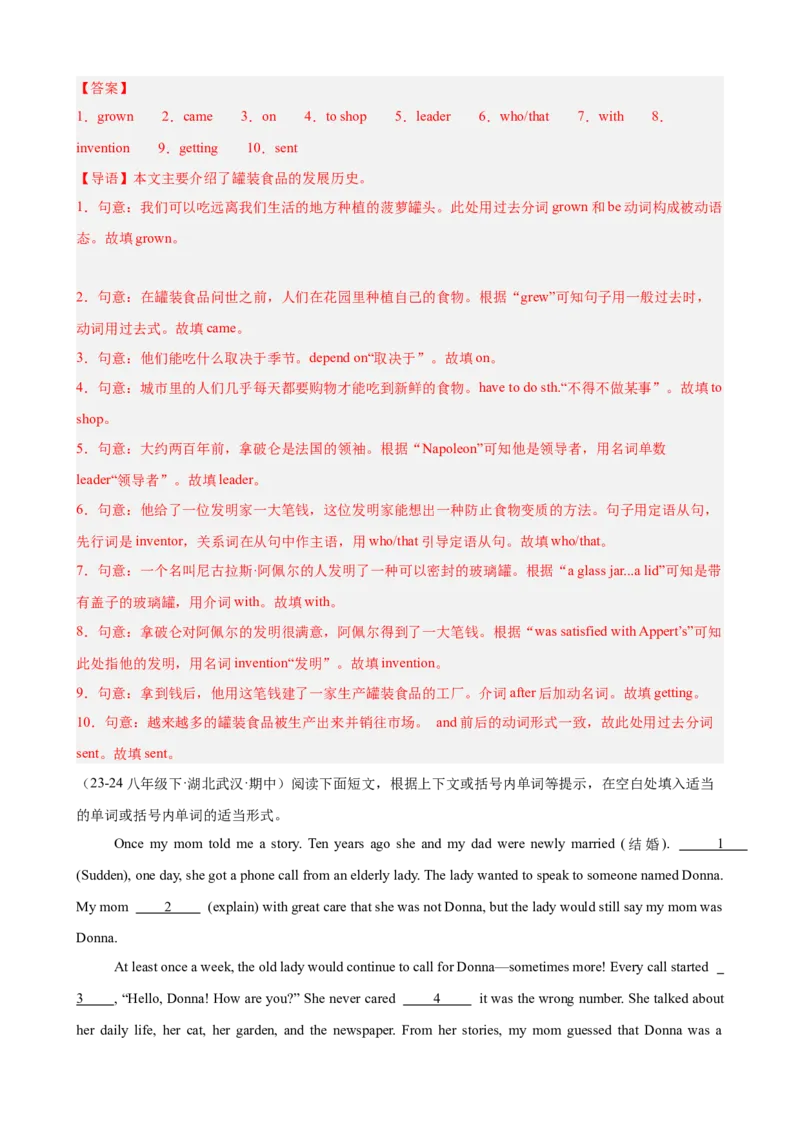
Once my mom told me a story. Ten years ago she and my dad were newly married (结婚). 1
(Sudden), one day, she got a phone call from an elderly lady. The lady wanted to speak to someone named Donna.
My mom 2 (explain) with great care that she was not Donna, but the lady would still say my mom was
Donna.
At least once a week, the old lady would continue to call for Donna—sometimes more! Every call started
3 , “Hello, Donna! How are you?” She never cared 4 it was the wrong number. She talked about
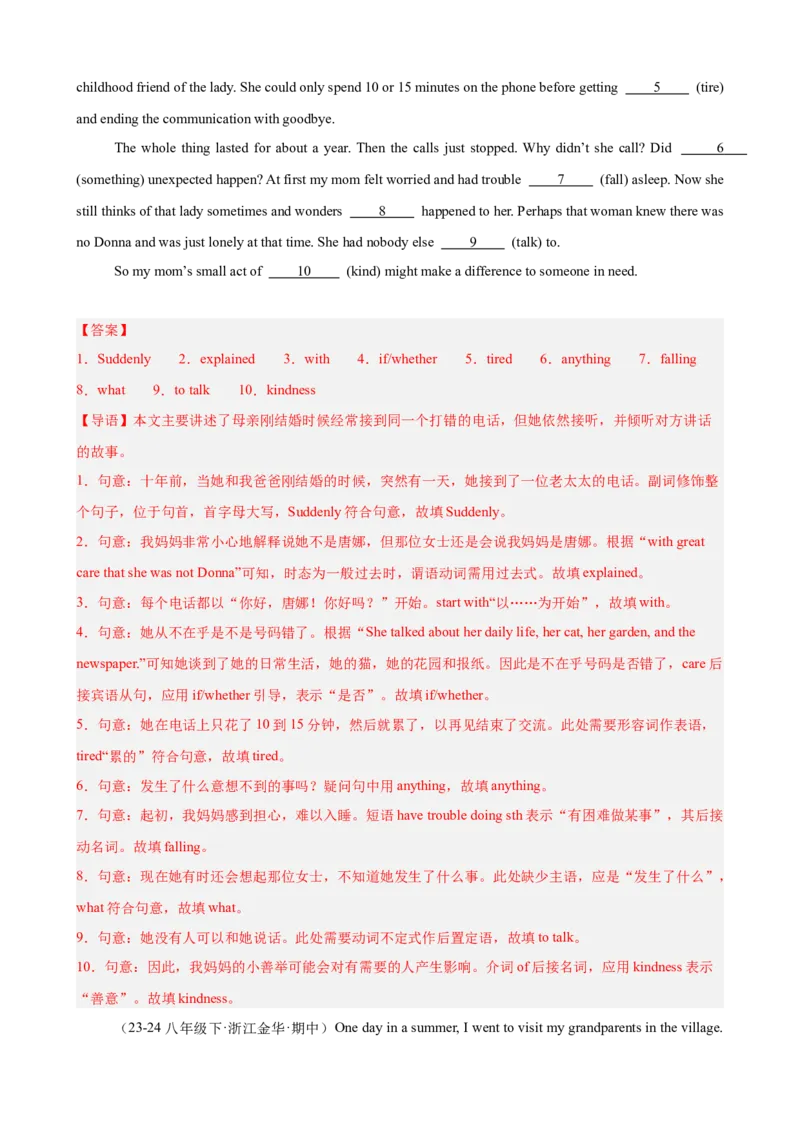
her daily life, her cat, her garden, and the newspaper. From her stories, my mom guessed that Donna was achildhood friend of the lady. She could only spend 10 or 15 minutes on the phone before getting 5 (tire)
and ending the communication with goodbye.
The whole thing lasted for about a year. Then the calls just stopped. Why didn’t she call? Did 6
(something) unexpected happen? At first my mom felt worried and had trouble 7 (fall) asleep. Now she
still thinks of that lady sometimes and wonders 8 happened to her. Perhaps that woman knew there was
no Donna and was just lonely at that time. She had nobody else 9 (talk) to.
So my mom’s small act of 10 (kind) might make a difference to someone in need.
【答案】
1.Suddenly 2.explained 3.with 4.if/whether 5.tired 6.anything 7.falling
8.what 9.to talk 10.kindness
【导语】本文主要讲述了母亲刚结婚时候经常接到同一个打错的电话,但她依然接听,并倾听对方讲话
的故事。
1.句意:十年前,当她和我爸爸刚结婚的时候,突然有一天,她接到了一位老太太的电话。副词修饰整
个句子,位于句首,首字母大写,Suddenly符合句意,故填Suddenly。
2.句意:我妈妈非常小心地解释说她不是唐娜,但那位女士还是会说我妈妈是唐娜。根据“with great
care that she was not Donna”可知,时态为一般过去时,谓语动词需用过去式。故填explained。
3.句意:每个电话都以“你好,唐娜!你好吗?”开始。start with“以……为开始”,故填with。
4.句意:她从不在乎是不是号码错了。根据“She talked about her daily life, her cat, her garden, and the
newspaper.”可知她谈到了她的日常生活,她的猫,她的花园和报纸。因此是不在乎号码是否错了,care后
接宾语从句,应用if/whether引导,表示“是否”。故填if/whether。
5.句意:她在电话上只花了10到15分钟,然后就累了,以再见结束了交流。此处需要形容词作表语,
tired“累的”符合句意,故填tired。
6.句意:发生了什么意想不到的事吗?疑问句中用anything,故填anything。
7.句意:起初,我妈妈感到担心,难以入睡。短语have trouble doing sth表示“有困难做某事”,其后接
动名词。故填falling。
8.句意:现在她有时还会想起那位女士,不知道她发生了什么事。此处缺少主语,应是“发生了什么”,
what符合句意,故填what。
9.句意:她没有人可以和她说话。此处需要动词不定式作后置定语,故填to talk。
10.句意:因此,我妈妈的小善举可能会对有需要的人产生影响。介词of后接名词,应用kindness表示
“善意”。故填kindness。
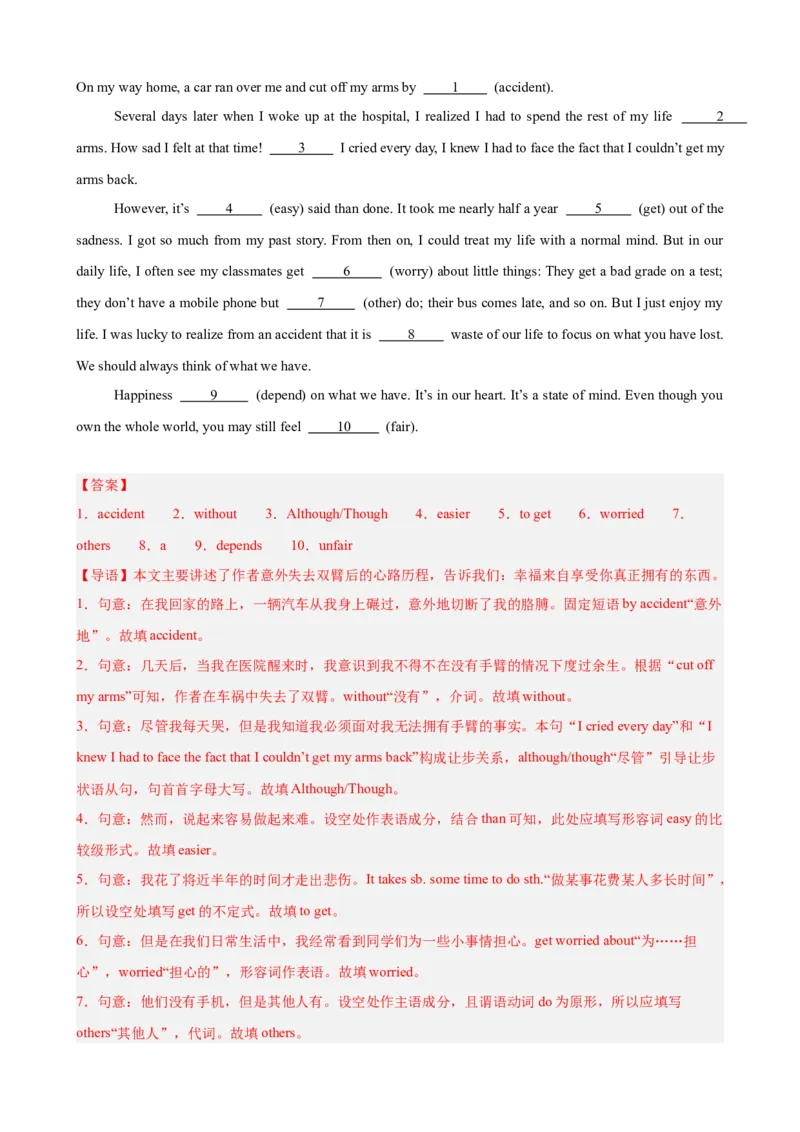
(23-24八年级下·浙江金华·期中)One day in a summer, I went to visit my grandparents in the village.On my way home, a car ran over me and cut off my arms by 1 (accident).
Several days later when I woke up at the hospital, I realized I had to spend the rest of my life 2
arms. How sad I felt at that time! 3 I cried every day, I knew I had to face the fact that I couldn’t get my
arms back.
However, it’s 4 (easy) said than done. It took me nearly half a year 5 (get) out of the
sadness. I got so much from my past story. From then on, I could treat my life with a normal mind. But in our
daily life, I often see my classmates get 6 (worry) about little things: They get a bad grade on a test;
they don’t have a mobile phone but 7 (other) do; their bus comes late, and so on. But I just enjoy my
life. I was lucky to realize from an accident that it is 8 waste of our life to focus on what you have lost.
We should always think of what we have.
Happiness 9 (depend) on what we have. It’s in our heart. It’s a state of mind. Even though you
own the whole world, you may still feel 10 (fair).
【答案】
1.accident 2.without 3.Although/Though 4.easier 5.to get 6.worried 7.
others 8.a 9.depends 10.unfair
【导语】本文主要讲述了作者意外失去双臂后的心路历程,告诉我们:幸福来自享受你真正拥有的东西。
1.句意:在我回家的路上,一辆汽车从我身上碾过,意外地切断了我的胳膊。固定短语by accident“意外
地”。故填accident。
2.句意:几天后,当我在医院醒来时,我意识到我不得不在没有手臂的情况下度过余生。根据“cut off
my arms”可知,作者在车祸中失去了双臂。without“没有”,介词。故填without。
3.句意:尽管我每天哭,但是我知道我必须面对我无法拥有手臂的事实。本句“I cried every day”和“I
knew I had to face the fact that I couldn’t get my arms back”构成让步关系,although/though“尽管”引导让步
状语从句,句首首字母大写。故填Although/Though。
4.句意:然而,说起来容易做起来难。设空处作表语成分,结合than可知,此处应填写形容词easy的比
较级形式。故填easier。
5.句意:我花了将近半年的时间才走出悲伤。It takes sb. some time to do sth.“做某事花费某人多长时间”,
所以设空处填写get的不定式。故填to get。
6.句意:但是在我们日常生活中,我经常看到同学们为一些小事情担心。get worried about“为……担
心”,worried“担心的”,形容词作表语。故填worried。
7.句意:他们没有手机,但是其他人有。设空处作主语成分,且谓语动词do为原形,所以应填写
others“其他人”,代词。故填others。8.句意:我很幸运地从一次事故中意识到,专注于你所失去的是对我们生命的浪费。固定短语a waste
of“浪费……”。故填a。
9.句意:幸福取决于我们拥有什么。本句时态为一般现在时,不可数名词作主语,谓语动词应用三单形
式。故填depends。
10.句意:即使你拥有整个世界,你可能仍然感觉不公平。根据“Even though you own the whole world,
you may still feel...”可知,此处意为“不公平”符合语境,其英文表达为unfair,形容词作表语。故填
unfair。
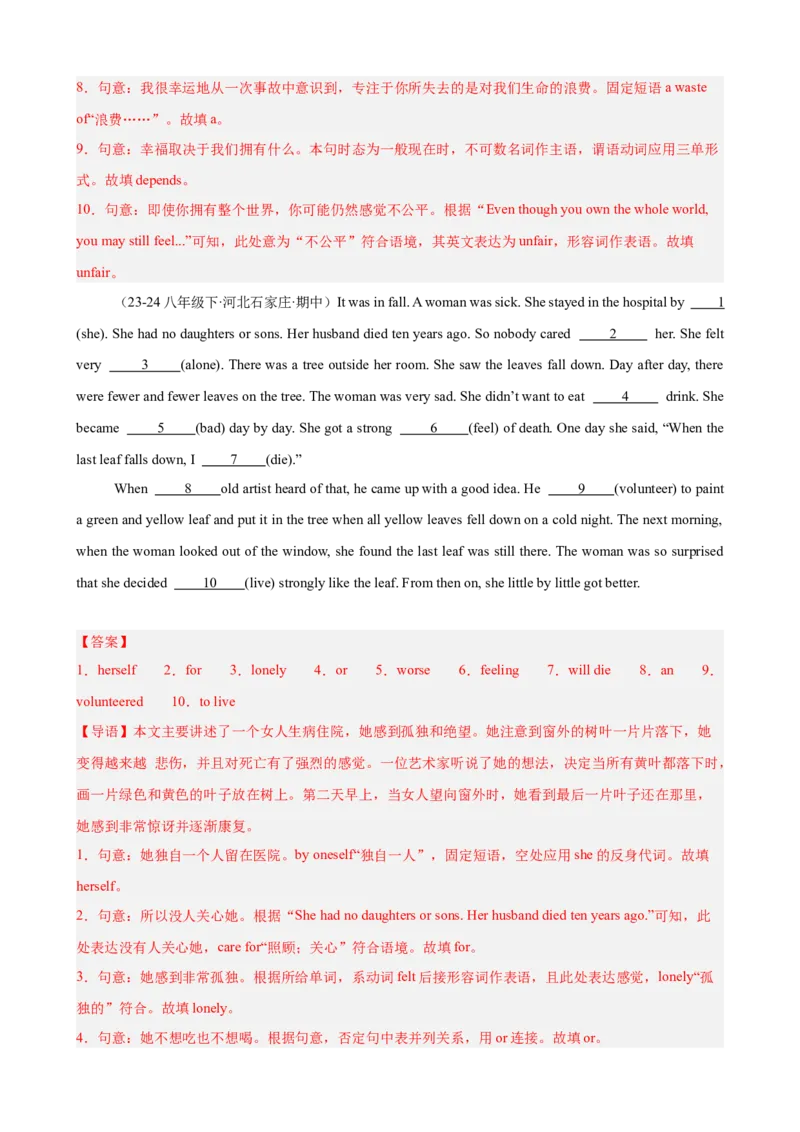
(23-24八年级下·河北石家庄·期中)It was in fall. A woman was sick. She stayed in the hospital by 1
(she). She had no daughters or sons. Her husband died ten years ago. So nobody cared 2 her. She felt
very 3 (alone). There was a tree outside her room. She saw the leaves fall down. Day after day, there
were fewer and fewer leaves on the tree. The woman was very sad. She didn’t want to eat 4 drink. She
became 5 (bad) day by day. She got a strong 6 (feel) of death. One day she said, “When the
last leaf falls down, I 7 (die).”
When 8 old artist heard of that, he came up with a good idea. He 9 (volunteer) to paint
a green and yellow leaf and put it in the tree when all yellow leaves fell down on a cold night. The next morning,
when the woman looked out of the window, she found the last leaf was still there. The woman was so surprised
that she decided 10 (live) strongly like the leaf. From then on, she little by little got better.
【答案】
1.herself 2.for 3.lonely 4.or 5.worse 6.feeling 7.will die 8.an 9.
volunteered 10.to live
【导语】本文主要讲述了一个女人生病住院,她感到孤独和绝望。她注意到窗外的树叶一片片落下,她
变得越来越 悲伤,并且对死亡有了强烈的感觉。一位艺术家听说了她的想法,决定当所有黄叶都落下时,
画一片绿色和黄色的叶子放在树上。第二天早上,当女人望向窗外时,她看到最后一片叶子还在那里,
她感到非常惊讶并逐渐康复。
1.句意:她独自一个人留在医院。by oneself“独自一人”,固定短语,空处应用she的反身代词。故填
herself。
2.句意:所以没人关心她。根据“She had no daughters or sons. Her husband died ten years ago.”可知,此
处表达没有人关心她,care for“照顾;关心”符合语境。故填for。
3.句意:她感到非常孤独。根据所给单词,系动词felt后接形容词作表语,且此处表达感觉,lonely“孤
独的”符合。故填lonely。
4.句意:她不想吃也不想喝。根据句意,否定句中表并列关系,用or连接。故填or。5.句意:她的病情一天比一天严重。根据“day by day”可知,空处用bad的比较级worse“更糟;更严
重”,表示一天比一天变得更严重。故填worse。
6.句意:她有一种强烈的死亡的感觉。根据“a strong… of death”可知,空处应为名词作宾语,feeling“感
觉”。故填feeling。
7.句意:当最后一片叶子落下,我就会死去。根据“When the last leaf falls down,”可知,此处为when引
导的时间状语从句,从句用一般现在时,主句表示将来含义,用一般将来时。故填will die。
8.句意:当一位老艺术家听说这件事时,他想出了一个好主意。根据“old artist”可知,此处表泛指,old
为元音字母开头的单词,不定冠词用an。故填an。
9.句意:在一个寒冷的夜晚,当所有的黄色叶子都掉下来的时候,他自告奋勇地画了一片绿色和黄色的
叶子放在树上。分析句子时态应为一般过去时,空处谓语动词用过去式。故填volunteered。
10.句意:这个女人非常惊讶,她决定像叶子一样坚强地生活。decide to do sth“决定做某事”,空处应为
动词不定式作宾语。故填to live。
(23-24八年级下·河北石家庄·期中)阅读下面短文,在空白处填入一个适当的单词(有提示词的,填入
所给单词的正确形式)
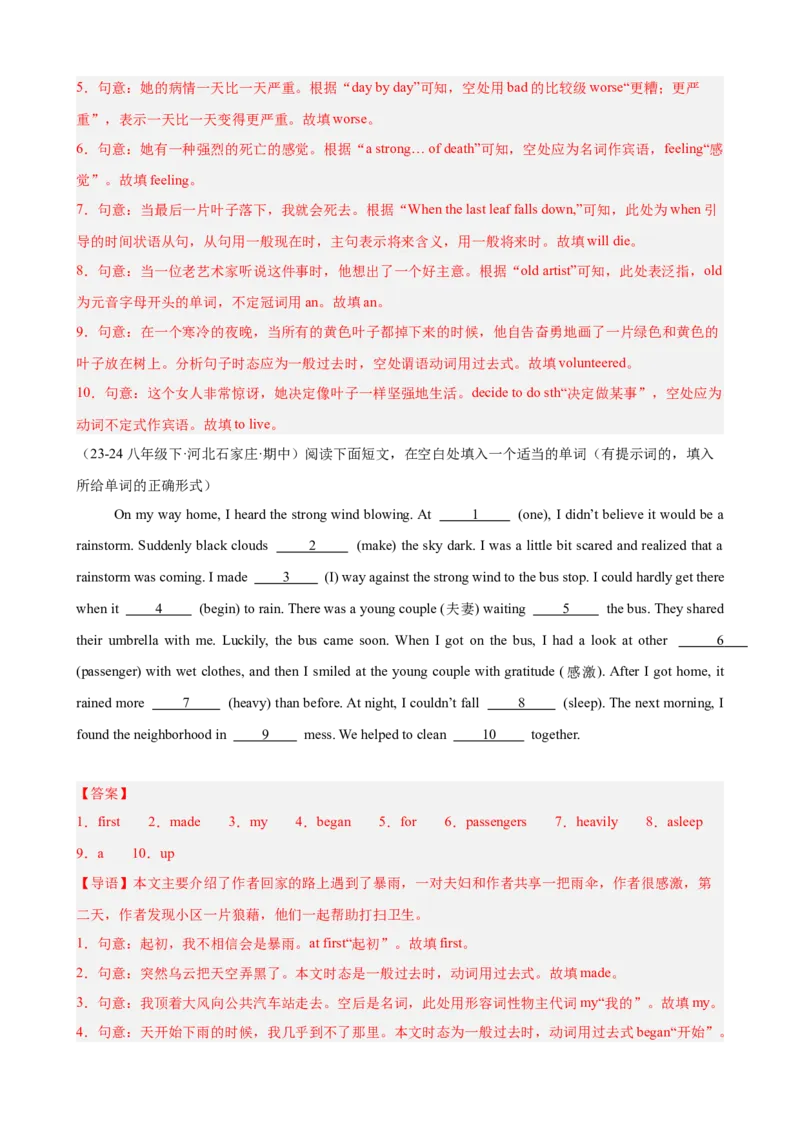
On my way home, I heard the strong wind blowing. At 1 (one), I didn’t believe it would be a
rainstorm. Suddenly black clouds 2 (make) the sky dark. I was a little bit scared and realized that a
rainstorm was coming. I made 3 (I) way against the strong wind to the bus stop. I could hardly get there
when it 4 (begin) to rain. There was a young couple (夫妻) waiting 5 the bus. They shared
their umbrella with me. Luckily, the bus came soon. When I got on the bus, I had a look at other 6
(passenger) with wet clothes, and then I smiled at the young couple with gratitude (感激). After I got home, it
rained more 7 (heavy) than before. At night, I couldn’t fall 8 (sleep). The next morning, I
found the neighborhood in 9 mess. We helped to clean 10 together.
【答案】
1.first 2.made 3.my 4.began 5.for 6.passengers 7.heavily 8.asleep
9.a 10.up
【导语】本文主要介绍了作者回家的路上遇到了暴雨,一对夫妇和作者共享一把雨伞,作者很感激,第
二天,作者发现小区一片狼藉,他们一起帮助打扫卫生。
1.句意:起初,我不相信会是暴雨。at first“起初”。故填first。
2.句意:突然乌云把天空弄黑了。本文时态是一般过去时,动词用过去式。故填made。
3.句意:我顶着大风向公共汽车站走去。空后是名词,此处用形容词性物主代词my“我的”。故填my。
4.句意:天开始下雨的时候,我几乎到不了那里。本文时态为一般过去时,动词用过去式began“开始”。故填began。
5.句意:有一对年轻夫妇在等公共汽车。wait for“等待”。故填for。
6.句意:当我上车时,我看了看其他穿着湿衣服的乘客。此处表示泛指用名词复数passengers“乘客”。
故填passengers。
7.句意:我到家后,雨比以前更大了。此处修饰动词rained用副词,根据“than”可知此处用副词的比较
级more heavily。故填heavily。
8.句意:晚上,我无法入睡。fall asleep“入睡”。故填asleep。
9.句意:第二天早上,我发现附近一片狼藉。in a mess“一片狼藉”。故填a。
10.句意:我们一起帮忙打扫卫生。clean up“打扫卫生”。故填up。
(23-24八年级下·湖南长沙·期中)阅读下面短文,在空白处填入1个适当的单词或括号内单词的正确形
式。
Keep Your Pets Cool
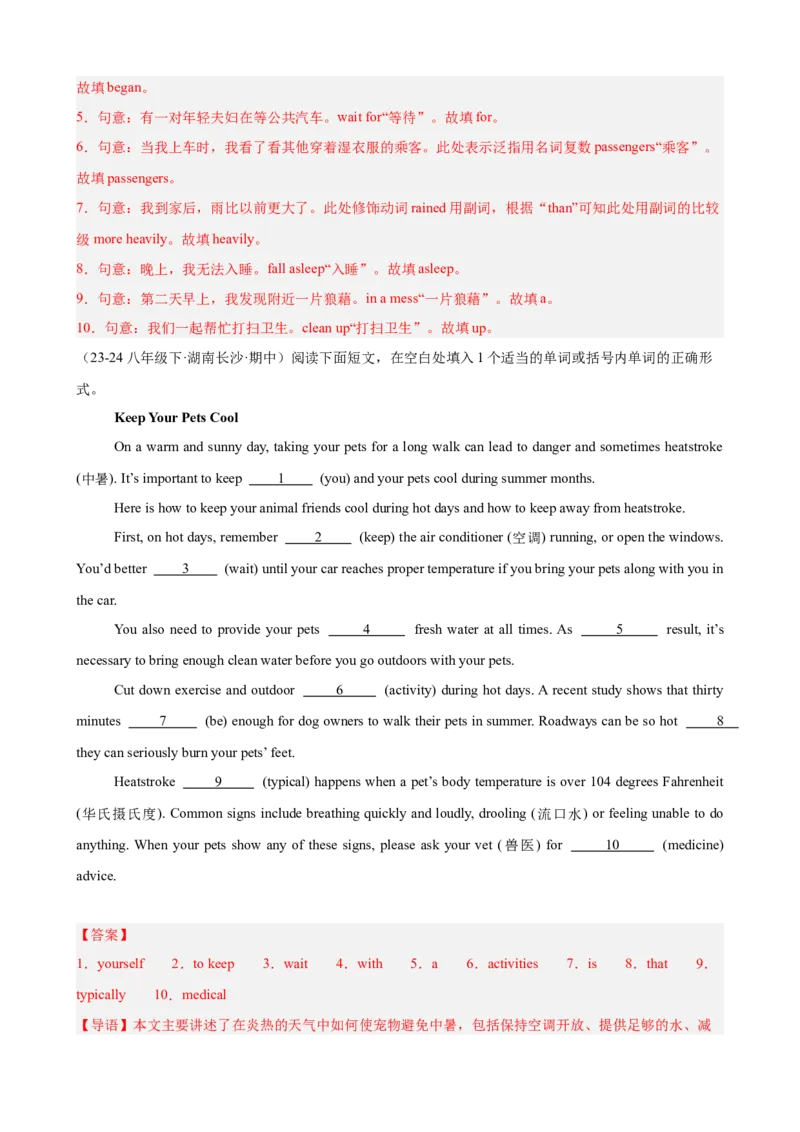
On a warm and sunny day, taking your pets for a long walk can lead to danger and sometimes heatstroke
(中暑). It’s important to keep 1 (you) and your pets cool during summer months.
Here is how to keep your animal friends cool during hot days and how to keep away from heatstroke.
First, on hot days, remember 2 (keep) the air conditioner (空调) running, or open the windows.
You’d better 3 (wait) until your car reaches proper temperature if you bring your pets along with you in
the car.
You also need to provide your pets 4 fresh water at all times. As 5 result, it’s
necessary to bring enough clean water before you go outdoors with your pets.
Cut down exercise and outdoor 6 (activity) during hot days. A recent study shows that thirty
minutes 7 (be) enough for dog owners to walk their pets in summer. Roadways can be so hot 8
they can seriously burn your pets’ feet.
Heatstroke 9 (typical) happens when a pet’s body temperature is over 104 degrees Fahrenheit
(华氏摄氏度). Common signs include breathing quickly and loudly, drooling (流口水) or feeling unable to do
anything. When your pets show any of these signs, please ask your vet (兽医) for 10 (medicine)
advice.
【答案】
1.yourself 2.to keep 3.wait 4.with 5.a 6.activities 7.is 8.that 9.
typically 10.medical
【导语】本文主要讲述了在炎热的天气中如何使宠物避免中暑,包括保持空调开放、提供足够的水、减少户外活动等。
1.句意:在夏季让你自己和你的宠物保持凉爽是重要的。you为人称代词,此处应使用其反身代词
yourself“你自己”,keep yourself cool“让你自己保持凉爽”。故填yourself。
2.句意:首先,在炎热的天气里,记得保持空调开放,或者打开窗户。remember to do sth. “记得去做某
事”。故填to keep。
3.句意:如果你带宠物上车,最好等到车内温度合适。had better do sth.“最好做某事”。故填wait。
4.句意:你还需要随时为你的宠物提供清水。provide sb. with sth. “为某人提供某物”。故填with。
5.句意:因此,在你带宠物出去之前,带足够的干净水是必要的。as a result“因此”。故填a。
6.句意:在炎热的天气减少锻炼和户外活动。activity“活动”,可数名词,此处应使用其复数形式
activities。故填activities。
7.句意:最近的一项研究表明,狗主人在夏天遛狗30分钟就足够了。thirty minutes “三十分钟”,为一
段时间,应将其看作一个整体,谓语动词应使用单数,此处描述的是一般事实,应使用一般现在时,be
动词应使用is。故填is。
8.句意:道路太热了,可能会严重烧伤宠物的脚。so...that...“如此……以至于……”,that引导结果状语
从句。故填that。
9.句意:中暑通常发生在宠物体温超过104华氏摄氏度的时候。typical“通常的”,此处应使用其副词形
式typically修饰动词happens。故填typically。
10.句意:当你的宠物出现任何这些迹象时,请咨询你的兽医寻求医疗建议。medicine名词“医学”,此
处应使用其形容词形式medical“医学的”,修饰名词advice。故填medical。
进阶拓展训练7篇
(23-24八年级下·湖南长沙·期中)阅读下面短文,在空白处填入1个适当的单词或括号内单词的正确形
式。
After three tries, Millie finally passed the first aid (急救) test. She remembered what to do 1
someone is unconscious (昏迷的).
Millie told everybody about it and really wanted to test her new learning. Every day, she kept looking for
possible 2 (accident), almost hoping that something bad would happen to someone, just so she could
save them. One morning, her dad 3 (eat) breakfast when he started coughing. “Finally,” thought Millie,
“I have my chance (机会) !” But then her dad stopped 4 (cough) and he was fine. Millie was upset.
Later at school, during lunchtime, her friend Stacy ran to her. “Quick!” She called. “It’s Bobby! He’s
unconscious!” Millie ran to help. She checked 5 (he) mouth. It was clear. While she was checkingbreathing, she thought, “Oh no. His breath smells bad.” But she knew how 6 (importance) it was to
save him now. She tried 7 (press) his nose and was going to give the mouth-to-mouth rescue breathing.
8 (sudden), Bobby began laughing and so did Stacy. Millie realized it was just 9 joke. She hit
Bobbie 10 the arm. She was angry, but then thought and said to her friends, “Well, at least I got to
practice, and maybe I don’t really want to do it in real life , anyway!”
【答案】
1.when/if 2.accidents 3.was eating 4.coughing 5.his 6.important 7.to press
8.Suddenly 9.a 10.on
【导语】本文主要讲述了一位名叫米莉的女生通过了急救考试,她想寻找机会施展,结果朋友恶作剧,
让她意识到实际施救不易。
1.句意:她记得当有人昏迷时该怎么做。/她记得如果有人昏迷时该怎么做。根据“someone is
unconscious”可知,此处既可以是when引导的时间状语从句,表示“当有人昏迷的时候”,也可以是if
引导的条件状语从句,表示“如果有人昏迷”。故填When/if。
2.句意:每天,她都在寻找可能的意外,几乎希望有人会发生不好的事情,这样她就可以拯救他们。根
据“possible”可知,此处填名词,accident“事故”;此处无限定词,所以应用可数名词填复数形式
accidents。故填accidents。
3.句意:一天早上,她的爸爸正在吃早餐,突然开始咳嗽。根据“her dad...breakfast when he started
coughing.”可知,此处指“在吃早饭期间开始咳嗽”,所以此空时态为过去进行时,结构为be+现在分词,
主语为“her dad”,所以be动词为was,eat的现在分词为eating。故填was eating。
4.句意:但后来她爸爸不咳嗽了,他没事了。stop doing sth.“停止正在做的事”,所以此空填动名词;
cough“咳嗽”的动名词为coughing。故填coughing。
5.句意:她检查了他的嘴巴。根据“mouth”可知,此空填形容词性物主代词修饰名词,he“他”的形容词
性物主代词为his。故填his。
6.句意:但她知道现在拯救他是多么重要。根据“it was”可知,此处填形容词作表语,importance“重
要”的形容词形式为important。故填important。
7.句意:她尽力按压他的鼻子,准备进行人工呼吸。try to do sth.“尽力做某事”,所以此空填动词不定
式to press。故填to press。
8.句意:突然,鲍比开始大笑起来,史黛西也笑了起来。此空用副词修饰整个句子,sudden“突然”的副
词形式为suddenly,句首首字母大写,故填Suddenly。
9.句意:米莉意识到这只是一个玩笑。根据“joke”可知,此处泛指“一个玩笑”,所以填不定冠词;
“joke”以辅音音素开头,所以填a。故填a。10.句意:她打了鲍比的手臂。hit sb. on the arm“击打某人的手臂”,故填on。
(23-24八年级下·湖南长沙·期中)阅读下面短文,在空白处填入1个适当的单词或括号内单词的正确形
式。
Sam is a little boy, and he is a good kid. He always 1 (help) his parents do housework and makes
his family happy.
One day, after a snowstorm at night, the snow piled (堆积) so high in front of Sam’s house. Sam thought
that the snow at the doorway could cause problems for his family. But his parents 2 (sleep) at that time.
With no one to ask for help, Sam made a 3 (decide) to shovel (铲) the snow from the doorway. He
wanted to give his parents a surprise by 4 (he).
5 (make) sure not to feel cold, Sam wore his heavy winter jacket, snowshoes and a warm hat.
Before long, Sam got hot. Sweat (汗) started running down his face. He became much 6 (slow) with
each move. The snow seemed to be getting heavier. Sam was getting really tired. “What 7 difficult
job!” he shouted. “How can someone keep doing this 8 a snowy winter day?” Just then, his parents
came out. Dad saw his son and laughed, “Oh dear, how wonderful you are! 9 you are wearing too
much. Shoveling snow is like doing exercise. You should dress 10 (proper).” Dad took the shovel and
helped Sam finish the work in ten minutes. “Next time,” Sam thought, “I will know how to dress when I shovel
the snow.”
【答案】
1.helps 2.were sleeping 3.decision 4.himself 5.To make 6.slower 7.a
8.on 9.But 10.properly
【导语】本文主要讲述了Sam在雪天为了帮助家人清理门口的积雪而自己动手,最后得到了父母的赞扬
和帮助,也学到了正确的穿衣方式。
1.句意:他总是帮助他的父母做家务,使他的家人快乐。根据“he is a good kid”与提示词可知,此处应
指他总帮助他的父母做家务,根据“always”可知,此处应用一般现在时,主语He为第三人称单数,因此
谓语动词应用第三人称单数形式,help“帮助”,其三单形式为helps。故填helps。
2.句意:但他的父母当时正在睡觉。根据“at that time”、“thought”与提示词可知,此处应指当时他的
父母正在睡觉,sleep“睡觉”,因此此处应应用过去进行时,构成为was/were doing。主语“his parents”为
复数形式,因此用were sleeping。故填were sleeping。
3.句意:由于没有人寻求帮助,山姆决定从门口铲雪。根据“a”与提示词可知,此处应用名词单数形式,
decide,动词,“决定”,其名词为decision,make a decision“作出决定”。故填decision。
4.句意:他想亲自给父母一个惊喜。根据“by”与提示词可知,此处应指他想自己给父母一个惊喜,byoneself“独自地”,主语为He,因此此处应用himself。故填himself。
5.句意:为了确保不感到冷,萨姆穿着厚厚的冬季夹克、雪鞋和一顶暖和的帽子。根据“… sure not to
feel cold”与提示词可知,此处应指为了确保不感到冷,因此处应用to do不定式表示目的,句子开头首字
母大写。故填To make。
6.句意:他每走一步都变得慢多了。根据“much”与提示词可知,此处应指变得慢多了,因此此处much
修饰比较级,slow“慢的”,比较级为slower“更慢的”。故填slower。
7.句意:“多么困难的工作啊!”他喊道。根据“What … difficult job!”可知,此处为What引导的感叹
句,构成为What+a/an+adj.+名词单数,difficult为辅音音素的单词,因此应用a。故填a。
8.句意:“怎么有人能在下雪的冬天一直这么做?”根据“a snowy winter day”可知,此处应指在下雪的
冬天,因此应用on,意为“在(具体的某天)”。故填on。
9.句意:但是你穿得太多了。根据“how wonderful you are!”与“… you are wearing too much.”可知,此
处前后两句表示转折,因此应用but,意为“但是”,句子开头首字母大写。故填But。
10.句意:你应该穿着得体。根据“You should dress… .”与提示词可知,此处指穿着得体,因此应用副词
修饰动词dress,proper“合适的”,副词为properly。故填properly。
(23-24八年级下·湖北武汉·期中)阅读下面短文,根据上下文或括号内单词等提示,在空白处填入适当
的单词或括号内单词的适当形式。
According to some old Chinese stories, there once was an ancient emperor named Shennong. At that time,
there was no medicine to treat illness. Many sick people could only wait for 1 (die).
To save his people, Shennong decided 2 (find) and test out different plants. He and his men set out
on a journey in search of medicinal plants.
Each time the team found a new plant, Shennong would taste it 3 (he). Some plants made him feel
sleepy, some caused him to have a stomachache, and some made him tremble ( 颤抖) all over. 4
Shennong searched and tested over a long time, he and his men discovered lots of medicinal plants.
As they 5 (continue) their search, the team found a plant with small yellow flowers. Shennong
picked off one piece 6 the plant in order to taste it. He said, “It looks like a medicinal plant. I have to
test it, 7 some people may misuse it.”
Suddenly, Shennong’s face turned pale and he fell to the ground 8 (heavy). Even after he was given
the leaves from other medicinal plants, he still 9 (lose) his life. People covered him with thousands of
10 (flower). From then on, they called him “the Emperor of Medicine”.
【答案】
1.death 2.to find 3.himself 4.After 5.continued 6.from 7.or 8.heavily9.lost 10.flowers
【导语】本文讲述了中国古老的故事——神农尝百草。
1.句意:很多人生病只能等死。介词for后用名词的形式作宾语。故填death。
2.句意:为了拯救自己的子民,神农决定寻找并检验不同的植物。decide to do sth.“决定做某事”。故填
to find。
3.句意:每次他的团队发现一种新的植物时,神农都会亲自品尝。应填he的反身代词,himself “他自己;
亲自”。故填himself。
4.句意:神农在搜索和试验了很长时间后,他和自己的手下发现了很多药用植物。根据句意可知,是搜
索很久之后有所发现,连词after引导时间状语从句,表示“在……之后”,句首单词首字母大写。故填
After。
5.句意:当他们继续搜寻时,团队发现了一种开着黄色小花的植物。根据句意及句子语境可知,此句用
一般过去时,用动词的过去式。故填continued。
6.句意:神农从树上摘下一片,尝了尝。此处表示是从树上摘下一片。故填from。
7.句意:我必须测试一下,否则有些人可能会误用它。根据前后句的句意关系,此处表示否则有些人可
能会误用它,or“否则”。故填or。
8.句意:突然,神农脸色苍白,重重地跌倒在地上。副词heavily修饰动词fell,表示重重地跌倒。故填
heavily。
9. 句意:即使他得到了其他药用植物的叶子,但他还是失去了生命。根据句意及句子语境可知,该空
用一般过去时,lose的过去式是lost。故填lost。
10.句意:人们用数以千计的鲜花覆盖在他身上。根据“thousands of”可知,可数名词flower用复数。故
填flowers。
(23-24八年级下·湖北武汉·期中)In the past, I didn’t get on well with my parents. I hardly talked to
them, because they liked to compare me with my sister. And that made me 1 (happy) and sad. I didn’t
know 2 to do. Sometimes I even 3 (argue) with them about this.
However, I wanted to show them that I could do things as 4 (good) as my sister. Then I began to
spend most of my free time 5 (paint) in my bedroom. 6 (Lucky), my art teacher, Miss Green,
offered me a lot of help. She taught me some drawing skills to help improve my paintings. At that time, she was
the only person I would like 7 (communicate) with.
One day, I told Miss Green 8 my problem. She encouraged me to take part in a painting
competition. She said the best way to communicate with my parents was to prove (证明) myself to them. After a
few weeks’ waiting, the result finally came out. I got the first prize! When I took the prize home, my parents were
so happy 9 they couldn’t stop laughing all the time! And they began to care more about me. Now 10(relation) between my parents and me are very good. So I think it’s very important to have someone to talk to.
【答案】
1.unhappy 2.what 3.argued 4.well 5.painting 6.Luckily 7.to communicate
8.about 9.that 10.relations
【导语】本文主要讲述了作者因为格林小姐的帮助而变得更优秀的故事。
1.句意:这让我很不开心,很难过。空处和sad“伤心的”并列,应用unhappy“不开心的”,故填
unhappy。
2.句意:我不知道该怎么办。此处是“疑问词+动词不定式”结构,作do的宾语应用what。故填what。
3.句意:有时我甚至和他们争论这个问题。根据上文可知,句子是一般过去时,动词用过去式。故填
argued。
4.句意:然而,我想让他们知道我可以做得和我姐姐一样好。空处修饰动词,应用副词。故填well。
5.句意:然后我开始花大部分的空闲时间在我的卧室里画画。spend time doing sth“花时间做某事”,故
填painting。
6.句意:幸运的是,我的美术老师格林小姐给了我很多帮助。lucky是形容词,空处修饰句子,应用副
词。故填Luckily。
7.句意:在那个时候,她是我唯一愿意交流的人。would like to do sth“愿意做某事”,故填to
communicate。
8.句意:一天,我把我的问题告诉了格林小姐。tell sb about sth“告诉某人关于某事”,是固定短语。故
填about。
9.句意:当我把奖品拿回家时,我的父母非常高兴,他们一直笑个不停!此处是so...that...“如此……以
至于……”引导的结果状语从句。故填that。
10.句意:现在我父母和我的关系很好。relation“关系”,结合are可知,名词用复数。故填relations。
(23-24八年级下·湖北武汉·期中)阅读下面短文,根据上下文或括号内单词等提示,在空白处填入适当
的单词或括号内单词的正确形式。
Nowadays, it’s very usual for people 1 (order) takeout (外卖食品), but did people eat takeout in
ancient times?
Maybe you don’t think so. 2 fact, there was takeout in the Song Dynasty (960—1279).
According to history books, Emperor Xiaozong (1127—1194) liked ordering takeout late at night. His servants
3 (go) out to pick up the dishes and bring them back to the palace.
Common people also ordered takeout. The owners of restaurants got their waiters to go out into the streets
and ask loudly which dishes could be 4 (send) that day. People could then place an order. Delivery (快递) 5 (work) would bring food to their homes later. In the famous Song Dynasty painting Along the
River During the Qingming Festival (清明上河图), 6 takeout worker is doing delivery work. We can
easily see the man 7 (walk) with food in his hand in a hurry.
People at that time even had boxes for takeout dishes, 8 they weren’t like normal boxes. They
were long 9 (wood) boxes with several layers (层). People also used plates made of two layers of
porcelain (瓷). Hot water could be put between the first layer and the 10 (two). In this way, they could
keep the dishes warm.
【答案】
1.to order 2.In 3.went 4.sent 5.workers 6.a 7.walking 8.but 9.
wooden 10.second
【导语】本文主要介绍了古代人是如何点外卖的。
1.句意:现在,人们点外卖很常见,但在古代人们吃外卖吗? 此处是结构it is adj. for sb. to do sth.“做某
事对某人来说是……的”。故填to order。
2.句意:事实上,在宋代(960年—1279年)就有外卖。in fact“事实上”。故填In。
3.句意:他的仆人出去取上菜肴,然后把它们带回宫殿。此处描述过去发生的事情,用一般过去时,动
词用过去式。故填went。
4.句意:餐馆老板让服务员走上街头,大声询问当天可以送哪些菜。主语dishes和谓语send之间是被动
关系,此处用过去分词sent和be动词构成被动语态。故填sent。
5.句意:快递员稍后会把食物送到他们家。根据“would bring food...”可知是快递员,此处表泛指用名词
复数workers“工人”。故填workers。
6.句意:在宋代名画《清明上河图》中,一位外卖员正在做送餐工作。此处泛指“一位外卖员”,
takeout以辅音音素开头,用不定冠词a。故填a。
7.句意:我们可以很容易地看到这个人手里拿着食物匆匆忙忙地走着。此处是see sb. doing sth.,表示
“看见一个人拿着食物在走着”。故填walking。
8.句意:那时的人们甚至有装外卖菜的盒子,但是它们不像普通的盒子。前后两句是转折关系,用but
连接。故填but。
9.句意:它们是几层的长木箱。此处修饰名词boxes用形容词wooden“木制的”。故填wooden。
10.句意:热水可以放在第一层和第二层之间。根据“the first layer and the...”可知此处指第二层,表示顺
序用序数词second。故填second。
(23-24八年级下·浙江台州·期中)阅读下面短文,在空白处填入一个适当的词,或填入括号中所给单
词的正确形式。Mr. Wilson was a meat cutter. One night, while he 1 (work) in the freezer (冷藏室), he got
locked in by accident. It was after working 2 (hour), so there was no one left to save him.
Mr. Wilson knew he would freeze to death by the next morning. 3 (Sudden), someone opened the
door. Mr. Wilson was 4 (surprise), shocked and most of all, thankful… There, standing in front of him,
was the security guard (保安).
Mr. Wilson didn’t expect 5 (see) him here. Then he asked the security guard, “How did you know I
was here?”
“It’s very simple,” he answered. “For ten years, you are 6 only person who comes in every day and
says hello and goodbye to me 7 a kind smile. Today I heard the hello, but I never heard the goodbye,
8 I knew you had to be here.”
Every day, it may be 9 (you) smile, a thank you, or a kind word that makes a change in someone’s
life. And if it 10 (come) back to you, that world will be nice.
【答案】
1.was working 2.hours 3.Suddenly 4.surprised 5.to see 6.the 7.with
8.so 9.your 10.comes
【导语】本文是一则小故事。一个尊重保安的人被锁在冷藏室中最后被保安救了。故事告诉我们:一个
微笑或者善意的话语会在生活中起重要的作用。
1.句意:一天晚上,当他在冷藏室工作时,他不小心被锁在里面。根据“while he...in the freezer (冷藏室),
he got locked in by accident”可知,此处指“正在工作的时候”,所以时态为过去进行时,结构为“be+现
在分词”;主语为“he”,所以be动词为was,故填was working。
2.句意:那是下班时间,所以没有人去救他。根据“after”可知,此处填名词;“hour”可数名词,前无
限定词,所以填复数形式hours。故填hours。
3.句意:突然,有人打开了门。此处修饰整个句子,填副词形式suddenly;句首单词首字母大写,故填
Suddenly。
4.句意:威尔逊先生感到惊讶、震惊,最重要的是,他很感激…… 根据“Mr. Wilson was”可知,此处填
形容词作表语;表示“人感到惊讶”为surprised。故填surprised。
5.句意:威尔逊先生没想到会在这里见到他。根据“expect”可知,考查expect to do sth.“期待做某事”,
故填to see。
6.句意:十年来,你是唯一一个每天进来,带着亲切的微笑和我打招呼和道别的人。根据“only person”
可知,此处表特指,所以填定冠词the。故填the。
7.句意:十年来,你是唯一一个每天进来,带着亲切的微笑和我打招呼和道别的人。根据“a kind smile”可知,此处表示“带有”,所以填with。故填with。
8.句意:今天我听到了你好,但没听到再见,所以我知道你一定在这里。根据“Today I heard the hello,
but I never heard the goodbye,”及“I knew you had to be here”可知,前后为因果关系,前因后果,故填so。
9.句意:每一天,也许是你的微笑,一句谢谢,或者一句友善的话语,改变了别人的生活。根据
“smile”可知,此处填形容词性物主代词your修饰名词,故填your。
10.句意:如果它回到你身边,世界将会变得美好。根据“And if it...back to you, that world will be nice.”
可知,此处为if引导的条件状语从句,主句为一般将来时,从句为一般现在时,从句主语为“it”,所以
动词填第三人称单数形式comes。故填comes。
(23-24八年级下·浙江宁波·期中)阅读下面短文,在空白处填入一个适当的词,或填入括号中所给单词
的正确形式。
Do you want to be happy? Follow these steps, please.
1 (one) of all, be realistic. Nobody is happy all 2 time. It is common 3
(have) different feelings from day to day, month to month, and even year to year. At any time and at any age, it is
possible to feel 4 (happy) than before.
Keep in good health. Nothing is more valuable than being 5 (health). Nothing is more likely to
make you unhappy than ill health.
Live with your family and love 6 (they). No matter how busy you are at work, try to spend more
time with your family, especially your 7 (child). Sometimes, they can really bring joy.
Raise a dog or a cat. 8 (play) with pets can make you feel good. 9 you stay with your
beloved pets, you may forget all your trouble.
Keep in close touch with relatives and friends. You can’t beat their love and support. If you get unhappy
10 (easy), don’t be afraid to admit (承认) it. Be open to them and say how you feel and what you need.
【答案】
1.First 2.the 3.to have 4.happier 5.healthy 6.them 7.children 8.
Playing 9.When 10.easily
【导语】本文主要介绍了如何变得开心。
1.句意:首先,现实一点。first of all“首先”,位于句首,首字母大写,故填First 。
2.句意:没有人是一直快乐的。all the time“一直”,故填the。
3.句意:每天、每月、甚至每年都有不同的感受,这是很正常的。此处是结构it’s adj. to do sth.“做某事
是……的”。故填to have。
4. 句意:在任何时候,任何年龄,都有可能感到比以前更快乐。根据“than”可知,需要比较级,happy的比较级是happier,故填happier。
5.句意:没有什么比健康更有价值。作be动词的表语用形容词,health的形容词是healthy,故填
healthy。
6.句意:和你的家人住在一起,爱他们。此处作宾语用代词宾格,they的宾格是them,故填them。
7.句意:无论你的工作有多忙,都要多花时间陪伴家人,尤其是你的孩子。根据“they can bring joy”可
知此处用名词复数,child的复数是children,故填children。
8.句意:和宠物玩会让你感觉很好。此处作主语用动名词。故填Playing。
9.句意:当你和你心爱的宠物在一起时,你可能会忘记所有的烦恼。根据“you stay with your beloved
pets”可知是当你和宠物玩时,when“当”。故填When。
10.句意:如果你很容易不快乐,不要害怕承认。此处修饰动词用副词,easy的副词是easily,故填
easily。
能力综合实践6篇
(23-24八年级下·浙江金华·期中)语法填空。(在空格处填入一个适当的词或使用括号中词语的正确形式
填空)
Mike is 1 8-year-old Australian boy. He stays in China now, and his parents work in China. He
has been in China 2 three years. Mike likes to collect 3 (stamp). He 4 (have) a lot
of Chinese stamps since he came to China. Mike is learning Chinese now. He studies very hard, but be usually has
many mistakes. He tries to spend more time 5 (read) Chinese stories. He often loses himself in reading.
Sometimes, mistakes make him learn much 6 (fast). Now he can write lots of Chinese words by
working hard. He was so 7 (luck) that he will have the chance 8 (enter) a competition called
Chinese Bridge in Hunan.
Mike likes Beijing Roast Duck very much, because it 9 (taste) delicious. He wants to learn how
to cook Roast Duck because his parents are also crazy about it. He hopes he can live and study 10
(happy) in China.
【答案】
1.an 2.for 3.stamps 4.has had 5.reading 6.faster 7.lucky 8.to enter
9.tastes 10.happily
【导语】本文主要讲的是澳大利亚男孩Mike在中国三年的生活和学习经历。
1.句意:迈克是一个8岁的澳大利亚男孩。根据“Mike is…8-year-old Australian boy.”可知,空后有单数
名词boy“男孩”,此处表示泛指,应用不定冠词修饰;空后为“8-year-old”,是以元音音素开头,应用an。故填an。
2.句意:他在中国已经三年了。根据“He has been in China…three years.”可知,此处指他在中国已经三
年了,空后为“three years”,空处应用for,“for+时间段”表示“延续多长时间”。故填for。
3.句意:迈克喜欢收集邮票。根据“Mike likes to collect…”可知,此处指Mike喜欢收集邮票,应填复数
名词stamps“邮票”。故填stamps。
4.句意:自从他来到中国,他已经有了许多中国邮票。根据“since he came to China”可知,主句应用现
在完成时,其结构为“has/have done”;He作主语,应用助动词has;have“有”,动词,其过去分词为
had。故填has had。
5.句意:他试图花更多的时间阅读中国故事。根据“He tries to spend more time…Chinese stories.”可知,
spend+时间+(in)+doing sth.“花费时间做某事”,动词短语,空处应填动名词形式;read“读”,动词,其
动名词形式为reading。故填reading。
6.句意:有时,错误会让他学得更快。根据“mistakes make him learn much…”可知,空前为much“更
加”,修饰比较级;fast“快”,副词,其比较级形式为faster。故填faster。
7.句意:他很幸运有机会参加在湖南举行的汉语桥比赛。根据“He was so…that he will have the chance…
a competition called Chinese Bridge in Hunan.”可知,此处指他很幸运有机会参加在湖南举行的汉语桥比赛,
空前有系动词“was”,空处应填形容词作表语;luck“运气”,名词,其形容词形式为lucky。故填
lucky。
8.句意:他很幸运有机会参加在湖南举行的汉语桥比赛。根据“have the chance…a competition”可知,
have the chance to do sth.“有机会做某事”,动词短语,此处应填动词不定式;enter“进入”,动词,此处
应填to enter。故填to enter。
9.句意:迈克非常喜欢北京烤鸭,因为它味道鲜美。根据“because it…delicious”可知,句子时态为一般
现在时,it作主语,谓语动词应用第三人称单数形式;taste“尝起来”,动词,其三单形式为tastes。故填
tastes。
10.句意:他希望他能在中国快乐地生活和学习。根据“he can live and study…in China”可知,此处指他
能在中国快乐地生活和学习,应用副词来修饰“live and study”;happy“快乐的”,形容词,其副词形式
为happily。故填happily。
(23-24八年级下·浙江宁波·期中)阅读下面短文,根据句子结构的语法情况和上下文连贯的要求,在空
格处填入一个适当的词或者使用括号中词语的正确形式填空。
Many people want to be in good health. As a student, do you know how to live or study 1
(healthy)? Different people have different answers. Here are some 2 (way) to keep fit. First, it is a good
idea 3 (eat) more vegetables and fruits. When we are eating, we should eat very slowly. Second, 4
(drink) enough water is very important. That is because water is an important part in our bodies. What’s more, weshould do more 5 (exercise) on a sunny weekend. Finally, stay happy every day! You can arrive at the
office 6 a smile on your face.
For students, study is also very 7 (importance). We have to go to bed early, because we need
enough time to sleep and have a good rest. If we don’t do that, we will feel sleepy in class and we can not study
well. We should 8 (have) good habits, too. We need to wash our hands in time and wash our teeth three
times 9 day. If we follow the advice, I believe we can keep fit. I hope all of 10 (we) can keep
fit.
【答案】
1.healthily 2.ways 3.to eat 4.drinking 5.exercise 6.with 7.important
8.have 9.a 10.us
【导语】本文主要介绍了一些保持健康的方法。
1.句意:作为学生,你知道如何健康地生活和学习吗?live和study都是动词,应用副词healthily修饰动
词。故填healthily。
2.句意:这是一些保持健康的方法。some后加可数名词的复数形式。故填ways。
3.句意:首先,多吃蔬菜和水果是一个很好的办法。It is a good idea to do sth“这是做某事的一个好办
法”。故填to eat。
4.句意:其次,喝足量的水是很重要的。此处应用drink的动名词drinking作主语。故填drinking。
5.句意:还有,在晴朗的周末,我们应该多进行锻炼。do exercise“进行锻炼”,exercise在此为不可数
名词。故填exercise。
6.句意:你可以面带微笑到达办公室。根据“…a smile on your face.”可知,此处是指面带微笑,用介词
with“带有”。故填with。
7.句意:对于学生来说,学生也是非常重要的。be动词is后接形容词作表语。故填important。
8.句意:我们也应该拥有良好的习惯。情态动词should后加动词原形。故填have。
9.句意:我们需要及时洗手,每天刷三次牙。three times a day“一天三次”,表示频率。故填a。
10.句意:我希望我们所有人都能保持健康。介词of后接人称代词的宾格作宾语。故填us。
(23-24八年级下·浙江杭州·期中)阅读下面材料,在空白处填入适当的内容(1个单词)或括号内单词的
正确形式,将答案填写在答题纸的相应位置。
We asked some people what troubled them. Here are some of the 1 (answer).
I hate 2 (wait) in line when the shop assistant (店员) has a long telephone talk. When that
happens, I usually say, “Would you mind 3 (help) me?” And I don’t like the shop assistants follow me
around. Then I say, “ 4 (can) you please not follow me around? I’ll ask you if I need some help.” 5(normal) they will say sorry, but sometimes they get 6 (happy). If that happens, I won’t go back to that
store again.
Someone keeps talking all the time 7 I’m reading in the school library. This troubles me a lot.
When this happens, I usually ask the person to be quiet. But people usually don’t understand 8 I feel, so
they do 9 same thing again. Maybe in the future I should try not to be so angry 10 it.
【答案】
1.answers 2.to wait/waiting 3.helping 4.Could 5.Normally 6.unhappy 7.
while 8.how 9.the 10.with
【导语】本文主要介绍了一些困扰着人们的事情。
1.句意:以下是其中的一些答案。结合are可知,名词用复数,故填answers。
2.句意:我讨厌在售货员讲很长的电话时排队等候。hate to do sth或hate doing sth都表示“讨厌做某
事”,故填to wait/waiting。
3.句意:当这种情况发生时,我通常会说:“你介意帮我吗?”mind doing sth“介意做某事”,为固定
短语。故填helping。
4.句意:你能不能不要跟着我?此处句型Could you please do...,表示委婉语气,故填Could。
5.句意:通常他们会说对不起,但有时他们会不高兴。normal是形容词,空处修饰句子,应用副词。故
填Normally。
6.句意:通常他们会说对不起,但有时他们会不高兴。but表示转折,说明有时候店员会不开心,应用
unhappy。故填unhappy。
7.句意:当我在学校图书馆看书时,有人一直在说话。此处是主从复合句,前后是时间上的关系,后句
是现在进行时,可以用while引导,故填while。
8.句意:但人们通常不理解我的感受,所以他们又做同样的事情。根据“But people usually don’t
understand...I feel,”可知,大家不理解作者是如何感受的,应用how引导宾语从句。故填how。
9.句意:但人们通常不理解我的感受,所以他们又做同样的事情。the same“相同的”,固定表达。故填
the。
10.句意:也许以后我应该尽量不那么生气。be angry with“对……生气”,为固定短语。故填with。
(23-24八年级下·浙江宁波·期中)阅读下面短文,在空白处填入一个适当的词,或填入括号中所给单词
的正确形式。
Last summer I went through a training program and became a volunteer. When I found out what other
people’s lives were like because they could not read, I realized the 1 (important) of reading.
Marie is a 44-year-old mother of three children and she is my first student. In the 2 (one) lesson,she told me that she 3 (walk) miles to the supermarket twice a week because she didn’t know how 4
(take) a bus. She said she also had trouble in the supermarket. She bought things just by their pictures 5
she didn’t know words. If the thing that she wanted to buy had a 6 (difference) picture, she would not
recognize (认出) it.
As we worked together, learning 7 to read built Marie’s confidence (信心). She started to make
great progress. She even took the bus to the supermarket once. After this 8 (succeed) trip, she felt very
excited.
9 (help) Marie made me feel so happy. As a volunteer, I learned a lot about teaching and helping
others. In fact, I learned 10 (much) from the experience than Marie did.
【答案】
1.importance 2.first 3.walked 4.to take 5.because 6.different 7.how
8.successful 9.Helping 10.more
【导语】本文是一篇记叙文,主要介绍了作者当志愿者的经历。
1.句意:当我发现其他人的生活是什么样子,因为他们不识字,我意识到识字的重要性。此处用名词作
realized的宾语,important的名词形式为importance。故填importance。
2.句意:在第一节课上,她告诉我,她每周两次步行几英里去超市因为她不知道如何乘坐公交车。此处
表述顺序,用序数词,one的序数词形式为first。故填first。
3.句意:在第一节课上,她告诉我,她每周两次步行几英里去超市因为她不知道如何乘坐公交车。根据
“she told me”可知,时态为一般过去时,此处用过去式walked。故填walked。
4.句意:在第一节课上,她告诉我,她每周两次步行几英里去超市因为她不知道如何乘坐公交车。how
to do sth.如何做某事。故填to take。
5.句意:她买东西仅仅依靠图片,因为她不认识字。前后两句为因果关系,前果后因,用because连接。
故填because。
6.句意:如果她想买的东西有不同的图片,她就认不出来了。picture为名词,前面用形容词修饰。
difference的形容词形式为different。故填different。
7.句意:当我们一起学习时,学习如何认字建立了Marie的信心。此处应该是作者教Marie如何识字,
how如何,符合语境。故填how。
8.句意:在这次成功的旅途后,她感觉非常兴奋。trip为名词,用形容词修饰,succeed的形容词形式为
successful。故填successful。
9.句意:帮助Marie让我感觉非常开心。此处句子缺少主语,用动名词。help的动名词形式为helping。
故填Helping。10.句意:事实上,我从这次经历中学到的比Marie还要多。根据than可知,此处用比较,much的比较
级形式为more。故填more。
(23-24八年级下·浙江金华·期中)阅读下面短文,在空白处填入一个适当的词,或填入括号中所给单词
的正确形式。
Confucianism (儒家思想) plays an important role in China. Chinese people 1 (follow) it for
more than two thousand years.
2 (help) people understand how to behave towards others, Confucianism teaches the Five
Constants (五常). These are ren, yi, li, zhi and xin. They are general virtues (美德) around 3 world. The
4 (important) two are ren and li.
Ren is the feeling of care and love we should have for others. Confucius explained ren could best be
understood as loving others. He is famous for teaching people “What you do not want done to 5 (you),
do not do to others”. It is quite similar to what is known in the West as the Golden Rule (treat others as you wish
to be treated).
While the 6 (mean) of ren is easy to understand, li is a little harder to express. It can be thought
of as duty or even respect. Generally, li is the way we should connect with people in our 7 (day) life. In
Confucian writings, discussions about li include the proper way to drink tea and 8 to remember
ancestors (祖先). While ren is mostly about our opinions and feelings, li is about how we express our opinions and
feelings towards others and towards the world around us.
The most well-known Confucian virtue is xiao. This is the duty children have to their parents. Xiao means
loving, respecting, obeying and taking care 9 one’s parents in their old age. In Confucianism, xiao is
important for a harmonious (和谐的) society: 10 we don’t follow it, the whole world would fall into a
mess.
【答案】
1.have followed 2.To help 3.the 4.most important 5.yourself 6.meaning 7.
daily 8.how 9.of 10.If
【导语】本文主要介绍了儒家思想,其中包括五常:仁、义、礼、智、信,这五常是世界的普遍美德,
其中最重要的是仁和礼。
1.句意:中国人已经沿袭了两千多年。根据“ for more than two thousand years”可知,时态是现在完成时,
主语是复数,所以助动词用have,后跟follow的过去分词,故填have followed。
2.句意:为了帮助人们理解如何对待他人,儒家教了五常。教人们五常的目的是为了帮助人们明白如何
对待他人,所以空处用动词不定式表目的,故填To help。3.句意:它们是世界各地的普遍美德。around the world“世界各地”,固定短语,故填the。
4.句意:最重要的两个是仁和礼。此处指五常中最重要的两个,所以用最高级,important的最高级是
most important。故填most important。
5.句意:己所不欲,勿施于人。根据所给词可知,主语和宾语是同一人称,所以此处用反身代词,指
“对自己”,you的反身代词是yourself,故填yourself。
6.句意:“仁”的意思很容易理解,而“礼”的意思就有点难表达了。根据“ the ... (mean) of”可知,此
处考查the meaning of“……的意思”,故填meaning 。
7.句意:一般来说,礼是我们在日常生活中与人联系的方式。空处作定语修饰名词day,所以用day的
形容词daily,故填daily。
8.句意:在儒家著作中,关于礼的讨论包括正确的喝茶方式和如何纪念祖先。根据“ the proper way to
drink tea and ... to remember ancestors (祖先)”可知,此处指纪念祖先的方式,且空后是不定式,所以此处应
是“疑问词+不定式”的结构,how“如何”符合语境,故填how。
9.句意:孝的意思是爱、尊重、服从和照顾父母的晚年。take care of“照顾”,固定短语,故填of。
10.句意:如果我们不遵循它,整个世界就会陷入混乱。分析句子可知,“we don’t follow it”和“ the
whole world would fall into a mess.”的肯定条件,所以用if“如果”引导条件状语从句,句首单词首字母要
大写。故填If。
(23-24八年级下·湖南长沙·期中)阅读下面短文,在空白处填入一个适当的单词或括号内单词的适当形
式。
It was late in the afternoon, nearly dark. Little Tom made his way home with tears in his eyes while the sun
1 (drop) down the mountains. “What’s the matter, Tom?How’s your trip?” His mother asked with a big smile.
“I wasn’t 2 (success) in getting to the top. The mountain is so high and full of stones on the way. I kept
going on. But I was so tired 3 I had to give up climbing it.” Tom cried. “It doesn’t matter. You are only
14 years old.When you get older, you will have 4 (much) chances (机会) than now.” his mother said.
“But, my dream is to stand 5 the top of the mountain!” Tom said.
Then, his father came over, “Did you see the green trees on your way to the mountain? Did you hear the
birds 6 (sing) at that time?”, his father asked, “Sure.There were many kinds of birds singing in the trees,
and the sound was very sweet.” Tom said. “Did you feel the beauty of nature?” his father asked. “Yes, the blue
sky, the green 7 (tree) and the colorful flowers made a nice picture.” Tom answered. “That’s enough!”
his father smiled and said. “Please remember, son.More often, achieving (取得) what you expect is not the 8
(important) thing in your life. 9 you didn’t reach the top of the mountain, you got a lot on the way.”
It is true that not every goal will be achieved, not every job will end up with (以……结束) a 10
(satisfy), and not every dream will come true. The most beautiful scenery (风景) is always on the way.【答案】
1.was dropping 2.successful 3.that 4.more 5.at 6.singing 7.trees 8.
most important 9.Although 10.satisfaction
【导语】本文是一篇记叙文,主要讲述小汤姆未能成功登顶高山,心情沮丧,父母亲对他进行安慰。
1.句意:当太阳要落山的时候,小汤姆含着泪水回家了。根据“while”可知,用来表述一个动作发生在
另一个动作过程当中,主句时态是一般过去时,从句应用过去进行时态。故填was dropping。
2.句意:我没能成功地到达山顶。根据空格前面的词语“wasn’t”可知,系动词后要用形容词。故填
successful。
3.句意:我是如此疲劳,以至于我不得不放弃爬山。根据前后文语境和“I was so tired”可知,此处表示
小汤姆因太累不得不放弃爬山。“so...that...”表示“如此……以至于……”。故填that。
4.句意:当你变老的时候,你比现在会有更多的机会。根据“than”可知,此处应用提示词“much”的比
较级。故填more。
5.句意:我的梦想是站在山顶上。根据空格后面的词语“the top of the mountain”可知,此处应用介词
“at”,“at the top of”表示“在……的顶部”。故填at。
6.句意:那时候你听见鸟叫了吗?根据“hear”可知,空格处应用现在分词,“hear...doing...”表示“听
见……在做某事”。故填singing。
7.句意:蓝天,绿树和五颜六色的花组成了一幅美丽的图画。根据“and the colorful flowers”可知,并列
连词“and”应连接两个复数名词表示一类事物。故填trees。
8.句意:更经常的是,得到你期望的东西不是你一生中最重要的事情。根据“in your life”可知,这是形
容词最高级表示比较的范围。故填most important。
9.句意:虽然你没有到达山顶,但是你一路上收获了很多。根据语境可知,前后句子存在转折关系,此
处可用连词“Although”。故填Although。
10.句意:确实,不是每个目标都会实现,不是每个工作都会成功,不是每个梦想都会满意。根据空格
前面的词语“a”可知,此处应用名词来填空。故填satisfaction。