高考英语语法词汇专项突破:05 透析虚拟语气和情态动词十二个考点+巩固练习+答案解析
【考点分析】
情态动词主要用来表示说话人的看法、态度等,它是英语动词中最难把握的一类,也是每年高考必考
内容。命题热点有:1. 情态动词的基本用法辨析,2. 情态动词表示态度的用法辨析,3. 情态动词表示推
测的用法辨析,4. 情态动词在虚拟语气中的运用。
虚拟语气在高考中考的频率不高,通常与情态动词和动词时态揉和在一起考查,主要考查以下 5个方
面: 1. 含有if引导的状语从句的虚拟语气, 2. 虚拟语气省略if的倒装情况 3. 名词性从句中的虚拟语气
4. 混合虚拟条件句(错综虚拟条件句) 5. 含蓄条件句
下面分考点逐个解读。
【应考指南】
情态动词和虚拟语气试题的设置通常语境比较强,一定要综观全局,不能只靠某一点的提示就确定答
案。具体要考虑以下几个方面。
1. 掌握并熟练运用情态动词和虚拟语气的基本用法和特殊形式及其表达的意义。
2. 解题时应能快速辨认相似或是同类情态动词在意义和功能上的区别和辨认并确定虚拟语气的形式,
从而确定具体考点,按照情态动词和虚拟语气的规则进行解题。
3. 有时候的虚拟语气并不是正确选项,而是用虚拟语气提示,从而得出一般过去时、过去完成时、一
般现在时或者一般将来时正确选项。
4. 一定要关注试题所提供的语境,绝大部分情态动词和虚拟语气的考题都是侧重借助于具体的语境来
考查考生对其基本用法的理解和掌握,因此只有全面学习各个情态动词的用法并结合语境进行练习,才能
真正掌握该语法项目。
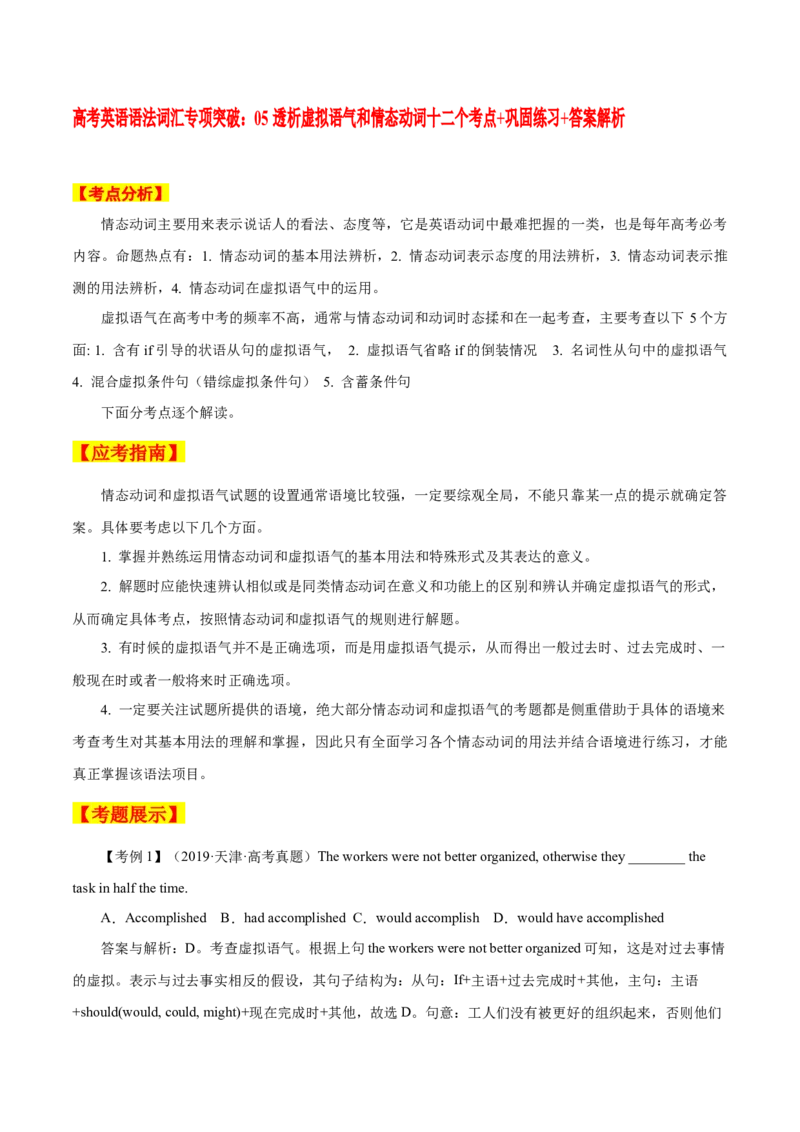
【考题展示】
【考例1】(2019·天津·高考真题)The workers were not better organized, otherwise they ________ the
task in half the time.
A.Accomplished B.had accomplished C.would accomplish D.would have accomplished
答案与解析:D。考查虚拟语气。根据上句the workers were not better organized可知,这是对过去事情
的虚拟。表示与过去事实相反的假设,其句子结构为:从句:If+主语+过去完成时+其他,主句:主语
+should(would, could, might)+现在完成时+其他,故选D。句意:工人们没有被更好的组织起来,否则他们用一半的时间就能完成任务。
【考例2】(2019·天津卷)Mary’s description of the party was so vivid that I felt as if I there.
A.would be B.might have been C.would have been D.had been
答案与解析:D。根据句意及句中felt可知,此处描述的是与过去事实相反的情况,应使用过去完成
时。故D选项正确。句意:玛丽对这次聚会的描述是如此生动,以至于我觉得我好像去过那里一样。
【考例3】(2017·天津卷)Ten days are devoted to this training program and ________ it be unsuccessful,
it could be repeated later.
A.should B.could C.might D.would
答案与解析:A。考查虚拟语气。结合后文“ it could be repeated later.”可知,此处表示与将来事实相
反的虚拟条件句,主句用would (should, could, might) +动词原形,从句动词用过去式(be 通常用were)或
用 should+动词原形或 were to+动词原形;且而虚拟条件句中,如有were、should或had,可将if省略,将
were、should或had提前至句首构成倒装。故选A。句意:我们用了10天的时间来完成这个训练计划,如
果不成功,以后还可以重复。
【考例4】(2018·天津卷)If we ___________the flight yesterday, we would be enjoying our holiday on the
beach
A.had caught B.caught C.have caught D.would catch
答案与解析:A。考查虚拟语气。根据时间状语yesterday可知,从句表示与过去事实相反,故用had +
v-ed。故选A。句意:如果我们昨天赶上飞机的话,现在我们正在海滩享受我们的假日了。
【考例5】(2016·天津卷)I was wearing a seatbelt. If I hadn’t been wearing one, I_________.
A.were injured B.would be injured C.had been injured D.would have been injured
答案与解析:D。考查虚拟语气。使用虚拟语气,根据if条件句用的had done可知,主句用would
have done表示对过去情况的虚拟,而且I和injure是被动关系。故选D。句意:我当时系着安全带。如果
我没有系安全带,我就会受伤了。
【考点解读】
考点一、考查表示推测意义的情态动词
must表示推测的语气最强,通常有一定的依据,在否定句或疑问句中用can或could代替。may/might
的推测语气比较弱。表示对过去的推测用must/ may/might/can’t/ couldn’t/ + have done。通常会在题干中设
置一定的事实作为推测的依据。
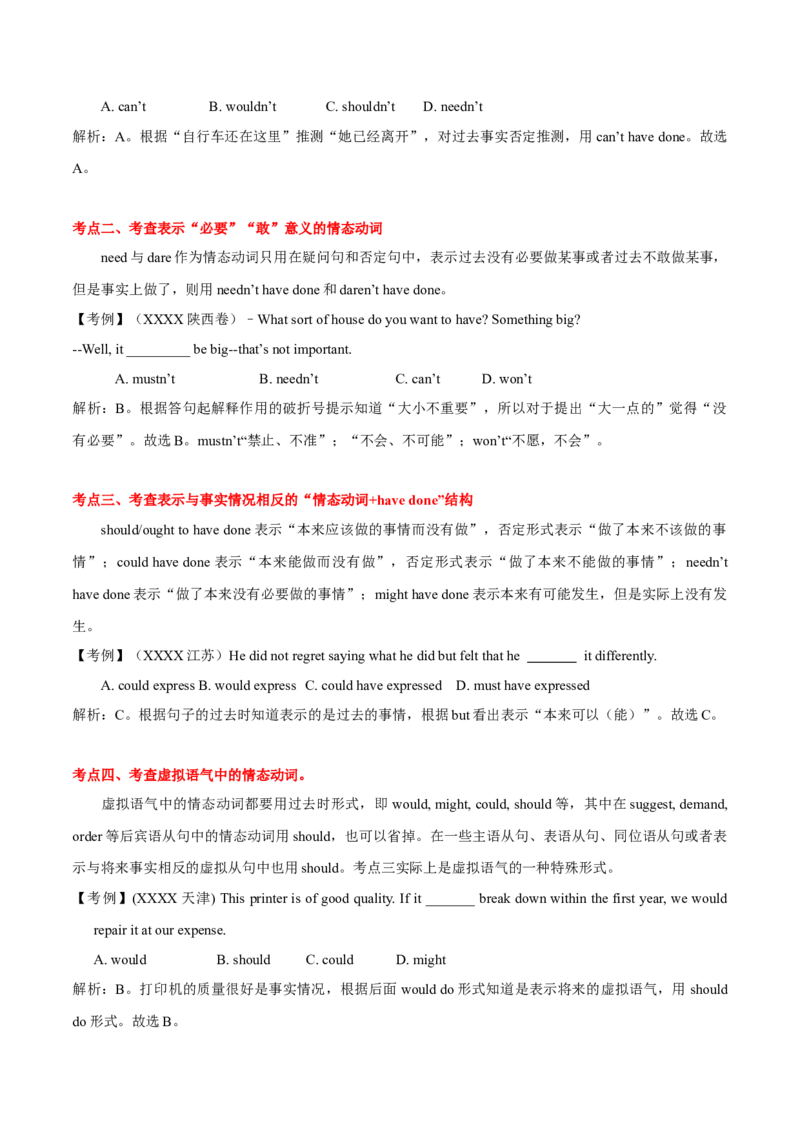
【考例】(XXXX天津卷)She ______ have left school, for her bike is still here.A. can’t B. wouldn’t C. shouldn’t D. needn’t
解析:A。根据“自行车还在这里”推测“她已经离开”,对过去事实否定推测,用can’t have done。故选
A。
考点二、考查表示“必要”“敢”意义的情态动词
need与dare作为情态动词只用在疑问句和否定句中,表示过去没有必要做某事或者过去不敢做某事,
但是事实上做了,则用needn’t have done和daren’t have done。
【考例】(XXXX陕西卷)–What sort of house do you want to have? Something big?
--Well, it _________ be big--that’s not important.
A. mustn’t B. needn’t C. can’t D. won’t
解析:B。根据答句起解释作用的破折号提示知道“大小不重要”,所以对于提出“大一点的”觉得“没
有必要”。故选B。mustn’t“禁止、不准”;“不会、不可能”;won’t“不愿,不会”。
考点三、考查表示与事实情况相反的“情态动词+have done”结构
should/ought to have done表示“本来应该做的事情而没有做”,否定形式表示“做了本来不该做的事
情”;could have done表示“本来能做而没有做”,否定形式表示“做了本来不能做的事情”;needn’t
have done表示“做了本来没有必要做的事情”;might have done表示本来有可能发生,但是实际上没有发
生。
【考例】(XXXX江苏)He did not regret saying what he did but felt that he it differently.
A. could express B. would express C. could have expressed D. must have expressed
解析:C。根据句子的过去时知道表示的是过去的事情,根据but看出表示“本来可以(能)”。故选C。
考点四、考查虚拟语气中的情态动词。
虚拟语气中的情态动词都要用过去时形式,即 would, might, could, should等,其中在suggest, demand,
order等后宾语从句中的情态动词用should,也可以省掉。在一些主语从句、表语从句、同位语从句或者表
示与将来事实相反的虚拟从句中也用should。考点三实际上是虚拟语气的一种特殊形式。
【考例】(XXXX天津) This printer is of good quality. If it _______ break down within the first year, we would
repair it at our expense.
A. would B. should C. could D. might
解析:B。打印机的质量很好是事实情况,根据后面 would do形式知道是表示将来的虚拟语气,用 should
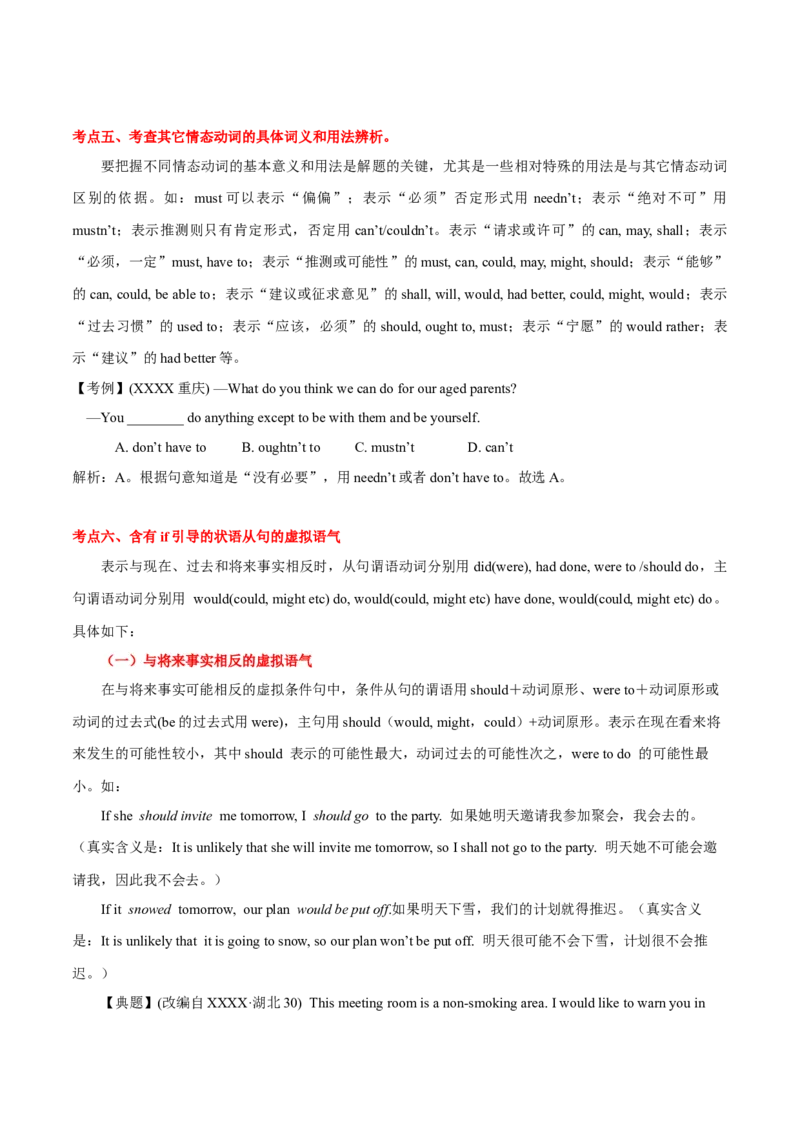
do形式。故选B。考点五、考查其它情态动词的具体词义和用法辨析。
要把握不同情态动词的基本意义和用法是解题的关键,尤其是一些相对特殊的用法是与其它情态动词
区别的依据。如:must可以表示“偏偏”;表示“必须”否定形式用 needn’t;表示“绝对不可”用
mustn’t;表示推测则只有肯定形式,否定用can’t/couldn’t。表示“请求或许可”的can, may, shall;表示
“必须,一定”must, have to;表示“推测或可能性”的must, can, could, may, might, should;表示“能够”
的can, could, be able to;表示“建议或征求意见”的shall, will, would, had better, could, might, would;表示
“过去习惯”的used to;表示“应该,必须”的should, ought to, must;表示“宁愿”的would rather;表
示“建议”的had better等。
【考例】(XXXX重庆) —What do you think we can do for our aged parents?
—You ________ do anything except to be with them and be yourself.
A. don’t have to B. oughtn’t to C. mustn’t D. can’t
解析:A。根据句意知道是“没有必要”,用needn’t或者don’t have to。故选A。
考点六、含有if引导的状语从句的虚拟语气
表示与现在、过去和将来事实相反时,从句谓语动词分别用 did(were), had done, were to /should do,主
句谓语动词分别用 would(could, might etc) do, would(could, might etc) have done, would(could, might etc) do。
具体如下:
(一)与将来事实相反的虚拟语气
在与将来事实可能相反的虚拟条件句中,条件从句的谓语用should+动词原形、were to+动词原形或
动词的过去式(be的过去式用were),主句用should(would, might,could)+动词原形。表示在现在看来将
来发生的可能性较小,其中should 表示的可能性最大,动词过去的可能性次之,were to do 的可能性最
小。如:
If she should invite me tomorrow, I should go to the party. 如果她明天邀请我参加聚会,我会去的。
(真实含义是:It is unlikely that she will invite me tomorrow, so I shall not go to the party. 明天她不可能会邀
请我,因此我不会去。)
If it snowed tomorrow, our plan would be put off.如果明天下雪,我们的计划就得推迟。(真实含义
是:It is unlikely that it is going to snow, so our plan won’t be put off. 明天很可能不会下雪,计划很不会推
迟。)
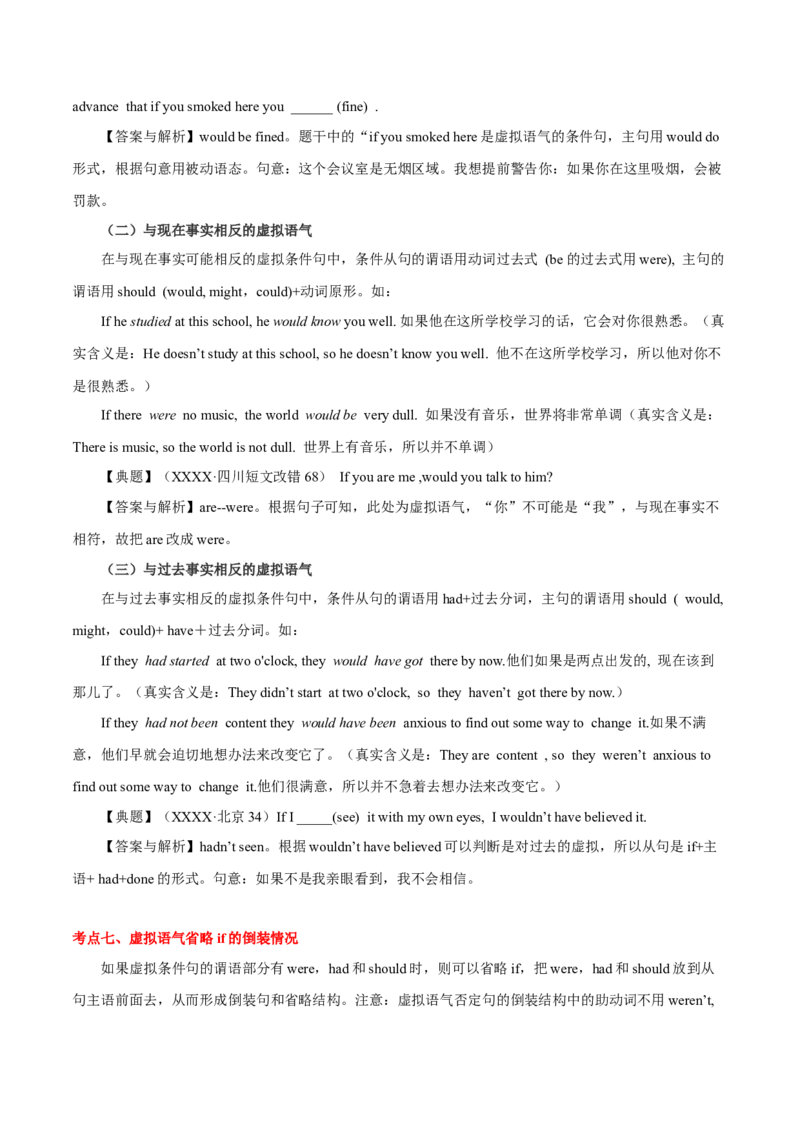
【典题】(改编自XXXX·湖北30) This meeting room is a non-smoking area. I would like to warn you inadvance that if you smoked here you ______ (fine) .
【答案与解析】would be fined。题干中的“if you smoked here是虚拟语气的条件句,主句用would do
形式,根据句意用被动语态。句意:这个会议室是无烟区域。我想提前警告你:如果你在这里吸烟,会被
罚款。
(二)与现在事实相反的虚拟语气
在与现在事实可能相反的虚拟条件句中,条件从句的谓语用动词过去式 (be的过去式用were), 主句的
谓语用should (would, might,could)+动词原形。如:
If he studied at this school, he would know you well. 如果他在这所学校学习的话,它会对你很熟悉。(真
实含义是:He doesn’t study at this school, so he doesn’t know you well. 他不在这所学校学习,所以他对你不
是很熟悉。)
If there were no music, the world would be very dull. 如果没有音乐,世界将非常单调(真实含义是:
There is music, so the world is not dull. 世界上有音乐,所以并不单调)
【典题】(XXXX·四川短文改错68) If you are me ,would you talk to him?
【答案与解析】are--were。根据句子可知,此处为虚拟语气,“你”不可能是“我”,与现在事实不
相符,故把are改成were。
(三)与过去事实相反的虚拟语气
在与过去事实相反的虚拟条件句中,条件从句的谓语用had+过去分词,主句的谓语用should ( would,
might,could)+ have+过去分词。如:
If they had started at two o'clock, they would have got there by now.他们如果是两点出发的, 现在该到
那儿了。(真实含义是:They didn’t start at two o'clock, so they haven’t got there by now.)
If they had not been content they would have been anxious to find out some way to change it.如果不满
意,他们早就会迫切地想办法来改变它了。(真实含义是:They are content , so they weren’t anxious to
find out some way to change it.他们很满意,所以并不急着去想办法来改变它。)
【典题】(XXXX·北京34)If I _____(see) it with my own eyes, I wouldn’t have believed it.
【答案与解析】hadn’t seen。根据wouldn’t have believed可以判断是对过去的虚拟,所以从句是if+主
语+ had+done的形式。句意:如果不是我亲眼看到,我不会相信。
考点七、虚拟语气省略if的倒装情况
如果虚拟条件句的谓语部分有were,had和should时,则可以省略if,把were,had和should放到从
句主语前面去,从而形成倒装句和省略结构。注意:虚拟语气否定句的倒装结构中的助动词不用weren’t,shouldn’t hadn’t等缩略形式,如:
Should it rain/were it to rain tomorrow, the sports meeting would be put off.(= If it should rain/were to
rain, ...)
Were it not raining, we should go for a picnic. (=If it were not raining, ...)
Had he seen you yesterday, he would have returned your book.(=If he had seen you yesterday, ...)
【考例1】(XXXX·江苏卷28)It might have saved me some trouble ______I known the schedule.
解析:had。根据题干中might have saved可知主句是对过去的虚拟,从句应用if I had known与主句保
持一致。if虚拟条件句中含有had时,可将if省去,同时将had提前构成倒装结构。句意:如果我早知道
日程安排,可能会省去我一些麻烦。
【考例2】 (XXXX湖北) ______fired, your health care and other benefits will not be immediately cut off.
A. Would you be B. Should you be C. Could you be D. Might you be
解析:B。句尾是句号,而备选项提供的句子开头都是情态动词,首先确定是陈述句,只有 should正
确,还原句子就是:If you should be fired, …。
考点八、名词性从句中的虚拟语气
在主语从句、宾语从句、同位语从句、表语从句中,表示建议、命令或要求的动词或名词后的从句谓语动
词常常用虚拟语气形式,即should+do,should也可以省掉。动词有request, suggest(建议), insist(坚持),
order, advise, demand, recommend, desire, urge 等;注意句型:It’s (high) time sb. did sth, It’s time sb. did sth,
It’s necessary/essential/ natural/ strange that sb. should do sth.,I’d rather you did sth.等;还有 wish that sb.
did/had done/ would(could, might…) do等。但是suggest表示“暗示,表明”;insist表示“坚持说,坚持某
种事实”不用虚拟语气。如:
He suggested that we should give her a hand.
It’s suggested that we should give her a hand.
His suggestion is that we should give her a hand.
What he suggested is that we should give her a hand.
【考例】(XXXX浙江)The doctor recommended that you swim after eating a large meal.
A .wouldn’t B. couldn’t C. needn’t D. shouldn’t
解析:recommend表示“建议”,宾语从句谓语动词用should do形式。故选D。
考点九、错综虚拟条件句
当条件从句与主句所表的时间不一致时,主句和从句的谓语动词并不相互呼应,此时主从句的谓语动词形式应该与各自所在句子中的时间状语或其所表达的意义相对应,虚拟语气的形式应作相应的调整,这
种条件句叫混合条件句或者错综虚拟条件句。较常见的是从句用过去完成时(指过去行为),而主句用一
般时(指目前状态)。如:
If I had a bike, I would have lent it to you yesterday. 假如我有自行车,昨天早就借给你了。(主句与过
去事实相反,从句与现在事实相反。)
If I had spoken to him yesterday, I should know what to do now. 假如昨天我对他说了,现在我就知道该
怎么办了。(真实含义是:I didn’t speak to him yesterday, so I don’t know what to do now. 我昨天没有跟他
说,现在我不知道怎么办。)
【考例1】(改编自XXXX·北京卷34)If we _____ (book) a table earlier, we couldn’t be standing here in
a queue.
【答案与解析】had booked。根据if和主句的couldn’t...here看出是虚拟语气,主句表示现在事实相反
的情况,从句的earlier提示是对过去的虚拟,用过去完成时态。句意:如果我们早点订桌的话,我们就不
可能在这里站着排队了。
【考例2】(XXXX上海) It is hard for me to imagine what I would be doing today if I ________ in love, at
the age of seven, with the Melinda Cox Library in my hometown
A. wouldn’t have fallen B. had not fallen C. should fall D. were to fall
解析:B。what I would be doing today表示现在的情况,而从句fall in love with the Melinda Cox Library
是过去的事情,从“在家乡”可以看出是与过去事实相反的假设,用过去完成时。故选B。
考点十、含蓄条件句
五、含蓄条件句的虚拟语气
虚拟条件句中的条件从句有时不表出来,只暗含在上下文中,这种句子叫含蓄条件句。常见的暗示在
像without“如果没有”, but for“要不是”,otherwise“要不然”, or(else)“否则”等单词或短语中。如:
Motionless, old Jolyon stared at the wall; but for his open eyes, he might have been asleep.老乔里恩一动不
动,望着墙壁;除掉一双眼睛还睁着外,他简直可以说还在睡觉。(but for his open eyes= if it hadn’t been
for his open eyes)
I'm not feeling very well today -- otherwise I would do it myself.今天我身体不太舒服,否则这事我就亲自
去做了。(otherwise = if I were feeling well today)
What would I have done without you? 如没有你,我会怎么办呢?(without you= if it hadn’t been for you)
He must be as strong as a horse, or he never could have defeated that great beast. 他一定是力大如牛,否则他绝不会击败那只庞大的野兽。(or = if he were not as strong as a horse )
【考例1】(XXXX·江苏34) Many of the things we now benefit from would not be around but for Thomas
Edison. 要不是爱迪生的发明,今天我们身边享用的很多东西都将不复存在。
【考例2】(XXXX·安徽32)It is lucky we booked a room, or we would have nowhere to stay now.
【考例3】(改编自XXXX·重庆7)______ his wartime experiences, Hemingway wouldn’t have written
his famous novel A Farewell to Arms.
【答案】Without。根据wouldn’t have written看出是虚拟语气,根据短文填空的要求知道没有提示词
的时候只填一个词,所以用Without, 不用But for。句意:没有他战时的经验,海明威就不可能写出著名的
小说《永别了武器》。
【考例4】(XXXX安徽)But for their help,we the program in time.
A.can not finish B.will not finish C.had not finished D.could not have finished
解析:in time表示“及时”,暗示finish动作已经发生过。
考点十一、if only引导的虚拟条件句
if only...用于感叹句中, 是一个保留条件句, 省略了主句的形式。用来表示某人对某事的一种强烈愿望
或未实现的条件, 其意为“但愿……; 真希望……; 要是……就好了”。其谓语动词形式用过去将来时表示
将来不大可能实现的愿望;接一般过去时,表示对现在的一种难以实现的愿望;接过去完成时,表示过去
没有实现的愿望。如:
If only it would clear up soon! 但愿天气赶快放晴。
If only she were my sister! 如果她是我姐姐该多好啊! (= How fine it would be if he were my sister. )
If only you had worked with great care! 你当时干活时要是再认真些就好了!(but you didn’t work with
care)
If only you would listen to reason. 你听从道理就好了。
【考例1】(XXXX上海春招)Look at the trouble I am in! If only I _____ your advice.
A. followed B. would follow C. had followed D. should follow
解析:C。前一句的一般现在时指目前的情况,而目前的结果正是由于在此之前没有采纳你的建议才
造成的,由此可知是表示与过去事实相反的情况,所以谓语动词用过去完成式。故选C。
【考例2】The snow is soft and deep outside. If _____ he could get out to try his new sled.
解析:only。根据if从句的谓语动词看是表示与事实相反的虚拟语气,根据if 看出是表示因为不能出
去试试他的新雪橇二感到遗憾,if only“要是……就好了”符合题意。句意是:外头的雪下得柔软又深厚,
如果他能出去试试他的新雪橇该多好!考点十二、状语从句的虚拟条件句
as if /as though 后有时用虚拟语气,如果表示的可能性比较大也可以不用虚拟语气。
【考例】(XXXX全国卷) Eliza remembers everything exactly as if it _____ yesterday.
A. was happening B. happens C. has happened D. happened
解析:根据时间状语yesterday排除B和C。昨天是一般过去时的标志。故选D。
【真题体验】
1. (XXXX安徽) Some people who don’t like to talk much are not necessarily shy;they _____ just be
quiet people.
A.must B.may C.should D.would
解析:根据not necessarily和just的提示知道后面是“有可能”的意思,并非“一定是”,也没有道理能说
明“应该是”,may表示“有可能”,符合题意。故选B。
2. (XXXX安徽) The teacher_________ have thought Johnson was worth it or she wouldn't have wasted time on
him, I suppose.
A. should B. can C. would D. must
解析:D。wouldn't have wasted 是虚拟语气形式,表示与过去事实相反的情况,因此是对老师过去对
Johnson看法的肯定推测,用must have done。故选D。
3. (XXXX 合肥二模) I tried more than once to persuade the taxi driver to slow down, but he just ______
listen.
A shouldn’t B mustn’t C couldn’t /D wouldn’t
解析:根据persuade“说服”的提示和转折词but知道司机“不愿意”听,情态动词表示意愿。只有 would
有此意。故选D。
4. (XXXX 合肥三模) It is required in some colleges that lights in students’ dorms ____ off by 11
o’clock.
A. be switched B. would switch C. should switch D. must be switched
解析: A。根据that引导的主语从句是谓语动词require的具体内容确定用should do学生的虚拟语气,主语
lights与switch off 是动宾关系,而且should可以省掉。故选A。
5. (XXXX全国卷II) If the weather had been better, we could have had a picnic. But it ____ all day.
A. rained B. rains C. has rained D. is raining解析:A。根据前面从句的过去完成时和主句的would +完成式的构成形式可以知道是表示过去的事情,即
“天气要是好的话,我们本来是可以去野餐的”,但是实际上并没有。因此后一句所讲的下雨应该是在过
去,故选A。
6.(XXXX江西)What a pity. Considering his ability and experience, he ____ better.
A. need have done B. must have done C. can have done D. might have done
解析:D。What a pity表明没能够做得更好,所以表示本来有做得更好的可能,但是没有做成,用 might
have done。故选D。
7. (XXXX重庆)—Hi, Tom. Any idea where Jane is?
— She _____in the classroom . I saw her there just now.
A. shall be B. should have been C. must be D. might have been
解析:C。问的是“现在在那里”,just now提示“刚刚”看到她在那里,所以推测她目前在教室,肯定语
气强。选C。
8.(XXXX湖南)You don’t have to know the name of the author to find a book. You _____ find the book by the
title.
A. must B. need C. can D. would
解析:C。根据前面的don’t have to“没有必要…”知道“可以”有另一种选择。need表示“需要”用在疑
问句和否定句中,must表示“必须”,would表示过去将来或表示“愿意”,都与题意不符。C正确。句
意是:要找到一本书,你没有必要必须知道作者的名字,你可以通过书名找到书。
9.(XXXX天津卷)She ______ have left school, for her bike is still here.
A. can’t B. wouldn’t C. shouldn’t D. needn’t
解析:A。for说明原因,“书还在那里”说明“没有离开学校”,表示推测,符合表示对过去事实否定推
测的结构can’t have done。故选A。
10. (XXXX 福建) But for the help of my English teacher, I the first prize in the English Writing
Competition.
A. would not win B. would not have won C. would win D. would have won
解析:B。but for意思是“要不是”,句子的谓语动词用虚拟语气。根据句子的意思看出相当于 If it had
not been for …,“获奖”是已经发生的事情,表示与过去事实相反,用would have done形式。故选B。
【模拟训练】
一、热身训练
1. You ______ change trains at Peterborough if you're going to Newcastle, for there is no direct one.A. would B. ought to C. ought D. had to
2. There was only five minutes to go. She ______ make a choice between the two dresses.
A. has to B. will C. can D. had to
3. He told me that there were only five seats? But there ______ be seven.
A. will B. should C. had to D. can
4. She can’t leave. Her mother told her that she_____ stay at home until her father comes back.
A. must B. can C. will D. may
5. --- Mum, can I watch TV now?
--- Have you finished your homework? You know, you ______ fail if you don’t work hard.
A. would B. need C. might D. shall
6. --- It’s not your home. It’s the school. So you ______ know smoking is not allowed here. ----Oh, sorry.
A. must B. may C. dare D. need
7. I told Mary how to work out the problem, but perhaps I ________ her a chance to think it over alone.
A. had to give B. must have given C. should have given D. ought to give
8. ---- Must we hand in our exercise books today?
---- No, you ________.
A. don’t have to B. need B. should C. oughtn’t
9. Patients ______ use medicine according to the doctor’s orders.
A. will B. may C. must D. might
10. Jack, you ______ play with the knife; you ______ hurt yourself.
A. won’t; can’t B. mustn’t; may C. shouldn’t; must D. can’t; should
11. I didn’t see your sister at the meeting. If she ________, she would have met my brother.
A. has come B. did come C. came D. had come
12. The little hero’s pale face suggested he ________dead, so the general ordered that all the soldiers ______
should salute him.
A. is; saluted B. was; salute C. should be; to salute D. be; salute
13. I wish that you ____ such a bad headache because I am sure that you would have enjoyed the concert
A. had not B. did not have had C. hadn’t had D. hadn’t have
14. He talked as if he ______ for years,ignoring the fact that it was the first time that they had met.
A. has lived there B. is living there C. was living there D. had lived there
15. The teacher agreed to the suggestion that the students ___ two weeks to prepare for the exam.
A. give B. should give C. be given D. would be given二、强化训练
1. (XXXX全国卷I)What do you mean, there are only ten tickets? There be twelve.
A. should B. would C. will D. shall
2. (XXXX全国卷II) I can’t leave. She told me that I _____ stay here until she comes back.
A. can B. must C. will D. may
3. (XXXX北京) One of the few things you _______ say about English people with certainty is that they talk a lot
about the weather.
A. need B. must C. should D. can
4. (XXXX四川)—I don’t care what people think.
—Well, you _______.
A. could B. would C. should D. might
5. (XXXX湖南)---It’s the office! So you ______ know eating is not allowed here.
---Oh, sorry.
A. must B. will C. may D. need
6. (XXXX山东卷)Thank you for all your hard work last week. I don’t think we ______ it without you.
A. can manage B. could have managed C. could manage D. can have managed
7. (XXXX辽宁) The traffic is heavy these days. I arrive a bit late, so could you save me a place?
A can B must C need D might
8. (XXXX全国卷II) If the weather had been better, we could have had a picnic. But it ____ all day.
A. rained B. rains C. has rained D. is raining
9. (XXXX江西) What a pity. Considering his ability and experience, he ____ better.
A. need have done B. must have done C. can have done D. might have done
10. (XXXX陕西) I told your friend how to get to the hotel, but perhaps I have driven her there.
A. could B. must C. night D. should
11. (XXXX重庆)—Hi, Tom. Any idea where Jane is?
— She _____in the classroom . I saw her there just now.
A. shall be B. should have been C. must be D. might have been
12.(XXXX江苏)—I’m sorry. I ______ at you the other day.
—Forget it. I was a bit out of control myself.
A. shouldn’t shout B. shouldn’t have shoutedC. mustn’t shout C. mustn’t have shouted
13. (XXXX上海) According to the air traffic rules, you ___ switch off your mobile phone before boarding.
A. may B. can C. would D. should
14. (XXXX江苏卷).---- Don't you think it necessary that he _______ to Miami but to New York?
---- I agree, but the problem is ________ he has refused to.
A. will not be sent; that B. not be sent; that
C. should not be sent; what D. should not send; what
15. (XXXX北京) In crowded places like airports and railway stations, you___ take care of your luggage.
A. can B. may C. must D. will
参考答案:
一、热身训练
1. B。根据后面说“没有直达的火车”推出“应该”转乘。故选B,相当于should。C少 to,A和D是
过去时,而if从句是一般将来时,时态不一致。
2. D。“只有五分钟”决定着“必须选择”,是“不得不”做的事情,根据过去时态用had to。
3. 选B。实际上只有5个座位,所以题干提到的7个只可以理解为“应该”有7个,从前面的only的
语气也可以看出。故选B。
4. A。根据“不能离开”看出"呆在家里"是“必须”做的事情,提出要求。故选A。
5. D。此处shall 用于第二称,表示说话人给对方的警告。
6. A。从语境看表示的是批评,dare和need作为情态动词用在疑问句和否定句中,选A,意思是:那
么你一定知道校园里是不允许抽烟的。
7. C。由句中的连词but可知前后句之间是对立关系,分析题意可知意思是“本来该给她独立思考的机
会”,但是实际上“我告诉过她如何解那道题”,本题应选C。
8. A。表示“没有必要”时,don’t have to或者needn’t都可以回答must的提问。
9. C。表示“必须”,句意是:病人用药一定要遵医嘱。
10. B。根据语境看出是要求孩子不要玩刀子,这样是很危险的,所以应该是“禁止,不准”,用
mustn’t,后面表示由弄伤的可能。故选B。
11. D。前一句提示知道表示与过去事实相反的情况,由主句would have met看出从句用过去完成时。
故选D。12. B。suggest不表示“建议”,而是“表明,暗示”的意思,宾语从句谓语不用虚拟语气,order所
跟宾语从句用虚拟语气,用(should) salute。故选B。
13. C。从would have enjoyed得出表示过去的事情,wish后从句谓动用虚拟语气,所以是过去完成
时。故选C。
14. D。根据后面“忽视了这是他们第一次见面”知道是虚拟语气,根据时间状语for years
完成时,表示所设想的动作live发生在talk之前。
15. C。同位语从句表明suggestion“建议”的具体内容,用虚拟语气。故选C。
二、强化训练
1. A。only暗示说明数量少,问号表明感到惊讶,然后陈述事实“应该是”十二张票。选A。
2. B。“不能离开”是因为她的要求,所以是“必须”,用must。
3. D。根据with certainty的提示看出是“可以,能够”的意思。故选D。
4. C。well起着提醒作用,对“不在乎别人怎么想”提出反对意见,此处 should表示建议,意思是
“应该”。故选C。
5. A。由It’s the office! “这是在办公室”可以推出你“一定”会知道“不准在此吃东西”,表示语气很
强的推测,故选A。
6. B。根据without you和前面过去时间状语last week可以看出表示与过去事实相反,表示本来不能做
成,但是实际上做成了,用could have done结构。故选B。
7. D。这些天的交通量比较大,但是并没有具体到今天会是什么样子,题干是肯定句,表示“有可
能”晚到一会,尽管可能性不是很大。选D。
8. A。根据前面与过去事实相反的虚拟语气知道后面陈述过去的事实情况,下雨应该是在过去,即当
时在下雨,故选A。
9. D。根据What a pity看出是虚拟语气,属于third conditional,而A、B、C选项的情态动词都是一般
时,不能构成虚拟语气,只有D符合。
10. D。根据转折词but可以看出“已经告诉你的朋友如何到宾馆”,从语境中可以看出你的朋友还没
有来,所以是“本来应该用车把她送到这里的”,但是实际上没有做。故选D。
11. C。根据“刚刚看到”知道是语气非常肯定的,确定现在就在教室里,所以用must。选C。
12. B。根据下面的过去时和上句过去时状语the other day“几天前”知道“本来不应该对你大叫”,但
是实际上对你大喊大叫了,用shouldn’t have done。故选B。
13. D。should可表示责任或义务,意思是“必须,应该”,根据traffic rules知道选D。14. 解析:句型it be necessary/essential/ strange/ natural/ vital…that…中的从句谓语动词用should+动词
原形,其中should可以省掉,排除A。答句是表语从句,而从句引导词不作成分,不可以用 what。故选
B。
15. 解析:C。在像机场或者火车站这样的地方,你“必须”照看好你的行李。这是一个常识,是在这
些地方“必须”要做的,不然行李就可能丢失,所以是强调一个客观的要求。故选C。