文档文本内容
【同步 100 分背默】 Unit1 What's the matter?知识清单
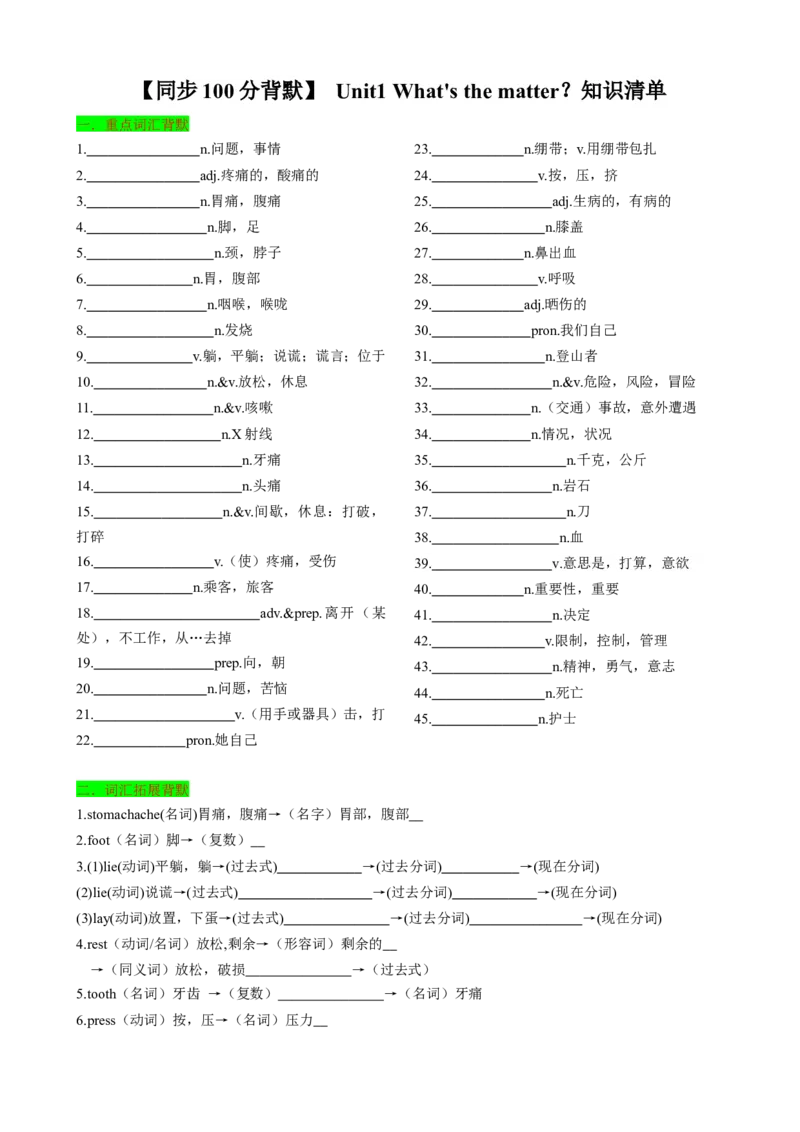
一.重点词汇背默
1. n.问题,事情 23. n.绷带;v.用绷带包扎
2. adj.疼痛的,酸痛的 24. v.按,压,挤
3. n.胃痛,腹痛 25. adj.生病的,有病的
4. n.脚,足 26. n.膝盖
5. n.颈,脖子 27. n.鼻出血
6. n.胃,腹部 28. v.呼吸
7. n.咽喉,喉咙 29. adj.晒伤的
8. n.发烧 30. pron.我们自己
9. v.躺,平躺;说谎;谎言;位于 31. n.登山者
10. n.&v.放松,休息 32. n.&v.危险,风险,冒险
11. n.&v.咳嗽 33. n.(交通)事故,意外遭遇
12. n.X射线 34. n.情况,状况
13. n.牙痛 35. n.千克,公斤
14. n.头痛 36. n.岩石
15. n.&v.间歇,休息:打破, 37. n.刀
打碎 38. n.血
16. v.(使)疼痛,受伤 39. v.意思是,打算,意欲
17. n.乘客,旅客 40. n.重要性,重要
18. adv.&prep.离开(某 41. n.决定
处),不工作,从…去掉 42. v.限制,控制,管理
19. prep.向,朝 43. n.精神,勇气,意志
20. n.问题,苦恼 44. n.死亡
21. v.(用手或器具)击,打 45. n.护士
22. pron.她自己
二.词汇拓展背默
1.stomachache(名词)胃痛,腹痛→(名字)胃部,腹部
2.foot(名词)脚→(复数)
3.(1)lie(动词)平躺,躺→(过去式) →(过去分词) →(现在分词)
(2)lie(动词)说谎→(过去式) →(过去分词) →(现在分词)
(3)lay(动词)放置,下蛋→(过去式) →(过去分词) →(现在分词)
4.rest(动词/名词)放松,剩余→(形容词)剩余的
→(同义词)放松,破损 →(过去式)
5.tooth(名词)牙齿 →(复数) →(名词)牙痛
6.press(动词)按,压→(名词)压力7.sick(形容词)生病的,有病的→(名词)疾病
→(同义词) →(名词)
8.breathe(动词)呼吸→(名词)呼吸
9.we(代词)我们→(宾格)我们 →(形容词性物主代词)我们的
→(名词性物主代词)我们的 →(反身代词)我们自己
10.climb(动词)攀登→(名词)攀登者
11.situation(名词)情况,状况→(同义词)
12.knife(名词)刀→(复数)
13.mean(动词)意思是,打算→(过去式)
→(名词)意思,意义
→(形容词)有意义的 →(反义词)毫无意义的
14.importance(名词)重要性→(形容词)重要的
15.decision(名词)决定→(动词)决定
16.death(名词)死亡→(动词)死 →(形容词)死了的
17.nurse(名词)护士→(名词)护理
二.重点短语背默
1.说得太多 (3)认为想起
2.嗓子痛 20.(1)上车
3.发烧 (2)下车
4.胃痛 21.迅速行动
5.(1)躺下休息 22.期待某人做某事
(2)休息 23.等待
6.量体温 24.令某人惊讶的是
7.看牙医 25.(1)同意做某事
8.喝加蜂蜜的热茶 (2)和某人意见一致/用意某人的观点
9.在...上面敷药 26.把...移动到...上面
10.头痛 27.(1)多亏,由于
11.远离 (2)因...而感谢
12.以同样的方式 28.被拯救
13.沿着...走 29.(1)及时
14.(1)看见某人做某事 (2)准时
(2)看见某人正在做某事 30.(1)陷入麻烦
15.在马路边 (2)做某事有困难
16.在...旁边/紧挨着
17.大声呼救 (3)在某事上有困难
18.一位十八岁的司机
19.(1)不假思索 31.伤到自己
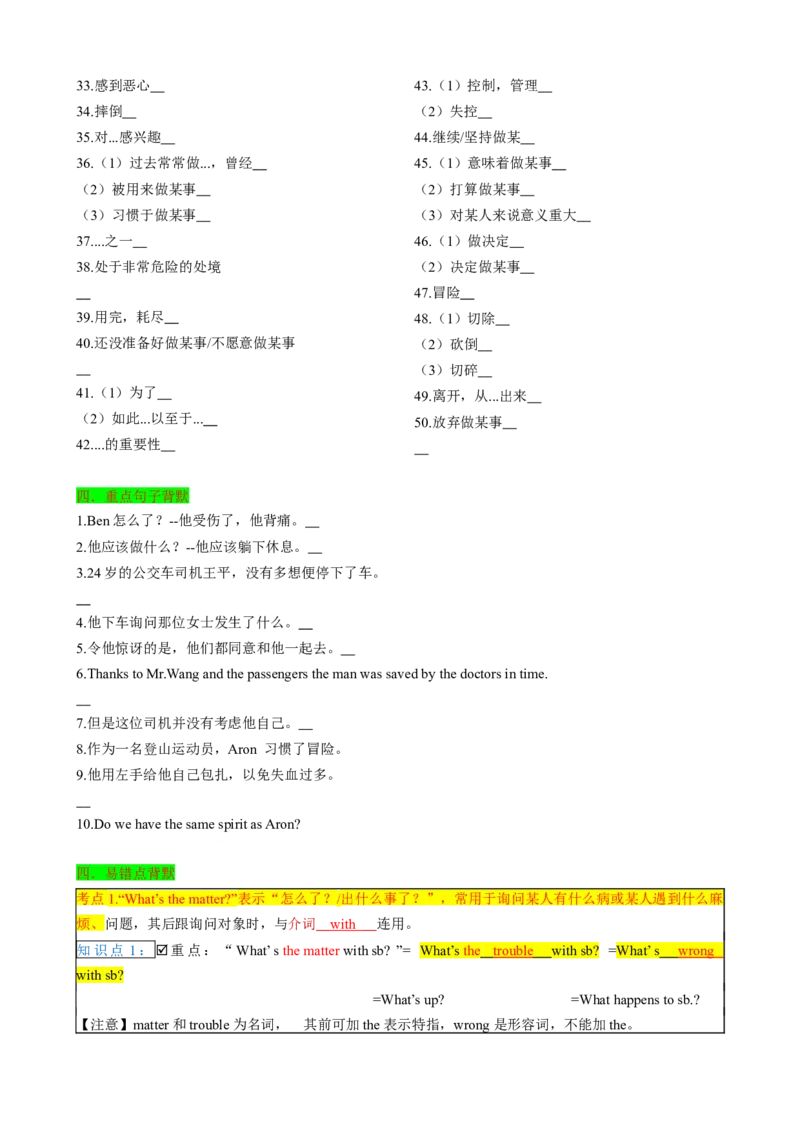
(2)思考 32.用绷带包扎...33.感到恶心 43.(1)控制,管理
34.摔倒 (2)失控
35.对...感兴趣 44.继续/坚持做某
36.(1)过去常常做...,曾经 45.(1)意味着做某事
(2)被用来做某事 (2)打算做某事
(3)习惯于做某事 (3)对某人来说意义重大
37....之一 46.(1)做决定
38.处于非常危险的处境 (2)决定做某事
47.冒险
39.用完,耗尽 48.(1)切除
40.还没准备好做某事/不愿意做某事 (2)砍倒
(3)切碎
41.(1)为了 49.离开,从...出来
(2)如此...以至于... 50.放弃做某事
42....的重要性
四.重点句子背默
1.Ben怎么了?--他受伤了,他背痛。
2.他应该做什么?--他应该躺下休息。
3.24岁的公交车司机王平,没有多想便停下了车。
4.他下车询问那位女士发生了什么。
5.令他惊讶的是,他们都同意和他一起去。
6.Thanks to Mr.Wang and the passengers the man was saved by the doctors in time.
7.但是这位司机并没有考虑他自己。
8.作为一名登山运动员,Aron 习惯了冒险。
9.他用左手给他自己包扎,以免失血过多。
10.Do we have the same spirit as Aron?
四.易错点背默
考点1.“What’s the matter?”表示“怎么了?/出什么事了?”,常用于询问某人有什么病或某人遇到什么麻
烦、问题,其后跟询问对象时,与介词 wit h 连用。
知识点 1:重点:“What’ s the matter with sb? ”= What’s the trouble with sb? =What’ s wrong
with sb?
=What’s up? =What happens to sb.?
【注意】matter 和trouble 为名词, 其前可加the 表示特指,wrong 是形容词,不能加the。知识点2: matter还可作动词v.,意为“要紧;关系重大”。
常用句型:It doesn’t matter. “没关系”,用来回答对方的道歉。
Eg.—Sorry, I’m late. I got stuck in a traffic jam. 抱歉,我来晚了。路上堵车。
—It doesn’t matter. 没关系。
1.—_______?
—I have a headache and I don’t feel like eating anything.
A. How are you B. What can I do for you
C. What’s the matter with you D. How do you like it
考点2.have a cold 感冒
have 在此处作及物动词,意为“患病”,可与get或catch 互换。 cold 前可用bad、heavy等词修饰。
Because the temperature dropped sharply, many students had/got/caught a bad cold.
【易错警示】have表示“患病”时, 不可用于进行时。
【拓展】“表示身体部位的名词+ ache”常表示“……痛”, 常见的还有:
tooth (牙齿) + ache = toothache (牙痛)
head (头) + ache = headache (头痛)
back (背) + ache = backache (背痛)
ear (耳朵) + ache = earache (耳朵痛)
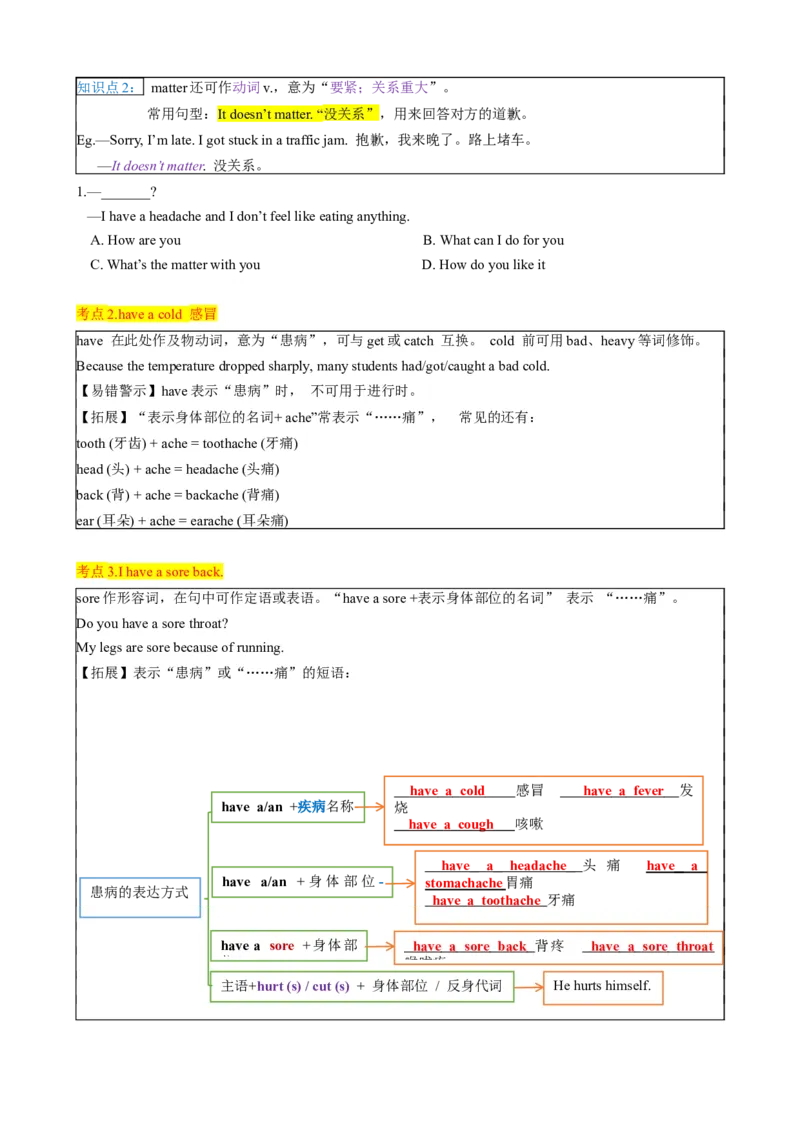
考点3.I have a sore back.
sore作形容词,在句中可作定语或表语。“have a sore +表示身体部位的名词” 表示 “……痛”。
Do you have a sore throat?
My legs are sore because of running.
【拓展】表示“患病”或“……痛”的短语:
hav e a cold 感冒 hav e a feve r 发
have a/an +疾病名称 烧
hav e a cough 咳嗽
have a headache 头 痛 have a
have a/an +身体部位- stomachache 胃痛
患病的表达方式
ache hav e a toothach e 牙痛
have a sore +身体部 have a sore back 背疼 have a sore throa t
位 喉咙疼
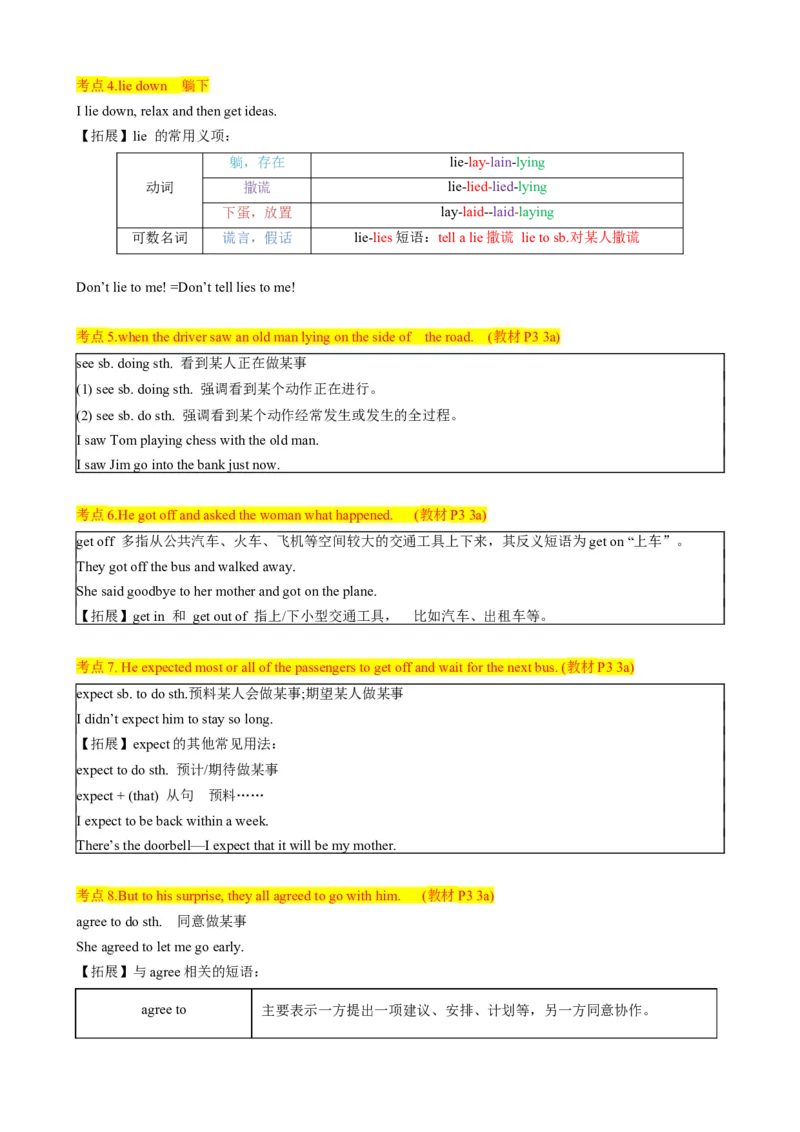
主语+hurt (s) / cut (s) + 身体部位 / 反身代词 He hurts himself.考点4.lie down 躺下
I lie down, relax and then get ideas.
【拓展】lie 的常用义项:
躺,存在 lie-lay-lain-lying
动词 撒谎 lie-lied-lied-lying
下蛋,放置 lay-laid--laid-laying
可数名词 谎言,假话 lie-lies短语:tell a lie撒谎 lie to sb.对某人撒谎
Don’t lie to me! =Don’t tell lies to me!
考点5.when the driver saw an old man lying on the side of the road. (教材P3 3a)
see sb. doing sth. 看到某人正在做某事
(1) see sb. doing sth. 强调看到某个动作正在进行。
(2) see sb. do sth. 强调看到某个动作经常发生或发生的全过程。
I saw Tom playing chess with the old man.
I saw Jim go into the bank just now.
考点6.He got off and asked the woman what happened. (教材P3 3a)
get off 多指从公共汽车、火车、飞机等空间较大的交通工具上下来,其反义短语为get on “上车”。
They got off the bus and walked away.
She said goodbye to her mother and got on the plane.
【拓展】get in 和 get out of 指上/下小型交通工具, 比如汽车、出租车等。
考点7. He expected most or all of the passengers to get off and wait for the next bus. (教材P3 3a)
expect sb. to do sth.预料某人会做某事;期望某人做某事
I didn’t expect him to stay so long.
【拓展】expect的其他常见用法:
expect to do sth. 预计/期待做某事
expect + (that) 从句 预料……
I expect to be back within a week.
There’s the doorbell—I expect that it will be my mother.
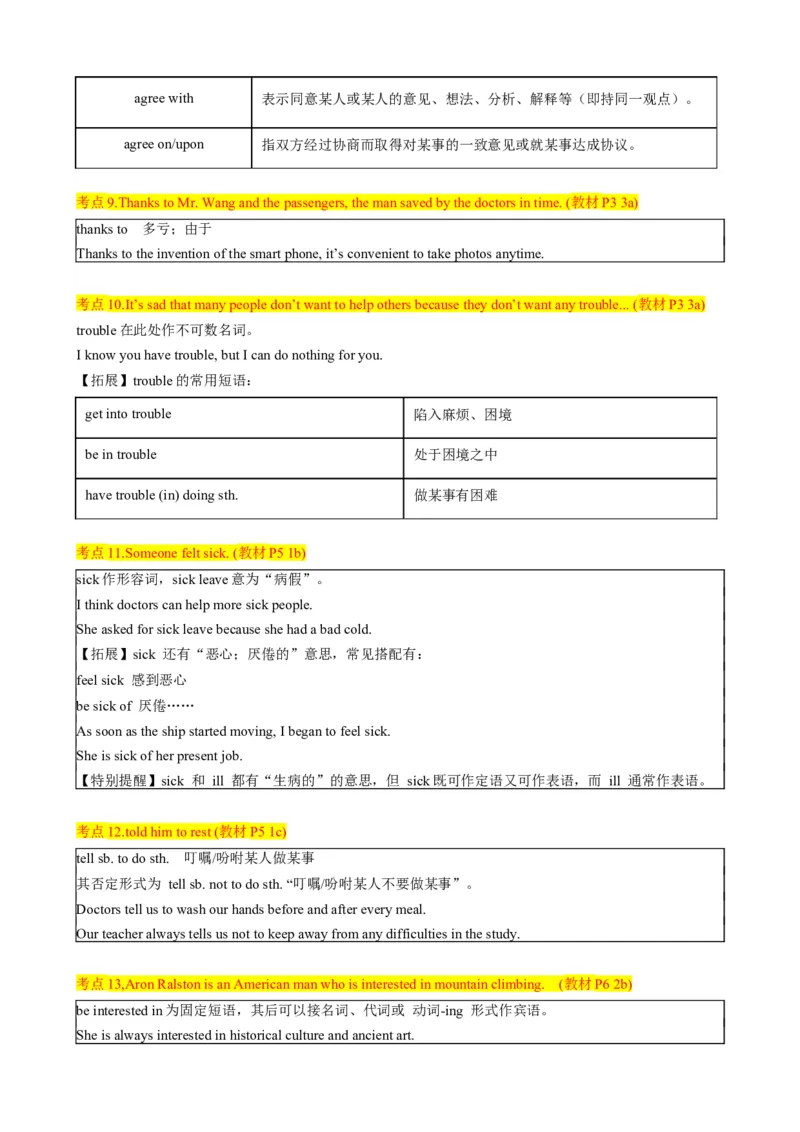
考点8.But to his surprise, they all agreed to go with him. (教材P3 3a)
agree to do sth. 同意做某事
She agreed to let me go early.
【拓展】与agree相关的短语:
agree to 主要表示一方提出一项建议、安排、计划等,另一方同意协作。agree with 表示同意某人或某人的意见、想法、分析、解释等(即持同一观点)。
agree on/upon 指双方经过协商而取得对某事的一致意见或就某事达成协议。
考点9.Thanks to Mr. Wang and the passengers, the man saved by the doctors in time. (教材P3 3a)
thanks to 多亏;由于
Thanks to the invention of the smart phone, it’s convenient to take photos anytime.
考点10.It’s sad that many people don’t want to help others because they don’t want any trouble... (教材P3 3a)
trouble在此处作不可数名词。
I know you have trouble, but I can do nothing for you.
【拓展】trouble的常用短语:
get into trouble 陷入麻烦、困境
be in trouble 处于困境之中
have trouble (in) doing sth. 做某事有困难
考点11.Someone felt sick. (教材P5 1b)
sick作形容词,sick leave意为“病假”。
I think doctors can help more sick people.
She asked for sick leave because she had a bad cold.
【拓展】sick 还有“恶心;厌倦的”意思,常见搭配有:
feel sick 感到恶心
be sick of 厌倦……
As soon as the ship started moving, I began to feel sick.
She is sick of her present job.
【特别提醒】sick 和 ill 都有“生病的”的意思,但 sick既可作定语又可作表语,而 ill 通常作表语。
考点12.told him to rest (教材P5 1c)
tell sb. to do sth. 叮嘱/吩咐某人做某事
其否定形式为 tell sb. not to do sth. “叮嘱/吩咐某人不要做某事”。
Doctors tell us to wash our hands before and after every meal.
Our teacher always tells us not to keep away from any difficulties in the study.
考点13,Aron Ralston is an American man who is interested in mountain climbing. (教材P6 2b)
be interested in为固定短语,其后可以接名词、代词或 动词-ing 形式作宾语。
She is always interested in historical culture and ancient art.He was interested in playing soccer when he was young.
考点14.As a mountain climber, Aron is used to taking risks. (教材P6 2b)
be used to 后常接名词、代词或动词-ing 形式作宾语。
I’m used to getting up early.
You will soon be/get used to the weather here.
考点15. There were many times when Aron almost lost his life because of accidents. (教材P6 2b)
【易混辨析】because of 和because的区别:
后可接名词、代词或动词- Because of too much traffic, I was lat
because of 短语介词
ing形式作宾语 e for the meeting.
He didn’t go to school because he wa
because 连词 后接句子
s ill.
考点16. But when his water ran out, he knew that he would have to do something to save his own life. (教材P6
2b)
动词不定式短语作目的状语
本句中的to save his own life为动词不定式短语,在句中作目的状语。动词不定式短语既可位于句首,也
可位于句末。如果置于句首,需要用逗号隔开。
They burn waste to make electricity in a green way.
To draw maps well, you need a special pen.
考点17.He was not ready to die that day. (教材P6 2b)
be ready to do sth. 准备好做某事;愿意做某事
(1) be ready to do sth. 在此处意为“准备好做某事”,其同义短语为get ready to do sth.。be 强调状态,get
强调动作。
I’m ready to pick you up.
(2) be ready to do sth. 还可意为“愿意做某事”。
I’m ready to answer your questions.
【拓展】be/get ready for 意为“为……做准备”。其中for为介词,其后跟名词、代词或动词-ing形式。
We are getting ready for the competition.
I’ve been ready for making dinner.
考点18.Then, with his left arm, he bandaged himself so that he would not lose too much blood. (教材P6 2b)
【易混辨析】with和in都可表示“用”的意思,其区别如下:
with 用 (工具、手段等) Chop the onions with a sharp knife.in 用 (语言、声音、材料等) Please retell the fairy tale in English.
考点19.This means being in a difficult situation that you cannot seem to get out of. (教材P6 2b)
mean /miːn/ v. 意思是;打算;意欲
(1) mean在此处作动词,意为“意思是”,其名词形式为meaning,意为“意思;含义”。What
do/does…mean? =What’s the meaning of…? 意为“……是什么意思?”
What does this word mean? = What’s the meaning of this word?
(2) mean作动词,还可表示“打算;意欲”。mean to do sth. 表示“打算做某事”。
We mean to visit you tomorrow.
考点20. His love for mountain climbing is so great that he kept on climbing mountains even after this experience.
(教材P6 2b)
so...that...引导结果状语从句,其中so为副词,后面常接形容词或副词的原级。
Chongqing is so beautiful that thousands of tourists visit it every year.
【拓展延伸】重点:so......that与such......that的用法
so+ 形容词 / 副词 + that
如此…… such + a/an + 形容词 + 名词单数 +
以至于……
that
such + 形容词 + 名词复数 / 不可数名词 + that
1.The teacher speaks very loudly ________ all the students can hear her.
A. so that B. because C. since D. when
2.They spoke _______ quietly _________ I could hardly hear them.
A.such ; that B.so ; that C.neither ; nor D.both ; and
3.Story Sign is ________ a useful app _________it can make it easier for deaf children.
A. so; that B. such ; that C. too ;to do D. as; as
考点21. His love for mountain climbing is so great that he kept on climbing mountains even after this experience.
(教材P6 2b)
keep on doing sth. 继续做某事
Keep on learning as long as you live.
【拓展】keep的其他常见搭配:
keep sb. doing sth. 让某人一直做某事
keep sb. from doing sth. 阻止某人做某事
keep sb. /sth. + adj. 使某人/某物保持……状态
Tom kept his friend waiting outside the gate.The heavy rain kept us from going to school.
We must keep our classroom clean and tidy.
五.语法点记忆
1.表示疾病及事故伤害的语言特征
1.用“have/ a(n)+疾病名称”表示患病。
have a fever、have a cough、have a stomachache、get a toothache等。
2.用“be/feel+形容词”表示不适,或用“get+动词的过去分词形式”表示受伤。
be/feel tired、be/feel sick、head feels hot、get hurt、get hit by a ball等。
3.用动词take/get (以take更为常见)表达诊治。
take one’s temperature、take some medicine、take/get an X-ray等。
4.用see或go to...表达就医。
see the dentist/doctor、go to a doctor、go to (the) hospital等。
5.用动词“hurt/cut/break+具体部位”等表示伤害。
hurt my leg、cut her finger、break him arm等。
hurt/cut等动词还可接用反身代词进行反指,表示“伤着/切着某人自己了”。hurt myself、cut himself等。
6.用情态动词should或had better表达建议。
You should lie down and have a rest.
He’d better go to a doctor.
2.反身代词的用法
-self(单数)/ -selves(复数)
一、反身代词的分类
第一人称 第二人称 第三人称
单数 myself yourself himself herself itself
我自己 你自己 他自己 她自己 它自己
复数 ourselves yourselves themselves
我们自己 你们自己 他们自己
二、反身代词的用法
1.反身代词多用于动词或介词后作宾语,表示“某人自己”
Eg. He learned to ride a bicycle by himself.他自己学会了骑自行车。
2.反身代词常考短语:
►by oneself 独自 ►enjoy oneself玩得开心
►look after oneself 照顾自己 ►help oneself to随便吃,随便用
►teach oneself 自学 ►hurt oneself 伤到自己
►cut oneself 切到自己 ►dress oneself 自己穿衣服
1. Could you help me clean the floor? I can't do it by (I).
2. You must look after (you) well while I'm away, Tom.3. Your sister is too young, so she can’t go to school by (she).
4. Don’t worry. We can solve our problems by (we).
3.情态动词should
情态动词should意为“应当;应该”,后接动词 原形 ,没有人称和数的变化,否定形式为
shouldn’t 。
一、should的句式结构
句式 结构 例句
肯定句 主语+ should +动词原形+其他 We should help the people in trouble.
否定句 主语+ shouldn’t +动词原形+其他 They shouldn’t eat too much.
特殊疑问句 特殊疑问词+ should +主语+动词原形+其他? Where should we meet?
Should +主语+动词原形+其他? —It’s too cold. Should I close the window?
一般疑问句 肯定回答 Yes, 主语+ should. —Yes, you should.
否定回答 No, 主语+shouldn’t. —No, you shouldn’t.
二、should的基本用法及示例
用法 示例
表示劝告、建议 You should answer the question in English.你应该用英语回答这个问题。
表示义务、责任 Children should do their homework by themselves.孩子们应该独自做作业。
表示推断、判断 They should be at home now, I think.我认为,他们现在应该在家。
表示惊讶、赞叹、不满等 How should I know?我怎么会知道?
1.Dogs _______ run through soccer games at the park. It's dangerous!
A. should B. shouldn't C.need D. needn't
2.To keep children safe, we _______ put the things like knives and medicine away in our house.
A. may B.should C. can D. might
3.You should _______ more fruit.
A.eats B.eat C.eating D.to eat
4.If you have a headache, I think you ______ see a doctor.
A.will B.shall C.should D.can
七.写作背默
假如你是李华,你的好友Judy感冒了,为了让她尽快恢复,请你根据以下提示给她一些建议。(80词左
右)
提示:1)去看医生,戴口罩出门
2)多吃蔬菜水果
3)每天锻炼Dear Judy,
I hope my suggestions are helpful for you.
Yours,
Li Hua