文档文本内容
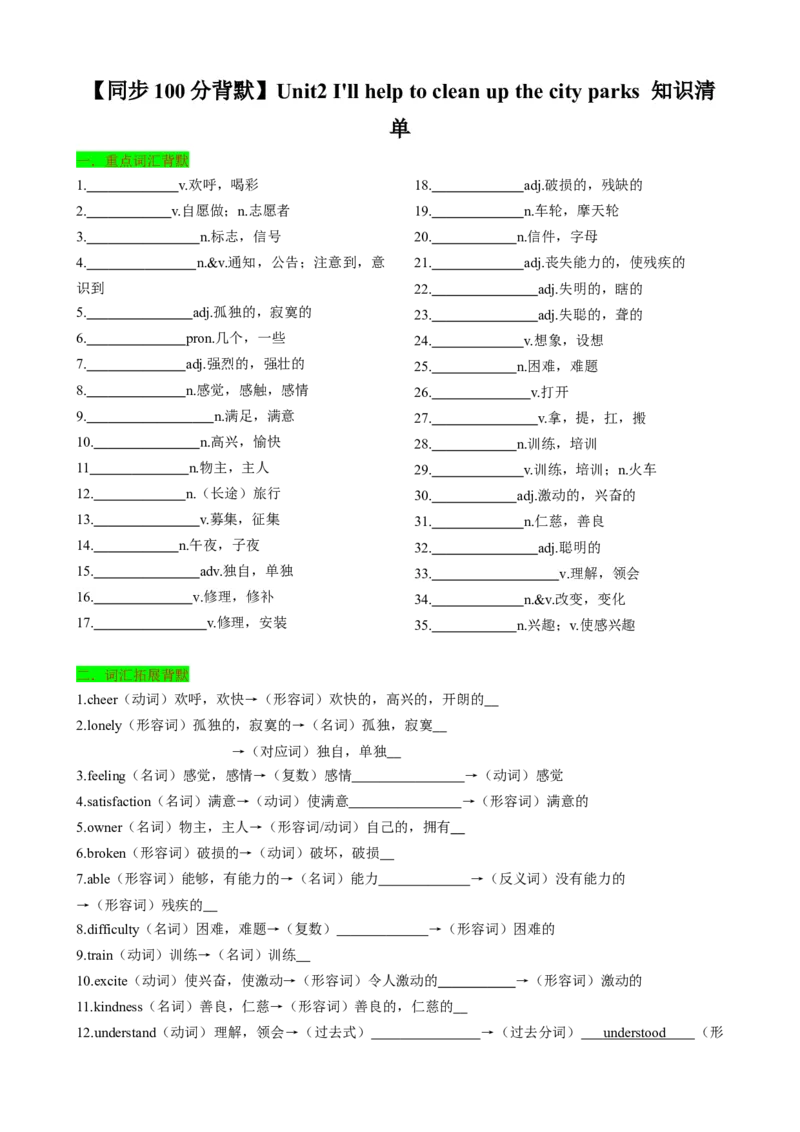
【同步 100 分背默】Unit2 I'll help to clean up the city parks 知识清
单
一.重点词汇背默
1. v.欢呼,喝彩 18. adj.破损的,残缺的
2. v.自愿做;n.志愿者 19. n.车轮,摩天轮
3. n.标志,信号 20. n.信件,字母
4. n.&v.通知,公告;注意到,意 21. adj.丧失能力的,使残疾的
识到 22. adj.失明的,瞎的
5. adj.孤独的,寂寞的 23. adj.失聪的,聋的
6. pron.几个,一些 24. v.想象,设想
7. adj.强烈的,强壮的 25. n.困难,难题
8. n.感觉,感触,感情 26. v.打开
9. n.满足,满意 27. v.拿,提,扛,搬
10. n.高兴,愉快 28. n.训练,培训
11 n.物主,主人 29. v.训练,培训;n.火车
12. n.(长途)旅行 30. adj.激动的,兴奋的
13. v.募集,征集 31. n.仁慈,善良
14. n.午夜,子夜 32. adj.聪明的
15. adv.独自,单独 33. v.理解,领会
16. v.修理,修补 34. n.&v.改变,变化
17. v.修理,安装 35. n.兴趣;v.使感兴趣
二.词汇拓展背默
1.cheer(动词)欢呼,欢快→(形容词)欢快的,高兴的,开朗的
2.lonely(形容词)孤独的,寂寞的→(名词)孤独,寂寞
→(对应词)独自,单独
3.feeling(名词)感觉,感情→(复数)感情 →(动词)感觉
4.satisfaction(名词)满意→(动词)使满意 →(形容词)满意的
5.owner(名词)物主,主人→(形容词/动词)自己的,拥有
6.broken(形容词)破损的→(动词)破坏,破损
7.able(形容词)能够,有能力的→(名词)能力 →(反义词)没有能力的
→(形容词)残疾的
8.difficulty(名词)困难,难题→(复数) →(形容词)困难的
9.train(动词)训练→(名词)训练
10.excite(动词)使兴奋,使激动→(形容词)令人激动的 →(形容词)激动的
11.kindness(名词)善良,仁慈→(形容词)善良的,仁慈的
12.understand(动词)理解,领会→(过去式) →(过去分词) understood (形容词)善解人意的
13.interest(名词/动词)兴趣,使感兴趣→(形容词)感兴趣的 →(形容词)有趣的
三.重点短语背默
1.打扫干净 11.如此强烈的满足感
2.(使)变得高兴,振奋起来 12.快乐的表情
3.(1)分发 13.在...岁时
(2)放弃 14.决定做某事
(3)赠送,捐赠 15.参加...选拔,试用
4.(1)提出,想处 16.继续做某事
(2)出版,发行 17.与此同时
(3)实现 18.担心...
(4)来自 19.制定计划做某事
5.(1)推迟,延迟
(2)搭建,张贴,举起 20.筹集资金
(3)穿、戴 21.(1)(外貌或行为)像
(4)放好,收好 (2)与...相似
6.(1)打电给某人,召集 22.修理
(2)号召,访问 23.建立,设立
7.帮助解决困难 24.对某人有重大意义
8.(1)照顾,非常喜欢
(2)关心 25.为...感到兴奋
9.将要做某事 26.能够做某事
10.几个小时 27.立刻
28.解决出,计算,起作用
四.重点句子背默
1.我想要帮助无家可归的人们。
2.She volunteers there once a week to help kids learn to read.
3.我正在做一些标识牌贴在学校周围。
4.这个男孩可以在食物救济站分发食物。
5.我们需要想出一个好主意。
6.Never put off till tomorrow what you can do today.
7.我想了解更多关于如何照顾动物的知识。
8.她四岁时就能自己阅读了。
9.我可以在做我喜欢的事情的同时帮助他人。
10.This group was set up to help disabled people like me.五.易错点背默
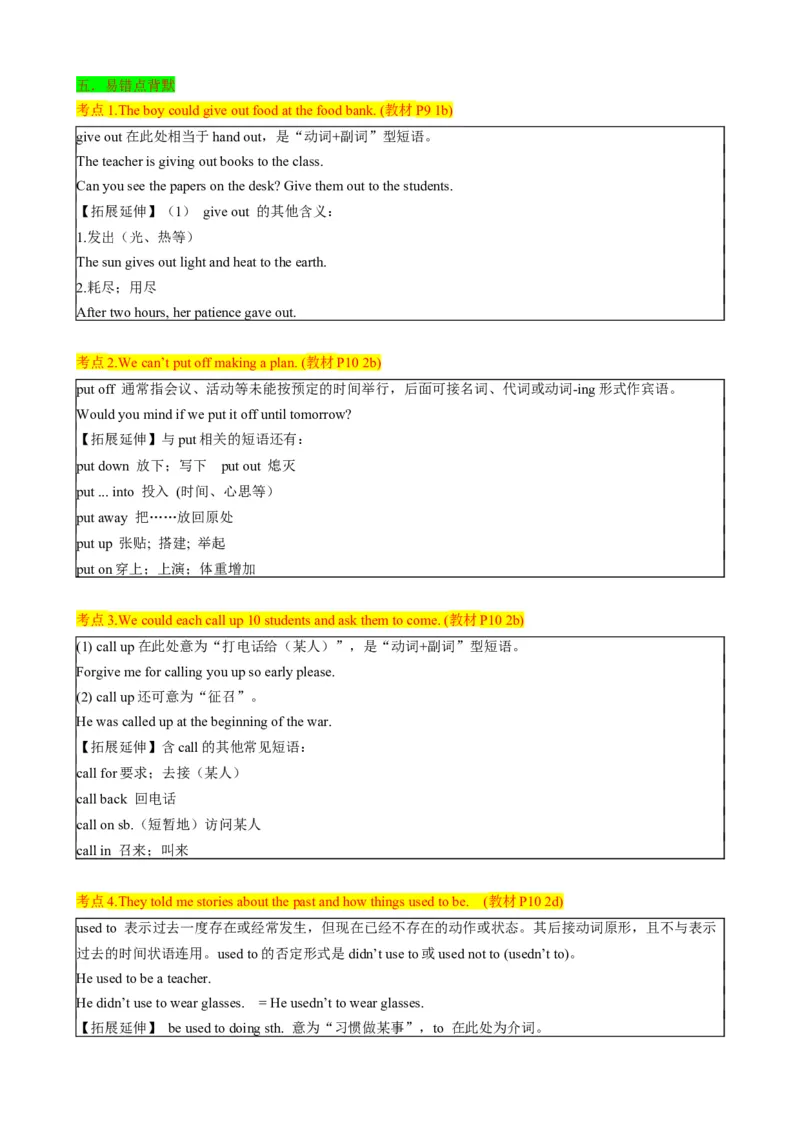
考点1.The boy could give out food at the food bank. (教材P9 1b)
give out在此处相当于hand out,是“动词+副词”型短语。
The teacher is giving out books to the class.
Can you see the papers on the desk? Give them out to the students.
【拓展延伸】(1) give out 的其他含义:
1.发出(光、热等)
The sun gives out light and heat to the earth.
2.耗尽;用尽
After two hours, her patience gave out.
考点2.We can’t put off making a plan. (教材P10 2b)
put off 通常指会议、活动等未能按预定的时间举行,后面可接名词、代词或动词-ing形式作宾语。
Would you mind if we put it off until tomorrow?
【拓展延伸】与put相关的短语还有:
put down 放下;写下 put out 熄灭
put ... into 投入 (时间、心思等)
put away 把……放回原处
put up 张贴; 搭建; 举起
put on穿上;上演;体重增加
考点3.We could each call up 10 students and ask them to come. (教材P10 2b)
(1) call up在此处意为“打电话给(某人)”,是“动词+副词”型短语。
Forgive me for calling you up so early please.
(2) call up还可意为“征召”。
He was called up at the beginning of the war.
【拓展延伸】含call的其他常见短语:
call for要求;去接(某人)
call back 回电话
call on sb.(短暂地)访问某人
call in 召来;叫来
考点4.They told me stories about the past and how things used to be. (教材P10 2d)
used to 表示过去一度存在或经常发生,但现在已经不存在的动作或状态。其后接动词原形,且不与表示
过去的时间状语连用。used to的否定形式是didn’t use to或used not to (usedn’t to)。
He used to be a teacher.
He didn’t use to wear glasses. = He usedn’t to wear glasses.
【拓展延伸】 be used to doing sth. 意为“习惯做某事”,to 在此处为介词。Mario is used to volunteering at an animal hospital now.
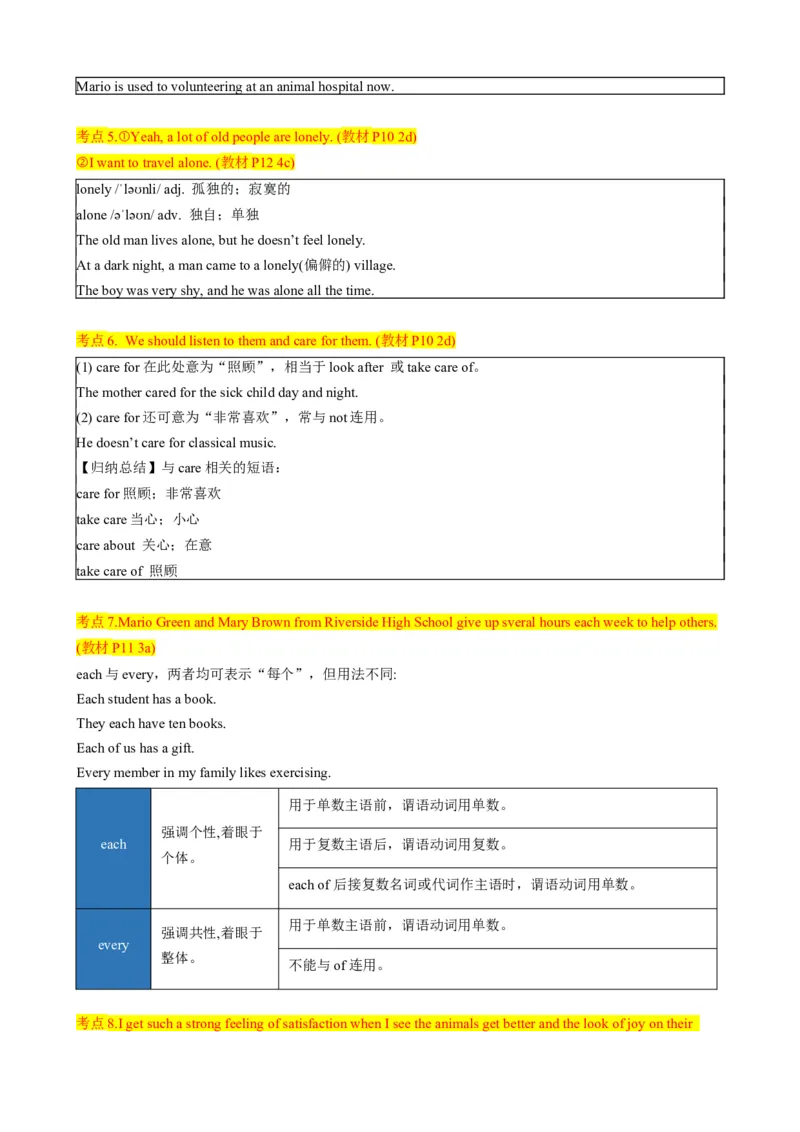
考点5.①Yeah, a lot of old people are lonely. (教材P10 2d)
②I want to travel alone. (教材P12 4c)
lonely /ˈləʊnli/ adj. 孤独的;寂寞的
alone /əˈləʊn/ adv. 独自;单独
The old man lives alone, but he doesn’t feel lonely.
At a dark night, a man came to a lonely(偏僻的) village.
The boy was very shy, and he was alone all the time.
考点6. We should listen to them and care for them. (教材P10 2d)
(1) care for在此处意为“照顾”,相当于look after 或take care of。
The mother cared for the sick child day and night.
(2) care for还可意为“非常喜欢”,常与not连用。
He doesn’t care for classical music.
【归纳总结】与care相关的短语:
care for照顾;非常喜欢
take care当心;小心
care about 关心;在意
take care of 照顾
考点7.Mario Green and Mary Brown from Riverside High School give up sveral hours each week to help others.
(教材P11 3a)
each与every,两者均可表示“每个”,但用法不同:
Each student has a book.
They each have ten books.
Each of us has a gift.
Every member in my family likes exercising.
用于单数主语前,谓语动词用单数。
强调个性,着眼于
each 用于复数主语后,谓语动词用复数。
个体。
each of 后接复数名词或代词作主语时,谓语动词用单数。
用于单数主语前,谓语动词用单数。
强调共性,着眼于
every
整体。
不能与of 连用。
考点8.I get such a strong feeling of satisfaction when I see the animals get better and the look of joy on theirowners’ faces. (教材P11 3a)
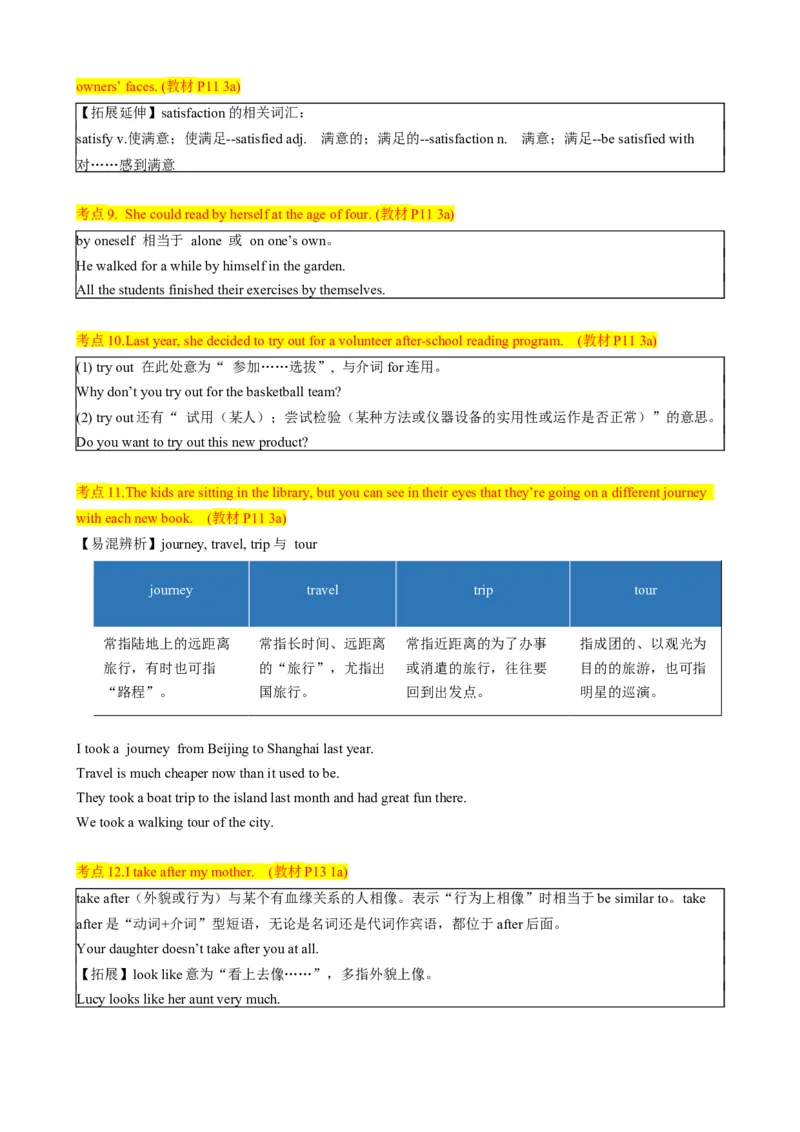
【拓展延伸】satisfaction的相关词汇:
satisfy v.使满意;使满足--satisfied adj. 满意的;满足的--satisfaction n. 满意;满足--be satisfied with
对……感到满意
考点9. She could read by herself at the age of four. (教材P11 3a)
by oneself 相当于 alone 或 on one’s own。
He walked for a while by himself in the garden.
All the students finished their exercises by themselves.
考点10.Last year, she decided to try out for a volunteer after-school reading program. (教材P11 3a)
(1) try out 在此处意为“ 参加……选拔”, 与介词for连用。
Why don’t you try out for the basketball team?
(2) try out还有“ 试用(某人);尝试检验(某种方法或仪器设备的实用性或运作是否正常)”的意思。
Do you want to try out this new product?
考点11.The kids are sitting in the library, but you can see in their eyes that they’re going on a different journey
with each new book. (教材P11 3a)
【易混辨析】journey, travel, trip与 tour
journey travel trip tour
常指陆地上的远距离 常指长时间、远距离 常指近距离的为了办事 指成团的、以观光为
旅行,有时也可指 的“旅行”,尤指出 或消遣的旅行,往往要 目的的旅游,也可指
“路程”。 国旅行。 回到出发点。 明星的巡演。
I took a journey from Beijing to Shanghai last year.
Travel is much cheaper now than it used to be.
They took a boat trip to the island last month and had great fun there.
We took a walking tour of the city.
考点12.I take after my mother. (教材P13 1a)
take after(外貌或行为)与某个有血缘关系的人相像。表示“行为上相像”时相当于be similar to。take
after是“动词+介词”型短语,无论是名词还是代词作宾语,都位于after后面。
Your daughter doesn’t take after you at all.
【拓展】look like意为“看上去像……”,多指外貌上像。
Lucy looks like her aunt very much.考点13.I gave it away. (教材P13 1a)
give away是“动词+副词”型短语。
The rich man gave away most of his money to charity.
【拓展】give away还有“颁发;泄露”之意。
The headmaster gave away the prizes on the school sports day.
She would give nothing away.
考点14.Jimmy fixes up broken bicycle parts, like wheels. (教材P13 1d)
broken在此处作形容词,可在句中作表语或定语。
My ruler is broken. Can I borrow yours?
Could you help me fix up the broken chair?
考点15.I’m sure you know that this group was set up to help disabled people like me. (教材P14 2b)
disabled作形容词,the disabled意为“残疾人”,表示复 数概念。
He was born disabled but he didn’t give up.
I worked as a volunteer to help the disabled.
【拓展】 一些词加否定前缀dis-可以构成它的反义词, 如:
agree (同意) — disagree (不同意)
appear (出现) — disappear (消失)
honest (诚实的) — dishonest (不诚实的)
考点16.You helped to make it possible for me to have Lucky. (教材P14 2b)
make it + adj. + (for sb.) to do sth. 使做某事(对某人来说)……
该结构中it作形式宾语,真正的宾语是后面的动词不定式短语,形容词作宾语补足语。
His help makes it easy for me to learn English.
【拓展】除make外,常用于这种结构的还有think、 find等。
I think it useful for us to master a foreign language.
We find it difficult for us to finish this task by ourselves.
考点17. ...or carrying things are difficult for me. (教材P14 2b)
【易混辨析】 carry, take, bring与get
carry 拿; 提; 扛 表示搬运、携带,具有负重的含义,没有方向性。
take 拿走; 带走 指把人或物从说话者所在的地方带到别处。有方向性。
bring 拿来; 带来 指把人或物从别的地方带到说话者所在的地方。有方向性。
get 去取; 去拿 指到某地去把某人或某物带来或拿来。表示来回。He was carrying a big bag.
Mark often takes his books to Beth’s house to study.
Don’t forget to bring it here.
Can you go and get some water for us?
考点18.Then one day last year, a friend of mine helped me out. (教材P14 2b)
a friend of mine相当于one of my friends,是双重所有格。如果被所有格修饰的名词前有冠词、数词、不定
代词或指示代词等,常用双重所有格,即“of+ ’s所有格/名词性物主代词“的形式,来表示所属关系。
John is a friend of my father’s = John is one of my father’s friends.
考点19. I love animals and I was excited about the idea of having a dog. (教材P14 2b)
be excited about 对……感到兴奋
这是一个固定短语,后接名词、代词或动词-ing形式。be excited about doing sth. = be excited to do sth. ,
意为“做某事感到兴奋”。
Are you excited about the new work place?
Jack was excited about traveling there by plane.
= Jack was excited to travel there by plane.
【拓展】 excited 与exciting
excited 表示“感到兴奋的”,常用来修饰人。
exciting 表示“令人兴奋的”,常用来说明事物。
When we arrived in Beijing,we are all excited.
Exciting news made me not sleep well.
考点20.What are your interests and hobbies? (教材P16 3b)
(1)interest在此处作名词,意为“兴趣;关注”。
常用短语:
have (an) interest in 对……感兴趣
have no interest in 对……不感兴趣
take an interest in 对……产生兴趣
lose interest in 对……失去兴趣
I have no interest in history at all.
He lost interest in his work.
(2) interest还可作动词,意为“使感兴趣;使关注”。
Things of that nature do not interest me.
六.语法点记忆
一、动词不定式1. 概念 动词不定式是非谓语动词的一种形式,其结构为“to+动词原 形”,其中 to不是介词,而是动
词不定式的符号,动词不定式没有人称和数的变化 。动词不定式和后面的名词等构成不定式短语,在句
子中可以用作主语、表语、宾语、宾语补足语、定语、状语等。
2. 用法
(1)作宾语 动词不定式(短语) 可以放在一些动词后面用作宾语,能以动词不定式作宾语的动词有:
begin,start,want,forget等。I want to tell you a story. 我想给你讲个故事。
注意
①如果 and 连接两个动词不定式,第 二 个动词不定式一般省to。He wants to go and have a swim with
us.他想和我们一起去游泳。
②若作宾语的动词不定式(短语)很长,可用 it作形式宾语。He found it hard to catch up with others他发现
赶上别人是困难的。
(2)作宾语补足语 动词不定式作宾语补足语,表示宾语所做的动作 。可以用动词不定式作宾语补足语的
动词有:tell,ask,want,like等。
但在 let,make,see等感官动词或使役动词后面作宾语补足 语的动词不定式一般要省略动词不定式符号
to
注意
感官动词或使役动词使用省略 to的不定式,主动语态中不带 to,但变为被动语态时,须加上 to。
The baby was made to cry by the boy. 那个婴儿被这个男孩弄哭了。
(3)动词不定式作目的状语
动词不定式作目的状语常用在 go,come,hurry等不及物动词后,表目的。
He went to see his sister yesterday. 昨天他去看他的妹 妹了。
注意
有时可以把不定式(短语)提前,放在句首,用来强调目的。
To learn English quickly and well,he went to England. 为了更快更好地学英语,他去了英国。
二、动词短语
有些动词可以和一些别的词构成短语,表达一个概念,作 用和一个单独的动词差不多,这种短语可以称
为动词短语 。动词短语主要有下面几种类型:
1. V.+adv.(动词+副词)
这类动词短语相当于一个及物动词,若宾语是名词,名词可 以放在动词与副词中间,也可放在副词后
面;若宾语是代词, 则代词必须放在动词与副词中间。
He is looking it up in the dictionary. 他正在字典上查找它。
2. V.+prep. (动词+介词)
3. V.+adv.+prep. (动词+副词+介词)
这类动词短语相当于一个及物动词,后面须跟宾语,宾语只能放在介词的后面。
Don,t look down upon the poor people from villages.不要看不起来自村里的穷人。
2. V.+n. +prep. (动词+名词+介词)
这类动词短语也相当于一个及物动词,后面须跟宾语,通常 动词后面作宾语的名词是固定的,介词后面
的名词可以视情 况而定。
Please pay more attention to your spelling. 请多注意你的拼写。5.V.+n. (动词+名词)
这类动词短语中的名词与动词构成固定搭配,表达特定的意思。
Don’t lose heart. Have another try. 别灰心,再试一次。
单项选择
1. she saw a lot of boys football on the playground when she walked past.
A. play B. to play C. played D. playing
2. Jimmy can,t buy any new books because he has his money.
A. sold out B. run out of
C. come out D. worked out
七.写作背默
假如你是李华。请给你加拿大的笔友Eric写一封80词左右的邮件,介绍你和你的朋友的一次志愿者活动
的情况。要点如下:
时间 上周日
地点 学校附近的街区
上午:打扫街道,帮助老人做家务
活动内容
下午:给小朋友们讲故事
感受 帮助别人是快乐的
参考词汇:
志愿者活动:volunteer work 街区:neighborhood
打扫街道:clean the street 做家务:do housework
讲故事:tell stories 帮助他人:help others
体裁 记叙文 话题 志愿活动
审题
时态 一般过去时 人称 第一人称
引出话题 what I’ve done these days
叙述事件 Last Sunday: did some volunteer work in the neighborhood
段落
near our school
布局
In the morning: cleaned the street; helped the old do housework
In the afternoon: told stories to the kids总结感受busy but very happy helping others can bring happiness not only ... but also ...
Dear Eric,
How’s it going? You want to know what I’ve done these days. Now let me tell you.
Yours,
Li Hua
假如你是李华,你想成为长沙社会福利中心的一名志愿者,请你根据以下提示向李女士写一封自荐信。
(80词左右)
提示:1)简要介绍自己的基本信息
2)解释你为什么想/适合这份工作(有先关经验、和小孩子相处得好、有耐心...)
3)周末和假期有空闲时间
参考词汇:长沙社会福利中心 the Changsha Social Welfare Centre
Dear Ms. Li,
I’m Li Hua from NO.26 Middle School.I’m a 13-year-old boy.I love kids and I hope to be a volunteer at the
Changsha Social Welfare Centre.
Yours,
Li Hua