课时 03 考点拓展 3&介词、There be 句型&写作指导(学校生活)
目录
一.词汇拓展...............................................................................................................................................................1
二.考点拓展...............................................................................................................................................................1
三.语法考点...............................................................................................................................................................6
四.写作考点.............................................................................................................................................................10
五.阅读拓展.............................................................................................................................................................11
一.词汇拓展
1. listen (v.)听,倾听→listener (n.)听众,听者listen to 听……
2. draw (v.)绘画,画→drew (过去式)draw a picture/pictures 画画
3. put (v.)放;置→put (过去式)→putting (现在分词)
put away 放好;收拾put back 将……放回原处put down 写下;放下put sth to good use 好好利用某物
4. hand (n.)手;帮助 (v.)交;递;给
hand by hand 手牵手shake hands 握手by hand (用)手工;靠人工 on the one hand .. . , on the other hand .. . 一方
面……,另一方面……give sb a hand 帮助某人,给某人搭把手
5. stand (v.)站立;位于 (某处);忍受 (n.)看台;摊位→stood (过去式)
stand up 起立stand in line 排队stand for 是……的缩写;代表
6. close (v.)合上;关闭;停业;结束 (adj.)亲密的;(距离上)近的,接近的close down (永久)关闭;倒
闭
7. one (num.)一→first (序数词)第一 (adj.)第一 (位)的,首要的 (adv.)先;首先→once (adv.)一次;曾
经
8. two (num.)二→second (序数词)第二→twice (adv.)两次;两倍
9. three (num.)三→third (序数词)第三
10. five (num.)五→fifth (序数词)第五
二.考点拓展
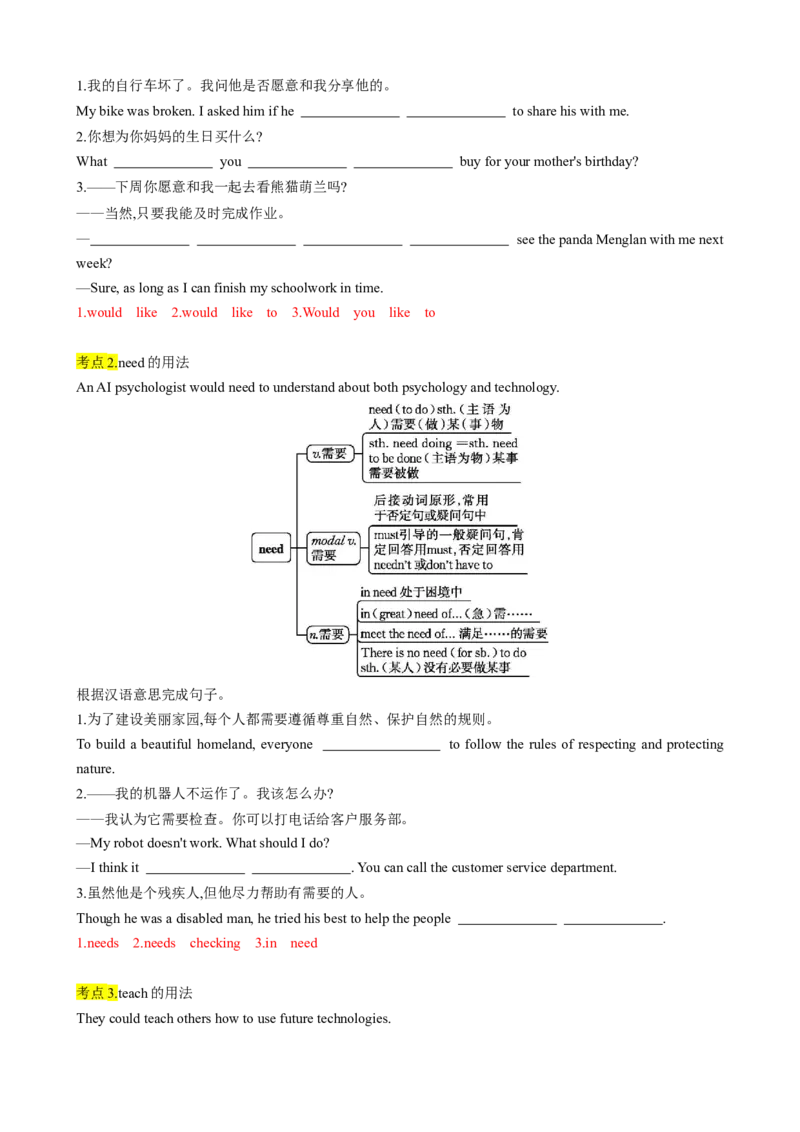
考点1.would like的用法
When you make a fresh salad, you may add your favorite fruit if you would like to.
根据汉语意思完成句子。1.我的自行车坏了。我问他是否愿意和我分享他的。
My bike was broken. I asked him if he to share his with me.
2.你想为你妈妈的生日买什么?
What you buy for your mother's birthday?
3.——下周你愿意和我一起去看熊猫萌兰吗?
——当然,只要我能及时完成作业。
— see the panda Menglan with me next
week?
—Sure, as long as I can finish my schoolwork in time.
1.would like 2.would like to 3.Would you like to
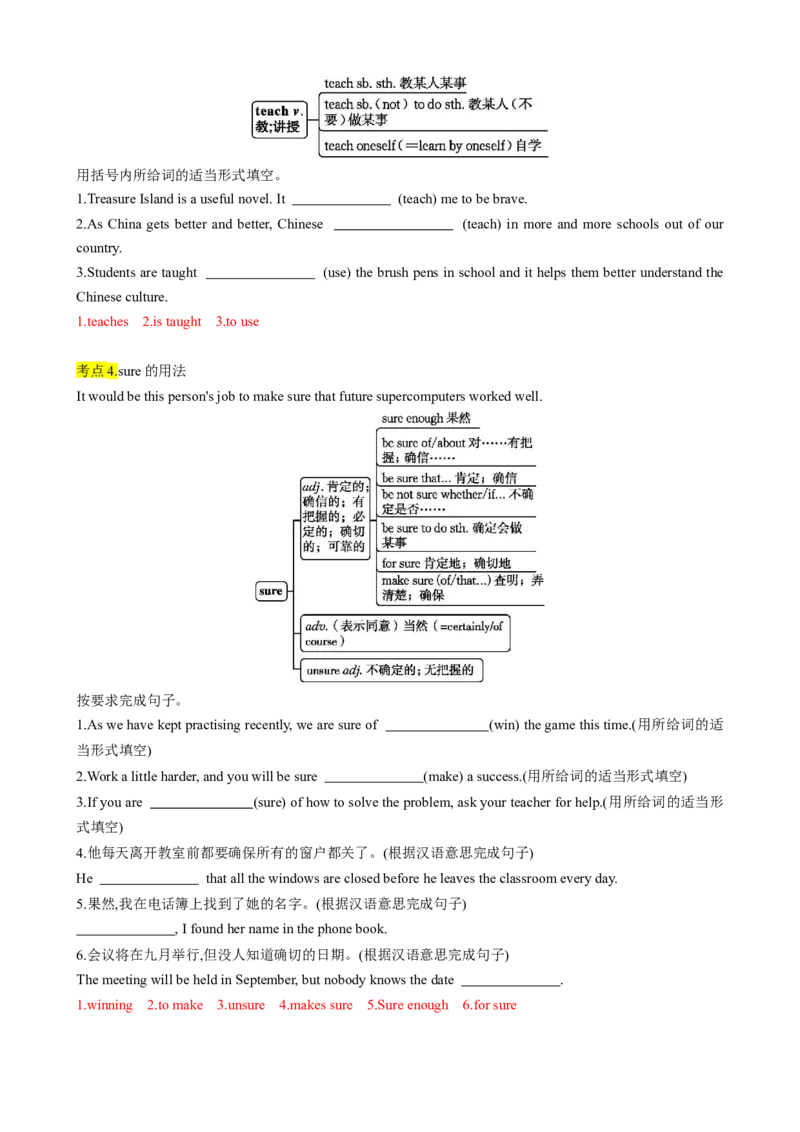
考点2.need的用法
An AI psychologist would need to understand about both psychology and technology.
根据汉语意思完成句子。
1.为了建设美丽家园,每个人都需要遵循尊重自然、保护自然的规则。
To build a beautiful homeland, everyone to follow the rules of respecting and protecting
nature.
2.——我的机器人不运作了。我该怎么办?
——我认为它需要检查。你可以打电话给客户服务部。
—My robot doesn't work. What should I do?
—I think it . You can call the customer service department.
3.虽然他是个残疾人,但他尽力帮助有需要的人。
Though he was a disabled man, he tried his best to help the people .
1.needs 2.needs checking 3.in need
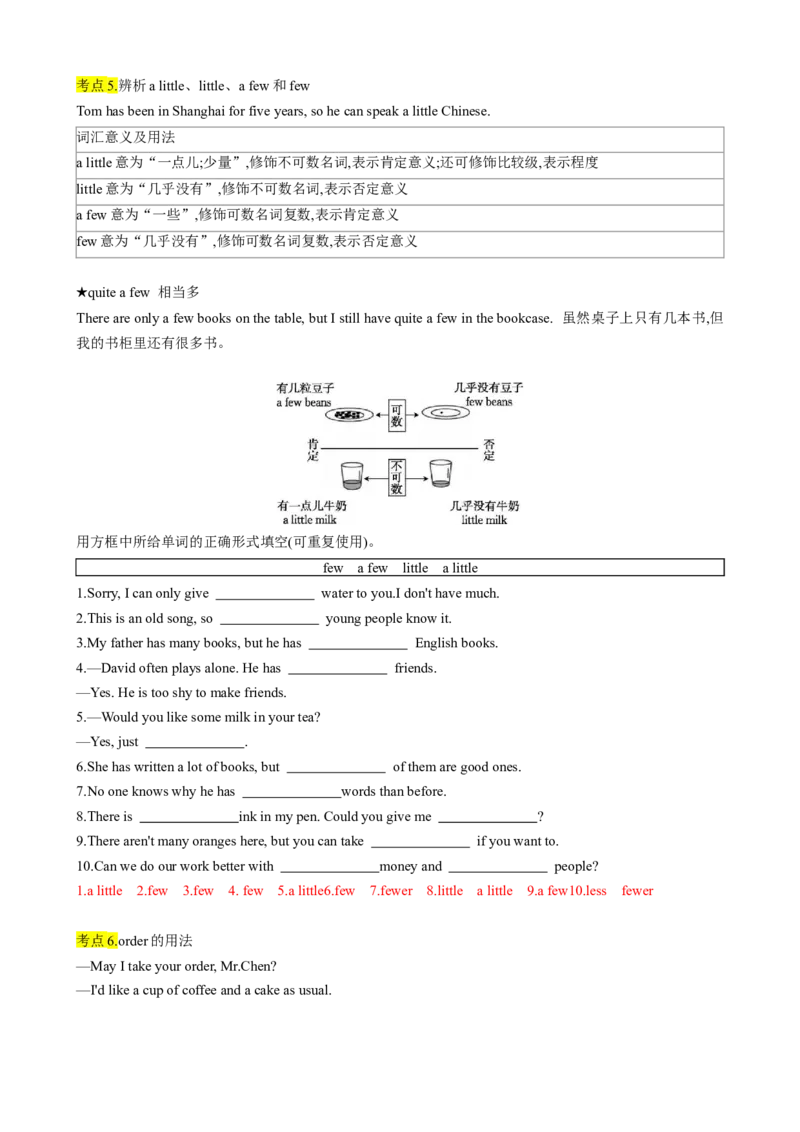
考点3.teach的用法
They could teach others how to use future technologies.用括号内所给词的适当形式填空。
1.Treasure Island is a useful novel. It (teach) me to be brave.
2.As China gets better and better, Chinese (teach) in more and more schools out of our
country.
3.Students are taught (use) the brush pens in school and it helps them better understand the
Chinese culture.
1.teaches 2.is taught 3.to use
考点4.sure的用法
It would be this person's job to make sure that future supercomputers worked well.
按要求完成句子。
1.As we have kept practising recently, we are sure of (win) the game this time.(用所给词的适
当形式填空)
2.Work a little harder, and you will be sure (make) a success.(用所给词的适当形式填空)
3.If you are (sure) of how to solve the problem, ask your teacher for help.(用所给词的适当形
式填空)
4.他每天离开教室前都要确保所有的窗户都关了。(根据汉语意思完成句子)
He that all the windows are closed before he leaves the classroom every day.
5.果然,我在电话簿上找到了她的名字。(根据汉语意思完成句子)
, I found her name in the phone book.
6.会议将在九月举行,但没人知道确切的日期。(根据汉语意思完成句子)
The meeting will be held in September, but nobody knows the date .
1.winning 2.to make 3.unsure 4.makes sure 5.Sure enough 6.for sure考点5.辨析a little、little、a few和few
Tom has been in Shanghai for five years, so he can speak a little Chinese.
词汇意义及用法
a little意为“一点儿;少量”,修饰不可数名词,表示肯定意义;还可修饰比较级,表示程度
little意为“几乎没有”,修饰不可数名词,表示否定意义
a few意为“一些”,修饰可数名词复数,表示肯定意义
few意为“几乎没有”,修饰可数名词复数,表示否定意义
★quite a few 相当多
There are only a few books on the table, but I still have quite a few in the bookcase. 虽然桌子上只有几本书,但
我的书柜里还有很多书。
用方框中所给单词的正确形式填空(可重复使用)。
few a few little a little
1.Sorry, I can only give water to you.I don't have much.
2.This is an old song, so young people know it.
3.My father has many books, but he has English books.
4.—David often plays alone. He has friends.
—Yes. He is too shy to make friends.
5.—Would you like some milk in your tea?
—Yes, just .
6.She has written a lot of books, but of them are good ones.
7.No one knows why he has words than before.
8.There is ink in my pen. Could you give me ?
9.There aren't many oranges here, but you can take if you want to.
10.Can we do our work better with money and people?
1.a little 2.few 3.few 4. few 5.a little6.few 7.fewer 8.little a little 9.a few10.less fewer
考点6.order的用法
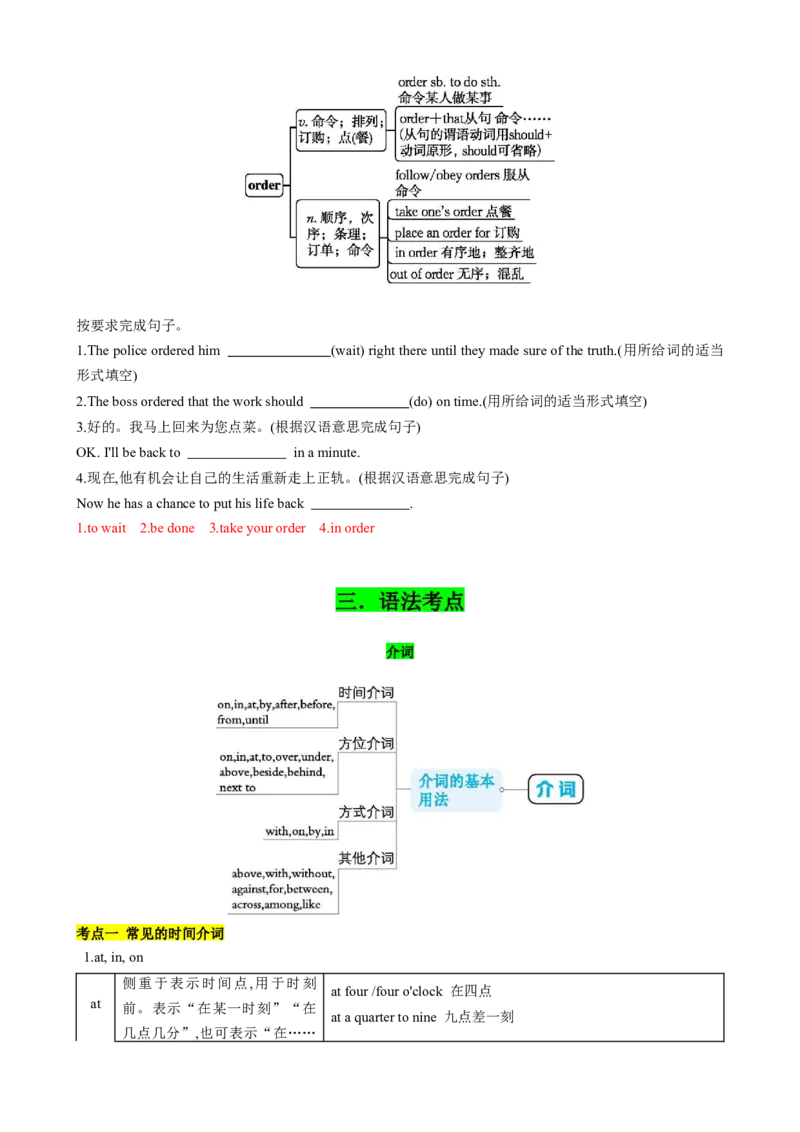
—May I take your order, Mr.Chen?
—I'd like a cup of coffee and a cake as usual.按要求完成句子。
1.The police ordered him (wait) right there until they made sure of the truth.(用所给词的适当
形式填空)
2.The boss ordered that the work should (do) on time.(用所给词的适当形式填空)
3.好的。我马上回来为您点菜。(根据汉语意思完成句子)
OK. I'll be back to in a minute.
4.现在,他有机会让自己的生活重新走上正轨。(根据汉语意思完成句子)
Now he has a chance to put his life back .
1.to wait 2.be done 3.take your order 4.in order
三.语法考点
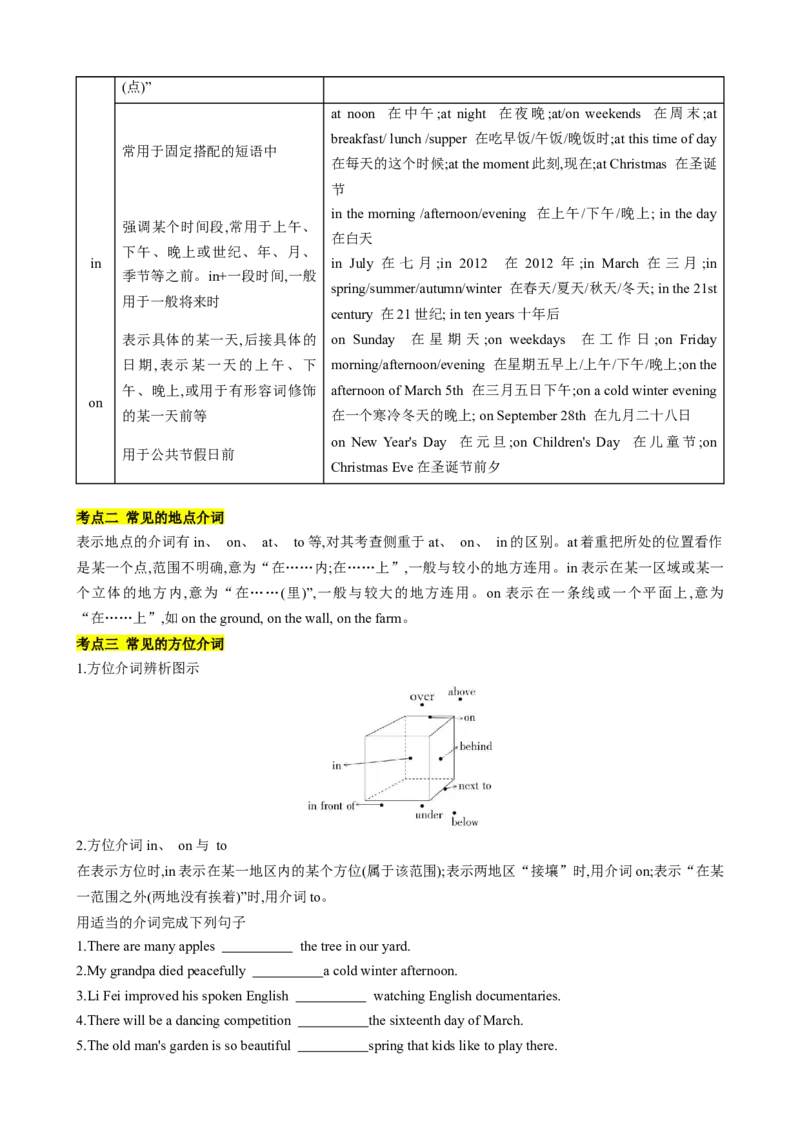
介词
考点一 常见的时间介词
1.at, in, on
侧重于表示时间点,用于时刻
at four /four o'clock 在四点
at
前。表示“在某一时刻”“在
at a quarter to nine 九点差一刻
几点几分”,也可表示“在……(点)”
at noon 在中午;at night 在夜晚;at/on weekends 在周末;at
breakfast/ lunch /supper 在吃早饭/午饭/晚饭时;at this time of day
常用于固定搭配的短语中
在每天的这个时候;at the moment此刻,现在;at Christmas 在圣诞
节
in the morning /afternoon/evening 在上午/下午/晚上; in the day
强调某个时间段,常用于上午、
在白天
下午、晚上或世纪、年、月、
in in July 在 七 月 ;in 2012 在 2012 年 ;in March 在 三 月 ;in
季节等之前。in+一段时间,一般
spring/summer/autumn/winter 在春天/夏天/秋天/冬天; in the 21st
用于一般将来时
century 在21世纪; in ten years十年后
表示具体的某一天,后接具体的 on Sunday 在 星 期 天 ;on weekdays 在 工 作 日 ;on Friday
日期,表示某一天的上午、下 morning/afternoon/evening 在星期五早上/上午/下午/晚上;on the
午、晚上,或用于有形容词修饰 afternoon of March 5th 在三月五日下午;on a cold winter evening
on
的某一天前等 在一个寒冷冬天的晚上; on September 28th 在九月二十八日
on New Year's Day 在元旦;on Children's Day 在儿童节;on
用于公共节假日前
Christmas Eve在圣诞节前夕
考点二 常见的地点介词
表示地点的介词有in、 on、 at、 to等,对其考查侧重于at、 on、 in的区别。at着重把所处的位置看作
是某一个点,范围不明确,意为“在……内;在……上”,一般与较小的地方连用。in表示在某一区域或某一
个立体的地方内,意为“在……(里)”,一般与较大的地方连用。on表示在一条线或一个平面上,意为
“在……上”,如on the ground, on the wall, on the farm。
考点三 常见的方位介词
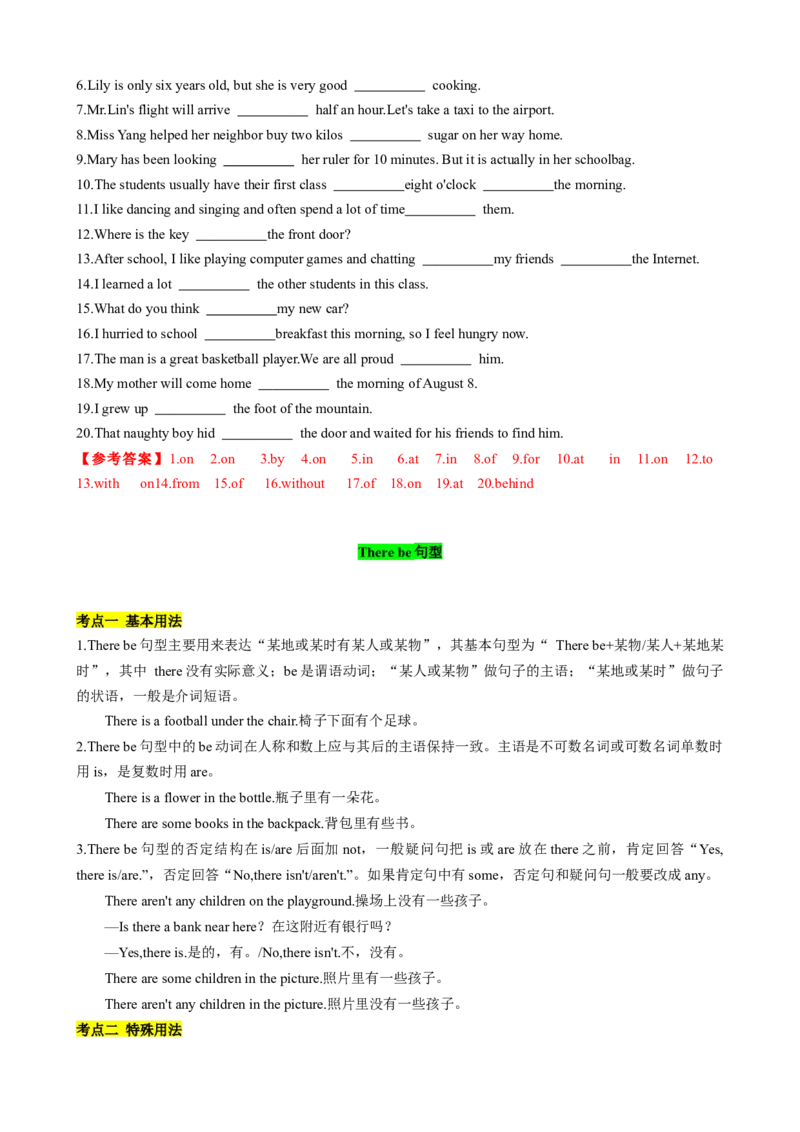
1.方位介词辨析图示
2.方位介词in、 on与 to
在表示方位时,in表示在某一地区内的某个方位(属于该范围);表示两地区“接壤”时,用介词on;表示“在某
一范围之外(两地没有挨着)”时,用介词to。
用适当的介词完成下列句子
1.There are many apples the tree in our yard.
2.My grandpa died peacefully a cold winter afternoon.
3.Li Fei improved his spoken English watching English documentaries.
4.There will be a dancing competition the sixteenth day of March.
5.The old man's garden is so beautiful spring that kids like to play there.6.Lily is only six years old, but she is very good cooking.
7.Mr.Lin's flight will arrive half an hour.Let's take a taxi to the airport.
8.Miss Yang helped her neighbor buy two kilos sugar on her way home.
9.Mary has been looking her ruler for 10 minutes. But it is actually in her schoolbag.
10.The students usually have their first class eight o'clock the morning.
11.I like dancing and singing and often spend a lot of time them.
12.Where is the key the front door?
13.After school, I like playing computer games and chatting my friends the Internet.
14.I learned a lot the other students in this class.
15.What do you think my new car?
16.I hurried to school breakfast this morning, so I feel hungry now.
17.The man is a great basketball player.We are all proud him.
18.My mother will come home the morning of August 8.
19.I grew up the foot of the mountain.
20.That naughty boy hid the door and waited for his friends to find him.
【参考答案】1.on 2.on 3.by 4.on 5.in 6.at 7.in 8.of 9.for 10.at in 11.on 12.to
13.with on14.from 15.of 16.without 17.of 18.on 19.at 20.behind
There be句型
考点一 基本用法
1.There be句型主要用来表达“某地或某时有某人或某物”,其基本句型为“ There be+某物/某人+某地某
时”,其中 there没有实际意义;be是谓语动词;“某人或某物”做句子的主语;“某地或某时”做句子
的状语,一般是介词短语。
There is a football under the chair.椅子下面有个足球。
2.There be句型中的be动词在人称和数上应与其后的主语保持一致。主语是不可数名词或可数名词单数时
用is,是复数时用are。
There is a flower in the bottle.瓶子里有一朵花。
There are some books in the backpack.背包里有些书。
3.There be句型的否定结构在is/are后面加not,一般疑问句把is或are放在there之前,肯定回答“Yes,
there is/are.”,否定回答“No,there isn't/aren't.”。如果肯定句中有some,否定句和疑问句一般要改成any。
There aren't any children on the playground.操场上没有一些孩子。
—Is there a bank near here?在这附近有银行吗?
—Yes,there is.是的,有。/No,there isn't.不,没有。
There are some children in the picture.照片里有一些孩子。
There aren't any children in the picture.照片里没有一些孩子。
考点二 特殊用法1.若句子中有几个并列的主语时,be动词要与离其最近的一个主语在人称和数上保持一致。(就近原则)
There is a boy,a girl and two women in the house.房子里有一个男孩、一个女孩和两个妇女。
There are ten students and a teacher in the office.办公室里有十个学生和一个教师。
2.“There be+名词或代词+动词-ing形式”意思是“有某人或某物正在做……”。
There are some teachers playing basketball on the playground.有些老师正在操场上打篮球。
3.There be句型的一般将来时的肯定结构为“There will be+名词+其他成分.”或“There is going to be+名词
+其他成分.”,意为“将要有……或“将举行……”。(注意:不论be后的名词是单数还是复数,be不能
写成is/are)
There will be a meeting tomorrow morning.明天上午有个会议。
考点三 难点突破
There be句型与 have/has都可以意为“有”,但它们的含义不同。There be句型表示的是“存在关
系”,而 have/has表示的却是“所有关系”,have/has的主语一般是人,有时也可以是物。
There is a car in front of the school gate.学校门前有辆小汽车。(强调车在门前)
I have a car.我有一辆小汽车。(强调车归我所有)
注意(1)如果这两个表示“有”的句型中含有some,改为否定句或疑问句时some要改为any。
There is some water in the glass.杯子里有一些水。
→ There isn't any water in the glass.杯子里没有水。
(2)表示“构成”关系时,have/has与 There be结构常常表示相同的意思,可以进行同义句转换。
A week has seven days.
=There are seven days in a week.一周有七天。
一.用括号内所给词的适当形式填空
1.There (be) fifty books here.
2.There (be) some water in the glass.
3.There (be) a lot of apples on the table.
4.There (be) an old building in front of our school.
5.There (be) some cups of tea on the table.
二..按要求完成句子,每空一词
1.There is a library across from the school.(改为否定句)
a library across from the school.
2.There are some birds in the tree.(改为一般疑问句)
birds in the tree?
3.Is there a baseball under the chair?(作肯定回答)
Yes, .
4.There are some children in the street. (改为一般疑问句)
children in the street?
5.There is a cat under the tree.(改为一般疑问句)
a cat under the tree?
三.用have,has,there is或there are填空1.I a good father and a good mother.
2. a basketball in the playground.
3.They a nice garden.
4. a reading room in the building.
5. some books in the bookcase.
6.My father a storybook.
7. a storybook on the table.
8. some flowers in the vase.
9.My parents some nice pictures.
10. a map of the world on the wall.
1.are there be句型中由be动词后面的名词是可数名词复数books可知设空处应用are。
2.is there be句型中由be动词后面的名词是不可数名词water可知设空处应用is。
3.are there be句型中由be动词后面的名词是可数名词复数apples可知设空处应用are。
4.is there be句型中由be动词后面的名词是可数名词单数building可知设空处应用is。
5.are there be句型中由be动词后面的cups可知设空处应用are。
二.1.There isn’t 2.Are there any 3.there is 4.Are there any 5.Is there
三.1.have 设空处表示“拥有”,主语是I,故填have。
2.There is 设空处表示“存在”,用there be句型,be动词后面的名词是可数名词单数basketball,故be动词
用is。
3.have 设空处表示“拥有”,主语是They,故填have。
4.There is 设空处表示“存在”,用there be句型,be动词后面的名词是可数名词单数reading room,故be动
词用is。
5.There are 设空处表示“存在”,用there be句型,be动词后面的名词是可数名词复数books,故be动词用
are。
6.has 设空处表示“拥有”,主语是My father,故谓语动词用第三人称单数形式has。
7.There is 设空处表示“存在”,用there be句型,be动词后面的名词是可数名词单数storybook,故be动词
用is。
8.There are 设空处表示“存在”,用there be句型,be动词后面的名词是可数名词复数flowers,故be动词用
are。
9.have 设空处表示“拥有”,主语是My parents,故填have。
10.There is 设空处表示“存在”,用there be句型,be动词后面的名词是可数名词单数map,故be动词用
is。
四.写作考点
一天的学习生活
John’s Day
John gets up at 6:30 a.m.in the morning. He has breakfast at 7:00 a.m. He goes to school by bike at 7:30 a.m.He has English, Chinese, history and math in the morning. He has P.E., geography and science in the afternoon.
After school he often plays football with his classmates. Sometimes he watches TV in the evening at home.
约翰节的一天
约翰早上六点半起床。他在7点吃早餐他早上7点半骑自行车去上学他早上有英语、中文、历史和数
学课。他下午有体育,地理和科学课程。放学后,他经常和同学们一起踢足球。有时他在晚上在家看电
视。
Dear Ling Ling,
Thanks for your letter. You ask me about my favorite school day. Well, I like Tuesday best. I have math at
8:00 on that day. It’s different but fun. The next class is Chinese. It’s from 9:00 to 10:00. I don’t think I like it,
because it’s so hard. But I know it’s useful. The teacher says more and more people in the world are learning
Chinese. So I learn it really hard. Then we have art and P.E. They are relaxing. Our P.E. teacher usually plays
games with us. Classes finish at 12:00, after that we have one hour for lunch.
How about you? Tell me about your school days.
Yours,
Susan
亲爱的凌玲,
谢谢你的信。你问我关于我最喜欢的上学的日子。嗯,我最喜欢周二。我那天8点就有数学成绩
了。这很不一样,但很有趣。下一节课是中文课。时间是从9点到10点。我想我不喜欢它,因为它太难
了。但我知道它很有用。老师说,世界上越来越多的人在学习汉语。所以我很难学习。然后我们就有了
艺术和体育活动,他们正在放松。我们的体育老师经常和我们一起玩游戏。12点结束,之后我们有一个
小时的午餐。 你呢?告诉我你上学的日子。
你的, 苏珊
五.阅读拓展
一
A duck race is back for 2021on Thursday, August 5th.People 1
70,000 yellow rubber(橡胶)ducks in sunglasses into the Chicago River
to have a race.
The 2 of the race is the Ducky Derby. Anyone in Chicago can get
a duck for $5 to take part in the race. This year it raised(筹集) over
$310,000 3 Special Olympics Illinois!
These yellow toy ducks 4 arrived at the finish line(终点线). The duck that came 5 got a
car. The second-place duck won a free 6 to Mexico for a visit. And the duck in third place won $2,000.
After the race, the ducks were collected. They were 7 to go again the next year.
Nate Simon is one of the people who took part in the race. And he has also 8 over 100 Special
Olympics medals(奖牌).That day he took his 9 to the Ducky Derby. "We love what Special Olympics
Illinois does for 10 children," said his mother. "Simon had a good time along the way.”
1.A. put B. borrowed C. lent D. lost2.A. place B. home C. name D. school
3.A.about B. with C. from D. for
4. A. luckily B. quickly C. happily D. differently
5.A. first B. second C. third D. last
6.A. show B. trip C. walk D. ride
7.A. prepared B. popular C. funny D. excited
8.A. saw B. played C. brought D. got
9.A. students B. parents C. friends D. teachers
10. A. her B. his C. our D. your
长难句分析
原句:(最后一段倒数第二句)“We love what Special Olympics Illinois does for our children," said his
mother.
译文:他的妈妈说:“我们喜欢伊利诺伊州特奥会为我们的孩子所做的一切。”
分析:直接引语部分是一个复合句。What Special Olympics Illinois does for our children 是what引导的宾
语从句,作love的宾语。
答案详析
1.A 根据空后的to have a race 可知,此处指人们把七万只橡皮鸭投入芝加哥河中,这些橡皮鸭进行比
赛。
2.C 根据语境及空后的“of the race is the Ducky Derby”可知,这项比赛的名字是Ducky Derby。
3.D 根据语境可知,此处指今年这项比赛为伊利诺伊州特奥会筹集到的钱超过了31万美元。
4.B根据上文内容可知,橡皮鸭们是在进行比赛,故它们应该是很快就到达了终点线quickly“很快地;迅
速地”,符合语境。luckily“幸运地”;happily“高兴地”differently“不同地”。
5.A 根据下文中的 The second-place及“And the duck in third place”可知,获得第一名的橡皮鸭主人赢得
了一辆汽车。
6.B根据空后的“to Mexico for a visit”可知,获得第二名的橡皮鸭主人赢得了一次免费的墨西哥之旅。
7.A根据空后的“to go again the next year”可知,橡皮鸭们准备好了下一年再战。
8.D 根据空后的“over 100 Special Olympics medals”可知,Simon赢得了100多枚特奥会奖牌。
9.B 根据下文中的 said his mother 可知,Simon 带自己的父母去了比赛现场。
10.C 根据本句主语We可知,此处指“我们的”孩子,故用our。
二
good;fortune;in;study;one;lesson;offer;However;play;young
Brigite Xie is a four-year-old girl. She can play the piano very 1
.
Brigitte started online piano 2 during COVID-19.When her father
signed her up. He did not think that Brigitte would be so good at 3
(play) the piano.
Brigitte's mother said they were 4 to have Felicia, Brigitte's piano teacher. Brigitte 5
met Felicia when she was three years and two months old. From the lessons, the teacher saw that the
little girl had interest 6 playing the piano. Brigitte was taught to read music, and she even 7to play apiece of classical(古典的) music from Beethoven.
Brigitte became the 8 winner of the Elite International Music Competition (精英国际音乐
比赛). It 9 her the chance(机会) to play at Carnegie Hall in New York. 10 ,because
of COVID-19. the date of her performance(表演) there changed to November 2022.
1._________ 2._________ 3._________ 4._________ 5._________
6._________ 7._________ 8._________ 9._________ 10._________
长难句分析
原句:(第二段第二句)When her father signed her up, he did not think that Brigitte would be
so good at playing the piano.
译文:当她父亲为她报名时,他没想到Brigitte会如此擅长弹钢琴。
分析:这是一个复合句。when引导时间状语从句:在主句中,that Brigitte would be so
good at playing the piano是that引导的宾语从句,作did not think 的宾语。
答案详析
1. well此处指她弹钢琴弹得很好。所填词修饰动词,故填good的副词形式well。
2. lessons 所填词 lesson是可数名词,且此处表泛指,空前没有任何限定词,故填其复数形式 lessons。
3.playing be good at doing sth.意为“擅长做某事”,为固定用法,故填playing。
4. fortunate 此处指Brigitte的母亲说,他们很幸运能遇到Brigitte的钢琴老师Felicia。所填词在were之
后,作表语,表示“幸运的”,故填fortune的形容词形式fortunate。
5.first 此处指Brigitte 第一次见到Felicia时才三岁零两个月。空处修饰met,表示“第一次”,应用
first。
6.in have interest in doing sth.意为“对做某事感兴趣”,为固定用法,故填in。
7.studied此处指她甚至学会了弹奏贝多芬的一首古典乐曲。空处描述的是过去发生的事情,故填 study的
过去式studied。
8.youngest 此处指Brigitte 成为精英国际音乐比赛年纪最小的冠军。形容词最高级前冠词 the也有提示,
故填youngest。
9.offered 此处指这给了她在纽约卡内基音乐厅演奏的机会。空处描述的是过去发生的事情,故填offer的
过去式offered。
10.However 空后的“由于新冠肺炎疫情,她的表演日期改到了 2022年11月”和上一句构成转折关系,
故填转折连词However。注意首字母大写。
三
There is more than just funny videos on TikTok. It is helping to bring new life to
books and reading.
People are posting videos with the hashtag( 标签 ) BookTok(#BookTok) on
TikTok. In the videos, they talk about the books that they love. BookTok now has
almost 10 billion views(浏览).It helps more young people take up reading as a
hobby.
“I started reading when I came across BookTok for the first time last October,” Mireille Lee. 15, said.
Mireille now runs a popular BookTok account(账号)with her 13-year-oldsister. Their account has over 305,600
followers and 6.9 million likes.One of their most popular videos gives a summary(总结) of a book. In the video, there is music and pictures
to tell people more about the story. The sisters said their videos and summaries help people understand the books
better and read more.
BookTok isn't just for children, however. It's for anyone who loves to read.
1.Why do people post videos with the hashtag BookTok?
2.When did Mireille start reading?
3.How many people follow Mireille and her sister's account?
4.What does the writer think of BookTok?
长难句分析
原句:(第四段最后一句)The sisters said their videos and summaries help people understand the books better
and read more.
译文:这对姐妹说,她们的视频和对图书的总结可以帮助人们更好地理解这些图书、更多地阅读。
分析:这是一个复合句。their videos and summaries help people understand the books better and read more是
省略了that的宾语从句,作said的宾语。
答案详析
1. To share something about books.根据第二段前两句“People are posting videos with the hashtag BookTok
(#BookTok) on TikTok. In the videos, they talk about the books that they love.”可知,人们在抖音上发布带有
BookTok标签的视频。在视频里,他们谈论自己喜欢的图书。由此可推断,人们发布带有BookTok 标签
的视频是为了分享和图书有关的事情。
2. At the age of 14.根据第三段第一句“‘I started reading when I came across BookTok for the first time last
October.' Mireille Lee,15,said.”可知,Mireille现在15岁,她从去年10月第一次接触BookTok后开始阅
读。因此,Mireille是在14岁时开始阅读的。
3. More than/Over 305,600.根据第三段最后一句中的“Their account has over 305.600 followers”可知,超过
305 600 人关注 Mireille和她妹妹的账号。
4. useful/helpful。根据最后一段可知,作者认为BookTok适合所有热爱读书的人,由此可推断,他认为
BookTok是有用的。