® 义 务 教 育 教 科 书
义
务
教
育
义 务 教 育 教 科 书
教
七年级
科
书
下册
七年级 下册
YIWU JIAOYU JIAOKESHU 英
YINGYU
语
七
年
级
下
册
绿色印刷产品
正正式式印印刷刷 1122套套义义教教初初中中英英语语 77年年级级下下册册封封面面..iinndddd 11 22002244//1122//33 0099::2244义 务 教 育 教 科 书
七年级
下册
人民教育出版社 课程教材研究所 编著
·北 京·主 编:刘道义 郑旺全
分册主编:张献臣
编写人员:(以姓氏笔画为序)
刘桂蓉 宇文利 吴晓威 张 鲲
陆锡钦 曹群珍 崔琳琳 熊金霞
责任编辑:王生军
责任设计:胡白珂
责任校对:何怡睿
责任印制:
义务教育教科书 英语 七年级 下册
人民教育出版社 课程教材研究所 编著
出 版
(北京市海淀区中关村南大街 17 号院 1 号楼 邮编:100081)
网 址 http://www.pep.com.cn
版权所有·未经许可请勿擅用本书制作各类出版物·违者必究致同学
亲爱的同学们,欢迎你们进入七年级下学期的学习!这套教科书将
继续伴随你们的英语学习,见证你们的成长。
本套教科书各单元以主题为引领,以问题为线索,以活动为途径,
关联现实生活,体现时代特征,包含丰富的文化内容。学习这套教科书
可以帮助你们发展语言能力,培育文化意识,提升思维品质,提高学习
能力,树立国际视野,涵养家国情怀,坚定文化自信,形成正确的世界观、
人生观和价值观。
七年级下册共有八个单元,分别围绕不同的主题安排了丰富的语言
学习活动。第一单元介绍和谈论动物,帮助你们认识保护动物的重要性。
第二单元引导你们正确认识规章制度的意义和作用,进一步规范日常行
为。第三单元主要介绍青少年常见的运动和锻炼方式,希望你们都能找
到适合自己的运动爱好,养成积极锻炼的好习惯。第四单元帮助你们认
识不良饮食习惯的危害,希望你们都能坚持健康的饮食方式。第五单元
结合时区的概念,介绍不同时区人们的生活。第六单元描述不同的天气,
帮助你们了解天气变化对人的活动和情绪可能产生的影响。第七单元鼓
励你们分享“难忘的一天”,希望你们认识到走出校门到校外实践的重
要意义,从内心里尊重劳动者,热爱劳动。第八单元讲述中外流传已久
且颇具代表性的小故事,启发你们思考故事的意蕴,涵养品格。
木受绳则直,金就砺则利。希望你们在英语学习过程中多实践,勤
反思,脚踏实地,克服困难。继续努力吧,同学们!祝你们在初中英语
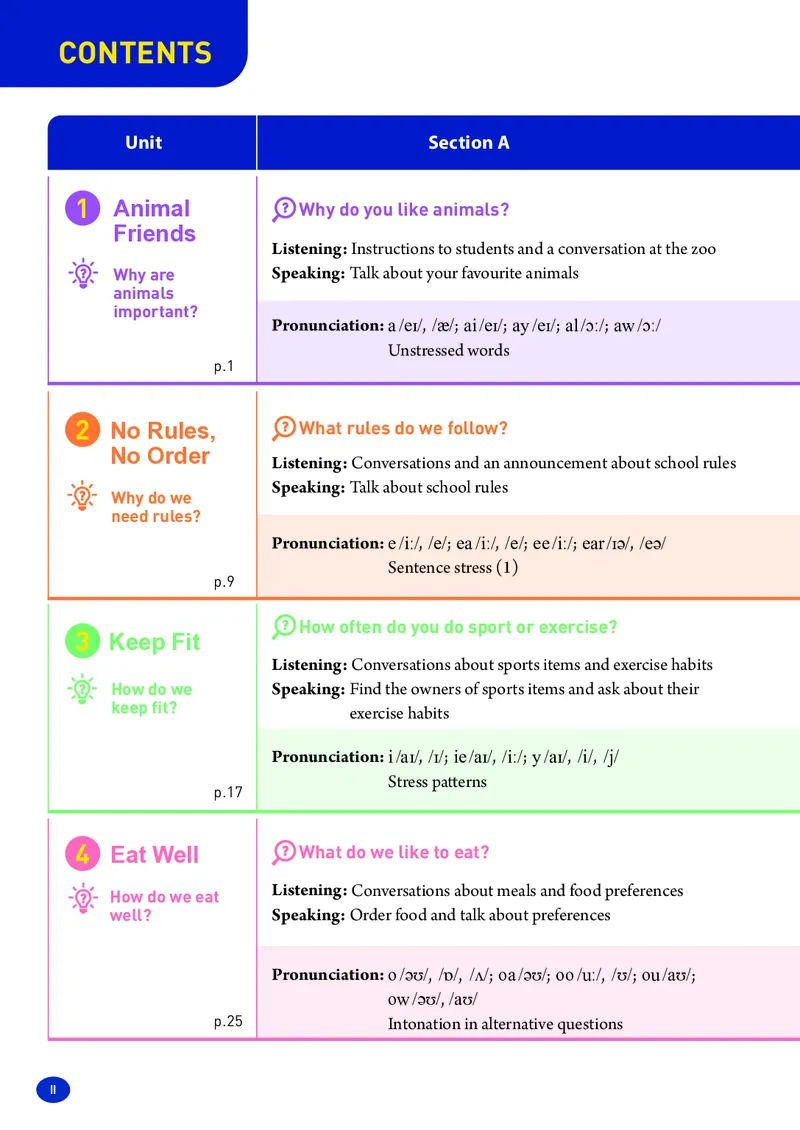
学习中取得更大进步!CONTENTS
Unit Section A
1
Animal Why do you like animals?
Friends
Listening: Instructions to students and a conversation at the zoo
Why are Speaking: Talk about your favourite animals
animals
important?
Pronunciation: a/eɪ/, /æ/; ai/eɪ/; ay/eɪ/; al/ɔː/; aw/ɔː/
Unstressed words
p.1
2
No Rules,
What rules do we follow?
No Order
Listening: Conversations and an announcement about school rules
Speaking: Talk about school rules
Why do we
need rules?
Pronunciation: e/iː/, /e/; ea/iː/, /e/; ee/iː/; ear/ɪə/, /eə/
Sentence stress (1)
p.9
How often do you do sport or exercise?
3
Keep Fit
Listening: Conversations about sports items and exercise habits
How do we Speaking: Find the owners of sports items and ask about their
keep fit?
exercise habits
Pronunciation: i /aɪ/, /ɪ/; ie/aɪ/, /iː/; y/aɪ/, /i/, /j/
Stress patterns
p.17
4 Eat Well What do we like to eat?
Listening: Conversations about meals and food preferences
How do we eat
well? Speaking: Order food and talk about preferences
Pronunciation: o /əʊ/, /ɒ/, /ʌ/; oa/əʊ/; oo/uː/, /ʊ/; ou/aʊ/;
ow/əʊ/, /aʊ/
p.25 Intonation in alternative questions
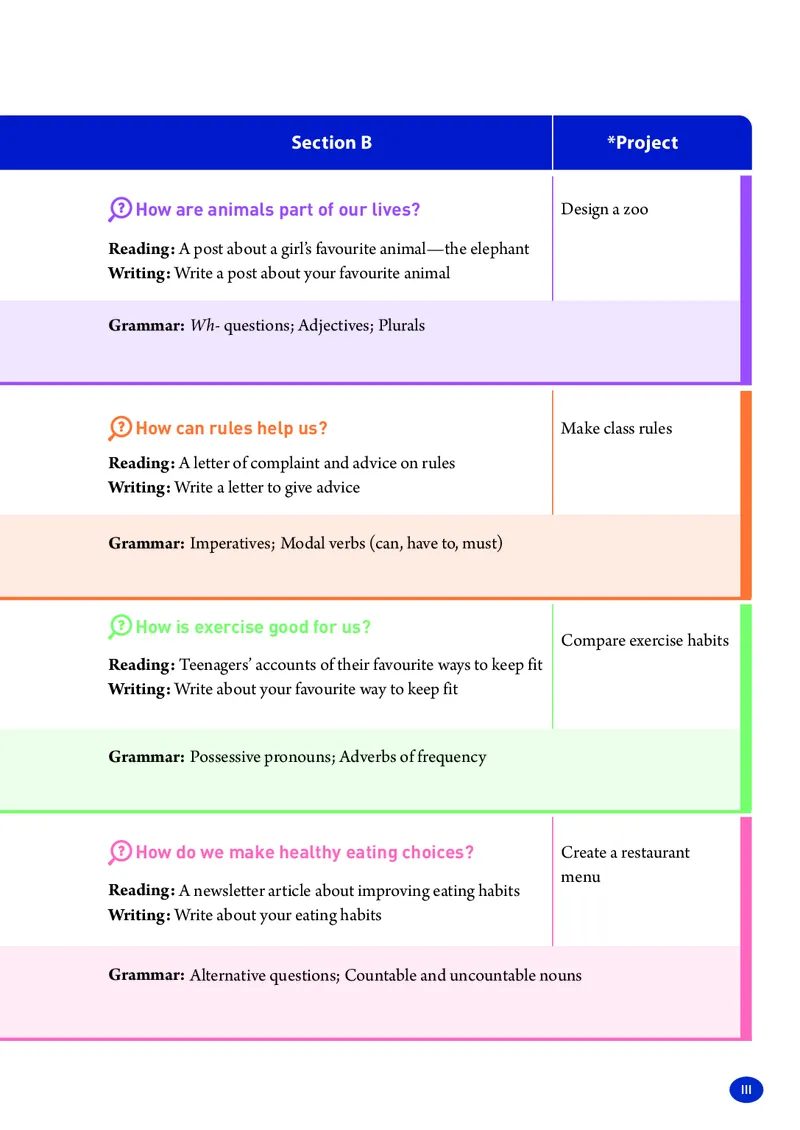
IISection B *Project
How are animals part of our lives? Design a zoo
Listening: Instructions to students and a conversation at the zoo Reading: A post about a girl’s favourite animal—the elephant
Speaking: Talk about your favourite animals Writing: Write a post about your favourite animal
Grammar: Wh- questions; Adjectives; Plurals
How can rules help us? Make class rules
Reading: A letter of complaint and advice on rules
Writing: Write a letter to give advice
Grammar: Imperatives; Modal verbs (can, have to, must)
How is exercise good for us?
Compare exercise habits
Reading: Teenagers’ accounts of their favourite ways to keep fit
Writing: Write about your favourite way to keep fit
Grammar: Possessive pronouns; Adverbs of frequency
How do we make healthy eating choices? Create a restaurant
menu
Reading: A newsletter article about improving eating habits
Writing: Write about your eating habits
Grammar: Alternative questions; Countable and uncountable nouns
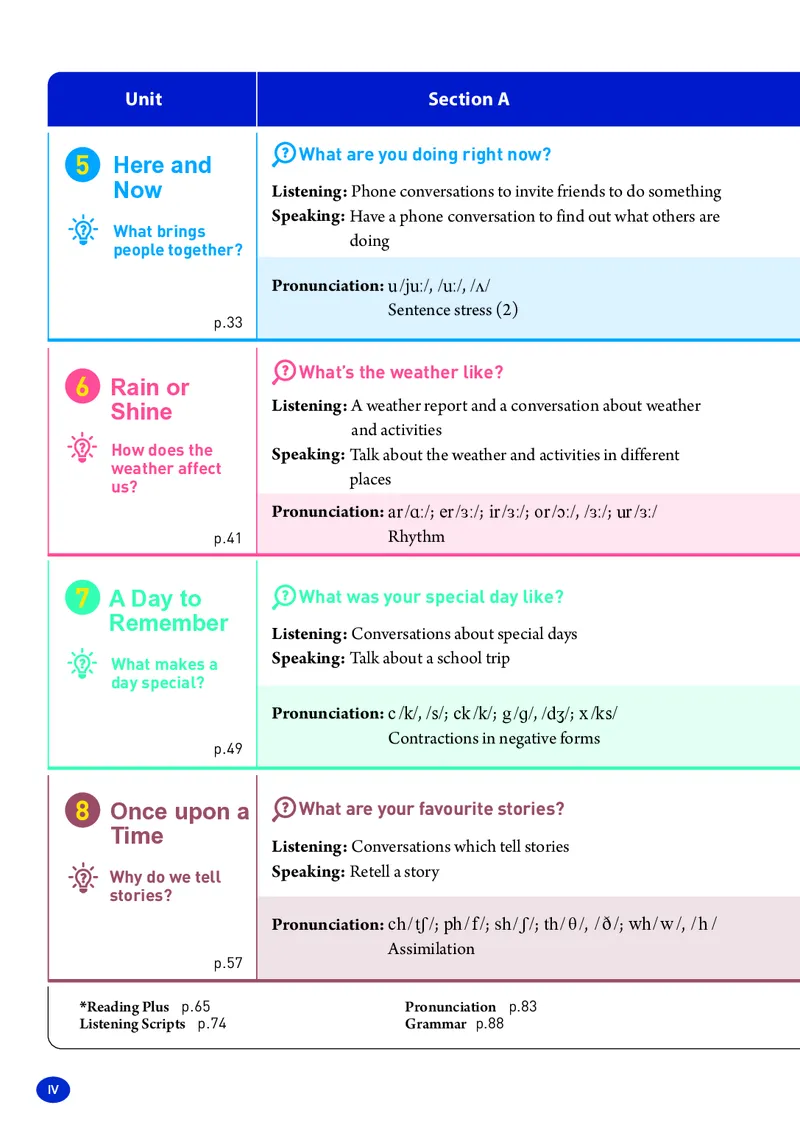
IIIUnit Section A
5
What are you doing right now?
Here and
Now Listening: Phone conversations to invite friends to do something
Speaking: H ave a phone conversation to find out what others are
What brings
doing
people together?
Pronunciation: u/juː/, /uː/, /ʌ/
Sentence stress (2)
p.33
What’s the weather like?
6
Rain or
Listening: A weather report and a conversation about weather
Shine
and activities
How does the
Speaking: T alk about the weather and activities in different
weather affect
places
us?
Pronunciation: ar/ɑː/; er/ɜː/; ir/ɜː/; or/ɔː/, /ɜː/; ur/ɜː/
p.41 Rhythm
7 A Day to What was your special day like?
Remember
Listening: Conversations about special days
What makes a Speaking: Talk about a school trip
day special?
Pronunciation: c/k/, /s/; ck/k/; g/ɡ/, /dʒ/; x/ks/
Contractions in negative forms
p.49
8 Once upon a What are your favourite stories?
Time
Listening: Conversations which tell stories
Why do we tell Speaking: Retell a story
stories?
Pronunciation: ch/tʃ/; ph/f/; sh/ʃ/; th/θ/, /ð/; wh/w/, /h/
Assimilation
p.57
*Reading Plus p.65 Pronunciation p.83
Listening Scripts p.74 Grammar p.88
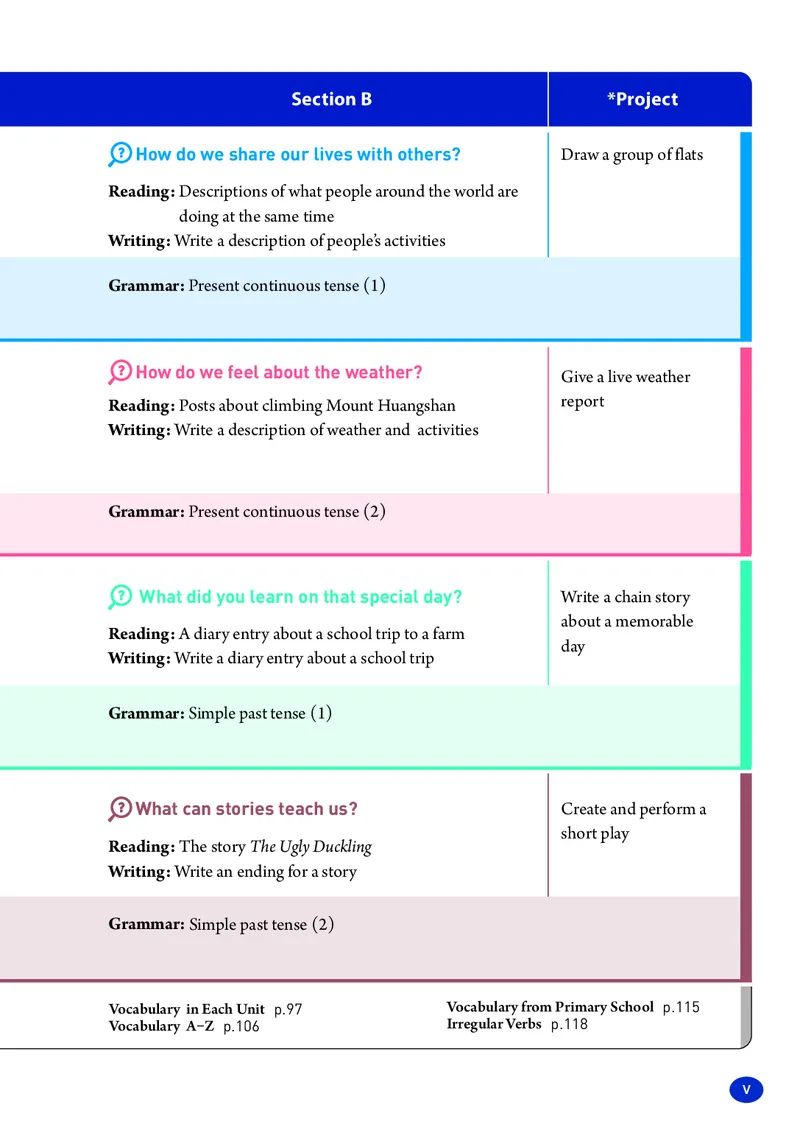
IVSection B *Project
How do we share our lives with others? Draw a group of flats
Reading: Descriptions of what people around the world are
doing at the same time
Writing: Write a description of people’s activities
Grammar: Present continuous tense (1)
How do we feel about the weather?
Give a live weather
Reading: Posts about climbing Mount Huangshan report
Writing: Write a description of weather and activities
Grammar: Present continuous tense (2)
What did you learn on that special day? Write a chain story
about a memorable
Reading: A diary entry about a school trip to a farm
day
Writing: Write a diary entry about a school trip
Grammar: Simple past tense (1)
What can stories teach us? Create and perform a
short play
Reading: The story The Ugly Duckling
Writing: Write an ending for a story
Grammar: Simple past tense (2)
Vocabulary in Each Unit p.97 Vocabulary from Primary School p.115
Vocabulary A–Z p.106 Irregular Verbs p.118
V1
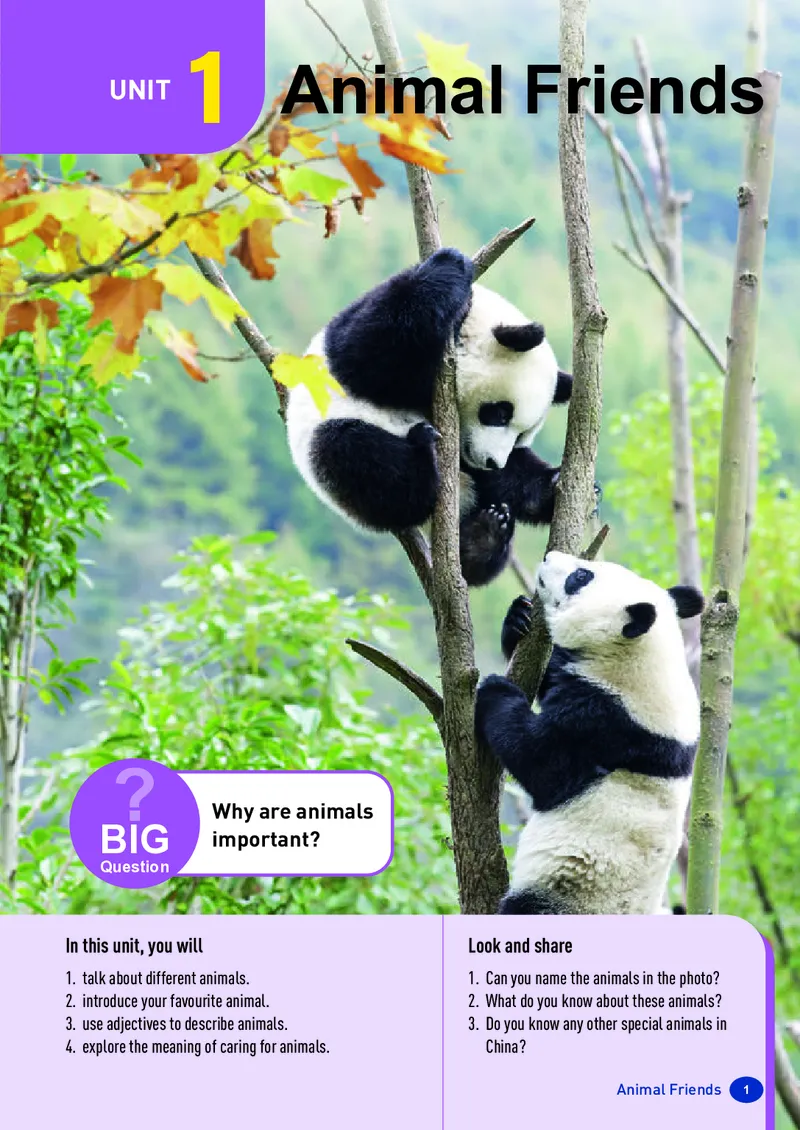
Animal Friends
UNIT
Why are animals
BIG important?
Question
In this unit, you will Look and share
1. talk about different animals. 1. Can you name the animals in the photo?
2. introduce your favourite animal. 2. What do you know about these animals?
3. use adjectives to describe animals. 3. Do you know any other special animals in
4. explore the meaning of caring for animals. China?
Animal Friends 1E
CTIO
S N
A
Why do you like animals?
1a Write the animals in the box under the pictures.
fox lion tiger giraffe monkey eagle wolf penguin
A B C
A
D E F G H
1b Listen to the teacher’s instructions. Answer the questions.
1. Where are the students?
2. Why are they there?
3. When should they be back?
1c Listen to the conversation. Circle T for true or F for false.
1. All three students like monkeys. T F
2. Yaming doesn’t like wolves. T F
3. Wolves take good care of their babies. T F
4. The three students see the monkeys before the wolves. T F
1d Talk about your favourite animal.
What’s your favourite animal?
It’s the monkey.
Why do you like monkeys? Because they’re clever
and funny.
2 UNIT 1Pronunciation
1
Listen and repeat. Add one more word to each group.
a ai ay al aw
/eɪ/ /æ/ /eɪ/ /eɪ/ /ɔː/ /ɔː/
game fat rain way walk draw
make cat brain play small law
2 Listen and repeat. Notice the pronunciation of –(e)s.
sharks lions boxes cats birds
giraffes monkeys foxes elephants toads
3 Listen and repeat. Notice how the unstressed words are pronounced.
1. A: Let’s go and see the monkeys. They’re my favourite animals.
B: Why do you like them?
A: Because they’re clever and funny.
2. A: Oh, look! A baby wolf and its mother! Do you like wolves?
B: No, I don’t. They’re very dangerous.
2a Listen to the conversation and circle the coloured words you hear.
Peter: The penguin is my favourite animal. What’s your favourite animal,
Fu Xing?
Fu Xing: I like penguins too. Why do you like them so much?
Peter: Because they’re very cute / cool!
Teng Fei: Yes, they look lovely / amazing. Let’s go and see them.
Peter: Oh, there they are! They can’t fly like other birds, but they can
swim fast. I like how they walk. It’s funny / interesting!
Teng Fei: Yes, it is! Where are they from?
Fu Xing: Look here! It says they’re from Antarctica. It’s very cold there, so
they often stand close together. It helps them keep warm.
Peter: They’re so clever / smart.
What do they eat?
Teng Fei: Fish and small sea animals,
I think.
Fu Xing: I have a fish sandwich …
Teng Fei: Don’t give them your sandwich!
It’s not good for them.
Animal Friends 32b Read the conversation and take notes.
1. Name 2. Looks
3. Home 4. Food
5. Ability
2c Listen to the conversation again and pay attention to the unstressed words.
Then role-play it.
2d Match the headers (1–5) in 2b with the questions (A–E).
A. What does it look like? / How does it look?
B. What’s your favourite animal?
C. What can it do?
D. Where does it usually live? / Where is it from?
E. What does it usually eat?
2e Complete a card about your favourite animal.
[Picture] Name:
Looks:
Home:
Food:
Ability:
2f Use the questions in 2d to ask about your partner’s favourite animal.
4 UNIT 1Grammar Focus
3a Read the sentences. Circle the word that introduces a reason.
What’s your favourite animal? It’s the monkey.
Where are penguins from? They’re from Antarctica.
Why do you like penguins so much? Because they’re very cute!
Why don’t you like snakes? Because they’re really scary.
3b Complete the conversation with the words in the box. Underline the animal
nouns.
Jane: Sam, are giraffes from?
They’re
Sam: from Africa. Do you like giraffes? because
Jane: Yes, I do. where
do
Sam: Why you like them?
don’t
Jane: Well, they’re interesting. They have
What’s
long necks. your favourite animal?
Sam: Guess! It lives in the sea.
Jane: Is it the shark?
Sam: No. I don’t like sharks.
Jane: Why you like sharks?
Sam: Because they’re really scary.
3c Make the nouns in the box plural. Then use the plural nouns to complete the
sentences.
eagle fox giraffe mouse penguin
shark sheep snake whale bear
I like because they’re cute / smart / interesting / funny / huge / ...
I don’t like because they’re dangerous / scary / ...
3d Think of an animal. Ask and answer questions with a partner to guess each
other’s animal.
A: Is the animal’s tail long? A: Where’s it from?
B: No, it isn’t. B: It’s from China.
A: Is it black and white? A: It’s a panda!
B: Yes, it is. B: Yes, you’re right!
Animal Friends 5E
CTIO
S N
B
How are animals part of our lives?
1a What do you know about elephants? Share your ideas with a partner.
1b Read Malee’s post and choose the best title for it.
A. What Is an Elephant?
B. My Favourite Animal: The Elephant
C. How to Save Elephants
Hi, I’m Malee and I live in Thailand!
The elephant is my favourite animal. I love elephants because they are
strong and clever. They are also a symbol of good luck here. The elephant
is our national animal. On 13 March, we celebrate Thai Elephant Day.
Elephants look very different from other animals. They are huge. They
have large ears and long trunks. They can pick up and carry heavy things
with their trunks.
Elephants are like us in some ways. They are very playful and love to play
in the water. They are great swimmers. They are also clever. For example,
they can remember one another and places with food and water after
many years. Elephants are very kind too. They look after other elephants
when they don’t feel well. The big elephants also help the baby ones.
Elephants are an important part of
Thai life and culture. However, they
are in danger. They live in forests,
but people cut down too many
trees. People also kill elephants for
their ivory. Let’s save the forests
and not buy things made of ivory.
Every elephant counts.
6 UNIT 11c Read the post again and answer the questions.
1. When do Thai people celebrate Thai Elephant Day?
2. What do elephants use to carry things?
3. Are elephants clever? Give your reasons.
4. Why are elephants in danger now?
5. How can we help save elephants?
1d Complete the mind map with the information from the post.
3. What they can do
2. What they look like ● pick up and carry 4. What they are like
things
● huge ● playful
● play and in the water
● ears ●
● places and other
● trunk ● kind
elephants well
1. What they are 5. How to save them
● Thailand’s ● don’t too
animal many trees
● a symbol of ● don’t things
made of ivory
2a Complete the passage with the words in the box.
close friendly big great beautiful
2 hours ago
My dog, Xiaohua, is part of the family. She is quite a dog, but she
is not scary at all! She has fur. She is really and loves
to play with everyone. She is also very special. You see, I am blind. Xiaohua is
my eyes. She helps me find my way around. She can see and has
hearing. She helps me walk to school and stay safe. I love her very much. We
are friends.
2b Write a post about your favourite animal. Use the questions to help you.
● What does it look like? ● What can it do?
● What is it like? ● Why do you like it so much?
Animal Friends 7Project Design a zoo
3a In groups, take turns to think of an animal. Describe it. Guess one another’s
animals and write them down in the table.
Land Water Sky
3b You’re going to design a zoo. Choose some of the animals from 3a for your
zoo. Give your reasons.
3c Draw a map of your zoo and
present it to the class. Use the
map and the expressions in the
box to help you. Vote for the
zoo you like.
Welcome to our zoo!
●
●
This is .../These are ...
●
Here you can see ...
●
There is /are ...
Exit
●
T hese animals are ...
Entrance
●
W e like ... because they
Wolves Eagles Giraffes Sharks
are ...
Lions Elephants Penguins Snakes
Restrooms Food Gifts
Reflecting
How well can you do these things? Very well OK Needs work
1. I can talk about different animals.
2. I can explain what I like or dislike about animals.
3. I can talk about the importance of animals.
4. I can think of ways to care for animals.
Animals are our best friends.
8 UNIT 12
No Rules,
UNIT
No Order
Why do we need
BIG rules?
Question
In this unit, you will Look and share
1. talk about rules by using imperatives and modal verbs 1. What school rules does the photo show?
can, have to, and must. 2. Do you follow rules like these?
2. explain why we need to follow rules. 3. What do you think about them?
3. understand how rules are helpful.
No Rules, No Order 9E
CTIO
S N
A
What rules do we follow?
1a Does your school have these rules? Tick the ones that your school has.
Mary, Sally, and
Rule Your school
Tony’s school
Don’t be late for school. Arrive on time.
Don’t run in the hallways.
Don’t eat in the classroom.
Wear the school uniform.
Don’t use your phone in class.
Don’t litter. Keep your school clean and tidy.
Be polite and treat everyone with respect.
Put up your hand if you want to ask your teacher
a question.
1b Listen to the first part of the recording. Tick the rules that are mentioned.
A B C D
1c Listen again. Complete the sentences.
1. Mary can’t in the .
2. Sally mustn’t wear her own jacket at . She has to wear
.
3. Tony can’t . He must keep the school .
1d Listen to the second part of the recording. Who is the speaker? What rules
does she talk about? Tick them in 1a.
1e In pairs, talk about the rules in 1c.
Can Mary run in the hallway?
No, she can’t. She has to walk in the hallway.
10 UNIT 2Pronunciation
1 Listen and repeat. Add one more word to each group.
e ea ee ear
/iː/ /e/ /iː/ /e/ /iː/ /ɪə/ /eə/
she bed please head tree ear pear
these pet speak ready sleep dear bear
2 Listen to the chant and notice the stressed words. Then listen again and repeat.
Across the country, in many schools, Every day, from Monday to Friday,
Students like us follow rules! Keep our school clean and tidy!
Be on time. Don’t be late for class. Raise your hand. Walk and don’t run.
Keeping the rules is good for us! Keep the rules and let’s have fun!
2a Listen to the conversation and circle the coloured words you hear.
Anne: Hi, I’m Anne. What’s your name?
Tom: Hello! I’m Tom. It’s my first day here.
Anne: It’s nice to meet you, Tom! Is everything OK?
Tom: Well, I can’t find my pencil box / pen. I think it’s in my locker /
at home.
Anne: Here, I can lend you my pen.
Tom: Thanks! Would you like a sweet?
Anne: No, thank you. We can’t eat snacks in class.
Tom: Can we eat fruit / drink water?
Anne: Yes, of course.
Tom: OK, thanks ... Oh! I’m sorry,
I have to answer my phone.
Anne: Oh, but we can’t / mustn’t
bring our mobile phones to class.
We have to turn them off and
put / keep them in our lockers.
That’s another rule.
Tom: OK! Thanks for telling me, Anne.
Anne: You’re welcome, Tom.
No Rules, No Order 112b Read the conversation and complete Tom’s notes about the school rules.
School rules
We cannot
We must not
We have to
2c Read the conversation again and answer the questions.
1. Why is the day special for Tom?
2. What does Anne lend to Tom?
3. Why doesn’t Anne take a sweet from Tom?
4. Can Tom and Anne use their phones in class?
5. Where must they keep their phones?
6. Do you think they have good school rules? Give your reasons.
2d Complete a summary of the conversation.
It’s Tom’s day at this school. He doesn’t know the school
well. Anne tells him about them. They eat snacks in class, but they
drink water. They can’t bring their mobile to class. They
must them off and keep them in their .
2e Listen to the conversation again and pay attention to the stressed words. Then
role-play the conversation.
2f Talk about the rules you have at school. Use the expressions to help you.
We must/mustn’t … We should …
What rules
do we have We can/can’t … Don’t …
at school?
We have to … Always …
12 UNIT 2Grammar Focus
3a Read the sentences. Do the verbs in bold need to change forms? Why?
Walk in the hallway. Don’t run!
Be polite and treat one another with Don’t litter./You mustn’t litter./You
respect. can’t litter.
No, we can’t. We must keep them in
Can we bring our phones to class?
our lockers.
No, we can’t eat in class. We have to
Can we eat snacks in class?
eat in the dining hall.
3b Complete the sentences using can, have to /must, or can’t /mustn’t.
1. Don’t jump the queue. You wait your turn.
2. I feed my dog many kinds of food, but I give him
chocolate. It is bad for him!
3. A: Can I leave the classroom if I don’t feel well?
B: Yes, but you tell your teacher about it when you
be absent from class.
4. A: Hey! Can I look at your book?
B: Shh, we talk quietly in the library.
5. A: Can you put on your seat belt? We wear one when we’re in
a car.
B: Sure. Thanks!
3c Look at the first sign and read the rules. Then write the rules for the other
signs.
● Do not eat or drink.
● No eating or drinking.
● You can’t / mustn’t eat or drink.
3d In groups, brainstorm three rules for one of the places below. Then draw signs
to show the rules. Share your signs in class and explain what they mean.
library school dining hall park cinema hospital
In the library, we must keep quiet. We mustn’t make noise. We can’t …
No Rules, No Order 13E
CTIO
S N
B
How can rules help us?
1a What are some of the rules in your home? What do you think about them?
1b Read Alice’s letter to Dr Know and Dr Know’s reply. Then answer the questions.
1. Why is Alice unhappy?
2. Does Dr Know think Alice is right?
Dear Dr Know,
Help! There are too many rules in my life! Every morning, I have to
make my bed before breakfast. I have to hurry to school because I
can’t be late for school. When I’m at school, I mustn’t use my phone
in class either. And I have to wear the uniform.
After school, there are even more rules! I have to finish my homework
first. I can only play basketball after I practise the piano. I can’t hang
out with my friends on weekdays. I know some rules are important,
but this is awful! What can I do?
Yours,
Alice
Dear Alice,
Yes, there are many rules in life! But they can help you to become a better
person.
You mustn’t be late for class. That shows respect for your class and teacher.
You can’t use your phone in class because you need to focus on learning.
You have to wear a uniform because it builds school spirit.
You can also think about the things you can do! You can use your phone at
home. You can relax after you finish your homework. And you can hang out
with friends at weekends!
I know it’s hard, but rules can help to make the world better. Remember: No
rules, no order!
Best,
Dr Know
14 UNIT 21c Read the letters again and complete Alice’s notes about her problem.
● have to before
Home ● have to because I for school
rules ● h ave to and before I can play basketball
● can’t with my friends on weekdays
School ● mustn’t use in class
rules ● must only wear
● understand rules help me to become a
Dr Know’s
● think about the things I
advice
● understand rules help to make
2a Complete the letter to Dr Know using can, have to /must, or can’t /mustn’t.
Dear Dr Know,
Can you help me? I follow too many rules at home and at
school. I clean my room every day, and I let my
desk get untidy. At school, I wear my own clothes. I
wear my favourite cap either. After school, I watch TV, but only
after I finish my homework, walk the dog, and do lots of other things!
I can’t even relax at weekends, because I practise
the violin every day! I never have fun. What I do?
Yours,
Eric
2b Choose three important rules from 2a. Discuss the questions with a partner.
● Why is each rule important?
● What is your advice for each rule?
2c Write a reply to Eric as Dr Know. Give him some advice.
Dear Eric,
I know it can be difficult to follow many rules. But rules can be good for us …
No Rules, No Order 15Project Make class rules
3a In groups, choose one goal that you hope your class can achieve.
● learn better ● have fun at school
● get along well ● take care of the classroom
3b Brainstorm 5–10 rules to help your class to achieve the goal. Write them down.
3c Work together to design a poster for your rules. Think of interesting ways to
present the rules.
Always be kind IN THIS CLASS Don’t use bad
and helpful. WE ARE FAMILY words.
FSaya “thamnk yoiu”l whyen
your classmates help
you.
Don’t fight Say “please”
with your when you
classmates. ask for help.
3d Share your rules in class. Vote for your favourite set of class rules.
In our class, we must get along well with others. We have to be kind to our classmates.
We mustn’t fight with them. We can …
Reflecting
How well can you do these things? Very well OK Needs work
1. I can talk about the things I can and cannot do
according to the rules.
2. I can explain how rules can be helpful.
3. I can use modal verbs to describe the rules in
different places.
4. I can understand how different people think and
feel about rules.
Nothing can be achieved without rules.
16 UNIT 23
Keep Fit
UNIT
How do we keep fit?
BIG
Question
In this unit, you will Look and share
1. talk about how to keep fit. 1. Can you name the sport in the photo?
2. share how often you do sport or exercise. 2. Is it a popular sport in China? Why do
3. use possessive pronouns to identify ownership. you think so?
4. discover how exercise helps you keep fit. 3. Do you like to do this sport? Why or
why not?
Keep Fit 17E
CTIO
S N
A
How often do you do sport or exercise?
1a Write the sports items in the box under the pictures.
baseball baseball glove basketball exercise mat
jump rope ping-pong bat running shoes tennis racket
A B C D
E F G H
1b Listen to the conversations at a sports centre. Answer the questions.
1. Whose football is it?
2. Whose baseball glove is it?
3. Whose tennis racket is it? How do you know?
1c Listen again. Complete the table with the correct information.
Name Sport How often
Han Lin
Emma hardly ever
Peter once or twice at weekends
Fu Xing
Binbin
tennis
Ella
1d In pairs, find one sports item that you both have. Talk about the sport or
exercise you do with it.
Do you have a ping-pong bat?
Yes, I do.
How often do you play ping-pong?
I play it three times a week.
18 UNIT 3Pronunciation
1 Listen and repeat. Add one more word to each group.
i ie y
/aɪ/ /ɪ/ /aɪ/ /iː/ /aɪ/ /i/ /j/
mine big pie piece sky party yard
time hill lie niece why healthy yours
2 Listen and clap when you hear the stressed words. Then listen again and repeat.
keep fit once a week work as a team if you like
play sport keep me fit play with my friends in the summer
Don’t talk. Not at all. Give her a book. Is it hers?
What’s this? Where’s my phone? Why do you like it? Do you see it?
2a Listen to the conversation and fill in the blanks.
Emma: There is a bat here. Is it yours?
Jim: No, it isn’t mine. Is it Ella’s?
Emma: No, hers is .
Jim: Maybe it’s Yaming’s.
Emma: Hi, Yaming! Is this your bat?
Yaming: Oh yes, it’s mine. Thanks!
Emma: . Your bat looks well-used. Do you play often?
Yaming: Yes, , and sometimes more! And you?
Emma: Hardly ever. I’m at it!
Yaming: Well, practice makes perfect. How often do you play, Jim?
Jim: I seldom do, but I often play badminton.
Yaming: Oh, me too.
Emma: I play badminton with Ella. We should all play doubles
sometime!
Keep Fit 192b Read the conversation. How often do the students do each sport? Tick the
correct boxes.
Ping-pong Badminton
Name
seldom sometimes often seldom sometimes often
Emma
Jim
Yaming
2c Retell the conversation with the information from the table in 2b.
Emma, Jim, and Yaming talk about the sports they do and how often they do them.
Emma and Jim seldom play ..., but Yaming ...
2d Listen to the conversation again and match the stress patterns below with the
coloured sentences. Then role-play the conversation.
A. B. C. D.
2e Imagine you have found an item at a sports centre. Make up a conversation
with a partner. Use the expressions to help you.
ping-pong bat,
badminton racket, play football / basketball /
a few times / three
baseball glove, jump badminton / ...
times / only once
rope, volleyball, mat, go swimming / jogging / ...
or twice (a month,
running shoes ... do exercise
a week ...)
jump rope
hers, his, theirs ...
A: Excuse me, is this your ...?
B: Yes, that’s mine. Thanks! / No, that’s not mine. I think it’s ...
A: Do you often ...?
B: Yes, I ... two or three times a week / ... How often do you ...?
A: I often / sometimes / hardly ever ...
20 UNIT 3Grammar Focus
3a Read the sentences. Decide what the pronouns in bold refer to. Circle the
adverbs of frequency and put them in order from the least to the most often.
Is this baseball glove yours? Yes, that’s mine. Thank you.
Whose badminton racket is this? I think it’s Han Lin’s. His has “HL” on it.
Do you often play ping-pong? Yes, I play once / twice / three times a week.
I play it twice a week, usually at weekends.
How often do you play football? I seldom / hardly ever play it.
I never do.
3b Complete the conversations with the correct pronouns.
1. A: Dad, where are my tennis shoes? And Tom’s?
B: Yours are right here. are over there.
2. A: Whose badminton racket is that? It looks just like mine!
B: It’s Sarah’s. It’s not !
3. A: Who does this T-shirt belong to? Is it yours?
B: Yes, it’s . Thanks!
4. A: Are these our baseballs?
B: No, they’re not . They belong to Emma and Ella.
They’re .
3c Complete the passage with always, usually, sometimes, seldom, or never.
I love jogging! I jog in the park near my home
in the morning. The air is clean, and I can hear birds
singing. I jog in the evening after work, but
I jog when I’m tired. I jog in the
afternoon on working days because I’m busy then. It’s
easy to go jogging. You just need running shoes. I jog
three times a week or more. I’m full of energy
after jogging. Keeping fit is not that hard!
3d In groups, ask one another how you keep fit. Take notes and give a report.
Name What sport / exercise do you do? How often do you do it?
jogging every day
Lin Tao
badminton twice a week
In our group, many students like to do sport and exercise. Lin Tao jogs every day ...
Keep Fit 21E
CTIO
S N
B
How is exercise good for us?
1a How are sport and exercise good for us? Discuss your ideas with a partner
and write them down.
1b Read three students’ accounts of their ways to keep fit. Fill in the blanks with
use an exercise app, skateboarding, or play baseball.
Xia Tian
I like very much. My
friends and I practise at a special park twice
a week. My skateboard is really cool, and so
are theirs. We encourage one another to do
tricks. Some tricks are difficult, but once you
succeed, you feel great! I like skateboarding
because it keeps me fit.
Jenny
This year, my goal is to be really
fit. I jog, swim, and do sit-ups. But
my favourite way of keeping fit is
to to work out.
The app gives me exercises to do
every day. It can show my progress. My friends use the app too. We have fun
when we keep fit together!
Steve
I’m in my school’s baseball club, so I
quite often. It’s my favourite
sport. We play many matches. The other
teams are great, but I think ours is the best!
We usually practise three times a week
after school. We also exercise a lot because
it keeps us fit and helps us play better.
Baseball also builds team spirit. All of us are good friends, both on and off
the field. We work as a team, and we win or lose as a team.
22 UNIT 31c Read the accounts again and complete the table.
Name How often he / she does it Why he / she likes it
Xia Tian
Jenny
Steve
1d Which activity in 1b would you like to try? Give your reasons.
2a A website wants to learn more about how teenagers keep fit. Read Kate’s post
and complete the mind map.
How teenagers keep fit
My favourite sport is swimming. It’s fun to swim and play with
my friends in the water. Also, I like swimming because the
Kate cool water feels great when it’s hot. I go swimming two or
three times a week.
Swimming is good for
me because it keeps
me healthy. It is good
exercise for my body. I
think everyone should
try it!
Kate’s favourite sport or exercise
What does she like about it? How often does she do it? Why is it good for her?
2b Make a similar mind map about your favourite sport or exercise.
2c Use your mind map to write a post about your favourite way to keep fit.
Keep Fit 23Project Compare exercise habits
3a In groups, ask your group members questions about their favourite sport
or exercise. Take notes in the table.
● What sport or exercise do you do most often?
● Why do you like it?
● How often do you do it?
Name Sport / Exercise Reason How often
Ai Ling basketball fun; good exercise twice a week
3b Write a brief report for your group. Then present it to the class.
In our group, three students’ favourite sport is basketball. Two students like tennis,
and one likes running. We like these for different reasons. Ai Ling plays basketball
for fun and exercise. She does it twice a week ...
3c Compare the reports. Find out which is the most popular sport or exercise
and why people like it.
Reflecting
How well can you do these things? Very well OK Needs work
1. I can talk about different ways to keep fit.
2. I can tell others about how often I do sport
or exercise.
3. I can talk about the things that I own and that
others own.
4. I can explain the importance of doing sport
and exercise.
Exercise shapes your body and mind.
24 UNIT 34
Eat Well
UNIT
How do we eat well?
BIG
Question
In this unit, you will Look and share
1. talk about what you or others have for meals. 1. Can you name any of the foods or dishes in
2. ask others about their food preferences and offer choices. the photo?
3. use countable and uncountable nouns to talk about 2. Which dish would you like to eat the most?
food and drink. 3. What is your favourite food? Do you often
4. explore how eating affects our health. eat it?
Eat Well 25E
CTIO
S N
A
What do we like to eat?
1a Write the foods in the box under the pictures. Which food(s) do you like?
watermelon cabbage mutton cookie onion carrot
A B C
D E F
1b Listen to the first conversation. Tick what Li Meng and Jane would like for lunch.
1. Jane would like to have
beef and carrot dumplings mutton and onion dumplings
watermelon juice coffee
2. Li Meng would like to have
mutton and onion dumplings noodles with beef and cabbage
tea watermelon juice
1c Listen to the second conversation. What does Jane have for breakfast (B),
lunch (L), and dinner (D)?
beef bread and milk chicken cookies
eggs and beans fish and chips ice cream juice
pizza salad sandwiches yogurt
1d Write what you usually eat for breakfast, lunch, and dinner. Then ask your
classmates about their meals.
What do you usually have for breakfast / lunch / dinner?
I usually have porridge for ...
26 UNIT 4Pronunciation
1 Listen and repeat. Add one more word to each group.
o oa oo ou ow
/əʊ/ /ɒ/ /ʌ/ /əʊ/ /uː/ /ʊ/ /aʊ/ /əʊ/ /aʊ/
no hot come coat food look about own down
home clock done roast school book trousers know brown
2 Listen and repeat. Notice the intonation.
A: Welcome to my home! First, do you want to play football or basketball in
the garden?
B: Football!
A: Okay. Later, would you like to eat Chinese food or Western food?
B: Chinese food!
A: Nice! And after dinner, what about playing a game or watching a film?
B: Both!
A: Wow, you’re full of energy! Yes, let’s do it all!
2a Listen to the conversation and circle the coloured words you hear.
Waiter: Hello! What would you like to order / eat?
Tom: What about Gongbao chicken? We often have it in America, but it may
taste different here. I’d like to try it.
Dad: Good idea!
Mum: Do you have anything with tofu?
Waiter: Yes. Would you like a hot tofu dish or a cold one?
Mum: A hot tofu dish, please.
Waiter: We have Mapo tofu. Would you like that?
Mum: Yes, please. We should also order some vegetables / a salad.
Dad: How about a chicken and cabbage salad?
Tom: That sounds good. Can we order / get soup too?
Dad: OK. Let’s see … Which soup would you like, chicken or fish?
Mum: Fish, please!
Dad: Sure. Now, would you like rice or
dumplings / noodles?
Tom: Rice, please.
Mum: OK. Let’s get that.
Eat Well 272b Read the conversation and complete the table.
Person Choice for the family meal
Tom
Mum
Dad
2c Listen to the conversation again and pay attention to the intonation in the
alternative questions. Then role-play it.
2d What food and drink would you and your partner like to order at a
restaurant? Take notes and discuss your ideas. You can use the words to help
you.
Beijing roast duck cabbage Dongpo pork fish soup
hot pot juice Gongbao chicken salad
strawberry cake tea beef noodles yogurt
Food Drink
2e Role-play a conversation between a customer and a waiter or waitress at a
restaurant.
A: Welcome to our restaurant!
Here is a menu for you. What
would you like to drink?
B: I’d like ...
A: OK! Now what would you like
to eat?
B: Do you have ...?
A: Yes, would you like ... or ...?
B: ..., please.
28 UNIT 4Grammar Focus
3a Read the sentences. Circle all the nouns for food and drink. Are they countable
or uncountable in the context?
I usually have some bread and milk.
What do you usually have for breakfast?
Sometimes I have eggs and beans.
Which would you like with your meal, rice or
Noodles, please!
noodles?
Would you like juice or coffee? No, thanks. I’d like a cup of tea.
3b Complete the jokes with the correct forms of
the nouns in brackets. Countable nouns:
bean, chip, cookie,
1. Customer: Do you serve (fish)?
dumpling, egg, noodle,
Waitress: Sir, we serve everyone.
strawberry, vegetable
2. Waiter: Would you like the
Uncountable nouns:
(bill) now?
beef, bread, meat, milk,
Customer: You can bring it over, but I’m
mutton, pork, rice, sugar,
sure I won’t like it!
tofu
3. Waitress: Would you like
Countable & uncountable
(chip), (noodle),
nouns:
or (rice) to go with
cabbage, cake, chicken,
your (chicken)?
drink, fish, food, fruit, salad,
Customer: I don’t know. Where is my
sweet, tea
chicken going?
3c Complete the passage with the correct forms of the nouns in brackets.
I try to eat healthy food every day. I eat fruit and (vegetable)
with every meal. I don’t eat (sweet). Instead, I have a pear, a
banana, or some (strawberry)! I love juice, but my mum says
that it’s not good to drink too much of it. It usually has a lot of (sugar).
Now I try to drink more (water) and (milk).
3d Imagine that your friends are at your home. Offer them food and drink.
A: Would you like ... or ...?
B: I’d like ...
A: What ... would you like, ... or ...?
B: ..., please.
Eat Well 29E
CTIO
S N
B
How do we make healthy eating choices?
1a List what you want to eat tomorrow. Discuss if your choices are healthy. Give
your reasons.
1b Read the article from a clinic’s newsletter. How many poor eating habits are
mentioned?
ANNOUNCEMENTS PEOPLE WHAT’S NEW
Joy Clinic
NEWSLETTER
Improve Your Eating Habits
Healthy eating is important for a healthy body and mind. Both what we
eat and how we eat are important!
For example, some people have fast food every week. It is easy and
delicious! But it often has lots of salt, fat, and sugar. That makes us put
on weight. Eating fast food like pizza and hamburgers too often may
cause heart problems later. If you cook your own meals instead, you can
make healthy balanced meals.
Eating three meals a day is important. But some people don’t have
breakfast. Maybe they don’t feel hungry in the morning, or they are too
busy to eat anything. But food gives us energy. It is easy to feel sleepy
and find it hard to focus on our work or studies if we don’t eat breakfast.
Some people also eat too many sweet things. Ice cream, sweets, and
chocolate are delicious, but they usually have lots of sugar. This can
cause tooth problems. When you want
a snack, why don’t you have some fruit
instead? After all, an apple a day keeps
the doctor away.
Remember: You are what you eat. Healthy
eating means eating healthy food and
having good eating habits.
30 UNIT 41c Complete the table with the information from the article.
Poor eating habit Result Reason for the result Idea / Advice
have fast food too
often
feel sleepy; hard to
need food for energy
focus
have fruit for
snacks
1d Read the article again and answer the questions.
1. What foods have lots of salt and fat?
2. What foods have lots of sugar?
3. What does “You are what you eat” mean?
4. Do you think the poor eating habits in the article are common among young
people? Why or why not?
2a The Joy Clinic wants teenagers to share their eating habits. Read Lisa’s post.
How many eating habits does Lisa write about? What are they?
5 hours ago
I have some good eating habits. I eat three meals a day, and I
have them on time. I eat a lot of vegetables too. Some of my
friends don’t like carrots or other vegetables, and they don’t eat
them, but I eat all kinds of vegetables.
Lisa
However, I have some bad eating habits too. First, I drink too many
soft drinks. I love soft drinks because they taste so good! But soft
drinks usually have a lot of sugar. They’re bad for me. Second, I
don’t drink enough water. I drink water when I am thirsty, but it’s
better to drink before I get thirsty. In future, I should drink more
water.
2b Talk about your own eating habits. Use the questions to help you.
1. What good habit(s) do you have?
2. What bad habit(s) do you have?
3. What can you do to improve your eating habits?
2c Write about your own eating habits with the information from 2b.
Eat Well 31Project Create a restaurant menu
3a In groups, create a list of menu dishes. You can choose dishes from China or
any other country.
3b Make a menu. You can also add prices or other information, such as
ingredients.
Soups
MENU
Staples
Cold dishes
Drinks
Hot dishes
Desserts
3c Swap your menu with another group. Use the following points to check the
menu and make revisions.
● Are there many kinds of dishes? ● Are there any special dishes?
● Are the dishes healthy? ● Do the dishes look good?
3d Work with a partner from a different group. Role-play ordering food at a
restaurant.
A: Good evening, welcome to our restaurant. Here is our menu. Would you like
something to drink first?
B: Yes, please. What drinks do you have?
A: We have tea and four kinds of juice: apple, orange, grape, and watermelon ...
Reflecting
How well can you do these things? Very well OK Needs work
1. I can name foods, drinks, and special dishes.
2. I can find out what others prefer to eat or drink
and offer them choices.
3. I can use countable and uncountable nouns for
food and drink.
4. I can make good food choices and develop
healthy eating habits.
Food is life.
32 UNIT 45
Here and Now
UNIT
What brings people
BIG together?
Question
In this unit, you will Look and share
1. talk about what is happening by using the 1. Where do you think the people in the photos are? What
present continuous tense. are they doing?
2. learn to make and answer telephone calls. 2. Can you explain how it can be daytime in one city when
3. find out more about the way of life in it is nighttime in another city?
different places around the world. 3. Do you know what time it is in other places right now?
Here and Now 33E
CTIO
S N
A
What are you doing right now?
1a Write the activities in the box under the pictures.
gardening playing volleyball reading a book
riding a bike shopping washing dishes
A B C
D E F
1b Listen to the conversations and answer the questions.
1. Who is calling his friends?
2. What activity does he want to do with his friends?
3. How many of his friends are free to do the activity?
1c Listen again. Match the questions with the answers.
1. What is Teng Fei doing? A. He is shopping.
2. What is Adam doing? B. He is watching a film.
3. What is Binbin doing? C. He is doing his homework.
1d Act out a phone conversation with a partner. Invite him or her to do something
with you.
Hi! It’s Peter. What are you
doing at the moment? I’m doing my homework.
Do you want to play volleyball
Of course! / I’d love to, but I’m
at the sports park?
working on something important.
34 UNIT 5Pronunciation
1 Listen and repeat. Add one more word to each group.
/juː/ use cute
u /uː/ true ruler
/ʌ/ up cut
2 Which words do you think are stressed? Underline them. Then listen and check.
A: What are you doing?
B: I’m walking my dog.
A: Would you like to play football with me at the sports park?
B: Yes, I’d love to. When shall we meet?
A: Let’s meet at three o’clock.
B: Sure.
2a Listen to the conversation between Jane and her family back in the UK. Fill in
the blanks.
Jane: Hi, Dad. ?
Dad: Hi, Jane! I’m fine. ?
Jane: We’re having a holiday here. Hao Yi and I are
making zongzi!
Dad: That sounds great! Are you making them for
the Dragon Boat Festival?
Jane: That’s right! What about you? What are you
doing?
Dad: I’m washing the car right now.
Jane: Is Mum there too? ?
Dad: Yes, her cold is gone. She’s gardening. Hold on. Here’s Mum.
Jane: Hi, Mum! ?
Mum: Good, thanks. It’s great to hear your voice!
Jane: Yours too! I’m happy you’re feeling better!
Mum: Thanks! Are you having fun in China?
Jane: Yes, I am. Hao Yi and I are making zongzi and watching dragon boat
races on TV. Oh, I have to go now. Let’s talk later.
Mum: OK. Bye, darling!
Here and Now 352b Read the conversation. Circle T for true, F for false, or NG for not given.
1. Jane is enjoying her life in Guangzhou now. T F NG
2 . Jane always spends the holiday with Hao Yi. T F NG
3 . Jane’s parents are preparing for the Dragon Boat
Festival now. T F NG
4 . Jane cares about her mother. T F NG
5 . Jane’s mum is not feeling well at the moment. T F NG
2c Read again and complete the table.
What are they doing?
Jane Jane’s family
2d Listen to the conversation again and pay attention to the stressed words.
Then role-play the conversation.
2e Work in pairs. Role-play a telephone conversation. Use the telephone
expressions to help you.
When you call somebody When you answer the phone
Hello?
Hello / Hi, it’s …
Who is it?
This is … speaking.
May I ask who’s calling?
Yes, hold on, please.
Could I speak to …? Sorry, he / she is out at the moment.
Is … there, please? Can I take a message?
Would you like to leave a message?
Could you tell him / her to call me back? No problem.
A: Hi, …! How are you doing?
B: I’m … Thanks! How about you? How is life in …?
A: It’s going … I’m … right now! And how is …? Could I speak to … too, please?
B: Yes, hold on, please. / Sorry, … is … at the moment.
36 UNIT 5Grammar Focus
3a Read the sentences. Underline the structures for the present continuous tense.
Is he exercising at the park? No. He’s shopping at the supermarket.
Are you making zongzi for the
Yes. We’re watching the races on TV too.
Dragon Boat Festival?
What are you doing right now? I’m doing my homework.
What is he doing at the moment? He’s watching a film.
What are they doing? They’re having breakfast.
3b Complete the sentences with the correct forms of the verbs in the box.
have sing paint learn take kick dance do
1. A: Wow! you a flower?
B: Not really. I’m painting a tree.
2. A: Listen! What the people next door ?
B: I can hear music. I think they and .
3. A: Where’s Mary?
B: She an online class in her room. She French.
4. A: What the boys ? They look like they
fun.
B: It’s a kind of shuttlecock. We call it jianzi in Chinese.
3c Complete the postcard with the correct forms of the verbs in brackets.
Dear Kate,
I (write) to you from Pingyao! My family and
I (visit) my uncle. We (have) a great
time! My uncle (show) us all the sights. We
(stay) near Pingyao’s famous city walls.
I know it’s near your exams. you
Kate Smith
(study) today? I hope it all (go) well! I
(look) forward to seeing you soon! 36 Flower Street
Love, London, UK
Beth
3d In pairs, take turns miming different activities and guessing what they are.
A: Are you running? B: N o, I’m not.
A: Are you skating? B: Yes, I am.
Here and Now 37E
CTIO
S N
B
How do we share our lives with others?
1a Look at the clocks and talk about the times in different places.
Chongqing Nairobi New York
evening / night / p.m. afternoon / p.m. morning / a.m.
A: What time is it in Chongqing?
B: It’s 8 p.m. / It’s eight o’clock in the evening.
1b Read the video script and add the times from 1a into the text.
What is happening in different time zones around the world right now? What
are people doing in different places?
It’s in Chongqing, China. Some people
are rushing to get home from work. But others are
not in a hurry! They are enjoying the city at night.
Lights are shining brightly across the city, and
colourful boats are moving slowly down the river.
People are eating delicious food, such as Chongqing
hot pot and noodles.
In Nairobi, Kenya, it’s . Many people are
working hard in their offices. Some people are shopping
for gifts, such as paintings and bags, in the markets.
Many others are walking in the parks and looking at
elephants and giraffes. In this city, people live side by
side with many wonderful animals!
It’s in New York, USA. It’s early, but the
city is getting busy! Many people are rushing to the
subway. They are going to work. Bright yellow taxis
are picking up and dropping off passengers. Some
people are jogging, walking, and riding bikes in
Central Park. Others are drinking coffee and eating
breakfast in coffee shops.
38 UNIT 51c Read the script again and answer the questions.
1. What special dishes can people eat in Chongqing?
2. Where can people in Nairobi see big animals like elephants and giraffes?
3. What are people doing in Central Park?
4. Can you explain why the time is different in each city at the same moment
in time?
5. Which city would you like to visit the most? Give your reasons.
1d People from the places in 1a are saying the sentences below. Write the names
of the places.
1. “Look at that giraffe! It’s drinking water.”
2. “Our family are taking part in a boat tour right now. We can see the city
well from here!”
3. “I’m jogging with my dog. The air is clean, and the morning sunshine is
great.”
4. “We’re shopping because I want to buy some gifts for my friends.”
5. “I’m driving to work today, but it’s taking a long time because it’s rush
hour. ”
2a It is Sunday, and people are doing different things in a park. Describe some of
the activities to a partner.
2b Write a video script by describing what is happening in the park.
Now it’s ten o’clock in the morning, and I’m at People’s Park. Look, the sun is shining! Let’s
take a look at …
Here and Now 39Project Draw a group of flats
3a In groups, draw a group of flats like the one in 3c. Think of a fun name for
your flats.
3b Draw some people doing different activities in the flats.
3c Present your flats to your classmates. Describe what is happening in each flat.
Decide who has the happiest or most interesting flats.
This is Sunny Flats. In this building, there are three floors. On the first floor, there are
three flats. Now it’s eight o’clock. Let’s see what everyone is doing!
Liangliang lives in Flat 101 with his family. He’s painting. He likes painting flowers.
Miss Jones lives in Flat 102. She’s playing the piano. She likes piano music. Mr Zhang’s
family lives in Flat 103. Mr Zhang is watching TV, and his wife is exercising on a mat!
Reflecting
How well can you do these things? Very well OK Needs work
1. I can describe what the people around me
are doing.
2. I can use the present continuous tense to
describe ongoing actions.
3. I can use the right expressions to make and
answer telephone calls.
4. I can understand how people around the
world can be doing different activities at the
same time.
Living in a global village, we should think like
a global citizen.
40 UNIT 56
Rain or Shine
UNIT
How does the weather
BIG affect us?
Question
In this unit, you will Look and share
1. talk about different types of weather. 1. How do you think the children in the photo feel
2. talk about weather-related activities by using the about the weather?
present continuous tense and the simple present 2. Do you like rainy weather? What weather do
tense. you like best?
3. explore how the weather affects people’s lives. 3. What do you do during such weather?
Rain or Shine 41E
CTIO
S N
A
What’s the weather like?
1a Write the weather descriptions in the box under the pictures.
cloudy
dry
lightning
stormy
windy
A B
C D E
1b Listen to the weather report. Match the different parts of Australia with the
weather conditions.
north warm and dry 35°C
west sunny and hot 20°C
south and east stormy 28°C
centre cloudy 22°C
1c Listen to the conversation. Circle the correct answers.
1. Where is Grandpa now?
A. In Australia. B. In his hometown.
2. What’s the weather like at Grandpa’s place?
A. It’s stormy. B. It’s sunny.
3. What’s Lucy doing?
A. She is staying in. B. She is watering flowers.
4. Is the weather making Grandpa sad?
A. Yes. B. No.
1d Act out a phone conversation with a partner. Talk about the weather near you
and what people are doing.
What’s the weather like?
It’s warm and sunny.
What are you doing?
…
42 UNIT 6Pronunciation
1 Listen and repeat. Add one more word to each group.
ar er ir or ur
/ɑː/ /ɜː/ /ɜː/ /ɔː/ /ɜː/ /ɜː/
hard verb first short word hurt
start person bird horse world nurse
2 Read the chant and clap when you read the bold syllables. Then listen and
repeat.
What’s the weather like today?
It’s windy and warm. It’s spring again.
Let’s fly a kite. Isn’t it great?
Hooray! Hooray! Let’s play!
2a Listen to the conversation and fill in the blanks.
Bill: Hey, Anna. How’s your holiday going?
Anna: It’s wonderful! I’m at a beach in Sanya!
Bill: Wow, lucky you! That sounds amazing. What’s the weather like there?
Anna: It’s . It’s about 28°C.
Bill: That’s nice! What are you doing at the beach?
Anna: I’m sunbathing at the moment! My brother John’s here too.
Bill: Oh, what’s he doing?
Anna: He’s right now. What about you?
How’s the weather in Stockholm?
Bill: Well, it’s . It’s about −3°C.
Anna: Oh, that’s really cold! What’s your family doing?
Bill: Well, we usually stay in when it snows, but now we’re
outside. Hey, come and visit us some day!
Anna: OK. Once the weather turns warm!
Rain or Shine 432b Read the conversation. Then complete the table.
Information Anna’s family Bill’s family
Place Stockholm
Temperature °C −3°C
Weather hot and cold and
sunbathing;
Activity building a
playing
2c Listen to the conversation again and pay attention to the rhythm of the
sentences. Then role-play the conversation.
2d List the activities you can do in different weather. Tick the activities you
enjoy doing the most.
swim outside read build a snowman
2e Imagine you are calling a friend. Your friend is having a holiday in a place with
different weather. Ask and answer questions using the ideas from 2d and the
expressions below to help you.
Talking about the weather
What’s the weather like in …? It’s really warm / … now.
How’s the weather in …? Today, it’s about …°C.
Is it very cold / … in …? It’s raining / … heavily.
Talking about activities
I’m shopping / … right now.
What are you doing now?
I’m outside / at home / …
Are you outside / … at the moment?
I usually run / … outside, but I’m
Are you having dinner / … now?
exercising / … at home now.
A: What’s the weather like in …?
B: It’s really …
A: What are you doing now?
B: I’m … right now. / I usually …, but I’m … at the moment.
44 UNIT 6Grammar Focus
3a Read the sentences. What tenses do they use? When do you use each tense?
What’s the weather like? It’s raining heavily.
How’s the weather? It’s cold and snowy.
What are you doing at the beach? I’m sunbathing.
What’s your brother doing? He’s playing beach volleyball right now.
We usually stay in when it snows, but
It’s really cold! What’s your family doing?
now we’re building a snowman outside.
3b Complete the conversations with the correct forms of the verbs in brackets.
1. A: Look, it (snow)!
B: That’s amazing! It (not snow) here in winter usually.
2. A: In my hometown, the sun (rise) at around 6 a.m. in summer.
B: Really? Here, the sun (rise) right now, but it’s already 7:30!
3. A: It’s so warm, but she (wear) a sweater!
B: Well, it’s her favourite sweater, after all. She always (wear) it.
4. A: Look at the kites! They (fly) so high.
B: It’s windy in spring here. People often (fly) kites in this
season.
5. A: Do you have an umbrella? It (rain) outside.
B: That’s the weather in London! It (rain) quite often. Here
you go.
3c Complete the passage with the correct forms of the verbs in brackets.
It is 2 January. It is freezing. The
temperature (be) −20°C!
Many people (visit) this
special place at the moment. Here
they can see lots of special ice works of
art like large and colourful buildings.
Some of the tourists (be) from South China. They (enjoy)
the ice festival very much. Look! What they (do)? Some
of them (take) photos, and some (skate). Do you know
the name of this special place?
3d Imagine that you are at a beautiful place outdoors. Tell your partner what
the weather is like and what activities people are doing. Can he or she guess
where you are?
RRaaiinn oorr SShhiinnee 4455E
CTIO
S N
B
How do we feel about the weather?
1a Look at the pictures on this page. What do you think you can see, hear, or
feel when you climb a mountain?
1b Read the posts by Helen and Peter. Are they visiting the same place? Do they
feel the same about it?
We’re at a rest area now. Climbing
is hard, but we’re making good
progress. Although the weather is
bad, many people here are still in
high spirits. I don’t think my brother
Peter is enjoying the experience
very much, so I’m encouraging him.
We’re here at Mount Huangshan!
The clouds look amazing. It feels Helen 9:18 | 1 May
like a magical place. The trees and
rocks look like a part of a painting.
Helen 7:22 | 1 May
The sun is shining through the clouds! It’s a lovely
sight. I’m so glad we’re here at Bright Peak.
Helen 10:36 | 1 May
Climbing is tiring! My shoes are all wet
and dirty too. There are many other
tourists at this rest area, but they
don’t seem tired at all. Instead, they’re
talking and laughing! My sister Helen
is also in high spirits.
Peter 9:15 | 1 May
Today I’m visiting Mount Huangshan
with my family. I’m not really
enjoying the experience. Everything
We’re here at Bright Peak. Mount
looks grey, and you can’t see much
Huangshan is beautiful in the sunlight.
because of the heavy fog. The
I’m tired and hungry, but it feels good
ground is very wet, so we have to
to be at the top!
climb slowly.
Peter 6:35 | 1 May Peter 10:40 | 1 May
46 UNIT 61c
Complete Helen’s and Peter’s descriptions about their trip. Then use or
to show how they feel.
Time and Helen Peter
place Thought Feeling Thought Feeling
● Everything looks
● The mountain feels like .
6:35–7:22
. ● He can’t
● The trees and rocks look because of .
like a part of . ● His family has to
.
● Climbing is .
● Climbing is .
● Her family is making
● His shoes are .
.
● The and Helen
Rest area ● She wants to
are all in .
Peter.
● The mountain is
10:36–10:40 ● The sun
in .
through the clouds.
● He is , but
● It is a sight.
he feels .
1d Read the posts again. Complete the questions with the question words in the
box and then answer them.
Why Who How Where What
1. did Helen and Peter see the tourists?
2. does Helen think about the trees and rocks?
3. enjoys the experience more at the start? do you think so?
4. does Peter feel at the end?
2a Complete the passage with the correct forms of the words in brackets.
There is a huge storm today. I am sitting in
my room and (look) out of the
window. It (rain) very hard. The
rain is pouring down. The wind
(blow) hard too. It is difficult for people
to use their umbrellas. A man in the street
(look) angry. He is shouting and
(run) after his hat!
2b Draw a picture of some people experiencing a heavy storm or another type
of weather. Write a description of their actions.
Rain or Shine 47Project Give a live weather report
3a Read the weather information and report about Chengdu. Underline the
information from the table in the report.
Chengdu
Season spring
Month April
Weather rainy
Temperature 20°C
Activity stay in; do indoor activities
Advice carry an umbrella; pack a raincoat
Good morning from Chengdu in Sichuan Province. It’s a cool spring morning in April.
It’s raining heavily today, and the temperature is around 20°C. Many people are staying
in today. It’s a good day to do indoor activities. But look behind me! A few people are
still outside. They’re hurrying towards the nearby buildings to hide from the rain. It’s
important to carry an umbrella or pack a raincoat today.
3b In groups, choose a city and find information about its weather on a certain
day. Make a similar table to the one in 3a.
3c Write a weather report with the information from your table in 3b. Give your
report to the class.
Reflecting
How well can you do these things? Very well OK Needs work
1. I can talk about different types of weather.
2. I can use the present continuous tense and
the simple present tense to describe
weather-related activities.
3. I can understand the influence of weather
on people’s lives.
Enjoy your day, come rain or shine.
48 UNIT 67
A Day to
UNIT
Remember
What makes a day
BIG special?
Question
In this unit, you will Look and share
1. talk about things that happened in the past by using the 1. Where are the students in the photo?
simple past tense. 2. What are they doing? Are they working
2. talk about school trips and what you can learn from them. hard?
3. learn to write a diary entry. 3. Would you like to try this kind of work?
4. reflect on special experiences.
A Day to Remember 49E
CTIO
S N
A
What was your special day like?
1a Write the activities in the box under the pictures. Did you do any of these
activities last weekend?
played badminton c ooked food met up with friends
went swimming d id homework visited a science museum
A B C
D E F
1b Listen to two conversations and answer the questions.
1. How was Peter’s weekend?
2. What did Peter like about the museum?
3. How was Teng Fei’s weekend?
4. How did Teng Fei feel after he talked to the tourists?
1c Who did each activity? Listen again and write P for Peter or TF for Teng Fei.
visited a museum went to an exhibition
lost a book took the wrong bus
tried to help tourists learnt how astronauts live and work
gave directions talked to robots
1d Talk about one of the conversations in 1b with a partner.
How was Peter’s weekend?
It was ...
What did he do?
Well, he ...
50 UNIT 7Pronunciation
1 Listen and repeat. Add one more word to each group.
c ck g x
/k/ /s/ /k/ /ɡ/ /dʒ/ /ks/
cook nice pick game age six
catch bicycle clock give large next
2 Listen and repeat. Notice the pronunciation of -(e)d.
/t/ talked picked helped stopped finished
/d/ moved climbed filled tried enjoyed
/ɪd/ wanted visited tasted needed ended
3 Read the coloured words. Then listen to the short conversations and circle
the words you hear.
1. A: Hey, I thought you didn’t / did like maths!
B: I do / don’t now. I was / wasn’t interested in it last year.
2 . A: H ello. Aren’t / Are you Ella’s friend?
B: I don’t / do know Ella!
3 . A: I can / can’t go on the school trip tomorrow.
B: O h, you should / shouldn’t tell our teacher about that now.
2a Listen to the conversation and fill in the blanks with correct adjectives.
Helen: H i, Fu Xing. How was your school trip to the wastewater plant? Was
it boring?
Fu Xing: No, it wasn’t at all. It was really interesting!
Helen: Wow! What did you see?
Fu Xing: We saw the plant make dirty water again.
Helen: Really? How?
Fu Xing: Well, first, water from our homes goes into the plant.
Then, special screens remove large pieces of waste from the water.
Helen: What happens next?
Fu Xing: Well, machines remove germs and other things from the
water. These things are usually too to see. It takes a few
more steps after that before the water becomes clean again.
Helen: Wow! I used to think it was to get clean water.
Fu Xing: Me too! I didn’t realize it was so .
A Day to Remember 512b Read the conversation and match the sentence parts.
A. remove small things from the water.
1. The plant makes
B. it was easy to get clean water.
2. Dirty water goes
C. dirty water clean again.
3. Machines inside the plant
D. remove large pieces of waste from the
4. Screens inside the plant
water.
5. Helen used to think
E. into the plant.
2c
Complete the summary of the conversation in 2a.
Last week, Fu Xing’s class went on a
school trip to a plant. The
plant turned dirty water into clean water.
Fu Xing learnt about the cleaning process:
First, dirty water goes from people’s
to the plant. Then the plant
uses screens to remove large pieces of
from the dirty water. Next,
large clean the water. They remove and other small
things. It takes a few more before the water becomes clean again.
2d Listen to the conversation again and pay attention to the pronunciation of
was, wasn’t, did, and didn’t. Then role-play the conversation.
2e Talk about a school trip you took to a special place.
theatre factory zoo museum
farm forest market park
How was your school trip?
It was great.
Where did you go?
We went to the theatre
to watch a show.
52 UNIT 7Grammar Focus
3a Read the sentences. Circle the verbs in the simple past tense. Then underline
the time expressions for the past.
Did you see anything interesting at the Yes, I did. There was a space exhibition.
science museum yesterday? There were robots.
Did Teng Fei give the tourists the right
No, he didn’t. He felt bad about that.
directions last weekend?
Yes, we did. We went to a wastewater
Did you go on a school trip a week ago?
plant.
What did you do the day before
I visited the zoo with my family.
yesterday?
It was terrible. I got on the wrong bus. I
How was your weekend?
left my book on the bus too.
3b Put the words in order. Write the sentences using the correct tenses.
1. my favourite actor, the day before yesterday, I, see, in a film
2. they, a day, spend, on a chicken farm, last month
3. two bottles of milk, on the table, a few minutes ago, there, be
4. last night, stop, the doctor, work, at ten o’clock
5. Ms Li, last Wednesday, meet, in the street, one of her friends
3c Complete the passage with the correct forms of the verbs in the box.
see learn be walk think work
Last week our class went on a school trip to Jinggangshan. In a museum,
we about important people like Mao Zedong and Zhu De. We
many things such as old photos, paintings, and guns. We also tried
on some uniforms from the past. We along the mountain roads and
about the past. Many people back then hard to create
what we have today. It a day to remember, and it made me want to
work hard for a better future too.
3d In pairs, ask each other about the activities you did yesterday and what time
you did them. Then tell the class about your partner’s day.
Peter got up at 5 a.m. yesterday. He had some bread and an egg for breakfast. Then he …
A Day to Remember 53E
CTIO
S N
B
What did you learn on that special day?
1a Do you keep a diary? Do you think it is a good idea to keep a diary? Discuss
your ideas with a partner. Use the points to help you.
● remember what happened ● record thoughts and feelings
● improve writing skills ● write down new ideas
1b Read Sam’s diary entry and write a one-sentence summary of what he did on
that day.
Friday, 30 May
Today we went on a school trip to a farm! It was tiring but great
fun! In the morning, we explored the farm. There were large tents
with tomatoes, cucumbers, and many other fruits and vegetables.
The farmer told us about how these fruits and vegetables go from
the fields to our tables. I was very interested because I usually
only see them in the supermarket.
Then we got straight to work! First, we picked some strawberries.
The work seemed easy, but it took time to get it right. Slowly, we
filled many baskets. In the afternoon, the farmer taught us how
to cut branches and leaves from tomato plants. This helps them
to grow more fruit. Finally, we watered the plants. Plants need so
much work! It was tiring, but I enjoyed working with my hands.
One thing I learnt today: Farming isn’t easy!
It made me think of the saying,“Every grain
comes from hard work.”The farmer let us
take some vegetables home. My mum cooked
some for dinner, and they were fresh and
delicious! They certainly taste better when
you work for them! Today was really a day
to remember.
54 UNIT 71c Complete the flow chart with the events from the text.
Learnt how food goes
Arrived at
from the
the farm the farm strawberries
to our
branches
Wrote a diary entry
vegetables at
and leaves from
for the day plants
home tomato plants
1d Read the diary entry again and answer the questions.
1. Where did Sam go for his school trip?
2. How did he feel about the trip?
3. What did he learn from the trip?
4. What do you think “Every grain comes from hard work” means?
5. Do you agree with Sam that food tastes better when you work for them?
Give an example.
2a Make notes about your last school trip.
MMyy SScchhooooll TTrriipp
1. Where did you go? 3. How did you feel?
2. What did you do / see? 4. What did you learn?
2b Write a diary entry about the school trip. Use your notes in 2a and the
expressions to help you.
I had a(n) amazing / good / bad / terrible day today.
Our class went on a school trip to …
What a day!
Friday, 6 June
I had a really good day today. Our class went on a school trip to an art museum …
A Day to Remember 55Project Write a chain story about a memorable day
3a In groups, think of a place or situation where the story took place. Share any
interesting or special experiences. Use the questions to help you.
● What did you see or do there?
● How did you feel?
● Did you learn anything?
3b Write a chain story together. Take turns to add one or two sentences each. You
can use your experiences from 3a to help you. Read the example below.
Last summer, At first it was We heard thunder
we had a very a nice day, but and saw lightning
memorable then the weather flash across the
day! We were changed. It sky. Just then, we
on holiday in the started raining. saw someone in
mountains. trouble.
3c Read your story to the class. Vote on the most interesting or special story.
Reflecting
How well can you do these things? Very well OK Needs work
1. I can talk about my experiences on a special day.
2. I can read and write diary entries about school
trips.
3. I can use the simple past tense to talk about
what happened in the past.
4. I can share what I learnt from past experiences.
If you try to learn something new each day,
you'll make each day special.
56 UNIT 78
Once upon a
UNIT
Time
Why do we tell stories?
BIG
Question
In this unit, you will Look and share
1. tell stories and talk about what you can learn from them. 1. What are the students in the photo
2. use the simple past tense and the simple present tense to doing?
tell a story. 2. How do you think they feel about it?
3. make up an ending for a story. 3. What do you think the teacher is helping
4. explore stories from different cultures. them with?
Once upon a Time 57E
CTIO
S N
A
What are your favourite stories?
1a Look at the pictures. Do you know what stories they are about?
A B C D
1b Listen to the first conversation. Put the sentences in order.
The mouse bit through the net.
The hunter caught the lion.
The lion let the mouse go.
The lion caught the mouse.
The mouse promised to help the lion.
1c Listen to the second conversation. Choose the correct words to complete
the sentences.
1. Long ago, a farmer his horse.
A. lost B. killed C. sold
2. The farmer’s horse came back with other horses.
A. five B. six C. seven
3. The farmer’s son broke his .
A. head B. arm C. leg
4. The didn’t have to join the war.
A. farmer B. farmer’s son C. farmer’s neighbour
1d Listen to the two conversations again and answer the questions.
1. Why do you think the lion laughed when the mouse promised to help
him?
2. Do you like the story about the lion and the mouse? Why or why not?
3. Did the farmer feel very sad when bad things happened?
4. Was the farmer wise? Why or why not?
1e Which story do you like more? Retell it to a partner.
58 UNIT 8Pronunciation
1 Listen and repeat. Add one more word to each group.
ch ph sh th wh
/tʃ / /f/ /ʃ/ /θ/ /ð/ /w/ /h/
chair physics ship throw then why who
which elephant fashion maths with where whose
2 In pairs, read the conversation aloud slowly. Then listen and read it again at
a normal speed. Notice how the letters in bold change sounds.
A: Did you read Little Women for English class? It’s great!
B: No, I didn’t. Would you like to tell me about it?
A: Well, I’d like to. But don’t you want to read it by yourself?
2a Emma is sharing a story with her class. Listen and circle the coloured words you hear.
Here’s The Emperor’s New Clothes by Hans Christian Andersen.
Once upon a time, an emperor loved / liked clothes very much. He
wanted to buy some new clothes.
Two brothers came and lied to him, “We can make wonderful clothes!
But only clever / smart people can see them!” They pretended to
make the clothes.
The emperor’s officials couldn’t see the clothes, but they said, “What
lovely clothes!” The emperor couldn’t see anything either, but he
said, “They’re beautiful!” No one wanted to look silly.
The emperor decided to show everyone his new clothes. People in
the street / city praised them. They were afraid to look silly too!
Suddenly, a boy cried / shouted, “Look! The emperor has no clothes
on!” Everyone looked at one another. They started / began laughing.
The end! Did you like the story? Please tell me what you think!
Once upon a Time 592b Read the story. Complete the flow chart.
They
Two
to make
lied to the
emperor. beautiful The emperor and
An emperor
clothes. his officials
wanted to buy
couldn’t
new clothes.
the clothes.
They The emperor
when a boy told people
People
the truth. his new clothes.
the clothes at
first.
2c
Read the story again and answer the questions.
1. What did the two brothers say about their clothes?
2. Why did the emperor and his officials praise the clothes?
3. Why did the people in the street praise the clothes at first?
4. Why do you think the boy told the truth?
5. Why do you think everyone started laughing at the end?
2d Which characters from the story do you think said the sentences?
1. “We can make a lot of money by lying to the emperor.” one of the brothers
2. “There are two brothers outside. They say that they can make you fine
clothes.”
3. “Oh! Where are my new clothes? I can’t see them. Am I silly? That can’t
be true!”
4. “I can’t see the emperor’s clothes. But everyone in the street is praising the
clothes! I hate to be different. I should praise them too.”
5. “What’s everyone talking about? The emperor isn’t wearing anything! I
know he isn’t!”
2e
Listen to the story again. Then retell it to a partner.
60 UNIT 8Grammar Focus
3a Read the sentences. What tenses do they use? When do you use each tense?
Did you read Little Women for English Yes, I did. It is a great book. / No, I didn’t.
class? We chose a different book.
Do you know the story of The Yes, I do. It’s a funny story! / No, I don’t.
Emperor’s New Clothes? Please tell me about it.
How did the mouse help the lion? It bit through the net, and the lion got out.
What did the brothers do? They lied to the emperor.
3b Choose the correct forms of the verbs.
1. When I am / was a child, my favourite book is / was Peter Rabbit.
2. I usually tell / told funny stories to my friends. But I tell / told them a sad
story yesterday, and they cried.
3. The mouse asks / asked the lion not to kill him. He promises / promised
to help the lion, and the lion let him go.
4. The two brothers lie / lied to the emperor, but the emperor didn’t know
that and buy / bought their clothes.
5. Usually, people feel / felt sad when they lose / lost something. But the
farmer in the story didn’t feel sad when he loses / lost his horse.
3c Complete the short story with the correct forms of the verbs in brackets.
Once upon a time, a king (ask) an artist to paint him a horse.
“Please (give) me some time,” the artist (answer).
The king waited for a few months before he (grow) angry. “Where
(be) my painting?” he asked. Quickly, the artist
(paint) a beautiful picture of a horse. The king said, “I (like) it!
But why did you make me wait so long?” The artist (smile) and
(take) the king to his house. There were paintings of horses all
over! “It took me months to learn how to paint a horse well!” he
(say).
3d
Share your favourite story. Tell your classmates why you like it.
My favourite story is …
Once upon a time, …
The end!
I like this story because …
Once upon a Time 61E
CTIO
S N
B
What can stories teach us?
1a Look at the pictures. What do you think happens in this story? Number the
pictures.
1b Read the story adapted from Hans Christian Andersen’s The Ugly Duckling.
Discuss the question with a partner.
● Is the ugly duckling a real duck?
The Ugly Duckling
Once upon a time, there was a mother duck. She had
six little ducklings. Five of the ducklings were small
and yellow, but the last duckling was big and grey. “He
doesn’t look like us! What an ugly duckling!” the other
ducklings said. “That’s not nice!” said Mother Duck. “He’s still a duck like us!”
At the river, the ugly duckling swam well, just like all the other ducklings. But
the other ducklings still laughed at him and told him to go away. It made the
poor duckling very sad, so he decided to search for a new home. He met many
other birds, but all of them thought that he was ugly too. They did not want him
to live with them.
One day, the duckling met a cat and a hen. “May I stay with you?” he asked
hopefully. But the two animals said no. They did not like him because he could
not purr or lay eggs!
Some days later, the ugly duckling came to a lake. There, he saw three beautiful
swans with long necks and white feathers. “I wish I looked like you!” he cried.
“My friend, you do look like us! Look in the water!” one of the swans said. The
duckling looked down, and to his surprise, he saw that he was a beautiful white
swan too!
62 UNIT 81c Read again and answer the questions.
1. How was the ugly duckling different from the other ducklings in size and
colour? How was he similar to them?
2. What did the ugly duckling search for? Why?
3. What did the swans look like? Were they friendly to the ugly duckling?
4. What do you think the story teaches us?
1d Match the characters with their opinions. Can you give these characters any
advice? Share your ideas.
A. The ugly duckling B. The five ducklings C. The other birds D. The cat and the hen
We only like animals You’re big and grey,
We want you to go I’m not happy here.
with special skills. but we’re small and
away. You cannot Is there a right
You are welcome yellow. You’re very
live with us because place for me out
here only if you can ugly because you
you’re too ugly! there?
purr or lay eggs. don’t look like us.
1. 2. 3. 4.
2a Read the beginning of the story. Write an ending for it. Use the questions to
help you.
Once upon a time, a fisherman caught a bottle in
his fishing net. When he opened it, a great cloud
came out and became a genie!
“Prepare to die!” shouted the genie. “A long time
ago, I made a promise. If someone set me free,
I would make them rich and powerful. But no
one ever came. After years and years of waiting, I
became very angry. If anyone set me free, I would
kill them instead of giving them anything. So, you
must die!”
. . .
● What would the fisherman say to the genie?
● Would the genie kill the fisherman? If so, how?
● Would the fisherman succeed in saving himself? If so, how?
● What would happen in the end?
2b Exchange your drafts and share your ideas with your group members.
Once upon a Time 63Project Create and perform a short play
3a In groups, choose one of the stories from this unit to act out in class.
● Which story do you think is the most interesting?
● Which story would make an exciting play?
3b Work together to write a short play for your group. Use the questions and
the example to help you.
● What happens in the scenes?
● Where do they take place?
● How many characters are there in each scene?
● Who will be the narrator and who will play each character?
● What will the characters say? How will they say it?
The Fisherman and the Genie
Scene One [At the seashore.]
Narrator: A fisherman saw something surprising in his net.
Fisherman: What’s this shiny thing? Oh, it’s a bottle! I wonder what’s inside.
Narrator: The fisherman opened the bottle. A great cloud of smoke came out,
and it became a genie …
3c Perform the play in class. Then vote for the best performance.
Reflecting
How well can you do these things? Very well OK Needs work
1. I can use the past tense to tell my favourite
stories to others.
2. I can express my thoughts and feelings about a
story.
3. I can write an ending for a story.
4. I can understand the meaning behind stories
from different cultures.
Short stories can hold big ideas.
64 UNIT 8Reading Plus
Unit 1
The Amazing Octopus
Among the many amazing animals in the world, few are as
strange and unusual as the octopus. There are around 300
different kinds of octopuses, and they come in all sizes!
The smallest is only around 2.5 centimetres long, but some
octopuses can grow up to more than five metres long. There
was even an octopus over nine metres long!
The octopus’s body is very interesting. All octopuses have
eight arms. Their brain is not just in their head, but also in their arms! This helps
them to think about and do more than one thing at once. Octopuses can also fit into
small places because they do not have any bones! And did you know that octopuses
have three hearts? These hearts work with different parts of the body.
Octopuses can also do many amazing things. Most of them can change their colour
and shape to look like plants or other sea animals, and they can also make ink. They
keep it inside a very small bag in their body. When they produce ink, the ink makes it
hard for other animals to see them. This helps the octopuses to get away fast. What’s
more, when an octopus loses an arm, it can grow it back!
Studying amazing animals like the octopus is important because we can learn a lot
from them. But they also show us how wonderful nature is and why it is important
to protect it!
1 Read the text. Choose six amazing things about octopuses to complete the
mind map.
The octopus
Body Ability
2 Think of some other amazing animals. Discuss them.
● What are they like?
● What can they do?
● What is amazing about their bodies or abilities?
Reading Plus 65Unit 2
Rules around Us
Do not feed the animals.
No flash photography. Do not litter.
Do not bring food or drink near exhibits. Do not shout or make loud noises.
Do not touch exhibits. Do not disturb the animals.
No smoking. Do not climb over or put your
Turn off or silence your phones. hands or arms through fences.
Do not push others to get to the front No flash photography.
of the crowd. No smoking.
Watch your step around exhibits. Follow instructions when you take
Do not shout or make loud noises. part in activities.
Arrive early or on time. Do not run in the pool area.
Wear formal clothes.
Do not dive or jump in the pool.
Take your seats quickly and do
Children and swimming learners must
not block the aisles.
always be with a good swimmer.
No filming or photography.
Do not bring food or drink to the pool area.
Turn off your phones.
Wear swimsuits in the pool.
Do not talk during the
performance. Only change clothes in the correct areas.
Clap only at the end of the No pets allowed.
performance. Shower before entering the pool.
1 Read the signs and write the names of the four places in the boxes above.
SWIMMING POOL ZOO MUSEUM CONCERT HALL
2 Introduce the rules and explain why they are important.
Ladies and gentlemen, welcome to the … Before you enter, please listen to our rules.
First, you must …
66 Reading PlusUnit 3
Healthy Body,
Healthy Mind
We all know exercise is important, yet we
don’t always want to do it! Often we are
too busy or feel lazy. But we should try our
best to exercise every day.
Exercise is good for our body. When we exercise, our body changes. Exercise develops
our muscles and makes us stronger. When we exercise, we use energy. This keeps our
weight down. Being overweight puts stress on our body. It can cause pain in our back
and knees, and even cause more serious problems such as heart disease later in life.
Exercise is also great for our brain. During exercise, our heart beats faster and we
breathe harder. Our brain gets more oxygen because of this, and that helps our
memory improve. Scientists also tell us the body makes more of certain chemicals
after exercise. This helps us to learn and think well. So, when you have trouble with
your homework, do some exercise, then try again!
Exercise also helps us to feel happier. When we exercise, our brain makes special
chemicals. These chemicals can relax our body and calm our mind. Feeling fit can also
make us feel better and more confident about ourselves. When we play a sport with
others, we can even make new friends.
Remember: Health is wealth. The more you exercise, the healthier you become. Try
to make exercise a part of your life.
1 Read the text and complete the outline.
Introduction
How is exercise good for our ...?
Main body brain mind
parts
Conclusion
2 Read the text again and answer the questions.
1. What are some common reasons people give for not exercising?
2. What do you think the writer means by “Health is wealth”? Do you agree?
Reading Plus 67Unit 4
Food Myths
“Only fruit and vegetables are
healthy foods.”
The human body needs to eat many
different types of food to stay healthy.
The Chinese Food Guide Pagoda shows
us what food we should eat. While
fruit and vegetables are healthy
choices, it is just as important to eat
foods from other food groups. Milk,
for example, contains many nutrients and is good for our bones. We should include
milk or dairy products among the things we eat.
“Eating fat makes you fat.”
Eating fat is important for keeping us healthy. It gives us energy and helps our body
to take in nutrients. Not all fat makes us gain weight. Some fat can even encourage
our body to lose weight. It is necessary to include some, but not too much, fat in our
food to help our body work well.
“It’s OK to eat only what I like while I’m young.”
When we are young, it might feel like we can just eat whatever we want! For example,
sweets and fried foods taste delicious. But we cannot eat those foods alone. Eating
balanced meals is very important when we are young. It helps our body and brain to
grow well. Bad eating habits may stay with us our whole life, so it is best to develop good
eating habits early!
1 Read the text and answer the questions.
1. What are the three food myths in the text?
2. Why is milk good for the body? Give two reasons.
3. Should we eat fat? Why or why not?
4. Why do young people also need to be careful about what they eat?
5. Do you agree with the ideas in the text? Is there anything you might
change about your eating choices?
2 Brainstorm other beliefs about healthy food and eating habits. Which do
you think are true? Discuss your ideas.
68 Reading PlusUnit 5
Visiting New Places
“Hey, I’m Sandra from Lisbon. Welcome back to my channel!
Today I’m visiting a friend in Paris. It’s a wonderful city! There are
many tourists here. They’re visiting the museums and galleries.
Some tourists are taking a boat along the River Seine too! My
friends and I are going to the Eiffel Tower now! I’m taking lots of
photos to send to my family.”
“Nihao! It’s Liu Meng from Shanghai. Right now my family
and I are visiting friends in Canada. We’re all on a tour of the
Niagara Falls. It’s amazing! We’re on a boat close to the falls.
The water’s pouring fast over the falls. It’s so powerful! We’re
wearing raincoats but are still getting very wet! We’re having
great fun anyway!”
“Hey everyone, it’s Alex. Today I’m visiting my uncle in Thailand.
We’re at the beach now! I’m from Switzerland, and this is actually
my first time seeing the sea! It’s great. The sun is shining and it’s
really hot, but there are still lots of people here. Some people are
swimming and playing in the water, and others are sunbathing or
playing games on the beach. My uncle is teaching me how to surf.
It’s tricky, but I think I’m making good progress. It feels great to
ride the waves!”
1 Read the video scripts. Who do you think is saying the sentences?
1. “The water’s so loud! It sounds like thunder!”
2. “There are lots of famous paintings in those buildings.”
3. “I’m tired, but that was great fun! I can see why people like this sport.”
4. “This coat isn’t helping much! I’m wet all over!”
5. “It’s really hot today. I can’t wait to get in the water.”
6. “My friends want to see the beautiful view of the city too!”
2 Imagine that you and your partner are in one of these places. Talk about what
you are seeing there.
Reading Plus 69Unit 6
Weather and Mood
Do you know how weather affects our lives? Well, it affects
where we go, what we do, and what we wear. And it also
affects how we feel and behave. It is a big part of our lives!
We often use weather language to describe how we feel. For example, if we are feeling
ill, we say we are “under the weather”. If we are feeling stressed and busy, we can say
that we are “snowed under”. We use “bad” weather (rainy, stormy, etc.) to describe a bad
mood, and “good” weather (sunny, warm, etc.) to describe a good mood.
And that is not all. The weather can even change the way we feel! For example, sunlight
helps our body to produce vitamin D. This vitamin can improve our mood. But some parts
of the world get little sunlight in winter, so people can feel unusually sad then. However,
when it is hot and sunny, some people may get angry easily too! Scientists are still
studying how the weather changes the way people feel and behave.
These days, many of us spend less time outside than in the past. Getting no fresh air or
sunlight and spending too much time inside can make us feel down. It is very important to
go outside once in a while, whatever the weather, rain or shine!
1 Read the text and correct the statements.
1. The weather doesn’t really affect how we feel and behave.
2. If we are feeling ill, we can say that we are “snowed under”.
3. We use sunny or warm weather to describe negative moods.
4. Darkness helps us produce more vitamin D.
5 . We can feel down if we spend too much time outside.
2 Use a dictionary to help you match the weather idioms with their meanings.
Then find more weather idioms and share them with a partner.
1. to brighten up A. to feel healthy or well again
2. to be on cloud nine B. to become happier
3. to feel as right as rain C. to be extremely happy and excited
4. to be in a fog D. to be confused
70 Reading PlusUnit 7
Wednesday, 22 July
Today was an amazing day. There was a total solar
eclipse in Wuhan! I woke up early because I couldn’t
wait to see it!
My friends and I went down to the Yangtze River
to find a good place to watch it. We took cameras,
chairs, food and drink, and special glasses so we
could look at it. Lots of people gathered there to
watch too. Slowly, the moon moved in front of the sun. It looked like someone bit a
hole in the sun! It got darker and darker as the moon slowly covered the sun.
At 9:26 a.m. the moon completely covered the sun. The sky went dark. The crowd
gasped and cheered. The light of the sun made a ring of light around the moon.
I took this photograph then. The total eclipse lasted for over five minutes! Then it
passed and the sky started to get brighter again.
I was really inspired by the eclipse this morning. In the afternoon, I spent hours
reading about astronomers, eclipses, and how the planets move in our solar system.
The universe is simply amazing! I also watched some videos with famous Chinese
astronauts. I want to become an astronaut or astronomer someday too. The sky is
the limit!
1 Read Lisa’s diary entry and answer the questions.
1. Where did Lisa and her friends watch the eclipse?
2. Why did Lisa and her friends take special glasses with them?
3. How long did the total eclipse last for?
4. What did Lisa want to be when she grew up?
2 Think of some memorable events. What was special about them? Share your
story.
visited a special place celebrated something attended a festival / celebration
took part in a competition met a famous person experienced something new
Reading Plus 71Unit 8
The Fisherman and the Golden Fish
(Adapted from Alexander Pushkin’s The Tale of the Fisherman and the Golden Fish)
Narrator: There was once a fisherman who lived in a small house by the sea with his
wife. One day, something very special happened.
Scene One [The fisherman’s hut.]
Fisherman: An amazing thing happened when I went fishing today! I caught a little
golden fish. It could speak! It promised me whatever I wanted if I set it free.
Wife: At last, fortune smiles upon us! What did you wish for?
Fisherman: Well … I felt sorry for the fish, so I just put it back into the sea.
Narrator: His wife was very angry and made him find the fish.
Scene Two [By the sea.]
Fisherman: Little golden fish, are you there?
Golden fish: Hello, kind fisherman. What’s the matter?
Fisherman: My wife was very angry because I didn’t
make a wish. We need a new pot. Please
give us one!
Narrator: The golden fish said yes, and it went back
into the water.
Scene Three [The fisherman’s hut.]
Narrator: Back home, the fisherman found a new pot outside the house.
Fisherman: Look, a new pot!
Wife: You fool! Can’t you see we need a new house instead? Go back again and
ask for one!
Scene Four [By the sea.]
Fisherman: Little golden fish, are you still there?
Golden fish: Hello again, kind fisherman.
Fisherman: My wife wants a new house! Can you help me please?
Narrator: Again, the golden fish granted his wish.
Scene Five [The fisherman’s hut.]
Narrator: The fisherman went back home. But his house was now big and beautiful.
Fisherman: Wow! Our house looks amazing!
Wife: The house is nice, but I want to be rich too! Go back and ask for money!
. . .
72 Reading Plus1 Read the play and answer the questions.
1. How did the fisherman meet the golden fish?
2. Why do you think the fisherman’s wife said, “At last, fortune smiles upon us”?
3. How do you think the fisherman felt when he saw the pot?
4. Why wasn’t the fisherman’s wife happy with the gifts?
5. Do you agree with what the fisherman and his wife did? Why or why not?
2 Read the words on the left and look at the play again. What do these words
refer to? Match the words with their meanings.
1. play A. what the characters say to one another
2. scene B. a part of a play
3. character C. a person in a story
4. narrator D. a story performed by actors
5. dialogue E. the person telling the story and explaining
what is happening
3 If you know the ending of the play, tell a partner about it. If you don’t know
the ending, what do you think it might be?
Reading Plus 73Listening Scripts
Unit 1 Animal Friends
Section A, 1b
Teacher: Listen up, everyone! Now, we’re at the zoo to learn about different animals, from
funny pandas and penguins to powerful lions and eagles. What’s your favourite
animal? Who likes the same animal? Make a group. Go and learn about them!
Come back before 12 o’clock.
Section A, 1c
Yaming: I like monkeys.
Emma: Me too! Why do you like them, Yaming?
Yaming: Because they’re really clever and funny. What about you, Chen Jie?
Chen Jie: They’re my favourite too.
Yaming: Great! Let’s go and see them.
Chen Jie: Oh, look! A baby wolf and its mother! Do you like wolves, Emma?
Emma: No, I don’t. They’re very dangerous.
Yaming: But I do. They’re dangerous, but they take good care of their babies.
Emma: Look! The monkeys are over there.
Chen Jie: Wow! Aren’t their faces interesting?
Yaming: Yes. They look like us!
Section A, 2a and 2c
Peter: The penguin is my favourite animal. What’s your favourite animal, Fu Xing?
Fu Xing: I like penguins too. Why do you like them so much?
Peter: Because they’re very cute!
Teng Fei: Yes, they look lovely. Let’s go and see them.
Peter: Oh, there they are! They can’t fly like other birds, but they can swim fast. I like
how they walk. It’s funny!
Teng Fei: Yes, it is! Where are they from?
Fu Xing: Look here! It says they’re from Antarctica. It’s very cold there, so they often stand
close together. It helps them keep warm.
Peter: They’re so smart. What do they eat?
Teng Fei: F ish and small sea animals, I think.
Fu Xing: I have a fish sandwich …
Teng Fei: Don’t give them your sandwich! It’s not good for them.
74 Listening ScriptsUnit 2 No Rules, No Order
Section A, 1b, 1c, and 1d
Part 1
Ms Brown: Mary, slow down! Don’t run in the hallway, please.
Mary: I’m sorry! I don’t want to be late.
Ms Brown: Sally, you know the rules. You can only wear the uniform at school. You can’t
wear that jacket here.
Sally: Sorry, Ms Brown.
Ms Brown: W hy is there a bottle here?
Tony: Oh! Sorry, Ms Brown. Sorry.
Ms Brown: Tony, you know you mustn’t litter. We have to keep the school clean and tidy.
Tony: Yes, Ms Brown.
Part 2
Ms Brown: Good morning, students. This morning I had to tell some students to follow the
school rules. Please remember them, everyone! Walk in the hallway. Don’t run!
You have to wear the uniform. You mustn’t wear other clothes to school instead.
Don’t litter. Make sure to keep the school tidy. And most importantly, we must
be polite and treat everyone with respect. If we follow these rules, we can have a
happy and safe school! Thank you.
Section A, 2a and 2e
Anne: Hi, I’m Anne. What’s your name?
Tom: Hello! I’m Tom. It’s my first day here.
Anne: It’s nice to meet you, Tom! Is everything OK?
Tom: Well, I can’t find my pencil box. I think it’s in my locker.
Anne: Here, I can lend you my pen.
Tom: Thanks! Would you like a sweet?
Anne: No, thank you. We can’t eat snacks in class.
Tom: Can we drink water?
Anne: Yes, of course.
Tom: OK, thanks … Oh! I’m sorry, I have to answer my phone.
Anne: Oh, but we mustn’t bring our mobile phones to class. We have to turn them off and
keep them in our lockers. That’s another rule.
Tom: OK! Thanks for telling me, Anne.
Anne: You’re welcome, Tom.
Listening Scripts 75Unit 3 Keep Fit
Section A, 1b and 1c
Conversation 1
Emma: Is this football yours, Han Lin?
Han Lin: Yes, thank you. That’s mine.
Emma: How often do you play football?
Han Lin: I play football three times a week. How about you?
Emma: Hardly ever. Maybe just once a year? I’m not very good at it!
Han Lin: You can practise with me if you like.
Emma: Thanks!
Conversation 2
Fu Xing: Whose baseball glove is this?
Peter: Oh, that’s mine. Thanks!
Fu Xing: You’re welcome, Peter. Do you play baseball often?
Peter: Yes. I usually play once or twice at weekends. How often do you play?
Fu Xing: Twice a week. Can I join your game this weekend?
Peter: Of course!
Conversation 3
Binbin: Ella, is this tennis racket yours?
Ella: No, it’s not mine. Ask Han Lin. I think it’s his.
Binbin: Oh, you’re right. It has “HL” on it.
Ella: Do you play tennis, Binbin?
Binbin: I never do. I don’t like it. What about you?
Ella: I like tennis.
Binbin: How often do you play it?
Ella: I play it three times a week, and sometimes more!
Binbin: That’s a lot!
Section A, 2a and 2d
Emma: There is a ping-pong bat here. Is it yours?
Jim: No, it isn’t mine. Is it Ella’s?
Emma: No, hers is at home.
Jim: Maybe it’s Yaming’s.
Emma: Hi, Yaming! Is this your bat?
Yaming: Oh yes, it’s mine. Thanks!
Emma: Not at all. Your bat looks well-used. Do you play often?
Yaming: Yes, twice a week, and sometimes more! And you?
76 Listening ScriptsEmma: Hardly ever. I’m not very good at it!
Yaming: Well, practice makes perfect. How often do you play, Jim?
Jim: I seldom do, but I often play badminton.
Yaming: Oh, me too.
Emma: I sometimes play badminton with Ella. We should all play doubles sometime!
Unit 4 Eat Well
Section A, 1b
Jane: Oh, dumplings, my favourite! Look, Li Meng, there are two kinds.
Li Meng: Lucky you! Well, there’s beef and carrot, and mutton and onion. Which would you
like, beef or mutton?
Jane: Beef, please. Do you want dumplings too?
Li Meng: Not really. I’d like noodles with beef and cabbage.
Jane: That sounds delicious. Now, what would you like to drink?
Li Meng: Is there any tea or juice?
Jane: There isn’t any tea, but there’s watermelon juice! That’s what I like. Do you want
that?
Li Meng: Sure!
Section A, 1c
Li Meng: What do you usually eat for breakfast in England, Jane?
Jane: I usually have some bread and milk. Sometimes I have eggs and beans.
Li Meng: And what about lunch?
Jane: Oh, I usually have lunch at school. Sometimes I have chicken or beef, sometimes I
have sandwiches, and sometimes fish and chips. I also drink juice or eat yogurt.
Li Meng: And what about dinner?
Jane: My family really likes pizza and salad for dinner. After that we sometimes have ice
cream or cookies for a treat!
Section A, 2a and 2c
Waiter: Hello! What would you like to order?
Tom: What about Gongbao chicken? We often have it in America, but it may taste different
here. I’d like to try it.
Dad: Good idea!
Mum: Do you have anything with tofu?
Waiter: Yes. Would you like a hot tofu dish or a cold one?
Mum: A hot tofu dish, please.
Waiter: We have Mapo tofu. Would you like that?
Listening Scripts 77Mum: Yes, please. We should also order a salad.
Dad: How about a chicken and cabbage salad?
Tom: That sounds good. Can we order soup too?
Dad: OK. Let’s see … Which soup would you like, chicken or fish?
Mum: Fish, please!
Dad: Sure. Now, would you like rice or noodles?
Tom: Rice, please.
Mum: OK. Let’s get that.
Unit 5 Here and Now
Section A, 1b and 1c
Conversation 1
Teng Fei: Hello?
Peter: Hi, Teng Fei. It’s Peter! What are you doing at the moment?
Teng Fei: H i, Peter. I’m doing my homework.
Peter: Do you want to play volleyball at the sports park instead?
Teng Fei: I’d love to, but I’m working on something important.
Peter: Never mind then! Maybe next time?
Teng Fei: That sounds good!
Conversation 2
Mrs Clark: Hello?
Peter: Hello. May I speak to Adam, please? It’s Peter.
Mrs Clark: Hi, Peter. I’m afraid he’s not home yet.
Peter: Oh, is he still exercising at the park?
Mrs Clark: No, he’s shopping at the supermarket at the moment. Can I take a message?
Peter: Yes, please. Could you ask him to call me back, please?
Mrs Clark: Sure.
Peter: Thanks, Mrs Clark. Bye.
Conversation 3
Binbin: Hello?
Peter: Hey, Binbin. It’s Peter. What are you doing right now?
Binbin: Nothing much! I’m watching a film, but it’s quite boring.
Peter: That’s too bad. I’m thinking about playing volleyball at the sports park. Would you
like to come?
Binbin: Of course!
Peter: Let’s meet at the sports park at ten, OK?
Binbin: Cool! See you then!
78 Listening ScriptsSection A, 2a and 2d
Jane: Hi, Dad. How are you?
Dad: Hi, Jane! I’m fine. How’s life in Guangzhou?
Jane: We’re having a holiday here. Hao Yi and I are making zongzi!
Dad: That sounds great! Are you making them for the Dragon Boat Festival?
Jane: That’s right! What about you? What are you doing?
Dad: I’m washing the car right now.
Jane: Is Mum there too? Is she feeling better?
Dad: Yes, her cold is gone. She’s gardening. Hold on. Here’s Mum.
Jane: Hi, Mum! How are you doing?
Mum: Good, thanks. It’s great to hear your voice!
Jane: Yours too! I’m happy you’re feeling better!
Mum: Thanks! Are you having fun in China?
Jane: Yes, I am. Hao Yi and I are making zongzi and watching dragon boat races on TV.
Oh, I have to go now. Let’s talk later.
Mum: OK. Bye, darling!
Unit 6 Rain or Shine
Section A, 1b
Here’s the weather report. Let’s look at the weather across Australia. In the north, it’s stormy.
It’s raining and the wind is blowing hard. The temperature is around 20°C. In the west, it’s
cloudy and about 22°C. In the south and east, the sun is shining and it’s very hot. It’s around
35°C. The centre of the country has the best weather right now. It’s warm and dry, and the
temperature is about 28°C.
Section A, 1c
Lucy: Hey, Grandpa. How are you? How’s the weather in Australia?
Grandpa: Hi, Lucy. It’s raining cats and dogs. Oh! And now there’s lightning!
Lucy: Oh no, don’t go outside!
Grandpa: Don’t worry. I’m staying in! What’s the weather like back home? What are you
doing now?
Lucy: I’m watering flowers in the garden. It’s sunny and warm here!
Grandpa: Lucky you! Well, enjoy your day!
Lucy: You too!
Grandpa: I’m always happy, rain or shine!
Section A, 2a and 2c
Bill: Hey, Anna. How’s your holiday going?
Listening Scripts 79Anna: It’s wonderful! I’m at a beach in Sanya!
Bill: Wow, lucky you! That sounds amazing. What’s the weather like there?
Anna: It’s hot and sunny. It’s about 28°C.
Bill: That’s nice! What are you doing at the beach?
Anna: I’m sunbathing at the moment! My brother John’s here too.
Bill: Oh, what’s he doing?
Anna: He’s playing beach volleyball right now. What about you? How’s the weather in
Stockholm?
Bill: Well, it’s cold and snowy. It’s about -3°C.
Anna: Oh, that’s really cold! What’s your family doing?
Bill: Well, we usually stay in when it snows, but now we’re building a snowman outside.
Hey, come and visit us some day!
Anna: OK. Once the weather turns warm!
Unit 7 A Day to Remember
Section A, 1b and 1c
Conversation 1
Yaming: Hi, Peter. How was your weekend?
Peter: It was great! I visited the science museum.
Yaming: Did you see anything interesting?
Peter: Yes, there was a space exhibition. There were some special rooms, and they looked
like parts of a space station. You could go inside them and see how astronauts live
and work! It was amazing.
Yaming: Cool! Were there any astronauts there?
Peter: Well, no. But there were robots! I asked one of them questions and it answered me!
Yaming: Wow! I’d love to go and see them!
Conversation 2
Helen: How was your weekend, Teng Fei?
Teng Fei: It was terrible!
Helen: Why? What happened?
Teng Fei: Well, first, I was on my way to meet my friends when some tourists asked me the
way to the history museum. I didn’t mean to, but I gave them the wrong directions.
I only realized it after they left!
Helen: Oh no! But don’t worry. They probably asked someone else too.
Teng Fei: I hope so! But I was so worried. I even got on the wrong bus. I was late to meet my
friends. Oh, and I left my book on the bus too!
Helen: Oh no. What a day!
80 Listening ScriptsSection A, 2a and 2d
Helen: H i, Fu Xing. How was your school trip to the wastewater plant? Was it boring?
Fu Xing: No, it wasn’t at all. It was really interesting!
Helen: W ow! What did you see?
Fu Xing: We saw the plant make dirty water clean again.
Helen: Really? How?
Fu Xing: Well, first, dirty water from our homes goes into the plant. Then, special screens
remove large pieces of waste from the water.
Helen: What happens next?
Fu Xing: Well, large machines remove germs and other things from the water. These things
are usually too small to see. It takes a few more steps after that before the water
becomes clean again.
Helen: Wow! I used to think it was easy to get clean water.
Fu Xing: Me too! I didn’t realize it was so hard.
Unit 8 Once upon a Time
Section A, 1b, 1c, and 1d
Conversation 1
Chen Jie: Please share your favourite story with me, Peter.
Peter: Sure. Once a lion caught a mouse. The mouse was afraid. He said, “Please let
me go! One day I will help you!” The lion laughed and let the mouse go. Later, a
hunter caught the lion in a net. The mouse helped the lion then. He bit through
the net and set the lion free!
Chen Jie: I like that story. Kindness is never wasted.
Conversation 2
Emma: What’s your favourite story, Teng Fei?
Teng Fei: Oh, I like this one. A farmer lost his horse. His neighbours said, “How unlucky!”
But the farmer just said, “Maybe.” Later, his horse came back with seven other
horses. People said, “That’s great!” But the farmer said, “Maybe.” Later, his son
broke his leg when he tried to ride a horse. People said, “That’s terrible!” Again,
the farmer said, “Maybe.” Well, because of his leg, the son didn’t have to join a war.
That saved his life!
Emma: I see. Unlucky things may turn out well. And good things could go wrong too.
Teng Fei: Yes, you never know.
Listening Scripts 81Section A, 2a and 2e
Here’s The Emperor’s New Clothes by Hans Christian Andersen.
Once upon a time, an emperor liked clothes very much. He wanted to buy some new
clothes.
Two brothers came and lied to him, “We can make wonderful clothes! But only clever
people can see them!” They pretended to make the clothes.
The emperor’s officials couldn’t see the clothes, but they said, “What lovely clothes!” The
emperor couldn’t see anything either, but he said, “They’re beautiful!” No one wanted to
look silly.
The emperor decided to show everyone his new clothes. People in the street praised them.
They were afraid to look silly too!
Suddenly, a boy shouted, “Look! The emperor has no clothes on!” Everyone looked at one
another. They started laughing.
The end! Did you like the story? Please tell me what you think!
82 Listening ScriptsPronunciation
一、英语字母在单词中的读音
表1 元音字母及元音字母组合在重读音节中的读音归类
元音字母
读音 例词
及组合
/eI/ game late sale same skate snake table whale
/{/ app hang thank habit dragon happy jacket
a
/Q/ watch what want
/A:/ (在f、s、
after ask last class basketball father
th等前)
al /O:/ all ball call small talk walk
ar /A:/ dark March star shark smart alarm market
aw /O:/ draw saw awful strawberry
ay /eI/ day May pay say away
/i:/ he me she we these
e
/e/ lend guess let next sell twelve respect
/i:/ leave please speak treat team easy teacher
ea
/e/ head bread breakfast healthy sweater
ee /i:/ beef feed meet free sweet fifteen seem
er /3:/ serve term perfect person certainly
/I@/ clear dear hear near
ear
/e@/ bear pear wear
/aI/ like price quite ride shine smile tidy
i
/I/ fit kick kill think trip with litter middle
/aI/ die lie pie
ie
/i:/ field piece thief believe
ir /3:/ girl shirt skirt third birthday thirty thirsty
y /aI/ cry dry fly try sky why
Pronunciation 83续表
元音字母
读音 例词
及组合
/@U/ hope phone photo rope sofa those
o /Q/ fox jog lost soft belong dollar model
/V/ (在m、
become Monday brother mother glove love
n、th、v前)
oa /@U/ boat coat goal road roast
/U/ book foot good look
oo
/u:/ cool food room school too
or /O:/ north pork short sport morning order
found ground shout sound south about mountain
ou /aU/
trousers
/@U/ grow know low show snow
ow
/aU/ brown down how now powerful
oy /OI/ boy joy toy enjoy
/ju:/ music excuse huge Tuesday useful computer
lunch much trunk rush culture dumpling mutton
u /V/
number ugly uncle
/u:/ blue June rule ruler
ur /3:/ turn burger purple Thursday
表2 元音字母及元音字母组合在非重读音节中的读音归类
元音字母
读音 例词
及组合
a arrive China salad sofa banana
e / i science moment April
o / or /
/@/ carrot dragon seldom tomato doctor colour
our
ar / er dollar brother dinner under number
u / ur August difficult Saturday
e eraser eleven relaxing
/I/
i English evening morning music
84 Pronunciation表3 辅音字母的读音归类
辅音字母 读音 例词
b /b/ bean brain Bob
/k/ call carry music
c
/s/ city pencil price
d /d/ danger feed decide
f /f/ father forest wolf
/g/ glad grow big
g
/dZ/ geography vegetable orange
h /h/ huge happy heavy
j /dZ/ jog jacket subject
k /k/ key king shark
luck glove July
l /l/
ball full world
m /m/ match maths moment
n /n/ noise north onion
p /p/ pick polite step
r /r/ race rule break
/s/ salt skate artist
s
/z/ noise always yours
t /t/ tape tiger forest
v /v/ advice voice serve
w /w/ war wind waste
/ks/ fox relax excuse
x
/gz/ exam example exactly
y /j/ yes your yellow
z /z/ zero zoo size
Pronunciation 85表4 辅音字母组合的读音归类
辅音字母
读音 例词
组合
ch /tS/ choose March rich
ck /k/ racket pick quick
dr /dr/ drop dragon children
ds /dz/ beds cards sounds
kn /n/ know knife knock
ng /N/ hang king morning
nk /Nk/ think thank drink
ph /f/ phone photo geography
qu /kw/ quilt queen question
sh /S/ dish shark fisherman
tch /tS/ catch hatch match
/T/ thank thought truth
th
/D/ brother either with
tr /tr/ trip treat straight
ts /ts/ bats hats habits
/w/ what white whale
wh
/h/ who whose whole
wr /r/ write wrong writer
二、朗读基本知识
1. 弱读(Unstressed Words)
上册书中介绍了英语句子的重音,一般来说,句子中传达重要意义的实词常常重读,
重读时,单词的音会发得更高、更长和更响亮。在句子中起粘合作用的助动词、代词、
连词、冠词、情态动词等常常会弱读,弱读时,音发得短而快。这些词往往都有自己的
弱读音形式(weak form)。例如:
A: Why do you duj@ like pandas?
B: Because they’re De@ very cute.
86 PronunciationA: What are you @ju doing?
B: We’re wI@ jogging.
英语中的助动词和情态动词在句子开头往往弱读,在句子末尾一般重读。例如:
A: Did you have a good time last night?
B: Yes, I ˈdid.
A: Are you feeling better?
B: Yes, I ˈam.
2. 音的同化(Assimilation)
当两个音相邻时,其中一个音常常受另一个邻音的影响而变成与其邻音相同,或相
似,或变成第三个音,这种变音现象叫作音的同化。例如:
Nice to meet you. mi:t ju→mi:tSu
What would you like to drink, tea or coffee? wUd ju→wUdZu
What did you do last night? dId ju→dIdZu
同化现象是英语连贯说话中一种自然的变化,初学者应根据示范朗读体会和模仿学习。
3. 节奏(Rhythm)
英语是一种节奏较强的语言。英语句子中有的词重读,有的词不重读。英语单词中
有重读音节和非重读音节,重读和非重读音节在句中形成一强一弱或一重一轻的变化,
这样就形成了英语的节奏。例如:
● ● ● ● ● ● ●
Twinkle, twinkle, little star,
● ● ● ● ● ● ●
How I wonder what you are.
● ● ● ● ● ● ●
Up above the world so high,
● ● ● ● ● ● ●
Like a diamond in the sky.
在上面的歌谣中,每行歌谣有四个重读音节,要读得清楚响亮,重读音节之间夹杂
的非重读音节,要读得又轻又快。重弱读音节交替进行,像音乐中的节拍,构成英语句
子的节奏。
Pronunciation 87Grammar
一、名词(Nouns)
1. 可数名词和不可数名词
名词按其所表示的事物的性质可分为可数名词和不可数名词。可数名词有单数和复
数两种形式,如an apple—two apples、a bag—some bags等。不可数名词一般只有一
种形式,没有复数形式,如milk、bread、rice等。还有一些词既可以充当可数名词,也
可以充当不可数名词,如fruit、fish、chicken等。
2. 名词复数
名词的复数形式一般在单数形式后面加-s或-es。名词复数词尾-s或-es的读音规律
一般是:在清辅音后读作/s/,在浊辅音和元音后读作/z/,在/s/、/z/、/S/、/tS/、/dZ/
等后读作/Iz/。
名词复数的构成和读音示例如表1所示。
表1 名词复数形式的构成和读音
类别 构成方法 例词与读音
book—books /bUks/
cap—caps /k{ps/
job—jobs /dZQbz/
一般情况 词尾加-s
bag—bags /b{gz/
key—keys /ki:z/
boy—boys /bOIz/
class—classes /ˈklA:sIz/
以s、x、
box—boxes /ˈbQksIz/
ch、sh等结 词尾加-es
watch—watches /ˈwQtSIz/
尾的词
dish—dishes /ˈdISIz/
family—families /ˈf{m@lIz/
以辅音字母加 变y为i,再
strawberry—strawberries /ˈstrO:b@rIz/
y结尾的词 加-es
party—parties /ˈpA:tIz/
注:少数名词的复数形式是不规则的,如man—men、woman—women、child—
children、sheep—sheep等。
二、形容词(Adjectives)
形容词可修饰名词或代词,在句子中通常用作定语、表语和补语等。
88 Grammar1. 用作定语。例如:
But only clever people can see them!
It feels like a magical place.
Those young people like sport very much.
2. 用作表语,置于系动词之后。例如:
She is busy.
The film is boring.
A good student must be diligent.
They are very hard-working.
3. 用作补语。例如:
We need to keep our school clean and tidy.
She made me angry last night.
三、副词(Adverbs)
1. 副词的用法和意义
副词在句中主要用作状语,修饰动词、形容词、其他副词以及全句,表示时间、地点、
程度、方式等概念。
(1)修饰动词。例如:
It’s raining heavily.
(2)修饰形容词。例如:
The dog is quite cute.
(3)修饰其他副词。例如:
She drives very carefully.
(4)修饰全句。例如:
I usually have some bread and milk for breakfast.
2. 频度副词
频度副词是副词的一种,表示事情发生的频率。常用的频度副词有 always、
usually、often、sometimes、seldom (hardly ever)、never等,它们在频度上的差异为:
always > usually > often > sometimes > seldom (hardly ever) > never
频度副词通常放在实义动词前面。如果句子里有情态动词、助动词或系动词be,频
度副词通常放在这类动词之后。例如:
I always play tennis near my house.
We usually practise three times a week after school.
I often go swimming because it keeps me healthy.
Grammar 89Sometimes I have eggs and beans.
I seldom / hardly ever see my friend Lucy now.
A kind word is never lost.
四、情态动词(Modal Verbs)
情态动词表示说话人的语气和情态,如请求、许可、意愿、可能等。在形式上,情
态动词一般没有人称和数的变化。有的情态动词没有时态的变化,如must。情态动词本
身不能单独作谓语,必须和动词原形连用。常见的情态动词有can、may、must、have
to、should、would等。情态动词一般有多个意义。情态动词的否定式一般是在其后加
not构成,一般疑问句通常将它提到句首。情态动词的肯定式一般不重读。
1. can和could的用法
(1)表示能力。例如:
We can speak a little English.
I can play badminton, but I can’t play volleyball.
He could swim when he was only six.
(2)表示许可。例如:
You can play basketball at the weekend.
We can’t run in the hallways.
Father said I could swim in the pool.
(3)表示请求。例如:
Can you help me with my Chinese?
could也可表示请求,但比can的语气更委婉。例如:
Could you tell him to call me back?
2. may的用法
(1)表示许可,意思是“可以”。例如:
May I borrow your dictionary?
Class is over. You may go now.
may和can都可以表示许可,但两者略有差别。may的用法比can更正式,语气
更委婉。
(2)表示可能性,意思是“也许;可能”。例如:
I may be late, so don’t wait for me.
That may be true.
3. must的用法
must表示“必须”。例如:
90 GrammarDon’t arrive late for class. We must be on time.
You must read a book before you watch TV.
4. have to的用法
have to表示“不得不;必须”。例如:
We have to be quiet in the library.
She has to do her homework first when she gets home.
have to表示“必须”时,与must意义很接近,有时可与must互换。例如:
We have to / must follow the rules.
但它们在以下方面有所不同。
(1)must通常表示的是说话人的主观看法,语气比较强烈,have to往往强调客观
需要。例如:
We must hurry. I don’t want to miss the beginning of the show.
We have to hurry. The train is leaving in five minutes.
(2)它们的否定式含义大不相同。mustn’t表示“不准;禁止”,而don’t have to
表示“不必”。例如:
You mustn’t talk to your mother like that.
You don’t have to come if you don’t want to.
(3)must没有人称和数的变化,而have to有人称和数的变化。例如:
I / We / You / They must do something about it.
I have to finish my work today.
She has to work late today.
They have to get to the station before five o’clock.
五、物主代词(Possessive Pronouns)
物主代词是表示所有关系的代词,分为形容词性物主代词和名词性物主代词两种。
七年级上册已介绍了形容词性物主代词,此处继续介绍名词性物主代词。
名词性物主代词相当于名词,不能用于名词前,说话时要加重语气。例如:
A: Is this your pen?
B: No, it isn’t. The blue pen is mine.
A: There is a ping-pong bat here. Is it yours?
B: No, it isn’t mine. Is it Ella’s?
C: No, hers is at home.
Grammar 91表2 物主代词的分类
单数 复数
物主代词
第一人称 第二人称 第三人称 第一人称 第二人称 第三人称
形容词性
my your his her its our your their
物主代词
名词性
mine yours his hers its ours yours theirs
物主代词
他(她,它)
含义 我的 你的 他的 她的 它的 我们的 你们的
们的
六、现在进行时(Present Continuous Tense)
1. 现在进行时的意义
(1)表示现在(说话时)正在进行的动作或存在的状态。例如:
The students are listening to the teacher.
He is sleeping now.
(2)也可表示当前一段时间或现阶段正在进行的动作或存在的状态。例如:
We are working on a farm today.
I’m reading a history book this month.
2. 现在进行时的构成
现在进行时是由助动词be (am / is / are) 加动词-ing 形式构成的。以动词work 为例,
现在进行时的肯定式、否定式、疑问式和简略答语如下。
表3 现在进行时的肯定式和否定式
肯定式 否定式
I am working. I am not working.
He / She is working. He / She is not working.
We / You / They are working. We / You / They are not working.
表4 现在进行时的疑问式和简略答语
疑问式 简略答语
Yes, you are.
Am I working?
No, you are not (aren’t). / No, you’re not.
Yes, I am. / Yes, we are.
Are you working?
No, I am not. / No, we are not (aren’t).
Yes, he / she is.
Is he / she working?
No, he / she is not (isn’t).
Yes, they are.
Are they working?
No, they are not (aren’t).
92 Grammar3. 动词-ing 形式的构成
表5 动词-ing形式的构成
类别 构成方法 例词
go—going
ask—asking
一般情况 直接加-ing
look—looking
study—studying
write—writing
以不发音字母e结尾的
去掉e,再加-ing make—making
动词
take—taking
get—getting
以重读闭音节结尾的动 sit—sitting
双写词尾的辅音字母,
词,末尾只有一个辅音 put—putting
再加-ing
字母 run—running
begin—beginning
lie—lying
以ie结尾的动词 变ie为y,再加-ing
die—dying
七、一般过去时(Simple Past Tense)
1. 一般过去时的意义
(1)表示过去某个时间或某一段时间内发生的动作或存在的状态,常和表示过去的
时间状语连用,如yesterday、last night、in 1990、two days ago 等。例如:
He got up early yesterday.
I visited my grandparents last week.
(2)也可表示过去经常或反复发生的动作,常和often、always 等表示频度的状语
连用。例如:
He always went to work by bus last year.
2. 一般过去时的构成
以动词be和work为例,一般过去时的肯定式、否定式、疑问式和简略答语构成如下。
表6 一般过去时的肯定式和否定式
动词 肯定式 否定式
I / He / She was not (wasn’t) at home
I / He / She was at home yesterday. yesterday.
be
We / You / They were at home yesterday. We / You / They were not (weren’t) at
home yesterday.
I / You / He / She / We / They worked I / You / He / She / We / They did not
work
in a hospital last year. (didn’t) work in a hospital last year.
Grammar 93表7 一般过去时的疑问式和简略答语
动词 疑问式 简略答语
Yes, you were.
Was I late yesterday?
No, you were not (weren’t).
Yes, I was.
Were you late yesterday?
No, I was not (wasn’t).
Yes, he / she was.
Was he / she late yesterday?
No, he / she was not (wasn’t).
be
Yes, we / you were.
Were we late yesterday?
No, we / you were not (weren’t).
Yes, we were.
Were you late yesterday?
No, we were not (weren’t).
Yes, they were.
Were they late yesterday?
No, they were not (weren’t).
Yes, you did.
Did I work last week?
No, you did not (didn’t).
Yes, I did.
Did you work last week?
No, I did not (didn’t).
Yes, he / she did.
Did he / she work last week?
No, he / she did not (didn’t).
work
Yes, we / you did.
Did we work last week?
No, we / you did not (didn’t).
Yes, we did.
Did you work last week?
No, we did not (didn’t).
Yes, they did.
Did they work last week?
No, they did not (didn’t).
3. 动词过去式的构成
动词过去式的构成分为规则与不规则两类。规则动词过去式一般有四种构成方式,
其读音规则一般是:清辅音后面读作/t/,浊辅音和元音后面读作/d/,/t/和/d/后面
读作/Id/。
94 Grammar表8 动词过去式的构成与读音
类别 构成方法 例词与读音
look—looked /lUkt/
一般情况 直接加-ed play—played /pleId/
start—started /ˈstA:tId/
hope—hoped /h@Upt/
以e结尾的动词 加-d live—lived /lIvd/
use—used /ju:zd/
以重读闭音节结尾的动词, 双写词尾的辅音字母,再 stop—stopped /stɒpt/
末尾只有一个辅音字母 加-ed plan—planned /pl{nd/
study—studied /ˈstVdId/
以辅音字母加y结尾的动词 变y为i,再加-ed carry—carried /ˈk{rId/
worry—worried /ˈwVrId/
还有很多动词的过去式是不规则的,可参见本书附录的不规则动词表。
八、句子种类(Sentence Types)
英语句子按照用途可分为陈述句、疑问句、祈使句和感叹句四类。七年级上册已经
介绍了部分句子种类,此处重点介绍祈使句和疑问句中的选择疑问句的用法。
1. 祈使句(Imperative Sentences)
祈使句一般用来表示请求、命令、劝说、号召、警告等。祈使句的主语一般是第二
人称 you,但往往省略。祈使句的肯定式以动词原形开头,否定式在动词原形前加
don’t。例如:
Just go along this street and turn left.
Be careful when you cross the street.
Practise the guitar every day.
Don’t be late for class.
Don’t fight.
Don’t cheat in the exam.
为表示礼貌,祈使句经常在句首或句末加please。句末用please时,前面通常加逗号。
例如:
Please write and tell me about yourself.
Please call Karen at 555-8823.
Come in, please.
Grammar 95以let开头的句子也是祈使句的一种结构,常用于第一人称和第三人称,表示建议、
邀请和劝说等。例如:
Let me tell you the way to my house.
Let’s see the lions.
Let him come in.
Let them play basketball with us.
2. 选择疑问句(Alternative Questions)
选择疑问句提供两种或两种以上情况,问对方选择哪一种,选择项用or连接。选择
疑问句不能用Yes或No来回答。朗读时or前面部分用升调,后面部分用降调。例如:
A: Is she tall or short?
B: She’s tall.
A: Do you usually eat a birthday cake or noodles?
B: I usually eat noodles.
A: What would you like, tea, juice, or coffee?
B: I’d like some tea, please.
96 GrammarVoVcoacbaublaurlayr iyn iEna Ecahc Uhn Uitnit
注:依据《义务教育英语课程标准(2022年版)》,本词表中的重点词汇用粗体显示。
Unit 1 look after 照顾 p.6
fox /fɒks/ n. 狐狸 p.2 culture /ˈkʌltʃə(r)/ n. 文化;文明 p.6
giraffe /dʒəˈrɑːf/ n. 长颈鹿 p.2 however /haʊˈevə(r)/ adv. 然而;不过 p.6
eagle /ˈiːɡl/ n. 雕;鹰 p.2 danger /ˈdeɪndʒə(r)/ n. 危险 p.6
wolf /wʊlf/ n. (pl. wolves /wʊlvz/) 狼 p.2 in danger 处于危险之中 p.6
penguin /ˈpeŋɡwɪn/ n. 企鹅 p.2 forest /ˈfɒrɪst/ n. 森林 p.6
care /keə(r)/ n. 照顾;护理 cut down 砍伐;减少 p.6
v. 关心;在乎 p.2 too many 太多 p.6
take care of 照顾;处理 p.2 kill /kɪl/ v. 杀死;弄死 p.6
sandwich /ˈsænwɪtʃ; ˈsænwɪdʒ/ n. 三明治 p.3 made of 由……制成的 p.6
snake /sneɪk/ n. 蛇 p.5 ivory /ˈaɪvəri/ n. 象牙 p.6
scary /ˈskeəri/ adj. 吓人的;恐怖的 p.5 friendly /ˈfrendli/ adj. 友好的 p.7
neck /nek/ n. 脖子 p.5 quite /kwaɪt/ adv. 相当;完全 p.7
guess /ɡes/ v. 猜测;估计 p.5 quite a 相当;非常 p.7
shark /ʃɑːk/ n. 鲨鱼 p.5 not … at all 一点也不;完全不 p.7
whale /weɪl/ n. 鲸 p.5 fur /fɜː(r)/ n(. 动物浓厚的)软毛 p.7
huge /hjuːdʒ/ adj. 巨大的;极多的 p.5 blind /blaɪnd/ adj. 瞎的;失明的 p.7
dangerous /ˈdeɪndʒərəs/ adj. 危险的; hearing /ˈhɪərɪŋ/ n. 听力;听觉 p.7
有危害的 p.5
save /seɪv/ v. 救;储蓄;保存 p.6 Antarctica /ænˈtɑːktɪkə/ 南极洲 p.3
luck /lʌk/ n. 幸运;运气 p.6 Africa /ˈæfrɪkə/ 非洲 p.5
Thai /taɪ/ adj.泰国的;泰国人的 Malee /mɑːˈliː/ 马莉 p.6
n. 泰国人;泰语 p.6 Thailand /ˈtaɪlænd/ 泰国 p.6
trunk /trʌŋk/ n. 象鼻 p.6
pick /pɪk/ v. 捡;摘 p.6 Unit 2
pick up 拿起;举起 p.6 rule /ruːl/ n. 规则;规章 p.9
carry /ˈkæri/ v. 拿;提 p.6 order /ˈɔːdə(r)/ n. 秩序;命令
playful /ˈpleɪfl/ adj. 爱嬉戏的;爱玩的 p.6 v. 点菜;命令 p.9
swimmer /ˈswɪmə(r)/ n. 游泳者 p.6 follow /ˈfɒləʊ/ v. 遵循;跟随 p.10
one another 互相 p.6 late for 迟到 p.10
Vocabulary in Each Unit 97arrive /əˈraɪv/ v. 到达 p.10 Dr (= doctor) 博士;医生 p.14
on time 准时 p.10 make sb’s/the bed 整理床铺;铺床 p.14
hallway /ˈhɔːlweɪ/ n. 走廊 p.10 either /ˈaɪðə(r); ˈiːðə(r)/
uniform /ˈjuːnɪfɔːm/ n. 校服;制服 p.10 adv. 也(用于否定词组后) p.14
litter /ˈlɪtə(r)/ v. 乱扔 n. 垃圾 p.10 practise /ˈpræktɪs/ v. 训练;练习 p.14
polite /pəˈlaɪt/ adj. 有礼貌的 p.10 hang /hæŋ/ v. 悬挂 p.14
treat /triːt/ v. 对待;招待;治疗 hang out 闲逛;常去某处 p.14
n. 款待 p.10 weekday /ˈwiːkdeɪ/ n. 工作日
respect /rɪˈspekt/ n. & v. 尊敬 p.10 (星期一至星期五的任何一天) p.14
if /ɪf/ conj. 如果 p.10 awful /ˈɔːfl/ adj. 糟糕的;讨厌的 p.14
jacket /ˈdʒækɪt/ n. 夹克衫;短上衣 p.10 become /bɪˈkʌm/ v. 变成;成为 p.14
have to 不得不 p.10 better /ˈbetə(r)/ adj. 较好的
everything /ˈevriθɪŋ/ adv. 较好地 p.14
pron. 每件事;一切 p.11 person /ˈpɜːsn/ n. 人 p.14
lend /lend/ v. 借给;借出 p.11 focus /ˈfəʊkəs/ v. 集中(注意力、
sweet /swiːt/ n. 糖果 adj. 甜的 p.11 精力等);聚焦 p.14
snack /snæk/ n. 点心;小吃 p.11 focus on 集中(注意力、精力等)于 p.14
of course /kɔːs/ 当然 p.11 build /bɪld/ v. 创建;建造 p.14
mobile /ˈməʊbaɪl/ adj. 可移动的 p.11 spirit /ˈspɪrɪt/ n. 精神;情绪 p.14
mobile phone 手机 p.11 think about 思考;考虑 p.14
turn off 关掉(水、电或煤气) p.11 relax /rɪˈlæks/ v. 放松;休息 p.14
queue /kjuː/ n. 队 p.13 advice /ədˈvaɪs/ n. 建议;意见 p.15
jump the queue 插队 p.13 understand /ˌʌndəˈstænd/
feed /fiːd/ v. 喂养;饲养 p.13 v. 理解;领会 p.15
leave /liːv/ v. 离开;留下 p.13 untidy /ʌnˈtaɪdi/ adj. 不整洁的 p.15
absent /ˈæbsənt/ adj. 缺席的;不在的 p.13
absent from 缺席;不在 p.13 Mary /ˈmeəri/ 玛丽 p.10
shh /ʃ/ (= sh) interj. Tony /ˈtəʊni/ 托尼 p.10
嘘(用以让别人安静下来) p.13 Anne /æn/ 安妮 p.11
quietly /ˈkwaɪətli/ adv. 轻声地; Eric /ˈerɪk/ 埃里克 p.15
安静地 p.13
belt /belt/ n. 安全带;腰带;皮带 p.13 Unit 3
noise /nɔɪz/ n. 声音;噪声 p.13 fit /fɪt/ adj. 健康的;健壮的 v. 适合 p.17
unhappy /ʌnˈhæpi/ adj. 不快乐的 p.14 baseball /ˈbeɪsbɔːl/ n. 棒球(运动) p.18
98 Vocabulary in Each Unitglove /ɡlʌv/ n(. 手指分开的)手套 p.18 excuse /ɪkˈskjuːz/ v. 原谅;宽恕 p.20
mat /mæt/ n(. 运动用的)垫子 p.18 excuse me 劳驾;请原谅 p.20
rope /rəʊp/ n. 绳子;粗绳 p.18 over there 在那边 p.21
jump rope 跳绳用的绳子; just /dʒʌst/ adv. 只是;正好 p.21
跳绳(运动) p.18 T-shirt /ˈtiː ʃɜːt/ n. T恤衫 p.21
racket /ˈrækɪt/ n(. 网球、羽毛球等的) belong /bɪˈlɒŋ/ v. 应在(某处) p.21
球拍 p.18 belong to 属于(某人) p.21
hardly /ˈhɑːdli/ adv. 几乎不; working /ˈwɜːkɪŋ/ adj. 工作的 p.21
几乎没有 p.18 working day 工作日 p.21
ever /ˈevə(r)/ adv. 在任何时候; full of 有许多;充满 p.21
从来;曾经 p.18 energy /ˈenədʒi/ n. 精力;能量 p.21
hardly ever 几乎从不 p.18 group /ɡruːp/ n. 组;群 p.21
once /wʌns/ adv. 一次;曾经 skateboard /ˈskeɪtbɔːd/ n. 滑板 p.22
conj. 一旦 p.18 encourage /ɪnˈkʌrɪdʒ/ v. 鼓励;激励 p.22
twice /twaɪs/ adv. 两次;两倍 p.18 trick /trɪk/ n. 技巧;戏法 p.22
mine /maɪn/ pron. 我的(所有物) p.19 succeed /səkˈsiːd/ v. 成功;达到目标 p.22
hers /hɜːz; ɜːz/ pron. 她的(所有物) p.19 skateboarding /ˈskeɪtbɔːdɪŋ/
maybe /ˈmeɪbi/ adv. 也许;大概 p.19 n. 滑板运动 p.22
well-used /ˌwelˈjuːzd/ adj. 使用得多的 p.19 goal /ɡəʊl/ n. 目标;目的 p.22
practice /ˈpræktɪs/ n. 练习;实践 p.19 sit-up /ˈsɪtʌp/ n. 仰卧起坐 p.22
perfect /ˈpɜːfɪkt/ adj. 完美的;极好的 p.19 work out 锻炼 p.22
seldom /ˈseldəm/ adv. 很少;不常 p.19 app /æp/ (= application /ˌæplɪˈkeɪʃn/)
badminton /ˈbædmɪntən/ n. 应用程序 p.22
n. 羽毛球运动 p.19 progress /ˈprəʊɡres/ n. 进步;进展 p.22
double /ˈdʌbl/ n. 双打(doubles); match /mætʃ/ n. 比赛;竞赛 p.22
两倍 adj. 成双的;两倍的 p.19 team /tiːm/ n. 队;组 p.22
sometime /ˈsʌmtaɪm/ adv. 在某个时候 p.19 ours /ˈaʊəz; ɑːz/ pron. 我们的(所有物) p.22
volleyball /ˈvɒlibɔːl/ n. 排球(运动) p.20 lose /luːz/ v. 输掉;丢失 p.22
theirs /ðeəz/ pron. 他们的,她们的, teenager /ˈtiːneɪdʒə(r)/
它们的(所有物) p.20 n. 青少年(13岁至19岁之间) p.23
jog /dʒɒɡ/ v. 慢跑 p.20
few /fjuː/ adj(. 表示否定的)很少的; Steve /stiːv/ 史蒂夫 p.22
几乎没有的 p.20
a few 少数;几个 p.20
Vocabulary in Each Unit 99Unit 4 improve /ɪmˈpruːv/ v. 改进;改善 p.30
watermelon /ˈwɔːtəˌmelən/ n. 西瓜 p.26 habit /ˈhæbɪt/ n. 习惯 p.30
cabbage /ˈkæbɪdʒ/ n. 卷心菜 p.26 fast food 快餐 p.30
mutton /ˈmʌtn/ n. 羊肉 p.26 salt /sɔːlt; sɒlt/ n. 盐 p.30
cookie /ˈkʊki/ n. 曲奇饼 p.26 fat /fæt/ n. 脂肪 adj. 肥胖的 p.30
onion /ˈʌnjən/ n. 洋葱;葱头 p.26 put on 增加;穿上 p.30
dumpling /ˈdʌmplɪŋ/ n. 饺子 p.26 weight /weɪt/ n. 体重;重量 p.30
coffee /ˈkɒfi/ n. 咖啡 p.26 hamburger /ˈhæmbɜːɡə(r)/ n. 汉堡包 p.30
bean /biːn/ n. 豆 p.26 cause /kɔːz/ v. 造成;导致 p.30
chip /tʃɪp/ n. 炸薯条 p.26 heart /hɑːt/ n. 心脏;中心 p.30
fish and chips 炸鱼薯条 p.26 balanced /ˈbælənst/ adj. 均衡的;
salad /ˈsæləd/ n. 沙拉;色拉 p.26 平衡的 p.30
porridge /ˈpɒrɪdʒ/ n. 粥;麦片粥 p.26 too … to 太……以至于不能 p.30
waiter /ˈweɪtə(r)/ n(. 男)服务员 p.27 sleepy /ˈsliːpi/ adj. 困倦的;想睡的 p.30
What about …? ……怎么样? p.27 after all 毕竟;终归 p.30
taste /teɪst/ v. 有……味道;尝 away /əˈweɪ/ adv. 离开;在别处 p.30
n. 味道 p.27 poor /pɔː(r); pʊə(r)/ adj. 不好的;
anything /ˈeniθɪŋ/ pron. 某事物; 贫穷的;可怜的 p.31
任何事物 p.27 result /rɪˈzʌlt/ n. 后果;结果 p.31
dish /dɪʃ/ n. 一道菜;盘子 p.27 article /ˈɑːtɪkl/ n. 文章;冠词 p.31
choice /tʃɔɪs/ n. 选择 p.28 common /ˈkɒmən/ adj. 共同的;
meal /miːl/ n. 一餐所吃的食物;一餐 p.28 普遍的 p.31
pork /pɔːk/ n. 猪肉 p.28 among /əˈmʌŋ/ prep. 在……中;
strawberry /ˈstrɔːbəri/ n. 草莓 p.28 ……之一 p.31
menu /ˈmenjuː/ n. 菜单 p.28 soft /sɒft/ adj. 柔和的;柔软的 p.31
customer /ˈkʌstəmə(r)/ n. 顾客 p.29 soft drink 软饮料(不含酒精) p.31
serve /sɜːv/ v. 提供;服务 p.29 enough /ɪˈnʌf/ adj. 足够的;充足的
waitress /ˈweɪtrəs/ n. 女服务员 p.29 adv. 足够地;充分地
sir /sɜː(r)/ n. 先生 p.29 pron. 足够;充分 p.31
go with 搭配;相配 p.29 thirsty /ˈθɜːsti/ adj. 渴的 p.31
instead /ɪnˈsted/ adv. 反而;代替 p.29
pear /peə(r)/ n. 梨 p.29 Gongbao chicken 宫保鸡丁 p.27
too much 太多 p.29 America /əˈmerɪkə/ 美国;美洲 p.27
sugar /ˈʃʊɡə(r)/ n. 糖 p.29 Dongpo pork 东坡肉 p.28
100 Vocabulary in Each UnitUnit 5 around the world 世界各地 p.38
right now 现在;立刻 p.34 rush /rʌʃ/ v. & n. 冲;奔 p.38
ride /raɪd/ v. 骑 n. 旅程 p.34 in a hurry 匆忙 p.38
moment /ˈməʊmənt/ n. 某个时刻; shine /ʃaɪn/ v. 发光;照耀 n. 光亮 p.38
片刻;瞬间 p.34 brightly /ˈbraɪtli/ adv. 明亮地 p.38
at the moment 现在;此刻 p.34 colourful /ˈkʌləfl/ adj. 色彩鲜艳的 p.38
work on 做;从事 p.34 slowly /ˈsləʊli/ adv. 缓慢地 p.38
dragon /ˈdræɡən/ n. 龙 p.35 such /sʌtʃ/ adj. 这样的;那样的
festival /ˈfestɪvl/ n. 节日 p.35 pron. 这样(那样)的人或事物 p.38
hold /həʊld/ v. 拿着;抓住 p.35 such as 例如 p.38
hold on 别挂断电话;等一等 p.35 painting /ˈpeɪntɪŋ/ n. 绘画作品;
voice /vɔɪs/ n. 嗓音;声音 p.35 绘画;油画 p.38
race /reɪs/ n. 比赛;竞赛 p.35 market /ˈmɑːkɪt/ n. 市场 p.38
darling /ˈdɑːlɪŋ/ n. 亲爱的;宝贝 p.35 side /saɪd/ n. 边;侧 p.38
somebody /ˈsʌmbədi/ pron. 某人;有人 p.36 side by side 并排;并肩地 p.38
could /kʊd; kəd/ modal v. 能;可以 p.36 subway /ˈsʌbweɪ/ n. 地铁 p.38
message /ˈmesɪdʒ/ n. 消息;信息 p.36 bright /braɪt/ adj. 鲜艳的;明亮的;
take a message 捎个口信 p.36 聪明的 p.38
leave a message 留个口信 p.36 drop /drɒp/ v. 把……送至;落下
call back 回电话 p.36 n. 滴;下降 p.38
kick /kɪk/ v. 踢;踹 p.37 drop off( 开车)把某人送到某处 p.38
wow /waʊ/ interj. 哇;呀 p.37 passenger /ˈpæsɪndʒə(r)/ n. 乘客 p.38
online /ˌɒnˈlaɪn/ adj. 在线的 p.37 central /ˈsentrəl/ adj. 中心的;中央的 p.38
shuttlecock /ˈʃʌtlkɒk/ n. 羽毛球 p.37 explain /ɪkˈspleɪn/ v. 解释;说明 p.39
sight /saɪt/ n. 名胜;风景;视力 p.37 take part in 参加 p.39
exam /ɪɡˈzæm/ (= examination tour /tʊə(r)/ n. & v. 旅行;旅游 p.39
/ɪɡˌzæmɪˈneɪʃən/) n. 考试 p.37 sunshine /ˈsʌnʃaɪn/ n. 阳光 p.39
hope /həʊp/ v. & n. 希望 p.37 drive /draɪv/ v. 开车;驾驶 p.39
forward /ˈfɔːwəd/ adv. 向前 p.37 rush hour( 上下班时的)交通高峰期 p.39
look forward to 盼望 p.37
skate /skeɪt/ v. 滑冰 p.37 Adam /ˈædəm/ 亚当 p.34
happen /ˈhæpən/ v. 发生 p.38 Dragon Boat Festival 端午节 p.35
zone /zəʊn/ n. 地区;地带;区域 p.38 Beth /beθ/ 贝丝 p.37
time zone 时区 p.38 Nairobi /naɪˈrəʊbi/ 内罗毕(肯尼亚首都) p.38
Vocabulary in Each Unit 101New York /ˌnjuːˈjɔːk/ 纽约 p.38 仅用于地名) 山;山峰 p.46
Kenya /ˈkenjə/ 肯尼亚 p.38 cloud /klaʊd/ n. 云;云彩 p.46
USA /ˌjuːesˈeɪ/ 美国 p.38 feel like 感觉像 p.46
Central Park 中央公园 p.38 magical /ˈmædʒɪkl/ adj. 魔法的;神奇的 p.46
rock /rɒk/ n. 岩石 p.46
Unit 6 rest /rest/ n. 休息;剩余部分 p.46
rain or shine 不论是雨或是晴; area /ˈeəriə/ n. 场地;地区 p.46
不管发生什么事 p.41 rest area 休息区 p.46
affect /əˈfekt/ v. 影响 p.41 make progress 取得进展 p.46
dry /draɪ/ adj. 干的;干旱的 p.42 although /ɔːlˈðəʊ/ conj. 虽然;尽管 p.46
lightning /ˈlaɪtnɪŋ/ n. 闪电 p.42 still /stɪl/ adv. 还;仍然 p.46
stormy /ˈstɔːmi/ in high spirits 情绪高涨;兴高采烈 p.46
adj. 有暴风雨(或暴风雪)的 p.42 experience /ɪkˈspɪəriəns/
north /nɔːθ/ n. 北部;北;北方 p.42 n. 经历;经验 v. 经历 p.46
west /west/ n. 西部;西;西方 p.42 through /θruː/ prep. 穿过;凭借 p.46
south /saʊθ/ n. 南部;南;南方 p.42 glad /ɡlæd/ adj. 高兴的 p.46
east /iːst/ n. 东部;东;东方 p.42 peak /piːk/ n. 山顶;顶点 p.46
stay in 待在家里;没有外出 p.42 grey /ɡreɪ/ (AmE gray /ɡreɪ/)
lucky /ˈlʌki/ adj. 运气好的; adj. 灰色的 p.46
带来好运的 p.43 because of 因为 p.46
lucky you 你真幸运 p.43 fog /fɒɡ/ n. 雾 p.46
sunbathe /ˈsʌnbeɪð/ v. 沐日光浴; ground /ɡraʊnd/ n.地面 p.46
晒太阳 p.43 wet /wet/ adj. 湿的 p.46
some day 将来;有朝一日 p.43 tiring /ˈtaɪərɪŋ/ adj. 令人疲倦的;
temperature /ˈtemprətʃə(r)/ n. 温度 p.44 累人的 p.46
snowman /ˈsnəʊmæn/ seem /siːm/ v. 似乎;好像 p.46
n. (pl. snowmen /ˈsnəʊmen/) 雪人 p.44 sunlight /ˈsʌnlaɪt/ n. 阳光;日光 p.46
heavily /ˈhevɪli/ adv. 大量地;沉重地 p.44 at the top 在顶部;在顶端 p.46
snowy /ˈsnəʊi/ adj. 下雪的;雪白的 p.45 thought /θɔːt/ n. 想法 p.47
beach volleyball 沙滩排球 p.45 mountain /ˈmaʊntən/ n. 山;高山 p.47
high /haɪ/ adv. & adj. 高 p.45 at the start 开始;起初 p.47
freezing /ˈfriːzɪŋ/ adj. 极冷的;冰冻的 p.45 end /end/ n. 末尾;结束 p.47
tourist /ˈtʊərɪst/ n. 旅行者;观光客 p.45 at the end 最后;在末尾 p.47
mount /maʊnt/ n(. 在现代英语里 storm /stɔːm/ n. 暴风雨;暴风雪 p.47
102 Vocabulary in Each Unitpour /pɔː(r)/ v. 倾倒;倒出 p.47 process /ˈprəʊses/ n. 过程 p.52
wind /wɪnd/ n. 风 p.47 theatre /ˈθɪətə(r)/ n. 戏院;剧场;
shout /ʃaʊt/ v. & n. 喊叫;呼唤 p.47 电影院 p.52
run after 追逐 p.47 factory /ˈfæktri; ˈfæktəri/ n. 工厂 p.52
terrible /ˈterəbl/ adj. 糟糕的 p.53
Anna /ˈænə/ 安娜 p.43 actor /ˈæktə(r)/ n. 演员 p.53
John /dʒɒn/ 约翰 p.43 gun /ɡʌn/ n. 枪 p.53
Stockholm /ˈstɒkhəʊm/ 斯德哥尔摩 try on 试穿 p.53
(瑞典首都) p.43 along /əˈlɒŋ/ prep. 沿着;顺着 p.53
Mount Huangshan 黄山 p.46 road /rəʊd/ n. 道路 p.53
Bright Peak 光明顶 p.46 create /kriˈeɪt/ v. 创造 p.53
record /rɪˈkɔːd/ v. 记录
Unit 7 /ˈrekɔːd/ n. 记录 p.54
meet up 碰头;相聚 p.50 skill /skɪl/ n. 技能 p.54
museum /mjuˈziːəm/ n. 博物馆 p.50 write down 写下;记下 p.54
exhibition /ˌeksɪˈbɪʃn/ n. 展览 p.50 explore /ɪkˈsplɔː(r)/ v. 探索 p.54
direction /dɪˈrekʃn; daɪˈrekʃn/ n. 方向 p.50 tent /tent/ n. 帐篷 p.54
trip /trɪp/ n. 旅行 p.51 cucumber /ˈkjuːkʌmbə(r)/ n. 黄瓜 p.54
wastewater /ˈweɪstwɔːtə(r)/ n. 废水 p.51 from … to … 从……到…… p.54
plant /plɑːnt/ n. 工厂 p.51 straight /streɪt/ adv. 直接;立即;
into /ˈɪntuː; ˈɪntə/ prep. 到……里面; 笔直地 adj. 直的 p.54
进入 p.51 fill /fɪl/ v. 装满;盛满 p.54
remove /rɪˈmuːv/ v. 移开;拿走 p.51 basket /ˈbɑːskɪt/ n. 篮子;筐 p.54
piece /piːs/ n. 片;块 p.51 teach /tiːtʃ/ v. (taught /tɔːt/) 教 p.54
waste /weɪst/ n. 废弃物 v. 浪费 p.51 branch /brɑːntʃ/ n. 分支;树枝 p.54
machine /məˈʃiːn/ n. 机器 p.51 leaf /liːf/ n. (pl. leaves /liːvz/) 叶;叶子 p.54
germ /dʒɜːm/ n. 微生物;细菌 p.51 finally /ˈfaɪnəli/ adv. 终于 p.54
step /step/ n. 步骤;脚步 p.51 think of 考虑;想起 p.54
used to 过去常常(做) p.51 grain /ɡreɪn/ n. 谷物;谷粒 p.54
realize /ˈrɪəlaɪz/ (= realise) fresh /freʃ/ adj. 新鲜的 p.54
v. 认识到;实现 p.51 certainly /ˈsɜːtnli/ adv. 肯定地 p.54
inside /ˌɪnˈsaɪd/ prep. 在……里面 diary /ˈdaɪəri/ n. 日记;日记本 p.55
adv. 在里面 p.52 entry /ˈentri/ n(. 日记的)一则;入口 p.55
go on a trip去旅行 p.52 agree /əˈɡriː/ v. 赞成;同意 p.55
Vocabulary in Each Unit 103agree with 赞成;同意 p.55 quickly /ˈkwɪkli/ adv. 快速地;很快 p.61
smile /smaɪl/ v. 微笑 n. 微笑;笑容 p.61
Unit 8 all over 到处;遍及 p.61
upon /əˈpɒn/ prep. 在……上 p.57 ugly /ˈʌɡli/ adj. 丑陋的;难看的 p.62
once upon a time 从前;很久以前 p.57 duckling /ˈdʌklɪŋ/ n. 小鸭子 p.62
bite /baɪt/ v. (bit /bɪt/) 咬;咬伤 p.58 real /rɪəl/ adj. 真的;真正的 p.62
bite through 咬穿 p.58 laugh at 嘲笑 p.62
net /net/ n. 网;网状物 p.58 go away 走开 p.62
hunter /ˈhʌntə(r)/ n. 猎人;搜寻者 p.58 search /sɜːtʃ/ v. 寻找;搜寻 p.62
promise /ˈprɒmɪs/ v. 承诺;保证 search for 寻找 p.62
n. 承诺;诺言 p.58 hen /hen/ n. 母鸡 p.62
long ago 很久以前 p.58 hopefully /ˈhəʊpfəli/ adv. 有希望地 p.62
war /wɔː(r)/ n. 战争 p.58 purr /pɜː(r)/ v.( 猫愉快时)发出呜呜声 p.62
neighbour /ˈneɪbə(r)/ n. 邻居 p.58 lay /leɪ/ v. (laid /leɪd/) 下(蛋);
wise /waɪz/ adj. 明智的;高明的 p.58 放置;搁 p.62
emperor /ˈempərə(r)/ n. 皇帝 p.59 swan /swɒn/ n. 天鹅 p.62
lie /laɪ/ v. 撒谎 n. 谎言 p.59 feather /ˈfeðə/ n. 羽毛 p.62
pretend /prɪˈtend/ v. 假装;伪装 p.59 to sb’s surprise 出乎某人的意料 p.62
official /əˈfɪʃl/ n. 官员;高级职员 p.59 size /saɪz/ n. 大小;尺寸 p.63
silly /ˈsɪli/ adj. 愚蠢的;傻的 p.59 believe /bɪˈliːv/ v. 相信;认为 p.63
decide /dɪˈsaɪd/ v. 决定 p.59 only if 只有 p.63
praise /preɪz/ v. & n.赞美;表扬 p.59 fisherman /ˈfɪʃəmən/ n.
afraid /əˈfreɪd/ adj. 害怕的;担心的 p.59 (pl. fishermen /ˈfɪʃəmən/) 渔夫 p.63
suddenly /ˈsʌdənli/ adv. 突然地; fishing /ˈfɪʃɪŋ/ n. 钓鱼;捕鱼 p.63
出乎意料地 p.59 come out 出现;盛开 p.63
at first 起初;最初 p.60 genie /ˈdʒiːni/ n. 妖怪;鬼 p.63
truth /truːθ/ n. 真相;事实 p.60 die /daɪ/ v. 死亡;消失 p.63
tell the truth 说实话 p.60 make a promise 许下诺言 p.63
make money 赚钱 p.60 someone /ˈsʌmwʌn/ pron. 某人;有人 p.63
true /truː/ adj. 符合事实的;真正的 p.60 set /set/ v. 使处于某种状况;使开始 p.63
hate /heɪt/ v. 不喜欢;厌恶;讨厌 p.60 set … free 释放 p.63
get out 逃脱;离开 p.61 rich /rɪtʃ/ adj. 富有的;富含……的 p.63
king /kɪŋ/ n. 君主;国王 p.61 powerful /ˈpaʊəfl/ adj. 强大的;
artist /ˈɑːtɪst/ n. 美术家;艺术家 p.61 有影响力的 p.63
104 Vocabulary in Each Unitanyone /ˈeniwʌn/ pron. 任何人; in the end 最后;终究 p.63
某个人 p.63
instead of 而不是;代替 p.63 Hans /hænz/ Christian /ˈkrɪstʃən/
succeed in doing sth 成功做成某事 p.63 Andersen /ˈændəsən/
himself /hɪmˈself/ pron. 他自己; 汉斯 · 克里斯蒂安 · 安徒生 p.59
他本人 p.63
Vocabulary in Each Unit 105Vocabulary A–Z
注:依据《义务教育英语课程标准(2022年版)》,本词表中的重点词汇用粗体显示。
A at the start 开始;起初 p.47
a few 少数;几个 p.20 at the top 在顶部;在顶端 p.46
absent /ˈæbsənt/ adj. 缺席的;不在的 p.13 away /əˈweɪ/ adv. 离开;在别处 p.30
absent from 缺席;不在 p.13 awful /ˈɔːfl/ adj. 糟糕的;讨厌的 p.14
actor /ˈæktə(r)/ n. 演员 p.53
advice /ədˈvaɪs/ n. 建议;意见 p.15 B
affect /əˈfekt/ v. 影响 p.41 badminton /ˈbædmɪntən/
afraid /əˈfreɪd/ adj. 害怕的;担心的 p.59 n. 羽毛球运动 p.19
after all 毕竟;终归 p.30 balanced /ˈbælənst/ adj. 均衡的;
agree /əˈɡriː/ v. 赞成;同意 p.55 平衡的 p.30
agree with 赞成;同意 p.55 baseball /ˈbeɪsbɔːl/ n. 棒球(运动) p.18
all over 到处;遍及 p.61 basket /ˈbɑːskɪt/ n. 篮子;筐 p.54
along /əˈlɒŋ/ prep. 沿着;顺着 p.53 beach volleyball 沙滩排球 p.45
although /ɔːlˈðəʊ/ conj. 虽然;尽管 p.46 bean /biːn/ n. 豆 p.26
among /əˈmʌŋ/ prep. 在……中; because of 因为 p.46
……之一 p.31 become /bɪˈkʌm/ v. 变成;成为 p.14
anyone /ˈeniwʌn/ pron. 任何人; believe /bɪˈliːv/ v. 相信;认为 p.63
某个人 p.63 belong /bɪˈlɒŋ/ v. 应在(某处) p.21
anything /ˈeniθɪŋ/ pron. 某事物; belong to 属于(某人) p.21
任何事物 p.27 belt /belt/ n. 安全带;腰带;皮带 p.13
app /æp/ (= application /ˌæplɪˈkeɪʃn/) better /ˈbetə(r)/ adj. 较好的
n. 应用程序 p.22 adv. 较好地 p.14
area /ˈeəriə/ n. 场地;地区 p.46 bite /baɪt/ v. (bit /bɪt/) 咬;咬伤 p.58
around the world 世界各地 p.38 bite through 咬穿 p.58
arrive /əˈraɪv/ v. 到达 p.10 blind /blaɪnd/ adj. 瞎的;失明的 p.7
article /ˈɑːtɪkl/ n. 文章;冠词 p.31 branch /brɑːntʃ/ n. 分支;树枝 p.54
artist /ˈɑːtɪst/ n. 美术家;艺术家 p.61 bright /braɪt/ adj. 鲜艳的;明亮的;
at first 起初;最初 p.60 聪明的 p.38
at the end 最后;在末尾 p.47 brightly /ˈbraɪtli/ adv. 明亮地 p.38
at the moment 现在;此刻 p.34 build /bɪld/ v. 创建;建造 p.14
106 Vocabulary A–ZC dish /dɪʃ/ n. 一道菜;盘子 p.27
cabbage /ˈkæbɪdʒ/ n. 卷心菜 p.26 double /ˈdʌbl/ n. 双打(doubles);
call back 回电话 p.36 两倍 adj. 成双的;两倍的 p.19
care /keə(r)/ n. 照顾;护理 Dr (= doctor) 博士;医生 p.14
v. 关心;在乎 p.2 dragon /ˈdræɡən/ n. 龙 p.35
carry /ˈkæri/ v. 拿;提 p.6 drive /draɪv/ v. 开车;驾驶 p.39
cause /kɔːz/ v. 造成;导致 p.30 drop /drɒp/ v. 把……送至;落下
central /ˈsentrəl/ adj. 中心的;中央的 p.38 n. 滴;下降 p.38
certainly /ˈsɜːtnli/ adv. 肯定地 p.54 drop off( 开车)把某人送到某处 p.38
chip /tʃɪp/ n. 炸薯条 p.26 dry /draɪ/ adj. 干的;干旱的 p.42
choice /tʃɔɪs/ n. 选择 p.28 duckling /ˈdʌklɪŋ/ n. 小鸭子 p.62
cloud /klaʊd/ n. 云;云彩 p.46 dumpling /ˈdʌmplɪŋ/ n. 饺子 p.26
coffee /ˈkɒfi/ n. 咖啡 p.26
colourful /ˈkʌləfl/ adj. 色彩鲜艳的 p.38 E
come out 出现;盛开 p.63 eagle /ˈiːɡl/ n. 雕;鹰 p.2
common /ˈkɒmən/ adj. 共同的; east /iːst/ n. 东部;东;东方 p.42
普遍的 p.31 either /ˈaɪðə(r); ˈiːðə(r)/
cookie /ˈkʊki/ n. 曲奇饼 p.26 adv. 也(用于否定词组后) p.14
could /kʊd; kəd/ modal v. 能;可以 p.36 emperor /ˈempərə(r)/ n. 皇帝 p.59
create /kriˈeɪt/ v. 创造 p.53 encourage /ɪnˈkʌrɪdʒ/ v. 鼓励;激励 p.22
cucumber /ˈkjuːkʌmbə(r)/ n. 黄瓜 p.54 end /end/ n. 末尾;结束 p.47
culture /ˈkʌltʃə(r)/ n. 文化;文明 p.6 energy /ˈenədʒi/ n. 精力;能量 p.21
customer /ˈkʌstəmə(r)/ n. 顾客 p.29 enough /ɪˈnʌf/ adj. 足够的;充足的
cut down 砍伐;减少 p.6 adv. 足够地;充分地
pron. 足够;充分 p.31
D entry /ˈentri/ n(. 日记的)一则;入口 p.55
danger /ˈdeɪndʒə(r)/ n. 危险 p.6 ever /ˈevə(r)/ adv. 在任何时候;
dangerous /ˈdeɪndʒərəs/ adj. 危险的; 从来;曾经 p.18
有危害的 p.5 everything /ˈevriθɪŋ/
darling /ˈdɑːlɪŋ/ n. 亲爱的;宝贝 p.35 pron. 每件事;一切 p.11
decide /dɪˈsaɪd/ v. 决定 p.59 exam /ɪɡˈzæm/ (= examination
diary /ˈdaɪəri/ n. 日记;日记本 p.55 /ɪɡˌzæmɪˈneɪʃən/) n. 考试 p.37
die /daɪ/ v. 死亡;消失 p.63 excuse /ɪkˈskjuːz/ v. 原谅;宽恕 p.20
direction /dɪˈrekʃn; daɪˈrekʃn/ n. 方向 p.50 excuse me 劳驾;请原谅 p.20
Vocabulary A–Z 107exhibition /ˌeksɪˈbɪʃn/ n. 展览 p.50 from … to … 从……到…… p.54
experience /ɪkˈspɪəriəns/ full of 有许多;充满 p.21
n. 经历;经验 v. 经历 p.46 fur /fɜː(r)/ n(. 动物浓厚的)软毛 p.7
explain /ɪkˈspleɪn/ v. 解释;说明 p.39
explore /ɪkˈsplɔː(r)/ v. 探索 p.54 G
genie /ˈdʒiːni/ n. 妖怪;鬼 p.63
F germ /dʒɜːm/ n. 微生物;细菌 p.51
factory /ˈfæktri; ˈfæktəri/ n. 工厂 p.52 get out 逃脱;离开 p.61
fast food 快餐 p.30 giraffe /dʒəˈrɑːf/ n. 长颈鹿 p.2
fat /fæt/ n. 脂肪 adj. 肥胖的 p.30 glad /ɡlæd/ adj. 高兴的 p.46
feather /ˈfeðə/ n. 羽毛 p.62 glove /ɡlʌv/ n(. 手指分开的)手套 p.18
feed /fiːd/ v. 喂养;饲养 p.13 go away走开 p.62
feel like 感觉像 p.46 go on a trip去旅行 p.52
festival /ˈfestɪvl/ n. 节日 p.35 go with 搭配;相配 p.29
few /fjuː/ adj(. 表示否定的)很少的; goal /ɡəʊl/ n. 目标;目的 p.22
几乎没有的 p.20 grain /ɡreɪn/ n. 谷物;谷粒 p.54
fill /fɪl/ v. 装满;盛满 p.54 grey /ɡreɪ/ (AmE gray) adj. 灰色的 p.46
finally /ˈfaɪnəli/ adv. 终于 p.54 ground /ɡraʊnd/ n.地面 p.46
fish and chips 炸鱼薯条 p.26 group /ɡruːp/ n. 组;群 p.21
fisherman /ˈfɪʃəmən/ n. guess /ɡes/ v. 猜测;估计 p.5
(pl. fishermen /ˈfɪʃəmən/)渔夫 p.63 gun /ɡʌn/ n. 枪 p.53
fishing /ˈfɪʃɪŋ/ n. 钓鱼;捕鱼 p.63
fit /fɪt/ adj. 健康的;健壮的 v. 适合 p.17 H
focus /ˈfəʊkəs/ v. 集中 habit /ˈhæbɪt/ n. 习惯 p.30
(注意力、精力等);聚焦 p.14 hallway /ˈhɔːlweɪ/ n. 走廊 p.10
focus on 集中(注意力、精力等)于 p.14 hamburger /ˈhæmbɜːɡə(r)/ n. 汉堡包 p.30
fog /fɒɡ/ n. 雾 p.46 hang /hæŋ/ v. 悬挂 p.14
follow /ˈfɒləʊ/ v. 遵循;跟随 p.10 hang out 闲逛;常去某处 p.14
forest /ˈfɒrɪst/ n. 森林 p.6 happen /ˈhæpən/ v. 发生 p.38
forward /ˈfɔːwəd/ adv. 向前 p.37 hardly /ˈhɑːdli/ adv. 几乎不;
fox /fɒks/ n. 狐狸 p.2 几乎没有 p.18
freezing /ˈfriːzɪŋ/ adj. 极冷的;冰冻的 p.45 hardly ever 几乎从不 p.18
fresh /freʃ/ adj. 新鲜的 p.54 hate /heɪt/ v. 不喜欢;厌恶;讨厌 p.60
friendly /ˈfrendli/ adj. 友好的 p.7 have to 不得不 p.10
108 Vocabulary A–Zhearing /ˈhɪərɪŋ/ n. 听力;听觉 p.7 jump rope 跳绳用的绳子;
heart /hɑːt/ n. 心脏;中心 p.30 跳绳(运动) p.18
heavily /ˈhevɪli/ adv. 大量地;沉重地 p.44 jump the queue 插队 p.13
hen /hen/ n. 母鸡 p.62 just /dʒʌst/ adv. 只是;正好 p.21
hers /hɜːz; ɜːz/ pron. 她的(所有物) p.19
high /haɪ/ adv. & adj. 高 p.45 K
himself /hɪmˈself/ pron. 他自己; kick /kɪk/ v. 踢;踹 p.37
他本人 p.63 kill /kɪl/ v. 杀死;弄死 p.6
hold /həʊld/ v. 拿着;抓住 p.35 king /kɪŋ/ n. 君主;国王 p.61
hold on 别挂断电话;等一等 p.35
hope /həʊp/ v. & n. 希望 p.37 L
hopefully /ˈhəʊpfəli/ adv. 有希望地 p.62 late for 迟到 p.10
however /haʊˈevə(r)/ adv. 然而;不过 p.6 laugh at 嘲笑 p.62
huge /hjuːdʒ/ adj. 巨大的;极多的 p.5 lay /leɪ/ v. (laid /leɪd/) 下(蛋);
hunter /ˈhʌntə(r)/ n. 猎人;搜寻者 p.58 放置;搁 p.62
leaf /liːf/ n. (pl. leaves /liːvz/)叶;叶子 p.54
I leave /liːv/ v. 离开;留下 p.13
if /ɪf/ conj. 如果 p.10 leave a message 留个口信 p.36
improve /ɪmˈpruːv/ v. 改进;改善 p.30 lend /lend/ v. 借给;借出 p.11
in a hurry 匆忙 p.38 lie /laɪ/ v. 撒谎 n. 谎言 p.59
in danger 处于危险之中 p.6 lightning /ˈlaɪtnɪŋ/ n. 闪电 p.42
in high spirits 情绪高涨;兴高采烈 p.46 litter /ˈlɪtə(r)/ v. 乱扔 n. 垃圾 p.10
in the end 最后;终究 p.63 long ago 很久以前 p.58
inside /ˌɪnˈsaɪd/ prep. 在……里面 look after 照顾 p.6
adv. 在里面 p.52 look forward to 盼望 p.37
instead /ɪnˈsted/ adv. 反而;代替 p.29 lose /luːz/ v. 输掉;丢失 p.22
instead of 而不是;代替 p.63 luck /lʌk/ n. 幸运;运气 p.6
into /ˈɪntuː; ˈɪntə/ prep. 到……里面; lucky /ˈlʌki/ adj. 运气好的;
进入 p.51 带来好运的 p.43
ivory /ˈaɪvəri/ n. 象牙 p.6 lucky you 你真幸运 p.43
J M
jacket /ˈdʒækɪt/ n. 夹克衫;短上衣 p.10 machine /məˈʃiːn/ n. 机器 p.51
jog /dʒɒɡ/ v. 慢跑 p.20 made of 由……制成的 p.6
Vocabulary A–Z 109magical /ˈmædʒɪkl/ adj. 魔法的; O
神奇的 p.46 of course /kɔːs/ 当然 p.11
make a promise 许下诺言 p.63 official /əˈfɪʃl/ n. 官员;高级职员 p.59
make money 赚钱 p.60 on time 准时 p.10
make progress 取得进展 p.46 once /wʌns/ adv. 一次;曾经
make sb’s/the bed 整理床铺;铺床 p.14 conj. 一旦 p.18
market /ˈmɑːkɪt/ n. 市场 p.38 once upon a time 从前;很久以前 p.57
mat /mæt/ n(. 运动用的)垫子 p.18 one another 互相 p.6
match /mætʃ/ n. 比赛;竞赛 p.22 onion /ˈʌnjən/ n. 洋葱;葱头 p.26
maybe /ˈmeɪbi/ adv. 也许;大概 p.19 online /ˌɒnˈlaɪn/ adj. 在线的 p.37
meal /miːl/ n. 一餐所吃的食物;一餐 p.28 only if 只有 p.63
meet up 碰头;相聚 p.50 order /ˈɔːdə(r)/ n. 秩序;命令
menu /ˈmenjuː/ n. 菜单 p.28 v. 点菜;命令 p.9
message /ˈmesɪdʒ/ n. 消息;信息 p.36 ours /ˈaʊəz; ɑːz/ pron. 我们的(所有物) p.22
mine /maɪn/ pron. 我的(所有物) p.19 over there 在那边 p.21
mobile /ˈməʊbaɪl/ adj. 可移动的 p.11
mobile phone 手机 p.11 P
moment /ˈməʊmənt/ n. 某个时刻; painting /ˈpeɪntɪŋ/ n. 绘画作品;
片刻;瞬间 p.34 绘画;油画 p.38
mount /maʊnt/ n(. 在现代英语里 passenger /ˈpæsɪndʒə(r)/ n. 乘客 p.38
仅用于地名) 山;山峰 p.46 peak /piːk/ n. 山顶;顶点 p.46
mountain /ˈmaʊntən/ n. 山;高山 p.47 pear /peə(r)/ n. 梨 p.29
museum /mjuˈziːəm/ n. 博物馆 p.50 penguin /ˈpeŋɡwɪn/ n. 企鹅 p.2
mutton /ˈmʌtn/ n. 羊肉 p.26 perfect /ˈpɜːfɪkt/ adj. 完美的;极好的 p.19
person /ˈpɜːsn/ n. 人 p.14
N pick /pɪk/ v. 捡;摘 p.6
neck /nek/ n. 脖子 p.5 pick up 拿起;举起 p.6
neighbour /ˈneɪbə(r)/ n. 邻居 p.58 piece /piːs/ n. 片;块 p.51
net /net/ n. 网;网状物 p.58 plant /plɑːnt/ n. 工厂 p.51
noise /nɔɪz/ n. 声音;噪声 p.13 playful /ˈpleɪfl/ adj. 爱嬉戏的;爱玩的 p.6
north /nɔːθ/ n. 北部;北;北方 p.42 polite /pəˈlaɪt/ adj. 有礼貌的 p.10
not … at all 一点也不;完全不 p.7 poor /pɔː(r); pʊə(r)/ adj. 不好的;
贫穷的;可怜的 p.31
pork /pɔːk/ n. 猪肉 p.28
110 Vocabulary A–Zporridge /ˈpɒrɪdʒ/ n. 粥;麦片粥 p.26 relax /rɪˈlæks/ v. 放松;休息 p.14
pour /pɔː(r)/ v. 倾倒;倒出 p.47 remove /rɪˈmuːv/ v. 移开;拿走 p.51
powerful /ˈpaʊəfl/ adj. 强大的; respect /rɪˈspekt/ n. & v. 尊敬 p.10
有影响力的 p.63 rest /rest/ n. 休息;剩余部分 p.46
practice /ˈpræktɪs/ n. 练习;实践 p.19 rest area 休息区 p.46
practise /ˈpræktɪs/ v. 训练;练习 p.14 result /rɪˈzʌlt/ n. 后果;结果 p.31
praise /preɪz/ v. & n. 赞美;表扬 p.59 rich /rɪtʃ/ adj. 富有的;富含……的 p.63
pretend /prɪˈtend/ v. 假装;伪装 p.59 ride /raɪd/ v. 骑 n. 旅程 p.34
process /ˈprəʊses/ n. 过程 p.52 right now 现在;立刻 p.34
progress /ˈprəʊɡres/ n. 进步;进展 p.22 road /rəʊd/ n. 道路 p.53
promise /ˈprɒmɪs/ v. 承诺;保证 rock /rɒk/ n. 岩石 p.46
n. 承诺;诺言 p.58 rope /rəʊp/ n. 绳子;粗绳 p.18
purr /pɜː(r)/ v.( 猫愉快时)发出呜呜声 p.62 rule /ruːl/ n. 规则;规章 p.9
put on 增加;穿上 p.30 run after 追逐 p.47
rush /rʌʃ/ v. & n. 冲;奔 p.38
Q rush hour( 上下班时的)交通高峰期 p.39
queue /kjuː/ n. 队 p.13
quickly /ˈkwɪkli/ adv. 快速地;很快 p.61 S
quietly /ˈkwaɪətli/ adv. 轻声地; salad /ˈsæləd/ n. 沙拉;色拉 p.26
安静地 p.13 salt /sɔːlt; sɒlt/ n. 盐 p.30
quite /kwaɪt/ adv. 相当;完全 p.7 sandwich /ˈsænwɪtʃ; ˈsænwɪdʒ/ n. 三明治 p.3
quite a 相当;非常 p.7 save /seɪv/ v. 救;储蓄;保存 p.6
scary /ˈskeəri/ adj. 吓人的;恐怖的 p.5
R search /sɜːtʃ/ v. 寻找;搜寻 p.62
race /reɪs/ n. 比赛;竞赛 p.35 search for 寻找 p.62
racket /ˈrækɪt/ n(. 网球、羽毛球等的) seem /siːm/ v. 似乎;好像 p.46
球拍 p.18 seldom /ˈseldəm/ adv. 很少;不常 p.19
rain or shine 不论是雨或是晴; serve /sɜːv/ v. 提供;服务 p.29
不管发生什么事 p.41 set /set/ v. 使处于某种状况;使开始 p.63
real /rɪəl/ adj. 真的;真正的 p.62 set … free 释放 p.63
realize /ˈrɪəlaɪz/ (= realise) shark /ʃɑːk/ n. 鲨鱼 p.5
v. 认识到;实现 p.51 shh /ʃ/ (= sh) interj.
record /rɪˈkɔːd/ v. 记录 嘘(用以让别人安静下来) p.13
/ˈrekɔːd/ n. 记录 p.54 shine /ʃaɪn/ v. 发光;照耀 n. 光亮 p.38
Vocabulary A–Z 111shout /ʃaʊt/ v. & n. 喊叫;呼唤 p.47 stormy /ˈstɔːmi/
shuttlecock /ˈʃʌtlkɒk/ n. 羽毛球 p.37 adj. 有暴风雨(或暴风雪)的 p.42
side /saɪd/ n. 边;侧 p.38 straight /streɪt/ adv. 直接;立即;
side by side 并排;并肩地 p.38 笔直地 adj. 直的 p.54
sight /saɪt/ n. 名胜;风景;视力 p.37 strawberry /ˈstrɔːbəri/ n. 草莓 p.28
silly /ˈsɪli/ adj. 愚蠢的;傻的 p.59 subway /ˈsʌbweɪ/ n. 地铁 p.38
sir /sɜː(r)/ n. 先生 p.29 succeed /səkˈsiːd/ v. 成功;达到目标 p.22
sit-up /ˈsɪtʌp/ n. 仰卧起坐 p.22 succeed in doing sth 成功做成某事 p.63
size /saɪz/ n. 大小;尺寸 p.63 such /sʌtʃ/ adj. 这样的;那样的
skate /skeɪt/ v. 滑冰 p.37 pron. 这样(那样)的人或事物 p.38
skateboard /ˈskeɪtbɔːd/ n. 滑板 p.22 such as 例如 p.38
skateboarding /ˈskeɪtbɔːdɪŋ/ suddenly /ˈsʌdənli/ adv. 突然地;
n. 滑板运动 p.22 出乎意料地 p.59
skill /skɪl/ n. 技能 p.54 sugar /ˈʃʊɡə(r)/ n. 糖 p.29
sleepy /ˈsliːpi/ adj. 困倦的;想睡的 p.30 sunbathe /ˈsʌnbeɪð/ v. 沐日光浴;
slowly /ˈsləʊli/ adv. 缓慢地 p.38 晒太阳 p.43
smile /smaɪl/ v. 微笑 n. 微笑;笑容 p.61 sunlight /ˈsʌnlaɪt/ n. 阳光;日光 p.46
snack /snæk/ n. 点心;小吃 p.11 sunshine /ˈsʌnʃaɪn/ n. 阳光 p.39
snake /sneɪk/ n. 蛇 p.5 swan /swɒn/ n. 天鹅 p.62
snowman /ˈsnəʊmæn/ sweet /swiːt/ n. 糖果 adj. 甜的 p.11
n. (pl. snowmen /ˈsnəʊmen/) 雪人 p.44 swimmer /ˈswɪmə(r)/ n. 游泳者 p.6
snowy /ˈsnəʊi/ adj. 下雪的;雪白的 p.45
soft /sɒft/ adj. 柔和的;柔软的 p.31 T
soft drink 软饮料(不含酒精) p.31 take a message 捎个口信 p.36
some day 将来;有朝一日 p.43 take care of 照顾;处理 p.2
somebody /ˈsʌmbədi/ pron. 某人;有人 p.36 take part in 参加 p.39
someone /ˈsʌmwʌn/ pron. 某人;有人 p.63 taste /teɪst/ v. 有……味道;尝
sometime /ˈsʌmtaɪm/ adv. 在某个时候 p.19 n. 味道 p.27
south /saʊθ/ n. 南部;南;南方 p.42 teach /tiːtʃ/ v. (taught /tɔːt/) 教 p.54
spirit /ˈspɪrɪt/ n. 精神;情绪 p.14 team /tiːm/ n. 队;组 p.22
stay in 待在家里;没有外出 p.42 teenager /ˈtiːneɪdʒə(r)/
step /step/ n. 步骤;脚步 p.51 n. 青少年(13岁至19岁之间) p.23
still /stɪl/ adv. 还;仍然 p.46 tell the truth 说实话 p.60
storm /stɔːm/ n. 暴风雨;暴风雪 p.47 temperature /ˈtemprətʃə(r)/ n. 温度 p.44
112 Vocabulary A–Ztent /tent/ n. 帐篷 p.54 U
terrible /ˈterəbl/ adj. 糟糕的 p.53 ugly /ˈʌɡli/ adj. 丑陋的;难看的 p.62
Thai /taɪ/ adj.泰国的;泰国人的 understand /ˌʌndəˈstænd/
n. 泰国人;泰语 p.6 v. 理解;领会 p.15
theatre /ˈθɪətə(r)/ n. 戏院;剧场; unhappy /ʌnˈhæpi/ adj. 不快乐的 p.14
电影院 p.52 uniform /ˈjuːnɪfɔːm/ n. 校服;制服 p.10
theirs /ðeəz/ pron. 他们的,她们的, untidy /ʌnˈtaɪdi/ adj. 不整洁的 p.15
它们的(所有物) p.20 upon /əˈpɒn/ prep. 在……上 p.57
think about 思考;考虑 p.14 used to 过去常常(做) p.51
think of 考虑;想起 p.54
thirsty /ˈθɜːsti/ adj. 渴的 p.31 V
thought /θɔːt/ n. 想法 p.47 voice /vɔɪs/ n. 嗓音;声音 p.35
through /θruː/ prep. 穿过;凭借 p.46 volleyball /ˈvɒlibɔːl/ n. 排球(运动) p.20
time zone 时区 p.38
tiring /ˈtaɪərɪŋ/ adj. 令人疲倦的;累人的 p.46 W
to sb’s surprise 出乎某人的意料 p.62 waiter /ˈweɪtə(r)/ n(. 男)服务员 p.27
too … to 太……以至于不能 p.30 waitress /ˈweɪtrəs/ n. 女服务员 p.29
too many 太多 p.6 war /wɔː(r)/ n. 战争 p.58
too much 太多 p.29 waste /weɪst/ n. 废弃物 v. 浪费 p.51
tour /tʊə(r)/ n. & v. 旅行;旅游 p.39 wastewater /ˈweɪstwɔːtə(r)/ n. 废水 p.51
tourist /ˈtʊərɪst/ n. 旅行者;观光客 p.45 watermelon /ˈwɔːtəˌmelən/ n. 西瓜 p.26
treat /triːt/ v. 对待;招待;治疗 weekday /ˈwiːkdeɪ/ n. 工作日
n. 款待 p.10 (星期一至星期五的任何一天) p.14
trick /trɪk/ n. 技巧;戏法 p.22 weight /weɪt/ n. 体重;重量 p.30
trip /trɪp/ n. 旅行 p.51 well-used /ˌwelˈjuːzd/ adj. 使用得多的 p.19
true /truː/ adj. 符合事实的;真正的 p.60 west /west/ n. 西部;西;西方 p.42
trunk /trʌŋk/ n. 象鼻 p.6 wet /wet/ adj. 湿的 p.46
truth /truːθ/ n. 真相;事实 p.60 whale /weɪl/ n. 鲸 p.5
try on 试穿 p.53 What about ...? ……怎么样? p.27
T-shirt /ˈtiː ʃɜːt/ n. T恤衫 p.21 wind /wɪnd/ n. 风 p.47
turn off 关掉(水、电或煤气) p.11 wise /waɪz/ adj. 明智的;高明的 p.58
twice /twaɪs/ adv. 两次;两倍 p.18 wolf /wʊlf/ n. (pl. wolves /wʊlvz/) 狼 p.2
work on 做;从事 p.34
Vocabulary A–Z 113work out 锻炼 p.22 write down 写下;记下 p.54
working /ˈwɜːkɪŋ/ adj. 工作的 p.21
working day 工作日 p.21 Z
wow /waʊ/ interj. 哇;呀 p.37 zone /zəʊn/ n. 地区;地带;区域 p.38
114 Vocabulary A–ZVocabulary from Primary School
Unit 1 hand /hænd/ n. 手 p.10
lion /ˈlaɪən/ n. 狮子 p.2 must /mʌst; məst/ modal v. 必须 p.10
tiger /ˈtaɪɡə(r)/ n. 老虎 p.2 pen /pen/ n. 钢笔 p.11
monkey /ˈmʌŋki/ n. 猴子 p.2 fruit /fruːt/ n. 水果 p.11
should /ʃʊd; ʃəd/ modal v. 应该; bring /brɪŋ/ v. 带来 p.11
应当 p.2 turn /tɜːn/ v. 转动 p.11
cool /kuːl/ adj. 妙极的;酷的 p.3 off /ɒf/ adv. 离开;(切)断;(停)止 p.11
lovely /ˈlʌvli/ adj. 优美的;迷人的 p.3 jump /dʒʌmp/ v. 跳 p.13
cold /kəʊld/ adj. 寒冷的 p.3 bad /bæd/ adj. 不好的;坏的 p.13
stand /stænd/ v. 站立 p.3 car /kɑː(r)/ n. 小汽车 p.13
close /kləʊs/ adv. 紧挨着;靠近 cinema /ˈsɪnəmə/ n. 电影院 p.13
adj. 亲密的;接近的 p.3 hospital /ˈhɒspɪtl/ n. 医院 p.13
warm /wɔːm/ adj. 温暖的;暖和的 p.3 hurry /ˈhʌri/ v. & n. 匆忙 p.14
sea /siː/ n. 海;海洋 p.3 show /ʃəʊ/ v. 表明;展示 n. 演出 p.14
look /lʊk/ n. 看;瞧; world /wɜːld/ n. 世界 p.14
(pl. looks /lʊks/)相貌;容貌 p.4 clothes /kləʊðz/ n. 衣服 p.15
mouse /maʊs/ n. (pl. mice /maɪs/)老鼠 p.5 TV /ˌtiː ˈviː/ n.
bear /beə(r)/ n. 熊 v. 承受;容忍 p.5 (= television /ˈtelɪvɪʒn/ ) 电视 p.15
tail /teɪl/ n.尾巴 p.5 never /ˈnevə(r)/ adv. 从不 p.15
elephant /ˈelɪfənt/ n. 象 p.6
strong /strɒŋ/ adj. 强壮的;强健的 p.6 Unit 3
ear /ɪə(r)/ n. 耳朵 p.6 over /ˈəʊvə(r)/ adv. 在另一边
heavy /ˈhevi/ adj. 重的;沉的 p.6 prep. 在……上方;超过 p.21
water /ˈwɔːtə(r)/ n. 水 p.6 near /nɪə(r)/ prep. 接近;在……附近
cut /kʌt/ v. 砍;切 p.6 adv. 在近处 adj. 近的 p.21
safe /seɪf/ adj. 安全的 p.7 air /eə(r)/ n. 空气 p.21
evening /ˈiːvnɪŋ/ n. 晚上 p.21
Unit 2 tired /ˈtaɪəd/ adj. 累的;疲倦的 p.21
late /leɪt/ adj. 迟到的;晚的 p.10 win /wɪn/ v. 获胜;赢 p.22
phone /fəʊn/ n. 电话 p.10 healthy /ˈhelθi/ adj. 健康的 p.23
Vocabulary from Primary School 115body /ˈbɒdi/ n. 身体 p.23 Unit 6
try /traɪ/ v. & n. 尝试;努力 p.23 rain /reɪn/ n. 雨 v. 下雨 p.41
weather /ˈweðə(r)/ n. 天气;气象 p.41
Unit 4 cloudy /ˈklaʊdi/ adj. 多云的;阴天的 p.42
tea /tiː/ n. 茶;茶叶 p.26 windy /ˈwɪndi/ adj. 多风的;风大的 p.42
bread /bred/ n. 面包 p.26 sunny /ˈsʌni/ adj. 阳光充足的;
ice cream n. 冰激凌 p.26 开朗的 p.42
vegetable /ˈvedʒtəbl/ n. 蔬菜 p.27 hometown /ˈhəʊmtaʊn/ n. 家乡;
soup /suːp/ n. 汤 p.27 故乡 p.42
rice /raɪs/ n. 米饭;大米 p.27 sad /sæd/ adj. 伤心的;难过的 p.42
cup /kʌp/ n. 杯 p.29 beach /biːtʃ/ n. 海滩;海滨 p.43
banana /bəˈnɑːnə/ n. 香蕉 p.29 snow /snəʊ/ v. 下雪 n. 雪 p.43
hungry /ˈhʌŋɡri/ adj. 饥饿的 p.30 winter /ˈwɪntə(r)/ n. 冬季;冬天 p.45
doctor /ˈdɒktə(r)/ n. 医生 p.30 summer /ˈsʌmə(r)/ n. 夏季;夏天 p.45
young /jʌŋ/ adj. 年轻的 p.31 sweater /ˈswetə/ n. 毛衣 p.45
kite /kaɪt/ n. 风筝 p.45
Unit 5 spring /sprɪŋ/ n. 春季;春天 p.45
wash /wɒʃ/ v. 洗;洗澡 p.34 season /ˈsiːzn/ n. 季节 p.45
free /friː/ adj. 空闲的;免费的 p.34 umbrella /ʌmˈbrelə/ n. 伞 p.45
holiday /ˈhɒlədeɪ; ˈhɒlədi/ n. 假期 p.35 dirty /ˈdɜːti/ adj. 肮脏的 p.46
boat /bəʊt/ n. 小船;小艇 p.35 top /tɒp/ n. 顶部;顶端
supermarket /ˈsuːpəˌmɑːkɪt/ n. 超市 p.37 adj. 顶部的;顶端的 p.46
boy /bɔɪ/ n. 男孩 p.37 man /mæn/ n. (pl. men /men/) 男人 p.47
city /ˈsɪti/ n. 城市 p.37 angry /ˈæŋɡri/ adj. 愤怒的;生气的 p.47
street /striːt/ n. 街道 p.37
light /laɪt/ n. 灯;光 adj. 轻的 p.38 Unit 7
move /muːv/ v. 移动;搬动 p.38 wrong /rɒŋ/ adj. 错误的 p.50
river /ˈrɪvə(r)/ n. 河 p.38 bus /bʌs/ n. 公交车 p.50
bag /bæɡ/ n. 袋子 p.38 astronaut /ˈæstrənɔːt/ n. 宇航员 p.50
by /baɪ/ prep. 靠近;在……旁边 p.38 robot /ˈrəʊbɒt/ n. 机器人 p.50
wonderful /ˈwʌndəfl/ adj. 精彩的; again /əˈɡen; əˈɡeɪn/ adv. 再一次;
绝妙的 p.38 又一次 p.51
taxi /ˈtæksi/ n. 出租车 p.38 zoo /zuː/ n. 动物园 p.52
sun /sʌn/ n. 太阳 p.39 yesterday /ˈjestədeɪ; ˈjestədi/ n. 昨天 p.53
116 Vocabulary from Primary Schoolspace /speɪs/ n. 太空;空间 p.53 sell /sel/ v. (sold /səʊld/) 出售 p.58
stop /stɒp/ v. 停下 p.53 arm /ɑːm/ n. 手臂;上肢 p.58
farmer /ˈfɑːmə(r)/ n. 农场主;农民 p.54 leg /leɡ/ n. 腿 p.58
cry /kraɪ/ v. 大叫;哭 p.59
Unit 8 money /ˈmʌni/ n. 钱;财富 p.60
catch /kætʃ/ v. (caught /kɔːt/)
捕捉;接住 p.58
Vocabulary from Primary School 117Irregular Verbs
注:本词表不含情态动词。
Verb Past tense Verb Past tense
awake awoke fight fought
be (am, is, are) was, were find found
bear bore fly flew
beat beat forget forgot
become became freeze froze
begin began get got
bleed bled give gave
blow blew go went
break broke grow grew
bring brought hang (悬挂) hung
build built have had
burn burnt / burned hear heard
buy bought hide hid
catch caught hit hit
choose chose hold held
come came hurt hurt
cost cost keep kept
cut cut know knew
deal dealt lay laid
dig dug lead led
do did learn learnt / learned
draw drew leave left
dream dreamt / dreamed lend lent
drink drank let let
drive drove lie (躺) lay
eat ate light lit / lighted
fall fell lose lost
feed fed make made
feel felt mean meant
118 Irregular VerbsVerb Past tense Verb Past tense
meet met smell smelt / smelled
mistake mistook speak spoke
pay paid speed sped / speeded
put put spell spelt / spelled
read /riːd/ read /red/ spend spent
ride rode spread spread
ring rang stand stood
rise rose steal stole
run ran stick stuck
say said sweep swept
see saw swim swam
sell sold take took
send sent teach taught
set set tell told
shake shook think thought
shine shone throw threw
shoot shot understand understood
shut shut wake woke
sing sang wear wore
sit sat win won
sleep slept write wrote
Irregular Verbs 119后 记
本套教科书(七~九年级)由人民教育出版社课程教材研究所英语课程教材研究
开发中心依据教育部《义务教育英语课程标准(2022年版)》编写。
本套教科书集中反映了基础教育课程改革的最新成果,总结了上一版《义务教育
教科书 英语》的编写经验,凝聚了教育专家、学科专家、教材编写人员、教研人员
及一线教师的集体智慧。本套教科书封面设计由中央美术学院设计团队完成,人民教
育出版社设计部制作。本册教科书版式设计为胡白珂,内文插图绘制为王平。参加编
写工作的还有王生军、辜翔宇、肖菲、马小洁、游晓霞,参加编辑工作的还有熊金霞、
张译峻、于佳名。我们感谢为本册教科书提供专业支持以及所有对教科书的编写、
审读、试教、出版等提供过帮助与支持的同仁和社会各界朋友。
本册教科书出版之前,我们通过多种渠道与教科书选用作品的作者进行了联系,
得到了他们的大力支持。视觉中国等图库、北京市陈经纶中学分校、成都市七中育才
学校学道分校、中国科技馆、中国营养学会,以及张朝平、吴彦旻、王鹏、雷淼提供
了图片素材。对此,我们表示衷心的感谢!
我们真诚地希望广大教师、学生及家长在使用本册教科书过程中提出宝贵的意见
和建议。我们将本着精益求精的态度,集思广益,不断修订,努力使教科书日趋完善。
联系方式
电 话:010-58758271,58758866
电子邮箱:jcfk@pep.com.cn
中小学教材意见反馈平台:jcyjfk.pep.com.cn
人民教育出版社 课程教材研究所® 义 务 教 育 教 科 书
义
务
教
育
义 务 教 育 教 科 书
教
七年级
科
书
下册
七年级 下册
YIWU JIAOYU JIAOKESHU 英
YINGYU
语
七
年
级
下
册
绿色印刷产品
正正式式印印刷刷 1122套套义义教教初初中中英英语语 77年年级级下下册册封封面面..iinndddd 11 22002244//1122//33 0099::2244