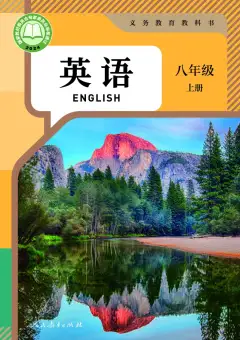
® 义 务 教 育 教 科 书
义
务
教
育
教
八年级
科
书
上册
八
年
级
绿色印刷产品
英
上
册
义 务 教 育 教 科 书
八年级 上册
YIWU JIAOYU JIAOKESHU
YINGYU
语
定价:8.80元
正正式式出出版版------义义务务教教育育教教科科书书 英英语语 八八年年级级上上册册 印印刷刷封封面面..iinndddd 11 22002255//55//3300 1100::0055义 务 教 育 教 科 书
八年级
上册
人民教育出版社 课程教材研究所 编著
·北 京·主 编:刘道义 郑旺全
分册主编:张献臣
编写人员(以姓氏笔画为序):
王生军 汤珏弘 宇文利 杨鹏辉
肖 菲 陆锡钦 高 淼 蔡文静
责任编辑:马小洁
责任设计:胡白珂
责任校对:曲 亮
责任印制:
义务教育教科书 英语 八年级 上册
人民教育出版社 课程教材研究所 编著
出 版
(北京市海淀区中关村南大街17号院1号楼 邮编:100081)
网 址 http://www.pep.com.cn
版权所有·侵权必究致同学
亲爱的同学们,欢迎你们进入八年级的英语学习!经过一年的
努力,相信你们在初中英语学习的道路上已经有了不少收获。
本套教科书各单元以主题为引领,以问题为线索,以活动为途
径,关联现实生活,体现时代特征,包含丰富的文化内容。学习这
套教科书可以帮助你们发展语言能力,培育文化意识,提升思维品
质,提高学习能力,树立国际视野,涵养家国情怀,坚定文化自
信,形成正确的世界观、人生观和价值观。
八年级上册共有八个单元,每个单元的主题内容都与你们的生
活密切相关。第一单元通过假期经历的分享,鼓励你们不断积累新
知识和新技能,度过更有意义的假期。第二单元从家庭生活切入,
引导你们思考“家”的内涵。第三单元通过比较彼此的异同,帮助
你们理解“和而不同”,学会合作互补。第四单元带你们见识神奇
的动植物,树立生态保护意识。第五单元邀请你们尝试烹饪中西方
美食,通过劳动“品尝”生活的美好。第六单元激励你们根据理想
和目标制订自我提升计划。第七单元和你们一起畅想未来的生活并
思考如何为未来做好准备。第八单元探讨沟通交流的方式和技巧,
希望你们在人际交往中更加礼貌得体。从本册开始,教科书每个单
元都设置了独立的词汇学习和以读促写板块,帮助你们进一步夯实
基础,让你们能更自信地用英语表达与交流。
纸上得来终觉浅,绝知此事要躬行。英语是实践性很强的学
科,学好英语的关键是多运用、多实践。只要坚持,付出一定会获
得回报。祝你们在八年级实现新的突破,取得更大的进步!CONTENTS
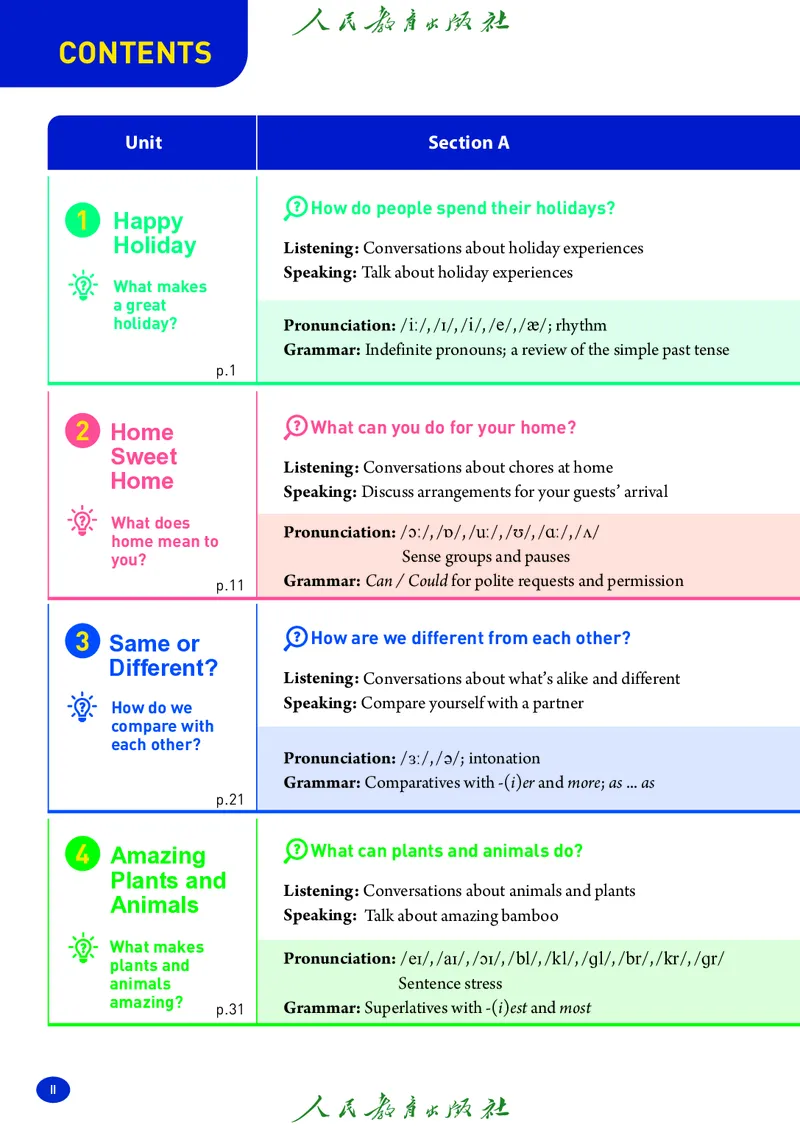
Unit Section A
How do people spend their holidays?
1
Happy
Holiday Listening: Conversations about holiday experiences
Speaking: Talk about holiday experiences
What makes
a great
holiday? Pronunciation: /iː/, /ɪ/, /i/, /e/, /æ/; rhythm
Grammar: Indefinite pronouns; a review of the simple past tense
p.1
2
Home
What can you do for your home?
Sweet
Listening: Conversations about chores at home
Home
Speaking: Discuss arrangements for your guests’ arrival
What does
Pronunciation: /ɔː/, /ɒ/, /uː/, /ʊ/, /ɑː/, /ʌ/
home mean to
you? Sense groups and pauses
p.11 Grammar: Can / Could for polite requests and permission
3
Same or
How are we different from each other?
Different?
Listening: Conversations about what’s alike and different
How do we Speaking: Compare yourself with a partner
compare with
each other?
Pronunciation: /ɜː/, /ə/; intonation
Grammar: Comparatives with -(i)er and more; as ... as
p.21
4
Amazing
What can plants and animals do?
Plants and
Listening: Conversations about animals and plants
Animals
Speaking: Talk about amazing bamboo
What makes
Pronunciation: /eɪ/, /aɪ/, /ɔɪ/, /bl/, /kl/, /ɡl/, /br/, /kr/, /ɡr/
plants and
animals Sentence stress
amazing?
p.31 Grammar: Superlatives with -(i)est and most
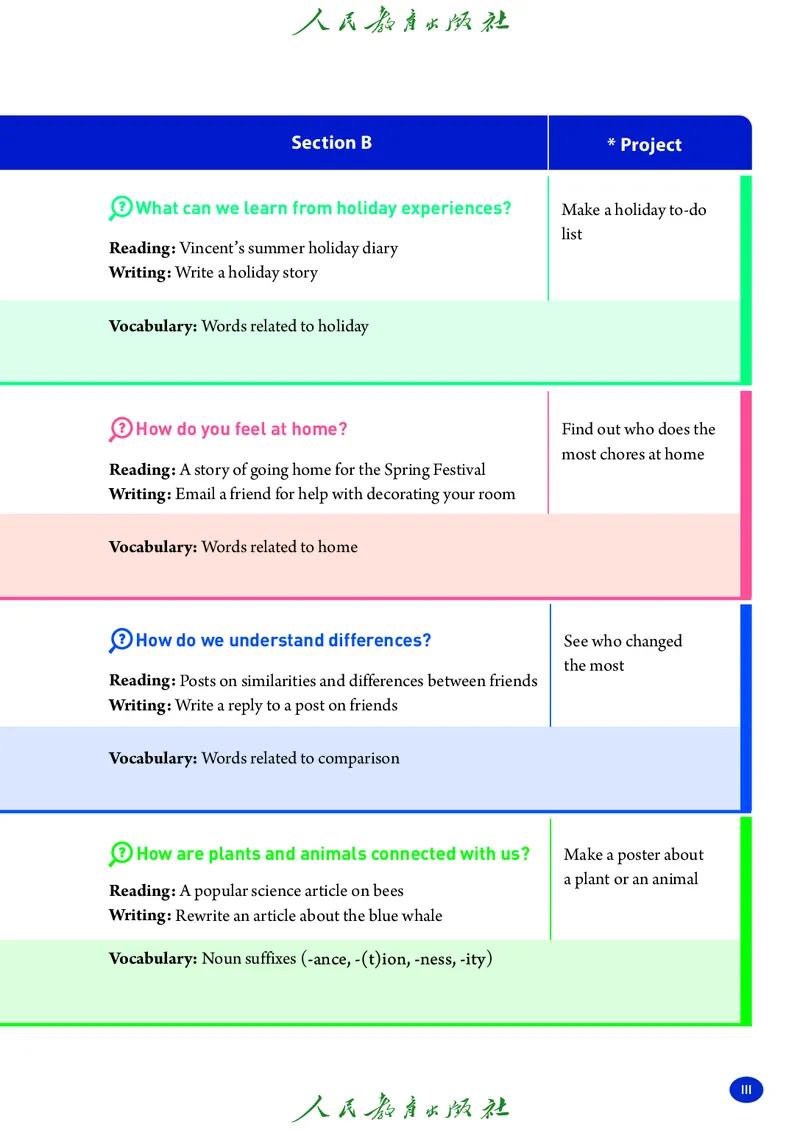
IISection B * Project
What can we learn from holiday experiences? Make a holiday to-do
list
Reading: Vincent’s summer holiday diary
Writing: Write a holiday story
Vocabulary: Words related to holiday
How do you feel at home? Find out who does the
most chores at home
Listening: Conversations about chores at home Reading: A story of going home for the Spring Festival
Speaking: Discuss arrangements for your guests’ arrival Writing: Email a friend for help with decorating your room
Vocabulary: Words related to home
How do we understand differences? See who changed
the most
Reading: Posts on similarities and differences between friends
Writing: Write a reply to a post on friends
Vocabulary: Words related to comparison
How are plants and animals connected with us? Make a poster about
a plant or an animal
Reading: A popular science article on bees
Writing: Rewrite an article about the blue whale
Vocabulary: Noun suffixes (-ance, -(t)ion, -ness, -ity)
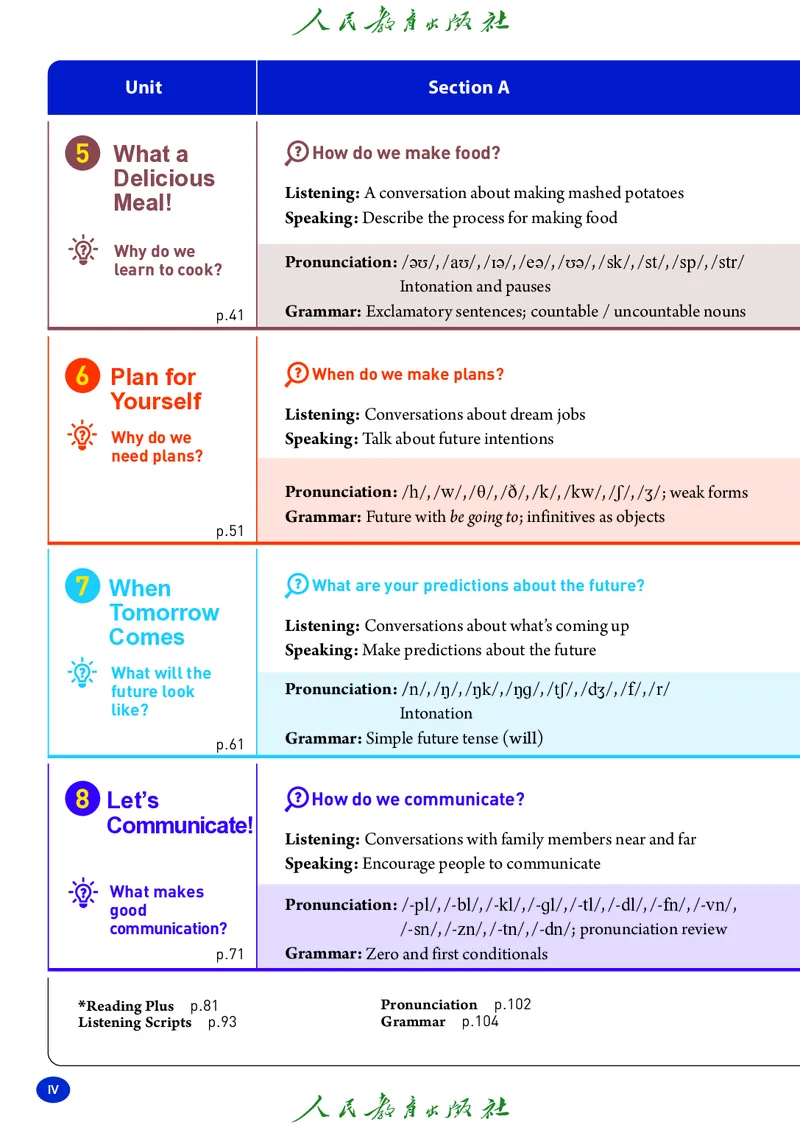
IIIUnit Section A
5 What a How do we make food?
Delicious
Listening: A conversation about making mashed potatoes
Meal!
Speaking: Describe the process for making food
Why do we
Pronunciation: /əʊ/, /aʊ/, /ɪə/, /eə/, /ʊə/, /sk/, /st/, /sp/, /str/
learn to cook?
Intonation and pauses
p.41 Grammar: Exclamatory sentences; countable / uncountable nouns
6 Plan for When do we make plans?
Yourself
Listening: Conversations about dream jobs
Why do we Speaking: Talk about future intentions
need plans?
Pronunciation: /h/, /w/, /θ/, /ð/, /k/, /kw/, /ʃ/, /ʒ/; weak forms
Grammar: Future with be going to; infinitives as objects
p.51
7 When What are your predictions about the future?
Tomorrow
Listening: Conversations about what’s coming up
Comes
Speaking: Make predictions about the future
What will the
future look Pronunciation: /n/, /ŋ/, /ŋk/, /ŋɡ/, /tʃ/, /dʒ/, /f/, /r/
like?
Intonation
Grammar: Simple future tense (will)
p.61
8 Let’s How do we communicate?
Communicate!
Listening: Conversations with family members near and far
Speaking: Encourage people to communicate
What makes
good Pronunciation: /-pl/, /-bl/, /-kl/, /-ɡl/, /-tl/, /-dl/, /-fn/, /-vn/,
communication? /-sn/, /-zn/, /-tn/, /-dn/; pronunciation review
p.71 Grammar: Zero and first conditionals
*Reading Plus p.81 Pronunciation p.102
Listening Scripts p.93 Grammar p.104
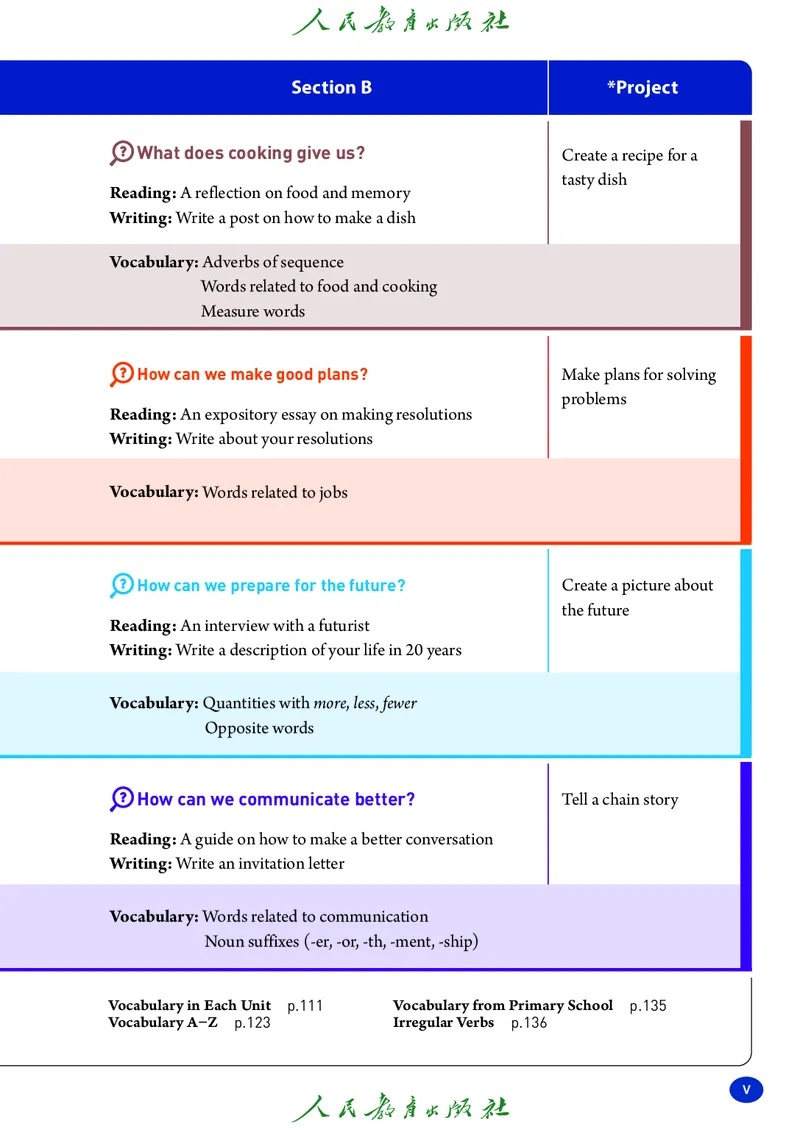
IVSection B *Project
What does cooking give us? Create a recipe for a
tasty dish
Listening: A conversation about making mashed potatoes Reading: A reflection on food and memory
Speaking: Describe the process for making food Writing: Write a post on how to make a dish
Pronunciation: /əʊ/, /aʊ/, /ɪə/, /eə/, /ʊə/, /sk/, /st/, /sp/, /str/ Vocabulary: Adverbs of sequence
Intonation and pauses Words related to food and cooking
Grammar: Exclamatory sentences; countable / uncountable nouns Measure words
How can we make good plans? Make plans for solving
problems
Listening: Conversations about dream jobs Reading: An expository essay on making resolutions
Speaking: Talk about future intentions Writing: Write about your resolutions
Pronunciation: /h/, /w/, /θ/, /ð/, /k/, /kw/, /ʃ/, /ʒ/; weak forms Vocabulary: Words related to jobs
Grammar: Future with be going to; infinitives as objects
How can we prepare for the future? Create a picture about
the future
Reading: An interview with a futurist
Writing: Write a description of your life in 20 years
Pronunciation: /n/, /ŋ/, /ŋk/, /ŋɡ/, /tʃ/, /dʒ/, /f/, /r/
Vocabulary: Quantities with more, less, fewer
Intonation
Opposite words
Grammar: Simple future tense (will)
How can we communicate better? Tell a chain story
Reading: A guide on how to make a better conversation
Writing: Write an invitation letter
Vocabulary: Words related to communication
Noun suffixes (-er, -or, -th, -ment, -ship)
Vocabulary in Each Unit p.111 Vocabulary from Primary School p.135
Vocabulary A–Z p.123 Irregular Verbs p.136
V1
1
Happy Holiday
UUNNIITT
What makes a
BIG great holiday?
Question
In this unit, you will Look and share
1. talk about holiday activities and experiences. 1. What is the relationship of the people
2. use indefinite pronouns to talk about uncertain people, in the photo?
things, or places. 2. Where do you think these people are?
3. express your feelings about holidays. 3. What are they doing?
4. explore the benefits of holiday experiences.
Happy Holiday 1E
CTIO
S N
A
How do people spend their holidays?
1a Tick the activities you did during the summer holidays. You can add more.
took music lessons visited my grandparents
visited some ancient buildings went to a festival
went to the mountains went to a summer camp
1b Listen to the conversations and circle the holiday activities you hear in 1a.
1c Listen again and complete the two summaries.
1. Yaming went to Mount 2. Emma went back to the US with
Huangshan with his . her and .
The landscape there was She went to a strawberry festival
amazing. Yaming saw the near her house in
Guest-Greeting Pine, the Seattle. At the festival, she
Sea of , lots of some strawberry
strange , and many cookies and chocolates. She
ancient . stayed with her for
days.
1d Talk about Yaming’s and Emma’s holidays.
Where did Yaming / Emma go on holiday / vacation?
He / She went to …
Did he / she do anything interesting?
Yes, he / she …
2 UNIT 1Pronunciation
1 Listen and repeat. Add one more word to each group.
/iː/ /ɪ/ /i/ /e/ /æ/
e ee ea i y e ea a
he see beach trip city fresh bread camp
she need peace swim busy forget ready relax
2 Listen and repeat. Notice the rhythm.
1. A: How was your holiday? 2. A: How was your holiday?
B: My holiday? Great! B: My holiday? Really good!
A: What did you do? A: What did you do?
B: I went to Beijing B: I hiked in the mountains
and saw the Great Wall. and saw the sunrise.
Oh, how great it was! Oh, how beautiful it was!
2a Listen to the conversation and choose the correct sentences to complete it.
Adam: Hi, Peter. How are you?
A. Did you eat anything special?
Peter: Hi, Adam. I’m fine, thanks.
B. Did you go anywhere interesting?
Adam: How was your holiday?
C. I did nothing special.
Peter: It was fantastic.
D. Did you go to Lijiang?
Adam:
E. Everyone says it’s beautiful.
Peter: Yes, I went to Yunnan with
F. Someone said you went to Beijing.
my family.
Adam: Wow! That sounds great.
Peter: Yes, we stayed in the old town for a few days, and we enjoyed it very much.
Adam: Did you visit Yulong Mountain?
Peter: It is! It just took my breath away. We took a lot of great photos there.
Adam:
Peter: Yes, we did! Everything tasted good, especially the steamed chicken
soup. What about you?
Adam: No, not this holiday. I just stayed
at home to read, play games, and relax, but it was still fun.
Happy Holiday 32b Read the conversation and complete the table.
Where did he
Name What did he do? How did he feel?
go / stay?
Peter
Adam
2c Complete the summary of the conversation.
Peter had a holiday. He went to Yunnan with his . They
stayed in the old of Lijiang for a few days and it very
much. They Yulong Mountain and took a lot of photos there. They
also tried some Yunnan dishes, and they the steamed chicken soup.
Adam didn’t do special, but he still had a relaxing and holiday.
2d Listen to the conversation again. Then role-play it.
2e Tick the words that describe your last summer holiday experience.
great amazing excellent fantastic relaxing
wonderful OK not too bad boring terrible
2f Share your summer holiday experience with a partner.
A: How was your summer holiday, …?
B: It was …
A: Did you go anywhere interesting?
B: Yes, I … / No, I didn’t. I just ...
A: Really? Did you do anything special?
B: Well, …
4 UNIT 1Grammar Focus
3a Read the sentences and notice the indefinite pronouns in bold. Then discuss
when you use these pronouns.
I didn’t go anywhere special, but I tried
Where did you go on holiday? something new — I worked as a tour guide
at a museum.
Did you do anything interesting on No, nothing special. But I met someone
your holiday? interesting.
Did you go anywhere interesting? Yes, I went to Yunnan.
Did you go with anyone? Yes, I went with my family.
Yes, we did! Everything tasted good, especially
Did you eat anything special?
the steamed chicken soup. Everyone loved it.
3b Complete the conversation with the correct indefinite pronouns.
A: Did you do interesting on your holiday?
B: No, special. How about you?
A: Well, I went to Hangzhou and spent a few days there.
B: Really? says the scenery around the West Lake is so beautiful.
A: It is. We had a wonderful experience.
B: Great! So, did you go there with ?
A: Yes, I went with my family. Oh! I just remembered. I got you as
a gift. Here you are!
B: Wow, it’s a silk scarf. Thank you!
A: You’re welcome!
3c Complete the passage with the correct indefinite pronouns.
someone no one everyone something nothing everything
It was summer. Like else, I was ready to go on a holiday somewhere.
I chose a town near my city, but could join me, so I went by
myself. When I got to the town, it started raining heavily. I could do
but stay in the hotel. The hotel was nice, with a comfortable bed, and
was very clean. I felt bored, so I decided to look for to read. I
found a book in my room and started reading by my bed. Then, I heard
shout from outside, “Look at the sky! How amazing!” I got up and
walked towards the window. There was a beautiful double rainbow in the sky.
Happy Holiday 5E
CTIO
S N
B What can we learn from holiday
experiences?
1a Look at the photos below. Do you know which country it is? Would you like
to visit it?
Red Square
Alexander Garden
1b Read Vincent’s diary entries about his holiday. Then answer the questions.
1. What places did Vincent visit?
2. How did he feel during the trip?
17 July
Today was our first day to visit Moscow. The weather was fine and everyone
felt excited to visit some famous places in Russia.
In the morning, we went to the Victory Museum. The Russian people built
this museum to remember their fight against the Nazis during World
War II. As we walked through the halls, the tour guide told us stories about
the war.
In one hall, I saw an artwork with thousands of glass “tears” falling down. It
reminds us that war is terrible and peace does not come easily. We should
not forget that.
At noon, we had lunch at a restaurant near the park. I liked the ice cream
there, so I ate a lot of it. But, during dinner, I didn’t feel like eating because
I felt sick. So now, I just want to get a good night’s sleep.
6 UNIT 118 July
It rained last night, so this morning the air was fresh and cool. I felt much
better today.
We took the Moscow Metro to travel around. The metro stations are really
beautiful. Sometimes I felt like I was walking inside a palace. After that, we
went to Red Square. We saw some
fantastic buildings there.
In the afternoon, we arrived at a
school and met a group of Russian
students. We played games and
soon became friends. Later,
someone took out his accordion,
and soon everyone got together to
sing and dance. We were so happy
that we didn’t notice the time. It
was such a good experience! Moscow Metro
1c Read the diary entries again. Complete the timeline.
In the morning At noon During dinner
went to the Victory
17
Museum
July
In the morning In the afternoon
18
July
1d What can you learn from Vincent’s travel experience? Make a list of your ideas
and share them with a partner.
1. I can learn about the history of a country or a city.
2.
3.
…
Happy Holiday 7Vocabulary in Use
2a Think of as many words as possible to make phrases. Then write them down.
1. holiday summer holiday(s), go on holiday, …
2. experience
3. scenery
4. station
5. camp
6. square
2b Complete the sentences with the correct words in the box.
ancient breath remind peace sick easily
1. I felt after staying in the sun for too long.
2. The tour guide told us the tower was over 1,000 years old.
3. Don’t spend too much on holiday shopping, or you might go
over budget.
4. When the night fell, the small town was finally at .
5. The mountain scenery was so beautiful that it took my away!
6. Please me to take my passport before I leave. I’m getting a little
forgetful these days.
2c Complete the passage with the correct forms of the words in the box.
especially ready forget landscape get together
People spend their holidays in different ways. Some travel to see beautiful
sights and in strange, faraway places. The amazing scenery makes
them smile and their worries. Others stay comfortable at home,
when they are tired or not feeling well. They do nothing but relax,
sleep, or watch TV. Many people with friends and family to have
a meal or play sport. There are lots of ways to relax and have fun. However,
the most important part of a holiday is to rest your mind and body. Then you
can go back to your regular life, and be to see what comes next.
8 UNIT 13a Read Gina’s holiday story and write down the things that she did.
My Holiday in Scotland
Last autumn, my family took a train to Scotland
for a holiday. We stayed in a comfortable house in
the countryside with beautiful scenery. I live in a
big city, so everything there seemed so different.
For example, beside the house, there was a huge
forest.
On the last day, early in the morning, I went to the
forest to explore. While there, something made a
noise. I turned around and was surprised to see a
deer.
I ran home and told my parents what I saw. My mum smiled and
said, “The deer is probably looking for food and hoping to get some
from you.” What a wonderful experience I had! I really hope I can go
back again.
Things that Gina did
took stayed went to saw ran home and
3b Think of an unforgettable holiday experience and answer the questions.
1. When did it happen?
2. Where were you?
3. What did you do?
4. How did you feel?
5. What did you learn?
3c Use your ideas above to write a holiday story.
Happy Holiday 9*Project Make a holiday to-do list
4a Work in groups. Make a list of the activities you did during your holidays.
4b Choose five meaningful activities you think everyone should try. Then give
your reasons.
Holiday activity Place Reason
to enjoy the beautiful
1 visiting Mount Taishan Tai’an city
scenery and …
2
3
4
5
4c
Share your five activities with your class. Then find out the top three activities
that everyone likes to do.
Reflecting
1. Can you use the simple past tense to describe your holiday experiences?
2. When do you use indefinite pronouns?
3. How would you describe your last holiday? How did you feel?
4. What can people learn from travel experiences and other holiday activities?
A holiday is a time to relax, enjoy life,
and make memories.
10 UNIT 12
Home
UNIT
Sweet Home
What does home
BIG mean to you?
Question
In this unit, you will Look and share
1. talk about what you can do for your home. 1. What are the people doing in the
2. make polite requests and ask for permission. photo?
3. find more ways to make a home comfortable. 2. Where are they?
4. explore the meaning of home. 3. How do you think they feel?
Home Sweet Home 11E
CTIO
S N
A
What can you do for your home?
1a Do you do these things at home? What chores do you do?
pack up things sweep the floor clean the bathroom
feed the fish hang up photos water the plants
1b Listen to the first conversation. Tick the things that Jim’s dad asks him to do.
hang out with friends sort things into boxes
write “Jim’s bedroom” on each box pack up his things
1c Listen to the second conversation and match the people with what they will do.
1. Jim A. sweep the floor
B. grow flowers on the balcony
2. Peter
C. hang up the photos
3. Helen
D. clean the bathroom
4. Mum E. invite friends to the new house
5. Dad F. keep fish in the living room
1d Make a conversation with the chores from 1a.
Can / Could you please water the plants?
Sure. / Sorry, I have to clean the bathroom now.
12 UNIT 2Pronunciation
1 Listen and repeat. Add one more word to each group.
/ɔː/ /ɒ/ /uː/ /ʊ/ /ɑː/ /ʌ/
or oor o oo u oo ar u
short door drop spoon blue cook far but
sport floor borrow food flute good party hunt
2 Listen and read. Notice the sense groups and pauses.
Peter: Mum, | can I invite my friends | to our new house?
Mum: Sure, | Peter. || But we need to clean up first. || Would you like to mop
the floor | or clean the windows?
Peter: I’d like to clean the windows.
[An hour later.]
Mum: Good job, | Peter! || The windows are really clean, | and they look like
mirrors!
2a Listen to the conversation and fill in the blanks.
Dad: Guess what! Grandpa and Grandma are visiting us this weekend!
Jim: Oh, great!
Peter: I can’t wait to show them our new house!
Mum: Yes, but now we need to for their arrival. Can you help
me their room?
Peter: But their room is already clean!
Mum: Well, it’s not “grandma clean” yet!
Peter: Oh, OK.
Dad: Jim, can you help me on the wall? I bought it for
Grandpa to see the time.
Jim: Sure, Dad.
Dad: Helen, can you to their room? Grandpa likes reading
books in front of the window.
Helen: No problem, Dad. Can I by the window?
Dad: Yes, good idea! Grandma loves flowers.
Helen: Mum, could you take me to the later?
Mum: No problem. Let’s go after lunch.
Home Sweet Home 132b Read the conversation and answer the questions.
1. Did Peter’s grandparents visit his new home before? Why do you think so?
2. What does “grandma clean” mean?
3. Why does Helen want to go to the flower shop?
4. What do you usually do for your grandparents?
2c Complete the mind map with the information from 2a. Add more things to the
“other” section.
a chair _______
a clock
for reading _______
add things _______ other:
to their _______ _______
room
make
grandparents
sweep other:
feel at home
the floor _______
_______ up
their room
2d Listen to the conversation again. Then role-play it.
2e Peter is preparing for his friend’s visit to his new home, but he needs help.
In groups make up conversations between Peter and his family.
go shopping buy drinks buy fruit make biscuits
cook a meal borrow a che ss set plan a treasure hunt
…
Peter: Dad, could you please give me a lift to the shop this afternoon?
Dad: Sorry, but I have to work from home all day.
Peter: Helen, can I borrow your chess set?
Helen: Sure. Here you are.
14 UNIT 2Grammar Focus
3a Read the questions with can or could. Notice how they are answered. Then
write R for requests or P for permission next to each question.
Could you please sweep the floor? OK, Mum. I’ll do it at once.
Could I hang out with my friends after Sorry, Jim, but you have to pack up your
lunch? things first.
Can I put some flowers on the table? Yes, good idea!
Can you help me hang up the photos? Sure. / No problem!
3b Choose the best question to complete each conversation.
A. Could you give me a ride to town now? B. Can I stay out until eleven?
C. Mr Lake, can I use your toilet? D. Could I use your computer?
1. A: 2. A:
B: Of course you can. Let me B: Yes, if you are careful with it.
show you the way.
3. A: 4. A: Can I go to the movies?
B: No, you can’t. You have a B: Of course.
basketball game tomorrow, A:
remember? You need a B: I can’t. I have to do some
good rest. work now.
3c Make up conversations for each setting, using can or could.
1. You are at your friend’s home. You want to call your parents, but your
phone is dead.
A: Can / Could I use your phone? B: Sure. / Of course.
2. You were sick at home yesterday. Your friend went to an English class and
took notes. You want to know more about the class.
3. You are holding a large box. It is difficult to open the door. Your neighbour
comes.
4. You and your classmates want to help clean up the community. Ask your
classmates to bring gloves and rubbish bags.
Home Sweet Home 15E
CTIO
S N
B
How do you feel at home?
1a How does home make you feel? Share your ideas with a partner.
1b Read the story and answer the questions.
Going Home for the Spring Festival
“It’s almost the Spring Festival. Can we go to Hainan for the holiday, Dad?”
“Not this time,” Dad answered with a smile. “We’re going to your mum’s
hometown!”
Soon the day of our family trip came. We got up very early in the
morning to catch the train. The train journey took more than five hours, and
then we changed to a bus to get to my grandparents’ village in the afternoon.
At the end of the road, I saw Grandpa and my little cousin standing in the
cold wind waiting for us. We walked quickly to greet them.
Grandpa helped us pull the heavy luggage into the house.
“Ah, home again!” said Mum with a smile on her face. Grandma, my
aunt, and my uncle were busy cooking dinner in the kitchen. They were very
happy to see us. After a little while, my parents went to the kitchen to help.
“Could you bring Wenwen her favourite snacks?” Grandma asked
Grandpa.
I shared the snacks with my cousin and told Grandpa about school.
He was happy to hear I was doing well at school. When dinner was ready, I
asked, “Can I help?”
“You can set the table,” Dad said.
We then enjoyed all the delicious food.
“Mm, the familiar taste of home!” said Mum.
During the dinner, my uncle told us some jokes and we had a good laugh.
Several days later when we were leaving, Grandma held my hands and
asked us, “Will you come home more often?”
Mum nodded, with tears in her eyes.
16 UUNNIITT 221. Where did the writer go for the Spring Festival?
2. What is the name of the writer?
3. In the text, what words are used to describe people’s feelings?
1c Complete the sentences to see what each family member did to make the home
full of love. Find more examples from the text.
1. Grandpa and my cousin in the cold wind.
2. helped us pull our luggage into the house.
3. Grandma, my aunt, and my uncle in the kitchen.
4. went to the kitchen to help.
5. Grandpa my favourite snacks.
6. shared the snacks with my cousin.
1d Discuss the questions.
1. Why do you think the family spent the Spring Festival at the village?
2. What do you think about the writer’s family members?
1e Read the poem and opinions. Then share your understanding of“home”.
My home is also
called family.
Home
No matter how long I’m
away, home is always glad
Follow the road,
to see me again.
Anywhere it goes.
Home is a place of love.
But at the end,
It always welcomes
Are family and friends.
me with open arms―
Wherever I go, and perhaps a plate of
freshly-made biscuits.
Finally I go,
To my home, sweet home.
Home is not a place …
It’s a kind of feeling. It
greets me when I walk
through the door.
Home Sweet Home 17Vocabulary in Use
2a Complete the puzzle with the new words in this unit. The clues can help you.
1. to look for something
1
H
2. to move your head up and down
2
O
3. the people living in the same area
3
M
4. not living 4
E
5. a room in a house for people to relax 5
I
6. something important or with a high price 6
S
7. a room for sleeping in 7 B
8
8. a long trip E
9
9. maybe S
10
10. a dish to put food on T
2b Match the words in column A with those in column B. Then use the phrases to
complete the sentences.
1. Could you after taking a
A
shower? We should keep it clean.
pack up
B
2. Could you please ? It’s
clean up
the luggage starting to smell.
hang up
the rubbish 3. Let’s and get ready to go
take out
the photo home.
the bathroom 4. Can you help me on the
wall? Grandma looks really young in it.
2c
Complete the letter with the words in the box.
community ready free arrival invite soon
Dear friends,
Welcome! We’re excited to have you in our community. We hope you’ll
feel at home here.
Your brings joy to us. We would like to you to the
community party at 2 p.m. on Sunday. You can find us on the first floor of
Apartment Block A.
In our , everyone is friendly and always to give a hand.
If you have any questions or need help, feel to ask.
Best wishes,
The Sunshine Community
18 UNIT 23a Read the email and find out what Zhang Peng asks his friend to do.
EMAIL
To:
Subject:
Hi John,
It was fun to decorate your room last month. I share a room with my
brother. We want to decorate it too. Can you help us?
Right now, the walls are blue. There are cute animals on them, but the
animals look too young for us. We want to cover the animals and paint
the walls light green. What do you think about the colour?
On Sunday, we can meet at the paint shop near the shopping centre and
choose the paint together. Then we can paint the room with my brother.
I loved the brushes we used for your room. Can you bring them?
After painting, could you help choose some photos to hang on the walls?
Let me know what you think.
Best,
Zhang Peng
Send
3b
Put the things in order to see how Zhang Peng organizes his ideas in writing.
ask John to bring the brushes
1 ask John to help decorate the room
ask John to help choose some photos to hang on the walls
describe how the room looks now
tell John about the plan for the walls
ask John to meet on Sunday at the paint shop
3c Write an email to ask a friend to help decorate your room. Below is a list of
things you may need help with.
buy some flowers make a poster go shopping
bring a pair of scissors buy glue bring a brush
make paper-cuts bring a painting …
Home Sweet Home 19Find out who does the most chores
*Project
at home
4a Tick the chores you do at home. You can add more.
Chores Tick Chores Tick
take out the rubbish do the laundry
do the dishes fold the clothes
walk the dog sweep the floor
make the bed clean the bathroom
help to cook other:
4b Do a class survey. Ask your classmates the following questions.
1. What chores do you do?
2. How often do you do chores?
3. What do you think about doing chores?
4c Report your findings to the class.
4d Find out who does the most chores at home.
Reflecting
1. What words and expressions can you use to talk about your home?
2. Can you use can or could to make polite requests and ask for permission?
3. What can you do to make your home comfortable?
4. What did you learn about the meaning of home?
East or west, home is best.
20 UNIT 23
Same or
UNIT
Different?
How do we compare
BIG with each other?
Question
In this unit, you will Look and share
1. compare people and things. 1. What is the possible relationship
2. discuss whether friends should be similar or different. between the girls in the photo?
3. talk about how you are different from the past. 2. What do they have in common?
4. discover why differences are important. 3. How are they different from each
other?
Same or Different? 21E
CTIO
S N
A
How are we different from each other?
1a Match each word with its opposite.
fast shy late tall lazy loud funny
outgoing boring short quiet early slow hard-working
1b Listen to the conversations. Tick the locations where the conversations
take place.
Conversation 1: at the music club at the music festival
Conversation 2: at the music club at the music festival
1c Listen to the conversations again and complete the sentences.
1. Peter and Chen Jie are talking about the . Chen Jie is afraid of
performing alone so they solve the problem by playing a song .
2. Mrs Brown and Peter are talking about and show.
1d Listen to the two conversations again. Match the characters with the correct
descriptions.
plays the Chinese
is taller
flute better
has longer hair
Chen Jie works harder Emma
sings louder
is more outgoing
dances better
is shyer
Peter Ella
1e Use the information from 1d to make comparisons.
Is Ella taller than Emma?
No, she is shorter than Emma.
Who dances better, Ella or Emma?
…
22 UNIT 3Pronunciation
1 Listen and repeat. Add one more word to each group.
/ɜː/ /ə/
er ir ur ear a e o er, or
term first nurse early China happen together number
person dirty Thursday learn agree moment compare doctor
2 Listen and repeat. Notice the intonation.
1. A: You know Ella and Emma? They won first prize in the school
music festival.
B: Ella and Emma? They did?
A: Yes. They did.
2. A: How was school today?
B: I took part in the school music festival.
A: Today? You did? I thought the festival would be tomorrow.
B: No. Today.
2a Han Lin is interviewing Emma and Ella for the school newspaper. Listen to
their conversation and fill in the blanks.
Han Lin: Congratulations on winning the prize at the school music festival!
The twins: Thank you!
Han Lin: You attended the festival last year and this year. How is this year different?
Ella: There are more students and more this year. I think
it is more than last year.
Han Lin: As twins, you look very similar. How are you different?
Emma: I’m a little than Ella. And she is funnier than me.
Ella: Emma always earlier than me. Many people say I’m
lazier than Emma, but that’s not true! I work as hard as her!
Han Lin: That’s really interesting. Besides , how do you spend
your spare time?
Ella: I love more than anything.
Emma: I like reading. You see, we’re different in many ways, but together,
we make a great team!
Han Lin: Thanks for talking with me.
The twins: Our pleasure!
Same or Different? 232b Read the conversation and answer the questions.
1. What does Ella think of the festival?
2. What do Emma and Ella have in common?
3. How are they different?
4. What do you think makes Emma and Ella a great team?
2c Listen to the conversation again. Then role-play it.
2d How can we make a comparison? Add words to each aspect.
quiet
tall
outgoing
strong
serious
short hair
Appearance Personality …
…
get up early run fast
work hard sing well
… Habit Strength …
2e Compare yourself with a partner using your ideas from 2d. Then answer the
questions below.
A: I’m taller than you.
B: That’s true. I am a little shorter than you, but I can run faster than you.
A: Yes. I’m as hard-working as you, but you read more than me.
…
● How are you different from each other?
● What do you have in common?
● What can you learn from each other?
24 UNIT 3Grammar Focus
3a Read the sentences and notice the comparatives in bold. Find more examples in
Section A.
There are more activities this year. It is more colourful than last year.
Emma is taller than Ella, but her hair is shorter than Ella’s.
Ella dances better than Emma, but Emma sings louder than her.
Emma always gets up earlier than me, but I work as hard as her!
3b Use the words in brackets to write questions and answers.
1. Q: Is Julie slimmer than you ? (Julie / slim / you)
A: No, she isn’t. She is as slim as me.
2. Q: ? (you / serious / your cousin)
A: No, I’m not. I am than he is.
3. Q: ? (Tom / smart / Sam)
A: No, I don’t think so. I think Sam is as as Tom.
4. Q: ? (Jack / swim / fast / Sally)
A: No, he doesn’t. He swims as as Sally.
3c Look at the chart. Then complete the sentences to compare Guangzhou and
Vancouver. Use the words in the box and than.
Guangzhou Vancouver
Facts
Population (2024) 18.978 million 0.76 million
Area 7,436 square km 115 square km
Average rainfall per year 1,923 mm 1,475 mm
Average January temperature 16 °C 5 °C
Average July temperature 31 °C 18 °C
large small much warm cool
1. The population of Vancouver was that of Guangzhou in 2024.
2. In area, Guangzhou is Vancouver.
3. It rains in Guangzhou in Vancouver.
4. Guangzhou has a pleasant temperature in January. It is
Vancouver in January.
5. Vancouver is Guangzhou in July.
Same or Different? 25E
CTIO
S N
B
How do we understand differences?
1a Are you similar to or different from your friends? In what ways?
1b Read the posts. What are Matt’s and Diana’s opinions about friends?
Forum
5 hours ago
Some people think that friends should be alike, but some
other people think that friends should be different. What
do you think? Should friends be similar or different?
Tom
4 hours ago
I think a good friend is like a mirror. You can understand
people by knowing their friends. My friend, Stephen, is a
great example. We often hang out together because we
Matt have similar hobbies and interests. For example, we both
love sports. He plays badminton better than I do, so he
always wins our matches. Because of that, I try harder
when I practise, and now I’m getting better at badminton.
Stephen and I are similar in other ways. He is as serious
as me. When we aren’t playing sports, we enjoy reading
together. I read more history books than he does, and he
reads a lot of novels. We often share interesting books with
each other.
26 UNIT 33 hours ago
I don’t agree. For me, friends who are different make me
better. I think we should respect each other’s differences and
learn from each other. For example, I am kind of shy, but my
Diana best friend, Yuan Lei, is outgoing. She has a great sense of
humour too. Thanks to her, I am becoming more outgoing.
Now I think meeting new people is really fun!
I have another friend, Zhang Yong. He is not afraid to give his
opinion, especially when he thinks I am making a mistake.
I am less straightforward than he is, but I am glad to have
an honest friend.
1c Match the people with the descriptions.
1. Matt A. reads a lot of novels
2. Stephen B. reads more history books
3. Diana C. gives direct opinions
4. Yuan Lei D. is kind of shy
5. Zhang Yong E. helps a friend become more outgoing
1d Read the posts again and answer the questions.
1. Why does Matt think that a good friend is like a mirror?
2. Why is Matt getting better at badminton?
3. In what ways is Stephen similar to Matt?
4. How is Yuan Lei different from Diana?
5. Why is Diana glad to have an honest friend?
6. How should we treat each other’s differences?
1e Discuss the questions.
What can similarities bring to a friendship?
What really matters
in a friendship?
What can differences bring to a friendship?
Same or Different? 27Vocabulary in Use
2a Find the words hidden in the word snake. Then match them with the meanings.
wdirectyfcseriousdshyiyhard workinghdoutgoingcrlazyo
being afraid to speak in front of people
being friendly and liking to meet people
not wanting to do anything
speaking in a straightforward way
not laughing a lot
putting a lot of time into a job and doing it well
2b
Complete the sentences with the words in the box.
average spare differences especially
pleasure kilometres population pleasant
1. The of Shanghai is much larger than that of Lanzhou.
2. The weather was , with white clouds and warm sunshine.
3. We got great from the prize we won.
4. We should respect the in others.
5. I love all fruits, strawberries.
6. The height of the students in the class is around 1.6 metres.
7. I enjoy reading books in my time.
8. It is about three from my house to school.
2c Complete the passage with the correct forms of the words in the box.
personality alike novel difference besides
The prince, Edward, and the poor boy, Tom, are the
two characters in Mark Twain’s famous ,
The Prince and the Pauper. They looked and
both had kind . They exchanged their lives
by accident.
During his time as a pauper, Edward learnt to respect
others. this, he also realized that people’s
lives were much harder than he expected. After
becoming king, he made a by trying to
help the people of his country.
28 UNIT 33a Read the post. Is Rose’s opinion the same as or different from the posts in
Section B 1b?
3 hours ago
I don’t really care if my friends are similar to or different
from me. I have two amazing friends. Lily is funnier than
anyone else I know. When I feel sad or have a problem, she
makes me laugh and feel better. She helps me see the silver
Rose
lining in difficult situations.
My other friend, Lucy, is not as funny as Lily. Lucy is quieter,
but she listens better than others. Lucy and I talk about
everything. I know she cares about me because she’s always
there to listen.
My favourite saying is, “A true friend reaches for your hand
and touches your heart.” Both Lily and Lucy are true friends.
We are always ready to help each other by lending a hand.
3b What is your opinion? Use personal experiences to support your opinion.
Opinion Reason Example
Friends should be
similar.
Friends should be
different.
I don’t mind.
3c Use the table above to write your reply to the post.
I think that because
. For example, my friend
is . When
, .
Same or Different? 29*Project See who changed the most
4a Did you change a lot after you entered junior high school? Let’s see!
Personal Growth
Physical Other
Mental Sports
Study
4b Answer the questions and then ask your partner’s opinions about your changes.
Do your answers match your partner’s opinions?
Growth Partner’s
Question My answer
area opinion
Physical Am I taller / stronger / ... than last year?
Mental Am I more confident / ... than last year?
Study Do I study more efficiently / ... than last year?
Sports Do I play sport better / ... than last year?
Other
4c
Create your growth chart. Give examples. Add photos or videos if possible.
4d Share your growth chart in class. What did you learn about yourself? Who
changed the most in your class?
Reflecting
1. What words and expressions can you use to make comparisons?
2. How can we benefit from each other’s similarities and differences?
3. How should you treat people who are different from you?
4. Is being different a good thing? Why?
We are different, but we can be stronger together.
30 UNIT 34
Amazing Plants
UNIT
and Animals
What makes plants
BIG and animals amazing?
Question
In this unit, you will Look and share
1. talk about some amazing plants and animals. 1. What do you see in the photo?
2. use superlatives to compare more than two things. 2. What do you think of when you see the
3. discuss the connection between plants, animals, and our photo?
lives.
4. explore why plants and animals are important to us.
Amazing Plants and Animals 31E
CTIO
S N
A
What can plants and animals do?
1a Look at the plants and animals. Use the words in the box to talk about them.
beautiful big fast heavy large
long old small tall short
□moss: □blue whale:
□redwood tree: □cheetah:
1b Listen to the conversations and number the plants and animals in 1a in the
order you hear them.
1c Listen again. Match the words with the plants and animals in 1a. Some have
two answers.
A. heaviest B. largest C. most beautiful
D. oldest E. fastest F. tallest
1d Ask and answer questions about the plants and animals in 1a.
What’s amazing about the blue whale?
It’s the largest / biggest animal in the world.
32 UNIT 4Pronunciation
1 Listen and repeat. Add one more word to each group.
/eɪ/ /aɪ/ /ɔɪ/ /bl/ /kl/ /ɡl/ /br/ /kr/ /ɡr/
a, ai, ay i, y, igh oy, oi bl cl gl br cr gr
whale mice toy black clean glad bread cross grass
rain fly join blow climb glass bring cream great
stay high choice blue clock globe brown cry grow
2 Listen and repeat. Notice the difference in stress and meaning of the same sentence.
I visited the redwood forests in California several times. (not other forests)
I visited the redwood forests in California several times. (not other places)
I visited the redwood forests in California several times. (not only once)
2a Listen to the conversation and fill in the blanks.
Ella: Oh, what’s that, Chen Jie? It’s so beautiful!
Chen Jie: Thanks. It’s a folding fan. I bought it last year.
Ella: Oh! It has a painting of bamboo on it.
Chen Jie: Yeah. Bamboo is one of the most popular subjects
in Chinese paintings. It’s a of
goodness in Chinese culture.
Ella: I didn’t know that before. So, where did you
get that fan?
Chen Jie: At the Bamboo Sea in Sichuan, the
and bamboo forest in China.
I learnt lots of interesting things when I was
Bamboo Sea
there.
Ella: Really? Like what?
Chen Jie: Well, bamboo is one of the fastest-growing plants. Some bamboo can grow
almost one metre in one day. Also, it’s one of the plants
in the world. People can use it to build houses and make tools and
instruments.
Ella: Oh, that’s interesting. I remember pandas love to eat bamboo too,
right?
Chen Jie: Exactly! Actually we eat bamboo shoots too. They’re really delicious.
Amazing Plants and Animals 332b Read the conversation and answer the questions.
1. What does Ella see on the folding fan?
2. Why does bamboo often appear in Chinese paintings?
3. Where is the Bamboo Sea?
4. What do people use bamboo for?
5. Is Ella interested in bamboo? How do you know?
2c Complete the mind map with the information from 2a.
got at __________
on Chen Jie’s a symbol of
folding fan __________
the __________ and __________
bamboo forest in China
one of the a popular
grow __________
fastest-growing Bamboo subject in Chinese
in one day
plants paintings
one of the
build __________
most useful food for __________
make __________ plants and __________
and __________ in the world
2d Listen to the conversation again. Then role-play it.
2e Imagine you are a tour guide at the Bamboo Sea and your partner is a foreign
tourist. Make up a conversation about bamboo and its importance.
A: Welcome to the Bamboo Sea! I’m your tour guide today. I’d love to share all
the interesting things about bamboo with you. Please feel free to ask me any
questions you have.
B: Bamboo seems to be a very popular plant in China. Can you tell me why
the Chinese people like bamboo so much?
A: Well, …
34 UNIT 4Grammar Focus
3a Read the sentences and notice the words in bold. What are the ways to form
a superlative adjective or adverb?
The blue whale is the largest and heaviest animal in the world.
The biggest land animal in the world is the African elephant.
The cheetah runs the fastest among all land animals.
I think the most useful plant in the world is bamboo.
It is perhaps the most interesting plant in the world.
3b Complete the sentences with the superlative forms of the words in brackets.
1. Among all animals, I love pandas the best. I think
they are (cute) animals in the world.
2. Which do you think is (beautiful),
the rose, the peony, or the lotus flower?
3. Look at that butterfly! It has (colourful)
wings.
4. Which animal jumps (high), the lion,
the monkey, or the tree frog?
5. The elephant birds were (large) and
(heavy) birds ever on earth. Some could
stand up to three metres tall and weigh up to 860 kg.
3c Complete the passage with the superlative forms of the words in the box.
ancient beautiful common good popular
The ginkgo tree is one of living trees on earth. Ginkgo trees
first appeared over 200 million years ago. Chinese people love the ginkgo, as
it is a symbol of hope and long life. Many Chinese believe that the old ginkgo
tree in the Zhongnan Mountains in Shaanxi Province is .
Thousands of tourists come to see it each year, especially in mid-October, as it
is time to see it. The ginkgo tree is one of trees in streets,
parks, and gardens across China. When autumn comes, one of activities
is to take a walk under ginkgo trees. People believe the bright yellow leaves can
bring joy to their heart.
Amazing Plants and Animals 35E
CTIO
S N
B How are plants and animals
connected with us?
1a Look at the title and the pictures below. Guess what the text is about.
1b Read the text and underline the adjectives the writer uses to describe bees.
’
We Can t Live Without Bees
Imagine you go to the supermarket in your area,
pollination
but there are almost no fruits, vegetables, honey,
milk, eggs, or chocolate. How would you feel?
Disappointed? Angry? Sad? At this moment
you realize people, plants, and animals are
all connected. We need each other to live,
and bees are one of the best examples of this
connection.
Bees are very hard-working animals, and their
greatest work is pollination. On one trip, they often visit
50 to 100 flowers. As they fly from one flower to another, they take pollen with
them. This action helps plants grow. In fact, without their work, about 80 per
cent of the plants in the world cannot grow. For this reason, many scientists
believe that bees are the most important animals on this planet.
Bees are also one of the most interesting
animals in the world. For example, they
work hard together to make their homes.
In order to store honey, they create
honeycombs. Another interesting thing
about bees is how they communicate.
When a bee finds new food, it uses a
dance to tell the others where and how far hhoonneeyyccoommbb
away the food is.
Bees play an important part in the ecosystem of our planet. However, the
number of bees is dropping, and scientists are worried. Bees need our help,
and there is a lot we can do. Think about what you can do to protect one of
the most amazing animals on earth.
36 UNIT 41c Read again and complete the mind map with the information from the text.
their greatest work:
visit
help
importance interesting facts
Bees
problem
their number is
1d Discuss the questions.
1. Can you give another title for the text?
2. What other interesting facts do you know about bees?
3. What do you know about the connection between humans and other
insects, such as ants and butterflies?
1e Imagine you are the writer. Write one more paragraph about bees and add it
to the text.
1f How do you understand the connection between plants, animals, and people?
Think of some examples and then share them with a partner.
A: We all know people and nature are connected. But can you give me an
example of how they are connected?
B: Sure. I visited a small town in Guangdong once. There are many large trees
in the town. They are home to many birds. A lot of tourists come to see
the trees and the birds …
Amazing Plants and Animals 37Vocabulary in Use
2a Circle the odd ones. Then give your reasons.
1. habit height size weight
2. joy happiness fun enjoy
3. angry disappointed smart sad
4. appear look seem watch
5. honey milk juice bread
2b Add the endings -ance, -(t) ion, -ness, and -ity to form nouns. Use your dictionary.
1. act 2. good
3. kind 4. appear
5. real 6. imagine
7. connect 8. popular
9. communicate 10. important
2c Complete the sentences with the correct forms of the words in the box.
appear disappoint imagine store weigh
1. I felt when my favourite flowers died.
2. After the rain, some mushrooms in the garden.
3. In my hometown, people often use bamboo baskets to food.
4. What did you put in your luggage? It a ton.
5. I can’t my life without my pets. They mean a lot to me.
2d Complete the passage with the correct forms of the words in the box.
however important land planet protect
You may not realize it, but frogs play an important role in
our ecosystem. The smallest frogs are about the
size of a pea, while larger ones can grow as big as a human hand.
Many people know that frogs help to farms
by eating insects. , not everyone understands their
in nature. Frogs can live on and in water.
Because of this, they are popular subjects in studies on climate
change and the ecosystem.
38 UNIT 43a Read the text and complete the table.
The Blue Whale
The blue whale is the largest and heaviest animal
on earth. It can weigh as much as 200 tons. Many
people like watching blue whales swim, and they
think it is one of the most beautiful things to see.
Blue whales live in all oceans except the Arctic
Ocean. They eat a lot, but they eat some of the
tiniest animals in the ocean. A blue whale can eat
around four tons of these a day.
Blue whales can live up to 90 years. When a blue
whale dies at sea, it becomes food for many kinds
of animals living in and around the sea. This food
lasts for over a year and it helps to create a lively and
healthy ecosystem. Blue whales play an important
role in our world, so we must protect them.
Blue whale facts
Weight
Where they live
Food
How long they live
Importance in nature
3b Imagine you are a blue whale. Use the first person to rewrite the first paragraph.
Hello everyone! My name is Billy the Blue Whale. I am
I’m heavy, but I
I live in
I can eat .
3c Complete your passage about the blue whale based on the text in 3a.
Amazing Plants and Animals 39*Project Make a poster about a plant or an animal
4a Work in groups. Choose or create the title of your poster.
The Strangest The Cutest The Most
Animal Animal Amazing Plant
The Most The Most
The Oldest
Beautiful Popular
Tree
Animal House Plant
4b Collect pictures and find out information about the plant or animal that you
chose.
1. What is its name?
2. Where does it live / grow?
3. Why did you choose it?
4. What are some interesting facts about it?
4c Make your poster.
4d Present your poster in class. Then vote for the best one.
Reflecting
1. What amazing plants and animals did you learn about in the unit?
2. When do you use the superlative forms of adjectives and adverbs?
3. Can you describe some amazing plants or animals in the world?
4. How are we connected with plants and animals?
Take care of animals and plants because we
cannot live without them.
40 UNIT 45
What a Delicious
UNIT
Meal!
Why do we learn
BIG to cook?
Question
In this unit, you will Look and share
1. talk about food and cooking. 1. Who are the people in the photo and what
2. give cooking instructions. are they doing?
3. describe a process using adverbs of sequence. 2. How do you think they feel?
4. use exclamatory sentences to express strong feelings. 3. In your family, who usually does the
5. explore how food and cooking can bring people together. cooking? Do you help?
What a Delicious Meal! 41E
CTIO
S N
A
How do we make food?
1a Match the instructions with the pictures.
______ Add pepper to the soup. ______ Cut up the tomatoes.
______ Mix the vegetables. ______ Bake the cake in the oven.
______ Pour the milk into the flour. ______ Boil the potatoes.
A B C
D E F
1b Listen to the conversation and tick the ingredients you hear.
potatoes tomatoes milk butter
sugar salt pepper cheese
1c Listen again and number the instructions.
Wash the potatoes and cut them into pieces.
Add salt and pepper.
Get one tablespoon of butter and half a cup of milk.
Mash the potatoes.
Add the milk and the butter to the potatoes, and mix.
Put the potatoes in a pot and boil them until they are soft.
1d Talk about how to make mashed potatoes in your own words.
How do we make mashed potatoes?
First, wash the potatoes.
What do we do after that?
Then, …
42 UNIT 5Pronunciation
1 Listen and repeat. Add one more word to each group.
/əʊ/ /aʊ/ /ɪə/ /eə/ /ʊə/ /sk/ /st/ /sp/ /str/
o, oa ou, ow ear air, are ure, our sk, sch st sp str
potato house dear air sure sky stay speak straight
coat how near care tour school stir spoon street
2 Listen and repeat. Pay attention to the intonation and pauses.
To make a banana milk shake, | you need to get three
bananas, one tablespoon of ice cream, and a cup of
milk. || First, | peel the bananas. || Then, | cut up the
bananas. || After that, | put the bananas and ice
cream in the blender. || Next, | pour the milk into
the blender | and turn it on. || Finally, | pour the
milk shake into a glass | and drink it.
2a Listen to the conversation and fill in the blanks.
Peter: Hey Teng Fei, can you teach me how to cook a popular Chinese dish?
Teng Fei: Sure. How about stir-fried eggs and tomatoes?
Peter: Great idea! How do we make it?
Teng Fei: We need eggs, tomatoes, , and .
Peter: OK. How many tomatoes and eggs do we need?
Teng Fei: tomatoes and eggs.
Peter: OK. What should we do with the tomatoes and eggs?
Teng Fei: First, cut the tomatoes into small . Next, mix the eggs in a
bowl.
Peter: Like this?
Teng Fei: Perfect. Then, heat some oil in a pan and add the to it.
Stir-fry for one minute. Then take the eggs out of the pan.
Peter: Got it.
Teng Fei: Next, cook the tomatoes in the pan until they’re . Then,
add some salt and sugar.
Peter: What an amazing ! What’s next?
Teng Fei: Finally, put the eggs back into the pan and mix them with the tomatoes.
Peter: Wow, it looks so good! How simple!
What a Delicious Meal! 432b Read the conversation and complete the recipe.
Stir-fried Eggs and Tomatoes
Ingredients
Instructions
1 2 3
First, Next, Then, .
. . for one minute
and then .
4 5 6
Next, Then, Finally,
. . and .
2c Listen to the conversation again. Then role-play it.
2d What dish can you make by yourself? Talk about how to cook it with a partner.
How do we make steamed fish /…?
How much beef / salt / tofu /… do we need?
How many green peppers /onions /… do we need?
What else do we need?
First … steamed fish
Next …
Then …
Finally …
beef with
hot and
black pepper
sour soup
44 UNIT 5Grammar Focus
3a Read the sentences and discuss how to make exclamatory sentences with what
or how.
What an amazing smell (it is)! How delicious the dish looks!
What a mess (it is)! How clever you are!
What luck (we have)! How wonderful life is!
3b Change the following sentences into exclamatory sentences.
1. It’s a pretty hat. (what)
2. The weather is terrible. (how)
3. The Christmas tree looks fantastic. (how)
4. It was an interesting film. (what)
5. Emma sings very well. (how)
6. The pancake tastes delicious. (how)
3c Complete the conversations using the correct exclamatory sentences.
A. How nice to see you! B. What a surprise! C. What a lovely cake!
D. What a beautiful day! E. How time flies! F. What a great idea!
1. A: Did you make it?
B: Yes. I made it for you.
A: Oh, how kind of you! Thank you so much.
2. A: John? 3. A: Sue got into her dream
B: Mary? I didn’t university!
think you could come. B: Wow! It feels like yesterday that
A: I finished work early. she started high school.
B: That’s great.
4. A:
B: Yes, it is.
A: Let’s go boating on the lake!
B:
What a Delicious Meal! 45E
CTIO
S N
B
What does cooking give us?
1a Discuss the questions.
1. What’s your favourite dish? Who often makes the dish for you?
2. What kind of food makes you happy?
1b Read the text and tick the best main idea.
Through food and cooking we create memories and show love to others.
It is fun to learn how to make food from other cultures.
I have wonderful memories of my grandmother’s kitchen.
Food for Thought
“Cooking is love made visible.” That is what my grandmother always told me.
Thanks to her, I love cooking. It’s a great way for me to share my love with
others. Every time I sit at the table, after cooking for my family, we create
memories. The smells and the food’s taste, along with our conversations,
connect us to each other. What wonderful memories I have!
One of my favourite memories is my grandmother’s pumpkin pie. She always
made it in autumn, when the weather got colder. Her friendly kitchen was
the perfect place to warm up and enjoy a taste of the changing seasons. I
still remember the days when the smell of cinnamon filled the room with
sweetness. Now, every time I smell cinnamon, I think of my grandmother’s
pumpkin pie.
My grandmother told me about her first pumpkin pie. When she was a
college student in the US, she stayed with a host family. One year around
Thanksgiving, the hostess taught her how to make a pumpkin pie. Many
years later, she taught me how to make it too.
Pumpkin Pie Recipe
Ingredients: eggs, sugar, cinnamon, salt, pumpkin, cream, pie crust
Instructions:
First, mix the eggs.
Then, add the sugar, cinnamon, salt, pumpkin, and cream.
Next, pour the mixture into the pie crust.
After that, place the pie in the oven and cook for 40 to 50 minutes.
Finally, let the pie cool for at least an hour before serving.
46 UNIT 5My grandmother loved learning how to make food from other cultures. “It’s my
way of making friends from around the world,” she said. Grandmother taught me
the secret to cooking: Cook with love. Thanks to my grandmother, I love to try
new food and new recipes from other countries and cultures.
1c Read again and answer the questions.
1. Why does the writer love cooking?
2. What was so special about the grandmother’s kitchen?
3. Where did the grandmother learn to make pumpkin pie?
4. When did the grandmother usually make the pie?
5. According to the text, what kind of person do you think the writer’s
grandmother is?
1d Read the recipe and put the pictures in the correct order.
— — — —
A B C
D E
1e Complete the summary of the text.
I love to cook because it is a good way to share love with others. Food
people and creates . For example, I remember my grandmother and
her pumpkin pie whenever I cinnamon. My grandmother first learnt
how to make it from her family, and after that, she made it every
year. She also taught me how to make it. My grandmother made food from other
and made with people from around the world. Thanks to her,
I also like to try new food and new from different places.
1f Think about a memory you have of food and love. Share it with a partner.
What a Delicious Meal! 47Vocabulary in Use
2a List the words you learnt about food and cooking. Are the words countable
nouns or uncountable nouns? Put the words into two groups.
1. Vegetables:
2. Fruit:
3. Drinks:
4. Meat:
5. Snacks:
6. Kitchen items:
2b Match the pictures with the phrases.
A B C D
E F G H I
1. a bottle of milk 2. a bowl of rice
3. a cup of tea 4. a piece of cake
5. a glass of grape juice 6. a plate of spaghetti
7. a bag of flour 8. a spoon of sugar
9. a slice of bread
2c Complete the recipe with the words in the box.
add … to pour … into cut … into share … with mix … with
Apple Pie First, the apples pieces. the flour,
salt, and sugar the apples and mix them.
Then, in a bowl, the eggs the yogurt and
oil. Add the apples.
Next, the mixture a pan. Place the pan
in the oven and cook for 45 minutes.
Finally, the pie your friends and enjoy it
together!
48 UNIT 53a Read the post and circle the ingredients that the chef uses.
My Favourite Dish: Guoqiao Rice Noodles
@thechinesechefblog Long ago,
there was a couple living in Yunnan
Province, China. The husband studied
on an island far from his home.
When his wife went a long way to
send meals, the food always got
cold. One day, the wife boiled some
chicken soup and used a large pot to keep it warm. And she kept the
ingredients separate. She put the ingredients into the soup when she
reached the island, and she found everything still hot. The Guoqiao
Rice Noodles was born!
Here’s how to make the dish:
● First, wash the vegetables and mushrooms.
● Next, cut the chicken and pork into thin pieces.
● Then, boil the chicken soup and pour it into a large bowl.
● After that, put the ingredients into the bowl, one by one.
● Finally, add the boiled rice noodles to the bowl.
So, that’s my favourite dish. What’s yours?
3b What dish do you like the best? Complete the notes.
● My favourite dish:
● Why I like it:
● Ingredients:
● Steps:
3c Write a response to the post about how to make your favourite dish.
Hi! My favourite dish is ...
Here’s how to make it. First, ...
What a Delicious Meal! 49*Project Create a recipe for a tasty dish
4a Work in groups. Choose a dish you want to make and do research on it.
4b Cook the dish at home and take pictures.
4c Make your own recipe with the ingredients, cooking instructions, and the
pictures.
Recipe for
SPAGHETTI BOLOGNESE
Ingredients: 1 pound dried spaghetti,
1 pound beef, 1 onion, 2 pieces of garlic,
1 can of tomatoes, 1 cup of cheese
Instructions:
First, cut up the onion and garlic. Put them in a pot.
Next, for the sauce, add the beef to the pot and cook until it changes colour.
After that, add the tomatoes and cook for 30 minutes.
Then, cook the spaghetti until it is ready.
Finally, put the spaghetti on a plate and pour the beef and tomato
sauce on top. Add some cheese and serve.
4d Present your recipe in class. Then vote for your favourite recipes.
Reflecting
1. Can you explain how to cook some dishes?
2. What information should a recipe include?
3. What words and expressions can you use to describe a process?
4. What sentences can you use to express strong feelings?
5. How do food and cooking make you feel?
Cooking brings us happiness and love.
50 UNIT 56
Plan for Yourself
UNIT
Why do we need
BIG plans?
Question
In this unit, you will Look and share
1. talk about your dream jobs. 1. What can you see in the photo?
2. use be going to to talk about your future plans. 2. What do you think the student is doing?
3. read and write New Year’s resolutions. 3. When do you make a plan?
4. explore ways to improve yourself.
Plan for Yourself 51E
CTIO
S N
A
When do we make plans?
1a Look at the pictures. Do you think these jobs are interesting? List all the
jobs you know and discuss what jobs interest you.
IT engineer fashion designer film director
musician fireman teacher
1b Listen to the conversations. Circle in 1a the three jobs you hear.
Listen again and find out what each student is going to do. Match the names
1c
with the statements.
John 1. I’m going to exercise every day.
2. I’m going to work hard at maths.
Jason 3. I’m going to take art lessons.
4. I’m going to practise my drawing skills every day.
Tina 5. I’m going to read more books about IT and AI.
1d Talk about the jobs that John, Jason, and Tina want to do.
What does John want to be when he grows up?
He wants to be …
How is he going to realize his dream?
He is going to …
52 UNIT 6Pronunciation
1 Listen and repeat. Add one more word to each group.
/h/ /w/ /θ/ /ð/ /k/ /kw/ /ʃ/ /ʒ/
h, wh w, wh th th c, k, ck qu s, sh s
habit want think than actor quiet sugar usually
human week earth though cook queen share pleasure
who what maths father luck question fashion television
2 Listen and repeat. Notice how the coloured words are pronounced.
A: What do you want to be when you grow up?
B: I want to be a fireman.
A: How are you going to do that?
B: I’m going to exercise every day, because a fireman needs to be strong.
2a Listen to the conversation and fill in the blanks.
Adam: What are you reading, Fu Xing?
Fu Xing: It’s a book of essays by a famous .
Adam: Wow, now I know why you’re so good at writing.
Fu Xing: Thanks! You know, I want to be a writer when I’m older.
Adam: Really? How do you do that?
Fu Xing: I’m going to read more classics. And also, I’m going to keep on
writing .
Adam: Your plan sounds wonderful! I think you’re going to be a great writer.
Fu Xing: I hope so! What about you, Adam? What do you want to be when
you’re older?
Adam: My parents want me to , but I’m not sure about that.
Fu Xing: Well, don’t worry. Not everyone knows what they want to be. Just
make sure you try your best at school. Then you can do anything you
want!
Adam: Yeah, you’re right.
Plan for Yourself 532b Read the conversation and decide whether these statements are true (T) or
false (F).
1. Fu Xing is reading a novel by a famous Chinese writer. T F
2. Fu Xing is going to read classic literature. T F
3. Fu Xing is going to write novels. T F
4. Adam’s parents want him to be a doctor. T F
5. Adam is not sure about what he wants to be. T F
2c
Listen to the conversation again. Then role-play it.
2d Ask your classmates about their dream jobs and how they are going to make
their dreams come true.
athlete photographer worker doctor
painter businessman farmer actress
A: What do you want to be when you grow up?
B: I want to be …
A: How are you going to do that?
B: I’m going to …
Name What How
Su Yan a lawyer She is going to study law at university.
54 UNIT 6Grammar Focus
3a Read the sentences and notice the words in bold. Then discuss when you use
be going to.
What do you want to be in the future? I want to be an IT engineer.
How do you plan to do that? I’m going to work hard at maths.
Are you going to read more books
Yes, I am.
about IT?
What else are you going to do? I’m going to learn about AI too.
3b
Match the situations with what people are going to do.
1. Alice wants to be an actress. A. I’m going to take a hot bath.
2. I miss my parents very much. B. They are going to live in the countryside.
3. It’s going to rain. C. She is going to take acting classes.
4. They are tired of city life. D. He is going to take a taxi.
5. I’m wet and cold. E. I’m going to get my umbrella.
6. He can’t drive after drinking. F. I’m going to see them this weekend.
3c Complete the conversation using the words in brackets.
A: What you (do) this weekend?
B: I have no idea. What about you?
A: I don’t know either. you (want) to do something together?
B: Sure. What you (want) to do?
A: How about playing badminton on Saturday?
B: OK. Where we (meet)?
A: Let’s meet at Zhongshan Park.
B: What time we (meet)?
A: What about 9:30?
B: Great! This (be) fun. See you on Saturday.
A: See you then.
3d Make your own timetable for the weekend. Then talk to a partner and try to
arrange a time to do something together.
A: What are you going to do on Saturday morning?
B: I’m going to …
Plan for Yourself 55E
CTIO
S N
B
How can we make good plans?
1a Discuss the questions.
1. What kinds of plans did you make last year?
2. Were you able to stick to the plans? Why or why not?
1b Read the text. Put the sentences in the correct places.
A. Some resolutions have to do with learning new things.
B. For example, a student may decide to start a new study plan.
C. Try to set mini-goals to help you achieve your resolution.
D. After all, the start of the year is often a perfect time for making resolutions.
Making Resolutions
Do you know what a resolution is? A resolution is a promise that you
make to yourself. People make resolutions to improve their life. The most
common kind is a New Year’s resolution.
Resolutions can be about anything. Some are about physical health.
For example, some people may promise to exercise more or eat more
healthily. People might decide they are going to
take up a hobby, like painting or photography. And some resolutions
have to do with self-improvement, like becoming more confident or
organized.
Although there are differences, most resolutions
have one thing in common: People hardly ever
keep them! But there are good reasons for this.
Sometimes the resolutions may be too difficult to
keep. And sometimes people just forget about them.
To make your resolutions work, you need to plan
them wisely. Always make sure your resolution
is possible to achieve. Don’t set a goal that is too
difficult or too much for you.
And if you don’t want to forget your resolutions,
write them down. Also, talk about them with your
family and friends. Encourage them to remind you
of your goals. So what resolutions are you going to
make? How are you going to keep them?
56 UNIT 61c
Read the text again and match each paragraph with its main purpose.
Paragraph 1 A. To list some popular resolutions.
Paragraph 2 B. To introduce the meaning of a resolution.
Paragraph 3 C. To give advice on how to achieve resolutions.
Paragraph 4 D. To explain why some people fail to keep resolutions.
1d Complete the mind map with the information from the text.
resolutions
a promise that meaning can be
about
most
common
kind
Resolution
reasons
when to
why people
make it
hardly keep
how to
resolutions
make
resolutions
work
1e Discuss the questions.
1. Do you think it is useful to make resolutions? Why or why not?
2. Do you like to plan ahead or do things at the last moment? Why?
Plan for Yourself 57Vocabulary in Use
2a Write the jobs based on the definitions. Then add more for your partner to
guess.
1. This person helps to put out fires. fireman
2. This person is good at playing music.
3. This person acts in a play or a film.
4. This person designs or builds machines, roads, or bridges.
5. This person designs clothes, shoes, or other items for people.
6. This person gives advice to people about the law.
7.
2b Write your own sentences using the words in brackets.
1. My father’s job . (have to do with)
2. My best friend and I . (make sure)
3. I’m going to . (take up)
4. I’m going to . (stick to)
5. I . (be tired of)
2c Complete the passage with the correct forms of the words in the box.
confident explain fail practise try one’s best
I still remember how disappointed I was when I my maths exam for
the first time. Mr Guo found me crying in the classroom after school. He said to
me, “Don’t give up. Keep working hard and again in the next exam.”
I promised him that I would not lose hope. After that, Mr Guo often spared
some time to help me. Whenever I found something I didn’t understand, he was
always happy to it. With his help, my maths skills started to improve.
One day, Mr Guo smiled and said, “You see, you are doing a great job. Now keep
on and be in your abilities.” I went into the final exam
with great confidence. Later, I found out I got an A in maths! I was so excited
about achieving my goal.
58 UNIT 63a Read the text and complete the table.
New Year, New Me
As the year draws to a close, it is the perfect
time to think about the changes we want to
make in the coming new year. We can improve
our lives by learning something new, forming
good habits, working harder at something, or
even improving our relationships with others.
I hope to make next year better than this one, so I am going to make three
resolutions.
The first one is about taking up a new hobby. I am going to join the school
music club to improve my singing! I think singing is a great activity. And my
friends and family all love my singing.
I am also going to get fitter. Besides jogging, I am going to do push-ups and
sit-ups. I feel energetic after I exercise. I’m sure I’m going to be a healthier and
happier person.
Last but not least, my English isn’t good enough, so I am going to study for
two more hours each weekend. It might be hard, but I am going to get a lot
better at English!
To improve … Resolution
1.
2.
3.
3b Write down the things you want to improve and your resolutions.
To improve … My resolution
1.
2.
3.
3c Use the notes above to write three paragraphs. In each paragraph, write what
you are going to improve and how.
Plan for Yourself 59*Project Make plans for solving problems
4a Work in groups. Discuss what problems there are in your class or at school.
Then make a list of the problems and the reasons why they exist.
Problems Reasons Solutions
There are some
scribbles on the walls
of our school.
4b Write down some plans to solve the problems.
4c Prepare a presentation to share your plans with the whole class.
Reflecting
1. What is your dream job? How are you going to achieve your goal?
2. What expressions can you use to talk about future plans?
3. Do you think it is important to make resolutions? Why?
4. What resolutions are you going to make? How are you going to keep them?
5. How did this unit help you think of ways to improve yourself?
Dream big, plan well, work hard, smile
often, and good things will happen.
60 UNIT 67
When Tomorrow
UNIT
Comes
What will the
BIG future look like?
Question
In this unit, you will Look and share
1. make predictions about the future. 1. What do you think of when you
2. talk about the future using the simple future tense. look at the picture?
3. explore how technology will change our lives. 2. Would you like to have a robot at
4. find out how to prepare for the future. home? Why?
When Tomorrow Comes 61E
CTIO
S N
A What are your predictions about the
future?
1a Which of the predictions do you think will come true in 100 years? Tick the
ones that you agree with.
1. We won’t be able to live on earth.
2. There will be less food.
3. Many people will live in outer space.
4. Climate change will be worse.
5. AI and robots will take over boring work.
6. People won’t work together in big offices.
1b Listen to the first conversation and complete the summary.
A new sci-fi film is coming out. Teng Fei invited Peter to the to see it.
Teng Fei booked the tickets . The film starts at , and they
will meet at the cinema at .
1c Listen to the second conversation and circle T for true or F for false.
1. Peter thinks climate change will be worse in the future. T F
2. Teng Fei thinks there will be less land to grow food. T F
3. Peter is quite positive about the future. T F
4. Teng Fei believes people will find ways to solve
the food problem. T F
5. Teng Fei thinks most people will live in outer space
in the future. T F
1d Ask and answer questions about the predictions in 1a.
Will we be able to live on earth in 100 years?
Yes, we will. I believe people will make the earth a
better place.
Will many people live in outer space?
Well, I don’t think …
62 UNIT 7Pronunciation
1 Listen and repeat. Add one more word to each group.
/n/ /ŋ/ /ŋk/ /ŋɡ/ /tʃ/ /dʒ/ /f/ /r/
n, kn ng nk ng ch, tch j, ge, g f, ph r, wr
news song ink hunger cheap jacket face race
mind hang bank angry much change photo orange
know dying monkey English watch magic elephant write
2 Listen and match the emotions with the sentences.
1. What an exciting sci-fi film! I really loved the story. bored
2. Can you hear the wind? It sounds scary! excited
3. My test is next week, but I don’t have time to study. scared
4. It’s still raining. There’s nothing to do. tired
5. I can hardly keep my eyes open. I’m going to bed now. worried
2a Listen to the conversation and fill in the blanks.
A. there will be fewer traffic accidents B. there will be more people in cities
C. we’ll have better health care technology D. people will live longer
Helen: Hi, Jennifer. What’s up?
Jennifer: Oh, hi, Helen. I’m watching a video about future predictions.
Helen: So, what will the future be like?
Jennifer: Well, , but the transport system will be more
efficient. It means that .
Helen: Sounds great! Any other predictions?
Jennifer: Students probably won’t go to a school in the future. They will
study at home or any place they want.
Helen: Oh, but I really like going to school! Anything else?
Jennifer: And .
Helen: Really? Why?
Jennifer: Because in our homes. Machines will tell us
how to solve small health problems before they become bigger.
Helen: That’ll be great. How long will most people live?
Jennifer: Well, more people will live to be over 100 years old. Some may even
live to be 150.
Helen: Wow, that sounds wonderful!
When Tomorrow Comes 632b Read the conversation and complete the table.
What will the future be like?
People in cities
Transport system
Education
Health care
Length of life
2c Read again and answer the questions.
1. What is Jennifer watching?
2. Is Helen interested in the future? How do you know?
3. Is the video positive about the future or not? How do you know?
2d Listen to the conversation again. Then role-play it.
2e What do you think life will be like in the future? Make up a conversation about
your future predictions.
Topic My prediction My partner’s prediction
Home
Population
Transport
Job
Free time
A: Will there be more / less / fewer … in the future?
B: Yes, I think there will … / Well, I don’t think there will …
A: Do you think we will …?
B: …
64 UNIT 7Grammar Focus
3a Read the sentences and notice the words in bold. Find more sentences in
Section A that use the simple future tense.
Shall we go to see the sci-fi film? Oh, I’d love to.
There will be more people in cities, but
What will the future be like?
there will be fewer traffic accidents.
Will most people live in outer space? Yes, they will. / No, they won’t.
Well, more people will live to be over 100
How long will people live?
years old.
3b Complete the conversations with the correct forms of the verbs in the box.
Some verbs are used more than once.
be find get live meet need see win
1. A: Do you think it’s going to rain?
B: Yes, but don’t worry. I think we home before it rains.
2. A: the exam difficult?
B: It (not) easy, but I’m sure you’ll pass it.
3. A: Who do you think the prize?
B: Well, I think Harry the winner.
4. A: Do you think scientists a cure for cancer in 50 years?
B: Yes, I do. And I believe more people up to 100 years old.
5. A: The concert begins at 7:30 p.m. we at
7:15 p.m. outside the theatre?
B: OK. I you then.
6. A: Do you think we will still use cash when shopping?
B: No, and I don’t think I a wallet either.
3c Write some predictions about your partner’s life in 20 years and then make
up a conversation.
A: You’re so friendly and nice. I think you will be a good teacher.
B: Well, I don’t think so. I think I’ll ...
When Tomorrow Comes 65E
CTIO
S N
B
How can we prepare for the future?
1a Look at the title of the interview below. What do you think the interview is
about?
1b Read the interview and see if your guess was correct.
Ready for Tomorrow?
Host: Good evening, everyone! Our guest today is Dr Lu Xingyuan, chief
researcher of the Future World Research Centre. So welcome to
our show, Dr Lu.
Dr Lu: Good evening. Thank you, it’s a pleasure to be here.
Host: Dr Lu, thank you for joining us. So, as a futurist, can you tell us how
life will be different in 50 years?
Dr Lu: Well, you’ll see robots working everywhere.
Host: Can you give us some examples?
Dr Lu: Well, as we all know, China’s robotics industry is growing fast.
Robots will make our life easier. We’ll have service robots. They
will do almost all our housework. They will also help save lives
when disasters and emergencies happen.
Host: So, what jobs will humans still do in the future?
Dr Lu: Good question! Some jobs today will disappear in the coming
years. However, there will be more challenging jobs in the future,
such as space pilots and AI experts.
Host: Do you think robots will replace humans one day?
Dr Lu: No, I don’t. Our creativity and emotional intelligence are important
for relationships. AI will not replace humans for these things.
Host: You mentioned AI. How will AI change our world?
Dr Lu: Well, it will certainly change how we work, study, and live. For
example, a smart refrigerator will know what you need and order
food for you when you’re running low.
Host: Wow, that’ll save us a lot of time! Now, my last question: How can
we prepare for the future?
Dr Lu: It’s simple. Just accept change. Keep learning and working hard.
Today’s choices will influence your future.
Host: Thank you for your time, Dr Lu.
66 UNIT 71c Complete the table with the information from the interview.
Guest name
Job
about robots:
about jobs in the future:
Future
prediction
about AI:
Advice
1d Read again and tick the statements that you can infer from the interview.
1. Dr Lu is very positive about the future.
2. In the future, robots will take over most jobs of today.
3. Robots will save lives during emergencies.
4. Humans will have more challenging jobs and do creative work.
5. Our emotional intelligence will always be important.
6. It is impossible for us to prepare for the future.
1e Discuss the questions.
2. What do you
think are the
most important
qualities that 3. What do you
1. Do you think people in the think we
robots will future should should do to
replace humans develop? prepare for
one day? Why the future?
do you think so?
When Tomorrow Comes 67Vocabulary in Use
2a Write the opposites of the words. Use your dictionary.
1. more 2. possible
3. better 4. challenging
5. appear 6. winner
7. positive 8. everywhere
2b Complete the sentences with the correct forms of the words in the box.
accept develop influence mention service
1. He a plan to learn German, but he didn’t say when he would
start.
2. It is important for young students to skills that will be
valuable in the future.
3. Asimov’s ideas about robots many sci-fi writers and even
some AI scientists.
4. China will take steps to improve the public health system to meet the
public’s needs for medical and health .
5. the challenges and don’t run away from your problems. Try
to solve them and then you will find your way.
2c Complete the passage with the correct forms of the words in the box.
challenge create influence quality traffic bad
How will AI technology the future world? Many experts think AI
will improve the of our future life and change many industries.
For example, AI will help us build a smart public transport system and solve
problems. AI will also change education. It will make learning
better match what students need. While some jobs may go away, people will
focus on more and difficult tasks. Will AI make our life better
or ? It depends on how we choose to improve and use AI to
meet future .
68 UNIT 73a Read about Mandy’s dreams for the future and find out what she wants to be.
My Dreams for the Future
What will my life be like in 20 years? It’s not
an easy question, but here are a few of my
predictions. I love art, so I think I will become
an artist. I want to study art in France,
and then I will visit all the famous art
museums. I will learn a lot about different
artists and their works of art, and I will
create my own too.
As an artist, I will live in the countryside
and stay close to nature. There will be
flowers and plants around my home. Life
there will give me good ideas for making
art. At the weekend, I will invite friends
to come over and have fun together.
I believe these dreams will come true as
long as I study hard and keep on trying.
3b Complete the table about Mandy’s dreams and yours.
Item Mandy You
Future job
Place to live
Free time activity
How to make dreams
come true
3c What will your life be like in 20 years? Write a short passage about your
dreams for the future. Use your notes in 3b.
When Tomorrow Comes 69*Project Create a picture about the future
4a Work in groups. Discuss what your city / town will be like in the future. Try
to think of many different ideas. For example:
● What will our city / ● Will many people live here?
town be like when ● What will the buildings be like? How
we are 35 years old? will people travel around?
● What activities will people be able to do in their free time?
● Will there be more parks and museums?
● What will the environment be like?
4b As a group, decide which predictions are more likely to come true.
4c Draw pictures that show these predictions.
4d Show your pictures to other groups. Have them guess your predictions.
Reflecting
1. What future predictions did you learn from this unit?
2. Can you use the simple future tense to talk about your future life?
3. How do you think technology will change our lives?
4. How will you get ready for the future?
Seize the day, and look forward to the
future.
70 UNIT 78 Let’s
UNIT
Communicate!
What makes good
BIG communication?
Question
In this unit, you will Look and share
1. discover different forms of communication. 1. What forms of communication
2. describe how people communicate with others. can you see in the photo?
3. talk about real situations in the present and 2. Why do you think they choose
predictions for the future. the forms of communication?
4. find ways to improve your communication skills.
Let’s Communicate! 71E
CTIO
S N
A
How do we communicate?
1a
How do you communicate with others? Match the phrases with the pictures.
talk face to face send text messages make a video call
send emails use sign language make a phone call
A B C
D E F
1b Listen to the conversations and complete the table.
Conversation How the speakers communicate Their relationship
1
2
1c Listen again and answer the questions.
1. When will the rehearsal end if it’s on time?
Conversation 1
2. When will the man pick Jim up?
3. Where is the girl now?
Conversation 2
4. What will the man do if he visits China this year?
1d Imagine you are phoning a friend from the UK and you want to invite the
friend to visit China. Make up a conversation about what you both will do.
If you come to my city / town, I’ll
show you around.
If I go there, I’ll try all the
delicious local food.
72 UNIT 8/-pl/ /-kl/ /-tl/ /-bl/ /-gl/ /-dl/ /-fn/ /-sn/ /-tn/ /-vn/ /-zn/ /-dn/
apple uncle little able eagle middle often listen certain even cousin garden
people article hospital possible single noodle person Britain seven reason pardon
Pronunciation
1 Listen and repeat.
talk face to face send text messages make a video call /-pl/ apple people /-kl/ uncle article /-tl/ little hospital
send emails use sign language make a phone call /-bl/ able possible /-ɡl/ eagle single /-dl/ middle noodle
/-fn/ often soften /-sn/ listen person /-tn/ certain Britain
/-vn/ even seven /-zn/ cousin reason /-dn/ garden pardon
2 Listen and read. Notice the linking, stress, intonation, and pauses.
If you ʹgive a ʹcat some milk, | she will beʹcome your friend.
If she beʹcomes your friend, | she will ʹprobably ʹfollow you everywhere.
If she ʹfollows you everywhere, | she may ʹwant to ʹplay games with you.
If you ʹplay ʹgames with her, | you might ʹget ʹtired.
And if you ʹget ʹtired | and beʹgin to sleep, | she might ʹwake you ʹup | and ʹask
for ʹmore milk!
2a Listen to the conversation and fill in the blanks.
A. take a break
B. just call your friend
C. a face-to-face talk usually works the best
D. it takes longer and can make things worse
Jason: Professor, thanks for the helpful speech on communication. I have
a question. Sometimes my friends and I argue but don’t know how
to make up. What’s the best way to communicate in this situation?
Professor: If you want to solve the problem, .
Jason: I understand, but meeting in person is not always easy.
Professor: If you can’t meet, . Some of you
may prefer texting, but if you’re
not careful with your words.
Jason: But what if we argue more over the phone?
Professor: If you stay calm and say sorry, it will help. If it is still hard to talk,
. Meet when you’re both ready.
Jason: I’ll call and try to meet. Because friendship is important. Thanks
for the advice!
Professor: You’re welcome.
Let’s Communicate! 732b
Read the conversation and answer the questions.
1. When did this conversation probably happen?
2. What does the professor think is the best way to solve the problem?
3. What are the problems with texting?
4. Why does Jason worry about talking on the phone?
2c
Talk about how you communicate with different people in your life and then
complete the chart.
family friends
Family Friends
· parents: talk face to face, every
day, talk about school life
How I
communicate
with …
Teachers Classmates
2d Listen to the conversation. Then role-play it.
2e Choose a situation from below and make up a conversation. The expressions
in the box may help you.
Situations Expressions
1. Susan, one of your classmates, If you can come, I’ll be very happy.
invites you to her birthday
If you want to make some new friends,
party this weekend. this is a good chance.
2. You have some problems If you need help, I think you should tell …
with your homework, and If you talk to …, I think he / she will be
you really need help. happy to help you.
3. You found a good place to go
If you go there, you’ll …
jogging, and you want to ask
If you join me, we can …
someone to go with you.
74 UNIT 8Grammar Focus
3a Read the sentences. Find more sentences with if-clauses in Section A.
If you want to solve the problem, a face-to-face talk usually works the best.
Texting can make things worse if you’re not careful with your words.
If the rehearsal ends at 7:00 p.m., I’ll pick you up at 7:15 p.m.
If you stay calm and say sorry, it will help.
If I go there, I will try all the delicious local food.
3b Match the two parts to make sentences.
1. If we have a face-to-face A. try texting.
meeting,
B. we’ll understand each
2. If I have good news,
other better.
3. If you need to leave,
C. you can write things down
4. If you can finish your work early for him.
today,
D. I’ll call you right away.
5. If the old man has difficulties in
hearing, E. I’ll call a taxi for you.
6. If you can’t reach her by phone, F. will you join me for dinner?
3c Fill in the blanks with the correct forms of the verbs in brackets. Then discuss
what the situations are and whom the information is for.
00:35
... If things (go)
Hey, it’s me. I wanted to talk to you
well, we (see) all
about the training plan for our team.
those old faces again. Just
The new season is coming, so it’s time
think how great it will be!
to make a plan for our training. If we
If you think you can come,
(start) earlier this year, I think we
(drop) me a line and
(perform) better. (give)
I (give) you all the
me a call and (let) me know if
details about the reunion.
you (think) of a good time for
But promise me you’ll think
everyone to meet. Talk to you soon!
about it seriously.
Let’s Communicate! 75E
CTIO
S N
B
How can we communicate better?
1a What do you talk about when you meet someone for the first time?
1b Read the text. Who did the author write this text for?
How to Make a Better Conversation
Do you get nervous when you talk to someone? Do you find it hard to have
a conversation with a stranger? If you have such worries, it is time for you to
learn some more conversation skills. Here are some tips for making better
conversations.
1. Listen carefully and show interest in others. One of the most important things
is to listen to the person you speak to. If you are a good listener, you will find
some good points to ask questions about. For example, if someone tells you
their hobby and you can ask questions about it, they will surely be happy to
continue the conversation.
2. Choose the right topic. Some of the best topics
might be the weather, sports, music, films, food, or
travel. However, it is impolite to ask someone’s age,
weight, or other personal information. Also, if you
don’t agree with others, don’t argue with them. Just
move on to another topic.
3. Be honest and sincere. If you have no idea of a
subject, just say “I don’t know much about it.” If you
want to make the other person happy, mention
his or her strong points. But don’t just pretend to
be nice, because people can find out you are not
telling the truth.
4. Pay attention to your body language. Sometimes it
is just as important as your words. Don’t be nervous.
Stand up straight, smile, and be yourself—you have
a lot to offer.
If you really work at it, you will find having conversations much easier.
76 UNIT 81c Complete the table with the information from the text.
How to make a better conversation
Tip Example
1. ● listen and find to ask about, such
as his / her
2. ● talk about but do not
ask
● just say if you have no
3. idea of a subject
● mention the of the
other person
4. ● stand up , , and be
yourself
1d Find out what the pronouns in bold refer to.
1. ... if someone tells you their hobby and you can ask questions about it, ...
2. Also, if you don’t agree with others, don’t argue with them.
3. If you have no idea of a subject, just say “I don’t know much about it.”
4. If you want to make the other person happy, mention his or her strong
points.
5. Sometimes it is just as important as your words.
6. If you really work at it, you will find having conversations much easier.
1e Discuss the questions.
1. According to the text, listening plays an important role in a conversation.
What do you think makes a good listener?
2. Do you think the tips are reasonable? Why or why not?
3. What other tips can you add to the text?
Let’s Communicate! 77Vocabulary in Use
2a Add the proper suffix to each word in brackets to make a new word. Then
complete the sentences with the new words.
-er -or -th -ment -ship
1. To keep a (friend), you need to make time for each other and
care about your friend’s feelings.
2. If you want to solve the (argue), perhaps you should talk about
the situation with your friend.
3. If you don’t know what to say to her, I think the best way is to tell the
(true).
4. They always welcome the (visit) in a kind, friendly way.
5. While giving a speech, you should watch the (listen) carefully
to see if they understand.
2b Complete the sentences with the phrases in the box.
make up right away show … around show … interest worry about
1. It was the first time for my cousin to visit Beijing, so I offered to
her .
2. My brother and I often have fights, but we always
soon after.
3. If you want to watch the drama, you should book the seats
.
4. He great in music when he was a small child.
5. If you are sure about your choice, you don’t have to
what other people will say.
2c Complete the sentences with the correct forms of the words in the box. Then
put them in the correct order to make a short passage.
text face to face communication relationship argue
Many people today communicate by and social media
instead of in person.
When we meet and talk, our body language and voice help
others better understand our meaning.
Also, it may be easier to build trust and develop stronger .
This can keep us away from misunderstandings and .
However, in-person is an important skill to learn.
78 UNIT 83a Read an invitation letter for an event. Underline the date, time, place, and
topic of the speech.
Minghua Middle School
10 December 20
Dear Professor Jones,
We would like to invite you to give a speech at our Education Talk
event. The event will take place at 9 a.m. on 10th January. If you are
able to attend the event, we will cover all your travel and hotel costs.
The event is an excellent opportunity for students, parents, and
teachers to hear new opinions and ideas. If you can spare the time
to give a speech on teenagers’ communication skills, we are sure the
students will benefit a lot from you.
We are looking forward to your reply. If you have any special needs,
please let us know. It would be a great honour to have you speak at
our school.
Yours sincerely,
3b Decide whether each sentence is the opening (O) or the closing (C) for an
invitation letter.
A. Hoping to meet you there.
B. I’m writing to invite you to …
C. I hope you’ll be able to make it.
D. We would like to invite you to …
E. Looking forward to seeing you then.
3c Write a letter to invite all students and their parents to attend the speech.
Make sure you include these points:
● the opening and the closing sentences
● the date, time, and topic of the speech
● why they should attend the speech (with if-clauses)
Let’s Communicate! 79*Project Tell a chain story
4a Work in groups. Each student writes one sentence beginning with “If ...” on
their own piece of paper. For example:
If it doesn’t rain tomorrow,
we’ll go for a picnic.
4b Put all the pieces of paper into a box or jar. The first person picks one and reads
it aloud. Others then add “if ” sentences to continue the story. For example:
If we go for a picnic, If everyone is excited,
everyone will be excited. we’ll play some fun games.
4c Take turns to add sentences until the story ends naturally. Each story should
include at least five sentences.
4d When a story ends, pick another piece of paper. Take turns to tell the next
story.
Reflecting
1. What forms of communication do you often use?
2. Which form of communication do you think works the best for you?
3. What will you do to improve your communication skills?
4. Can you use if-clauses to talk about possible future actions?
Good communication skills are key to
success in life.
80 UNIT 8*Reading Plus
UUnniitt 11
Holiday Experiences
Lin Tao
My best holiday experience was two years ago. My family
lives in Wuhan, the biggest city in Central China. That
summer, I decided to do something cool: cycling from
Wuhan to Beijing with some friends from college. My
parents were surprised at my idea, but soon they gave me
all their support. With their help, I made a cycling plan.
I also learnt a lot from other people’s cycling experiences. I packed everything I
needed and started the trip. The cycling took us almost a month to complete. It
was tiring but worthwhile. I saw beautiful mountains, forests, and rivers. I met
a lot of nice people, and some of them gave me a lot of help along the way. But
there were also difficulties, and sometimes I just wanted to give up. However,
when I finally arrived at the Tian’anmen Square, I was so proud of myself.
Amanda
My best holiday experience was when I learnt to
scuba dive. My family and I went to a town beside
the ocean. At first, I took some classes to learn how to
scuba dive safely. I practised in a swimming pool for
a few days. Then, I lived on a boat for a week in order
to do scuba diving in the ocean. Every day, I went
scuba diving with a guide. I saw so many colourful fish, amazing sea animals,
and fantastic coral everywhere. While I was diving, another diver pointed, and
I realized there was a baby shark near me. It was a stunning experience, and I
will never forget it!
*Reading Plus 811 Read about Lin Tao’s and Amanda’s holiday experiences and answer the questions.
1. Where did Lin Tao finish his adventure?
2. Who helped Lin Tao make his plans?
3. Where did Amanda learn to scuba dive?
4. Why did Amanda stay on a boat?
5. How did Amanda feel about seeing the baby shark?
2 Tick the correct column.
Holiday experience Lin Tao Amanda
● did the activity outside
● did the activity with family
● did the activity with friends
● felt the activity was
sometimes very hard
Unit 2
Anne’s Decision
(Adapted from Lucy Montgomery’s Anne of
Green Gables)
Anne was adopted by Marilla when she was little.
They lived happily together on a farm called Green
Gables. Now Anne is going to a university out of
town, but Marilla gets sick …
Anne came back and found Marilla sitting by the kitchen table. She looked tired.
“Are you OK, Marilla?”
“I saw the doctor,” Marilla said sadly. “But it’s no good talking about it, Anne.
Can you get me a cup of tea?”
“Could you tell me what the doctor said?” Anne asked softly as she brought tea
to Marilla.
82 *Reading Plus“He said I must give up all reading, sewing, and farming, or I will go blind.”
“Marilla, don’t think of it,” said Anne. “There is still hope.”
“I don’t know,” said Marilla. “I’m afraid I have to sell Green Gables.”
Anne was surprised. “Oh, Marilla, you can’t! It’s our home!”
“What else can I do, Anne? I’m sorry you won’t have a home to come to during
your university holidays.” Marilla began to cry.
That night, Anne sat in the darkness, alone with her tears and heavy heart. But
before long, there was a smile on her lips and peace in her heart.
The next day, she spoke with Marilla. “You mustn’t sell Green Gables. I’m going to
teach here. I can’t leave you alone, Marilla. I’ll read to you. We’ll be happy together.”
“Oh, Anne, you can’t do that for me.”
“But I want to! Nothing is worse than giving up our home.”
“But your dreams ...”
“My dreams are the same: to be a good teacher, and to help you stay healthy.
Nobody loves Green Gables as we do. We must keep it.”
Most people, not knowing about Marilla’s eyes, thought Anne was foolish.
Mrs Lynde, their neighbour, did not. She often found Anne and Marilla sitting
outside their home. They liked sitting there at dusk, when the smell of flowers filled
the air.
1 Read the story and find out what Anne’s decision is.
2 Discuss the questions.
1. What is the problem at the beginning of the story?
2. What are Anne’s two dreams?
3. Why does Anne make her decision?
4. Why doesn’t Mrs Lynde think Anne is foolish?
5. What do you think will happen next?
*Reading Plus 83Unit 3
Four Brothers
(Adapted from Grimm’s Fairy Tales)
Once upon a time, there were four brothers.
“I can see farther than anyone,” the first brother said. “At the top of that
tree, there are five eggs in a nest.”
“I am faster than all of you—I move as quickly as a cat,” said the
second brother. He climbed up, took the eggs quietly, and then put them back.
The bird never noticed it.
“I can shoot better than all of you,” said the third. He then shot a leaf
above the nest.
The fourth brother said, “I can sew anything together, even something as
soft as that leaf.” In no time, the leaf was as good as new.
Not long after, the king’s daughter was taken away by a dragon. The king
said whoever brought the princess back could marry her.
The first brother said, “I see her! She is far away, on a rock at sea, with the
dragon.” So the brothers sailed to the rock.
The third brother said, “I may hurt the princess if I shoot the dragon.”
“Leave it to me,” said the second brother. He moved as quietly as a mouse
and quickly freed the princess.
Suddenly, the dragon began to chase them. The third brother shot it, but
its fall broke their ship. Luckily, the fourth brother took his needle and sewed
the ship together. Then they sailed home safely.
The happy king asked, “Which of you will marry my daughter?” The
brothers began to argue. Each brother believed that he did more than the
others. Finally, the king said, “Each of you is as good as the others, but you are
much stronger together. Instead, I give half of my kingdom to you as a reward.”
The brothers were pleased. It was much better to share than to fight.
84 *Reading Plus1 Read the story and complete the table.
First Second Third Fourth
Character
brother brother brother brother
Ability
Action to save
the princess
2 Discuss the questions.
1. Who did the most in saving the princess? Could any of them save her
alone?
2. How did the king settle their argument? What do you think of his
solution?
3. What did you learn from the story?
Unit 4
The Brave Homing Pigeon
(Adapted from Ernest Seton’s Animal Heroes)
Somewhere in the Atlantic Ocean, 1862.
The captain sighed. This was the thickest fog he had ever seen. They were over
330 kilometres from the closest land, so he didn’t know where to go. The ship was on
its way to Europe. Just ten hours ago they left New York, but now the engine stopped
working. Clearly, they needed help!
Suddenly, the captain remembered the homing pigeons. He ran to them quickly,
wrote a message for help, and tied it to Big Blue’s leg. Big Blue flew up and then
returned almost right away.
The captain became more worried.
*Reading Plus 85“You are our last hope, little guy,” said the captain as he tied a note to Arny, the
smaller and younger of the two pigeons. The captain threw him into the air. Arny flew
around and around, higher and higher. Soon, the bird was away from the ship, and
the captain couldn’t see Arny anymore.
“That’s a good sign,” said the captain with more hope.
Almost 340 kilometres away, Billy heard fast-moving wings come into his building
and go straight to the water bowl.
“Hi there, little guy. Well, aren’t you the thirstiest bird!” Billy smiled. Then he
saw the note.
Billy knew what to do. He took the note, running as fast as he could to the
company office. There, he learnt Arny had flown in fog and over the sea, for more
than four hours.
Thanks to Arny, people sent help to the ship.
The captain later explained, “Arny really is the most amazing bird!”
1 Read the story and answer the questions.
1. What was the captain’s problem?
2. When did the captain’s problem start?
3. How did the captain send a message to Billy?
4. Why did the captain say “That’s a good sign”?
5. Why was Arny so thirsty?
2 Do you know any stories about animals that helped people? Share a story
with a partner.
86 *Reading PlusUnit 5
The History of Pizza
Do you know pizza is one of the most popular fast foods in the world? In fact, around
the world, people eat 5 billion pizzas every year! But where did pizza come from and
what makes it so popular? Read on to find out.
Thousands of years ago, the Greeks, Italians, and Persians started putting vegetables,
oil, cheese, and other things on flat bread. The ingredients depended on the area,
but there was one thing in common: Everyone put the toppings on some type of
bread. This was the ancient form of “pizza”.
Our modern pizza goes back to the Romans more than 2,000 years ago. They put
cheese and olive oil on bread. In the 1700s, a pizza with tomato sauce and cheese
became popular in Naples, Italy. Later, Italians brought the pizza to America, and
then it became a popular food all over the world, with different pizzas from different
places.
Photographs of movie stars and famous athletes with pizza helped it become more
and more popular, and that led to competitions. Today, we have the World Pizza
Games. There are also all kinds of world records. For example, in 2017, there was a
new record for the world’s longest pizza. It was over 1.9 kilometres long!
Today, pizza is popular all over the world, and different places have their own local
pizzas. So do you like eating or cooking pizza? What is your favourite pizza style?
1 Read the text and choose the best answers.
1. The text is mainly about .
A. how pizza spread B. how pizza became popular
C. who made pizza famous
*Reading Plus 872. How many pizzas do people eat every year?
A. 5 billion. B. 2,000. C. 1,700.
3. Which of the following is NOT a pizza topping?
A. Bread. B. Cheese. C. Tomato sauce.
4. In Paragraph 4, that means .
A. pictures of movie stars B. pizza’s popularity
C. new kinds of pizza
2 Discuss the questions.
1. Why do you think pizza is so popular all over the world?
2. What is the most popular food or dish in your region? What do you know
about it?
Unit 6
The Ant and the Grasshopper
(Adapted from Aesop’s Fables)
It was summertime. The ant and the grasshopper
were in the farmer’s field. The ant was busy collecting
corn. The grasshopper was relaxing in the sun.
“Hey, Ant, come sit with me,” said the grasshopper.
“No, thanks,” said the ant. “I have to take this corn
home. I’m preparing for the winter.”
A few weeks later, summer was almost at an end. The ant continued to take corn
home every day, but the grasshopper just played his violin and danced around.
“Come on, Ant!” said the grasshopper. “Dance with me!”
“No,” replied the ant. “I’m going to get more corn. Why don’t you join me? You
should plan for the winter.”
“But the winter is so far away! Your work looks so boring! Come with me! Let’s
have a picnic!”
“No, thanks, Grasshopper. I’m going to continue with my boring work.”
88 *Reading PlusThe grasshopper was silent for a
while, but then he happily danced away.
The ant looked tired, but she felt happy
when she saw all the food in her kitchen.
The autumn arrived and the weather
became cool and windy. The grasshopper
ran around the farm singing songs. The
poor ant had to fight her way through the
wind. She wanted to collect lots of wood.
“Ant, it’s too windy to work!” said the
grasshopper. “Come and sing with me!”
“No, thanks, Grasshopper. There’s just a little bit more work for me to do. I want
to be warm in the winter.”
And then the cold winter came. The ant sat at home by her fire, enjoying some
lovely corn soup. Then she heard a knock at the door.
“Oh, dear Ant,” said the grasshopper, “you must help me! I have no food! And
no fire to keep me warm!”
“Sorry, Grasshopper, you must learn to look after yourself. Keep dancing and
singing through the winter, and work hard when spring comes!”
1 Read the story and answer the questions.
1. What did Ant do to get ready for the winter?
2. What did Grasshopper do before winter came?
3. What do you think of Ant? What about Grasshopper?
2 Write a new ending to the story.
And then the cold winter came.
*Reading Plus 89Unit 7
Looking into the Future
Are you curious about the future? What do you think our life will be like in 50 years
or more? To answer this, you can read a sci-fi book. Perhaps you will have some ideas
then. Today, many young readers are interested in science fiction. But what makes it
so popular?
For one thing, science fiction gives us a chance to imagine what our future will be like.
Anything is possible. We can dream big. Some people think there will be flying cars and
robot servants. Others believe we will learn more about strange aliens and other worlds.
Another reason is that sci-fi writers and their work can inspire us to create the future.
In 1945, a sci-fi author named Arthur C. Clarke wrote about a system of space stations.
In the article, he predicted the earth of the future would have many TV stations and
people would send TV programmes around the world. However, this was before TV
was a common item at home! In a short story by Clarke, he suggested people in the
future would use a system to talk with others around the world. Amazingly, the short
story was actually the inspiration for the internet!
Science fiction is also popular because it can make us think about our world in new
ways. Although many sci-fi stories are set in imaginary worlds or societies, they can
help us better understand the real world. They can also make us excited when we feel
like we are living in a boring world.
What will the future be like? Sci-fi inspires us and helps us to understand what it
could be like.
90 *Reading Plus1 Read the text and answer the questions.
1. What makes science fiction so popular?
2. What did Arthur C. Clarke do to inspire people to create the important
inventions of today?
3. According to the text, what do you think most sci-fi writers have in
common?
2 Discuss the questions.
1. Do you like science fiction? Why?
2. Who is your favourite sci-fi writer? Give a short introduction to the writer
and his / her works.
Unit 8
How to Stay Safe Online
No matter whether you like it or not, social media is becoming a big part of many
teenagers’ lives. The internet is popular among young people in China. According to
a survey by the Central Committee of the Communist Youth League, over 90 per cent
of all Chinese minors use the internet and 50 per cent of these young people have
made new friends online.
Social media allows people to connect with friends, share experiences, and stay on
trend. However, the internet also has risks. It is important to stay safe while having
fun online. Here are some simple tips.
First, if you have accounts on different apps, make sure you use strong passwords.
Avoid using easy-to-guess information, like your birthday or your pet’s name.
Second, be careful when you talk to strangers online. Not every person online is
friendly or telling the truth about themselves. Don’t share personal details, like your
address, school name, or phone number.
Third, if you want to post anything online, think it over. Once it is out there, it is hard
*Reading Plus 91to know who sees it. Don’t talk about things you may regret.
Lastly, keep your social media profiles private so only real friends can see your posts
and information.
Remember, by following these tips, you can stay safe on social media and the internet.
Your parents and teachers want the best for you. Be aware of the risks and protect
yourself.
1 Read the text and answer the questions.
1. What is the writer’s purpose of writing this text?
2. What do people use social media for?
3. What kinds of passwords are easy to guess?
2 Discuss the questions.
1. What are the risks of going online? Give some examples.
2. Why is it important to keep your personal details private?
3. What should you keep in mind if you want to post something online?
Make a list of the dos and don’ts.
92 *Reading PlusListening Scripts
Unit 1 Happy Holiday
Section A, 1b and 1c
Conversation 1
Emma: Hi, Yaming. How was your vacation?
Yaming: Hi, Emma. It was great. I went to Mount Huangshan.
Emma: Oh, really? What was it like?
Yaming: It was so beautiful. No one wanted to leave.
Emma: What did you see there?
Yaming: I saw the Guest-Greeting Pine, the Sea of Clouds, lots of strange rocks, and many
ancient buildings. Here, I can show you some photos.
Emma: Thanks. ... Wow! That looks amazing! Did you go with anyone?
Yaming: Yeah, I went with my family. Everyone said they wanted to go again.
Emma: Cool! I’d like to go too!
Conversation 2
Yaming: How about you, Emma? Where did you go on holiday?
Emma: I went back to the US with my mum and sister.
Yaming: I see. So, did you do anything interesting there?
Emma: Yes, I went to a strawberry festival. The food was great! Everything had strawberries
in it. I ate strawberry cookies and strawberry chocolates. They were delicious!
Yaming: That sounds fantastic!
Emma: Yeah, it was. The festival was near my grandparents’ house in Seattle too.
Yaming: Nice! Did you stay with them?
Emma: Yes, we stayed for ten days.
Section A, 2a and 2d
Adam: Hi, Peter. How are you?
Peter: Hi, Adam. I’m fine, thanks.
Adam: How was your holiday?
Peter: It was fantastic.
Adam: Did you go anywhere interesting?
Peter: Yes, I went to Yunnan with my family.
Listening Scripts 93Adam: Wow! That sounds great. Did you go to Lijiang?
Peter: Yes, we stayed in the old town for a few days, and we enjoyed it very much.
Adam: Did you visit Yulong Mountain? Everyone says it’s beautiful.
Peter: It is! It just took my breath away. We took a lot of great photos there.
Adam: Did you eat anything special?
Peter: Yes, we did! Everything tasted good, especially the steamed chicken soup. What
about you? Someone said you went to Beijing.
Adam: No, not this holiday. I did nothing special. I just stayed at home to read, play games,
and relax, but it was still fun.
Unit 2 Home Sweet Home
Section A, 1b and 1c
Conversation 1
Jim: Dad, can I hang out with my friends after lunch?
Dad: Sorry, Jim, you have to pack up your things first.
Jim: But I want to spend time with them before we move.
Dad: I know, but we need to get ready before the movers come. Can you sort your things
into those boxes?
Jim: OK. After that, could I go out?
Dad: Yes. Remember to write “Jim’s bedroom” on each box!
Jim: No problem, Dad.
Conversation 2
Jim: I love our new house. The living room is so big! Could we keep some fish here?
Dad: Well, Jim, that’s a lot of work. Can you take care of them every day?
Jim: Yes!
Dad: OK. Now, could you please help me hang up the photos?
Jim: Sure.
Helen: Our balcony is so big and gets a lot of sunshine. Can I grow some flowers there?
Mum: Yes, you can. That’s a great idea, Helen!
Peter: Mum, can I invite my friends to our new house?
Mum: Yes, Peter, but help clean up first. Could you please sweep the floor? I’ll clean the
bathroom.
Peter: OK, Mum.
94 Listening ScriptsSection A, 2a and 2d
Dad: Guess what! Grandpa and Grandma are visiting us this weekend!
Jim: Oh, great!
Peter: I can’t wait to show them our new house!
Mum: Yes, but now we need to get ready for their arrival. Can you help me clean up their
room?
Peter: But their room is already clean!
Mum: Well, it’s not “grandma clean” yet!
Peter: Oh, OK.
Dad: Jim, can you help me put the new clock on the wall? I bought it for Grandpa to see the
time.
Jim: Sure, Dad.
Dad: Helen, can you move this chair to their room? Grandpa likes reading books in front
of the window.
Helen: No problem, Dad. Can I put some flowers by the window?
Dad: Yes, good idea! Grandma loves flowers.
Helen: Mum, could you take me to the flower shop later?
Mum: No problem. Let’s go after lunch.
Unit 3 Same or Different?
Section A, 1b, 1c, and 1d
Conversation 1
Peter: Chen Jie, did you hear about the school music festival?
Chen Jie: Yeah, it sounds fun.
Peter: Why don’t you perform? You play the Chinese flute better than anyone else in
our music club.
Chen Jie: Well, I’m afraid of performing alone. I’m not as outgoing as you.
Peter: But you work harder than me. And last week you played a really beautiful song!
Chen Jie: You liked it? Maybe we could play it together!
Peter: Great idea!
Conversation 2
Mrs Brown: I loved your performance! You two did a wonderful job!
Peter and Chen Jie: Thank you!
Peter: Look, it’s time for Ella and Emma’s show!
Mrs Brown: Is that Ella singing?
Peter: No, that’s Emma. Emma is taller than Ella. And she sings louder than Ella.
Listening Scripts 95Chen Jie: Look! That is Ella dancing. Her hair is longer than Emma’s.
Peter: They both dance well, but I think Ella dances better than her sister.
Section A, 2a and 2c
Han Lin: Congratulations on winning the prize at the school music festival!
The twins: Thank you!
Han Lin: You attended the festival last year and this year. How is this year different?
Ella: There are more students and more activities this year. I think it is more colourful
than last year.
Han Lin: As twins, you look very similar. How are you different?
Emma: I’m a little quieter than Ella. And she is funnier than me.
Ella: Emma always gets up earlier than me. Many people say I’m lazier than Emma,
but that’s not true! I work as hard as her!
Han Lin: That’s really interesting. Besides singing, how do you spend your spare time?
Ella: I love playing sports more than anything.
Emma: I like reading. You see, we’re different in many ways, but together, we make a
great team!
Han Lin: Thanks for talking with me.
The twins: Our pleasure!
Unit 4 Amazing Plants and Animals
Section A, 1b and 1c
Conversation 1
Emma: Hi, Yaming. What are you doing?
Yaming: Hi, Emma. I’m starting a test on animals and plants.
Emma: Sounds fun. Let’s take it together.
Yaming: OK. First question. What’s the largest animal in the world?
Emma: It’s the blue whale, right?
Yaming: Right. It’s also the heaviest animal on earth. Next question. Which animal runs the
fastest?
Emma: Oh wait! I just read about it. The cheetah runs the fastest.
Yaming: Right again! And I think it’s the most beautiful animal in the world.
Emma: I completely agree with you.
Conversation 2
Yaming: Now let’s answer the questions about plants. What is the oldest plant in the
world?
96 Listening ScriptsEmma: Hmm, I’m not sure. Do you have any idea?
Yaming: Well, I think moss is one of the oldest plants. It appeared on earth around 470
million years ago ... Oh, look here. I’m correct!
Emma: Interesting! Let’s go on!
Yaming: Which kind of tree is the tallest in the world?
Emma: The redwood tree, right?
Yaming: Yes! I hope I can see some one day.
Section A, 2a and 2d
Ella: Oh, what’s that, Chen Jie? It’s so beautiful!
Chen Jie: Thanks. It’s a folding fan. I bought it last year.
Ella: Oh! It has a painting of bamboo on it.
Chen Jie: Yeah. Bamboo is one of the most popular subjects in Chinese paintings. It’s a
symbol of goodness in Chinese culture.
Ella: I didn’t know that before. So, where did you get that fan?
Chen Jie: At the Bamboo Sea in Sichuan, the largest and oldest bamboo forest in China. I
learnt lots of interesting things when I was there.
Ella: Really? Like what?
Chen Jie: Well, bamboo is one of the fastest-growing plants. Some bamboo can grow almost
one metre in one day. Also, it’s one of the most useful plants in the world. People
can use it to build houses and make tools and instruments.
Ella: Oh, that’s interesting. I remember pandas love to eat bamboo too, right?
Chen Jie: Exactly! Actually we eat bamboo shoots too. They’re really delicious.
Unit 5 What a Delicious Meal!
Section A, 1b and 1c
Peter: Let’s make some mashed potatoes for lunch.
Teng Fei: Great idea! How do we make them?
Peter: Well, first, get some potatoes and wash them.
Teng Fei: OK. How many do we need?
Peter: Six. Cut them into pieces.
Teng Fei: OK. Done.
Peter: Next, put the potatoes in the pot and boil them until they are soft.
Teng Fei: Got it.
Peter: Then, we need some milk and butter. Can you get them for me, please?
Teng Fei: Sure. How much do we need?
Peter: One tablespoon of butter and half a cup of milk ... Thanks. Now, let’s start mashing
Listening Scripts 97the potatoes.
Teng Fei: The potatoes are done.
Peter: Now, add the milk and butter to the potatoes, and mix.
Teng Fei: Like this?
Peter: Great! Finally, add salt and pepper ... OK. We’re done! Let’s try them!
Teng Fei: Mmm ... How delicious they taste!
Section A, 2a and 2c
Peter: Hey Teng Fei, can you teach me how to cook a popular Chinese dish?
Teng Fei: Sure. How about stir-fried eggs and tomatoes?
Peter: Great idea. How do we make it?
Teng Fei: We need eggs, tomatoes, salt, and sugar.
Peter: OK. How many tomatoes and eggs do we need?
Teng Fei: Four tomatoes and three eggs.
Peter: OK. What should we do with the tomatoes and eggs?
Teng Fei: First, cut the tomatoes into small pieces. Next, mix the eggs in a bowl.
Peter: Like this?
Teng Fei: Perfect. Then, heat some oil in a pan and add the eggs to it. Stir-fry for one minute.
Then take the eggs out of the pan.
Peter: Got it.
Teng Fei: Next, cook the tomatoes in the pan until they’re soft. Then, add some salt and sugar.
Peter: What an amazing smell! What’s next?
Teng Fei: Finally, put the eggs back into the pan and mix them with the tomatoes.
Peter: Wow, it looks so good! How simple!
Unit 6 Plan for Yourself
Section A, 1b and 1c
Conversation 1
Susan: John, what do you want to be when you grow up?
John: I want to be a fireman.
Susan: Wow! But why?
John: Well, my uncle is a firefighter. He is like a hero to me. So I want to be just like him.
Susan: So how are you going to become a fireman?
John: I’m going to exercise every day, because a fireman needs to be strong.
Susan: Yes, you need to be really fit.
98 Listening ScriptsConversation 2
Jason: Tina, what do you want to be when you grow up?
Tina: I want to be a fashion designer.
Jason: Cool! How are you going to do that?
Tina: I’m going to take art lessons and practise my drawing skills every day.
Jason: That sounds great!
Tina: What about you, Jason? What do you want to be when you’re older?
Jason: I want to be an IT engineer.
Tina: Nice! How do you plan to do that?
Jason: I’m going to work hard at maths. And I’m also going to read more books
about IT and AI.
Section A, 2a and 2c
Adam: What are you reading, Fu Xing?
Fu Xing: It’s a book of essays by a famous Chinese writer.
Adam: Wow, now I know why you’re so good at writing.
Fu Xing: Thanks! You know, I want to be a writer when I’m older.
Adam: Really? How do you plan to do that?
Fu Xing: I’m going to read more classics. And also, I’m going to keep on writing stories and
essays.
Adam: Your plan sounds wonderful! I think you’re going to be a great writer.
Fu Xing: I hope so! What about you, Adam? What do you want to be when you’re older?
Adam: My parents want me to be a doctor, but I’m not sure about that.
Fu Xing: Well, don’t worry. Not everyone knows what they want to be. Just make sure you
try your best at school. Then you can do anything you want!
Adam: Yeah, you’re right.
Unit 7 When Tomorrow Comes
Section A, 1b
Teng Fei: Hi, Peter! Are you free tomorrow? A new sci-fi film is coming out. I know you like
sci-fi films. Shall we go to see it?
Peter: Oh, I’d love to! Which cinema shall we go to?
Teng Fei: What about the Huaxia Cinema?
Peter: Good idea!
Teng Fei: OK. I’ll book the tickets online now ... OK, done. The film starts at 5:15 p.m.
Peter: Good. Shall we meet at the cinema at five o’clock?
Teng Fei: All right. See you then!
Listening Scripts 99Section A, 1c
Peter: What an exciting sci-fi film! I really loved the story.
Teng Fei: Me too. But do you think the film was right? Will climate change be worse in the
future?
Peter: I’m afraid so. Some scientists believe there will be less land to grow food.
Teng Fei: I don’t think there will be less land.
Peter: You seem quite positive about the future.
Teng Fei: I am. I read that people could plant trees and turn deserts into forests. And we can
make more farmland too.
Peter: Perhaps you are right. So, do you think we will still live on earth in the future?
Teng Fei: Yes, but I believe we’ll keep on exploring space.
Section A, 2a and 2d
Helen: Hi, Jennifer. What’s up?
Jennifer: Oh, hi, Helen. I’m watching a video about future predictions.
Helen: So, what will the future be like?
Jennifer: Well, there will be more people in cities, but the transport system will be more
efficient. It means that there will be fewer traffic accidents.
Helen: Sounds great! Any other predictions?
Jennifer: Students probably won’t go to a school in the future. They will study at home or
any place they want.
Helen: Oh, but I really like going to school! Anything else?
Jennifer: And people will live longer.
Helen: Really? Why?
Jennifer: Because we’ll have better health care technology in our homes. Machines will tell
us how to solve small health problems before they become bigger.
Helen: That’ll be great. How long will most people live?
Jennifer: Well, more people will live to be over 100 years old. Some may even live to be 150.
Helen: Wow, that sounds wonderful!
Unit 8 Let’s Communicate!
Section A, 1b and1c
Conversation 1
Dad: Hello?
Jim: Hi Dad, I have a rehearsal after school. Can you pick me up later?
Dad: Sure. When does it end?
Jim: We’ll finish at 7:00 p.m. if it’s on time. Can you pick me up at 7:15?
100 Listening ScriptsDad: OK. If everything goes well, I’ll see you at 7:15. If the traffic is too bad, you’ll have
to wait for a few minutes.
Jim: Got it. I’ll wait for you at the school gate. Bye!
Dad: Bye!
Conversation 2
Emma: Grandpa, can you see me? Welcome to People’s Park! Let me use the camera to
show you around.
Grandpa: Hello! Yes, I can see you and the park. Oh, people are singing and dancing. They
seem happy.
Emma: Yeah. Many people come here to exercise and relax.
Grandpa: If I visit China this year, I will go to the park with you. It seems fun and lively.
Emma: Great! If you can make it, I’ll show you around the city and let you taste all the
yummy local food.
Grandpa: Wonderful!
Section A, 2a and 2d
Jason: Professor, thanks for the helpful speech on communication. I have a question.
Sometimes my friends and I argue but don’t know how to make up. What’s the
best way to communicate in this situation?
Professor: If you want to solve the problem, a face-to-face talk usually works the best.
Jason: I understand, but meeting in person is not always easy.
Professor: If you can’t meet, just call your friend. Some of you may prefer texting, but it
takes longer and can make things worse if you’re not careful with your words.
Jason: But what if we argue more over the phone?
Professor: If you stay calm and say sorry, it will help. If it is still hard to talk, take a break.
Meet when you’re both ready.
Jason: I’ll call and try to meet. Because friendship is important. Thanks for the advice!
Professor: You’re welcome.
Listening Scripts 101Pronunciation
一、句子重音 ( Sentence Stress)
在英语句子中,实词(如名词、动词、形容词、副词等)承载重要信息,一般需要
重读;而充当语法功能的虚词(如冠词、连词、介词、助动词等)一般弱读。但这条读
音规律并非一成不变,句子中的重音可以随着说话者要表达的意思的变化而变化。例如:
Please pass me the ʹbook.( 强调把“书”递给我,而不是把别的东西给我)
Please pass the book to ʹme.( 强调把书递给“我”,而不是给其他人)
A: I think she will win.
B: She ʹwon’t.( 预测她“不会”赢)
A: She ʹwill.( 坚信她一定“会”赢)
一般情况下,me、will等功能词在句中弱读,但在上述情境中这两个词需要重读。
二、弱读(Weak Form)
在英语语流中,说话者一般会遵循省力原则,弱读不太重要的功能词,给听者的印
象是某些词一带而过,甚至含混不清。实际上,这种听觉上的模糊读音有规律可循。了
解弱读的一些基本规律,一方面有助于我们准确理解语流中的弱读音,另一方面在自己
表达时也能尽量做到强弱得当。
表1 常见功能词的弱读形式
a /ə/ am /əm/ from /frəm/
an /ən/ are /ə/ have /həv; əv/
you /jə; jʊ/ do /də/ has /həz; əz/
them /ðəm/ does /dəz/ had /həd; əd/
her /hə; ə/ and /ənd; ən/ can /kən/
us /əs/ but /bət/ could /kəd/
there /ðə/ for /fə/ must /məst; məs/
根据表中例词可以看出,这些功能词的元音一般会弱化为/ə/。
三、意群(Sense Group)
意群是句子内部意义相对完整的一组词。意群的界限是相对的。一个句子可以是一
个大意群,也可分为若干个小意群,句子内的意群之间停顿时间较短,用一根竖直线
102 Pronunciation()标出。句子和句子之间的停顿时间较长,用两根竖直线( )标出。例如:
Home is a place of love. It always welcomes me with open arms —and perhaps a plate
of freshly-made biscuits.
每个意群要一口气说完。在说每个意群时,要注意词与词之间的连读、不完全爆破
和词的弱读等现象。
四、语调(Intonation)
英语有两种最基本的语调,即降调和升调。降调的基本意义是“肯定”和“完结”,
通常用于陈述句、特殊疑问句、选择疑问句的后半部分、祈使句和感叹句等。升调的基
本意义是“不确定”和“未完结”,可表示犹豫、怀疑、婉转、含蓄、试探等含义。升调
通常用于一般疑问句、陈述句表示疑问的各类句子,以及表示意思未完的各种情况。升
调可以用于说话者不能确定信息是否准确,需要对方核实的情况。例如:
A: I’m putting the mixture into the oven. What temperature and time should I set?
B: 160 degrees, 50 minutes.
A: 160 degrees? 50 minutes?
B: Exactly.
在列举事物时,前面的各件事物都用升调,最后一件事物用降调。例如:
The family enjoy outdoor activities such as mountain climbing, hiking,
boating, and camping.
同一句话用不同语调表达时,意义也会有所不同。
Be quiet.( 表示命令)
Be quiet.( 表示善意的警告)
I’m sorry.( 比较随意)
I’m sorry.( 比较真诚)
You will go to the party, won’t you? ( 说话人不太确定,提出问题让对方回答)
You will go to the party, won’t you? ( 说话人比较确定,提出问题让对方确认)
Pronunciation 103Grammar
一、不定代词(Indefinite Pronouns)
不指明代替任何特定名词或形容词的代词叫作不定代词。常见的不定代词如下:
some 一些 one 一个(人或物)
somebody某人 another另外一个;又一个
someone某人 other(s)另一个(些)
something某事;某物 all 全体;全部
any 一些;任何 both两个(都)
anybody任何人 each每个
anyone任何人 either任何一个(指两个当中)
anything任何事物 neither没人或物(指两个当中)
nobody无人 none没人或物(指两个以上)
no one无人 many很多
nothing没有任何东西 much很多
everybody每人;大家;人人 few很少;几乎没有
everyone每人 a few 一些;几个
everything每一件事物;一切 little很少;几乎没有
a little 一些;一点儿
不定代词大都可以代替名词和形容词,在句子中用作主语、宾语、定语等。关于不
定代词的用法,需要注意以下几点:
1. some和any
这两个代词既可代替或修饰可数名词,也可代替或修饰不可数名词。some多用于肯
定句,any则多用于否定句、疑问句和条件从句。例如:
A: Are there any apples in the fridge?
B: Yes, there are some. / No, there aren’t any.
A: Is there any water in the bottle?
B: Yes, there is some water. / No, there isn’t any water.
但是,在“Would you like some tea?”这类疑问句中则用some,而不用any,这是
因为说话人希望得到对方肯定的答复。
104 Grammar2. many和much
这两个词均表示“很多”,但many只代替或修饰可数名词复数,而much只代替或
修饰不可数名词。例如:
In the future, many people will live in outer space.
He didn’t say much about his family.
I’m afraid the kids spend too much time online.
3. few与a few; little和a little
few与a few代替或修饰可数名词复数;little与a little代替或修饰不可数名词。few
和little的意思是“很少;几乎没有”,侧重“否定”的含义;a few和a little的意思是
“一些”, 侧重“肯定” 的含义。例如:
We stayed in the old town for a few days.
Don’t worry. There is a little time left.
I’ve read all of his books. Only a few are interesting.
There is now little hope of success.
4. 复合不定代词
由some、any、no、every加上-body、-one、-thing构成的不定代词叫作复合不定
代词。除了no one以外,其他复合不定代词都写成一个词。复合不定代词只相当于名词,
在句中用作主语、宾语或表语。复合不定代词作主语时,都作单数看待。例如:
Everyone says Yulong Mountain is beautiful.
Nobody knows what the future will be like.
I’m on vacation in Hangzhou and everything is fantastic.
复合不定代词如果有定语修饰,定语须置于复合不定代词之后。例如:
Did you do anything fun on your holiday?
I did nothing special.
Yesterday, I met someone interesting.
二、形容词和副词的比较级与最高级(Comparative and Superlative Forms
of Adjectives and Adverbs)
大多数形容词和副词有三个等级:原级,即原形;比较级,表示“较……”或
“更……一些”;最高级,表示“最……”。
Grammar 1051. 形容词和副词的比较级和最高级的构成
(1)规则变化
表1 形容词和副词的比较级和最高级的构成(规则变化)
构成方法 原级 比较级 最高级
tall taller tallest
一般情况下,比较
short shorter shortest
级词尾加-er,最高
fast faster fastest
级词尾加-est。
high higher highest
以字母e结尾的词,
large larger largest
比较级词尾加-r,
late later latest
最高级词尾加-st。
单音节词 重读闭音节词尾只
和部分双 有一个辅音字母
big bigger biggest
音节词 时,先双写该辅音
fat fatter fattest
字母,然后比较级
thin thinner thinnest
词尾加-er,最高级
词尾加-est。
以“辅音字母+ y”
结尾的双音节词, easy easier easiest
先把y改为i,然后 heavy heavier heaviest
比较级词尾加-er, early earlier earliest
最高级词尾加-est。
多音节词 词前加more构成 beautiful more beautiful most beautiful
和部分双 比较级,词前加 quickly more quickly most quickly
音节词 most构成最高级。 popular more popular most popular
(2)不规则变化
表2 形容词和副词的比较级和最高级的构成(不规则变化)
原级 比较级 最高级
good / well better best
bad / badly worse worst
many / much more most
little less least
farther farthest
far
further furthest
106 Grammar2. 形容词和副词的比较级和最高级的用法
表3 形容词和副词的比较级和最高级的用法
等级 用法 例句
I’m more outgoing than my
sister.
表示两者(人或事物)的比较。在“比较
级+ than”的句型中,当than前后所使用 You know more about yourself
比较级
的动词相同时,通常用助动词代替后面的 than I (do).
动词。该助动词也可以省略。
He works much harder than me.
(口语中一般用me)
The blue whale is the largest and
表示三者或三者以上(人或事物)的比
heaviest animal in the world.
较,其中有一个在某一方面超过其他几
个,后面可用带有of、in、among的短语 In my country, July is the hottest
最高级
等来说明比较的范围。形容词最高级的前 month of the year.
面一般要加定冠词the,副词最高级前的
The cheetah runs (the) fastest
the可以省略。
among all land animals.
注:在形容词和副词的比较级前,可以用much、a little、a lot、even等修饰。例如:
I’m feeling much better today.
My brother is a little taller than me.
3. “as + 形容词或副词原形 + as”句型
(1)表示两者在某一方面相同时,用“as + 形容词或副词原形 + as”的句型。例如:
I think science is as important as maths.
Tom runs as fast as Jack.
(2)表示一方在某一方面不及另一方时,用“not as / so + 形容词或副词原形 + as”的
句型。例如:
It is not as / so warm today as yesterday.
He did not come as / so early as Wang Lin.
三、情态动词( Modal Verbs)
情态动词can / could
情态动词can和could都可用于表示能力、请求允许和给予许可,以及提出请求和建
议。例如:
Can you speak English? 你会说英语吗?(能力)
He could sing very well when he was young. 他年轻的时候歌唱得很好。(能力)
A: Can I put some flowers on the table? 我能在桌上摆些花吗?(请求允许)
Grammar 107B: Yes, of course you can. 可以,当然可以。(表示许可)
Could I use your mobile phone? 我可以用你的手机吗?(请求允许)
Can you help me hang up the photos? 你能帮我把这些照片挂起来吗?(提出请求)
Could you please sweep the floor? 请你打扫一下地板,好吗?(提出请求)
We can eat in a restaurant this evening. 今晚我们可以在餐馆吃饭。(提出建议)
Maybe I could give you a lift to the supermarket. 也许我可以让你搭我的车去超市。
(提出建议)
We could go fishing this weekend. 这个周末我们可以去钓鱼。(提出建议)
四、一般将来时( Simple Future Tense)
一般将来时通常由“助动词will(shall)+动词原形”构成,表示将来某个时间要发
生的动作或存在的状态,也表示将来经常或反复发生的动作,常与表示将来的时间状语
连用,如tomorrow、next week、next year、in the future等。例如:
We will come to see you next week.
You will see robots working everywhere in the future.
Some jobs today will disappear in the coming years. However, there will be more
challenging jobs in the future.
What will your life be like in 20 years?
在口语中,will常缩略为’ll,will not常缩略为won’t /wəʊnt/。在表示“带意愿色
彩的将来”时,常用助动词will。例如:
I will tell you all about it.
当主语为第一人称(I或we)时,也可用助动词shall。例如:
Shall we go to see the sci-fi film?
在书面语中,当主语为第一人称(I或we)时,也可用助动词shall,表达比较正式。
例如:
I shall write you a letter next month.
但在口语中,所有人称都可以用will。
注:“be going to + 动词原形”也可表示将要发生的动作或安排,或打算、计划、决
定要做的事。例如:
I’m going to read more books about IT and AI.
She is hungry. She is going to make a sandwich.
What are you going to do tonight?
How are you going to improve yourself?
108 Grammar五、句子种类(Sentence Types)
英语句子按照用途可分为陈述句、疑问句、祈使句和感叹句四类。
表4 句子种类
句子种类 用途 例句
Bamboo is a symbol of goodness in Chinese
用于说明事实或说话人
陈述句 culture.
的看法。
I think you are going to be a great writer.
Did you do anything special on holiday?
What do you want to be when you grow up?
疑问句 用于提出问题。
Which would you like, tea or coffee?
It’s a lovely day, isn’t it?
Let’s make some mashed potatoes for lunch.
用于表示请求、命令、
Don’t be nervous.
祈使句 劝说、号召、警告、建
Pay attention to your body language.
议等。
Come in, please.
How clever you are!
感叹句 用于表达强烈的感情。
What wonderful memories I have!
六、句子的成分(Parts of a Sentence)
句子的成分可分为主语、谓语、表语、宾语、宾语补足语、定语和状语等。主语和
谓语是句子的主体部分。
表5 句子的成分
句子成分 意义 例句
表示句子所说的是“什么
My sister wants to be a singer.
人”或“什么事物”,一般
主语 Everything tasted good.
由名词、代词或相当于名词
The film starts at half past two.
的词或短语等充当。
说明主语“做什么”“是什
I love our new house.
么”或者“怎么样”。谓语
I often do my homework after school.
谓语 (谓语部分主要的词)用动
Many people are singing and dancing
词。谓语和主语在人称和数
in the park.
两方面必须一致。
说明主语“是什么”或者 The metro stations are beautiful.
“怎么样”,由名词、形容词 You seem positive about the future.
表语 或相当于名词或形容词的词 A good friend is like a mirror.
或短语等充当,和系动词一 I felt sick after walking in the rain for
起构成谓语。 too long.
Grammar 109续表
句子成分 意义 例句
表示动作、行为的对象,由 We need some milk and butter.
名词、代词或相当于名词的 Could you take me to the flower shop?
宾语
词或短语等充当,和谓语一 Grandpa likes reading books in front of
起说明主语“做什么”。 the window.
用来补足宾语的意义,一般
置于宾语之后,由名词、形 I found the book very interesting.
宾语补足语
容词、不定式、分词、介词 My parents want me to be a doctor.
短语等充当。
用来修饰名词或代词。作定
What’s your name?
语的除形容词外,还有代
I am going to make three resolutions.
定语 词、数词、名词、介词短语
Bees are hard workers, and their
或其他相当于形容词的词或
greatest work is pollination.
短语等。
用来修饰动词、形容词或副 I like it very much.
词,一般表示行为发生的时 We will meet at nine o’clock.
间、地点、目的、方式、程 My friend will go to the airport to pick
状语
度等,通常由副词、介词短 you up.
语或其他相当于副词的词或 What jobs will humans still do in the
短语等充当。 future?
七、简单句的五种基本句型(Five Kinds of Simple Sentences)
表6 简单句的五种基本句型
谓语部分 Predicate
主语
宾语补足语
类别 Subject 谓语动词 表语 宾语 Object
(S) Predicative
Verb (V) Object (O) Complement
(P)
(OC)
主谓 Ella is dancing.
(SV) (不及物动词)
主(系)表 They are friends.
(SP) They look the same.
(系动词)
主谓宾 I like bananas.
(SVO) (及物动词)
主谓宾宾 She gave me a pen.
(SVOO) (及物动词) (间接 (直接
宾语) 宾语)
主谓宾补 He made us laugh.
(SVOC) (及物动词)
110 GrammarVocabulary in Each Unit
(注:依据《义务教育英语课程标准(2022年版)》,本词表中的重点词汇用粗体显示。)
Unit 1 pron. 某处;某个地方 p.5
ancient /ˈeɪnʃənt/ adj. 古代的;古老的 p.2 myself /maɪˈself/ pron. 我自己 p.5
camp /kæmp/ n. 度假营;营地 nothing but 只有;只是 p.5
v. 露营;宿营 p.2 hotel /həʊˈtel/ n. 旅馆;旅社 p.5
landscape /ˈlændskeɪp/ n. 风景;景色 p.2 comfortable /ˈkʌmftəbl/
strange /streɪndʒ/ adj. 奇怪的;陌生的 p.2 adj. 使人舒服的;舒适的 p.5
vacation /vəˈkeɪʃn/ n. 假期;度假 p.2 bored /bɔːd/ adj. 厌倦的;烦闷的 p.5
fantastic /fænˈtæstɪk/ sky /skaɪ/ n. 天;天空 p.5
adj. 极好的;吸引人的 p.3 towards /təˈwɔːdz; tɔːrdz/ (= toward)
town /taʊn/ n. 镇;商业区 p.3 prep. 向;朝 p.5
breath /breθ/ n. 呼吸的空气;一口气 p.3 rainbow /ˈreɪnbəʊ/ n. 虹;彩虹 p.5
take sb’s breath away square /skweə(r)/ n. 广场;正方形
令人惊叹;让人叹绝 p.3 adj. 正方形的;平方的 p.6
especially /ɪˈspeʃəli/ adv. 尤其;特别 p.3 during /ˈdjʊərɪŋ/ prep. 在……期间 p.6
steamed /stiːmd/ chicken soup 汽锅鸡 p.3 victory /ˈvɪktəri/ n. 胜利;成功 p.6
anywhere /ˈeniweə(r)/ adv. & pron. Russian /ˈrʌʃn/
在任何地方;随便哪个地方 p.3 adj. 俄罗斯的;俄罗斯人的
nothing /ˈnʌθɪŋ/ n. 俄罗斯人;俄语 p.6
pron. 没有事;没有任何东西 p.3 fight /faɪt/ n. 战斗;搏斗;斗争
guide /ɡaɪd/ n. 导游;指南;手册 v. (fought /fɔːt/) 打仗;打架 p.6
v. 给某人领路;指导 p.5 against /əˈɡenst/
scenery /ˈsiːnəri/ n. 风景;景色 p.5 prep. 反对;与……相反;紧靠 p.6
silk /sɪlk/ n. 丝绸;(蚕)丝 p.5 fight against sb / sth 与……作战;
scarf /skɑːf/ n. 围巾;披巾 p.5 与……作斗争 p.6
ready /ˈredi/ adj. 准备好的;现成的 artwork /ˈɑːtwɜːk/ n. 艺术作品;插图 p.6
adv. 已做完;已完成 p.5 thousands of 数以千计的;成千上万的 p.6
ready to do sth 马上要(做某事); tear /tɪə(r)/ n. 眼泪;泪水 p.6
愿意做(某事) p.5 remind /rɪˈmaɪnd/ v. 提醒;使想起 p.6
somewhere /ˈsʌmweə(r)/ peace /piːs/ n. 和平;太平 p.6
adv. 在某处;到某处 easily /ˈiːzəli/ adv. 容易地;轻易地 p.6
Vocabulary in Each Unit 111forget /fəˈɡet/ v. (forgot /fəˈɡɒt/) Seattle /siˈætl/ 西雅图(美国城市) p.2
忘记;遗忘 p.6 Red Square 红场 p.6
noon /nuːn/ n. 正午;中午 p.6 Alexander /ˌælɪɡˈzɑːndə(r)/ Garden
sick /sɪk/ adj. 恶心的;生病的 p.6 亚历山大花园 p.6
metro /ˈmetrəʊ/ n. 地下铁道系统 p.7 Vincent /ˈvɪnsənt/ 文森特 p.6
station /ˈsteɪʃn/ n. 车站;所;局 p.7 Moscow /ˈmɒskəʊ/
palace /ˈpæləs/ n. 王宫;宫殿 p.7 莫斯科(俄罗斯首都) p.6
accordion /əˈkɔːdiən/ n. 手风琴 p.7 Russia /ˈrʌʃə/ 俄罗斯 p.6
get together 聚会;相聚 p.7 the Victory Museum 胜利博物馆 p.6
in the sun 在阳光下 p.8 Nazi /ˈnɑːtsi/ n. 纳粹党人;纳粹分子 p.6
tower /taʊə(r)/ n. 塔;塔楼 p.8 World War II 第二次世界大战 p.6
might /maɪt/ modal v. 可能;可以 p.8 Moscow Metro 莫斯科地铁 p.7
budget /ˈbʌdʒɪt/ n. 预算 Scotland /ˈskɒtlənd/ 苏格兰 p.9
v. 把……编入预算;精打细算 p.8
passport /ˈpɑːspɔːt/ n. 护照 p.8 Unit 2
forgetful /fəˈgetfl/ pack /pæk/ v. 打包;收拾 p.12
adj. 健忘的;好忘事的 p.8 pack up 打包 p.12
faraway /ˈfɑːrəweɪ; ˌfɑːrəˈweɪ/ bathroom /ˈbɑːθruːm/
adj. 远方的;遥远的 p.8 n. 浴室;洗手间 p.12
regular /ˈreɡjələ(r)/ sort /sɔːt/ v. 把……分类;整理
adj. 平常的;有规律的 p.8 n. 种类 p.12
countryside /ˈkʌntrisaɪd/ bedroom /ˈbedruːm/ n. 卧室 p.12
n. 乡村;农村 p.9 balcony /ˈbælkəni/ n. 阳台 p.12
turn around 转身;翻转 p.9 hang up 挂起;挂断电话 p.12
surprised /səˈpraɪzd/ invite /ɪnˈvaɪt/ v. 邀请 p.12
adj. 惊奇的;惊讶的 p.9 living room 客厅 p.12
deer /dɪə(r)/ n. (pl. deer)鹿 p.9 arrival /əˈraɪvl/ n. 到达 p.13
probably /ˈprɒbəbli/ yet /jet/ adv.( 用于否定句和疑问句)还
adv. 很可能;大概 p.9 conj. 但是 p.13
look for 寻找 p.9 add /æd/ v. 添加;加 p.14
add sth to sth 把……加入…… p.14
Guest-Greeting /ˈɡestˌɡriːtɪŋ/ Pine /paɪn/ go shopping 去购物 p.14
迎客松 p.2 biscuit /ˈbɪskɪt/ n. 饼干 p.14
Sea of Clouds 云海 p.2 borrow /ˈbɒrəʊ/ v. 借 p.14
112 Vocabulary in Each Unitplan /plæn/ v. 策划;打算 several /ˈsevrəl/ pron. 几个;一些 p.16
n. 计划;方案 p.14 nod /nɒd/ v. & n. 点头 p.16
treasure /ˈtreʒə(r)/ n. 宝物;财富 writer /ˈraɪtə(r)/ n. 作者 p.17
v. 珍视 p.14 text /tekst/ n. 正文;文本
hunt /hʌnt/ n. 搜寻;狩猎 v(. 用手机给某人)发短信 p.17
v. 搜寻;打猎 p.14 describe /dɪˈskraɪb/ v. 描述;形容 p.17
treasure hunt 寻宝游戏 p.14 wherever /weərˈevə(r)/ adv. & conj.
lift /lɪft/ n. 搭便车;电梯 无论去哪里;在任何地方 p.17
v. 举起;抬起 p.14 matter /ˈmætə(r)/ v. 要紧 n. 问题 p.17
give sb a lift 开车顺便送某人 p.14 no matter不论;不要紧 p.17
until /ənˈtɪl/ perhaps /pəˈhæps; præps/
prep. 到……时;直到……为止 p.15 adv. 也许;可能 p.17
be careful with 注意;当心 p.15 plate /pleɪt/ n. 盘子;碟子 p.17
movie /ˈmuːvi/ n. 电影 p.15 freshly /ˈfreʃli/ adv. 刚刚 p.17
the movies 电影院;电影产业 p.15 smell /smel/ v. 发臭;闻到
dead /ded/ adj. 不运行的;死的 p.15 n. 气味;臭味 p.18
note /nəʊt/ n. 笔记;记录;便条 joy /dʒɔɪ/ n. 喜悦;乐趣 p.18
v. 注意;指出 p.15 apartment /əˈpɑːtmənt/
take notes 做笔记 p.15 n. 房间;公寓套房 p.18
clean up 清扫 p.15 block /blɒk/ n. 大楼;街区;大块
community /kəˈmjuːnəti/ v. 阻挡;堵塞 p.18
n. 社区;社团 p.15 decorate /ˈdekəreɪt/ v. 装饰;装潢 p.19
rubbish /ˈrʌbɪʃ/ n. 垃圾 p.15 cover /ˈkʌvə(r)/ v. 遮盖;包括
almost /ˈɔːlməʊst/ adv. 差不多;几乎 p.16 n. 遮盖物;封皮 p.19
journey /ˈdʒɜːni/ n. 旅行;历程 poster /ˈpəʊstə(r)/ n. 海报 p.19
v. 旅行 p.16 scissors /ˈsɪzəz/ n. (pl. )剪刀 p.19
pull /pʊl/ v. & n. 拉;拖;拽 p.16 glue /ɡluː/ n. 胶水 v. 粘贴 p.19
luggage /ˈlʌɡɪdʒ/ n. 行李 p.16 paper-cut /ˈpeɪpə(r)kʌt/ n. 剪纸 p.19
ah /ɑː/ interj. 啊(表示高兴、惊奇等) p.16
share sth with sb 把……与……分享 p.16 Unit 3
mm /m/ (= mmm) interj. compare /kəmˈpeə(r)/ v. 比较;对比 p.21
嗯(表示喜欢、同意等) p.16 shy /ʃaɪ/ adj. 害羞的 p.22
familiar /fəˈmɪliə(r)/ adj. 熟悉的 p.16 lazy /ˈleɪzi/ adj. 懒惰的;懒洋洋的 p.22
joke /dʒəʊk/ n. 笑话 v. 开玩笑 p.16 loud /laʊd/ adv. 响亮地 adj. 大声的 p.22
Vocabulary in Each Unit 113outgoing /ˌaʊtˈɡəʊɪŋ/ adj. 外向的 p.22 n. 平均数;平均水准 p.25
hard-working /ˌhɑːd ˈwɜːkɪŋ/ rainfall /ˈreɪnfɔːl/ n. 降雨量 p.25
adj. 勤奋的 p.22 per /pə(r); pɜː(r)/ prep. 每 p.25
perform /pəˈfɔːm/ v. 表演;执行 p.22 mm (= millimetre /ˈmɪlimiːtə(r)/;
alone /əˈləʊn/ adv. & adj. 独自;单独 p.22 millimeter) 毫米 p.25
solve /sɒlv/ v. 解决;解答 p.22 pleasant /ˈpleznt/ adj. 宜人的;友好的 p.25
flute /fluːt/ n. 长笛 p.22 difference /ˈdɪfrəns/ n. 差异 p.26
congratulation /kənˌɡrætʃəˈleɪʃn/ alike /əˈlaɪk/ adj. 相像的 adv. 相似地 p.26
n. 祝贺;恭喜 p.23 mirror /ˈmɪrə(r)/ n. 镜子 p.26
Congratulations (on ...) ! interest /ˈɪntrest/ n. 业余爱好;兴趣
(对……表示)祝贺! p.23 v. 使感兴趣 p.26
prize /praɪz/ n. 奖;奖励 p.23 novel /ˈnɒvl/ n. 小说 p.26
attend /əˈtend/ v. 参加;出席 p.23 sense /sens/ n. 理解力;感觉
as … as … 像……一样…… p.23 v. 意识到;感觉到 p.27
besides /bɪˈsaɪdz/ prep. 除……之外(还) humour /ˈhjuːmə(r)/ (= humor)
adv. 而且 p.23 n. 幽默;幽默感 p.27
spare /speə(r)/ adj. 空闲的;备用的 thanks to 归功于;由于;因为 p.27
v. 抽出;拨出 p.23 opinion /əˈpɪnjən/ n. 看法;意见 p.27
spare time 空闲时间 p.23 make a mistake 犯错误 p.27
pleasure /ˈpleʒə(r)/ less /les/ adj. 较少的;更少的
n. 乐事;愉快;荣幸 p.23 adv. 较少地;更少地
have sth in common 有共同之处 p.24 pron. 较少;更少 p.27
appearance /əˈpɪərəns/ n. 外表;露面 p.24 straightforward /ˌstreɪtˈfɔːwəd/
personality /ˌpɜːsəˈnæləti/ adj. 坦率的;简单的 p.27
n. 性格;品质 p.24 honest /ˈɒnɪst/ adj. 坦诚的;诚实的 p.27
serious /ˈsɪəriəs/ adj. 严肃的;严重的 p.24 direct /dəˈrekt; daɪˈrekt/
strength /streŋθ/ n. 优势;力量 p.24 adj. 率直的;直接的 p.27
slim /slɪm/ adj. 苗条的;薄的 p.25 similarity /ˌsɪməˈlærəti/ n. 相似之处 p.27
fact /fækt/ n. 事实;现实 p.25 friendship /ˈfrendʃɪp/ n. 友谊;友情 p.27
population /ˌpɒpjuˈleɪʃn/ n. 人口 p.25 metre /ˈmiːtə(r)/ (= meter) n. 米 p.28
km (= kilometre /ˈkɪləmiːtə(r); prince /prɪns/ n. 王子 p.28
kɪˈlɒmɪtə(r)/; kilometer)千米;公里 p.25 character /ˈkærəktə(r)/ n. 人物;个性 p.28
average /ˈævərɪdʒ/ pauper /ˈpɔːpə(r)/ n. 贫民;乞丐 p.28
adj. 平均的;平常的 exchange /ɪksˈtʃeɪndʒ/ v. & n. 交换 p.28
114 Vocabulary in Each Unitaccident /ˈæksɪdənt/ adj. 广受欢迎的;流行的 p.33
n. 意外;(交通)事故 p.28 goodness /ˈɡʊdnəs/ n. 美德;营养 p.33
by accident 偶然;意外地 p.28 tool /tuːl/ n. 工具;手段 p.33
expect /ɪkˈspekt/ v. 预料;期待 p.28 actually /ˈæktʃuəli/ adv. 实际上;居然 p.33
silver /ˈsɪlvə(r)/ adj. 银色的 n. 银 p.29 shoot /ʃuːt/ n. 幼苗;嫩芽
lining /ˈlaɪnɪŋ/ n. 内衬 p.29 v. (shot /ʃɒt/) 开(枪);射击 p.33
silver lining 一线光明 p.29 appear /əˈpɪə(r)/ v. 出现;看来好像 p.34
situation /ˌsɪtʃuˈeɪʃn/ n. 情况;状况 p.29 feel free (to do sth)可以随便做某事 p.34
care about 关心;担心 p.29 land /lænd/ n. 陆地;土地
reach /riːtʃ/ v. 伸手;到达 p.29 v. 降落;着陆 p.35
reach for 伸手触碰 p.29 African /ˈæfrɪkən/
touch /tʌtʃ/ v. 触动;触碰 p.29 adj. 非洲的;非洲人的
lend (sb) a hand 帮助(某人) p.29 n. 非洲人 p.35
rose /rəʊz/ n. 玫瑰;蔷薇 p.35
Julie /ˈdʒuːli/ 朱莉 p.25 peony /ˈpiːəni/ n. 牡丹;芍药 p.35
Vancouver /vænˈkuːvə(r)/ lotus /ˈləʊtəs/ n. 莲花 p.35
温哥华(加拿大城市) p.25 butterfly /ˈbʌtəflaɪ/ n. 蝴蝶 p.35
Matt /mæt/ 马特 p.26 wing /wɪŋ/ n. 翅膀;翼 p.35
Stephen /ˈstiːvən/ 斯蒂芬 p.26 frog /frɒɡ/ n. 蛙;青蛙 p.35
Diana /daɪˈænə/ 戴安娜 p.27 up to 接近;直到 p.35
Edward /ˈedwəd/ 爱德华 p.28 weigh /weɪ/ v. 有……重;称重量 p.35
Mark Twain /tweɪn/ 马克·吐温 p.28 kg (= kilogram; kilogramme)
Rose /rəʊz/ 罗丝 p.29 千克;公斤 p.35
ginkgo /ˈɡɪŋkəʊ/ n. 银杏 p.35
Unit 4 believe /bɪˈliːv/ v. 相信;认为有可能 p.35
moss /mɒs/ n. 苔藓 p.32 province /ˈprɒvɪns/ n. 省份 p.35
redwood /ˈredwʊd/ n. 红杉;红木 p.32 take a walk 散步 p.35
cheetah /ˈtʃiːtə/ n. 猎豹 p.32 connect /kəˈnekt/ v. 关联;连接 p.36
folding /ˈfəʊldɪŋ/ adj. connected /kəˈnektɪd/
折叠式的;可折叠的 p.33 adj. 连接的;相关的 p.36
folding fan 折扇 p.33 be connected with / to 与……相连;
bamboo /ˌbæmˈbuː/ n. 竹;竹子 p.33 与……有关联 p.36
yeah /jeə/ interj.是的;对 p.33 without /wɪˈðaʊt/ prep. 没有;缺乏 p.36
popular /ˈpɒpjələ(r)/ imagine /ɪˈmædʒɪn/ v. 想象;猜想 p.36
Vocabulary in Each Unit 115honey /ˈhʌni/ n. 蜂蜜;(爱称)亲爱的 p.36 role /rəʊl/ n. 作用;职能;角色 p.38
disappointed /ˌdɪsəˈpɔɪntɪd/ play a role (in) 在……中发挥作用;
adj. 失望的;沮丧的 p.36 扮演角色 p.38
connection /kəˈnekʃn/ n. 联系;连接 p.36 pea /piː/ n. 豌豆 p.38
pollination /ˌpɒləˈneɪʃn/ n. 授粉 p.36 climate /ˈklaɪmət/ n. 气候 p.38
pollen /ˈpɒlən/ n. 花粉 p.36 ocean /ˈəʊʃn/ n. 大海;海洋 p.39
action /ˈækʃn/ n. 行动;行为 p.36 except /ɪkˈsept/
in fact 确切地说;实际上 p.36 prep. 除……之外;除了 p.39
per cent /pə ˈsent/ (= percent) tiny /ˈtaɪni/ adj. 极小的;微小的 p.39
n. 百分之…… lively /ˈlaɪvli/
adj. & adv. 每一百中 p.36 adj. 精力充沛的;生机勃勃的 p.39
for this reason 出于这个原因 p.36
planet /ˈplænɪt/ n. 行星 p.36 the Arctic /ˈɑːktɪk/ Ocean 北冰洋 p.39
in order to 为了;以便 p.36 Billy /ˈbɪli/ 比利 p.39
store /stɔː(r)/ v. 贮存;存储
n. 百货商店;商店 p.36 Unit 5
honeycomb /ˈhʌnikəʊm/ n. 蜂巢 p.36 pepper /ˈpepə(r)/ n. 胡椒粉;菜椒 p.42
communicate /kəˈmjuːnɪkeɪt/ cut up 切碎;剁碎 p.42
v. 交流;沟通 p.36 mix /mɪks/ v(. 使)混合;融合;调配
play a part (in sth) 参与某事 p.36 n. 混合;混杂;混合料 p.42
ecosystem /ˈiːkəʊsɪstəm/ n. 生态系统 p.36 bake /beɪk/ v. 烘焙 p.42
protect /prəˈtekt/ v. 保护;防护 p.36 oven /ˈʌvn/ n. 烤箱;烤炉 p.42
importance /ɪmˈpɔːtns/ n. 重要性 p.37 pour sth into sth 将……倒入…… p.42
title /ˈtaɪtl/ n. 标题;题目;名称 p.37 flour /ˈflaʊə(r)/ n. 面粉 p.42
human /ˈhjuːmən/ n. 人 boil /bɔɪl/ v. 煮沸;烧开
adj. 人的;人类的 p.37 n. 沸腾;沸点 p.42
ant /ænt/ n. 蚂蚁 p.37 butter /ˈbʌtə(r)/ n. 黄油 p.42
be home to sb / sth 有……栖息; cheese /tʃiːz/ n. 奶酪;干酪 p.42
是……的家乡 p.37 cut sth in / into sth 将……切成…… p.42
happiness /ˈhæpinəs/ n. 幸福;快乐 p.38 tablespoon /ˈteɪblspuːn/
disappoint /ˌdɪsəˈpɔɪnt/ n. 一汤匙(的量);餐匙;汤匙 p.42
v. 使失望;使破灭 p.38 mash /mæʃ/ v. 捣烂;捣碎 p.42
mushroom /ˈmʌʃrʊm/ n. 蘑菇;伞菌 p.38 mashed /mæʃt/ potatoes 土豆泥 p.42
ton /tʌn/ n. 吨 p.38 stir-fry /ˈstɜːfraɪ/ v. 翻炒;炒;煸 p.43
116 Vocabulary in Each Unitdo with处理 p.43 n. 肉桂皮;桂皮香料 p.46
bowl /bəʊl/ n. 碗;钵;盆 p.43 fill … with …( 使)充满;(使)填满 p.46
heat /hiːt/ v. 加热;变热 sweetness /ˈswiːtnəs/
n. 热;温度;炎热天气 p.43 n. 甜;芬芳;愉悦 p.46
oil /ɔɪl/ n. 食用油;石油;燃油 p.43 college /ˈkɒlɪdʒ/ n. 学院;大学 p.46
pan /pæn/ n. 平底锅;烤盘 p.43 host /həʊst/ n. 主人;东道主
put sth back 将……放回 p.43 v. 主办;主持(活动) p.46
mix … with …( 使)……和……混合 p.43 hostess /ˈhəʊstəs/ n. 女主人;女房东 p.46
simple /ˈsɪmpl/ adj. 简单的;朴素的 p.43 recipe /ˈresəpi/ n. 食谱;烹饪法 p.46
ingredient /ɪnˈɡriːdiənt/ n. 食材;成分 p.44 cream /kriːm/ n. 奶油;护肤霜 p.46
instruction /ɪnˈstrʌkʃn/ n. (pl.) crust /krʌst/ n. 糕饼酥皮;面包皮 p.46
用法说明;操作指南 p.44 mixture /ˈmɪkstʃə(r)/
steamed fish 清蒸鱼 p.44 n. 混合物;结合体 p.46
sour /ˈsaʊə(r)/ adj. 酸的;有酸味的 p.44 least /liːst/ adv. & pron. 最小;最少 p.46
hot and sour soup酸辣汤 p.44 at least 至少 p.46
mess /mes/ n. 脏乱;凌乱 p.45 secret /ˈsiːkrət/ n. 诀窍;秘密
pretty /ˈprɪti/ adj. 漂亮的;美丽的 adj. 秘密的;隐秘的 p.47
adv. 相当;十分;非常 p.45 according /əˈkɔːdɪŋ/ to 根据;依照 p.47
Christmas /ˈkrɪsməs/ n. 圣诞节 p.45 whenever /wenˈevə(r)/ adv. & conj.
pancake /ˈpænkeɪk/ n. 烙饼;薄饼 p.45 每当;在任何……的时候 p.47
dream /driːm/ n. 梦想;梦 item /ˈaɪtəm/ n. 项目;条 p.48
v. (dreamt /dremt/或dreamed) spaghetti /spəˈɡeti/ n. 意大利细面条 p.48
做梦;梦见;梦想 p.45 spoon /spuːn/
university /ˌjuːnɪˈvɜːsəti/ n. (= spoonful) 一勺的量;勺 p.48
n.( 综合性)大学;高等学府 p.45 slice /slaɪs/ n. 薄片;片
go boating 去划船 p.45 v. 把……切成薄片;切;割 p.48
memory /ˈmeməri/ n. 回忆;记忆 p.46 couple /ˈkʌpl/ n. 夫妻;情侣;两人 p.49
visible /ˈvɪzəbl/ adj. 看得见的;可见的 p.46 island /ˈaɪlənd/ n. 岛 p.49
along with sb / sth 除……以外(还); wife /waɪf/ n. (pl. wives /waɪvz/) 妻子 p.49
与……同样地 p.46 separate adj. /ˈseprət/ 单独的;分开的
pumpkin /ˈpʌmpkɪn/ n. 南瓜 p.46 v. /ˈsepəreɪt(/ 使)分开;(使)分离 p.49
pie /paɪ/ n. 果馅饼;肉馅饼 p.46 born /bɔːn/ v. 出生;出世
warm up( 使)活跃起来;热身;预热 p.46 adj. 天生(有某方面才能)的 p.49
cinnamon /ˈsɪnəmən/ one by one 逐个地;逐一地 p.49
Vocabulary in Each Unit 117Thanksgiving /ˌθæŋksˈɡɪvɪŋ/ 感恩节 p.46 bath /bɑːθ/ n. 洗澡;浴缸 p.55
Guoqiao Rice Noodles 过桥米线 p.49 miss /mɪs/ v. 想念;错过 p.55
be tired of 对……感到厌倦 p.55
Unit 6 able /ˈeɪbl/ adj. 能够;有才能的 p.56
yourself /jɔːˈself/ stick /stɪk/ v. (stuck /stʌk/)
pron. (pl. yourselves /jɔːˈselvz/) 粘贴;将……刺入
你自己;您自己 p.51 n. 枝条;棍 p.56
engineer /ˌendʒɪˈnɪə(r)/ stick to sth 坚持;维持 p.56
n. 工程师 ;技师 p.52 resolution /ˌrezəˈluːʃn/ n. 决定;决议 p.56
fashion /ˈfæʃn/ n. 时装业;时尚 p.52 have (…) to do with sb / sth
designer /dɪˈzaɪnə(r)/ n. 设计师 p.52 与……有关系 p.56
director /dəˈrektə(r); daɪˈrektə(r)/ mini-goal /ˈmɪniˌɡəʊl/ n. 小目标 p.56
n. 导演;主任;董事 p.52 achieve /əˈtʃiːv/
musician /mjuˈzɪʃn/ n. 音乐家;乐师 p.52 v.( 经过努力)达到;完成 p.56
fireman /ˈfaɪəmən/ physical /ˈfɪzɪkl/ adj. 身体的;物质的 p.56
n. (pl. firemen /ˈfaɪəmən/) 消防队员 p.52 health /helθ/ n. 健康 p.56
AI /ˌeɪ ˈaɪ/ (= artificial /ˌaːtɪˈfɪʃəl/ healthily /ˈhelθɪli/ adv. 健康地 p.56
intelligence /ɪnˈtelɪdʒəns/) 人工智能 p.52 take up 开始学;开始从事 p.56
essay /ˈeseɪ/ n. 小品文;文章 p.53 photography /fəˈtɒɡrəfi/
classic /ˈklæsɪk/ n. 经典作品;名著 n. 照相术;摄影 p.56
adj. 最优秀的;古典的 p.53 self-improvement /ˌselfɪmˈpruːvmənt/
keep on doing sth 继续做;反复做 p.53 n. 自我改进;自我提高 p.56
make sure 确保;保证 p.53 confident /ˈkɒnfɪdənt/
try one’s best 尽最大努力 p.53 adj. 自信的;肯定的 p.56
literature /ˈlɪtrətʃə(r)/ n. 文学;文献 p.54 organized /ˈɔːɡənaɪzd/ (= organised)
athlete /ˈæθliːt/ n. 运动员 p.54 adj. 有条理的;有组织的 p.56
photographer /fəˈtɒɡrəfə(r)/ wisely /ˈwaɪzli/ adv. 聪明地;明智地 p.56
n. 摄影师;拍照者 p.54 possible /ˈpɒsəbl/
painter /ˈpeɪntə(r)/ n. 画家;油漆匠 p.54 adj. 可能的;合理的 p.56
businessman /ˈbɪznəsmæn/ paragraph /ˈpærəɡrɑːf/ n. 段;段落 p.57
n. 商界人士;企业家 p.54 introduce /ˌɪntrəˈdjuːs/
actress /ˈæktrəs/ n. 女演员 p.54 v. 介绍;引见;引进 p.57
lawyer /ˈlɔːjə(r)/ n. 律师 p.54 meaning /ˈmiːnɪŋ/ n. 意义;含义 p.57
law /lɔː/ n. 法律;法规 p.54 fail /feɪl/ v. 未能(做到);失败 p.57
118 Vocabulary in Each Unitahead /əˈhed/ adv. 提前;在前面 p.57 adj. 乐观的;积极的;良好的 p.62
put out 扑灭;把……摆好 p.58 traffic /ˈtræfɪk/ n. 交通;运输
design /dɪˈzaɪn/ v. 设计;计划 v.( 非法)进行交易;做……买卖 p.63
n. 设计;花纹 p.58 technology /tekˈnɒlədʒi/ n. 科技;工艺 p.63
bridge /brɪdʒ/ n. 桥 p.58 video /ˈvɪdiəʊ/ n. 视频;录像系统
final /ˈfaɪnl/ adj. 最后的;最终的 v. 录视频;给……录像 p.63
n. 决赛 p.58 transport n. /ˈtrænspɔːt/
confidence /ˈkɒnfɪdəns/ n. 信心;信任 p.58 交通运输系统;旅行方式
draw to a close 即将结束;即将完成 p.59 v. /trænˈspɔːt/ 运输;运送 p.63
form /fɔːm/ v.( 使)形成;组成 system /ˈsɪstəm/ n. 系统 p.63
n. 类型;形式;表格 p.59 efficient /ɪˈfɪʃnt/
relationship /rɪˈleɪʃnʃɪp/ adj. 效率高的;有功效的 p.63
n. 关系;联系 p.59 education /ˌedʒuˈkeɪʃn/ n. 教育 p.64
push-up /ˈpʊʃʌp/ n. 俯卧撑 p.59 length /leŋθ/ n. 时长;长度 p.64
energetic /ˌenəˈdʒetɪk/ topic /ˈtɒpɪk/ n. 话题;题目;标题 p.64
adj. 精力充沛的;充满活力的 p.59 partner /ˈpɑːtnə(r)/ n. 搭档;同伴 p.64
last but not least 最后但同等重要的 p.59 shall /ʃəl; ʃæl/ modal v. (should /ʃʊd/)
将要;将会 p.65
Jason /ˈdʒeɪsən/ 贾森 p.52 pass /pɑːs/ v. 及格;通过
Tina /ˈtiːnə/ 蒂娜 p.52 n. 及格;通行证 p.65
winner /ˈwɪnə(r)/ n. 优胜者;成功者 p.65
Unit 7 cure /kjʊə(r)/ n. 药物;疗法
prediction /prɪˈdɪkʃn/ n. 预测;预言 p.62 v. 治愈;治好 p.65
outer /ˈaʊtə(r)/ adj. 外围的;外表的 p.62 cancer /ˈkænsə(r)/ n. 癌症 p.65
outer space (= space)太空;外层空间 p.62 concert /ˈkɒnsət/ n. 音乐会;演奏会 p.65
worse /wɜːs/ adj.( bad 的比较级) cash /kæʃ/ n. 现金;金钱 v. 兑现 p.65
更差的;更糟的;更坏的 wallet /ˈwɒlɪt/ n. 钱包;皮夹 p.65
adv.( badly 的比较级) guest /gest/ n. 客人;宾客 p.66
更差;更糟;更坏 p.62 chief /tʃiːf/ adj. 首席的;最重要的
take over 接替;接管;接收 p.62 n. 首领;酋长 p.66
sci-fi /ˈsaɪ faɪ/ n. (= science fiction) researcher /rɪˈsɜːtʃə(r)/
科幻小说(或影片等) p.62 n. 研究者;探索者 p.66
ticket /ˈtɪkɪt/ n. 票;券 p.62 research /rɪˈsɜːtʃ/ n. & v.研究;调查 p.66
positive /ˈpɒzətɪv/ futurist /ˈfjuːtʃərɪst/ n. 未来学家 p.66
Vocabulary in Each Unit 119everywhere /ˈevriweə(r)/ quality /ˈkwɒləti/ n. 素质;质量;品质
adv., pron. & conj. 到处;所有地方 p.66 adj. 优质的;高质量的 p.67
robotics /rəʊˈbɒtɪks/ n. 机器人学 p.66 develop /dɪˈveləp/
industry /ˈɪndəstri/ n. 行业;工业 p.66 v. 增强;发展;开发 p.67
service /ˈsɜːvɪs/ n. 服务;公共服务 p.66 German /ˈdʒɜːmən/ n. 德语;德国人
disaster /dɪˈzɑːstə(r)/ n. 灾难;不幸 p.66 adj. 德国的 p.68
emergency /ɪˈmɜːdʒənsi/ valuable /ˈvæljuəbl/
n. 突发事件;紧急情况 p.66 adj. 很有用的;宝贵的 p.68
disappear /ˌdɪsəˈpɪə(r)/ v. 消失;不见 p.66 public /ˈpʌblɪk/ adj. 公共的;公众的 p.68
challenging /ˈtʃælɪndʒɪŋ/ medical /ˈmedɪkl/ adj. 医学的;医疗的 p.68
adj. 挑战性的 p.66 challenge /ˈtʃælɪndʒ/ n. 挑战;质疑
pilot /ˈpaɪlət/ n. 飞行员;领航员 p.66 v. 向(某人)挑战;对……怀疑 p.68
expert /ˈekspɜːt/ n. 专家;行家 task /tɑːsk/ n. 任务;工作 p.68
adj. 熟练的;内行的 p.66 depend /dɪˈpend/ v. 取决于;依靠 p.68
replace /rɪˈpleɪs/ v. 代替;取代 p.66 depend on / upon 取决于;依靠 p.68
creativity /ˌkriːeɪˈtɪvəti/ n. 创造力 p.66 come over 来访;拜访 p.69
emotional /ɪˈməʊʃənl/ as long as 只要 p.69
adj. 情感的;情绪的 p.66
intelligence /ɪnˈtelɪdʒəns/ Jennifer /ˈdʒenifə/ 珍妮弗 p.63
n. 智力;智慧 p.66 Harry /ˈhæri/ 哈里;哈丽 p.65
emotional intelligence 情绪智力 p.66 Asimov /ˈæzɪmɒf/ 阿西莫夫 p.68
mention /ˈmenʃn/ v. 提到;写到 p.66 France /frɑːns/ 法国 p.69
refrigerator /rɪˈfrɪdʒəreɪtə(r)/ Mandy /ˈmændi/ 曼迪 p.69
(= fridge /frɪdʒ/) n. 冰箱 p.66
low /ləʊ/ adv. 向……底部;低 Unit 8
adj. 低的;矮的 communication /kəˌmjuːnɪˈkeɪʃn/
n. 低水平;低谷 p.66 n. 表达;交流 p.71
run low (on sth) 即将用尽;快用完 p.66 face to face 面对面 p.72
accept /əkˈsept/ v. 接受;相信 p.66 text message( 手机)短信息;短信 p.72
influence /ˈɪnfluəns / v. 影响;对……起作用 sign /saɪn/ n. 手势;迹象;标志
n. 影响;作用 p.66 v. 签(名);签字 p.72
creative /kriˈeɪtɪv/ speaker /ˈspiːkə(r)/ n. 说话者;发言者 p.72
adj. 创造性的;创作的 p.67 rehearsal /rɪˈhɜːsl/ n. 排演;排练 p.72
impossible /ɪmˈpɒsəbl/ adj. 不可能的 p.67 show sb around 领某人参观 p.72
120 Vocabulary in Each Unitlocal /ˈləʊkl/ adj. 当地的;地方的 show interest in sth
n. 当地人;本地人 p.72 对……表现出兴趣 p.76
face-to-face adj. 面对面的 p.73 listener /ˈlɪsənə(r)/ n. 听者 p.76
professor /prəˈfesə(r)/ n. 教授 p.73 point /pɔɪnt/ n. 观点;重点
speech /spiːtʃ/ n. 演说;发言 p.73 v. 指向;瞄准 p.76
argue /ˈɑːɡjuː/ v. 争论;争吵 p.73 surely /ˈʃʊəli/ adv. 想必;必定 p.76
make up (with sb) 与……言归于好 p.73 continue /kənˈtɪnjuː/ v. 持续;继续做 p.76
in person 亲自;亲身 p.73 impolite /ˌɪmpəˈlaɪt/
prefer /prɪˈfɜː(r)/ v. 较喜欢 p.73 adj. 不礼貌的;粗鲁的 p.76
calm /kɑːm/ adj. 镇静的;沉着的 personal /ˈpɜːsənl/
v. 使平静;使镇静 p.73 adj. 个人的;私人的 p.76
worry about 为……担心 p.74 argue with sb 与某人争论 p.76
expression /ɪkˈspreʃn/ move on (to sth)
n. 表达方式;表达 p.74 换话题;开始做(别的事) p.76
chance /tʃɑːns/ n. 机会;可能性 sincere /sɪnˈsɪə(r)/ adj. 真诚的;诚实的 p.76
adj. 意外的;偶然的 p.74 find out 查明;弄清(情况) p.76
meeting /ˈmiːtɪŋ/ n. 会面;会议 p.75 pay /peɪ/ v. (paid /peɪd/) 付费;交纳;偿还
difficulty /ˈdɪfɪkəlti/ n. 困难;难题 p.75 n. 工资;薪水 p.76
right away 立即;马上 p.75 attention /əˈtenʃn/ n. 注意;专心;关注 p.76
line /laɪn/ n. 字行;便条;线 p.75 pay attention (to …) 注意;关注 p.76
drop sb a line 给……写信 p.75 be yourself 行为自然;不做作 p.76
detail /ˈdiːteɪl/ n. 细节;详情 p.75 offer /ˈɒfə(r)/ v. 提供;主动提出
reunion /ˌriːˈjuːniən/ n. 主动提议;出价 p.76
n. 团聚;重逢;聚会 p.75 reasonable /ˈriːznəbl/
seriously /ˈsɪəriəsli/ adj. 公平的;合理的 p.77
adv. 严肃地;认真地 p.75 social /ˈsəʊʃl/ adj. 社会的;社交的
training /ˈtreɪnɪŋ/ n.训练;培训 p.75 n. 联谊会;联欢会 p.78
nervous /ˈnɜːvəs/ medium /ˈmiːdiəm/ n. (pl. media /ˈmiːdiə/)
adj. 担忧的;焦虑的;胆怯的 p.76 媒介;手段
stranger /ˈstreɪndʒə(r)/ n. 陌生人 p.76 adj. 中等的;适中的 p.78
tip /tɪp/ n. 指点;实用的提示;尖端 social media 社交媒体 p.78
v.( 使)倾斜;倒出;给小费 p.76 trust /trʌst/ n. & v. 信任;相信 p.78
carefully /ˈkeəfəli/ keep (…) away from …
adv. 认真地;仔细地;小心地 p.76 (使)远离;避免……靠近 p.78
Vocabulary in Each Unit 121misunderstanding /ˌmɪsʌndəˈstændɪŋ/ sincerely /sɪnˈsɪəli/
n. 误解;误会 p.78 adv. 真诚地;诚实地 p.79
event /ɪˈvent/ n. 公开活动;重要事情 p.79 opening /ˈəʊpənɪŋ/
take place 发生;进行 p.79 adj. 开篇的;开始的
cost /kɒst/ n. 费用;价钱;代价 n. 开始;孔;洞 p.79
v. 价格为;使损失;使付出努力 p.79 closing /ˈkləʊzɪŋ/ adj. 结尾的;结束的
opportunity /ˌɒpəˈtjuːnəti/ n. 停业;关闭 p.79
n. 机会;时机 p.79 sentence /ˈsentəns/ n. 句子;判决
benefit /ˈbenɪfɪt/ v. 对……有用;使受益 v. 判决;宣判 p.79
n. 益处;成效 p.79 date /deɪt/ n. 日期;日子;约会
benefit … from … 从……获益 p.79 v. 确定年代;注明日期 p.79
reply /rɪˈplaɪ/ n. & v. 回答;回复 p.79 clause /klɔːz/ n. 从句;分句 p.79
honour /ˈɒnə(r)/ (= honor)
n. 荣幸;尊敬 Susan /ˈsu:zən/ 苏珊 p.74
v. 给……荣誉;表彰 p.79 Jones /dʒəunz/ 琼斯 p.79
122 Vocabulary in Each UnitVocabulary A–Z
(注:依据《义务教育英语课程标准(2022年版)》,本词表中的重点词汇用粗体显示。)
A anywhere /ˈeniweə(r)/ adv. & pron.
able /ˈeɪbl/ adj. 能够;有才能的 p.56 在任何地方;随便哪个地方 p.3
accept /əkˈsept/ v. 接受;相信 p.66 apartment /əˈpɑːtmənt/
accident /ˈæksɪdənt/ n. 房间;公寓套房 p.18
n. 意外;(交通)事故 p.28 appear /əˈpɪə(r)/ v. 出现;看来好像 p.34
according /əˈkɔːdɪŋ/ to 根据;依照 p.47 appearance /əˈpɪərəns/ n. 外表;露面 p.24
accordion /əˈkɔːdiən/ n. 手风琴 p.7 argue /ˈɑːɡjuː/ v. 争论;争吵 p.73
achieve /əˈtʃiːv/ argue with sb 与某人争论 p.76
v.( 经过努力)达到;完成 p.56 arrival /əˈraɪvl/ n. 到达 p.13
action /ˈækʃn/ n. 行动;行为 p.36 artwork /ˈɑːtwɜːk/ n. 艺术作品;插图 p.6
actress /ˈæktrəs/ n. 女演员 p.54 as … as … 像……一样…… p.23
actually /ˈæktʃuəli/ adv. 实际上;居然 p.33 as long as 只要 p.69
add /æd/ v. 添加;加 p.14 athlete /ˈæθliːt/ n. 运动员 p.54
add sth to sth 把……加入…… p.14 at least 至少 p.46
African /ˈæfrɪkən/ attend /əˈtend/ v. 参加;出席 p.23
adj. 非洲的;非洲人的 attention /əˈtenʃn/
n. 非洲人 p.35 n. 注意;专心;关注 p.76
against /əˈɡenst/ average /ˈævərɪdʒ/
prep. 反对;与……相反;紧靠 p.6 adj. 平均的;平常的
ah /ɑː/ interj. 啊(表示高兴、惊奇等) p.16 n. 平均数;平均水准 p.25
ahead /əˈhed/ adv. 提前;在前面 p.57
AI /ˌeɪ ˈaɪ/ (= artificial /ˌaːtɪˈfɪʃəl/ B
intelligence /ɪnˈtelɪdʒəns/) 人工智能 p.52 bake /beɪk/ v. 烘焙 p.42
alike /əˈlaɪk/ adj. 相像的 adv. 相似地 p.26 balcony /ˈbælkəni/ n. 阳台 p.12
almost /ˈɔːlməʊst/ adv. 差不多;几乎 p.16 bamboo /ˌbæmˈbuː/ n. 竹;竹子 p.33
alone /əˈləʊn/ adv. & adj. 独自;单独 p.22 bath /bɑːθ/ n. 洗澡;浴缸 p.55
along with sb / sth 除……以外(还); bathroom /ˈbɑːθruːm/ n. 浴室;洗手间 p.12
与……同样地 p.46 be careful with 注意;当心 p.15
ancient /ˈeɪnʃənt/ adj. 古代的;古老的 p.2 be connected with / to 与……相连;
ant /ænt/ n. 蚂蚁 p.37 与……有关联 p.36
Vocabulary A–Z 123be home to sb / sth 有……栖息; camp /kæmp/ n. 度假营;营地
是……的家乡 p.37 v. 露营;宿营 p.2
be tired of 对……感到厌倦 p.55 cancer /ˈkænsə(r)/ n. 癌症 p.65
be yourself 行为自然;不做作 p.76 care about 关心;担心 p.29
bedroom /ˈbedruːm/ n. 卧室 p.12 carefully /ˈkeəfəli/
believe /bɪˈliːv/ v. 相信;认为有可能 p.35 adv. 认真地;仔细地;小心地 p.76
benefit /ˈbenɪfɪt/ v. 对……有用;使受益 cash /kæʃ/ n. 现金;金钱 v. 兑现 p.65
n. 益处;成效 p.79 challenge /ˈtʃælɪndʒ/ n. 挑战;质疑
benefit … from … 从……获益 p.79 v. 向(某人)挑战;对……怀疑 p.68
besides /bɪˈsaɪdz/ prep. 除……之外(还) challenging /ˈtʃælɪndʒɪŋ/
adv. 而且 p.23 adj. 挑战性的 p.66
biscuit /ˈbɪskɪt/ n. 饼干 p.14 chance /tʃɑːns/ n. 机会;可能性
block /blɒk/ n. 大楼;街区;大块 adj. 意外的;偶然的 p.74
v. 阻挡;堵塞 p.18 character /ˈkærəktə(r)/ n. 人物;个性 p.28
boil /bɔɪl/ v. 煮沸;烧开 cheese /tʃiːz/ n. 奶酪;干酪 p.42
n. 沸腾;沸点 p.42 cheetah /ˈtʃiːtə/ n. 猎豹 p.32
bored /bɔːd/ adj. 厌倦的;烦闷的 p.5 chief /tʃiːf/ adj. 首席的;最重要的
born /bɔːn/ v. 出生;出世 n. 首领;酋长 p.66
adj. 天生(有某方面才能)的 p.49 Christmas /ˈkrɪsməs/ n. 圣诞节 p.45
borrow /ˈbɒrəʊ/ v. 借 p.14 cinnamon /ˈsɪnəmən/
bowl /bəʊl/ n. 碗;钵;盆 p.43 n. 肉桂皮;桂皮香料 p.46
breath /breθ/ n. 呼吸的空气;一口气 p.3 classic /ˈklæsɪk/ n. 经典作品;名著
bridge /brɪdʒ/ n. 桥 p.58 adj. 最优秀的;古典的 p.53
budget /ˈbʌdʒɪt/ n. 预算 clause /klɔːz/ n. 从句;分句 p.79
v. 把……编入预算;精打细算 p.8 clean up 清扫 p.15
businessman /ˈbɪznəsmæn/ climate /ˈklaɪmət/ n. 气候 p.38
n. 商界人士;企业家 p.54 closing /ˈkləʊzɪŋ/ adj. 结尾的;结束的
butter /ˈbʌtə(r)/ n. 黄油 p.42 n. 停业;关闭 p.79
butterfly /ˈbʌtəflaɪ/ n. 蝴蝶 p.35 college /ˈkɒlɪdʒ/ n. 学院;大学 p.46
by accident 偶然;意外地 p.28 come over 来访;拜访 p.69
comfortable /ˈkʌmftəbl/
C adj. 使人舒服的;舒适的 p.5
calm /kɑːm/ adj. 镇静的;沉着的 communicate /kəˈmjuːnɪkeɪt/
v. 使平静;使镇静 p.73 v. 交流;沟通 p.36
124 Vocabulary A–Zcommunication /kəˌmjuːnɪˈkeɪʃn/ D
n. 表达;交流 p.71 date /deɪt/ n. 日期;日子;约会
community /kəˈmjuːnəti/ v. 确定年代;注明日期 p.79
n. 社区;社团 p.15 dead /ded/ adj. 不运行的;死的 p.15
compare /kəmˈpeə(r)/ v. 比较;对比 p.21 decorate /ˈdekəreɪt/ v. 装饰;装潢 p.19
concert /ˈkɒnsət/ n. 音乐会;演奏会 p.65 deer /dɪə(r)/ n. (pl. deer)鹿 p.9
confidence /ˈkɒnfɪdəns/ depend /dɪˈpend/ v. 取决于;依靠 p.68
n. 信心;信任 p.58 depend on / upon 取决于;依靠 p.68
confident /ˈkɒnfɪdənt/ describe /dɪˈskraɪb/ v. 描述;形容 p.17
adj. 自信的;肯定的 p.56 design /dɪˈzaɪn/ v. 设计;计划
congratulation /kənˌɡrætʃəˈleɪʃn/ n. 设计;花纹 p.58
n. 祝贺;恭喜 p.23 designer /dɪˈzaɪnə(r)/ n. 设计师 p.52
Congratulations (on ...) ! detail /ˈdiːteɪl/ n. 细节;详情 p.75
(对……表示)祝贺! p.23 develop /dɪˈveləp/
connect /kəˈnekt/ v. 关联;连接 p.36 v. 增强;发展;开发 p.67
connected /kəˈnektɪd/ difference /ˈdɪfrəns/ n. 差异 p.26
adj. 连接的;相关的 p.36 difficulty /ˈdɪfɪkəlti/ n. 困难;难题 p.75
connection /kəˈnekʃn/ n. 联系;连接 p.36 direct /dəˈrekt; daɪˈrekt/
continue /kənˈtɪnjuː/ v. 持续;继续做 p.76 adj. 率直的;直接的 p.27
cost /kɒst/ n. 费用;价钱;代价 director /dəˈrektə(r); daɪˈrektə(r)/
v. 价格为;使损失;使付出努力 p.79 n. 导演;主任;董事 p.52
countryside /ˈkʌntrisaɪd/ n. 乡村;农村 p.9 disappear /ˌdɪsəˈpɪə(r)/ v. 消失;不见 p.66
couple /ˈkʌpl/ n. 夫妻;情侣;两人 p.49 disappoint /ˌdɪsəˈpɔɪnt/
cover /ˈkʌvə(r)/ v. 遮盖;包括 v. 使失望;使破灭 p.38
n. 遮盖物;封皮 p.19 disappointed /ˌdɪsəˈpɔɪntɪd/
cream /kriːm/ n. 奶油;护肤霜 p.46 adj. 失望的;沮丧的 p.36
creative /kriˈeɪtɪv/ disaster /dɪˈzɑːstə(r)/ n. 灾难;不幸 p.66
adj. 创造性的;创作的 p.67 do with 处理 p.43
creativity /ˌkriːeɪˈtɪvəti/ n. 创造力 p.66 draw to a close 即将结束;即将完成 p.59
crust /krʌst/ n. 糕饼酥皮;面包皮 p.46 dream /driːm/ n. 梦想;梦
cure /kjʊə(r)/ n. 药物;疗法 v. (dreamt/dremt/或dreamed)
v. 治愈;治好 p.65 做梦;梦见;梦想 p.45
cut sth in / into sth 将……切成…… p.42 drop sb a line 给……写信 p.75
cut up 切碎;剁碎 p.42 during /ˈdjʊərɪŋ/ prep. 在……期间 p.6
Vocabulary A–Z 125E familiar /fəˈmɪliə(r)/ adj. 熟悉的 p.16
easily /ˈiːzəli/ adv. 容易地;轻易地 p.6 fantastic /fænˈtæstɪk/
ecosystem /ˈiːkəʊsɪstəm/ n. 生态系统 p.36 adj. 极好的;吸引人的 p.3
education /ˌedʒuˈkeɪʃn/ n. 教育 p.64 faraway /ˈfɑːrəweɪ; ˌfɑːrəˈweɪ/
efficient /ɪˈfɪʃnt/ adj. 远方的;遥远的 p.8
adj. 效率高的;有功效的 p.63 fashion /ˈfæʃn/ n. 时装业;时尚 p.52
emergency /ɪˈmɜːdʒənsi/ feel free (to do sth)可以随便做某事 p.34
n. 突发事件;紧急情况 p.66 fight /faɪt/ n. 战斗;搏斗;斗争
emotional /ɪˈməʊʃənl/ v. (fought /fɔːt/) 打仗;打架 p.6
adj. 情感的;情绪的 p.66 fight against sb / sth 与……作战;
emotional intelligence 情绪智力 p.66 与……作斗争 p.6
energetic /ˌenəˈdʒetɪk/ fill … with …( 使)充满;(使)填满 p.46
adj. 精力充沛的;充满活力的 p.59 final /ˈfaɪnl/ adj. 最后的;最终的
engineer /ˌendʒɪˈnɪə(r)/ n. 决赛 p.58
n. 工程师 ;技师 p.52 find out查明;弄清(情况) p.76
especially /ɪˈspeʃəli/ adv. 尤其;特别 p.3 fireman /ˈfaɪəmən/
essay /ˈeseɪ/ n. 小品文;文章 p.53 n. (pl. firemen /ˈfaɪəmən/) 消防队员 p.52
event /ɪˈvent/ n. 公开活动;重要事情 p.79 flour /ˈflaʊə(r)/ n. 面粉 p.42
everywhere /ˈevriweə(r)/ flute /fluːt/ n. 长笛 p.22
adv., pron. & conj. 到处;所有地方 p.66 folding /ˈfəʊldɪŋ/ adj.
except /ɪkˈsept/ 折叠式的;可折叠的 p.33
prep. 除……之外;除了 p.39 folding fan 折扇 p.33
exchange /ɪksˈtʃeɪndʒ/ v. & n. 交换 p.28 for this reason 出于这个原因 p.36
expect /ɪkˈspekt/ v. 预料;期待 p.28 forget /fəˈɡet/ v. (forgot /fəˈɡɒt/)
expert /ˈekspɜːt/ n. 专家;行家 忘记;遗忘 p.6
adj. 熟练的;内行的 p.66 forgetful /fəˈgetfl/
expression /ɪkˈspreʃn/ adj. 健忘的;好忘事的 p.8
n. 表达方式;表达 p.74 form /fɔːm/ v.( 使)形成;组成
n. 类型;形式;表格 p.59
F freshly /ˈfreʃli/ adv. 刚刚 p.17
face to face 面对面 p.72 friendship /ˈfrendʃɪp/ n. 友谊;友情 p.27
face-to-face adj. 面对面的 p.73 frog /frɒɡ/ n. 蛙;青蛙 p.35
fact /fækt/ n. 事实;现实 p.25 futurist /ˈfjuːtʃərɪst/ n. 未来学家 p.66
fail /feɪl/ v. 未能(做到);失败 p.57
126 Vocabulary A–ZG hostess /ˈhəʊstəs/ n. 女主人;女房东 p.46
get together 聚会;相聚 p.7 hot and sour soup酸辣汤 p.44
German /ˈdʒɜːmən/ n. 德语;德国人 hotel /həʊˈtel/ n. 旅馆;旅社 p.5
adj. 德国的 p.68 human /ˈhjuːmən/ n. 人
ginkgo /ˈɡɪŋkəʊ/ n. 银杏 p.35 adj. 人的;人类的 p.37
give sb a lift 开车顺便送某人 p.14 humour /ˈhjuːmə(r)/ (= humor)
glue /ɡluː/ n. 胶水 v. 粘贴 p.19 n. 幽默;幽默感 p.27
go boating 去划船 p.45 hunt /hʌnt/ n. 搜寻;狩猎
go shopping 去购物 p.14 v. 搜寻;打猎 p.14
goodness /ˈɡʊdnəs/ n. 美德;营养 p.33
guest /ɡest/ n. 客人;宾客 p.66 I
guide /ɡaɪd/ n. 导游;指南;手册 imagine /ɪˈmædʒɪn/ v. 想象;猜想 p.36
v. 给某人领路;指导 p.5 impolite /ˌɪmpəˈlaɪt/
adj. 不礼貌的;粗鲁的 p.76
H importance /ɪmˈpɔːtns/ n. 重要性 p.37
hang up 挂起;挂断电话 p.12 impossible /ɪmˈpɒsəbl/ adj. 不可能的 p.67
happiness /ˈhæpinəs/ n. 幸福;快乐 p.38 in fact 确切地说;实际上 p.36
hard-working /ˌhɑːd ˈwɜːkɪŋ/ in order to为了;以便 p.36
adj. 勤奋的 p.22 in person 亲自;亲身 p.73
have (…) to do with sb / sth in the sun 在阳光下 p.8
与……有关系 p.56 industry /ˈɪndəstri/ n. 行业;工业 p.66
have sth in common 有共同之处 p.24 influence /ˈɪnfluəns / v. 影响;对……起作用
health /helθ/ n. 健康 p.56 n. 影响;作用 p.66
healthily /ˈhelθɪli/ adv. 健康地 p.56 ingredient /ɪnˈɡriːdiənt/ n. 食材;成分 p.44
heat /hiːt/ v. 加热;变热 instruction /ɪnˈstrʌkʃn/ n. (pl.)
n. 热;温度;炎热天气 p.43 用法说明;操作指南 p.44
honest /ˈɒnɪst/ adj. 坦诚的;诚实的 p.27 intelligence /ɪnˈtelɪdʒəns/
honey /ˈhʌni/ n. 蜂蜜;(爱称)亲爱的 p.36 n. 智力;智慧 p.66
honeycomb /ˈhʌnikəʊm/ n. 蜂巢 p.36 interest /ˈɪntrest/ n. 业余爱好;兴趣
honour /ˈɒnə(r)/ (= honor) v. 使感兴趣 p.26
n. 荣幸;尊敬 introduce /ˌɪntrəˈdjuːs/
v. 给……荣誉;表彰 p.79 v. 介绍;引见;引进 p.57
host /həʊst/ n. 主人;东道主 invite /ɪnˈvaɪt/ v. 邀请 p.12
v. 主办;主持(活动) p.46 island /ˈaɪlənd/ n. 岛 p.49
Vocabulary A–Z 127item /ˈaɪtəm/ n. 项目;条 p.48 lining /ˈlaɪnɪŋ/ n. 内衬 p.29
listener /ˈlɪsənə(r)/ n. 听者 p.76
J literature /ˈlɪtrətʃə(r)/ n. 文学;文献 p.54
joke /dʒəʊk/ n. 笑话 v. 开玩笑 p.16 lively /ˈlaɪvli/
journey /ˈdʒɜːni/ n. 旅行;历程 adj. 精力充沛的;生机勃勃的 p.39
v. 旅行 p.16 living room 客厅 p.12
joy /dʒɔɪ/ n. 喜悦;乐趣 p.18 local /ˈləʊkl/
adj. 当地的;地方的
K n. 当地人;本地人 p.72
keep (…) away from … look for 寻找 p.9
(使)远离;避免……靠近 p.78 lotus /ˈləʊtəs/ n. 莲花 p.35
keep on doing sth 继续做;反复做 p.53 loud /laʊd/ adv. 响亮地 adj. 大声的 p.22
kg (= kilogram; kilogramme) low /ləʊ/ adv. 向……底部;低
千克;公斤 p.35 adj. 低的;矮的
km (= kilometre /ˈkɪləmiːtə(r); n. 低水平;低谷 p.66
kɪˈlɒmɪtə(r)/; kilometer)千米;公里 p.25 luggage /ˈlʌɡɪdʒ/ n. 行李 p.16
L M
land /lænd/ n. 陆地;土地 make a mistake 犯错误 p.27
v. 降落;着陆 p.35 make sure 确保;保证 p.53
landscape /ˈlændskeɪp/ n. 风景;景色 p.2 make up (with sb) 与……言归于好 p.73
last but not least 最后但同等重要的 p.59 mash /mæʃ/ v. 捣烂;捣碎 p.42
law /lɔː/ n. 法律;法规 p.54 mashed /mæʃt/ potatoes土豆泥 p.42
lawyer /ˈlɔːjə(r)/ n. 律师 p.54 matter /ˈmætə(r)/ v. 要紧 n. 问题 p.17
lazy /ˈleɪzi/ adj. 懒惰的;懒洋洋的 p.22 meaning /ˈmiːnɪŋ/ n. 意义;含义 p.57
least /liːst/adv. & pron. 最小;最少 p.46 medical /ˈmedɪkl/ adj. 医学的;医疗的 p.68
lend (sb) a hand 帮助(某人) p.29 medium /ˈmiːdiəm/ n. (pl. media /ˈmiːdiə/)
length /leŋθ/ n. 时长;长度 p.64 媒介;手段
less /les/ adj. 较少的;更少的 adj. 中等的;适中的 p.78
adv. 较少地;更少地 meeting /ˈmiːtɪŋ/ n. 会面;会议 p.75
pron. 较少;更少 p.27 memory /ˈmeməri/ n. 回忆;记忆 p.46
lift /lɪft/ n. 搭便车;电梯 mention /ˈmenʃn/ v. 提到;写到 p.66
v. 举起;抬起 p.14 mess /mes/ n. 脏乱;凌乱 p.45
line /laɪn/ n. 字行;便条;线 p.75 metre /ˈmiːtə(r)/ (= meter) n. 米 p.28
128 Vocabulary A–Zmetro /ˈmetrəʊ/ n. 地下铁道系统 p.7 nothing but 只有;只是 p.5
might /maɪt/ modal v. 可能;可以 p.8 novel /ˈnɒvl/ n. 小说 p.26
mini-goal /ˈmɪniˌɡəʊl/ n. 小目标 p.56
mirror /ˈmɪrə(r)/ n. 镜子 p.26 O
miss /mɪs/ v. 想念;错过 p.55 ocean /ˈəʊʃn/ n. 大海;海洋 p.39
misunderstanding /ˌmɪsʌndəˈstændɪŋ/ offer /ˈɒfə(r)/ v. 提供;主动提出
n. 误解;误会 p.78 n. 主动提议;出价 p.76
mix /mɪks/ v.( 使)混合;融合;调配 oil /ɔɪl/ n. 食用油;石油;燃油 p.43
n. 混合;混杂;混合料 p.42 one by one 逐个地;逐一地 p.49
mix ... with ...( 使)……和……混合 p.43 opening /ˈəʊpənɪŋ/
mixture /ˈmɪkstʃə(r)/ adj. 开篇的;开始的
n. 混合物;结合体 p.46 n. 开始;孔;洞 p.79
mm (= millimetre /ˈmɪlimiːtə(r)/; opinion /əˈpɪnjən/ n. 看法;意见 p.27
millimeter) 毫米 p.25 opportunity /ˌɒpəˈtjuːnəti/
mm /m/ (= mmm) interj. n. 机会;时机 p.79
嗯(表示喜欢、同意等) p.16 organized /ˈɔːɡənaɪzd/ (= organised)
moss /mɒs/ n. 苔藓 p.32 adj. 有条理的;有组织的 p.56
move on (to sth) outer /ˈaʊtə(r)/ adj. 外围的;外表的 p.62
换话题;开始做(别的事) p.76 outer space (= space)太空;外层空间 p.62
movie /ˈmuːvi/ n. 电影 p.15 outgoing /ˌaʊtˈɡəʊɪŋ/ adj. 外向的 p.22
mushroom /ˈmʌʃrʊm/ n. 蘑菇;伞菌 p.38 oven /ˈʌvn/ n. 烤箱;烤炉 p.42
musician /mjuˈzɪʃn/ n. 音乐家;乐师 p.52
myself /maɪˈself/ pron. 我自己 p.5 P
pack /pæk/ v. 打包;收拾 p.12
N pack up 打包 p.12
nervous /ˈnɜːvəs/ painter /ˈpeɪntə(r)/ n. 画家;油漆匠 p.54
adj. 担忧的;焦虑的;胆怯的 p.76 palace /ˈpæləs/ n. 王宫;宫殿 p.7
nod /nɒd/ v. & n. 点头 p.16 pan /pæn/ n. 平底锅;烤盘 p.43
no matter不论;不要紧 p.17 pancake /ˈpænkeɪk/ n. 烙饼;薄饼 p.45
noon /nuːn/ n. 正午;中午 p.6 paper-cut /ˈpeɪpə(r)kʌt/ n. 剪纸 p.19
note /nəʊt/ n. 笔记;记录;便条 paragraph /ˈpærəɡrɑːf/ n. 段;段落 p.57
v. 注意;指出 p.15 partner /ˈpɑːtnə(r)/ n. 搭档;同伴 p.64
nothing /ˈnʌθɪŋ/ pass /pɑːs/ v. 及格;通过
pron. 没有事;没有任何东西 p.3 n. 及格;通行证 p.65
Vocabulary A–Z 129passport /ˈpɑːspɔːt/ n. 护照 p.8 pleasant /ˈpleznt/ adj. 宜人的;友好的 p.25
pauper /ˈpɔːpə(r)/ n. 贫民;乞丐 p.28 pleasure /ˈpleʒə(r)/
pay /peɪ/ v. (paid /peɪd/) 付费;交纳;偿还 n. 乐事;愉快;荣幸 p.23
n. 工资;薪水 p.76 point /pɔɪnt/ n. 观点;重点
pay attention (to …) 注意;关注 p.76 v. 指向;瞄准 p.76
pea /piː/ n. 豌豆 p.38 pollen /ˈpɒlən/ n. 花粉 p.36
peace /piːs/ n. 和平;太平 p.6 pollination /ˌpɒləˈneɪʃn/ n. 授粉 p.36
peony /ˈpiːəni/ n. 牡丹;芍药 p.35 popular /ˈpɒpjələ(r)/
pepper /ˈpepə(r)/ n. 胡椒粉;菜椒 p.42 adj. 广受欢迎的;流行的 p.33
per /pə(r); pɜː(r)/ prep. 每 p.25 population /ˌpɒpjuˈleɪʃn/ n. 人口 p.25
per cent /pə ˈsent/ (= percent) positive /ˈpɒzətɪv/
n. 百分之…… adj. 乐观的;积极的;良好的 p.62
adj. & adv. 每一百中 p.36 possible /ˈpɒsəbl/
perform /pəˈfɔːm/ v. 表演;执行 p.22 adj. 可能的;合理的 p.56
perhaps /pəˈhæps; præps/ poster /ˈpəʊstə(r)/ n. 海报 p.19
adv. 也许;可能 p.17 pour sth into sth 将……倒入…… p.42
personal /ˈpɜːsənl/ prediction /prɪˈdɪkʃn/ n. 预测;预言 p.62
adj. 个人的;私人的 p.76 prefer /prɪˈfɜː(r)/ v. 较喜欢 p.73
personality /ˌpɜːsəˈnæləti/ pretty /ˈprɪti/ adj. 漂亮的;美丽的
n. 性格;品质 p.24 adv. 相当;十分;非常 p.45
photographer /fəˈtɒɡrəfə(r)/ prince /prɪns/ n. 王子 p.28
n. 摄影师;拍照者 p.54 prize /praɪz/ n. 奖;奖励 p.23
photography /fəˈtɒɡrəfi/ probably /ˈprɒbəbli/ adv. 很可能;大概 p.9
n. 照相术;摄影 p.56 professor /prəˈfesə(r)/ n. 教授 p.73
physical /ˈfɪzɪkl/ adj. 身体的;物质的 p.56 protect /prəˈtekt/ v. 保护;防护 p.36
pie /paɪ/ n. 果馅饼;肉馅饼 p.46 province /ˈprɒvɪns/ n. 省份 p.35
pilot /ˈpaɪlət/ n. 飞行员;领航员 p.66 public /ˈpʌblɪk/ adj. 公共的;公众的 p.68
plan /plæn/ v. 策划;打算 pull /pʊl/ v. & n. 拉;拖;拽 p.16
n. 计划;方案 p.14 pumpkin /ˈpʌmpkɪn/ n. 南瓜 p.46
planet /ˈplænɪt/ n. 行星 p.36 push-up /ˈpʊʃʌp/ n. 俯卧撑 p.59
plate /pleɪt/ n. 盘子;碟子 p.17 put sth back 将……放回 p.43
play a part (in sth) 参与某事 p.36 put out 扑灭;把……摆好 p.58
play a role (in) 在……中发挥作用;
扮演角色 p.38
130 Vocabulary A–ZQ robotics /rəʊˈbɒtɪks/ n. 机器人学 p.66
quality /ˈkwɒləti/ n. 素质;质量;品质 role /rəʊl/ n. 作用;职能;角色 p.38
adj. 优质的;高质量的 p.67 rose /rəʊz/ n. 玫瑰;蔷薇 p.35
rubbish /ˈrʌbɪʃ/ n. 垃圾 p.15
R run low (on sth) 即将用尽;快用完 p.66
rainbow /ˈreɪnbəʊ/ n. 虹;彩虹 p.5 Russian /ˈrʌʃn/
rainfall /ˈreɪnfɔːl/ n. 降雨量 p.25 adj. 俄罗斯的;俄罗斯人的
reach /riːtʃ/ v. 伸手;到达 p.29 n. 俄罗斯人;俄语 p.6
reach for 伸手触碰 p.29
ready /ˈredi/ adj. 准备好的;现成的 S
adv. 已做完;已完成 p.5 scarf /skɑːf/ n. 围巾;披巾 p.5
ready to do sth 马上要(做某事); scenery /ˈsiːnəri/ n. 风景;景色 p.5
愿意做(某事) p.5 sci-fi /ˈsaɪ faɪ/ n. (= science fiction)
reasonable /ˈriːznəbl/ 科幻小说(或影片等) p.62
adj. 公平的;合理的 p.77 scissors /ˈsɪzəz/ n. (pl.)剪刀 p.19
recipe /ˈresəpi/ n. 食谱;烹饪法 p.46 secret /ˈsiːkrət/ n. 诀窍;秘密
redwood /ˈredwʊd/ n. 红杉;红木 p.32 adj. 秘密的;隐秘的 p.47
refrigerator /rɪˈfrɪdʒəreɪtə(r)/ self-improvement /ˌselfɪmˈpruːvmənt/
(= fridge /frɪdʒ/) n. 冰箱 p.66 n. 自我改进;自我提高 p.56
regular /ˈreɡjələ(r)/ sense /sens/ n. 理解力;感觉
adj. 平常的;有规律的 p.8 v. 意识到;感觉到 p.27
rehearsal /rɪˈhɜːsl/ n. 排演;排练 p.72 sentence /ˈsentəns/ n. 句子;判决
relationship /rɪˈleɪʃnʃɪp/ n. 判决;宣判 p.79
n. 关系;联系 p.59 separate adj. /ˈseprət/ 单独的;分开的
remind /rɪˈmaɪnd/ v. 提醒;使想起 p.6 v. /ˈsepəreɪt(/ 使)分开;(使)分离 p.49
replace /rɪˈpleɪs/ v. 代替;取代 p.66 serious /ˈsɪəriəs/ adj. 严肃的;严重的 p.24
reply /rɪˈplaɪ/ n. & v. 回答;回复 p.79 seriously /ˈsɪəriəsli/
research /rɪˈsɜːtʃ/ n. & v.研究;调查 p.66 adv. 严肃地;认真地 p.75
researcher /rɪˈsɜːtʃə(r)/ service /ˈsɜːvɪs/ n. 服务;公共服务 p.66
n. 研究者;探索者 p.66 several /ˈsevrəl/ pron. 几个;一些 p.16
resolution /ˌrezəˈluːʃn/ n. 决定;决议 p.56 shall /ʃəl; ʃæl/ modal v. (should/ʃʊd/)
reunion /ˌriːˈjuːniən/ 将要;将会 p.65
n. 团聚;重逢;聚会 p.75 share sth with sb 把……与……分享 p.16
right away 立即;马上 p.75 shoot /ʃuːt/ n. 幼苗;嫩芽
Vocabulary A–Z 131v. (shot /ʃɒt/) 开(枪);射击 p.33 spare time 空闲时间 p.23
show interest in sth 对……表现出兴趣 p.76 speaker /ˈspiːkə(r)/ n. 说话者;发言者 p.72
show sb around 领某人参观 p.72 speech /spiːtʃ/ n. 演说;发言 p.73
shy /ʃaɪ/ adj. 害羞的 p.22 spoon /spuːn/
sick /sɪk/ adj. 恶心的;生病的 p.6 n. (= spoonful)一勺的量;勺 p.48
sign /saɪn/ n. 手势;迹象;标志 square /skweə(r)/ n. 广场;正方形
v. 签(名);签字 p.72 adj. 正方形的;平方的 p.6
silk /sɪlk/ n. 丝绸;(蚕)丝 p.5 station /ˈsteɪʃn/ n. 车站;所;局 p.7
silver /ˈsɪlvə(r)/ adj. 银色的 n. 银 p.29 steamed /stiːmd/ chicken soup 汽锅鸡 p.3
silver lining 一线光明 p.29 steamed fish 清蒸鱼 p.44
similarity /ˌsɪməˈlærəti/ n. 相似之处 p.27 stick /stɪk/ v. (stuck /stʌk/)
simple /ˈsɪmpl/ adj. 简单的;朴素的 p.43 粘贴;将……刺入
sincere /sɪnˈsɪə(r)/ adj. 真诚的;诚实的 p.76 n. 枝条;棍 p.56
sincerely /sɪnˈsɪəli/ adv. 真诚地;诚实地 p.79 stick to sth 坚持;维持 p.56
situation /ˌsɪtʃuˈeɪʃn/ n. 情况;状况 p.29 stir-fry /ˈstɜːfraɪ/ v. 翻炒;炒;煸 p.43
sky /skaɪ/ n. 天;天空 p.5 store /stɔː(r)/ v. 贮存;存储
slice /slaɪs/ n. 薄片;片 n. 百货商店;商店 p.36
v. 把……切成薄片;切;割 p.48 straightforward /ˌstreɪtˈfɔːwəd/
slim /slɪm/ adj. 苗条的;薄的 p.25 adj. 坦率的;简单的 p.27
smell /smel/ v. 发臭;闻到 strange /streɪndʒ/ adj. 奇怪的;陌生的 p.2
n. 气味;臭味 p.18 stranger /ˈstreɪndʒə(r)/ n. 陌生人 p.76
social /ˈsəʊʃl/ adj. 社会的;社交的 strength /streŋθ/ n. 优势;力量 p.24
n. 联谊会;联欢会 p.78 surprised /səˈpraɪzd/
social media 社交媒体 p.78 adj. 惊奇的;惊讶的 p.9
solve /sɒlv/ v. 解决;解答 p.22 surely /ˈʃʊəli/ adv. 想必;必定 p.76
somewhere /ˈsʌmweə(r)/ sweetness /ˈswiːtnəs/
adv.在某处;到某处 n. 甜;芬芳;愉悦 p.46
pron. 某处;某个地方 p.5 system /ˈsɪstəm/ n. 系统 p.63
sort /sɔːt/ v. 把……分类;整理
n. 种类 p.12 T
sour /ˈsaʊə(r)/ adj. 酸的;有酸味的 p.44 tablespoon /ˈteɪblspuːn/
spaghetti /spəˈɡeti/ n. 意大利细面条 p.48 n. 一汤匙(的量);餐匙;汤匙 p.42
spare /speə(r)/ adj. 空闲的;备用的 take a walk 散步 p.35
v. 抽出;拨出 p.23 take notes 做笔记 p.15
132 Vocabulary A–Ztake over 接替;接管;接收 p.62 treasure /ˈtreʒə(r)/ n. 宝物;财富
take place 发生;进行 p.79 v. 珍视 p.14
take sb’s breath away treasure hunt 寻宝游戏 p.14
令人惊叹;让人叹绝 p.3 trust /trʌst/ n. & v. 信任;相信 p.78
take up 开始学;开始从事 p.56 try one’s best 尽最大努力 p.53
task /tɑːsk/ n. 任务;工作 p.68 turn around 转身;翻转 p.9
tear /tɪə(r)/ n. 眼泪;泪水 p.6
technology /tekˈnɒlədʒi/ n. 科技;工艺 p.63 U
text /tekst/ n. 正文;文本 university /ˌjuːnɪˈvɜːsəti/
v.( 用手机给某人)发短信 p.17 n.( 综合性)大学;高等学府 p.45
text message( 手机)短信息;短信 p.72 until /ənˈtɪl/
thanks to 归功于;由于;因为 p.27 prep. 到……时;直到……为止 p.15
the movies 电影院;电影产业 p.15 up to 接近;直到 p.35
thousands of
数以千计的;成千上万的 p.6 V
tiny /ˈtaɪni/ adj. 极小的;微小的 p.39 vacation /vəˈkeɪʃn/ n. 假期;度假 p.2
ticket /ˈtɪkɪt/ n. 票;券 p.62 valuable /ˈvæljuəbl/
tip /tɪp/ n. 指点;实用的提示;尖端 adj. 很有用的;宝贵的 p.68
v.( 使)倾斜;倒出;给小费 p.76 victory /ˈvɪktəri/ n. 胜利;成功 p.6
title /ˈtaɪtl/ n. 标题;题目;名称 p.37 video /ˈvɪdiəʊ/ n. 视频;录像系统
ton /tʌn/ n. 吨 p.38 v. 录视频;给……录像 p.63
tool /tuːl/ n. 工具;手段 p.33 visible /ˈvɪzəbl/ adj. 看得见的;可见的 p.46
topic /ˈtɒpɪk/ n. 话题;题目;标题 p.64
touch /tʌtʃ/ v. 触动;触碰 p.29 W
towards /təˈwɔːdz; tɔːrdz/ (= toward) wallet /ˈwɒlɪt/ n. 钱包;皮夹 p.65
prep. 向;朝 p.5 warm up( 使)活跃起来;热身;预热 p.46
tower /ˈtaʊə(r)/ n. 塔;塔楼 p.8 weigh /weɪ/ v. 有……重;称重量 p.35
town /taʊn/ n. 镇;商业区 p.3 whenever /wenˈevə(r)/ adv. & conj.
traffic /ˈtræfɪk/ n. 交通;运输 每当;在任何……的时候 p.47
v.( 非法)进行交易;做……买卖 p.63 wherever /weərˈevə(r)/ adv. & conj.
training /ˈtreɪnɪŋ/ n. 训练;培训 p.75 无论去哪里;在任何地方 p.17
transport n. /ˈtrænspɔːt/ wife /waɪf/ n. (pl. wives /waɪvz/) 妻子 p.49
交通运输系统;旅行方式 wing /wɪŋ/ n. 翅膀;翼 p.35
v. /trænˈspɔːt/ 运输;运送 p.63 winner /ˈwɪnə(r)/ n. 优胜者;成功者 p.65
Vocabulary A–Z 133wisely /ˈwaɪzli/ adv. 聪明地;明智地 p.56 Y
without /wɪˈðaʊt/ prep. 没有;缺乏 p.36 yeah /jeə/ interj.是的;对 p.33
worry about 为……担心 p.74 yet /jet/ adv(. 用于否定句和疑问句)还
worse /wɜːs/ adj.( bad的比较级) conj. 但是 p.13
更差的;更糟的;更坏的 yourself /jɔːˈself/
adv.( badly的比较级) pron. (pl. yourselves /jɔːˈselvz/)
更差;更糟;更坏 p.62 你自己;您自己 p.51
writer /ˈraɪtə(r)/ n. 作者 p.17
134 Vocabulary A–ZVocabulary from Primary School
Unit 1 Unit 3
game /ɡeɪm/ n. 游戏;运动 p.3 slow /sləʊ/ adj. 慢的;迟钝的 p.22
excited /ɪkˈsaɪtɪd/ adj. 兴奋的;激动的 p.6
sleep /sliːp/ n. 睡觉;睡眠 Unit 4
v. (slept /slept/)睡觉;入睡 p.6 fan /fæn/ n. 扇子;电风扇 p.33
worry /ˈwʌri/ n. & v. 担心;发愁 p.8 earth /ɜːθ/ n. 地球;世界 p.35
autumn /ˈɔːtəm/ n. 秋天;秋季 p.9 bee /biː/ n. 蜜蜂 p.36
train /treɪn/ n. 火车;列车 far /fɑː(r)/ adv. 远;(离……)有多远
v. 训练;培训 p.9 adj. 较远的;远端的 p.36
beside /bɪˈsaɪd/ prep. 在……旁边;
在……附近 p.9 Unit 5
meat /miːt/ n. 肉 p.48
Unit 2 grape /ɡreɪp/ n. 葡萄 p.48
sweep /swiːp/ v. (swept /swept/) thin /θɪn/ adj. 薄的;细的;瘦的 p.49
扫;清扫 p.12
floor /flɔː(r)/ n. 地板 p.12 Unit 6
toilet /ˈtɔɪlət/ n. 厕所;抽水马桶 p.15 worker /ˈwɜːkə/ n. 工人;工作者 p.54
careful /ˈkeəfl/ adj. 小心;注意;细致的 p.15 fire /faɪə(r)/ n. 火;火灾
tomorrow /təˈmɒrəʊ/ n. 明天 p.15 v. 射击;开火 p.58
face /feɪs/ n. 脸 p.16
kitchen /ˈkɪtʃɪn/ n. 厨房 p.16 Unit 8
word /wɜːd/ n. 词;字 p.17 helpful /ˈhelpfl/ adj. 有用的;有益的 p.73
Vocabulary from Primary School 135Irregular Verbs
(注:本词表不含情态动词。)
Verb Past tense Verb Past tense
awake awoke fight fought
be (am, is, are) was, were find found
bear bore fly flew
beat beat forget forgot
become became freeze froze
begin began get got
bleed bled give gave
blow blew go went
break broke grow grew
bring brought hang (悬挂) hung
build built have had
burn burnt / burned hear heard
buy bought hide hid
catch caught hit hit
choose chose hold held
come came hurt hurt
cost cost keep kept
cut cut know knew
deal dealt lay laid
dig dug lead led
do did learn learnt / learned
draw drew leave left
dream dreamt / dreamed lend lent
drink drank let let
drive drove lie (躺) lay
eat ate light lit / lighted
fall fell lose lost
feed fed make made
feel felt mean meant
136 Irregular Verbs续表
Verb Past tense Verb Past tense
meet met smell smelt / smelled
mistake mistook speak spoke
pay paid speed sped / speeded
put put spell spelt / spelled
read /riːd/ read /red/ spend spent
ride rode spread spread
ring rang stand stood
rise rose steal stole
run ran stick stuck
say said sweep swept
see saw swim swam
sell sold take took
send sent teach taught
set set tell told
shake shook think thought
shine shone throw threw
shoot shot understand understood
shut shut wake woke
sing sang wear wore
sit sat win won
sleep slept write wrote
Irregular Verbs 137后 记
本套教科书(七~九年级)由人民教育出版社课程教材研究所英语课程教材研究
开发中心依据教育部《义务教育英语课程标准(2022年版)》编写。
本套教科书集中反映了基础教育课程改革的最新成果,总结了上一版《义务教育
教科书 英语》的编写经验,凝聚了教育专家、学科专家、教材编写人员、教研人员及
一线教师的集体智慧。本套教科书封面设计由中央美术学院设计团队完成,人民教育
出版社设计部制作。本册教科书版式设计为胡白珂,内文插图绘制为王平,参加编写
工作的还有马小洁、辜翔宇、张琳琳、熊金霞、游晓霞,参加编辑工作的还有肖菲、
张译峻、唐芳心。我们感谢为本册教科书提供部分内容素材和咨询的赵曼云、黄乘明
以及所有对教科书的编写、审读、试教、出版等提供过帮助与支持的同仁和社会各界
朋友。
本册教科书出版之前,我们通过多种渠道与教科书选用作品的作者进行了联
系,得到了他们的大力支持。视觉中国等图库、成都市高新区银都紫藤初中学校以及
张朝平、雷淼为本册教科书提供了图片素材。对此,我们表示衷心的感谢!
我们真诚地希望广大教师、学生及家长在使用本册教科书过程中提出宝贵的意见
和建议。我们将本着精益求精的态度,集思广益,不断修订,努力使教科书日趋完善。
联系方式
电 话:010-58758086,58758866
电子邮箱:jcfk@pep.com.cn
意见反馈平台:jcyjfk.pep.com.cn
人民教育出版社 课程教材研究所® 义 务 教 育 教 科 书
义
务
教
育
教
八年级
科
书
上册
八
年
级
绿色印刷产品
英
上
册
义 务 教 育 教 科 书
八年级 上册
YIWU JIAOYU JIAOKESHU
YINGYU
语
正正式式出出版版------义义务务教教育育教教科科书书 英英语语 八八年年级级上上册册 印印刷刷封封面面..iinndddd 11 22002255//55//3300 1100::0055