文档文本内容
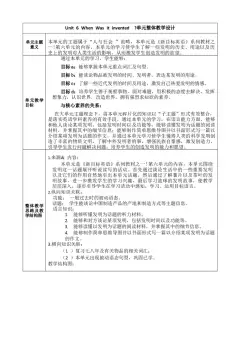
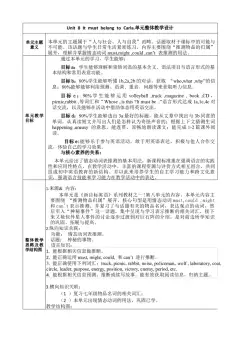
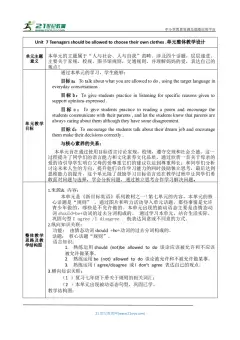
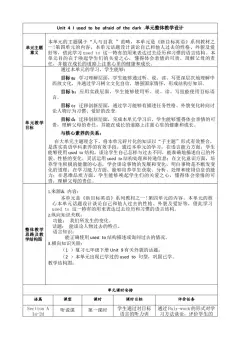
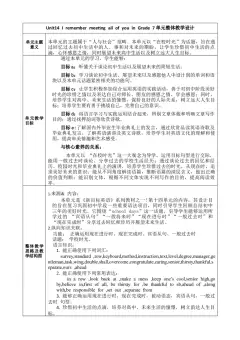
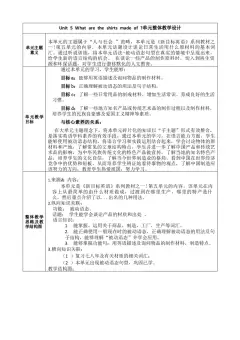
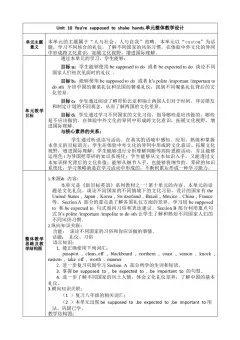
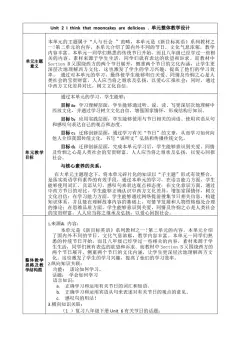
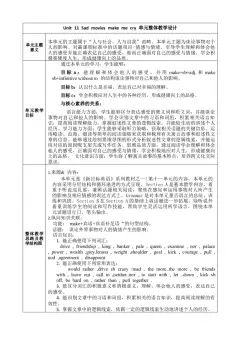
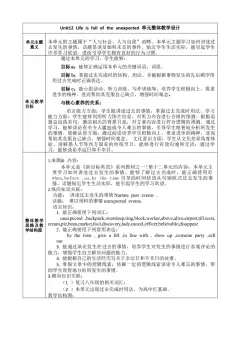
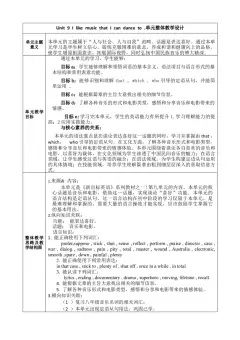
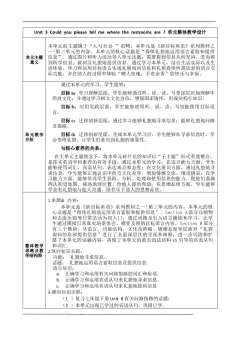
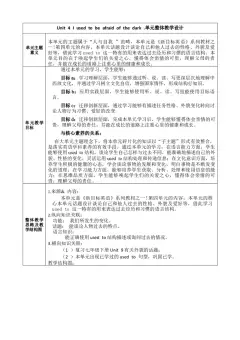
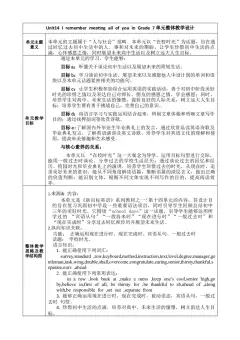
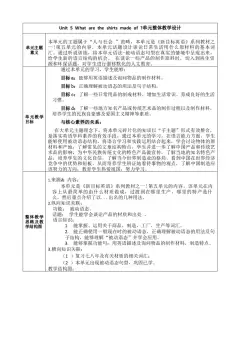
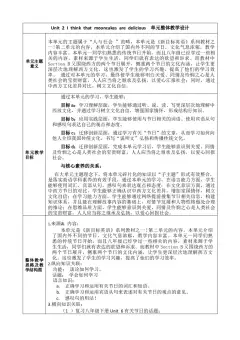
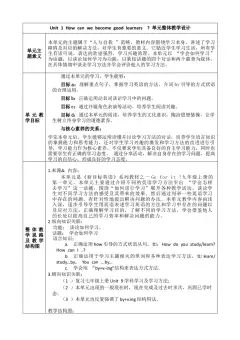
Unit 6 When Was it invented ?单元整体教学设计
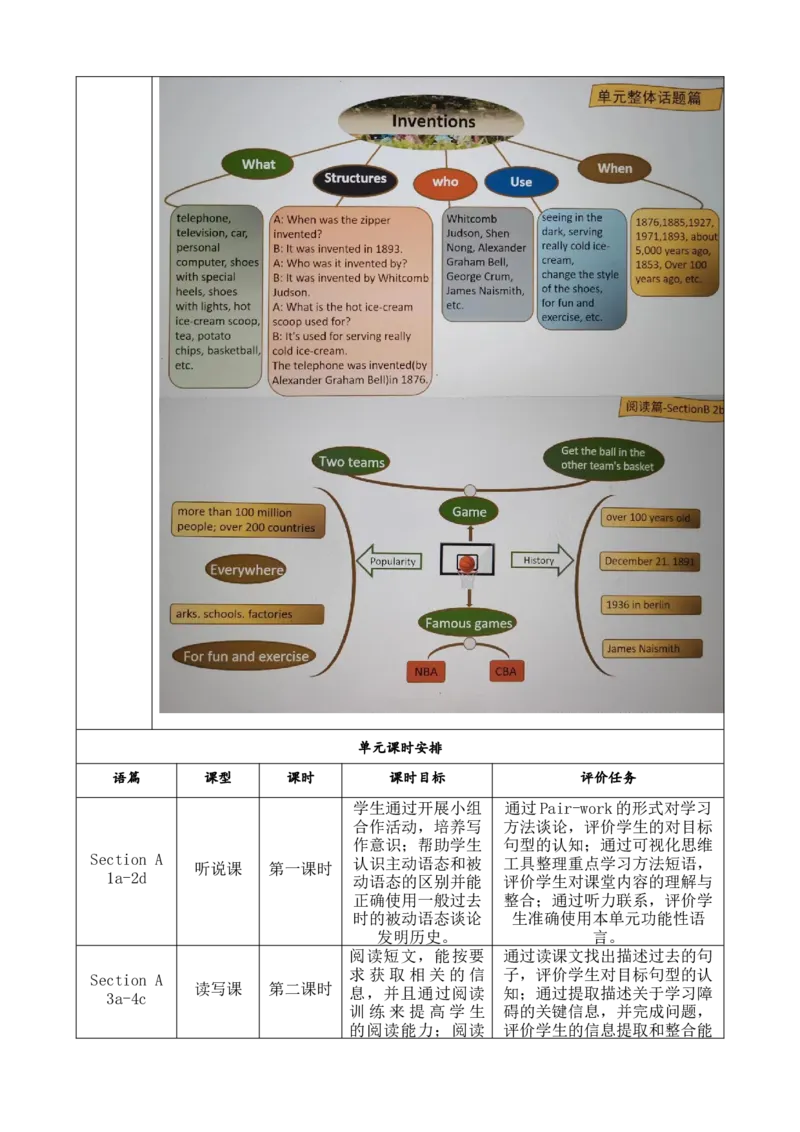
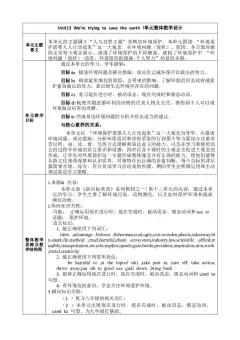
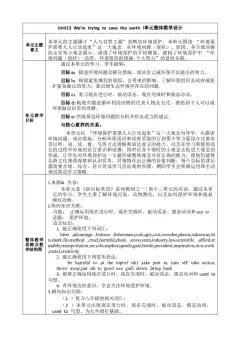
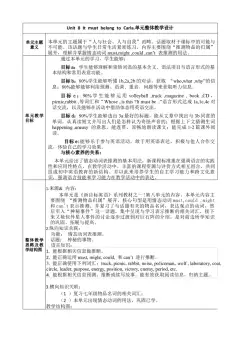
单元主题 本单元的主题属于“人与社会 ”范畴,本单元是《新目标英语》系列教材之
意义 一!第六单元的内容,本单元的学习使学生了解一些发明的历史、用途以及历
史上的发明对人类生活的影响,从而激发学生创造发明的欲望。
通过本单元的学习,学生能够:
目标a:能够掌握本单元重点词汇及句型。
目标b:能谈论物品被发明的时间、发明者,表达某发明的用途。
目标c:了解一些近代发明的时间及用途,激发自己热爱发明的情感。
目标d:培养学生善于观察事物,面对难题,用积极的态度去解决,发挥
想象力,认识世界,改造世界,拥有强烈求知欲的素养。
单元教学
目标 与核心素养的关系:
在大单元主题理念下,将本单元碎片化的知识以“子主题”形式有效整合,
是落实英语学科素养的有效手段,通过本单元的学习,在语言能力方面,能够
和他人谈论某项发明,包括发明时间以及功能等;能够读懂发明为话题的阅读
材料,并掌握其中的细节信息;能够制作简单思维导图并以书面形式写一篇以
介绍某项发明为话题的作文,并通过本单元学习使学生懂得人类的科学发明创
造了丰富的物质文明,了解中外发明者的事,增强民族自豪感,激发创造力,
引导学生发行问题解决问题,培养学生的创造发明的能力和愿望。
1.来源& 内容:
本单元是《新目标英语》系列教材之一!第六单元的内容,本单元围绕
发明这一话题展开听说读写的活动。首先通过谈论生活中的一些重要发明
以及它们的作用自然地引出本单元话题,然后通过了解薯片以及茶叶的发
明故事,进一步激发学生的学习兴趣,最后学习篮球的发明故事,使教学
层层深入,逐步引导学生在学习活动中感知,学习、运用目标语言。
2.纵向知识关联:
功能: 一般过去时的被动语态。
话题: 学生能谈论中国制造产品的产地和制造方式等主题信息。
整体教学
语言知识:
思路及教
学结构图 1. 能够听懂发明为话题的听力材料。
2. 能够和对方谈论某项发明,包括发明时间以及功能等。
3. 能够读懂以发明为话题的阅读材料,并掌握其中的细节信息。
4. 能够制作简单思维导图并以书面形式写一篇以介绍某项发明为话题
的作文。
3.横向知识关联:
(1 )复习七八年及有关物品的相关词汇;
(2 )本单元出现被动语态句型,巩固已学。
教学结构图:单元课时安排
语篇 课型 课时 课时目标 评价任务
学生通过开展小组 通过Pair-work的形式对学习
合作活动,培养写 方法谈论,评价学生的对目标
作意识;帮助学生 句型的认知;通过可视化思维
Section A 认识主动语态和被 工具整理重点学习方法短语,
听说课 第一课时
1a-2d 动语态的区别并能 评价学生对课堂内容的理解与
正确使用一般过去 整合;通过听力联系,评价学
时的被动语态谈论 生准确使用本单元功能性语
发明历史。 言。
阅读短文,能按要 通过读课文找出描述过去的句
求获取相关的信 子,评价学生对目标句型的认
Section A
读写课 第二课时 息,并且通过阅读 知;通过提取描述关于学习障
3a-4c
训练来提高学生 碍的关键信息,并完成问题,
的阅读能力;阅读 评价学生的信息提取和整合能短文了解茶叶发明 力;在图片和文字提示下,复
发展的过程,能按 述课文,评价学生对语言结构
要求找到相应的信 和词汇的理解;通过编写对话
息并能恰当地使用 和角色表演进行口头输出,评
被动语态完成相关 价学生的英语思维和语言表达
练习。 能力。
通过问题启发式评价引导学
完成听说活动,了
生,评价学生对语篇主题的理
Section B 解美食的发明史;
听说课 第三课时 解;通过个人思考和合作交
1a-1e 能用被动语态谈论
流,评价学生主动参与到学习
美食的发明史。
中的能力。
通过问题启发式评价引导学生
从整体到具体的认识,并提取
关键信息完成思维导图,评价
通过了解篮球的发 学生对文本第一段的理解和信
明的过程,培养学 息提取能力;通过读文章,定
Section B
阅读课 第四课时 生运用思维导图记 位、获取、整合信息,评价学
2a-2f
忆语篇信息的能 生对文章第二段的理解和信息
力。 整合的能力;通过对话编写和
角色表演进行口头输出,并通
过书面表达的形式,评价学生
对句型的掌握
学生能运用书面表
Section B 通过书面表达的形式介绍礼貌
达自己的改变,在
3a-Self 写作课 第五课时 的寻求表达信息,评价学生写
练中学,培养学生
check 作的能力。
语言运用能力。
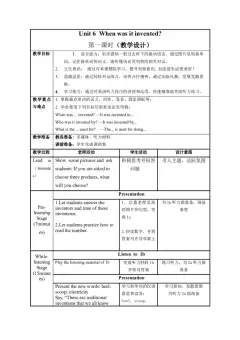
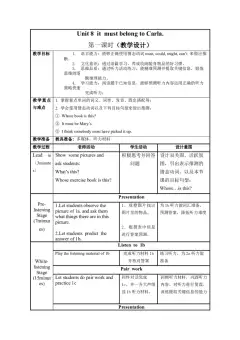
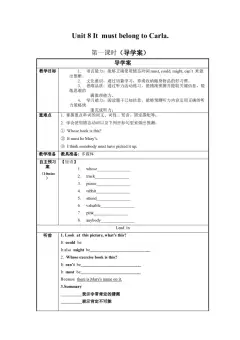
第1课时 教学设计
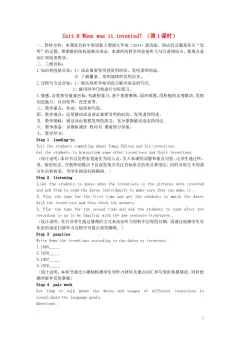
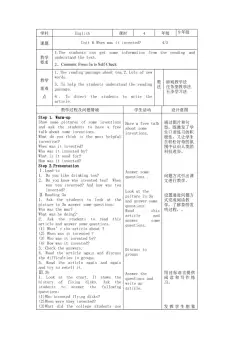
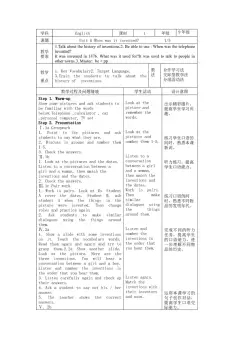
课题 Unit 6 When was it invented ?
课型 听说课√ 语法课口 阅读课口 写作课口 其它课__________
教材(语篇)分析:
【what】
本节课是一节听说课,教材以“When was it invented”为话题。
【why】
通过听说活动,充分练习了被动语态的基本结构,同时也了解了更多发明的历
史。
【how】
Section A 介绍了我们生活中的一些常见物品的发明历史,介绍它们被发明的时间,
被什么人发明及其作用或发展等,从语言结构上学习一般过去时的被动语态。1a-1c是整
个 Section A 的基础。本部分输入了本单元的重要语言结构 When was it invented ?It was
invented in ...活动2a-2d 侧重听说互动,的对单元话题的深化和拓展。
学情分析:
(一)自然情况
学生在上一个单元对被动语态的一般现在时形式已经有了初步的认识。
(二)已有基础
初三学生求知欲强,兴趣广,对于历史上的发明有一定的了解。
(三)存在问题
由于学生的自觉性差,很少自觉地复习预习,学过的词汇句型可能已经不在熟
悉。(四)解决措施
教师可让他们体会被动语态的结构和表意功能。在听说训练过程中,让学生通过自
主和合作学习的方式进行句式结构的语言输入,并设计相应的任务,鼓励学生运用所学进
行语言实践,并就原材料话题对学生进行生态环保方面的人文教育。
教学目标:
通过本课学习,学生能够:
1. 学生能学会重点词汇以及目标语言。 (学习理解)
重点单词及短语:invent, invention , inventor , calculator
目标语言:A:When was the telephone invented ?
B: I think it was invented in 1876.
A: Who was it invented by ?
B: It was invented by Bell .
A: What was it used for ?
B: It was used for ...
2. 帮助学生认识主动语态与被动语态的区别并能正确使用一般过去时的被动语态谈
论发明历史。 (应用实践)
3. 通过学习懂得科学发明改变了人类生活。 (迁移创新)
9教学重难点
重点:询问发明的时间、发明人及用途。
难点:使用过去时的被动语态谈论发明历史。
学习活动设计
教师活动 学生活动
环节一:Activity 1
教师活动1 Lead-in 学生活动1
Show pictures of
the four great Make conversations .
inventions . Say
“ Today we are
going to talk
about inventions .
Do you know
what an invention
Ask and answer
is ? These are the
four great
inventions in
ancient China .
They were
invented a long
time ago .
“ Show some
pictures about
modern inventions
. Tell students
that all of these
things were
invented in last
last 150 years .Point to each
pictures and
students tell what
it is . Then write
the names of the
inventions .
活动意图说明:
通过图片帮助学生理解invention的含义,引出更多发明
名称,为下一步谈论发明作好词汇准备。
环节二:Activity 2
教师活动2 Work on 1a 学生活动2
1. Ask students to think
about the following
Discuss with groupmates .
questions: Can you
guess which one of
them was invented first
?Which one of them was
invented last ?Was the TV
Learn the new words.
invented before the car or
after the car ?
Have the students
look at the sample
Ask and answer
conversation in the box .
Ask two students to read
this conversation to the
class :
2. Call the students’
Work in pairs .
attention to the pictures
. Have students guess
and write the dates on
the blackboard . Ask
the class to repeat the
questions and answers
like this :
T: When was the
computer invented ? S1:
1971.
T:OK. The computer
was invented in 1971.
Repeat the process with
other inventions .
活动意图说明:
先通过让学生猜测的先后顺序,激发学生的好奇心和求
知欲,同时引出句型I think it was invented before
/after ...为后买你的学习作知识和语言的铺垫。
环节三:Activity 3
教的活动3 Work on 1b 学的活动31. Call the students’
attention to the inventions
in the picture . Ask four
students to say names of
them . Then ask them to
Finish 1b
see the dates with a blank
line in front of each .
Read the dates together.
Then say “We’ll listen
to a conversation
between a girl and a
lady What are they
talking about ?
Check the answers
2. In the
conversation they will
talk about when these
things with the years .
Write the correct letter in
front of each date as the
sample given . Ask
Repeat the sentences .
students to have a look at
the sample answer . Play
the recording the first
time . The students only
listen and try to catch the
main idea . Play the
recording a second time .
Let the students match the
inventions with the years .
3. Check the answers
. Help students to answer
like this :
The telephone was
invented in 1876.
4. Listen again and
answer the questions .
5. Then play the
recording again. Pause
after each sentence and let
students repeat .
活动意图说明:
通过听的方式输入功能句型,让学生在听的活动中感知
目标语言。听前鼓励学生利用图片及说明大胆预测听力
内容。听后通过设问。帮助学生加深对文本的理解,跟
读对话练习说地道的英语。
环节四:Activity 4
教的活动4 work on 1c 学的活动4 学的活动3
Read the 1. Ss observe the images and
instruction and point to Read aloud . understand the situation.
2. Ss complete the questions and
the list of dates in
answers using past future tense.
Activity 1b . You willbe talking about the
dates that things were
invented with a partner .
Call the students to read
this conversation to the
Work in pairs and practice
class .
.
S1: When was the
telephone invented ?
S2: I think it was
invented in 1876.
Then get the
students to practice in
pairs , using the
information in Activity
1b .
Ask several pairs
to share their
conversations with the
class.
活动意图说明:
利用听力内容给学生提供开口表达的机会,使学生进一
步理解并运用目标语言。
环节五:Activity 5
教的活动5 Pair Work 学的活动5
Show the first Picture and
ask What is this called in
English ?Help students to Make a conversations and
answer It’s called a TV . ask .
Then ask the questions and
help the students to answer
like this :
T:When was it invented ?
S: It was invented in ..?
T: Who was it invented by ?
S:It was invented by /..
Show other pictures to let
students make up similar
conversations .
活动意图说明:
引出新的语言知识及新的功能句型”Who Was it
invented by ?
环节六:Activity 6 Work on 2a-2c
教的活动6 学的活动6
1. Show Some pictures to
help students to understand Read aloud and understand .
these words: heel , scoop ,
electricity .
2. Look at the picture
What can you see in the
Listen to the tapes forpicture ? three times and finish the
What is the girl doing ? tasks
What is the scoop used
for ?
What are the shoes used
for ?
3. Listen and number the Check the answers
inventions in the order you
hear them.
Play the recording the fist
time . Students only
listen . Then play the
recording again . Check
the answers by asking a
student to tell answers . Make conversations.
The answer is 3,2,1
4. These are interesting
inventions . Who are they
invented by ?What are they
used for ? Please listen
carefully and fill in the
chart .
5. Listen again answer the
questions
6. Listen and repeat . Play
the recording for students
to listen and repeat .
7. Make conversations
using the information in
2b . Make a sample
conversation like this :
A: What are they used for
?
B: They’re used for
seeing in the dark .
Students work in pairs
while the teacher moves
around to offer help .
活动意图说明:
听前利用图片介绍生词并引入核心句型。完成教材听力
活动后,设计四个问题一方面帮助学生进一步理解听力
材料,另一方面又给学生提供了练习本课功能句型的机
会,最后的对子活动给学生提供口头表达的练习。
环节七:Activity 7
教的活动7 Listening work 学的活动7
on 2d
1. Show a picture of a
zipper . Say “ What is Look at the picture and
this ?” and teach the word answer
Zipper . Write it down on
the blackboard . And as“ Where can we see a
zipper ?” Collect the
answers and write them
down . Read conversations and
2. Who invented the answer the questions .
zipper ? Read the
conversation and find out
the answers . If you find
the answer , please put up
your hands. Ask and answer
3. Read it again and
answer the following
questions :
Who invented the zipper ?
When was the zipper
Listen and repeat
invented ?
When was it used widely
?
Do you think it is a great
invention?Why?
Check the answers and
explain the language points
at the same time and deal
with the problems the
students may have .
4. Play the tape for
students to listen and
repeat .
5. Role-play the
conversation in pairs .
Then ask some pairs to
act out their conversations.
活动意图说明:
首先通过设问使学生逐步理解文本,使学生充分熟悉内
容,确保能够顺利完成角色扮演。
板书设计
Unit 6 When was it invented?
Period 1 Section A 1a-2d
1. The name of the inventions :
computer , car , telephone , TV.
2. Target language :
A:When was the telephone invented ?
B: I think it was invented in 1876.
A: Who was it invented by ?
B: It was invented by Bell .A: What was it used for ?
B: It was used for ..
分层作业设计
1. 基础巩固:
Recite the conversation in 2d
设计意图:熟记本课重点单词和短语。
2. 能力提升:
Review the passage on An Accidental Invention .
设计意图: 为下节课作铺垫,养成良好习惯。
教学反思与改进
本节课的设计体现了任务型教学的特点,由易至难,层层递进,由任务推动教学,使
每个学生尽可能地参与到课堂之中,但在具体的操练过程中,操练的方法还有待于进
一步改进,应加上自己和同伴的前后变化或加上更多的活动和游戏来调动学生参与的
积极性,以达到更好的教学效果。