人教版(新标准)初中英语知识点精析
九年级下册 UNIT 11
Sad movies make me cry.悲伤的电影让我哭泣。
重点
● “the+ 比较级…,the+ 比较级…”结构
● 掌 握take,spend,cost 与 pay 的用法区别
难点
● so …that,such …that 与 so that 的用法区别
● make 的用法
语法
● make 的用法
Section A
重点单词
drive v.迫使
friendship n.友谊;友情
king n.国王;君主
power n.权力;力量
banker n.银行家 pale adj.苍白的;灰白的
queen n.王后;女王
examine v. (仔细地)检查;检验
nor conj.& adv.也不
palace n.王宫;宫殿
wealth n.财富
grey adj.(天空)阴沉的;昏暗的;灰色的
lemon n.柠檬
uncomfortable adj.使人不舒服的;令人不舒适的
1重点短语
would rather (通常缩写为 rather) 宁愿
drive sb.crazy/mad使人发疯/发狂
the more… the more… 越……越…… ;愈……愈……
be friends with sb.成为某人的朋友
leave out 忽略;不提及;不包括
prime minister首相;大臣
call in召来;叫来
neither…nor… 既不……也不……
to start with起初;开始时
重点句型
1. I'd rather go to Blue Ocean because I like to listen to quiet music while
I'm eating.我宁愿去蓝色海洋(餐馆),因为我喜欢在吃饭时听安静的音乐。
2. I think I've made Alice mad and I'm not sure what to do about
我想我已经使艾丽斯发疯了,我不确定对这件事该做什么。
it.
3. Well, the more I get to know Julie, the more I realize that we have a lot
in common. 嗯,我对朱莉了解得越多,我越意识到我们有很多的共同点。
4.So we've been spending more time together lately.
所以最近我们花更多的时间在一起。
5. …why don't you ask Alice to join you each time you do something with
Julie?
……每次你和朱莉在一起做某事的时候,你为什么不邀请艾丽斯加入你们呢?
6.A long time ago, in a rich and beautiful country, there lived an unhappy
king.很久以前,在一个富饶又美丽的国家里住着一位不快乐的国王。
7.I'm always worried about losing my power.我总是担心失去我的权力。
2Section B
重点单词
weight n.重量;分量 shoulder n.肩;肩膀
goal n.球门;射门;目标 coach n.教练;私人教师
kick v.踢;踹 courage n.勇敢;勇气
pull v.拉;拖 nod v.点头
agreement n. (意见或看法)一致;同意 disappoint v.使失望
重点短语
let…down 使失望
kick sb.off 开除某人
be hard on sb.对某人苛刻;对某人要求严厉
rather than 而不是
pull together 齐心协力;通力合作
重点句型
1. What made the poor man so happy even though he had no power,
money or fame? 什么使那位穷人这么高兴,尽管他没有权力、金钱和声誉?
2. He had let his whole team down.他使整个球队都失望了。
3. He was really worried that his coach might kick him off the
team. 他非常担心,他的教练可能会把他从球队中开除。
4. Ten minutes later, Peter heard his father knocking on his bedroom
door. 十分钟以后,彼得听到他的爸爸在敲他的卧室门。
5. But whatever it was, don't be too hard on
yourself. 但不管结果是什么,不要对自己太苛刻。
6.The next day, Peter went to soccer practice with courage rather than fear in
3his heart.第二天,彼得心里并没有害怕,而是鼓起勇气去参加足球训练。
7. But think if we continue to pull together, we're going to win the next
one. 但是我想如果我们继续团结一致,我们将会赢得下一场比赛。
8.To his surprise and relief, his teammates all nodded in agreement.
令他吃惊和欣慰的是,他的队友都同意地点点头。
Section A 知识点精析
1. I'd rather go to Blue Ocean because I like to listen to quiet music while
I'm eating.我宁愿去蓝色海洋(餐馆),因为我喜欢在吃饭时听安静的音乐。
要点精析
'd rather 是 would rather 的缩写形式,意为“宁愿”,表示主语的愿望、选择。
would rather 后跟动词原形,即 would rather do sth.“宁愿做某事”,其否定
形
式是 would rather not do sth.“宁愿不做某事”。
例:To be honest, I'd rather stay at home.老实说,我宁愿待在家里。
We would rather not tell her.我们宁愿不告诉她。
知识拓展
①would rather do sth.than do sth. 意为“宁愿做某事,也不愿做某事”,相当
于 prefer to do sth. rather than do sth.。
例:I would rather go swimming than go shopping.=I prefer to go swimming
rather than go shopping.我宁愿去游泳,也不愿去购物。
②Would … rather do.? 意为“……宁愿做……吗?”
例:Would you rather stay here or go home? 你宁愿待在这儿还是回家?
链接中考
(江苏宿迁中考)-Which do you prefer, Chinese food or Western food?
-I would rather Chinese food. Let's have noodles.
4A. to have B.having C. had D. have
解析: would rather后跟动词原形,即 would rather do sth.“宁愿做某事”,
故选 D。
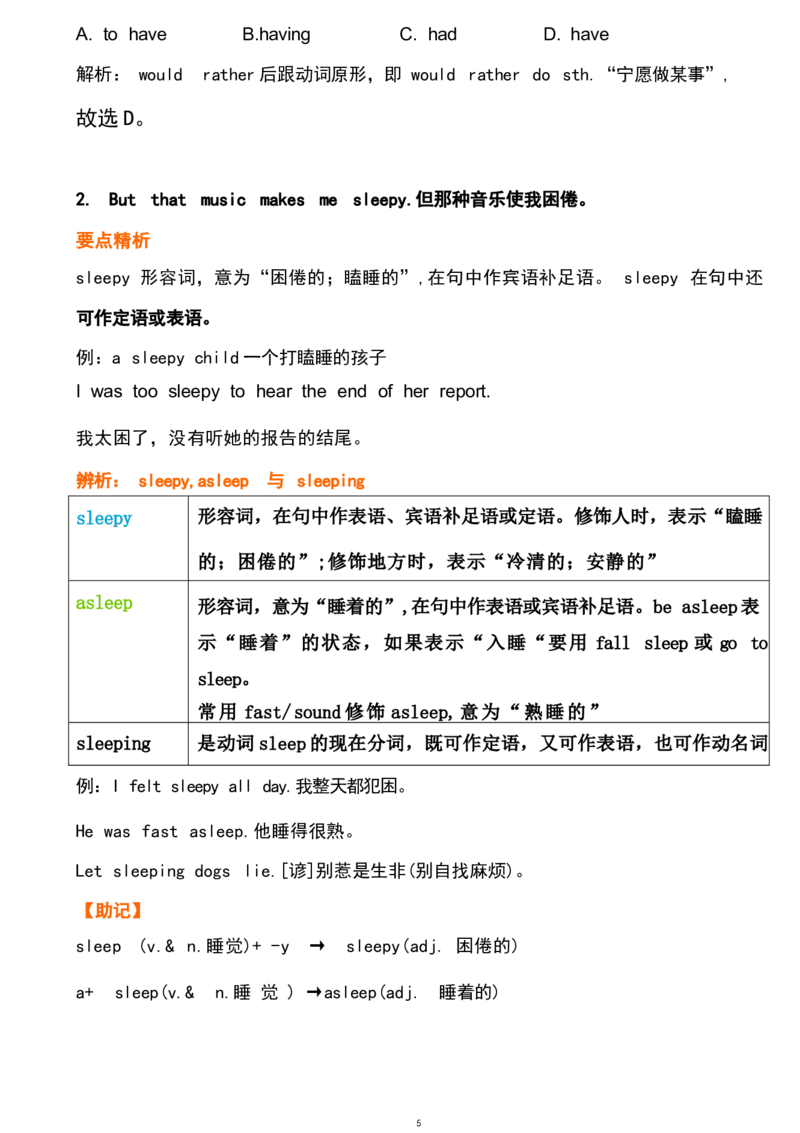
2. But that music makes me sleepy.但那种音乐使我困倦。
要点精析
sleepy 形容词,意为“困倦的;瞌睡的”,在句中作宾语补足语。 sleepy 在句中还
可作定语或表语。
例:a sleepy child一个打瞌睡的孩子
I was too sleepy to hear the end of her report.
我太困了,没有听她的报告的结尾。
辨析: sleepy,asleep 与 sleeping
sleepy 形容词,在句中作表语、宾语补足语或定语。修饰人时,表示“瞌睡
的;困倦的”;修饰地方时,表示“冷清的;安静的”
asleep
形容词,意为“睡着的”,在句中作表语或宾语补足语。be asleep表
示“睡着”的状态,如果表示“入睡“要用 fall sleep 或 go to
sleep。
常用 fast/sound修饰 asleep,意为“熟睡的”
sleeping 是动词 sleep的现在分词,既可作定语,又可作表语,也可作动名词
例:I felt sleepy all day.我整天都犯困。
He was fast asleep.他睡得很熟。
Let sleeping dogs lie.[谚]别惹是生非(别自找麻烦)。
【助记】
sleep (v.& n.睡觉)+ -y → sleepy(adj. 困倦的)
a+ sleep(v.& n.睡 觉 ) →asleep(adj. 睡着的)
53. Waiting for Amy drove Tina crazy.等待埃米使蒂娜发疯。
要点精析
drive 动词,此处意为“迫使”,其过去式为 drove, 过去分词为 driven。
例:The workers were driven by their boss to finish the job.
老板逼迫工人们完成任务。
You drive me mad when you say that.你讲这话真使我恼火。
知识拓展
①drive sb.to do sth.迫使某人做某事; drive sb.crazy/mad 使某人发疯/发狂
例:He drove her to refuse others' help.他逼迫她拒绝他人的帮助。
You're driving me mad, Jack.你让我发疯了,杰克。
②drive 作动词时,还可意为“驾驶;开车”。
例:Please drive carefully.请谨慎驾驶。
The boy is driving the car so fast.这个男孩儿开车太快。
4.Loud music makes John want to dance.高亢的音乐使约翰想要跳舞。
要点精析
loud 此处作形容词,意为“响亮的;大声的”。 loud 也作副词,意为“大声地;喧
闹地;响亮地”。
例:He has a loud voice.他嗓门很大。
辨析: loud,aloud 与 loudly
强调声音响亮,常与 speak,talk,sing,laugh 等动词连用
loud
重点在于”出声”(能被人听见,但声音不一定很大),通常与read,
aloud
think连用
loudly 含有“喧闹的意味,与 quietly 相对
6例:He should not speak so loud.他不该如此大声说话。
She read the story aloud to the children.她把这个故事朗读给孩子们听。
He wept loudly.他大声哭泣。
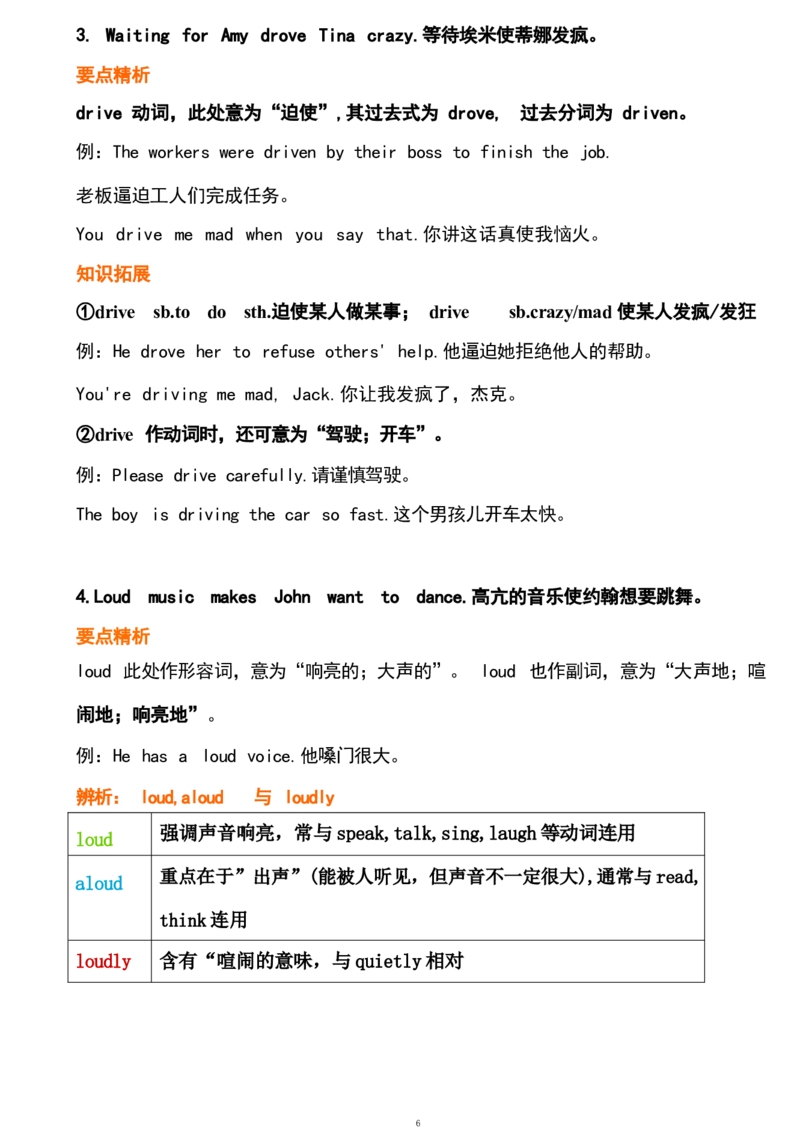
5. The movie was so sad that it made Tina and Amy cry.
这部电影如此悲伤,以至于它使蒂娜和埃米哭了。
要点精析
so…that… 意为“如此……以至于……”,在句中引导结果状语从句。
例:The book is so interesting that everyone wants to read it.
这本书如此有趣,以至于每个人都想读它。
知识拓展
如果 so…that… 引导的从句中的主语与主句的主语一致,在否定句中可与 too…to….
no… enough to do…结构转换。
例:He is so young that he can't' go to school.
= He is too young to go to school.
= He isn't old enough to go to school.他太小了不能去上学。
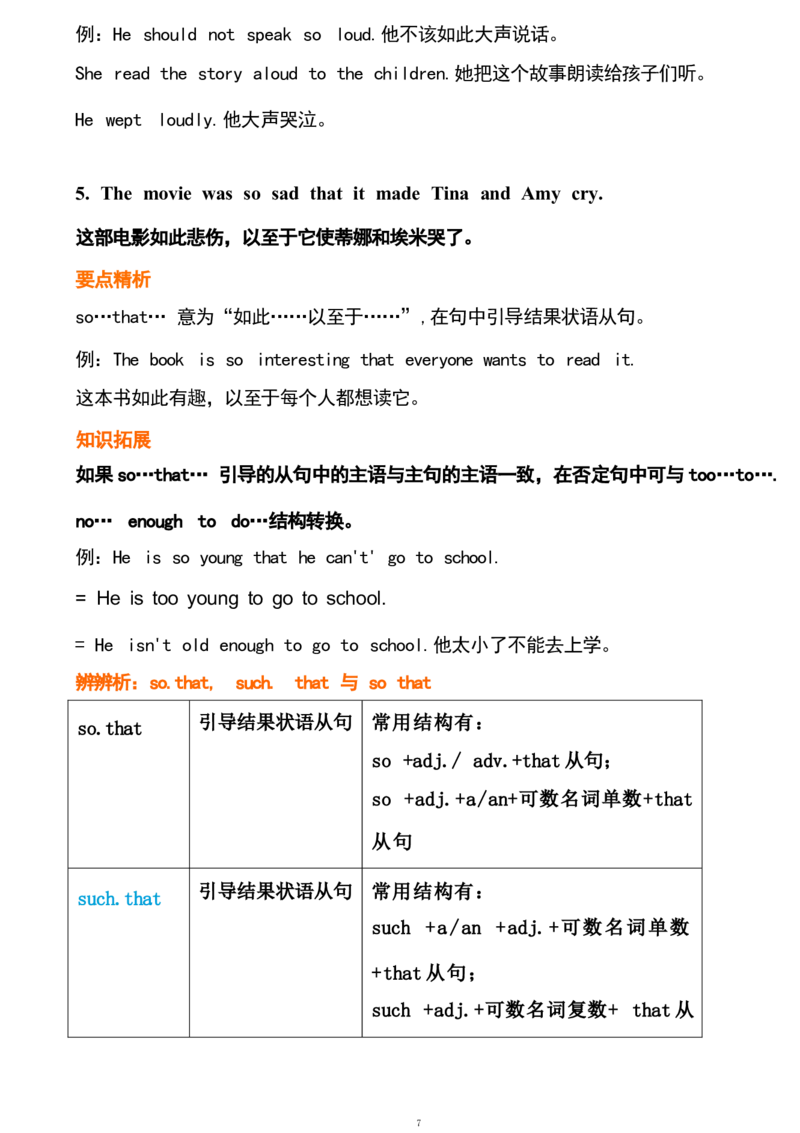
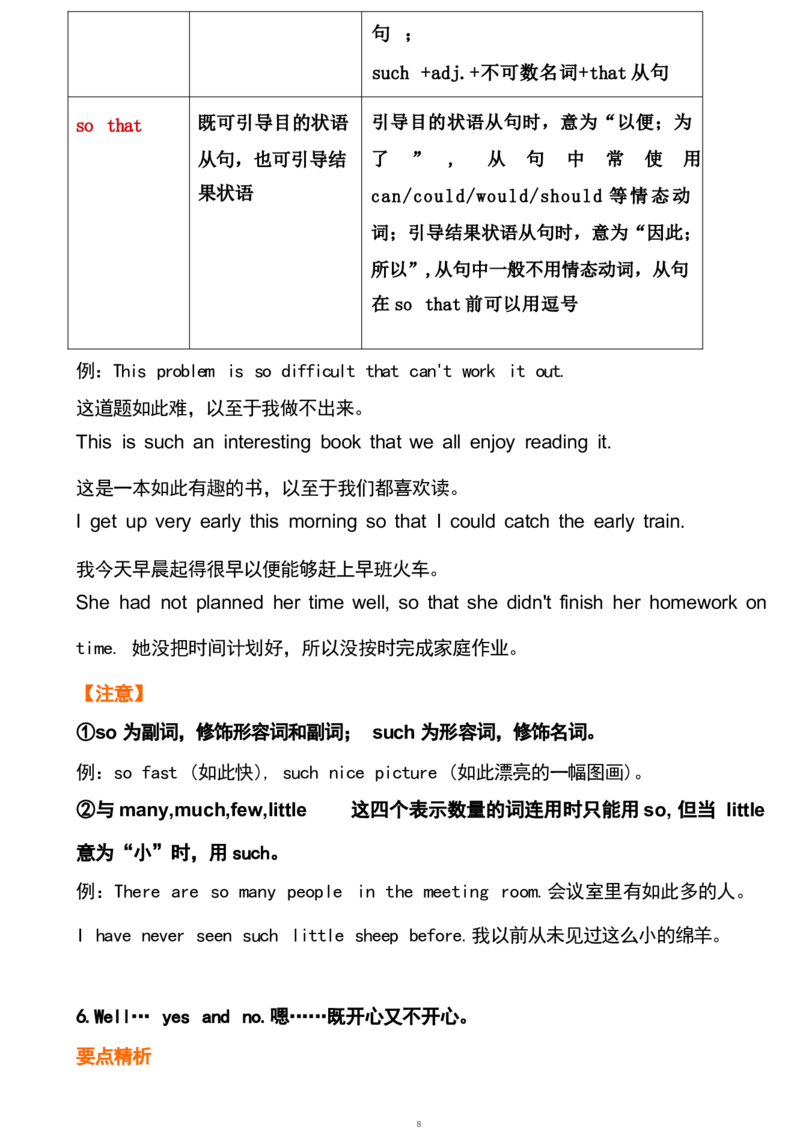
辨辨析:so.that, such. that 与 so that
引导结果状语从句 常用结构有:
so.that
so +adj./ adv.+that 从句;
so +adj.+a/an+可数名词单数+that
从句
引导结果状语从句 常用结构有:
such.that
such +a/an +adj.+可数名词单数
+that 从句;
such +adj.+可数名词复数+ that 从
7句 ;
such +adj.+不可数名词+that从句
so that 既可引导目的状语 引导目的状语从句时,意为“以便;为
从句,也可引导结 了 ” , 从 句 中 常 使 用
果状语 can/could/would/should 等情态动
词;引导结果状语从句时,意为“因此;
所以”,从句中一般不用情态动词,从句
在 so that前可以用逗号
例:This problem is so difficult that can't work it out.
这道题如此难,以至于我做不出来。
This is such an interesting book that we all enjoy reading it.
这是一本如此有趣的书,以至于我们都喜欢读。
I get up very early this morning so that I could catch the early train.
我今天早晨起得很早以便能够赶上早班火车。
She had not planned her time well, so that she didn't finish her homework on
time. 她没把时间计划好,所以没按时完成家庭作业。
【注意】
①so 为副词,修饰形容词和副词; such 为形容词,修饰名词。
例:so fast (如此快), such nice picture (如此漂亮的一幅图画)。
②与 many,much,few,little 这四个表示数量的词连用时只能用 so, 但当 little
意为“小”时,用 such。
例:There are so many people in the meeting room.会议室里有如此多的人。
I have never seen such little sheep before.我以前从未见过这么小的绵羊。
6.Well… yes and no.嗯……既开心又不开心。
要点精析
8yes and no “既是又不是”,表示对某一问题的模棱两可的回答。
例:My answer is both yes and no.我的回答既肯定又否定。
Yes and no are not the best answer.既是又不是不是最好的答案。
7.I think I've made Alice mad and I'm not sure what to do about it.
我想我已经使艾丽斯发疯了,我不确定对这件事该做什么。
要点精析 1
make sb.mad意为“使某人发疯/发狂”,还可表达为 make sb.crazy。
例: I can't stand the noise outside. It nearly makes me mad/crazy.
我不能忍受外面的噪音。它几乎使我发疯。
要点精析 2
be sure意为“确信;确定”。
知识拓展
①be sure of/about, 意为“对……有把握;相信”,其后可接名词、代词或动词-ing
形式作宾语,主语必须是人。
例:He is sure of/about success.他确信会成功。
②be sure to do sth., 意为“务必/切记要做某事”常用于祈使句,表示说话人对
对方提出要求。
例:Be sure to give it back to me on time.务必按时将它还给我。
③be sure+从句,表示“肯定;对……有把握”,主语必须是人。
例:I'm sure that he will win.我确信他会赢。
小贴士
be sure of/about可 与 “be sure+从句”进行同义句转化。
要点精析 3
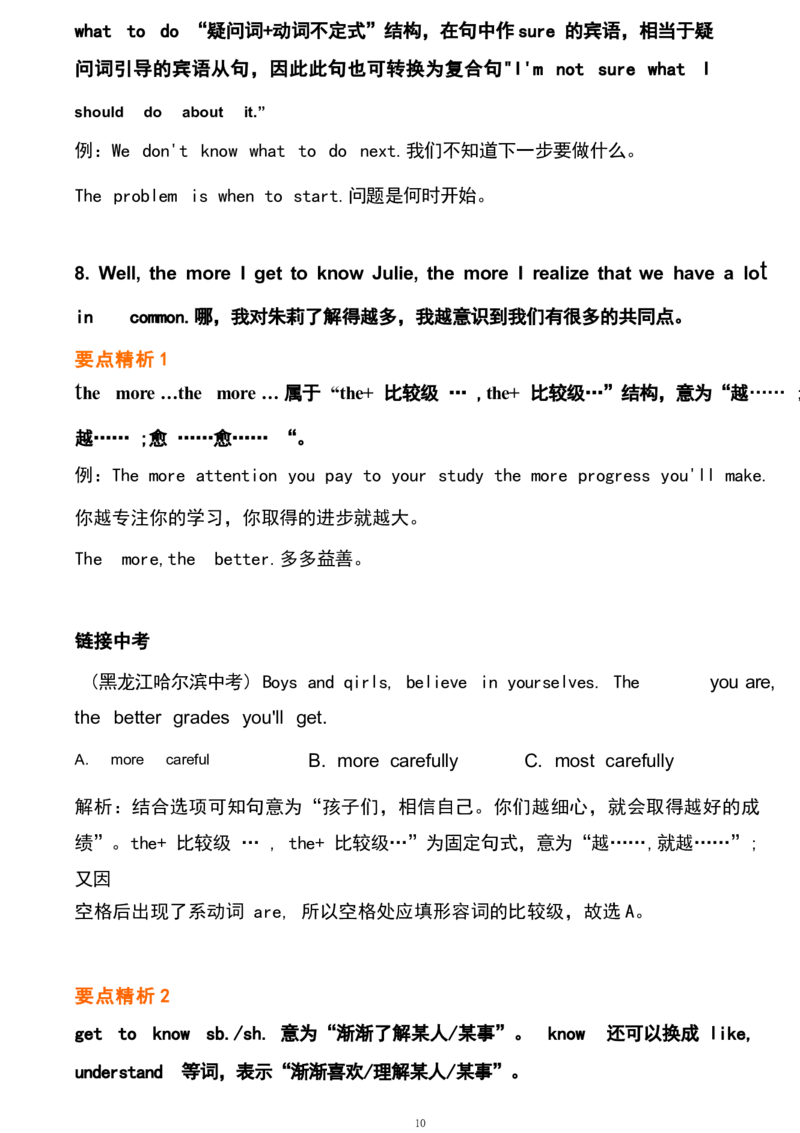
9what to do “疑问词+动词不定式”结构,在句中作sure 的宾语,相当于疑
问词引导的宾语从句,因此此句也可转换为复合句"I'm not sure what I
should do about it.”
例:We don't know what to do next.我们不知道下一步要做什么。
The problem is when to start.问题是何时开始。
t
8. Well, the more I get to know Julie, the more I realize that we have a lo
in common.哪,我对朱莉了解得越多,我越意识到我们有很多的共同点。
要点精析 1
t
he more …the more … 属于 “the+ 比较级 … ,the+ 比较级…”结构,意为“越…… ;
越…… ;愈 ……愈…… “。
例:The more attention you pay to your study the more progress you'll make.
你越专注你的学习,你取得的进步就越大。
The more,the better.多多益善。
链接中考
(黑龙江哈尔滨中考) Boys and qirls, believe in yourselves. The you are,
the better grades you'll get.
A. more careful B. more carefully C. most carefully
解析:结合选项可知句意为“孩子们,相信自己。你们越细心,就会取得越好的成
绩”。the+ 比较级 … , the+ 比较级…”为固定句式,意为“越……,就越……”;
又因
空格后出现了系动词 are, 所以空格处应填形容词的比较级,故选 A。
要点精析 2
get to know sb./sh. 意为“渐渐了解某人/某事”。 know 还可以换成 like,
understand 等词,表示“渐渐喜欢/理解某人/某事”。
10例:It took me one year to get to know him.我花了一年时间才渐渐了解他
The students get to understand the Importance of studying hard.
学生们渐渐理解了努力学习的重要性。
要点精析 3
have a lot/much in common (with sb./sth.) 意为“(与某人/某物)有许多共
同点;(与某人/某物)有许多相同之处在此处作名词。
例:The two languages have lot/much in common.这两种语言有很多共同之处。
知识拓展
①have nothing in common(with sb./sth.) (与某人/某物)毫无共同之处
例:1 have nothing in common with Jane.我和简毫无共同之处。
②common 还可作形容词,意为“共同的;普通的;常见的”。
例:We have common interests and hobbies.我们有共同的兴趣和爱好。
His name is Hansen, a common name in Norway.
他的名字是汉森,在挪威是一个常见的名字。
【习惯搭配】
the common people 老百姓
common sense 常识
辨析:common,ordinary 与 usual
指为许多人或事物所共同具备因而常见
common
ordinary 指由于与一般事物的性质或标准相同,因而显得平常,无奇特之处,
反义词为 special
指在某一地方或某一时间内所常见的,往往指常用的东西,或常发生
usual
的事情,反义词为 unusual
例:Rabb its and foxes are common in Britain. 兔子和狐狸在英国很常见。
11Our ordinary weekday is eight hours.我们正常的工作日是 8 小时。
As usual, he went to work by bike.像往常一样,他骑着自行车去上班。
9. So we've been spending more time together lately.
所以最近我们花更多的时间在一起。
要点精析
lately 副词,意为“最近;不久前”,常用于完成时的句子中,同义词为 recently。
例:What have you been doing lately? 你最近在做什么?
辨辨析:lately 与 recently
lately “最近”,用来指一段时间,常用于现在完成进行时
recently “最近”,既可用来指一段时间,也可指某一时刻
例:Just lately/recently I have been wondering whether to look for a new job.
就是最近我一直在考虑要不要找一份新工作。
Just recently I decided to look for a new job.就是最近我决定找一份新工作。
辨辨析: lately 与 late
lately 意为“最近;不久前”
late 意为“晚;迟“
例:Have you seen them lately? 你最近见到过他们吗?
Jenny didn't come late to school the next morning.詹妮第二天早晨上学没迟到。
r
10.. it makes Alice unhappy because she thinks Julie is now bette
friends with me than with her.
………那使艾丽斯不高兴,因为她认为朱莉现在成了跟我比跟她更好的朋友。
要点精析
unhappy 形容词,意为“不高兴的,不快乐的”,是 happy 的反义词。
例:The girl is unhappy.这个女孩儿不快乐。
12Your younger brother felt unhappy, didn't he? 你弟弟感到不高兴了,是
吗?
知识拓展
常见的含否定前 un- 的单词:
unlucky 不幸的 unlike不像
unfriendly不友好的 unimportant 不重要的
unreal不真实的 unable 不能
uncomfortable 不舒服的
11. …why don't you ask Alice to join you each time you do
something with Julie?…… 每次你和朱莉在一起做某事的时候,你为什么不邀请艾
丽斯加入你
们呢?
要点精析 1
Why don't you do sth.? 相当于 Why not do sth.? 意为“你为什么不做某事
呢?”用于向对方提出建议。
例:Why don't you go home now?=Why not go home now?
你现在为什么不回家呢?
要点精析 2
ask sb.to do sth.意为“要求某人做某事”,其否定结构为 ask sb.not to do sth.
意为 “要求某人不要做某事”。
例:Mary asked Jack to do the chores with her.玛丽让杰克和她一起做家务。
My mom asked me not to go out at night.我妈妈让我晚上不要出去。
要点精析 3
join sb.意为“加入某人;和某人一起”。
13例:I'll join you in a minute.我马上就来加入你们。
Will you join me in a walk? 和我一起去散步,好吗?
知识拓展
join 作动词,还可意为“结合;连接”。
例:The island is joined to the mainland by a bridge.一座桥把岛与大陆相连。
【习惯搭配】
join in参 加
join…to… 把……和……连起来
要点精析 4
each/every time意为“每次”,常用来引导时间状语从句。
例:Each/Every time see Kate, she is singing.每次我见到凯特,她都在唱歌。
I visit my teacher each/every time I go to Jinan.
我每次去济南都会拜访我的老师。
知识拓展
可引导时间状语从句的含 time 的短语还有 next time, last time,this time 等。
12. Then she won't feel left out.那么她就不会感到自己被冷落了。
要点精析
feel left out意为“感觉被遗忘;感觉被冷落“。
leave out意为“忽略;不提及;不包括”。
例: Sarah feels left out after her little brother was born.
弟弟出生后,萨拉感觉自己被冷落了。
Frank speaks slowly, trying not to leave anything out.
弗兰克说得很慢,努力不遗漏任何事情。
知识拓展
14leave for… 出发去……
leave behind 落后;留下
13. That can make our friendship stronger. 那会使我们的友谊更加牢固。
要点精析
friendship 名词,意为“友谊;友情”。它一般用作不可数名词,但表示具体的或一
段友谊时,可用作可数名词。
例:Real friendship is more valuable than money.
真正的友谊比金钱更宝贵。
He seemed to have already begun a friendship with Jo.
他似乎已经和乔开始了一段友谊。
知识拓展
①friend 名词,意为“朋友”。
例:A friend in need is a friend indeed.患难朋友才是真正的朋友。
I enjoy a chat with a friend.我喜欢与朋友一起聊天。
②friendly 形容词,意为“友好的”。
例:You should be friendly to your classmates.你应当对你的同学友好。
14. A long time ago, in a rich and beautiful country, there lived an
unhappy king.很久以前,在一个富饶又美丽的国家里,住着一位不快乐的国王。
要点精析 1
a long time ago 意为“很久以前”。
类似的用法还有: long long ago (很久很久以前), once upon time (从前)。
例:I gave up that idea a long time ago.我很久以前就放弃了那个想法。
A long time ago, there lived young man in a village.
很久以前,在一个村庄里住着一位年轻人。
15要点精析 2
本句中 there 引导完全倒装句。 there/here 可以引导倒装句,结构为
“There/Here+ 谓语+主语”,其中的主语必须是名词。
例:There remain several questions to be answered.还有几个问题有待回答。
Here comes the bus.公交车来了。
【注意】
①当主语是代词时,句子不倒装。
例:Herel am.我来了。
②谓语动词用单数还是复数,要根据名词或代词的数来确定。
例:Here comes our teacher.我们的老师来了。(主语是第三人称单数)
There they go.他们走了。(主语是人称代词复数)
15.He slept badly and didn't feel like eating.他睡不好觉并且不想吃东西。
要点精析
feel like意为“想;想要”,其后可接名词、代词或动词-ing 形式作宾语,相当于
would like 或 want。
例:Do you feel like some fish for dinner? 晚饭你想吃些鱼吗?
I feel like flying like a bird.我想像鸟儿一样飞翔。
知识拓展
①feel like 还可意为“感觉像”,其后常接名词或从句。
例:I felt like I was a bird.我感觉自己像一只鸟。
②lt feels like … 意为“(天气、时间等)好像要 ……,似乎是 ……”。
例:It feels like tea time.好像喝茶的时间到了。
辨析: feel like, would like 与 want
接名词、代词或动词-ing 形式,常用结构为: feel like doing
like
16sth.
接名词、代词或动词不定式,常用结构为:would like to do
would like
sth.
接名词、代词或动词不定式,常用结构为: want to do sth.
want
链接中考
(重庆中考) I feel like going for a walk this afternoon.(改为同义句)
go for a walk this afternoon.
解析: feel like doing sth.的同义短语是 would like/ want to do sth.,此题中设
了两个空格,故 want to do sth.合题意。 填 want to。
16.His face was always pale as chalk.他总是面色苍白。
要点精析
pale as chalk 意为“惨白;苍白”,”(as+) 形容词+as+ 名词”意为“像……一样”。
例:The boy is (as) strong as an ox.这个男孩儿强壮如牛。
His hands are (as) cold as ice.他的手冰凉。
17.He often cried for no reason.他经常无缘无故地哭泣。
要点精析
for no reason 意为“无缘无故;毫无原因”。
例:The man quit his job for no reason.那个人无缘无故就辞掉了工作。
知识拓展
for some reason出于某种原因
例:She must do that for some reason.她一定是出于某种原因才那么做的。
1718.One day, a doctor was called in to examine the King.
一天, 一位医生被叫来给国王检查。
要点精析 1
call in 意为“召来;叫来”, was called in 是一般过去时的被动语态。
例:I'm going to call in a waiter this afternoon.
今天下午我打算找一名服务员。
Some teachers are called in to deal with the problem.
几名教师被叫来处理这个问题。
知识拓展
①call sb.back意为“给某人回电话”。
例:Five minutes later, please call me back.五分钟后,请给我回电话。
②call up 意为“(给 ……)打电话;征召(服役)”。
例:If you want to say sorry to her, you can call her up.
如果你想对她说抱歉,你可以给她打电话。
要点精析 2
examine 及物动词,意为“(仔细地)检查;检验”,后接名词、代词作宾语,也可
接 whether 从句作宾语。其名词形式为 examination 意为“检查”。
例:We must examine all the machines.我们必须检查所有的机器。
It's very important to examine them carefully.仔细地检查它们是非常重要的。
19. Neither medicine nor rest can help him. 药物和休息都不能帮助他。
要点精析
neither…nor… 意为“既不……也不……”,连接两个并列的句子成分。
例:It's neither hot nor cold in winter here.这里冬天既不热也不冷。
The clothes in this shop are neither cheap nor beautiful.
18这家店的衣服既不便宜,也不漂亮。
知识拓展
neither/nor 引导倒装句表示与上述否定情况相同,而 so 引导的倒装句表示与上
述 肯定情况相同。倒装句的时态与上句保持一致。结构为: neither/nor/so+
情态动
词/助动词/系动词 be+ 主语。
例:-He didn't finish his work.他没有完成工作。
-Neither/Nor did l.我也没有。
-I prefer the first version.我喜欢第一稿。
-So do we.我们也是。
20.Although have lot of power, it doesn't make me happy.
虽然我有很多权力,但那并没有使我快乐。
要点精析
power 不可数名词,意为“权力;力量”。
例:How much power does he have? 他有多少权力?
Knowledge is power. (谚)知识就是力量。
知识拓展
①in power 意为“得势;掌权”。
例:He had been in power for seven years.他已经掌权 7 年了。
②power 的形容词形式为 powerful, 意为“权力强大的;强有力的”。
例:He was one of the most powerful men in this area.
在这个地区,他是最有权势的人之一。
This defeat was a powerful blow to the enemy.
对敌人来说,这次失败是一次有力的打击。
21.I'm always worried about losing my power.我总是担心失去我的权力。
19要点精析
be worried about 意为“为……担心”,其后可接名词、代词或动词-ing 形
式作宾语。其中 worried 为形容词,意为“担心的;焦虑的”。
例:She is worried about her sick mother.她为她生病的母亲而担心。
知识拓展
worry about 意为“为……而焦虑/担心”,其中 worry 为动词,意为“担心;焦
虑”。worry about 相当于 be worried about 。
例:She always worries about some little things.她总是为一些小事而烦恼。
链接中考
(上海中考) You really don't have to worry your weight. You look just
right.
A. for B. from C. with D. about
解析: worry about 意为“为……担心”,是固定短语。故选 D。
22. Many people are trying to take my position. 许多人正试图取代我的位置。
要点精析 1
try to do sth.意为“试图做某事;尽力做某事”。
例:He shut his eyes and tried to sleep.他闭上眼睛试图睡觉。
辨析 try to do sth.与 try doing sth.
try to do sth. 意为“试图做某事;尽力做某事“表示想尽一切办法把事情办成
try doing sth. 意为“尝试做某事“ 表示试着做做看
例:She tried to carry the basket.她努力提起这个篮子。
The boy tried making a model plane.这个男孩儿尝试着制作一个飞机模型。
【助记】
20try doing sth.
try to do
尝试做某事
sth. 尽力做
try to do sth.尽力做某事
try doing sth.尝试做某事
要点精析 2
take one's position 意为“代替某人的位置”,相当于 take one's place.
例:If you don't go to the playground, who will take your position for the
game? 如果你不去操场,谁会替你参加比赛?
【习惯搭配】
get a position 得到一个职位
hold the position 担任职位
be in position 就位
辨析:position,job 与 situation
position ‘职位;职务",指级别高的工作,有一定身份
job “工作;差事”,指任何一般的、临时的或单位的工作
“工作;职业”,指雇用或受雇的职位
situation
【助记】
2123. To start with, it was cloudy and grey, and cloudy days make me
unhappy. 起初,天气阴沉昏暗,阴天使我不高兴。
要点精析
to start with 意为“起初;开始时”,相当于 to begin with 或 at first,通常用
于句首。
例:To start with, the tennis club had only six members.
开始时,网球俱乐部只有六名会员。
I was very nervous to start with, but after a while I was fine.
起初我很紧张,但过了一会儿就好了。
知识拓展
start with 相当于 begin with, 意为“以……开始”。
例:Maybe it would be easier to start with a smaller problem.
也许从小问题开始会更容易些。
24. Me, too. It makes me want to tell them to clean up the streets.
我也是。那使我想告诉他们去打扫街道。
要点精析 1
Me,too. 意为“我也是”,表示前面所述的肯定情况也适用于后者,相当于 “So+
系动词 be/ 助动词/情态动词+主语”。
例:-She is student.她是一名学生。
-Me,too./So am l.我也是。
知识拓展
如果是针对否定的情况,表示“我也不……”,用 “Me,neither.” 或 "Neither+
系动词 be/ 助动词/情态动词+1.”。
例:-He didn't go to school yesterday.他昨天没去上学。
-Me,neither. 我也没去。
22要点精析 2
tell sb.to do sth.意为“告诉某人做某事”,其否定结构为 tell sb. not to do
sth., 意为“告诉某人不要做某事”。
例:He told us to get ready for the examination.他告诉我们要为考试做好准备。
知识拓展
常见的与 tell 相关的短语:
tell sb.sth.告诉某人某事;
tell sb about sth.告诉某人关于某事。
例: Tell me your telephone number, please.请告诉我你的电话号码。
Please tell me about his life.请告诉我关于他的生活(的事情)。
要点精析 3
clean up 意为“打扫干净;清理”。
例:The volunteers usually clean up the beaches on Mondays.
志愿者们通常在周一清理海滩。
小贴士
clean up为“动词+副词”型短语,名词作其宾语时,放在 clean 和 up 之间或 up
之后均可;代词作其宾语时,只能放在clean 和 up 之间。
例:The room is dirty.Please clean it up.房间很脏,请打扫一下。
知识拓展
clean-up 名词,意为“打扫;清洁”。
例:We must give our classroom a good clean-up.
我们必须把教室好好打扫一下。
链接中考
(四川广安中考)-Jane,your bedroom is so dirty.
23-Sorry, I'll ·
A. clean up it B. clean it up C. clean them up
解析:句意:“简,你的卧室太脏了。”“对不起,我会打扫干净。”clean up 意为
“打 扫干净”,是“动词+副词”型短语,宾语是代词时要放在 clean 和 up 之
间;且
bedroom 是可数名词单数,故用代词 it。故 选 B。
Section A即学即试
I. 单项选择
1.Let's go to Kunming for vacation. It's too hot too cold there.
A.either; or B. neither; nor C. both; and D. not only; but also
2 . (北京中考) My parents always tell me more vegetables and fruit.
A.eat B.eating C. eats D. to eat
3.Neither you nor l been to the Water Park, so we don't know it
wel] A. has B. have C. are D. am
4. The doctor the boy and found that there was nothing wrong with
him.
A.examines B. examined C.examination D.examining
5.Your father feels sick; you should call a doctor at once.
A. in B. in back C. up D. back
6 Would you like me?
A. be friend with B. be friends with C. to be friend with D.to be friends with
7.You can the parts of the story that are not interesting.
A. leave for B. leave out C. leave to D.leave on
8 . (山东聊城中考) Jackie asked me anything.
A. not touch B.not touched C. not touching D. not to touch
9 . (湖北黄石中考) Chenq Long and Li Lianjie have much .And they
24often play similar roles in movies.
A.in general B. in style C. in common D.in shape
10.Why not your teacher for help when you can't finish t he
story by yourself?
A. to ask; write B. to ask; writing C.ask; writing D.ask; to write
Ⅱ .根据句意及汉语提示完成句子
1. Emperors in ancient times usually had a lot of . (权力)
2. The king lives in a ( 宫 殿 ) with the queen.
3. His father is a (银行家) and his mother is a music teacher.
4 -You look ( 苍 白 的 ) . What's the matter?
-I'm not feeling well.
5.I don't like ( 柠 檬 ) because they taste so sour.
Ⅲ .根据汉语意思完成下列句子
1.这本书我越看越喜欢。
I read the book, I like it
2.没人跟他讲话,他总是被冷落。
Nobody speaks to him. He is always ,
3.他们无缘无故地拒绝了我们的采访。
They refused our interview .
4.大家都愿意和苏珊做朋友。
Everyone wants to be Susan.
5.吉姆的话把我气疯了。
lim's words
25Section B 知识点精析
1. The general cannot find a happy person and the king remains
unhappy forever. 那位将军没能找到一个快乐的人,国王仍然是永远不高兴。
要点精析
remain 此处用作连系动词,意为“保持不变;仍然是”,后接形容词、名词、分词
或介词短语作表语。
例:Peter became a manager, but John remained a worker.
彼得当上了经理,但约翰仍然是一个工人。
She remained sitting when they came in.他们进来时,她仍然坐着。
知识拓展
remain 还可用作不及物动词,意为“剩下;逗留;遗留”,此时不能用进行时,也
不能用于被动语态。
例:Very little of the house remained after the fire.
火灾之后,这座房子所剩无几。
They remained in Mexico until June.他们在墨西哥一直待到六月。
2.The general searched for three days and found a happy person.
那位将军搜寻了三天,找到了一个快乐的人。
要点精析
search for 意为“搜寻,搜查”,后面的宾语是寻找的目标。
例:Scientists are still searching for a cure for the cold.
科学家们仍在寻找治疗感冒的方法。
知识拓展
search 还可作及物动词,后接地点或物品时,意为“搜查某处或某物”;后接人时,
指 “搜某人的身”。
例:He searched his pockets, but found nothing.
26他搜了搜口袋,但什么也没找到。
Visitors are regularly searched as they enter the building.
参观者进入大楼时要接受例行的搜身检查。
辨析:search for,search,find 与 look for
“搜寻;搜查”;指搜寻的具体目标,强调动作
search for
“搜寻;搜查”;指搜寻的范围,强调动作
search
“找到;发现”;后接找到的人或物, 强调结果
find
“寻找”;后接寻找的人或物,强调动作
look for
例 : The Customs were searching for drugs when I came through the
airport. They searched everybody's luggage for them, and they searched
the man in
front of me from head to foot.
我进入机场时,海关人员正在搜查毒品。他们检查每个人的行李找毒品,把我前面
那个人从头到脚搜了一遍。
I'm looking for my book, but don't find it.我正在找我的书,但没找到。
3. How long did it take the general to find the happy man?
找到那个快乐的人花了将军多长时间?
要点精析 1
how long 意为“多久;多长时间”;用来询问某个动作所持续的时间,其谓语动词
为延续性动词,答语常用 “For+ 一段时间.”或 “Since+ 时间点.”来回答。
例:How long are you going to stay here? 你要在这儿待多久?
辨析:how long, how soon 与 how often
how long 意为“多长”,用来询问时间的长度和物体的长度
意为“还要多久(时间)才 …… ”“in+一段时间”进行提
how soon
问,
常用将来时态
2727意为
how often
例:-How long have you learned English? 你学英语多久了?
-I have learned it for five years.我学英语已经有5年了。
-How soon will your new classroom be completed?
你们的新教室还有多久才能完工?
-It will be completed in two months.还有两个月才能完工。
-How often does the girl come back to see her parents?
那个女孩儿多久回来看望她父母一次?
-Once year.一年一次。
要点精析 2
take 此处用作及物动词,意为“花费(时间)”,常用于“It takes(sb.) some time
to do sth.”结构中,意为“做某事花费(某人)多长时间”。此句中 it 为形式主语,
真正的主语是后面的动词不定式短语 to find the happy man。
例:It took me five hours to finish that work.我用了五个小时完成那项工作。
辨析:take,spend,pay 与 cost
表示花时间,常用于“It takes(sb.)some time to do sth. “结
take
构 中
spend 表示花时间或金钱,主语是表示“人”的名词或代词,常用于
spend … on/doing sth.结构中
表示花金钱,主语是表示“物”的名词或代词,常用于"pay…for."
pay
结构中
表示花金钱,主语是表示物的名词或代词
cost
例:It takes me half an hour to get to school every day.
每天我花费半个小时去学校。
28She spent lots of money on clothes.她花了很多钱买衣服。
I paid 100 yuan for the dress.我买这件衣服花了100元。
The book cost me 20 yuan.这本书花了我 20 元。
链接中考
(福建福州中考)-It will o nly about 50 minutes to travel to Mount Wuyi
by high-speed railway.
-Wow, how exciting! I can't wait.
A. take B. spend C. Cost
解析:空格所在句句意为“乘高铁去武夷山旅游只花费大约 50 分钟”。此题考查
表 “花费”的词的用法。 take 常用于 It takes (sb.)some time to do sth.句
式中; spend 常用于 spend some time/money on/doing sth.结构中,并且主
语只能是
人; cost 用于指花费金钱,主语为物。故选 A。
4. What made the poor man so happy even though he had no power,
money or fame? 什么使那个穷人这么高兴,尽管他没有权力、金钱和声誉?
要点精析 1
even though意为“尽管;即使;纵然”,有退一步设想的意味,引导让步状语从
句,相当于 even if, 多用于书面语中。
例:I don't like spinach even though I know it's good for me.
我不喜欢菠菜,即使我知道它对我有好处。
要点精析 2
no 此处作限定词,意为“没有,无”,修饰名词。 no 既可以修饰可数名词,也可以
修饰不可数名词。修饰单数可数名词时, no 相当于 not a(n); 修饰可数名词复
数
或不可数名词时, no 相当于 not any。
29例:There is no bridge here.=There is not a bridge here.这儿没有桥。
I have no brothers.=I don't have any brothers.我没有兄弟。
5. He felt like there was a heavy weight on his shoulders as he walked
home alone. 当他独自走着回家时,他感觉像有重担压在他的肩膀上。
要点精析
weight 名词,意为“重量;分量”。
例:The weight of this dog is about twenty kilos.这条狗的体重大约是20千克。
知识拓展
①weigh 是 weight 的动词形式,意为“称……的重量;掂量;有……重”。
例:How much does your father weigh? 你爸爸有多重?
②与weight 有关的短语:
put on weight增肥,变胖 lose weight减肥
6. How could he have missed scoring that goal?
他怎么没把球射进呢?
要点精析
此句中could have done表示“过去本能够做某事却未做”,含有责备意义。
例:How could he have done that foolish thing?
他怎么会做那么愚蠢的事情呢?
You could have started little earlier.你本来可以早点儿出发的。
She could have won,but she failed.她本来可以赢的,但是她输了。
7.He had let his whole team down. 他使整个球队都失望了。
要点精析
let…down 意为“使……失望”,其同义词为 disappoint。
30例:I trusted him, but he let me down.我信任他,但他让我失望了。
You shouldn't let your parents down.你不应该让父母失望。
知识拓展
与 down 有关的短语:
cut down砍 倒
take down拆除;取下;记录
lie down躺 下
die down逐渐变弱;逐渐平息
链接中考
(湖北黄冈中考)选出与画线部分意思相同的一项。
-Mei will represent our class in the English Speech Contest.
She is clever and can speak English really well. She will not make us
disappointed .
A. knock into us B. care about us
C. let us down D. help us out
解析: make sb.disappointed= let sb.down,意为“使某人失望”,故选 C。
knock into sb. “撞上某人”; care about sb. “关心某人”; help sb.out “帮
助某人解决困
难”。
8.He was really worried that his coach might kick him off the team.
他非常担心,他的教练可能会把他从球队中开除。
要点精析 1
might 在此处作情态动词,意为“可能;也许”,是 may 的过去式,表示的可能性
比 may 小。
例:Who might she be? 她可能会是谁呢?
31要点精析 2
kick sb.off意为“开除某人”,kick off是“动词+副词”型短语,后接名词
作宾语时,名词可置于 off 后也可置于 off 前;后接代词作宾语时,代词只能位于
kick 与 off 中间。
例:The teacher had to kick off Jack because of his fight.
由于打架,老师不得不开除了杰克。
We don't know why the boss kicked him off yesterday.
我们不知道为什么老板昨天开除了他。
要点精析 3
kick意为“踢;踹”,可作及物动词,也可作不及物动词。
例:The horse kicked the young man.那匹马踢了这位年轻人。
Don't kick! 不要踢了!
9. As soon as he walked through the door, his father asked,"What's
wrong,son?” 他一走进家门,他的爸爸就问:“怎么了,儿子? ”
要点精析
as soon as意为“一 ……就 …… “,引导时间状语从句。
例:I'll write to you as soon as I get there.我一到那儿就给你写信。
小贴士
在含有 as soon as引导的时间状语从句的复合句中,主句用一般将来时,从句则用
一般现在时表示将来。
链接中考
(山东泰安中考)-Would you please give this newly-published novel to Jack?
-Certainly, he comes back.
32A. before B. as soon as C. until D. unless
解析: before 意为“在……之前”; as soon as意为“一……就……”; until意
为“直到……为止”;unless 意为“除非;如果不”。由问句句意“你把这本新出版的
小说给杰克好吗?”可知,答语句意为“当然可以,他一回来(我就给他)”。故选 B。
10.Ten minutes later,Peter heard his father knocking on his bedroom
door. 十分钟以后,彼得听到他的爸爸在敲他的卧室门。
要点精析
hear sb.doing sth.表示“听见某人正在做某事”。
例:I heard them laughing when passed his house.
我经过他的房子时听到他们在笑。
辨析:hear sb. doing sth.与 hear sb. do sth.
hear sb. doing sth. 意为“听到某人正在做某事”,是听到正在进行的动作,
而不是整个过程
hear sb.do sth. 意为“听到某人做某事”,是听到做的整个过程,或听
到经常这样做,变为被动语态时,要把动词不定式符
号 to添 上
例: I heard her singing in the room at that time.那时我听到她正在房间里唱歌。
We often hear her sing this song.我们经常听到她唱这首歌。
She is often heard to sing this song.她经常被听到唱这首歌。
11. He opened the door to let him in.他打开门让爸爸进来。
要点精析 1
to let him in为动词不定式短语,在句中作目的状语,意为“为了……”。
例:I stayed there to see what would happen.我待在那儿,看看会发生什么。
33要点精析 2
let sb. in意为“让某人进入”。
例:Please open the door and let me in.请打开门让我进去。
小贴士
let sb.in 相当于 let sb.come in。
12. But whatever it was, don't be too hard on yourself.
但不管结果是什么,不要对自己太苛刻。
要点精析 1
whatever 作连接代词,意为“无论什么;不管什么”,引导让步状语从句,相当于
no matter what。
例:Whatever they do, they will let their parents know.
不管他们做什么,他们都会让父母知道。
Whatever you choose, I'll support you.无论你选择什么,我都支持你。
知识拓展
whatever 作连接代词,还可引导名词性从句,如主语从句、宾语从句、表语从句。
例:Whatever she did was right.无论她做什么都是对的。
You may do whatever you want to do.无论你想做什么,你都可以做。
小贴士
no matter what只能引导让步状语从句,不能引导名词性从句。
要点精析 2
be hard on sb.意为“对某人苛刻;对某人要求严厉”,相当于 be strict with sb.。
例:Don't be too hard on your son. He is only a child.
别对你儿子太严厉了,他还只是个孩子。
Tom thinks his parents are too hard on him.汤姆认为父母对自己太苛刻了。
3413. If you have good team, you should support each other.
如果你们有一个优秀的球队,你们应该互相支持。
要点精析
support 在此处作及物动词,意为“支持”,后接名词或代词作宾语。常用短语:
support sb. in sth.“在某方面支持某人”。
例:Air, food and water are necessary to support life.
空气、食物和水是维持生命所不可缺少的。
His family supported him in his decision.他的家人支持他的决定。
14. Besides, winning or losing is only half the game.
而且,赢或者输只是比赛的一半。
要点精析
besides 在此处用作副词,意为“而且;还有”,用来引出另一种情况,以作补充。
例 :I don't feel like eating. Besides, the food looks awful.
我不想吃东西。而且,这食物看起来很难吃。
知识拓展
besides 还可用作介词,意为“除 ……之外(还有)”,强调包括后者在内,是一种
累加的关系。
例:There was another visitor besides me.除我之外,还有一个参观者。
15. The other half is learning how to communicate with your teammates
and learning from your mistakes.
另一半是学会怎样与你的队友交流并且从错误中吸取教训。
要点精析 1
动 名 词 短 语 learning how to communicate with your teammates 和
learning from your mistakes 在句中作并列表语。其形式与现在分词形式相同,
35但二者所属结构和意义完全不同。
例:His biggest challenge is learning how to behave well at the dinner
table.
他最大的挑战是学习如何在餐桌上举止得体。(动名词作表语)
He is learning how to behave well at the dinner table.
他正在学习如何在餐桌上举止得体。(现在进行时)
要点精析 2
communicate 动词,意为“交流;沟通”。常用短语: communicate with sb.意
为“与某人交流/沟通”。其名词形式为 communication。
例 :We can communicate with people in most parts of the world by
telephone.
我们可以借助电话与世界上大多数地区的人们进行交流。
Young people sometimes can't communicate with their parents easily.
年轻人有时不能很容易地与他们的父母沟通。
n
16. The next day, Peter went to soccer practice with courage rather tha
fear in his heart.
第二天,彼得心里并没有害怕,而是鼓起勇气去参加足球训练。
要点精析 1
the next day 意为“第二天”,表示以过去某个时间为准绳的“下一天”,常与一般
过去时连用。
例:The next day we went to a small village.第二天我们去了一个小村庄。
辨析:the next day 与 next day
the next day 意为“第二天”,表示紧接在后的那一天,多用于一般过去时
next day 意为“明天”,相当于 tomorrow, 多用于一般将来时
36例:He said he would like to finish the job the next day.
他说他想第二天结束这份工作。
I will finish the job next day.我明天会完成这份工作。
要点精析 2
courage 不可数名词,意为“勇敢;勇气”。
例:Marty finally agreed, but only if John would go there with him to give him
courage. 马蒂最终同意了,但是要求约翰和他一起去,给他鼓气
要点精析 3
rather than常用在两个平行结构中,连接名词、代词、动词、介词短语、形容词、
副词或动词不定式短语(可省略 to) 等。
例:I'd like tea rather than coffee.我想要茶,而不是咖啡。
He decided to go out rather than (to) stay at home.
他决定出去,而不是待在家里。
I decided to write rather than (to) telephone.我决定写信,而不打电话。
17.We were so close to winning that game.我们差点儿就赢了那场比赛。
要点精析
be close to(doing)sth.意为“几乎处于某种状态;快要做某事”,其中to 为介
词,其后可接名词、代词、动词ing 形式作宾语。
例:She was close to tears.她几乎要落泪了。
The workers are close to finishing the project.工人们快要完成那个项目了。
知识拓展
be close to还可意为“离……近”,其反义短语是 be far from,意为“离……远
“
。
37例:My house is close to a supermarket.我的房子离一家超市很近。
18.But I think if we continue to pull together, we're going to win the next
one. 但是我想如果我们继续齐心协力,我们将会赢得下一场比赛。
要点精析 1
pull together意为“齐心协力;通力合作”。
例:If we pull together, we can finish the work on time.
如果我们齐心协力,就能按时完成这项工作。
要点精析 2
pull动词,意为“拉;拖”,其反义词为push, 意为“推”。
辨析:pull 与 push
pull 意为“拉;拖”,指用手把某物用力地向自己的方向拉并使其移动
push意为“推”,指施加给某人或某物一个向前或向后的力
例:I pulled the box into the room.我把箱子拖进了房间。
She pushed the door open quietly.她悄悄地推开了门。
19. To his surprise and relief, his teammates all nodded in agreement.
令他吃惊和欣慰的是,他的队友都同意地点点头。
要点精析 1
to one's surprise and relief意为“令某人吃惊和欣慰的是”。
to one's surprise意为“令某人吃惊的是”,
38to one's relief意为“令某人欣慰的是”。
例:To his surprise, the lost pencil is in his pencil-box.
使他吃惊的是,那支丢了的铅笔就在他的铅笔盒里。
To Mr. Li's relief, his son kissed his cheek.
让李先生感到欣慰的是,儿子亲吻了他的脸颊。
知识拓展
① “to one's+表示情绪的名词(如 pleasure,surprise 等)”表示“令某人……
的 是”。通常用作插入语,放在句首,用逗号与其他部分隔开。
②in/with surprise/relief 意为“惊奇地/欣慰地”,用作状语。
例:Bill looked at me in surprise.比尔诧异地看着我。
链接中考
(贵州遵义中考) our surprise, the twin sisters went to Peking
University at the same time last year.
A. With B. In C. To
解析:句意:令我们吃惊的是,这对双胞胎姐妹去年同时考上了北京大学。 to one's
surprise “令某人吃惊的是”,为固定搭配。
要点精析 2
nod 既可用作及物动词,也可用作不及物动词,意为“点头”。其过去式和过去分词
均为 nodded, 现在分词为 nodding。
例:He nodded when he passed me in the street.
在街上他走过我身旁时向我点了点头。
要点精析 3
in agreement意为“同意”。
39例:Mrs. Wang nodded in agreement after her husband finished his
words.
丈夫说完话后,王太太点头表示同意。
知识拓展
①agreement 名词,意为“(意见或看法)一致;同意”。
其反义词为 disagreement, 动词形式为 agree。
短语 be in agreement with= agree with, 意为“同意……和……一致”; be in
agreement that.=agree that. 意为“同意……”。
例:We are all in agreement with what our teacher says.我们都同意老师所说的
话。 We are in agreement that he was made our monitor.
我们同意他当选为我们的班长。
②由“动词+-ment” 构成的名词还有:
excitement 兴奋;激动
enjoyment 享受;令人愉快的事
disappointment 失望
movement 活动;运动
achievement 成就
improvement 改善
development 发展
③由 “in+ 名词”构成的短语还有:
in danger 处于危险中
in silence 沉默地
in person 亲自
in excitement 兴奋地;激动地
in surprise 吃惊地
in fear 害怕
4020.What advice did Peter's father
offer him?
彼得的爸爸给他提出了什么建议?
要点精析
offer 用作及物动词,意为“(主动)提出;提供;给予”,后可接名词或代词作宾语,
也可接双宾语,即 offer sb.sth.= offer sth.to sb.意为“给某人提供某物“;offer
to do sth.意为“主动提出做某事”。
例:Many people willingly offer their blood.很多人自愿献血。
The young man offered the old man his own seat on the bus.=The young
man offered his own seat to the old man on the bus.
那个年轻人在公共汽车上将自己的座位让给了那位老人。
She offered to lend me her bike.她主动提出将她的自行车借给我。
21.She was worried because she disappointed her parents.
她很担心因为她使她的父母失望了。
要点精析
disappoint 及物动词,意为“使失望”,相当于 let…down, 后接名词或代词作
宾 语。其形容词形式为 disappointed “失望的”, disappointing “令人失望
的”;
名词形式为 disappointment “失望”。
例:The news disappointed her hopes.这个消息使她的希望落空。
Although was disappointed, I didn't despair.
我虽然失望了,但还没有绝望。
辨析:disappointed 与 disappointing
disappointed “失望的;沮丧的”,多用来修饰人
disappointing "令人失望的;令人扫兴的",多用来修饰物
例 :The disappointing news that he failed the exam made him very
disappointed. 他没有通过考试,这令人扫兴的消息让他感到非常失望。
4122. You should learn to relax and not put so much pressure on
yourself.
你该学会放松,不要给自己这么多的压力。
要点精析
put pressure on sb.意为“向某人施加压力”。
例:The company is putting pressure on its workers to work late.
这家公司正在向职工施加压力,让他们工作到很晚。
知识拓展
be under pressure 意为“承受着压力;在压力下”。
例:People are easier to lose temper when they are under pressure.
人们在压力下更容易发脾气。
23. The teacher told the students to work hard together and not give up.
老师告诉学生们要共同努力,不要放弃。
要点精析 1
work hard together 意为“共同努力”。
例: We need to trust each other and work hard together to make our bright
future.我们需要互相信任、共同努力,创造美好的未来。
要点精析 2
give up 意为“放弃”,为“动词+副词“型短语,宾语是人称代词时,要将代词放
在 give 和 up 之间。
例:He is man who never gives up easily.他是一个决不会轻易放弃的人。
Math is too difficult, but can't' give it up.数学太难了,但我不会放弃它。
知识拓展
give up doing sth.意为“放弃做某事”。
42例:I'll never give up doing sports because I hope to be healthier.
我永远不会放弃做运动因为我希望更健康。
Section B 即学即试
I. 单项选择
1.The news made them very .
A.disappointed; disappointing B. disappointing; disappointed
C. disappointed; disappointed D. disappointing: disappointing
2. The boy is very shy and he often his head instead of saying
"Yes"。 A. nods B. nods to C. nods at D. nods with
3. He failed to break the world record for long jump many times, but
he never his hope.
A. took off B. put away C. gave up D. turned down
4.-How's Bob now?
-I heard the company him a very good job, but he turned it down.
A.donated B. served C. offered D. introduced
5. Finally our team and won the basketball match.
A. get together B. pull together C. got together D. pulled together
6.Please believe: happens, your parents will be with you.
A. What B. Whatever C. Where D. Wherever
7.I don't have time to see the movie; ,it's very boring.
A. beside B. except C. besides D. but
8.-When will you return the book to me?
-I'l give it to you I finish it.
A.once B. until C. as soon as D. unless
9.-Where are you going this month?
43-We go to Xiamen, but we're not sure.
A. needn't B. must C. might D. mustn't
10. The team felt that they the coach .
A.let; down B. cut; down C.died; down D.lay; down
Ⅱ .根据句意及汉语提示完成句子
1.His sister wanted to lose (体重), but failed.
2.You all need ( 勇 气 ) to face the difficulties.
3. The girl's hair falls to her ( 肩 ) .
4. Now Zhang Peng kicked the ball and it flew into the ( 球 门 ) .
5. The boy has three ( 教 练 ) to teach him to swim.
Ⅲ .根据汉语意思完成下列句子
1.父母不应该向孩子施加太大压力。
Parents shouldn't too much their children.
2.我们同意他的决定。
We are with his decision.
3.吉姆不想让老师失望。
Jim doesn't want to his teacher .
4.别对你的朋友太苛刻了,这对你们的友谊无益。
Don't your friend. It's not good for your friendship.
5.我们快要赢得这场比赛时,我们的一个队友受伤了。
When we were the game, one of our teammates
was hurt.
44人教版(新标准)初中英语重点知识归纳
九年级下册 UNIT 11
单词归纳
friendship n.友谊;友情 fault n.过失;缺点
king n.国王;君主 drive v.迫使
power n.权力;力量 examine v. (仔细地)检查;检
验
minister n.大臣;部长 kick v.踢;踹
banker n.银行家 pull v.拉;拖
fame n 名声;声誉 nod v.点头
wealth n.财富 disappoint v.使失望
palace n 王宫;宫殿 prime adj 首要的;基本的
shoulder n.肩;肩膀 pale adj.苍白的;灰白的
weight n.重量;分量 rather adv.相当;相反
coach n.教练;私人教师 lately adv 最近;不久前
goal n.球门;射门;目标 besides adv. 而且
mate n.同队队员;队友 nor conj&adv.也不
courage n.勇敢;勇气 fn.轻松;解脱
uncomfortable ac 可 i, 使不舒服的;令人不舒适的
agreement n (意见或看法)一致;同意
grey adj.(天空)阴沉的;昏暗的;灰色的
短语归纳
be friends with sb.成为某人的朋友
wait for 等待
loud music 高亢的音乐
45communicate with sb.与某人交流
be sure 确信;确定
neither…nor… 既不…也不
have… in common 有……共同点
each time 每次;每当
leave out 忽略;不提及;不包括
feel left out 感觉被忽略
a long time ago 很久以前
feel like 想;想要
one day 有一天
cry for no reason 无缘无故地哭泣
take one's position 取代某人;代替某人
in three days' time 在三天的时间里
to start with 起初;开始时
clean up 打扫
a person with power and money 有权有钱的人
pull together 齐心协力;通力合作
to one' s surprise and relief 令某人吃惊和欣慰的是
in agreement 同意
put pressure on sb.向某人施加压力
give up 放弃 in front of 在…前面
get into a fight with 和…打
offer sb.sth.= offer sth. to sb.给某人提供某物
kick sb.off 开除某人
let sb.in 让某人进入
46用法归纳
1. would rather do sth.宁愿做某事
2.drive/make sb. +adj.使某人…
3.so+adj./adv.+ that从句如此…以至于
4.the+ 比较级 … ,the+ 比较级.越越
5. Why don't' you do sth.?=Why not do sth.? 为什么不做某事?
6.try to do sth.尽力做某事
7.feel like doing sth.想要做某事
8.How long does it take sb. to do sth.? 做某事花费某人多长时间?
9.stop doing sth.停止做某事
10.miss doing sth.错过做某事
11.hear sb.doing sth.听见某人正在做某事
12.make sb.do sth.使/让某人做某事
13.drive sb.to do sth.迫使某人做某事
14.be worried about doing sth.担心做某事;为做某事而担心即学即试参考答案与解析
Section A
I.1.B 句意:让我们去昆明度假吧。那里既不太热,也不太冷。 neither…nor… “既
不……也不……”,符合题意。 either…or… “或者……或者…… "; both…and…”……
和……都"; not only…but also…不但……而且…… "。
2.D 句意为“我的父母总是告诉我多吃蔬菜和水果"。 tell sb.to do sth. “告诉某人
做某事”,是固定结构。
3. B neither…nor.连接两个并列成分作主语时,其谓语动词的单复数遵循“就近一
致”原则,空格前为 I,故可排除 A、C 两项;根据空格后的 been 可知用助动词
have。
句意为“你和我都没去过水上公园,所以我们对它不是很了解”。故选B。
4.B 分析句子结构可知空格处在句子中作谓语,根据 and 后的 found 是过去式可
知 前面的动词应用过去式,浏览各选项可知选 B。句意为“医生仔细检查了这个男孩
儿,
发现他没什么事”。
5.A callin 意为“叫来”; call in back 短语不存在; call up 意为“(给……)电
话”; call back 意为“(给……)回电话”。句意为“你爸爸感觉不舒服,你应当
立刻叫医
生来”。故选A。
6.D would like 后接动词不定式,故可排除A、B 两项; be friends with sb.是固定
短语。故选D。 句意为“你想和我做朋友吗?“
7.Bleave for 意为“动身去”; leave out 意为“忽略;不提及;不包括”; C、D 两
项短语有误。句意为“你可以忽略故事中无趣的部分”。故选B。
8.D 结合选项可知句意为“Jackie 要求我不要碰任何东西”。 ask sb.not to do sth.
意为“要求某人不要做某事”,是固定结构,故选 D。
9.C 由第二句“并且他们常常在电影中扮演相似的角色。”可知,成龙和李连杰有许
多相同点。 in common“共有;公共”,have much in common “有很多相同之处
48“, 符合题意。 in general“通常; 一般情况下"; in style “流行"; in shape
“健康状
况良好"。
4810.C Why not do sth.? 是一个提建议的句型,意为“为什么不做某事?”,
故排除A、B 两项;finish doing sth.意为“做完某事”,是固定搭配。故选C。
.1
Ⅱ . power 2.palace 3. banker 4. pale 5.lemons
.1
Ⅲ . The more,the more 2.left out 3. for no reason
4. friends with 5.drive/drove me crazy/mad
Section B
I.1.B news意为“消息”,应用 disappointing 修饰;them 表示人 disappointed,
应用修饰故选 B.
2.A 因为空格后是 his head, 故前面直接用nod 的相应形式; nod one's head 意
为“点头“。句意为“这个男孩儿很腼腆,他经常点头代替说是”。故选 A。
3.Ctake off”脱下;起飞”; put away “放好,收好”;give up“放弃”; turn
down “拒绝;调低"。由句意“他在打破跳远的世界纪录上失败很多次了,但是他
从不放
弃希望。”知选C。
4.Cdonate” 捐赠“; serve”招待”;offer”提供”; introduce” 介绍”。由问
句句 意“鲍勃现在怎么样?”可知,答语句意为“我听说公司给他提供了一份很
好的工
作,但是他拒绝了"。 offer sb.sth. “给某人提供某物”,是固定短语。故选 C。
5.D 句意为“最后我们队齐心协力,赢得了那场篮球比赛”。前后时态保持一致,故
用一般过去时; get together 意为“团聚;聚会”; pull together 意为“齐心协力;
通力合作"。故选 D。
6.B what 意为“什么";whatever 意为“不管什么“;where 意为“哪里”;wherever
意为“不管哪里”。句意为“请相信:不管发生什么事,你的父母总会和你在一起”。
whatever 引导让步状语从句。
7.C 句意为“我没有时间去看这部电影,而且,它很乏味"。 beside 意为“在……
旁 边”; except 意为“除……之外(不包括在内)”; besides 意为“而且“; but
意为
“但是”。故选C。
498.C once“一旦”,可引导时间状语从句,但含有条件意味; until“直到……
为止”,用于引导时间状语从句; as soon as“一……就……”,用于引导时间状
语从句,表示主句动作紧跟从句动作发生; unless “除非;如果不”,引导条件状语
从句。句意:“你什么时候会把这本书还给我?”“我一看完就会还给你。”故选C。
9.Cneedn't” 不必;不需要”,表建议; must “一定”,表猜测的可能性很大;
might “可能;也许”,表示不太肯定的推测; mustn't “不允许;禁止”,表示命令。
句意: “这个月你们将去哪里?”“我们或许去厦门,但还不确定。”由句意知选
项C 符合
题意。
10.Alet down意为“使失望”; cut down 意为“砍倒”; die down意为“逐新”;
lie down 意为“躺下”。句意为“队员们感到他们让教失望了”,故选A。
Ⅱ.1.weight 2. courage 4. goal
3. Shoulders 5. coaches
.1
Ⅲ . put, pressure on 2. in agreement 3.let, down
5. close to winning
4. be too hard on