人教版(新标准)初中英语知识点精析
八年级下册 UNIT 3
Could you please clean your room? 请你打扫一下你的房间好吗?
重点
● 熟练运用提出要求或请求许可的句型
● 明辨重要词汇的意义区别
难点
● 情态动词 could 的用法
语法
● 情态动词 could 的用法
Section A
重点单词
rubbish 垃圾;废弃物 fold折叠;对折
sweep 扫;打扫 floor地板
mess 杂乱;不整洁 throw 扔;掷
neither也不;两者都不
shirt衬衫
pass 给;递;走过;通过 borrow 借;借用
lend 借给;借出
finger手指
hate 厌恶;讨厌 while与……同时;当……的时候;而;然
而
重点短语
take out the rubbish 倒垃圾
1all the time 频繁;反复
as soon as 一……就……
重点句型
1.Peter, could you please take out the rubbish?
彼得,请你把垃圾倒了好吗?
2. And she won't be happy if she sees this mess.
如果她看到这么乱,她会不高兴的。
3. The minute I sat down in front of the TV, my mom came over.
我刚在电视机前坐下,我妈妈就过来了。
4. I'm just as tired as you are! 我和你一样累!
5. For one week, she did not do any housework and neither did.
一个星期,她没有做任何家务,我也没有做。
Section B
重点单词
stress精神压力;心理负担 waste 浪费;垃圾;滥用
provide 提供;供应 anyway 而且;加之
depend 依靠;信赖 develop 发展;壮大
fairness 公正性;合理性 since 因为;既然;从……以后;自以
来
neighbor 邻居 ill 有病;不舒服
drop 落下;掉下 fair合理的;公正的
unfair不合理的;不公正的
重点短语
in order to 目的是;为了
2depend on 依靠;依赖
take care of 照顾;处理
重点句型
1.I do not understand why some parents make their kids help with
housework and chores at home.我不理解为什么一些父母让他们的孩子在家帮
忙做家务。
2. They should spend their time on schoolwork in order to get good grades
and get into good university.
为了取得好成绩,进入一所好大学,他们应该把他们的时间花在学业上。
3. I think it is important for children to learn how to do chores and help their
parents with housework.
我认为对孩子们来说,学会如何做家务并帮助父母做家务是重要的。
4. The earlier kids learn to be independent, the better it is for their future.
孩子们越早学会独立,对他们的未来就越好。
Section A知识点精析
1.Peter, could you please take out the rubbish? 彼得,请你把垃圾倒了好吗?
要点精析 1
Could you please…? 意为“请问你能……吗?”。
could 在此不表示过去,而是表示委婉的语气; please 后应接动词原形。
例:Could you please tell me the way to the bus station?
请问你能告诉我公共汽车站怎么走吗?
小贴士
以 could 开头的表示请求的问句,其肯定回答可以用 “Sure./Of course.
/Certainly."等,也可以用“…can.”,不能用“… could.”;否定回答可以用“Sorry…”并给出理由,也可以用“… can't/mustn't.”, 不能用”…couldn't.”
例:-Could you please help me with my home-work? 请问你能帮我做家
庭作业吗?-Sure./Of course./Certainly.当然可以。
Sorry, I can't.I'm busy now. 对不起,我不能。我现在很忙。
知识拓展
各种“请求”的表达方式:
Would you please do…? 请你做……好吗?
Would you like/love to do…? 你愿意做……吗?
Would you mind doing…? 你介意做……吗?
Shall l/we do…? 我/我们做……好吗?
Let's do… 让我们做……吧。
要点精析 2
take out意为“带出去”,是“动词+副词”型短语。名词作宾语时放在 take out
之间或后面皆可;代词作宾语时,必须放在take 与 out 之间。
例:Take the rubbish out when you go out.你出去时把垃圾倒掉。
The dog is noisy. Can you take it out, Bob? 这只狗很吵。你能把它带出去吗,鲍
勃?
知识拓展
take out还有“取出”之意。
例:The book is in my bag.Please take it out.书在我的包里,请把它拿出来。
2. Tony, could you please help out with a few things?
托尼,请问你能帮忙做几件事吗?
要点精析
a few意为“几个; 一些”。
4例:I have to buy few things at the supermarket.
我不得不在超市买些东西。
I have read a few of her books.我读过她的几本书。
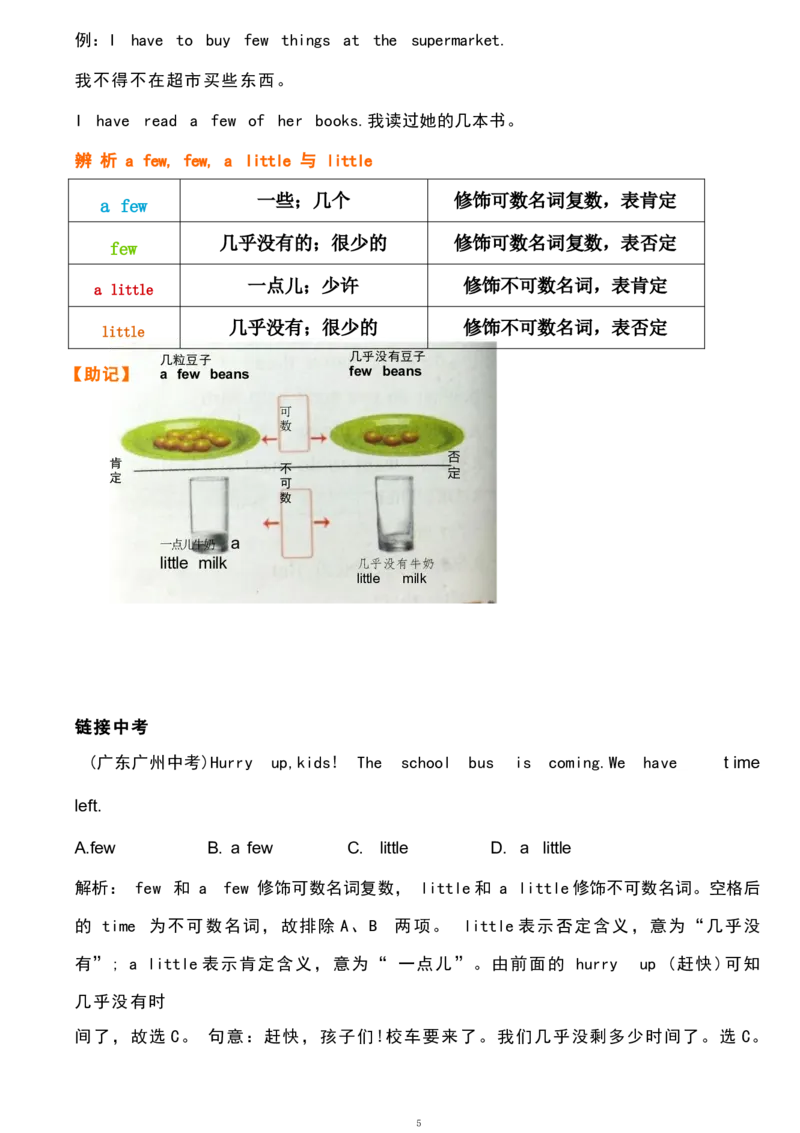
辨 析 a few, few, a little 与 little
一些;几个 修饰可数名词复数,表肯定
a few
几乎没有的;很少的 修饰可数名词复数,表否定
few
一点儿;少许 修饰不可数名词,表肯定
a little
几乎没有;很少的 修饰不可数名词,表否定
little
几粒豆子 几乎没有豆子
【助记】 a few beans few beans
可
数
否
肯
不
定 定
可
数
一点儿牛奶 a
little milk 几乎没有牛奶
little milk
链接中考
(广东广州中考)Hurry up,kids! The school bus is coming.We have t ime
left.
A.few B. a few C. little D. a little
解析: few 和 a few 修饰可数名词复数, little和 a little修饰不可数名词。空格后
的 time 为不可数名词,故排除 A、B 两项。 little 表示否定含义,意为“几乎没
有”; a little 表示肯定含义,意为“ 一点儿”。由前面的 hurry up (赶快)可知
几乎没有时
间了,故选 C。 句意:赶快,孩子们!校车要来了。我们几乎没剩多少时间了。选 C。
53. Could I at least finish watching this show?
我能至少看完这个节目吗?
要点精析
finish此处为及物动词,意为“完成”,其后跟名词、代词或动名词作宾语。
例:You can't go anywhere until you have finished your homework.
在完成家庭作业前你哪儿都不能去。
He finished reading the book before supper.晚饭前他把这本书看完了。
知识拓展
finish 与一样,在与动词连用时,只能用动名词形式作宾语的常见动词及短语有:
enjoy doing sth.喜爱做某事
practice doing sth.练习做某事
keep(on)doing sth.继续/一直做某事
mind doing sth.介意做某事
be busy doing sth.忙于做某事
have fun doing sth.高兴做某事
feel like doing sth.想要做某事
look forward to doing sth.盼望做某事
can't help doing sth.禁不住做某事
链接中考
(四川巴中中考) Mrs.Zhao went after she finished her work last
Monday.
A.shop; doing B.shopping; doing C.shopping; to do
解析:句意为“上周一完成工作后,赵夫人去购物了”。 go shopping “去购物”,
是固定短语; finish doing sth. “完成做某事”,是固定搭配。故选 B。
64. And she won't be happy if she sees this mess.
如果她看到这么乱,她会不高兴的。
要点精析
mess 名词,意为“杂乱,不整洁”。
make a mess 搞得一团糟(表动作);
in a mess 一团糟(表状态)。
例:The kids made a mess in the bedroom.孩子们把卧室搞得一团糟。
All the rooms are in a mess.所有的房间都杂乱不堪。
5.I threw down my bag and went to the living room.
我扔下我的书包,去了起居室。
要点精析
throw down 意为“扔下”。
其中 throw 既可用作及物动词,也可用作不及物动词,意为“扔;掷”。
其过去式为 threw, 过去分词为 thrown。
例:She threw down her book and went out.她扔下书就出去了。
Why did Betty throw down her bag? 贝蒂为什么把她的包扔下了?
知识拓展
含 throw 的其他常见短语有:
throw at 向……扔去(恶意,带攻击性)
throw to 扔给…… (不含恶意)
throw away 扔掉
6. The minute I sat down in front of the TV, my mom came over.
我刚在电视机前坐下,我妈妈就过来了。
要点精析 1
7the minute(that) 意为“一 ……就 ……”,引导时间状语从句,相当于 the
moment 或 as soon as。
例:Please call me up the minute you get there.请你一到那儿就给我打电话。
要点精析 2
in front of意为“在……的前面”。
例:A bike suddenly stopped in front of me.一辆自行车突然在我面前停下了。
There is a tree in front of my house.在我的房子前面有一棵树。
辨析: in front of 与 in the front of
in front of“在 …… 的前面”,是指在某物体外面的前面
in the front of“在 …… 的前部”,是指在某物体内部的前面
要点精析 3
come over为固定短语,意为“过来;来访,拜访”。
例:When did your family first come over to America?
你们一家第一次来美国是什么时候?
7.I'm just as tired as you are! 我和你一样累!
要点精析
as…as…意为“与 ……一样 ……”,用于同级比较。第一个 as 为副词,后接形容词或
副词原级;第二个as 为连词,引导比较状语从句。 as…as. 的否定形式为 not as…
so/as… 意为“不如……”。
例:My girl is as tall as yours.我女儿和你女儿一样高。
链接中考
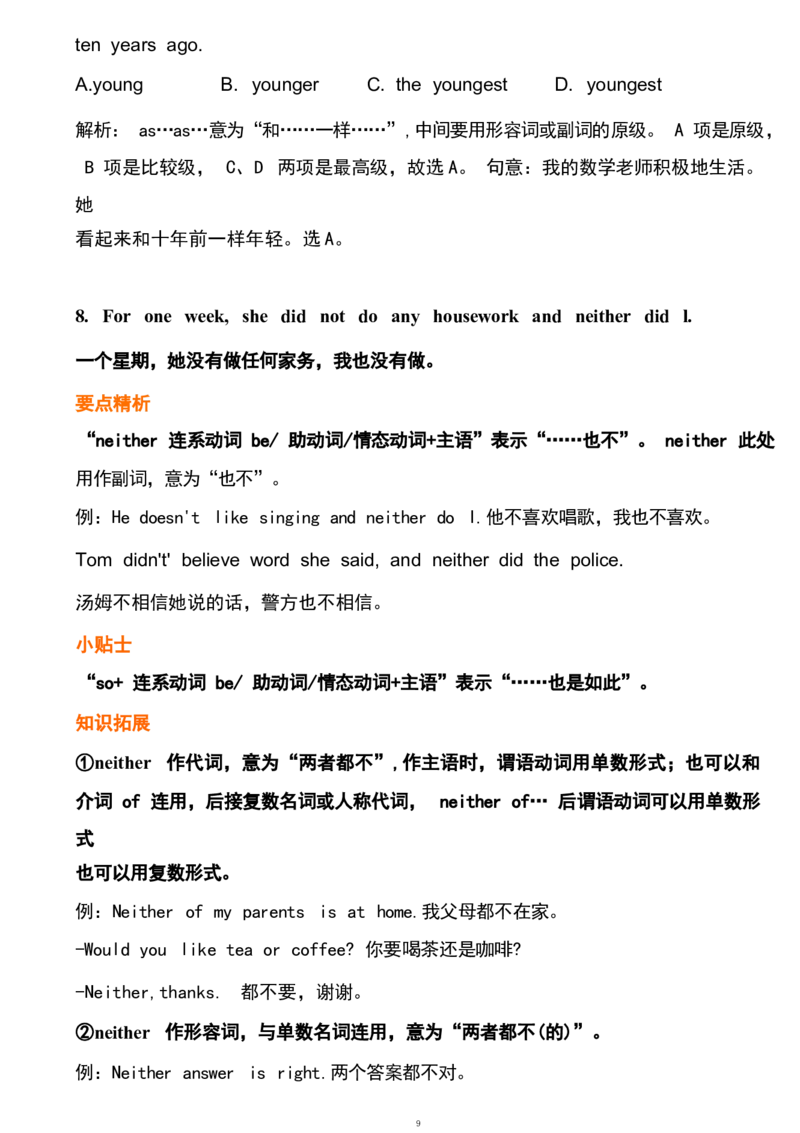
(重庆中考)My math teacher lives an active life.She looks as as she was
8ten years ago.
A.young B. younger C. the youngest D. youngest
解析: as…as…意为“和……一样……”,中间要用形容词或副词的原级。 A 项是原级,
B 项是比较级, C、D 两项是最高级,故选 A。 句意:我的数学老师积极地生活。
她
看起来和十年前一样年轻。选 A。
8. For one week, she did not do any housework and neither did l.
一个星期,她没有做任何家务,我也没有做。
要点精析
“neither 连系动词 be/ 助动词/情态动词+主语”表示“……也不”。 neither 此处
用作副词,意为“也不”。
例:He doesn't like singing and neither do I.他不喜欢唱歌,我也不喜欢。
Tom didn't' believe word she said, and neither did the police.
汤姆不相信她说的话,警方也不相信。
小贴士
“so+ 连系动词 be/ 助动词/情态动词+主语”表示“……也是如此”。
知识拓展
①neither 作代词,意为“两者都不”,作主语时,谓语动词用单数形式;也可以和
介词 of 连用,后接复数名词或人称代词, neither of… 后谓语动词可以用单数形
式
也可以用复数形式。
例:Neither of my parents is at home.我父母都不在家。
-Would you like tea or coffee? 你要喝茶还是咖啡?
-Neither,thanks. 都不要,谢谢。
②neither 作形容词,与单数名词连用,意为“两者都不(的)”。
例:Neither answer is right.两个答案都不对。
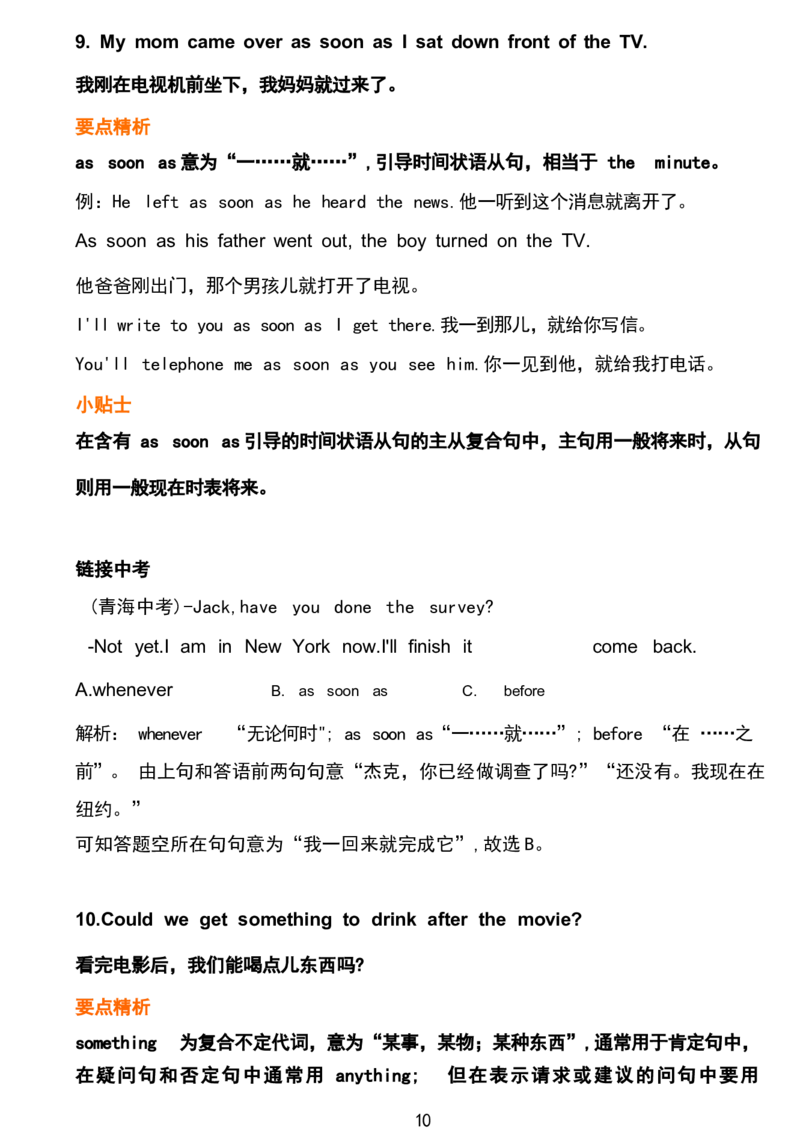
99. My mom came over as soon as I sat down front of the TV.
我刚在电视机前坐下,我妈妈就过来了。
要点精析
as soon as意为“一……就……”,引导时间状语从句,相当于 the minute。
例:He left as soon as he heard the news.他一听到这个消息就离开了。
As soon as his father went out, the boy turned on the TV.
他爸爸刚出门,那个男孩儿就打开了电视。
I'll write to you as soon as I get there.我一到那儿,就给你写信。
You'll telephone me as soon as you see him.你一见到他,就给我打电话。
小贴士
在含有 as soon as 引导的时间状语从句的主从复合句中,主句用一般将来时,从句
则用一般现在时表将来。
链接中考
(青海中考)-Jack,have you done the survey?
-Not yet.I am in New York now.I'll finish it come back.
A.whenever B. as soon as C. before
解析: whenever “无论何时"; as soon as“一……就……”; before “在 ……之
前”。 由上句和答语前两句句意“杰克,你已经做调查了吗?”“还没有。我现在在
纽约。”
可知答题空所在句句意为“我一回来就完成它”,故选 B。
10.Could we get something to drink after the movie?
看完电影后,我们能喝点儿东西吗?
要点精析
something 为复合不定代词,意为“某事,某物;某种东西”,通常用于肯定句中,
在疑问句和否定句中通常用 anything; 但在表示请求或建议的问句中要用
10something, 而不用 anything。
例:Would you like something to drink? 你要喝点儿什么吗?
Could you tell me something interesting? 你能告诉我某些有趣的事吗?
Is there anything important in today's newspaper?
今天报纸上有什么重要的事情吗?
There isn't anything in the box.盒子里没有东西。
知识拓展
①复合不定代词作主语时,被视为第三人称单数。
②常见的复合不定代词一览表:
something 某事 anything 任何 nothing 没有东 everything 每件事;
东 西 一
西 切
somebody 某人; anybody 任何人 nobody 没有人 everybody 人人;每
人
有人
someone 某人;有 anyone 任何人 no one 没有人 everyone 人人;每人
人
链接中考
(吉林长春中考) I bought for my mother on Mother's Day this year.
A. special anything B. anything special
C. special something D. something special
解析:something 通常用于肯定句, anything 通常用于疑问句和否定句,本句是
肯 定句,所以用不定代词 something, 排除 A 项与 B 项。形容词修饰不定代词
时,放
在不定代词后面,再排除 C 项。 something special 意为“特别的东西”,故选 D。
11.Could you please pass me the salt? 请你把盐递给我好吗?
11要点精析
pass 此处作及物动词,意为“给;递”。
pass sb.sth.= pass sth.to sb.,意为“递给某人某物;把某物递给某人”。
例:Please pass me pen.=Please pass pen to me.请递给我一支钢笔。
12. Could I borrow that book? 我能借那本书吗?
要点精析
borrow 及物动词,意为“借;借用”,常用短语: borrow sth.from sb.,意为“向
某人借某物”。其反义词为 lend。
例:Sam borrowed a car from his friend.萨姆向他的朋友借了一辆小汽车。
13. Could you lend me some money? 你能借给我一些钱吗?
要点精析
lend(lent,lent) 及物动词,意为“借给;借出”,
常用短语: lend sb.sth.或 lend sth.to sb.,意为“借给某人某物;把某物借给
某人”。其反义词为 borrow。
例:Ilent my bike to Frank yesterday.昨天我把我的自行车借给弗兰克了。
Could you lend me some books? 你可以借给我一些书吗?
辨析:lend,borrow 与 keep
“借给;借出”,非延续性动词。强调主语把自己的东西借出去,常用结
lend
构:lend sth. to sb.借给某人某物
“借入”,非延续性动词。强调以主语为中心,主语从别人那里把东西借
borrow
来供自己使用,常用结构:borrow sth.from sb.向某人借某物
keep “保持;保存”,延续性动词,常用结构:“keep sth.for+时间”保存
某物一段时间
12例:Tom lent his pen to his friend.汤姆把他的钢笔借给了他的朋友。
I borrow books from the library.我从图书馆借书。
You can keep the book for three days.你可以借这本书三天。
链接中考
(四川南充中考)-Excuse me,canl your pen?
-Sorry, I have it to Bob.
A.borrow; lent B. borrow; borrowed C.lend; borrowed D.lend; lent
解析:borrow “借入”; lend “借出”。由问句句意“打扰了,我可以借你的钢笔吗?”
及答语句意“对不起,我已经把它借给鲍勃了”可知 A 项符合题意,故选 A。
14. I hate to do chores.我讨厌做家务。
要点精析
hate 及物动词,意为“讨厌;厌恶”,表示一种感情或心理状态,不能用于进行时
态,其反义词为 love/like。 常用结构有:
①hate sb./sth.不喜欢(讨厌)某人/某物
例:I hate Monday mornings.我讨厌星期一的早晨。
②hate to do sth./ doing sth.厌恶/不愿做某事
例:I hate to trouble you.我不愿打扰你。
She hates traveling by air.她讨厌乘飞机旅行。
Section A 即学即试
根据句意及首字母或汉语提示完成句子
1. Could you help me f the clothes on the sofa, Jenny?
2.-What is Jane doing?
She's s the floor.
133.My eraser is there.Could you please p it to me?
4.Many children h history because they think it's very boring.
5.Just ( 扔 ) your bag down over there.
Section B 知识点精析
1. invite my friends to a party 邀请我的朋友们来参加聚会
要点精析
invite 为及物动词,意为“邀请”。
invite sb.to do sth.意为“邀请某人做某事”。
例:We invited all our friends.我们邀请了我们所有的朋友。
Kate invited me to go to the movies with her.凯特邀请我和她一起去看电影。
知识拓展
invite的名词形式为 invitation, 意为“邀请;请帖”。
例:Thank you for your kind invitation.谢谢你的盛情邀请。
2.I do not understand why some parents make their kids help with
housework and chores at home.
我不理解为什么一些父母让他们的孩子在家帮忙做家务。
要点精析
make their kids help with housework and chores是 make sb.do sth.结构,
此结构意为 “让/使某人做某事”。
例:This good news made her laugh happily.这个好消息使她开心地笑了。
3. Housework is a waste of their time. (做)家务是浪费他们的时间。
要点精析
a waste of..意为“浪费……”,其中 waste 是名词,意为“浪费;滥用”。
14例:Playing computer games is a waste of time.玩电脑游戏是浪费时间的。
知识拓展
waste 还可作动词,意为“浪费”。
例:Don't waste your money on clothes.别把你的钱浪费在衣服上。
4.They should spend their time on schoolwork in order to get good
grades and get into a good university.
为了取得好成绩,进入一所好大学,他们应该把他们的时间花在学业上。
要点精析 1
此处 spend(spent,spent) 作及物动词,意为“花费(时间、金钱)”。
例:She spent all her money.她花光了她所有的钱。
He spent much money on books.他花了许多钱买书。
辨析 spend,pay,cost 与 take
spend 指花费时间、金钱;主语为人。常用结构:Sb.spend(s) time/money on
sth. (或 doing sth.)
指支付、花费金钱;主语为人。常用结构:Sb. pay(s)(sb.) money (for
pay
sth.)
指花费金钱;主语为物。常用结构:Sth. cost(s)(sb.) money
cost
take 指花费时间。常用结构: It takes sb.some time to do sth.,it 为形式
主语
【歌诀巧记】
cost 和 pay 花金钱, take 只把时间费;
既花时间又花钱,花费能手 spend。
要点精析 2
15in order to 意为“目的是;为了”,后面接动词原形,位置可放在句首,也可
放在句中。否定结构为 in order not to do。
例:In order to look after his parents, he returned to work in his hometown.
为了照顾父母,他回到了家乡工作。
She started at five o'clock in order not to be late.为了不迟到,她五点就出发了。
辨辨析:in order to 与 in order that
后面接动词原形,表示目的
in order to
后面接从句,表示目的,从句中常含有情态动词
in order that
链接中考
(广东中考) In order for the meeting, my sister forced herself to get up
early this morning.
A. not to be late B. not being late C.to be late D. being late
解析: in order to do sth.为固定搭配,意为“为了做某事”,其否定式为 in
order not to do sth.,故排除 B、D 两项。由句意“为了开会不迟到,我姐姐今
天早上迫
使自己早早地起床了”可知, A 项符合题意。选 A。
5. It is the parents'job to provide a clean and comfortable environment
at home for their children.
在家里为孩子们提供一个干净而舒适的环境是父母的责任。
要点精析
provide 为及物动词,意为“提供;供给”。常用结构: provide sth. for sb.或
provide sb.with sth.,意为“为某人提供某物”或“提供给某人某物”。
例:We'll provide food and drinks for them.我们将向他们提供食物和饮料。
The company provided me with car.公司提供给我一辆小汽车。
166.I think it is important for children to learn how to do chores and
help their parents with housework.
认为对孩子们来说,学会如何做家务并帮助父母做家务是重要的。
要点精析
句型 “lt+be+ 形容词+for sb.to do sth.”意为“对某人来说做某事是……的”,
其中 it 是形式主语,真正的主语是后面的动词不定式(短语)。
例:It is useful for me to learn a foreign language.学一门外语对我来说是有用的。
知识拓展
用 for 与用 of 的区别:
①lt+be+ 形容词+ for sb.to do sth.意为“对某人来说做某事是……的”。形容词
是用来描述动词不定式的,此类形容词有: easy,hard, difficult, important。
②lt+be+ 形容词+ofsb.to do sth.意为“某人做某事是……”。形容词是用来描述
或说明人的品行的,此类形容词有: good,kind,nice,clever。
7.Children these days depend on their parents too much.
如今孩子们过于依赖他们的父母。
要点精析
depend on意为“依靠;依赖”。
例:The country depends heavily on its tourist trade.这个国家非常依赖旅游业。
You can't depend on your parents forever.你不能永远依赖你的父母。
知识拓展
lt all depends./That depends.意为“视情况而定”。
例:-Can you come to work tomorrow? 明天你能来上班吗?
-That depends.视情况而定。
8.Since they live in one house with their parents, they should know that
17everyone should do their part in keeping it clean and tidy.
既然他们与父母一起住在一所房子里,他们就应该知道每个人应该尽自己的一
份力保持房子干净和整洁。
要点精析
since 作连词,意为“由于;因为;既然”,引导原因状语从句。
例:Since we don't have money, we can't buy house.
由于我们没有钱,我们买不起房子。
知识拓展
since 作连词,还可意为“从 …… 以后;自 …… 以来”,引导时间状语从句。
例:It is two years since we visited your mother.
自从我们看望你母亲以来到现在有两年了。
He has worked in the company since he came to China.
自从他来中国以来,他就在这家公司工作。
链接中考
(安徽中考) Rick has learned a lot about Chinese culture he came
to
China.
A. before B. when C. until D. since
解析 before”……之前”;when” 当 …… 的时候";until”直到…… "; since “自
……
以来”。主句用现在完成时,通常与 since 引导的时间状语从句连用。故选 D。
9. As a result, he often fell ill and his grades dropped.
因此他经常生病,并且成绩下降。
要点精析 1
as a result为习惯用语,意为“结果;因此”,后面跟逗号,和表示结果的句子。
18例:As a result, we had to change our plan.结果,我们不得不改变了计划。
18He didn't work hard.As result, he failed his exam.
他学习不用功,结果他考试不及格。
知识拓展
as a result of. 意为“由于 …… ;作为 ……的结果”,后面常跟名词、代词,相当
于 because of。
例:He was late as result of snow.由于下雪,他迟到了。
As a result of the pilots' strike, all flights had to be cancelled.
由于飞行员罢工,所有的航班都不得不取消了。
要点精析 2
此处fall(fell,fallen) 为连系动词,意为“进入某种状态;变成”。
例:He was so tired that he fell asleep quickly.他是那么累以至于很快就睡着了。
Finally he fell silent.最后他安静了下来。
辨析: fall ill与 be ill
“生病”,指一时的动作,后面不能接一段时间
fall ill
“生病”,指生病的状态,后面可以接一段时间
be ill
例:Ifell ill that day and decided to stay at home.我那天生病了,决定待在家里。
He has been ill for three days.他生病三天了。
要点精析 3
此处drop 为不及物动词,意为“下降;降落”; drop 还可作及物动词。
例:The temperature will drop later.稍后温度会下降。
Apples are beginning to drop from the trees.苹果开始从树上落下来。
You might be able to get them to drop the price.
你也许能够让他们把价格降下来。
19辨析:drop 与 fall
drop “下降;降落”,常作不及物动词,也可作及物动词;指物体由于
重力从高处往下落
“下降;落下”,只作不及物动词;指物体由于不明原因或物体本
fall
身失去平衡而向下降落,有自然下落的意思
例:He dropped the cup.他把杯子弄掉了。
Leaves fall in autumn.秋天树叶落下。
10.The earlier kids learn to be independent, the better it is for their
future. 孩子们越早学会独立,对他们的未来就越好。
要点精析
the earlier.,the better. 意为“越早……, ……越好”,其结构为 “the+ 比较
级, the+ 比较级”,意为“越……,就越……”。
例:The more friends you have, the happier you'll be.
你拥有朋友越多,你就会越快乐。
The more,the better.越多越好。
链接中考
(黑龙江哈尔滨中考) Boys and girls, believe in yourselves.The you are,
the better grades you'll get.
A. more careful B.more carefully C. most carefully
解析:结合选项可知此句句意为“孩子们,相信自己。你们越是细心,就会取得
越 好的成绩"。 ”the+ 比较级, the+ 比较级”为固定句式,意为“越……,就
越…… ":
又因空格后出现了连系动词 are, 空格处应填形容词的比较级,故选 A。
20Section B 即学即试
单项选择
1. (江苏连云港中考) A lot of famous doctors gathered in Harbin save
"China's most beautiful teacher" Ms.Zhang Lili.
A. so that B. in order to C. in order that D. as a result
2. (四川泸州中考)-Your coat is so beautiful. It must be expensive.
-Not really. I only ¥30 on it.
A.cost B. spent C. paid D. took
3 . (安徽中考) To protect the environment,supermarkets don't free
plastic bags for shoppers.
A. take B. show C. provide D. carry
4. (浙江湖州中考)-Shall we go for picnic tomorrow?
-Well, it all the weather.
A.belongs to B. happens to C. depends on D. concentrates on
5. (四川自贡中考)You should keep the window because the room is too
hot.
A. open B.opening C.opened即学即试参考答案与解析
Section A
1. fold 2. sweeping 3. pass 4. hate 5. throw
Section B
1.B so that “以便”,后接从句; in order to “为了 …… “,后接动词原形; in
order that “为了 …… ”后接从句; as result “结果”,常独立作状语。由空格后
的动词原
形 save 可知选 B。
2.B 表示“买某物花了多少钱”可以用“人+ spend(s)+ 钱 +on+ 物”,“人+pay
(s)+ 钱 +for+ 物”或“物+cost(s)+ 钱”。故由句子结构可知选 B。
3.Ctake 带 走 ;show 给 ……看; provide 提 供 ;carry 拿,搬。句意:为了保护环
境,超市不提供免费的塑料袋给购物者。故选 C。
4.C 句意:“我们明天去野餐怎么样?”“嗯,这完全要视天气情况而定。”belong to
“属于”; happen to“(某人)发生 … … ,碰巧”; depend on “依靠,依赖,取决
于”; concentrate on “集中精力于”。故选C。
5. “keep+ 宾语+形容词(作宾语补足语)”为固定结构,意为“使某事物处于某状
态”。故选A, 此 处open 作形容词,意为“开着的”。