初中英语全部时态
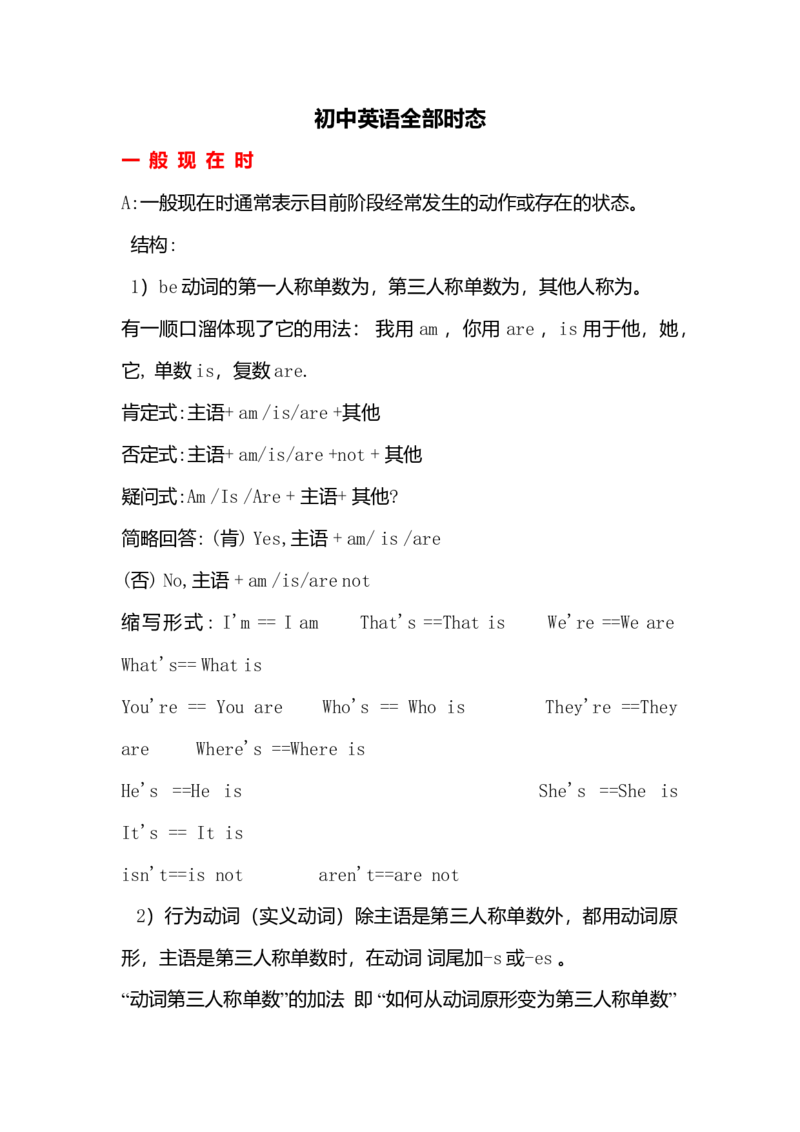
一 般 现 在 时
A:一般现在时通常表示目前阶段经常发生的动作或存在的状态。
结构:
1)be动词的第一人称单数为,第三人称单数为,其他人称为。
有一顺口溜体现了它的用法: 我用 am ,你用 are ,is 用于他,她,
它, 单数is,复数are.
肯定式:主语+ am /is/are +其他
否定式:主语+ am/is/are +not + 其他
疑问式:Am /Is /Are + 主语+ 其他?
简略回答: (肯) Yes,主语 + am/ is /are
(否) No,主语 + am /is/are not
缩写形式: I'm == I am That's ==That is We're ==We are
What's== What is
You're == You are Who's == Who is They're ==They
are Where's ==Where is
He's ==He is She's ==She is
It's == It is
isn't==is not aren't==are not
2)行为动词(实义动词)除主语是第三人称单数外,都用动词原
形,主语是第三人称单数时,在动词 词尾加-s或-es 。
“动词第三人称单数”的加法 即 “如何从动词原形变为第三人称单数”1、一般情况加 s. 2、以o, s, x, ch, sh 结尾加es. 3、以“辅音
字母+y”结尾 改y为i +es
写出下列动词的第三人称单数:
study play go come help
teach lie listen begin open
sit throw wash
guess cut run relax
beat eat
肯定式:主语+动词原形/动词的第三人称单数
否定式:主语+助动词 don't/doesn't +动词原形+其他
疑问式:Do/Does+主语+动词原形+其他
简略回答:(肯)Yes,主语+do/does (否)No,主语+do/does not
缩写形式: don't == do not doesn't ==does not
注意:have的第三人称单数为has
用法:
1.表示事实,现状,性质或经常的,习惯的动作,常与often, usually,
always, sometimes, today,every day,once a week, every five
minutes, on Sundays等时间状语连用,
eg. He has a brother.
2.表示普遍真理. eg. The earth goes round the sun.
3.表示在现在时间里所发生的一个动作 .
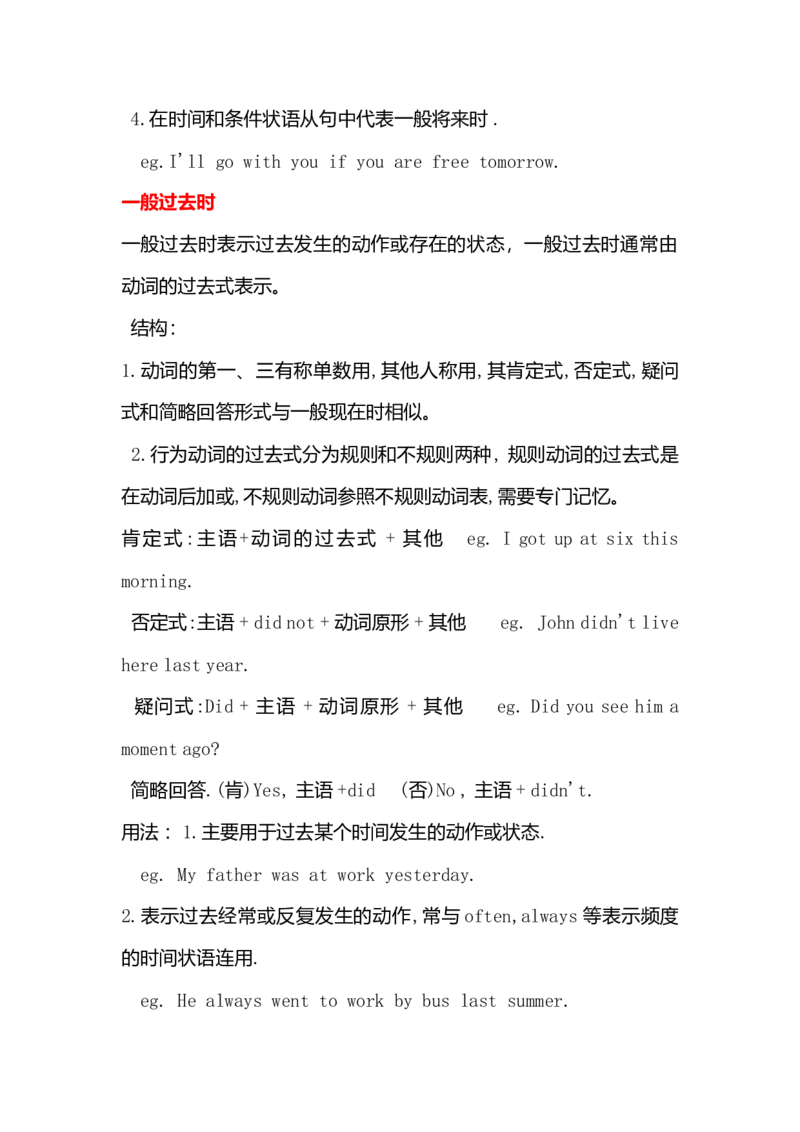
eg. Here comes the train.4.在时间和条件状语从句中代表一般将来时 .
eg.I'll go with you if you are free tomorrow.
一般过去时
一般过去时表示过去发生的动作或存在的状态,一般过去时通常由
动词的过去式表示。
结构:
1.动词的第一、三有称单数用,其他人称用,其肯定式,否定式,疑问
式和简略回答形式与一般现在时相似。
2.行为动词的过去式分为规则和不规则两种, 规则动词的过去式是
在动词后加或,不规则动词参照不规则动词表,需要专门记忆。
肯定式:主语+动词的过去式 + 其他 eg. I got up at six this
morning.
否定式:主语 + did not + 动词原形 + 其他 eg. John didn't live
here last year.
疑问式:Did + 主语 + 动词原形 + 其他 eg. Did you see him a
moment ago?
简略回答.(肯)Yes, 主语 +did (否)No , 主语 + didn't.
用法 :1.主要用于过去某个时间发生的动作或状态.
eg. My father was at work yesterday.
2.表示过去经常或反复发生的动作,常与 often,always 等表示频度
的时间状语连用.
eg. He always went to work by bus last summer.3.和when等连词引导的状语从句连用.
eg. When she reached home, she had a short rest.
4.常与表示过去的时间状语, 如… ago, yesterday, last week, in
the old days, when I was five years old, in 1995 等连用.eg.They
began the work two months ago. Were you born in 1981? Yes,
I was.
不规则中寻"规则"
英语中很多动词的过去式是不规则的,有些同学死记硬背,却效果
不佳。我们不妨共同寻找一些不规则动词中的“规则”,这样记忆起
来就会事半功倍了。
I. 过去式与动词原形同形。例如:
let—let, put—put, hit—hit, read—read[red]等。
II.动词原形以ow/aw结尾,过去式常变为ew。例如:
know—knew, grow—grew, throw—threw, draw—drew等。但是也
有一些例外,例如:show—showed。
III.许多动词只要将动词原形中的元音字母 i 改为 a,就可变为过
去式。例如:
begin—began, give—gave, sing—sang, swim—swam, sit—sat,
drink—drank, ring—rang等
但是win—won例外。
IV.有些动词的过去式以o(a)ught结尾。例如:
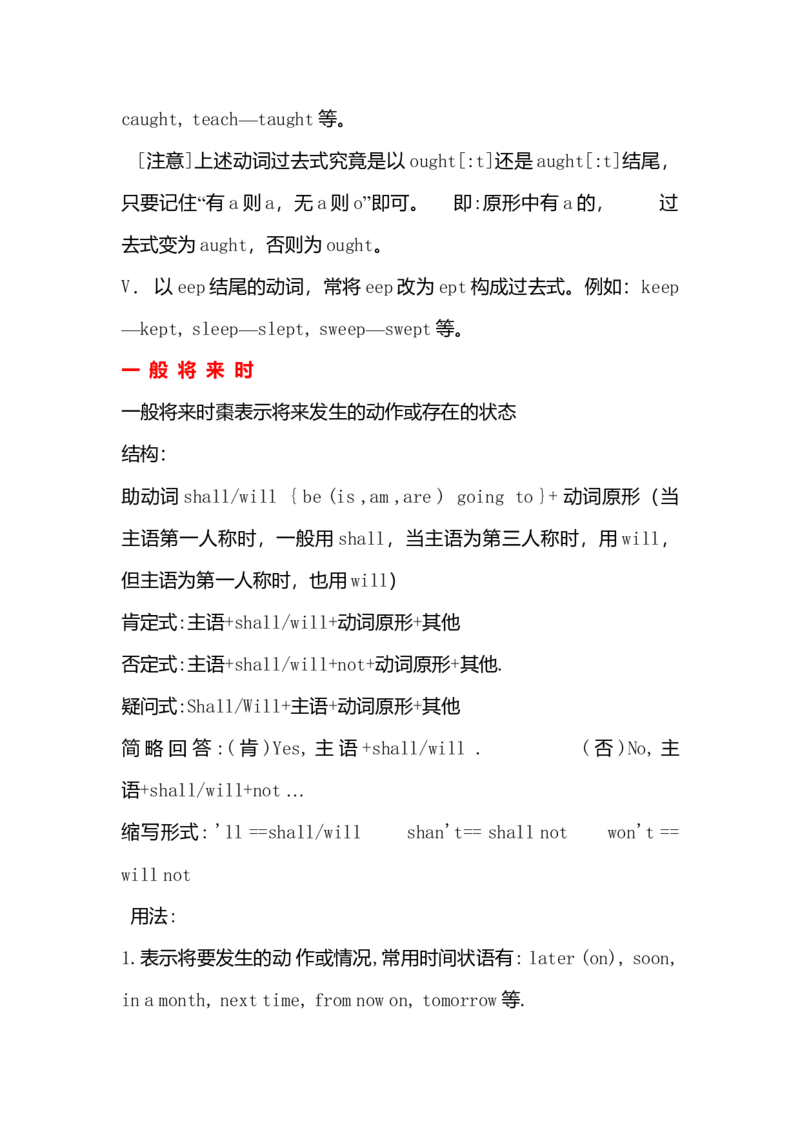
bring— brought, buy— bought, think— thought, catch—caught, teach—taught等。
[注意]上述动词过去式究竟是以 ought[:t]还是 aught[:t]结尾,
只要记住“有 a则a,无 a则o”即可。 即:原形中有 a的, 过
去式变为aught,否则为ought。
V. 以eep结尾的动词,常将 eep改为ept构成过去式。例如:keep
—kept, sleep—slept, sweep—swept等。
一 般 将 来 时
一般将来时棗表示将来发生的动作或存在的状态
结构:
助动词 shall/will { be (is ,am ,are ) going to }+ 动词原形(当
主语第一人称时,一般用 shall,当主语为第三人称时,用 will,
但主语为第一人称时,也用will)
肯定式:主语+shall/will+动词原形+其他
否定式:主语+shall/will+not+动词原形+其他.
疑问式:Shall/Will+主语+动词原形+其他
简 略 回 答 :( 肯 )Yes, 主 语 +shall/will . ( 否 )No, 主
语+shall/will+not …
缩写形式: 'll ==shall/will shan't== shall not won't ==
will not
用法:
1.表示将要发生的动 作或情况,常用时间状语有: later (on), soon,
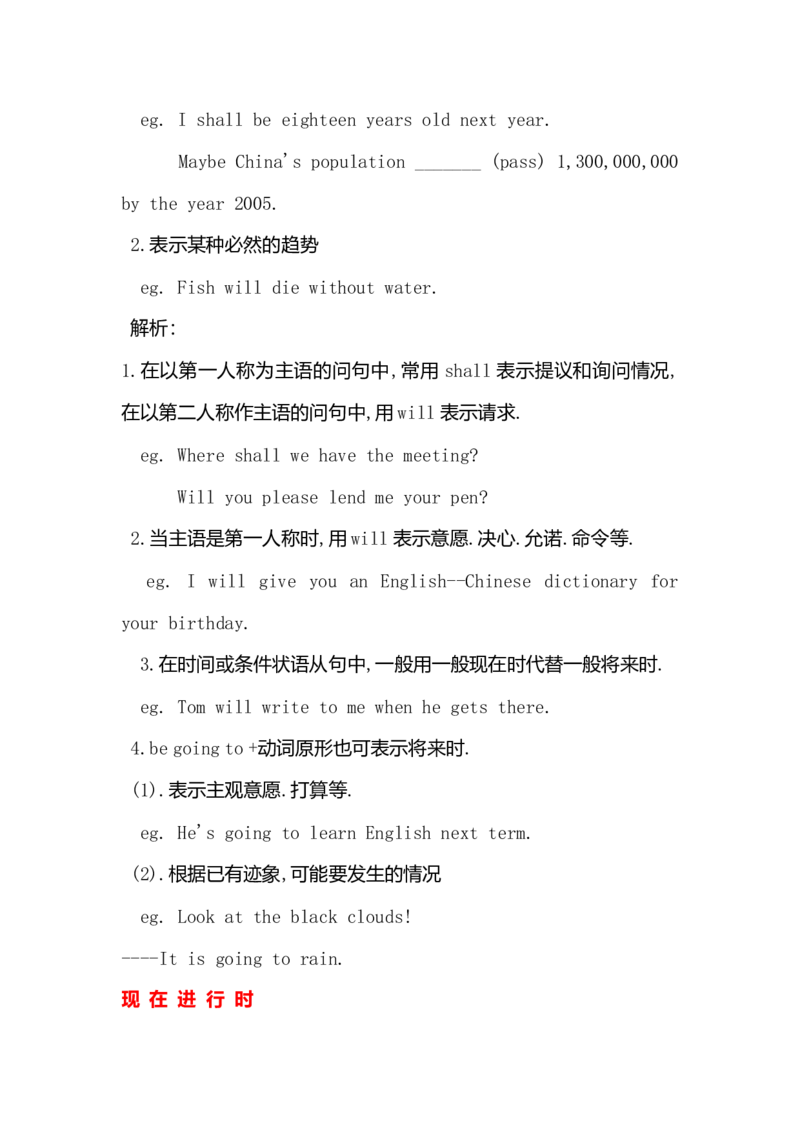
in a month, next time, from now on, tomorrow等.eg. I shall be eighteen years old next year.
Maybe China's population _______ (pass) 1,300,000,000
by the year 2005.
2.表示某种必然的趋势
eg. Fish will die without water.
解析:
1.在以第一人称为主语的问句中,常用 shall 表示提议和询问情况,
在以第二人称作主语的问句中,用will 表示请求.
eg. Where shall we have the meeting?
Will you please lend me your pen?
2.当主语是第一人称时,用will 表示意愿.决心.允诺.命令等.
eg. I will give you an English--Chinese dictionary for
your birthday.
3.在时间或条件状语从句中,一般用一般现在时代替一般将来时.
eg. Tom will write to me when he gets there.
4.be going to +动词原形也可表示将来时.
(1).表示主观意愿.打算等.
eg. He's going to learn English next term.
(2).根据已有迹象,可能要发生的情况
eg. Look at the black clouds!
----It is going to rain.
现 在 进 行 时现在进行时棗表示目前或目前阶段正在进行的动作。( 表示“……正
在(在)干……”)
结构:
is/am/are + 动词的-ing形式 ( 动词的现在分词 )
用法:
1.表示目前发生(进行)的动作(不指状态),常用时间状语有:now, at
the moment 等,并常出现在祈使句的句子中,与 look, listen连用.
eg. Are you writing a letter to your father at the
moment?
Listen! She is singing in the next room.
2.表示目前阶段正在进行,而此刻不一定在进行的动作.
eg. They are planting trees these days.3.表示按计划或安排即将进行的动作,表示这种动作的动词有:come,
go, leave, arrive, start, see等,并常与表示将来时间的状语连用.
eg. They are leaving for Australia tomorrow afternoon.
注意: 某些表示感觉或状态的动词,如 love, like, prefer, hate,
see, know等一般不用现在进行时.
eg. Lucy prefers art to science.
练习题:(选择填空)
一. 般现在时.
( )1.My English teacher about thirty years old, but
he younger than he really is.A. is, look B .is, looks C.
am, look
( )2.Jim very hard, but he till a little
weak in Chinese.
A. studies, is B. study, is C.
doesn’t study, is
( )3.We all know that the sun round the earth.
A. goes B. don’t go C.
doesn’t go
( )4.There twelve months in a year and January
first.
A. is, comes B. are, come C.
are, comes
( )5.Who the kite best of all, Jim. Lucy or Lily?
A .flies B. fly
C .are flying
( )6. the Great Wall one of the places of great
interests in China? A.Was B. Do
C. Is
( )7. you usually to school with
classmates?
A. Do, comes B. does, come C.Do, come
( )8. she home at six o’clock every
mornig?
A. Do, comes B. Does. Come C.
Do, come
( )9. My mother like watcing TV,so she to
bed very early every evening.
A. doesn’t ,go B. don’t go C. doesn’t goes
( )10.Mr Green usually newspapers after supper
every day.
A. read B. reading C. reads
二. 一般过去式.
( )1.The two in the same class last year.
A. are B. was C. were
( )2.---Where you ?
----I went to buy some food for supper.
( )3.The students in Li Lei’s class on a farm last
week.
A. work B. works C. worked
( )4. that worker in a shoe factory a year
ago?A. Do, work B.Did, worked C. Did,
work
( )5.---Did you find your pen ?
----Yes, I it two hours ago.
A. found B. find C. finded
( )6. your mother to work last Saturday?
A. Did, go B. Do, go C. Does,
go
( )7.They not late the day before yesterday.
A. did B. were C. are
( )8. they away from school last October?
A. Did B. Were C. Do
( )9. you to school last Sunday?
A. Did, come B. Do, come C. Were,
come
( )10.What they for breakfast last week?
A. were, have B. did, have C.
will, have
( )11.My friend his homework fifteen minutes ago.
A. finish B. finishes C.
finished
( )12.The boys only subjects last term, but this termthey five.
A. have, have B. had, had C. had,
have
( )13.Why Ann TV last night ?
A. didn’t, watch B. don’t watch C.
doesn’t watch
( )14.They stopped here because they the way to
the station.
A. didn’t know B. don’t know C.
will know
( )15---Where you find your ticket?
----I it on the ground.
A. did, found B. do, found C.
were, find
三. 现在进行时.
( )1.Can’t you see Uncle Wang and his friends some
machines?
A. is makig B. are making
C.make
( )2.My father TV with my mother now.
A. watch B. watching C. is
watching( ) 3.I’ s six o’ clock in the evening, My family
supper at the table.
A. eats B. is eating C.
are eating
( )4. Lucy and Lily to speak Chinese with Miss
Gao.
A. Is, try B. Is trying
C. Are, trying
( )5.The dog itself outside the door.
A. is washing B. wash C.
washes
( )6.The students in Class One carefully to their
English teacher.
A. is listening B. is looking
C. are listening
( )7.Listen! The children in the open air.
A. singing B. is singing
C. are singing
( )8.What’s the matter, Li Lei? I for my pen.
A. am look B. am looking
C. look
( )9.Let’s go into the classroom. The bell .A. ringing B. is ringing
C. is ring
( )10.The man is badly hurt and he on the road sadly.
A. is lying B. are lying
C. lieing
四. 一般将来时.
( )1.The students back in two hours.
A. come B. is coming C.
came
( )2.What you with your classmates this Sunday
afternoon?
A. are, do B.do, do
C. will do
( )3.There an English party in our class this
evening.
A. will have B. are going to have
.C. is going to be
( )4. Wei Hua visit the Great Wall during this
summer holiday?
A.Do, going to B. Is, going to
C. Will, going to
( )5.When they leave for Beijing?A. will, going .B. will, /
C. do, going to
( )6.---Where are you going ?
---I the shops for some fruit.
A. am going to B. go to C.
shall going to go to
( )7.Which oranges they to buy?
A. are, going B. will, going
C.do, going
( )8.My mother says that she buy me a schoolbag
better than this one.
A. is B. shall C.
will
( )9.Mr Green is afraid that Jim behind the other
students after he comes back.
A. will fall B. will fell
C.is going to fell
( )10.The students in my class harder than before this
term.
A. is going to study B. will going to study
C. will study
现在完成时现在完成时的结构: 主语 + “have(has) + 过去分词”
(1)现在完成时用来表示对目前状况仍有影响的,刚刚完成的动作
(常与yet,already,just连用),或者过去某一时刻发生的,持
续到现在的情况(常与for,since连用)。例如:
1)I have just finished my homework.
2)Mary has been ill for three days.
注意:与 for ,since 连用的动词必须用延续性动词,而不能用短暂
性动词如:come —be here go ——be there join—— be a
member borrow ——keep leave ——be away 等等
(2)常与现在完成时连用的时间状语有:since, for, during,
over 等 引 导 出 的 短 语 ; 副 词 already, yet, just, ever, now,
before, often, lately, recently 等 ; 状 语 词 组 this week
(morning, month, year), so far, up to now, many times, up to the
present等。例如:
1)I haven’t been there for five years.
2)So far, she hasn’t enjoyed the summer vacation.
3)There have been a lot of changes since 1978.
◆◇一般过去时和现在完成时的比较与转换
一般过去时:
与之搭配的时间副词常用的有:Yesterday, last week, last year,
at 5:30 , last weekend, last month. 有时用 on weekend, this
morning现 在 完 成 时 : 常 用 的 时 间 副 词 有 :ever, never, yet, still,
already , in the past ten years; in my life; today
Examples:
Linda still hasn’t finished her homework.
Stanley has already gotten bored with the life here in
Toronto.
Have you ever gone to Paris?
I have gone to the post office twice today.
2、 过去完成时
(1)表示过去某时间前已经发生的动作或情况,这个过去的时间可
以用by,before等介词短语或一个时间状语从句来表示;或者表示
一个动作在另一个过去动作之前已经完成。{ 表示“过去的过去 ”} 例
如:
1)We had just had our breakfast when Tom came in.
2)By the end of last year they had turned out 5, 000 bicycles.
(3)过去完成时常用于以下固定句型:
1)by (the end of ) +过去时间,主句中谓语动词用过去完成时。例
如:
The experiment had been finished by 4 o’clock
yesterday afternoon.
八种时态的比较
一般现在时和现在进行时a.一般现在时:重复发生的习惯性动作和真理。 标志性的时间副词:
always often frequently usually sometimes every day every
week every month occasionally once a month once a month once
a year seldom rarely never
Examples: She goes shopping every week.
He reads Business News every morning.
He seldom goes dancing.
The sun rises in the east and sets in the west.
Susan loves chocolate.
b.表示一种状态或性质
Examples: This tastes very good. I don’t believe
my eyes.
I need a car. I hate this
music.
c.在讲述一个过去发生的故事时,有时可用一般现在时表示过去发
生的一系列事情。-This use is called the “historical present”.
如在看图说话一类题时经常用到这一点。 b>
Examples: h
一个美国人描述他到中国旅游的经历
My friend and I arrive at the capital air port in
Beijing on the morning of May 25 th , 1993. Robert comes to
meet with us in a taxi, and we drive to what is to be ourapartment for nearly three. week. The drive is culture
shock number one. We see people everywhere. Also, Beijing
seems to be more modern than its has been written in all
the books on China I have read. My friend and I are
extremely astonished by the number of bicycles on the road,
truly the kingdom of bicycles.
现在进行时:
a.正在进行的动作
常用的时间状语:(right)now at the(this)moment at
present ;,?|Lm
Examples:
Robert is teaching at this moment。
Mendel is working on the first draft of his essay。
I’m looking for my umbrella right now.
He’s enjoying a holiday right now.
b.表达在现在一段时间内重复发生的动作,但是动作在说话时不一
定正在进行。
常 用 的 时 间 副 词 : these days Nowadays today this
semester/quarter this week/month/year
Examples:
He’s relaxing this week.
He’s working as a librarian this semester.c.对一类经常发生的事情所表达的强烈情感
常用的时间副词:Always Forever constantly
Examples:
He’s always complaining.(他怎么总是抱怨。)
You’re always dancing.(你怎么总是跳舞,是不是太多了吧。)
◆◇一般现在时和现在完成时
一般现在时:
表达的动作不表明动作从何时开始或已进行了多长时间。
Examples: Helen and Tom are happily married.
Bruce listens to the news every morning.
现在完成时:
a.现在完成时所表达的动作正在进行,但句子总是表明动作是什么时
候开始的。
Examples:
Helen and Tom have been happily married since their wedding
day 60 years ago.
Bruce has listened to the news all his life without missing
a day.
b.与现在完成时常用的两个词: For and Since
For:表示动作持续的一段时间。如:for two minutes/weeks/years;
for several days/a long time/the past month 而在一般现在时不能
与之连用。Since: 表示动作从何时开始时间点. 如:since 6:00/Apr. 23/last
week /the accident
◆◇现在进行时和现在完成时
现在进行时:
表示一个正在进行的动作,但不表明动作从什么时候开始的。
Examples:
He is waiting over there.
Matthew is studying Chinese in Beijing.
现在完成时:可表明发生动作的具体数字和次数。
Examples:
He has tried to pass the exam twice.
◆◇一般过去时和过去进行时
a.二者的区别在于一般过去进行时表示在过去某个特定时间正在进
行的动作。
Examples:
My brother was sleeping at 2:00 yesterday afternoon.
My neighbor’s dog was barking at 3:00 this morning.
b.二者的区别在于一般过去进行时表示在过去同一时间两个同时进
行的动作。
与之常用的时间副词: while, as
Examples;
Robert was moving the lawn while Susan was fixing the car.As Michael was visiting Paris, Robert was teaching English
classes in Beijing.
◆◇一般过去时和过去将来时
二者的区别在于过去将来时表示在过去打算做,但是没有做的动作.
而一般过去时表示为什么没有做的原因。
Examples:
I was going to become a rock star but I didn’t know the
right people in the music business.
◆◇一般过去时和过去完成时
二者的区别在于过去完成时表示在过去的过去所发生的动作。
Examples:
Mary was hungry because she hadn’t eaten breakfast.
Charlie lost his way to the hotel although he had been
there a few days earlier.
I realized that I hadn’t eaten a single French Fry since
I started my diet.
◆◇一般现在时和一般将来时 -
一般现在时在时间和条件从句当中表示将来时的动作。
Examples:
As soon as I save enough money I’ll buy a big house.
When he gets back home he will phone a friend in New York.
If it rains tomorrow we will cancel the camping trip.◆◇过去进行时 { be (was,were)+ 现在分词 }
动词的时态和语态
试题与解析
( )1.He stepped into the office, _____ down and began to
fill in the forms.
A. sitting B. to sit C. sat D. having it
( )2.She said she would telephone but we _____from her so
far.
A. haven’t heard B. didn’t hear C. hadn’t
heard D. won’t hear
( ) 3.When I got to the cinema, the film ____for ten
minutes.
A. has begun B. had begun C. had been on D. was
( )4.I’ll go with you as soon as I____ my homework.
A. will finish B. finish C. am finishing D.
finished
( )5.If it _____tomorrow, I won’t go to the cinema.
A. will rain B. rains C. is raining D. rained
( )6.She is going to be a nurse when she up.
A. is going to grow B. grows C. growing D.
grew
( )7. 下列四句是“这本书我已经买了三个月了。”的英译文,哪一种不对?
A. I have had this book for three months.
B. I have bought this book for three months.
C. I bought this book three months ago.
D. It is three months since I bought this book.
( )8.——Come in, Peter, I want to show you something.
——Oh, how nice of you! I_____ you _____ to bring me a
gift.
A. never think; are going B. never thought; were
going
C. didn’t think; were going D. had’t thought; were
going
( )9.When I was at college I_____ three foreign languages,
but I_____ all except for a few words of each.
A. spoke; had forgotten B. spoke; have forgotten
C. had spoken; had forgotten D. had spoken; have
forgotten
( ) 10.The police found that the house_____and a lot of
things____.
A. has broken into; has been stolen B. had broken
into; had been stolen
C. has been broken into;stolen D. had been brokeninto; stolen
( )11.The volleyball macth will be put off if it____.
A. will rain B. rains C. rained D. is raining
( )12.Mary_____a dress when she cut her finger.
A. made B. is making C. was making D. makes
( )13.The students_____ busily when Miss Brown went to get a
book she_____ in the office.
A. had writen; left B.were writing; has left
C. had written; had left D. were writing; had left
( )14.——Have you moved into the new house?
——No yet, the rooms_____,
A. are being painted B. are painting
C. are painted D. are being painting
( )15.——We haven’t heard from Jane for a long time.
——What do you suppose____to her?
A. was happening B. to happen C. has happened D.
having happened
( )16.——Do you know our town at all?
——No, this is the first time I _____here.
A. was B. have been C. came D. am coming
( )17.——We could have walked ot the station.It was so
near.——Yes, A taxi _____ at all necessary.
A. wasn’t B. hadn’t been C. wouldn’t be D. won’t
be
( )18.If city noises_____ from increasing, people____
_shout to be heard even at the dinner table 20 years from now.
A. are not kept;will have to B.are not kept; have to
C. do not keep;will have to D.do not keep; have to
( )19.Tom_____into the house when no one_____.
A. slipped; was looking B. had slipped; looked
C. slipped; had looked D. was slippping; looked
( ) 20.The last time I_____ Jane she____ cotton in the
fields.
A.had seen; was picking B. saw; picking
C.had seen; picked D. saw; was picking
( ) 21.We were all surprised when he made it clear that
he_____ office soon.
A. leaves B .woulds leave C. left D. had left
( )22.In some parts of the world, tea with milk and
sugar.
A. is serving B. is served C. serves D.served
( )23.The pen I____I ____is on my desk, right under my nose.
A. think; lost B. thought; had lost C. think; hadlost D. thought; have lost
( )24.——How long ____ each other before they____ married?
——For about a year.
A. have they known; get B. did they know; were going
to get
C. do they know; are going to get D. had they known;
got
( )25.My dictionary _____. I have looked for it everywhere
but still ____it.
A. has lost; don’t find B. is missing;
don’t find
C. has lost; haven’t found D. is missing;
haven’t found
( )26.——Can I join the club, Dad ?
——You can when you ____ a bit older.
A. get B. will get C. are getting D. will
have got
( )27.—— I’m sorry to keep you waiting.
—— Oh, not at all . I____ here only a few minutes.
A. have been B. had been C. was D. will be
( )28.——Do you like the material(材料)?
——Yes, it_____ very soft.A. is feeling B. felt C. feels D. is felt
( )29.I don’t really work here. I____ until the new
secretary arrives.
A. just help out B. have just helped out
C. am just helping out D. is completed
( )30.I need one more stamp before my collection_____.
A. has completed B. completes
C. has been completed D. is completed
( )31.——Your phone number again? I____ quite catch it.
——It’s 9568442.
A. didn’t B. couldn’t C. don’t D. can’t
( )32 .—— _____the sports meet might be put off.
—— Yes, it all depends on the weather.
A. I’ve been told B. I’ve told C. I’m told
D. I told
( )33.As she ____the newspaper, Granny ____ asleep.
A. read; was falling B. was reading; fell
C. was reading; was falling D. read; fell
( )34.You don’t need to describe her, I____ her several
times.
A. had met B. have met C. met D. meet
( )35.I don’t think Jim saw me; He ____ into space.A. just stared B. was just staring C. has just
stared D. had just stared
( )36. ——____my glasses?
——____ Yes, I saw them on your bed a minute ago.
A. Do you see B. Had you seen C. Would you see D.
have you seen
( )37. Helen ____ her keys in the office so she had to wait
until her husband ____ home.
A. has left ;comes B. left; had come C. had left; came
D. had left; would come
( )38. I first met Lisa three years ago. She ____at a radio
shop at the time.
A. has worked B. was working C. has been working D.
has worked
( )39. ——Who is Jerry Cooper?
— — _____? I saw you shaking hands with him at the
meeting.
A. Don’t you meet him yet B. Hadn’t you meet him
yet
C. Didn't’ you meet him yet D. Haven’t you met him
yet
( )40.—— Alice, why didn’t you come yesterday?——I____ , but I had an unexpected visitor.
A. had B. would C. was going to D. did
( )41.The Chinese Communist Party _____ in Shanghai in
1921.
A. was found B. found C. was founded D. founded
( )42.Great changes______ in my home town since liberation.
A. have been taken place B. took place
C. have taken place D. were taken place
( ) 43.The water will be further polluted unless some
measures_____.
A. will be taken B. are taken C. were taken D. had
been taken
( )44. He’ll be an astronaut by the time he _____ thirty.
A. is B. had been C. will be D. is
going to be
( )45.The____look on his face suggested that he____ that.
A. surprising; hadn’t expected B. surprised; hadn’t
expected
C.surprising; would expect D. surprised;
shouldn’t expect
【试题解析】
选C。该句的含义是“他走进办公室,坐下来然后开始填表”。根据前面的 stepped into the office 后面的 began to fill in the forms 这
两个动作能够推断出,sat 与他们是一个主语发出的三个并列动作,
故形式应一致,也用一般过去式。
选A。
选 C。在这个时间状语从句中,主句谓语动词的动作发生在从句谓
语动作之前,即“电影开演了十分钟”在“到达电影院”之前,故主句
谓语动词应该用过去完成时,又因为 begin 这个动作无法延续,所
以用be动词加上副词on来表示动作的延续。
选 B。当主句是一般将来时,条件状语从句和时间状语从句要用一
般现在时代替一般将来时。
选B。
选B。
选 B。现在完成时的肯定句和段时间状语连用时必须用持续性动词。
本题A、B两句都是现在完成时肯定句,而且都有时间状语。have是
持续性动词,而 buy 是瞬时性动词,所以 A 对,B 不对。C、D 两种
译法采用一般过去式,其两种说说法也都是正确的,请同学们注意
这种表达方法。
选B。句意是“我过去从来没想到你会给我带件礼物。”现在收到了礼
物,用How nice of you!这一感叹句来表达内心的喜悦心情。
选 B。第一分句中时间状语从句是一般过去时,所以主句也应该用
一般过去时,而 but 连续的第二分句表示的却是一个延续到目前的
状态,与第一分句有对比之意,即过去与现在对比。第二个分句可以视为省略了now,应该用现在完成时。句意是:“我在大学时能说三
门外国语,但现在除了几个单词之外几乎全忘光了。”
10.选 D。宾语从句中的动作 break into 与 steal 发生在 found 这一
过去时之前,因此用过去完成时。且 house与break into,things与
steal有被动关系。
11.选B。主句用一般将来时或一般现在时,从句通常用一般现在时
或现在完成时。
12、选 C。全句意思表示第一动作正在进行,这时突然发生了另一
个动作。When是并列连词,相当于and at that time(moment).
13、选D。
14、选A。答话中的not yet,说明没搬入新房的原因是“房间正在被
粉刷。”用现在进行时的被动语态。
15、选 C。从原题中的 We could have walked to the station,it was
so near,是一个与过去事实相反的虚拟语气,言外之意是“如果我
们知道车站这样近,就会步行去了,而出租车毫无必要”。但实际上
并不知道,所以乘了出租车。根据这一情景,考生便可得知 A 为正
确答案。
16、选 B。It/This is+序数词+time+that的句型中,that从句常用
现在完成时。
17、选A。
18、选 A。在真实条的状语从句中,主句应用一般将来时,从句用
一般现在时,且city noises和keep是被动关系。19、选A。slip into这个“点”动作发生在 look这个动词之中,所以
第一空用一般过去,第二空用过去进行时。意思是:“当没有人看见
的时候,汤姆溜进了屋内。”
20、选 D。表示过去某一时刻正在进行的动作,应该用过去进行时。
the last time相当于从属连词,引导时间状语从句。
21、选 B。soon 这一信息词告诉考生应选择将来时。且主句的谓语
动词是 made,故用过去将来时。全句意思是:“当他表明不久将离任
时,我们都觉得吃惊。”
22、选B。
23、答案选B。right under my nose这一信息句可暗示考生,该句是
说:“我原以为已经丢失了的钢笔,现在在我的书桌上,就在我的眼
前。” 原以为用 thought,且“丢”发生在 thought 之前,故用过去完
成时。
24、选 D。问句中 How long 可以提示考生应该同完成时连用,而
before 所接的时间状语表进时。其主语应该用过去完成时。因为答
句可以证明,他们是先相识一年多后才结婚。
25、选 D。该题的考试目标为同义词用法上的区别和时态。miss 和
lose 均为“丢失”的意思,但前者用现在分词形式,主动结构,而后
者常用过去分词形式,被动结构。根据这一规则,可排除 A 和 C。I
have looked for it everywhere 一句和 but still…可以暗示,第二
个空格应填入现在完成时的选项。
26、选A。27、选A。“道歉”用的是现在时,表示在说话时已经完成的动作。答
案中用现在完成时,表示对现在有影响。
28、选 C。当 feel 用做系动词时,表示在说话时已经完成的动作。
答案中用现在完成时,表示对现在有影响。
29、选C。
30、选 D。before 引导的时间状语从句中用现在时表示将来,
collection与complete之间为被动关系,所以答案为 D。全句意思
是:“我所集的邮票还差一张才能成整套。”
31 、 选 A 。 原 题 中 的 Your phone number again? 可 理 解
为Could/Would you tell me your phone nunber again?Ididn’t catch
it(just now).表示我刚才没有听清楚。在电话用语中,如没听清对
方,用一般过去时表示。
32、选 A。原题中的 it all depends on the weather这一信息句可告
诉考生,应用现在完成时的被动语态,表示与现在有联系。
33、选B。
34、选B。强调过去的动作“见过她”对现在的影响“不必再描述她了”,
要用现在完成时。
35、选 B。这句话可理解为 I don’t think Jim saw me at that
time,because at that time,he was just staring into space.stare
既可作及物动词,也可作不及物动词,意思“凝视,盯着看”。
36、选 D。根据问句和答句中时态的提示。可以知道问句要用现在
完成时来表示“你是否看到我的眼镜一事”与答句对应。37、选 D。第一空应填过去完成时,因为遗落钥匙的动作先发生。
在过去时间里,等丈夫将要回家,应用过去将来时。
38、选 B。从“我第一次遇见 lisa 是在三年前”可知,且后文有“at
the time”该句应用过去时,故排除 A项。at the time不能与完成时
连用,故排除C、D项。
39、选 D。从“Who is Jerry Cooper?”可知,填 D 项。因为,现在完
成时,指发生在过去的事(下文已告之)与上文一般现在时有联系。
40、选 C。表示正打算做某事或某事正在进行之中所发生的另外一
件事。此句可以这样来理解:Iwas going when an unexpected
visitor arrived.选项C之后省略一个地点名词。
41、选 C。found(创建)这个词在汉语里好像没有语态,如受汉语
影响,在用英语表达时用主动语态就错了。found 的过去分词是
founded.
42、选 C。take place 不能用于被动语态。类似 take place 的还有
break out,belong to,happen,disappear,last(持续),suffer(遭
受)等。
43、选 B。主句中为一般将来时,unless 引导条件状语从句用一般
现在时表示将来,而“措施”应该是“被采取”,用被动语态。如果不
采取措施,这水就会进一步受到污染。
44、选 A。主句中用的是一般将来时,by the time 引导的时间状语
从句中用现在时态。表示将来。句意为:“到他三十岁时,他就会成
为一句宇航员。”45、选 B。该句的含义是“他脸上惊奇的神情表明了那件事使他出乎
意料”。有人以为 surprise 的变化形式修饰了 look,look 为物而误
选了 A。实际上 surprising 的含义是“(某物,某事)令人吃惊”,
而该句表示的意思不是他的表情令人吃惊,而是他本身吃惊。那是心与心的交汇,是相视的
莞尔一笑,是一杯饮了半盏的酒,沉香在喉,甜润在心。
我无所谓成功不成功,但我在乎我自己的成长;我无法掌握别人,但我可以掌握自己。
我唯一能把握的,是我会一直尽力走下去,不为了别人,为了给自己一个交代。
这个世界上有太多的事情是我们无法掌握的,你不知道谁明天会离开,你不知道意外和你等的人谁先到来。
最可怕的是因为怕失去而放弃拥有的权利。
我们都会遇到很多人,会告别很多人,会继续往前走,也许还会爱上那么几个人,弄丢那么几个人。
关键在于,谁愿意为你停下脚步?
对于生命中每一个这样的人,一千一万个感激。有一些人、一些事是不需要理由的:
比如天空的颜色;
比如连你自己都不知道为什么会喜欢上的那个人;
比如昨天擦肩而过的人变成了你今天的知己。
梦想这东西,最美妙的在于你可以制造它,重温它。
看一本书,听一首歌,去一个地方,梦想就能重新发芽,那个在你体内扎根的与生俱来的梦想。
我们唯一能把握的事情是,成为最好的自己,我们可以不成功,但是我们不能不成长,没有什么比背叛自己更可怕。
你唯一能把握的,是变成最好的自己。
也许你最后也没能牵到那个人的手,但是你付出了就不会有遗憾;也许最后你也只是默默无闻,但你曾经为了将来努力地奋斗了一把;
也许你最后也没能环游世界,可是你在实现梦想的途中找到了自己。
那是能够为了一个目标默默努力的自己,不抱怨,不浮躁,不害怕孤单,沉默却又努力的自己。
说不定你想要苦苦追寻的梦想,已经握在你手中了。