Unit 1 China and the world
单元话题阅读理解练习
(2023·福建厦门·统考模拟预测)The light bulb has been called the most important invention since man-
made fire. Thomas Alva Edison, born in 1847, will forever be remembered for his contributions to the light bulb.
His mother, who was the making of him, knew that her son was fond of chemistry and electronics (电子学), so
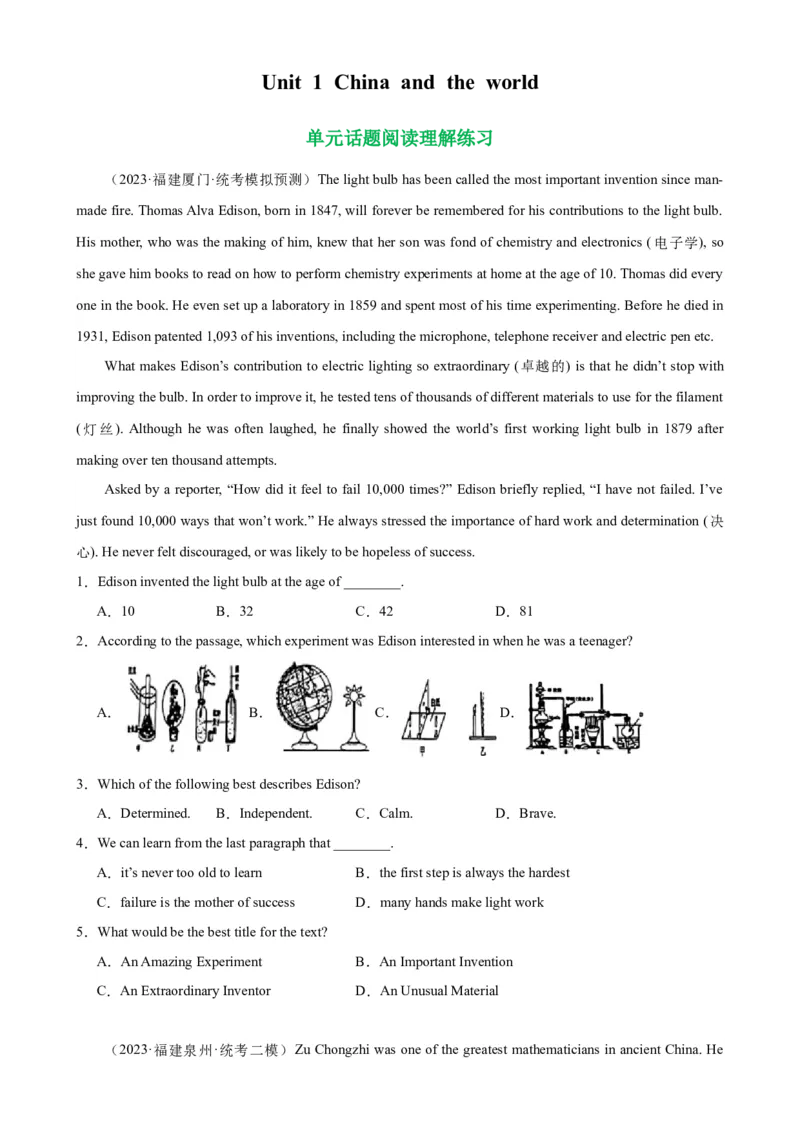
she gave him books to read on how to perform chemistry experiments at home at the age of 10. Thomas did every
one in the book. He even set up a laboratory in 1859 and spent most of his time experimenting. Before he died in
1931, Edison patented 1,093 of his inventions, including the microphone, telephone receiver and electric pen etc.
What makes Edison’s contribution to electric lighting so extraordinary (卓越的) is that he didn’t stop with
improving the bulb. In order to improve it, he tested tens of thousands of different materials to use for the filament
(灯丝). Although he was often laughed, he finally showed the world’s first working light bulb in 1879 after
making over ten thousand attempts.
Asked by a reporter, “How did it feel to fail 10,000 times?” Edison briefly replied, “I have not failed. I’ve
just found 10,000 ways that won’t work.” He always stressed the importance of hard work and determination (决
心). He never felt discouraged, or was likely to be hopeless of success.
1.Edison invented the light bulb at the age of ________.
A.10 B.32 C.42 D.81
2.According to the passage, which experiment was Edison interested in when he was a teenager?
A. B. C. D.
3.Which of the following best describes Edison?
A.Determined. B.Independent. C.Calm. D.Brave.
4.We can learn from the last paragraph that ________.
A.it’s never too old to learn B.the first step is always the hardest
C.failure is the mother of success D.many hands make light work
5.What would be the best title for the text?
A.An Amazing Experiment B.An Important Invention
C.An Extraordinary Inventor D.An Unusual Material
(2023·福建泉州·统考二模)Zu Chongzhi was one of the greatest mathematicians in ancient China. Hewas born during the Northern and Southern dynasties. His family were very talented. They had been studying
mathematics and astronomy (天文学) for generations. From a young age, Zu was taught natural science,
astronomy, math, philosophy (哲学) and so on. The little boy was interested in all of these subjects, especially in
math.
Zu was best known for his calculation of pi. According to historical records, he did all the work using only
wooden sticks. It took him lots of time to work out the value — between 3.1415926 and 3.1415927. No one at that
time was able to calculate it more accurately (准确地) than Zu. The achievement has been recognized around the
world. In order to remember Zu, some mathematicians have suggested calling pi “Zu Lv (祖率)”. Zu was also
known for working out how to calculate the volume (体积) of a sphere (球). He did this with the help of his son
Zu Gengzhi. The two recorded their achievement in Zhui Shu. The book was used during the Tang dynasty.
But Zu was successful not only in math; he did a good job in astronomy, too. He worked out that a year
should be 365.24281481 days long and created the Daming Calendar. However, government officials at that time
did not agree with Zu. The great mathematician never saw his calendar put into use. After his death, Zu Gengzhi
kept on proving that the Daming Calendar was more accurate. Almost ten years later, the new calendar was finally
accepted.
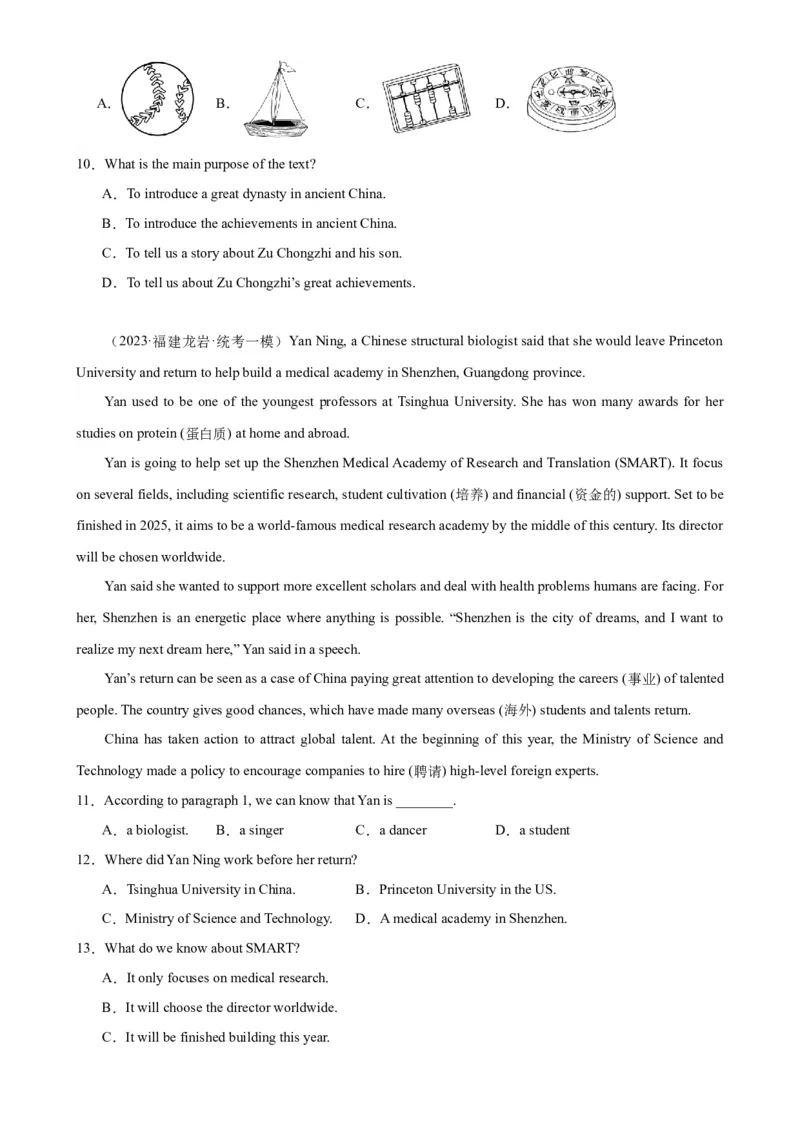
Zu was also an inventor. He once made a vehicle that carried a pointer. However the vehicle turned, the
pointer always pointed to the South. Zu also invented the 1,000-li Boat. The boat could travel 100 li (about 60
kilometers) in a day.
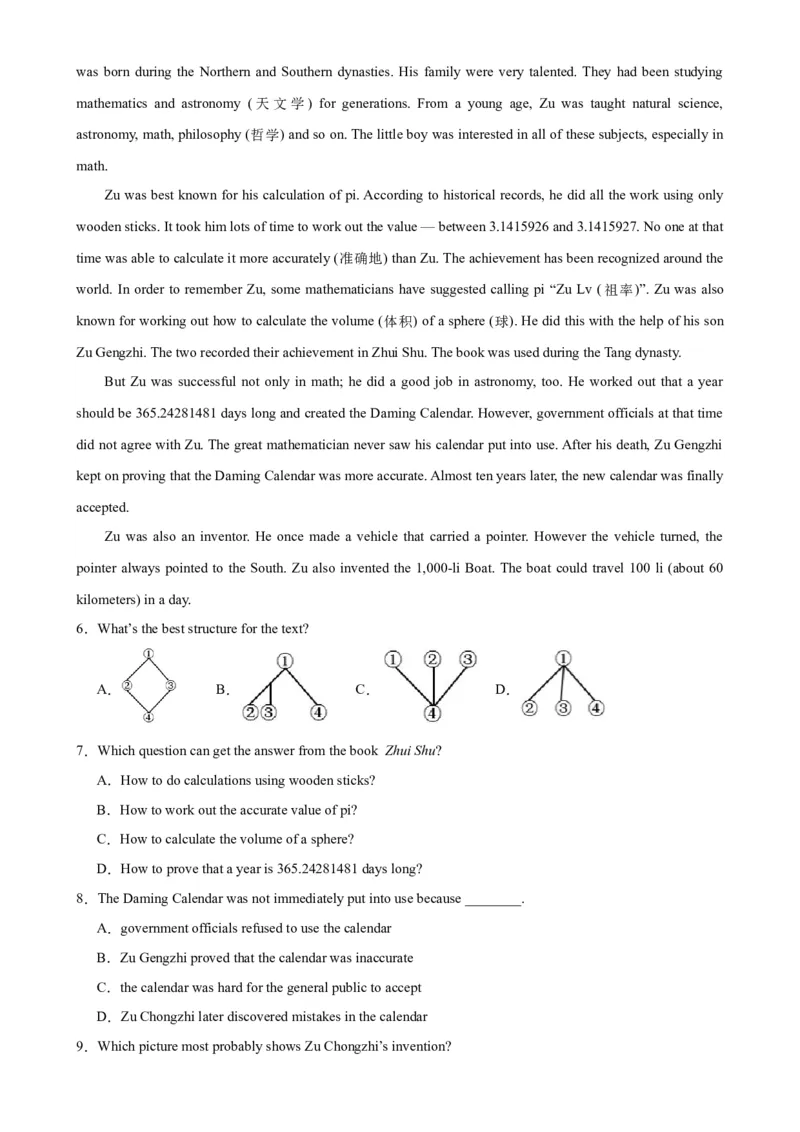
6.What’s the best structure for the text?
A. B. C. D.
7.Which question can get the answer from the book Zhui Shu?
A.How to do calculations using wooden sticks?
B.How to work out the accurate value of pi?
C.How to calculate the volume of a sphere?
D.How to prove that a year is 365.24281481 days long?
8.The Daming Calendar was not immediately put into use because ________.
A.government officials refused to use the calendar
B.Zu Gengzhi proved that the calendar was inaccurate
C.the calendar was hard for the general public to accept
D.Zu Chongzhi later discovered mistakes in the calendar
9.Which picture most probably shows Zu Chongzhi’s invention?A. B. C. D.
10.What is the main purpose of the text?
A.To introduce a great dynasty in ancient China.
B.To introduce the achievements in ancient China.
C.To tell us a story about Zu Chongzhi and his son.
D.To tell us about Zu Chongzhi’s great achievements.
(2023·福建龙岩·统考一模)Yan Ning, a Chinese structural biologist said that she would leave Princeton
University and return to help build a medical academy in Shenzhen, Guangdong province.
Yan used to be one of the youngest professors at Tsinghua University. She has won many awards for her
studies on protein (蛋白质) at home and abroad.
Yan is going to help set up the Shenzhen Medical Academy of Research and Translation (SMART). It focus
on several fields, including scientific research, student cultivation (培养) and financial (资金的) support. Set to be
finished in 2025, it aims to be a world-famous medical research academy by the middle of this century. Its director
will be chosen worldwide.
Yan said she wanted to support more excellent scholars and deal with health problems humans are facing. For
her, Shenzhen is an energetic place where anything is possible. “Shenzhen is the city of dreams, and I want to
realize my next dream here,” Yan said in a speech.
Yan’s return can be seen as a case of China paying great attention to developing the careers (事业) of talented
people. The country gives good chances, which have made many overseas (海外) students and talents return.
China has taken action to attract global talent. At the beginning of this year, the Ministry of Science and
Technology made a policy to encourage companies to hire (聘请) high-level foreign experts.
11.According to paragraph 1, we can know that Yan is ________.
A.a biologist. B.a singer C.a dancer D.a student
12.Where did Yan Ning work before her return?
A.Tsinghua University in China. B.Princeton University in the US.
C.Ministry of Science and Technology. D.A medical academy in Shenzhen.
13.What do we know about SMART?
A.It only focuses on medical research.
B.It will choose the director worldwide.
C.It will be finished building this year.D.It was built a few years ago.
14.Yan Ning chose to move to Shenzhen because ________.
A.Shenzhen is the richest city in China
B.she was born in Shenzhen
C.Shenzhen is an energetic city
D.Shenzhen has more excellent scholars
15.What can we infer from the story?
A.More Chinese students will study abroad.
B.China will give chances to the homeless people.
C.Yan Ning’s return discouraged many overseas talents.
D.More high-level foreign experts may come to China.
(2022·福建福州·福建省福州屏东中学校考模拟预测)
When Thomas Edison hit a wall with his inventions, he would nap in an armchair while holding a steel ball.
As he started to fall asleep and his muscles (肌肉) relaxed, the ball would strike the floor, waking him with
insights (深刻见解) into his problems. Or so the story goes.
Now, scientists have repeated (重复) the trick in a lab, proving that the famous inventor was on to something.
The trick was to wake up in the transition (过渡期) between sleep and wakefulness, just before deep sleep. This
period can be as short as a minute and appears right when we start to doze off (打瞌睡). It slips by (滑走)
unnoticed most of the time unless it is interrupted (打断) by waking.
Researchers invited more than 100 easy sleepers to be volunteers for the experiment (实验). The team gave
them a math test. Those who didn’t find the key took a 20-minute break resting in a chair in a dark room with their
eyes closed. Each held a plastic bottle in their right hand. After the break when the bottle fell, the volunteers went
back to complete the math problems.
The researchers found that those who napped and were interrupted during the first stage of sleep were three
times better at finding the hidden key to the problem than those who remained awake.
However, the eureka (得意的呼声) moment didn’t come immediately after waking in this study. The
research team has already planned an experiment to help people reach a creative zone by monitoring (监测) their
brain waves in real time.16.Edison would nap in an armchair when he _________ in his inventions.
A.felt a little tired B.avoided some difficulties
C.solved some problems D.made no progress
17.Paragraph 2 explains something about Edison’s trick EXCEPT ________.
A.when insights happen B.how short the period can last
C.when the experiment begins D.how the creative moment escapes
18.In Paragraph 3, researchers did an experiment to ________.
A.see whether Edison was right B.make a creative team
C.deal with math problems D.find connections between thoughts and action
19.What can be inferred from the passage? _________.
A.We can solve difficult problems shortly after we wake up.
B.Those who nap will do better than those who stay awake in a math test.
C.Creativity happens while sleeping, but it can disappear easily.
D.Sleeping with a ball held in a hand plays an important role in problem-solving.
20.The passage is mainly about _________.
A.Edison’s experiment on nap B.a study on creativity
C.the importance of enough sleep D.the researchers’ plan for future experiments
(2021·福建厦门·厦门一中校考二模)
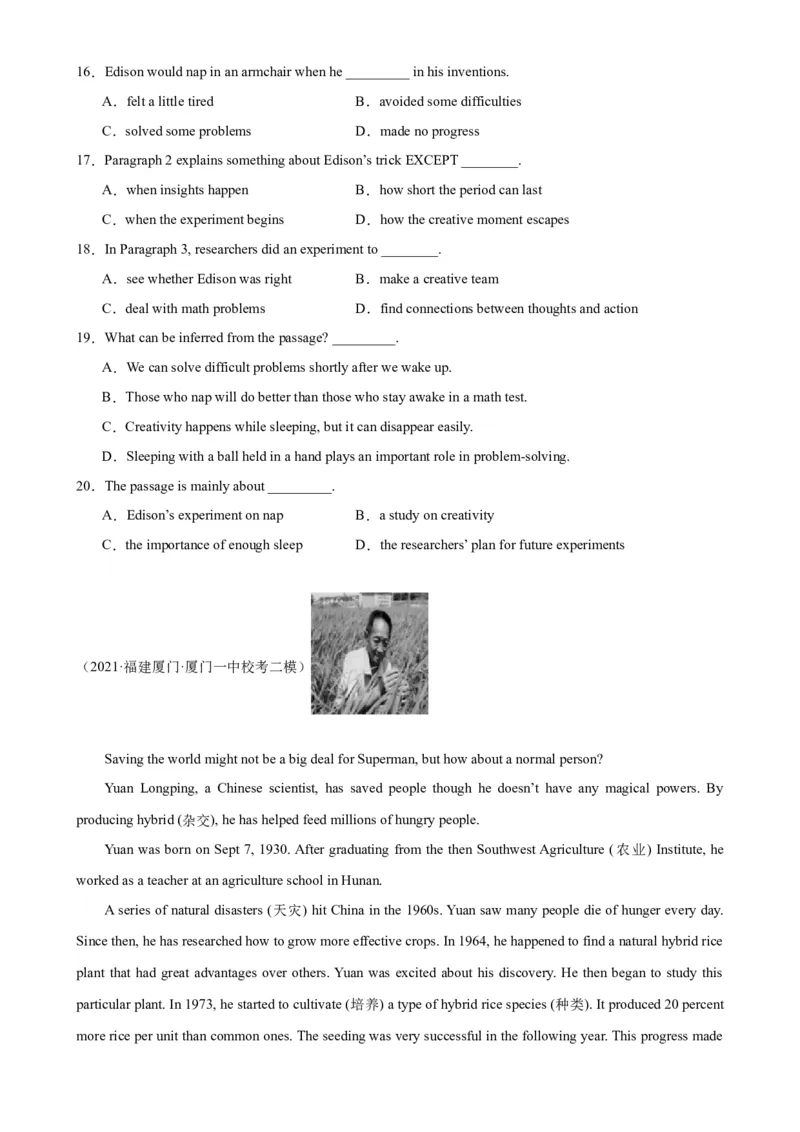
Saving the world might not be a big deal for Superman, but how about a normal person?
Yuan Longping, a Chinese scientist, has saved people though he doesn’t have any magical powers. By
producing hybrid (杂交), he has helped feed millions of hungry people.
Yuan was born on Sept 7, 1930. After graduating from the then Southwest Agriculture (农业) Institute, he
worked as a teacher at an agriculture school in Hunan.
A series of natural disasters (天灾) hit China in the 1960s. Yuan saw many people die of hunger every day.
Since then, he has researched how to grow more effective crops. In 1964, he happened to find a natural hybrid rice
plant that had great advantages over others. Yuan was excited about his discovery. He then began to study this
particular plant. In 1973, he started to cultivate (培养) a type of hybrid rice species (种类). It produced 20 percent
more rice per unit than common ones. The seeding was very successful in the following year. This progress madeChina the world’s leader in rice production. More than 50 percent of China’s total rice fields grow Yuan’s hybrid
species. People call him the “Father of Hybrid Rice”.
He has a dream. He hopes hybrid rice will grow as tall as Chinese sorghum (高粱) one day!
Sadly, the father of hybrid rice passed away on May 22, 2021.The whole country were in great sadness. He is
a hero who helped lift the country out of hunger. He will live in our mind forever.
21.From the second and third paragraphs, we learn that Yuan Longping ________.
A.was born into a scientist’s family B.has a magical power that helps him grow hybrid rice
C.graduated from Southwest Agriculture Institute in 1930 D.was once a teacher at an agriculture school
22.Yuan Longping succeeded in seeding hybrid rice in ________.
A.1960 B.1964 C.1973 D.1974
23.According to the passage, we learn that Yuan’s hybrid rice ________.
A.can provide all Chinese people with riceB.is grown in all of China’s rice fields
C.made China the world’s leader in rice production D.can grow as tall as Chinese sorghum
24.The story mainly talks about ________.
A.different rice species B.how to grow rice
C.the “Father of Hybrid Rice” D.natural disasters in China in the 1960s
25.In which part of a newspaper may you read this passage?
A.YOUR VOICE. B.OUR WORLD. C.SCHOOL TIME. D.
READING FUN.
(2022上·福建厦门·九年级厦门市第十一中学校考期中)The greatest scientists were famous not only
for their discoveries, but also for their interesting lives. Having a special, uncommon mind often goes hand in
hand with unusual acts.
Nikola Tesla is known for many inventions. One is the alternating-current(AC) electricity(交流电).
While inventing, Tesla was good at keeping things in mind, because he used picture thinking and imagined every
step in his mind before even picking up a pencil. Tesla said he wanted to do it because of his mother, who
invented small electrical machines when he was a child.In his later years, Tesla had many strange habits. He slept only two hours every night and dined at exactly
8:10 p. m. After dinner, he’d often work until 3 a. m. Before bed, Tesla curled(卷曲)each foot 100 times,
saying it was good for his brain.
Another scientist encouraged by his mother was Albert Einstein, though what he got from his mother was a
love of music. In fact, Einstein often played music on the piano and violin to help him brainstorm.
Einstein’s great works include the most famous E = mc2 and his theory of relativity. However, thanks to his
wild hair, he is also well-known for the looks of a “mad scientist” and you can tell that he had some interesting
quirks. For example, he had a strong dislike of wearing socks. And Einstein was so withdrawn(内向的)as a
boy that he couldn’t speak until he was three.
Sometimes, the smartest of us are also the strangest. That quiet child in the corner may one day be the next
Tesla or Einstein.
26.How did Tesla remember things?
A.By taking things down. B.By thinking in pictures.
C.By drawing mind-maps. D.By reading aloud.
27.What does the underlined word “quirks” mean in Chinese?
A.奇怪的个性 B.谨慎的个性 C.冲动的个性 D.固执的个性
28.Which of the following statements is TRUE according to the passage?
A.Tesla hated having to wear socks.
B.Tesla did some foot exercises before bed.
C.Einstein was outgoing when he was a child.
D.Einstein was also famous for his hair color.
29.What did Tesla and Einstein have in common?
A.They both had great inventions of electricity.
B.They both took up inventing because of their mothers.
C.They both thought and acted in unusual ways.
D.They both played the piano for better working.30.What does the writer mainly want to tell us about?
A.The special things about well-known scientists.
B.The living habits of smart people.
C.The mothers of Tesla and Einstein.
D.The inventions of great people.
(2022上·河南平顶山·九年级统考期末)In 2021, President Xi Jinping gave China’s top science award
(奖) to Gu Songfen and Wang Dazhong for their excellent achievements in science and technology (sci-tech).
Gu Songfen is an airplane designer (设计师). Born in 1930, Gu was responsible for the research and
development of many airplanes, including JJ-1, CJ-6, J-8 and J-8- II and served as the main designer of J-8 and
J-8-II.
Wang Dazhong,born in 1935,is a world-famous nuclear (核能) scientist. He has spent all his life on the study
of nuclear energy technology. He made great efforts to improve the safety of nuclear energy, and helped China
achieve high levels of nuclear energy technology.
Premier Li Keqiang expressed congratulations to them. Li said that our country pays much attention to sci-
tech development and sci-tech workers. He also mentioned that sci-tech workers have made great achievements,
especially in dealing with the COVID-19 and protecting people’s lives and health.
Sci-tech workers are expected to follow the examples set by these great scientists and help the country
achieve a high level in science and technology. As students, we are also supposed to study hard and learn from the
great scientists.
根据材料内容选择最佳答案。
31.Who gave China’s top science award (奖) to Gu Songfen and Wang Dazhong in 2021?
A.Premier Xi Jinping. B.Premier Li Keqiang.
C.President Xi Jinping. D.President Li Keqiang.
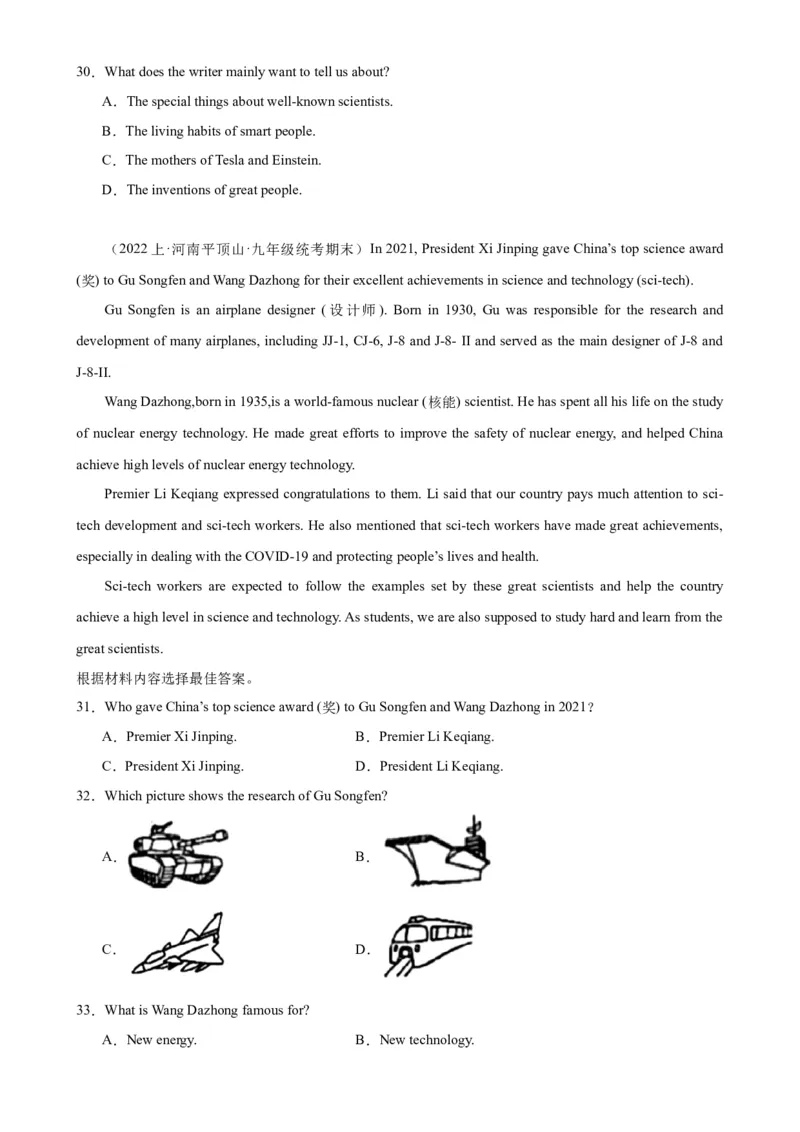
32.Which picture shows the research of Gu Songfen?
A. B.
C. D.
33.What is Wang Dazhong famous for?
A.New energy. B.New technology.C.Safety of China. D.Nuclear energy technology.
34.When was Wang Dazhong born?
A.In 1930. B.In 1935. C.In 1940. D.In 1945.
35.What is the purpose of the last paragraph?
A.To express congratulations to the scientists.
B.To show the greatness of these scientists.
C.To show the development of science and technology.
D.To encourage us to learn from these scientists.
(2022上·山东青岛·九年级统考期末)
During the Tang Dynasty, Emperor Taizong asked Feng Deyi to look for talented people. However, several
months passed, he didn’t find anyone.
“I tried my best, but there are not unusual people at all.” Feng said.
“People are like tools. What we need to do is to make good use of their talent. You should check yourself for
not noticing talented people. How could you say that there are no talented people in our country?” said the
emperor.
It is really true that each tool has a specific use. A knife is made to cut things while chopsticks are made to
pick up food. We can’t use a knife as chopsticks. Like a tool, each person has a special talent. Nobody is perfect.
We can’t expect a person to be good at everything.
With this idea in mind, Emperor Taizong discovered many talented people. He offered them important
positions, which helped them make the most of their talents The talented people helped the society develop. A
good example is Ma Zhou, who grew up in a poor family. Ma gave a lot of useful advice, so Emperor Taizong
gave him a high position and promoted him many times. He helped deal with difficult problems and became a
famous person in history. During that period, the important people around Emperor Taizong, such ag Fang
Xuanling, Wei Zheng Li Jing, all were the brightest and the best of the time with their own strong points.
Emperor Taizong’s talented people helped the society develop and created a “golden age”.
36.Who was asked to look for talented people by the emperor?
A.Emperor Taizong. B.Fang Xuanling. C.Wei Zheng.D.Feng Deyi.
37.What does the underlined word “promoted” mean?A.惩罚 B.批评 C.教导 D.晋升
38.Why couldn’t Feng Deyi find any talented people in Taizong’s opinion?
A.Because his rules were wrong. B.Because he didn’t agree with the emperor.
C.Because he was afraid of making mistakes. D.Because there were no talented people.
39.Ma Zhou is a good example of people who ________.
A.have no talent but are still useful B.are unusual and perfect
C.show talent in the right field D.know when to take a chance
40.What is the main message of the story?
A.Chance only comes to those who are prepared.
B.Talented people should be valued and led to the right place.
C.Nothing in the world is difficult if you put your heart into it.
D.Appearance can be changed, but talent always stays the same.
(2022上·广东广州·九年级统考期末)If you’ve ever seen your insides on an x-ray, you can thank Marie
Curie for being able to see them so clearly.
Marie was born in Poland on November 7, 1867. Her father, who taught math and physics, helped her
develop a talent for science early. As she grew older, she wanted to go to university and learn all about physics.
But women students were not allowed at the local university. Wishing to become a scientist and work on her
experiments, she moved to Paris, France, to study physics at a university.
In 1895, she married Pierre Curie. Together they discovered two new radioactive elements (放射性元素),
and won the Nobel Prize in physics in 1903. And she became the first woman to win any kind of Nobel Prize.
Then she continued to make more amazing achievements in science. In 1906, she became the first woman physics
professor at the university. In 1909, she was given her own lab at the University of Paris. Then in 1911, she won a
Nobel Prize in chemistry. She’s still the only person— man or woman— to win the Nobel Prize in two different
sciences.
She soon started using her work to save lives. She used her understanding to help the x-ray take detailed
pictures inside the human body. In 1914, during World War I, she created mobile x-ray units that could be driven
to hospitals. She also helped train some women to operate the units. With these x-ray units, doctors could see
broken parts inside soldiers’ bodies clearly and help save over one million soldiers.
After the war ended in 1918, Marie Curie returned to her lab to continue working with radioactive elements.
But those can be dangerous in a very large amount, and on July 4, 1934, she died of a disease caused by radiation.
Marie Curie was a woman hero, not only because of her groundbreaking and life-saving scientific work. She
encouraged, and today she continues to encourage women to work in science, and scientists to use their work tohelp people.
41.What was the first difficulty on Marie’s way to science?
A.Her parents didn’t support her study. B.She had trouble understanding science.
C.Women couldn’t enter university in her city. D.She couldn’t afford to move to Paris.
42.What can we know about Marie Curie’s prizes in science?
A.She got a Nobel Prize in physics all by herself.
B.She got a Nobel Prize in physics because she was the first woman professor.
C.She got a Nobel Prize in chemistry because she got a lab.
D.She got the Nobel Prize both in physics and chemistry.
43.How did Marie Curie save lives?
A.She created mobile x-ray units. B.She carried x-ray units to the hospitals.
C.She operated x-ray units in the hospitals.D.She checked the insides of soldiers’ bodies.
44.What is probably the best title of this passage?
A.A Nobel Prize winner B.A life-saving invention
C.A great woman scientist D.Dangerous scientific work参考答案:
1.B 2.D 3.A 4.C 5.C
【导语】本文主要介绍托马斯·阿尔瓦·爱迪生对电灯的贡献以及他的多项发明。
1.细节理解题。根据“Thomas Alva Edison, born in 1847”和“he finally showed the world’s first working
light bulb in 1879”可知,爱迪生在32岁时发明了电灯泡,故选B。
2.细节理解题。根据“His mother, who was the making of him, knew that her son was fond of chemistry and
electronics (电子学), so she gave him books to read on how to perform chemistry experiments at home at the age
of 10.”可知,他的母亲是他的创造者,她知道儿子喜欢化学和电子学,所以在他10岁的时候,她给了他
一些关于如何在家里做化学实验的书。故选D。
3.推理判断题。根据“In order to improve it, he tested tens of thousands of different materials to use for the
filament (灯丝). Although he was often laughed, he finally showed the world’s first working light bulb in 1879
after making over ten thousand attempts.”可知,为了改进它,他测试了成千上万种不同的材料来制作灯丝。
尽管他经常被嘲笑,但他在尝试了一万多次之后,终于在1879年展示了世界上第一个可以工作的灯泡。
由此推知,爱迪生是一个坚定的人,故选A。
4.推理判断题。根据“I have not failed. I’ve just found 10,000 ways that won’t work.”可知,我没有失败,
我只是发现了一万种行不通的方法。由此可知,失败是成功之母,故选C。
5.最佳标题题。本文主要介绍托马斯·阿尔瓦·爱迪生对电灯的贡献以及他的多项发明。选项C“一位非凡
的发明家”符合主题,故选C。
6.D 7.C 8.A 9.B 10.D
【导语】本文主要介绍了数学家祖冲之。
6.篇章结构题。第一段总体概述介绍的对象;第二,三,四段介绍祖冲之的的成就。故是总分的结构。
故选D。
7.细节理解题。根据“Zu was also known for working out how to calculate the volume (体积) of a sphere (球).
He did this with the help of his son Zu Gengzhi. The two recorded their achievement in Zhui Shu.”可知Zhui
Shu这本书记载的是如何计算球的体积,故选C。
8.细节理解题。根据“ However, government officials at that time did not agree with Zu. The great
mathematician never saw his calendar put into use.”可知没有投入使用是因为政府官员不同意。故选A。
9.细节理解题。根据“Zu also invented the 1,000-li Boat. The boat could travel 100 li (about 60 kilometers) in
a day.”可知,祖还发明了千里船。这艘船一天可以行驶100里(约60公里),结合图片可知是B。故选
B。10.主旨大意题。本文主要介绍祖冲之的伟大成就。故选D。
11.A 12.B 13.B 14.C 15.D
【导语】本文介绍了生物学家颜宁要回国发展的消息,并对未来进行了规划。
11.细节理解题。根据“Yan Ning, a Chinese structural biologist said that she would leave Princeton
University”可知颜宁是生物学家。故选A。
12.细节理解题。根据“Yan Ning, a Chinese structural biologist said that she would leave Princeton University
and return to help build a medical academy in Shenzhen, Guangdong province.”可知颜宁将离开普林斯顿大学,
回到广东深圳帮助建立一所医学院,因此之前在普林斯顿大学工作。故选B。
13.细节理解题。根据“ Its director will be chosen worldwide.”可知SMART将在全世界范围选择负责人。
故选B。
14.细节理解题。根据“ For her, Shenzhen is an energetic place where anything is possible.”可知对颜宁来说,
深圳是一个充满活力的地方,在这里一切皆有可能。故选C。
15.推理判断题。根据“At the beginning of this year, the Ministry of Science and Technology made a policy to
encourage companies to hire (聘请) high-level foreign experts.”可知今年年初,科学技术部制定了鼓励企业聘
请高水平外国专家的政策,因此更多高水平的外国专家可能会来中国。故选D。
16.D 17.C 18.A 19.C 20.B
【导语】本文是一篇说明文。本文主要通过爱迪生的一个故事及科学家们的实验,去研究人类的创新时
刻。
16.细节理解题。根据“When Thomas Edison hit a wall with his inventions, he would nap in an armchair
while holding a steel ball. As he started to fall asleep and his muscles(肌肉) relaxed, the ball would strike the
floor, waking him with insights(深刻见解) into his problems. ”可知,他遇到了困惑。D选项“没有进展”符
合语境。故选D。
17.细节理解题。根据“The trick was to wake up in the transition(过渡期) between sleep and wakefulness,
just before deep sleep. This period can be as short as a minute and appears right when we start to doze off(打瞌
睡).”可知,深刻见解呈现的时间及其它是多么的短暂,它与“As he started to fall asleep and his muscles(肌
肉) relaxed, the ball would strike the floor, waking him with insights(深刻见解) into his problems.”相符 ;又根
据“ It slips by(滑走) unnoticed most of the time unless it is interrupted(打断) by waking.”可知,这个时刻怎
么迅速消失的;根据题干“ EXCEPT”可知,C选项“实验什么时候开始”与“Edison’s trick”无关。故选
C。
18.细节理解题。根据“Now, scientists have repeated(重复) the trick in a lab, proving that the famous inventorwas on to something. ”及第三段“Researchers ... the math problems.”可知,研究人员做实验的目的为了验证
爱迪生的当时的状况。故选A。
19.推理判断题。根据“The trick was to wake up in the transition(过渡期) between sleep and wakefulness,
just before deep sleep.”和“It slips by(滑走) unnoticed most of the time unless it is interrupted(打断) by waking.”
可推知,创造力发生在睡觉的时候,但它很容易消失。故选C。
20.主旨大意题。通读全文,根据第一段爱迪生的故事,以及后面科学家们为了验证爱迪生的午睡技巧
所做的一系列实验可知,本文主题是关于创造力的研究。故选B。
21.D 22.D 23.C 24.C 25.B
【导语】本文主要讲述了“杂交水稻之父”袁隆平研究杂交水稻的经历。
21.细节理解题。根据短文第三段“After graduating from the then Southwest Agriculture (农业) Institute, he
worked as a teacher at an agriculture school in Hunan.”可知,袁隆平从当时的西南农学院毕业后,就在湖南
一所农校任教。D选项符合题意,故选D。
22.推理判断题。根据第四段“In 1973, he started to cultivate (培养) a type of hybrid rice species (种类). It
produced 20 percent more rice per unit than common ones. The seeding was very successful in the following
year.”可知,1973年,他开始培育一种杂交水稻品种,每单位水稻产量比普通水稻高20%,次年播种非常
成功,即1974年,袁隆平成功播种杂交水稻。故选D。
23.细节理解题。根据短文第四段“This progress made China the world’s leader in rice production.”可知,
这一进步使中国成为世界水稻生产的领头羊。C选项符合文意,故选C。
24.主旨大意题。根据短文第二段“Yuan Longping, a Chinese scientist, has saved people though he doesn’t
have any magical powers. By producing hybrid (杂交), he has helped feed millions of hungry people.”中国科学
家袁隆平虽然没有任何神通却拯救了人们。通过生产杂交水稻,他帮助了数百万饥饿的人。结合全文内
容可知,本文主要介绍了袁隆平研究杂交水稻的经历。故选C。
25.推理判断题。根据第二段“Yuan Longping, a Chinese scientist, has saved people though he doesn’t have
any magical powers. By producing hybrid (杂交), he has helped feed millions of hungry people.”并介绍全文内
容可知,本文主要介绍了“杂交水稻之父”袁隆平,应该来源于B选项“我们的世界”。故选B。
26.B 27.A 28.B 29.C 30.A
【导语】本文主要介绍了两名科学家的有趣的生活。
26.细节理解题。根据“Tesla was good at keeping things in mind, because he used picture thinking and
imagined every step in his mind before even picking up a pencil.”可知他用图画思维进行记忆。故选B。
27.词义猜测题。根据“ For example, he had a strong dislike of wearing socks.”可知他非常不喜欢穿袜子,所以这些是奇怪的个性。故选A。
28.细节理解题。根据“Before bed, Tesla curled(卷曲)each foot 100 times,”可知在睡觉之前,Tesla会做
一些足部锻炼。故选B。
29.细节理解题。根据“Having a special, uncommon mind often goes hand in hand with unusual acts.”以及两
位科学家的介绍可知,他们都以不同寻常的方式思考和行动。故选C。
30.主旨大意题。本文主要介绍了两名科学家的有趣的生活。故选A。
31.C 32.C 33.D 34.B 35.D
【导语】本文主要讲述了习近平主席为顾诵芬和王大中颁发国家最高科技奖、对两位科学家的介绍以及
鼓励学生向他们学习。
31.细节理解题。根据第一段“In 2021, President Xi Jinping gave China's top science award (奖) to Gu
Songfen and Wang Dazhong” 可知,是习近平主席为他们两位颁奖,故选C。
32.细节理解题。根据第二段“Gu Songfen is an airplane designer”可知,顾诵芬是一位飞机设计师,故选
C。
33.细节理解题。根据第三段“Wang Dazhong, born in 1935,is a world-famous nuclear (核能) scientist.” 可
知王大中是一位核能科学家,因此以研究核能而闻名,故选D。
34.细节理解题。根据第三段“Wang Dazhong, born in 1935”可知,王大中出生于1935年,故选B。
35.主旨大意题。根据“As students, we are also supposed to study hard and learn from the great scientists.”可
知,文章最后一段的目的是鼓励学生们向这些科学家学习,故选D。
36.D 37.D 38.A 39.C 40.B
【导语】本文通过唐太宗知人善任的故事,说明了人才应该被重视并用在正确的地方。
36.细节理解题。根据“During the Tang Dynasty, Emperor Taizong asked Feng Deyi to look for talented
people.”可知,唐太宗让封德彝物色人才。故选D。
37.词句猜测题。根据“so Emperor Taizong gave him a high position and promoted him many times. He
helped deal with difficult problems and became a famous person in history.”可知,唐太宗给了他很高的职位,
他帮助解决了难题,可推知前面应表达提拔了他很多次,故推出划线部分promoted意为“提拔、晋升”。
故选D。
38.推理判断题。根据“People are like tools. What we need to do is to make good use of their talent. You
should check yourself for not noticing talented people.”可推出,唐太宗认为封德彝找不到人才的原因是因为
他选拔人才的标准是不对的。故选A。
39.推理判断题。根据“A good example is Ma Zhou, who grew up in a poor family. Ma gave a lot of usefuladvice, so Emperor Taizong gave him a high position and promoted him many times.”可知,马周给了很多有用
的建议,所以唐太宗给了他很高的职位,并多次提拔他,由此可推断出马周是一个在正确的地方发挥了
才能的例子。故选C。
40.主旨大意题。通读全文可知,本文通过唐太宗知人善任的故事说明了人才应该被重视并用在正确的
地方。故选B。
41.C 42.D 43.A 44.C
【导语】本文主要向我们介绍了玛丽·居里传奇的一生,她热爱科学研究,并且深具真正的品格和精神。
41.细节理解题。根据“But women students were not allowed at the local university.”可知,Marie遇到的第
一个难题是女学生不允许进入当地的大学。故选C。
42.细节理解题。根据“Together they discovered two new radioactive elements (放射性元素), and won
the Nobel Prize in physics in 1903.”以及“Then in 1911, she won a Nobel Prize in chemistry.”可知,她获得了
诺贝尔物理学和化学奖。故选D。
43.细节理解题。根据“In 1914, during World War I, she created mobile x-ray units that could be driven to
hospitals. She also helped train some women to operate the units. With these x-ray units, doctors could see broken
parts inside soldiers’ bodies clearly and help save over one million soldiers.”可知,她创建了移动x射线装置拯
救生命。故选A。
44.最佳标题题。根据通读全文可知,文章主要介绍了女科学家玛丽·居里传奇的一生。故选C。