关注公众号:陆陆高分冲刺 ~领取:最新版“小中高考-总复习”、最新试卷下载
简单句考点聚焦和精讲
【中考简单句考点聚焦】
1、简单句的五大基本句型结构;
2、陈述句的构成形式及基本用法;
3、祈使句的构成形式及基本用法;
4、疑问句的构成形式及基本用法;
5、由what, how引导的感叹句的构成形式、用法及区别。
一 英语简单句的五大基本句型结构
1、主语+连系动词+表语。如:The bike is new. 这辆自行车是新的。// The hat looks nice on you! 你戴这顶
帽子真好看。
除了be动词外,还有下列动词:feel, smell, sound, taste, keep, rest, remain, stay, lie, stand, seem (to be),
appear (to be), look, become, grow, get, come, turn, fall (asleep, ill, silent), go, run, prove, turn out 等也可以用作
系动词。
2、主语+不及物动词。如:He runs fast. 他跑得快。 // We study hard. 我们努力学习。
He swims in the river every summer. 他每年夏天都在这条河里游泳。
3、主语+及物动词+宾语。如:
He studies English. 他学习英语。// Children often sing this song. 孩子们经常唱这首歌。
(1)常用-ing 形式, 而不用不定式作宾语的动词有:enjoy, finish, feel like, consider,
practise, keep, suggest, mind等。
1.I finished reading the book last night. 昨晚我看完了这本书。
2.She enjoys reading novels and swimming. 她喜欢读小说和游泳。
(2)常用不定式,而不用-ing形式作宾语的动词有:wish, hope, agree, plan, decide, refuse,
want等。
Where do you wish ? 你想坐哪里?
Tom agreed me some money. 汤姆同意借我一些钱。
1 1
原创精品资源学科网独家享有版权,侵权必究!
学科网(北京)股份有限公司关注公众号:陆陆高分冲刺 ~领取:最新版“小中高考-总复习”、最新试卷下载
(3)有些及物动词既可用不定式,又可用-ing形式作宾语,但意义不同。这类动词常见
的有:remember, forget等。
1.Please remember the letter for me. 请记住替我寄了这封信。
2.I remember the letter. 我记得那封信寄过了。
(4)有些及物动词的宾语,既可用不定式,又可用-ing形式,意义基本相同。这类动词常见
的有:begin, start, continue。
We bega n English when we came to junior middle school. 我们来初中学习时才开始学习
英语。
4、主语+及物动词+间接宾语+直接宾语。
(1)及物动词之后跟有双宾语,往往一个指人,一个指物。指人的为间接宾语,指物的为直
接宾语。一般情况下,间接宾语在前,直接宾语在后。若要把间接宾语放在直接宾语之后,间接宾语前
需加介词。
Please pass me a cup of tea.= Please pass a cup of tea me. 请递给我一杯茶。
Show me your new book, please. =Please show your new book me. 请把你的新书给我。
(2)把间接宾语放在直接宾语之后,间接宾前有时加介词to,有时加介词for,这主要取决于
谓语动词。一般在动词give, tell, sell, lend, show之后加to。在动词buy, make, get等之后加for。
1.Mr. Li bought Jim a pair of new shoes. = Mr. Li bought a pair of new shoes Jim. 李先生给吉姆买了
一双新鞋。
2.Would you lend me your dictionary, please? =Would you lend your dictionary me, please? 请你借你
的字典给我好吗?
5、主语+及物动词+宾语+宾语补足语。
We keep our classroom clean and tidy. 我们保持教室干净整洁。
2 2
原创精品资源学科网独家享有版权,侵权必究!
学科网(北京)股份有限公司关注公众号:陆陆高分冲刺 ~领取:最新版“小中高考-总复习”、最新试卷下载
(1)及物动词后跟有复合宾语,一个是宾语,一个是宾语补足语。宾语和宾语补足语之间有
逻辑上的主谓关系。
We call him Jack. 我们叫他杰克。
Don’t get your hands dirty. 不要把你的手弄脏。
(2)在及物动词之后,用不定式作宾语补足语和用-ing形式作宾语补足语表示的意思往往不
同。用不定式作宾语补足语指事情的全过程;用-ing形式作宾语补足语指正在进行的动作的一部分。
I heard him that song. 我听他唱过那首歌。
When I came back, I heard him in the room. 我回来时,听见他正在房间里唱歌。
(3)在感官动词see, hear, feel, watch, listen to, look at和使役动词let, make, have等的复合
宾语中,不定式须省去to。但变为被动句时,省去的to要加上。
I saw him go into the room. 我看见他进了房间。→He was seen to go into the room. 他被看见进了房间。
二 陈述句的构成形式及基本用法
陈述句是用来陈述一个事实或表达说话人看法的句子。通常用降调,句末用句号“.”。 它有肯定式
和否定式两种形式。
1. 肯定句。肯定句的基本结构是“主语+谓语”。如:I have a new friend. 我有一个新朋友。
I bought a book in the shop last Sunday. 上个星期天我在书店里买了一本书。
2. 否定句。否定句分为完全否定句和部分否定句。
(1)完全否定句:
① 若肯定陈述句谓语部分含有助动词、情态动词或连系动词 be,则只需在这些动词后加not即可构成完
全否定句。如:
He is playing the guitar.(肯定)→ He is the guitar.(否定)
We can get there before dark.(肯定)→ We there before dark.(否定)
② 如果陈述句的谓语动词是实义动词,而其中又没有情态动词或助动词时,则需根据人称和时态在该实
义动词前加don’t, doesn’t或didn’t,同时把该实义动词变为原形,即可构成完全否定句。如:
3 3
原创精品资源学科网独家享有版权,侵权必究!
学科网(北京)股份有限公司关注公众号:陆陆高分冲刺 ~领取:最新版“小中高考-总复习”、最新试卷下载
He plays the violin well.(肯定)→ He the violin well.(否定)
She won the game.(肯定)→ She the game.(否定)
③ 如果句子是there be结构或谓语动词是have/has(有),则只需在be和have/has后加not,即可构成完
全否定句。如:
He has some books. → He any books.
There is some water in the cup. → There water in the cup.
④ 除not外,否定词no, no one, nothing, nobody, never, neither等也可构成完全否定句。如:
I have seen the film. → I have seen the film.
There is something wrong with his bike. → There is wrong with his bike.
【注意】英语中,有些单词在变为否定句后,有所改变。如:some 改为 any,too 改为
either,already改为yet,and改为or,lots of改为many或much。
I have already had breakfast. → I haven’t had breakfast .
There is some water in the cup. → There is not water in the cup.
Jim has brothers and sisters. → Jim doesn’t have brothers sisters.
There are lots of books in the library. → There aren’t books in the library.
(2)部分否定句:
① 用hardly, seldom, few, little等词表示部分否定。如:
I can hardly see anything in the rain. 在雨中我几乎什么东西也看不见。
② not和both, all, each, every, quite, always等连用表示部分否定。如:
Not all students come to school by bus. 并非所有的学生都乘公共汽车来上学。
三 疑问句的构成形式及基本用法
用来提出问题的句子叫做疑问句,句末用问号。疑问句可分为:一般疑问句、特殊疑问句、选择疑
问句、反意疑问句。
1. 一般疑问句:
一般疑问句用来询问事物或某种情况是否属实,以助动词、情态动词、be动词或have/has(有)开
头,通常要求以yes,或no来回答的疑问句,读时通常用升调。
(1)一般疑问句的肯定结构:①Be+主语+其他(?) ②助动词(或情态动词)+主语+谓语(动词原形)
+其他(?) 使用一般疑问句时应特别注意问句与答句在人称、数和时态上要保持一致。对一般疑问句作肯
4 4
原创精品资源学科网独家享有版权,侵权必究!
学科网(北京)股份有限公司关注公众号:陆陆高分冲刺 ~领取:最新版“小中高考-总复习”、最新试卷下载
定回答时,通常是:Yes, 主语+be/助动词/情态动词;作否定回答时,通常是:No, 主语+be/助动词/情态
动词+not;not一般要与前面的词构成缩略形式。如:
---- Can you swim? 你会游泳吗? ---- Yes, I can. 是的,我会。// ---- No, I can’t. 不,我不会。
---- Is Tom a doctor? 汤姆是一个医生吗?---- Yes, he is. 是的,他是。// ---- No, he isn’t. 不,他不是。
---- Do you know Mr. Smith? 你认识史密斯先生吗? ---- Yes, I do. 是的,我认识。// ---- No, I don’t.
不,我不是。
【注意】一般疑问句也可用表示肯定或否定的词来回答,如 certainly(当然),surely(当然),of course(当
然),I think so(我想是的),all right(好吧) certainly not(当然不是), not at all(一点也不),never(从不),
sorry(很抱歉),not yet(还没有) I’m afraid not(恐怕不是)等。从而使语气变得客气、委婉。
---- Can you come and play badminton with me? 你能和我一起去打羽毛球吗?
---- I’m afraid not. I have many things to do. 恐怕不能,我有许多事情要做。
(2)一般疑问句的否定结构:一般是以助动词、情态动词、be动词或have/has(有)与not的
缩略形式开头,往往表示惊讶、赞叹、怀疑等语气。与汉语不同的是,英语一般疑问句否定结构的答语
是否定还是肯定,全由答语的否定或肯定来决定。若答语是肯定的,则用yes加肯定结构;若答语是否定
的,则用no加否定结构。但其汉语翻译与其原意正好相反。
---- Won’t she like it? 难道她不喜欢它?---- Yes, she will. 不,她喜欢。// No, she won’t. 是的,她不喜
欢。
---- Aren’t you a football fan? 难道你不是一个足球迷吗?---- Yes, I am. 不,我是。// No, I’m not. 是的,
我不是。
2. 特殊疑问句:
以特殊疑问词开头的疑问句叫特殊疑问句。基本结构为:“特殊疑问词+一般疑问句”。但如果疑问
词在句子中作主语或作主语的定语,就用“特殊疑问词+陈述句”。 特殊疑问句不能用yes或no回答,
要根据询问的内容具体回答。读时用降调。疑问词包括疑问代词、疑问副词和疑问词组。
疑问代词可提问主语、谓语、表语或定语,常用的疑问代词有 who(谁),whom(谁),whose(谁的),
which(哪一个),what(什么);疑问副词有when(何时),where(何地),why(为什么),how(如何)以及疑问词
组:how soon (多久);how long (多长时间);how far (多远);how often (多久一次);how many/much (多
少)等。
5 5
原创精品资源学科网独家享有版权,侵权必究!
学科网(北京)股份有限公司关注公众号:陆陆高分冲刺 ~领取:最新版“小中高考-总复习”、最新试卷下载
常用的特殊疑问句和疑问词组用法辨析:
询问内容 疑问词或句型 例 句 回 答
职业,身份 what What is your father? He is a doctor.
He is Jack.
姓名或关系 who Who is that boy?
He is my brother
She is kind/friendly.
What be…like? What is she like?
相貌特征
She looks like her
What do/does…like? What does she look like?
mother.
目的 what…for? What did they come here for? To attend a meeting.
Because they have a
原因 why Why did they come here?
meeting to attend.
how How is the weather today?
天气 It’s fine.
what…like? What is the weather like today?
颜色 what color…? What dolor is her skirt? It’s red.
服装尺寸 what size What size does he wear? He wears 40.
几点钟 what time What time is it? It’s 7:30.
星期几 what day What day is today? It’s Tuesday.
几号,日期 what is the date…? What is the date today? It’s May 2.
年龄(多大) how old How old is he? He is 38.
持续多长时间(多
how long How long have you been here? For five months.
久)
长度(多长) how long How long is the bridge? It’s 500 metres.
How far is it from here to the
距离(多远) how far It’s 6 kilometres.
zoo?
频度(多久一次) how often How often do you come back? Once a week.
时间经过(多久) how soon How soon will she arrive? In a week.
how many(可数名词) How many jackets do you have?
数量 Three.
how much(不可数名 How much coffee do you want?
(多少) Two cups.
词)
How much is it?
价格 how much Five dollars.
How much does it cost?
how tall(人,树) How tall is she? She’s 1.73 metres.
高度(多高)
how high(山,建筑物) How high is the tower? It’s 450 metres.
3. 选择疑问句:
选择疑问句是说话者提出两种或两种以上的不同情况,让对方选择回答的疑问句。其结构是“一般
疑问句+or+供选择部分”。or前面的部分读升调,or后面的部分读降调。选择疑问句不能用yes或no回
答,而必须具体的选择答复。选择疑问句可分为一般选择疑问句和特殊选择疑问句。
6 6
原创精品资源学科网独家享有版权,侵权必究!
学科网(北京)股份有限公司关注公众号:陆陆高分冲刺 ~领取:最新版“小中高考-总复习”、最新试卷下载
一般选择疑问句的结构:一般疑问句+or+供选择部分? 如:
---- Shall we go there by bus or on foot? 我们乘坐公共汽车去还是步行去?
---- We’ll go by bus. 我们乘坐公共汽车去。
特殊选择疑问句的结构:特殊疑问句,+A or B/A, B or C? 如:
---- Which do you like better, tea or coffee? 茶和咖啡,你更喜欢哪种?
---- I like tea better. 我更喜欢茶。
4. 反意疑问句:
反意疑问句也叫附加疑问句,是在陈述句的后面加一个简短问句,对陈述句所说的事实或者观点提
出疑问或希望陈述句部分内容得到证实。
(1)反意疑问句的结构为:“肯定陈述+否定疑问句”或“否定陈述+肯定疑问句”(前肯,
后否。前否,后肯。)如:
1.You are coming, you? 你会来的,是吗?
2.You can’t swim, you? 你不会游泳,对吗?
3.Her brother went to college last year, he? 她哥哥去年上的大学,是不是?
(2)使用反意疑问句应该注意的问题:
① 简略问句如果是否定式,not应与be, do, will等系动词、助动词、情态动词缩写;
② 简略问句的主语不用名词,应用人称代词主格;
③ 当说话者的目的存在疑问,则用升调;
④ 当说话者的目的不存在疑问,而是为了加强语气时,用降调;
⑤ 反意问句里还必须要保持前后两部分在人称、时态、情态动词等方面的一致性。
(3)反意疑问句的回答:在回答反意疑问句的时候,如果是前肯后否的句子,思维和中国人
相同;如果是前否后肯的句子,思维正好同中国人相反。
1.---- He is a student, he? 他是个学生,不是吗? ---- Yes, he is. 是的,他是学生。// No, he isn’t.
不是,他不是学生。
2.---- He doesn’t like playing football, does he? 他不喜欢踢球,是吗?
---- Yes, he does. 。// No, he doesn’t. 。
7 7
原创精品资源学科网独家享有版权,侵权必究!
学科网(北京)股份有限公司关注公众号:陆陆高分冲刺 ~领取:最新版“小中高考-总复习”、最新试卷下载
3.I am not a teacher, am I? (我不是一名老师,是吗?Yes, I am. No, I am not.
【注意】在回答时,不允许用“Yes, 人称代词+(系/助/情+not)(缩写).“或者“No, 人称代词+系/助/情.”。
(4)初中常见附加疑问句部分的主语和谓语动词的确定:
1 ) 当 陈 述 句 谓 语 动 词 是 be, have 或 有 其 他 助 动 词 、 情 态 动 词 时 , 附 加 疑 问 句 部 分
用be/have/will/can+not(缩写)+主语。
1.You are in Class Four, you? 你在四班,不是吗?
2.Jim will go to England, he? 吉姆将要去英格兰,不是吗?
3.He can swim, he? 他会游泳,不是吗?
2)当陈述句谓语是行为动词的一般现在时或一般过去时,附加疑问句部分用 do/don’t, does/doesn’t,
did/didn’t +主语。
1.You need some help, you?
2.Tom tells you about it, he?
3.Jenny didn’t come to school yesterday, she?
3)当陈述部分谓语动词的have表示“有”之意时,则附加疑问可用have/haven’t(的适当形式)+主语,也
可用助动词 do/don’t (的适当形式)+主语;have 用在完成时态中作助动词时,则附加疑问部分
用have/haven’t(的适当形式)+主语;如果have作实义动词,表示“吃、喝、玩、度过”等意思时,则附加
疑问部分用 do/don’t (的适当形式) +主语;have to 表示“必须,不得不”之意时,则附加疑问部分
用do/don’t(的适当形式)+主语。
1.The Smiths has two children, they? 史密斯夫妇有两个孩子,不是吗?
2.They have planted a lot of trees, they? 他们已经种了许多树,不是吗?
3.Jim had a good journey, he? 吉姆度过一次愉快的旅行,不是吗?
4.Peter has to help Dad in the garden, he? 皮特不得不在花园里帮助爸爸,不是吗?
4)当陈述部分是There be结构,附加疑问句部分用be there。
8 8
原创精品资源学科网独家享有版权,侵权必究!
学科网(北京)股份有限公司关注公众号:陆陆高分冲刺 ~领取:最新版“小中高考-总复习”、最新试卷下载
There is a clock on the table, there? 桌子上有一个时钟,不是吗?
There is nothing in the box, there? 盒子里没有东西,是吗?
5)当陈述部分的情态动词must 表示“推测”时,附加疑问部分用aren’t/isn’t +主语,而不可用mustn’t;
如果must表示“必须”时,附加疑问部分用needn’t。当陈述部分有mustn’t表示“禁止”时,附加疑问
部分用must。
1.It must be yours, it? 它一定是你的,不是吗?
2.You must be hungry, you? 你一定饿了,不是吗?
3.She must go home, she? 她必须回家,不是吗?
4.You mustn’t play football in the street, you? 你不准在街上踢足球,是吗?
6)当陈述句中含有情态动词may时,附加疑问句部分用mightn’t或can’t。如果表示将来意义,也可用
won’t。
They may be here next week, they? 下周他们可能在这儿,不是吗?
7)当陈述部分含有情态动词used to时,附加疑问部分可用usedn’t或didn’t。
They used to write to you, they? 他们过去常常写信给你,不是吗?
The old man used to smoke, he? 老人过去常常抽烟,不是吗?
8)当陈述句中含有ought to时,附加疑问部分用oughtn’t或shouldn’t。
We ought to go now, we? 我们应当现在走,不是吗?
9)当陈述句的谓语部分含有had better, would rather, would like时,附加疑问部分的谓语应用相应的助动
词+主语。
1.You’d better go now, you? 你最好现在走,不是吗?
2.You’d rather go there early, you? 你宁愿早去那儿,不是吗?
3.He’d like to go there, he? 他想要去那儿,不是吗?
9 9
原创精品资源学科网独家享有版权,侵权必究!
学科网(北京)股份有限公司关注公众号:陆陆高分冲刺 ~领取:最新版“小中高考-总复习”、最新试卷下载
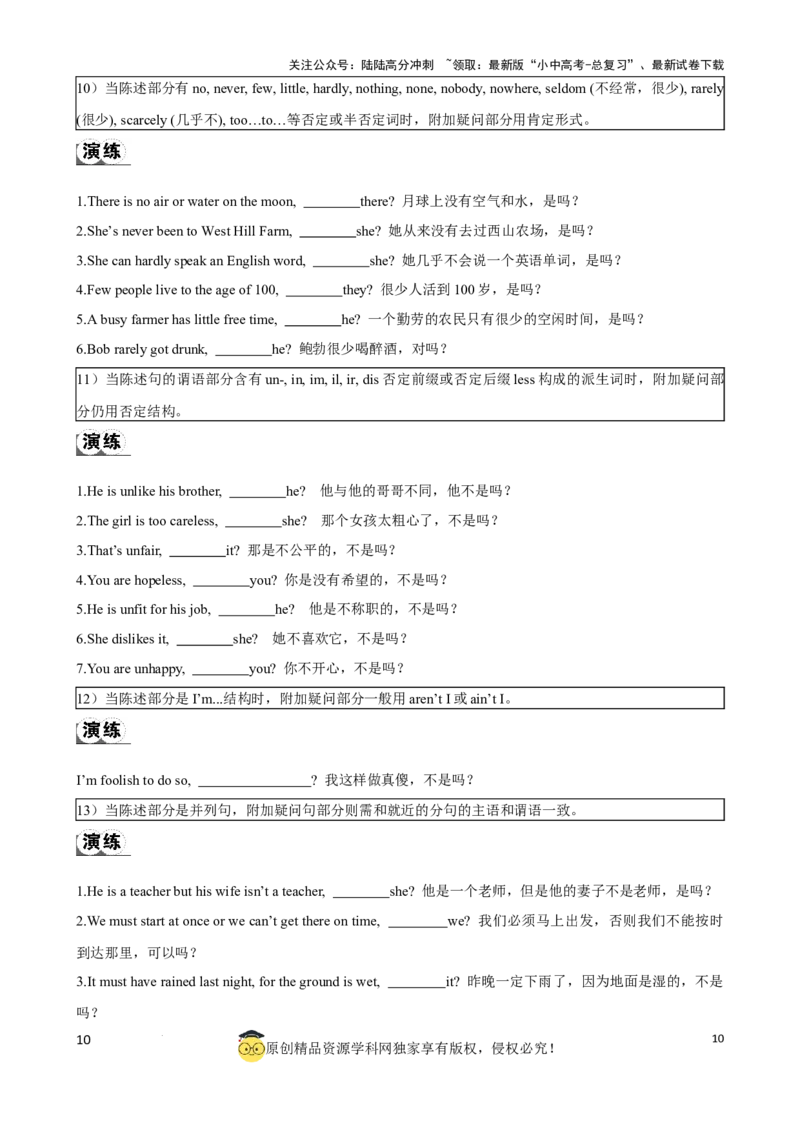
10)当陈述部分有no, never, few, little, hardly, nothing, none, nobody, nowhere, seldom (不经常,很少), rarely
(很少), scarcely (几乎不), too…to…等否定或半否定词时,附加疑问部分用肯定形式。
1.There is no air or water on the moon, there? 月球上没有空气和水,是吗?
2.She’s never been to West Hill Farm, she? 她从来没有去过西山农场,是吗?
3.She can hardly speak an English word, she? 她几乎不会说一个英语单词,是吗?
4.Few people live to the age of 100, they? 很少人活到100岁,是吗?
5.A busy farmer has little free time, he? 一个勤劳的农民只有很少的空闲时间,是吗?
6.Bob rarely got drunk, he? 鲍勃很少喝醉酒,对吗?
11)当陈述句的谓语部分含有un-, in, im, il, ir, dis否定前缀或否定后缀less构成的派生词时,附加疑问部
分仍用否定结构。
1.He is unlike his brother, he? 他与他的哥哥不同,他不是吗?
2.The girl is too careless, she? 那个女孩太粗心了,不是吗?
3.That’s unfair, it? 那是不公平的,不是吗?
4.You are hopeless, you? 你是没有希望的,不是吗?
5.He is unfit for his job, he? 他是不称职的,不是吗?
6.She dislikes it, she? 她不喜欢它,不是吗?
7.You are unhappy, you? 你不开心,不是吗?
12)当陈述部分是I’m...结构时,附加疑问部分一般用aren’t I或ain’t I。
I’m foolish to do so, ? 我这样做真傻,不是吗?
13)当陈述部分是并列句,附加疑问句部分则需和就近的分句的主语和谓语一致。
1.He is a teacher but his wife isn’t a teacher, she? 他是一个老师,但是他的妻子不是老师,是吗?
2.We must start at once or we can’t get there on time, we? 我们必须马上出发,否则我们不能按时
到达那里,可以吗?
3.It must have rained last night, for the ground is wet, it? 昨晚一定下雨了,因为地面是湿的,不是
吗?
10 10
原创精品资源学科网独家享有版权,侵权必究!
学科网(北京)股份有限公司关注公众号:陆陆高分冲刺 ~领取:最新版“小中高考-总复习”、最新试卷下载
14)当陈述部分为主从复合句时,附加疑问部分一般应与主句的主语和谓语动词保持对应关系。
1.She says that I did it, she? 她说是我做的,不是吗?
2.I told them not everybody could do it, I? 我告诉他们,不是每个人都能做,不是吗?
15)当陈述部分的主语是I/we,谓语是think, believe, suppose, expect, guess, imagine这类动词时,附加疑
问部分则往往与从句中的主语和谓语动词保持对应关系,但要注意否定的转移,如果否定意义转移到从
句中,附加疑问句部分要用肯定形式。
1.I don’t believe she says so, she? 我相信她不会说这话,会吗?
2.I think he can finish the work by himself, he? 我认为他能独立完成这项工作,不能吗?
16)当陈述部分为肯定祈使句时,附加疑问句一般用will/won’t you;当陈述部分为否定祈使句时,附加
疑问句一般用will you.
1.Be quiet, you? 请安静,好吗?
2.Don’t make so much noise, you? 别这样吵闹,好吗?
17)当陈述部分的祈使句为Let’s...结构时,则附加疑问部分用shall we;但当陈述部分的祈使句为Let
us ...结构时,则附加疑问部分用will you。
Let’s go skating, we? 咱们去滑冰,好吗?(包括听话人)
Let us go home, you? 让我们回家吧,好吗?(不包括听话人)
18)当陈述句的谓语是wish时,附加疑问部分的谓语用may,而且前后两个部分都用肯定式。
1.I wish to have a word with you, I? 我希望和你谈一下,可以吗?
2.I wish to have a chance to learn English, I? 我希望有机会学英语,可以吗?
19)当陈述部分为感叹句时,附加疑问句部分一般用be+not (缩写)+主语,be用现在时形式。
1.What a beautiful painting, it? 多漂亮的画,不是吗?
11 11
原创精品资源学科网独家享有版权,侵权必究!
学科网(北京)股份有限公司关注公众号:陆陆高分冲刺 ~领取:最新版“小中高考-总复习”、最新试卷下载
2.How hot, it? 多么热,不是吗?
20)当陈述部分的主语是指人的不定代词 everybody, everyone, someone, nobody, no one, somebody等合成
代词时,附加疑问句中的主语通常用they或he。
1.Somebody phoned while I was out, they/he? 当我不在的时候有人打电话给我了,不是吗?
2.Everybody is here, h e? 每个人都在这里,是不是?
3.Everyone enjoyed the party, ? 每个人都喜欢聚会,不是吗?
4.Nobody wants to go there, ? 没有人想去那里,是吗?
21)当陈述部分的主语是指物的不定代词 everything, nothing, anything, something时,附加疑问句中的主
语一般用it,不用they。
1.Everything is ready, it ? 一切都准备好了,不是吗?
2.Nothing is kept in good order, it ? 没有什么是保持良好秩序,是吗?
3.Everything seems all right now, i t? 现在似乎一切正常,不是吗?
4.Something must be done to stop pollution, it ? 必须采取某些措施来阻止污染,不是吗?
22)当陈述部分的主语是指示代词this, that或these, those时,附加疑问句部分的主语分别用it和they。
1.These are your friends Tom and Jack, the y? 这些都是你的朋友汤姆和杰克,不是吗?
2.This is important, i t? 这是重要的,不是吗?
3.That isn’t correct , it ? 那是不正确的,不是吗?
23)当陈述句子中的主语为动词不定式短语、动名词短语、短语或从句时,附加疑问部分的主语通常用
it。
1.Where to hold the meeting has not been decided, it? 在哪里开会还没有决定,是吗?
2.Drinking too much cola is bad for your health, it? 可乐喝得太多对你的身体不好,不是吗?
3.Between six and seven will suit you, i t? 六和七之间的适合你,不是吗?
4.What he said is right, i t? 他说的是对的,不是吗?
四 祈使句的构成形式及基本用法
祈使句是用来表示命令、请求、建议、劝告、号召等的句子,谓语动词用原形,句末用感叹号“!”或
12 12
原创精品资源学科网独家享有版权,侵权必究!
学科网(北京)股份有限公司关注公众号:陆陆高分冲刺 ~领取:最新版“小中高考-总复习”、最新试卷下载
句号“.”。朗读时一般用降调。
1. 肯定的祈使句:
(1)祈使句主语是you时,you常省略,但如果要特别强调对方或表达某种强烈的情绪时可以有主语或
称呼语。如:
Be quiet. 安静! // You be quiet! 你安静!
(2)“Do+祈使句”表示一种强烈的感情或请求,do起强调作用。如:
Do come on time! 一定要准时来!// Do look out! 一定要小心!
(3)有时为了表示一种客气、委婉的语气,可在句首或句末加please,但please加在句末时,前面必须
用逗号与其余部分分开。如:Open the window, please. 请打开窗! // Please listen to me carefully. 请认真
听我讲。
(4)Let引导祈使句时,后面需跟上人称代词或称呼语,人称代词一般只用第一、第三人称。如:
Let Jack wait a minute. 让杰克等一分钟。 // Let’s go to school. 让我们去上学吧。
(5)在祈使句中,Let’s和 Let us是有区别的。Let’s包括说话者在内,而Let us不包括说话者在内。这
点从反意疑问句时可明显看出。如:
Let’s go skating, shall we?(表示内部的建议) // Let us try again, will you?(表示向别人发出请
求)
2. 否定祈使句:
(1)Don’t/Never+动词原形。如:Don’t be late.不要迟到。// Don’t do that again! 别再那样做
了!
Never leave today’s work for tomorrow! 决不要把今天的工作留到明天!
(2)Let型的否定式有两种:“Don’t+let+宾语+动词原形+其它成分”和“Let+宾语+not+动词原形+其它
成分”。如:
Don’t let him go.= Let him not go. 别让他走。
Don’t let me go with her tomorrow.=Let me not go with her tomorrow. 不要让我明天跟她一起去。
(3)在公共场合的提示语中,否定祈使句常用“No+名词/V-ing形式”结构,表示“禁止做某事”。
如:
No fishing! 禁止钓鱼! // No smoking! 禁止吸烟! // No parking! 禁止停车!// NO PHOTOS! 禁止
拍照!
3.祈使句的反意疑问句需特别注意(见本专题考点三)
4.应答祈使句用将来时。如:
---- Don’t talk in class.“不要在课堂上讲话。”---- Sorry, I won’t.“对不起,我不会了。”
13 13
原创精品资源学科网独家享有版权,侵权必究!
学科网(北京)股份有限公司关注公众号:陆陆高分冲刺 ~领取:最新版“小中高考-总复习”、最新试卷下载
---- Remember to close the window when you leave. “记得离开时关窗户。”---- Yes, I will. “好的,我会
的。”
5.“祈使句+and/or+结果状语”句型,此句型可以转换成if引导的条件状语从句的主从复合
句。
Hurry up, or you will be late. 快点,否则你就迟到了。
=If you don’t hurry up, you will be late. 如果不快点,你就会迟到。
=If you hurry up, you won’t be late. 如果快点,你将不会迟到。
五 由what, how引导的感叹句的构成形式、用法及区别
感叹句是表示喜、怒、哀、乐以及惊异等感情的句子。句末用感叹号“!”,读时用降调,感叹句
往往由what或how引导,what修饰名词,how修饰形容词,副词或动词。
1. what引导的感叹句:
(1)what + a/an +形容词+单数可数名词+主语+谓语!
(2)what+形容词+可数名词复数/不可数名词+主语+谓语!
2. How引导的感叹句:
(1)How+形容词/副词+主语+谓语!
(2)How+主语+谓语!
(3)How+形容词+a/an+单数可数名词+主语+谓语!
3. what和how引导的感叹句有时可以互换,但是要注意词序的变化。
1. a tall boy your brother is! 你哥哥是一个多么高的男孩!
2. beautiful pictures they are! 那些图画多美丽呀!
3. terrible weather it is! 天气多么糟糕啊!
4. cold it is! 天气多么冷啊!
5. hard he works! 他工作多么努力啊!
6. he loves his son! 他多么爱他儿子啊!
7. I miss you! 我多么想你啊!
8. tall a tree it is! 它是一颗多么高的树啊!
9. a clever boy he is!= clever a boy he is!= clever the boy is! 他是多聪明的孩子!
题组1填空题
1.“ interesting it is! This is simply fantastic!” he cried excitedly.
14 14
原创精品资源学科网独家享有版权,侵权必究!
学科网(北京)股份有限公司关注公众号:陆陆高分冲刺 ~领取:最新版“小中高考-总复习”、最新试卷下载
2. a clever boy he is!
3. Just before the lights turned dark, I saw my father rush into the hall and take the seat beside my mother.
a pleasant surprise it was!
4.So, w not stop taking photos and just enjoy the food ahead of you?
5.Simon, (推)hard when I tell you to.
6.But later her condition improved. a brave girl!
题组2 选择题
1.(2023·四川雅安·统考中考真题)—Look at Panda YaYa! ________ happy she is!
—Yes. There is enough fresh bamboo for her to eat now.
A.What B.What a C.How a D.How
2.(2023·江苏宿迁·统考中考真题)— There ________ a lot of new magazines in our school reading room.
— Oh, really? Shall we go there this afternoon?
A.is B.was C.are D.were
3.(2023·江苏宿迁·统考中考真题)—China won all the gold medals at the 2023 World Table Tennis
Championships.
—______ exciting news!
A.What a B.How a C.How D.What
4.(2023·辽宁抚顺·统考中考真题)Look! There ________ some information about traffic safety in this book.
A.is B.are C.was D.were
5.(2023·吉林长春·统考中考真题)— Which season do you like better in Changchun, winter or autumn?
— _______. I like playing with snow.
A.Yes, I do B.No, I don’t C.Winter D.Autumn
6.(2023·吉林长春·统考中考真题)_______ good day! Why not take a walk along the sea?
A.What B.What a C.How D.How a
7.(2023·吉林长春·统考中考真题)_______ less time on the phone at night, or you will find it hard to fall
asleep.
A.Spend B.Spending C.To spend D.Spent
8.(2023·黑龙江·统考中考真题)—You haven’t visited the Palace Museum, have you?
—________ How I wish to visit it some day!
A.No, I haven’t. B.Yes, I haven’t. C.Yes, I have.
9.(2023·黑龙江·统考中考真题)—It was the Dragon Boat Festival last Thursday. I watched the boat races by
the lake.
15 15
原创精品资源学科网独家享有版权,侵权必究!
学科网(北京)股份有限公司关注公众号:陆陆高分冲刺 ~领取:最新版“小中高考-总复习”、最新试卷下载
—________, but I didn’t see you there.
A.So did I B.So I did C.Neither did I
10.(2023·黑龙江绥化·统考中考真题)— Our school volleyball team won the first prize last Friday.
— Wow, ________ great news!
A.what an B.what a C.what
11.(2023·黑龙江绥化·统考中考真题)— Attention, please! ________ inside because of the heavy rain.
— We will, Mr. Li.
A.To stay B.Stay C.Staying
12.(2023·广西·统考中考真题)—Cindy, do you know Wan Buyan?
—________. He received the title “Role Model of the Times” in May, 2023.
A.Yes, there is B.Yes, he will C.Yes, I do
13.(2023·辽宁锦州·统考中考真题)—________ good advice it is! I’m sure to have a wonderful summer
vacation.
—I’m so glad that you like it.
A.How B.What a C.What D.What an
14.(2023·青海·统考中考真题)—More and more wild animals have been found as the natural environment
improved in Guoluo.
—_________ exciting it is!
A.What B.How a C.How
15.(2023·吉林·统考中考真题)________ interesting movie it is! I want to see it again.
A.What B.What an C.How
【答案】B
题组3、语法选择
When it becomes colder and colder and you see people sneezing and getting a runny(流鼻涕的) nose, you
should think about getting vaccinated (接种疫苗) to protect yourself against the flu. Below are some commonly
asked questions about this illness. 1 on and you'll find out how to prevent yourself from getting it.
Q: 2 I need to be vaccinated against the flu?
A:The Centers for Disease Control and Prevention in the US recommends that everyone aged 6 months and older
receive a flu vaccine.
Q: 3 does a flu shot (注射) work?
A:The formula(配方) in the shot helps your immune system(免疫系统) to produce antibodies(抗体). The
16 16
原创精品资源学科网独家享有版权,侵权必究!
学科网(北京)股份有限公司关注公众号:陆陆高分冲刺 ~领取:最新版“小中高考-总复习”、最新试卷下载
antibodies work against the three most common flu viruses.
Q:Do I really need a vaccine every year?
A: 4 . This is because public health officials look at which of the flu viruses will be the most common every
year. Then they set a formula to work against those special viruses. So the formula can change from year to year.
Q: 5 does the flu season start?
A:It usually begins in October and can last through May. But people don't know when the flu will strike, and
seasonal peaks may be different in different areas.
Q:I hate needles (针)!I can take a flu pill instead, 6 I?
A:Unfortunately, you can't! But now, there is a new, less scary method. It uses a new needle, about 90 percent
smaller than the standard one. It goes just under the skin rather than deep into the muscle, causing less pain later.
People aged from 18 to 64 can have this kind of vaccine.
Q: 7 are the risks(风险)?
A:Serious problems from flu vaccines seldom happen. Common mild problems include:soreness or redness where
the shot was given, a fever, a headache, and a cough. Allergic (过敏的) reaction symptoms include:difficult
breathing, a fast heart rate and hives (荨麻疹).
Q: 8 dangerous it seems! What should people do if such problems happen?
A:People with severe allergies, especially to eggs, should talk to their doctors before getting a shot.
1.A.Read B.To read C.Readed D.Reading
2.A.Do B.Does C.Are D.Did
3.A.What B.How C.Why D.When
4.A.Yes, I do B.No, I don't
C.Yes, you do D.No, you don't
5.A.Where B.When C.Which D.Why
6.A.can B.can't C.do D.don't
7.A.What B.How C.When D.Where
8.A.What B.What a C.How D.How a
题组4 短文填空
One day, I wanted my father to get some fruit for me.So I said to my father, “Dad, 1 here!” When my
dad heard me, he came over right away. However, my mom said to me, “ 2 say it that way. Say it more
politely.”
“I didn't want to.” I replied.“If you don't say it politely, then 3 watching TV from now on!” my mom
said angrily.
17 17
原创精品资源学科网独家享有版权,侵权必究!
学科网(北京)股份有限公司关注公众号:陆陆高分冲刺 ~领取:最新版“小中高考-总复习”、最新试卷下载
4 sad I was when I heard this! Then my mom said,“ 5 you want others to be polite to you? If so,
you should be polite to others too.”
Indeed, we should be polite, or it might make others feel uncomfortable.
1. 2. 3. 4. 5.
18 18
原创精品资源学科网独家享有版权,侵权必究!
学科网(北京)股份有限公司关注公众号:陆陆高分冲刺 ~领取:最新版“小中高考-总复习”、最新试卷下载
19 19
原创精品资源学科网独家享有版权,侵权必究!
学科网(北京)股份有限公司