关注公众号:陆陆高分冲刺 ~领取:最新版“小中高考-总复习”、最新试卷下载
定语从句考点聚焦和精讲
1. 定语从句的定义:修饰一个名词或代词的从句称为定语从句,一般紧跟在它所修饰的先行词后面。
2. 定语从句的先行词:被定语从句修饰的词叫先行词。先行词在定语从句中充当主语,宾语,时间状
语,地点状语,原因状语。
3. 定语从句的关系词:引导定语从句的关联词称为关系词。关系词有关系代词和关系副词。
关系代词有that, which, who, whom, whose, as 等;
关系副词有where, when, why等。
关系词常有3个作用:1. 引导定语从句。2. 代替先行词。3. 在定语从句中担当一个成分。
4. 定语从句的结构:先行词+关系词+定语从句。
5. 关系代词引导的定语从句
(1)who指人,在从句中做主语。
The woman visited our factory yesterday is an Australian friend. 昨天参观我们工厂的女士
是一位澳大利亚朋友。
(2)whom指人,在定语从句中充当宾语,常可省略。
【注意】关系代词whom在口语和非正式语体中常用who代替,可省略。
1.This is the student I met yesterday. 这是我昨天见到的那个学生。
2.Who’s that man you just talked to? 刚才与你谈话的那个男人是谁?
3.The man you met just now is my friend. 你刚刚遇见的那个人是我的朋友。
(3)which指物,在定语从句中做主语或者宾语,做宾语时可省略。
1.The shoe shop is a shop sells shoes. 鞋店是销售鞋的商店。
2.The book I read last night was wonderful. 我昨晚看的那本书很精彩。
(4)that指人时,相当于who 或者whom;指物时,相当于which。在宾语从句中做主语或者宾语,做
宾语时可省略。
1 1
原创精品资源学科网独家享有版权,侵权必究!
学科网(北京)股份有限公司关注公众号:陆陆高分冲刺 ~领取:最新版“小中高考-总复习”、最新试卷下载
1.She is one of the students works very hard. 她是最用功的学生中的一个。
2.A library is a place people like very much. 图书馆是一个人们非常喜欢的地方。
(5)whose通常指人,也可指物,在定语从句中做定语。
【注意】whose指物时,常用以下结构来代替。
1.This is our classmate, Mary, home is not far from our school. 这是我们的同学玛丽,她的家离我
们学校不远。
2.He has a friend father is a doctor. 他有一个爸爸是医生的朋友。
3.I once lived in a house roof has fallen in. 我曾经住在一幢屋顶已倒塌的房子。
4.Do you like the book cover is yellow? 你喜欢那本封面是黄色的书?
=Do you like the book the cover is yellow? 你喜欢那本封面是黄色的书?
5.The classroom door is broken will soon be repaired. 门坏了的那个教室将很快修复。
=The classroom the door is broken will soon be repaired. 门坏了的那个教室将很快修
复。
(6)介词+关系代词引导的定语从句:关系代词在定语从句中做介词宾语时,从句常由介词+关系代词引
导。
① 含有介词的动词短语一般不拆开使用,如:look for, look after, take care of等。
② 若介词放在关系代词前,关系代词指人时用whom,不可用who或者that;指物时用which,不能
用that;关系代词是所有格时用whose。
1.This is the watch which/that I am looking for. (T) // This is the watch for which I am looking. (F)
The man with whom you talked is my friend. (T) // The man who/that you talked with is my friend. (F)
The plane in which we flew to Canada is very comfortable. (T) // The plane in that we flew in to Canada is very
comfortable. (F)
7. 关系副词引导的定语从句
(1)when引导的定语从句其先行词往往是表示时间的名词,在句中作状语。关系副词when引导的定语
从句也可以转换为“介词+which”引导的定语从句。
【注意】若定语从句的先行词是时间,但定语从句缺主语或宾语,则用which或that引导定语从句。
1.I still remember the day I first came to Beijing. 我仍然记得来北京的第一天。
2.I still remember the time I lived in the countryside. 我还记得我住在乡下的时候。
2 2
原创精品资源学科网独家享有版权,侵权必究!
学科网(北京)股份有限公司关注公众号:陆陆高分冲刺 ~领取:最新版“小中高考-总复习”、最新试卷下载
3.I’ll never forget the time I spent on campus. 我决不会忘记我在校园中度过的日子。
4.I’ll never forget the time was spent with you. 我永远不会忘记你在一起的时光。
(2)where引导的定语从句其先行词往往是表示地点的名词,在句中作状语。关系副词 where引导的定
语从句可以转换为“介词+which”引导的定语从句。
【注意】若定语从句的先行词是地点,但定语从句缺主语或宾语,用 which或that引导定语从句,而不用
where来引导。
1.Shanghai is the city I was born. 上海是我出生的城市。
2.The hotel we stayed wasn’t clean. 我们住的那个旅馆不干净。
3.This is the house I lived two years ago. 这就是我两年前住的房子。
4.The library you visited yesterday was built in 1990. 你昨天参观的图书馆建于1990年。
(3)why引导的定语从句其先行词往往是表示原因的名词(excuse ; explanation; reason),在句中作状
语。关系副词why引导的定语从句可以转换为“for +which ”引导的定语从句。
【注意】若定语从句的先行词是reason,但定语从句缺主语或宾语,则用which或that引导定语从句。
1.I know the reason he came late. 我知道他来晚的原因。
2.We can’t accept the excuse you were absent. 我们不能接受你缺席的借口。
3.This is the explanation they put off the meeting. 这就是他们推迟会议的解释。
4.The reason she gave was not true. 她给的原因不是真的。
8. 限制性定语从句和非限制性定语从句
限制性定语从句:从句对先行词进行必要的描述或说明,缺少它,则句义显得不完整,从句与先行
词紧密相连。同先行词之间一般不加逗号,仅修饰先行词,可以由关系代词、关系副词或that来引导。
非限制性定语从句:对先行词进行补充说明,解释,它与先行词之间有逗号隔开,既可修饰先行
词,又可修饰整个主句,不可用that引导。
(1)限制性定语从句举例:
China is a country which has a long history. 中国是一个具有悠久历史的国家。
The teacher told me that Tom was the only person that I could depend on. 老师告诉我汤姆是我唯一可以依靠
的人。
(2)非限制性定语从句举例:
3 3
原创精品资源学科网独家享有版权,侵权必究!
学科网(北京)股份有限公司关注公众号:陆陆高分冲刺 ~领取:最新版“小中高考-总复习”、最新试卷下载
His mother, who loves him very much, is strict with him. 他妈妈十分地爱他,对他要求很严格。
China, which was founded in 1949, is becoming more and more powerful. 成立于1949的中国,正变得越来越
强大。
要注意区分以下句子的不同:
His brother who is now a doctor always encourages him to go to college. 他那当医生的哥哥常鼓励他要考上大
学。(他还有其他的哥哥)
His brother, who is now a doctor, always encourages him to go to college. 他的哥哥是当医生的,常鼓励他要
考上大学。(他只有一个哥哥)
9. 限制性定语从句只能用that 的几种情况
① 先行词为不定代词all, few, little, much, everything, nothing 等。
② 先行词被序数词或形容词的最高级修饰时。
③ 先行词被all, any, every, few, little, no, some 等不定代词修饰时。
④ 先行词被the only, the very, the last, the same 等修饰时。
⑤ 当主句是以who或 which 开头的特殊疑问句时,定语从句用that 引导。
⑥ 先行词既有人又有物时。
⑦ time作先行词,前面如果有序数词或 last 修饰时,定语从句用 that 来引导或省略;如果没有序数词
或 last 修饰时,既可用 when 也可用that来引导。
1.All he said is true. 他所说的都是真的。
2.All you have to do is to practice every day. 你要做的就是每天都要练习。
3.The first lesson I learned will never be forgotten. 我将永远不会忘记我上的第一堂课。
4.This is the best film I have ever seen. 这是我看过的最好的一部电影。
5.I have read all the books you gave me. 我已经读完了你给我的所有的书。
6.The white flower is the only one I really like. 这朵白花是我唯一真正喜欢的。
7.This is the very book I want to read. 这就是我要看的那本书。
8.This is the same skirt I want to buy. (同一条裙子) 这就是我想买的那条裙子。
9.This is the only book I have read this year. 这是我今年读过的唯一的一本书。
10.Who is the man is standing there? 站在那儿的那个人是谁?
11.Which of us knows something about physics doesn't know this? 在我们懂点物理的人当中有谁
不知道这个?
4 4
原创精品资源学科网独家享有版权,侵权必究!
学科网(北京)股份有限公司关注公众号:陆陆高分冲刺 ~领取:最新版“小中高考-总复习”、最新试卷下载
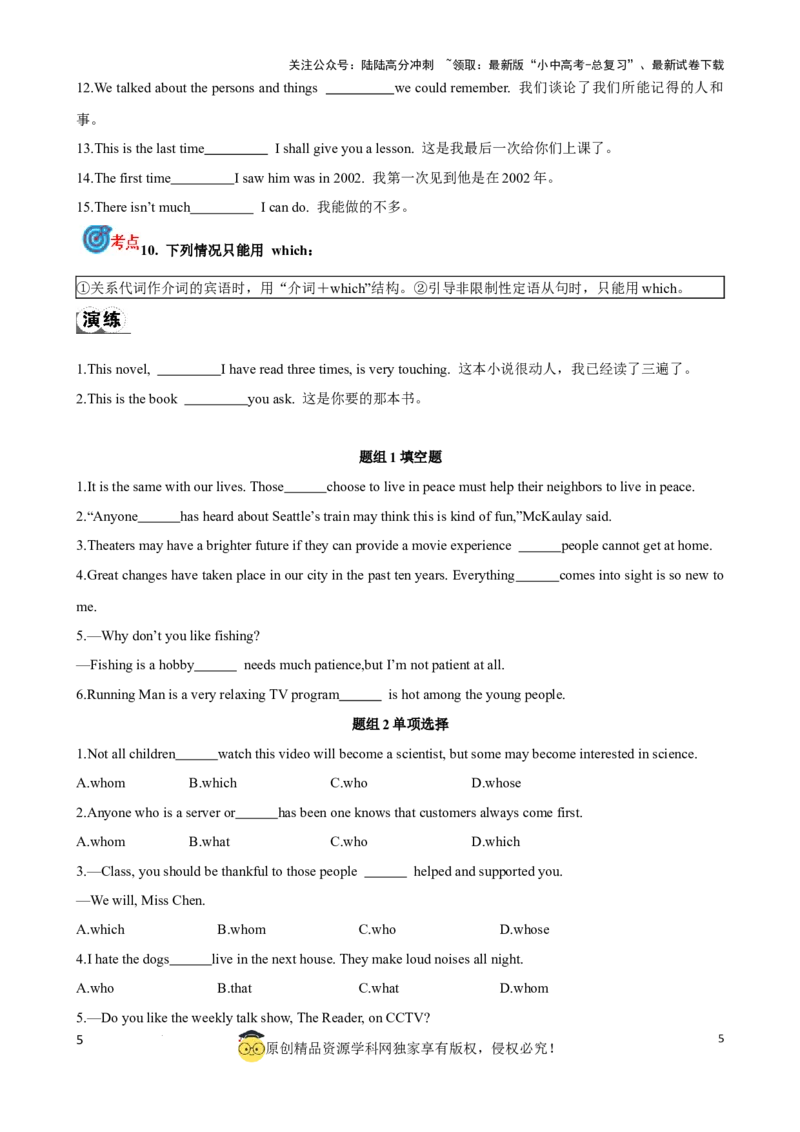
12.We talked about the persons and things we could remember. 我们谈论了我们所能记得的人和
事。
13.This is the last time I shall give you a lesson. 这是我最后一次给你们上课了。
14.The first time I saw him was in 2002. 我第一次见到他是在2002年。
15.There isn’t much I can do. 我能做的不多。
10. 下列情况只能用 which:
①关系代词作介词的宾语时,用“介词+which”结构。②引导非限制性定语从句时,只能用which。
1.This novel, I have read three times, is very touching. 这本小说很动人,我已经读了三遍了。
2.This is the book you ask. 这是你要的那本书。
题组1填空题
1.It is the same with our lives. Those choose to live in peace must help their neighbors to live in peace.
2.“Anyone has heard about Seattle’s train may think this is kind of fun,”McKaulay said.
3.Theaters may have a brighter future if they can provide a movie experience people cannot get at home.
4.Great changes have taken place in our city in the past ten years. Everything comes into sight is so new to
me.
5.—Why don’t you like fishing?
—Fishing is a hobby needs much patience,but I’m not patient at all.
6.Running Man is a very relaxing TV program is hot among the young people.
题组2单项选择
1.Not all children watch this video will become a scientist, but some may become interested in science.
A.whom B.which C.who D.whose
2.Anyone who is a server or has been one knows that customers always come first.
A.whom B.what C.who D.which
3.—Class, you should be thankful to those people helped and supported you.
—We will, Miss Chen.
A.which B.whom C.who D.whose
4.I hate the dogs live in the next house. They make loud noises all night.
A.who B.that C.what D.whom
5.—Do you like the weekly talk show, The Reader, on CCTV?
5 5
原创精品资源学科网独家享有版权,侵权必究!
学科网(北京)股份有限公司关注公众号:陆陆高分冲刺 ~领取:最新版“小中高考-总复习”、最新试卷下载
—Sure. It’s a great TV programme brings the habit of reading back into the public.
A.who B.that C.what
6.She often parks her car near the house she can easily get to.
A.where B.who C.which D.what
题组3
1.(2023·湖北十堰·统考中考真题)I will remember the important people ________ helped and supported me
in my life.
A.which B.whose C.whom D.who
2.(2023·四川遂宁·中考真题)Miss Xiang is a great teacher _________always makes her classes lively and
fascinating.
A.which B.who C.what D.whom
3.(2023·新疆·中考真题)Lots of Chinese young people ___________ were born after 1995 use door-to-door
cooking to save time.
A.that B.those C.which D./
4.(2023·吉林·统考中考真题)The students are reading books ________ are full of the “red spirit” these days.
A.who B.where C.which
83.(2023·黑龙江·统考中考真题)— What can we do for the left-home children ________ need help?
— We could help them with their study online on weekends.
A.which B.who C.whom
5.(2023·黑龙江绥化·统考中考真题)Mrs. Wang is an English teacher ________ makes her class lively.
A.which B.whose C.who
6.(2023·四川乐山·统考中考真题)Guo Moruo is a famous Chinese writer ________ is popular around the
world.
A.which B.whom C.who
7.(2023·湖南株洲·统考中考真题)Today’s China is a country ________ keeps to this national character.
A.what B.who C.that
8.(2023·湖南郴州·统考中考真题)Tea is the leaf of a plant ________ grows widely in China, Japan and
other countries.
A.what B.who C.that
题组4语法选择
One day, 14-year-old Wen Jiayi posted a photo on QQ 1 she took when she graduated (毕业) from
primary school. However, one of her classmates wrote “You're so ugly” and “Idiot” under the photo. Wen was
6 6
原创精品资源学科网独家享有版权,侵权必究!
学科网(北京)股份有限公司关注公众号:陆陆高分冲刺 ~领取:最新版“小中高考-总复习”、最新试卷下载
shocked 2 didn't know how to reply.
This is a typical example of cyber bullying (网络欺凌), 3 refers to sending, posting, or sharing
negative (消极的) contents about someone else online. Lots of kids these days have experienced some form of
cyber bullying. According to a recent survey by the Chinese Academy of Social Sciences (中国社会科学院),
there are nearly 30 percent of teenagers in China 4 have been bullied online. The most common form of
cyber bullying is the use of abusive (辱骂的) language, such as calling somebody's names or saying rude things
about them.
Nearly 70 percent of cyber bullying happens through social media, similar to 5 Wen experienced.
Other kinds of bullying happen in online communities and on video and news sites. This is familiar to Sun
Zhenyao, 14, 6 studies in Hefei No. 50 Middle School in Anhui. 7 he comments (评论) on news
articles, he sometimes receives rude messages from strangers. “It comes out of nowhere and drives me crazy,” Sun
said. He adds the bullies to his blacklist and reports them to the sites he posts on.
“However, most victims don't take this kind of action. About 60 percent of cyber bullying victims stay
silent,” experts say. But 8 you receive threatening (威胁性的) messages, you should ask your parents or
teachers for help. Cyber bullying can be a real threat. “I think 9 it's as harmful as physical bullying. It does
harm to our mental health, 1 0 is hard to deal with,” Wen said.
1.A.what B.that C.when D.who
2.A.and B.but C.or D.so
3.A.that B.what C.which D.where
4.A.which B.who C.whom D.whose
5.A.that B.which C.what D.who
6.A.which B.who C.whom D.whose
7.A.If B.Though C.When D.Before
8.A.if B.unless C.because D.until
9.A.whether B.why C.when D.that
10.A.where B.what C.which D.that
题组5 短文填空
During the Jin Dynasty (266—420), there was a child 1 name was Che Yin. He was smart and loved to
read. He grew up in a poor family 2 couldn't afford lamp oil (灯油) to study at night.
One night, he saw fireflies (萤火虫) outside his house and came up with an idea. He caught some fireflies in
a bag 3 he hung up as a lamp. It is said 4 he spent all of his summer nights reading like this.
7 7
原创精品资源学科网独家享有版权,侵权必究!
学科网(北京)股份有限公司关注公众号:陆陆高分冲刺 ~领取:最新版“小中高考-总复习”、最新试卷下载
Another child named Sun Kang also loved reading. One night during winter, Sun used up all of his lamp oil
and couldn't study at night. 5 he woke up at midnight, he saw the snow reflecting (反射) the moonlight
outside his house. “Oh, I can use the reflected light to read!” he thought. He took out his books and read, 6 he
was cold.
Both of these kids later became successful government officials (官员). People were touched by their
hardworking spirit and turned their stories into the Chinese idiom (成语) nangying yingxue.
1. 2. 3. 4. 5. 6.
8 8
原创精品资源学科网独家享有版权,侵权必究!
学科网(北京)股份有限公司关注公众号:陆陆高分冲刺 ~领取:最新版“小中高考-总复习”、最新试卷下载
9 9
原创精品资源学科网独家享有版权,侵权必究!
学科网(北京)股份有限公司