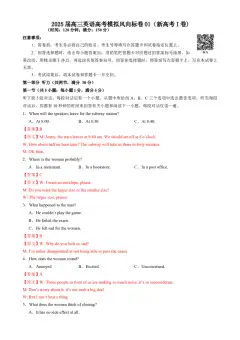
2025届高三英语高考模拟风向标卷01 (浙江特供卷)
(时间:120分钟;满分:150分)
注意事项:
1.答卷前,考生务必将自己的姓名、考生号等填写在答题卡和试卷指定位置上。
2.回答选择题时,选出每小题答案后,用铅笔把答题卡对应题目的答案标号涂黑。如需
改动,用橡皮擦干净后,再选涂其他答案标号。回答非选择题时,将答案写在答题卡上。写在本试卷上无
效。
3.考试结束后,将本试卷和答题卡一并交回。
第一部分 听力(共两节,满分 30 分)
第一节(共5小题;每小题1分,满分5分)
听下面5段对话。每段对话后有一个小题,从题中所给的A、B、C三个选项中选出最佳选项。听完每段
对话后,你都有10秒钟的时间来回答有关小题和阅读下一小题。每段对话仅读一遍。
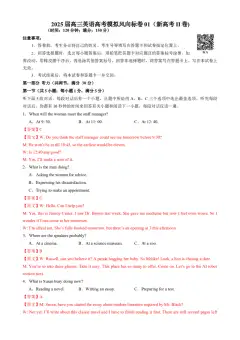
1.What will the speakers do first?
A.Get some gas. B.Watch a play. C.Eat something.
2.Where does the conversation mostly take place?
A.At the lab. B.At the library. C.At the classroom.
3.What are the speakers mainly talking about?
A.A holiday. B.A dish. C.A tradition.
4.Why does the son go on a theater trip?
A.To learn how to put on a play.
B.To raise money for his club.
C.To volunteer for the theater.
5.What is the man's attitude towards the changes?
A.Pleased. B.Confused. C.Worried.
第二节(共15小题;每小题1分,满分15分)
听下面5段对话或独白。每段对话或独白后有几个小题,从题中所给的A、B、C三个选项中选出最佳选
项。听每段对话或独白前,你将有时间阅读各个小题,每小题5秒钟;听完后,各小题将给出5秒钟的作
答时间。每段对话或独白读两遍。
听第6段材料,回答6~7小题。
6.Why does the man talk to Sarah?
A.To ask for information. B.To extend an invitation. C.To make an appointment.
7.When is the man scheduled to meet the HR department?
A.This afternoon. B.Tomorrow morning. C.Next Monday afternoon.
听第7段材料,回答8~10小题。
8.Why does the man go to the woman?
A.To borrow books. B.To ask for time extension. C.To submit his work.
9.Whose book is the man reading now?
A.Oliver’s. B.Billy’s. C.Andrew’s.10.What will the man probably do?
A.Design a survey. B.Analyze research data. C.Interview specialists.
听第8段材料,回答11~13小题。
11.What does the woman think of the catalogue?
A.It is useless. B.It is detailed. C.It is simple.
12.What is the man satisfied with about the exhibition?
A.Its use of natural light. B.Its supply of energy drinks. C.Its gift of free catalogues.
13.What surprised the man a lot?
A.The artworks were disappointing. B.Few visitors came to the exhibition.
C.The weather was pleasant.
听第9段材料,回答14~17小题。
14.What is the woman using ChatGPT to do?
A.Organize outlines. B.Generate contents. C.Get unique opinions.
15.What does ChatGPT prefer in the study?
A.Science fiction. B.Romance novels. C.Historical books.
16.How was ChatGPT tested in the study?
A.By writing sci-fi stories.
B.By participating in a quiz(测验).
C.By acting as a student.
17.Who likes Interstellar most?
A.Jamie. B.Devin. C.Dr. Robert.
听第10段材料,回答18~20小题。
18.Who might injure the old man?
A.A stranger. B.His wife. C.His neighbor.
19.What did the manager say about the English team?
A.They did very well.
B.They moved more than slow.
C.Their attacking style was average.
20.Why did the English team fight with the judges?
A.They judged a wrong goal.
B.They stopped the team from kicking.
C.They gave a wrong card to its member.
第二部分 阅读(共两节, 满分50分)
第一节(共15小题:每小题2.5分, 满分37.5分)
阅读下列短文, 从每题所给的A、B、C、D四个选项中选出最佳选项。
A
OpenLearn is a free learning platform, delivered by the Open University (OU) as part of its commitment tosupport the wellbeing of the community. Since its launch in 2006, OpenLearn has become an integrated part of the
Open University, with the site attracting over 100 million visitors. Many of these visitors go on to make an enquiry
about becoming a formal student.
You can use OpenLearn to:
* browse the subject categories to discover articles, watch videos and interact with online games created by
our academic experts and guest contributors;
* discover the most popular courses and articles with our top 10 lists;
* take our free courses;
* explore new topics to build your personal knowledge or look for reference material for an OU unit you are
already studying.
What are the advantages?
● Flexible Learning: With OpenLearn, you have the freedom to work through the courses at your own pace.
● Diverse Course Selection: OpenLearn offers a wide range of courses, with about 1,000 options to choose
from.
● Courses from the Open University: If you’ re interested in taking an Open University course but are not
sure what to study, then OpenLearn lets you try out what’s on offer. It allows prospective students to get a feel for
the subjects and teaching methodology before committing to a formal program of study.
Note: On successful completion of our free courses, you will be able to get a free statement of participation.
This document can be shared digitally or printed. Though the courses do not contribute formal credit towards a
qualification or degree, the statement of participation can help show your interest in a subject and a commitment to
your career.
21.What can users do by visiting OpenLearn?
A.Register as a formal OU student.
B.Seek academic help for their study.
C.Interact with personal learning tutors.
D.Assist professors in improving teaching.
22.What benefit does OpenLearn provide for students who are interested in OU courses?
A.Experiencing the offered courses in advance.
B.Gaining the guidance of learning methods.
C.Obtaining more courses than other students.
D.Entering a formal study program ahead of time.
23.What can you get after completing an OpenLearn course?
A.The priority to apply to OU. B.Certain credits to a degree.
C.A professional certification. D.Proof of participation.
B
When my brother died in an accident, I was only 4 years old. But I still felt the big change in my mom’s
attitude toward safety. Overnight, I couldn’t walk home from school by myself, even
though everyone I knew already did. I couldn’t go to summer camps, because what if something happened to me?
As I grew up, the list got longer and longer.
I know my mom was worried about me because after my brother died, I was her only child. As a result, Ibecame a natural worrier. I worried about things like car accidents, earthquakes, losing my wallet — disasters big
and small, real and imagined.
The funny part is that you’d never know it by looking at my current life, because I have been constantly
forcing myself to do things that frighten or worry me shortly after my mom’s death. Since then I have developed a
rule for myself: If anything scares me, then I will force myself to do it at least once. As a result, I’ve done lots of
things that my mom would have worried about: I’ve ridden a motorcycle and I’ve traveled — a lot. In fact. I am
studying bird flu as a scientist.
There’s something else I don’t usually talk about, but it’s a cornerstone in my belief: When I was 14, I
made a decision that I would either live out the rest of my life trying to be “safe” or I could be brave enough to
live out an exciting and, yes, sometimes dangerous life.
Even though I inherited(继承) my mother’s cautious nature, I’ve also come to believe that the more often I
do things that scare me, the more I realize that I can do a lot more than I originally thought I could do. Believing
that has made my world a less scary place.
24.What does the author think of her mother?
A.Courageous. B.Overprotective. C.Hardworking. D.Cruel.
25.How did the rules affect the author before her mother’s death?
A.They led to much more freedom for her.B.They helped her to avoid a lot of accidents.
C.They made her feel more and more worried. D.They encouraged her to be more adventurous.
26.What did the author do to overcome her fear?
A.She tried to do those seemingly scary things.
B.She stayed away from the unnecessary risks.
C.She forced herself to focus on her current job.
D.She persuaded her mother to stop protecting her.
27.What does the author most likely want to tell us?
A.It’s funny for parents to worry about the kids.
B.Fear can be a good thing to some degree.
C.We should be careful in a dangerous world.
D.We can achieve more if we can control our fear.
C
Could our evaluation of art be changing in wake of artificial intelligence? A critic might say that AI
programs could never grasp the human pursuit of art. Whether that is true or not, it does not mean they won’t lead
to major shifts in the ways humans perceive art. To understand this, let’s consider a few ways in which we
evaluate art.
Economists often say that it is tough to assign an objective value to works of art. What makes someone pay
millions of dollars for a Van Gogh and next to nothing for Van Gogh lookalike? What is art really worth? Experts
often agree that art is often evaluated in terms of its authenticity (真实性) - whether it was produced by a specific
person, in a certain place, in a special way, or at a momentous time. Similarly, research shows that we rate art
produced by humans as more skillful and expensive than AI. It seems that the importance of source information
may work as a standard for authenticity employed in the evaluation of art.Another form of authenticity is called “motivational authenticity”. We can break it into two parts: the
absence of submission to external motivation and the presence of international motivation. Was the artist
producing work because they desired money and fame or because they desired pure self- expression and creative
freedom? The latter is often praised, the former criticized. This division may take on increasing importance as
technology continues to develop. AI programs occupy a particularly tricky space when it comes to motivation. On
the one hand, one may say AI programs lack the necessary internal emotional expressiveness, the internal drive to
produce art. On the other hand, one could make a similarly strong argument that art produced by AI is never
produced for money, fame, or respect, but for no other reason than production, which is often considered laudable
in the human artist.
The introduction of AI in the art world should allow us to look at artistic authenticity in a new light. Where
will it lead us? Let’s wait and see.
28.Which of the following can be the least valuable according to paragraph 2?
A.A Van Gogh lookalike. B.A Van Gogh image by AI.
C.An ink painting by Qi Baishi. D.A sculpture by an art student.
29.What may we agree about motivational authenticity?
A.It refers to submission to external motivation.
B.It increases the importance of technology.
C.It reflects the internal drive to produce art.
D.It applies to humans rather than AI programs.
30.What does the underlined word “laudable” in paragraph 3 mean?
A.Praiseworthy. B.Necessary. C.Acceptable. D.Pointless.
31.What is the text mainly about?
A.AI’s influence on art evaluation. B.Standards for authenticity in art.
C.Latest development of AI programs. D.The introduction of AI generated art.
D
Many of us love sweet, carbonated drinks — even though we know they’re not good for our teeth or our
bodies. But a large new study has found that they could be bad for our minds, too. Researchers from South Korea
have found that drinking more sugar-filled, carbonated drinks is linked to an increased risk of depression.
The team looked at data from more than 87, 000 people in South Korea, with an average age of about 40.
Participants were asked about their consumption of sugar-sweetened carbonated drinks over a week. They were
then put into groups based on their consumption, from people who almost never drank them — less than one
200ml serving per week—to those who drank five or more servings per week. The researchers compared this with
people’s scores on a questionnaire designed to check for symptoms (症状) of depression.
The study found that depressive symptoms increased proportionally (成比例地) with consumption of sweet,
carbonated drinks. “Even the group that consumed sugar-sweetened carbonated drinks at least once a week had a
higher look through of depressive symptoms than the group that did not drink at all.” said Ju Young Jung, one of
the authors.
The results were not affected when taking obesity (肥胖) into account, the researchers said.They said they were a little surprised to see such clear results — South Koreans don’t usually have sugary drinks
as often as people in places like Europe and the US. However, they said South Koreans and others in Asia are
increasingly replacing water with sugary drinks — and the study found that about one third of participants
consumed these drinks more than once a week.
Jung said the team wasn’t sure exactly why sugary drinks are linked to depression, although their results are
similar to those from some recent, smaller studies. The study did not consider zero-calorie drinks, but Jung said
more research would be needed to look at the effect of zero-calorie drinks.
32.What is Paragraph 2 mainly about?
A.The limits of the study. B.The finding of the study..
C.The purpose of the study. D.The process of the study.
33.What made the researchers surprised?
A.The participants are so crazy about sugary drinks.
B.Sugary drinks are getting popular in South Korea.
C.Sugary carbonated drinks can increase the risk of depression.
D.People in South Korea have no interest in sugary drinks.
34.What can we conclude from the last paragraph?
A.Why sugary drinks cause depression is clear.
B.The team had carried out similar studies before.
C.All kinds of drinks were included in the study.
D.More studies about drinks will be carried out.
35.What is the author’s purpose in writing the text?
A.To offer advice on health. B.To introduce a science study.
C.To reveal a science phenomenon. D.To advertise a new product.
第二节(共5小题:每小题2. 5分, 满分12. 5分)
阅读下面短文, 从短文后选项中选出可以填入空白处的最佳选项。选项中有两项为多余选项。
In life, you get used to falling, making mistakes, being on the receiving end of blows and
disappointments, and making the wrong decisions. Furthermore, you get used to having to deal with depression,
anger, sadness, and despair. Negative emotions and pain are necessary. After all, you wouldn’t be strong if you
didn’t have to defend yourself in order to survive and keep going. 36
In fact, when something beautiful comes into your life, you feel rather at a loss and even depersonalized.
37 You observe your own life from the outside, without participating in your own happiness. You fear that it’s
not for real, or that you’ve created expectations that aren’t going to be met. So, you fall into the trap of not taking
risks. You believe that good things only come after a great deal of effort and that nothing in life is free. You’ve
become distrustful of happiness.
38 You think it involves so much more effort to be happy. So, you go out into the street wearing a suit
of armor (盔甲) of pessimism to safeguard yourself from anything unexpected. 39 Because when you’re
happy, you can touch your life with your own hands, but this makes you feel too fragile.Nevertheless, you caress (抚摸) the dreams that used to shine on your horizon, keep those unforgettable
magical moments in your pocket, and seat yourself in mental clouds that comfort your well-being. You don’t want
to go back to the glorious unknown. What unsettles you the most is the fear that it’d be the last time. 40
There’s always light outside and it always shines through. That’s the beauty of life.
A.Surprisingly, this has its own logic.
B.However, what about positive emotions?
C.It’s as if it weren’t really happening to you.
D.So how can we deal with these negative feelings?
E.As a result, you separate yourself from the outside world.
F.However, there’s one thing for certain — the sun rises again every morning.
G.It’s contradictory that you’re more used to falling than to maintaining your balance.
第三部分语言运用(共两节,满分30分)
第一节(共15小题:每小题1分,满分15分)
阅读下面短文, 从每题所给的A、B、C、D四个选项中选出可以填入空白处的最佳选项。
I never planned on learning Chinese. Even when I found out I was going to Shanghai, I assumed that I
would be able to 41 with English. It didn’t take long for me to realize how naive (天真的) I was. Chinese
characters are totally foreign and 42 . I quickly got sick of not being able to understand anything, and I
decided to 43 for the Chinese class offered by my university.
I had Chinese every weekday, after which I spent at least an hour 44 the lesson. In the evening my
friends and I quizzed each other on the 45 we had to memorize. More importantly, I made a conscious 46
to speak in Chinese in stores and restaurants. I was 47 when I was able to maintain a simple conversation
with the locals.
When I 48 achieved A’s on my Chinese exams, I thought it was time to take a break from studying for
Chinese every day and focus on my other classes. Unfortunately, this turned out to be a(n) 49 . Not only were
my study habits 50 , the lessons themselves were getting harder. I had to start over 51 coming up with
(and maintaining) new study habits.
With finals coming up, I have established my golden rule: there isn’t a(n) 52 way to learn a new
language. Once you commit and accept that you are a 53 , it becomes an ongoing process of exploration,
failure, reassessment, and trying again. Am I fluent now? Not even 54 . And I may never be. But I learned
how to be honest with myself and push through 55 .
41.A.get by B.carry on C.fit in D.keep up
42.A.inflexible B.incomprehensible C.unmemorable D.unacceptable
43.A.register B.provide C.account D.prepare
44.A.evaluating B.adapting C.reviewing D.presenting
45.A.structures B.articles C.characters D.rules
46.A.effort B.statement C.appointment D.commitment
47.A.relaxed B.delighted C.shocked D.relieved48.A.exceptionally B.obviously C.randomly D.regularly
49.A.challenge B.mistake C.accident D.escape
50.A.changing B.emerging C.suffering D.developing
51.A.in support of B.in place of C.in spite of D.in terms of
52.A.innovative B.useful C.alternative D.perfect
53.A.follower B.beginner C.supporter D.winner
54.A.close B.ready C.sure D.right
55.A.shortcomings B.hesitations C.setbacks D.disasters
第三部分语言运用(共两节,满分30分)
第二节(共15小题:每小题1分,满分15分)
阅读下面短文,在空白处填入1个适当的单词或括号内单词的正确形式。
UNESCO on Wednesday inscribed Spring Festival, social practices of the Chinese people in 56
(celebrate) of the traditional new year, on the Representative List of the Intangible Cultural Heritage of Humanity.
The decision 57 (make) during the 19th session of the Intergovernmental Committee for the
Safeguarding of the Intangible Cultural Heritage. The committee recognized the festival for 58 (it) wide array
of rituals (庆典) and unique cultural elements 59 engage all of Chinese society.
UNESCO highlighted that the Spring Festival, 60 (mark) the start of the traditional Chinese Lunar
New Year, 61 (involve) various social practices, including prayers for good fortune and family 62
(reunion). It also features activities 63 (plan) by elders and festive public events organized by communities.
The committee emphasized that the festival represents the 64 (harmony) relationship between humans
and nature and contributes 65 sustainable development in areas such as food security and education. It also
plays a key role in raising environmental awareness.
With this addition, China now has 44 cultural elements or practices recognized by UNESCO as Intangible
Cultural Heritage of Humanity.
第四部分 写作(共两节, 满分40分)
第一节(满分15分)
66.假定你是某国际学校学生李华,参与了上周学校环保社举办的“生活中的小智慧”创意制作展。请你给
朋友Lina写一封邮件,分享此次活动。要点如下:
1. 简介活动内容;
2. 分享你的创意作品;
3. 你的感想。
注意:
1. 写作词数应为80个左右;
2. 请按如下格式在答题卡的相应位置作答。
Dear Lina,____________________________________________________________________________________________
____________________________________________________________________________________________
____________________________________________________________________________________________
____________________________________________________________________________________________
______________________________________________________________________________________
Yours,
Li Hua
第二节(满分25分)
67.阅读下面材料,根据其内容和所给段落开头语续写两段,使之构成一篇完整的短文。
“I feel hopeless about my school life! I’m not a popular student in our class. I can’t play basketball as well
as other boys. And I failed Math exam again yesterday, which made me…”, Tom, a 16-year-old boy of Mr.
Brown’s class, lowered his head, sobbing (啜泣) uncontrollably in the Teacher’s Office.
“I’m sorry to hear that”, Mr. Brown patted Tom’s shoulder gently and asked the young boy
to sit down in front of the desk so that they could sit opposite each other. This was the first time that Tom had
turned to Mr. Brown for help because he was so shy and quiet in school. But Mr. Brown had noticed him many
times in school’s volunteer work. Looking at the sad young boy, Mr. Brown was silent for a moment. Then, he
took a piece of paper and a pen out of his drawer.
“I’d like to invite you to take a surprise test, my boy”, said Mr. Brown, passing the pen to Tom. “A new
Math exam?”, Tom raised his eyes which were still filled with tears, got the pen and replied in confusion,
worrying about the coming challenge. “Just take it easy because it’s not about numbers or formulas (方程) ”, Mr.
Brown comforted him with a big smile. Not knowing what would come in the exam paper, Tom nodded his head
and wiped his tears with his sleeves.
Mr. Brown handed Tom the question paper and encouraged him softly, “Now, you can begin and please finish the
test within ten minutes.” To Tom’s surprise, there were no questions in the paper, but just a black dot in the center
of the page. Mr. Brown thoroughly read through Tom’s puzzled expressions and said, “I want you to write what
you see there.” Confused as he was, Tom began to do what he had been asked to do. Meanwhile, Mr. Brown
picked up a novel and started reading it, waiting patiently. Paragraph one:
Tom scratched (挠) his head anxiously, having no idea what to write.
____________________________________________________________________________________________
____________________________________________________________________________________________
____________________________________________________________________________________________
____________________________________________________________________________________________
____________________________________________________________________________________________
Paragraph two:
“What your writing focused on was just the black dot, but you have a whole white paper,” said Mr. Brown.
____________________________________________________________________________________________
____________________________________________________________________________________________
____________________________________________________________________________________________
____________________________________________________________________________________________________________________________________
____________________________________________________