文档文本内容
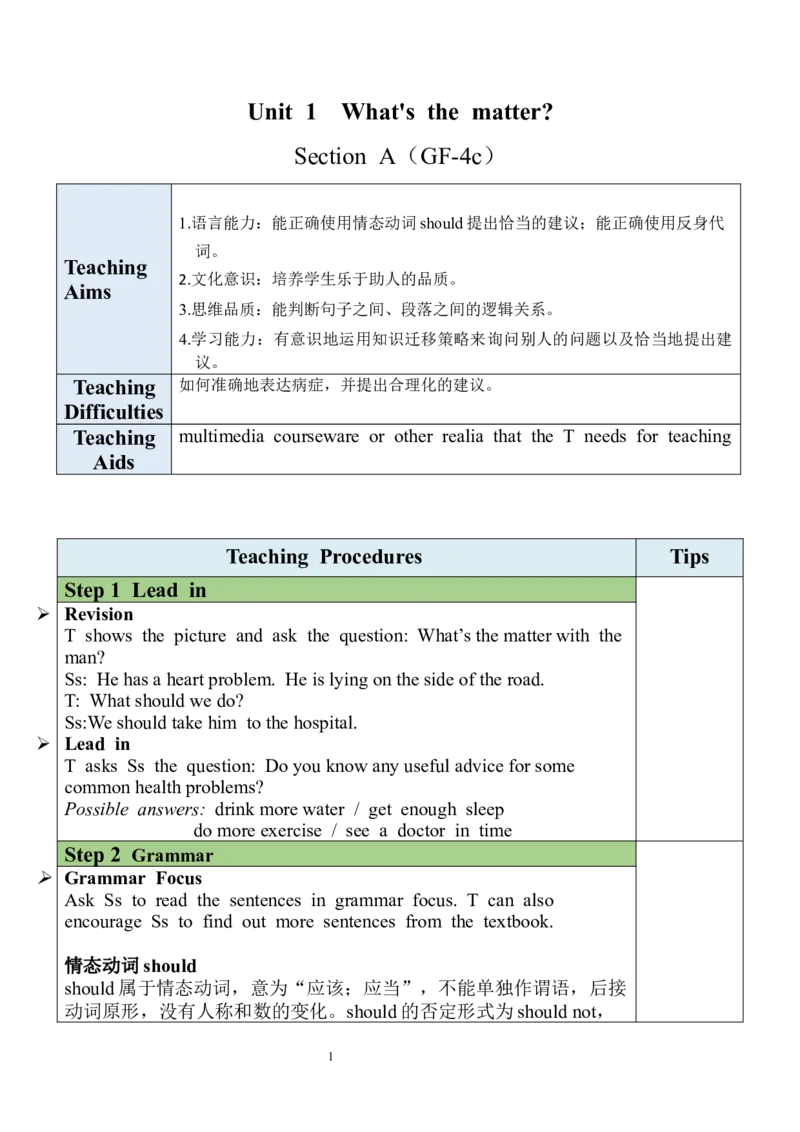
Unit 1 What's the matter?
Section A(GF-4c)
1.语言能力:能正确使用情态动词should提出恰当的建议;能正确使用反身代
词。
Teaching
2.文化意识:培养学生乐于助人的品质。
Aims
3.思维品质:能判断句子之间、段落之间的逻辑关系。
4.学习能力:有意识地运用知识迁移策略来询问别人的问题以及恰当地提出建
议。
Teaching 如何准确地表达病症,并提出合理化的建议。
Difficulties
Teaching multimedia courseware or other realia that the T needs for teaching
Aids
Teaching Procedures Tips
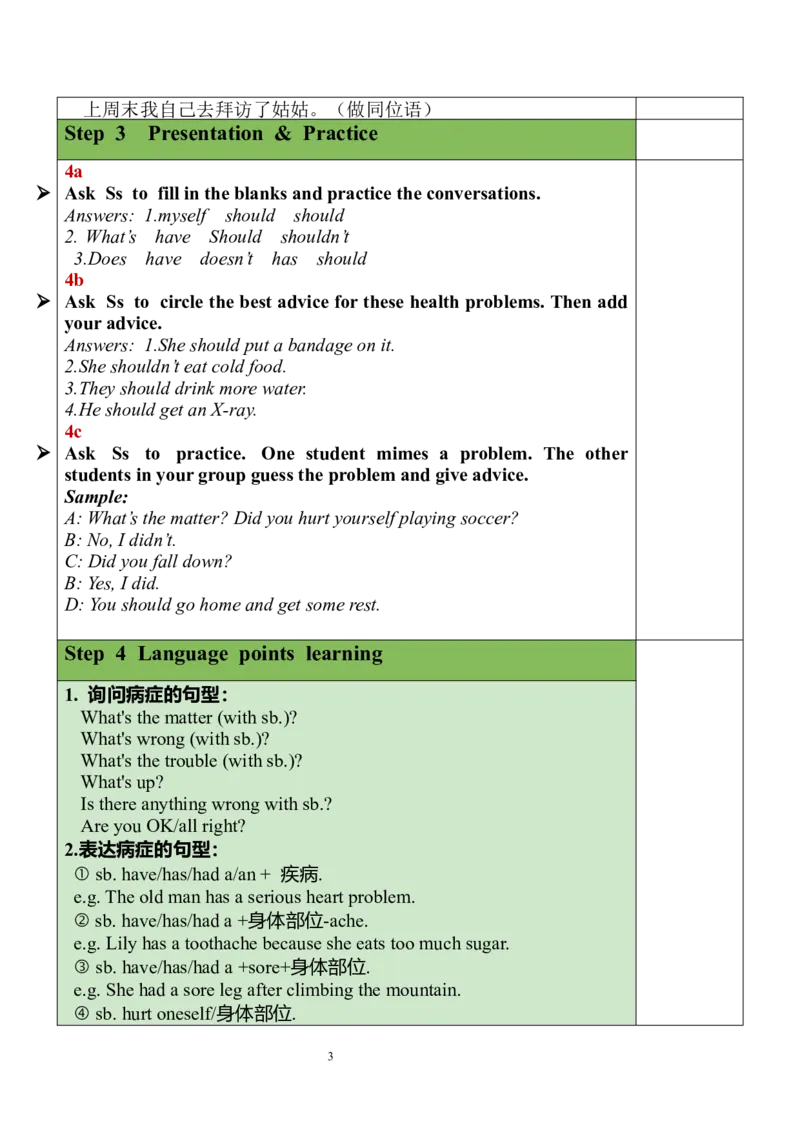
Step 1 Lead in
Revision
T shows the picture and ask the question: What’s the matter with the
man?
Ss: He has a heart problem. He is lying on the side of the road.
T: What should we do?
Ss:We should take him to the hospital.
Lead in
T asks Ss the question: Do you know any useful advice for some
common health problems?
Possible answers: drink more water / get enough sleep
do more exercise / see a doctor in time
Step 2 Grammar
Grammar Focus
Ask Ss to read the sentences in grammar focus. T can also
encourage Ss to find out more sentences from the textbook.
情态动词should
should属于情态动词,意为“应该;应当”,不能单独作谓语,后接
动词原形,没有人称和数的变化。should的否定形式为should not,
1缩写形式为shouldn’t。在疑问句中should位于主语前面。
We should go home at once. 我们应该马上回家。
You shouldn’t smoke here. 你不应该在这里抽烟。
should用法荟萃
1.用来向别人提出建议或劝告别人做某事,意为“应
该;应当”。
e.g. —Tom, I have a toothache. 汤姆,我牙痛。
—You should see a dentist. 你应当去看牙医。
2.表示现在或将来的某种义务或责任。
e.g. We should respect the old. 我们应该尊重老人。
You should leave her a note. 你应该给她留个字条。
3.用来表示要求、命令。
e.g. You should listen to the teacher carefully in class.在课堂上你应该认
真听老师讲课。
4.表示可能性、期望以及推测即将发生的情况。
e.g. They should be there by now.他们现在应该到那儿了。
It should be snowing now according to the weather forecast. 按天气
预报,现在应该下雪才是。
5. Should/Shall I …?用来征求意见、提供帮助或请求指示。
e.g. Should I help you clean the bedroom?要不要我帮你打扫卧室?
Should we begin now? 我们要不要现在开始呢?
6. “假如;万一”。表可能。常用于if 引导的条件状语从句中。
e.g. If you should change your mind, please let me know.假如你改变主意
的话,请告诉我。
In case you should need any help, here's my number.万一你需要帮助
的话,这是我的电话号码。
反身代词小结:
myself (我自己),yourself (你自己)是反身代词。表示“某人自己的
词”叫反身代词。见下表:
我自己 myself 你自己yourself 他自己himself
她自己herself 它自己itself 我们自己ourselves
你们自己yourselves 他(她、它)们自己 themselves
1) Did you buy anything for yourself?
你为你自己买什么东西了吗?(做介词宾语)
2) The old man taught himself English.
那位老人自学英语。(做动词宾语)
3) The thing itself is not important.
事情本身并不重要。(做同位语)
4) I myself visited my aunt last weekend.
2上周末我自己去拜访了姑姑。(做同位语)
Step 3 Presentation & Practice
4a
Ask Ss to fill in the blanks and practice the conversations.
Answers: 1.myself should should
2. What’s have Should shouldn’t
3.Does have doesn’t has should
4b
Ask Ss to circle the best advice for these health problems. Then add
your advice.
Answers: 1.She should put a bandage on it.
2.She shouldn’t eat cold food.
3.They should drink more water.
4.He should get an X-ray.
4c
Ask Ss to practice. One student mimes a problem. The other
students in your group guess the problem and give advice.
Sample:
A: What’s the matter? Did you hurt yourself playing soccer?
B: No, I didn’t.
C: Did you fall down?
B: Yes, I did.
D: You should go home and get some rest.
Step 4 Language points learning
1. 询问病症的句型:
What's the matter (with sb.)?
What's wrong (with sb.)?
What's the trouble (with sb.)?
What's up?
Is there anything wrong with sb.?
Are you OK/all right?
2.表达病症的句型:
① sb. have/has/had a/an + 疾病.
e.g. The old man has a serious heart problem.
② sb. have/has/had a +身体部位-ache.
e.g. Lily has a toothache because she eats too much sugar.
③ sb. have/has/had a +sore+身体部位.
e.g. She had a sore leg after climbing the mountain.
④ sb. hurt oneself/身体部位.
3e.g. Did you hurt yourself playing soccer?
I hurt my back when I fell off my bike.
⑤ sb. get/got hit on the +身体部位.
e.g. He got hit on his head when he passed by the playground.
3. ache, sore和hurt的区别:
(1)ache是一个名词后缀,表示某部位疼痛。
tooth+ ache = toothache(牙痛)
head+ ache = headache (头痛)
back+ ache = backache(背痛)
stomach + ache = stomachache(胃痛)
ear + ache = earache (耳朵痛)
heart + ache = heartache(心脏病)
(2) sore 是一个形容词,用来修饰名词,指的是身体某一部
位的酸痛。如:sore back, sore throat
(3) hurt是一个动词,指“刺痛;使受伤痛”。如:
He hurts his leg. = His leg hurts. 他腿疼。
Step 5 Summary & Homework
Summary
“Have” for talking about health problems:
have (+ a) + 病症
A: What’s the matter with Ben?
B: He hurt himself. He has a sore back.
A: Do you have a fever?
B: Yes, I do. (No, I don’t.)
Should/ shouldn’t for suggestions
You shouldn’t eat so much next time.
Should I put some medicine on it?
Reflexive pronouns
He didn’t think about himself.
Exercise
Ask Ss to do the exercises from PPT P30-32.
Homework
Preview the new words and phrases in Section B(1a-1d).
Do the exercises in students’ book.
Teaching In this period, we guide students to pay attention to modal verbs
Reflection should. We can show the usage of them on PPT. Ask students to
4make a conversation themselves using modal verbs should. Invite
some of them to show their conversations and see if they master the
grammar in this unit.
When we deal with the grammar, we’d better give students some
written work as homework. For example, ask students to use reflexive
pronoun to fill in the blanks of the sentences.
5