单元知识点梳理
词汇拓展
1.脚;足n. foot (复数) feet
2.胃;腹部n. stomach (复数) stomachs 胃痛;腹痛n. stomachache
3.躺;平躺v. lie (过去式) lay (现在分词) lying
4.(使)疼痛;受伤v. hurt (过去式) hurt (过去分词) hurt
5.问题;苦恼n. trouble (同义词) matter /problem
6.(用手或器具)击;打v. hit (过去式) hit (过去分词) hit
7.她(主格)pron. she 她自己(反身代词)pron. herself
8.生病的;有病的adj. sick (近义词) ill
9.我们(主格)pron. we 我们自己(反身代词)pron. ourselves
10.爬v. climb 登山者;攀登者n. climber
11.刀n. knife (复数) knives
12.意思是;打算;意欲v. mean (过去式) meant 意义;意思n. meaning 有意义的
adj. meaning ful 毫无意义的adj. meaningless
13.重要的adj. important 不重要的adj. unimportant 重要性n. importance
14.决定;下决心v. decide 决定;抉择n. decision
15.死 v. die (过去式) died (现在分词) dying 死的;失去生命的adj. dead 死;
死亡n. death
词块归纳
1.感冒 have_a_cold
2.胃痛/头痛/牙痛 have_a_stomachache/headache/toothache
3.躺下 lie_down
4.量体温 take_one's_temperature
5.发烧 have_a_fever
6.休息 take_breaks/take_a_break
7.下车 get_off
8.使……惊讶的是;出乎……的意料 to_one's_surprise
9.拍X光片 get_an_ X - ray
10.在……上面敷一些药 put_some_medicine_on_sth.
11.以同样的方式 in_the_same_way
12.多亏了;由于 thanks_to
13.低下头 put_one's_head_down
14.失去生命 lose_one's_life
15.用尽;耗尽 run_out_(of)
16.切除 cut_off
17.做出决定 make_a_decision
18.放弃 give_up
19.离开;从……出来 get_out_of
20.冒险 take_risks/take_a_risk
21.公布;说明 tell_of
22.由于;因为 because_of
23.掌管;管理 be_in_control_of24.意味着做某事 mean_doing_sth.
25.在困境中 in_a_difficult_situation
26.准备好做某事;愿意做某事 be_ready_to_do_sth.
核心句型
1.你怎么了?
What's the matter with you?/What's the trouble with you?/What's wrong with you?
2. 他下车问那位妇女发生了什么。
He got off and asked the woman what happened.
3.多亏了王先生和乘客们,医生及时挽救了那位老人的生命。
Thanks to Mr.Wang and the passengers,the man was saved by the doctors in time.
4.令人难过的是,许多人不想帮助他人,因为他们不想惹麻烦。
It's sad that many people don't want to help others because they don't want any trouble.
5.作为一名登山者,阿伦习惯了冒险。
As a mountain climber,Aron is used to taking risks.
6.有好多次,阿伦差点因为意外丢掉性命。
There were many times when Aron almost lost his life because of accidents.
7.因此,他用刀切断了他的半只右臂。
So he used his knife to cut off half his right arm.
8.然后,他用左手臂拿绷带给自己包扎,以便他(自己)不会失血太多。
Then,with his left arm,he bandaged himself so that he would not lose too much blood.
重难知识点归纳
What's the matter?怎么了?
该句常用来询问某人患有何种疾病或遇到什么麻烦或问题等。其后可接with sb./sth.引
出具体的某人或某物。常用答语为表示身体状况或者所处困境的短语或句子。
【拓展延伸】询问“某人怎么了?”的其他句型
What's wrong (with…)?
What's the trouble (with…)?
What happened (to…)?
What's the problem (with…)?
What's up (with…)?
I have a cold.我感冒了。
have a cold意为“感冒”,是由“have a+表示疾病的名词”构成的短语,表示疾病的名
词前的冠词不可省略。
【同类归纳】
have a fever发烧 have a cough咳嗽
have a stomachache胃痛 have a toothache牙痛
have a headache头痛 have a earache耳朵痛
have a sore throat喉咙痛 have a sore back 背痛
She talked too much yesterday and didn't drink enough water.昨天她说得太多,没喝足够的水。
1.too much意为“太多”,在此处作副词,修饰动词talked。
【易混辨析】too much,too many与much too
用作副词词组,意为“太多”,修饰动词。
too much 用作形容词词组,意为“太多”,修饰不可数名词。
用作代词,意为“太多”,常用作宾语
too many 用作形容词词组,意为“太多”,修饰可数名词。
much too 用作副词词组,意为“太”,修饰形容词或副词。
2.enough意为“足够的;充分的”,在此处作形容词,修饰名词,可位于名词前,也可位于名
词后。
【拓展延伸】
①enough作副词,意为“足够地”,修饰形容词或副词,位于所修饰词之后。
You should be careful enough when you do homework.做作业时你应该足够认真。
②enough后可接动词不定式,意为“(对于某人来说)足够……做某事”。
He got up early enough to catch the train.他起得足够早,能赶上那趟火车。
lie down and rest躺下来休息
lie意为“躺;平躺”,在此为动词,其现在分词为lying,过去式为lay。
【易混辨析】lie与lay
原形 过去式 过去分词 现在分词
lie vi.躺;位于 lay lain lying
lie vi.说谎 lied lied lying
lay vt.放置;下蛋 laid laid laying
You need to take breaks away from the computer.你需要离开电脑休息一下。
此处need是行为动词,后面常接名词、代词、动词不定式或动词-ing形式作宾语。
【易混辨析】need to do 与need doing
need to do 表示主动含义,主语通常是人。
need doing 表示被动含义,主语通常是物,相当于need to be done。
You need to do more exercise to keep healthy.你需要多锻炼来保持健康。
My bike is broken.It needs fixing up.我的自行车坏了,需要修一修。
【拓展延伸】
①need作情态动词,意为“需要”,后接动词原形,常用于否定句或疑问句中。needn't意
为“不必”,相当于don't have to。
②need作名词,意为“需要;需求”。常用短语有:in need有需要的
But to his surprise,they all agreed to go with him.但令他吃惊的是,他们所有人都同意
和他一起去。
to one's surprise意为“使某人惊讶的是;出乎某人的意料”,是固定短语,一般放在句首。
【拓展延伸】
①类似的短语还有to one's pleasure/joy“令某人高兴的是”;to one's anger“使某人生气的
是”;to one's regret“令某人遗憾的是”。
②与surprise相关的短语有in surprise“惊奇地”。have problems breathing呼吸困难
have problems (in) doing sth.做某事有困难/麻烦
If you have problems finding the way to the post office,please turn to the policeman.如果你
找去邮局的路有困难,请向警察求助。
【同类归纳】“在(做)……方面有困难”的表达:
have problems/trouble/difficulty (in) doing sth.
have problems/trouble/difficulty with sth.
As a mountain climber,Aron is used to taking risks.作为一名登山者,阿伦习惯了冒险。
1.be used to doing sth.习惯于做某事
其中to是介词,后面接名词、代词或动名词等。be可用get或become替换。
【易混辨析】be used to doing sth.与used to do sth.
be used to doing sth. 意为“习惯于做某事”,to后接名词、代词或动名词。
used to do sth. 意为“过去常常做某事”,强调过去做,而现在不做。
2.risk危险;风险
①risk在此为名词,take risks意为“冒险”。risk相关的短语有:
at risk 在危险中
take risks/a risk冒险
at the risk of doing sth.冒着……的危险
②risk还可作动词,意为“冒险”,后接名词或动名词。
That young man risked his life to save the boy.那个年轻人冒着生命危险去救那个男孩。
This means being in a difficult situation that you cannot seem to get out of.它的意思是
“处于一个你似乎无法摆脱的困境之中”。
此处mean表示“……意思是;意为”。作动词,mean还表示“打算;意欲”,其过去式为
meant。其常见结构有:
mean to do sth.打算做某事
mean doing sth.意味着做某事
mean+从句 打算/意思是……
【拓展延伸】mean 可用来解释某个词语的含义,表示“意思是……”,其后面的单词形式
常与被解释的单词形式保持一致。如解释一个动词时,后接动词不定式;解释一个动名词,后
接动名词形式。
…and of being in control of one's life.……以及掌控自己的生命。
be in control of是固定搭配,意为“掌管;控制”;其中control 既可以作名词,也可以作
动词,意为“掌管;控制”。
【拓展延伸】含control的常见短语:
out of control 失去控制
under the control of…在……的控制下
beyond sb.'s control难以约束;不由自主
单元语法点回顾
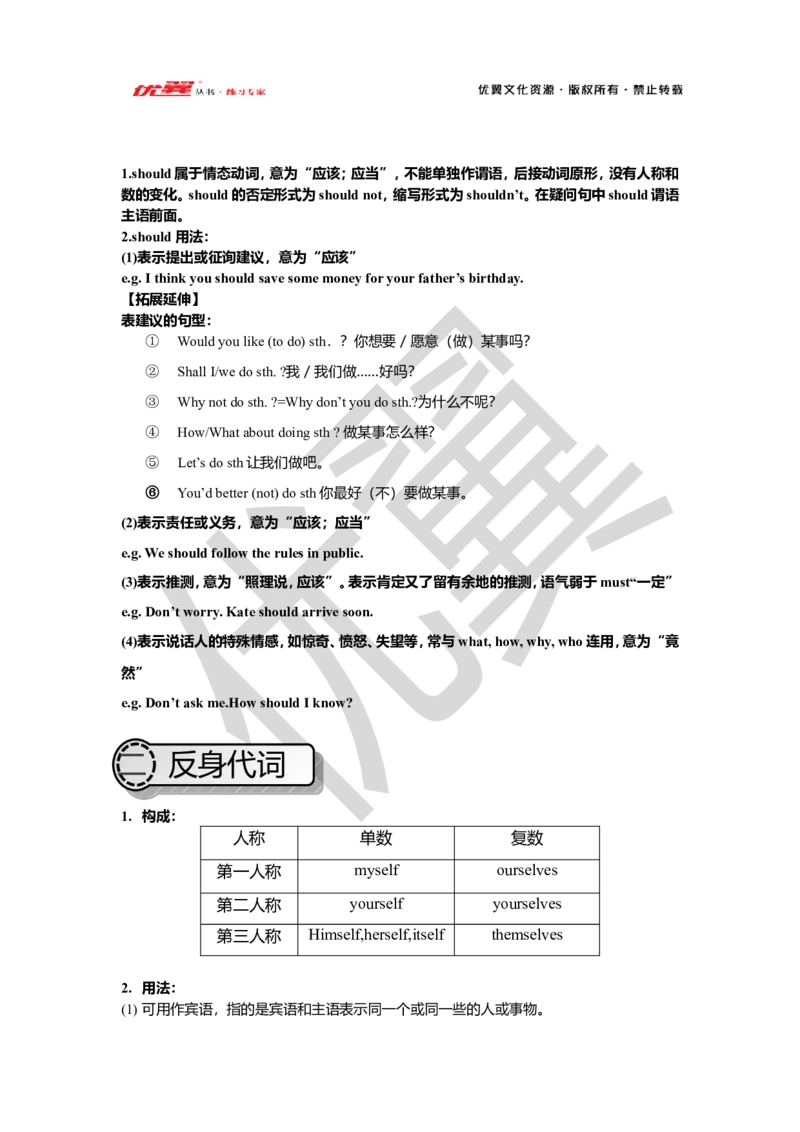
一 情态动词 should1.should属于情态动词,意为“应该;应当”,不能单独作谓语,后接动词原形,没有人称和
数的变化。should的否定形式为should not,缩写形式为shouldn’t。在疑问句中should谓语
主语前面。
2.should 用法:
(1)表示提出或征询建议,意为“应该”
e.g. I think you should save some money for your father’s birthday.
【拓展延伸】
表建议的句型:
① Would you like (to do) sth.?你想要/愿意(做)某事吗?
② Shall I/we do sth. ?我/我们做……好吗?
③ Why not do sth. ?=Why don’t you do sth.?为什么不呢?
④ How/What about doing sth ? 做某事怎么样?
⑤ Let’s do sth让我们做吧。
⑥ You’d better (not) do sth你最好(不)要做某事。
(2)表示责任或义务,意为“应该;应当”
e.g. We should follow the rules in public.
(3)表示推测,意为“照理说,应该”。表示肯定又了留有余地的推测,语气弱于must“一定”
e.g. Don’t worry. Kate should arrive soon.
(4)表示说话人的特殊情感,如惊奇、愤怒、失望等,常与what, how, why, who连用,意为“竟
然”
e.g. Don’t ask me.How should I know?
二 反身代词
1. 构成:
人称 单数 复数
第一人称 myself ourselves
第二人称 yourself yourselves
第三人称 Himself,herself,itself themselves
2. 用法:
(1) 可用作宾语,指的是宾语和主语表示同一个或同一些的人或事物。e.g. Maria bought herself a scarf.
(2) 可用作表语,指的是表语和主语表示同一个或同一些人或事物
e.g.She isn’t quite herself today.
(3) 可用作主语或宾语的同位语,常用来加强语气。
e.g. She herself will fly to London tomorrow.
I met the writer himself last week.
(4) 用在某些固定短语当中,例如
by oneself意为“独自,凭自己”,相当于alone;
enjoy oneself“玩得高兴,过得愉快”,=have fun或have a good time;
help oneself to…“随便吃或喝点……,随便用……";
keep…to oneself意为“不将某事说出去”;
say to oneself意为“自言自语”。
3. 提醒
(1) 反身代词不能单独做主语,但可以做主语的同位语,起强调作用 。
(2) 反身代词表示“某人自己”不能表示“某人的东西”,因为它没有所有格的形式。
表达“某人自己的(东西)”时,须要用one’s own.
单元知识点过关
过单词
Ⅰ.根据句意用方框中所给词的适当形式填空。
lie, die, toothache, headache, neck
1. —Jenny, who’s that girl with a scarf (围巾) around her ________?
—She’s Mike’s sister Gina.
2. Now his uncle is ________ on the sofa, enjoying the music.
3. —Do you have a ________, John?
—No. My head doesn’t hurt but my stomach hurts.
4. Peter has a ________ because he often eats sugar.
5.The scientist's ________ made us sad.
1. neck 2. lying 3. headache 4. toothache 5.death
Ⅱ. 根据首字母提示填写单词。
1.He is a mountain climber. He likes taking r______.
2.My sister is a n________. She often helps the sick in hospital.
3.Though the brave young man died, his s________ will always live in our heart.
4.Just now my mother told me the i________ of learning English.
5. I don't know what to do in this terrible s________. Can you help me?1. risks 2. nurse 3. spirit 4.importance 5. situation
Ⅲ.用所给单词的适当形式填空。
1. We haven’t made the_________(decide) about where to go on vacation.
2. As we all know, a horse has four_________(foot).
3. She didn’t think about___________(her), she only thought about helping others.
4.She fell to the ground on her________(knee).
5.He took a deep ________(breathe), and began to climb the stairs.
1.decision 2.feet 3.herself 4.knees 5.breath
过短语
根据句意用方框中所给短语的适当形式填空。
get into; run out of; hurt oneself; to one’s surprise; be
used to
1. Girl, hate doesn’t necessarily hurt other people, but certainly ___________.
2. ___________, he is our teacher's husband.
3.He ___________ the soft climate of the south now.
4.Nobody likes to ___________ trouble.
5.They ___________ money very quickly on their last vacation .
1.hurt yourself; 2.To my/our surprise; 3.is used to; 4.get into 5.ran out of
过句子
根据汉语意思完成句子,每空一词。
1. 多亏那位年轻人,我们及时到达了火车站。
_________ _________ that young man, we arrived at the train station _____ ______.
2.我现在习惯住在这里。
I'm _________ _________ _________ here now.
3. 刚才我看见一只猫从你的房间出来了。
Just now I saw a cat _________ _________ _________ your room.
4. 如果你想保护眼睛,你需要远离电脑休息一下。
If you want to protect your eyes, you need to ____ ____ ____ ____ the computer.
5. 现在谁管理着这家计算机公司?
Who is _______ _______ _______ this computer company now?
1.Thanks to; in time 2.used to living 3.get out of
4.take breaks away from 5.in control of
过交际
补全对话。(有两项多余)
Jenny: Sam, you look unhappy. What’s the matter?
Sam: My best friend, John is ill in hospital.
Jenny:1.______What’s wrong with him?Sam: He has a stomachache and can’t eat anything.
Jenny: But he looks very healthy, I think.
Sam:2.______He’s too fat because he eats too much meat.
Jenny:3.______
Sam: You are right. His doctor told him to take more exercise and eat less meat, but he didn’t
listen to him.
Jenny:4.__.____
Sam: Yes Now he thinks his doctor is right and he begins to do what he told him.
Jenny:5.______
Sam: Me, too.
A. I hope he’ll be better soon.
B. I’m sorry to hear that.
C. It’s bad for his health.
D. I don’t think so.
E. He hoped to be thin.
F. I’m sure he must feel sorry for it.
G. He didn’t like to eat it.
1-5BDCFA
过语法
I.用括号内所给词的适当形式填空。
1.The shirt is ,and to my surprise she made it .(she).
2.Lisa is reading a novel (call)The Adventure of Tom Sawyer.
3. (eat)vegetables (be)good for you.
4.Bill agreed (help)me to look for my lost bike.
5. As students,you _______ (should ) break the school rules.
1.hers; herself 2.called 3.Eating; is 4.to help 5.shouldn’t
Ⅱ.单项选择。
1.---Does Jane have__________fever?
---Yes,she does. I think she should go to__________hospital.
A.an; / B.a; the C./; a D.the; an
2.I saw her__________basketball when I walked on the playground this morning.
A.practice B.practiced C.practicing D.to practice
3. My sister is__________heavy because she has__________ice-cream.A. much too; too much B.too much; too many C. much too; many too D.much too; too much
4.He__________ play soccer. But now, he__________and does well in it.
A. used to; is used to swimming B. used to; used to swimming
C. use to; is used to swimming D.uses to; gets used to swimming
5.We should keep on__________English every day.
A.to practice to speak B. to practice speaking
C. practicing to speak D. practicing speaking
6.Why not_______ your father for help when you have trouble_______the problem?
A. to ask; solve B. to ask; solving C. ask; solving D. ask; to solve
7.-- I find it difficult to learn English well. I want to drop it.
.
-- English is very important in our daily life Never _______.
A. give up it B. give it up C. give away it D. give it away
8.Please give me some__________on how to learn English well.
A. plan B. suggestion C. advice D. tip
9.Could you give me a hand? I can’t complete the task on time__________your help.
A. without B. under C. with D. for
10.Jane is__________in hospital.I have to look after the__________ girl.
A.ill; sick B.illness;sick C.sick;ill D.ill;ill
1-5 BCDAD 6-10 CBCAA
过教材
Passage 1
用括号中所给词的适当形式填空。
Bus Driver and Passengers Save an Old Man.
At 9:00 a.m. yesterday, bus No.26 1.______ (go) along Zhonghua Road when the driver saw
an old man 2.____ (lie) on the side of the road. A woman next to him was shouting for help.
The bus driver, 24-year-old Wang Ping, stopped the bus without 3.____ (think) twice He got
off and asked the woman what 4._____ (happen). She said that the old man had a heart problemand should go to the hospital. Mr. Wang knew he had to act 5.____ (quick). He told the passengers
that he must take the man to the hospital. He expected most or all of the passengers 6.____ (get)
off and wait for the next bus. But to his surprise, they all agreed7.___ (go) with him. Some
passengers helped Mr. Wang to move the man onto the bus.
Thanks to Mr. Wang and the passengers, the doctors 8.____ (save) the man in time. “It’s sad
that many people 9.____ (not want) to help others because they don’t want any trouble,” says one
passenger. “But the driver didn’t think about 10.____ (he). He only thought about saving a life.”
1.was going 2. lying 3. thinking 4. happened 5.quickly
6.to get 7.to go 8.saved 9. don’t want 10.himself
Passage 2
根据短文内容,用方框中所给词的正确形式填空,使短文完整、正确. (提示:每空不超过三个
单词)
mean; take risks; who; catch; for; run out; cut off; so that; be; tell of
Aron Ralston is an American man 1.________ is interested in mountain climbing. As a mountain
climber, Aron is used to 2.______________. This is one of the exciting things about doing
dangerous sports. There were many times when Aron almost lost his life because of accidents. On
April 26, 2003, he found himself in a very dangerous situation when climbing in Utah.
On that day, Aron’s arm 3.________ under a 360-Kilo rock that fell on him when he was climbing
by himself in the mountains. Because he could not free his arm, he stayed there 4._______five
days and hoped that someone would find him. But when his water5.__________ , he knew that he
would have to do something to save his own life. He wasn’t ready to die that day. So he used his
knife to 6.________ half his right arm. Then, with his left arm, he bandaged himself 7._________
he wouldn’t lose too much blood. After that, he climbed down the mountain to find help.
After losing his arm, he wrote a book called Between a Rock and Hard Place. This means 8._____
in a difficult situation that you can’t seem to get out of. In this book, Aron 9.__________ the
importance of making good decisions, and of being in control of one’s life. His love for mountain
climbing is so great that he kept on climbing mountains even after this experience.
Do we have the same spirit as Aron? Let’s think about it before we find ourselves “between a rock
and a hard place”, and before we have to make a decision that could 10._______ life or death.
1.who 2. taking risks 3. was caught 4. for 5.ran out
6.cut off 7.so that 8.being 9. tells of 10.mean