文档文本内容
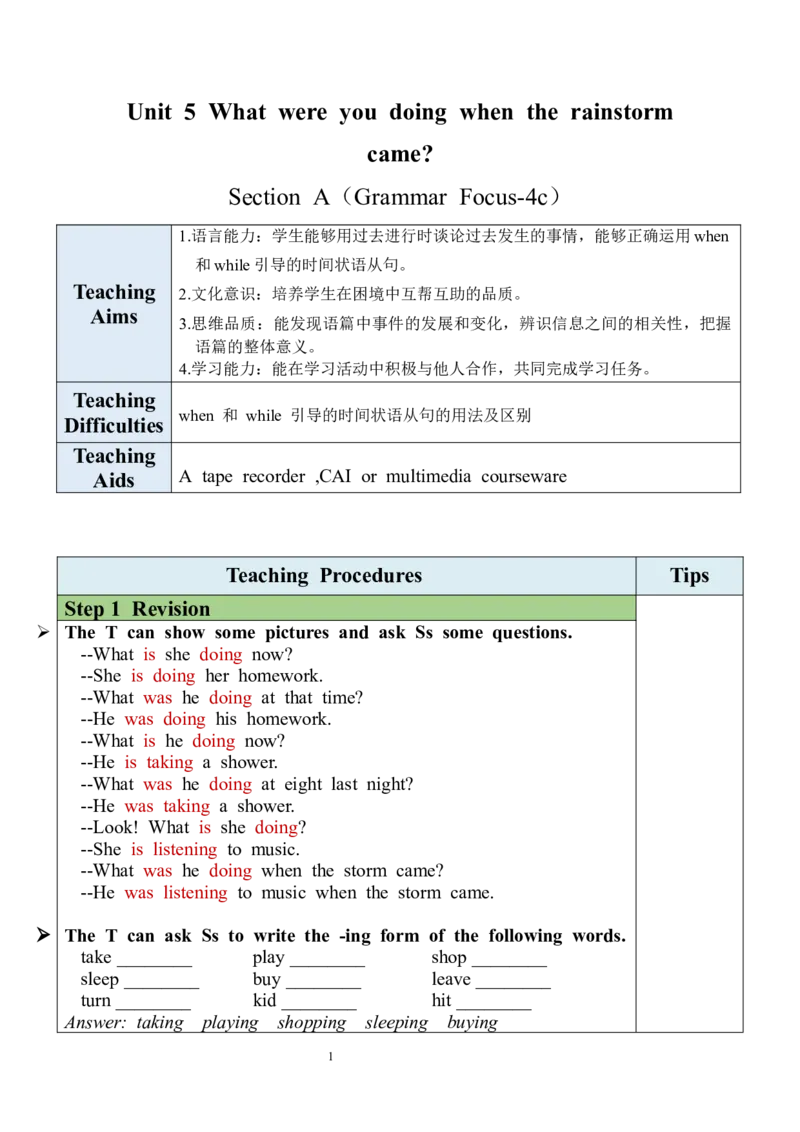
Unit 5 What were you doing when the rainstorm
came?
Section A(Grammar Focus-4c)
1.语言能力:学生能够用过去进行时谈论过去发生的事情,能够正确运用when
和while引导的时间状语从句。
Teaching 2.文化意识:培养学生在困境中互帮互助的品质。
Aims
3.思维品质:能发现语篇中事件的发展和变化,辨识信息之间的相关性,把握
语篇的整体意义。
4.学习能力:能在学习活动中积极与他人合作,共同完成学习任务。
Teaching
when 和 while 引导的时间状语从句的用法及区别
Difficulties
Teaching
Aids A tape recorder ,CAI or multimedia courseware
Teaching Procedures Tips
Step 1 Revision
The T can show some pictures and ask Ss some questions.
--What is she doing now?
--She is doing her homework.
--What was he doing at that time?
--He was doing his homework.
--What is he doing now?
--He is taking a shower.
--What was he doing at eight last night?
--He was taking a shower.
--Look! What is she doing?
--She is listening to music.
--What was he doing when the storm came?
--He was listening to music when the storm came.
The T can ask Ss to write the -ing form of the following words.
take ________ play ________ shop ________
sleep ________ buy ________ leave ________
turn ________ kid ________ hit ________
Answer: taking playing shopping sleeping buying
1leaving turning kidding hitting
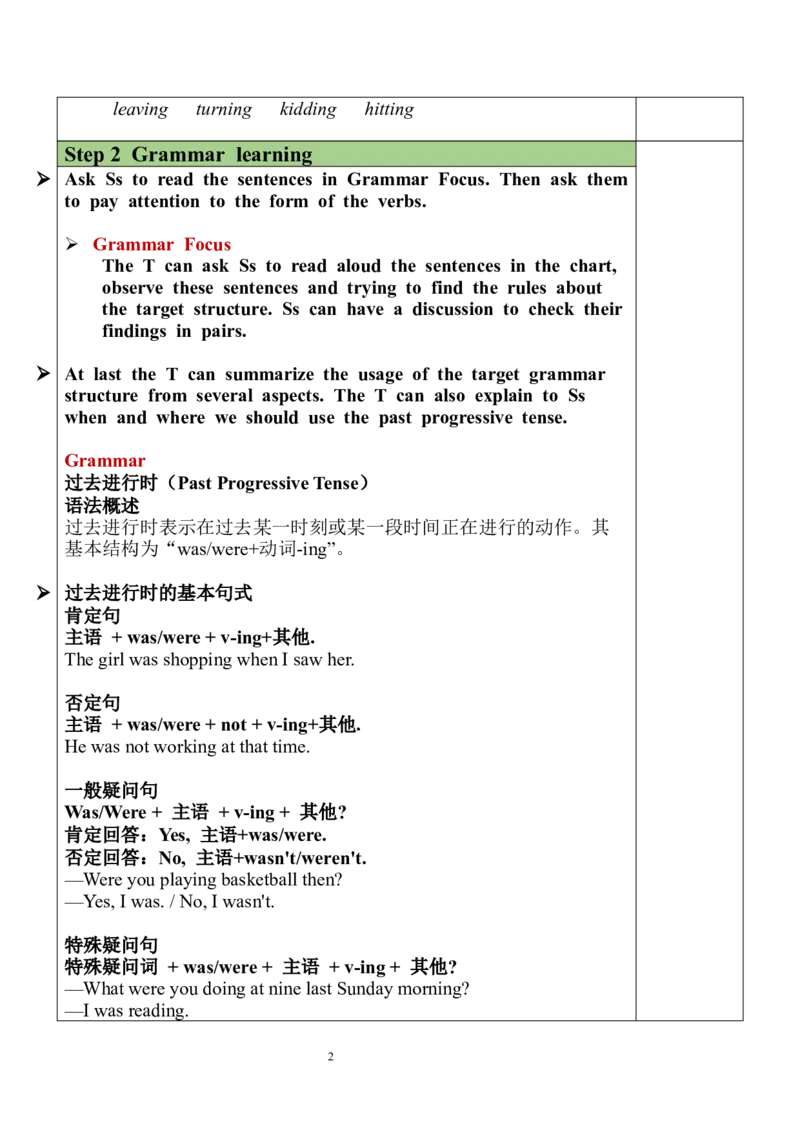
Step 2 Grammar learning
Ask Ss to read the sentences in Grammar Focus. Then ask them
to pay attention to the form of the verbs.
Grammar Focus
The T can ask Ss to read aloud the sentences in the chart,
observe these sentences and trying to find the rules about
the target structure. Ss can have a discussion to check their
findings in pairs.
At last the T can summarize the usage of the target grammar
structure from several aspects. The T can also explain to Ss
when and where we should use the past progressive tense.
Grammar
过去进行时(Past Progressive Tense)
语法概述
过去进行时表示在过去某一时刻或某一段时间正在进行的动作。其
基本结构为“was/were+动词-ing”。
过去进行时的基本句式
肯定句
主语 + was/were + v-ing+其他.
The girl was shopping when I saw her.
否定句
主语 + was/were + not + v-ing+其他.
He was not working at that time.
一般疑问句
Was/Were + 主语 + v-ing + 其他?
肯定回答:Yes, 主语+was/were.
否定回答:No, 主语+wasn't/weren't.
—Were you playing basketball then?
—Yes, I was. / No, I wasn't.
特殊疑问句
特殊疑问词 + was/were + 主语 + v-ing + 其他?
—What were you doing at nine last Sunday morning?
—I was reading.
2 过去进行时的基本用法
◆ 表示过去某一段时间内一直进行的动作,常与the whole day, all
day yesterday等时间状语连用。有时没有明显的时间状语,可根据上
下文语境判断。
I was watching TV the whole night.
We were having classes all day yesterday.
◆ 表示过去某一时刻正在进行或发生的动作,与表示过去某一时间
点的时间状语连用,如at 3 o'clock yesterday afternoon, at this time
yesterday等。
Miss Li was shopping at this time yesterday.
I was looking for my lost cat at nine last Monday morning.
过去进行时与其他时态的区别
现在进行时 一般过去时 过去进行时
用法 表示现在或最近 表示过去某个时间 表示过去某一时
正在进行和发生 发生过的动作或存 刻或某一时间正
的动作。 在的状态。强调动 在进行的动作。
作已经结束。 强调动作的未完
成性。
构成 主语+am/is/are+v- 主语+v-ed 主语+was/
ing were+v-ing
时间 now(或引起注意 yesterday, last night, at eight last night,
的look/ listen等 two years ago at the time of the
动词) rainstorm, when
the rainstorm
came, while he
was sleeping
when 与 while 引导的时间状语从句
语法概述
when和while都可意为“当······时”,用来引导时间状语从句,表示
主句动作发生的背景。
when引导的时间状语从句
◆ 表示主句动作发生的特定时间,既可指时间点,也可指时间段。
When he was a child, he always tried out new ideas.
◆ 从句的谓语动词可以是延续性动词,也可以是非延续性动词;从
句的动作和主句的动作既可同时发生,也可以是先后发生。
It was snowing when he arrived at the station.
◆ 从句位于主句之前或之后,当位于主句之前时,与主句要用逗号
3分开。
When I got to the airport, the guests had left.
◆ 当主句为将来时或表示将来意义时,从句要用一般现在时表示将
来。(主将从现)
The boy will be a writer when he grows up.
while引导的时间状语从句
◆ while引导的时间状语从句强调主句动作在从句动作进行的过程中
发生,或者同时发生。从句的谓语动词必须为延续性动词,常用进
行时。
While Linda was sleeping, Jenny was helping me with my homework.
The boy fell asleep while I was reading the story.
When和while的区别
1.When I arrived at home, my mum was cooking.
从句 主句
主句的动作是持续的,而从句的动作是短暂的,此时用when
引导时间状语从句,主句用过去进行时态,从句用一般过去
时态。
2.I arrived at home while/when my mum was cooking.
主句 从句
主句的动作是短暂性的,从句的动作是持续性的,此时用while/
when
引导从句,主句用一般过去时态,从句用过去进行时态。
3.I was watching TV while my mother was cooking.
主句 从句
主句和从句的动作在过去的某时刻或某时段同时发生,而且动作都
是持续性的,此时用while引导从句,并且主句和从句都用过去进行
时态。
Step 3 Presentation & Practice
4a
Look at the table and write sentences with both while and
when.
John Mary
take photos buy a drink
play the piano leave the house
clean his room turn on the radio
shop take the car to the car wash
While John was taking photos, Mary bought a drink .
John was taking photos when Mary bought a drink .
Possible answers:
41. While John was playing the piano, Mary left the house.
John was playing the piano when Mary left the house.
2. While John was cleaning his room, Mary turned on the radio.
John was cleaning his room when Mary turned on the radio.
3. While John was shopping, Mary took the car to the car wash.
John was shopping when Mary took the car to the car wash.
4b
Ss finish the task in 4b and then communicate with their
partners.
Then the T can invite some Ss to share their answers in class
and the T can make assessments.
Answers:While was was While When was was were
4c
What were you doing at these times last Sunday? Fill in the
chart. Then ask your partner.
Time You Your partner
9:00 a.m.
11:30 a.m.
4:00 p.m.
9:00 p.m.
For example,
A: What were you doing at nine o'clock last Sunday
morning?
B: I was sleeping. How about you?
A: I was doing my homework.
B: You're kidding!
Work in pairs, look at the pictures on PPT30 , then ask and
answer questions.
What were you doing at … last Sunday?
Example
A: What were you doing at nine o’clock last Sunday?
B: I was running. How about you?
A: I was reading.
B: You’re kidding!
Step 4 Language Points
1. You're kidding!
kid v. 开玩笑;欺骗
5kid作动词,其现在分词为kidding,过去式和过去分词均为kidded。
I didn't mean it. I was only kidding.
Don't kid yourself (that) he'll change.
【拓展延伸】kid 还可以作名词,意为“小孩”,复数形式为 kids。
正式用语或书面用语中用child表示。
They've got three kids.
He is just a child.
Step 5 Summary & Homework
Summary The
Ask the Ss to do the exercises on PPT P32-36. homework
Homework can vary
Preview the new words and phrases in Section B(1a-1d). with the
Do the exercises in students’ book. specific
conditions.
We always learn grammar when we have enough language
knowledge. When dealing with grammar, we can get the students to
conclude or sum up what they have learned in this unit and then
Teaching
learn the structure and the pattern drills. After they learn the main
Reflection
structure in the grammar focus frame, the students should practice in
different activities. And we’d better give them some written work
after speaking and reading.
6