文档文本内容
Unit 9 Have you ever been to a museum?
Section A(Grammar Focus-4c)
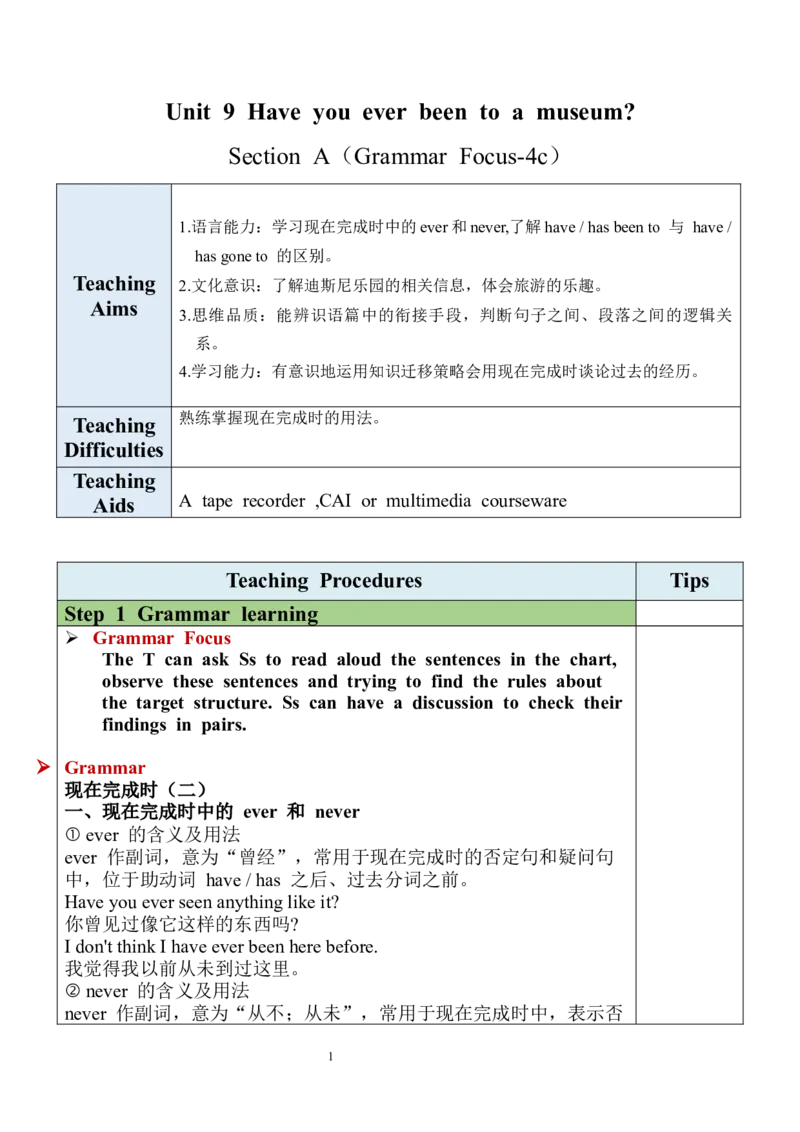
1.语言能力:学习现在完成时中的ever和never,了解have / has been to 与 have /
has gone to 的区别。
Teaching 2.文化意识:了解迪斯尼乐园的相关信息,体会旅游的乐趣。
Aims
3.思维品质:能辨识语篇中的衔接手段,判断句子之间、段落之间的逻辑关
系。
4.学习能力:有意识地运用知识迁移策略会用现在完成时谈论过去的经历。
熟练掌握现在完成时的用法。
Teaching
Difficulties
Teaching
Aids A tape recorder ,CAI or multimedia courseware
Teaching Procedures Tips
Step 1 Grammar learning
Grammar Focus
The T can ask Ss to read aloud the sentences in the chart,
observe these sentences and trying to find the rules about
the target structure. Ss can have a discussion to check their
findings in pairs.
Grammar
现在完成时(二)
一、现在完成时中的 ever 和 never
① ever 的含义及用法
ever 作副词,意为“曾经”,常用于现在完成时的否定句和疑问句
中,位于助动词 have / has 之后、过去分词之前。
Have you ever seen anything like it?
你曾见过像它这样的东西吗?
I don't think I have ever been here before.
我觉得我以前从未到过这里。
② never 的含义及用法
never 作副词,意为“从不;从未”,常用于现在完成时中,表示否
1定含义,位于助动词 have / has 之后、过去分词之前。
I have never lost the weight I put on in my teens.
我在十几岁时增加的体重从没减下去过。
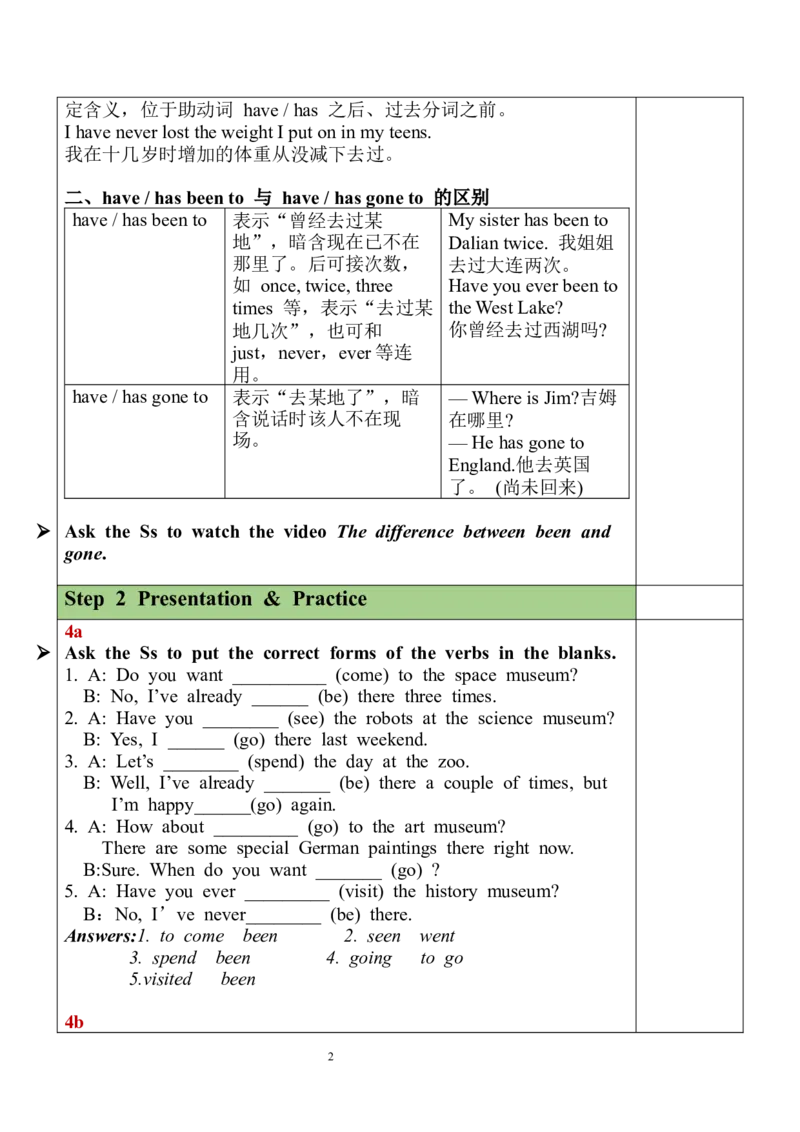
二、have / has been to 与 have / has gone to 的区别
have / has been to 表示“曾经去过某 My sister has been to
地”,暗含现在已不在 Dalian twice. 我姐姐
那里了。后可接次数, 去过大连两次。
如 once, twice, three Have you ever been to
times 等,表示“去过某 the West Lake?
地几次”,也可和 你曾经去过西湖吗?
just,never,ever等连
用。
have / has gone to 表示“去某地了”,暗 — Where is Jim?吉姆
含说话时该人不在现 在哪里?
场。 — He has gone to
England.他去英国
了。 (尚未回来)
Ask the Ss to watch the video The difference between been and
gone.
Step 2 Presentation & Practice
4a
Ask the Ss to put the correct forms of the verbs in the blanks.
1. A: Do you want __________ (come) to the space museum?
B: No, I’ve already ______ (be) there three times.
2. A: Have you ________ (see) the robots at the science museum?
B: Yes, I ______ (go) there last weekend.
3. A: Let’s ________ (spend) the day at the zoo.
B: Well, I’ve already _______ (be) there a couple of times, but
I’m happy______(go) again.
4. A: How about _________ (go) to the art museum?
There are some special German paintings there right now.
B:Sure. When do you want _______ (go) ?
5. A: Have you ever _________ (visit) the history museum?
B:No, I’ve never________ (be) there.
Answers:1. to come been 2. seen went
3. spend been 4. going to go
5.visited been
4b
2 Ask the Ss to fill in the blanks with the correct forms of the
verbs in brackets.
Most of us _________ (see) Mickey Mouse, Donald Duck and other
famous Disney characters in cartoons before. But have you ever
_________ (be) to Disneyland? Disneyland ________ (be) an amusement
park with a special theme — Disney characters and movies. There
_________ (be) many exciting rides, lovely restaurants and fantastic gift
shops there.
You can also _________ (see) the Disney characters walking around
the park. And have you ever _________ (hear) of a Disney Cruise? This
_________ (be) a boat ride with a Disney theme. You can _________
(take) a ride on the boat for several days and eat and sleep on it. On the
boat, you can _________ (shop) and have Disney parties before you
_________ (arrive) at the Disney island.
Answers: have seen been is are see heard is
take shop arrive
Ask the Ss to read the passage in 4b and answer the questions.
1.What is the theme of Disneyland?
2.What can you do on a Disney Cruise?
Answers:1.Disney characters and movies.
2.You can take a ride on the boat for several days and eat and sleep on it.
On the boat, you can shop and have Disney parties before you arrive at
the Disney island.
Ask the Ss to watch the video Disney Cruise.
Ask the Ss to read the passage Cruise ships.
4c
Answer the survey questions and then ask your partner.
Have you ever … You Your partner
been to another
province in China?
lost something
important?
3Step 3 Language points learning
1. Well, I've already been there a couple of times, but I’m happy to go
again.
a couple of 两个;一对;几个
a couple of 后跟可数名词复数。a couple of... 作主语时,谓语动词用
复数形式。
There are a couple of shoes in my bedroom, but they are not a pair.
A couple of monkeys are playing in the tree.
2. There are some special German paintings there right now.
adj. 德国的;德语的;德国人的 n. 德语;德国人
① German 在此处作形容词,意为“德国的”。
German cars are different from ours.
② German 作形容词,还可意为“德语的;德国人的”。
I find German grammar is very difficult.
③ German 还可作名词。作不可数名词时,意为“德语”;作可数名
词时,意为“德国人”,其复数形式为 Germans。
I know a little German.
There are a few Germans in our school.
【拓展延伸】Germany 作名词,意为“德国”。
My best friend comes from Germany.
区分:
Englishman→Englishmen
Frenchman→Frenchmen
German→Germans
Chinese→Chinese
Japanese→Japanese
Step 4 Summary & Homework
4Summary The
Ask the Ss to do the exercises on PPT P21-24. homework
Homework: can vary
Preview the new words and phrases in Section B(1a-1e). with the
Do the exercises in students’ book. specific
conditions.
The teacher can invites several groups of students to perform the dialogue
and guides other students to ask questions about the contents reported by
Teaching
each group. This not only enables students to form a good habit of listening
Reflection
to other students' speeches and taking down key information, but also
trains students to use the target language in the natural speech.
5