高三年级试题
英 语
注意事项及说明:
1.试卷共150分,考试时间120分钟。
2.答案一律写在答题卡上。考试结束时,上交答题卡。
第一部分 听力(共两节,满分30分)
做题时,先将答案标在试卷上。录音内容结束后,你将有两分钟的时间将试卷上的答案转涂
到答题卡上。
第一节(共5小题;每小题1.5分,满分7.5分)
听下面5段对话。每段对话后有一个小题,从题中所给的A、B、C三个选项中选出最佳选
项。听完每段对话后,你都有10秒钟的时间来回答有关小题和阅读下一小题。每段对话读两遍。
1. What helps the man quit social media?
A
4. Doing sports.
B. Focusing on his work.
C. Volunteering in the community.
2. How much will Mark's card show right after he adds 150 yuan today?
c./165yuan
A.110 yuan. B. 150 yuan.
A
3. What are the two speakers doing?
Al Playing a quiz. B. Planning a trip. C.Drawing a map.
A 4. What does the man advise the woman to do?
A. Bargain with the seller. B. Look for another bag. C. Wait for the next sale.
C
5. What does the woman think of rereading Harry Potter in English?
A. Boring. B. Practical. C Rewarding.
第二节(共15小题;每小题1.5分,满分22.5分)
听下面5段对话或独白。每段对话或独白后有几个小题,从题中所给的A、B、C三个选项
中选出最佳选项。听每段对话或独白前,你将有时间阅读各个小题,每小题5秒钟;听完后,
各小题将给出5秒钟的作答时间。每段对话或独白读两遍。
听第6段材料,回答第6、7题。
B 6. What does the boy mainly use his phone for?
A. Playing a game. B Doing school research. Cc. Chatting with friends.
C 7. What does Tom think of his mom's rule?
A. Reliable. B. Worrying. Reasonable.
听第7段材料,回答第8至10题。
8. What is the main challenge for the speakers now?
A. Not having enough workers.
B. Lacking proper food supply.
C. Losing some regular customers.
高三 试卷 第1页 共10页9. Where will the speakers probably go first?
A. To the bar. B To the office. C. To the dining area.
10. What is the probable relationship between the two speakers?
A. Couple. B. Workmates. C. Neighbours.
听第8段材料,回答第11至13题。
11. Why does the woman want cherry trees?
A.To make her garden more beautiful.
B. To provide shade for her garden.
C. To get fresh fruits for her family.
12. What does the man say a cherry tree needs?
A. Enough water. B. Lots ofsoil. C. Plenty of sunlight.
13. What will the woman probably do next?
A. Buy some cherry trees and soil.
B. Plant the cherry trees.
C. Pick up some tomatoes.
听第9段材料,回答第14至17题。
14. What is the man's paper mainly about?
A. Effects of the weather on farming habits.
B. Different types of crops harvested in China.
C. The history of Norwegian agriculture.
15. What does the man think about wheat farming in North China?
A. It doesn't require much teamwork.
B. It encourages large-group cooperation.
C. It's strongly influenced by cold winters.
16. Where is the man from?
A. The north of Norway B. The south of China. C The north of China.
17. Why does the man ask the woman about things in Norway?
A. To make his travel plan there.
B To collect information for his paper.
C. To learn about weather in Norway.
听第10段材料,回答第18至20题。
18. What type of programme is News Spin?
A. A science news programme. B A cooking show. C. A food documentary.
19. What will Dr.Lisa Park mainly discuss?
A. Three key points about the new technology.
B. Ways of cooking lab-grown chicken.
C. The production process of lab-grown meat.
20. What will the listeners probably do before the end of the programme?
A Purchase lab-grown meat products.
B. Vote online about the taste test.
C. Search for Australian restaurants online.
高三英语试卷 第2页 共 10页第二部分 阅读理解(共两节,满分50分)
第一节(共15小题;每小题2.5分,满分37.5分)
阅读下列短文,从每题所给的A、B、C、D四个选项中选出最佳选项。
A
AI Teaching in Louisa Schools:AMixed Picture
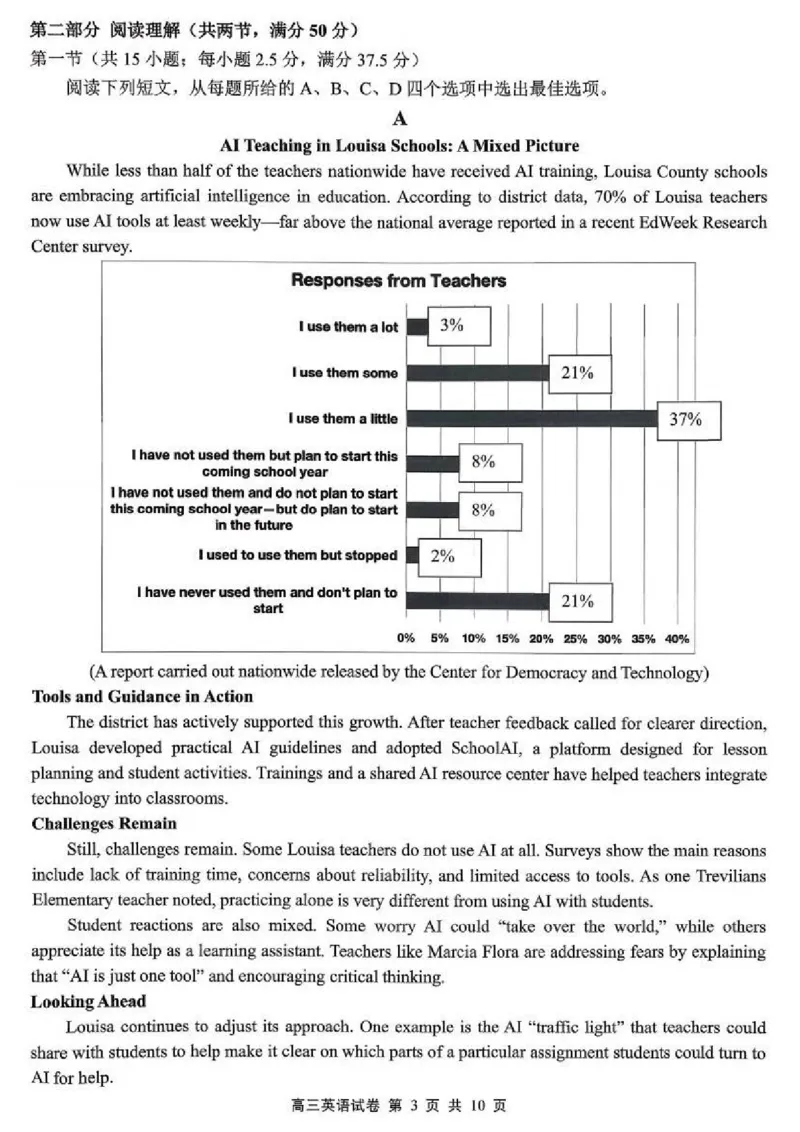
While less than half of the teachers nationwide have received AI training, Louisa County schools
are embracing artificial intelligence in education. According to district data,70of Louisa teachers
now use AI tools at least weekly—far above the national average reported in a recent EdWeek Research
Center survey.
Responses from Teachers
3%
luse them a lot
luse them some 21%
luse them a little 37%
I have not used them but plan to start this 8%
coming school year
I have not used them and do not plan to start
this coming school year-but do plan to start 8%
in the future
lused to use them but stopped 2%
I have never used them and don't plan to
21%
start
00505050%
(A report carried out nationwide released by the Center for Democracy and Technology)
Tools and Guidance in Action
The district has actively supported this growth. After teacher feedback called for clearer direction,
Louisa developed practical AI guidelines and adopted SchoolAI, a platform designed for lesson
planning and student activities. Trainings and a shared AI resource center have helped teachers integrate
technology into classrooms.
Challenges Remain
Still, challenges remain. Some Louisa teachers do not use AI at all. Surveys show the main reasons
include lack of training time, concerns about reliability, and limited access to tools. As one Trevilians
Elementary teacher noted,practicing alone is very different from using AI with students.
Student reactions are also mixed. Some worry AI could “take over the world,”while others
appreciate its help as a learning assistant. Teachers like Marcia Flora are addressing fears by explaining
that“AI is just one tool” and encouraging critical thinking.
Looking Ahead
Louisa continues to adjust its approach.One example is the AI "traffic light" that teachers could
share with students to help make it clear on which parts of a particular assignment students could turn to
AI for help.
高三英语试卷 第3页共10页Green means students may use AI with citation; yellow means limited use; and red means no AI
allowed. These tools help integrate AI into daily learning while encouraging proper use.
As the technology develops, Louisa's experience offers a real-time model of how schools can
prepare students for a tech-driven future.
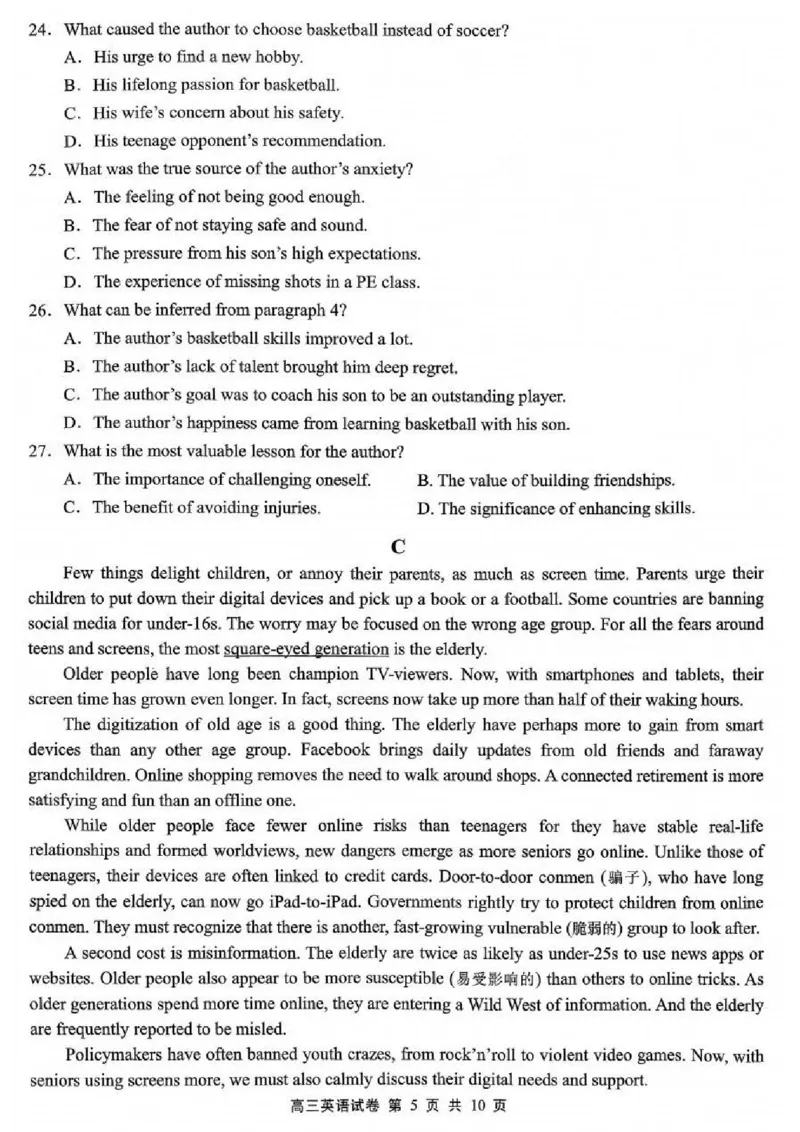
21. What percentage of the teachers nationwide are using AI in the classroom?
A.24%. B.61%. C.63%. D. 70%.
22. Why do some Louisa teachers avoid using AI?
A. They believe it will take over the world.
B. They feel unprepared to integrate AI effectively.
C. They feel uncomfortable to adopt AI fully.
D.They find the students depend too much on AI.
23. What does the AI "traffic light" system do?
A.It limits teachers'use of AI in lessons.
B. It controls the Internet speed in classrooms.
C. It is used to teach students about road safety.
D. It guides students on proper AI use.
B
The basketball felt awkward in my hands as I watched my teenage opponent effortlessly dribble(运
球)past me for the twentieth time. He moved with natural grace, making my attempts seem comical(可
笑的). How did I, someone who hadn't played sports since my middle school, end up being schooled by
someone half my age?
It all began when I decided to find a new hobby. My original plan was to join a soccer team, but
my wife warned,“You may twist your ankle. I'd rather not spend our weekends in hospital.” So I settled
on basketball—a sport I'd enjoyed watching but never actually played.
My biggest fear starting out wasn't physical injury, but social embarrassment. For the first few
weeks, I stuck to basic athletic wear, hoping to look like someone who did belong in the sport. I also
worried about being picked last or laughed at, just like in middle schoolPE classes. However,everyone
at the community court proved incredibly supportive—even when I accidentally passed the ball to the
wrong team. This experience drove home a point: my deepest anxiety wasn't about missing shots, but
about feeling unskilled around more experienced players.
After months, my performance was still far from perfect.I'd occasionally travel with the ball, and
three minutes of full-court running could stillleave me breathless. However,any frustration(挫败)was
overshadowed when my seven-year-old son joined the youth basketball program. While he's still
leaning the rules, he enjoys practicing with his peers. What truly matters to him,and consequently to
me, is the joy ofus learning together in the same place.
Basketball hasn't transformed me into a skilled player, but there is something valuable: the
importance of trying things beyond your experience and natural abilities. You might surprise yourself
with what you can learn. Of course,the first lesson should be that if you have your ankle injured, you
shouldn't keep playing. But that whole "challenging yourself"lesson is definitely a close second.
高三英语试卷第4页 共 10 页24. What caused the author to choose basketballinstead of soccer?
A. His urge to find a new hobby.
B. His lifelong passion for basketball
C. His wife's concern about his safety.
D. His teenage opponent's recommendation.
25. What was the true source of the author's anxiety?
A. The feeling of not being good enough.
B. The fear of not staying safe and sound.
C. The pressure from his son's high expectations.
D. The experience of missing shots in a PE class.
26. What can be inferred from paragraph 4?
A. The author's basketball skills improved a lot.
B. The author's lack of talent brought him deep regret.
C. The author's goal was to coach his son to be an outstanding player.
D. The author's happiness came from learning basketball with his son.
27. What is the most valuable lesson for the author?
A. The importance of challenging oneself. B. The value of building friendships.
C. The benefit of avoiding injuries. D. The significance of enhancing skills.
C
Few things delight children, or annoy their parents, as much as screen time. Parents urge their
children to put down their digital devices and pick up a book or a football. Some countries are banning
social media for under-16s. The worry may be focused on the wrong age group. For all the fears around
teens and screens, the most square-eyed generation is the elderly.
Older people have long been champion TV-viewers. Now, with smartphones and tablets, their
screen time has grown even longer.In fact,screens now take up more than half of their waking hours.
The digitization of old age is a good thing. The elderly have perhaps more to gain from smart
devices than any other age group. Facebook brings daily updates from old friends and faraway
grandchildren. Online shopping removes the need to walk around shops. A connected retirement is more
satisfying and fun than an offline one.
While older people face fewer online risks than teenagers for they have stable real-life
relationships and formed worldviews, new dangers emerge as more seniors go online. Unlike those of
teenagers, their devices are often linked to credit cards. Door-to-door conmen(骗子),who have long
spied on the elderly, can now go iPad-to-iPad. Governments rightly try to protect children from online
conmen. They must recognize that there is another,fast-growing vulnerable(脆弱的)group to look after.
A second cost is misinformation. The elderly are twice as likely as under-25s to use news apps or
websites. Older people also appear to be more susceptible(易受影响的)than others to online tricks. As
older generations spend more time online,they are entering a Wild West of information. And the elderly
are frequently reported to be misled.
Policymakers have often banned youth crazes, from rock’n’roll to violent video games. Now,with
seniors using screens more, we must also calmly discuss their digital needs and support.
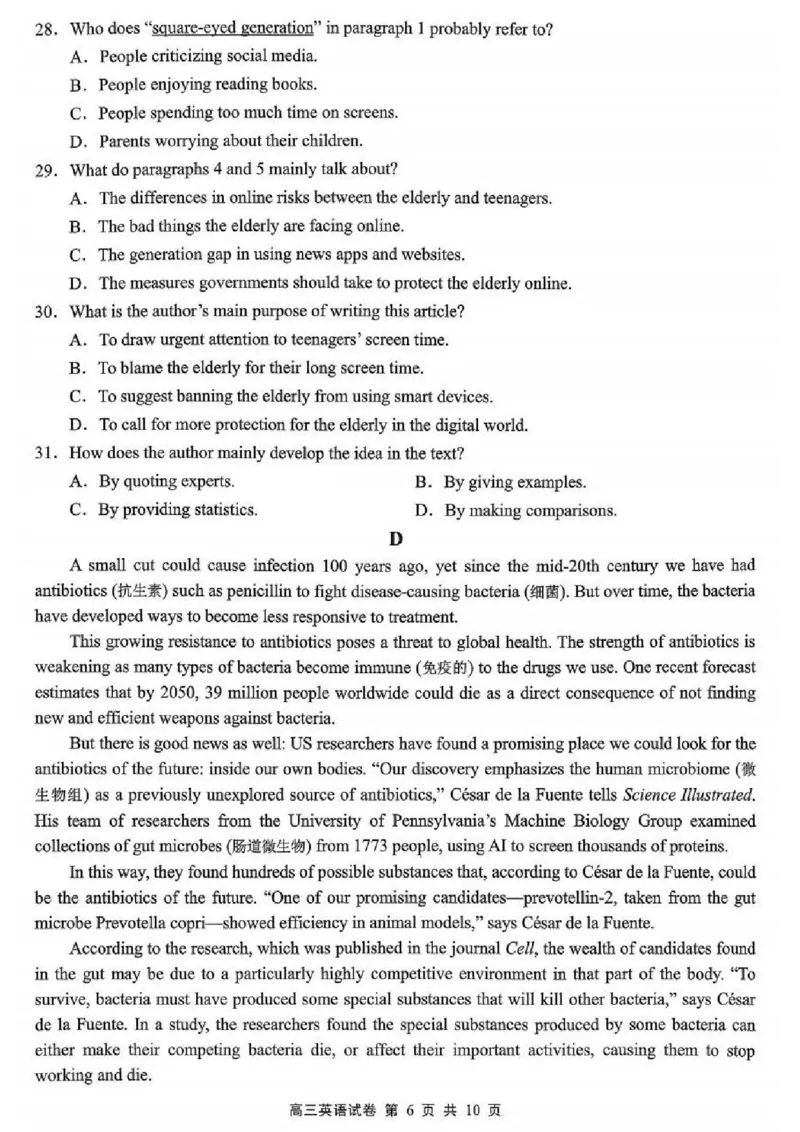
高三英语试卷第5页 共10页28. Who does “square-eyed generation” in paragraph 1 probably refer to?
A. People criticizing social media.
B. People enjoying reading books.
C. People spending too much time on screens.
D. Parents worrying about their children.
29. What do paragraphs 4 and 5 mainly talk about?
A. The differences in online risks between the elderly and teenagers.
B. The bad things the elderly are facing online.
C. The generation gap in using news apps and websites.
D. The measures governments should take to protect the elderly online.
30. What is the author's main purpose of writing this article?
A. To draw urgent attention to teenagers'screen time.
B. To blame the elderly for their long screen time.
C. To suggest banning the elderly from using smart devices.
D. To call for more protection for the elderly in the digital world.
31. How does the author mainly develop the idea in the text?
A. By quoting experts. B. By giving examples.
C. By providing statistics. D. By making comparisons.
D
A small cut could cause infection 100 years ago, yet since the mid-20th century we have had
antibiotics(抗生素)such as penicillin to fight disease-causing bacteria(细菌).But over time,the bacteria
have developed ways to become less responsive to treatment.
This growing resistance to antibiotics poses a threat to global health.The strength of antibiotics is
weakening as many types of bacteria become immune(免疫的)to the drugs we use.One recent forecast
estimates that by 2050,39 million people worldwide could die as a direct consequence of not finding
new and efficient weapons against bacteria.
But there is good news as well: US researchers have found a promising place we could look for the
antibiotics of the future: inside our own bodies. “Our discovery emphasizes the human microbiome(微
生物组)as a previously unexplored source of antibiotics," Cesar de la Fuente tells Science IIlustrated.
His team of researchers from the University of Pennsylvania's Machine Biology Group examined
collections of gut microbes(肠道微生物) from 1773 people,using AI to screen thousands of proteins.
In this way,they found hundreds of possible substances that,according to César de la Fuente,could
be the antibiotics of the future. “One of our promising candidates—prevotellin-2, taken from the gut
microbe Prevotella copri—showed efficiency in animal models,"says César de la Fuente.
According to the research, which was published in the journal Cell, the wealth of candidates found
in the gut may be due to a particularly highly competitive environment in that part of the body."To
survive, bacteria must have produced some special substances that will kill other bacteria,"says Cesar
de la Fuente. In a study, the researchers found the special substances produced by some bacteria can
either make their competing bacteria die, or affect their important activities, causing them to stop
working and die.
高三英语试卷 第6页共10页32. What is the main problem mentioned in the text?
A. Treatment is often delayed and weak. B.Existing antibiotics cause side effects.
C. Bacteria are growing more resistant. D. _Di_se_ase-causing bacteria are increasing.
33. What can we learn about the antibiotics of the future?
A. They willbe created by AI systems.
B. They may come from the human microbiome.
C. They can stop different bacterial competitions.
D. They'll solve the problem of antibiotic resistance by 2050.
34. What can be inferred about prevotellin-2 from the text?
A. It has cured many patients. B. It has replaced existing antibiotics.
C. It is a widely-used antibiotic now. D. It proves effective in animal models.
35. What does the last paragraph mainly talk about?
A. The method of testing new antibiotic drugs.
B. The importance of antibiotics for global health.
C. The cause of the gut's rich antibiotic candidates.
D. The role of diet in producing antibacterial substances.
第二节(共5小题;每小题2.5分,满分12.5分)
阅读下面短文,从短文后的选项中选出可以填入空由处的最佳选项。选项中有两项为多余选项。
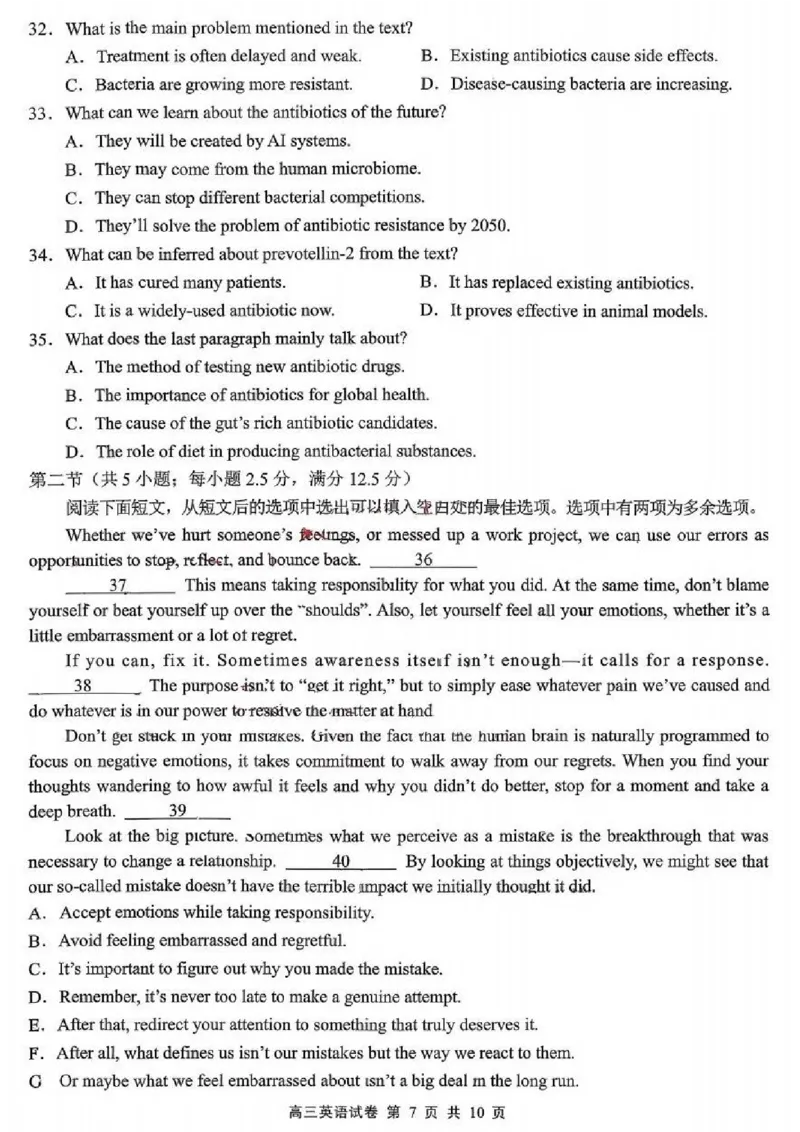
Whether we've hurt someone's feetngs, or messed up a work project, we can use our errors as
opporkunities to stop,rcflect,and bounce back.36
37____ This means taking responsibility for what you did. At the same time, don't blame
yourself or beat yourself up over the “shoulds”. Also,let yourself feel all your emotions, whetherit's a
little embarrassment or a lot of regret.
If you can, fix it. Sometimes awareness itsenf isn't enough—it calls for a response.
38_The purpose isn't to “get it right,” but to simply ease whatever pain we've caused and
do whatever is in our power to ressive the matter at hand
Don't get stack in your mstakes. Given the fact that the humian brain is naturally programmed to
focus on negative emotions, it takes commitment to walk away from our regrets. When you find your
thoughts wandering to how awful it feels and why you didn’t do better,stop for a moment and take a
deep breath.39_
Look at the big picture. sometimes what we perceive as a mistake is the breakthrough that was
necessary to change a relationship.40__By looking at things objectively, we might see that
our so-called mistake doesn't have the terrible impact we initially thought it did.
A. Accept emotions while taking responsibility.
B. Avoid feeling embarrassed and regretful.
C. It's important to figure out why you made the mistake.
D. Remember,it's never too late to make a genuine attempt.
E. After that, redirect your attention to something that truly deserves it.
F.After all, what defines us isn't our mistakes but the way we react to them.
C Or maybe what we feel embarrassed about isn't a big deal m the long run.
高三英语试卷第7页 共10页第三部分 语言运用(共两节,满分30分)
第一节(共15小题;每小题1分,满分15分)
阅读下面短文,从每题所给的A、B、C、D四个选项中选出可以填入空白处的最佳选项。
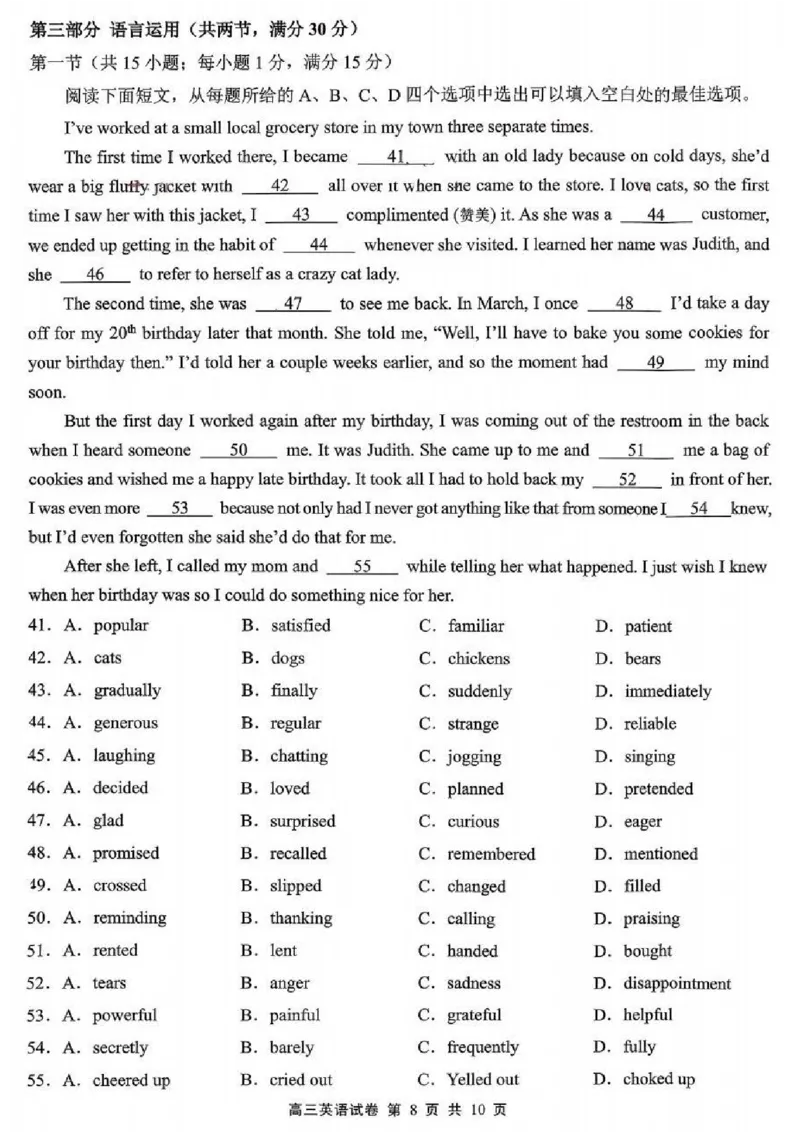
I've worked at a small local grocery store in my town three separate times.
The first time I worked there, I became 41. with an old lady because on cold days, she'd
wear a big flufly jacket with 42all over it when sne came to the store. I love cats,so the first
time I saw her with this jacket,I 43complimented(赞美)it.As she was a 44customer,
we ended up getting in the habit of 44whenever she visited. I learned her name was Judith,and
she 46 to refer to herself as a crazy cat lady.
The second time,she was47to see me back. In March, I once 48 I'd take a day
off for my 20? birthday later that month. She told me, “Well, I'll have to bake you some cookies for
your birthday then."I'd told her a couple weeks earlier,and so the moment had 49my mind
soon.
But the first day I worked again after my birthday, I was coming out of the restroom in the back
when I heard someone 50 me. It was Judith. She came up to me and 51 me a bag of
cookies and wished me a happy late birthday. It took all I had to hold back my 52 in front of her.
I was even more 53 because not only had Inever got anything like that from someone I 54 knew,
but I'd even forgotten she said she'd do that for me.
After she left, I called my mom and 55while telling her what happened. Ijust wish I knew
when her birthday was so I could do something nice for her.
41.A. popular B. satisfied C. familiar D. patient
42. A. cats B. dogs C. chickens D. bears
43.A. gradually B. finally C. suddenly D. immediately
44. A. generous B. regular C. strange D. reliable
45.A. laughing B. chatting D. singing
C. jogging
46. A. decided B. loved C. planned D. pretended
47.A. glad B. surprised C. curious D. eager
48.A. promised B. recalled C. remembered D. mentioned
49. A. crossed B. slipped C. changed D. filled
50. A. reminding B. thanking C. calling D. praising
51. A. rented B. lent C. handed D. bought
52. A. tears B. anger C. sadness D. disappointment
53.A. powerful B. painful C. grateful D. helpful
54.A. secretly B. barely C. frequently D. fully
55.A. cheered up B. cried out C. Yelled out D. choked up
高三英语试卷第8页 共 10页第二节(共10小题;每小题1.5分,满分15分)
阅读下面短文,在空白处填入1个适当的单词或括号内单词的正确形式。
Khoomei, a traditional art form from Mongolia, is known as a kind of throat singing. It's
56 ancient vocal tradition which allows singers to produce the sounds ofmultiple notes simultaneously
(同时地)in their throats. And it creates a sound 57 echoes the natural world—from the howling
wind to the rumbling river.
Khoomei has been passed down through generations of Mongolians and is closely tied to their
58(spirit) and cultural practices. Its ability to mimic(模仿) the sounds of nature reflects a deep
connection to the land,59(demonstrate) the vastness and beauty of the grasslands.
In 2009,khoomei 60(recognize)by UNESCO as an Intangible Cultural Heritage of Humanity,
highlighting its significance as a vital part of the world's cultural heritage.This 61(acknowledge)
not only honors its cultural importance but also raises awareness of the ongoing need to preserve the
ancient art form. Ever since,the recognition 62(fuel) efforts to ensure it continues to develop
in modern society.
One of khoomei's remarkable qualities is its ability to transcend(超越)generations. 63it
has traditionally been performed by senior masters, the art form has increasingly captured the interest of
younger generations.
The appearance of khoomei in popular reality shows and movies has helped raise its profile among
a64(wide) audience. The hit animated movie Ne Zha 2,for example,features the distinctive
sound, especially during mythical moments, such as the appearance of the Tianyuan Ding. Sung by
Halamuji, a young Mongolian artist, it contributes 65(significant) to the atmosphere.
第四部分 写作(共两节,满分40分)
第一节(满分15分)
假定你是李华,你校主题为“慧学赋能,探究成长”的“慧学周”(Smart Study Week)活动
已圆满结束,请你写一篇短文向校英文报投稿,内容包括:
1.活动内容;
2.你的收获。
注意:
1.词数80左右;
2.请按如下格式在答题卡的相应位置作答。
▲
▲
▲
▲
高三英语试卷第9页 共10页第二节(满分25分)
阅读下面材料,根据其内容和所给段落开头语续写两段,使之构成一篇完整的短文。
Like many other teenage boys, I was in a band. We played a mix of hard rock and heavy metal. We
weren't great, but we were good enough to come in third place at our school's talent show.And when
we got a chance to give a charitable performance at a large rehabilitation(康复)hospital, we were
excited. It was our first real job. For two weeks we practiced hard, getting together every day after
school to polish our skills and learn enough songs to fill a one-hour show, expecting to receive
thundering applause.
The day of the concert,we showed up early in order to check out the stage. It was stressful to stand
there and look out at the hundred or so chairs lined up below us. We did a quick sound check, and then
went backstage to have a soda and rest, anything to calm our nerves. While we were back there the
hospital's entertainment director Ms. Evans came over to talk to us.
“Okay,boys, I just want to fill you in on a couple of important details,”Ms. Evans told us. “A lot
of people in the audience are suffering from severe physical and/or mental disabilities. Also, many of
them are older,in their sixties and seventies."Ms. Evans cast a glance to the auditorium(观众席)and
added, "Don't let that alarm you. These patients have very few chances to see live entertainment of any
kind, so they enjoy any kind of musical talent that we can bring in. Just play your regular show, and
you'll do fine."We all nodded.
With that, Ms. Evans left, going into the auditorium to help the volunteers and staff that were
assisting the patients to their seats. The majority of them had either been seriously injured in accidents
or born with major birth defects(缺陷).Many of them were missing limbs. Some were talking quietly
among themselves, but most were just sitting there,quietly watching the stage.
1.续写词数应为150左右;
2.请按如下格式在答题卡的相应位置作答。
Soon enough it was show time,and we stepped out of the thick curtain onto the stage.
▲
▲
▲
▲
Since no one was applauding us,we cut our performance short and went backstage.
▲
▲
▲
▲
高三英语试卷第10页 共 10页英语解析
123456