2004年全国硕士研究生入学统一考试英语试题
Section I Use of English
Directions:
Read the following text. Choose the best word(s) for each numbered blank and mark A, B, C or D on
ANSWER SHEET 1.(10 points)
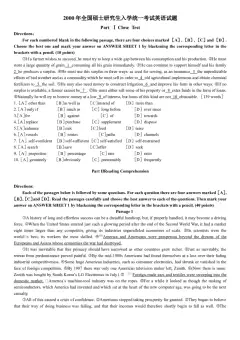
Many theories concerning the causes of juvenile delinquency (crimes committed by young
people) focus either on the individual or on society as the major contributing influence. Theories
1 on the individual suggest that children engage in criminal behavior 2 they were not
sufficiently penalized for previous misdeeds or that they have learned criminal behavior through
3 with others. Theories focusing on the role of society suggest that children commit crimes
in 4 to their failure to rise above their socioeconomic status, 5 as a rejection of middle
class values.
Most theories of juvenile delinquency have focused on children from disadvantaged families,
6 the fact that children from wealthy homes also commit crimes. The latter may commit crimes
7 lack of adequate parental control. All theories, however, are tentative and are 8 to criticism.
Changes in the social structure may indirectly 9 juvenile crime rates. For example, changes
in the economy that 10 to fewer job opportunities for youth and rising unemployment 11 make
gainful employment increasingly difficult to obtain. The resulting discontent may in 12 lead more
youths into criminal behavior.
Families have also 13 changes these years. More families consist of one-parent households or
two working parents; 14 , children are likely to have less supervision at home 15 was common
in the traditional family 16 This lack of parental supervision is thought to be an influence on
juvenile crime rates. Other 17 causes of offensive acts include frustration or failure in school, the
increased 18 of drugs and alcohol, and the growing 19 of child abuse and child neglect. All
these conditions tend to increase the probability of a child committing a criminal act, 20 a direct
causal relationship has not yet been established.
第 1 页 共 12页1. [A] acting [B] relying [C] centering [D] commenting
2. [A] before [B] unless [C] until [D] because
3. [A] interaction [B] assimilation [C] cooperation [D] consultation
4. [A] return [B] reply [C] reference [D] response
5. [A] or [B] but rather [C] but [D] or else
6. [A] considering [B] ignoring [C] highlighting [D] discarding
7. [A] on [B] in [C] for [D] with
8. [A] immune [B] resistant [C] sensitive [D] subject
9. [A] affect [B] reduce [C] check [D] reflect
10. [A] point [B] lead [C] come [D] amount
11. [A] in general [B] on average [C] by contrast [D] at length
12. [A] case [B] short [C] turn [D] essence
13. [A] survived [B] noticed [C] undertaken [D] experienced
14.[A] contrarily [B] consequently [C] similarly [D] simultaneously
15. [A] than [B] that [C] which [D] as
16. [A] system [B] structure [C] concept [D] heritage
17. [A] assessable [B] identifiable [C] negligible [D] incredible
18. [A]expense [B] restriction [C] allocation [D] availability
19. [A] incidence [B] awareness [C] exposure [D] popularity
20. [A] provided [B] since [C] although [D] supposing
Section II Reading Comprehension
Part A
Directions:
Read the following four texts. Answer the questions below each text by choosing [A], [B], [C] or [D].
Mark your answers on ANSWER SHEET 1. (40 points)
第 2 页 共 12页Text 1
Hunting for a job late last year, lawyer Gant Redmon stumbled across CareerBuilder, a job
database on the Internet. He searched it with no success but was attracted by the site's "personal search
agent”. Ifs an interactive feature that lets visitors key in job criteria such as location, title, and salary,
then E-mails them when a matching position is posted in the database. Redmon chose the keywords
legal, intellectual property and Washington, D.C. Three weeks later, he got his first notification of an
opening. 46I struck gold,^^ says Redmon, who E-mailed his resume to the employer and won a position
as in-house counsel for a company.
With thousands of career-related sites on the Internet, finding promising openings can be
time-consuming and inefficient. Search agents reduce the need for repeated visits to the databases. But
although a search agent worked for Redmon, career experts see drawbacks. Narrowing your criteria,
for example, may work against you: "Every time you answer a question you eliminate a possibility^^
?
says one expert.
For any job search, you should start with a narrow concept-what you think you want to
do- then broaden it. "None of these programs do that,“ says another expert. "There's no career
counseling implicit in all of this/9 Instead, the best strategy is to use the agent as a kind of tip service to
keep abreast of jobs in a particular database; when you get E-mail, consider it a reminder to check the
database again. "I would not rely on agents for finding everything that is added to a database that
might interest me,“ says the author of a job-searching guide.
Some sites design their agents to tempt job hunters to return. When CareerSite^ agent sends out
messages to those who have signed up for its service, for example, it includes only three potential
jobs-those it considers the best matches. There may be more matches in the database; job hunters will
have to visit the site again to find them—and they do. "On the day after we send our messages, we see
a sharp increase in our traffic J says Seth Peets, vice president of marketing for CareerSite.
Even those who aren't hunting for jobs may find search agents worthwhile. Some use them to
keep a close watch on the demand for their line of work or gather information on compensation to arm
themselves when negotiating for a raise. Although happily employed, Redmon maintains his agent at
CareerBuilder. "You always keep your eyes open,“ he says. Working with a personal search agent
means having another set of eyes looking out for you.
第 3 页 共 12页21. How did Redmon find his job?
[A] By searching openings in a job database.
[B] By posting a matching position in a database.
[C] By using a special service of a database.
[D] By E-mailing his resume to a database.
22. Which of the following can be a disadvantage of search agents?
[A] Lack of counseling.
[B] Limited number of visits.
[C] Lower efficiency.
[D] Fewer successful matches.
23. The expression "tip service^^ (Line 3, Paragraph 3) most probably m e a n s .
[A] advisory
[B] compensation
[C] interaction
[D] reminder
24. Why does CareerSite9s agent offer each job hunter only three job options?
[A] To focus on better job matches.
[B] To attract more returning visits.
[C] To reserve space for more messages.
[D] To increase the rate of success.
25. Which of the following is true according to the text?
[A] Personal search agents are indispensable to job-hunters.
[B] Some sites keep E-mailing job seekers to trace their demands.
[C] Personal search agents are also helpful to those already employed.
[D] Some agents stop sending information to people once they are employed.
第 4 页 共 12页Text 2
Over the past century, all kinds of unfairness and discrimination have been condemned or made
illegal. But one insidious form continues to thrive: alphabetism. This, for those as yet unaware of such
a disadvantage, refers to discrimination against those whose surnames begin with a letter in the lower
half of the alphabet.
It has long been known that a taxi firm called AAAA cars has a big advantage over Zodiac cars
when customers thumb through their phone directories. Less well known is the advantage that Adam
Abbott has in life over Zoe Zysman. English names are fairly evenly spread between the halves of the
alphabet. Yet a suspiciously large number of top people have surnames beginning with letters between
A and K.
Thus the American president and vice-president have surnames starting with B and C respectively;
and 26 of George Bush's predecessors (including his father) had surnames in the first half of the
alphabet against just 16 in the second half. Even more striking, six of the seven heads of government
of the G7 rich countries are alphabetically advantaged (Berlusconi, Blair, Bush, Chirac, Chretien and
Koizumi). The world's three top central bankers (Greenspan, Duisenberg and Hayami) are all close to
the top of the alphabet, even if one of them really uses Japanese characters. As are the world's five
richest men (Gates, Buffett, Allen, Ellison and Albrecht).
Can this merely be coincidence? One theory, dreamt up in all the spare time enjoyed by the
alphabetically disadvantaged, is that the rot sets in early. At the start of the first year in infant school,
teachers seat pupils alphabetically from the front, to make it easier to remember their names. So
short-sighted Zysman junior gets stuck in the back row, and is rarely asked the improving questions
posed by those insensitive teachers. At the time the alphabetically disadvantaged may think they have
had a lucky escape. Yet the result may be worse qualifications, because they get less individual
attention, as well as less confidence in speaking publicly.
The humiliation continues. At university graduation ceremonies, the ABCs proudly get their
awards first; by the time they reach the Zysmans most people are literally having a ZZZ. Shortlists for
job interviews, election ballot papers, lists of conference speakers and attendees: all tend to be drawn
up alphabetically, and their recipients lose interest as they plough through them.
26. What does the author intend to illustrate with AAAA cars and Zodiac cars?
第 5 页 共 12页[A] A kind of overlooked inequality.
[B] A type of conspicuous bias.
[C] A type of personal prejudice.
[D] A kind of brand discrimination.
27. What can we infer from the first three paragraphs?
[A] In both East and West, names are essential to success.
[B] The alphabet is to blame for the failure of Zoe Zysman.
[C] Customers often pay a lot of attention to companies9 names.
[D] Some form of discrimination is too subtle to recognize.
28. The 4th paragraph suggests t h a t .
[A] questions are often put to the more intelligent students
[B] alphabetically disadvantaged students often escape from class
[C] teachers should pay attention to all of their students
[D] students should be seated according to their eyesight
29. What does the author mean by “most people are literally having a ZZZ” (Line 2, Paragraph 5)?
[A] They are getting impatient.
[B] They are noisily dozing off.
[C] They are feeling humiliated.
[D] They are busy with word puzzles.
30. Which of the following is true according to the text?
[A] People with surnames beginning with N to Z are often ill-treated.
[B] VIPs in the Western world gain a great deal from alphabetism.
[C] The campaign to eliminate alphabetism still has a long way to go.
[D] Putting things alphabetically may lead to unintentional bias.
第 6 页 共 12页Text 3
When it comes to the slowing economy, Ellen Spero isn't biting her nails just yet But the
47-year-old manicurist isn't cutting, filing or polishing as many nails as she'd like to, either. Most of
her clients spend $12 to $50 weekly, but last month two longtime customers suddenly stopped showing
up. Spero blames the softening economy. 6Tm a good economic indicator,,5 she says. "I provide a
service that people can do without when they*re concerned about saving some dollars.^^ So Spero is
downscaling, shopping at middle-brow Dillard's department store near her suburban Cleveland home,
instead of Neiman Marcus. 6aI don't know if other clients are going to abandon me, too," she says.
Even before Alan Greenspan's admission that America's red-hot economy is cooling, lots of
working folks had already seen signs of the slowdown themselves. From car dealerships to Gap outlets,
sales have been lagging for months as shoppers temper their spending. For retailers, who last year took
in 24 percent of their revenue between Thanksgiving and Christmas, the cautious approach is coming
at a crucial time. Already, experts say, holiday sales are off 7 percent from last year's pace. But don*t
sound any alarms just yet. Consumers seem only mildly concerned, not panicked, and many say they
remain optimistic about the economy*s long-term prospects even as they do some modest
belt-tightening.
Consumers say they're not in despair because, despite the dreadful headlines, their own fortunes
still feel pretty good. Home prices are holding steady in most regions. In Manhattan, 44there*s a new
gold rush happening in the $4 million to $10 million range, predominantly fed by Wall Street
bonuses/5 says broker Barbara Corcoran. In San Francisco, prices are still rising even as frenzied
overbidding quiets. "Instead of 20 to 30 offers, now maybe you only get two or three/ says John
Tealdi, a Bay Area real-estate broker. And most folks still feel pretty comfortable about their ability to
find and keep a job.
Many folks see silver linings to this slowdown. Potential home buyers would cheer for lower
interest rates. Employers wouldn*t mind a little fewer bubbles in the job market. Many consumers seem
to have been influenced by stock-market swings, which investors now view as a necessary ingredient
to a sustained boom. Diners might see an upside, too. Getting a table at Manhattan*s hot new Alain
Ducasse restaurant used to be impossible. Not anymore. For that, Greenspan & Co. may still be worth
toasting.
第 7 页 共 12页31. By "Ellen Spero isn't biting her nails just yet” (Line 1, Paragraph 1), the author m e a n s .
[A] Spero can hardly maintain her business
[B] Spero is too much engaged in her work
[C] Spero has grown out of her bad habit
[D] Spero is not in a desperate situation
32. How do the public feel about the current economic situation?
[A] Optimistic [B] Confused. [C] Carefree. [D] Panicked.
33. When mentioning "the $4 million to $10 million range,,(Lines 3, Paragraph 3), the author is talking
a b o u t .
[A] gold market.
[B] real estate.
[C] stock exchange.
[D] venture investment.
34. Why can many people see “silver linings^^ to the economic slowdown?
[A] They would benefit in certain ways.
[B] The stock market shows signs of recovery.
[C] Such a slowdown usually precedes a boom.
[D] The purchasing power would be enhanced.
35. To which of the following is the author likely to agree?
[A] A new boom, on the horizon.
[B] Tighten the belt, the single remedy.
[C] Caution all right, panic not.
[D] The more ventures, the more chances.
第 8 页 共 12页Text 4
Americans today don't place a very high value on intellect. Our heroes are athletes, entertainers,
and entrepreneurs, not scholars. Even our schools are where we send our children to get a practical
education-not to pursue knowledge for the sake of knowledge. Symptoms of pervasive
anti-intellectualism in our schools aren't difficult to find.
"Schools have always been in a society where practical is more important than intellectual,55 says
education writer Diane Ravitch. ''Schools could be a counterbalance.^^ Ravitch's latest book, Left Back:
A Century of Failed School Reforms, traces the roots of anti-intellectualism in our schools, concluding
they are anything but a counterbalance to the American distaste for intellectual pursuits.
But they could and should be. Encouraging kids to reject the life of the mind leaves them
vulnerable to exploitation and control. Without the ability to think critically, to defend their ideas and
understand the ideas of others, they cannot fully participate in our democracy. Continuing along this
path, says writer Earl Shorris, “We will become a second-rate country. We will have a less civil
society.^^
"Intellect is resented as a form of power or privilege,writes historian and professor Richard
Hofstadter in Anti-Intellectualism in American Life, a Pulitzer-Prize winning book on the roots of
anti-intellectualism in US politics, religion, and education. From the beginning of our history, says
Hofstadter, our democratic and populist urges have driven us to reject anything that smells of elitism.
Practicality, common sense, and native intelligence have been considered more noble qualities than
anything you could learn from a book.
Ralph Waldo Emerson and other Transcendentalist philosophers thought schooling and rigorous
book learning put unnatural restraints on children: "We are shut up in schools and college recitation
rooms for 10 or 15 years and come out at last with a bellyful of words and do not know a thing." Mark
Twain's Huckleberry Finn exemplified American anti-intellectualism. Its hero avoids being
civilized- going to school and learning to read- so he can preserve his innate goodness.
Intellect, according to Hofstadter, is different from native intelligence, a quality we reluctantly
admire. Intellect is the critical, creative, and contemplative side of the mind. Intelligence seeks to grasp,
manipulate, re-order, and adjust, while intellect examines, ponders, wonders, theorizes, criticizes, and
imagines.
School remains a place where intellect is mistrusted. Hofstadter says our country's educational
system is in the grips of people who joyfully and militantly proclaim their hostility to intellect and
their eagerness to identify with children who show the least intellectual promise.”
第 9 页 共 12页36. What do American parents expect their children to acquire in school?
[A] The habit of thinking independently.
[B] Profound knowledge of the world.
[C] Practical abilities for future career.
[D] The confidence in intellectual pursuits.
37. We can learn from the text that Americans have a history o f .
[A] undervaluing intellect
[B] favoring intellectualism
[C] supporting school reform
[D] suppressing native intelligence
38. The views of Ravitch and Emerson on schooling a r e .
[A] identical
[B] similar
[C] complementary
[D] opposite
39. Emerson, according to the text, is p r o b a b l y .
[A] a pioneer of education reform
[B] an opponent of intellectualism
[C] a scholar in favor of intellect
[D] an advocate of regular schooling.
40. What does the author think of intellect?
[A] It is second to intelligence.
[B] It evolves from common sense.
[C] It is to be pursued.
[D] It underlies power.
第 10页 共 12页Part B
Directions:
Read the following text carefully and then translate the underlined segments into Chinese. Your
translation should be written clearly on ANSWER SHEET 2. (10 po血s)
The relation of language and mind has interested philosophers for many centuries. (41) The
Greeks assumed that the structure of language had some cormection with the process of thought, which
took root in Europe long before people realized how diverse languages could be.
Only recently did linguists begin the serious study of languages that were very different from
their own. Two anthropologist-linguists, Franz Boas and Edward Sapir, were pioneers in describing
many native languages of North and South America during the first half of the twentieth century. (42)
We are obliged to them because some of these languages have since vanished, as the peoples who
spoke them died out or became assimilated and lost their native languages. Other linguists in the
earlier part of this century, however, who were less eager to deal with bizarre data from “exotic”
language, were not always so grateful. (43) The newly described languages were often so strikingly
different fix)m the well studied languages of Europe and Southeast Asia that some scholars even
accused Boas and Sapir of fabricating their data. Native American languages are indeed different, so
much so in fact that Navajo could be used by the US military as a code during World War II to send
secret messages.
Sapir's pupil, Benjamin Lee Whorf^ continued the study of American Indian languages. (44)
Being interested in the relationship of language and thought, Whorf developed the idea that the
structure of language determines the structure of habitual thought in a society. He reasoned that
because it is easier to formulate certain concepts and not others in a given language, the speakers of
that language think along one track and not along another. (45) Whorf came to believe in a sort of
linguistic determinism which, in its strongest form, states that language imprisons the mind, and that
the grammatical patterns in a language can produce far-reaching consequences fbr the culture of a
society. Later, this idea became to be known as the Sapir-Whorf hypothesis, but this term is somewhat
inappropriate. Although both Sapir and Whorf emphasized the diversity of languages, Sapir himself
never explicitly supported the notion of linguistic determinism.
第 11页 共 12页Section III Writing
46. Directions:
Study the following drawing carefully and write an essay in which you should
1) describe the drawing,
2) interpret its meaning, and
3) support your view with examples.
You should write about 200 words neatly on ANSWER SHEET 2 (20 points)
终点又是新起点
第 12页 共 12页
![《2004年考研英语真题(可复制、可搜索)_考研真题_x_英语一真题+解析[80-25]_英语一1980-2009真题及解析_1998-2009考研英语真题(PDF)》第1页预览](https://static.diaifu.net/ssd/ssd5/wenku/2026-04-17/3b58cfb8741dc44d3fb7d047d5e0af08/3b58cfb8741dc44d3fb7d047d5e0af08_1.webp)
![《2004年考研英语真题(可复制、可搜索)_考研真题_x_英语一真题+解析[80-25]_英语一1980-2009真题及解析_1998-2009考研英语真题(PDF)》第2页预览](https://static.diaifu.net/ssd/ssd5/wenku/2026-04-17/3b58cfb8741dc44d3fb7d047d5e0af08/3b58cfb8741dc44d3fb7d047d5e0af08_2.webp)
![《2004年考研英语真题(可复制、可搜索)_考研真题_x_英语一真题+解析[80-25]_英语一1980-2009真题及解析_1998-2009考研英语真题(PDF)》第3页预览](https://static.diaifu.net/ssd/ssd5/wenku/2026-04-17/3b58cfb8741dc44d3fb7d047d5e0af08/3b58cfb8741dc44d3fb7d047d5e0af08_3.webp)
![《2004年考研英语真题(可复制、可搜索)_考研真题_x_英语一真题+解析[80-25]_英语一1980-2009真题及解析_1998-2009考研英语真题(PDF)》第4页预览](https://static.diaifu.net/ssd/ssd5/wenku/2026-04-17/3b58cfb8741dc44d3fb7d047d5e0af08/3b58cfb8741dc44d3fb7d047d5e0af08_4.webp)
![《2004年考研英语真题(可复制、可搜索)_考研真题_x_英语一真题+解析[80-25]_英语一1980-2009真题及解析_1998-2009考研英语真题(PDF)》第5页预览](https://static.diaifu.net/ssd/ssd5/wenku/2026-04-17/3b58cfb8741dc44d3fb7d047d5e0af08/3b58cfb8741dc44d3fb7d047d5e0af08_5.webp)
![《2004年考研英语真题(可复制、可搜索)_考研真题_x_英语一真题+解析[80-25]_英语一1980-2009真题及解析_1998-2009考研英语真题(PDF)》第6页预览](https://static.diaifu.net/ssd/ssd5/wenku/2026-04-17/3b58cfb8741dc44d3fb7d047d5e0af08/3b58cfb8741dc44d3fb7d047d5e0af08_6.webp)