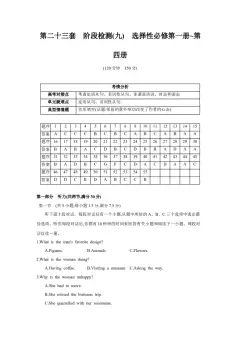
第二十三套 阶段检测(九) 选择性必修第一册~第
四册
(120分钟 150分)
考情分析
高考对接点 考查定语从句、名词性从句、非谓语动词、时态和语态
单元疑难点 定语从句、名词性从句
典型情境题 完形填空(话题:邻居的意外举动改变了作者的心态)
第一部分 听力(共两节,满分30分)
第一节 (共5小题;每小题1.5分,满分7.5分)
听下面5段对话。每段对话后有一个小题,从题中所给的A、B、C三个选项中选出最
佳选项。听完每段对话后,你都有10秒钟的时间来回答有关小题和阅读下一小题。每段对
话仅读一遍。
1.What is the man's favorite design?
A.Figures. B.Animals. C.Flowers.
2.What is the woman doing?
A.Having coffee. B.Visiting a museum. C.Asking the way.
3.Why is the woman unhappy?
A.She had to move.
B.She missed the business trip.
C.She quarrelled with her roommate.
4.What will Mark do with the book?
A.Keep it. B.Return it. C.Renew it.
5.What is Jim's boss's attitude toward his suggestion?
A.Opposed. B.Supportive. C.Doubtful.
第二节 (共15小题;每小题1.5分,满分22.5分)听下面5段对话或独白。每段对话或独白后有几个小题,从题中所给的A、B、C三个
选项中选出最佳选项。听每段对话或独白前,你将有时间阅读各个小题,每小题5秒钟;听完
后,各小题将给出5秒钟的作答时间。每段对话或独白读两遍。
听第6段材料,回答第6、7题。
6.Why has the man borrowed many books?
A.For his trip. B.For his schoolwork. C.For his presentation.
7.Where is the presentation going to be held?
A.In the school library.
B.In the school theatre.
C.In the Students' Union.
听第7段材料, 回答第8、9题。
8.Why does Diana say sorry to Peter?
A.She needs to put off her test.
B.She wants to visit another city.
C.She has to give up her travel plan.
9.What does Diana want Peter to do?
A.Take a book to her friend. B.Help her with her study. C.Teach her geography.
听第8段材料,回答第10至12题。
10.What kind of camera does the woman want?
A.A film camera. B.A video camera. C.A security camera.
11.What quality does the second video camera have?
A.Underwater filming. B.Big memory. C.Quick focus.
12.How much should the woman pay?
A.$450. B.$675. C.$750.
听第9段材料, 回答第13至16题。
13.What is the relationship between the speakers?
A.Teacher and student.
B.Interviewer and interviewee.
C.Manager and clerk.
14.Why did the man leave his previous job in the bank?
A.His family moved to another place.
B.He had never gotten a raise.C.He wanted to make a change.
15.What did the man do after quitting from the bank?
A.He worked in a company.
B.He went abroad for further study.
C.He taught in a private school.
16.How much does the man want to get at least a month?
A.$4,000. B.$5,000. C.$6,000.
听第10段材料, 回答第17至20题。
17.How did the Stone Age people in Doggerland make a living?
A.By hunting. B.By farming. C.By trading.
18.Who often find the evidence of Doggerland?
A.Scientists. B.Fishermen. C.Historians.
19.When did the people leave Doggerland?
A.About 6,000 years ago.
B.About 9,000 years ago.
C.About 12,000 years ago.
20.Which modern issue do researchers warn us about?
A.Immigration. B.Pollution. C.Climate change.
第二部分 阅读(共两节,满分50分)
第一节 (共15小题;每小题2.5分,满分37.5分)
阅读下列短文,从每题所给的A、B、C、D四个选项中选出最佳选项。
A
We are very pleased to announce the 20th International EAS (the European Association for
Music in Schools) Student Forum will take place from May 22 to 25.
The Student Forum has become an established part of the annual EAS conference. The EAS
Student Forum presentation at the EAS conference has become one of the highlights.
The Student Forum programme will include workshops, discussions and musical
presentations. Its aim is to give student teachers an opportunity to share and exchange their
experience and views of music teaching.
The theme of the Student Forum:Innovating and Inventing Music in the Classroom
Three elements to the programme:● Practical and creative music making through sharing examples of musical activities, and
creating new music together.
● Discussion on the theme and sharing the students' different experience and perspectives of
learning to become a teacher in their own school system.
● Participation in selected conference activities, and group work.
Selection criteria:
The participating students should:
● currently be in the final years of their music teacher training programme;
● be interested in European and international perspectives in music education;
● have a basic knowledge of English;
● have the ability to work with others and contribute to debate.
EAS Student Forum Team:
Sara Savovi (Faculty of Music, Belgrade, student delegate, Serbia)
mail: savovic.sara4@gmail.com
Prof Dr Branka Rotar Pance (University of Ljubljana, Slovenia)
mail: branka.rotar-pance@ag.uni-lj.si
Tom Rousselet (Le Centre Formation des Musiciens Intervenants, de l'Université Lyon 2)
mail: tomrousselet@univ.lyon2.fr
Prof Dr Oliver Krämer (Rostock University of Music and Drama, Germany)
mail: oliver.kraemer@hmt-rostock.de
Contact person of the EAS board for further questions: Prof Andreas Bernhofer
mail: andreas.bernhofer@moz.ac.at
21.What do we learn about the Student Forum?
A.It usually lasts five days. B.It invites professors as teaching guides.
C.It presents the history of music. D.It focuses on creation of music in class.
22.Which is a requirement for the Student Forum participants?
A.Being native English speakers. B.Being good at communication.
C.Rich experience in music education. D.A unique view of European education.
23.Who can students consult for more information?
A.Sara Savovi . B.Oliver Krämer.
C.Andreas Bernhofer. D.Branka Rotar Pance.
BKala has deep ties to her Hawaiian roots. Her ancestors navigated (航行) the oceans for
centuries using their knowledge of the stars, the sun, the currents and the wind. It's not that she
does it in a canoe without technology, but rather uses the natural technology around her. It's called
Wayfinding, and was taught to her by her father.
“My father was my foundation, my rock,” Kala said of her first voyage with her father from
Oahu to Lahaina in a traditional canoe. He taught Kala how to read the stars, the ocean swells and
how to use them to hold the course. “Over 200 stars have specific names and purposes when you
are Wayfinding. You have to look at each and determine if they are rising or setting. You know
this star and the direction it represents. If you can do that, you can use it as a tool to orient (确定
方向),” Kala added.
Kala sailed the canoe in the ocean for up to three weeks. During the day, Kala used the sun
until it hit a certain height. When she got closer to land, she looked for certain species of land
birds and clouds that indicated there was land below. When Kala sailed “I feel very connected to
the crew and the canoe. We're a family.” The longer voyage required Kala to spend hours studying
the day and the night skies. It was demanding physical work. But it also had its moments of awe.
For Kala, the beauty was in tying together the past and the present to enjoy the moment. So when
she was not sailing, she was teaching Wayfinding skills to school-aged children in hopes of
preserving the skills her ancestors relied on.
It's easy to be lost in the immediacy of the technology of our day, to be consumed by screens
and miss the nature that unfolds around us. But if we will take the time to look up, to see the stars
and the sun, the way the clouds move, the miracle of life beneath and above us, we will discover
something deep inside us, something that will always lead to happiness.
24.How does Kala navigate the ocean in a canoe?
A.By turning to her father for help.
B.By using navigation equipment.
C.By following the course of ocean currents.
D.By observing the natural elements around.
25.What did Kala think of the three-week voyage?
A.It was a heroic adventure. B.It brought great joy to her life.
C.It represented a kind of bravery. D.It was school children's favorite.
26.What does the author advise us to do?A.Enjoy the screens. B.Get close to nature.
C.Explore space. D.Keep the earth clean.
27.What can be the best title for the text?
A.Finding our way B.Navigating the ocean
C.The wisdom from ancestors D.An unforgettable journey
C
As wildfires have grown larger and deadlier in recent years, one company, Drone Amplified,
is using drones (无人机) and fire-starting “dragon eggs” to help prevent extremely big fires and
save firefighters' lives.
The company is using the unmanned aerial technology to improve one of the oldest and most
effective methods of stopping wildfires from happening: prescribed burns. Carrick Detweiler,
founder and CEO of the company, said that this method works by “doing a very low intensity burn
that will basically burn up the dead leaves and sticks that would cause major wildfires when they
dry out later in the summer”.
While the technique of prescribed burns has been around for centuries, it can be challenging
and risky at times for firefighters to carry it out today. They often must hike or ride an all-terrain
vehicle (全地形车) through thick forest or mountainous terrain, carrying a drip torch (滴液点火
器) to start small fires in specific, remote locations. “Then you have helicopters with a whole crew
on board, flying really low and slow over the fire,” Detweiler added of other methods for
prescribed burns.“About a quarter of all wildland firefighting deaths are related to aviation. And
for me, this really was a motivation to start the technique and get these systems into the hands of
firefighters.”
The drones carry so-called “dragon eggs”, or fireballs that start to burn when they land on the
ground, resulting in a fire. They allow firefighters to work at a distance from flames, and in areas
that are difficult to reach due to terrain or visibility. Moreover, the drones, which are controlled by
an app, can also allow the fire-starting balls to be dropped in very specific locations, which is a
critical element when conducting prescribed burns, because it is crucial for preventing fire
escapes.
Detweiler said his company's equipment aims to prevent fire escapes through the use of
different kinds of cameras, and other technology that lets firefighters see through smoke, adding,“Our app also allows firefighters to set boundaries to prevent any fires outside of that area.” While
the technique is already being used by the US Forest Service and other federal agencies, he hopes
to see the technology on the back of every firefighter's truck in the future.
28.What does the underlined phrase “prescribed burns” in paragraph 2 refer to?
A.Detecting wildfires much earlier.
B.Locating wildfires more accurately.
C.Controlling wildfires by professional organizations.
D.Burning materials easy to catch wildfires in advance.
29.Why did Detweiler develop the unmanned aerial technology?
A.To save lives. B.To make money.
C.To analyze fire situations. D.To protect forest and wildlife.
30.What is paragraph 4 mainly about?
A.The advantages of the technology.
B.The difficulty of dropping fireballs.
C.The working principle of “dragon eggs”.
D.The importance of preventing fire escapes.
31.What does Detweiler say about the technology?
A.It needs further improvement.
B.It can precisely control the burning area.
C.It has been used on every firefighter's trucks.
D.It can also protect firefighters from thick smoke.
D
Archaeologists have found the earliest direct evidence for horseback riding in 5,000-year-old
human skeletons in Central Europe. David Anthony, a co-author of the study, said that horseback
riding was the fastest way for humans to travel before the railroads. The researchers analyzed over
200 Bronze Age skeletal remains, searching for signs of “horse rider syndrome”, which consists of
six markers indicating a person likely rode an animal.
The study, published in the journal Science Advances, identified five probable riders from
the Yamnaya culture who lived around 4,500 to 5,000 years ago. While there is earlier evidence of
harnessing and milking horses, this is the earliest direct evidence for horseback riding.
Domesticating wild horses on the plains of Eurasia was a process rather than a single event.The Yamnaya culture originated in present-day Ukraine and western Russia. Their horses
were distinct from modern horses, possibly being more easily startled and less tolerant of humans.
These horses may have been the immediate genetic ancestors of modern horses that emerged a
few centuries later.
The Yamnaya are significant for their dramatic expansion across Eurasia in just a few
generations, moving westward to Hungary and eastward to Mongolia. Their relationship with
horses may have partly enabled this stunning movement. University of Helsinki archaeologist and
co-author Volker Heyd said that the spread of Indo-European languages is linked to their
movement, reshaping the genetic makeup of Europe.
However, only a small percentage of the skeletons studied clearly showed all six markers of
riding horseback. Molecular archaeologist Ludovic Orlando, who was not involved in the
research, said that a minority of people at that time were riders, suggesting that a whole society
wasn't built on horseback riding. Nonetheless, he praised the work for helping to better pinpoint
the potential origin of horseback riding, an innovation that significantly impacted human history.
The Yamnaya people were not necessarily warriors on horseback, as the horses they rode
were likely too skittish for battlefield situations. However, horses may have allowed the Yamnaya
to more effectively send communications, build alliances, and manage the herds of cattle central to
their economy.
32.What does “horse rider syndrome” consist of?
A.Six markers suggesting a person likely rode an animal.
B.An injury pattern specific to horse riders.
C.A collection of horse riding techniques.
D.A set of physical traits shared by modern horse riders.
33.What was the primary purpose of domesticating horses for the Yamnaya culture?
A.War and race. B.Entertainment and sports.
C.Hunting and gathering. D.Transportation and communication.
34.What's the author's attitude towards the earliest evidence for horseback riding?
A.Skeptical. B.Supportive. C.Indifferent. D.Critical.
35.What is the main idea of the text?
A.The role of horses in ancient battles.
B.The process of horse domestication in Eurasia.C.Earliest direct evidence of horseback riding in the Yamnaya culture.
D.The spread of Indo-European languages in the Yamnaya culture.
第二节 (共5小题;每小题2.5分,满分12.5分)
阅读下面短文,从短文后的选项中选出可以填入空白处的最佳选项。选项中有两项为多
余选项。
So often in life, things don't work out exactly as we plan, despite our best efforts to control
the outcome. What can we do in the face of these unexpected challenges?
Take a step back
Step back from the situation. 3 6 .You could read a book or watch a movie or go for
dinner. Whatever you choose to do, make sure that it is an activity that is unrelated to the situation
so that you are able to afford yourself the mental space to create distance between you and the
challenge you are facing.
Identify your options
Consider yourself an observer, not a participant in the issue at hand. And answer some
questions:Can the obstacle (障碍) be avoided?If so, is a course-correction worth your time and
resources or would it make better sense to face the obstacle head-on? 3 7 ?
Choose a course of action and stick with it
Decide what you think is an appropriate course of action course. 3 8 .The trick is that
once you've made your decision, you have to commit to the actions that follow with faith and
certainty in the direction of your decision.
Trust the process
We need to realise and remember that committing to a course of action doesn't equate to a
guarantee of a successful outcome. 3 9 ?Because it will drastically improve your odds of
achieving success compared with no plans at all. Furthermore, by planning and sticking with
them, you always find yourself moving in a forward direction.
4 0
Choose to release the outcome, knowing that it is not in your control but trusting in the
process anyway. When you have reached this point, you will be able to act authentically and work
towards what you want to achieve.
A.Release the outcome
B.Focus on the journeyC.And then act on that decision
D.So what's the point in making plans
E.This makes an already bad situation worse
F.Can the obstacle be viewed as an opportunity
G.Seek a distraction to take your mind off the problems
第三部分 语言运用(共两节,满分30分)
第一节 (共15小题;每小题1分,满分15分)
阅读下面短文,从每题所给的A、B、C、D四个选项中选出可以填入空白处的最佳选项。
When big things in your life aren't going well, will the little things bother you more? Last
year, my husband, Paul, was 4 1 .I was worried about money, and our future. That's when our
mailbox really started 4 2 me.
The mailbox had already been in 4 3 shape when we moved in. 4 4 , because the box
could hold the mail and the mail carrier wasn't 4 5 , there really was no need to 4 6 it. But
every time I saw it lately, it reminded me of all the 4 7 in my life.
I wished we had had a better mailbox, but it was just a passing thought. I probably would
have 4 8 all about it if not for the news we got from Shihiem, a neighbor and good friend.
“Shihiem just texted. A girl drove her car right into the mailbox. Completely 4 9 it down,”
Paul said. “The driver wasn't hurt, but she was really 5 0 .Shihiem saw it happen. He gave her
our number and information.”
I 5 1 .As much as I wanted a new mailbox, that certainly wasn't in the 5 2 .
However, the next day I glanced out of the window. Wow! Where our badly damaged, rusted
mailbox had once 5 3 was a new, shiny mailbox. Inside it was a note, which read, “Dear
neighbor, I am so sorry I hit your mailbox. I bought a new one and replaced it”.
So much good came out of this 5 4 .And it gave me a much-needed reminder that
everything will be OK, from the big things all the way down to the little things—like a better
55 .
41.A.better off B.turned down C.laid off D.worn out
42.A.confusing B.attracting C.shocking D.disturbing
43.A.rough B.natural C.flexible D.right
44.A.However B.Therefore C.Besides D.Otherwise45.A.planning B.explaining C.complaining D.arguing
46.A.make B.check C.damage D.replace
47.A.changes B.connections C.stories D.problems
48.A.acknowledged B.kept C.forgotten D.expected
49.A.got B.knocked C.put D.cut
50.A.annoyed B.shy C.cautious D.upset
51.A.sighed B.doubted C.left D.failed
52.A.case B.budget C.shade D.end
53.A.gathered B.gone C.stood D.hidden
54.A.favor B.trouble C.accident D.lesson
55.A.neighbor B.mailbox C.wish D.principle
第二节 (共10小题;每小题1.5分,满分15分)
阅读下面短文,在空白处填入1个适当的单词或括号内单词的正确形式。
The pavilion (展馆) of translated Chinese books, 5 6 (decorate) with Chinese-style red
lanterns, saw a big turnout of book lovers at the 54th edition of Cairo International Book Fair, the
largest book fair in Egypt.
The pavilion 5 7 (display) during the fair about 1,000 book titles in Arabic and English
on Chinese culture, history, literature, economy, etc. Visitors of different ages frequented the
pavilion of Chinese books. Some parents picked children's books for their kids and some young
people 5 8 (attract) to books on Chinese culture, history and development.
A high school student, 5 9 was picking a book on Chinese history, said that China has
overcome numerous problems throughout its history while the Chinese 6 0 (wise) is shown
in their literature, thoughts and philosophy. Noura Gamal, a junior student, said 6 1 attracted
him most was the Chinese culture and people.He wanted to learn more about China, an ancient
civilization with 6 2 unique language, history, literature and culture.
The Chinese pavilion participates in the fair with many rich book titles that increase every
year 6 3 a very successful effort to bring the cultures of Egypt and China closer. It is 6 4
(wide) acknowledged that China's great development is one of the reasons for the 6 5 (grow)
popularity of Chinese books.
第四部分 写作(共两节,满分40分)第一节 (满分15分)
假定你是李华,是学校英语俱乐部的一名成员,负责接待一位来访的外教Mr Smith。请你
给外教发封邮件,内容包括:
1.你们将一起品尝的中国美食;
2.以上安排的目的。
注意:写作词数应为 80左右。
Dear Mr Smith,
_______________________________________________________________________________
_______________________________________________________________________________
_______________________________________________________________________________
_______________________________________________________________________________
_______________________________________________________________________________
_______________________________________________________________________________
Yours sincerely,
Li Hua
第二节 (满分25分)
阅读下面材料, 根据其内容和所给段落开头语续写两段, 使之构成一篇完整的短文。
I was on my daily morning jog when I saw a small kitten trapped in a storm drain. The drain
was too deep, and the opening was too small for the kitten to crawl out. It must have been stuck
there for a while because it was crying and appeared weak. I knew I had to do something to help.
With the help of a neighbor who heard the kitten's cries, we were able to pry open the drain
cover. I reached down and lifted the kitten out of the drain. She was a little dirty, but otherwise
unharmed. I immediately fell in love with the adorable little creature.
I couldn't just leave the kitten alone, so I brought her home with me. She was timid at first,
but as I gave her some food and water, she started to warm up to me. I decided to keep her and
give her a home.
As time passed, the kitten grew into a beautiful cat. She was full of energy and always
seemed to be up to something. I named her Luna and she quickly became a beloved member of
my family. But one day, Luna disappeared. I searched everywhere for her but couldn't find her. I
was heartbroken.A few weeks later, I was walking home from work when I saw a cat that looked just like
Luna. I called her name, and to my surprise, she turned around and came running towards me. It
was Luna! I couldn't believe it.
Excitedly, I scooped her up and took her home. As I looked at her, I realized that she had
grown even more beautiful than before. But something was different about her. She seemed more
mature, more confident.
注意:
1.续写词数应为150左右;
2.请按如下格式在相应位置作答。
I knew that Luna had been through an adventure while she was away.___________________
_______________________________________________________________________________
_______________________________________________________________________________
_______________________________________________________________________________
_______________________________________________________________________________
_______________________________________________________________________________
_______________________________________________________________________________
I thanked the woman and hung up, feeling grateful that Luna had been found._____________
_______________________________________________________________________________
_______________________________________________________________________________
_______________________________________________________________________________
_______________________________________________________________________________
_______________________________________________________________________________
_______________________________________________________________________________