2015年12月大学英语六级考试真题(二)答案与详解
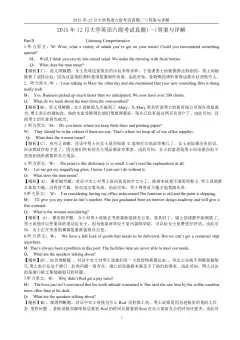
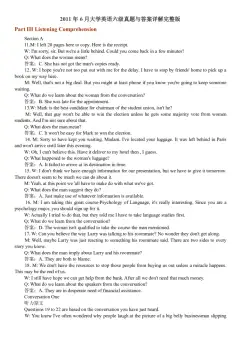
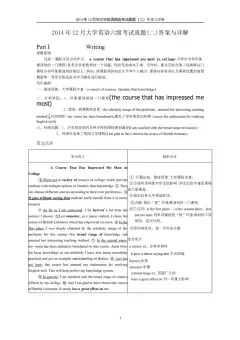
2015 年 12 月大学英语六级考试真题(二)答案与详解
PartⅡ ListeningComprehension
1.听力原文:W: I’msofrustratedwiththisnewcomputerprogram.Ijustcan’tfigureitout.
M: I know whatyou mean. It can beoverwhelming, especially sincethe technology is always changing. By
thetimeyoulearnoneprogram,it’soutdated.
Q: Whatdowelearnaboutthewomanfromtheconversation?
【精析】C)。语义理解题。对话中女士表示新的电脑程序令她很沮丧,她不明白如何使用;男士说现在技
术更新变化快,往往刚学会操作一个新程序,它就过时了。由此可知,女士不会使用新的电脑程序。
2. 听力原文:W: Don’tyouwishyouweregoingawayfortheholiday?
M: No,I’mhappytostayathome.It’sprettyirritatinghavingtofightallthatholidaytrafficjusttogetoutof
townforacoupleofdays.
Q: Whatdoesthemanmean?
【精析】B)。事实细节题。对话中女士问男士是否愿意假期出游,男士回答说他喜欢待在家里,他觉得仅
仅为了出城待几天而忍受拥挤的假日交通是很烦人的。由此可见,男士更喜欢假期待在家里。
3.听力原文:W: We’re new in East Asia, so we have to be careful in choosing the location for our regional
office.
M: Well,TokyoandSingaporearebothattractive,butthelivingexpensesthereareincrediblyhigh.
Q: Whatarethespeakersdiscussing?
【精析】B)。综合理解题。对话中女士指出他们新进入东亚市场,因此选择区域办公室所在地点时务必要
谨慎;男士也相应地指出了两个备选城市的优缺点。由此可知,对话谈论了他们新办公室的选址。
4.听力原文:W: Excuseme,didanybodyseemycellphoneafterthelastshow?Itmayhaveslippedoutofmy
pocketduringtheperformance.
M: Infact,wefoundseveral.Pleasegocheckattheticketcounter.
Q: Whatdowelearnfromtheconversation?
【精析】A)。综合理解题。对话中女士问到是否有人捡到了她的手机,男士表示演出结束后他们捡到了好几
部手机,让女士去售票处找找。由此可知,演出之后他们捡到了好几部手机。女士并不是忘记手机落在了哪
里,而是不知道在哪里弄丢了,故排除B)。
5.听力原文:W: Willyoubeabletocompletetheprojectontime?
M: Well, I’m having my carpenters work full time, but some of the important building materials are being
delayedatthecustoms.
Q: Whatdowelearnfromtheconversation?
【精析】 C)。弦外之音题。对话中女士询问工程是否能够按时完工,男士表示木匠在全天工作,但是有
些重要材料在过海关时耽搁了,也就是说工程也许不能按时完工。
6.听力原文:W:IwishIhadn’thurtJane’sfeelingslikethat.YouknowInevermeantto.
M: Onething I like aboutJane is shedoesn’t harbor resentment. I guess she’llhave forgotten allaboutit by
tomorrow.
Q: WhatdoesthemansayaboutJane?
【精析】B)。语义理解题。对话中女士担心自己伤害了 Jane,男士指出Jane的一个优点就是不记仇,不
高兴的事很快就忘了,由此可知,Jane不记仇。
7.听力原文:M:The next place I will show you is going for a great price. The owners are moving to a foreign
country,sotheyhavetosellitimmediately.
W: It’s beautiful. I like the small apartment attached to the back. We could rent it out to help with our mortgage
payments.
12015年12月大学英语六级考试真题(二)答案与详解
Q: Whatdowelearnaboutthespeakersfromtheconversation?
【精析】D)。推理判断题。对话中男士正在带女士看房,并且游说说价钱很合适,而女士也比较满意,认
为可以将后面的小套房租出去来补贴抵押贷款。 由此可见,男士正在卖给女士房子。
8.听力原文:W: DidyoureadtheMorningNews!Theydidastoryonourelectioncampaign.
M: Sure. I guess it will spark some interest among the women in town. Without their votes, we won’t be able to
wintheelection.
Q: Whatdowelearnaboutthespeakersfromtheconversation?
【精析】C)。综合理解题。对话中女士指出《晨报》报道了他们的竞选活动,男士认为报道可以激起城里
女性的关注,没有她们的支持,很难赢得竞选(注意不是竞选连任,故B)可以排除),也就是说他们竞选
活动的目的就是吸引女性投票者。
9-11.听力原文:
W: Charles,asasinger,doyouevermakeyourselfcrywhenyousing?
M:No,notatthisage.I’manoldman.(9)Butthesongscanstillgetthroughtome.
W : Whatsongwritersarecurrentlyexcitingyou?
M:I don’tknow muchaboutsongwriters. Oncein awhile, I’lllisten to theradio toseewhattheyare puttingout,
but it’s not too often I hear something I like. Somebody like Art Tatum can make me sit up and take notice,
butsome music,like rap,isn’tvery musicalandI can’tlearnanything from it. Yougotto dosomething more
thantalktome.
W : What’sthemostdifficultkindofmusictosing?
M: It depends. (10) If I like something, I can sing it. I did the opera Porgiam best and that’s said to be a
complicatedpieceofmusic.AndIcandocountrymusic, bluesandlove songs.(10)Ontheotherhand,Ican’t
singsomethingIdon’tlikeandthat’soneofmydefects.
W:Canyouperformmusicthat’soutoftunewiththemoodyoumightbeinonagivennight?
M: Yes,becausewhenyousing,youarelikeanactorperformingapart.Onceyougetoutthere,youbecomethat
part—onlyyou’reusingmusicinsteadofdialogue.(11)Iamthekindofapersonthatifmypersonallifeishurting;
I can go to work and the-music will take over.It’s like a guy who goes to a bar and drinks. For those few hours, I
canwrapmyselfupinmymusic.
Questions9to11arebasedontheconversationyouhavejustheard.
9.WhatdoesCharlessaysongscandowhenhesingsthem?
10.WhatdoesCharlessayabouthimselfasasinger?
11.WhatwouldCharlesdowhenhispersonallifeishurting?
答案详解:
9.A)。语义理解题。对话中男士表示他现在岁数大了,已经过了因为音乐而哭泣的年龄,但是音乐会让他
感动。getthroughtome,这里译为“打动我”。
10.C)。细节辨认题。对话中男士表示如果他喜欢某种音乐,他就可以演唱,不喜欢就不唱。
11.D)。事实细节题。对话中男士指出如果个人生活中遇到失意的事情,他会去工作,全身心地投入 (wrap
myselfup)音乐中,音乐就会取代(takeover)不开心的事,酒吧喝酒只是男士做的一个类比。
ConversationTwo
12-15听力原文
W:Iwonderifyoucouldtellmealittlebitaboutyourjobasaradioannouncer.(12)Whatdoyouactuallydoand
howdoyouprepareforyourjob?
M: Well,inthenewsroomIamsittingwithreportersandnews-subs,asthoughIamsittinginanewspapernews
room.
W: Sorry,whatdoyoumeanbynews-subs?
22015年12月大学英语六级考试真题(二)答案与详解
M:(13)Theyaresub-editors.Theyarethepeoplewhowritethenewsstoriesastheycomein.Thestoriesarethen
passedtotheseniordutyeditorandtheassistanteditor.Asstoriesgothroughthechainofpeople,theyarerefined,
correctedandsorted outuntil theycome finally to me and(14)I have a chanceto readthrough most stories before
Igo onthe air. Ofcourse, sometimes things happenatthe lastmoment andI don’thave a chance. So I’ve justgot
to do my best, and take a couple of seconds to look through the first few lines before I launch into something.
Becauseit’ssuchapityifyoustartoffonabrighttoneonastoryandsuddenlyrealizeyouaretalkingaboutsome
peoplehavingbeenkilledinaroadcrash.(14)Itisveryimportanttojusthaveaquickflipthrough.
W : Thereisnothingtomarkwhatisoutofentityonyourpieceofpaper?
M:(15)No,Ihavemyownlittlemark.Ifit’ssomethingsad,I’llputasmallcrossatthetop.That’smylittleclue.
SowhileItimworkingonthenews,Tmjustabsorbingthenewsandcheckingpronunciations.
Questions12to15arebasedontheconversationyouhavejustheard.
12.Whatdoesthewomanwanttoknowabouttheman?
13.Whatdoesthemansaynews-subsdo?
14.Whatdoesthemansayisabigchallengeforhim?
15.Whatroledoesthemansayhissmallcrossplace?
12、D)。细节推断题。对话中,女士向男士提问 “你的工作具体是做什么以及要做什么准备工作”,也就
是在问男士的工作是怎么进行的。
13、A)。推理判断题。对话中男士解释news-subs 的职责,说他们是副编辑,有新闻故事的时候,他们进
行编写,然后稿子才会到高级责编、助理编辑手中做进一步处理,也就是说他们是新闻稿件的。
14、 B)。细节推断题。对话中男士指出通常播音之前有时间可以事先读完大部分的新闻故事,但是最后关
头也经常有事情发生,因此并不是每次都有机会能够事先阅读,而事先看一眼就可以避免工作中的错误。
由此可见,男士工作中的挑战是在播新闻前没有时间阅读新闻。
15、D)。细节辨认题。对话最后,男士提到他用小叉号标记悲伤的新闻故事。
SectionB
PassageOne
16-18听力原文
You probably know what a mobile is, but the mobile I’m talking about is a delicate object of decoration hanging
fromthe ceiling andmoving gently with every breath.(16)It delights both childrenandadults. Now, doyou know
who invented the mobile? This lovely creation was the work of an American artist named Alexander Calder.
Calder became interested in making things when he was a child. And even then he often used wire in his
constructions.When hewentto college,hestudiedengineering ratherthanart. (18)Buthequickly realized thatart
was his real passion. (17)He also loved the circus, and many of his early artworks were small circus figures made
with wire. In about1930, Calder turned from realistic wire figures to abstract ones.He began constructing objects
that have circles, squares and other geometric shapes. To get the shapes to move, he used small motors. Then he
wentonestepbeyondtheseearlymobiles.Hegottheshapesinhisconstructionstomovebythemselves.Amobile
may look simple as it shifts in the wind, but it requires careful construction to work properly. Calder used his
engineering knowledge to create his first mobiles. Often these consisted of small pieces of brightly printed metal
strung by wire to a thicker base wire. Calder learnt how to find the precise point to connect each wire so that all
the pieces will sway in harmony. In doing so, he created an art form for people all over the world to copy and
enjoy.
Questions16to18arebasedonthepassageyouhavejustheard.
16.Whatdoesthespeakersayaboutamobile?
17.WhatdowelearnaboutmanyofAlexanderCalder’searlyartworks?
18.WheredoesAlexanderCalder’srealpassionlie?
答案详解:
16、A)。细节推断题。短文开头提到,mobile即风铃,是一种设计精巧的物品,挂在天花板上,随风轻轻
摇摆,成年人和孩子都喜欢它。
32015年12月大学英语六级考试真题(二)答案与详解
17、C)。细节辨认题。短文中指出Calder的早期作品都是用线制成的小马戏团人物,后来他才转向抽象的
形象。
18、A)。细节辨认题。本题考查Calder本人的真正热情所在,短文中提到他的真正爱好是艺术。
Passage Two
19-21听力原文
If sheer numbers provide any proof, America’s universities are the envy of the world. (19) For all their
troubles, the United States’ 3 500 institutions were flooded with more than half a million students from 193
countries last year. Asia led the way, with the biggest number from China, followed by Japan and India. Most
European and Asian universities provide an elite service to a small number of people. While fully 60% of all US
high school graduates attend college of some point in their life, just 30% of the comparable German population,
28% of the French, 20% of the British, and 37% of the Japanese proceed beyond high school. Britains who pass
their A levels may still not qualify for a top university at home, but find American universities far more
welcoming. Some US schools acknowledge the rigor ofEuropean secondary training, and will give up to a year’s
credittoforeigners whohavepassedtheirhighschoolexams. (20)“Theconceptionthateveryonehasarighttoan
education appropriate to his potentialis a highly democratic andcompassionate standard, says Marven Breselor, a
professor at Princeton University. True, not all US students can match the performance of their foreign
counterparts,buttheAmericaninstitutionsdoofferstudentsfromrichandpoorfamiliesalikethechancetorealize
theirfullpotential.“Americaeducatessomanymorepeopleatuniversitythatonecan’texpectallthosewhogoto
be as intelligent as the much narrower band in British universities,” says professor Christopher Rakes at Boston
university,(21)“I’mnotagainstelitism,butIhappentolikehavingpeoplewhoaremoreeagertolearn.
Questions19to21arebasedonthepassageyouhavejustheard.
19.WhatdoesthespeakersayaboutAmerica’suniversities?
20. WhatisAmerican’sviewoneducationaccordingtoProfessorMarvenBreselor?
21.WhatdowelearnfromProfessorChristopherRakes’remark?
答案详解:
19、B)。语义理解题。短文中指出尽管美国的大学存在问题,去年美国的3500家大学还是吸引了来自全
球193个国家的50多万名学生,befloodedwith意为“充斥”,暗指学生如潮水般涌到美国大学,也就是说
美国大学吸引了来自世界各地的学生。
20、D)。细节辨认题。短文中MarvenBreselor教授明确指出,每个人都有权利接受与自己的潜能相匹配的
教育,这个概念是高度民主和善意的标准。
21、A)。细节推断题。短文最后ChristopherRakes教授指出他不反对精英主义,但是他碰巧喜欢教那些学
习欲望更加强烈的人,也就是说他喜欢学习动力强的学生。
Passage Three
22-25听力原文
(22)Every year, peoplein America use energy equalto over 30million barrels ofoil each day. That’s energy
in all forms—oil, gas, coal, nuclear, solar and even wind power. (23) Viewed from scientists’ standpoint, all the
energy contained in fuel either now or in the future becomes heat. Some of the heat is used directly or produces
useful work; the rest is lost or rejected, radiated into the atmosphere from the engines, motors, boilers and all the
other energy-consuming machinery that makes Americans’ wheels go around. (25)If we could figure how to
improve the efficiency with which we use energy, we can do a lot more work with the energy that is available.
With money and careful planning, we can boost efficiency up to a point. Yet improvement won’t come easily, it
won’tcomeovernightandtherearelimits beyondwhichnotevensciencecantakeus.AccordingtotheCenterfor
Strategic and International Studies, aboutthree quarters ofthe energy we use to move things, including ourselves,
accomplishes no usefulwork. (24) In terms of efficiency and cleanness, buses, trains and other forms of public or
mass transportation are superior to the private automobile. But only if they operate at near capacity, otherwise,
their overall efficiency is poor. For some people, mass transit may answer all transportation needs. For others, a
42015年12月大学英语六级考试真题(二)答案与详解
combination of mass transit and private transportation may be desirable. Better design and wiser use of both mass
transitsystemsandprivatevehicleswillplayanimportantpartinhelpingAmericagetmoreoutofenergyusedfor
transportation.
Questions23to25arebasedonthepassageyouhavejustheard.
22.WhatdoesthespeakersayaboutenergyusedintheUnitedStates?
23.Whatdoscientistssayaboutenergycontainedinfuel?
24.Whendoesmasstransitprovesuperiortoprivatevehicles?
25.Whatseemstobethespeaker’sbiggestconcern?
答案详解:
22、D)。细节辨认题。短文中提到,美国人每天使用的能源等于3千多万桶石油。
23、A)。细节辨认题。短文中提到,根据科学家的观点,燃料里所含的全部能源或迟或早都会变成热量。
24、C)。细节推断题。短文中提到,公共交通工具只有在发挥最大能效时,才能在能源使用效率和清洁度
上优于私人交通工具。
25、B)。综合理解题。讲话者多处提到 efficiency, 指出效率的重要性。讲话者认为通过资金投入加之详细
计划,我们可以提高能源使用效率,讲话者还对交通工具的低能效表示关注。因此他真正关注的是能源利
用率不足的问题。
5