机密★启用前
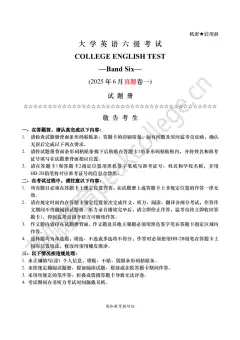
大 学 英 语 六 级 考 试
COLLEGE ENGLISH TEST
—Band Six—
(2025 年 6 月真题卷二)
试 题 册
☆☆☆☆☆☆☆☆☆☆☆☆☆☆☆☆☆☆☆☆☆☆☆☆☆☆☆☆☆☆☆☆☆☆☆☆☆☆☆☆
敬 告 考 生
一、在答题前,请认真完成以下内容:
1. 请检查试题册背面条形码粘贴条、答题卡的印刷质量,如有问题及时向监考员反映,确认
无误后完成以下两点要求。
2. 请将试题册背面条形码粘贴条揭下后粘贴在答题卡1的条形码粘贴框内,并将姓名和准考
证号填写在试题册背面相应位置。
3. 请在答题卡1和答题卡2指定位置用黑色签字笔填写准考证号、姓名和学校名称,并用
HB-2B铅笔将对应准考证号的信息点涂黑。
二、在考试过程中,请注意以下内容:
1. 所有题目必须在答题卡上规定位置作答,在试题册上或答题卡上非规定位置的作答一律无
效。
2. 请在规定时间内在答题卡指定位置依次完成作文、听力、阅读、翻译各部分考试,作答作
文期间不得翻阅该试题册。听力录音播放完毕后,请立即停止作答,监考员将立即收回答
题卡1,得到监考员指令后方可继续作答。
3. 作文题内容印在试题册背面,作文题及其他主观题必须用黑色签字笔在答题卡指定区域内
作答。
4. 选择题均为单选题,错选、不选或多选将不得分,作答时必须使用HB-2B铅笔在答题卡上
相应位置填涂,修改时须用橡皮擦净。
三、以下情况按违规处理:
1. 未正确填写(涂) 个人信息,错贴、不贴、毁损条形码粘贴条。
2. 未按规定翻阅试题册、提前阅读试题、提前或在收答题卡期间作答。
3. 未用所规定的笔作答、折叠成毁损答题卡导致无法评卷。
4. 考试期间在非听力考试时间佩戴耳机。
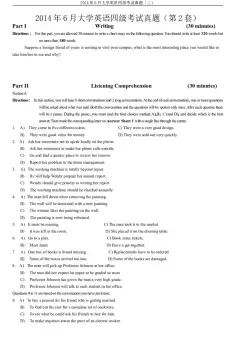
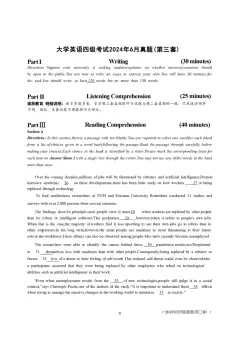
英伽教育教研组Part Ⅰ Writing (30 minutes)
Directions: For this part, you areallowed 30 minutes to write an essay that begins with the sentence
“As social media is used more and more extensively, there is a growing awareness of the
importance of using it properly and responsibly.” You can make comments, cite examples or use
your personal experiences to develop your essay. You should write at least 150 words but no more
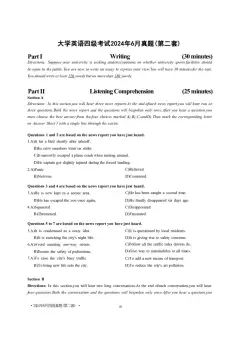
than200words. You should copythesentence given in quotes at thebeginning of your essay.Part Ⅱ Listening Comprehension (25 minutes)
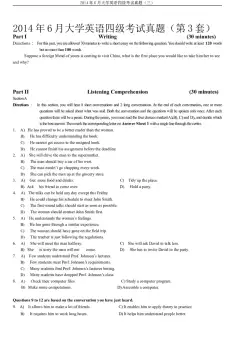
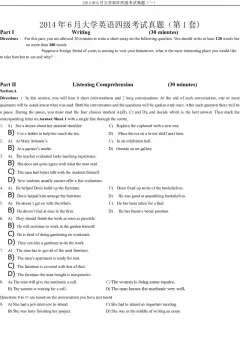
SectionA
Directions: In this section, you will hear two long conversations. At the end of each conversation,
you will hear four questions. Both the conversation and the questions will be spoken only once. After
you hear a question, you must choose the best answer from the four choices marked A), B), C) and
D). Then mark thecorrespondingletter onAnswer Sheet1with asinglelinethrough thecentre.
Questions1to 4arebased onthe conversation you havejustheard.
1.
A)They have tomake a choicebythe end ofthe day.
B) Both candidates are very keen ongettingthe job.
C)They hold different views ontheprocedure.
D)Both candidates are quitecompetitive.
2.
A)Both Rachel and Petercame across as respectful and professional.
B) Rachel scored moderately higher grades than Peterat school.
C)Both Rachel and Peter excelled intheir academicpursuit.
D)Peter appeared slightly strongerthan Rachel physically.
3.
A)His useof bodylanguage.
B) His accumulation of experience.
C)His unusual stateofmind.
D)His knowledge about thecompany.
4.
A)Compare thecandidates sidebysideagain.
B)Ask theboard tocast the deciding vote.C)Findaway to break thetienexttime.
D)Let Johnmake thefinal decision.
Questions5to 8arebased onthe conversation you havejustheard.
5.
A)The private label “L’Orange”.
B)Thewoman’s latestcollection.
C)This season’s new fashion.
D)The head designer’s role.
6.
A)Something reflecting thesocial norms.
B) Somethingmeeting publicexpectations.
C)Somethingslightly absurd.
D)Something abit ambiguous.
7.
A)Merge styles often at oppositeends ofthefashion spectrum.
B) Learnfrom the designs oftheAsian rural mountainvillagers.
C)Makevelvet capes look both majesticand masculine.
D)Draw intricate patterns ontoa traditional power suit.
8.
A)Obtaining thewoman’ssignature.
B) Seeing thewoman’s new creations.
C)Incorporating indigenous aspects intohis work.
D)Sharing more ideas with thewoman nexttime.
Section B
Directions: In this section, you will hear two passages. At the end of each passage, you will hearthree or four questions. Both the passage and the questions will be spoken only once. After you hear
a question, you must choose the best answer from the four choices marked A), B), C) and D). Then
markthecorresponding letter onAnswer Sheet 1with asinglelinethrough thecentre.
Questions9to 11arebasedon thepassageyou havejustheard.
9.
A)They could readily recognizetheir ownersimply bylooking.
B)They could understand theimplications ofhuman commands.
C)They could be domesticated to act as ourcompanions.
D)They could followpointinggestures without training.
10.
A)Cultivating them tobeintelligent creatures.
B)Training them to behave likedomesticated dogs.
C)Understanding howhumans impact theirbehavior.
D)Taking measures to reduce theirnumbers.
11.
A)Tamethem through repeated training.
B)Treat them with sensitivityand respect.
C)Makethem responsive toourcommands.
D)Watch their behavior and try toimproveit.
Questions12to 15arebased onthe passageyouhavejustheard.
12.
A)The temperature insideit varies from place toplace.
B) Properplacement facilitates access to food products.
C)Its different shelves are designed for different purposes.
D)The space in anaverage fridge changes from top to bottom.13.
A)Toslow therising oftemperature in it.
B)Toprovidea big boxofevenly cold air.
C)Toprevent germs from growing quickly.
D)Tokeep the food cold as long as possible.
14.
A)On the topshelf.
B) In themiddlesection.
C)On theinsideofits doors.
D)At theback ofitsbottom shelf.
15.
A)They will beextra-chilly.
B)They will behard to defrost.
C)They will becontaminated.
D)They will beruined.
Section C
Directions: In this section, you will hear three recordings of lectures or talks followed by three or
four questions. The recordings will be played only once. After you hear a question, you must choose
the best answer from the four choices marked A), B), C) and D). Then mark the corresponding letter
onAnswer Sheet 1withasinglelinethrough thecentre.
Questions16to 18arebased onthe recordingyou havejustheard.
16.
A)Chronicdepression.
B) Growing feebleness.
C)Hip fracture.
D)Fatal infections.17.
A)It feels real and relevant.
B) It contributes topsychology.
C)It outcompetes lots ofacademics’research.
D)It wins recognition outsideofBirmingham.
18.
A)By bringing togetherexperts old and young.
B) By countingonadvanced modern technology.
C)By makingfull use ofher expertise.
D)By combining multipleperspectives.
Questions19to 21arebased onthe recordingyou havejustheard.
19.
A)They don’t teach basic organization.
B)They don’t focus onteaching techniques.
C)They attach littleimportance torecipes.
D)They hire very few distinguished chefs.
20.
A)It’s uniquetocelebrity chefs.
B) It’sa way oftransformation.
C)It’stoo demanding forthem.
D)It’s away oflife tothem.
21.
A)Respect others so as to be respected.
B) Usetimeand resources inawiseway.
C)Cultivatea habit ofself-discipline.D)Learnfrom philosophers earnestly.
Questions22to 25arebased onthe recordingyou havejustheard.
22.
A)The motiveforhard work.
B)Thereason forstagnation.
C)Thebasis for self-improvement.
D)The justification forself-confidence.
23.
A)Feel confidence, happiness and satisfaction.
B) Believethey have achieved theirlifegoals.
C)Usea key tool forsetting ambitiousgoals.
D)Stop imagining further progress inlife.
24.
A)Wefeel we are always falling behind others.
B)Wehaveto adapt to theever-changing goal.
C)There are various misconceptions about goal setting.
D)There are always problems withthegoal originally set.
25.
A)Anoticeablechange inthenumber ofgoals toachieve.
B) Measuring always against thegap rather than thegain.
C)Measuring where we’vecomefrom instead of measuring against thegoal.
D)Aproperconception of what wefail to noticein trying to achieve our goals.Part Ⅲ Reading Comprehension (40 minutes)
SectionA
Directions:In thissection, thereis apassagewith ten blanks. Youarerequired to select one wordfor
each blank from a list of choices given in a word bank following the passage. Read the passage
through carefullybeforemaking your choices. Each choice in the bank is identified by a letter Please
mark the corresponding letter for each item on Answer Sheet 2 with a single line through the centre.
Youmay notuse anyof thewords in thebankmorethanonce.
No beast on Earth is tougher than the tiny tardigrade (缓步类动物). It can __26__ being frozen
at -272° Celsius, being exposed to the vacuum of outer space and even being __27__ with 500
times the dose of X-rays that would kill a human. In other words, the creature can endure conditions
that don’t even exist on Earth. And researchers are looking to the microscopic animals to learn how
toprepare humans and crops tohandle the__28__ofspace travel.
The tardigrade’s indestructibility stems from its __29__ to its environment—which may seem
surprising, since it lives in __30__ comfortable places, like the cool, wet patches of moss (青苔) that
dot agarden wall. But itturns out that a tardigrade’s damp, mossy home can dry out many times each
year. Drying is pretty __31__ for most living things. It does damage to cells in some of the same
ways that freezing, vacuum and radiation do. Tardigrades, however, have __32__ special strategies
fordealing withthese kinds ofdamage.
As a tardigrade dries out, its cells produce several strange proteins that are unlikeanything found
in other animals. In water, the proteins are shapeless. But as water disappears, the proteins
self-assemble into long fibers that fill the cell’s __33__. The fibers support the cell’s membranes (细
胞膜)and proteins, preventing them from breaking or__34__.
Emulating tardigrades could one day help humans colonize outer space. Food crops could be
engineered to produce tardigrade proteins, allowing these organisms to grow more efficiently on
spacecraft where levels of radiation are elevated compared withonEarth.
So if humans ever succeed in reaching the stars, they may accomplish this __35__, in part, by
standing ontheshoulders ofthe tinyeight-legged endurance specialists in your backyard.A)adaptations B) blasted C)catastrophic D)evolved
E)feat F) interior G)probing H)recurrence
I) rigors J) seemingly K)survive L) tempt
M)thrill N) unanimously O)unfolding
Section B
Directions: In this section, you are going to read a passage with ten statements attached to it. Each
statement contains information given in one of the paragraphs. Identify the paragraph from which
the information is derived. You may choose a paragraph more than once. Each paragraph is marked
withaletter.Answer thequestions by marking thecorresponding letter onAnswer Sheet 2.
Yes,eating meataffects theenvironment, butcows arenotkillingtheclimate
A) As the scale and impacts of climate change become increasingly alarming, meat is a popular
target for action. Advocates for the protection of the natural environment from destruction or
pollution urge the public to eat less meat. Some activists have even called for taxing meat to reduce
consumptionof it.
B) A key claim underlying these arguments holds that globally, meat production generates more
greenhouse gases than the entire transportation sector. However, this claim is demonstrably wrong,
as I will show.And its persistence has led to false assumptions about the linkage between meat and
climatechange.
C) My recent research focuses on ways in which animal agriculture affects air quality and climate
change. In my view, there are many reasons for either choosing animal protein or opting for a
vegetarian selection. However, abandoning meat and meat products is not the environmental panacea
(万灵药) many would have us believe. And if taken to an extreme, it also could have harmful
nutritionalconsequences.
D) A healthy portion of meat’s negative reputation centers on the assertion that livestock is the
largest source of greenhouse gases worldwide. For example, an analysis published in 2009 by theWorld Watch Institute based in Washington, D.C. asserted that 51 percent of global greenhouse gas
emissions come from rearing and processing livestock. According to the U.S. Environmental
Protection Agency, the largest sources of U.S. greenhouse gas emissions in 2016 were electricity
production (28 percent of total emissions), transportation (28 percent) and industry (22 percent). All
of agriculture accounted for a total of 9 percent, but all of animal agriculture contributes less than
half of this amount, representing 3.9 percent of the total greenhouse emission in the U.S.That is very
different from claiming that livestockrepresents as muchas ormorethan transportation.
E) Why is there such a misconception? In 2006 the United Nations Food and Agriculture
Organization (FAO) published a study titled “Livestock’s Long Shadow,” which received widespread
international attention. It stated that livestock produced a staggering 18 percent of the world’s
greenhouse gas emissions. The agency drew a startling conclusion that livestock was doing more to
harm the climate than all modes of transportation combined. This latter claim was wrong, and has
sincebeen corrected byHenning Stenfeld, thereport’s seniorauthor.
F)The problem was that analysts from the FAO used a comprehensive life-cycle assessment to study
the climate impact of livestock, but a different method when they analyzed transportation. For
livestock, they considered every factor associated with producing meat. This included emissions
from fertilizer production, converting land from forests to pastures, growing feed, and direct
emissionsfrom animals (manure as well as expelling ofgas from thestomach)from birth to death.
G) However, when they looked at transportation’s carbon footprint, they ignored impacts on the
climate from manufacturing vehicle materials and parts, assembling vehicles and maintaining roads,
bridges and airports. Instead, they only considered theexhaust smokeemitted byfinished cars, trucks,
trains and planes. As a result, the FAO’s comparison of greenhouse gas emissions from livestock to
thosefrom transportation was greatly distorted.
H) I pointed out this flaw during a speech to fellow scientists in San Francisco on March 22, 2010,
which led to a flood of media coverage. To its credit, the FAO immediately owned up to its error.
Unfortunately, the agency’s initial claim that livestock was responsible for the lion’s share of worldgreenhouse gas emissions had already received wide coverage. To this day, we struggle to “unring”
the bell In its most recent assessment report, the FAO estimated that livestock produces 14.5 percent
of global greenhouse gas emissions from human activities. There is no comparable full life-cycle
assessment for transportation. However, as Stenfeld has pointed out, direct emissions from
transportation versus livestock can be compared and amountto 14versus 5percent, respectively.
I) Many people continue to think that avoiding meat as infrequently as once a week will make a
significant difference to the climate. But according to one recent study, even ifAmericans eliminated
all animal protein from their diets, they would reduce U.S. greenhouse gas emissions by only 2.6
percent. According to our research at the University of California, Davis, if the practice of Meatless
Mondaywere to be adopted byallAmericans, we’dseea reduction of only 0.5percent.
J) Moreover, technological, genetic and management changes that have taken place in U.S.
agriculture over the past 70 years have made livestock production more efficient and less greenhouse
gas-intensive.According tothe FAO’s statistical database, total direct greenhouse gas emissionsfrom
U.S. livestock have declined by 11.3 percent since 1961, while production of livestock meat has
morethan doubled.
K) Demand for meat is rising in developing and emerging economies, especially in the Middle East,
North Africa and Southeast Asia. For example, raising livestock such as goats in Kenya is an
important source of food and income for many small-scale farmers and herders. But meat
consumption per person in these regions still lags that of developed countries. In 2015, average
annual meat consumption per person in developed countries was 92 kilograms, compared to 24
kilograms in the Middle East and North Africa and 18 kilograms in Southeast Asia. Still, given
projected population growth in the developing world, there will certainly be an opportunity for
countries such as theUnited States to bring theirsustainablelivestock rearing practices to thetable.
L) Removing animals from U.S. agriculture would lower national greenhouse gas emissions to a
small degree, but it would also make it harder to meet people’s nutritional requirements. Many critics
of animal agriculture are quick to point out that if farmers raised only plants, they could producemore pounds of food and more calories per person. But humans also need many essential micro- and
macro-nutrients for good health. It’s hard to make a compelling argument that the United States has a
calorie deficit, given its high national rates of adult and child obesity. Moreover, not all plant parts
are edible or desirable. Raising livestock is a way to add nutritional and economic value to plant
agriculture.
M)As one example, the energy in plants that livestock consume is most often contained in cellulose
(纤维素), which is indigestible for humans and many other mammals. But cows, sheep and other
ruminant (反刍的) animals can break cellulose down and release the solar energy contained in this
vast resource.According to the FAO, as much as 70 percent of all agricultural land globally is range
land that can onlybe utilized as grazing landfor ruminant livestock.
N) The world population is currently projected to reach 9.8 billion by 2050. Feeding this many
peoplewill raise immensechallenges. Meat is morecalorie-dense per serving than vegetarian options,
and ruminant animals largely thrive on feed that is not suitable for humans. Raising livestock also
offers much-needed income for small-scale farmers in developing nations. Worldwide, livestock
provides a livelihoodfor 1billion people.
O) Climate change demands urgent attention, and the livestock industry has a large overall
environmental footprint that affects air, water and land. These, combined with a rapidly rising world
population, give us plenty of compelling reasons to continue to work for greater efficiencies in
animal agriculture. Ibelieve theplace tostart is with science-based facts.
36. The FAO concluded that farm animals were producing more greenhouse gases than all modes of
transportation combined.
37. Consumption of meat per person in developing countries is much less than that in countries like
theU.S.
38.TheFAOwas worthy ofpraise in that itadmitted its mistake once itwas pointed out.39.Environmentaliststry hard to makepeople consumeless meat to combat climatechange.
40. Recent research has shown that even if Americans quit eating meat altogether, the resulting
reductionof greenhouse gases in theU.S. would be slight.
41.Morethan halfofthe world’s farmland is suitableonly foranimals likecows to grazeon.
42. The allegation that farm animals produce the world’s largest portion of greenhouse gases is
responsiblefor meat’s bad reputation.
43.Raisingfarm animals makes iteasier to meet people’s nutritionalneeds.
44. The author doesn’t believe giving up meat and meat products will be a cure-all for the
environmental problem.
45. Changes in America’s farming technology and management in the past decades have increased
efficiency and reduced greenhouse gas emissions in meat production.
Section C
Directions:There are 2 passages in this section. Each passage is followed by some questions or
unfinished statements. For each of them there are four choices marked A), B), C) and D). You should
decide on the best choice and mark the corresponding letter on Answer Sheet 2 with a single line
through thecentre.
PassageOne
Questions46to 50arebased onthe followingpassage.
Why are we so worried about our careers? Partly it’s to do with money, but there’s a
psychological aspect toourfears as well.We worry because we suspect—not wrongly—that the world is full of a frightening sort of
person readyto judge us ruthlessly and swiftly: aperson we can call asnob.
Asnob is anyone who takes a relatively small part of us and uses it to come to a rigid conclusion
about how much of their attention we deserve. In the past, that might be your ancestry and royal
connections.Nowadays, thesnob cares about onething only: what you dofor aliving.
This explains why the first question we will be asked in any new social context is “What do you
do?” andaccording to howwe answer,snobs will either welcome us with broad smiles, orleave us in
thecold.And that iswhy weare fired upbysuch a desperateurge to achieve and impress.
Sometimes our behaviour is mistaken for greed and vanity, but it is more than this.Alot of our
interest in fancy cars, jobs and houses has nothing to do with materialism. It has to do with a hunger
for the respect and esteem that is only available in our societies through the acquisition of material
goods. It isn’t the goods themselves we seek, it is the love we stand to gainthrough our possession of
them. The next time we see someone driving a Ferrari, we shouldn’t condemn them for their greed,
weshouldpity them fortheintensity oftheirneed for lovefrom theworld.
At the root of snobbery is a lack of imagination and confidence about how to decide who in the
world is valuable. The snobs are brutally misguided and slavish in their beliefs about how the
superior individuals can be identified. For snobs, it is the already acclaimed and already successful
who are the only ones worthy of respect. There is no room in their timid regimented minds to
imagine that someone might be clever, kind or good—and yet somehow have been overlooked
entirely by society, their qualities lying hidden beneath an unfamiliar veil, and having as yet
discovered noobvious outlet.
The true answer to snobbery is not to say that there is no such thing as a better or worse person,
but to insist that better or worse exist in constantly unexpected places and carry none of the outward
signs of distinction. And because we are such poor judges of the worth of others, our ultimate duty
remains to be kind, good, curious and imaginative about pretty much everyone who ever crosses our
path.
46.What gives rise toourworry about careers apart from money?
A)Fear ofbeingjudged ina snobbishmanner.
B)Theprospect offacing fault -finding managers.C)Theruthless way employees are often treated.
D)Fright at thedifficulty inhunting for ajob.
47.What dowelearn from thepassage about today’s snobs?
A)They try hard todiginto aperson’s past.
B)They draw a rigid conclusion about people.
C)They judge a person bytheiroccupation.
D)They tend to place peoplein a social context.
48.What does theauthorsay about people’s interest in material goods?
A)It is thecause for condemnation of theirgreed.
B) It has a lotto dowith thecomforts they provide.
C)It arouses pityrather than respect from thewealthy.
D)It arises from their craving forsocial recognition.
49.What kindofpeople dosnobs deem worth respect and esteem?
A)Those with fameand fortune.
B)Thosewith regimented minds.
C)Thosewith intelligence and imagination.
D)Those with qualities lying hidden in disguise.
50.What does theauthorimply weshould doto avoid being snobbish?
A)Be aware there has never been such a thingas a betteror worse person.
B) Be kind toand curious about thosewho wehappen to meet in ourlives.
C)Realizethat betterorworse keeps changing inunexpected ways.
D)Judge peopleonthebasis of theirdistinctivecharacter traits.
PassageTwo
Questions51to 55arebased onthe followingpassage·
Women have historically been paid less. But in the US in the 1980s, they began to catchup—fast. During that decade, the gender pay gap closed by about one percentage point a year. Had
that trend continued, the gender wage gap would have been closed by 2017. But the trend didn’t
continue, andthe gap remains yawning.
According to a new study from academics at Harvard, the stagnation can be put down, perhaps
counterintuitively,to theintroduction ofstate and federal familyleave policies.
The academics argue that during the 1990s, as governments began to introduce leave policies, it
was mainly women who took advantage of them. Though the leave policies might have helped those
women to stay in the workplace — instead of dropping out to have families — those who returned
sawtheir wages had increased at lower rates than themen.
After family leave was introduced in the US, in fact, the rate of gender wage convergence fell to
just0.03percentage points per year,and has remained there ever since.
Those monitoring the process towards salary equity at work have long watched as progress
slowed in many countries around the world. In fact, that progress began to reverse during the
pandemic(大流行病).
The gender pay gap is one of the most outstanding examples of that lack of parity (平等), and
still exists just about everywhere. The motherhood penalty has become a shorthand for describing
why: In many places, especially rich countries, women earn the same as men until they reach their
childbearing years. Women who have children begin to see their salaries slip behind their male
counterparts.
Part of this is because women take on more of the unpaid labor at home, which can eat into time
available for work and energy for career advancement. But it’s also because mothers are passed over
for raises and promotion, and because time out of the workplace sets women back, even if that time
is taken voluntarily,and supported bycompany orgovernment policy.
What would have happened if leave policies hadn’t been introduced? The study doesn’t go into
that question, other than to say that if the 1980s trend continued, we would have been at parity by
now.
It’s possible, however, that the journey towards wage parity would have stalled either way. If
women’s gains in the 1980s were made through the erasure of things like bias, once those less
uncontrollable problems had been addressed, there would still have been an issue with women —
who are the ones to bear children and take care of them in the early weeks because of biologicalfactors like the ability to breastfeed, forcing them to take breaks, whether or not those breaks were
mandated.
51.What dowelearn about thegender pay gap in theUS during the1980s?
A)It was being slowly closed.
B) It was shrinking rapidly.
C)It started to yawn.
D)It remained substantial.
52.What happened with theintroduction ofstateand federal family leave policies?
A)The process towards salary equity at work began toreverse.
B)Therate of gender wage convergence started tofall noticeably.
C)Thetrend ofwomen returning to work after childbirthstarted.
D)The narrowing ofthegender pay gap attracted more attention.
53.What partly accountsfor theslip in women’s salaries?
A)The insufficientmotivation women generally have forcareer advancement.
B)Theopportunities numerous women give upfor payraise and promotion.
C)Thehuge amounts oftimeand energy women spend taking care ofthefamily.
D)The lack of policy support from government and business corporations.
54.What does thenew studysay about wage parity?
A)It would have stalled ifthosecontrollable problems had not been addressed.
B) It would have halted ifcompany and government hadnot worked together.
C)It would have beenachieved with thecompleteerasure ofgender biases.
D)It would have been attained with thecontinuation of the1980s trend.
55.What prevents women from achieving parity with men in thefinal analysis?
A)Ignoring biases against women in theworkplace.
B) Givingbirth to children and taking careof them.C)Failing to mandate breaks forchildbirth and care.
D)Lacking resources toaddress biological problems.Part Ⅳ Translation (30minutes)
Directions: For this part you are allowed 30 minutes to translate a passage from Chinese into
English.Youshouldwriteyour answer onAnswer Sheet 2.
粤港澳大湾区 (Guangdong-HongKong-MacaoGreaterBayArea) 具有得天独厚的地理位置,拥有完善的
交通基础设施和丰富的产业资源。大湾区是中国开放程度最高、经济活力最强的区域之一,在国家经济发
展中具有重要的战略地位。大湾区不仅将建成充满活力的世界级城市群和具有全球影响力的国际科技创新
中心,还将打造成适合工作、购物、旅游的优质生活圈。随着改革开放的不断深入,大湾区的建设将进一
步推动区域经济发展。到 2035 年,大湾区将实现成为国际一流湾区的目标。