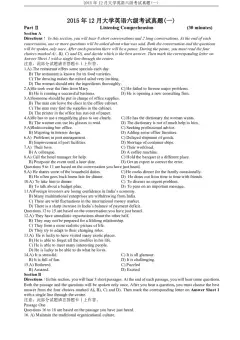
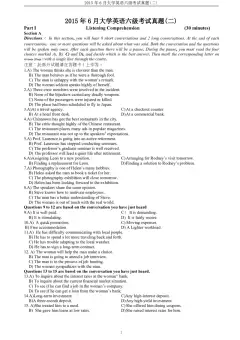
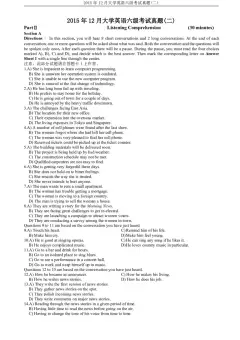
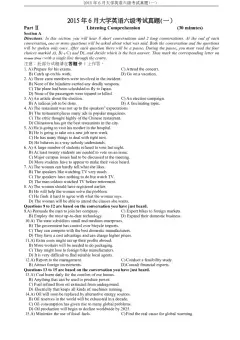
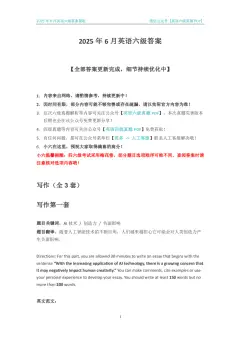
机密★启用前
大 学 英 语 六 级 考 试
COLLEGE ENGLISH TEST
—Band Six—
(2025 年 6 月真题卷一)
试 题 册
☆☆☆☆☆☆☆☆☆☆☆☆☆☆☆☆☆☆☆☆☆☆☆☆☆☆☆☆☆☆☆☆☆☆☆☆☆☆☆☆
敬 告 考 生
一、在答题前,请认真完成以下内容:
1. 请检查试题册背面条形码粘贴条、答题卡的印刷质量,如有问题及时向监考员反映,确认
无误后完成以下两点要求。
2. 请将试题册背面条形码粘贴条揭下后粘贴在答题卡1的条形码粘贴框内,并将姓名和准考
证号填写在试题册背面相应位置。
3. 请在答题卡1和答题卡2指定位置用黑色签字笔填写准考证号、姓名和学校名称,并用
HB-2B铅笔将对应准考证号的信息点涂黑。
二、在考试过程中,请注意以下内容:
1. 所有题目必须在答题卡上规定位置作答,在试题册上或答题卡上非规定位置的作答一律无
效。
2. 请在规定时间内在答题卡指定位置依次完成作文、听力、阅读、翻译各部分考试,作答作
文期间不得翻阅该试题册。听力录音播放完毕后,请立即停止作答,监考员将立即收回答
题卡1,得到监考员指令后方可继续作答。
3. 作文题内容印在试题册背面,作文题及其他主观题必须用黑色签字笔在答题卡指定区域内
作答。
4. 选择题均为单选题,错选、不选或多选将不得分,作答时必须使用HB-2B铅笔在答题卡上
相应位置填涂,修改时须用橡皮擦净。
三、以下情况按违规处理:
1. 未正确填写(涂) 个人信息,错贴、不贴、毁损条形码粘贴条。
2. 未按规定翻阅试题册、提前阅读试题、提前或在收答题卡期间作答。
3. 未用所规定的笔作答、折叠成毁损答题卡导致无法评卷。
4. 考试期间在非听力考试时间佩戴耳机。
英伽教育教研组Part Ⅰ Writing (30 minutes)
Directions: For this part, you areallowed 30 minutes to write an essay that begins with the sentence
“As requirements for job applications are getting increasingly higher, college students ought to be
better prepared for their future career.” You can make comments, cite examples or use your
personal experiences to develop your essay. You should write at least 150 words but no more than
200words.You should copythe sentence given inquotes at thebeginning of your essay.Part Ⅱ Listening Comprehension (25 minutes)
SectionA
Directions: In this section, you will hear two long conversations. At the end of each conversation,
you will hear four questions. Both the conversation and the questions will be spoken only once. After
you hear a question, you must choose the best answer from the four choices marked A), B), C) and
D). Then mark thecorrespondingletter onAnswer Sheet1with asinglelinethrough thecentre.
Questions1to 4arebased onthe conversation you havejustheard.
1.
A)Met the computertechnician.
B)Told theman about her trouble.
C)Called theman’s company.
D)VisitedAlphaMaintenance.
2.
A)Consulted someonein charge.
B) Cameas soon as possible.
C)Informed thecentral officeat once.
D)Designated an engineer to thecase.
3.
A)Frustration.
B) Intimidation.
C)Desperation.
D)Indignation.
4.
A)Whether thecontents have been backed up.
B)Whetherthey canfind help somewhere else.C)Whetherall data stored onthehard drivehas got lost.
D)Whether they need to wipethesystem directories clean.
Questions5to 8arebased onthe conversation you havejustheard.
5.
A)It’s boring.
B) It’schallenging.
C)It’sa beautiful thing.
D)It’s unlikemostjobs.
6.
A)Arbitrating between disagreeing solicitors.
B) Preventing disputes from escalating.
C)Buying and sellingproperty.
D)Mediating landdisputes.
7.
A)Courts are intended for fixing majorlegal disputes.
B) Courts are gettingtoo bureaucraticto function.
C)Courts can be frustrating and expensive.
D)Courts can befrightening and arbitrary.
8.
A)The ability tomake arguments ina uniqueway.
B)Theskill ofpreventing conflicts between parties concerned.
C)Theskill offoreseeing any potential stakes in theirwork.
D)The ability toexpress themselves clearly and forcefully.
Section B
Directions: In this section, you will hear two passages. At the end of each passage, you will hearthree or four questions. Both the passage and the questions will be spoken only once. After you hear
a question, you must choose the best answer from the four choices marked A), B), C) and D). Then
markthecorresponding letter onAnswer Sheet 1with asinglelinethrough thecentre.
Questions9to 11arebasedon thepassageyou havejustheard.
9.
A)They looked into therelationship between one’s prior knowledge and creativity.
B)They offered novel ways to helpolderadults to keep theirmemories from aging.
C)They proposed an explanation forold people’s difficultyin retrieving memories.
D)They advanced anewmodel concerning human information storage and retrieval.
10.
A)Young adultsrely onmemory while olderadults keep notes as areminder.
B) Olderadults often retrieve irrelevant memories along with what they want.
C)Youngadults accumulateknowledge muchmore quickly thanolderadults.
D)Older adults generally perform cognitivetasks much slower than young adults.
11.
A)They showpreserved, andsometimes enhanced,creativity.
B)They frequently sufferfrom disorderly crowded memories.
C)They can rely ontheir accumulated wisdom in an emergency.
D)They may well beserved byforgetting their priorknowledge.
Questions12to 15arebased onthe passageyouhavejustheard.
12.
A)They are actually proud ofthegoods and services they produce.
B)They are worried about being alienated from theoutsideworld.
C)They are rarely in control ofmany things related to theirwork.
D)They are longing to sharetheprofits madefrom theirwork.13.
A)The steady decrease inproductivity.
B)Theadverse effect onphysical health.
C)Thefeeling of being timepoor.
D)The rising economicinequality.
14.
A)It alters thestructure ofwork.
B) It putsjobs and wages at risk.
C)It liberates peoplefrom tedious and laborious work.
D)It creates newwork opportunities in theITindustry.
15.
A)Finding meaning in work.
B) Prioritizinglife overwork.
C)Improving relationships in thecommunity.
D)Realizingone’s social value intheworkplace.
Section C
Directions: In this section, you will hear three recordings of lectures or talks followed by three or
four questions. The recordings will be played only once. After you hear a question, you must choose
the best answer from the four choices marked A), B), C) and D). Then mark the corresponding letter
onAnswer Sheet 1withasinglelinethrough thecentre.
Questions16to 18arebased onthe recordingyou havejustheard.
16.
A)Affect our attitudetonovel tasks.
B) Distinguish us inthe social world.
C)Outweigh IQ inimportance.
D)Impact academicachievements.17.
A)By pressing a hidden button.
B) By pushingabig button ontop.
C)By pressing two buttonsat the sametime.
D)By helping thebabies pushthe right button.
18.
A)Perform difficulttasks successfully just byobserving howadults acted.
B) Makegeneralizableinferences about persistence from afew examples.
C)Adapt themselves to different social contexts.
D)Work hard to interact with experimenters.
Questions19to 21arebased onthe recordingyou havejustheard.
19.
A)Offering advice onovercoming habitual lateness.
B) Exemplifying various recreational opportunities.
C)Scrutinizing individuals’defining traits.
D)Suggesting ways for setting priorities.
20.
A)Make thebreakfast simpler.
B)Takethealarms seriously.
C)Ready yourself in theearly dawn.
D)Get prepared thenight before.
21.
A)Finish theprior task 30minutes earlier.
B) Keep ourselves from hittingabump.
C)Leave timein between activities.D)Try to avoid possiblehold-ups.
Questions22to 25arebased onthe recordingyou havejustheard.
22.
A)Their lifestyles vary.
B)Their traits vary.
C)They have different customs.
D)They have different feels.
23.
A)They are not as willingtohelp strangers.
B)They are not as patient with oneanother.
C)They violatetraffic rules more frequently.
D)They become moreeasily irritated inpublic.
24.
A)It was practiced byBoston’sfounding fathers.
B) It isnot deemed exotic byProperBostonians.
C)It was adopted byBoston’s upper class.
D)It is not part of Boston’s local culture.
25.
A)Stick to itsown way ofshowing courtesy to strangers.
B) Followtheexamples set byParis andNewYork City.
C)Learnfrom the world’s majorcities in promotingtourism.
D)Takepride in itshistory and adhere toits cultural tradition.Part Ⅲ Reading Comprehension (40 minutes)
SectionA
Directions:In thissection, thereis apassagewith ten blanks. Youarerequired to select one wordfor
each blank from a list of choices given in a word bank following the passage. Read the passage
through carefullybeforemaking your choices. Each choice in the bank is identified by a letter Please
mark the corresponding letter for each item on Answer Sheet 2 with a single line through the centre.
Youmay notuse anyof thewords in thebankmorethanonce.
In her second year, Charlene Duong learned of the use of poisonous, synthetic pesticides on her
college campus. Shocked but not surprised, she knew she had to do something. Along with a couple
ofclassmates, Charlene did a quick web search and discovered asmall but growing movement led by
the organization, Herbicide-Free Campus (HFC), to rid college campuses of artificial herbicides (灭
草剂).They were __26__.
Like many,Charlene experiences climate anxiety-a __27__fear of aclimate catastrophe-and was,
at the time, looking for an __28__. When she discovered the HFC movement, she said she felt she
“had found a specific area to focus on that still fit into the larger picture of fighting for a healthier,
safer,cleaner __29__forall.”
Toxic herbicide use in university land care is not unique. Most institutions of higher education
rely on synthetic pesticides and fertilizers to achieve __30__ goals. Having a “beautiful” campus
means green and perfectly maintained lawns along with flower beds and paved sidewalks. But these
__31__ managed campuses can come at a cost: increased cancer risk, __32__waterways, poisoned
wildlifeand lifeless soil.
Pesticide use on college campuses also contributes to our global climate crisis. The use of
chemicals to get rid of insects or unwanted plant life can increase indirect __33__, as they can
include petroleum-based ingredients. Pesticide use also decreases the life in soil, __34__ the ability
of soils to absorb carbon or retain water and thus reducing campuses’ability to recover quickly from
climate-related extremeweather events likedroughts and floods.
Instead of using toxic chemicals, students working with HFC help out with __35__ the campus
grounds. “This work reminds me to be in the present moment as I play my role in reducing herbicideuseand keeping my campus safe and healthy,” says Charlene.
A)aesthetic B) chronic C)contaminated D)conventionally
E)emissions F) environment G)hampering H)incidentally
I) infringement J) intrigued K)juvenile L) outlet
M)rotating N) vibrations O)weeding
Section B
Directions: In this section, you are going to read a passage with ten statements attached to it. Each
statement contains information given in one of the paragraphs. Identify the paragraph from which
the information is derived. You may choose a paragraph more than once. Each paragraph is marked
withaletter.Answer thequestions by marking thecorresponding letter onAnswer Sheet 2.
WhyYourLibrary IstheMost Important Place inTown
A) Librarians know the value of their community services, and their patrons appreciate their
importance as well. But in an increasingly digital world, we see the role of libraries as community
and cultural centers at times undervalued. When shrinking municipal budgets combine with the
nonstop technological revolution, public library services that focus on building communities
face-to-face, inspiring and educating patrons about art, literature, and music, and helping patrons
engage in civil discourse can seem old-fashioned. But it is precisely those shrinking budgets and the
assault of technologically mediated life that make public libraries’cultural and community offerings
moreimportant than ever.
B) Many people point out the value public libraries bring to their communities. More than just books
and banks of computers, libraries are still places where individuals gather to explore, interact, and
imagine. Some of the specific ways in which libraries add value to our communities and serve as
cultural centers for our patrons are community builders, centers for the arts, and champions of youth.
Libraries serve in thesecapacities and aremore thanjust about information.
C) As community builders libraries are engaged in incredible work. From tiny public libraries tohuge city institutions with multiple branches, libraries across the United States are building
community and supporting local culture in exciting ways. These are inspiring and hopefully will
encourage librarians interested in community services and cultural outreach to make connections
with each other, share ideas, and build partnerships. Supporters of libraries as community builders
claim that unless you are out there changing neighborhoods, you are not completing the work you are
to do. Strengthening neighborhoods and championing the cultural lives of communities are big
responsibilities.
D) Place-based economic development stresses the importance of offering attractive, functional, and
community-based places, such as libraries, in town squares and depressed neighborhoods. Like a
major department store in a mall, libraries attract large numbers of people, creating economic
opportunities for numerous businesses and organizations in the surrounding area. Large cities,
medium-sized ones, and even small towns have successfully transformed their libraries into the hubs
(枢纽)of vibrant neighborhoods.
E)As key municipal agencies, and focal points for community education, libraries are major players
in creating livable, environmentally friendly cities and towns. The Urban Libraries Council released
a report detailing the unique ways in which libraries can further sustainability at the local level.
Beyond ensuring that library construction projects consider environmental impact, libraries can take
a lead in supporting local foods and craftsmen, like the Peabody Institute Library’s partnering with
local businesses to pioneer a farmers’ market in their courtyard, or the Richmond Public Library’s
seed lending library which “nurtures locally-adapted plant varieties, and fosters community
resilience (韧性), self-reliance andaculture ofsharing.
F) Archives preserve historic artifacts, oral histories, digital history projects, and scholarly writings
relevant to the community, including minority groups. Communities lucky enough to have archivists
have a great advantage when it comes to organizing historical records and artifacts. An organized
archive is a place where people can research their ancestry and immigration history, do
environmental research, and more. An archivist is an advocate for preservation who, among other
things, coordinates the restoration of maps and paintings, the digitization of vital records, and thecreation of oral history projects. With projects like the Massachusetts Memories Road Show and the
Veterans History Project, evidence of theimportance ofarchives iseverywhere.
G) In the words ofRobert Putnam, “People may go to the library looking mainly for information, but
they find each other there.” New moms connect at baby story-times; elderly people, often facing
difficult life transitions, attend events and find that they make new friends; teenagers meet up in
libraries’ teen spaces after school; and readers discuss current events in the periodicals room. In
libraries, community-building connections are happening all thetime.
H) As Keith Richards said, “The public library is the great equalizer.” Despite the rising costs of
concert and theater tickets, public library events (including concerts, author visits, and gallery
displays) are often offered free of charge, enabling people of any income level to attend. In addition,
library book groups allow people to explore and discuss the literary arts, and the Great Stories Club
introduces at-risk youth toliterature. Thebest part: it’sall free andopen to thepublic.
I) In a time when education is increasingly expensive, public libraries provide information and
educational opportunities free for all people, regardless of their socio-economic status. Offered by
libraries across the country, American Library Association’s Let’s Talk about It programs are
wonderful examples of scholar-facilitated learning opportunities in libraries. In addition, many
libraries present classes and discussion programs, and some even provide online continuing
educationcourses such as theUniversal Classdatabase.
J) Librarians know that patrons aren’t just information consumers, they’re information producers.
Patrons use the library to gain knowledge in order to create their own new and independent works.
Increasing numbers of libraries provide spaces and services that meet the needs of people who want
to learn how to edit Wikipedia, set up blogs or podcasts, create their own magazines, and so much
more. Many libraries offer art or writing workshops and groups, and some provide music practice
rooms for patrons. Programs like ImaginOn in Charlotte, North Carolina, provide exciting models
that takecommunity partnership, creativity,and creation to anew level.K) The decline of civil discourse stems in part from the fact that it is so easy for people to watch
news about, buy products from, and engage--in both the virtual and real worlds--only with those of
similar backgrounds and ideologies. Public libraries, through such programs as The Human Library
and Socrates Café, can help build small communities of difference that encourage people to interact
with and learn from each other through dialogue. By both actively promoting civil discourse through
these programs, and modeling and upholding the principles of free inquiry and expression for all,
libraries help individuals rediscover the importance of and increased need for civil discourse in
American life.
L) Free tutoring, homework help programs, and summer reading programs for kids and teens help
bridge the economic divide that impacts students’academic performance.The cost of hiring a private
tutor is well beyond what many library patrons can afford, so libraries offer homework help and
tutoring online, by phone, in person, and even through social media and homework apps. Annual
summer reading programs also have a positive impact on student performance and, according to a
2010 study conducted by Dominican University’s Graduate School of Library and Information
Science, students’reading skillsget a boost from thesepopular nationwideevents.
M)Through library collections, programs, and physical spaces, children learn to share, to be engaged
in their communities, to participate in the arts, and to explore their immediate world and the world at
large. There are surely endless examples of innovative library services for children, including the
Middle Country Public Library’s Nature Explorium, which engages children in learning about the
natural world.
N) These examples are just a few of the many amazing things that public libraries around the United
States (and the world) are doing to build and maintain strong community connections. We encourage
you to try some of these ideas in your own libraries, and we hope that these ideas will help you be
better able to convince your community leaders of the important role that public libraries play in
communitieslarge and small.
36.Peoplegoing tothe library in search ofinformation can buildconnections with each otherthere.37.According to advocates of libraries as community builders, librarians are not doing their job well
iftheydonot change theircommunities.
38.With the costs of education continually rising, public libraries remain places where all people can
have access to education.
39.Libraries draw large crowds, thus creating lots ofbusiness opportunities inneighboring areas.
40. With the world more and more digitalized, people sometimes underestimate the role of libraries
as community andcultural centers.
41. Various programs organized by public libraries for children and adolescents help narrow the gap
between students from varying economic backgrounds.
42 In an organized archive, people can do research on their family history and find out how their
ancestors came tosettle in thenewland.
43. Public libraries organize cultural events, often allowing people of different income levels to
attend free ofcharge.
44. Besides being an information provider, the library performs many other important services for
thecommunity.
45. Public libraries can help build small communities of people with different backgrounds and
ideologies.
Section C
Directions:There are 2 passages in this section. Each passage is followed by some questions or
unfinished statements. For each of them there are four choices marked A), B), C) and D). You shoulddecide on the best choice and mark the corresponding letter on Answer Sheet 2 with a single line
through thecentre.
PassageOne
Questions46to 50arebased onthe followingpassage.
Nationally, one in six children miss 15 or more days of school in a year.Education officials have
deplored all thismissed instruction.
These chronically absent students suffer academically because of all the classroom instruction
they miss out on. In 2015, the U.S. secretary of education responded to this crisis, urging
communities to support every student toattend every day and be successful inschool. His open letter
stated that missing 10% of school days in a year for any reason—excused or unexcused—is a
primary cause of lowacademicachievement.
Worrying about whether children attend school makes sense.After all, if students don’t show up,
teachers can’t teach them.
But what ifAmerica’s attendance crisis is about much more than students missing class?What if,
instead, it is a reflection of family and community crises these students face—such as being ejected
from thefamily apartment, fearing for theirsafety in theirneighborhood or suffering an illness?
As social scientists we investigated how excused and unexcused absences relate to children’s
academicachievement.
We find that absences excused by a parent do little to harm children’s learning. In fact, children
with no unexcused absences—but 15 to 18 excused absences—have test scores equal to their peers
who have noabsences.
Meanwhile, the average child with even just one unexcused absence does much worse
academically than peers with none.
We believe unexcused absence is a strong signal of the many challenges children and families
face, including economic and medical hardships. Unexcused absences can be a powerful signal of
howthoseout-of-school challenges affect children’s academicprogress.
Our evidence suggests unexcused absences are problematic, but for a different reason than
people often think. Absence from school, and especially unexcused absence, matters mainly as asignal of many crises children and their families may be facing. It matters less as a cause of lower
student achievement dueto missed instruction.
How we choose to think of school absences matters for educational policy. School attendance
policies typically hold schools and families accountable for the days children miss, regardless of
whether they were excused or unexcused absences.
These policies assume that missing school for any reason harms children academically because
they are missing classroom instruction. They also assume that schools will be able to effectively
intervene byreducing studentabsences.Wefind neither tobe thecase.
As a result, these attendance policies end up disproportionately punishing families dealing with
out-of-school crises in their lives and pressuring schools who serve them to get students to school
moreoften.
We instead suggest using unexcused absence from school as a signal to channel resources to the
children and families who need them most.
46.What does theU.S.secretary ofeducation say in hisopen letter?
A)It is ofvital importance to respond promptly totheschool absence crisis.
B)Theacademic performance of chronically absent studentsis deplorable.
C)Lowacademicachievement ismainly attributed to school absences.
D)The effect ofschool absences onAmerican education is worrisome.
47.What dotheauthors find about school absences?
A)Excused school absences have littleimpact onchildren’s learning.
B)There is littledifference between unexcused and excused absences.
C)Excused absences lead tocomparatively better school performance.
D)Unexcused absences are abig challenge to bothschools and families.
48.What dotheauthors believe concerning unexcused school absences?
A)They are likely to cause adecrease in students’academicachievements due tomissed instruction.
B) They point directly to many of the out-of-school challenges confronting children and their
families.C) They are matters the American government typically ignores when formulating educational
policies.
D) They give a clear signal to children and their families of the crises they are likely to face in the
future.
49.What istheassumption underlying education policies in theU.S.?
A)Children’s academic performance depends onreducing the numberofabsences.
B) Schools can boost children’s academic performance byeffective intervention.
C)Schools as well as families should beheld responsibleforout-of-school crises.
D)Children’s academic performance isclosely related to thequalityofinstruction.
50.What dotheauthors suggest doing regarding school absences?
A)Identifying theirunderlying causes.
B) Reframingschool attendance policies.
C)Directingresources tohelping needy children.
D)Pressuring schools to reduce unexcused ones.
PassageTwo
Questions51to 55arebased onthe followingpassage·
After earning a bachelor’s degree, I was determined to do what I love. I headed straight to
graduateschool toinvestigate thesocial problems that fascinated me.
For almost a decade, I told everyone I encountered that they should do the same. “Follow your
passion,”Icounseled. “You can figure outtheemployment stufflater.”
It wasn’t until I began to research this widely accepted career advice that I understood how
problematicit really was.
As a sociologist, I interviewed college students and professional workers to learn what it really
meant to pursue their dreams, which I will refer to here as the passion principle. I was stunned by
what Ifound out about thisprinciple intheresearch formynew book.
Surveys show theAmerican public has long held the passion principle in high regard as a career
decision-making priority. And its popularity is even stronger among those facing job instability.Advocates of the passion principle found it compelling because they believed that following one’s
passion can provide workers with both the motivation necessary to work hard and a place to find
fulfillment.Yet, what I found is that following one’s passion does not necessarily lead to fulfillment,
but is one of the most powerful cultural forces perpetuating overwork. I also found that promoting
the pursuit of one’s passion helps perpetuate social inequalities due to the fact that not everyone has
thesameeconomic resources to allowthem topursue theirpassion with ease.
While the passion principle is broadly popular, not everyone has the necessary resources to turn
their passion into a stable, good-paying job. Passion-seekers from wealthy families are better able to
wait until a job they are passionate about comes along without worrying about student loans in the
meantime. They are also better situated to take unpaid internships to get their foot in the door while
their parents pay their rent.And they often have access to parents’social networks to help them find
jobs. Surveys revealed that working-class and first-generation college graduates, regardless of their
career field, are more likely than their wealthier peers to end up in low-paying unskilled jobs when
they pursue theirpassion.
Colleges, workplaces and career counselors who promote the “follow your passion” path for
everyone, without leveling the playing field, help perpetuate socioeconomic inequalities among
career aspirants.
It’s not just well-off passion-seekers who benefit from the passion principle. Employers of
passionate workers do, too. Potential employers showed greater interest in passionate applicants in
part because they believed theapplicants would work hard at their jobswithout expecting an increase
inpay.They even sacrifice agood salary,job stabilityand leisure timeto work inajob they love.
51.What didthe authoradvisepeople dofor almosta decade?
A)Figure out what isthemost fascinating job.
B) Followwidely accepted career counsel.
C)Pursuetheircareers with passion.
D)Do whatever they are zealous for.
52.Howdid theauthor feel about thepassion principlethrough his research?
A)He was astonished byitsconsequences.B) Hewas further convinced ofitssoundness.
C)Hewas actually right to followit through.
D)He was struck byitsbroad popularity.
53.What isimportant toturning one’s passion intoa stable, good-paying job?
A)Willingness to take unpaid internshipsand low-paying jobs.
B) Full academicpreparedness and sound career counseling.
C)Hard work and sacrifice of leisuretime.
D)Financial backing andsocial connections.
54.What happens when everyone is encouraged tofollow theirpassion?
A)Many morecareer aspirants endupunemployed.
B) Peopleare less concerned withsocioeconomic inequality.
C)Socioeconomicinequality is likely topersist.
D)Career counselors are going to losecredibility.
55.What does theauthorsay about employers of passionateworkers?
A)They provide theseworkers with jobstability and a good salary.
B)They exploit these workers’passion tobenefit themselves.
C)They level theplaying field for theseworkers to reach theirgoals.
D)They encourage theseworkers to realizetheiraspirations.Part Ⅳ Translation (30minutes)
Directions: For this part you are allowed 30 minutes to translate a passage from Chinese into
English.Youshouldwriteyour answer onAnswer Sheet 2.
天宫空间站(TiangongSpaceStation)是中国首个太空实验室,拥有 110 多立方米使用空间,可驻留三
名宇航员,在距地球表面 400-450 公里的轨道上运行。天宫空间站已实施 180 多个科学研究与应用项目,
涉及空间生命科学、太空医学、空间材料科学等领域。天宫空间站的研究成果在我国得到了广泛应用,产
生了显著的经济效益。例如,太空育种创造的直接经济效益高达数千亿元。这不仅标志中国在航天技术上
取得了巨大进步,也表明中国为全球的太空研究和应用做出了重大贡献。