外刊读写营第8期 公众号/B站:三言两语杂货社 Unit 2
The Government’s Disturbing Rationale for Banning TikTok
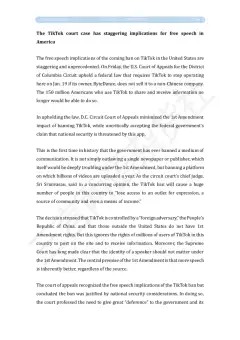
Last week, a federal court upheld the extraordinary use of government power
against TikTok, the social-media platform that an estimated 170 million Americans
use to dance, sing, talk about politics, and engage in a lot of other First Amendment–
protected expression. A three-judge panel of the U.S. Court of Appeals for the D.C.
Circuit unanimously dismissed TikTok’s challenge to a law requiring that the app
—currently a subsidiary of the Chinese tech company ByteDance—be sold to new
owners by January 19 or be shut down in the United States.
This is a stunning holding in a country proud of its free-speech tradition. And the
decision is all the more remarkable because the court acknowledged that the law
was motivated by concerns about what Americans might be convinced to believe
by using the app. Although the government had also argued that the law, passed in
April, was justified by data-security concerns, the court strongly suggested that
concerns that the Chinese government would leverage its power over ByteDance
to covertly manipulate content on TikTok to promote Beijing’s interests would on
their own be enough to justify the law. In other words, in the land of the First
Amendment, the judges showed a surprising amount of deference to the idea that
an entire platform can legally be shut down to keep people from holding views the
government doesn’t like.
In a concurring opinion, Chief Judge Sri Srinivasan described the potential threat
more concretely: He mused about officials of the People’s Republic of China “sowing
discord in the United States by promoting videos—perhaps even primarily truthful
ones—about a hot-button issue having nothing to do with China,” or even using
ostensibly anti-Chinese TikTok content to “conjure a justification for actions China
would like to take against the United States.”
These statements, which presume that Beijing could easily reshape users’ political
beliefs via an app known largely for its dance videos, reflect a highly unflattering
view of the American public. That view is also completely inconsistent with the
First Amendment, which typically allows people to think for themselves. If the外刊读写营第8期 公众号/B站:三言两语杂货社 Unit 2
government thinks people have wrong beliefs, then the Constitution requires that
the government change their minds, not censor speech it doesn’t like, unless it can
meet the heavy burden of proving that it has no other way of preventing an
inevitable, direct, and immediate national-security harm.
Instead of demanding such proof, the court accepted the TikTok law as part of a
“well-established practice of placing restrictions on foreign ownership or control”
of mass-communications technologies. But most of the precedents cited by the
court involve broadcast television and radio, which rely on common airwaves that
the government has long regulated closely. Therefore, the Supreme Court has held,
broadcasters can even be subject to limited content-based standards that, for
example, prohibit obscenity. No such regime governs cable channels, news websites,
or social-media apps. The new law doesn’t establish a careful regulatory framework
for the mobile-app industry; it singles out TikTok by name and demands the app’s
sale or closure. It is, to be clear, a de facto ban.
To be clear, covert manipulation of the online public sphere is a real problem. It’s
also the status quo: Social-media platforms wield enormous power over what
people are allowed to say and read online, and they exercise that power in opaque
ways. Platforms publish content-moderation rulebooks, but there’s no way to know
if they are enforced consistently.
The threat of covert manipulation does not come only from the platforms
themselves. Governments around the world eye platforms’ power jealously and
often try to leverage it to their own ends. Asking—with varying degrees of politeness
—for social-media platforms to remove content is a common habit of governments
from around the world. In many cases, platforms are eager to accommodate. Some
set up “trusted flagger” programs for officials to alert them to content they think
should be taken down. The black box of content moderation obscures all of these
inputs into platform decision making.
Just last term, however, the Supreme Court sounded a very blase; note about外刊读写营第8期 公众号/B站:三言两语杂货社 Unit 2
these threats. In one case, it held that platforms’ covert manipulation—sorry,
content moderation—of the speech on their sites was protected by the First
Amendment. Motivated by concerns that platforms were secretly suppressing
conservative viewpoints, Texas and Florida had passed laws to constrain platforms’
content moderation and make it more transparent. But the Supreme Court was
clear: Covert manipulation of online spaces was not in itself a harm that the First
Amendment allowed U.S. governments to regulate to prevent. This argument rested
on the principle, fundamental to First Amendment law, that no matter how much
damage private companies appear to be doing to the marketplace of ideas,
governmental intervention would be worse.
Courts should be very wary of letting amorphous claims of “national security”
interests by the government become a loophole in the First Amendment. In a
globalized and interconnected world, we need a structural answer to what are
likely to be recurring problems caused by foreign-ownership stakes in platforms
and indeed covert manipulation in general. Industry-wide regulation would create
fewer fears that the government is simply picking and choosing which platforms
to favor and which to restrict.