The back pages
3 May 2025 | New Scientist | 43
SEGAMI
YTTEG
AIV
PFA/TREMME
NOD
Puzzles Almost the last word Tom Gauld for Feedback Twisteddoodles
Try our crossword, Why don’t droplets New Scientist OpenAI can’t fool us, for New Scientist
quick quiz and of water tend to run A cartoonist’s take we know what its logo Picturing the lighter
logic puzzle p45 in straight lines? p46 on the world p47 really looks like p48 side of life p48
The science of exercise
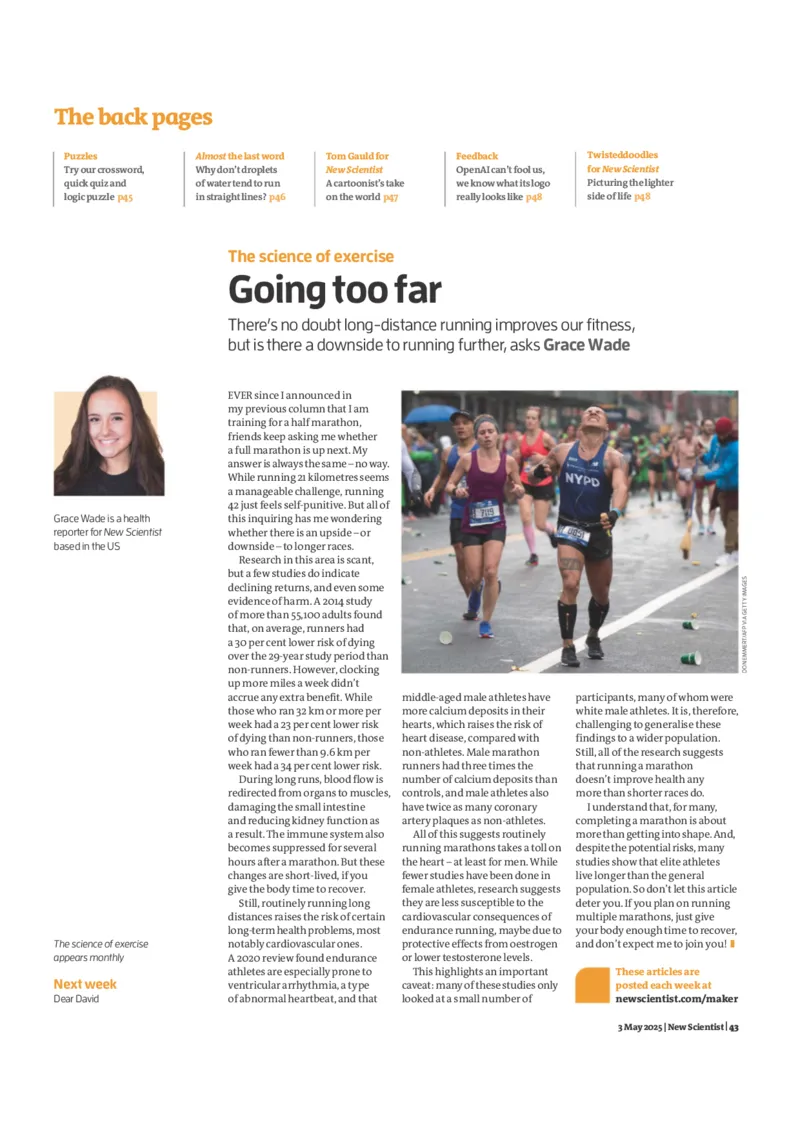
Going too far
There’s no doubt long-distance running improves our fitness,
but is there a downside to running further, asks Grace Wade
EVER since I announced in
my!previous column that I am
training for a half marathon,
friends keep asking me whether
a!full marathon is up next. My
answer is always the same!– no way.
While running 21 kilometres seems
a manageable challenge, running
42 just feels self-punitive. But all of
Grace Wade is a health this inquiring has me wondering
reporter for New Scientist whether there is an upside!– or
based in the US downside!– to longer races.
Research in this area is scant,
but a few studies do indicate
declining returns, and even some
evidence of harm. A 2014 study
of!more than 55,100 adults found
that, on average, runners had
a!30!per cent lower risk of dying
over the 29-year study period than
non-runners. However, clocking
up more miles a week didn’t
accrue any extra benefit. While middle-aged male athletes have participants, many of whom were
those who ran 32 km or more per more calcium deposits in their white male athletes. It is, therefore,
week had a 23 per cent lower risk hearts, which raises the risk of challenging to generalise these
of!dying than non-runners, those heart disease, compared with findings to a wider population.
who ran fewer than 9.6 km per non-athletes. Male marathon Still, all of the research suggests
week had a 34 per cent lower risk. runners had three times the that running a marathon
During long runs, blood flow is number of calcium deposits than doesn’t!improve health any
redirected from organs to muscles, controls, and male athletes also more!than shorter races do.
damaging the small intestine have twice!as many coronary I understand that, for many,
and!reducing kidney function as artery plaques as non-athletes. completing a marathon is about
a!result. The immune system also All of this suggests routinely more than getting into shape. And,
becomes suppressed for several running marathons takes a toll on despite the potential risks, many
hours after a marathon. But these the heart!– at least for men. While studies show that elite athletes
changes are short-lived, if you fewer studies have been done in live!longer than the general
give!the body time to recover. female athletes, research suggests population. So don’t let this article
Still, routinely running long they are less susceptible to the deter you. If you plan on running
distances raises the risk of certain cardiovascular consequences of multiple marathons, just give
long-term health problems, most endurance running, maybe due to your!body enough time to recover,!
The science of exercise notably cardiovascular ones. protective effects from oestrogen and don’t expect me to join you!!!❚
appears monthly A!2020 review found endurance or lower testosterone levels.
athletes are especially prone to This highlights an important These articles are
Next week ventricular arrhythmia, a type caveat: many of these studies only posted each week at
Dear David of!abnormal heartbeat, and that looked at a small number of newscientist.com/maker