外刊读写营第8期 公众号/B站:三言两语杂货社 Unit 1
Unit 1
信息真实性
精读预习
步骤 任务
听录音,填空(每空填写一个单词,含连字符的单词算一个)。如无听力练习需求,
Step 1
可跳过本练习,直接查看参考答案补充原文。
请阅读全文,完成阅读选择题。首次阅读全文时请勿查单词,可通过上下文或猜词
Step 2
理解原文,模拟阅读考试。
完成阅读题后,请使用课程附送的专业词典(牛津、朗文等)再次阅读原文,查询
Step 3
生词。请标记出表达、句法、背景知识的费解之处,观看视频讲解时可重点留意。
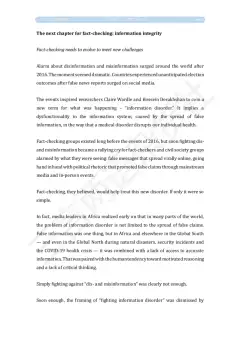
The next chapter for fact-checking: information ______________________
Fact-checking needs to evolve to meet new challenges
(1) Alarm about disinformation and misinformation surged around the world after 2016. The
moment seemed dramatic. Countries experienced ______________________ election outcomes
after false news reports surged on social media.
(2) The events inspired researchers Claire Wardle and Hossein Derakhshan to _____________________
a new term for what was happening – “information disorder.” It implies a dysfunctionality in
the information system, caused by the spread of false information, in the way that a medical
disorder disrupts our individual health.
(3) Fact-checking groups existed long before the events of 2016, but soon fighting dis- and
misinformation became a rallying cry for fact-checkers and civil society groups alarmed by
what they were seeing: false messages that spread ______________________ online, going hand in
hand with political rhetoric that promoted false claims through mainstream media and in-
person events.
(4) Fact-checking, they believed, would help treat this new disorder. If only it were so simple.
(5) In fact, media leaders in Africa realized early on that in many parts of the world, the problem
of information disorder is not limited to the spread of false ______________________. False
1外刊读写营第8期 公众号/B站:三言两语杂货社 Unit 1
information was one thing, but in Africa and elsewhere in the Global South — and even in the
Global North during natural disasters, security incidents and the COVID-19 health crisis — it
was combined with a lack of access to accurate information. That was ______________________
with the human tendency toward motivated reasoning and a lack of critical thinking.
(6) Simply fighting against “dis- and misinformation” was clearly not enough.
(7) Soon enough, the framing of “fighting information disorder” was ______________________ by
opponents as a flawed endeavour; they argued for an information marketplace where
individuals would fend for themselves. Authoritarian governments, too, used “information
disorder” as an inverse of their own ______________________ for “information order,” which meant
officially defined “truth” and state-created agencies that determined what information was
acceptable. In other words, “information disorder” was getting co-opted.
(8) To avoid these risks, what’s needed now is a framing that captures the full scope of fact-
checkers’ work — and shows what they’re fighting for; not just what they’re against—a
framing that would be more ______________________ in the face of attacks.
(9) Enter the recent concept of “information integrity”. The ______________________ is now being
promoted by some fact-checkers and international organizations, like the UNDP and the G20.
(10) Achieving information integrity certainly requires fact-checking. But the concept also points
clearly to other indispensable ______________________, which many fact-checking organizations
also address. Notably:
• Promoting accurate and independent ______________________
• Opening up state (and, as appropriate, private sector) information and data archives
• Reinforcing people’s abilities to resist junk content, and strengthening their agency as
critical consumers and producers of content
(11) Information integrity not only describes a positive goal, but the formulation can also help
counter the attacks that fact-checkers are part of a so-called “______________________ industrial
complex.” Information integrity underlines the idea that fact-checking is actually an essential
part of exercising free speech.
(12) The new concept can move the debate away from arguments about the motives of purveyors
of falsehoods and the challenge of proving intent to _________________. This is especially relevant
when addressing content produced by generative artificial intelligence, which is frequently
incorrect. In many cases, the results can be downright wrong but lack deliberate intent.
2外刊读写营第8期 公众号/B站:三言两语杂货社 Unit 1
(13) The umbrella model of information integrity is also in action right now. Fact-checking
organizations have for years engaged in a range of activities beyond correcting myths and
______________________. Many have long worked towards a plurality of information sources
known for accuracy, as well as engaging in media and information literacy initiatives so that
members of the public know to pause before they click.
(14) In Europe, the Spanish fact-checking organization Maldita, for example, holds regular
meetings with political groups in parliament to discuss the challenge of dis- and
misinformation. (As a result, the parliamentary leader of one party recently reported that
they now require staff to provide footnotes for sources of any claims they make.) Africa Check
provides a service, known as Info Finder, that serves as an information helpdesk for
______________________ media, helping journalists find accurate information on important topics
in half a dozen countries.
(15) There’s room for even more work to be done here, and fact-checking operations can embrace
the various roles they can play within a framework that promotes information integrity. In
addition to debunking and pre-bunking, they can call out actual censorship and transparency
______________________, especially when the public should have access to information it’s not
getting. Fact-checkers can champion the availability and prominence of accurate journalism.
And they can help the general public develop their own skills to ______________________ the ever-
more complex landscape.
(16) “Countering information disorder” has served fact-checkers well for almost a decade.
Updating it in favor of “fighting for information integrity” can help to position
______________________ to embrace what’s coming up next.
文章来源:2024年12月Poynter
请根据原文,选择正确的选项。
1. Which of the following is NOT a contributor to information disorder according to
Paragraph 5?
(A) Lack of access to accurate information
(B) The spread of false information
(C) The absence of objective analysis and tendency toward biased conclusions
(D) An overwhelming number of media outlets providing excessive information
3外刊读写营第8期 公众号/B站:三言两语杂货社 Unit 1
2. According to paragraph 7, what does the term "co-opted" refer to in the context of
"information disorder"?
(A) It was manipulated by governments to justify their control.
(B) It was embraced by fact-checkers as an effective solution.
(C) It was rejected by authoritarian governments as irrelevant.
(D) It was redefined by civil society to promote free speech.
3. According to paragraph 11, what is the relationship between "information integrity"
and fact-checking?
(A) Information integrity helps fact-checkers prove that misinformation is harmless.
(B) Information integrity positions fact-checking as a key element in defending free speech.
(C) Information integrity discourages fact-checking because it can restrict speech.
(D) Information integrity is part of government censorship.
4. Which of the following is NOT a role of fact-checkers according to the article?
(A) Supporting the accessibility of reliable journalism
(B) Highlighting transparency issues and calling out censorship
(C) Helping the public access hidden or restricted information
(D) Assisting the public in building critical thinking and media literacy
精读(1)
The next chapter for fact-checking: information integrity
Fact-checking needs to evolve to meet new challenges
(1) Alarm about disinformation and misinformation surged around the world after 2016. The
moment seemed dramatic. Countries experienced unanticipated election outcomes after false
news reports surged on social media.
4外刊读写营第8期 公众号/B站:三言两语杂货社 Unit 1
(2) The events inspired researchers Claire Wardle and Hossein Derakhshan to coin a new term
for what was happening – “information disorder.” It implies a dysfunctionality in the
information system, caused by the spread of false information, in the way that a medical
disorder disrupts our individual health.
(3) Fact-checking groups existed long before the events of 2016, but soon fighting dis- and
misinformation became a rallying cry for fact-checkers and civil society groups alarmed by
what they were seeing: false messages that spread virally online, going hand in hand with
political rhetoric that promoted false claims through mainstream media and in-person events.
(4) Fact-checking, they believed, would help treat this new disorder. If only it were so simple.
(5) In fact, media leaders in Africa realized early on that in many parts of the world, the problem
of information disorder is not limited to the spread of false claims. False information was one
thing, but in Africa and elsewhere in the Global South — and even in the Global North during
natural disasters, security incidents and the COVID-19 health crisis — it was combined with a
lack of access to accurate information. That was paired with the human tendency toward
motivated reasoning and a lack of critical thinking.
(6) Simply fighting against “dis- and misinformation” was clearly not enough.
5外刊读写营第8期 公众号/B站:三言两语杂货社 Unit 1
(7) Soon enough, the framing of “fighting information disorder” was dismissed by opponents as a
flawed endeavour; they argued for an information marketplace where individuals would fend
for themselves. Authoritarian governments, too, used “information disorder” as an inverse of
their own quests for “information order,” which meant officially defined “truth” and state-
created agencies that determined what information was acceptable. In other words,
“information disorder” was getting co-opted.
(8) To avoid these risks, what’s needed now is a framing that captures the full scope of fact-
checkers’ work — and shows what they’re fighting for; not just what they’re against—a
framing that would be more resilient in the face of attacks.
(9) Enter the recent concept of “information integrity”. The term is now being promoted by some
fact-checkers and international organizations, like the UNDP and the G20.
精读(1)练习
1. 请根据中文写出对应英文表达。
(1) 与……关系密切 __________________________________________________
(2) 批判性思维 __________________________________________________
(3) 缺乏获取……的途径 __________________________________________________
(4) 与……结对 __________________________________________________
6外刊读写营第8期 公众号/B站:三言两语杂货社 Unit 1
2. 请根据首字母和英文释义写出对应单词。
(1) i_________________________: the quality of being whole and complete;
(2) c________________________: to invent a new word or phrase that other people then begin to use;
(3) r________________________: able to recover quickly after something unpleasant such as shock,
injury.
3. 请将以下原文句子译为中文。
To avoid these risks, what’s needed now is a framing that captures the full scope of fact-checkers’
work — and shows what they’re fighting for; not just what they’re against—a framing that would
be more resilient in the face of attacks.
4. 请使用指定表达用英文写出以下句子。
(1) 由于儿子常年在国外,这位空巢老人只能自己照顾自己。(fend for oneself, empty-nester)
(2) 她提出公司应该加大在可再生能源上的投入,然而上级驳回了她的提议,认为这个想法不
切现实。(dismiss sth. as …)
精读(2)
(1) Achieving information integrity certainly requires fact-checking. But the concept also points
clearly to other indispensable preconditions, which many fact-checking organizations also
address. Notably:
7外刊读写营第8期 公众号/B站:三言两语杂货社 Unit 1
• Promoting accurate and independent journalism
• Opening up state (and, as appropriate, private sector) information and data archives
• Reinforcing people’s abilities to resist junk content, and strengthening their agency as
critical consumers and producers of content
(2) Information integrity not only describes a positive goal, but the formulation can also help
counter the attacks that fact-checkers are part of a so-called “censorship industrial complex.”
Information integrity underlines the idea that fact-checking is actually an essential part of
exercising free speech.
(3) The new concept can move the debate away from arguments about the motives of purveyors
of falsehoods and the challenge of proving intent to mislead. This is especially relevant when
addressing content produced by generative artificial intelligence, which is frequently
incorrect. In many cases, the results can be downright wrong but lack deliberate intent.
(4) The umbrella model of information integrity is also in action right now. Fact-checking
organizations have for years engaged in a range of activities beyond correcting myths and
falsehoods. Many have long worked towards a plurality of information sources known for
accuracy, as well as engaging in media and information literacy initiatives so that members of
the public know to pause before they click.
8外刊读写营第8期 公众号/B站:三言两语杂货社 Unit 1
(5) In Europe, the Spanish fact-checking organization Maldita, for example, holds regular
meetings with political groups in parliament to discuss the challenge of dis- and
misinformation. (As a result, the parliamentary leader of one party recently reported that they
now require staff to provide footnotes for sources of any claims they make.) Africa Check
provides a service, known as Info Finder, that serves as an information helpdesk for under-
resourced media, helping journalists find accurate information on important topics in half a
dozen countries.
(6) There’s room for even more work to be done here, and fact-checking operations can embrace
the various roles they can play within a framework that promotes information integrity. In
addition to debunking and pre-bunking, they can call out actual censorship and transparency
deficits, especially when the public should have access to information it’s not getting. Fact-
checkers can champion the availability and prominence of accurate journalism. And they can
help the general public develop their own skills to navigate the ever-more complex landscape.
(7) “Countering information disorder” has served fact-checkers well for almost a decade.
Updating it in favor of “fighting for information integrity” can help to position practitioners to
embrace what’s coming up next.
9外刊读写营第8期 公众号/B站:三言两语杂货社 Unit 1
精读(2)练习
1. 请根据中文写出对应英文表达。
(1) 先决条件 __________________________________________________
(2) 大量,众多…… __________________________________________________
(3) 公开谴责 __________________________________________________
(4) 视情况而定 __________________________________________________
2. 请根据首字母和英文释义写出对应单词。
(1) c_________________________: to fight for or support a person, belief, right, or principle
enthusiastically;
(2) d________________________: done on purpose, intentional or planned;
(3) p________________________: to put something or someone in a particular place.
3. 请将以下原文句子译为中文。
Many have long worked towards a plurality of information sources known for accuracy, as well as
engaging in media and information literacy initiatives so that members of the public know to
pause before they click.
4. 请使用指定表达用英文写出以下句子。
(1) 她辞去稳定的工作,选择自己创业,为的是能自由追求自己真正的热情所在。(in favor of)
(2) 他们尝试通过组织一次公益跑活动来抵消针对公司的负面评论,希望能重新赢回公众的信
任。(counter, charity run)
10外刊读写营第8期 公众号/B站:三言两语杂货社 Unit 1
写作练习
请按照「总结与写作」课要求,完成相应造句练习。
11外刊读写营第8期 公众号/B站:三言两语杂货社 Unit 1
泛读
步骤 任务
请阅读全文,完成阅读选择题。首次阅读全文时请勿查单词,可通过上下文或猜词
Step 1
理解原文,模拟阅读考试。
Step 2 跟随课程计划,阅读泛读(1)和泛读(2)文字解析,疏通理解障碍,学习词句。
Step 3 听录音,跟读。如无听说练习需求,可跳过此步骤。
Journalism’s What If Problem
Too many reporters are writing fiction.
(1) When I was growing up in New York in the 1970s, the city was at its nadir—bankruptcy,
burned-out buildings, rampant crime. I started in public school, then switched to private in
the fifth grade. My parents made the change because they said that if I went to the local middle
school, I would be “knifed in the halls.” This was an act of fiction.
(2) I say it was an act of fiction not because getting knifed was an impossibility, but because it
was speculative, one of many potential futures. In my house, the fear of that potential future
was strong enough for my dad to take on extra work and make the change.
(3) As a novelist and filmmaker, I spend a lot of time thinking about the value of fiction. I tell
stories to help me understand my world and the people in it. My job is to create feelings in
the audience—fear and longing, joy and anger. When I consider the author’s role in our
culture, I picture the following sequence: first comes news, then comes history, then comes
fiction. But over the past 10 years, I’ve noticed something at first puzzling, then alarming. Fact
and fiction are trading places in the sequence.
12外刊读写营第8期 公众号/B站:三言两语杂货社 Unit 1
(4) I first saw evidence of this phenomenon during coverage of the 2016 Republican National
Convention. Halfway through the week, a CNN anchor noted in an interview with Newt
Gingrich, the Republican politician, that violent crime was down across the country. But
Gingrich argued that this was just one “view” and that people “feel more threatened.” The
CNN anchor insisted, “Feel it, yes. They feel it, but the facts don’t support it.” Without missing
a beat, Gingrich said, “As a political candidate, I’ll go with how people feel, and I’ll let you go
with the theoreticians.”
(5) This was an early sign that we were moving from a fact-based world to a fictional one, where
how people feel about crime is as real as the crime itself. Feelings are meant to be the purview
of fiction writers. We construct our stories around the feelings of our characters. How they
feel drives their actions. However, feelings are not, traditionally, how we as humans
understand reality and how we filter events into first news and then history.
(6) Another sign of this shift came with the rapid proliferation of alternative narratives. In the
past, when news happened, the media would report the facts. Only later would conspiracy
theories emerge. Then came January 6, an event that unfolded as fact and fiction
simultaneously. While the mainstream media showed us footage of Donald Trump supporters
storming the Capitol in real time, Fox News, other right-wing outlets, and social media told
people that the riot they were watching was actually the work of antifa. And so, before our
eyes, the fictional version of the moment was born at the same instant as the reality.
(7) Speculation is not the function of journalism. It is what an anxious brain does, worrying about
all the ways things could go wrong, sending the worrier into a panicked and angry state—the
same state of mind that consumes Fox News viewers. In the past 20 years, Fox has made
13外刊读写营第8期 公众号/B站:三言两语杂货社 Unit 1
billions off its viewers’ anxiety, the fear its hosts inspire motivating those viewers to watch
more and more Fox in a cause-and-effect spiral. In the online age, this is known as
doomscrolling.
(8) You can argue that there’s no equivalency—that replacing fact with fiction in the present is
dangerous, while painting pictures of potential disasters is simply being prepared. My point,
though, is not that news organizations are inventing the threat to democracy. My point is that
when they fill their feeds with what ifs, they degrade the exercise of journalism, turning news
into gossip and journalists into pundits.
(9) This is not a new phenomenon. Twenty-four-hour cable-news networks and talk radio were
the original alarmists, but in a country where the news media are polarized between “our”
sources and “their” sources, we should consider the idea that how journalists report the news
may be as important as the news itself. The mainstream media may be trapped in an
emotional call-and-response with the audience that escalates fear and anger at the expense
of our shared reality.
(10) There is a larger story here about how algorithms push content with high emotional impact
into our feeds, and how clicks and likes drive advertising dollars. That is, a story about how
news is a for-profit business. But to the degree that this is a story about how news
organizations approach the job of informing Americans about the events and personalities of
the day, I’m going to keep it simple and say that by using the tools of fiction to stir feelings of
fear and anger, news platforms undermine the real value of their news and impair people’s
ability to consider it clearly.
14外刊读写营第8期 公众号/B站:三言两语杂货社 Unit 1
(11) One day in the not-too-distant future, history books will be written about what actually
happened in the second Trump term. Then the fiction writers will descend, looking for
meaning, having meditated on the realities we’ve experienced, the truths we’ve uncovered.
And if it turns out we were all knifed in the halls, we will write about that as well. But until
then, I think we are all best served by focusing on what is happening, not what might.
文章来源:2024年12月《大西洋月刊》
请根据原文,选择正确的选项。
1. What was Newt Gingrich's argument during his interview with CNN?
(A) Violent crime was down, and the media had misreported it
(B) He believed that the perception of crime was more important than the actual statistics
(C) The media exaggerated the decline in crime for political reasons
(D) Crime had increased significantly since 2016
2. What does the author suggest about the nature of media coverage of the Jan. 6th riot?
(A) The mainstream media presented a neutral account of the events, while alternative narratives
emerged later.
(B) Media coverage was largely unified, with all outlets agreeing on the involvement of antifa.
(C) Right-wing media outlets and social media introduced alternative explanations while the
mainstream media showed the actual events.
(D) The mainstream media’s coverage of the riot was quickly overshadowed by conspiracy
theories on social media.
3. What does the author argue in Paragraph 8 about replacing facts with speculation?
(A) It prepares people for potential disasters, which is beneficial
(B) It makes news more engaging and dynamic for audiences
(C) It enhances the credibility of news outlets
(D) It undermines journalism by turning it into gossip and reducing its factual value
4. What does paragraph 10 suggest about news platforms?
(A) They enhance public understanding by focusing on facts.
(B) They prioritize profit, often at the expense of truth.
(C) They rely on unbiased, objective content to attract viewers.
(D) They strive to educate the public without emotional manipulation.
15