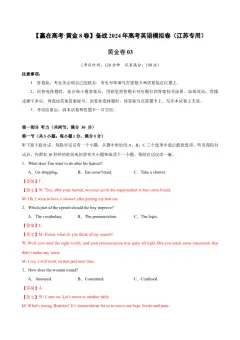
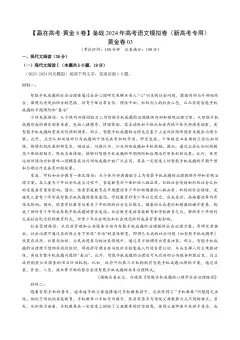
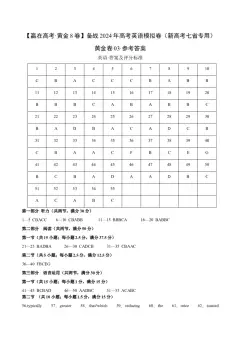
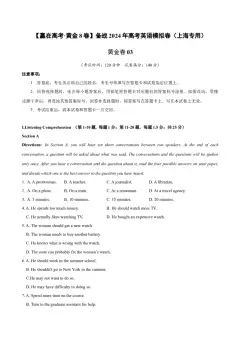
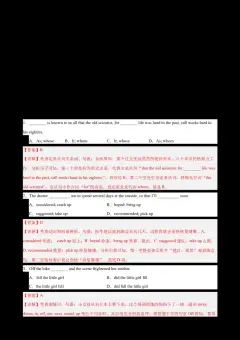
【赢在高考·黄金8卷】备战2024年高考英语模拟卷(江苏专用)
黄金卷03
(考试时间:120分钟 试卷满分:150分)
注意事项:
1.答卷前,考生务必将自己的姓名、考生号等填写在答题卡和试卷指定位置上。
2.回答选择题时,选出每小题答案后,用铅笔把答题卡对应题目的答案标号涂黑。如需改动,用橡
皮擦干净后,再选涂其他答案标号。回答非选择题时,将答案写在答题卡上。写在本试卷上无效。
3.考试结束后,将本试卷和答题卡一并交回。
第一部分 听力(共两节,满分 30 分)
第一节(共5小题;每小题1分,满分5分)
听下面5段对话。每段对话后有一个小题,从题中所给的A、B、C三个选项中选出最佳选项。听完每段对
话后,你都有10秒钟的时间来回答有关小题和阅读下一小题。每段对话仅读一遍。
1.What does Tim want to do after his haircut?
A.Go shopping. B.Eat some bread. C.Take a shower.
2.Which part of the speech should the boy improve?
A.The vocabulary. B.The pronunciation. C.The logic.
3.How does the woman sound?
A.Annoyed. B.Concerned. C.Confused.
4.Where are the speakers?
A.In a hospital. B.In a grocery store. C.In a restaurant.
5.Why doesn’t the woman wear the pink skirt?
A.It’s a little small.
B.It has a bright color.
C.It’s too casual for a formal occasion.
第二节(共15小题;每小题1分,满分15分)
听下面5段对话或独白。每段对话或独白后有几个小题,从题中所给的 A、B、C三个选项中选出最佳选
项。听每段对话或独白前,你将有时间阅读各个小题,每小题 5秒钟;听完后,各小题将给出5秒钟的作
答时间。每段对话或独白读两遍。
听下面一段较长对话,回答以下小题。
6.Why did Tom come home late?A.He lost track of the time.
B.He missed the last bus.
C.He finished school late.
7.What does Tom say about the singer?
A.He needs some money.
B.He just wants to be appreciated.
C.He’s good at singing classical songs.
听下面一段较长对话,回答以下小题。
8.What are the speakers talking about?
A.Features of Chinese food.
B.A recipe for chicken soup.
C.A local Chinese restaurant.
9.What does the man think of the dinner?
A.Oily. B.Light. C.Tasty.
听下面一段较长对话,回答以下小题。
10.What is the probable relationship between the speakers?
A.Schoolmates.
B.Former neighbors.
C.Interviewer and interviewee.
11.Why does the man feel upset about the interview on campus?
A.He didn’t attend it.
B.He found it meaningless.
C.He hasn’t received any notice.
12.What advice does Jenny give to the man about interviews?
A.Providing satisfactory answers.
B.Arriving at the company on time.
C.Doing research on the company beforehand.
听下面一段较长对话,回答以下小题。
13.What is the woman doing?
A.Hosting a show. B.Giving a lecture. C.Having a class.
14.How did Steven’s mother influence him?
A.By sending him to poetry classes.
B.By teaching him to write business plans.
C.By asking him to read from early childhood.15.What does Steven find most difficult in writing?
A.Finding the right words.
B.Choosing a suitable topic.
C.Describing real experiences.
16.What is Steven’s opinion on his own writing?·
A.Creative. B.Successful. C.Encouraging.
听下面一段独白,回答以下小题。
17.Why will Mr. Jenkins be leaving?
A.He is sick. B.He has found a new job. C.He will take care of a family member.
18.When will Mr. Jenkins be leaving?
A.At the end of the week. B.At the end of the month. C.At the end of the semester.
19.What will the school do to appreciate Mr. Jenkins?
A.Hold a party for him.
B.Send him on vacation.
C.Name something after him.
20.Who is Mr. Ryan?
A.A teacher. B.An athlete. C.A basketball coach.
第二部分 阅读(共两节, 满分50分)
第一节(共15小题:每小题2.5分, 满分37.5分)
阅读下列短文, 从每题所给的A、B、C、D四个选项中选出最佳选项。
A
Volunteer by supporting a local animal rescue center in Costa Rica!
If you like animals and are also interested in preserving the environment, you will be perfect for this program.
You will be helping out in and supporting a local animal shelter. Not only does this shelter take in homeless
animals, but also wild animals which are in bad condition.
In addition to the caretaking of the animals, volunteers help us welcome visitors at the entrance and answer
any questions that visitors may have about the shelter or its animals. As volunteers spend more days in the shelter,
knowledge about wildlife management will grow.
Requirements
*You need to be at least 15 years old on the program start date at the high school level or above.
*Speaking English is a basic requirement.
*No restrictions on nationality. Helping hands both in Costa Rica and beyond are welcome.*Your helping hand will be required from 09:00 to 15:00 on Monday, Tuesday, Wednesday, Thursday,
Saturday and Sunday.
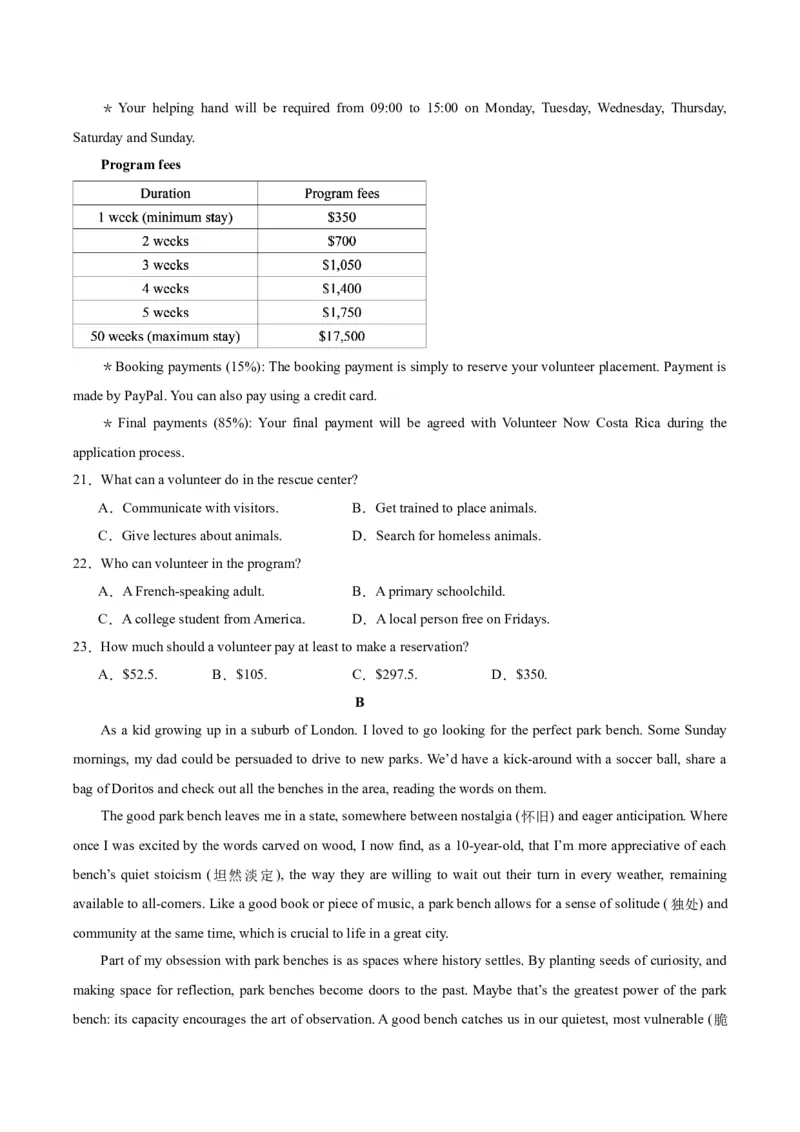
Program fees
*Booking payments (15%): The booking payment is simply to reserve your volunteer placement. Payment is
made by PayPal. You can also pay using a credit card.
*Final payments (85%): Your final payment will be agreed with Volunteer Now Costa Rica during the
application process.
21.What can a volunteer do in the rescue center?
A.Communicate with visitors. B.Get trained to place animals.
C.Give lectures about animals. D.Search for homeless animals.
22.Who can volunteer in the program?
A.A French-speaking adult. B.A primary schoolchild.
C.A college student from America. D.A local person free on Fridays.
23.How much should a volunteer pay at least to make a reservation?
A.$52.5. B.$105. C.$297.5. D.$350.
B
As a kid growing up in a suburb of London. I loved to go looking for the perfect park bench. Some Sunday
mornings, my dad could be persuaded to drive to new parks. We’d have a kick-around with a soccer ball, share a
bag of Doritos and check out all the benches in the area, reading the words on them.
The good park bench leaves me in a state, somewhere between nostalgia (怀旧) and eager anticipation. Where
once I was excited by the words carved on wood, I now find, as a 10-year-old, that I’m more appreciative of each
bench’s quiet stoicism (坦然淡定), the way they are willing to wait out their turn in every weather, remaining
available to all-comers. Like a good book or piece of music, a park bench allows for a sense of solitude (独处) and
community at the same time, which is crucial to life in a great city.
Part of my obsession with park benches is as spaces where history settles. By planting seeds of curiosity, and
making space for reflection, park benches become doors to the past. Maybe that’s the greatest power of the park
bench: its capacity encourages the art of observation. A good bench catches us in our quietest, most vulnerable (脆弱的) moments, when we may be open to imagining new narratives and revisiting old ones. Our masks are taken
off, hung from the bench’s wrought iron. On other nearby benches, babies are being burped. Glances exchanged.
Sandwiches eaten. Newspapers read it .
Lately, I’ve found me sitting on a lot of cramped metal benches of the kind that don’t invite you to linger long,
or harsh concrete ones that leave you cold. That’s because public seating is becoming an endangered species. Our
cities are becoming more like Disneyland, which has been quietly removing public seating and replacing it with
more restaurant seating. If you want a moment’s rest in 21st-century America, you have to open your wallet.
One recent Sunday, I wandered through Central Park. To be in Central Park in what is hopefully the
pandemic’s twilight is to be reminded of the beauty of living in a city that still makes space for park benches in the
modern cityscape.
24.How did the writer lead in the topic?
A.By describing the scene of the park.
B.By revealing his passion for London.
C.By showing his father’s affection for him.
D.By introducing his childhood experience.
25.What can we learn about the writer after he grew up?
A.He was suffering great frustration in his 40s.
B.He enjoyed the peace in the park very much.
C.He liked the feel park benches brought to him.
D.He was still crazy about the words on the bench
26.Which aspect of park benches does paragraph 3 focus on?
A.Design. B.History. C.Location. D.Power.
27.Why is public seating becoming an endangered species?
A.It is out of date. B.It is uncomfortable to sit there.
C.It is commercialized. D.It is usually made of metal.
C
Is there anything Sponges (海绵) can’t do? For thousands of years, humans have used dried natural sponges to
clean up, to paint and as containers to consume liquids like water or honey. And, as scientists around the world are
beginning to show, sponges’ cavity-filled (空腔填充) forms mean they could provide a solution to one of our era’s
biggest problems: microplastic pollution.
In August, researchers in China published a study describing their development of a man-made sponge that
makes short work of microscopic plastic debris (碎片). In tests, the researchers show that when a specially prepared
plastic-filled solution is pushed through one of their sponges, the sponge can remove both microplastics and evensmaller nanoplastics from the liquid. These particles typically become trapped in the sponge’s many openings.
Though the sponges’ effectiveness varied in experiments, in part depending on the concentration of plastic and the
acidity and saltiness of the liquid, the best conditions allowed the researchers to remove as much as 90 percent of
the microplastics. They tried it in everything from tap water and seawater to — why not — soup from a local
takeout spot.
According to Guoging Wang, a materials chemist at Ocean University of China and co-author on the paper, the
sponge formula is adjustable. By adjusting the temperature when the two compounds are mixed, he says, the
sponges can be made more or less porous (渗透). This affects the size of particles collected — highly porous
sponges have lots of very small pores, which is good for catching very tiny particles. The sponges, if ever produced
at an industrial scale, Wang says, could be used in wastewater treatment plants to remove microplastics out of the
water or in food production facilities to depollute water.
There are hiccups to the sponge’s potential adoption, though What’s still lacking, says AliceHorton at the
United Kingdom’s National Oceanography Center, is proof that any of these newer sponge-based technologies can
be cost effective and successful in removing microplastics from water at a large scale. But one thing she is
confident about is that efforts to remove microplastics after they have already reached the ocean are probably
doomed to fail.
“I don’t think there is anything we can do on a large enough scale that will have any impact,” she says of that.
“We have to stop it getting there in the first place.”
28.Why does the author mention multiple applications of sponges in paragraph 1?
A.To introduce sponges’ newfound function.
B.To highlight that sponges can do anything.
C.To prove that sponges boast a long history.
D.To demonstrate sponges’ cavity-filled forms.
29.What can we learn about the man-made sponge?
A.Its effectiveness is uniform in experiments.
B.Its formula is fixed in controlling its openings.
C.It has been produced at an industrial scale.
D.It can effectively remove microscopic plastic debris.
30.What does the underlined word “hiccup” probably mean?
A.Opportunity. B.Prospect. C.Problem. D.Failure.
31.What does Alice Horton imply in the last paragraph?
A.All things are difficult before they are easy. B.Every cloud has a silver lining.
C.Prevention is better than cure. D.Better late than never.D
Portia Kapraun has always seen unwelcome ads on Twitter, usually from major brands pitching (竭力推销)
her expensive jewelry or vehicles that she, as a librarian in Indiana, could not afford. Ms. Kapraun was not
interested. But she soon saw the ads again. And again. And again. “These feel like low-end ads,” she said. In a
shaky advertising market in an uncertain economy, ads that few people want to see suddenly seem to be
everywhere.
Advancements in digital advertising technology were meant to improve users’ experience. People interested in
shoes are intended to get ads for sneakers and boots, not repeated pitches promoting gold investments. And the
technology is supposed to remove misleading or dangerous pitches. But lately, on several platforms, the opposite
seems to be happening for a variety of reasons, including a slowdown in the overall digital ad market. As numerous
deep-pocketed markets have pulled back, and the softer market has led several digital platforms to lower their ad
pricing, opportunities have opened up for less demanding advertisers.
Advertising experts agree that poor-quality ads appear to be increasing greatly. They point to a variety of
potential causes: internal troubles at technology companies, weak content moderation (审核), and high-level
advertisers seeking other choices. Then, there’s the economy: A recent survey of 43 multinational companies
representing more than $44 billion in advertising spending found that nearly 30 percent planned to cut back on their
marketing spending last year.
Other factors are also contributing to lower advertising quality. Social media advertising, once only practiced
by specialists, is now easily available to anyone. Many of them are avoiding targeted ads—placements intended to
reach specific audiences, usually at a higher cost -- in favor of a cheaper spray-and-pray (广撒网式的) approach
online, hoping to catch the attention of gullible (容易受骗的) or bored shoppers. Major social media platforms are
now like “a mall that used to be good”, Corey Richardson, vice president at a multicultural ad company, says. “But
now there’s no longer a mall there —it’s just a place selling anything.”
32.What message does the author want to deliver in Portia Kapraun’s story?
A.Repeated ads have a strong power of persuasion.
B.Social media users often encounter unwanted ads.
C.Major brands usually prefer social media advertising.
D.An uncertain economy leads to lower levels of consumption.
33.What can be inferred about the “less demanding advertisers” mentioned in Paragraph 2?
A.They are forced to exit the digital ad market.
B.They have benefited from advertising experts.
C.They work hard to improve their users’ experience.
D.They can now advertise at a more affordable price.34.What is Corey Richardson’s attitude to major social media platforms?
A.Negative. B.Unclear. C.Favorable. D.Hopeful
35.Which of the following is a suitable title for the text?
A.Where is social media advertising heading?
B.What is shaking up the online advertising market?
C.Why are you seeing so many bad digital ads now?
D.How are targeted ads impacting your-purchase decisions?
第二节(共5小题:每小题2. 5分, 满分12. 5分)
阅读下面短文, 从短文后的选项中选出可以填入空白处的最佳选项。选项中有两项为多余选项。
Benefits of sharing jokes as a family
A well-chosen joke can have a big impact when speaking to a crowd or attempting to redirect a tense meeting.
36 Our family started regularly enjoying jokes when my son began sharing the “Joke of the Day” read On the
morning announcements his school with us at dinner. A burst of laughter prevents us from complaining about the
menu. 37 The benefits of sharing jokes definitely go beyond mealtime conversation matter, though. Here
are some reasons to make joking around a regular family habit:
38 Knowing a good joke can help a kid connect with other kids at the cafeteria table or start a
conversation on the school bus. Enjoying jokes and practicing the art of humorous delivery in the safety of their
home can give kids tools for social situations, especially if this is an area of difficulty.
Jokes improve language skills. 39 Consider the learning potential in these samples from
Funology.com: “What do you call a cow that eats your grass? A lawn mower.” “When is a door not a door? When
it’s ajar (半开着).”
Jokes encourage reading and learning. Many parents and teachers report that joke books help motivate their
reluctant or struggling readers to read more. Since jokes, by design, are for sharing, reading them aloud is
particularly good practice for kids who struggle with reading fluently. 40 If your child needs help
remembering a difficult concept, a joke might do it. For instance, try another joke from Funology.com: “Two atoms
are playing together when on tells the other, ‘I lost an electron.’ The second atom asks, ‘Are you sure?’ The first
atom replies ‘I’m positive!’”
A.Jokes help kids build social relationships.
B.Jokes aren’t just for the public stage, though.
C.Humor can even help a person deal with mood disorders.
D.Studies show humor can make information more memorable, too.
E.Jokes are quick lessons about sounds in words and word meanings.F.Humor encourages family connection and can help ease kids’ anxiety.
G.Also, it’s been a good chance to explain jokes he didn’t quite understand.
第三部分语言运用(共两节,满分30分)
第一节(共15小题:每小题1分,满分15分)
阅读下面短文, 从每题所给的A、B、C、D四个选项中选出可以填入空白处的最佳选项。
Katie Jo Benitz, who graduated from high school in 2021, is one of the newest trainees at the Yakima Fire
Department. She was 41 to join the male-dominated field 42 her mother Captain Bonnie
Rogers, the first female firefighter in her department.
The pair finally met for the first time at the scene of the fire, when Benitz was called in to help 43
the Cow Canyon wildfire. In the past, the two had 44 crossed paths, which wasn’t unusual considering
they are 45 about 90 minutes from each other. But this time was 46 . In this particular
instance, they were 20 miles away from each other when the fire started. Benitz described their 47 of
paths at the site of the fire as both “pretty exciting” and a(n)“ 48 occurrence.”
The mother and daughter’s 49 story has since been 50 by the media. The pair said
they hope it will inspire more individuals—particularly women—to become firefighters themselves. “I am just so
51 I can do the job I love,” Benitz said. “I hope I can encourage others to become a firefighter.” Rogers
added her own 52 . “Everyone should pursue his 53 . And I also want other women to
know you can do this job. With 54 work and determination, it is absolutely possible, and being able
to 55 is a great honor.”
41.A.invited B.required C.inspired D.persuaded
42.A.as for B.because of C.except for D.instead of
43.A.study B.battle C.challenge D.recognize
44.A.never B.ever C.often D.also
45.A.directed B.exposed C.stationed D.interviewed
46.A.strange B.different C.familiar D.necessary
47.A.winding B.running C.turning D.crossing
48.A.rare B.early C.fast D.potential
49.A.meet-up B.break-up C.show-off D.take-off
50.A.helped out B.paid for C.picked up D.left over
51.A.confident B.brave C.special D.happy
52.A.commitment B.congratulation C.exploration D.encouragement
53.A.virtue B.passion C.education D.hobby54.A.busy B.dangerous C.hard D.annoying
55.A.support B.appear C.attempt D.serve
第三部分语言运用(共两节,满分30分)
第一节(共15小题:每小题1分,满分15分)
阅读下面短文, 从每题所给的A、B、C、D四个选项中选出可以填入空白处的最佳选项。
阅读下面短文,在空白处填入1个适当的单词或括号内单词的正确形式。
I was recently fortunate enough to have the opportunity to travel to Suzhou in Jiangsu Province. As 56
amateur student of history, I have always been fascinated with this incredible city and had 57 (particular) high
expectations.
Upon landing and heading to my hotel, I began to wonder what the scenery around my hotel would be like.
The following few days 58 (find) me floating down the ancient canals in the “Old Town” district of Suzhou,
visiting its gorgeous and historic gardens, 59 (explore) the many markets of the city and taking advantage of
every opportunity I could to eat favorable Suzhou cuisine. I found myself 60 (overwhelm) by the infectious
energy that surges (涌动) through the city.
This “energy of Suzhou” is represented best by its people. Suzhou people have enormous respect for 61
(they) city’s history, while also having an innovative eye on the future. Suzhou served 62 a key trading hub for
much of China’s history, drawing in scholars, engineers 63 merchants from all over the country for thousands of
years.
The entirety of Suzhou 64 (be) a true treasure of China that manages the difficult balance of innovation
and preservation. I eagerly await what extraordinary 65 (accomplish) it will surely achieve next.
第四部分 写作(共两节, 满分40分)
第一节(满分15分)
66.假定你是校学生会主席李华。学生会近期要组织一场高三同学向自己的学校捐赠图书的活动。请你给
校英文报写一封倡议书,号召大家积极参与。内容包括:
1. 活动目的;
2. 活动内容;
3. 发出倡议。
注意:1. 词数 80 左右;
2. 可以适当增加细节,以使行文连贯;
3. 请按如下格式在答题卡的相应位置作答。
________________________________________________________________________________________________________________________________________________________________________________________
____________________________________________________________________________________________
____________________________________________________________________________________________
_____________________________________________________________________________________
第二节(满分25分)
阅读下而材料,根据其内容和所给段落开头语续写两段,使之构成一篇完整的短文。
At one time children made May Day baskets to celebrate spring and enjoy the rewards of giving surprising
gifts to their beloved ones. When I was in perhaps the third grade, our class took on such an adventure. For several
days, we worked on creating paper baskets. We cut colorful stripes of construction paper and wove them together,
following our teacher, Miss Anderson. We cut and wove and glued. Then we decorated them with our crayons and
more cutting and gluing. Finally, we fitted paper handles onto the tops so that we could secretly hang our creations
on the doors of unsuspecting receivers: surely our mothers.
We were finished right on time. Miss Anderson brought armloads of flowers for us to use in stuffing our
prizes. Lilacs and tulips and al the colorful flowers of spring. We had to wait until the day was nearly over before
we were allowed to choose the flowers that were just right for our baskets. I chose the biggest, most beautiful
blossoms, allowing myself to be selfish for the sake of my mother. Then we fidgeted (烦躁) away what remained of
our day, waiting for the clock to tick down the minutes to our release.
Finally, mercifully, the bell rang! We threw on our coats, gathered our homework and our lunch boxes, tied on
our scarves and then, carefully, we cradled our offerings of love and off we ran to our individual homes! I was so
excited! I ran as fast as I could down the hill, across the street, up the block, heading home. I paused at the corner
of my house, to catch my breath and savor the moment. Then I glanced down to admire my offering one last time
before I hung it lovingly over the doorknob. Horrors! Shock, dread and depression! My flowers were gone!
Apparently, bouncing out on my mad dash home, all that was left was a sad, messed-up, wrinkled little empty
basket! I stood on the doorway and burst into mournful sobbing tears.
注意:
1.续写词数应为150左右;
2.请按如下格式在答题卡的相应位置作答。
Para 1
By and by, my mom came to the door to discover the source of the sorrow.
____________________________________________________________________________________________
____________________________________________________________________________________________
________________________________________________________________________________________________________________________________________________________________________________________
____________________________________________________________________________________________
_______________
Para 2
Soon, my newly-decorated basket was ready to be offered again.
____________________________________________________________________________________________
____________________________________________________________________________________________
____________________________________________________________________________________________
____________________________________________________________________________________________
____________________________________________________________________________________________
_______________