文档文本内容
阅读理解+阅读七选五+完形填空+语法填空
一 阅读理解
阅读下列短文,从每题所给的 A、B、C 和 D 四个选项中,选出最佳选项。
A
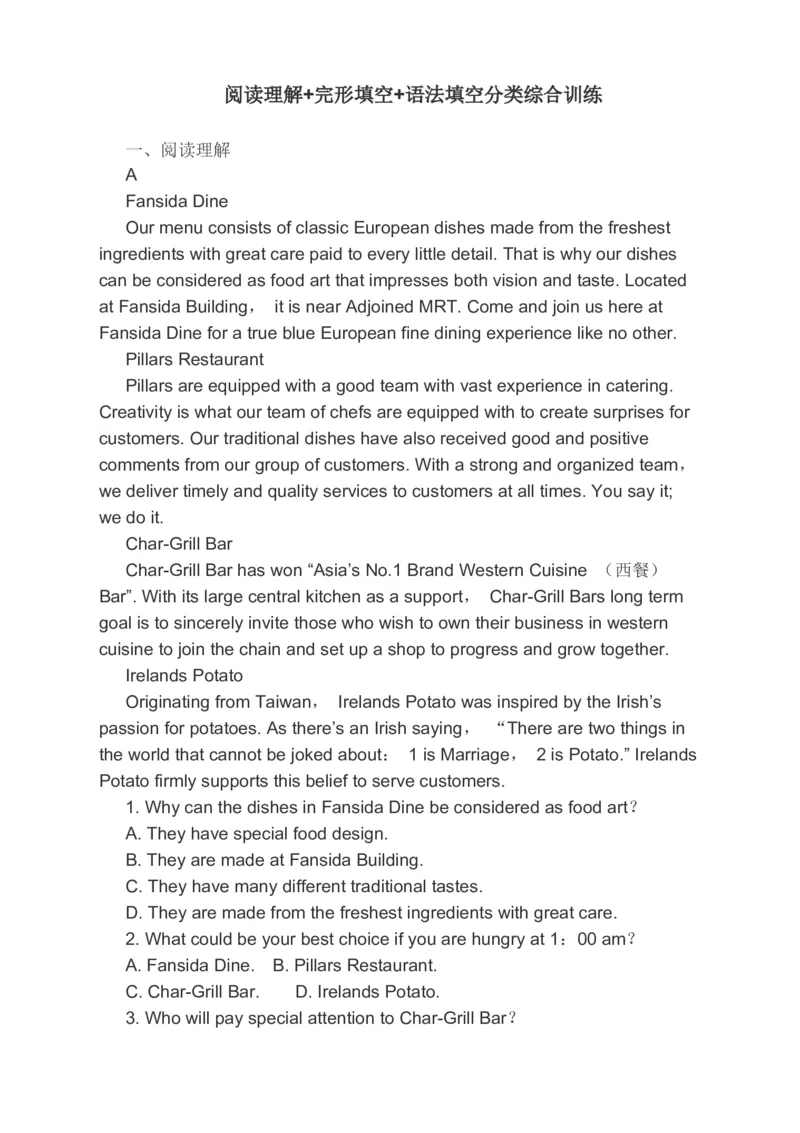
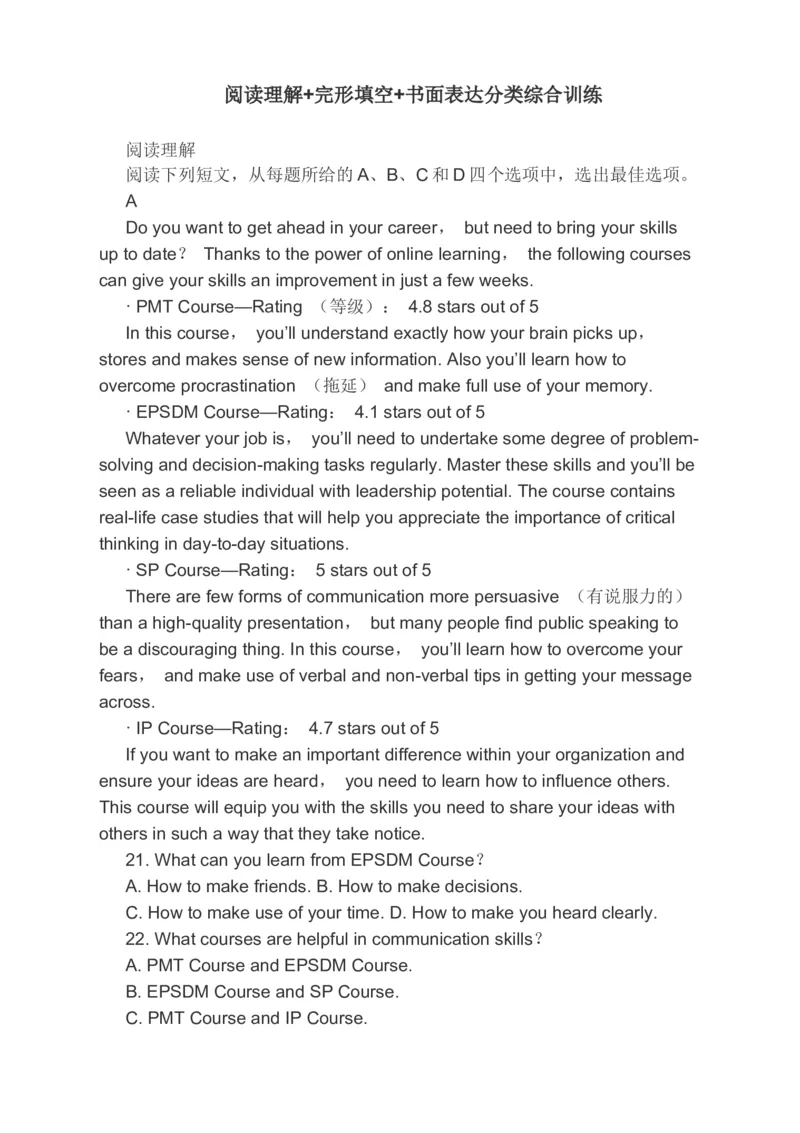
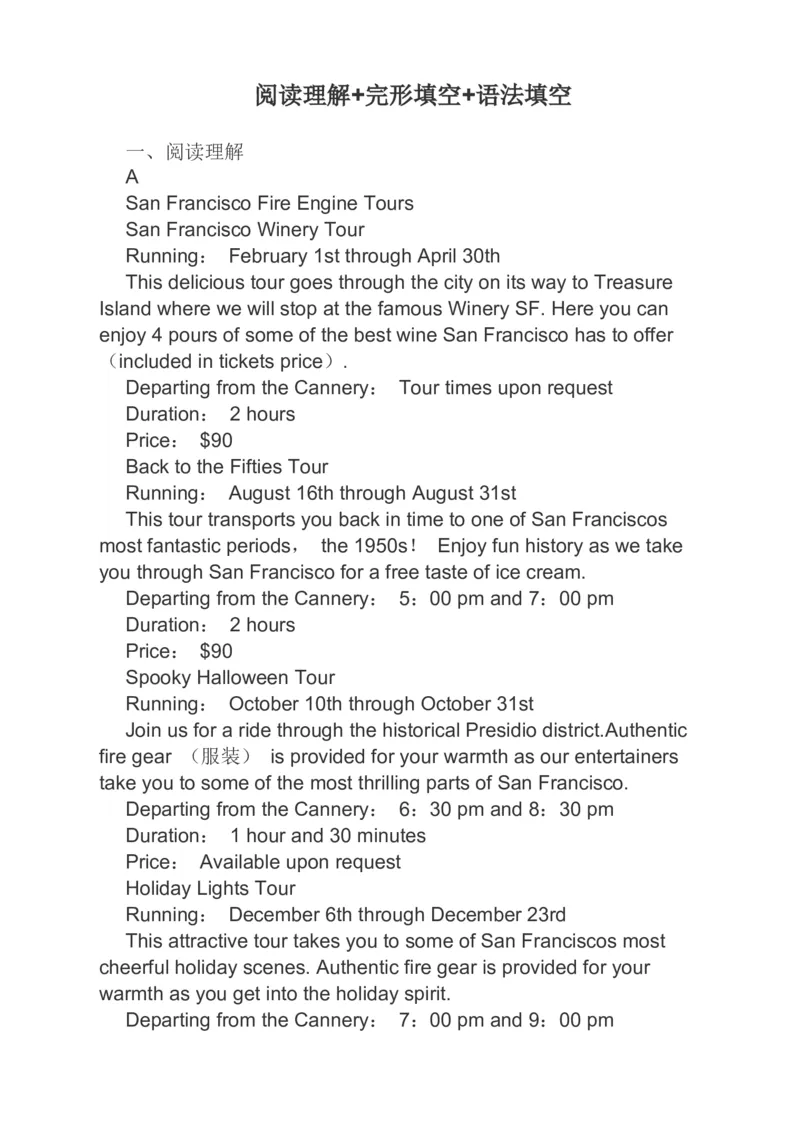
English Classes for Free
Adults of all nationalities (国籍) are welcome to take our English
classes. Our classes meet every day, Monday to Friday from 1 pm to 3
pm. Our classes are free because we are running a teacher training center
and our teachers need students for teaching practice. Classes will cover
grammar, vocabulary, conversations, reading and writing skills.
Classes will begin on July 24th and will end on October 13th. All students
must be 18 and over.
Table Tennis Lessons
If you love to play Ping-Pong and like to improve your game, welcome
to Chicago Table Tennis Club all year around. We are the biggest club in
Chicago with more than 100 members and students at all levels and ages.
We can improve your Ping-Pong skills and within one class you will see the
result. If you or your kids are interested, please feel free to call 317-287-
9852.
Dance Classes Start Soon
Don’t worry if you have no dance experience. 90% of our students don’t.
Our summer dance classes start you off at ground zero and build you up.
The classes are for adults and are full of people in their 20s and 30s
hoping to learn some moves, stay in shape, and meet cool people!
We have been in business for 5 years now, and have taught almost 2,
000 students!
Summer Theater Camp
Our Summer Theater Camp educates young people aged 7—14 in the
theater arts. The camp offers classes in speech, character-building,
dance, reading and so on. Camp hours will be 8 am to 4 pm. The camp
will provide theater experience for only 45 campers. The campers will have
to join in a contest and be chosen for the camp.
1. Why are the English classes free?
A. They hope to attract more people.
B. Their teachers are trained for free.C. They are supported by the government.
D. Their teachers need students for teaching practice.
2. What do people need to do before joining in the Summer Theater
Camp?
A. Win a contest.
B. Pass a speech test.
C. Attend an interview.
D. Have acting experience.
3. What is suitable for a 6-year-old kid to take classes?
A. English Classes for Free.
B. Table Tennis Lessons.
C. Dance Classes Start Soon.
D. Summer Theater Camp.
B
Too many people want others to be their friends, but they don’t give
friendship back. That is why some friendships do not last very long. To
have a friend, you must learn to be one. You must learn to treat your
friend the way you want your friend treat you. Learning to be a good friend
means learning three rules. Be honest; be generous; be understanding.
Honesty is where a good friendship starts. Friends must be able to trust
one another. If you do not tell the truth, people usually find out. If a
friend finds out that you haven’t been honest, you may lose your friends
trust. Good friends always count on one another to speak and act honestly.
Generosity means sharing and sharing makes a friendship grow. You do
not have to give your lunch money on your clothes of course. Instead you
have to learn how to share things you enjoy, like your hobbies and your
interest. Naturally you will want to share your ideas and feelings. These
can be very valuable to a friend. They tell your friend what is important to
you. By sharing them you help your friend know you better.
Sooner or later everyone needs understanding, and help with a
problem. Something may go wrong at school. Talking about the problem
can make it easier to solve. Turning to a friend can be a first step in
solving the problem. So to be a friend you must listen and understand. You
must try to put yourself in your friends place so you can understand the
problem better.No two friendships are ever exactly alike. But all true friendships have
three things in common. If you plan to keep your friends, you must
practice honesty, generosity and understanding.
4. Why don’t some friendships last very long?
A. There is little real friendship in fact.
B. There are some people who are not friendly.
C. Some people don’t treat friendship seriously.
D. Some people want to receive rather than give friendship.
5. According to Paragraph 2, honesty is ____ .
A. the base of friendship
B. as important as friendship
C. something understandable
D. more important than trust
6. What does the underlined word “They” in Paragraph 3 refer to?
A. Generosity and interest. B. Hobbies and friendship.
C. Your ideas and feelings. D. Your clothes and lunch money.
7. What does this text mainly talk about?
A. How to be a friend. B. Honesty and generosity.
C. The best policy to be honest. D. Three important points in life.
C
Whenever were introduced to strangers, we make quick decisions
without careful thought about them according to our first impressions. Are
they attractive? Or how much do they earn?
For most Brits, simply asking someone how much he or she is worth
financially is considered very impolite. Thankfully, most people are kind
enough to drop several hints (暗示) about their relative wealth or
successful careers. They always post on social media about flying to a
meeting for work. They’re always wearing clothes with labels big enough to
silently scream about how rich they are and how well they’re doing.
It’s a worrying trend, and I’m not immune to it. I’ve felt the warm
happiness of knowing I earn more than somebody, and the baseless
anger of knowing that I earn less than another. I’ve checked into places
while I know full well that anybody reading it will get jealous (忌妒的).
It seems as though self-worth is increasingly being tied to the careers
we choose and the money we earn. A study in 2020, for example, found
that nearly 17% of unemployed Americans were depressed compared toalmost 6% of those who had a permanent job. We need to stop placing
so much value on what a person earns. Don’t get me wrong—being
ambitious (有野心的) is not a fault, and achievements should always
be celebrated. But when people use their success to judge you
negatively, it becomes a problem.
If you want to know what you’re really worth, here’s a tip: It doesn’t
have anything to do with your bank account. It’s about how many times
you’ve been there for your friends. It’s about how many times you’ve been
kind to a stranger. Its every time you did something unselfish, or told
your partner you loved him/her, or treated someone with respect no
matter where he or she was in his or her own life.
8. Paragraph 2 mainly tells us most Brits ____ .
A. are polite in some way
B. are wealthy and successful
C. tend to show off their wealth or career
D. love asking others about wealth
9. What does the underlined word “immune” in Paragraph3 probably
mean?
A. Used. B. Unaffected.
C. Addicted. D. Attracted.
10. What does the example of the study in 2020 show?
A. People think self-value isn’t tied to wealth or career.
B. People tend to think wealth and career reflect self-value.
C. People tend to feel depressed because of their unemployment.
D. People get to stop placing so much value on wealth and career.
11. What is the authors purpose in writing the text?
A. To convince us what self-value lies in.
B. To explain why we show off our wealth.
C. To tell us how we deal with our wealth and career.
D. To help us know how to choose careers and earn money.
D
In life, were often torn between the person we want to be and the
person we ought to be. Yet, while many hesitate to take the risks of
becoming their “ideal self”, a new study shows that people regret not
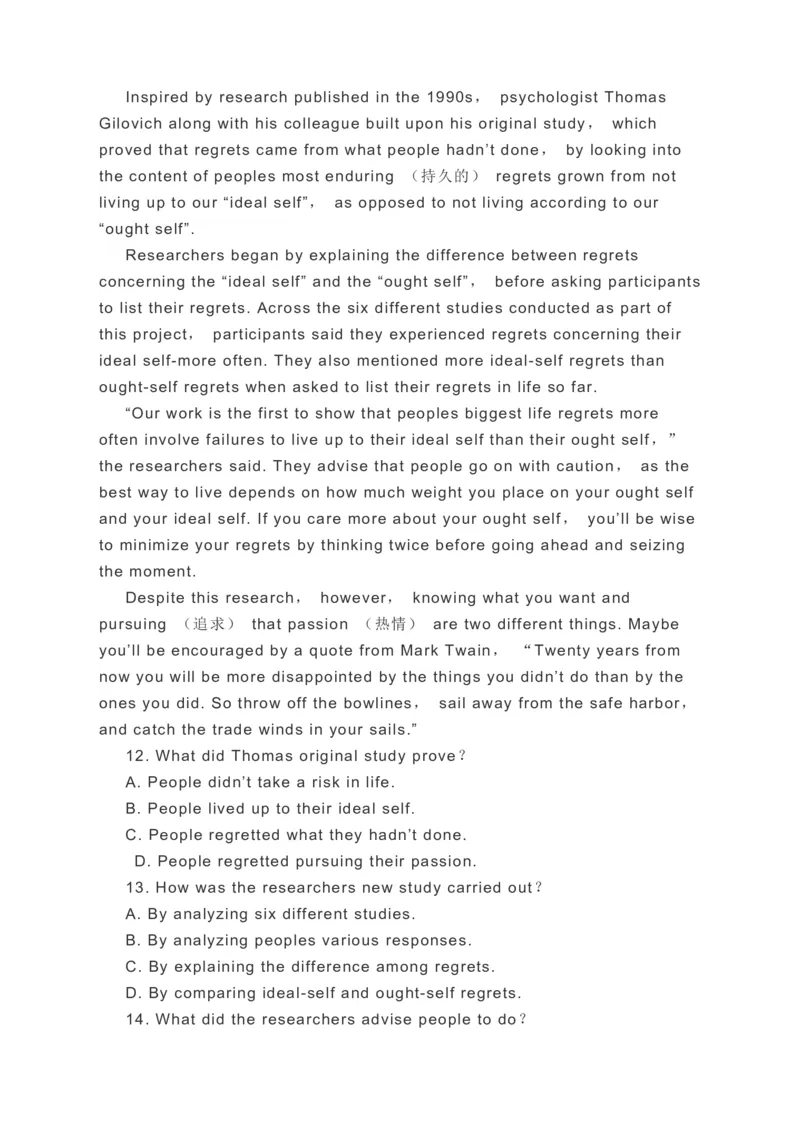
running after their passion.Inspired by research published in the 1990s, psychologist Thomas
Gilovich along with his colleague built upon his original study, which
proved that regrets came from what people hadn’t done, by looking into
the content of peoples most enduring (持久的) regrets grown from not
living up to our “ideal self”, as opposed to not living according to our
“ought self”.
Researchers began by explaining the difference between regrets
concerning the “ideal self” and the “ought self”, before asking participants
to list their regrets. Across the six different studies conducted as part of
this project, participants said they experienced regrets concerning their
ideal self-more often. They also mentioned more ideal-self regrets than
ought-self regrets when asked to list their regrets in life so far.
“Our work is the first to show that peoples biggest life regrets more
often involve failures to live up to their ideal self than their ought self,”
the researchers said. They advise that people go on with caution, as the
best way to live depends on how much weight you place on your ought self
and your ideal self. If you care more about your ought self, you’ll be wise
to minimize your regrets by thinking twice before going ahead and seizing
the moment.
Despite this research, however, knowing what you want and
pursuing (追求) that passion (热情) are two different things. Maybe
you’ll be encouraged by a quote from Mark Twain, “Twenty years from
now you will be more disappointed by the things you didn’t do than by the
ones you did. So throw off the bowlines, sail away from the safe harbor,
and catch the trade winds in your sails.”
12. What did Thomas original study prove?
A. People didn’t take a risk in life.
B. People lived up to their ideal self.
C. People regretted what they hadn’t done.
D. People regretted pursuing their passion.
13. How was the researchers new study carried out?
A. By analyzing six different studies.
B. By analyzing peoples various responses.
C. By explaining the difference among regrets.
D. By comparing ideal-self and ought-self regrets.
14. What did the researchers advise people to do?A. Think twice about their ideal life.
B. Care more about their own life.
C. Live according to their choice.
D. Look back now and then.
15. Mark Twain’s words suggests everyone should ____ .
A. stop themselves from getting disappointed
B. have the courage to pursue their goals
C. make full use of their surroundings
D. live up to their ought self
二、阅读七选五
根据短文内容,从短文后的选项中选出能填入空白处的最佳选项。选项中有两
项为多余选项。
We are all called upon to make a speech at some point in life, but
most of us don’t do a very good job. 1
So, you have to give a speech—and you are terrified. You get
nervous, you forget what you want to say, you stumble (结结巴巴)
over words, you talk too long, and you bore your audience. Later you
think, “Thank goodness, it’s over. I’m just not good at public speaking.
I hope I never have to do that again.”
Cheer up! 2 Here are some simple steps to take the pain
out of speech making. Ask yourself the purpose of your speech. What is
the occasion? Why are you speaking? Then, gather as many facts as
you can on your subject. Spend plenty of your time doing your research.
Then spend plenty of your time organizing your material so that your
speech is clear and easy to follow. Use as many examples as possible,
and use pictures, charts, and graphs if they help you make your points
more clearly. 3 Don’t talk over their heads, and don’t talk
down to them. Treat your audience with respect. They will appreciate your
thoughtfulness.
Just remember: Be prepared. Know your subject, your audience,
and the occasion. Be brief. 4 And be yourself. Let your
personality come through so that you make person-to-person contact with
your audience.
If you follow these simple steps, you will see that you don’t have to be
afraid of public speaking. In fact, you may find the experience soenjoyable that you volunteer to make more speeches! You’re not
convinced yet? 5
A. Never forget your audience.
B. It doesn’t have to be that bad.
C. Give it a try and see what happens.
D. Don’t say what you aren’t familiar with.
E. Say what you have to say and then stop.
F. Take several deep breaths before your speech.
G. This article gives some advice on how to give a good speech.
1. 2. 3. 4. 5.
三、完形填空
I landed at the Toronto airport a day late. To my 1 , the rental car
service I found on the Internet was 2 ! With the help of other travelers
and airport workers who clearly 3 the “lost puppy” look on my face, I
found the area with several rental car companies. I started at the end of
the 4 and walked my way down as each employee said “sorry, we are
5 ”. All I could do was to fight back the 6 . The lovely young woman at
the last counter,7 , really took pity on me and went around to the back
office and 8 with a set of car keys and a smile!
Things got tricky on the way. The GPS on my phone would not 9 ,
and there was no highway lighting and no overhead 10 for miles and
miles. Finally, I found an exit and saw the first signs of 11 —a
neighborhood! Just about a mile down the road, I found 12 —
McDonalds! Not my usual dining option (选择), but at the time I
would have eaten 13 ! So, it’s about 8:30 pm and I should have
happily arrived at my final destination by now. I walk in to get food and
more directions; and it’s full of teenagers.
Ironically (讽刺地是), I am a Life Coach for Teenagers, but wasn’t
“feeling the love” at this moment. My hopes for anyone taking sympathy
(同情) on me was 14 fast, until I saw Mary. She was standing next to
me waiting for her 15 . I asked for help. “Don’t worry. Ill drive you to the
16 that will take you to your destination. Just follow me!” she said. I
felt 17 in my heart because she drove 18 her way for many miles to
help me find my way.I will never forget her 19 and determination to make sure I was going
to be OK. My forever McDonalds 20 , Mary.
1. A. pleasure B. excitement C. surprise D. sorrow
2. A. extended B. closed C. improved D. guaranteed
3. A. exchanged B. liked C. shared D. recognized
4. A. row B. room C. office D. airport
5. A. given out B. sent out C. sold out D. left out
6. A. tears B. fear C. trouble D. campaign
7. A. therefore B. however C. thus D. besides
8. A. recalled B. interrupted C. replaced D. returned
9. A. focus B. stop C. work D. fail
10. A. signs B. lights C. wires D. clouds
11. A. friendship B. life C. home D. nature
12. A. direction B. area C. hope D. experience
13. A. some B. that C. nothing D. anything
14. A. lacking B. rising C. growing D. fading
15. A. table B. order C. turn D. offer
16. A. highway B. subway C. station D. company
17. A. comfort B. pain C. warmth D. cold
18. A. beyond B. via C. off D. on
19. A. motivation B. kindness
C. patience D. importance
20. A. restaurant B. food C. figure D. angel
四、语法填空
Talking is the most effective and satisfying way of communicating with
others. There are many forms of communication, 1 include texting,
cell phones, emails, and social media. 2 (use) these alternative
forms to communicate with others may be faster, 3 they lack many
qualities that a face-to-face conversation 4 (own).
Facial expression and body language can 5 (great) affect a
conversation. They can be used to give a person some information about
what the other person is thinking and 6 (feel). Facial expression can
7 (apply) to video chatting, but body language can only be found in a
face-to-face conversation. Talking in person can have physical 8
(feature), for example, give someone a hug and hold their hand 9(comfort) them. When you are talking to someone by texting or
messaging them, physical touch does not exist at all, and it can limit
the connection 10 the people in the communication.
1. 2. 3. 4 . 5.
6. 7. 8. 9. 10.
答案
阅读理解
1—5 DABDA 6—10 CACBB
11—15 ACDCB
阅读七选五
1—5 GBAEC
完形填空
1—5 CBDAC 6—10 ABDCA
11—15 BCDDB 16—20 ACCBD
语法填空
1. which 2. Using 3. but 4. owns 5. greatly 6. feeling
7. be applied 8. features 9. to comfort 10. between