2023-2024 学年八年级上期末考点大串讲(人教版)
专题 02 核心考点归纳
Unit1 Where did you go on vacation?
考点聚焦
1. go on
vacation
考点一:go on vacation为“去度假”, on vacation相当于on/for holiday。
考点二:“on+名词”可以表示“在某种状态中”
如on duty“值日”,on business“出差”,on sale“出售”,go on a picnic “去野餐”, go on a trip“去旅
行”
2. quite a
few
quite a few 相当多;不少
考点一:quite a few多用于口语中,相当于many,其后谓语动词用复数。
例:Quite a few students go to school by bike.相当多的学生骑自行车上学。
考点二:quite作副词,表示“颇;相当”,可以修饰动词、形容词或副词。当它同形容词连用修饰可数名
词单数时,quite一般置于冠词a或an之前。
例:I saw a film Home Coming yesterday and it’s quite an educational one.
昨天我看了一个叫万里归途的电影,很有教育意义。
I quite like reading.我很喜欢阅读。
3. most of
time
考点一:most of the time意为“大部分时间”, 其中most为代词,意为“大多数;几乎所有”。
例:It’s noisy here most of the time.这儿大部分时间都很喧闹。
考点二:most of... 意为“……中的大多数”,它作主语时,谓语动词的单复数形式取决于most of后的名
词或者代词。
例:Most of us are going to the park.我们大多数人要去公园。
Most of the food goes bad.大部分的食物都变质了。
考点三:most用作形容词,意为“大多数的;大部分的”。
例:Most children like playing football very much.大部分的孩子非常喜欢踢足球。
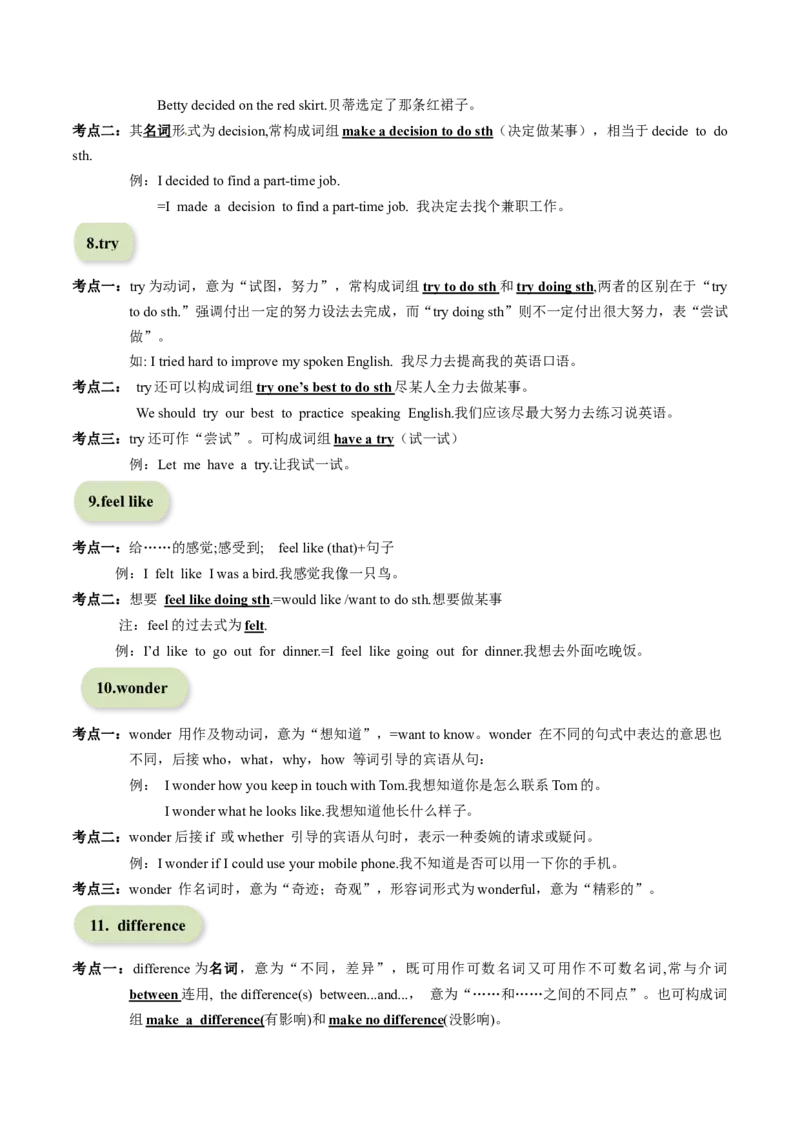
4. How do you like
it?How did you like it? 你觉得它怎么样?
常用来询问对方对某人或某事物的看法
5.seem
seem /siːm/ v.似乎;好像
考点一:seem意为“好像;似乎;看来”,作系动词, 后 常 接形容词 作表语。
例:Everything seems so easy. 一切看起来很简单。
考点二:可构成词组 seem to do st h .,其后接形容词时,可构成 seem to be+adj .
例:He seems to cry.他似乎要哭了。
He seems to be friendly. 他似乎很友好。
考点三:可构成句型“ It seems that+ 从句 ”
例: He seems happy.
=He seems to be happy.
=It seems that he is happy.科他似乎很开心。
6. There was nothing much to do in the evening but read.
考点一:but 作介词的用法“除......之外”。but前的谓语动词是do,并且翻译为“做”,接省略to的不定式。
如果but 接动词不定式,当前面有do或cannot时,不定式不带to
例: What can you do but take back what you said? 除了收回你所说的话你还能做什么?
考点二:当前面有anything,everything,nothing 等时,不定式不带to,但也有例外
eg:I have nothing to do but watch TV.除了看电视我没事可做。
考点三:其余情况都带to 例:He had no choice but to wait.他除了等待别无选择。
7.decide
考点一:decide为动词,意为“决定”,常构成词组 decide (not) to do sth (决定做/不做某事)和decide on
sth ( 选定;决定),其后还可以跟从句
例:He decided not to tell his mother the truth.他决定不告诉他的妈妈实话。
He decided that he would start out at 6:00 that morning. 那天早上他决定六点出发。Betty decided on the red skirt.贝蒂选定了那条红裙子。
考点二:其名词形式为decision,常构成词组make a decision to do sth(决定做某事),相当于decide to do
sth.
例:I decided to find a part-time job.
=I made a decision to find a part-time job. 我决定去找个兼职工作。
8.try
考点一:try为动词,意为“试图,努力”,常构成词组try to do sth 和try doing sth,两者的区别在于“try
to do sth.”强调付出一定的努力设法去完成,而“try doing sth”则不一定付出很大努力,表“尝试
做”。
如: I tried hard to improve my spoken English. 我尽力去提高我的英语口语。
考点二: try还可以构成词组try one’s best to do sth 尽某人全力去做某事。
We should try our best to practice speaking English.我们应该尽最大努力去练习说英语。
考点三:try还可作“尝试”。可构成词组have a try(试一试)
例:Let me have a try.让我试一试。
9.feel like
考点一:给……的感觉;感受到; feel like (that)+句子
例:I felt like I was a bird.我感觉我像一只鸟。
考点二:想要 feel like doing sth.=would like /want to do sth.想要做某事
注:feel的过去式为felt.
例:I’d like to go out for dinner.=I feel like going out for dinner.我想去外面吃晚饭。
10.wonder
考点一:wonder 用作及物动词,意为“想知道”,=want to know。wonder 在不同的句式中表达的意思也
不同,后接who,what,why,how 等词引导的宾语从句:
例: I wonder how you keep in touch with Tom.我想知道你是怎么联系Tom的。
I wonder what he looks like.我想知道他长什么样子。
考点二:wonder后接if 或whether 引导的宾语从句时,表示一种委婉的请求或疑问。
例:I wonder if I could use your mobile phone.我不知道是否可以用一下你的手机。
考点三:wonder 作名词时,意为“奇迹;奇观”,形容词形式为wonderful,意为“精彩的”。
11. difference
考点一:difference为名词,意为“不同,差异”,既可用作可数名词又可用作不可数名词,常与介词
between 连用, the difference(s) between...and..., 意为“……和……之间的不同点”。也可构成词
组 make a difference( 有影响)和make no difference(没影响)。例:There is no difference between you and them. 你和他们之间没有区别。
There are some differences between Tom and Bob. Tom和Bob之间有些差异。
考点二:其形容词形式为different,常构成词组 be different from ( 和……不同),反义短语是be the same
as(和……相同)。
例:My ideas are different from his. 我的想法和他的不同。
12.wait
考点一:wait为不及物动词,意为“等待”,后面接宾语时常用介词for 连接。
常用搭配:wait for sb./sth.to do sth. 等某人/ 物做某事。
例:They are waiting for a bus. 他们正在等公共汽车。
We are waiting for Jim to come. 我们正等着吉姆的到来。
考点二:can’t wait to do sth. 意为“迫不及待做.......”
wait in line 排队等候 wait a moment 等一会儿
例:I can’t wait to see you. 我迫不及待想见你。
13.too many/too much/much too
▲too many+可数名词复数
如:There are too many people on the street. 街上有太多人。
▲too much +不可数名词 意为“太多”
如:There is too much water in the cup. 杯子里有太多水。
▲much too +形容词 “太……”
如:The dress is much too long for me.这条裙子对我来说太长了。
14.because
考点一:because/because辨析
because of后接名词或名词性短语;
because因为,后接句子,引导原因状语从句 , so表“所以”引导结果状语从句,两者不能同时出现在
同一句中,但是两者可互换。
eg: We didn’t get there in time because of the heavy rain.
= We didn’t get there in time because it rained heavily.由于下大雨我们没有及时到那里。
15.bored
考点:-ed形容词和-ing形容词辨析
bored是感觉无聊,boring是令人感觉无聊;bored主语是人,boring主语一般是物。
例:We felt bored when we saw the boring movie.当我们看这个无聊的电影的时候感到很无聊。【拓展】
类似单词辨析:exciting—excited, interested—interesting, relaxed—relaxing, surprised—surprising等。
16.enough
考点一:enough既可作形容词,也可作副词,意为“足够的(地)”,修饰名词时一般放在名词前,修饰形
容词或副词时只能放其后。(enough一般放在名词前或形容词后)
如: I have enough money. 我有足够的钱。
It’s warm enough in the room. 房间里面足够温暖
考点二:(be) adj.+enough(+n.)+to do sth 足够……做某事
例:The young man didn’t have enough money to buy a new car. 这个年轻人没有足够的钱买一辆新
车。
He is old enough to go to school.他足够大可以去上学了。
Unit2 How often do you exercise?
考点聚焦
1.help
考点一:help (sb.) with sth.帮助(某人)做某事,with 后接名词、动名词
同义结构help sb. (to) do sth.
考点二:
其他与help相关短语
with the help of sb./with one’s help 在某人的帮助下
without one’s help 没有……的帮助的话
help oneself to 随便吃/喝
help ...out 帮助(某人) 解决困难/摆脱困境
can’t help doing 忍不住/禁不住做......
2.exercise
考点一:作可数名词时,其复数是exercises,意为“体操;练习”。
do morning exercises做早操 do eye exercises 做眼保健操
do math exercises 做数学练习
考点二:作不可数名词时,意为“运动,锻炼”。
例:I have to do lots of/a lot of exercise to keep healthy.我必须做大量锻炼来保持健康。
考点三:作动词,意为“练习、运动”。
例:How often do you exercise? 你多久锻炼一次?3.hard/hardly
考点一:hard作形容词,意为“困难的,艰苦的,硬的”;作副词,意为“努力地,猛烈地”。
例:The ground is too hard to dig.地太硬了挖不动。
考点二:hardly副词,意为“几乎不;几乎没有”,本身含有否定意义,不能与其他表示否定的词连用。
I can hardly understand what he said. 我几乎听不懂他说的话。
It’s raining hard, the people can hardly go outside. 雨下得很大,人们几乎不能出门,
4.once
考点一:once /wʌns / adv.一次;曾经
例: —How often do you go shopping?你多长时间去购物一次?
—Once a week. 一周一次。
【拓展】
次数的表达
表达次数很容易,once,twice单独记,
三次以上有规律,基数词加times就可以。
考点二:once也可意为“曾经”。
例:He once lived in America.他曾在美国生活过。
考点三:与once相关的搭配
at once 立即,马上 once again 再一次 once or twice一两次、有时、偶尔
5.every day/everyday
※every day 副词短语,意为“每天,常作时间状语”,相当于“each day”。
例:He reads books every day. 他每天都看书。
※everyday 形容词,意为“日常的”,相当于“daily”。
例:The Internet has become part of our everyday life.
6.how
often
How often do you watch TV?你多久看 一次电视?
how often 多久一次,用于对动作发生的频率进行提问。回答应该是频度副词或表示频率的词组,如
always,usually,often,sometimes,never,hardly ever ,every day,once a week,three times a day等
【拓展】
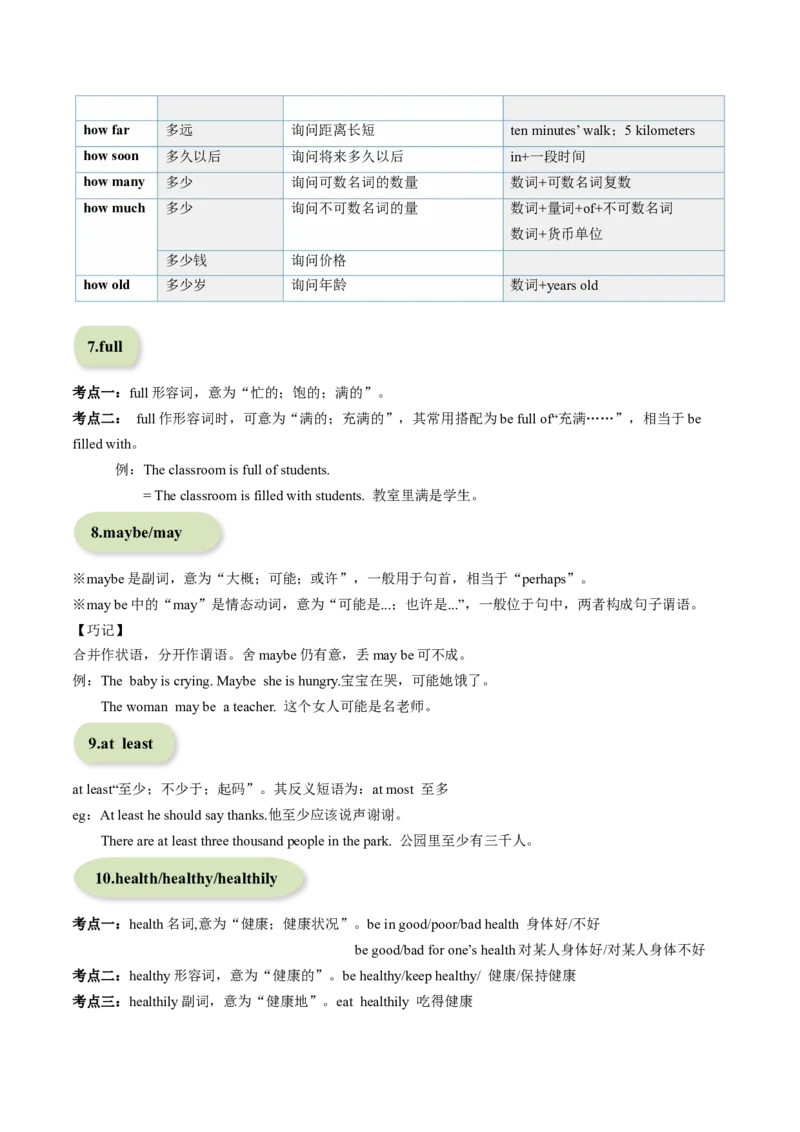
与how相关词组辨析
词组 词义 用法 常用答语特征
how long 多长时间;多久 询问多长时间,对时间段提问 for/about+一段时间
how often 多久一次 询问频率 often;once a week等how far 多远 询问距离长短 ten minutes’ walk;5 kilometers
how soon 多久以后 询问将来多久以后 in+一段时间
how many 多少 询问可数名词的数量 数词+可数名词复数
how much 多少 询问不可数名词的量 数词+量词+of+不可数名词
数词+货币单位
多少钱 询问价格
how old 多少岁 询问年龄 数词+years old
7.full
考点一:full形容词,意为“忙的;饱的;满的”。
考点二: full作形容词时,可意为“满的;充满的”,其常用搭配为be full of“充满……”,相当于be
filled with。
例:The classroom is full of students.
= The classroom is filled with students. 教室里满是学生。
8.maybe/may
be
※maybe是副词,意为“大概;可能;或许”,一般用于句首,相当于“perhaps”。
※may be中的“may”是情态动词,意为“可能是...;也许是...”,一般位于句中,两者构成句子谓语。
【巧记】
合并作状语,分开作谓语。舍maybe仍有意,丢may be可不成。
例:The baby is crying. Maybe she is hungry.宝宝在哭,可能她饿了。
The woman may be a teacher. 这个女人可能是名老师。
9.at least
at least“至少;不少于;起码”。其反义短语为:at most 至多
eg:At least he should say thanks.他至少应该说声谢谢。
There are at least three thousand people in the park. 公园里至少有三千人。
10.health/healthy/healthily
考点一:health名词,意为“健康;健康状况”。be in good/poor/bad health 身体好/不好
be good/bad for one’s health对某人身体好/对某人身体不好
考点二:healthy形容词,意为“健康的”。be healthy/keep healthy/ 健康/保持健康
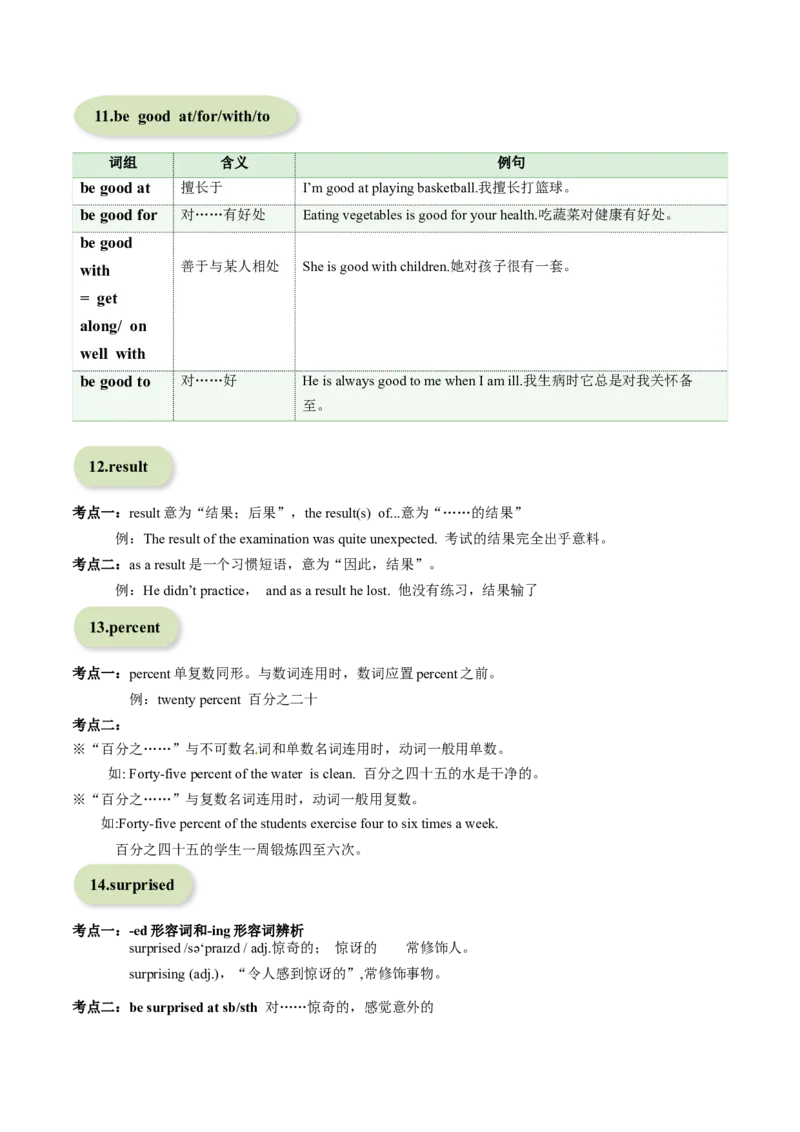
考点三:healthily副词,意为“健康地”。eat healthily 吃得健康11.be good at/for/with/to
词组 含义 例句
be good at 擅长于 I’m good at playing basketball.我擅长打篮球。
be good for 对……有好处 Eating vegetables is good for your health.吃蔬菜对健康有好处。
be good
with 善于与某人相处 She is good with children.她对孩子很有一套。
= get
along/ on
well with
be good to 对……好 He is always good to me when I am ill.我生病时它总是对我关怀备
至。
12.result
考点一:result意为“结果;后果”,the result(s) of...意为“……的结果”
例:The result of the examination was quite unexpected. 考试的结果完全出乎意料。
考点二:as a result是一个习惯短语,意为“因此,结果”。
例:He didn’t practice, and as a result he lost. 他没有练习,结果输了
13.percent
考点一:percent单复数同形。与数词连用时,数词应置percent之前。
例:twenty percent 百分之二十
考点二:
※“百分之……”与不可数名词和单数名词连用时,动词一般用单数。
如: Forty-five percent of the water is clean. 百分之四十五的水是干净的。
※“百分之……”与复数名词连用时,动词一般用复数。
如:Forty-five percent of the students exercise four to six times a week.
百分之四十五的学生一周锻炼四至六次。
14.surprised
考点一:-ed形容词和-ing形容词辨析
surprised /sə‘praɪzd / adj.惊奇的; 惊讶的 常修饰人。
surprising (adj.),“令人感到惊讶的”,常修饰事物。
考点二:be surprised at sb/sth 对……惊奇的,感觉意外的例:I was surprised at how quickly she agreed.我对于她这么快就同意感到非常惊讶。
be surprised to do sth. 惊讶地做某事(常跟see/find/hear等词)
例:He is surprised to find that she has left. 他惊讶的发现她被剩下了。
考点三:surprise作名词,意为“令人惊奇的事,感觉意外的事”, 常构成短语“to one’s surprise”意思是
“令人惊讶的是……”;in surprise “惊讶地”,常位于动词之后作状语,表示方式。
例:He looked at me in surprise. 他惊讶地看着我。
To our surprise,the boy won the first place. 让我们感到惊讶的是,这个男孩赢得了第一
名。
考点四:surprise动词,“使惊讶”
例:It surprises me how rich he is. 他有多富有这件事让我很震惊。
15.although
考点一:although为连词,意为“虽然;尽管”,引导让步状语从句,可以和though互换使用。
考点二:汉语中常说“虽然……但是……”,但在英语中如果用了“although”,则不能再用“but”,但
可以用副词yet或still。
例:Although he was tired, he didn’t stop to have a rest.
=He was tired,but he didn’t stop to have a rest. 尽管他累了,但他没有停下来去休息。
16.through
考点一:through介词,意为“以;凭借”。 through hard work 凭借努力
考点二:through作介词时,还可意为“(从内部)穿过”。注意区别cross /across/ through。
17.mind
考点一:mind名词,意为“头脑;心智”。
keep...in mind牢记 change one’s mind 改变主意 make up one’s mind 下决心
考点二:mind还可作动词,意为“介意;反对”,后跟动词时,要用V-ing形式。
常用句“Would you mind (人称代词宾格/one's)doing sth.?”意为“你介意(某人)做某事
吗?”。
例:Would you mind (me/my) opening the door? 你介意(我)打开门吗?
例:Would you mind lending me your pen? 你介意把你的笔借给我一下吗?
18.together
考点一:together为副词,意为“一起;共同”。
考点二:当主语后面接说明主语的修饰语with,along with, together with 等时,谓语动词应与主语保持数的
一致。
The boy together with his friends is playing in the yard.这个男孩和他的朋友们正在院子里玩耍。19.however
考点一:表“不过,然而”,有转折的含义,相当于but.
如:Although/Though he is young, he knows a lot. However,she has some bad habits,too.
虽然他很小,但他知道很多。然而,他也有一些坏习惯。
考点二:连接副词,“无论如何,不管怎样”,相当于no matter how,通常与一个形容词或副词
搭配使用,后面接从句。
如:I never win,however hard I try.我无论怎么努力也赢不了。
20.例如
①for example一般只举同类人或物中的“一个”为例,作插入语,用逗号隔开,可置于句首、句中、句末,
后面可接句子。
②such as常列举同类人或物中的几个例子,不能穷尽,可和and so on连用;
③like表示列举,常可和such as互换。
例:
Noise,for example,is a kind of pollution.比如,噪音就是一种污染。
China has many big cities,such as Beijing,Shanghai,Shenzhen and so on.
中国有很多大城市,比如北京、上海、深圳等等。
Some warm-blooded animals,like the cat,the dog or the wolf do not need to hibernate.
一些热血动物,比如猫、狗或者狼不需要冬眠。
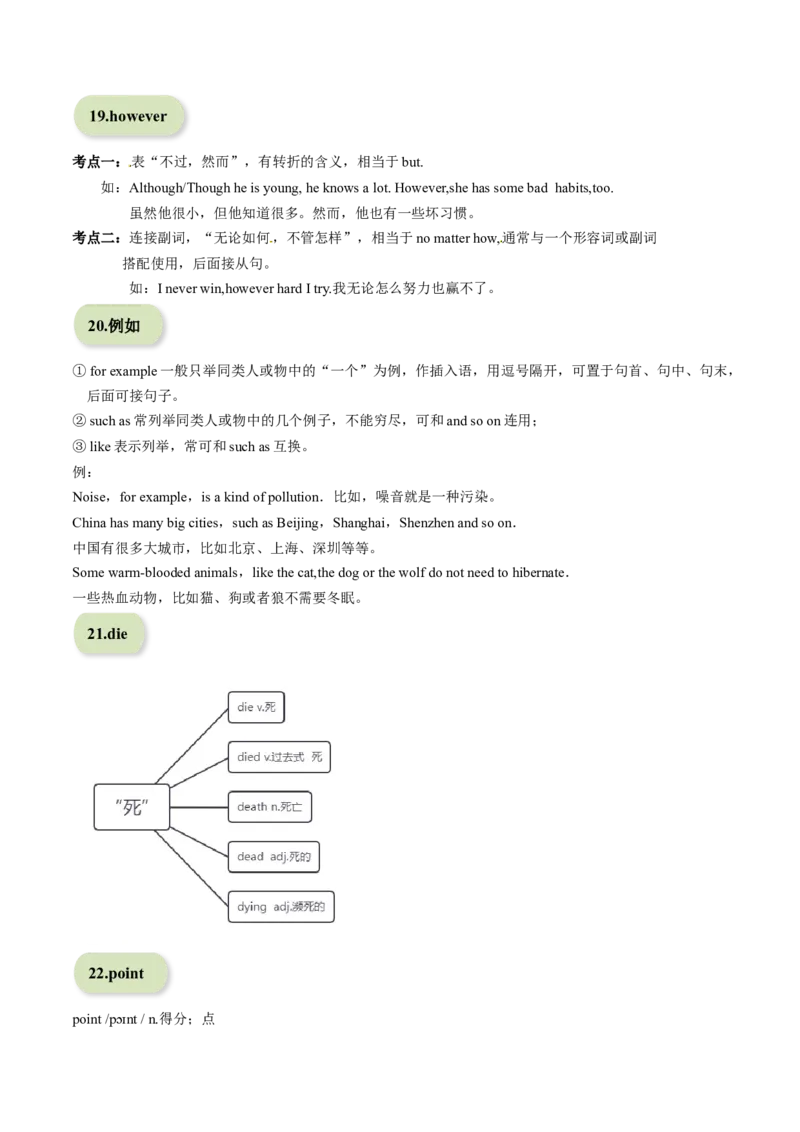
21.die
22.point
point /pɔɪnt / n.得分;点考点一:point可作名词,意为“得分”,也可意为“点;要点;意思”。可构成短语:have a point(有道
理)
例:I can’t see your point. 我不明白你的意思。
考点二:point可作动词“指着”讲,point to(指远处)/point at(指近处)sb./sth. 指着某人/某物。
Unit3 I’m more outgoing than my sister.
考点聚焦
1.both
考点一:both 表示“两者都”,它的位置→ 实 前助后 / 实 前 b e 后 (实义动词前或助动词/be动词后)
如:We both like sports.我们两个都喜欢运动。
They are both tall. 他们两个都很高。
考点二:both 表示“两者都”, 可作形容词或代词;
【用法】
both+名词复数
both of the+ 名词复数 /代词
both...and.... 两者都……
例:They both are students.= Both of them are students. 他们两个都是学生。
The girls both like English.=Both (of the) girls like English. 这两个女孩都喜欢英语。
【拓展】
①neither 表示“两者都不”。neither of 表示“两者都/都不”。neither... nor...既不……也不……
例:Neither of them is a doctor. 他们两个都不是医生。
②all 全都,none全都不,用于三者或三者以上。 either两个中任一个。
either... or...“或者……或者……” ,
not only...but also...“不仅……而且……”,连接两个并列主语时,谓语动词的单复数遵循“就近
原则”。
2.loudly
※loudly adv.大声地;响亮地,强调“喧闹”
※loud adj.&adv. 大声的/地
※aloud adv.强调发出声音使人听见
例:Don’t speak and laugh loudly in public.不要在公共场合大声说笑。
He should not speak so loud.他不该如此大声说话。
Please read aloud so that I can hear you. 请大声朗读,好让我能听到。
loud的比较级是louder,loudly的比较级是more loudly。3.friendly
friendly(adj.)友好的,作定语或表语。
be friendly to sb.对某人友好(指态度),同义词组be nice to 和be kind to
4.competition
※competition,可指体育方面的“比赛”,也可以指书法、朗读、音乐等方面的“竞赛”,动词:
compete。
※race往往与赛跑联系在一起,本意是“在速度方面的竞赛”
※match指体育运动中的竞技比赛,凡是球类方面的比赛均可用match表示
5.tell
tell除表示“告诉”外,还可表“看出,知道,判断”,表示此意时常与情态动词 can, could和be able to
连用。其后若接介词from,表示“辨别;区别;认出”。
eg:Can you tell Tom from his twin brother?
你能分得出汤姆和他的孪生弟弟吗?
6.win
※win v.赢得,后接比赛、奖品、金钱等名词,对应名词winner,意为“获胜者,赢家”
※beat v.打败,后接打败的对象,如某人或某个球队等
例:He beat Mary and won the first place. 他打败了玛丽,得了第一名。
7.be talented
in
※talented /'tæləntɪd/ adj. 有才能的;有才干的,同义词是gifted (adj. )有天赋的
考点一: be talented in 在……方面有天赋,后接名词或动名词,。
例:Mozart was talented in music. 莫扎特有音乐天赋。
考点二:talented 的名词是talent天赋;天才,人才;
have a talent for = have a gift for 有……天赋
talent show 才艺表演
例:The woman has a talent/gift for cooking. 这个女人有烹饪的天赋。
He is a great talent.他是个了不起的人才
8.care
care /keə/ v. 在意;担忧【拓展】
careful adj.小心的 carefully adv.小心地 careless adj.粗心的 carelessly adv.粗心地
9.make
make v. 制造;使;让
考点一:make sb./ sth.+adj. 让某人/某物怎么样
例:The news makes everyone happy. 这个消息让每个人都很高兴。
考点二:make sb. do sth. 让某人做某事。
例:His mother made him finish the work alone. 他的妈妈让他独自完成工作。
考点三 make sb./ sth.+n. 使某人/某物成为
例:We made him our monitor.我们选了他当班长。
10.serious
serious /'sɪərɪəs/adj.严肃的;稳重的
考点一:serious用来指人的表情严肃或事情严重,常用短语:be serious about对……认真
例:The mistake is not very serious.这错误不太严重。
You should be serious about your job.你应该认真对待你的工作。
考点二:seriously用作副词,意为“严肃地;认真地;严重地”,take ...seriously 认真对待……
例:Li Xing’s illness(病) is very serious. You must take his illness seriously.
李星的病很严重。你必须认真对待他的病。
11.as long as
考点一:as long as 只要,表示条件,引导条件状语从句,遵循“主将从现”原则。
例:As long as you tell the truth,I’ll try to help you. 只要你说实话,我将尽力帮你。
考点二:表示时间,意思是“达……之久”。
例:You can keep the book as long as you like. 这本书你要借多久都随你的便。
考点三:同级比较:as long as 还可以表示“像……一样长”。例:My arms are as long as yours.
【拓展】
as soon as 一……就……
12.same
考点一:the same as 和……一样
【注意】
same前面一般都要用定冠词the
例:I have the same pen as yours.=My pen is the same as yours.我的笔和你的一样。
We are in the same school.我们在同一所学校。
They look the same. 他们看起来一样。
考点二:The same to you!表示“你也一样!”,是回复对方祝福的常用语。
例:—Happy New Year!新年快乐!
—The same to you!你也一样
13.reach/arrive/get to
reach /riːtʃ/v.伸手;到达;抵达
※reach + 地点
※get to + 地点
※arrive in + 大地点
※arrive at + 小地点
【注意】
①若是用副词表达地点,get to和arrive in/at后面的介词均省去。
②其后不接地点时,只能用arrive表示“到达”。
例:I will call you when he arrives. 当他到达的时候我就给你打电话。
14.share
share / ʃeə / v. 分享;共享;共用;分摊
share...with sb. 与某人分享……
例:My best friend shares her happiness and sadness with me. 我最好的朋友与我分享她的快乐与悲伤。
【拓展】
share n.一份;份额;股份
例:He did his share of the work.他干了他的那份工作。
15.be similar
to
similar /'sɪmələ(r)/ adj.相似的; 类似的考点一:be similar to 与……类似的、相像的
例:Jack is similar to his father in many ways.杰克在很多方面与他爸爸相似。
考点一:be similar in sth.意为“在某方面相似/相仿”。
例:Ice fishing is similar in many ways to regular fishing. 冰下捕鱼在许多方面与常规钓鱼是相似
的。
16.Who (do you think ) should get the job, Jenny or
Jill?
考点一:选择疑问句
Who (do you think ) should get the job, Jenny or Jill?你认为谁应该得到这份工作,Jenny还是Jill?
本句是由“特殊疑问句+选项”构成的选择疑问句,“do you think”作插入语。
另一种特殊疑问句结构为:一般疑问句+选项。
例:Which bike do you think is Tom’s, the new one or the old one?
你认为哪辆自行车是汤姆的,新的还是旧的那辆?
Is he a tall or short? 他是高还是矮?
【注意】
回答选择疑问句时,不能用yes/no,应选择具体的选项。
例:—Is he a teacher or student? 他是名老师还是学生?
—A teacher/student.一名老师/一名学生。
考点二:do you think 作为插入语,与句子其他成分无语法关系。作插入语分两种情况:
(1)疑问句在句中作主语,若去掉do you think ,句子仍然完整且语序不变,do you think 之后即为句子的
谓语。
例:Who do you think cleaned the classroom yesterday? 你认为昨天谁打扫了教室?
(2)疑问词不作主语,do you think 后接句子的主语,然后用陈述语序。
例:What do you think the weather will be like tomorrow?
Unit4 What’s the best movie theater?
考点聚焦
1.close
考点一:close adj.近的,亲密的; 常用短语be close to离……近。
如:The cinema is the close to my home. 电影院离我家很近。
I have a close friend. 我有一个密友。
考点二:close v.关闭 反义词:open v.打开
closed adj. 关闭的 open adj. 开着的
如:Please close/open the door. 请关上/打开门。The door is closed/open. 门是关着的/开着的。
2.choose
choose /tʃuːz/ v.选择,挑
考点一:与choose相关动词短语
※choose...from 从……中选择
※choose sb. to do sth. 挑选某人去做某事
※choose...as 选……当
※choose (not) to do sth. 决定(不)做某事
例:You can choose the better ones from those gifts.你可以从这些礼物中选出最好的。
He chose an iPhone Ⅹ as his birthday present.他选择一部 iPhone Ⅹ作为他的生日礼物。
I choose not to go there. 我选择不去那里。
考点二:choose 的名词是choice“选择”,make a choice 做一个选择。
例:She insisted on her choice and chose to stay at home. 她坚持待在家。
3.thanks
考点一: thanks(n):感谢 如:many thanks = Thank you very much.
thanks for (doing) sth. = thank sb. for (doing) sth. 感谢某人做某事
如:Thanks for telling me. 谢谢你告诉我。
考点二:回答感谢:You are welcome./Not at all. /That’s all right/ It’s my pleasure./No problem.等
考点三:thanks to多亏,由于。
4.common
考点一:adj.共同的,普通的 the common people老百姓
考点二:have...in common “在某方面有共同点”,可为兴趣或观念上的相同
如无共同点,可用短语have nothing in common
如:We have many things in common. 我们有很多共同之处。
【拓展】
commonly adv. 普遍地,通常
It is commonly believed... 普遍认为……
5.kind
考点一:kind adj.善良的;慈祥的;友好的。常用搭配:be kind to=be friendly to 对……友好。
如: She is kind to us. 他对我们很友好。
考点二:kind n.种类 a kind of一种 all kinds of 各种各样的 different kinds of 不同种类的如: It is a kind of animal with long ears. 它是一种有着长长的耳朵的动物。
There are all kinds of animals in the zoo. 在动物园里有各种各样的动物。
考点三:kind of =a little 有点
It’s kind of cute. 它有点可爱。
6.be up
to
考点一:be up to sb. ( to decide.) 由某人决定 常用结构为:It’s up to sb. to do sth. “应由某人做某事”。
例:It’s up to me to choose the clothes. 应由我来选择衣服。
That’s up to you to decide. 那由你决定。
考点二:up to 达到(某数量、程度等) up to now到目前为止
7.role
role“角色”,常考点:
①play a role in doing... 在……扮演角色/起作用
例:Everyone plays an important role in the family.每个人都在家庭中扮演重要角色。
When people watch the show, they usually play a role in deciding the winner.
人们在看表演时,他们通常在决定胜者中发挥作用。
②play the role of ... 扮演……角色
例:He plays the role of a reporter in the play. 他在剧中扮演一名记者的角色。
8.poor
考点一:贫穷的;可怜的
例: She is such a poor girl that she can’t buy a toy. 她如此的穷,以至于她买不起一个玩具。
考点二:糟糕的;质量差的
例: I’m poor in English. 我英语很差。
He is in poor health. 他身体不好。
9.make up
make up 编造(故事、谎言等) ;be made up为被动语态,意为“被编造”。
例:I often make up stories to tell my younger sister. 我经常编故事给我妹妹听。
【拓展】
(1)make sb./oneself up意为“给某人/自己化妆 ”
例:She makes herself up every morning. 她每天早上都给自己化妆。
(2)make up one’s mind to do sth. 决定做某事
例:He made up his mind to ride a bike instead of driving to work. 他决定骑车去上班而不是开车去。
(3) be made up of 由......组成/构成例:The medical team is made up of ten doctors. 这只医疗队由十名医生组成。
10.come
true/achieve
※come true“实现,成为现实”主语为梦想、愿望或理想。
※achieve“实现”,指实现成绩、目标,主语是人。
11.crowded
考点一:crowd v. 拥挤;n.人群 a crowd of... 一群……
如:I can always see you among the crowd at my first glance.
我总是第一眼就能在人群中看到你。
A crowd of people are waiting in the room. 房间里有一群人等着。
考点二:crowded adj. 拥挤的 be crowded with挤满了……
The bus was crowded with passengers. 公交车上挤满了人。
Unit5 Do you want to watch a game show?
考点聚焦
1.think
考点一:
think of含义:
①认为;以为:如: What do you think of soap operas? 你认为肥皂剧怎么样?
②想起;记得:如: I can’t think of his name now. 我现在想不起他的名字。
③考虑;关心:如: Lei Feng always thought of other people first. 雷锋总是首先考虑别人。
【注意】
think of 当“考虑, 对……有某种看法” 讲时可以和think about互换。
例:Don’t think of/about me any more.不要再考虑我。
They’re thinking about/of buying a new car.他们在考虑买一辆新车。
④想一想; 想象:如: Think of the past, you’ll feel happier. 想想过去,你就会感到更幸福。
考点二:
其他think相关短语:
think about 考虑 如: He is thinking about going on vacation. 他在考虑去度假。
think highly/lightly of sb. /sth.: 对…评价甚高/ 轻视;看重/看轻
如: Mr. Black thinks highly of his students. Black老师对他的学生评价甚高。
think out 想出 如: think out a plan 想出一个计划
think over 仔细考虑….. 如: Let me think it over. 让我仔细考虑一下。think twice 慎重考虑; 三思而后行
如: You’d better think twice about going there alone. 对于独自前往那里你最好三思。
2.mind
考点一:(n) 头脑;想法;心思 如: Out of sight, out of mind..眼不见,心不烦。
考点二:(v)注意;留心: 如: Mind your head! 当心别碰头!
Mind your own business! 别管闲事
考点三:介意 Would /Do you mind (doing) sth.? 你介意...吗?
如: Would you mind opening the window?你介意开一下窗户吗?
考点四: mind相关短语
keep... in mind 记住... make up one’s mind to do sth. 下定决心做…..
change one’s mind 改变想法
Never mind.没关系,回答道歉( sorry),用于安慰对方。
如:—Sorry,I broke the cup.对不起,我打碎了杯子。
—Never mind.没关系。
3.news
news / njuːz/ n. 新闻节目;新闻
news为不可数名词,如:a lot of news = much news = lots of news “大量的新闻”
a piece of news“一条新闻”。
例:No news is good news. 没有消息就是好消息。
【注意】
news虽然以s结尾,但不是名词复数形式,newspaper报纸,却是可数名词。比如:some newspapers一
些报纸
【拓展】
※news 不可数名词,表“信息;新闻”,一般指公众感兴趣的近来发生的事件,尤指媒体报道的事件。
※information 不可数名词,表“信息”,常指通过学习、阅读、查询等方式获得的信息。
※message 可数名词,表“信息;消息”,一般指口头或书面传递的“音信”,可指口信、手机短信
等。
4.stand
考点一: stand up站立 stand for sth.代表
例:Our flag stands for our country.我们的旗子代表我们的国家。
考点二: 容忍(否): can’t stand (doing) sth.
例:I can’t stand telling lies.我容忍不了说谎。5.plan
考点一:(n)计划: make a plan to do sth.= plan to do sth. 制定计划做…
make a plan for sth. 为……制定计划 如: make a plan for your future为你的未来作打
算
考点二:(v) 计划;打算:plan (to do) sth 如: plan (to have) a trip 计划一次旅行
6.hope/wish
考点一: (n)希望:如: He never gave up his hope. 他从未放弃过希望。
hope
(v)希望: …hope to do sth. ; …hope +that从句
情景交际中: I hope so. 我希望如此。 I hope not. 我希望不是这样。
考点二: 但愿(虚拟): …wish +that从句. 如: I wish that I were a bird. 我希望我是一只鸟。
wish 希望: …wish(sb.) to do sth. 如: Do you really wish me to go? 你真的希望我去
吗?
祝愿:wish +sb.+ adj./n. 如: Wish you success.祝你成功。
Wish you a happy New Year.祝你新年快乐
考点三:. 辨析:hope与wish
hope作“希望”讲,是一般用语,没有wish的愿望强烈,指确信可能实现的希望; 而wish一般表
示不太可能实现的愿望。
【搭配用法】
① hope to do / hope that+从句 注意:不能说hope sb.to do
② wish sb. to do / wish to do / wish that+从句
7.find/ find out/ look for
find 找到;发现 如: I found a wallet lying on the ground. 我发现一只钱包掉在地上。
I found it necessary to take exercise. 我发现做锻炼很有必要。
find out 查明;弄清楚 如: You’d better find out who broke the window. 你最好弄清楚谁打坏了窗户。
look for 寻找 如: They looked for it everywhere, but they didn’t find it. 他们到处找它,但是没有找到。
8.discussion
discussion / dɪ'skʌʃn / n.讨论,商量
考点一: have a discussion about/on sth.就某事展开讨论 have a discussion with sb.和某人讨论例:They had a discussion about where to spend their holidays. 他们讨论过到什么地方度假。
考点二: discussion的动词是discuss,其用法为 discuss sth.;discuss sth. with sb.;discuss +从句。
例:It sounds like a good plan, but you should discuss it with your parents first.
听起来这是个好主意,但是你应该首先和你的父母讨论一下。
9.happen/take
place
考点一:1.sth happen +时间/地点 某时某地发生了什么
2.sth happen to sb 某人出了某事(不好的事情)
3.sb happen to do sth 某人碰巧做某事
考点二:1.take one’s place = take the place of sb. 代替;替换
2.take place 发生
考点三:辨析:happen指偶然的、计划外的事情发生。 take place指计划中的事情发生。
例: What happened when you told him the news? 当你告诉他这个消息时发生了什么?
Great changes have taken place in my hometown. 我的家乡发生了很大的变化。
10.expect
考点一:期望;盼望 expect sth/that+从句: I expect the result.我期待这个结果。
expect (sb. ) to do sth. I expect (you) to win the game.我期盼你赢得比赛。
考点二:预料;期盼
I expect so.我期盼如此
I expect not.= I don’t expect so. 我期望不是这样。
11.one day
one day “有一天” 通常用于过去时或将来时的句子,表示“(过去的)某一天;有一天;(将来)总有一
天”
例:We have lost 100 times,but one day we shall win.我们已经失败了一百次,但是有一天我们一定会赢。
One day,he asked an artist to draw him a beautiful horse. 有一天,他要求一名画家给他画一副漂亮的马。
【拓展】
①some day“有一天,有朝一日”,只用于将来时,不用于过去时。
例:We will meet again some day/one day. 我们有朝一日会再次见面。
②the other day“不久前的一天;前几天;几天前”只指过去,不指将来
例:I had a long conversation with her the other day. 前几天我和她进行了一次促膝长谈。
③the next day指以过去或将来的某一时间为基点说“第二天;次日”,既可用于将来时,也可以用于过去
时。
例:He came back again the next morning. 第二天早上他再次回来了。
He’ll get there on Sunday,and leave the next day. 他将会在周日到达,在第二天离开。12.famous
famous /'feɪməs/ adj. 著名的;出名的;famous 相当于well known,其用法如下:
※be famous for→be well known for因为……出名
※be famous as→be well known as作为……出名
例:China is famous for the Great Wall. 中国因长城出名。
Yao Ming is famous as a basketball player.姚明作为一个篮球运动员出名。
13.come
out
①出版;发行
例:The book came out in 1990s.这本书是二十世纪九十年代出版的。
②出来;出现
例:The sun is coming out.太阳出来了。
③开花;发芽
例:Some flowers begin to come out.一些花开始开放了。
14.successful
①successful / sək'sesfl/ adj. 获得成功的,有成就的 be successful in 在......方面成功。
例:He is successful in math.他在数学上很成功。
②success n.意为“成功”(Uc);“成功的人或物”(C)
例:I wish you success in studies.我祝你学业成功。
Failure is the mother of success.失败是成功之母
③succeed (v.)成功 succeed in (doing) sth.成功地做某事,相当于be successful in (doing) sth.
例:He succeeded in solving the problem.
=He was successful in solving the problem.他成功解决了问题。
15.reason
reason / 'riːzn/ n.原因;理由
reason的常用搭配:
①a/the reason for (doing) sth.(做)某事的原因
例:What is the reason for your long silence? 什么原因使你沉默良久?
I have no reason for doing it. 我没有理由做那件事。
②the reason why...……的原因
例:I don’t know the reason why he is so crazy about Glory of Kings.
我不知道他对王者荣耀如此疯狂的原因。
②for this reason 由于这个原因例:A bad storm hit the city. For this reason, the sports meeting was put off.
一场猛烈的暴风雨袭击了这个城市。由于这个原因,运动会被推迟了。
16.lose/lost
考点一:失去;丢失 lose his girlfriend 失去他的女朋友
考点二:迷失(方向、路) lose the way =get lost 迷路
考点三:输掉(比赛) lose the game; lose to sb : 输给某人
17.ready
考点一: be /get ready to do sth. 准备/乐于做... ;
考点二: be ready for sth. 为...做准备
18.more
than
more than “超过;多于”=over
例:There are more than 30 students in the classroom. 教室里有三十多个学生。
19.dress up
考点一:dress up 装扮,乔装打扮
dress up常与as/like连用,后接表 示“人”的词,意为“打扮成……”。
例:The boy dressed up as/like a king.男孩装扮成一位国王。
考点二: dress up in+衣服
例:The girl likes to dress up in her sister’s clothes. 这小女孩喜欢穿她姐姐的衣服。
考点三:be dressed in+衣服 穿着……
例:He was dressed in a black sweater. 他穿着一件黑毛衣。
20.other相关辨析
1)other可作形容词或代词。adj. “别的,其他的”
例:Do you have any other questions? 你还有其他的问题吗?
Ask some other people. 问问别人吧。
2) others代词,泛指“其余的(人或物)” (指其余的部分)
some……others……一些……,(另)一些……
例:There are lots of students on the playground, some are playing basketball, others are dancing.
操场上有许多学生,有些人在打篮球,有些人在跳舞。
Give me some others, please. 给我一些别的东西吧。
3)the other 代词,(两者中的)“另一个” (other为代词)one……the other……一个……,另一个……
例:He has two sons, one is a doctor, the other is a worker. 他有两个儿子,一个是医生,另一个是工人。
4) the others代词,特指某一范围内的“其他的(人或物)”(指其余的全部)
例:Only ten of the students passed the exam, while the others didn’t.
只有十个学生通过了考试,其余都没通过。
5) another 可作形容词或代词,泛指同类事物中的三者或三者以上的“另一个”,只能代替或修饰单数可
数名词。
例:I don’t like this one. Please show me another. 我不喜欢这个,请给我看看另一个。
Unit6 I’m going to study computer science.
考点聚焦
1.询问职业的句型
①What do you do?
②What are you?
③What’s your job?
2.grow
考点一:vi.生长;发育 Vegetables here grow well. 这里的蔬菜长得很好。 He grows taller.他长高了。
vi.逐渐变得;渐渐 He grew old.他变老了。 He grew to like his job.他逐渐喜欢他的工作了。
考点二:vt.种植 People grow rice in South China. 人们在中国南方种植水稻。
vt.留长;蓄长(头发、胡须等) I’ve decided to grow my hair. 我决定留长发。
考点三: grow up 长大;成长 grow into... 长成
例:He has grown into a young man.他已经长成了一个年轻人。
3.keep
①keep+adj. 保持……
例:keep healthy保持健康
②keep+sb./sth.+adj. 使某人/某物保持……
例:Keep the door open. 让门开着。
③keep+doing sth. 一直不断地做某事
例:He kept blaming himself for what had happened. 他因发生的事情一直自责不已。
④keep on doing sth. (间歇后)做… 例:keep on trying 一直努力
⑤keep...from doing sth.=stop...from doing sth. 阻止……做某事
例:Faith can keep people from doing bad things. 信念能阻止人们干坏事。⑥keep up with 跟上;赶上
例:To keep up with others, we have to study hard. 为了跟上别人,我们必须努力学习。
【拓展】
keep其他含义
①记(日记、账簿) 例: keep a diary 写日记
②抚养(人);饲养(动) 例: keep his family 支撑他的家庭 keep a pet养宠物
③保留;留下 例: You can keep the book for two days.这本书你可以借两天。
4.sure
①be sure to do sth. 一定会... 例:She is sure to pass the test. 她一定会通过考试的。
位于句首时,表“一定要/务必”例:Be sure to come tomorrow. 明天一定要来。
②be sure of /about sth. 对...有把握 例:I’m sure of the result. 我对结果有把握。
③be sure that 从句 确信... 例:I’m sure that he will succeed. 我确定他会赢。
④make sure of sth. 对……有把握 例:You should make sure of the time. 你应该确保好时间。
⑤make sure that 从句 确保 例:Make sure (that) No one else knows the secrets.
确保没有其他人知道这个秘密
⑥for sure 确切地;肯定地 例:No one knows for sure what happens.没有人确切地知道发生了什么。
⑦sure = certainly = of course 当然(回答请求)
5.send
①邮寄;发送
send sth. to sb.= send sb.sth.把某物寄送给某人
send a letter/ message 寄信/发消息
例:I’m going to write articles and send them to magazines and newspapers.
我打算写文章并把它们寄到报社和杂志社。
②打发;派遣(人) 例:send sb. to sp. 派遣某人去某地;send sb to do sth.派遣某人去做某事
③派(车等) 例:Will you send a car for him? 你会给他派辆车吗?
【拓展】
send up 发射;使上升 send for 派(人)去请
6.sound
①n.声音 voice: 嗓音;说话声 noise:噪音
②v.听起来,系动词。 sound+adj 听起来怎么样 That sounds wonderful.那听起来很棒。
sound like sth.听起来像 It sounds like a good idea. 那听起来是个好主意。
7.be able
tobe able to 表示“能够”,相当于can,一般可以互换,但在将来时、完成时的句子中只能用be able to ,不
能用can.
【辨析】
1.can “能”,表示过去或现在“能力所及”时,与be able to 通用。
例:I think I am able to/can go there on foot. 我认为我可以走路去那里。
2.be able to 的过去时表示“经过努力做到了”的意思,而can 的过去时没有这种意义。
例:He started late, but he was able to catch the eight o'clock train.他出发得晚,但是他赶上了八点的火车。
3.在表达过去某种具体的能力,即在某种场合做某事的能力时,要用was/were able to ,而不用could。
例:At last he was able to swim across the river. 最后他能游过这条河。
4.can 通常只用于现在时和过去时,而be able to 则用于各种时态。
8.promise
①n.承诺;诺言 make promises (to sb.) to do sth. 许下承诺...
②v.承诺
※promise (sb.) to do sth. 承诺(某人)做某事
例:I promise (you) not to tell anyone.我向你承诺不告诉其他任何人。
I promise myself to travel around the world one day. 我对自己承诺有一天要环游世界。
※promise that从句
例:He promised (that) he would help me.他承诺他会帮助我。
※promise sb. sth.=promise sth. to sb. 承诺某人某物
例:I can’t promise you anything.我不能承诺你任何东西。
【拓展】
keep a promise 遵守承诺 break a promise 违背承诺
9.have to do
with
have to do with... 与……有关
have nothing to do with...与...无关
例:Some resolutions have to do with better planning, like making a weekly plan for schoolwork.
有些决心是与更好地计划有关,比如为学习做周计划。
10.take up
①开始做,学着做(兴趣) take up doing sth.开始学着做某事。
例:He took up (playing) golf when he was a child. 他还是个孩子的时候就开始学着打高尔夫球。
Some people might say they are going to take up a hobby like painting or taking photos.
有些人也许会说他们将会开始一项业余爱好,比如绘画或摄影
②占用(时间、空间)例:The desk takes up too much room. 这张书桌占据了太大的空间。
I’m sorry to take up your time. 我很抱歉占用了你的时间。
11.too...to...
※too…to…太……而不能……
※so...that 如此……以至于……
※not+形容词/副词+enough to do 不够……到……
例:He is too young to school.他太小了还不能上学。
He is so young that he can’t go to school.他太小了还不能上学。
He is not old enough to go to school. 他不够大到去上学。
特例:
One is never too old to learn.活到老,学到老。(前有not、never、nothing等时不表示否定意义)
Unit7 Will people have robots?
考点聚焦
1.There will
be...
there will be将有……
there be句型的一般将来时形式,也可用there is/are going to be 来表示。
例:There will (is going to)be a meeting this afternoon.今天下午将会有一场会议。
2.live to
be
live to be +年龄“活到......岁”
例:His grandfather lived to be 99. 他的爷爷活到了九十九岁。
3.in/after/later
①in 指以现在的时间为起点的“在一段时间之后”,也可以表示“在将来的多少时间内”,句中的谓语
动词要用一般将来时。对其提问常用how soon。
例:I will finish my homework in three hours.
—How soon can the clothes be ready?服装什么时候才能准备好?
—In three days.三天过后。
②after常表示以过去时间为起点的“在一段时间后”,可与过去时态连用。当after 指某个特定的将来时
刻或日期之后或指将来某一时间为起点的若干时间之后时,可以与将来时态连用。
例:After a few days he came back. 几天过后他回来了。
I will go after two o'clock.两个小时过后我就回来。③later (adv.),“一段时间后”,“一段时间+later”用于过去时态,如果单独使用later ,可与将来时态
或过去时态连用。
例:Nine months later they were discovered.九个月过后他们被发现了。
We are going to Rome later in the year.我们年内晚些时候去罗马。
4.fewer/less/more
※fewer few的比较级,修饰可数名词。
例:People will have less free time.人们将会有更少的休闲时间。
※less little的比较级,修饰不可数名词。
例:There will be fewer mistakes in your homework if you are careful.
如果你仔细点,你的家庭作业中将会有更少的错误。
※more many/much的比较级,修饰可数或不可数名词
例:There will be more people and more pollution.将会有更多的人和更多的污染。
5.future
future (n.)未来;将来
※in the future “在将来,在未来” ,通常指将来的某一时间,侧重较长远的未来,多用于将来时
※in future (=from now on ) 意为“从今以后;往后”
例:You should get rid of bad habit in future. 从今以后你应该摆脱坏习惯。
6.part
考点一:部分;参加;零件;器官
some parts of the machine 机器的一些零件
every part of the body 身体的每个器官
考点二:
take part in … 参加;参与
play a part in (doing) sth. 在……起作用/有影响 = play a role in…
7.human/person/people
※human 也写作“human being”,意为“人,人类”,复数形式为humans
※person “人”。可数名词,可用来表示男女老少各种人。
※people作“人(们)”讲时为集体名词,在句中作主语时,谓语动词要用复数形式。people通常用来指大批
的或数目不详的人,在口语里也常指“家人”、“亲属”。
people作“民族”讲时是可数名词。a people 意为“一个民族”
8.There be sb. doing
sth.There be sb. doing sth. 有某人正在做…
例:There is a bird singing in the tree. 有只鸟儿在树上唱歌。
例:Today there are already robots working in factories. 现在已有机器人在厂里工作了。
9.such/so
such / sʌtʃ / adj. &adv.这样的&这样地
※such+a/an+adj.+可数名词单数=so+adj.+a/an+可名单数
※such+adj.+可数名词复数/不可数名词
※so+adj./adv.
【巧记】
名前such,形(副)前so;
多多少少(many,much,few,little)也用so;
little一词特殊记,“小”用such,“少”用so。
例:All of us feel surprised that such a little boy can eat so much food.
我们所有人都惊讶于这个小男孩能吃如此多食物。
10.agree
①agree to do sth. 同意做某事
We agree to meet up later and talk things over (协商).我们同意晚点见面协商。
②agree with sb. 同意某人
如:Do you agree with me about/on the plan?
11.fall
①n.秋天(美)= autumn 例:Leaves turn red in the fall. 叶子在秋天变红了。
②v.(物)落下;掉落 例:The rain began to fall again. 雨再次落下。
③v.(价格、温度、声音等)下降 例:The temperature fell to below 00C. 温度下降到了零摄氏度以
下。
④系动词,变为(状态) fall asleep睡着 fall ill生病 fall in love with 爱上 fall over 绊倒
fall behind 落后 fall off=fall down from 从……落下
12.if possible
if possible 如果可能的话
例:I think I’ll take a holiday in Hong Kong when possible.我想如果可能的话,我会去香港度假。
【拓展】
①impossible(adj.) 不可能的 possibly(adv.)可能地 impossibly(adv.)不可能地
②相似表达:if so 如果是这样的话
if not 如果不是这样的话
if true 如果是真的的话
Unit8 How do you make a banana milk shake?
考点聚焦
1.turn
①turn on 打开(电、煤气、水、灯、电视等)
例:Will you please turn on the light? It’s too dark. 可以请你开一下灯吗?太暗了。
②turn off 关掉(电、煤气、水、灯、电视等)
例:Please turn the light off when you leave the building.请离开这栋楼的时候关下灯。
③turn up 调高(音量等)
例:I can’t hear clearly, please turn up the radio. 我听不清楚,请把收音机调高一点。
④turn down
※调低(音量等)
例:Please turn down the TV when I’m talking on the phone. 我在讲电话的时候请把电视声音调低点。
※拒绝
例:She turned down his invitation.她拒绝了他的邀请。
【注意】
“open/close”指的是“打开/关闭门、窗户等”
2.cut
①cut… into… 把…切成…
例:Please cut the turkey into pieces.请把火鸡切成片。
②cut off 切断;中断
例:He almost cut off his finger while working.在工作的时候他几乎切掉了他的手指。
③cut up 切碎;剁碎
例:Please cut the onion up in small pieces. 请把洋葱切碎成小块。
④cut down:砍倒;削减
例:They cut down the old trees in order to build a new factory.他们为了建造新工厂看到了老树。
3.pour
pour作及物动词,意为“倾倒,斟(饮料)”,常用短语:pour... into...,意为“把……倒入……”,常指
倾倒液体或粉末状物体。
例:Pour the milk into the cup.把牛奶倒进杯子。【拓展】
put...into...意为“把……放入……”
例:He put the keys into his pocket. 他把钥匙放进了口袋。
4.need
考点一:
作实义动词,有人称、数和时态的变化,后面接名词作宾语。当主语为人时,常与动词不定式连用
构成短语sb. need sth. / sb. need to do sth.
例:She needs help.她需要帮助。
You need to get it back tomorrow. 你明天需要把它取回来。
考点二:
当主语是物时,need常与动名词或动词不定式的被动形式连用。
例:The flowers need watering.=The flowers need to be watered.这些花需要被浇。
考点三:
need 作情态动词无人称、数和时态的变化,意为需要,常用于疑问句和否定句中。needn’t 用于以must
开头的疑问句的否定回答中。
例:—Must he go? 他必须去吗?
—No, he needn't.不,他不必。
【拓展】
need还可以作名词,意为“必要 ”,常用句型:There’s no need for sb. to do sth.某人没有必要做某事。
例:There’s no need for you to hurry. 你没有必要慌张。
5.add
add /æd/ v.增加;添加
考点一: add...to...把……加到……
例:The children are adding some wood to the stove. 孩子们正在往火炉里添加一些木头。
考点二: add to 增加;添加
例:The music added to our enjoyment. 音乐给我们增添了快乐。
【拓展】
add up 合计,加起来 add up to 总计为
例:The cost adds up to $75.费用总计为75美元。
6.another ten
minutes
another 10 minutes另外十分钟
another+数词+名词复数=数词+more+名词复数 表示“又,再”
例:another 10 teachers=ten more teachers 另外十名老师7.Do you know how to plant a
tree?
how to plant a tree为“疑问词+动词不定式”结构,在句中作know的宾语。不定式可以和疑问词who,
what, which,when, how, where等连用,构成不定式短语,在句子中作主语、宾语、表语等。
例:Where to stay for the night is a problem. (作主语)
The young woman doesn't know what to do. (作宾语)
The question is which to choose. (作表语)
“疑问词+动词不定式”作宾语时,相当于一个由该疑问词引导的宾语从句。
例:Excuse me. Can you tell me how to get to the bookshop?
= Excuse me. Can you tell me how I can get to the bookshop? 打扰了,你能告诉我如何去书店吗?
8.It’s time...
※It’s time for sth.
※It’s time (for sb.) to do sth. 是……的时候了
例:It’s time for you to get up. 你该起床了。
It’s time for supper.=It’s time to have supper. 是该吃晚餐的时候了。
【拓展】
There is no time to do sth.“没时间做某事”
例:There is no time to read the book. 没有时间读这本书。
9.mix
考点一:n.混合物(=mixture);食品混合干配料 a cake mix 蛋糕混合物
考点二:v.使掺和;使混合: mix salad 拌沙拉
※mix…with…: 把……与……调在一起 =mix…and …together
例:She mixed the flour with eggs.
= She mixed the flour and eggs together.她把面粉和鸡蛋混在一起。
※mix… into…: 把……掺在……里面
例:She mixed some salt into the soup. 她把盐放到汤里面。
【拓展】
mix up意为“混合;混淆”。
例:Let’s mix up the two kinds of seeds. 让我们把这两种种子混合在一起吧。
10.fill
v.使充满;装满
※fill A with B 用B装满A
※A be filled with B = A be full of B A装满了B例:Fill the bottle with water. 用水装满瓶子。
The bottle is filled with / is full of water. 瓶子里装满了水。
11.cover
考点一:n.盖子;封面;罩:
例:The book has a blue cover.这本书有一个蓝色的封面。
考点二:v.覆盖;遮盖:掩饰;隐瞒
※cover … with…用某物遮盖某物
※be covered with………被覆盖着……
例:She covered the table with a cloth. 她用一块布盖住桌子。
The table was covered with a cloth. 这个桌子遮着一块布。
Jim tried to cover his mistake with a joke. Jim努力用一个笑话来掩饰他的错误。
12.serve
serve (v.) “服务;接待;提供”
考点一:serve+ 名词/代词
例:This restaurant serves nice food. 这家饭店提供美味的食物。
考点二:serve sb. sth./serve sth. to sb. /serve sb. with sth. 用某物招待某人
例:The waiter served his customer tea.= The waiter served tea to his customer.
服务员用茶招待顾客。
She served us with fruit yesterday.她昨天用水果招待了我们。
Unit9 Can you come to my party?
考点聚焦
1.prepare
考点一:prepare动词,“使做好准备,把……准备好”名词是preparation“准备,准备工作”,常构成短语
prepare for“为……做准备”。
例:I have to prepare for a math test. 我必须为数学考试做准备。
考点二:prepare to do sth.表示“准备做......”。
例:They were preparing to cross the river when it began to rain.他们正准备过河,
突然下雨了。
考点二:名词形式:preparation
2.until考点一:until“直到……为止”,用在肯定句中,与延续性动词连用。
例:I waited until 3:00, but he didn’t come.(wait是延续性动词)。我等到三点,但是他没有来。
考点二:not +瞬间动词+ until (否定句),意为“直到……才”。如:go,come,finish,stop,open,close 等。
例:The noise didn’t stop until midnight. 噪音直到半夜才停。
3.catch
考点一:v.及时赶上,接住,抓住
例:He started late, but he was able to catch the 8 o’clock train.他出发得晚,但还是赶上了八点的火
车。
考点二:
相关固定搭配
※catch up with sb.赶上某人
例:Please slow down,I can’t catch up with you.请慢一点,我跟不上你。
※catch a cold 感冒
Tom didn’t go to school yesterday,because he caught a cold. Tom没有去上学,因为他感冒了。
※Catch you on Monday. 周一见
4.invite
考点一:invite sb. to +地点“邀请某人到某地”。 invite sb. to do sth. “邀请某人做某事”
考点二:invitation名词,“邀请,请柬”。accept an invitation 接受邀请
turn down/ refuse an invitation 拒绝邀请
5.accept
v.主观上“接受”,“receive”与其意思相近,用法不同。“receive”表客观上“收到”。
例:The girl received some flowers from Tom,but she didn’t accept it.
这个女孩收到了Tom的一些花,但是她没有接受。
6.What’s today?
考点一:
What’s today? 用来提问今天是几号、星期几。回答时,通常用星期和日期,也可以用节日。
例:—What’s today? 今天是什么日子?
—It's Teachers’ Day.今天是教师节。
考点二:
What’s the date today?“今天是几月几号?”,回答的是日期。
例:—What’s the date today? 今天是几月几号?
—It’s September 10th.九月十号。考点三:
What day is it today?意为“今天星期几?” ,回答的是星期几。
例:—What day is it today?今天星期几?
—It’s Monday.星期一
7.reply
reply /rɪ'plaɪ/ v.&n. 回答;答复
考点一:
※answer 及物动词,意为“回答”,多用于“回答问题(answer the question)”或“接电话(answer the
phone)”
例:Can you answer my question?你能回答我的问题吗?
※reply作不及物动词,意为“回复”,比answer正式,一般指经过思考,有针对性地回答,不可直接跟
宾语,要加to。reply to...(with...)(以……)对……作出回复。
例:She never replied to any of my letters. 他从来不回我的任何信。
考点二:
reply in writing 表示“ 以书面的形式进行回复”,此处介词in表示方式,相当于汉语“ 用……方式(形
式)”之意。
例:Please reply in writing to this invitation by Friday, December 20th.
请于12月20日以前以书信方式回复此邀请。
8.so that
so that 为了;以便
※so that一般引导目的状语从句,从句中通常用may(might)或can(could)等情态动词。
例:We learn English so that we may get more knowledge. 我们学习英语是为了学会更多知识。
※so...that...意为“如此……以至于……”
例:She spoke so quietly that I could hardly hear her. 她说得如此小声以至于我几乎听不见她说的话。
【注意】
当so that 从句的主语和主句的主语一致时,可用in order to 或不定式短语替换从句的开始部分,其意义基
本不变。
例:They got up early so that they could catch the first bus.
→They got up early in order to catch the first bus.
→They got up early to catch the first bus.为了赶上首班车,他们起床起得很早。
9.look forward
to
look forward to“盼望,期待”,短语中的to是介词,所以后面接动词应该用动词的ing形式。
例:I look forward to hearing from you. 我期待收到你的信。10.hear from
hear from 收到某人的来信
其后接人名或表示人的代词,意为“收到某人的来信”, 相当于 receive/get a letter from sb.。hear from本
身含有“信件”的意思,其后不能再接letter。
例:We often hear from him.我们经常收到他的来信。
Unit10 If you go to the party, you’ll have a great time!
考点聚焦
1.advice/advise
考点一:advice n.“劝告,建议”,是不可数名词,一条建议“a piece of advice”
常用短语:
give sb. some advice 给某人一些建议
give advice on sth. 在某方面给出建议
ask sb. for advice 向某人征求意见
take/follow sb.’s advice 听从某人的建议
考点二:advise v.“劝告,建议”
※advise sb. to do sth. 建议某人做某事
例:He advised me to stop smoking. 他建议我戒烟。
※advise doing
例:He advised going to the museum. 他建议去博物馆。
2.travel
travel动词,“旅行”,过去式和过去分词都是 travelled,现在分词是 travelling, traveler名词,“旅行
者”。
travel常指长距离的旅行或国外旅行。[来源:学科网ZXXK]
journey常指远距离的陆地旅行。
trip常指短距离的旅行,远足。
tour常指观光,考察等环球旅行。[
3.have problems
have problems with 在某方面有问题/困难
with
表示“做某事有困难”有以下几种常用结构:have problems (in) doing sth.=have difficulty/trouble (in) doing sth.
例:We have problems/difficulty/trouble (in) getting to the top of the mountain.我们要爬到山顶很困难。
4.unless
unless /ən'les/ conj. 除非;如果不
unless引导条件状语从句时,主句为将来时,从句用一般现在时表示将来(即主将从现)。在意义上相当于
if…not
例:I will go there unless it rains. =I will go there if it doesn't rain. 如果不下雨,我就去那里。
5.angry
angry (adj.) 发怒的;生气的
※be angry with sb. 对某人感到生气
例:Why are you angry with him? 你为什么生他的气?
be angry at/ about sth. 对某事感到生气
例:The teacher was angry at/ about his mistake. 老师对于他的错误感到很生气。
6.mistake
mistake (n.)错误;失误;过失
考点一:make mistakes 犯错;出错
例:The boy made a serious mistake.这个男孩犯了一个严重的错误。
考点二:by mistake 错误地;无意地
例:He took the umbrella by mistake.他错拿了这把雨伞。
考点三:mistake(v.) 弄错;误解;把......误认为 mistake...for...“把......误认为”
例:I often mistake Tom for his brother. 当他的妈妈出去的时候照顾一下这个宝宝。
7.experience
名词“经历,经验”当“经历”讲是可数名词,当“经验”讲是不可数名词。
例:Alice often shares her learning experience with us. Alice经常和我们分享她的学习经验。
My trip to Beijing is an unforgettable experience. 我的北京之旅是一次难忘的经历。