绝密★启用前
嘉兴市2026年高三教学测试
英语试卷
2026年4月
注意事项
1.答卷前,考生务必将自己的姓名、准考证号填写在答题卡上。
2.回答选择题时,选出每小题答案后,用铅笔把答题卡上对应题目的答案标号涂黑。如需改动,用橡
皮擦干净后,再选涂其他答案标号。回答非选择题时,将答案写在答题卡上,写在本试卷上无效。
3.考试结束后,将本试卷和答题卡一并交回。
第一部分 听力(共两节,满分30分)
做题时,先将答案标在试卷上,录音内容结束后,你将有两分钟的时间将试卷上的答案转涂到答题卡
上
第一节(共5小题;每小题1.5分,满分7.5分)
听下面5段对话。每段对话后有一个小题,从题中所给的A、B、C三个选项中选出最佳选项。听完每
段对话后,你都有10秒钟的时间来回答有关小题和阅读下一小题。每段录音读两遍。
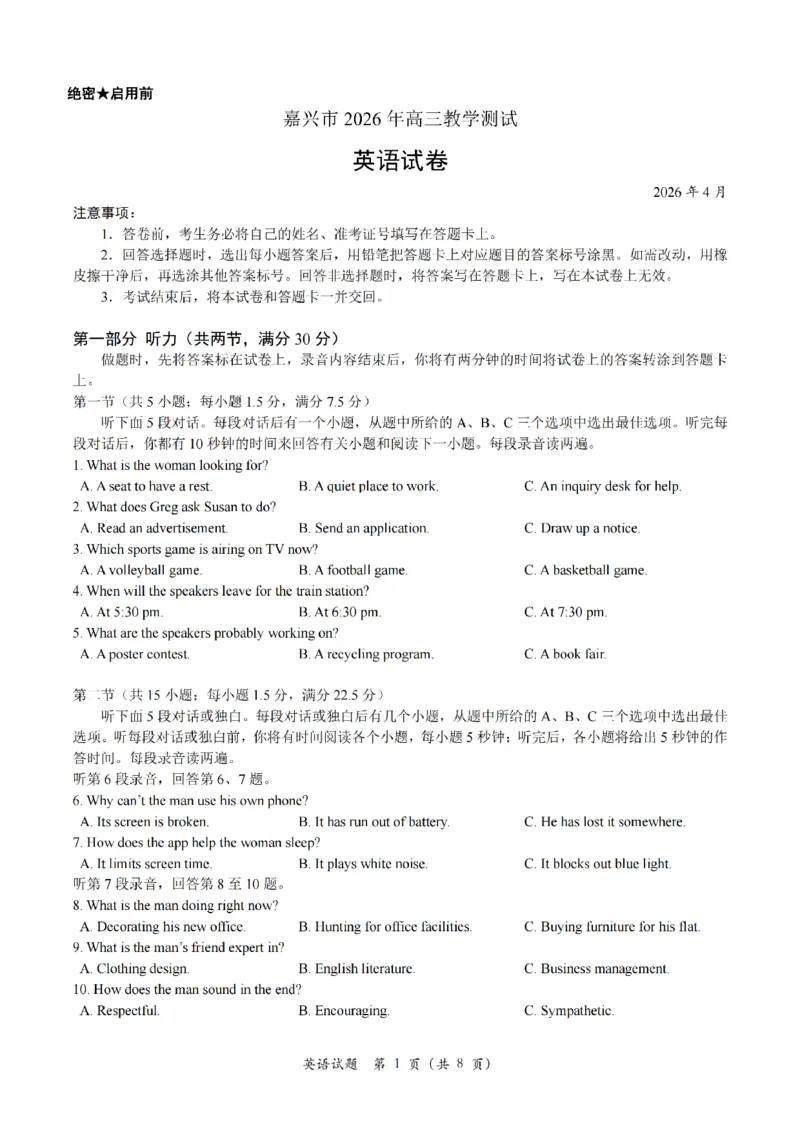
1.What is the woman looking for?
A.A seat to have a rest. B.A uiet lace to work. C.An inquiry desk for help.
2. What does Greg ask Susan to do?
A. Read an advertisement. B. Send an application. C.Draw up a notice.
3. Which sports game is airing on TV now?
A.A volleyball game. B.A football game. C.A basketball game.
4.When will the speakers leave for the train station?
A.At 5:30 pm. B.At6:30 pm. C.At7:30 pm.
5. What are the speakers probably working on?
A.A poster contest. B.A recycling program. C.A book fair.
第二节(共15小题;每小题1.5分,满分22.5分)
听下面5段对话或独白。每段对话或独白后有几个小题,从题中所给的A、B、C三个选项中选出最佳
选项。听每段对话或独白前,你将有时间阅读各个小题,每小题5秒钟;听完后,各小题将给出5秒钟的作
答时间。每段录音读两遍。
听第6段录音,回答第6、7 。
6.Why can't the man use his own phone?
A.Its screen is broken. B. It has run out of battery. C.He has lost it somewhere.
7.How does the app help the woman sleep?
A.It limits screen time. B. It plays white noise. C. It blocks out blue light.
听第7段录音,回答第8至10题。
8.What is the man doing right now?
A.Decorating his new office. B.Hunting for office facilities. C. Buying furniture for his flat.
9. What is the man's friend expert in?
A.Clothing design. B.English literature. C. Business management.
10.How does the man sound in the end?
A. Respectful. B. Encouraging. C.Sympathetic.
英语试题 第 1 页(共8页)听第8段录音,回答第11至13题。
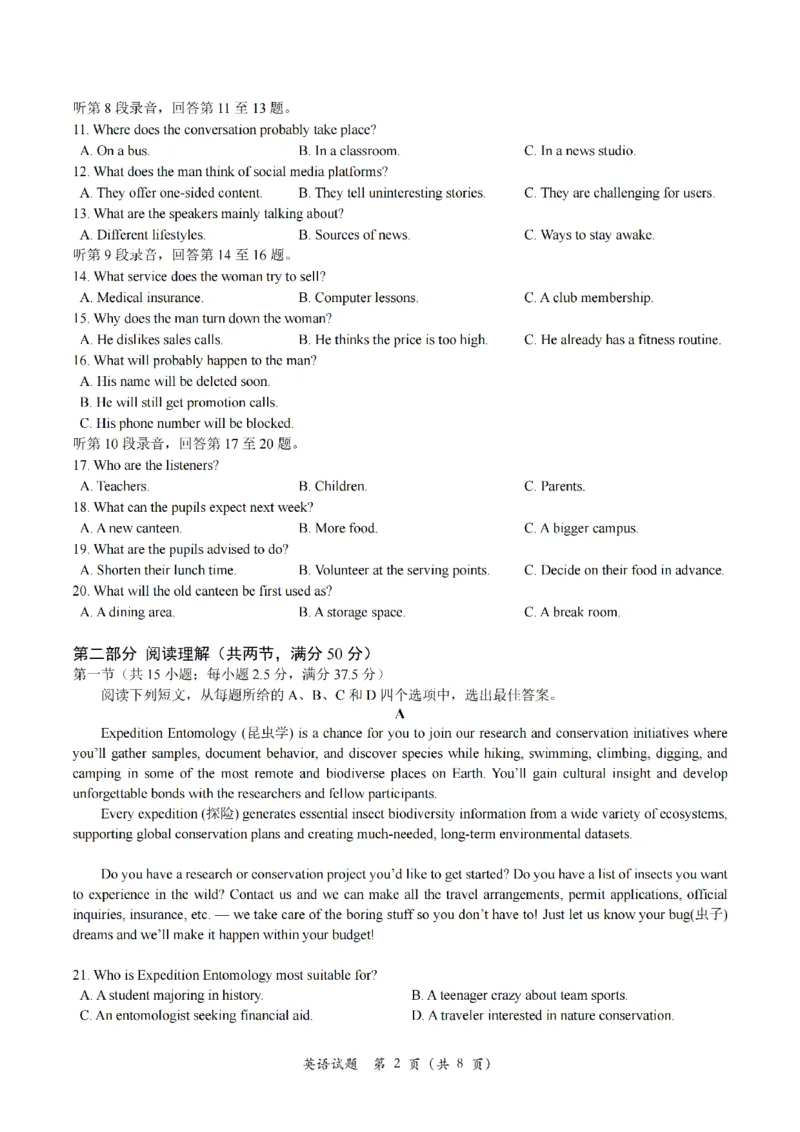
11.Where does the conversation probably take place?
A. On a bus. B.In a classroom. C.In a news studio.
12. What does the man think of social media platforms?
A.They offer one-sided content. B. They tell uninteresting stories. C.They are challenging for users.
13. What are the speakers mainly talking about?
A.Different lifestyles. B. Sources of news. C.Ways to stay awake.
听第9段录音,回答第14至16题。
14. What service does the woman try to se
A. Medical insurance. B. Computer lessons. C.A club membership.
15. Why does the man turn down the woman?
A.He dislikes sales calls. B.He thinks the price is too high. C.He already has a fitness routine.
16. What willprobably happen to the man?
A.His name willbe deleted soon.
B. He will still get promotion calls.
C.His phone number will be blocked.
听第10段录音,回答第17至20题。
17.Who are the listeners?
A.Teachers. B. Children. C. Parents.
18. What can the pupils expect next week?
A.A new canteen. B. More food. C.A bigger campus.
19. What are the pupils advised to do?
A.Shorten their lunch time. B. Volunteer at the serving points C.Decide on their food in advance.
20. What will the old canteen be first used as?
A.A dining area. B.A storage space. C.A break room.
第二部分 阅读理解(共两节,满分50分)
第一节(共15小题;每小题2.5分,满分37.5分)
阅读下列短文,从每题所给的A、B、C和D四个选项中,选出最佳答案。
A
Expedition Entomology(昆虫学)is a chance for you to join our research and conservation initiatives where
you'll gather samples, document behavior,and discover species while hiking, swimming, climbing, digging, and
camping in some of the most remote and biodiverse places on Earth. You'll gain cultural insight and develop
unforgettable bonds with the researchers and fellow participants.
Every expedition(探险)generates essential insect biodiversity information from a wide variety of ecosystems,
supporting global conservation plans and creating much-needed, long-term environmental datasets.
Do you have a research or conservation project you'd like to get started?Do you have a list of insects you want
to experience in the wild? Contact us and we can make all the travel arrangements, permit applications, official
inquiries,insurance, etc.—we take care of the boring stuff so you don't have to! Just let us know your bug(虫子)
dreams and we'll make it happen within your budget!
21.Who is Expedition Entomology most suitable for?
A.A student majoring in history. B.A teenager crazy about team sports.
C.An entomologist seeking financial aid. D.Atraveler interested in nature conservation.
英语试题 第2 页(共8 页)22. What do the two expeditions have in common?
A.They last ten days. B. They are open to children.
C. They are free for singles. D. They offer platform campsites.
23.What service can Expedition Entomology offer?
A. Guidance on budget cuts. B. Help with official procedures.
C.Care for young participants. D. Training in academic research.
B
They say that the truth comes out of the children's mouth, and that truth is sometimes more upsetting than we
realize. Jen Adams Beason, a 2nd-grade teacher from Louisiana,witnessed this when she asked her students to write
about an invention that they didn't like,or an invention that they wish would have never seen the light of day.
Jen has 21 students,and she was absolutely heartbroken when she noticed that four of her students shared the
same invention: the smartphone. With dozens of notifications(通知)from apps,emails,and social media updates, it
could be hard not to look at your phone for longer than five minutes.
Jen shared a boy's essay on her Facebook page. ""I hate my mom's phone and I wish she never had one. That is
an invention that I don't like.”The essay is even accompanied by a sad and angry face saying “"I hate it,"looking at
a drawn phone with a cross through it.
"I had my 2nd graders write about an invention that they wish had never been created. Out of 21 students,4 of
them wrote about this topic.#getoffyourphone #listentoyourkids,"Jen posted on her Facebook wall.
Her message was seen by millions and even shared 300,000 times. It received dozens of eye-opening comments.
"That is so sad. Great reminder for us all to put those phones down and engage with our kids more,"Tracy Jenkins
posted.
Luckily, it seems that awareness about smartphone addiction is increasing. Both iPhones and smartphones
running on a recent Android operating system will soon include features to monitor,control and restrict your personal
smartphone use for your own health.
Still it's interesting to see that parents'concerns about their children becoming addicted to smartphones and
other smart devices, are also perfectly true the other way around.
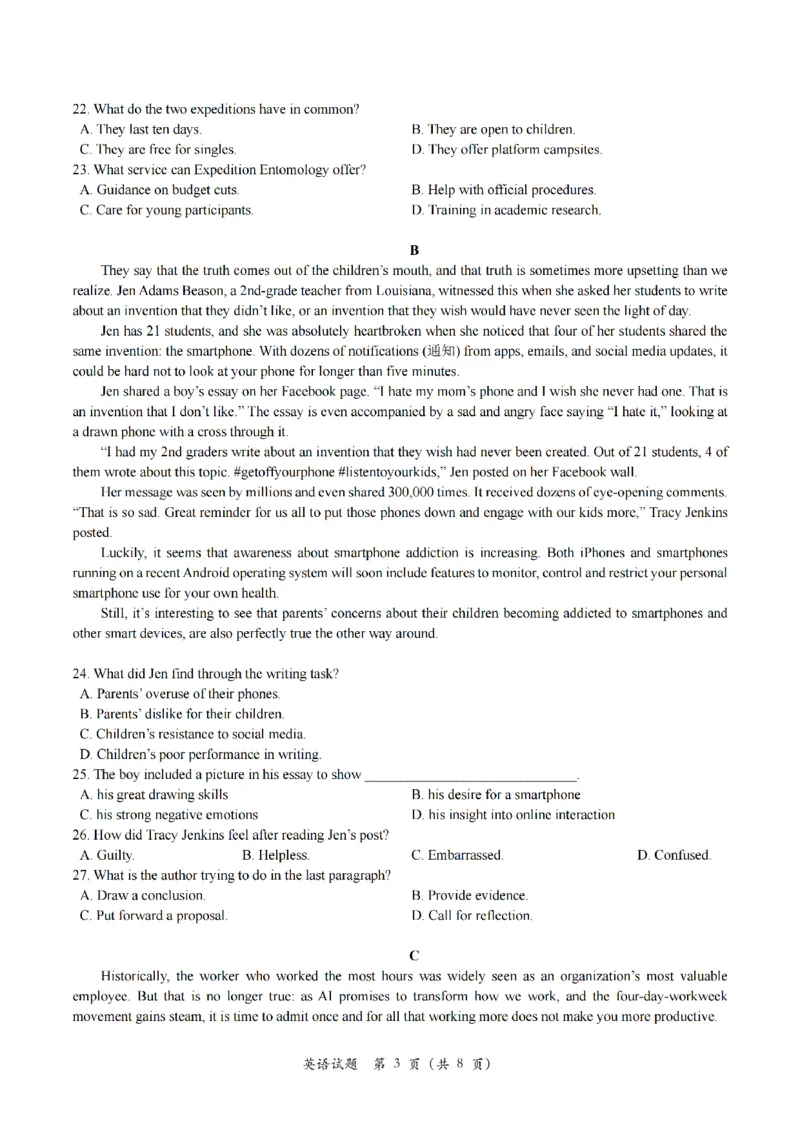
24. What did Jen find through the writing task?
A.Parents'overuse of their phones.
B.Parents'dislike for their children.
C.Children's resistance to social media.
D. Children's poor performance in writing.
25.The boy included a picture in his essay to show.
A.his great drawing skills B.his desire for a smartphone
C.his strong negative emotions D.his insight into online interaction
26.How did Tracy Jenkins feel after reading Jen's post?
A.Guilty. B. Helpless. C.Embarrassed. D. Confused.
27. What is the author trying to do in the last paragraph?
A.Draw a conclusion. B.Provide evidence.
C.Put forward a proposal. D. Call for reflection.
C
Historically, the worker who worked the most hours was widely seen as an organization's most valuable
employee. But that is no longer true: as AI promises to transform how we work,and the four-day-workweek
movement gains steam,it is time to admit once and for all that working more does not make you more productive.
英语试题 第 3 页(共8页)In fact, many workers could dutifully keep themselves busy for an entire day without doing anything of real
value, instead answering pointless emails and attending unnecessary meetings.Meanwhile, many are struggling under
the unsustainable consequences of applying an industrial-era measure of productivity— namely, dividing output by
hours— to our modern knowledge economy. As a result, workers are under constant pressure to relinquish their
rightfully earned time to prove their commitment.
Those who finish their tasks more quickly are typically rewarded with more work to fill the hours they've saved,
in what is sometimes referred to as "performance punishment."Aco-worker who works throughevenings, weekends,
or lunch breaks to complete the same workload, meanwhile, is often more likely to be praised or even promoted for
their perceived commitment. This dynamic ultimately creates more pressure to look busy than to deliver value, which
is getting in the way of actually getting work done and holding back organizational productivity while wearing down
workers'well-being.
So it is time for us to be smarter about how we work. That is ultimately what the four-day-workweek movement
seeks to inspire. Instead of just giving everyone an extra vacation day each week, when positioned as a performance-
based motivator, the four-day workweek becomes a wake-up call to refocus our time and energy at work on the things
that really matter to the business.
In today's knowledge economy and tomorrow's Al reality, the most successful individuals, organizations,and
nations won't be those that work the most hours, but those that are the most effective at making their working hours
count.
28.How does the author introduce the topic?
A.By listing Al-driven changes in work. B.By challenging the hours-productivity link.
C. By describing employee-centered practices. D. By advocating a short-time working pattern.
29.What does the underlined word “relinquish”in paragraph 2 mean?
A. Set aside. B. Count on. C.Give up. D. Care about.
30. What weakens organizational effectiveness according to paragraph 3?
A.Job burnout. B. Performative busyness. C.Unfair punishment. D. Unnoticed commitment.
31.What does the author think of the four-day workweek?
A.A reward for efficiency at work. B.A wake-up call to stay competitive.
C.A push to think smarter about work. D.Apreparation for the uncertain future.
D
At any bus stopor while waiting in line,most people will have their heads down scrolling(滚屏)on their phones.
But studies suggest ifyou resist that urge and let your mind wander instead, there could be some serious benefits.
We actually spend nearly half our waking time daydreaming, but it isn’'t always pleasant. A study found people
even preferred electric shocks to bein alone with their thoughts. This explains why we automatically reach for
phones during downtime.
Social psychology pro essor r n estgate compares mindless scrolling to “brain candy”— momentarily
pleasurable but lacking in meaning. She adds human achievements largely come from higher-order thinking.
So next time you have a few minutes free,put away your phone and let your mind wander. Many people fear
boredom, but this fear is often overblown. In a 2022 study, people predicted they would hate 20 minutes alone doing
nothing,yet afterward reported greater enjoyment than expected.According to researcher Kou Murayama, the ability
to mentally wander—to reflect on past experiences,and consider others'viewpoints—is a distinctly human capacity
that boosts learning and helps understand others.
Mind-wandering is also key to problem-solving. People often find solutions better after unfocused thinking than
intentional effort alone,especially during routine tasks like driving or showering. Even when people are not actively
thinking, their brains remain active in a so-called default mode(默认模式), allowing ideas to connect in new ways.
It's especially helpful for complex problems.
英语试题 第 4 页(共8页)Beyond cognitive(认知的)benefits, daydreaming also boosts social and emotional connections. A study found
imagining pleasant interactions with loved ones made people feel closer. Social daydreaming allows individuals to
practice conversations,reflect on past interactions,and prepare for future social situations. As psychologist Poerio
says,our ability to mentally “time travel”helps us better handle the social wo
Murayama says he now tries to resist checking his phone during short waits an e s oug s wan er. He
finds simply entertaining oneself mentally can be both satisfying and meaningful.
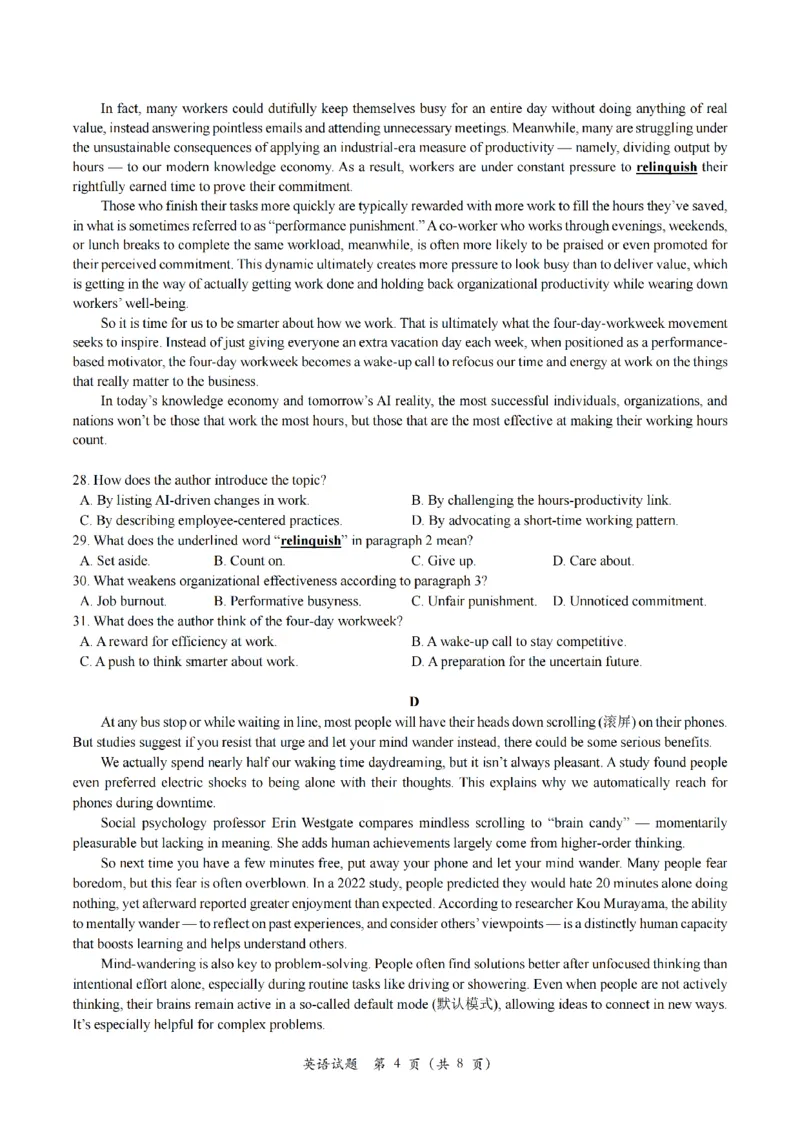
32.Why does Erin Westgate compare mindless scrolling to "brain candy"?
A. It does harm to people's health. B. It helps people to avoid boredom.
C.It replaces deep thinking in daily life. D. It brings quick but shallow enjoyment.
33. What is the 2022 study used to demonstrate?
A.Phone addiction is avoidable. B.Daydreaming is undervalued.
C. Being alone promotes learning. D. Self-reflection defines humans.
34. What does the default mode suggest?
A.Unfocused thinking fuels creativity. B. Intentional effort brings new ideas.
C. Complex tasks require active minds. D. Routines involve little brain activity.
35. Which of the following is a suitable title for the text?
A. Maintain Focus in the Digital Age B.Discover the Joy of Being Truly Alone
C.Unlock the Power of Your Wandering Mind D.Explore Secret Benefits of Social Daydreaming
第二节(共5小题;每小题2.5分,满分12.5分)
阅读下面短文,从短文后的选项中选出能填入空白处的最佳选项。选项中有两项为多余选项。
Have you ever found yourself reciting your grocery list out loud in the supermarket or saying something
encouraging to yourself before a big moment? If so,you are not alone. Talking to ourselves, either within our heads
or out loud, is a common behavior.Psychologists refer to it as "self-talk,”" a mental tool like a Swiss army knife.
36--
Saying something out loud,whether it's positive or negative,can make the thought that you're expressing seem
more official, or public, than if you merely think about it. 37 For them workin through a problem aloud
helps them think more clearly and see how things fit toget
Some people report using self-talk to help them calm down n per o s o negat ve mental states. Research, for
instance,has found that when people are anxious or stressed, they are more likely to engage in self-talk.__38__
It is like giving yourself the support a friend would.
__39__"I really do believe in the power of positive self-talk,at the gym,in the mirror,before a big meeting
—allof that,"says Carol Bergman,52.She does it before she works out with “Come on, you got this!” or with“You
look great!”if she needs to hear some kind words about herself from time to time.
In fact,we learn to talk to ourselves in childhood, where it is associated with better performance on tasks and
challenging activities.___40___As adults, we may return to speaking out loud when mentally or emotionally
challenged. In such moments, it serves as an extra tool to help us focus and think and solve problems. So talking to
yourself is not being as strange as you think you are.
A.However, we do it less as we grow older.
B. Self-talk also helps people stay motivated.
C.Here are some ways to put it into practice.
D.It's a superpower that we all naturally possess.
E.It can be useful in many different situations in life.
F. Speaking emotions aloud makes them manageable.
G.Some people use self-talk to sort through a challenge.
英语试题 第5页(共8页)第三部分 语言知识运用(共两节,满分30分)
第一节(共15小题;每小题1分,满分15分)
阅读下面短文,从短文后各题所给的A、B、C和D四个选项中,选出可以填入空白处的最佳选项。
It was 1974.My friends and I decided to backpack around Tasmania in winter—go figure. We were all in our
late teens, without a clear__41__
We got on a train owned by a mining company and travelled through Tasmania's wild west coast to Queenstown.
It was allforest and mountains. So___42___was the weather that we were all___43___to sit in our sleeping bags
trying to warm up.
Queenstown's economy___44__the copper mine at the time. I remember the___45__of travelling through
hours of forest and then arriving at a place where the hills were left___46__by pollution. The depressing mood
wasn't__47___by the bitter cold and constant rain.
Our idea was to hitchhike(搭车旅行) from Queenstown to our next destination,and we walked alon a road
waiting___48for a ride. For a couple of hours, there were hardly any cars passin
Our youthful enthusiasm was___49___when a young boy came out of a neat cottage carrying a basket,
explaining that he thought we might___50_something to eat. Inside was a Thermos of tea, along with some cake
and biscuits—__51_offerings that brought unexpected__52___on that freezing day.
We were__53__that someone had taken the__54___to notice the three untidy teens hanging around and
offer help. The rain stopped and we got our ride, with the memory of that brief but meaningful__55___remaining
vivid.
41.A.plan B.clue C. rule D.duty
42.A.mild B. relaxing C.awful D.changeable
43.A.inspired B. instructed C.forced D.ordered
44.A.shifted from B. contributed to C.ended in D. depended on
45.A.fear B. shock C.stress D.guilt
46.A.bare B.alone C.hidden D.burned
47.A.affected B.helped C. worsened D.controlled
48.A.aimlessly B.curiously C.hesitantly D. anxiously
49.A. declining B.continuing C.emerging D. recovering
50.A. receive B.appreciate C.purchase D.bring
51.A.rare B.expensive C.simple D.unique
52.A. praise B. progress C.confidence D.comfort
53.A.convinced B. touched C.worried D. ashamed
54.A.risk B.courage C.chance D.trouble
55.A.activity B.accident C.encounter D.cooperation
第二节(共10小题;每小题1.5分,满分15分)
阅读下面短文,在空白处填入1个适当的单词或括号内单词的正确形式。
Cheers echoed(回响)across the frozen Songhua River in northeast China's Heilongjiang Province, where
students from__56_(lead) universities in China and Britain competed in a first-of-its-kind ice dragon boat race.
The event,_57_(know) as the "HIT-Cambridge-Oxford Cup,"brought together 14 teams,including those from
Oxford, Cambridge and Harbin Institute of Technology (HIT), as well as universities from Hong Kong and Macao.
_58___traditional water dragon boating, ice dragon boating requires athletes to use ice icks to ush their
boats forward on solid ice,_59__task demanding great upper body strengt
英语试题 第6 页(共8页)Edward Townsend from Cambridge described the race as a fantastic experience,admitting it was the first time
that they___60__(try) dragon boat racing on ice and that adapting to the cold climate__61_(be)no easy task.
With guidance provided by HIT__62__(coach), however,his team gradually mastered the skills and secured the
first prize in the race.
Besides the competition,participants also enjoyed___63(variety)cultural activities, visiting the Harbin Ice-
Snow World, feeding Siberian tigers__64__experiencing local cuisine. Organizers hope that the friendship race
willserve as a positive beginning for youth exchanges between China and Britain,as well as an important link for
universities to expand cooperation and__65__(joint) develop talent.
第四部分 写作(共两节,满分40分)
第一节(满分15分)
假定你是李华,最近你参加了学校举办的“心理韧性训练营(Resilience Training Camp)”。请你给美国网
友 David写一封邮件分享这次经历,内容包括:
(1)你的变化;
(2)你的感想。
注意
(1)写作词数应为80左右;
(2)可适当增加细节,使内容充实、行文连贯。
Dear David,
Best wishes,
Li Hua
英语试题 第 7 页(共8 页)第二节(满分25分)
阅读下面材料,根据其内容和所给段落开头语续写两段,使之构成一篇完整的短文。
The wind swept across the Irish coast as Grandfather bent to examine Caper's front hooves(蹄).The little horse
stepped back and let out a painful sound. "They are burning and swollen(肿胀的),"said Grandfather with a heavy
heart. "I think he has a mild case of sickness. Horses will eat themselves sick any chance they get. And the sickness
has gone straight to this one's hoove
"When will he feel better?" asked Aislinn worriedly. Caper was not just their pet—he carried the load of fish
to the market every week. Without him,they could not take the fish to the market.Without selling the fish, they would
not get their rent paid.
Grandfather removed half of the grain from Caper's feed. He then explained that Caper would soon be right as
rain if they cut back on his diet and let him rest properly. The most important thing now, he added, was to bring the
heat down and reduce the swelling. "Don't worry about the fish, child. The sea has always been kind to us."
Grandfather smiled at Aislinn and urged her to get some sleep.
Aislinn lay in bed,but sleep would not come. She opened her window.The sliver moon had risen above the sea.
Aislinn wondered how Grandfather could sell the fish he'd worked so hard to catch. She wished they had enough
money for the rent. But above all, Aislinn wished Caper's hooves would stop hurting. Damp wind filled the room as
she watched the cold waves crash on the beach. Aislinn gradually remembered when she had got a swollen ankle,
Grandfather had told her to keep ice on it, and the swelling had gone down.
If cold could reduce the heat and swelling in her ankle,perhaps it could ease Caper's pain as well! There was
ice in the fish crate(箱子)to keep the fish fresh, and the cold sea lay only a short walk away,with its waves rolling
on and on toward the shore.
注意
(1)续写词数应为150左右;
(2)请按如下格式在答题卡的相应位置作答。
Paragraph 1:Aislinn pulled on her sweater and boots and hurried down the hallway.
Paragraph 2:The next morning,Aislinn woke beside the horse.
英语试题 第8页(共8 页)