人教版
八年级英语
下册
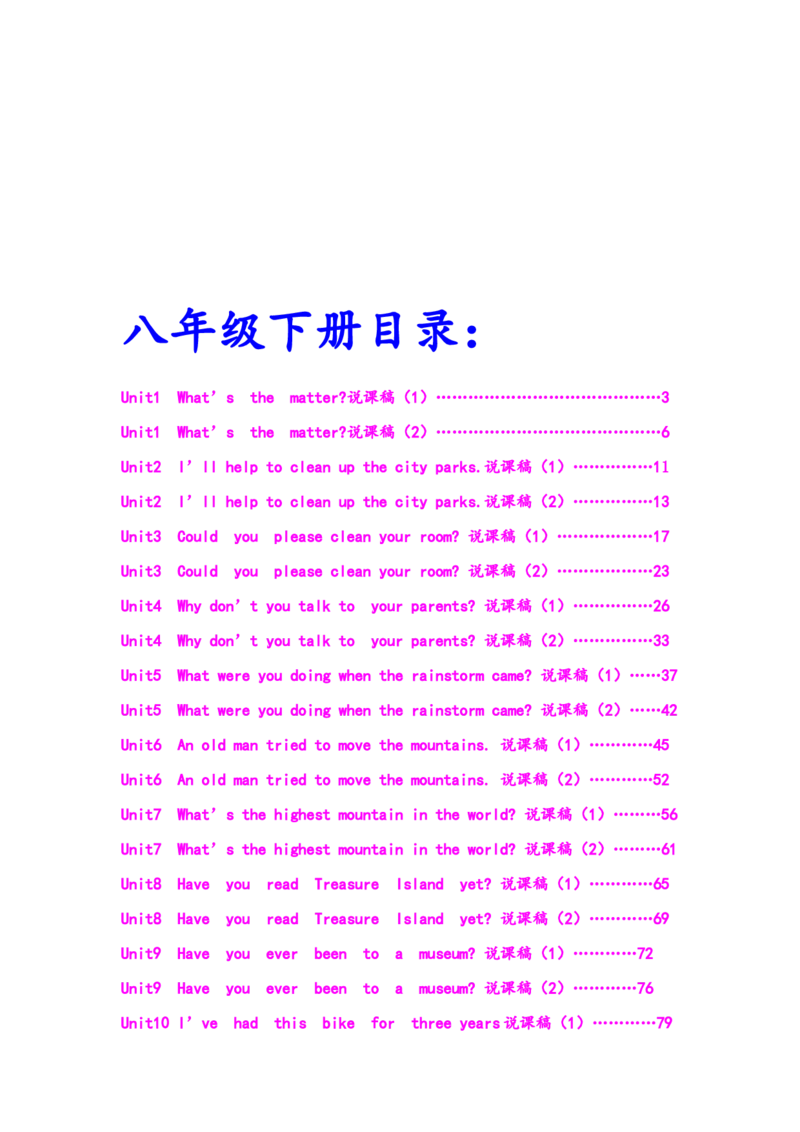
全册说课稿八年级下册目录:
Unit1 What’s the matter?说课稿(1)……………………………………3
Unit1 What’s the matter?说课稿(2)……………………………………6
Unit2 I’ll help to clean up the city parks.说课稿(1)……………11
Unit2 I’ll help to clean up the city parks.说课稿(2)……………13
Unit3 Could you please clean your room? 说课稿(1)………………17
Unit3 Could you please clean your room? 说课稿(2)………………23
Unit4 Why don’t you talk to your parents? 说课稿(1)……………26
Unit4 Why don’t you talk to your parents? 说课稿(2)……………33
Unit5 What were you doing when the rainstorm came? 说课稿(1)……37
Unit5 What were you doing when the rainstorm came? 说课稿(2)……42
Unit6 An old man tried to move the mountains. 说课稿(1)…………45
Unit6 An old man tried to move the mountains. 说课稿(2)…………52
Unit7 What’s the highest mountain in the world? 说课稿(1)………56
Unit7 What’s the highest mountain in the world? 说课稿(2)………61
Unit8 Have you read Treasure Island yet? 说课稿(1)…………65
Unit8 Have you read Treasure Island yet? 说课稿(2)…………69
Unit9 Have you ever been to a museum? 说课稿(1)…………72
Unit9 Have you ever been to a museum? 说课稿(2)…………76
Unit10 I’ve had this bike for three years说课稿(1)…………79Unit10 I’ve had this bike for three years说课稿(2)…………84
Unit1 What’s the matter ?说课稿(模板一)
一、 说教材
1、 教材内容及地位
本节课的主要内容是新目标英语八年级下册第 1单元第一课时,教材是以
What’s the matter ?为中心话题,描述身体不适和提出建议展开,学习和运用
“What’s the matter ?”和“What should…do?”让学生学会描述身体的不适
和提出建议,本课教材内容与学生的实际生活密切相关,易于引出学生运用简单
的英语进行交际和交流,在学习活动中,学生通过交换对身体不适的描述及建议
促进学生之间和师生之间的情感交流,增进情谊。
第一课时主要学习的内容是学习有关身体部位的单词,学习“What’s the
matter ?”和“What should …do?”句型。
2、 说教学目标
1) 知识目标:学习掌握有关身体的词汇以及有关疾病的词汇,并学会描述身
体的不适和提出建议。
2) 能力目标:听懂本课学习活动中的问题及回答,能在本课的任务型活动中进
行简单的交流,能正确朗读本的对和句型,能写出本课的单词和句型。
3) 情感目标:通过描述自己的身体的不适提出建议,表达自己的看法,使学
生在人际交往中学会关心别人,增进情谊。
4) 文化意识目标:用恰当的方式表达自己的看法,增进人际交往中学会关心
别人的能力,了解英美国家询问和表达身体不适的习惯,培养世界意识。
3、 说教学重难点
重点:本节课主要学习身体部位的单词和一些疾病的词汇,以及身体不适的
表达及建议。
难点:身体不适的表达及建议
二、 说学情
初二年级的学生对英语已经有了一定的基础,但本地区部分学生对学习英语
的兴趣不是很浓,在学习中,他们更喜欢从游戏中或活动中学习,这样更能提高
他们的学习兴趣,让他们更轻松地掌握英语知识。
三、 说教法
作为教学的引导着,我遵循新课程“学生是学习的主人,一切的教学活动设
计在以学生为本”的教学理念,坚持“为学生的发展,必须培养学生的自主性、
能动性、独立性和创造性”的教学原则。课堂教学中利用图片,单词卡片等直观
的教学手段,通过任务型教学法,游戏教学法,情景教学法等教学法引导学生学
习,使枯燥的单词教学变得生动有趣,激活课堂,最终达到预期的教学目标。
四、 说教学流程Step 1 Greeting
T: How are you?
Ss: I’m fine. Thank you. How are you?
T: I’m OK. But I have a cold. (我感冒了)What should I do?(我该怎么
做)
学生提建议:看医生(see a doctor)休息(have a rest) ,吃药(take some
medicines)等 ,教学以上词汇,为以下对话做铺垫。
Step 2 Lead-in 直接导入新课,引出课题。
Today we’re going to talk about the matters. Let’s learn Unit 2
What’s the matter? (板书并教学课题)
Step 3 New words
1、 Now let’s look at the picture. This is a body. We’re going to learn
the part of the body. (利用图片、单词卡片进行教学)
2、 Game.(叫几个学生上讲台,其余的学生在下面通过卡片抽读,上面的学
生迅速指出身体部位)通过游戏让学生更好地掌握单词,这样可以加强对单词的
巩固。
3、 通过老师的表情,动作让学生用“What’s the matter?”询问,引出疾病
的单词,如:sore throat, sore back=backache, toothache, stomachache等,并利用
卡片进行教学。同时让学生用You should…提出建议。
Step 4 Practice (利用图片问答)
1、Game (学生抽图片,表演,进行问答)
A: What’s the matter ?
B: I have a cold./ a stomachache/ backache…
A: You should see a doctor./ have a rest/ take some medicine…
2、A: What’s the matter?
B: She/He has a cold. /a stomachache/ backache…
A: what should she do?
B: She/He should see a doctor./ have a rest/ take some medicine…
Step 5 pair work (让学生和同伴练习对话,抽查几对学生对话)
A: What’s the matter?
B: I have a cold. /a stomachache/ backache…
A: You should see a doctor./ have a rest/ take some medicine…
Step6 listening
通过上面一系列的对话练习,学生对1b的对话已经很熟悉了,所以更好的把
握。
Step 7 小结(这节课主要学习掌握有关身体的词汇以及有关疾病的词汇,并
学会描述身体的不适和提出建议。)
Step 8 Homework 记单词和用所学单词句型跟同学进行对话练习
五、 说板书设计
Unit 2 What’s the matter?
①A: What’s the matter ?
B: I have a cold./ a stomachache/ backache…
A: You should see a doctor./ have a rest/ take some medicine…
② A: What’s the matter?B: She/He has a cold/ sore throat /stomachache…
A: She/He should see a doctor./ have a rest/ take some medicine…
单词已经利用卡片学习了,本课我只板书这两个对话,这样让学生更一目了
然,知道这课主要学习的句型,对话。
Unit1 What’s the matter?英文說課稿(模板二)
1. Ability Objects
Enable students to talk about health problems and give a
dvice with the language points.
2. Moral Objects
(1)Improve the cooperative spirit through pair work and r
ole playing. (2)Students care more about themselves and their
family members’ health. Teaching Key Points
1. Learn and master the parts of the body, the names o
f the illness and the expressions of giving advice. 2. Lear
n to talk about health problems by using “What’s the matt
er? I have a…” and give advice by using “should”.
Teaching Difficult Points
1. Learn to talk about health problems by using “Wha
t’s the matter? I have a…”.
2. Learn to give appropriate advice to the certain
health problems.
Teaching Methods
Task-based language teaching method, the cooperative learni
ng method, and multimedia-assisted teaching and learning metho
d.
Teaching Aids
The picture about illness; PPT.
Teaching Procedures
Step 1 Warming-up (about 3 minutes)
Sing the English song If you’re happy.
Step 2 Presentation (about 6 minutes)
T: This is really a beautiful song. What can you do if
you are happy?
Ss: Clap our hands and stamp our feet.
T: Yes. Hands and feet are parts of our body; do you
know other parts of our body in English?
Ss: Eye, head…
T: You’re great. Today, let’s learn the names of theebody parts.
The teacher touches the parts of the body one by on
e and says them. While teaching each one, let students touc
h or show it.
Present a picture of Pan Changjiang on the screen. L
et students say each part of the body.
Play the game: Touch the parts of your body. Let th
e whole class touch the parts of their body when teacher s
ay: Touch your
Ask six students to come to the front and do as the teach
er tells them: Touch our…If one does wrong, let him or he
r go back, the last one who’s in the front is the winner
Step 3 Presentation and Practice (about 8 minutes)
The teacher mimes having a stomachache with an action
of touching his stomach, and asks, “What’s the matter?” (
Write it on the blackboard), then says, “I’m not feeling
well, I have a stomachache.” (Students repeat with teacher.)
Then show some pictures on the screen and ask studen
ts to practice. Have students look at the picture and a
sk: What can we say to him?
Ss: What’s the matter?
T: Yes. And what should the boy say?
Ss: I have a stomachache.
Let students repeat with other pictures about other i
llness.
Ask some students to use gestures to show the illnes
s, and have others to guess. Make a model dialogue. (S1
does an action to express an illness.) T: What’s the m
atter? Ss: He/ She has a headache. Let students prac
tice other illness. A: What’s the matter?
B: He/ She has a headache/ toothache/ a sore back/
a sore throat/ a cold and a cough.
Show other pictures, and ask students to talk about
health problems of the persons in the pictures in pairs.
Step 4 Consolidation (about 5 minutes)
Teacher pretends to cough and asks: T: What’s the m
atter with me? Ss: Do you have a cough/ a sore throat?
T: Yes, I have a sore throat. Can you give me some
advice? What should I do?
Ss: You should drink hot tea with honey/ shouldn’t
talk too much/ go to a doctor…(Students can give different
advice as they like)
Show different pictures to students, have them practic
e in pairs. S1: What’s the matter with him/ her?S2: Yes, he/ she has a/ an toothache/ fever/ headach
e…(Teach the new words)What should he/ she do? S2: He/
She should go to see a dentist/ lie down and rest/ drink
a lot of water./ see a doctor… He/ She shouldn’t drink c
old water/ play basketball…
Work in groups, and have students role-play between a do
ctor and a patient. Ask them to talk about the health prob
lems and give advice in groups.
Step 6. Summary (about 3 minutes)
Ask students to sum up the parts of a body and the
names of illness. If there is enough time, ask Ss to do t
he exercises on workbook page 10,11.
Period 2
1. Ability Objects
Enable students to talk about health problems and give a
dvice with the language points.
2. Moral Objects
(1)Improve the cooperative spirit through pair work and r
ole playing. (2)Students care more about themselves and their
family members’ health.
Teaching Key Points
1. Learn and master the parts of the body, the names o
f the illness and the expressions of giving advice. 2. Lear
n to talk about health problems by using “What’s the matt
er? I have a…” and give advice by using “should”.
Teaching Difficult Points
1. Learn to talk about health problems by using “Wha
t’s the matter? I have a…”. 2. Learn to give
appropriate advice to the certain health problems.
Teaching Methods
Task-based language teaching method, the cooperative learni
ng method, and multimedia-assisted teaching and learning metho
d.
Teaching Aids
The picture about illness; PPT. Teaching Procedures
Step 1 Warming-up. (5’)
Greet the class as usual, then have students play gu
essing game.
T: (Ask one student to choose a card of illness and do
an action, then asks) What’s the matter with him/her?
The other students guess according to the actioin. T: Wh
at’s the matter with him/ her? S2: Did you have a toothac
he? S1: No, I didn’t.
S3: Did you have a headache?S1: Yes, I did.
Show a picture of the body. Ask students to say each p
art of the body.
T: (Touches his own head and says) I have a headache,
then write “headache” next to the head. Then point to the
teeth and asks: What’s the matter with his teeth? Help stu
dents to answer: Oh, His tooth has a hole. He has a tooth
ache. Then have students to finish Self Check 1 alone. Chec
k the answers and have them say more health problems.
Step 2 Grammar Focus (about 7 minutes)
Have students to read and remember the sentences of
Grammar Focus by themselves, and then have them work in gro
ups to sum up how to talk about health problems and give
right advice.
T: (Show a picture of the boy that has a sore back
, and say to the class) This is Mark. He hurt himself pla
ying soccer. Now make a conversation to talk about his prob
lem and give him some advice. (Practice using should/ should
n’t)
A: What’s the matter with Mark? B: He has a so
re back. A: Does he have a fever? B: No, he doesn
’t. A: What should he do?
B: He should lie down and rest./ He shouldn’t exerc
ise, etc.
Show some pictures about other health problems and as
k students to work with their partners. Have two pairs
talk about different problems in class.
Step 3 .Practice (about 7 minutes)
Work in groups. Have students do a survey in groups
about their health problems, then discuss in groups and give
some right advice and make a conversation. Ask each gr
oup to report their conversations.
Step 5. Summary (about 3 minutes)
Help students to sum up how to give advice by using
“should” and “shouldn’t”, then ask them to give the rig
ht advice about different problems.
Homework
1. Finish the exercises on workbook page 19-21.
2. Dictate the words of Unit 1.Unit 1 What’s the matter? 说课(模板三)
一、教材分析
1、教材的内容和地位
本节课采用人教版新目标八年级下册 Unit21What’s the matter 第一节。而
本单元主要学习谈论健康状况。学习询问人们的健康状况以及如何针对不同健康
问题提出意见和建议并倡导人们养成健康饮食及生活习惯。教育学生注意饮食健
康,关心他人。包括人体部位名称、各种疾病表示法以及怎样给人提出建议和意
见。语法学习情态动词should 、 shouldn’t的使用和询问、描述健康状况以及回
答的句子。
而本节是本单元的重点,主要学习人体各个部位名称及询问对方的身体状况
使学生学会关心他人。
2、教学目标:
根据教学大纲和学生的实际情况,我制定如下教学目标:
(1).知识目标:
A.识记人体各个部位的名称及如何谈论身体健康状况
B.运用”What’s the matter…?” “I have/get …”句型在日常生活中进
行对话
(2).能力目标:
培养学生能运用所学语言简单的描述自己的健康状况及如何询问对方的身
体健康状况。提高听、说、读、写的综合能力。
(3)情感、态度和价值观:
教育学生要学会关心他人,通过询问他人的健康情况并能给予帮助,增进人与
人之间的感情。让学生感受到学英语最主要是为了在现实生活中进行交流,而不
是单纯的为了英语课和应付考试而学习。
3.重点、难点
根据教学大纲的要求,及本课在教材的地位及作用。我确定以下重点、难点:
重点:学习人体各个部位的名称及如何询问和回答身体的健康状况。
难点:用“What’s the matter?/ What’s wrong?” “I have/get a sore
throat…”句型在实际生活中的应用。
二、学情分析
老城中学是一所乡镇中学,学生的英语学习起步比较慢。 针对这一情况,
我在课堂上创造外语语言氛围,让他们有身临其境之感,激发学生学习英语的兴
趣;让学生在参与英语各项活动时,能够更好地掌握知识;同时通过游戏来进行
训练,巩固所学的知识。
三、教法、学法的分析
根据新课程理念,教学过程是师生互动的过程。 为了激励学生在课堂积极交谈,作为一个引导者、组织者,我创设一些真实的情景来激发学生的学习兴
趣。设计以学生为主,师生互动的任务型教学法。让学生以调查的形式去询问他
人的健康状况,以游戏、活动方式来进行教学。我采用了多媒体、卡片、挂图和肢
体动作来辅助教学,贯穿整个教学过程。增加了直观性、活跃性和趣味性。使学生
在轻松的气氛里掌握知识,达到最佳的教学效果。
四、教学过程
1、新课导入
本单元与之前学过的单元没有太多的联系,Greeting 过后做一些有关
身体放松的动作,(stretch, stretch, stretch my hand, shake, shake, shake my
head…),然后放一首歌曲if you are happy,让同学跟着视频音乐做动作,活跃气
氛,使课堂充满生机与活力,同时让学生有个悬念,这节课将会学习关于怎样的
知识,然后老师以肢体语言告诉同学,今天将去了解身体各部分名称 和如何表
述身体的不适。出示图片,导入新课。
2、新课的呈现和讲解:
本本课利用多媒体展示一幅色彩逼真、大家都比较熟悉的名星漫画像
且结合自己的肢体来教授单词。这节课主要以分组比赛记分的形式进行,这样可
以激发学生参与课堂活动的积极性,吸引全体学生的注意力,从而达到完成教学
目标中的知识目标,提高学生的能力目标。
3、通过游戏等活动反复操练所学知识
A.口语操练:以抡答的形式进行操练和比赛,给表现好的组加分。
T:What’s this? (教师指着身体各个部位问学生)
Ss: Nose, mouth, head…
B. Touching game:
(1)、老师说英语,学生快速指向所说的身体部位,给反应快,表现整齐的组
加分。
(2)、选几个代表组上讲台参与活动。这几位学生面对其它同学,老师出示单
词卡给讲台下的学生,他们快速读出英语,而台上的同学根据读音指出相应的部
位。
通过A和B的反复练习,加深知识目标的巩固,提高了能力目标。
C.找朋友游戏:老师把两张人物像各发到组里的同学,音乐一响,在图像上写
相应的单词,给完成最快的组加分,游戏之前由老师示范。这个游戏能使学生更
好的辨认新单词,巩固所学知识,同时也激发了学生的学习兴趣。
D.练习,进一步巩固所学知识。(1a)
4、新句型的呈现和操练:
老师通过复习身体部位名称,以肢体动作引出新句型,同时也以多媒体示出
图片和新句型。“ What’s the matter?/What’s wrong with you?” , “I
have/get a cold\....
A.为了调动学生的积极性,利用 work in pairs, work in groups, boys ask,
girls answer 等多种方式操练巩固句型。使学生处于积极思维的状态之中,全方
位,多角度培养学生运用英语的能力。
B.以游戏和活动来操练句型。
1、老师做动作,学生以比赛的形式说出英语
2、个别学生表演动作,其余同学询问及回答。
3、全班同学一起做动作及说英语。4、根据多媒体上的图片快速猜出健康状况,给好的组加分
What’s the matter? I have…
……
5、听力操练:(1b)
通过以上的操练、游戏等环节,同学们的兴趣很高,也掌握了一定的单词和内
容。这时通过听力既能检验学生掌握知识的情况,又能锻炼听力。动静结合,达到
最佳教学效果。
6、归纳总结:
带读所学内容,然后以“动”来结束这一堂课。全班一边说英语一边做动作,
让学生感受到英语是一门活语言,充满乐趣。
7、Homework:
要求学生回去能熟读身体各个部位的名称并能写出来。然后用所学知识与同
学交流,询问同学的健康状况,关心他人。同时能体验成功的乐趣,让学生明白,
学英语是为了交流而不是为了考试。
五、板书设计(略)UNIT2 I’ll help clean up the city park说课稿(模板一).
今天我说课的题目是初中英语人教版八年级 UNIT 2 I’ll help clean
up the city park本课的中心话题是提供帮助。引导学生关注社会,利用自己的特
长为他人社会做事情。整个说课我将分成四个大部分进行讲述:即教材分析、教
法学法、教学程序、板书设计。
一、 教材分析
(一)教材的地位和作用
本单元的中心话题是提供帮助,整个单元的内容是围绕提供帮助,以及
志愿活动展开生动、活泼的对话,和阅读。而且这些志愿活动与我们的生活密切
相关,通过本课的学习,要求学生能够谈论自己帮助别人的方式,学会关心社会,
关心他人。从而关注身边的生活环境,从小事做起。引导学生体会志愿活动,投身
于社会公益事业。根据新目标对学生交际能力的培养,我将本课设计为一堂听说
作课。通过听力口语训练,帮助学生输入地道的语言材料,为提高学生的语言表
达能力及输出奠定基础。
(二)教学目标的确立和依据
英语课程标准规定,通过听、说、读、写的训练,使学生获得英语基础知
识和为交际初步运用英语的能力,激发学生的学习兴趣,为进一步学习打好初步
的基础。 所以, 我确立如下的教学目标:
1.知识目标:
A、掌握词组:
clean up give out cheer up
help with come up with put off
write down put up hand out
call up
B掌握句型: I’d like to…….
You could……
2、能力目标:
A 提供帮助
B 提高学生听、说、读、写的综合能力。
3.情感目标:
通过对本单元的学习,增强实际交际能力,引导学生体会志愿活动,积极
投身于社会公益事业。 引导学生关注社会关注未来,从现在做起,从小事做起,
成为一个有爱心的公民。
(三)重点和难点:
1.重点:根据新目标的要求,我把听说能力的培养确定为本课重点
2.难点:在听说的基础上能够运用所学知识是英语学习的一个难点,所以我把本课难点确定为:通过大量的输入和练习,能够运用所学内容升华到书面
表达。
二、教法学法
1、任务型教学法:每个教学环节都是围绕着如何完成一个教学任务来设
计的。
2、感悟法:创设语境,让学生在一定的语言环境中感悟语言内涵,从而实
现悟中学的目的。只有学生自己悟出的东西才能较好地内化为自己的东西。
3、合作点拨法:通过教师创设的学习氛围,设置问题和反思质疑,推动师
生,生生间的合作探究,
小组合作学习,在解决问题中完成教学目标。以培养他们的合作探究的
意识与精神。
三、教学程序
1 导入新课
利用课件中的图片导入:在大屏幕上出示汶川大地震中一些悲惨的图片
让同学们说出汶川,然后老师说as we all k-now a stong earthquake happened
in wenchuan,so many kind people go there to help others.再出示一些军人,医
疗工作者,志愿者忙碌的身影,特别是******************总理看望受伤的孩子
让同学们知道一方有难,四方支持,帮助困难中的人是很有意义的。然后说Would
you like to help others?What would you like to do?
2 出示一些需要帮助的人,然后学习我们可以为他们做什么。最后讨论
我们还可以为别人做什么?让孩子们说出自己可做的事情,利用自己的特长来帮
助别人。从小事做起从身边的事情做起。
3 听磁带,完成句子,通过听力练习,帮助学生输入地道的语言材料,为
提高学生口语表到能力及输出奠定基础,然后是核对答案。
4 口语练习,通过上面的听力练习,让学生学会表达提供帮助的句型,让
他们两人一组进行练习,然后表演给大家看,最后再一起回答老师。
5 做2a 2b 听力练习,先听2a标出学生们准备要做的事情,然后再听填
空最后核对答案。
6 把今天所学的所有动词短语板书到黑板上,然后让同学们记忆,造句。
为了更深入的了解这些短语的用法。
7 在前面听说写的基础上,出示一个写作任务,让学生把今天所学的内
容能够学以致用,也是一个升华的过程。
8 作业设计
本课的重点是提供帮助,通过本课的听说和写的训练,学生已经掌握了
基本的短语和句型,所以今天的作业是制定一个志愿活动计划,写出他们想做什
么,能做什么。
四 板书设计
我将把本课的知识目标,及一些表达提供帮助的短语和句型板书到黑板
上:
Clean up give out cheer up
Help with come up with put off
Write down put up hand out
Call up
I’d like to…….You could……
Unit 2I'll help to clean up the city parks.
(說課稿模板二)
第一课时
教学目标
能运用以下句型进行交际: I'd like to work outside.
You could give out food at a food bank. 教学过程
一、导入(Lead-in):
展示几张需要帮助的人或事的图片。(如:sick people,homeless childr
en,dirty park,hunger)
通过图片让学生充分展开想像力,针对每一幅图片进行描述,激起学生的同
情心和对以下内容的兴趣。
二、句型引入和操练(Presentation and practice)
1.版书:What can you do to help sick people?
I could visit them in the hospital.
I’d like to buy them some flowers.
I hope to cheer them up.
让学生给出不同的回答,强调I’d like to,hope to,volunteer to,
could和其他动词的搭配。老师不断强化句型,让学生有个模式进行下面的训练。
2.结对练习对话
另外再让学生结对操练句型:
通过反复操练,巩固句型,体会以上句型的结构,为后面的讨论作铺垫 。
三、教学操练(Practice) . 1.教学 1a, 1c, 2c.
Step1: 让学生根据内容对话,引出volunteer,work outside,cheer u
p,help sb. with sth.,give out,clean up,in the 1aospital.并用
刚刚学到的目标句型来操练。(若有学生不明白,老师可先示范一次。)
Step2: 抽查几对学生,让他们在全班面前,按要求进行对话。 2.教学1b,
2a,2b.
Step1: 帮助学生明确题目的要求。接着,听力练习,学生根据录音内容完
成1b,2a and 2b。
Step2:重放一遍录音内容,学生跟读。学生通过听力练习,进一步熟悉本课
的目标语言。
四、教学巩固
通过版书引导学生完成一个任务:
假设你有个朋友周末生日,他打算在家开个生日舞会。他现在有很多事情忙不过来,你能给他提供什么帮助?
说明:通过来完成一个任务。让学生运用所学内容,既巩固了本课所学的语
言目标,又开拓了学生的思维,使学生的语言运用源于书本又高于书本,培养学
生在实际生活中运用本课所学内容,来解决现实生活中的实际问题的能力,达到
新课标提出的培养学生综合运用语言的能力。
五、作业 (Homework):
1.下周你们班将去老人院,去那里有什么可以做的,罗列4~5点。
2.翻译下列短语。
(1)打扫
(2)张贴
(3)去医院看望生病的小孩
(4)在外面工作
(5)提供帮助
(6)推迟
(7)分发
(8)无家可归的人
六 教学反思
第二课时
教学目标
A.能运用所掌握的语法、句型和词汇进行交流 。
B.如果学校开展志愿者活动,能比较流利地讲述自己能够做的事情。
C.能运用语言和语法知识进行阅读并理解文章意思。
D.能运用句型:You could help coach a football team.
F.掌握词汇及短语:spend…doing,set up,each of,put off,cheer u
p
教学过程
版书:spend…doing,set up,each of,put off,cheer up
说明:这些词组句型都是以前学过的但是经常使用,列出来给他们加深印象
以便他们能更灵活运用到各种场合。
二、教学 (Practice)3b
Group work仿照书上的示范,用书上的提示让他们集体讨论解决方法。
先由学生小组讨论,由两三组同学起来表演他们的对话。
说明:通过这些对话,让学生能针对不同的地方发表自己的不同的见解,使
他们能流利运用英语进行交流,引导学生关心和帮助他人。
三、教学巩固
完成一个任务:Group work: A survey
全班活动。利用课文4的表格,询问同学的兴趣爱好以及根据自己的兴趣爱
好可以做哪些帮助人们的事。
说明:同学们对自己感兴趣人提问题,并且罗列出爱好和可做的事情。通过
来完成一个任务。让学生运用所学内容,既复习第一课时所学的语言目标和巩固
了本课所学的语言目标,又开拓了学生的思维,培养了学生在实际生活中运用本
课所学内容,来解决现实生活中的实际问题的能力。四、作业(Homework): 1.句型转换。
假设你们班打算组织学生去敬老院慰问,以下表格是你们班个别同学的爱好
请根据表格,安排他们能做的事情。
2.汉译英。
(1)我自愿打电话通知朋友。
(2)你愿意去医院看望小孩吗?
(3)我昨晚花了2个小时做作业。
(4)我们不能再推迟会议了。
五 教学反思
第三课时
教学目标
A.听——能从所听到的对话中获取信息。
B.掌握词汇:
run out of, take after, fix up,
give away, be similar to, try to do,
call up, hand out, come up with
教学过程
一、导入(Warm-up):
展示图片,让学生用图片上的内容及提示短语造句。
I’ve run out of money. I take after my mother.
I fix up my bike. I gave away the bo
oks.
(通过口语造句,既激发了学生的学习积极性,让学生在轻松好奇的氛围
中复习了上节课的目标语言,又引出新短语。)
在造句的基础上,能进一步用英文解释以上短语
run out of—don’t have any of fix up—repair take a
fterbe similar to
二、教学 2a,2b.
3.Check the answers
说明:通过听电话,学习辨别信息,选择内容并完成填空,学生通过听力
练习,进一步熟悉本课的目标语言。
4.最后,重放一遍录音内容,学生跟读。
5. 2c Pairwork
根据听力的对话内容,首先理解对话,模仿对话。
6.表演对话(Act out)
叫部分同学演示其对话内容。 说明:让学生合作学习,互相
交流
三、教学阅读(Reading) 3a
Explain their questions about the 3a.四、作业 (Homework):
1.想想你周围哪些人需要你的帮助,你能够为他们做什么,以此为题写篇作
文。 2.完成句子。
(1)我们需要提出一个计划。
We need to ________________________ a plam.
(2)我喜欢足球,所以我可以训练一支球队。
I like football 80 I could ________________________
. (3)他给了很多钱去帮助无家可归的小孩。
He ____________a lot of money to ____________ chil
dren. (4)你可以帮我修单车吗?
Would you please help me ____________ ____________
my bike
五 教学反思UNIT2 I’ll help clean up the city park说课稿(模板三)
各位老师大家好,我今天说课的内容是:“八年级英语第2单元Section
A”,下面我就本节内容给大家做一介绍:
一、教材分析
本单元是以九年级英语第八单元“I will help to clean up the city
park”为主题,要求学生在实际生活中要保护环境,学生学会在实际生活中能使
用英语。同时,学生可以了解他国异乡的文化、人土风情、自然环境等情况,以扩
充学生的知识面。
二 、学生分析
本节课是针对于九年级全体学生,由于学生的基础知识比较薄弱和环境
的限制,所以在教学中,我采用了不同的教学方法和方式,让学生更好的了解社
会,以至于很好的掌握本节知识。
三、教学目标分析
1. knowledge objects
(1) key vocabulary
clean up, hunger, homeless, cheer up, give out, volunteer, food, bank
(2) target language
I’d like to work outside.
you could give out food at a food bank.
2. ability objects
(1) train the students to express offering to help with the target
language.
(2) train the students’ listening skill.
3. moral object: offer help to the others as much as possible.
4、学习策略目标:
积极认真的投入到语言实践中去听、说、读、写,学会听去要点,能用将
实际生活和课本知识很好的连接起来运用。
四、教法分析和学法指导
1.教法分析
新课程的背景下,要求学生以“任务”为前提,进行有条件、有目的的听
说、读、写活动。因此在我本节课的教学中,我采用“口语教学----------听力练
习----------对话操练--------过程评价”的教学方式。因为学生在开始的情景对话和
听力中可以感知英语,在评价过程中开发课程新资源。
2.学法指导
在新课程的条件下和以上教学方式的指导之下,要求学生养成良好的听
英语的习惯,通过听力对话及时的巩固并记忆本节知识,之后在进行对话的产出
检查学生对本节知识的掌握得到很好的反馈。在此之上,给学生展示一些有关环境的图片,,让学生在过程中进行情感培养和策略调整,以形成积极的学习态度,
促进自己语言实际的运用能力。
五、教学程序
1. 复习旧知识,引入新知识
教师和学生进行简单的问候之后,通过对第七单元知识的复习,引出本
单元的知识点,并写在黑板上。
如:Do you want to go to some place?
Where would you like to go?
If you want to go there, what would like to take?
After you go for a long walk, you will be very tired and hungry, and
you want to have a rest and eat something. is that right?
After eating, someone may through the rubbish, and make the
environment dirty, so after class I will help clean up the city park.
Do you want to go with me?
2.新课交际和训练阶段
(1).给学生展示一些图片,导出新单词、短语如:clean up. homeless等。
(2).让学生听录音,完成1b的练习。
(3).根据听力内容,运用幻灯片中一些图片的情景,让学生表演对话,从
而突出重点,分散难点,并照顾到不同的学生。
3.总结拓展
反复运用本节重点句型,练习本节重点短语动词,引导学生总结本课重
难点知识,并让学生在学习和运用中,学会英语。
4.作业布置
六.板书设计:
Unit 8 I’ll help clean up the city parks,
Section A
The first period
Phrasal verbs:
1. clean up—make a place clean and tidy, put things in order
we should always clean up the dirty parts of the sea.
2. cheer up—make someone feel happy
the good news cheers everyone up.
3. give out—hand out, distribute
Lin Tao helped the teacher give out the new textbooks to the class.
总之,本节课,我始终坚持“任务型”教学的策略,让学生在任务中了解知
识、学习知识、掌握和应用知识。Unit3 could you please clean your room? (说课稿一)
good morning, judges. it’s my great pleasure to be here to share my
teaching ideas with all of you. the lesson i’m going to talk about
is from unit11“could you please clean your room?” in go for it for
the students of grade 8. i will analyze the lesson from six parts:
analysis of teaching material, student analysis, teaching methods,
studying ways, teaching steps and blackboard design.
part one : analysis of teaching material
first, i’d like to show my understanding of teaching material which
includes 5 aspects.
1. status and function
the title of this unit is “could you please clean your room?”, and
the topic is about chores. it mainly talks about making polite
requests and asking for permissions. i divided this unit into five
periods, and today i’d like to talk about the first period of this
unit. if students can learn it well, it will be helpful for the
students to learn the rest of this unit. besides, such topic is
related to students’ daily life, so it can raise students’ learning
interest and improve students’ spoken english. in this lesson,
students will learn some new words and phrases about chores and learn
to make polite requests and ask for permission by using modal verb
“could”.
2. teaching aims
according to the teaching material and the new curriculum of english,
i hope the following aims can be achieved in this lesson.
a knowledge aims
1) by the end of the class, students should master the key words and
phrases of this lesson: do the chores, do the dishes, sweep the
floor, etc
2) students should master the key structures:
could you please take out the trash?
sure
could i borrow the car?
sorry, but i need it. i have to go to a meeting.
b ability aims
1) to improve students’ ability of listening and speaking.2) to cultivate their ability of cooperating with others.
c emotional aims
1) make students help their parents with the chores.
2) stimulate their interest in learning english.
3. leaning strategies
in my class, i’ll treat my students as real masters. i’ll adopt
communication strategy to create situations to make the students
participate and learn by doing.
key teaching points and difficult points
next, i’d like to talk about the important points and difficult
points,
4. the important points is
how to let the students master the key words and key structures.
as for difficult points,
it is how to use the key words and key structures in the real
situation.
part two: student analysis
that’s all for my understanding of teaching material, now let’s
focus on the student analysis.
as we know, the students in the junior school are very active, they
want to show themselves but they can’t focus on the class for a long
time. but some of them lose interest in learning english, so when i
design my class, i have to pay attention to make my class lively and
interesting and design more activities to attract their attention.
part three: teaching methods
let’s come to the third part, teaching methods. to achieve the
teaching aims above, i adopt task—based teaching method and
communicative approach in my class as for learning. since students
are the real masters in my class, student-centered teaching method
will be used in my class.
part four: studying ways
as for studying ways, students will work in pairs and groups to do
the cooperative learning and learn sentence structures by remember-
drill-practice in the real situation.
part five : teaching steps
then comes the most important part, teaching steps.
step 1 warming-up
i will lead in my class by having a free talk with students like
this: what do you usually do at home?
then i will introduce the question: do you often help your parents
with the chores?
it’s a natural way to introduce the content of this lesson and let
them start to touch what they’ re going to learn.step 2 learn new words
1. i will use cai to present some different chores to and ask
students to answer this question: what is he/ she doing?
he is doing the dishes.
he is taking out the trash.
by using this way, i will teach them other phrases of chores.
multimedia can make learning content more lively and specific. it can
raise students’ learning interest.
2. then i will ask students to play a game. first, i will let the
students write the phrases on a card. then turn it over. let their
partner guess what they wrote by using the structure: do you want me
to do the dishes?
this task is to consolidate what they learnt and let them enjoy the
happiness of learning english.
step3 1a
i will get students to ask the questions like this : do you do the
dishes at home?
i will divide them into groups of four and let students to write down
their survey result and report it to the class.
this task is to consolidate the key phrases they learnt.
step4 presentation
first, i’ll point to the sample conversation in the book. ask
students to read it aloud. it’s a natural way to introduce the key
structures and lay foundation for the next step.
then, i will ask students to complete activity 1b.before listening, i
will give students some skills on listening. i will tell them you
needn’t understand every sentence and you just need to pay attention
to the chores and the answer. then i will play the tape. later check
the answers with students. after that, ask students turn to p90and
read the listening material.
this task is to train student’s listening ability and help students
have a good pronunciation. and it will help them consolidate the key
structures.
step5 practice 1c
first, i will ask two students to read the sample conversation. then
point to the picture and let them work in pairs to practice their own
conversation. while they practicing, i will walk around the classroom
and offer help to them if necessary. according to their response, i
will ask 5 pairs to present their conversations. other students just
listen and judge their performance. i’ll give 3 stars for the best
pair.
step 6 2a. 2b
read the instructions to the students and make sure they know what to
do. i will tell them to pay attention to the key words. then i willplay the tape for three times. for the first time students only
listen. for the second time, they should complete 1a. for the third
time, i will ask students to complete 2b. later, check the answers.
after that, i will ask students to read the listening material after
the tape. i will cultivate their ability of listening and let them be
familiar with the key structures.
step 7 pairwork
in this step, students are going to do a pair work. first, i will ask
2 students to read the sample conversation. then let them work in
pairs to practice their own conversations. this task is to train
students’ ability of speaking and using the key words and structures
in the real situation.
step 8 summary
i will make a brief summary with all the students about what we
learnt in this period and they should remember as following: we
should learn to care about others and be polite.
step9 homework
task1: review what we learnt in this period and recite
task2: practice the dialogue with partner.
part six: blackboard design
at last, let me show you my blackboard design. the title is in the
middle and the key structures will be under it. on the left, there
are some key words and phrases. on the right, there is the result of
competition.Unit 3 Could you please clean your room?(說課稿二)
教学目标:
1语言目标:谈论做家务的词汇,及如何有礼貌的提出要求。
2 技能目标:能听懂和谈论做家务的话题;能写出重点单词和重点句型。
3 情感目标:培养学生爱劳动,分享家务的能力。
教学重点
短语: do the dishes, make the bed, take out the rubbish, fold the clothes, sweep
the floor, clean the living room ……
句子:
1. Could you please take out the rubbish?
. Sure. / Sorry, I can’t. I have to finish homework first.
2. Could I use your computer?
Sorry. I'm going to work on it now.
3. Well, could I watch TV?
Yes, you can. But first you have to clean your room.
教学难点:
Make polite requests
Ask for permission
课时划分:
Period 1 Section A 1a – 2d
Period 2 Section A 3a-3c
Period 3 Section A Grammar focus-4cPeriod 4 Section B 1a-2e
Period 5 Section B 3a-self check
Section A1 (1a – 2d)
Step 1 Warming-up
Sing the song and dance to the music
Step 2 Presentation
1. Watch the photos and talk about them “What does he do every day?’ and learn
these phrases: do chores, do the dishes, make the bed, take out the rubbish,
fold the clothes, do the laundry, clean the living room.
2. Look these phrases and practice the conversation: Could you please take out
the rubbish? Sure. / Sorry, I can’t. I have to finish homework first.
3. 1a Do you do these chores at home? Discuss them with your partner.
Step 3 Listening
1b Listen. Who will do these chores? Check (√) Peter’s mother or
Peter.
Chores Peter’s mother Peter
do the dishes
sweep the floor
take out the rubbish
make the bed
fold the clothes
clean the living room
Step 4 Practice
1c Make conversations about the chores in 1a.
Make conversations.
Examples
A: Could you please...?
B: Yes, sure. /All right. /No problem./Certainly.
Sorry, I can't. I have to do...
Sorry, I can't. I am doing...
Step 5 Listening 2a&2bPeter asks his father if he can do four things. What does his father say?
Check (√) “yes” or “no”. Listen again. Draw lines to the reasons.
Peter wants to… Peter’s father says… His father’s reasons
go out for dinner. Yes No I have to do some work.
go to the movies. Yes No You have to clean your room
stay out late. Yes No I need to eat breakfast.
get a ride. Yes No You have a basketball game.
Step 6 Practice
2c Make conversations using the information in 2a and 2b
A: Could I use your computer?
B: Sorry. I’m going to work on it now.
A: Well, could I watch TV?
B: Yes, you can. But first you have to clean your room?
2d Role –play the conversation
Step 7 Language points and summary
1. help out 动词短语,表示在某人繁忙或
遇到困难时“给予帮助”。help和out之间还可以加入具体的“人”。
e.g. He helped me out with my task.
他帮我完成了任务。
They helped (us) out with the clean-up.
他们帮助我们做大扫除。
2. at least 至少
e.g. We should brush our teeth at least twice a day.
我们每天应该至少刷两次牙。
3. be back 回来
e.g. I won't be back till 11:00.我11点以前回不来。
4. any minute now
一种常见的口语表达法,相当于“随时;马上;在任何时刻”的意思,表示事情
有可能在极短的时间内发生或眼下就要发生。
minute还可以用second, moment, time等词替换。
e.g. Don't worry, he will come here any minute now.
别担心, 他会马上来这儿。
The guests are arriving any time now but we’re still not ready.
客人即刻就到,但我们还没有准备好。
We’re expecting them any moment now.
我们期待他们随时到来。
Step 8 Summary
1. New vocabulary
do the dishes, sweep the floor, take out the trash, make the bed, fold the clothes,
clean the room
2. ---Could you please…?
---Yes, please. / Sorry, I can’t.
Step 8 Homework
1 List all the main phrases of doing chores that you know. (必做)
2 Make a conversation between you and your mother, using the sentence pattern
“Could you please …?” (选做)
Section A 2 (3a – 3c)
Step 1 Review
A: Could you please make sentences with these phrases in the past tense?
B: Sure. I did some chores.
take out the trash fold the clothes
do chores clean the living room
do the dishes help out with
sweep the floor at least
make dinner finish doing sth.
make the bed be back from shoppingsee this mess
mother cleane.g. 1. A: Could you please......?
B: Yes, sure./ All right./No problem./Certainly.
Sorry, I can't. I have to do ...
Sorry, I can't. I am doing ...
2. A: What kind of chores did you do last weekend?
B: I did the washes.
Step 2 Reading
3a Read the passage and answer the following questions.
1. Did Nancy do any housework that day?
2. Why was Nancy’s mom angry with Nancy?
3. Did they solve the problem? How?
3b. Read the story again and read the sentences below. Underline the sentences from
the reading that mean the same thing.
1. Neither of us did any housework for a week.
2. My mom came over as soon as I sat down in front of the TV.
3. You’re tired, but I’m tired, too.
3c. Decide whether the underlined words in the sentences are verbs or nouns. Then
write another sentence using the underlined word in the other form.
1. Could you take the dog for a walk? (noun)
2. Could I watch one show first?
3. I can’t work all day.
4. You watch TV all the time.
5. “What happened?” she asked in surprise.
Step 3 Language points
1. You watch TV all the time and ...
all the time(在该段时间内)一直;向来, 一向;时时刻刻;每时每刻
e.g. I do this all the time. 我一直是这么做的。
This happens all the time. 这种情况是时时发生的。
2. I’m just as tired as you are!as ... as 意为 “和……一样” ,表示同级的比较。使用时要注意第一个as为副词
第二个as为连词。其基本结构为:as + adj./ adv. + as。
e.g. This film is as interesting as that one. 这部电影和那部电影一样有趣。
Your pen writes as smoothly as mine. 你的钢笔书写起来和我的一样流畅。
as … as 的否定形式为 “not as/so + adj./adv. + as”。
e.g. He didn’t act as well as you. 他表现得不如你好。
3. For one week, she did not do any housework, and neither did I.
neither 用作副词,作“也不”解释,放在句首,表示前面否定的内容也适用于
另一个人或物,句子须采用部分倒装。此时也可用nor替换 neither 使用。例如:
— I don’t like this dress. 我不喜欢这件连衣裙。
— Neither / Nor do I. 我也不喜欢。
注意:neither 之后的主语要置于助动词或系动词之后。
neither 用作代词,表示“两者都不,双方均不”。例如:
He answered neither of the letters. 他两封信都没回。
— Which one would you like? 你喜欢哪一个?
— Neither. 两个都不喜欢。
also, too, either, neither 的用法
一、 also 是比较正式的用语,语气较庄重。它通常放在句中,位于行为动
词之前,连系动词之后; 如有助动词或情态动词,一般放在助动词或情态动词之
后。例如:
Peter also has two brothers. 彼得也有两个兄弟。
I am also a student. 我也是一名学生。
Mrs. Green can also sing the song in Chinese. 格林夫人也能用汉语唱这首歌。
二、 too 是普通用词,多用于口语,语气较随便。一般用在肯定句中,放在句
末。例如:
I’m in Row 1, too. 我也在第一排。
注意:also和too一般都用于肯定句,很少用于否定句。
三、either 表示“也”时,一般只用于否定句,且置于句末。例如:
I don’t know him. Tom doesn’t know him, either.我不认识他,汤姆也不认识他。
If you don’t go there, he won’t go there, either.
如果你不去那儿,他也不会去那儿。
注意:either 本身没有否定的意义。所以多与 not 连用。
四、neither 表示“两个都不”,它作主语时,谓语动词常用单数。例如:
Neither of you can do it. 你们两个都不能做这件事。
Step 4 Summary
1. New vocabulary
last month, come over
take the dog for a walk, watch one show
all the time, the next day, neither did I
2. The minute I sat down in front of the TV, my mom came over.
For one week, she did not do any housework, and neither did I.
I’m just as tired as you are!
Step 5 Homework
1. List all the main phrases of doing chores that you know. (必做)
2. Make a conversation between you and your mother, using the sentence pattern
“Could you please …? Could I …?” (选做)
Section A 3 (Grammar focus-4c)
Step 1 Revision
根据所学内容,写出下列短语。
fold one’s clothes, do the dishes, use one’s computer, take out the rubbish
make the bed, sweep the floor, stay out late, be angry with sb., take sb. for a
walk
clean the living room, work on, come over, do the housework, get a ride
Step 2 Presentation
阅读下列句子,观察问句的用法及回答。
Could I go out for dinner with my Sure, that should be OK.friends?
Could we get something to drink after the No, you can’t. You have a
movie? basketball game tomorrow.
Could you please take the dog for a walk? OK, but I want to watch one show
first.
Could you please take out the rubbish? Yes, sure.
Step 3 Grammar
Could you(please)+ V-原形?表示委婉地提出请求
1. Could you please clean your room?
Yes, sure. / Of course./ Certainly./All right.
2. Could you please do the dishes?
Sorry, I can’t. I have to do my homework.
在表示请求帮助或请求允许的疑问句中,常用could代替can,以表示礼貌,委婉
或不确定的语气,而can则不具备这些语气。这种情况下不能把could看作can的
过去式。以上两句中用could是为了表示礼貌的请求。表示请求帮助或请求允许
时,除了can, could之外,还可以用may,句子的表达方式也各有不同,可以用不
同的方式来表示同一个概念。例:
① Could/Can/May I use your car for a day?
② I wonder if I could use your car for a day?
对于①、②句所作允答可以各种各样,如同意可以说Yes或Sure或Certainly,还
可说 Yes, (do) please. 或 Of course. (you may/can). 或 Go ahead, please. 或 That’s
OK/all right; 如果不同意,可以说I’m sorry you can’t. 或I’m really sorry, but I have
to use it today. 要避免说No, you can’t. 这样显得很不礼貌。否定回答通常用委婉
语气。
③ Do you mind if I use your car for a day?
对于句③所作回答可以说Never mind. /Not at all. 表“不介意”。不能用Yes. /Sure.
/Of course. /Certainly.等。无论肯定还是否定应答中,要避免使用could,要用can
或may。因为应答须用确定的语气。而could在表请求的问句中是为了表示礼貌
或委婉语气,用在应答中则成了不确定语气,与情理不符。所以应答中不说Yes,you could. 或No, you couldn’t. 而要说Yes, you can. 或Sorry. /No, you can’t.
—Could I please use your computer?
—Sorry, I’m going to work on it now.
—Well, could I watch TV?
—Yes, you can.
Could I/you please …?表示一种有礼貌的请求或提议,其后连接原形动词,比
Can you /I…?语气更委婉。类似句型有:
Would you like + sth. / to do sth.?
May I + do sth.?
Shall we + do sth.?
Would you mind + sth. /doing sth.?
What / How about + sth. /doing sth.?
肯定回答有 Sure. /Of course. / Certainly. /OK. /Great. / Well. / Good idea. / I agree.
等。否定回答有Sorry… / No, you can’t. 等。
Step 4 Practice
Make up dialogues using the sentences in Grammar Focus with your partner.
A: Could you please take the dog for a walk?
B: OK, but I want to watch one show first.
4a Write R for requests and P for permission. Then match each one with the
correct response.
1. ___ Could I hang out with my friends after the movies?
出去玩
2. ___ Could you please pass me the salt?
3. ___ Could I borrow that book?
4. ___ Could you help me do the dishes?
5. ___ Could you lend me some money?
a. Yes, here you are.
b. Hmm. How much do you need?
c. Yes, sure. No problem. I finished reading it last night.
d. Yes, but don’t come back too late.e. No, I can’t. I cut my finger and I'm trying not to get it wet.
Note:
borrow和lend
borrow和lend都有“借”的意思,但它们的含义和用法有所不同。
★ borrow表示“借入”,即把本来不属于自己的东西借来暂时使用,常与介词
from连用。如:
You can borrow a book from the library.
★ lend表示“借出”,即把属于自己的东西借给别人暂时使用,常与介词to连用
也可以跟双宾语。如:
He’s going to lend his bike to Tom.
You mustn’t lend others my pen.
4b Fill in the blanks in the conversation.
A: I hate to ____ chores.
B: Well, I hate some chores too, but I like other chores.
A: Really? Great! _____ I ask you to ____ me with some chores then?
B: What do you need help with?
A: ______ you please _____ my clothes for me?
B: I don’t want to do that! It’s boring!
A: OK. Then ______ you ______ do the dishes for me?
B: Sure, no problem. But _____ we go to the movies after that?
A: Sure. I’ll finish my homework while you help me with the dishes. Then we can go
to the movies.
Step 5 Discussion
If we are having a camping trip, what should we do before the trip?
Step 6 Homework
Write a letter to your friend to ask him/her to take care of your house when you are on
vacation.
Section B 1 (1a-2e)
Step 1 Review
单项选择。1. -- Could you please take care of my dog?
-- ______. I’m too busy.
A. Yes, you can
B. Sure
C. Sorry, I can’t
2. -- Could you please ____ his bed?
-- Certainly!
A. makes B. making C. make
3. -- Could I use your car?
-- ______.
A. Sure, you can
B. Sorry, you can
C. Sure, I can
4. Could you help _____?
A. making the bed
B. make the bed
C. made the bed
Step 2 Discussion
Q1: Do you help your parents do the chores at home?
Q2: Do you ask your parents’ permission for?
Q3: Do your parents ask you to do some things for them?
Give some pictures and answer the following questions.
What do your parents ask you to do?
What do you ask your parents’ permission for?
Step 3
Finish 1a. What do teenagers ask their parents’ permission for? What do
parents ask their teenagers to do? Write parents or teenagers next
to each phrase.
1. buy some drinks and snacks
2. borrow some money
3. clean your room4. invite my friends to a party
5. go to the store
6. use your CD player
7. take out the rubbish
8. make your bed
Step 4.
Finish 1b. Use the phrases in 1a to make conversations.
Step 5 Pair work
1. Parents: Could you please…?
Child: Yes, sure. / Sorry, I can’t. I have to ...
2. Child: Could I …?
Parents: Yes, you can. / No, you can’t. You ...
Step 6 Listening
Finish 1c. Listen to a conversation between Sandy and her mom. Check (√ )
the things in 1a that you hear.
1. buy some drinks and snacks
2. borrow some money
3. clean your room
4. invite my friends to a party
5. go to the store
6. use your CD player
7. take out the rubbish
8. make your bed
Finish 1d. Listen again. Fill in the chart.
What are they going to do?
Sandy’s momSandy invite her friends
Sandy and Dave
Step 7 Finish 1e.
You are having a party. Invite your partner to come your party and ask for help
with
these things. So, talk about the following things with your partner.
e.g. A: Would like to come to my birthday party?
B: Yes, I’d love to./Sorry, I can’t. I have to…
A: Could you please take out the rubbish?
B: Yes, sure./No, I can’t. I have to do…
Step 8 Reading
1. Warming up
2a. Discuss the questions with your partner
1) What do you often do to help your parents at home?
2) Do you think kids should help out with chores at home?
2. New words
stress n. 精神压力; 心理负担
waste n. 浪费; 垃圾 v. 浪费; 滥用
depend v. 依靠; 依赖
develop v. 发展; 壮大
fairness n.公正性; 合理性
since conj. 因为; 既然
prep., conj. & adv. 从……以后; 自……以来
neighbor(= neighbour) n. 邻居
drop v. 落下; 掉下3. Skimming
2b. The Sunday Mail magazine invited parents to write about whether they think
young people should do chores at home. Skim the following letters. Which
one agrees and which one disagrees?
了解阅读策略:
Skimming 意为“快速掠过,从中提取最容易取得的精华”。这种读法包含有原
词的所有意思——快速读过去,取出读物中关键性的东西。因此,我们可以把
这种读法理解为快速浏览课文,领会文章大意。一般而言,通过标题可知道文
章的主题。对文章的首段和末段要多加注意,以便发现作者的观点。
Answer the questions.
1) What is Ms. Miller’s opinion?
2) What is Mr. Smith’s opinion?
4. Reading
2c. According to Mr. Smith and Ms. Miller, what are the pros and cons about kids
doing chores
Read the letters again and finish the following tasks.
I. 完成句子,每空词数不限。
1. Ms. Miller thinks children should spend their time on schoolwork in order to
_ ____________________________________________.
2. Mr. Smith thinks these days children depend on _______________________.
II. 判断正(T)误(F)。
( )3. Ms. Miller thinks doing chores is not difficult.
( )4. Mr. Smith’s neighbors’ son looked after himself well during his first
year in the college.
2d. Write one sentence with each phrase from the letters.
Discuss the questions with partner.
Step 9 Language points
1. It is the parents’ job to provide a clean and comfortable environment at home for
their children.
此处代词it仅为形式上的主语, 真正的主语是to provide … for their children。我们也可将It is one’s job (duty, …) to do something.视为一个固定的句型, 表
示“做某事是某人的工作(职责等)”。如:
It’s every teacher’s job to explain things clearly to the students.
把东西给学生讲明白是每一位老师应做的事情。
provide 作动词,意为“ 提供;供应”。
provide sb. with sth.或provide sth. for
sb.意为“为某人提供某物”。如:
The movie theater provides us with good service.
His school provided a house for him.
汉译英。他们提供给他钱和衣服。
They provided him with money and clothes.
They provided money and clothes for him.
2. And anyway, I think doing chores is not so difficult.
反正我觉得干点家务也不难。
anyway是一个副词, 若位于句首, 其后往往会有逗号将其与句子的其他内容隔
开。anyway在此句中的作用是追加评论, 相当于汉语的“反正; 仍然; 依然”。
如:
Sam didn’t get the job, but he’s not unhappy because it didn’t pay well anyway.
萨姆没有得到那份工作, 但他并没有闷闷不乐, 反正薪酬也不算高。
anyway还可用来表示“不管怎样; 无论如何”之意。例如:
It’s just a cold. But anyway, you should still see the doctor.
这只不过是感冒, 但不管怎样, 你还是应该看看医生。
3. ill & sick
◆相同点
ill 与sick 都可以表示“生病的”,都可作表语。如:
Alice was ill / sick yesterday.
◆不同点
表示“生病”时,sick 可作定语,但ill 通常不作定语。如:
Could you help the sick girl?
【运用】根据句意,用ill或sick填空。
(1) The driver sent the ________ baby to the hospital.(2) My brother is ________. I have to look after him at home.
4. The earlier kids learn to be independent, the better it is for their future.
孩子们越早学会独立, 对他们的未来就越好。
“the+比较级+……, the+比较级+……”是英语中一个常用的句型结构, 表示
“越……, 就越……”。如:
The more he explained, the better we understood.
他解释得越多, 我们就理解得越透彻。
Many people believe that the more a person reads, the wiser he will become.
很多人相信一个人书读得越多就会变得越聪明。
Step 10 Exercise
I. 根据句意及所给首字母提示,补全句中所缺单词。
1. He was i_____ but nobody took him to the hospital.
2. If you don’t study hard, your grades will d______.
3. I like Old Henry because he often p_______ us with hot water.
4. We can d______ on him for help.
5. Mother thinks playing computer games is a w______ of time.
II. 根据句意,用括号内所给单词的适当形式填空。
1. He _________(develop) a farm from nothing.
2. In fact, young people have too much ______ (stress) today.
3. He didn’t mind ________(help) me with my English.
4. Mr. Li and Mr. Wang are both my _________ (neighbor).
5. Why did the man make the little boy ________(carry) water?
Step 11 Homework
After class, please make some new dialogues with the phrases in 1a.
Section B 2 (3a—Self check)
Step 1 Revision
Discuss the questions with a partner. And take notes.
Do you think children should do some chores at home?
Why or why not?
Children should do chores Children should not do choresbecause… because…
Step 2 How to write a letter
1. 信头:发信人地址和日期。
这部分中有时可省去发信人地址,但一般要写日期。放在信纸的右上方。
2. 称呼:对收信人的尊称。
最普通的是Dear,但与Mr,Mrs,Miss等不同的是:Dear后一般用名字,
而Mr,Mrs,Miss后不能单独用名字,而只能是姓或姓与名,比如:对
John Smith的称呼,应该是Mr Smith,Mr John Smith或 Dear John.称呼后
面可用逗号或者冒号。
3. 信的正文。
4. 结尾:发信人对收信人的谦称或敬语。放在信的右下方。
这部分要特别注意英语习惯,不可根据汉语意思写上诸如“此致敬礼”、
“祝您健康”之类的中国式的结尾语。常用的英语书信结尾语如下:
写给同龄人或年长的朋友: Yours sincerely,Sincerely yours,Yours等等。
写给好朋友: Love,With love, Best wishes等等。
写给亲戚:Love,With love,Affectionately yours,Your( ever) loving son
(sister等等)。
5. 签名。
签名一般在结尾语的下面一行。
6. 常见的私人信件的开头方式:
高兴:I was so glad/pleased/happy to receive your letter.
感谢:Thank you for your wonderful gift / your interesting letter.
关心与询问:How are you these days?/ How are you getting on these days?/ How
are you getting on with your work/studies?
抱歉:I am sorry that I did not write to you sooner but I have been very busy these
days.
一般在表示道歉没有及时给对方写信时,还要简述原因或写上安慰的话。
遗憾:I was sorry to learn that you did not do well in the examination. / I was so upsetto hear that you are ill these days. I do hope you are getting better.
Step 3 Writing
1. Write a letter to the Sunday Mail and express your opinion.
Dear Sir or Madam,
I think /believe that __________. I agree/disagree that ________________.
I think it is fair/unfair for children to __________________________________.
I think children should/should not ____ because ________________________.
For example, they should/should not_________ because ___________________.
Yours truly,
__________
2. Useful phrases.
help with housework and chores at home
have enough stress from school
spend the time on school work in order to…
There is no need for them to…
It is important for sb. to do sth.
It’s not enough to…
develop children’s independence
The more…, the more…
Step 4 Self check
1. Make a list of chores using these verbs.
1. do _______________________
2. clean _____________________
3. make _____________________
4. fold _______________________
5. sweep ____________________
6. take out ___________________
Answers: do the dishes clean the living room make your bed
fold your clothes sweep the floor take out the rubbish
2. Are these polite requests or permissions? Write the numbers in the correct
places in the chart.1. Could you please do your homework?
2. Could I watch TV?
3. Could you take out the rubbish first?
4. Could I use your computer?
5. Could I leave now?
6. Could you come back before nine?
Requests Permissions
2 4 5 1 3 6
Step 5 Homework
Use the questions in activity 2 to write a conversation.
A: _______________________
B: _______________________
Unit 3 Could you please clean your room?说课稿三
大家好,我今天说课的内容是八年级下册第三单元。
接下来我将分别从以下五个方面进行阐述。
一.说教材
1.本单元的主要语言功能是礼貌地请求别人做某事和向他人请求允许做某事,语法项目是
Could you please do…?和Could I do …? 整单元分四课时完成。本节课是本单元的
SECTION A部分的第一课时。从教材的整合来说它是Can you do…?(表请求)和Can I do…?(请求许可)的延续,只是表达更委婉,更有礼貌。从本单元来说,它既是本单元的基本语
言内容,又为本单元知识扩展和综合语言运用奠定坚实的基础。至于学生,八年级的学生在
之前已学过Can you do…? Can I do …? 句型,还掌握了一定的动词短语如do some
washing, clean the floor…等,而且本单元话题又贴近他们的生活,应该会有话可讲,有话要
讲。
2.基于以上的教材以及学生的分析,本节课教学要达到以下几个目标:
A.语言知识目标:通过本节课的学习,学生要掌握chore等8个词汇以及词组的运用。
B.语言技能目标:让学生学会用所学词汇和句型委婉地向他人表示请求或要求许可。
C.学习策略目标:让学生掌握在听力前进行预测或浏览关键词的策略,还有对单词的直拼策
略,以及学会与同学之间的交际策略。
D.情感技能目标:1)让学生学会为家长分担家务,做一个好儿子或好女儿。
2)对他人提出请求或请求许可时要有礼貌。
E.文化意识目标:通过这节课,让学生对英美国家青少年如何向家长提出请求和请求许可有
所了解,培养世界意识。
3.重、难点:
A.重点:让学生掌握本节课的词汇的运用以及用Could you please do…? Could I do…?两
个句型提出请求和请求许可。
B.难点:本节课表示家务的动词词组较多,如do the dishes fold your clothes 等较难记忆和
运用。
二.说教法
本节课我准备采用猜测、创设情境完成任务、小组合作以及多媒体辅助教学等方法来让学生
掌握新词新句型,并学会运用新句型。
三.说学法
本节课我倡导学生体验、实践、参与、合作与交流的学习方式,瑞士心理学家让?皮亚杰的
“建构主义理论”指出:学习是获取知识的过程,但知识不是通过教师传授得到的,而是学
习者在一定的情景即社会文化背景下,借助他人(包括教师和学习伙伴)的帮助,利用必要的
学习资料,通过意义建构的方式而获得的。
四.说过程
1. 以歌曲导入新课。5分钟
为了给学生创设轻松愉快的学习气氛,我播放一段学生熟悉的动画片蜡笔小新的主题曲导
入新课,而且也是为下文话题做铺垫。T:Xiao xin is very happy and energetic. But I am very tired today. Because I did much
housework(chores) at home last night.. (教chores,让学生用直拼法拼出)What did I do?
Can you guess?
S: …wash clothes
…clean the floor (写到黑板上)
通过猜测,引起他们的好奇心,在不知觉中复习了已学的一些动作短语。
2. 呈现新知。10’
T:Because my son is little. He can’t help me to do the chores. But do you know Xiaoxin
is a good boy. He always helps his mother do the chores.
Look, what can he do to help his mother. 从学生的口中引出本节课的重点词组,并伴有幻
灯片,如make the bed. Do the dishes…
谈论他们喜爱的熟知的人物,能使学生更积极参与到课堂中。
为了突破难点,加深记忆,我紧接着设计了三个活动,一个是图片与词组连线,另一个是Do
you have good eyes?迅速闪过幻灯片,让学生说出看到的动作。第三个是拓展,就是让他们
做一个关于同学们在家做什么家务的调查。
然后我说:Now we know you are good boys and girls. Xiaoxin is a good boy too. If you
are his parents, and you want him to help you do some chores. How will you ask ? 设计
情境,(学生可能会说Can you clean the floor …)引出句型:Could you please… Yes, sure.
在老师的带领下,学生一起大声读出这一句型。并播放多张有关家务活的图片来巩固这一句
型,与此同时也又一次巩固了本节课的难点。
3. 操练句型。5’
T:Next weekend, Xiaoxin is going to visit your house. So you should help your mother
make your house beautiful.设计情景让学生一人扮演妈妈,一人扮演孩子,在真实的情景中
操练句型。(在屏幕上显示example, 照顾那些英语口语程度不是很好的同学,让他们也能张
口说英语)
4. 通过听力巩固新知。3’
小新的朋友Peter家也有客来访,那他能帮他妈做些什么呢?(这是教材安排的听力)我让学
生在听力之前先进行预测,通过预测,可降低听力难度,并培养学生听前预测的学习策略。
听力完毕后T:I think Peter is a good boy too.
We should help our parents do as many things as we can.适时进行情感教育,落实情感目
标。
5. 呈现另一新知:(Could I do…?表示请求许可)并操练巩固。10’
播放一张幻灯片,小新在哭。T: What happened to him? 引出 He wants to do something. But his mother disagrees
with him. What does he want to do? 先让学生猜测。再show一些图片如(He wants to)go
to movies. Play computer games. Watch TV. Stay out late. Drive a car…来帮助他们猜测,
在此通过猜测又一次出现信息差,学生急于想知道答案,这样容易激发学生表达英语的兴趣。
还有这些词组都是接下来的听力中会出现的,在此呈现,为听力做铺垫。然后引导他们站在
小新的角度问我这个“小新妈妈”“Could I go to movies, mom?”等等。我做简单回答。这
样就自然过渡到这一句型,也进行了一定的初步操练。
然后show出答案:Xiaoxin said: Could I play computer games?
His mother: Sorry, you have to finish your homework first.
T: xiaoxin’s mother disagrees with him. Now peter wants to do something too. Does his
father agree with him? Look at the activities he wants to do and read it first, (培养学生在
听力前先浏览相关内容的学习策略。)然后播放听力内容,做2a,2b. 听力部分,以不同的方式
巩固以上句型。
6. 拓展。8’
Show another picture(小新在笑)
T: Look, xiaoxin is laughing now, because he can play computer games now. Why?
引出He has finished his homework already. I hope you should do something for fun after
homework. Study comes first.(适时进行情感教育)
T.Now if you want to play computer games or do other things, but your mother wants
you to help her do some chores, because she is very busy. Can you make a
conversation with your partners.为了让学生掌握运用本课重难点,并有所拓展,达到预期目
标,我创设了这一话题让他们编对话,在对话过程中他们自然而然的会使用到Could you
please do …? Could I do…?等句型并进行拓展。而且在此过程中又对本课难点“家务动词
词组”进行再一次深化。在分组时我注意让各小组都有各个层次的学生,因为这样的合作学
习方式能突出以人为本的教育思想,使学生会用心去体验集体的力量,在活动中体验合作成
功的快乐。
7.归纳总结:3’
T: what have we learned this lesson?本节课的重点句型和词组现在都已呈现在黑板上了,
让学生整体地感知一下它们,第一可以让学生养成在学习中进行总结的习惯,第二是可以加
深对本节课所学的知识点的印象。
8.作业:面向全体,作业分层。1’
为了满足不同类型不同层次学生的需求,在作业布置上我尝试进行分层教学即让程度较差
的学生做a类作业;程度较好的学生做b类作业,当然,也可以根据自己的兴趣特长进行自由选择。
a、朗读并抄写要求四会掌握的单词和词组两次;
听录音,朗读并跟读课本对话。
b、将最后部分的同学间的对话形成文字稿。并用英语写出自己在家平时做的家务活。
通过这样的作业形式争取让每一个孩子都学有所获,从而达到激励全体学生努力学习的目
的。
五.教学评价
本节课我主要考虑到教学目标及教材重点、难点和英语学科的特点,在教学过程中以小新为
主线,让学生积极体验、实践、参与、合作与交流,并利用多媒体辅助教学,从视、听、说等方
面使学生得到锻炼,在愉快、轻松的氛围中温故而知新,达到初步运用英语交际的能力。
Unit 4 Why don’t you talk to your parents?(模板一)
Section A 1 (1a-2b)
一、教学目标
1. 语言知识目标:1) 能掌握以下单词及短语:allow, wrong,midnight,too many ,too much
能掌握以下句型:
① —What’s wrong?
—I’m really tried because I studied until midnight last night.
②You should talk to him so that you can say you’re sorry.
③My parents don’t allow me to hang out with my friends.
④I got into a fight with my best friend yesterday.
2) 能了解以下语法:
(1)能够运用所学知识谈论问题和困难、提出建议并做出选择 ;
(2)能根据对方所提出的问题,给出一些合理的建议。
2. 情感态度价值观目标:
培养学生良好的合作意识,鼓励学生大胆表达自己的想法和意愿。正确认识生活中的一
些困难,能采用正确的方式解决生活中的问题。
二、教学重难点
1. 教学重点:
1) Talk about the problems.2) Learn the new language points.
2. 教学难点:
能根据对方所提出的问题,给出一些合理的建议。 学会表达建议的一些方式。
三、教学过程
Step 1 导入-----Watch a video
Jane: Excuse me Miss Xu, I need your help.
Teacher: What’s wrong?
Jane: My parents are angry with me. I know I am wrong. But what should I do?
Teacher: Why don’t you talk to your parents? I think you should say sorry to them.
Jane: I will have a try. But I have other problems. I sent an E-mail to you.
I really need your help.
Teacher: OK, I’ll try my best.
Jane: Bye.
Teacher: Bye.
Answer:
1.What’s her problem? 2.What advice did I give her?
Step2:Presentation----Read the e-mail and learn about the problems.
Dear Miss Xu,
I have to study too much so I don’t get enough sleep. I’ m really tired because I studied until
midnight(午夜)last night. And I have too many after-school classes. I have too much
homework so I don’t have any free time to do things I like. Even worse, my parents don’t
allow(允许) me to hang out with my friends. The most serious problem is that I got into a fight
with (和某人打架)my best friend yesterday.
What should I do?
Jane
Step 3: Practice the convertations
(1)Teacher: What’s wrong?
Jane: I have to study too much so I don’t get enough sleep.
Teacher : Why don’t you go to sleep earlier this evening?
(2) Pair work-------Discuss the problems and make conversations.
*Her parents doesn’t allow her to hang out with her friends.
*She got into a fight with her best friend.
A: What’s wrong with her?
B: She is really tired because she studied until midnight last night.
A: Why doesn’t she listen to music?
Step 4 : Listening
Work on 2a:
T: Peter has some problems. What advice does his friend give him? Fill in the blanks with could or
should.
Work on 2b:
Let Ss read the sentences below. Explain some main sentences for the Ss. Make sure they know
the meaning of each sentence.
Answers: 1. d 2. e 3. a 4. c 5. b
Step5: Groupwork
Each group chooses one problem and discuss in your group. You should give as much
advice as you can.(每组抽取一个问题,讨论并尽可能多的给出建议。)
Step6: Summary
New words:
表建议的句型:
Step7: Watch the video
Step8: Homework
What should they do? Please give them some advice.
Advice:
They should study hard.
They could ...
Why don’t they …
…
Unit 4 Why don’t you talk to your parents?(模板二)
Section A (1a-1c)
Period 1
一、教学目标:1. 语言知识目标:
1) 能掌握以下单词:allow, wrong.
能掌握以下句型:
—What’s wrong?
—I’m really tried because I studied until midnight last night.
2) 能了解以下语法:
能够运用所学知识谈论问题和困难、提出建议并做出选择;
2. 情感态度价值观目标:
培养学生良好的合作意识,鼓励学生大胆表达自己的想法和意愿。正确
认识生活中的一些困难,能采用正确的方式解决生活中的问题。
二、教学重难点
1. 教学重点:
1) Talk about the problems.
2) Learn the new language points.
2. 教学难点:
能根据对方所提出的问题,给出一些合理的建议。
学会表达建议的一些方式。
三、教学过程
[来源:学科网]
Step 1 Warming up
1. 导入学生们平时在学校和生活中存在的问题。
T: What’s the matter/ What’s wrong?
S: He has too much homework to do.
T: Do he like to do it?
S1:No, he doesn’t. Because he doesn’t have any free time to do things he likes.
…
Step 2 Talking
1. Look at these problems. Do you think they are serious or not? Ss discuss with their
partners and give some advice.
① I have to study too much so I don’t get enough sleep.
② I have too much homework so I don’t have any free time to do things I like.
③ My parents don’t allow me to hang out with my friends.④ I have too many after-school classes.
⑤ I got into a fight with my best friend.
Step 3 Listening
1. T: Tell Ss to read the sentences in 1a again. Make sure they know the meaning of
the sentences.
2. Play the recording for the Ss to listen and circle the problems you hear in 1a.
3. Play the recording again. Check the answers with the Ss.
Step 4 Pair work
1. Let Ss read the conversation in the box.
2. Use the information in 1a to make other conversations.
3. Let some pairs act out their conversations.
e.g. A: What’s wrong?
B: I’m really tied because I studied until midnight last night.
A: Why don’t you go to sleep earlier this evening?
4. Language points
1) allow v. 允许;准许
allow sb. (not)to do sth. (不)允许某人做某事
e.g. My parents don’t allow me to stay up late. 我父母不允许我熬夜。
Mr. Smith allowed Mike to drive there. 史密斯先生允许迈克开车去那里。
2) wrong adj. 错误的;不对的
= not right
e.g. Some words on the advertisement are wrong. 广告上的一些字错了。
Unit 4 Why don’t you talk to your parents?
Section A (2a-2d)
Period 2
一、教学目标:
1. 语言知识目标:
1) 能掌握以下单词:guess, deal, work out.
能掌握以下句型:① You could give him a ticket to a ball game.
② I think you should ask your parents for some money.
③ Why don’t you talk to him about it?
2) 能了解以下语法:
(1)能够运用所学知识谈论问题和困难、提出建议并做出选择;
(2)能根据对方所提出的问题,给出一些合理的建议。
2. 情感态度价值观目标:
培养学生良好的合作意识,鼓励学生大胆表达自己的想法和意愿。正确
认识生活中的一些困难,能采用正确的方式解决生活中的问题。
二、教学重难点
1. 教学重点:
1) Talk about the problems.
2) Learn the new language points.
2. 教学难点:
1、能根据对方所提出的问题,给出一些合理的建议。
2、学会表达建议的一些方式。
三、教学过程
[来源:学科网]
Step 1 Warming up and Revision
Have students review some problems that we have learnt last class.
T: Everyone has his/her problem in daily life. What things make you unhappy?
Step 2 Listening (2a,2b)
Work on 2a:
T: Peter has some problems. What advice does his friend give him? Fill in the blanks
with could or should.
1. Let Ss read the sentences in 2a.
2. Play the recording for the Ss to listen and write the words in the blank.
3. Play the recording again to check the answers.
Work on 2b:
1. Let Ss read the sentences below. Explain some main sentences for the Ss. Make
sure they know the meaning of each sentence.2. Play the recording for the Ss to write the letters (a-e) next to the advice in 2a.
3. Play the recording again to check the answers.
Answers: 1. d 2. e 3. a 4. c 5. b
Exercise:
Listen again. Fill in the blanks.
Boy 2 had a ______ with his best friend. He could ______ him a letter. But he
isn’t good at writing letters. He ______ call him ____, but he doesn’t want to talk
about it on the ______. He ______ talk to him so that he can say he’s sorry but it’s not
____. He ______go to his house but he doesn’t want to _______ him. He could take
him to the _____________, but he doesn’t want to wait that long.
Step 3 Pair work (2c)
1. Tell Ss to make a conversation using the information in 2a and 2b.
2. Let one pair to read out their conversation first.
3. e.g. A: What’s the matter, Peter?
B: I had a fight with my best friend. What should I do?
A: Well, you should call him so that you can say you’re sorry.
B: But I don’t want to talk about it on the phone.
4. Ss act the conversation in pairs. Ask some pairs to act out their conversations.
Step4 Role-play (2d)
1. Ss read the conversations and try to understand the meaning.
2. Read the conversation after the teacher.
3. Practice the conversation with their partner. Then let some pairs to act out the
conversation.
4. Explain some new words and main points in the conversation.
(1) guess
e.g. Let us guess the height of the building. 让我们来猜一下这个建筑物的高
度。
(2) big deal, deal
big deal是英语中的一个固定搭配,表示 “重要的事情或状况”,多用于非
正式交流。作否定用法时,常说It’s not a big deal或It’s no big deal.表示说
话人并不认为某事有什么了不起。
[来源:学科网]e.g. There's a soccer game on TV this evening but I don’t have to watch it. It’s
no big deal. 今天晚上电视上有一场足球赛,但我不一定要看。没什么大不
了的。
It’s a big deal, David, bigger than you know.
这事挺重要的,戴维,比你所知道的要重要。
What's the big deal? It’s only a birthday, not the end of the world.
有什么了不起的?这不过是个生日,又不是世界某日。
(3) work out
work out 解决(问题);算出
e.g. Mike worked out the difficult problem by himself.
迈克自己算出了那道难题。
Is it possible to work out the problem? 有可能解决这个问题吗?
Step5 Homework:
Write three conversations about your problems and your friends’ suggestions.
A: I have too many after-school classes.
What could I do?
B: You could …Unit 4 Why don’t you talk to your parents?
Section A (3a-3c)
Period3
一、教学目标:
1. 语言知识目标:
1) 学习掌握下列词汇:get on with; relation, communication, argue, cloud, elder,
instead, whatever, nervous, offer, proper, secondly, communication, explain, clear
2)阅读短文,能按要求找到相应的信息。
3)通过阅读提高学生们的阅读能力。
4) 了解在如果生活中发生了一些不尽如人意的问题,应当如何面对理性地去解
决。
2. 情感态度价值观目标:
人的一生并不都是一帆风顺的,难免有一些挫折的困难,如果生活中发生了
一些不尽如人意的问题,我们学会冷静对待,学会合理的办法去理性地去解决。
二、教学重难点
1. 教学重点:
1) 掌握本部分出现的生词和词组,达到熟练运用的目标。
2) 阅读短文,获得相关的信息。通过阅读练习,来提高阅读能力。
2. 教学难点:
1) 阅读短文,获得相关的信息的能力。
2) 理解并运用所学的词汇及表达方式。
三、教学过程
Step 1 Revision
1. Some Ss give some problems. Other Ss give advice.
2. Role-play the conversation of 2d.
Step 2 Presentation the new words
1. relation n. 关系;联系;交往
e.g. Their relation seemed quite close. 他们的关系看起来很亲密。
2. argue v. 争吵;争论
e.g. The couple began to argue about the child’s education.那对夫妇开始就孩子的教育问题争吵。
3. proper adj. 正确的;恰当的
e.g. It’s not proper to visit a friend too late in the evening.
太晚了,去看朋友不合适。
4. nervous adj. 焦虑的;担忧的
e.g. Don’t be nervous. It is just a small test. 不要紧张。就是个小测试而已。
5. clear adj. 清楚易懂的;晴朗的
e.g. The sun shone out of a clear sky. 天空晴朗,阳光灿烂。
Step 3 Lead in
通过问答一些有关家庭生活的问题来导入正题:
1. Can you get on well with your family?
2. Are the relations between your parents good?
3. Do you have any brothers or sisters? Can you get on well with him/her?
4. Who do you ask for help when you have problems?
…
Step 4 Reading
Work on 3a:
1. Tell Ss to read the article in 3a quickly and try to find the answers to
these questions:
What’s Sad and Thirteen’s problem?
How does he feel at home?
方法指导:带着问题,然后快速阅读短文,争取在较短的时间内,找到答案。
学生们,按老师指导的方法进行阅读,并快速回答这两个问题。最后,教师让部分
学生回答答案,并校对答案。
2. Ss read the article again and fill in the chart.
学生们认真阅读短文,并在表格中填出男孩Sad and Thirteen面临的问题,并填
写出罗波特先生所给出的建议。和同学们一起校对答案。
3. Ss read the article again and fill in the blanks.
Work on 3b:
1. 让学生们讨论罗波特先生对问题的建议,并发表自己的看法。
2. 学生们分小组讨论,发表自己的意见,由小组长汇总。3. 让小组长并汇总的意见和其他同学汇报。
S1: I agree with his advice. Because more communication can make family members
understand each other better and know about the feeling they have.
S2: I don’t agree with his advice. I think their parents should fight any more. They
should care more about their children and spend more time with them.
Work on 3c
1. 告诉学生们本学习活动的要求:找出短文与下列词汇意思相同的句子。
2. 让学生们先读3c中的词汇,理解其意思,然后再在短文找出与其意思相同的
词汇或词组。
3. 方法指导:根据上下文的意思,来确定词汇或词组的意思。
4. Check the answers。
5. 让学生们用这些词汇或词组造句子。
make sth. clear — explain
Can you explain to me how to do this math problem?
talk — _____________ __________________________________
not allow — _______ ___________________________________
worried — ________ __________________________________
get along with — ______________ ___________________________________
Step 5 Language points
1. My problem is that I can’t get on with my family.
get on with 和睦相处;关系良好 相当于 get along with
e.g. The child doesn’t get on well with others. 那个小孩不合群。
2. Instead he watches whatever he wants until late at night.
1) instead adv. 代替;反而;却
e.g. Lee was ill so I went instead. 李病了,所以我去了。
辨析:
instead 是副词,常置于句子末尾。
instead of 是介词短语,后接名词、代词、动名词等。
例如:
2) whatever pron. 任何;无论什么 相当于 no matter whate.g. Whatever I suggest, he always disagrees.
无论我提什么建议,他都不同意。
3. If your parents are having problems, you should offer to help.
offer v. 主动提出;自愿给予
offer侧重主动或愿意给予,主动提出做某事。常用结构:offer sb. sth. 或offer to
do sth.
e.g. She offered me a cup of tea. 她给我端了杯茶。
He offered to go instead of me. 他主动提出代替我去。
4. Secondly, why don’t you sit down and communicate with your brother?
communicate v. 交流;沟通
communicate with sb. 与某人交流
e.g. Li Mei can easily communicate with foreigners in English.
李梅能用英语与外国人轻松交流。
5. Can you explain to me how to do this math problem?
explain v. 解释;说明
explain + that / what/ why 等从句
explain sth. (to sb.)(向某人)解释某事
e.g. Can you explain what this means?
你能解释一下这个的意思吗?
Please explain it to me.
请你向我解释一下吧。…
Step 6 Homework
1. Read the article several times after school.
2. Make sentences with these words:
argue; whatever; instead; nervous; explain; offer to do sth. ; communicate with…Unit 4 Why don’t you talk to your parents?
Section A (Grammar Focus-4c)
Period4
一、教学目标:
1. 语言知识目标:
1) 学习掌握下列词汇:copy, return
2)进行一步复习巩固学习Section A 部分所学的生词和词组。
3)对询问困难及提出的建议的句型,掌握其规则。
4) 通过不同方式的练习,来熟练运用询问及提建议的表达方式。
2. 情感态度价值观目标:
让学生了解每个人在生活中都有可能遇到一些挫折和不幸,我们多去向那些不
幸和困难的人们多表示自己的爱心,多去理解和帮助他们,多向他们提出解决问
题的建议而不是去嘲笑他们。
二、教学重难点
1. 教学重点:
1) 复习巩固Section A 部分所学的生词和词组,达到熟练运用的目标。
2) 熟练掌握和运用询问困难和提建议的表达方式。
2. 教学难点:
1) 总结询问问题和提出建议的句型,掌握规则。
2) 练习运用所学的句型。
三、教学过程
Step 1 Warming- up and revision
1. Have a dictation of the new words learned in the last class.
1. make sth. clear (同义词) ___________
2. talk (同义词) _______________
3. not allow (同义词) ______________
4. worried (同义词) ______________
5. get along with (同义词) ____________
6. communicate (名词)_____________
7. old (比较级) _______________2. Check the homework.
Step 2 Grammar Focus.
1. 学生阅读Grammar Focus中的句子,然后做填空练习。
① 你看上去很疲劳,怎么了?
You ____ tired. What’s _____ _______?
② 昨晚,我一直学习到午夜,因此我没有睡足觉。
I studied _____ _________ last night so I didn’t ___ ______ sleep.
③ 我应该做什么? ________ ____I do?
你为什么不忘掉此事呢?尽管她错了,但那不是一件大事。
_____ ____ you forget about it? ______ she’s wrong. It’s not _____ _____ ______.
④他应当如何做?
_______ _______ he do?
⑤ 他应当和他的朋友交谈一下,以便于他能向他道歉。
He _____ _____ _____ his friends ____ ___ he can say he’s sorry.
⑥ 或许你应当去他家。
_______ you ______ go to his house.
⑦ 我想我可以,但是我不想让他吃惊。
I think I _______, but I don’t want to _______ _________.
2. 学生们根据记忆,看大屏幕来完成填空练习。
3. 学生们完成填空试题后,可以打开课本检查答案,对错误的句子,单独进行强
化记忆。
Step 3 Try to Find
一、提出建议
1.掌握提出问题的方法,
What’s wrong?
What’s the matter? with sb.
What’s the problem/the trouble?
并能讨论所给出的建议。
情态动词should, should等
should,shouldn’t “(不)应该”,常用来提出请求和建议
could “可以”可也用来给出建议。表建议的句型:
You should/could +v.
Why don’t you + v.?
Why not + v.?
Could you please + v.?
You’d better (not) + v..
Would you mind doing……?
What about/How about + n./doing……?
Step 4 New Words
Look at the big screen and learn the new words and expressions:
1. copy v. 复制;复印
It’s not good habits to copy other’s homework.
抄袭别人的作业不是好习惯。
2. return v. 回来;回去
They didn’t return until yesterday afternoon. 直到昨天下午他们才回家。
Step 5 Practice
Work on 4a:
1. Fill in the blanks with although, so that or until.
2. 方法指导:
1) so that; 点拨:so that 意为“因此”,引导目的状语从句,表示前一句所表述
的动作的目的。在从句中常使用can/could/will/may/should等词。
拓展:so… that… 意为“如此……以至于”,常用于结果状语从句,表示上
文动作所产生 结果。
2) 点拨:though 意为“尽管……但是”,不能说,though…but。句意“尽管你
现在没有朋友,但不久你就会有朋友的。”
3) 点拨:until 用于否定句中,表示句子的动作直到until短语所表示的时间才
开始发生,即表示动作的起点。一般译为“直到……才”。
4) 点拨:句意“尽管他是你的最好的朋友,但你还是应当告诉他,抄袭别人的作
业是不对的。”,可知空格处应用though 。
Step 6 Giving advice.Work on 4c.
1. 让学生们阅读表格中的问题,明确每个问题的意思,为进行讨论做好准备。
2. 和同学们讨论一下如何解决这些问题,或某个问题。
3. 找到一个较为合理的建议。
4. 最后,向同班同学们展示自己的想法建议。
Homework
用下列词组造句
put up, hand out, call up, cheer up, come up with, give out, put offUnit 4 Why don’t you talk to your parents?
Section B 1 (1a-1e)
Period5
一、教学目标:
1. 语言知识目标:
1) 能掌握以下单词:member, pressure, compete
2) 能掌握以下句型:
① I think Wei Ming should…
② Although you may be…, you should talk to them.
③ Life shouldn’t just be about …
2. 情感态度价值观目标:
了解中国及一些其他国家中学生们普通存在的生活及学习上问题,了解别人
的生活现状及他们苦恼,知道学习知识是很重要的事情,但它并不是生活的全部
二、教学重难点
1. 教学重点:
1) 掌握本课时出现的生词及用法。
2) 进行听力训练,提高综合听说能力。
2. 教学难点
听力训练
三、教学过程
Step 1 Revision
1. Daily greeting.
2. 复习提建议的表达方式,并完成相关任务。
3. Check the homework. Let some Ss give advice.
Step 2 Warming up
1. T: Show a picture of student.
—What’s wrong with the girl?
—She’s too stressed out.
—What should she do? Can you give her some advice?
2. Ss discuss the problem and give some advices:e.g.
S1: Why not hang out with her friends.
S2: She could play sports.
S3: She could play computer games.
S4: She should listen to music and read some books.
Step 3 Writing
Work on 1b
1. Ask one student read the sentences in 1a. Explain some main sentences.
2. What activities do you like to help lower your stress? Order them from 1-8 with
being the most favorite thing you do to lower stress.
3. Ss discuss with their desk mates then order them.
4. Let some Ss say their answers
Step 4 Talking
Let some Ss talk about their answers.
S1: I always hang out with my friends to lower stress.
S2: I like to listen to music to lower stress best.
Step 5 Listening
Work on 1c:
1. Tell Ss to read the sentences 1c first.
2. Play the recording for the Ss. Ss just listen for the first time. Play the recording
again and check the problems Wei Ming talks about.
3. Check the answers:
Work on 1d:
1. Let Ss read the sentences in 1d first. Tell Ss to listen again and fill in the blanks.
2. Play the recording again for the Ss to listen and write.
3. Ss listen to the recording carefully and try to write the words in the blanks.
4. Check the answers with the class.
Step 6 Pair work
1. Work in pairs. Suppose your partner is Wei Ming. You try to tell her some advice
and say why.
2. Let two students make a model for the Ss.3. Ss practice their conversations
4. Teacher can walk around the classroom, and give some help to the Ss.Unit 4 Why don’t you talk to your parents?
Section B 1 (2a-2b)
Period6
一、教学目标:
1. 语言知识目标:
1) 能掌握以下单词:opinion, skill, typical, football, cut out, continue, compare,
compare…with, crazy, push, development, cause
2) 能掌握以下句型:
①Why don’t they just let their kids be kids?
②Although it’s normal to want successful children, it’s even more important to have
happy children.
2. 情感态度价值观目标:
阅读一篇短文了解中外学生的课后生活,帮助学生与家长正确对待各种各样
的课后活动。
二、教学重难点
1. 教学重点:
1) 掌握本课时出现的生词及用法。
2) 阅读短文,获得相关信息,提高学生们的综合阅读能力。
2. 教学难点
阅读2b部分的短文并完成相关要求。
Step1 Thinking
1. T: There are some after-school activities. What activities do you and your
classmates usually do? Check them.
2. Ss check the activities they usually do.
3. Ask some Ss say their choices.
Step2 Reading
Warming up
What did you do after school?
Do you have stress in your life?
How do you relax yourself?Fast Reading
1. T: Now let’s work on 2b. First, let’s read the questions and make sure we know the
meanings of all the questions. Then read the passage quickly and find the
answers to the questions.
1) What is the common problem for Chinese and American families?
2) Who gives their opinions about the problems?
2. Ss read the letter quickly and try to find the answers to the two questions.
3. Check the answers with the class.
Careful Reading
1. T: Now let’s read these sentences about the letter. Read the passage again. Judge if
the sentences are True or False. Please underline under the main sentences.
1) Chinese children have to take so many after-school classes on weekends these
days.
2) Cathy Taylor really wants her three children to be successful, so she believes
these after-school activities are important for them.
3) Linda Miller thinks parents should send their small kids to all kinds of classes.
4) Linda thinks some parents push their kids too much.
5) Alice thinks kids shouldn’t have time to relax and think for themselves
2. Ss read the letter again and judge the sentences.
3. Check the answers with the class.Unit 4 Why don’t you talk to your parents?
Section B 1 (2c-2e)
Period7
一、教学目标:
1. 语言知识目标:
1) 能掌握以下单词:opinion, skill, typical, football, cut out, continue, compare,
compare…with, crazy, push, development, cause
2) 能掌握以下句型:
①Why don’t they just let their kids be kids?
②Although it’s normal to want successful children, it’s even more important to have
happy children.
2. 情感态度价值观目标:
阅读一篇短文了解中外学生的课后生活,帮助学生与家长正确对待各种各样
的课后活动。
二、教学重难点
1. 教学重点:
1) 掌握本课时出现的生词及用法。
2) 阅读短文,获得相关信息,提高学生们的综合阅读能力。
2. 教学难点
阅读2b部分的短文并完成相关要求。
Step 1 Revision
Review the expressions and sentences.
1. 一个典型的美国家庭 a typical American family
2. 足球训练 football training
3. 删除 cut out
4. 比较;对比 compare…with
5. 逼得太紧 push…so hard
6. 一个儿童的成长 a kid’s development
7. 疲惫的孩子们直到晚上七点钟后才到家。
The tired children don’t get home until after 7:00 p.m.8. 他们总是将自己的孩子与其他的孩子相比较。
They always compare their children with other children.
9. 他们为什么不让孩子们顺其自然呢?
Why don’t they let their kids be kids?
10. 所有这些活动会给孩子们导致很大的压力。
All these activities can cause a lot of stress for children.
Step2 Work on 2c
1. Now look at the words in bold in the article. Can you guess their meanings? Try to
match them with the meaning below.
2. Let Ss read and try to match the words.
3. Give Ss some advice on how to do it.
4. Check the answers with the Ss.
5. Give some explanation about the difficult words.
Step3 Work on 2d
1. Tell Ss to read the passage again and answer these questions below.
1) Does Cathy Taylor think it’s important for kids to join after school activities?
2) Does Linda Miller agree with Cathy? What’s her opinion?
3) Does Dr. Green agree with Cathy or Linda? What does she say?
2. Ss work by themselves.
3. Check the answers together.
Homework
1. Read the article again after school.
2. Write a short passage about Cathy’s daily life and her opinions about the education
of the kids.Unit 4 Why don’t you talk to your parents?
Section B (3a-Self check)
Period8
一、教学目标:
1. 语言知识目标:
1) 复习though, as soon as, so …that等词的用法。掌握生词perhaps。
2) 能够用英语表达自己的建议,并就自己所熟知的问题发表看法。
3) 能用本单元所学的语言简单表达对困难的一些建议。
2. 情感态度价值观目标:
人的一生并不都是一帆风顺的,难免有一些挫折或困难,如果生活中发生了一
些不尽如人意的问题,我们要学会冷静对待,学会合理的办法理性地解决。
二、教学重难点
1. 教学重点:
1) 能运用所学的语言知识来简单地表达自己对某一困难问题的看法和建议。
2)总结本单元所学到的重点词组及句型。
3)复习总结unless, as soon as, so that等词的用法,并能完成相关练习题。
2. 教学难点:
运用所学的语言知识来写一封简短的信,表达自己对学生上课外辅导班这一
社会现象的看法。
三、教学过程
Step1 Greeting
Greet to the whole class as usual.
Step 2 Talking
Work on 3a:
A magazine interviewed some parents about after-school classes for children. Read
the opinions below and make notes on your own opinions.
List the main views:
1. After-school classes can help kids get into a good university.
2. I want my child to be a successful person.
3. It’s good for children to start learning from a young age.Ss talk with their partners about these views.
Step 3 Asking and answering
1. Ss say if they agree or disagree with the views above. Then give their reasons.
2. Let some Ss say their reasons:
S1: I disagree. Many factors may influence in one’s life. Even though one goes to a
good university, he may still not be successful.
S2: I agree. Many great people learn things from a very young age. If the child is
gifted in some area, it’s helpful to learn it from a young age.
S3: I disagree. People shouldn’t push their kids so hard. Parents shouldn’t send their
small kids to all kinds of classes. They shouldn’t always compare their children
with other children. I believe it’s better to let the kids be kids.
3. Let some more Ss to tell their opinions.
Step 4 Writing
Work on 3b:
1. Ask Ss what’s the common problem for Chinese and American families?
Ss: They have to go to many after-school classes.
2. OK. What’s your opinion about after-school classes? Now think about it and write a
short article about to a magazine.
3. Ss try to write a short article by themselves.
4. Walk around the class and give any help Ss may need.
5. Let some Ss read their letters and correct them.
One possible version
I don’t agree with the idea of sending kids to after-school classes because all
these activities can cause a lot of stress for children. It’s not good for a child’s
development. In my opinion, kids should have time to relax and think for
themselves, too. I think it’s better that parents shouldn’t compare their children
with other children. It’s crazy and not fair.
Step 5 Self check
Work on Self check 1:
1. Fill in each blank using until, so that or although.2. Fill in the blanks and try to say the meaning of it.
1. You should eat more now ______ you won’t be hungry later.
2. ________ you may not like to do chores, you should help your parents around
the house.
3. You could save more money ____ you can buy a gift for your friend’s birthday.
4. Kids shouldn’t play computer games ____ late at night. They should rest early.
5. ________ many people like to eat junk food, they should really eat more fruit
and vegetables ______ they can be healthy.
3. Check the answers with the Ss.
Answers: so that, although, until, until, although/so that
Work on Self check 2:
1. Tell Ss to read the short conversation. Then think and discuss with your partners.
2. Tell Ss to try to give their advice.
3. Ss work and write about their own advice.
e.g.
S1: Why don’t you call him up and say you’re sorry.
4. Check the answers with the class.
Answers: 1. Why don’t you call him up and say you’re sorry.
2. You should study for the exams because you can go to many parties later.
3. Why don’t you tell him that you are studying and he should be quiet?
Homework
根据下列提示写一篇文章。
你和张莉是朋友、同桌, 昨天英语测试,她想抄袭,被你拒绝;想查字典,又被
你阻止。她很生气,你也很伤心。
你决定下周找她好好谈谈你对这事的想法和观点,并希望今后你们能够互相
帮助,共同进步。
Unit 5 What were you doing when the rainstorm came?
说课稿 第一课时(1a-1c)
一、 教学理念
理论联系实际,即知识要于应用,用英语进行交流,培养学生口语能力,
打破学生害羞说英语的状况,让学生能学以致用。
二、 教材分析:
(一) 教材的地位与作用
本课是新目标英语八年级下册第五单元,其教材是以“What were you d
oing when the rainstorm came?”为中心话题,学习和运用过去进行时让学
生能描述过去正在发生的事情。这些都是与我们的实际密切相关,能够轻松地激
起学生学习英语的兴趣,师生、生生之间的交流也培养了学生的合作精神,促进
了学生,教师的情谊,从而对学生英语学习水平的提高会有很大的促进。
(二) 教学目标 知识目标:
1.掌握本课的词汇rainstorm 、when、while、 report、pick up 、at that tim
e、so many times.
2.掌握副词短语“when”和“while”. 能力目标:
通过掌握这些描述的词,进行简单的对话及进行句子的仿写。 情感目
标:
1.鼓励学生仔细观察周围事物并善于发现生活中的美 。 2.发展学生的合
作精神和乐观的态度。
(三) 教学重点及难点
重点:掌握词汇rainstorm 、when、while、report、pick up 、
at that time、so many times等,并学以致用。 难点:1.学习和掌握过去
进行时的学习和用法。
2.掌握副词短语“when”和“while”。
三、 教学方法
1.教法分析
(1)过去进行时是初中非常重要的语法项目,而本单元的话题源自生活,立足这一
点,我充分利用学生已有的知识和生活经验,让他们讲述今天的天气,创设生活化
的真实情境引导学生在运用语言中学习语言,然后在学习新的语言知识后创造性
地运用语言(为用而学, 在用中学,学了就用).
(2)开展多种类型的任务型活动,提供给学生合作交流的空间和时间,促使学生为
完成任务和同学进行合作,为完成任务进行探究性学习. 2.学情分析
我们教学的对象是初二学生(好,中,差等生都有),他们学习英语既感到好奇又担忧,
希望能得到他人的肯定.因此我在教学活动中尽量让他们参与到活动中来,有更多
的机会来说英语,减少他们的恐惧感,通过学生间的合作学习,降低他们的学习难
度,使他们体验到成功的喜悦.同时在阅读和书面表达中加以落实,提高他们综合
运用语言的能力,使各层次的学生都有所收获。
四、教学过程设计
(一)展示图片或挂图
在师生问候后,通过展示一些表示人特征的一些图片,让学生们分析其图片之
间的不同,从而导入新的知识,新的单词,新的句型。(二)词汇巩固
让学生用这rainstorm 、when、while、report、这些词汇来描述老师及同
学,并看图说出其描述词及句子。 (三)句型的深入
先让学生比较自己与他人之间的不同,然后师生之间对话进行合作交流其
不同之处,再就是学生之间的不同之处,促进师生之间的情谊,并加强师生之间
的了解。 (四)合作与交流
小组合作,合作描述所给图片,学会用过去进行时态描述,并为下面的听
力做铺垫。
(五)听力
有了之前词汇与词汇的比较级的铺垫,我采取“听-填-听”的形式来处理
训练学生的听力。
(六)拓展
通过一些练习巩固所学的词,共同学习2d,从而让学生对所学的词及过去
进行时有更深入的了解,并且学习2d中pick up 、at that time、so many t
imes;掌握副词短语“when”和“while”等新知识点。 (七)练习
练习部分其实是对本课新学词汇与语法的一种变相总结,从中可以系统的复习到
每一点,是一种学生自检自测的学习方式,有利于学生对知识的进一步记忆。
五、作业布置
做相关本课时活动手册的配套练习 。
六、教学反思
在课上,90%的学生基本上的学生能够顺利的描述过去进行的事件,通过
课堂教学, 学生学习的主动性和积极性得以调动。另一方面,多媒体辅助教学形
象生动,有利于学生从视觉听觉上更好更快地接受知识。但不足的地方更多,在
掌握副词短语“when”和“while”层面不够深入,在学生活动中活动内容太少,
组织形式只是那么两三种,没有完全调动学生的积极性,归根到底是课堂准备不
够充分,以后应当在备课方面多下功夫,钻研教学方法。Unit 5 What were you doing when the rainstorm came?
(說課稿二)
Unit 5 What were you doing
教学内容 when the rainstorm came? 备课时间 2014、3、31
Section A 1a—1c
备课教师 王瑞青 课 型 听说课
重点 能初步交谈过去进行的事学习了解过去进行时的构成及用法。
难点 学会讲故事Tell a story;学会谈论难以忘记的事情Talk about past events
1、会背本课的rainstorm, at the time of.学习了解过去进行时的构成及用法。
2、多数学生能正确的使when 与at the time of引导的时间状语从句初步交谈过去
进行的事。如:
教学 (1) Where were you when the rainstorm came? —I was in the library.
目标 (2)What were you doing at the time of the rainstorm? —I was studying.
3、学习策略:学会通过看提示预测问题的答案。
4、通过和同学合作对话,了解彼此过去正在进行的生活,促使学生积极参与英语实
践活动。
教学中,我们可以采用多种手段帮助学生多记单词,多学习语言规则,并尽可能
多创造模仿的机会,提高学生的语音和语调。在英语学习中,听、说、读、写、译五种能
力是可以互补的。真正做到听说先行,读写跟上。光听说不读写,很难收到高效。只靠
教学
模仿不培养学习能力,也难减轻学习负担。所以学生还是应当认真进行语言学习。
反思
导学流程 教师导学策略
一、课前准备(教师寄语:Many hands make light work. )
1、根据下列汉语提示的单词短语识记并默写。
暴风雨_____ 在….的时候_____ 步行回家_____
等公交车_____ 做我的家庭作业_____ 去上班 _____ 根据音标读出
2.仔细观察下面的对话,用“_____”标出对话中所出现的时间, 1a---1c 的单词,
导 并补全句子. 并 记 住 基 本 句
型,为本课学习
(1) A: What are you doing now? B: I am doing my
扫清障碍。
homework now. They are having an English lesson.
学
(2) A: What were you doing at 9 o’clock last night?
B: I was doing homework.
设
C:___________________________(我正在打扫我的房间).
(3) A: What were you doing when your mother came back 通过复习,引出
计 yesterday? 本单元过去进行
B:I ________________________________(我正在做作业). 时这一语法知
二、设问导读 识。
1. 自学书110页预习过去进行时,掌握其构成及用法,并完成书
中1a。
2. Learning the new knowledge: 训练在听的过
1.小组核对预习答案,检查学生的预习效果。 程中捕捉相关信
2.听力练习:听1b完成课本上的内容,并用完整的句子回答 息的技巧。
What were people doing yesterday at the time of the 1b方法指导:
rainstorm? 首先,帮助学生
The girl The boy 明 确 本 题 的 要
The woman The man 求。接着,听力练
3. Pair work: 看1a中的图片,仿1c的内容编对话。 习,学生根据录三、合作共建(教师寄语:Many hands make light work. ) 音内容完成1b,最
过去进行时 后,重放一遍录
过去进行时主要表示在_____或_____进行的动作。其构成为 音内容,学生跟
_____。常与at that time, this time yesterday, all the evening, 读。
from 8:00 to 10:00yesterday, just then, at nine yesterday, when 1c方法指导:
等表示明确有具体的时间状语。 由问答形式引出
eg:(1)I was doing my homework at this time yesterday. 本课重点单词和
(2)What was Tom doing at ten yesterday. 短语,并用句型
(3)I was eating dinner when the phone rang. 练习单词和短语.
其具体的句型为: 肯定句:主语+_______+其他。
eg:They were having a meeting that time.
否定句:主语+_______+其他。
eg:They weren’t having a meeting that time.
一般疑问句________+主语+______+其他?
肯定回答:Yes,主语+was/were.
否定回答:No,主语+wasn’t/weren’t.
eg:Were they having a meeting that time?
Yes, they _____. No, they_____.
四、精讲释疑
过去进行时
概念:表示过去某段时间或某一时刻正在进行的动作。其结构为
“_______+_______”
构成
【观察】1)肯定句式 重点、难点指
When you called, I was having a shower.
导,帮助学生解
I was sleeping at that time.
疑释难。
He was reading in the library when the rainstorm came.
The students were singing and dancing happily on the
playground at that time.
【小结】肯定句式:______+was/____+____
【观察】2)否定句式
Kate Smith was not watching a movie when a plane hit the
World Trade Center.
In fact, he wasn’t helping his mother in the kitchen. He was
watching TV.
When Mr. Lee came in, they weren’t reading English, just
导
chatting
学
【小结】否定句式:主语 +____ /were + not +________
设 【观察】3)一般疑问句式
计 —Were you playing basketball then?—Oh, yes.
—Was she sleeping at that time?—Yes, she was. / No, she
wasn’t.
—Were they doing homework at this time yesterday evening?
—No, they weren’t.
【小结】一般疑问句式:Was/____ + 主语 + __________.
【观察】4)特殊疑问句式
What were you doing at eight last night?
What was Ben doing when it began to rain heavily?
【小结】特殊疑问句式:疑问词+____/____ + 主语+ ________.
用法
句式与学生的
1)表示过去某段时间内正在进行的动作,一般要有表示过去时
日常生活相结
间的状语
合,通过对话交
At that time she was working in Oxford. 那时,她正在牛津大 流的方式培养学
学工作. 生运用语言的技
He was studying in Cambridge _____ 1999 and 2001.在1999 能。年和2001年那段时间,他在剑桥学习.
_____ January____ March I was traveling in Egypt. 从3月份
到4月份期间,我在埃及旅游.
2)表示过去某一时刻正在进行的动作,一般要有表示过去时间
的状语
It was raining at 6 o'clock this morning. 今天早晨六点钟天正
下着雨.
What were you doing when I phoned you last night? 昨晚我
给你打电话时你在干什么?
一般过去时与过去进行时的区别
【观察】
We were building a bridge last winter.
去年冬天我们在修建一座桥。(可能尚未建成)
We built a bridge last winter.
去年冬天我们修建了一座桥。(已经建成)
【小结】一般过去时:强调过去某一时间开始或完成的动作。
过去进行时:强调过去某一时间正在进行的动作。
试区别下面两句:
He wrote a letter last night.___________
He was writing a letter last night.______
五、巩固训练(教师寄语:Never do things by halves)
1. I _____ (have) my breakfast at half past six yesterday morning.
2. Mary _____ (go) over her lessons from six to seven last night.
John and peter ____________(do) the same thing.
3. What _____ you _____ (do) at that time? We _____(watch) TV.
4. Was your father at home yesterday evening?
导
Yes ,he was. He _________ (listen) to the radio.
学 5. They ____________(not make) a model ship when I saw him.
六、课堂检测:
设
1.昨天晚上8:30我正在看电视。___________________________.
计
2.当我妈妈回来时我正在做作业。_________________________.
3.正当我在打扫房间时电话响了。_________________________.
4. The boy was walking home when the rainstorm came._________.
作业:写一个短文介绍你的家人在昨晚八点的时候正在做什么。Unit 5 What were you doing when the rainstorm came?
(說課稿三詳細)
教学目标:
1 语言目标:能运用过去时态描写过去发生的事情
2 技能目标:能听懂有关过去发生事件,能简单描写过去发后的事件
3 情感目标:能过学习本课,培养学生在困境中互帮互助的品质
教学重点
单词短语: rainstorm, suddenly, alarm , go off , pick up , strange, report, area,
wood, light, window, match, beat, heavily, against, asleep, fall asleep, die down, rise,
apart, passage, pupil, bright, play ground, bell, completely, silence, in silence,
recently, date, tower, at first, realize, truth
句子:1. What were you doing at eight last night? I was taking a shower.
2. What was she doing at the time of the rainstorm?
She was doing her homework.
3. What was he doing when the rainstorm came?
He was reading in the library when the rainstorm came.
4. What was Ben doing when it began to rain heavily?
When it began to rain, Ben was helping his mom make dinner.
5. What was Jenny doing while Linda was sleeping?
While Linda was sleeping, Jenny was helping Mary with her homework
语法:过去进行时。
教学难点: when, while引导的时间状语从句中的过去时和过去进行时
课时划分
Section A 1 (1a -2d)
Section A 2 (3a-3c)
Section A 3 (Grammar Focus-4c)
Section B 1 (1a-2e)
Section B 2 (3a-self check)
Section A 1 (1a-2d)
Step 1 Warming up
Yesterday, there was a rainstorm. Where were they when the rainstorm came?
Here are some reports.
For example:
A: Where were you when the rainstorm came?
B: I was in the library.
A: What were you doing when the rainstorm came?
B: I was waiting for the bus at the bus stop.
1a Where were the people at the time of the rainstorm? Match the statements with the
people in the picture.
1. _____ I was in the library.
2. _____ I was in my house.3._____ I was on the street.
4._____ I was at the bus stop.
Step 2 Listening:What were they doing when the rainstorm came? Let’s listen. Pay
attention to “was/were +doing”
1b Listen to the TV report and circle the correct response.
a. doing my homework / studying
b. playing basketball / reading
c. going to work / waiting for the bus
d. walking home / shopping
Step 3 Speaking
Look at the pictures and answer the questions by using “was/were + doing”
For example:
A: What was the boy doing at the time of the rainstorm?
B: He _____________________.
Pair work: 1c Talk about what the people in 1a were doing at the time of the
rainstorm.
Step 4 Listening
2a Listen and number the pictures 1-5.
2b Listen again. Fill in the blanks in the sentences in 2a.
Step 5 Speaking
2c Use the information in 2a to retell the story in a conversation between the boy and
a TV reporter.
2d Role play the conversation.
Step 6 Language points
1. My alarm didn’t go off so I woke up late.
alarm n. 闹钟
e.g. What time shall I set the alarm for?
我该把闹钟拨到几点钟响?
2. I was waiting for the bus when it began to rain heavily.
1) begin v. (began) 开始e.g. I’ll begin whenever you’re ready.
你什么时候准备好我就开始。
常用的句型: begin to do与begin doing
一般来说,begin to do和begin doing可以互换,但在以下三种情况下,用to
do。
I. 主语不是指人,而是it等。
如:It began to rain.
II. begin后接表示心理活动的词。如:begin to know还有believe, wonder, think
等词。
III. begin本身是ing形式,为避免重复后接to do。 即:beginning to do
2) heavily adv. 在很大程度上;大量地
e.g. moving heavily 吃力地移动
It was raining heavily. 雨下得很大。
3. So, when the rainstorm suddenly came, …
suddenly adv. 突然;忽然
e.g. I suddenly remembered that I hadn’t locked the door.
我忽然想起没有锁门。
4. That’s strange.
strange adj. 奇特的,奇怪的;不可思议的
e.g. a strange noise 奇怪的声音
He’s always here; it’s strange you’ve never met him.
他经常在这,你却没有见过他,真是不可思议。
5. I called at seven and you didn’t pick up.
pick up(=pick up the phone) 接电话
pick up 还有以下含义:
1) 拾起;抱起
e.g. The children picked up many sea shells at the seashore.
孩子们在海边捡到许多贝壳。
Pick that book up. 把那本书拣起来。
2) 搭载e.g. The car stopped to pick me up.
汽车停下来接我。
Step 7 Speaking
Make a survey. Ask your partners in your group what they were doing at
the following time. Fill in the form then give a report.
Time Names doing
Yesterday 7:00 Tom reading
Peter shopping
Yesterday 8:00 Tom walking
Peter …
Yesterday 9:00 … …
Report: Tom was reading.
Peter was shopping…
A: What were you doing yesterday at 7:00?
B: I was reading.
Step 8 Summary
1. 在图书馆 in the library 2. 在的时候 at the time of
3. 去上班 go to work 4. 等公共汽车wait for the bus
5. 走路回家walk home 6. 在街上on the street
7. 打篮球play basketball 8. 弹钢琴play the piano
Step 9 Exercise
根据上下文内容填空。
Mary: What ______ you doing last night, Linda? I called at seven and you didn’t pick
____.
Linda: Oh, I was in the kitchen helping my mom.
Mary: I see. I called _____ at 8 and you didn’t _______ then either.
Linda: What was I doing at 8? Oh, I know. When you called, I was ______ a
shower.Mary: But then I called again at 9.
Linda: Oh, I _____ sleeping at that time.
Mary: So early? That’s strange.
Linda: Yeah, I was tired. Why _____ you call so many times?
Mary: I needed help with my homework. So while you were ________, I called Jenny
and she helped me.
Step 10 Homework
1. Remember the words and phrases in this lesson.
2. Finish the exercises in the workbook.
Section A 2 (3a-3c)
Step 1 Revision
1. Ask students to talk about what they were doing last night in groups
of four then give a report.
2. 写出下列短语
在图书馆 in the library
在……的时候 at the time of
去上班 go to work
等公共汽车 wait for the bus
走路回家 walk home
在街上 on the street
打篮球 play basketball
Step 2 Presentation
Ask the students to look at the picture and think about what has happened.
Step 3 Reading
3a Read the passage quickly and answer the following questions
1) What was the weather like before the heavy ran started?
2)What was the neighborhood like after the storm?
Keys: 1. Black clouds were making the sky very dark. With no light outside, it felt
like midnight.2. The neighborhood was in a mess.
3b Read the passage again and complete the sentences using information from the
passage.
1) When the news on TV was reported, strong winds were _____________
outside.
2)While Ben’s mom was making sure the radio was working, his dad
________________.
3) Ben _____________________ when the heavy rain finally started.
4) When Ben _______________at 3:00 a.m., the wind _________________.
Keys: 1) were blowing
2) was putting pieces of wood over the windows
3) was helping his mom make dinner
4) fell asleep: was dying down
Step 4 Speaking
3c Discuss the questions with a partner.
“Although the storm broke many things apart, it brought families and neighbors
closer together.” What other can bring people closer together? How can we help
each other in times of difficulty?
Step 5 Language points
1. With no light outside, it felt like midnight.
此句中介词with表示一种伴随状况,同时还包含着某种因果关系,表示“因某
种状况的存在而导致……”, 因此可翻译成“由于;因为”等。
e.g. With my parents away, I’m the king of the house.
我爸妈不在家,我可是家中的“王”了!
I can’t work with all that noise going on.
由于那噪音响着,我无法工作。
2. Ben’s dad… while his mom was making sure the flashlights and radio were
working.
1) 此句中的连词while的意思是 “当……的时候;和……同时”,while还可以表
示“而;然而;但”之意,用来说明和强调两种事情或情形不同。
e.g. Tom is active and outgoing while his sister Rosa is shy and quiet.汤姆活跃外向,而他的妹妹罗莎却害羞腼腆。
2) make sure“确认,查明,核实;确保;设法保证”,其后可接句子,或接介词
of及宾语,用来引入需要确认的内容。
e.g. Could you make sure what time he’s arriving?
你能确认一下他几点到达吗?
Make sure you turn off the TV before you leave the house.
在你离开屋子前确认关闭了电视。
3) 此句中的work表示机器,器官等 “运作,运转”,这是动词work的一种基本
用法。
e.g. My watch is waterproof— that means it would work fine even if it’s in water. 我
的手表是防水的— 这就是说即便在水里它也会正常运转。
3. It was hard to have fun with a serious storm happening outside.
It is adj.+ to do sth. 做……怎么样。
It is adj. for sb. to do sth. 对某人来说做……怎么样。
e.g. It is important for us to learn English. 对我们来说学英语很重要。
活学活用:
1. 在街上踢球很危险。
It is _______________ soccer on the street.
2. 每天早上读书对你来说很有必要。
It is ________ for you _______ in the morning.
3. 对他来说完成作业很容易
It is ____ for him __________________.
4. He finally fell asleep when the wind was dying down at around 3:00 a.m.
fall asleep 进入梦乡,睡着
asleep adj. 睡着
区别sleepy, asleep & sleep
sleepy是形容词,可意为 “困倦的;瞌睡的”,可作定语和表语。如:
I’ll go to bed. I’m sleepy. 我要去睡觉了。我困了。
asleep是形容词,意思是“睡着的”,强调状态,常作表语。短语fall asleep意为
“入睡;睡着”。如:
Grandma fell asleep when watching TV. 奶奶看电视时睡着了。sleep可作动词,意为 “睡觉”,也可作名词,意为“睡眠;睡觉”。 如:
My father is sleeping. Please keep quiet. 我父亲在睡觉,请保持安静。
die down逐渐变弱,逐渐平息
e.g. When you saw him, his anger had died down a bit.
你看见他的时候,他的火气已经下去了。
5. When he woke up, the sun was rising.
rise是不及物动词,意为:(价格、水位等)上涨;(月亮、太阳等)上升。
e.g. It is too hot. The temperature rises by 6℃ today.
太热了。今天的气温一下子上升了6摄氏度。
Step 6 重点短语
feel like
at first
fall asleep
die down
make sure
wake up
in a mess
clean up
help each other
in times of difficulty
Homework
Read the text and remember the language points.
Preview next lesson.
Section A 3 (Grammar focus-4c)
Step 1 Revision
Look at the pictures and make up the sentences.
Step 2 Grammar Focus
读下列句子,能否总结出句子中包含的语法?
1. What were you doing at eight last night?
I was taking a shower.2. What was she doing at the time of the rainstorm?
She was doing her homework.
3. What was he doing when the rainstorm came?
He was reading in the library when the rainstorm came.
4. What was Ben doing when it began to rain heavily?
When it began to rain, Ben was helping his mom make dinner.
5. What was Jenny doing while Linda was sleeping?
While Linda was sleeping, Jenny was helping Mary with her homework.
Step 3 过去进行时
1. 基本概念:过去进行时表示在过去某一时刻或一段时间内正在进行的
动作。这一特定的过去时间除有上下文暗示以外, 一般用时间
状语来表示。
2. 结构 was / were ( not ) + 动词-ing
3. 句式
肯定式:
I/He/She/It was working.
We/You/They/ were working.
否定式:
I/He/She/It was not working.
We/You/They/ were not working.
疑问式和简略回答:
Was I working?
Yes, you were.
No, you were not.
Were you working?
Yes, I was.
No, I was not.
Was he/she/it working?
Yes, he/she/it was.
No, he/she/it was not.
Were we/you/they working?Yes, you/we/they were.
No, you/we/they were not.
注:
1) was not常缩略为wasn’t; were not常缩略为weren’t。
2) 一般过去时与过去进行时用法的比较: 一般过去时表示在过去某个时间
发生过的动作或存在的状态, 而过去进行时则表示在过去某一时刻或某
一段时间正在进行的动作。
例如:
David wrote a letter to his friend last night.
大卫昨晚给他的朋友写了封信。(信写完了。)
David was writing a letter to his friend last night.
大卫昨晚一直在给他的朋友写信。(信不一定写完。)
Practice: Look at the picture and make up the dialogues.
Step 4 过去进行时中的when和while
when和while都可表示“当……的时候”,引导时间状语从句。你知道两
者在过去进行时中的用法有什么不同吗?
请仔细观察下面的例句,然后补全空格中的内容。
① I was walking to school when I saw a cat in a tree.
② When Sally arrived home, her mother was cleaning the house.
主句的动作是持续性的,而从句动作是短暂性的,此时用_______引导
时间状语从句,主句用_____________时态,从句用一般过去时态。
③ While I was sleeping in the bedroom, someone knocked at the door.
④ David fell while he was riding his bike.
主句的动作是短暂性的,从句的动作是持续性的,此时用_________
引导从句,主句用____________时态,从句用过去进行时态。
⑤ While Andy was waiting for the bus, he was reading a newspaper.
⑥ He was cleaning his car while I was cooking.
主句和从句的动作在过去的某时刻或某段时间同时发生,而且动作都
是持续性的,此时用_________引导从句,而且主句和从句都用
_____________时态。Practice: 汉译英。
Step 5 活学活用
4a. Look at the table and write sentences with both while and when.
John Mary
take photos buy a drink
play the piano leave the house
clean his room turn on the radio
shop take the car to the car wash
4b. Fill in the blanks with was, were, when or while.
At 7:00 a.m., I woke up. _____ I ____ making my breakfast, my brother
______ listening to the radio. ________ I was eating, the radio news talked
about a car accident near our home. My brother and I went out right away to
have a look. _____ we got to the place of the accident, the car _____ in bad
shape from hitting a tree. But luckily the driver ____ fine. The roads ______
icy because of the heavy snow from the night before.
Step 6 Speaking
4c. What were you doing at these times last Sunday? Fill in the chart. Then ask
your partner.
Y Your partner
ou
9:00 a.m.
11:30 a.m.
4:00 p.m.
9:00 p.m.
Step 7 Exercises
I. 根据汉语意思完成下列英语句子,每空一词。
1. 昨天下午五点钟你哥哥在做什么?What ________ your brother ________ at five yesterday afternoon?
2. 昨天我回到家时,我妈妈在洗衣服。
My mother _____ ________ clothes ________ I ________ home yesterday.
3. 你做作业时,你妹妹在干什么?
What ________ your sister ________ ________ you ________ ________ your
homework?
Ⅱ. 根据各题后括号内的要求完成下列各题,每空一词(含缩略形式)。
1. I was running in the park at 7:00 yesterday morning. (改为一般疑问句并作
肯定回答)
—________ ________ ________ in the park at 7:00 yesterday morning?
—________, ________ ________.
2. I was flying kites with my friends at this time last Sunday. (对划线部分提问)
________ ________ ________ ________ at this time last Sunday?
3. They were playing basketball from three to four yesterday. (改为否定句)
They ________ ________ basketball from three to four yesterday.
Step 8 Homework
After class, please make some dialogues with the phrases and sentences in 4c.
Section B 1 (1a-2e)
Step 1 Presentation
1a Think of a time when you were late for or couldn’t go to an event.
What was the event?
What was the reason why you were late or couldn’t go?
Tell your partner the story.
Step 2 Listening
What happened to the girl? Let’s listen.
1b. Listen and write short answers to the questions.
1. What event happened at the school yesterday?
2. Who missed the event?
3. Which team won at the event?
1c Listen again. Number the events 1-6 in the order they happened.____ Kate saw a dog by the side of the road.
____ Kate got to the bus stop.
____ Kate called the Animal Helpline.
____ Kate left the house.
____ Kate waited for someone to walk by.
____ Kate realized her bag was still at home.
Step 3 Speaking
1d. Talk about why Kate missed the school basketball competition. Student A
begins a sentence with while or when. Student B completes the sentence.
A: When she got to the bus stop, Kate …
B: When she got to the bus stop, Kate realized that her bag was still at
home.
A: While she was running back home, …
B: While she was running back home, she saw a dog by the side of the road.
Step 4 Presentation
2a. Look at the pictures and the title in the passage. What do you think the
passage is about?
阅读指导:
Read the title and first Sentences.
The title can be helpful for you to understand a text. It is also a good idea to
read the first sentence of each paragraph before you read the whole text.
Step 5 Reading
2b. Read the passage and answer the questions.
1. What are the two events in the passage?
2. When did they happen?
2c. Read the passage again. Are the following statements true (T) or false (F), or
is the information not given (NG)?
___ 1. Everyone in American remembers who killed Dr. King.
___ 2. Robert Allen was eating lunch when Dr. King was killed.
___ 3. Robert’s parents were shocked to hear the news.
___ 4. Kate Smith was watching a movie when a plane hit the World TradeCenter.
___ 5. Kate didn’t think her friend was telling the truth about the event.
2d. Underline sentences from the passage with similar meanings to the ones
below.
1. Not everyone will remember who killed him, but they can remember what
they were doing when they heard that he got killed.
2. No one said anything for the rest of dinner.
3. September 11, 2001---- the date alone means something to most people in
the US.
4. I had trouble thinking clearly after that because I was very afraid.
Step 6 Language points
1. passage n. 章节,段落
passage 作“(文章的)段落”解时, 不限于文章的一个自然段, 也可以由若干句
话或若干个 paragraphs 组成。
passage 也可作“一段, 一节”解, 一般指讲话、文章或乐曲的一部分。
e.g. The teacher spent an hour in explaining this passage.
老师用了一小时来讲解这一段。
Choose the correct order of the following sentences to form a passage.
把下列句子排好顺序组成一篇短文。
2. My parents were completely shocked!
completely adv. 彻底地,完全地
e.g. I understand completely. 我完全明白。
shocked adj. 惊愕的;受震惊的
e.g. She was so shocked that she could hardly say a word.
她大为震惊,几乎一句话也说不出来。
[即学即练] 翻译下列句子。
1) 看到邻居那样对待孩子我很惊愕。
2) 他对她抽烟感到很震惊。
3. My parents did not talk after that, and we finished the rest of our dinner in
silence.in silence 沉默,无声
without speaking or making a sound; silently
e.g. Many patients were waiting in silence.
许多病人在静静地等候着。
A hundred and fifty reporters sat in silence.
在场的150名记者静静地坐在那里。
4. I didn’t believe him at first.
at first “起初,首先”,作为介词短语,只起副词作用(在句中用作状语)。 at first
主要用于强调前后对照,暗示接下去的动作与前面的动作不同甚至相反,因此
常有 but, afterwards, soon, at last 等相呼应。
e.g. At first we used hand tools. 首先我们使用手工工具。
At first I didn’t want to go, but soon I changed my mind.
我开始不想去,但我很快就改变了主意。
Step 7 Speaking
2e. How much do you remember about the events in the passage? Test your
partner.
A: When did Dr. Martin Luther King die?
B: He died on …
Step 8 Summary
1. 在历史上 in history
2. 默默地 in silence
3. 首先 at first
4. 讲实话 tell the truth
5. 做......感到吃惊 be shocked to do sth.
6. 做某事有麻烦 have trouble doing sth.
7. 如此......以致 so … that
Step 9 Homework
1. Remember the words and phrases in this lesson.
2. Finish the exercises in the workbook.Section B 2 (3a – Self check)
Step 1 Free talk
Look at the picture and talk about what they were doing when the plane hit the
World Trade Center.
Step 2 Presentation
3a Make notes about an event you remember well.
What was the event?
When did it happen?
Where did it happen?
What were you doing?
What were your friends doing?
Why was it important?
Why do you remember this event?
Step 3 Writing
3b Write a short article about the important event in 3a. Try to write three
paragraphs.
An important event that I remember
well was _____________________.
It happened in/on _____________
First, write about the event (when at /in __________________.
and where it happened). When I heard the news of this
Next, write about what you and event/ When this event happened, I was
some of your friends were doing when ____________.
this event happened. My friends were
Then, write about why this event _________________. This event is very
was important. important to me because
_____________. /I remember this event
well because _________________.
One possible version
An important event that I remember well was Wenchuan Earthquake. Ithappened on May 12, 2008 in Wenchuan, Sichuan. When I heard the news of this
event, I was working. My friends were watching games on TV. This event is very
important to me because many people died in the earthquake. They need some help.
Lots of people came to help them.
Step 4 单元复习
过去进行时
1. 概念: 表示过去某个时刻或过去一段时间正在进行的动作。
2. 句子结构: 主语 + was/were + doing sth. + 时间状语
3. 时间状语词: at 5:00 yesterday afternoon, at that time, then 等连用, 或者用另
一动作来表示过去的时间。如:
They were playing basketball when she arrived.
While they were playing basketball, she arrived.
过去进行时与一般过去时的区别
过去进行时着重描述当时正在持续进行的动作,它的特点是:暂时,持续和
未完成,强调过程;一般过去时表示发生过的动作或存在的状态,即表示动作发
生过,而且已经结束了,强调结果 。
1) Shirley ___D___ a book about China last year but I don’t know whether she had
finished it.
A. has written B. wrote
C. had written D. was writing
2) Mary ____ a dress when she cut her finger.
C
A. made B. is making
C. was making D. makes
was making 表示正在做衣服的过程,如用made 则表示这一动作已结束,做
衣服的动作已结束与 cut her finger就没有联系。
3) He __w_r_o_t_e_ (write) a letter, then went to bed.
wrote 表示动作已结束,做另一件事,如用was writing 就与 went to bed 在逻
辑上相矛盾。
过去进行时侧重表示动作延长的时间长度; 一般过去时表示过去某时发生过
某事,侧重说明事实。He __
w
_
a
_
s
_ _
w
__
ri
_
t
_
in
_
g
all night last night.
(生动的描写,他一直写……)
He ___w__r_o_te_ something last night.
(说明他写了……的事实)
注:下列几类动词通常不用过去进行时。
① 表示状态的动词 be;
② 感官动词:feel, hear, see, smell, taste等;
③ 表示思维或心理状态的动词:believe (认为), forget, consider, know,
remember, hope, wish, want 等;
④ 表示所属关系的动词:belong, have, own, hold (容纳)等。
when, while
区别:
1. 由when引导的时间状语从句,主句用过去进行时,从句应用一般过去时;
由while引导的时间状语从句,主句用一般过去时,从句应用过去进行时
When the teacher came in, we were talking.
当此句改变主从句的位置时,则为:
While we were talking, the teacher came in.
2. 如果从句和主句的动作同时发生,两句都用过去进行时的时候,多用while
引导。如:
They were singing while we were dancing.
活学活用
1. I _________ my homework when Mike ______ last night.
昨天晚上迈克来的时候我正在写作业。
2. While Ann ____________ TV, her father _______ home.
安正在看电视时,她父亲回来了。
3. What were you doing when I ________ at the door?
我敲门(knock)的时候你在干什么?
4. She ______________ the room when I ______ to see her.
我去看她的时候她不是在打扫房间。
重要短语
1. 感觉像 2. 首先3. 入睡
4. 逐渐变弱
5. 确信
6. 醒来
7. 凌乱
8. 清洁
9. 互相帮助
10. 在困难时期
feel like
at first
fall asleep
die down
make sure
wake up
in a mess
clean up
help each other
in times of difficulty教师招聘淘宝工作室
重点句子
1. What were you doing at eight last night?
I was taking a shower.
2. He was reading in the library when the rainstorm came.
3. While Linda was sleeping, Jenny was helping Mary with her homework.
Step 5 Self-check
1. Fill in the blanks with when or while.
1. _____ I was walking home from school, I saw a strange light in the sky. But
_____ I pointed it out to my friend, it went away.
2. ______ I told my older brother about the strange light in the sky, he just
laughed and didn’t believe me.
3. ______ my brother was laughing, the television news reported that other
people had seen the light as well.
2. Fill in the blanks with the correct forms of the words in brackets.
When I ____ (be) in the sixth grade, I ______ (join) a piano competition. I
________ (practice) for four hours every day and my piano teacher _____ (come)
three times a week to _____ (help) me. Then the big day finally _______ (arrive). I
____ (be) so nervous when they _____ (call) my name. I _____ (go) up and _______
(start) to play. While I ___________ (play), everyone ____ (sit) still and listened. I
played the song without any mistakes. Then I ______ (wait) for them to call out the
winner. When I ______ (hear) my name, my heart ____ (beat) so quickly I thought I
would stop breathing. I couldn’t believe it. I ____ (win)! It ____ (be) the happiest day
of my life!
Step 6 Homework
Remember the words and phrases in this unit.
精心筛选,科学备考教师招聘淘宝工作室
Unit 6 An old man tried to move a mountain.
说课稿
五山镇中心学校 孙雯雯
尊敬的各位评委,各位老师,大家好。今天我说课的内容是人教版新目标
八年级英语下册 Unit 6 An old man tried to move amountain 的第一
课时,我的说课包括:
一、 说教材
(一)教材的地位的作用
本单元讨论的主题是“传说和故事”,其功能项目是讲故事(tell a story)。语
言目标是要求学生用连词unless, as soon as, 以及so…that结构的用法。
分为SectionA, SectionB, Self Check三个部分。本单元内容与实际生活息息
相关,是学生感兴趣的话题。本单元是围绕story来展开话题的一个单元,分为五
个课时。本节课为本单元第一课时,主要以中国传统的故事愚公移山为主题,让
学生能听懂故事,并能用英语为他人讲述故事。
(二)三维教学目标的设立
《英语课程标准》指出:激发和培养学生学习英语的兴趣,使学生树立自信心,养
成良好的学习习惯和形成有效地学习策略,发展学生自主学习的能力和合作精神
是中学英语教学的基本任务。在认真分析教材的基础上,我又结合了学生实际,
将本课时的教学目标确定如下:
A .知识与能力:
(1)words:shoot--shot , stone , weak , god , remind . (2 ) phrases:shoo t the sun
s , move a mountain , once upon a time , work on doing sth , finish doing sth ,
continue to do sth , so …that , take… away , remind sb o f sth , remind sb to
do sth….
(3) Sentences: ① How does the story begin? ② What
happened next? B. 过程与方法:
1.教师可以通过播放愚公移山的动画视频开启本单元的教学,从而激发学生的
兴趣。
2.通过一系列的听力训练,使学生能够听懂与本单元话题相关的对话或短文。
C. 情感态度与价值观:
1.学习愚公,要学习他“主动挖山”的精神。
2.培养学生合作能力,促进学生和谐相处。
(三)教学重难点
1. 教学重点:
(1)words:shoot--shot , stone , weak , god , remind . (2 ) phrases:shoo t the sun
s , move a mountain , once upon a time , work on doing sth , finish doing sth ,
continue to do sth , so …that , take… away , remind sb o f sth , remind sb to
do sth….
(3) Sentences : ① How does the story begin? ② Wh
at happened next?
2. 教学难点:学会表达故事中的人物或情节,并发表一些简单的看法或观点 。
二.说教法
精心筛选,科学备考教师招聘淘宝工作室
为了突破这堂课的重难点,我主要采取了以任务型教学模式为主,以活动,合作
为主线,通过创设良好的语言环境和提供大量的语言实践机会,让学生运用所学
目标语言去完成各个任务。学生在完成任务过程中,通过自己的体验,感知,实践
参与和交流,形成语感,提高语言运用能力。本节课根据教学目标,灵活运用情境
创设法,任务型教学法, 鼓励鞭策评价,创设生活化的情景,为用而学,在用中
学,学了就用;开展多种类型任务活动,促使学生为了完成任务和同学进行合作、
探究学习。
三、说学情
学生是学习的主体,对学生情况的分析是教学工作的关键环节。八年级学生的特
点:八年级学生经过一年多系统的英语学习,具备了一定的听说基础,正逐步向
读,写过渡,通过一年多新课程理念的熏陶和实践,有了初步自主合作, 分析归
纳的能力。并处于知识积累,前后知识衔接,培养良好的学习习惯的关键时期。大
部分学生对英语有一定兴趣,但由于知识的安排由浅入深,有少数学生对这门学
科产生了厌恶心理,消除学生厌学情绪,激发学习兴趣至关重要。 基于以上
学情,我制定了以下学法。
四、说学法
1.善于抓住用英语交际的机会,充分感知,积极体验,大胆感知。 2.积极参与,善
于合作,培养团队合作意识。 3.为赢取“英语课堂最佳表现奖”而努力表现。
依据:新课程标准提出的感知---体验----实践-----参与----合作。以及形成性评价
五.说教学流程
(一)热身运动,活跃气 氛
教授新课之前师生先进行一组热身运动,通过图片展示故事
兴趣是推动学生学习的强大动力,是学生参与教学活动的基础。激发
学生参与学习的兴趣,是新课导入的关键。 精彩的课堂开头,往往给学生带来
新意、亲切的感觉,不仅能使学生迅速地兴奋起来,而且还会使学生把学习当成
一种自我需要,自然地进入学习新知的情景。 (二)导入新课 Step1.G
reeting each other Step2. lead in : 1. Warming up
教师通过大屏幕,展示愚公移山的动画视频,让学生对故事有一定的了
解。 T: What is the name of the story? S: It’s Yu Go
ng Moves a Mountain.
2.让学生看大屏幕上的图片,了解更多的中国传统故事。 T: What other
traditional Chinese stories do you know? S: Journey to the We
st
Hou Yi Shoots the Suns
Yu Gong Moves a Mountain Nu Wa Repairs the Sky…….
(设计意图:既扩宽了学生的知识面,让学生在了解更多的传统故事,培养学
生热爱中国文化的感情,同时竞赛的形式更能活跃课堂气氛。)
Step3. Listening 听力
1. Play the recording for the first time. Students only listen. And finish 1b. 2. Play the
recording a second time, check the answers.
3. Discussing. Have the students work in groups, and retell the story. 4. Let some grou
ps show their stories. 5. listening. Tell the rest of the story.
(设计意图:这一步是让学生在真实的语言情境中运用本课所学语言知识去完成
任务。设计的任务贴近学生生活和经验。所用的语言是交际语言,这样有助于引
精心筛选,科学备考教师招聘淘宝工作室
导学生注意语言的交际意义,同时有利于培养学生综合运用英语的能力和与他人
沟通合作能力.)
Step4 Group work Tell the whole story of Yu Gong Moves a Mountain. Step 5 Play
a game. Step 6 Summary.
(设计意图:通过对知识的小结,帮助学生将本课的信息进行加工、储存,从而明
确教学目标、重点和难点。)对学生的表现进行总结评价,以评价促发展,培养小
组团队精神,激励学生大胆开口,积极活动,为小组争得荣誉。 Step7 . Homewor
k
六、说教学预设
这堂课我主要采取了以任务型教学模式为主,以活动,合作为主线,通
过创设良好的
语言环境和提供大量的语言实践机会,让学生运用所学目标语言去完成各个任务
学生在完成任务过程中,通过自己的体验,感知,实践,参与和交流,形成语感,提
高语言运用能力。如果教师给予正确的引导,学生能够很好的配合,将是一堂效
果较好的课
精心筛选,科学备考教师招聘淘宝工作室
Unit 6 An old man tried to move a mountain.
说课稿二
尊敬的各位评委,各位老师,大家好。今天我说课的内容是人教版新目
标八年级英语下册Unit 6 An old man tried to move a
mountain的第一课时,我的说课包括:
一、 说教材
(一)教材的地位的作用
本单元讨论的主题是“传说和故事”,其功能项目是讲故事(tell a story)。语
言目标是要求学生用连词unless, as soon as, 以及so…that结构的用法。
分为SectionA, SectionB, Self Check三个部分。本单元内容与实际生活息息
相关,是学生感兴趣的话题。本单元是围绕story来展开话题的一个单元,分为五
个课时。本节课为本单元第一课时,主要以中国传统的故事愚公移山为主题,让
学生能听懂故事,并能用英语为他人讲述故事。
(二)三维教学目标的设立
《英语课程标准》指出:激发和培养学生学习英语的兴趣,使学生树立自信心,养
成良好的学习习惯和形成有效地学习策略,发展学生自主学习的能力和合作精神
是中学英语教学的基本任务。在认真分析教材的基础上,我又结合了学生实际,
将本课时的教学目标确定如下:
A .知识与能力:
(1)words:shoot--shot , stone , weak , god , remind . (2 ) phrases:shoo t the sun
s , move a mountain , once upon a time , work on doing sth , finish doing sth ,
continue to do sth , so …that , take… away , remind sb o f sth , remind sb to
do sth….
(3) Sentences: ① How does the story begin? ② What
happened next?
B. 过程与方法:
1.教师可以通过播放愚公移山的动画视频开启本单元的教学,从而激发学生的
兴趣。
2.通过一系列的听力训练,使学生能够听懂与本单元话题相关的对话或短文。
C. 情感态度与价值观:
1.学习愚公,要学习他“主动挖山”的精神。
2.培养学生合作能力,促进学生和谐相处。
(三)教学重难点
1. 教学重点:
(1)words:shoot--shot , stone , weak , god , remind . (2 ) phrases:shoo t the sun
s , move a mountain , once upon a time , work on doing sth , finish doing sth ,
continue to do sth , so …that , take… away , remind sb o f sth , remind sb to
精心筛选,科学备考教师招聘淘宝工作室
do sth….
(3) Sentences : ① How does the story begin? ② Wh
at happened next?
2. 教学难点:学会表达故事中的人物或情节,并发表一些简单的看法或观点。
二.说教法
为了突破这堂课的重难点,我主要采取了以任务型教学模式为主,以活动,合作
为主线,通过创设良好的语言环境和提供大量的语言实践机会,让学生运用所学
目标语言去完成各个任务。学生在完成任务过程中,通过自己的体验,感知,实践
参与和交流,形成语感,提高语言运用能力。本节课根据教学目标,灵活运用情境
创设法,任务型教学法, 鼓励鞭策评价,创设生活化的情景,为用而学,在用中
学,学了就用;开展多种类型任务活动,促使学生为了完成任务和同学进行合作、
探究学习。
三、说学情
学生是学习的主体,对学生情况的分析是教学工作的关键环节。八年级学生的特
点:八年级学生经过一年多系统的英语学习,具备了一定的听说基础,正逐步向
读,写过渡,通过一年多新课程理念的熏陶和实践,有了初步自主合作, 分析归
纳的能力。并处于知识积累,前后知识衔接,培养良好的学习习惯的关键时期。大
部分学生对英语有一定兴趣,但由于知识的安排由浅入深,有少数学生对这门学
科产生了厌恶心理,消除学生厌学情绪,激发学习兴趣至关重要。 基于以上
学情,我制定了以下学法。
四、说学法
1.善于抓住用英语交际的机会,充分感知,积极体验,大胆感知。 2.积极参与,善
于合作,培养团队合作意识。 3.为赢取“英语课堂最佳表现奖”而努力表现。
依据:新课程标准提出的感知---体验----实践-----参与----合作。以及形成性评价
五.说教学流程
(一)热身运动,活跃气 氛
教授新课之前师生先进行一组热身运动,通过图片展示故事
兴趣是推动学生学习的强大动力,是学生参与教学活动的基础。激发
学生参与学习的兴趣,是新课导入的关键。 精彩的课堂开头,往往给学生带来
新意、亲切的感觉,不仅能使学生迅速地兴奋起来,而且还会使学生把学习当成
一种自我需要,自然地进入学习新知的情景。 (二)导入新课 Step1.G
reeting each other Step2. lead in : 1. Warming up
教师通过大屏幕,展示愚公移山的动画视频,让学生对故事有一定的了
解。 T: What is the name of the story? S: It’s Yu Go
ng Moves a Mountain.
2.让学生看大屏幕上的图片,了解更多的中国传统故事。 T: What other
traditional Chinese stories do you know? S: Journey to the We
st
Hou Yi Shoots the Suns Yu Gong Moves a Mountain Nu Wa Repairs the Sky…….
(设计意图:既扩宽了学生的知识面,让学生在了解更多的传统故事,培养学
生热爱中国文化的感情,同时竞赛的形式更能活跃课堂气氛。)
Step3. Listening 听力
1. Play the recording for the first time. Students only listen. And finish 1b. 2. Play the
recording a second time, check the answers.
精心筛选,科学备考教师招聘淘宝工作室
3. Discussing. Have the students work in groups, and retell the story. 4. Let some grou
ps show their stories. 5. listening. Tell the rest of the story.
(设计意图:这一步是让学生在真实的语言情境中运用本课所学语言知识去完成
任务。设计的任务贴近学生生活和经验。所用的语言是交际语言,这样有助于引
导学生注意语言的交际意义,同时有利于培养学生综合运用英语的能力和与他人
沟通合作能力.)
Step4 Group work Tell the whole story of Yu Gong Moves a Mountain. Step 5 Play
a game. Step 6 Summary.
(设计意图:通过对知识的小结,帮助学生将本课的信息进行加工、储存,从而明
确教学目标、重点和难点。)对学生的表现进行总结评价,以评价促发展,培养小
组团队精神,激励学生大胆开口,积极活动,为小组争得荣誉。 Step7 . Homewor
k
六、说教学预设
这堂课我主要采取了以任务型教学模式为主,以活动,合作为主线,通
过创设良好的
语言环境和提供大量的语言实践机会,让学生运用所学目标语言去完成各个任务
学生在完成任务过程中,通过自己的体验,感知,实践,参与和交流,形成语感,提
高语言运用能力。如果教师给予正确的引导,学生能够很好的配合,将是一堂效
果较好的课。
精心筛选,科学备考教师招聘淘宝工作室
Unit7 What's the highest mountain in the world?
Section A 说课稿
一.说教材
1.教材的地位与作用:本单元是在学习了形容词比较级的基础上进一步学习最
高级.通过复习和学习一些地理知识,练习最高级,让学生在完成任务的过程中,运
用所学知识进行英语交流,培养运用英语解决实际问题的能力.
语法:形容词最高级及构成(规则和不规则good ,better ,best, bad , worse
, worst)
(2). 过程与方法.:让学生在对比中运用比较级过度到最高级,培养学生学习英语
的兴趣和应用英语实际交流的能力,进而提高学生听、说、读、写等能力。
(3) 情感态度价值观:通过比较,了解中国以及世界地理知识,培养爱国主义情操
以及通过了解珠穆朗玛峰及人类克服困难,挑战极限的精神 2.教学重、难点:重
点是掌握本课重点词汇,重点句型和最高级的用法即知识目标的内容,难点是形容
词比较级和最高级构成法及正确运用.
二.学情分析
本课的教学操练点,谈论的话题是地理知识,学生都有了解, 再加上现在的中学
生思维能力较强,但注意力容易分散。对英语普遍感兴趣,但有很大的不稳定性.
因此,本课采取独立呈现,综合操练的方式,让学生逐渐理解消化.在本课教学过程
中,在注重启发引导的同时,更要注重教学方法的灵活性,激发学生学习的兴趣,
让学生乐于接受,易于接受。
三.说教法
精心筛选,科学备考教师招聘淘宝工作室
1.Teach English in English : 即新课标倡导的“用英语教英语”,尽量
用英语教学,创造英语课堂良好的听的环境,让学生充分感知,积极体验,大
胆实践,把握用英语交际的机会,鼓励学生大胆开口说英语。
2. Task-based teaching method突出重点,突破难点:倡导体验参与,培养
自主学习能力,让学生带着任务有目的地上课,并在课堂学习中不断获得完成此
任务所必须的知识、能力、技能等.
3. 游戏教学法:新课标倡导的“玩中学,学中玩”的理念很受学生欢迎。设计猜
谜游戏练习最高级,既达到以旧带新的目的,又有效地激发了学生的学习兴趣,活
跃了课堂气氛。
4.借助多媒体辅助教学,形象、生动,使课堂容量相对增加,给学生提供更多的语
言实践机会,有利于语言综合运用能力的提高。
四.说教学过程: Step 1 Free talk: T: What day is it today? S1:
It’s … T: What’s the date? S1: It’s …
T: Do you like visit different places? S1: Yes.
T: Where have you been? Did you visit any great mountain or rivers? S2: I have …
T: Do you know what the highest mountain is in our country? And what’s the longest
river in our country? S2: I think it is … S3: I know it is….
T: Yes, that’s right. Mount… is the highest mountain in our country. It is also the high
est in the world. Today we will learn something about mountains and rivers. Open the
book. Turn to page 49. Try to match the facts you know in 1a. Step 2 Presentation.
1. Listen to the tape and complete the sentences in 1b. The teacher introduces the infor
mation about the mountains and rivers and lakes that mentions in this part.
3
2. Listen to the tape and complete 2a. Teach students to read large numbers. 3. Teach t
he conversation in 2d. Let students to translate the conversation and then role-play the
conversation.
4. Teach the text in 3a and the language points in the article.
5. Let students to translate the article and complete the questions after the text. 6. Mak
e a summary of the whole text.
7. Give students several minutes to ask questions. Step 3 Practice
精心筛选,科学备考教师招聘淘宝工作室
1. Based on the information from 1a to 1b. Let students to work in pairs to make a con
versation to talk about mountain and river. 2. Work in groups and retell the article in 3
a. 3. Finish the test on the new words and phrases. Step 4 Homework 1. Recite the fi
rst letter in 3a. 2. Preview
Section B. 板书设计:
Unit 7 What’s the highest mountain in the world? 說課稿
Section B Reading
东平县实验中学 梁
宏
教学目标:
1. 掌握课文中出现的重点短语和句型。
2. 阅读理解文章,培养阅读策略和技巧,增强阅读理解能力。 3. 树立环保意
识,保护濒危动物。
教学重点:
能够读懂文章,掌握一些重点的词组和句子。 教学难点:
通过学习掌握阅读的策略 教学过程:
Step 1 :Show the learning aims Step 2 : Pre-reading
Listen to a song about pandas and then talk about pandas.(using m
ind map) Step 3: Preview new words
Show some pictures to students and read the new words
bamboo 竹子 keeper 饲养员 illness 疾病government 政
府endangered 濒危的 research调查;研究 awake 醒着 excitement
激动 wild 野生的
Ask students to read and know about these new words Step 4: Reading
Reading guidance: scanning
This means moving your eyes quickly down the page to find specific information. Rea
ding tasks
1、Scan the article to find out what these numbers mean:
10, 12, 200, 2000
2、Skimming the passage and put the sentences in the right order
()Adul t panda s spend more than 12 hour s a day eating . ( )There are fe
wer and fewer pandas. ( ) Panda keepers feed pandas.
( ) An education program teaches children to help save pandas.
( ) The Chinese government is planting more bamboo trees. 3 、
Careful reading
Ask students to read the fist paragraph and answer two questions 1. What is
精心筛选,科学备考教师招聘淘宝工作室
Lin Wei’s job?
2. What do the baby pandas eat for breakfast? Check the answers in g
roups
Ask students to read the fourth paragraph and choose the answers Pandas do not
have many babies
Adult pandas spend more than 12 hours a day There are now fewer than 2000 p
andas 200 or so
A eating B live in zoos or research centers C maybe only one every two years D li
ving in the remaining forests
Ask students to read the last paragraph and fill in the blanks
The Chinese government ______________________________.So there ‘ll be ______
____________________________ to live in.
Step 5 Group work
Discuss what other ways to save pandas Step 6 Interview
One student is Lin Wei ,the other one is a panda. Make a dialogue according to the pas
sage
Lin Wei: Hello ,panda! Can I ask you some questions? Panda:________!
L: What is your favorite food? P:_________
L: How much do you eat a day? P:__________
L: Why are you fewer and fewer? P:_______________________
L: How many pandas are living in the forest now? P:__________ L: Thank you! Step
7 : Learn to love animals
Show some pictures about some endangered animals and ask students what do they w
ant to say?
Animals are our fiends.
Loving animals is to love ourselves.
Step 8: Homework
Write an article to tell us pandas
精心筛选,科学备考教师招聘淘宝工作室
Unit 8 Have you read Treasure Island yet?說課稿一
教学目标:
1语言目标:掌握本单元词汇,听懂、掌握谈论读书的语言材料。 2 技能目标
能听懂语言材料,掌握听的技巧;能就阅读方法提建议,掌握阅读策略;能读懂介
绍名著的文章。
3 情感目标:通过开展角色表演等活动,培养学生阅读兴趣。通过本单元的阅读
培养学生的文学鉴赏能力,陶冶思想情操。 教学重点
(1) 短语: hear of, be like ,go out ,full of, finish doing sth., be
about, grow up,put down, hurry up, arrive on this island, make a
boat, bring back, give up, wait for, cut down, build a house, kill
…for food ,the marks of another man’s feet, who else, see sb. d
oing sth., run towards, help sb. do sth., name sb.…,teach sb. sth., be interested in ,can’
t wait to do sth., used to, fight over, return home ,on the radio, make sb. do sth., think
about, come to realize ,ever since, the home of, such as, belong to, be kind to sb., trust
one another, remind sb. that…,have been to, do research on ,hope to do sth. introduce
…to
(2) 句子:Have you ever read Little Women yet? What’s it
like?
Oliver Twist is about a boy who goes out to sea and finds an island full of
treasures.
Steve, have you decided yet which book to write about for English class? Although I
have lost everything, I have not lost my life. How long have they been here?
So I will not give up and I will wait for another ship.
Not long after that, I saw some cannibals trying to kill two men from a broken
ship.
One of them died, but the other ran towards my house. I named him Friday because th
at was the day I met him.
精心筛选,科学备考教师招聘淘宝工作室
Every time she is in the library, Sally looks at the many books she hasn’t read
yet and can’t wait to read them.
When Sarah was a teenager, she fought over almost everything with her family. Ever s
ince then, she has been a fan of American country music. It reminds us that the best th
ing in life is free….
Sarah hasn’t been to Nashville yet, but it is her dream to go
there one day. He’ s sold more than 120 million records. Have y
ou introduced the singer to others? (3)语法:现在完成时
教学难点:现在完成时与一般过去时的区别. 课时划分 Section A1 1a –
2d Section A2 3a-3c
Section A 3 Grammar Focus 4a-4c Section B1 1a-2e
Section B2 3a-3b Self check Summary
Section A1 (1a – 2d)
Step1 Presentation
1a Look at the picture. Have you read these books? Check (√)
the ones you know. ___ Alice in Wonderland ___ Little Woman _
__ Treasure Island ___ Olive Twist ___ Robinson Cr
usoe ___ Tom Sawyer Step 2 Learn the new words
treasure, island, classic, page, hurry, due Step 3 Listening
1. 1b Listen and complete the chart. Book Title Name
Have they read it? What do they think of it?
Treasure
Nick ×
Step 4 Speaking
1c Practice the conversation. Then talk about the other books in 1a. Examples
A: Have you read Little Women yet? B: No, I haven’t. Have you? A: Yes, I have alrea
dy read it. B: What’s it like? A: It’s fantastic. Step 5 Listening
2a Listen. Who has read these books? Circle the names. 1. Treasure Island
Mark / Tina 2. Olive Twist Mark / Tina 3. Robinson Crusoe Mar
k / Tina 4. Tom Sawyer Mark / Tina Keys: 1. Tina 2. Mark Tina 3. Mar
k Tina 4. Tina 2b Listen again. Write T for true and F for false.
1. Oliver Twist is about a boy who goes out to sea and finds an island full of treasures.
( )
2. Robinson Crusoe is a classic. ( )
3. Tina thinks that Treasure Island is a fantastic book. ( )
4. Tom Sawyer is about a boy who lives in the United Kingdom. ( ) Keys: FTTF Ste
p 6 Speaking
2c Use the information in 2a and 2b to talk about the books.
A: Has Tina read Treasure Island? B: Yes, she has. She thinks it’s fantastic. A: What’s
it about? B: It’s about….
2d Role –play the conversation Step 7 Language points and summary
1. Oliver Twist is about a boy who goes out to sea and finds an island full of treasures
.
《雾都孤儿》是一个男孩去海边发现一个充满珍宝的岛的故事。 ful l o f 满
精心筛选,科学备考教师招聘淘宝工作室
是……的;(有)大量的
e.g. The area is full of beautiful lakes and rivers.
这个区域有大量美丽的湖泊和河流。
2. Have you at least read the back of the book to see what it
’s about? 至少你已经读过书的背面,了解了它的大致内容吧?
此句中的动词see表示―(通过查看、打听等)弄清、了解;查看、发现(信息或事
实)‖。作这种用法时,see常接how, what, when等引导的宾语从句。 e.g
. He agreed to go with me to see what was wrong.
他同意跟我去了解一下毛病出在哪里。
First of all, we need to take some time to see how it
works. 首先,我们需要花些时间了解一下它是如何运作的。 3. Y
ou should hurry up. 你需要加快速度。 hurry up 赶快;(急忙)做某
事
e.g. Hurry up, or we cannot get to the railway station on time.
快些,否则我们不能按时赶到火车站了。
4. Steve: …The book report is due in two weeks. 读书报告两周后
必须交。 Amy: Yes, I know… 是的,我知道… 1) due adj. 预
定;预期;预计
后边引出预期的时间、地点等,还常常构成短语be due (to do somethin
g)或be due (for something)。
e.g. Our plane is due at Shanghai Hongqiao International Airport at 12:30.
我们的飞机预计于12:30降落在上海虹桥国际机场。
Rose is due to start school in January. 罗丝一月
份就要开始上学了。
You are due for a medical examination next month.
你的身体检查预定在下个月。
2) I know表示说话人对所谈的观点、内容已了解,无需多说,相当于汉语中―
我早知道了;我全都了解‖这样的意思,区别于许多日常交际场合中表示―我明
白了;我知道了;我懂了‖的用法。
e.g. A: It’s already very late. You should get some rest. 已经很
晚了,你应该休息了。 B: Well, I know. Thanks.
对,我是知道的。谢谢 。
注意,当我们获知对方提供的信息后,常用I see. 表示―我知道了;我明白了;
我懂了‖。
e.g. A: He lives in the countryside but works in the city during
the week. 他住在乡下,但工作日在城里上班。
B: Oh, I see. 哦,我知道了。 Summary Phrases:
hear of, be like ,go out ,full of, finish doing sth., be about, grow up, put down, hurry u
p Sentences:
Have you ever read Little Women yet? What’s it like?
Oliver Twist is about a boy who goes out to sea and finds an island full of treasures. St
eve, have you decided yet which book to write about for English class?
精心筛选,科学备考教师招聘淘宝工作室
Unit 8 Have you read Treasure Island yet?說課稿二
一、说教材
1、教材的地位和作用
能够运用现在完成时介绍自己并询问他人读过的名著。通过对本单元
的学习进一步培养学生爱读书的习惯激发学生对国内外文学著作的
热爱,拓宽视野.
2. 教学目的:
从宏观上说教学大纲指出要从英语的学科的特点出发,激发培
养学生的兴趣,帮助学生树立学习英语的信心,克服学习 中产生的畏
惧心理和困难,建立语感,掌握语言基本知识和技能。从微观角度而
精心筛选,科学备考教师招聘淘宝工作室
言,本节课我主要通过用中外名著引出现在完成时 ,通过口语交际及
听力的训练让学生掌握语言时态.同时鼓励学生多读书,读好书,培养
爱读书的好习惯.最终达到情感教育的目的。
(1).知识目标:
a. 掌握本单元的单词与词组及初步掌握现在完成时。
b. 掌握语言交际,口语表达.
(2)能力目标
a.Understand and use sentences.
A: Have you read Little Women yet?
B: No, I haven’t. Have you?
A: Yes, I have already read it.
B: What’s it like?
A: It’s fantastic.
B: What’s it about?
b.Master listenig skills.
3. 重难点
(1)本单元的主题对话是 Have you read Treasure Island yet?
因此现在完成时句型结构的理解及相关口语交际,听力技能的训练等
是本节课的重点。
精心筛选,科学备考教师招聘淘宝工作室
(2)学生在使用 Have/Has you/she/he ......yet?What’s it
like ?What’s it about?是学习中的难点。
二.说教法
1.图片教学法 通过图片导入单元的语法,课题。
2.情境教学法利用老师设计的语言情景练习对话。
3听力教学法通过听力情境的设计,让学生加深了语言点的巩固,从
而训练了学 生的听力技能.
4. 任务教学法 通过Report 强化所学的语法知识并通过汇报
提高了学生的表达能力及综合运用语言的能力。
5. 情感教学法
三.说学法
1.遵循“教为主导,学为主体,练为主线”的教育思想,但教师又
要因人而异,对不同能力水平的学生给予不同的要求与指导,从而达
到英语学习的标的 。
2.小组合作,分享成果. 培养学生协作能力.
三.说学法
遵循“教为主导,学为主体,练为主线”的教育思想,但教师又要因
人而异,对不同能力水平的学生给予不同的要求与指导,从而达到英
语学习的标的 。
四.情感,态度与价值观:能够运用现在完成时介绍自己并询问他人读过的名著。激发学生
对国内外文学著作的热爱。鼓励学生多读书,读好书.
精心筛选,科学备考教师招聘淘宝工作室
五.说教学流程
Step1: Warming –up
1.Greetings
2.Do some reading in April.Do you like reading ?What kind
of books do you like best?
3.Show some Chinese books “Have you read...yet ?Show some
foreign classics板书课题
Step2:Presentation
(1)Have you read…….yet?(意图:通过问答让学生感知现在完成
时的结构丰富了语言交际)
No, I haven’t. Have you?Yes, I have. I have already
read it.
(2)What’s it like?
It’s fantastic.
(3)What’s it about? It’s about a boy called...
Step3 listenig skills意图 :通过听力进一步对学过的的词汇语
法交际语等知识点加以巩固,训练听力技巧,为小组活动做准备。 )
1. Check the words and phrases in unit 8
2. Show a picture ,lead in the grammar focus in unit 8.
3. Review how to give suggestions and comments
精心筛选,科学备考教师招聘淘宝工作室
Step 4 .Group work (Checking time 意图 :通过检测强化知识点,
加强小组间的竞争意识,协作能力。)
Step 5 .Report(Sharing time 意图 :通过汇报,1.培养学生综
合运用语言的能力并加强小组间的协
调与合作能力。2.通过汇报为 下一步
渗透本节课的情感目标做铺垫。)
Step6:Reading books .Reading many books .Reading good
books.
Let’s read books together!( 意图:号召全民读书,与导课呼应。
渗透情感。)
(Summary. 意图 :语法小结。再一次巩固知识。)
Handwriting Unit8 Have you read Treasure Island yet?
(1) ----Have you read Treasure Island yet?
----No, I haven’t. Have you?Yes, I have. I have already
read it.
(2)What’s it like?
It’s fantastic./wonderful/interesting...
(3)What’s it about? It’s about a boy called...
教学反思:本节课思路清晰,重难点突出,环节衔接紧密.
不足之处也不少:首先,对学生预测过高,听力完成的不好,耽误了学习下一环节
的时间.其次,学生课前预习能力不好,”315” 导学案对于该校学生不实用,学
生没有养成课前预习习惯.再次,本节课内容较难,学生的知识面较窄,老师对名
精心筛选,科学备考教师招聘淘宝工作室
著内容讲解起来较难.改进措施:借班上课首先要充分作好学生的预测,其次,教
学内容不能太难,要设计简单些,再次,内容容量要根据本节课的难易设计适量.
如,本节课可以删去听力2a,2b.
Unit9《Have you ever been to an amusement park》
說課稿模板一
精心筛选,科学备考教师招聘淘宝工作室
一, 教材分析:
1,教学内容:
本单元是Go for it ( 八年级下 ) Unit 9的内容.主要围绕"Have you ever been to an amusement
park "这一主题展开各种教学活动,并以这一主题引出现在完成时的一般疑问句,否定句以及
特殊疑问句等语言功能.本单元旨在创造一个轻松,愉快的学习,交流环境,通过听,说,读,写来
培养学生综合运用这些知识的能力.
2,教材的地位和作用:
本单元讲述的是现在完成时的用法,这是初中非常重要的时态之一.学生们能够用现在完成时
来表达自己的经历,来体会别人的感受是很重要的.所以,我们不仅要使学生理解枯燥的语法,
体会现在完成的真正含义和用法,还要让学生们学会用所学的新语法知识来表达自己的观
点和情感.
二, 教学目标:
依据初中英语新课标的要求,并根据素质教育中面向全体培养学生素质的要求,我为本课确
定了三项教学目标:即知识目标,能力目标和情感目标。
1.知识目标:
a.本单元要求学生掌握以下新词汇(如:neither,especially, discover, population, simply等)
b.本单元要求学生学会运用以下完成时态句型:
Have you ever been to...?/Where have you been to?/I have never been to...
以及它们的肯/否定式回答:Yes,I have./No,I havn't.
2.能力目标:
a.能用现在完成时的各种形式进行准确的描述和表达过去的经历.
b.能区分现在完成时态中几个重点词组的使用,如:
have been to , have gone to , have been in 等.
c.能在日常生活中恰当理解和运用本单元话题范围内的单词和习惯用语.
3.情感目标:
通过用英语描述过去经历这一任务型活动,提高学生的观察能力和表达能力,激发他们对学习
英语的兴趣和热爱,在接近生活常态的交际中能乐于模仿,敢于开口,积极参与,主动请教.
三, 教学的重,难点分析:
根据教学大纲要求,教材编排特点,并从学生的实际出发,本课的重点与难点确定如下:
教学重点:新词汇,词组搭配和现在完成时的用法掌握.
教学难点:对现在完成时含义的理解和用法的掌握,能在交际中准确地运用现在完成时来描
述或表达过去的经历.
四, 教法和学法:
1,教法分析:
基于新教材重视以人为本,注重发挥学生的主体性作用等理念,我将采用以下教学方法:
a.多媒体直观教学法:通过多媒体展示色彩丰富形象生动的图片,唤起学生们的生活经历和
学习兴趣。
b.情景教学法:师生之间,生生之间围绕着“Have you ever been to an amusement park”这一
话题展开情景对话。
c.课堂互动法:通过问答方式,小组交流,调查等活动,增强师生/生生之间的交流和互动。
d.任务型教学法:以任务为中心,以学生为主体。通过一系列的任务型活动,提高学生的听,
说,读,写能力。
2,学法分析:
精心筛选,科学备考教师招聘淘宝工作室
我们教学的对象是初二学生(好,中,差等生都有),他们学习英语既感到好奇又担忧,希望能得
到他人的肯定.我会引导学生自主参与学习,交流合作,通过合作学习和自主探究的学习方式,
降低他们的学习难度和对英语的恐惧感,使其体验到成功的喜悦.从而,提高他们综合运用语
言的能力,使各层次的学生都有所收获.
五,教学过程设计
经过以上对教情,学情的分析,本课的教学过程设计为以下九大环节。
(1)课前准备:
a.在上一堂课中布置预习任务,预习的具体要求为:预习本课的生词,泛读课文,了解课文大
意并找出重点短语和句子。
b.教具准备:多媒体幻灯片,地图,照片,图片,调查表。
(2).循序渐进,导入新课(即Warming up)
("良好的开端是成功的一半", 因此,我认为能以一种新颖的方式导入新课,唤起学生的学习
兴趣和积极性,就能起到事半功陪的效果。)
T:I like travelling. I have been to Dalian and many big cities in China./
Look at the picture in my hands,who can tell me where is it?/Year,have
you ever been to Shenzhen?Or where have you been to?
顺势用幻灯片展示本课的课题,生词和句型,然后带读,让学生跟读。
(3).讲解课文对话,展示图片,引出现在完成时的结构和用法。
T:Look at this picture,it's a water park.have you ever been to a water
park?
Yes,I have./No,I havn't.(这样设计的目的是让学生在交际情景中感受现在完成时的结
构句型。主语+HAVE/HAS+动词的过去分词(培养学生归纳的能力,找出记忆的规律)趁热
打铁,叫学生同桌间练习对话。)
(4).听力(Listening)
(5).读(Reading)
(6).看中国地图,进行情景对话(4人一组,用所学的句型问答)
(7).总结(Sum up)
(8).布置作业:基于之前的小组活动,完成一份调查表,然后依此写一篇作文,描述关于去过
某地游玩的经历。
(9).英文歌
西域男孩的Have you ever?
六.板书设计
The end.
Unit9
精心筛选,科学备考教师招聘淘宝工作室
Have you ever been to an amusement park 說課
稿二
一,教材分析:
1,教学内容:
本单元是Go for it ( 下 ) Unit 9.主要围绕"Have you ever been t
o an amusement park "这一主题展开各种教学活动,并以这一主题引出现在
完成时的一般疑问句,否定句以及特殊疑问句等语言功能.本单元旨在创造一个轻
松,愉快的学习,交流环境,通过听,说,读,写来培养学生综合运用这些知识的能力.
并让学生能在"做中学"(learning by doing),通过有限的课堂实践活动,拓展以往
的经历,能准确地用英语来表达.
2,教材的地位和作用:
八年级下九单元Have you ever been to an amusement park
讲述的是现在完成时的用法,这是初中非常重要的时态之一.学生们能够用现在完
成时来表达自己的经历,来体会别人的感受是很重要的.这个单元一定要体会现在
完成时的真正含义和用法.要避免混淆几个重点词组的使用.
我们更要使学生不仅理解枯燥的语法,还要让学生们会用新学的语法知识来表达
思想.
3,教材的处理:
根据《英语课程标准》(实验稿)关于总目标的具体描述,结合本单元这部分的教学
内容及基于对教材的分析,我对本单元的内容进行如下处理,目的是突出重点,使
课堂节奏紧凑,衔贯.本单元分为四课时,第一课时是 Section A,第二课时是
Section B, 第三课时是Self Check, 第四课时是 Reading,最后一部分是
做练习,以学生的自测为主,然后予以校对. 二,教学目标:
根据以上我对本单元教材内容的分析,我确定以下几个为本单元的教学目标:语言
知识,语言技能,学习策略,情感态度和文化意识五个方面. 1.语言知识:
本单元要求学生掌握以下词汇(neither, theme, end up, especially, discover,
population, simply, fear, whenever) 语言功能:
学习和增加阅读技巧和阅读策略. 语言结构:
Have you ever been to an aquarium Yes, I have been to an aquarium. No, I haven't.
I' ve never been to a water park. Me neither. 2.语言技能:
(1)能用现在完成时的各种形式进行准确的描述和表达过去的经历. (2)能掌握现
在完成时态中几个词组的正确使用,如: have been to , have gone to ,
have been in 等.
(3)能在日常生活中恰当理解和运用本单元的话题范围内的单词和习惯用语. 3,
学习 策略:
通过本单元的教学,我要求学生能通过上下文内在的逻辑联系和在一定的语境中
正确理解并运用现在完成时来准确地表达所发生过去的经历.
4,情感态度:
通过对本单元的任务性活动,我的目的是让学生们用英语描述他们过去的经历,同
时能提高他们的观察能力和表达能力,激发他们对学习英语的兴趣和热情,在接近
生活常态的交际中能乐于模仿,敢于开口,积极参与,主动请教. 5,文化意识:
通过他们描述过去的经历,了解一些西方国家的风土人情. 三,教学的重,难点:
精心筛选,科学备考教师招聘淘宝工作室
基于上述对教材的分析,我确定本单元的教学重点为词汇,词组搭配和现在完成时
的用法.
教学难点为现在完成时的含义和用法,能在交际中准确地运用现在完成时来描述
或表达过去的经历. 四,教学方法: 1,教法分析:
(1)现在完成时是初中非常重要的语法项目,而本单元的话题源自生活,立足这一
点,我充分利用学生已有的知识和生活经验,让他们讲述去过的国家或地方,创设
生活化的真实情境引导学生在 运用语言中学习语言,然后在学习新的语言知识
后创造性地运用语言(为用而学, 在用中学,学了就用).
(2)开展多种类型的任务型活动,提供给学生合作交流的空间和时间,促使学生为
完成任务和同学进行合作,为完成任务进行探究性学习. 2,学情分析:
我们教学的对象是初二学生(好,中,差等生都有),他们学习英语既感到好奇又担忧,
希望能得到他人的肯定.因此我在教学活动中尽量让他们参与到活动中来,有更多
的机会来说英语,减少他们的恐惧感,通过学生间的合作学习,降低他们的学习难
度,使他们体验到成功的喜悦.同时在阅读和书面表达中加以落实,提高他们综合
运用语言的能力,使各层次的学生都有所收获.
五,教学过程设计 Unit 9
The First Period (Section A) Step 1 Warming up
("良好的开端是成功的一半", 因此,我认为能以一种新颖的问候方式或复习方
式进入一节课,就能唤起学生的兴趣,使学生保持一种积极的学习状态,或循序渐
进地导入所学的内容,那么可为这节课的成功打下基础,同时也能给自己适当的减
压.)
T:I like travelling. I have been to Dalian and many big cities. What about you
接下来教师让几个学生讲述他们去过的城市或国家,让其他学生用英语来猜测.
(目的是为本节课的现在完成时作好铺垫) Step 2 Presentation
教师出示几张图片,引出现在完成时的结构和用法. T: Have you been to
an aquarium Yes, I have.
T: Have you been to a water park No, I haven't.
这样设计的目的是让学生在交际情景中感受出现在完成时的结构和用法.
然后叫学生归纳出现在完成时的结构句型. 主语 + have/has + 动词的过
去分词 (培养学生归纳能力,找出记忆的规律.) Step 3 Practice
1. Show some pictures and let the students ask and answer in pairs. A: Have you ever
been to an amusement park
B: Yes, I have. Have you ever been to a water park A: No, I haven't.
2. Practice Section A (1a) Step 4 Listening
接下来的任务型听力要求学生对现在完成时加深理解,教师可承接刚开始的话题,
引导学生根据所学语言完成以下任务: (1)听力练习,让学生完成1b, 填写表格.
(2)然后看图,完成2a ,进行判断正误练习.
S1: John has never been to the space museum(T) S2: Linda has
been to the aquarium. (F) (通过听力训练,现在完成时的结构得以很好
的落实) Step 5 Reading
让学生阅读主题公园的一篇文章,圈出他们认为有趣的地点,事情和活动. (1)
四个人一组合作学习,更好,更快地 回答问题,加强对文章的理解. (2)然后叫学
生再阅读一遍文章,做一个对话练习.
(3)本部分要求学生掌握一些固定的词组搭配,如: around the world, end u
精心筛选,科学备考教师招聘淘宝工作室
p , take different routes 等. Step 6 Group work
接下来我设计的任务是要求四个学生为一小组, 进行问答练习.
如:Have you ever studied with more than three friends Have you
traveled to another province of China
Have you helped someone you didn't know
(这样的活动既可以培养学生的合作意识,又能在情景中用现在完成时交际,巩固
了本节课的重点,从而突破了难点,促使学生在学习过程中体会理解.) Step 7
Summary and exercise Section A Difficult points "have been to"
means you went somewhere before , but now you are still here "have gone to"
means "you leave here already , you aren't here." Homework:
1.熟记本课时的单词,词组和重点句型.
2. 在上述小组活动的基础上,再要求学生完成一份调查表,目的是为下面的写作
作好准备.
3.要求学生写一篇关于去过某地和一些经历的文章.在以上的学习过程中,学生以
具备了阅读和处理相关信息的能力,因此这部分任务交给学生自己完成,以此提供
学生运用语言,解决问题的空间.) 写作是学生综合运用语言能力的体现,通过写
作能强化语言的运用,同时加深对所学知识的理解,将学与用融合.)
4.要求学生为下一节课准备照片,进行问答练习(Tell the group about your
photos.)(这样的小组活动,有利于培养学生的合作,又能让学生在实践中学习,在交
流中运用语言.) 教学设计理念:
1,教学活动始终遵循任务型教学的教学理念,以学生为学习的主体,以任务为中心,
在运用语言完成任务的过程中来学习,体会和掌握语言. 2,自始自终贯穿了以交
际为目的的原则(在做中学,在学中用).
3,在教学过程中,关注学生的生活实际和生活体验,让其贴近实际,贴近生活,贴近
时代,树立以学生为本的思想,提倡学生参与,体验,亲身实践,独立思考,合作探究,
从而实现教学方式和学习方式的转变.
精心筛选,科学备考教师招聘淘宝工作室
Unit 10 I’ve had this bike for three years.
Section A1 (1a-2d)
学习目标: ★知识目标: 掌握本课单词和短语
yard sale, sweet, soft toy, bear maker, scarf, board game, check o
ut ★能力目标:
能听懂谈论人们拥有某物多长时间的话题,能熟练运用since, for 谈论自己的
个人物品。 ★情感目标:
正确处理并充分利用自己的废旧物品。 Step1 Presentation New words:
yard sale, toy bear, bread maker, scarf, soft toys, board games Step 2 Pair work
Work on 1a. Show the things at the yard sale. Let the students talk about them in pairs
by using the important sentences.
--How long have you had that bike over there?
--I’ve had it for three years! I learned how to ride a bike on it. Step 3 Listening
1b Listen and check (√) the facts you hear. Keys: Jeff’s family
is having a yard sale. Amy thinks it’ s hard to sell h
er old things.
You can also give old things away to people in need. Step 4 Work on 1c
Practice the conversation. Then make conversations about other things in the picture a
bove.
Language points:
not…anymore再也(不);(不)再。相当于not …any longer
e.g. You can have it, for I don’t need it anymore.
The doctor told me not to play computer games anymore. Step 5 Listening 2a,
2b
Work on 2a. Listen and check (√) the things Amy’s family are
giving away and circle the things they are keeping.
Keys: giving away: magazine, toy lion, toy tiger, bread maker, dress Keeping: boo
k, toy bear, hat, scarf Work on 2b. Listen again and fill in the blanks. Keys: book, bear
, baby, 10, sweater, dress
More practice. Listen again and choose the correct answers. 1. Amy wants to give awa
y the _____. A. book B. magazine C. bear D. hat 2. Why does the bear has special
meaning to Amy? A. Because her father bought it for her. B. Because her Grandpa
bought for her. C. Because her Grandma bought for her. 3. Where can Amy take thes
e things? A. the children’s home B. the old people’s home C. the teachers’ home
Keys: BCA Step 6 Pair work
Work on 2c. Student A is Amy’s mom, Student B is Amy. Make new conversations ac
cording to 2c.
Step 7 2d Role play the conversation
Let the students read 2d, then role play the conversations in pairs. Step 8 Language po
ints
精心筛选,科学备考教师招聘淘宝工作室
1. --How long have you had that bike there? --I have had it for three years
辨析:how long, how soon, how often, how far
How long 多久,多长(时间)。对时间段提问,如:for+时间段;since+过去的时
间点。
e.g. --How long have you worked in Beijing? --For five years.
How soon 多久以后。对―in+时间段提问,常用于一般将来时‖,其答语常
用―in+时间段‖。
e.g. –How soon will Mr. Li be back? --In a week.
How often 多久一次,对频率提问,其答语为:once(twice/…)+时间段,
always,usually等。
e.g. --How often do you exercise? -- Once a day.
How far 多远,对距离提问,其答语是表距离的内容。 e.g. --How far is
it from here to your school? -- Three kilometers. 辨析:
for 与since
for其后只能接表示―一段时间‖的名词性短语,可用于多种时态,表示动作或状
态持续时间段长短。
e.g. I have lived in this city for five years. 我在这座城市居住了 5
年了。 He usually sleeps for twelve hours every day. 他
通常每天睡12个小时。 since 其后接表示―时间点‖的短语或从句(过去时)
也可以接―一段时间+ago‖,常用于完成时态;还用于句型:―It is +时间段
+since+一般过去时的句子‖。表示过去某个时间发生并持续到说话时的动作或
状态。
e.g. It is two years since I came to China. 自从我到中国以来已经
两年了。 She has worked here for five years. =She has
worked here since five years ago. 她在这儿工作5年了。 2.
Jeff’s family is having a yard sale.
sale用作名词,意为―出售,销售‖,on sale意为―出售,上市‖;for sale意
为―待售,供出售‖,尤指从主人手里出售。 e.g. Chickens are on sale in
the market. 小鸡在市场上出售。 I’m sorry, i
t’s not for sale. 抱歉,它不出售。
3. Amy thinks it’s hard to sell her old things. 艾米认为卖掉她的
旧东西很难。
It’s +adj. (+for sb.) to do sth. 意为―(对某人来说)做某事时……
的‖,it 是形式主语,真正主语是后面的动词不定式。 e.g. It’s important
for un to learn English well. 学好英语对于我们来说是很重要的。
4. Amy wants to keep her old things because they bring back s
weet memories. 艾米想保留她的旧东西,因为它们勾起她的甜蜜回忆。
memory n. ,意为―记忆;回忆‖,复数形式为memories,动词为memorize,意
精心筛选,科学备考教师招聘淘宝工作室
为―记忆,背诵‖。
e.g. She has a good memory. 她记忆力好。
5. I’ve had this magazine for a couple of months. 这本杂志我买
了几个月了。 a couple of 表示具体的数量―两个‖,指两个相同的人或物
体; 表示数量不定的―少数几个‖,作这种虚指的用法时,具体意思往往视上下
文和具体的语境而决定,例如:
You have to wait for a couple of hours for the clothes to dry
completely. 你得等上一两个小时让这些衣服完全晾干。
6. The stories inside may be a bit old, but they’re still interesti
ng. a bit 意为―一点儿,稍微‖,修饰形容词或副词,相当于 a little;
a bit of +不可数名词,a little直接加不可数名词。 e.g. There is a
bit of/a little water in the bottle. 瓶子里有点儿水。
not a bit =not at all 意为―一点也不‖ not a little =very 意
为―非常‖
e,g. She is not a bit happy. 她一点儿也不快乐。
He is not a little tired.=He is very tired. 他非常累。 7. And
check out these soft toys and board games for younger kids.
check用作及物动词,意为―检查,审查‖,短语check out,意为―察看,观察‖。
e.g. If you finish it,check it by yourself first. 如果
你完成了,就自己先检查一下。
Check out all the books for children. 察看一下所有的儿童
书籍。
check 还可用作名词,意为―支票。账单‖ Step 8 中考链接
1. -- ____ have you been married? -- For twenty years.
A. How far B. How often C. How long D. How soon 2. If you sit in a chair
____ a long time, your back may begin to hurt. A. at B. in C. on D.
for 3. -- I often have hamburgers for lunch.
--You’d better not. It’s bad for you ____ too much junk food. A. eat B. to eat
C. eating D. ate Keys: CDB Step 9 Homework
Write a conversation according to 2c
精心筛选,科学备考教师招聘淘宝工作室
Unit 10 Ive had this bike for three years.
Section B(1a-2d) 說課稿二
教学目标
1、知识与技能: Grasp the vocabulary and expressions of this
lesson.
2.Improve students’ listening skills . 3.Grasp the Present Perfect Tense
2、过程与方法:
To generate ideas about visiting someplace
3、情感态度价值观:
To be interested in taking part in all kinds
of activities in English class.
教学重点 及难点 The usage of “for” “since” in the Present P
erfect Tense
教学方法
Listening. talking .looking at the pictures and make conversations. thinking of exampl
es in real lives
教学过程
Step 1 Greetings and Revision
Greet the class and check the homework. Step 2 1a
1.Make students look at the pictures and learn the places themselves.
2.T:What can you see? Which places are they? Then learn the
new words.
3.Make students make conversations in pairs: --Have you ever been to /seen /visited „
? --Yes/No,„
4.Invite some pairs to work out .
5.Read the instructions in 1b and 1c to the class. 6.Play the tape three times , ask stud
ents to finish the activities on their own, then invite some students to check the answer
s .
7.Make students discuss the key points . 8.Give more examples. Step 3 1b
1. Read the instructions in 1b and 1c ,make students ready
for them for three minutes .
2. Play the tape three times ,make students listen and
精心筛选,科学备考教师招聘淘宝工作室
finish 1b and 1c.
3. Check the answers in pairs . 4. Explain the key points. Step 4 Pair work
1. Invite a student to read the conversation to the class,
then practice in pairs .
2. Make more conversations in pairs . 3. Show in pairs. Step 5 Summary
Invite some students to summarize what have learnt in this unit.
Step 6 Homework
Practice the conversation in 1a. Memorize the new words.
Write a small article to introduce their hometown.
课后作业
1. Practice the conversation in 1a.
2. Memorize the new words.
3.Write a small article to introduce their hometown.
教学反思
精心筛选,科学备考