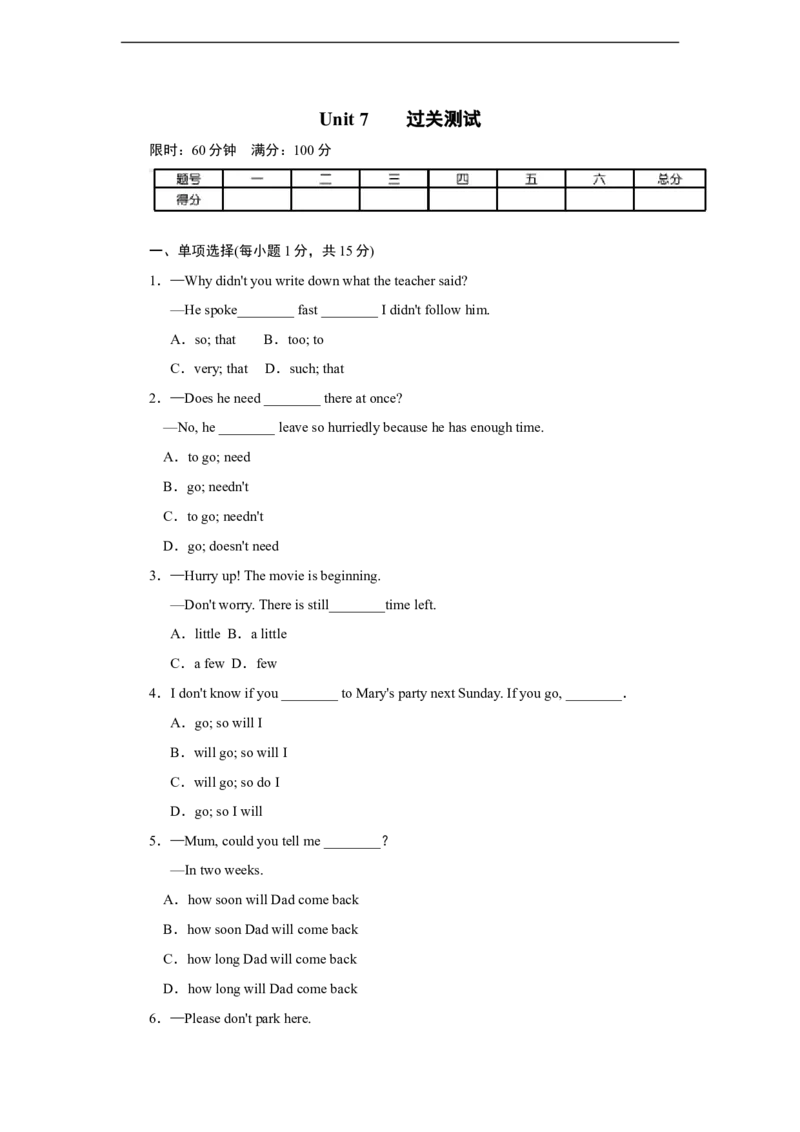
Unit 7 过关测试
限时:60分钟 满分:100分
一、单项选择(每小题1分,共15分)
1.—Why didn't you write down what the teacher said?
—He spoke________ fast ________ I didn't follow him.
A.so; that B.too; to
C.very; that D.such; that
2.—Does he need ________ there at once?
—No, he ________ leave so hurriedly because he has enough time.
A.to go; need
B.go; needn't
C.to go; needn't
D.go; doesn't need
3.—Hurry up! The movie is beginning.
—Don't worry. There is still________time left.
A.little B.a little
C.a few D.few
4.I don't know if you ________ to Mary's party next Sunday. If you go, ________.
A.go; so will I
B.will go; so will I
C.will go; so do I
D.go; so I will
5.—Mum, could you tell me ________?
—In two weeks.
A.how soon will Dad come back
B.how soon Dad will come back
C.how long Dad will come back
D.how long will Dad come back
6.—Please don't park here.—________.
A.Never mind
B.Sorry, I won't
C.Thank you very much
D.It doesn't matter
7.—Have you watched the new movie Kung Fu Panda 3, Kelly?
—Not yet. I ________ it with my classmate tonight.
A.will watch
B.was watching
C.have watched
D.watch
8.—Is there a watermelon on the table?
—________
A.Yes, there is. B.Yes, it is.
C.No, there is. D.No, it isn't.
9.—Daniel, could you tell me________?
—Certainly, in Japan.
A.when the 2020 Olympics will be held
B.when will the 2020 Olympics be held
C.where the 2020 Olympics will be held
D.where will the 2020 Olympics be held
10.Many wild animals are________, and it's time for us to do whatever we can to
protect them.
A.on duty B.on show
C.in order D.in danger
11.Teenagers should be encouraged to go ________ and be close to nature.
A.inside B.back
C.outside D.off
12.Jason likes the________of the cake. It is a heart.
A.color B.size
C.smell D.shape
13.—He got an A in last week's math test.—It is ________!His math is always the worst.
A.possible B.simple
C.impossible D.bored
14.Take it easy. I am sure you ________ work it out soon.
A.will can B.will be able to
C.be able to D.could
15.At this point,Bob and Tom have several ________.Who do you ________ with?
A.disagree; disagreements
B.disagreements; disagree
C.agreements; disagrees
D.disagreement; disagree
二、完形填空(每小题1分,共10分)
Let me tell you about the best day of my life! I got up early and ran to the kitchen in my
pyjamas(睡衣). It was my thirteenth birthday and I was really ________16.In fact, I wasn't
sleeping all night because I kept ________17 all the presents I would get.
I walked into the kitchen with a big smile on my face, ________18 nobody looked up.
Mum and Dad were reading their newspapers while my two older brothers were eating
breakfast. ________19 said a word! “They have forgotten about my birthday!” I said to
myself. I turned around and walked out of the ________20. Suddenly, I heard a noise, so I
went back to ________21 what it was. I couldn't believe my eyes! There were lots of
________22 on the kitchen table. “Surprise!” I heard ________23 me. When I turned
around, I saw Mum, Dad and my brothers! Mum was holding a huge ________24 with
candles and they were singing “Happy Birthday” to me. We shared the cake and opened all
the presents.
They didn't ________25 my birthday after all. It really was the best day of my life!
16.A.lonely B.excited C.successful D.weak
17.A.thinking about B.picking up C.taking out D.putting away
18.A.for B.so
C.or D.but
19.A.Nobody B.Anybody
C.Somebody D.Everybody20.A.garden B.kitchen
C.bedroom D.study
21.A.see B.taste
C.explain D.choose
22.A.newspapers B.presents
C.menus D.rings
23.A.of B.above
C.behind D.from
24.A.picture B.bowl
C.spoon D.cake
25.A.realise B.enjoy
C.forget D.celebrate
三、阅读理解(每小题2分,共20分)
A
Copenhagen is a city full of fairy tales (童话故事). If you want to explore it, you have
to spend a long time and walk slower to enjoy yourself. Copenhagen was the first city to have
a street for walkers only. The city has less traffic noise and pollution than any other European
capital.
Walking along the river banks, you'll see the Amalienborg Palace first. The king's family
is living there.
Churches and castles show us the original (最初的) city. Copenhagen became the capital
of Denmark in 1445.But fires in 1728 and 1795 completely destroyed (摧毁) the old wooden
buildings. Much of what we see today dates back to (追溯到) the 19th and early 20th
centuries.
Keep going, and you'll see the Christiansborg Palace. The town of Copenhagen began
there. Then you will see Nyhavn (尼哈芬),a waterway, which was dug in 1673.When you
see it, you'll understand why Hans Christian Andersen made this beautiful waterway his
home. Nyhavn is a peaceful and wonderful place. You'll usually see some rich people walk
along here.
If you walk there, you can enjoy the old trees, the colourful lights and the beautiful
gardens. You might feel as if you were in a fairy tale.26.The underlined word “explore” in Paragraph 1 probably means ________ in Chinese.
A.探索 B.进入 C.找到 D.离开
27.Which of the following European capital cities has the least traffic noise and pollution?
A.London. B.Rome.
C.Paris. D.Copenhagen.
28.We can NOT see ________ in Copenhagen today.
A.churches and castles
B.the Amalienborg Palace
C.the old wooden buildings
D.the Christiansborg Palace
29.Which of the following is TRUE about Nyhavn?
A.Andersen made it his home.
B.It has a history of 383 years.
C.Rich people seldom walk along it.
D.It's a fictitious (虚构的) place in a fairy tale.
30.What does the passage mainly talk about?
A.Preventing fires.
B.Visiting Copenhagen.
C.Writing fairy tales.
D.Digging a waterway.
B
Peng Liyuan, First Lady of China, made a speech in English at the United Nations(联合
国)on September 26.She talked about education and shared her Chinese dream with the
world.
Peng began the speech with a story of her father. Her father grew up in a very small
village in China. In those days, not many villagers could read, so her father opened a night
school to teach them. With his help, many people learned to write their names and read
newspapers for the first time. And many women were able to teach their children how to
read. Peng's father's love for education influenced her deeply. She was lucky enough to have
a good education. Later, she followed in her father's footsteps and became a professor of
music.Education is important, but still, some children in China can't go to school. Peng hopes
that all children, especially girls, can have a good education, and that is her Chinese dream.
31.What language did Peng give her speech in at the United Nations?
_______________________________________________________________________
32.What's the main topic of Peng's speech?
_______________________________________________________________________
33.How did Peng's father help the villagers to learn to read and write?
_______________________________________________________________________
34.Why was Peng lucky enough?
_______________________________________________________________________
35.What's Peng's Chinese dream in the passage?
_______________________________________________________________________
四、 用所给词(组)的恰当形式填空(每小题2分,共20分)
36.There ________(not be) any paper books. Everyone will have books on computers.
37.We all want ________(predict) the future of ourselves.
38.Where do you think Sally ________ (work) ten years from now?
39.The pilot ________(fly) to New York two days ago, and he'll be back soon.
40.________(be) you at school yesterday evening? We had an exciting party.
41.—Does he always ________ (live) alone?
—I don't know.
42.—Where is Mr. Lu?
—I'm not sure. ________ he ________ (write) in his office?
43.Could you please ________ (buy) some snacks for me?
44.When I grow up, I ________ (be) a famous pilot.
45.My friend Liz often ________ (wash) her clothes on Wednesday.
五、补全对话(每小题2分,共10分)
A: What do you think our life will be like in 50 years?
B: Oh, I think our life will be much better.
A: ________46
B: We'll live on the space station.
A: ________47
B: We'll fly a spaceship(宇宙飞船) to get there.A: ________48
B: Yes. I think it will be more interesting.
A: Will there be banks, schools or shopping malls?
B: ________49 I think the shopping malls will have all kinds of things and we will take
everything for free.
A: ________50 Maybe everyone will enjoy his life there.
B: I agree. People will have a happier life.
六、 书面表达(共25分)
你们班下周将召开一次班会,主题是“22世纪的生活(Life in the 22nd Century)”。请
写一份80词左右的发言稿。
提示:1.人口(population)迅速增长;
2.机器人做工, 人们工作时间缩短,娱乐和旅游时间将更充裕。
_______________________________________________________________________
_______________________________________________________________________
_______________________________________________________________________
_______________________________________________________________________
_______________________________________________________________________
_______________________________________________________________________
_______________________________________________________________________
_______________________________________________________________________
_______________________________________________________________________
_______________________________________________________________________
_______________________________________________________________________Unit 7过关测试
一、1.A
2.C 点拨:语法判定法。句意:——他需要马上去那里吗?——不,他不必太匆忙离开,
因为他有足够的时间。need作为实义动词,常用结构 need to do sth.需要做某事;作
为情态动词,常用于否定形式needn't,不必。故选C。
3.B 4.B
5.B
6.B 点拨:语境判断法。句意:——请不要在这儿停车。——对不起,我不会了。
A.Never mind 不介意,没关系;B.Sorry, I won't对不起,我不会了;C.Thank you very
much 非常感谢你;D.It doesn't matter没关系。故选B。
7.A 8.A 9.C
10.D 点拨:句意:许多的野生动物处于危险之中,那么对于我们来说到了做我们能做
的事情来保护它们的时候了。A.on duty值班;B.on show在展出,在展览;C.in order
按顺序;D.in danger处于危险之中。故选D。
11.C 点拨:inside在里面;back回原处,向后地;outside在外面; off切断,走开。根据
后半句中接触大自然,可知“青少年应该被鼓励走到外面”。故选C。
12.D 点拨:color表示“颜色”,size表示“尺寸”,smell表示“味道”,shape表示
“形状”。根据后句句意“它是一个心形。”可知此处说的是蛋糕的形状,故选D。
13.C 点拨:possible可能的;simple简单的;impossible不可能的;bored厌烦的。根据答
语“他的数学成绩总是最糟糕的”可知他在上周的数学测试中得了个 A是“不可
能的”。故选C。
14.B 点拨:语法判定法。be able to 的将来时是will be able to。故选B。
15.B 点拨:disagree 是动词,意为“不同意”; disagreement和agreement是可数名词;
several后接可数名词复数。句意:在这点上,鲍勃和汤姆有几次争吵。你不同意谁呢?
故选B。
二、16.B
17.A 点拨: think about思考;pick up捡起;take out拿出;put away收起来。句意:事实
上,我整个晚上没睡,因为我一直在思考我将要获得的所有礼物。故选A。
18.D 点拨: for由于;so所以;or或者;but但是。句意:我面带大大的微笑进入厨房,
但是发现没有人抬头看。根据前后之间的转折关系,故选D。19.A 点拨:nobody没有人;anybody任何人; somebody有人;everybody每个人。根据
上下文可知没有人说话,故选A。
20.B 点拨:garden花园;kitchen厨房;bedroom卧室;study书房。根据上文作者进入厨
房,可知现在是走出厨房,故选B。
21.A 点拨:see看;taste尝尝;explain解释;choose选择。句意:突然我听到一声噪音,
所以我回去看看是什么。故选A。
22.B 点拨: newspaper报纸;present礼物;menu菜单;ring指环。句意:在厨房的餐桌
上有许多的礼物。根据后文可知是礼物,故选B。
23.C 点拨: of...的; above在……之上; behind在……后面;from从……。根据后文
作者转身,可知是来自身后的声音,故选C。
24.D 点拨: picture照片;bowl碗;spoon勺;cake蛋糕。根据with candles 可知是蛋糕,
故选D。
25.C 点拨:realise意识到;enjoy喜欢,享受;forget忘记;celebrate庆祝。根据上下文及
句意可知选C。
三、A 26.A 点拨:词义猜测题。 根据下文Walking along the river banks, you'll see the
Amalienborg Palace first.和Keep going, and you'll see the Christiansborg Palace.等可
以猜测explore应是“探索”的意思。故选A。
27.D 点拨:细节理解题。根据文章第一段Copenhagen was the first city to have a street
for walkers only.The city has less traffic noise and pollution than any other European
capital.可知哥本哈根比欧洲其他的首都有着更少的噪音和污染。故选D。
28.C 点拨:推理判断题。 根据文章第三段中But fires in 1728 and 1795 completely
destroyed (摧毁) the old wooden buildings.可知现在看不到古老的木制建筑。故选C。
29.A 点拨:细节理解题。根据文章倒数第二段中When you see it, you'll understand why
Hans Christian Andersen made this beautiful waterway his home.可知选A。
30.B 点拨:主旨大意题。 通读文章可知:这篇文章主要介绍了哥本哈根的悠久历史和
主要建筑。故选B。
B 31.In English. 32.Education.
33.He opened a night school.
34.Because she could have a good education.
35.All children, especially girls, can have a good education.
四、36.won't be 37.to predict 38.will work39.flew 40.Were 41.live 42.Is; writing
43.buy 44.will be 45.washes
五、46.Where will we live?
47.How will we get there?
48.Will it be interesting?
49.Yes. 50.That's great.
六、范文:
Life in the 22nd Century
Life in the 22nd century will be different from life in the 21st century.
The population will grow fast. There will be more and more people in the world and
most of them will live longer. Robots will do much dangerous and hard work.People will
work fewer hours, and they will have more free time for sports, watching TV and
traveling.More and more people will go to other countries for holidays.
I hope everyone will have a happy life in the 22nd century.
点评:本文运用了“总分总法”描述了22世纪的生活。总:(第1句),分:(第2——6
句),总:(第7句)。结构清晰,内容完整。文意连绵起伏,让人读来有一气呵成之感,充分
体现了英语语言的圆润流畅之美。