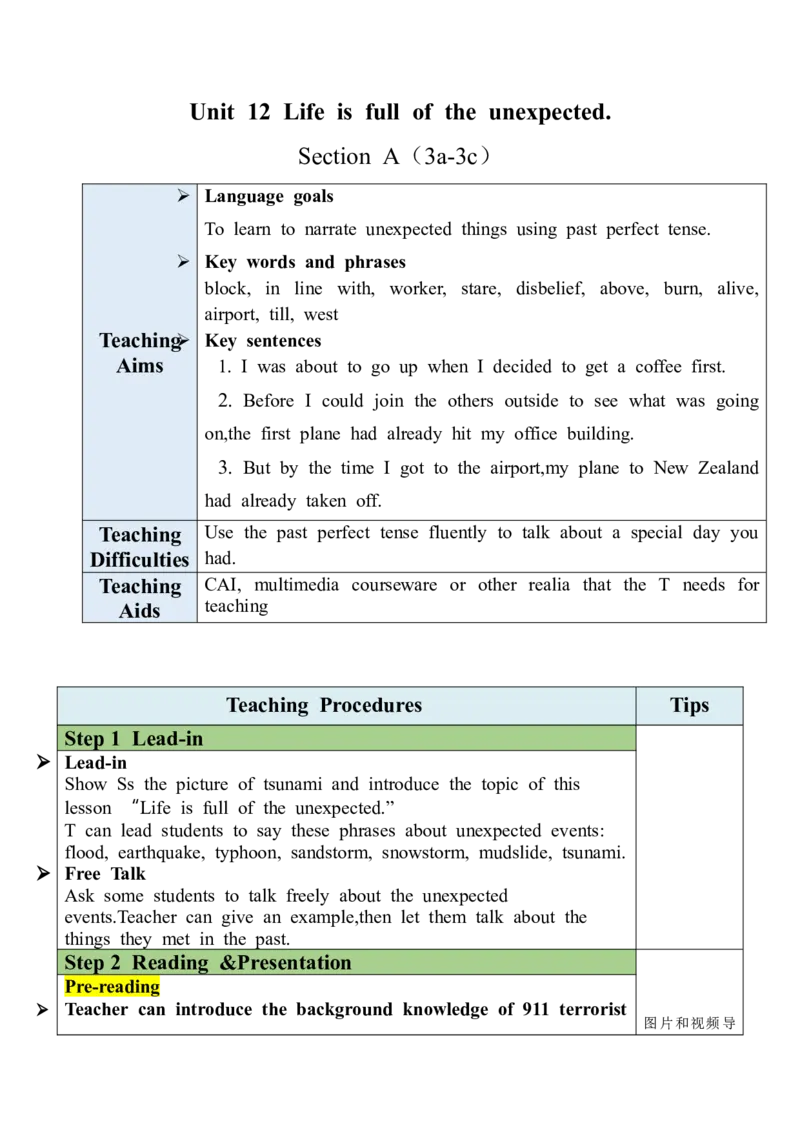
Unit 12 Life is full of the unexpected.
Section A(3a-3c)
Language goals
To learn to narrate unexpected things using past perfect tense.
Key words and phrases
block, in line with, worker, stare, disbelief, above, burn, alive,
airport, till, west
Teaching Key sentences
Aims 1. I was about to go up when I decided to get a coffee first.
2. Before I could join the others outside to see what was going
on,the first plane had already hit my office building.
3. But by the time I got to the airport,my plane to New Zealand
had already taken off.
Teaching Use the past perfect tense fluently to talk about a special day you
Difficulties had.
Teaching CAI, multimedia courseware or other realia that the T needs for
Aids teaching
Teaching Procedures Tips
Step 1 Lead-in
Lead-in
Show Ss the picture of tsunami and introduce the topic of this
lesson “Life is full of the unexpected.”
T can lead students to say these phrases about unexpected events:
flood, earthquake, typhoon, sandstorm, snowstorm, mudslide, tsunami.
Free Talk
Ask some students to talk freely about the unexpected
events.Teacher can give an example,then let them talk about the
things they met in the past.
Step 2 Reading &Presentation
Pre-reading
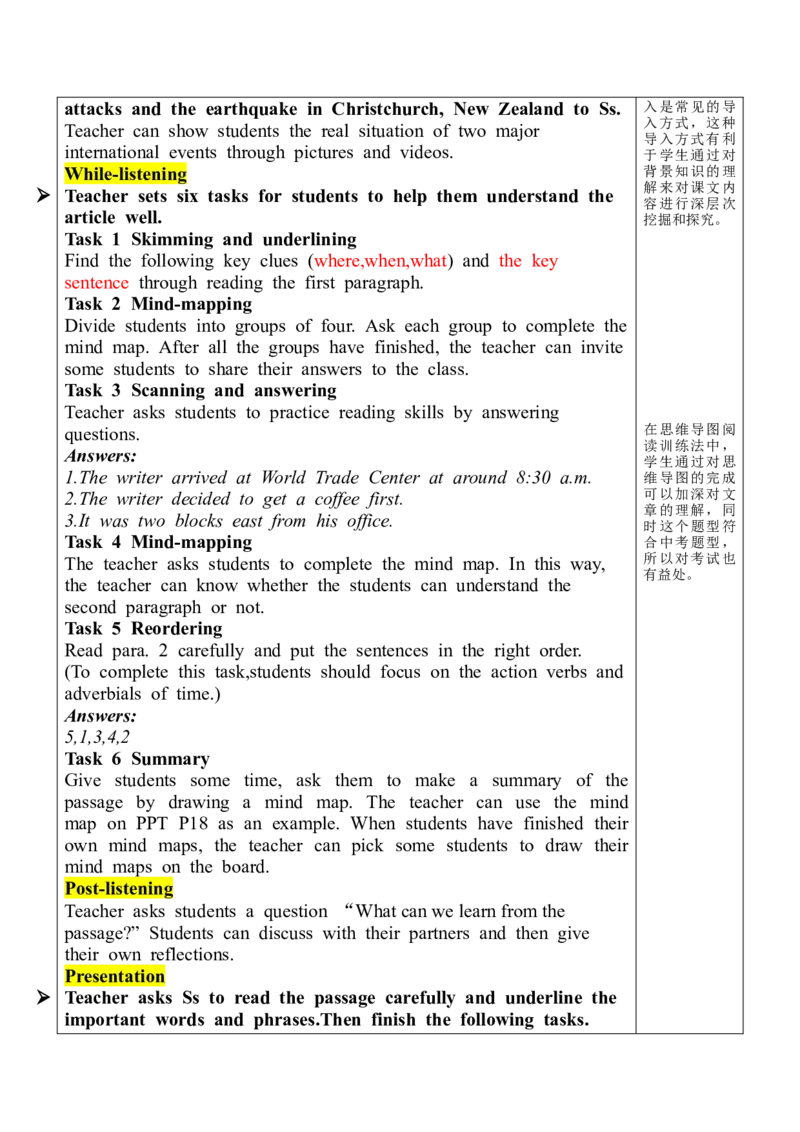
Teacher can introduce the background knowledge of 911 terrorist
图片和视频导attacks and the earthquake in Christchurch, New Zealand to Ss. 入是常见的导
入方式,这种
Teacher can show students the real situation of two major
导入方式有利
international events through pictures and videos.
于学生通过对
While-listening 背景知识的理
解来对课文内
Teacher sets six tasks for students to help them understand the
容进行深层次
article well. 挖掘和探究。
Task 1 Skimming and underlining
Find the following key clues (where,when,what) and the key
sentence through reading the first paragraph.
Task 2 Mind-mapping
Divide students into groups of four. Ask each group to complete the
mind map. After all the groups have finished, the teacher can invite
some students to share their answers to the class.
Task 3 Scanning and answering
Teacher asks students to practice reading skills by answering
questions. 在思维导图阅
读训练法中,
Answers:
学生通过对思
1.The writer arrived at World Trade Center at around 8:30 a.m. 维导图的完成
2.The writer decided to get a coffee first. 可以加深对文
章的理解,同
3.It was two blocks east from his office.
时这个题型符
Task 4 Mind-mapping 合中考题型,
The teacher asks students to complete the mind map. In this way, 所以对考试也
有益处。
the teacher can know whether the students can understand the
second paragraph or not.
Task 5 Reordering
Read para. 2 carefully and put the sentences in the right order.
(To complete this task,students should focus on the action verbs and
adverbials of time.)
Answers:
5,1,3,4,2
Task 6 Summary
Give students some time, ask them to make a summary of the
passage by drawing a mind map. The teacher can use the mind
map on PPT P18 as an example. When students have finished their
own mind maps, the teacher can pick some students to draw their
mind maps on the board.
Post-listening
Teacher asks students a question “What can we learn from the
passage?” Students can discuss with their partners and then give
their own reflections.
Presentation
Teacher asks Ss to read the passage carefully and underline the
important words and phrases.Then finish the following tasks.3a
Answer the questions in 3a.
Answers:
1.The writer mentioned the September 11 attacks in New York and the
February 21 earthquake in New Zealand.
2.The writer went to get a coffee first and was not in the office when
the plane hit the World Trade Center.
He/ She had overslept and missed his/ her flight, so he/ she was able
to avoid the earthquake.
3b
Finish the tasks of 3b.
Answers:
1.found I found a pen on the desk.
2.east The sun rises in the east.
3.above There was a plane flying above us.
4.alive She was so happy to hear he was still alive.
5.full The room is full of people.
3c
Work in pairs, ask students to retell one of the events to his /
her partner. Tell students that they can use the words in the
box of 3c to help them.
Answers will vary.
Step 3 Language points learning
be about to do sth.意为“刚要做某事,即将做某事”,表示即将发生
的动作,在时间上指最近的将来。
be about to do sth.通常不与具体的时间状语连用,而常与when引导的
时间状语从句连用。
alive是形容词,侧重说明生与死之间的界限,既可指人,也可指物。
可用来作表语,后置定语或宾补等。虽有死的可能,但还活着。
意为“活着的”,强调说明“尚在人间”,“健在”,可用来指
人或物,作定语或表语。My first teacher is still living.我的启蒙老
living
师仍健在。
意为“活的”,通常指物,不指人,常用作定语放在名词的前
面。
live
它还可指“实况转播的”。He said he had seen a live whale.他说他
看见过活鲸鱼。
意为“活泼的;活跃热情的;充满活力的”,可作定语、表语或
lively 宾补,既可指人,也可指物。Jenny is a lively girl.珍妮是个活泼的
女孩。
stare v. 后常接介词at/into,意为“凝视,盯着”,指由于好奇、惊
讶、赞叹等原因而瞪大眼睛长时间地、直接地注视,有时含有粗鲁无礼的意思。
look at指集中注意力地看,是有意的,强调“看”的动作。
in disbelief 不相信,疑惑,怀疑
above prep.
1)(表示位置)在……正上方;高于”(与 below相对)。
2) 表示在地位、级别、能力、资历、重要性等方面“超过”、
“在……之上”、“比……强”。
注意:on, over与above都可以表示“在……上”。
Step 4 Exercises,Summary & Homework 一节课后的练
习是必不可少
的环节,学生
Exercises
通过练习可以
Complete pages from 35 to 36 of the PPT. 加强对基础知
Summary 识的巩固。
The T can encourage Ss to summarize the key points of this class
to help Ss consolidate the knowledge.
Homework
Read and recite the passage in 3a.
Do the exercises in students’ book.
In this lesson, the teacher gives students enough time to read the
Teaching passage by themselves. Also, the teacher gives students lots of
Reflection chances to do the group discussion, and the students can understand
the passage better through group work.