文档文本内容
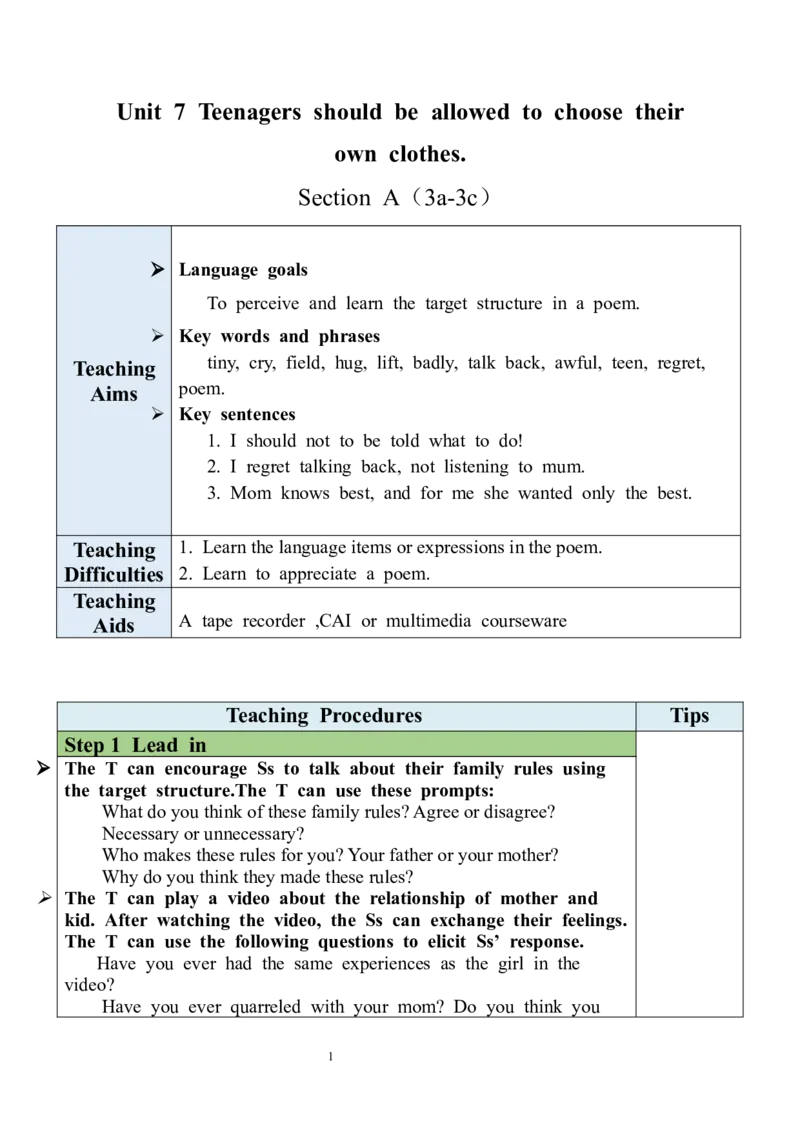
Unit 7 Teenagers should be allowed to choose their
own clothes.
Section A(3a-3c)
Language goals
To perceive and learn the target structure in a poem.
Key words and phrases
tiny, cry, field, hug, lift, badly, talk back, awful, teen, regret,
Teaching
poem.
Aims
Key sentences
1. I should not to be told what to do!
2. I regret talking back, not listening to mum.
3. Mom knows best, and for me she wanted only the best.
Teaching 1. Learn the language items or expressions in the poem.
Difficulties 2. Learn to appreciate a poem.
Teaching
Aids A tape recorder ,CAI or multimedia courseware
Teaching Procedures Tips
Step 1 Lead in
The T can encourage Ss to talk about their family rules using
the target structure.The T can use these prompts:
What do you think of these family rules? Agree or disagree?
Necessary or unnecessary?
Who makes these rules for you? Your father or your mother?
Why do you think they made these rules?
The T can play a video about the relationship of mother and
kid. After watching the video, the Ss can exchange their feelings.
The T can use the following questions to elicit Ss’ response.
Have you ever had the same experiences as the girl in the
video?
Have you ever quarreled with your mom? Do you think you
1and your mother understand each other?
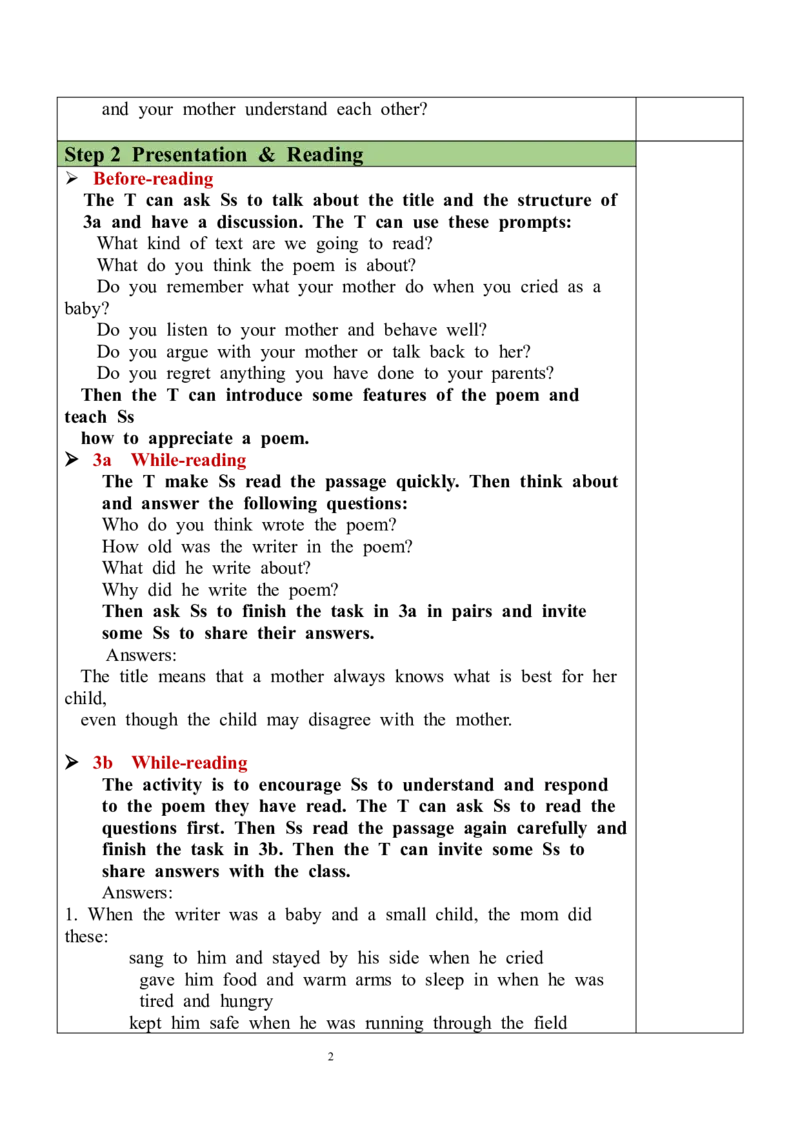
Step 2 Presentation & Reading
Before-reading
The T can ask Ss to talk about the title and the structure of
3a and have a discussion. The T can use these prompts:
What kind of text are we going to read?
What do you think the poem is about?
Do you remember what your mother do when you cried as a
baby?
Do you listen to your mother and behave well?
Do you argue with your mother or talk back to her?
Do you regret anything you have done to your parents?
Then the T can introduce some features of the poem and
teach Ss
how to appreciate a poem.
3a While-reading
The T make Ss read the passage quickly. Then think about
and answer the following questions:
Who do you think wrote the poem?
How old was the writer in the poem?
What did he write about?
Why did he write the poem?
Then ask Ss to finish the task in 3a in pairs and invite
some Ss to share their answers.
Answers:
The title means that a mother always knows what is best for her
child,
even though the child may disagree with the mother.
3b While-reading
The activity is to encourage Ss to understand and respond
to the poem they have read. The T can ask Ss to read the
questions first. Then Ss read the passage again carefully and
finish the task in 3b. Then the T can invite some Ss to
share answers with the class.
Answers:
1. When the writer was a baby and a small child, the mom did
these:
sang to him and stayed by his side when he cried
gave him food and warm arms to sleep in when he was
tired and hungry
kept him safe when he was running through the field
2hugged him and lifted him up when he fell
2. He felt that he was growing up and he did not want to be
treated
like a small child anymore.
3. He was upset because he felt that he was old enough to be
independent and should not be told what to do.
4. He loves his mom and is thankful for what she has done for
him.
3b
The T can make Ss read the poem again and perceive the
rhythm. And consolidate Ss’ understanding of the poem by
providing more questions for them.
Why did the mother sing to the crying baby?
How do you think a baby feels when he sleeps in his mother's
warm
arms?
What might happen when a two-year-old child runs through a
field? Why did the mom give the child a hug when he fell?
How did the boy feel when he was not allowed to eat ice-
cream?
Why did the boy say“I am not a baby”?
What did the writer regret when he grew up?
3c
The T can point out to Ss that the aim of this activity is to
give Ss practice in using the target language in everyday
conversations. The T may conduct the activity as a group
activity and have Ss share their stories in groups of four or
five. The T can use the following prompts to lead Ss.
How old were you at that time?
What did you want to do?
What did your mom / dad say?
Did you talk back to them?
Why did you say that at that time?
What did you do at last?
How do you feel about it now?
Step 3 Language points learning
field作名词,此处意为“田野;场地”,还可意为“领域”。常用 The
短语:in the field of 在......方面,在......领域。 language
make sure确保;核实 points are
hug作名词,give sb. a hug意为“给某人一个拥抱”。 for
reference
hug还可作动词,意为“拥抱;搂抱”。其过去式和过去分词都
3是hugged;现在分词为hugging。 only.
badly作副词,在此处意为“严重地”。
badly还可意为“差”,反义词为well“好”。
do badly in... 在......方面做得差。
regret作动词,意为“感到遗憾;懊悔”。其后通常接名词、代词、
从句、动词-ing形式或动词不定式作宾语。 regret还可作名词,意
为“懊悔;后悔”。
regret doing sth. 表示“后悔做了某事”(已做)。
regret to do sth. 表示“很遗憾去做某事”(未做)。
Step 4 Summary & Homework
Summary The T can encourage Ss to summarize the key points The
of this class to help Ss consolidate the knowledge. homework
Homework: can vary
Read and recite the passage in 3a. with the
Do the exercises in students’ book. specific
conditions.
In the process of English teaching, teachers should try their best to
encourage students to participate in the discussion and do not
overemphasize the correct answers. This can not only broaden
students' thinking space, help the development of creative thinking
Teaching
ability, but also help students master the language in use.
Reflection
Reading aloud is very important in poetry teaching. Teachers should
let students experience the rhythm of poetry while reading aloud, so
as to experience the feelings and artistic conception and enjoy the
beauty of the poem.
4