文档文本内容
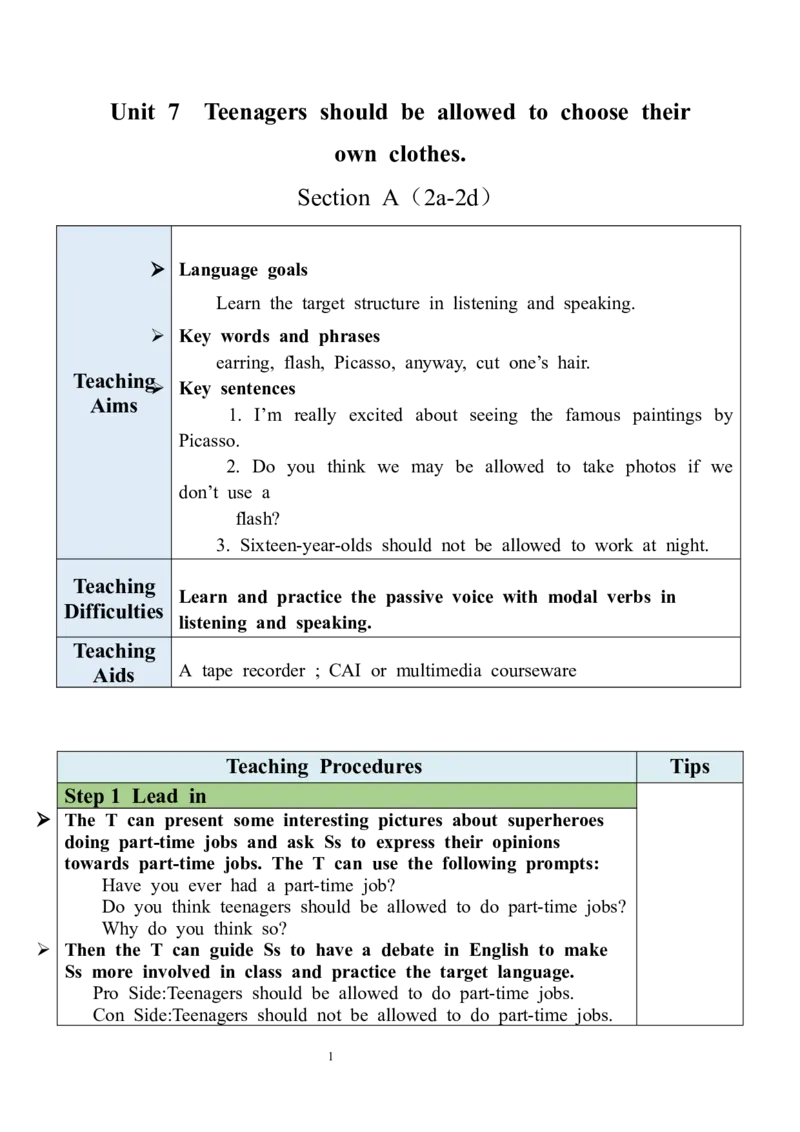
Unit 7 Teenagers should be allowed to choose their
own clothes.
Section A(2a-2d)
Language goals
Learn the target structure in listening and speaking.
Key words and phrases
earring, flash, Picasso, anyway, cut one’s hair.
Teaching
Key sentences
Aims
1. I’m really excited about seeing the famous paintings by
Picasso.
2. Do you think we may be allowed to take photos if we
don’t use a
flash?
3. Sixteen-year-olds should not be allowed to work at night.
Teaching
Learn and practice the passive voice with modal verbs in
Difficulties
listening and speaking.
Teaching
Aids A tape recorder ; CAI or multimedia courseware
Teaching Procedures Tips
Step 1 Lead in
The T can present some interesting pictures about superheroes
doing part-time jobs and ask Ss to express their opinions
towards part-time jobs. The T can use the following prompts:
Have you ever had a part-time job?
Do you think teenagers should be allowed to do part-time jobs?
Why do you think so?
Then the T can guide Ss to have a debate in English to make
Ss more involved in class and practice the target language.
Pro Side:Teenagers should be allowed to do part-time jobs.
Con Side:Teenagers should not be allowed to do part-time jobs.
1Step 2 Presentation & Practice
2a
Before listening , the T can ask Ss to look at the picture in
2a and read the statements in the chart.Then Ss try making
predictions. The T can use the following prompts:
What is the boy in the picture doing?
Where do you think we can see it in our daily life?
2a
The activity is to give Ss practice in listening to different
opinions. At the beginning, the T play the recording for the
first time and make Ss to finish the task in 2a. Then the T
may play the recording for the second time and stop at the
key point to make Ss to check their own answers. At last the
T can present the correct answers.
Answers:
1. D 2.A 3.DK 4.D 5.A
After Ss have completed the activity 2a, the T may highlight
the different ways of giving opinions used by the speakers.
should/I think/ I don’t think/I agree/ I disagree/ I don’t know...
2b
The activity is to give Ss practice in listening for specific
reasons given to support opinions expressed. Ask Ss to read
the reasons and reorder them from memory. Then the T can
play the recording and make Ss to check their answers. Then
the T can invite some Ss to read the reasons in the right
order.
Answers: 4, 1, 5, 2, 3
2b
Play the recording again and ask Ss to focus attention to
more details in the conversation. The T can provide more
exercises to check Ss’ understanding like True or False:
1.Molly is working late tonight. ( F )
2. Both Kathy and Molly think teenage boys never get tired. ( F
)
3. Kathy and Molly don’t think Larry should work every night. ( T
)
4. Larry’s hair is too long and doesn’t look clean. ( T )
5. Larry doesn’t have many friends because he doesn’t like to
make friends. ( F )
After listening , the T can present the listening material to
the students in need to help them get the specific information
2about the conversation.
2c
To give Ss opportunity to talk about what teenagers should or
should not be allowed to do, the T may conduct the activity
by having Ss work in pairs first to make a list of things that
teenagers should or should not be allowed to do. Once Ss
have done that, ask each pair to join another pair. The two
pairs can take turns to ask and answer questions using the
model given in the blue box. Remind Ss to give reasons to
support their opinions.
Should not
Should
Step 3 Presentation & Reading
2d
Before reading, the T can use these prompts to encourage
Ss to have a discussion so that Ss’ interest can be aroused:
How will you feel if you know you are going to visit an art
museum?
What will you do there?
Do you think you will be allowed to take photos in a museum?
Why?
Then the T can play a video to explain why taking photos
in museums is not allowed and elicit more museum rules
from Ss.
2d
The T can ask Ss to read the conversation carefully. The T
can check their understanding by asking them questions :
1. What’s the relationship between Sandy and Wu Lan?
2. Where are they going for the school trip this year?
3. How does Sandy feel about the trip? Why?
4. What did Mr. Smith say about the rules in the museum?
5. What does Sandy think they should be allowed to do in the
museum?
2d
The T can focus Ss’ attention on the structure of passive
voice appeared in the conversation and other key word
3groups. Ss can be asked to make sentences using the key
structure and phrases.Then the T can make Ss read the
conversation in chorus to check their pronunciation and
intonation. At last the T can invite some Ss to role-play the
conversation as open pairs.
Step 4 Summary & Homework
Summary The T can encourage Ss to summarize the key points The
of this class to help Ss consolidate the knowledge. homework
Homework: can vary
Preview the passage in 3a. with the
Do the exercises in students’ book. specific
conditions.
We can discuss the school rules in the passive voice.We teach the students
to use “should be allowed to do/should not be allowed to do” in this
Teaching unit.They can learn by listening and speaking about the rules they are
Reflection familiar with.They have a lot to say and this can help them learn fast.In this
period,we can use reflecting and transforming strategy to lead the students
to talk about rules and practice oral ability.
4