文档文本内容
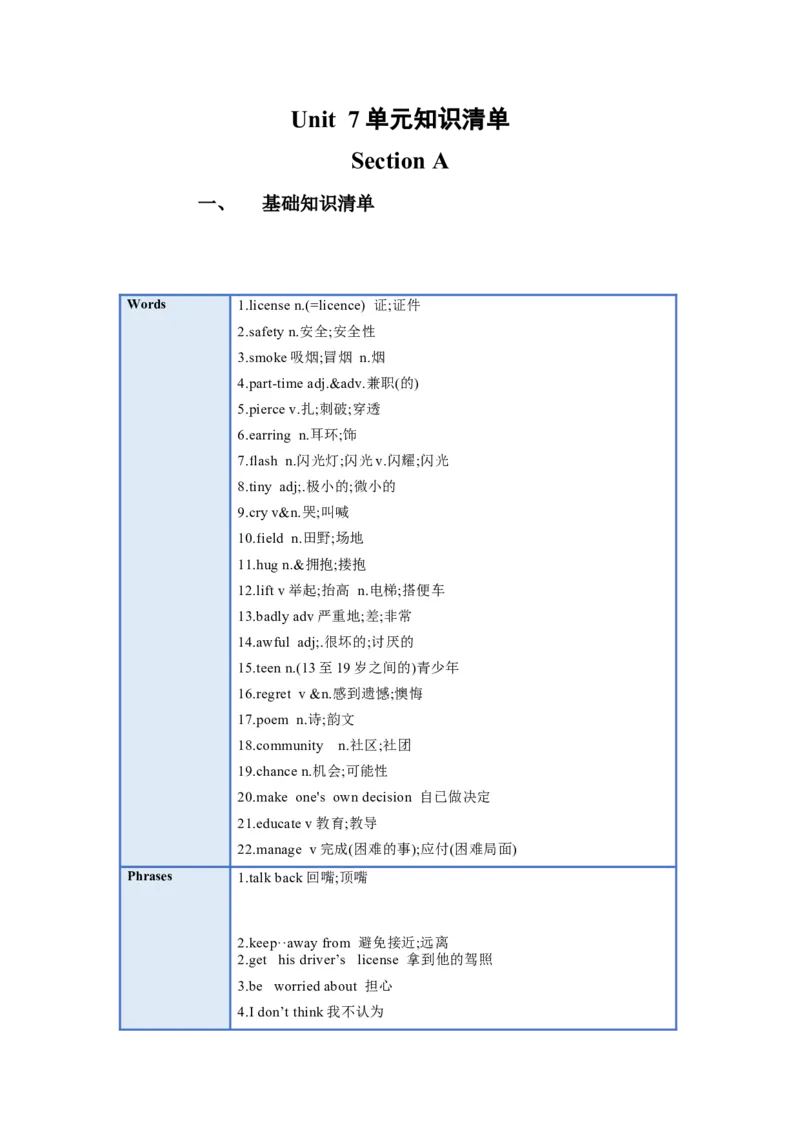
Unit 7 单元知识清单
Section A
一、 基础知识清单
Words 1.license n.(=licence) 证;证件
2.safety n.安全;安全性
3.smoke吸烟;冒烟 n.烟
4.part-time adj.&adv.兼职(的)
5.pierce v.扎;刺破;穿透
6.earring n.耳环;饰
7.flash n.闪光灯;闪光v.闪耀;闪光
8.tiny adj;.极小的;微小的
9.cry v&n.哭;叫喊
10.field n.田野;场地
11.hug n.&拥抱;搂抱
12.lift v举起;抬高 n.电梯;搭便车
13.badly adv严重地;差;非常
14.awful adj;.很坏的;讨厌的
15.teen n.(13至19岁之间的)青少年
16.regret v &n.感到遗憾;懊悔
17.poem n.诗;韵文
18.community n.社区;社团
19.chance n.机会;可能性
20.make one's own decision 自已做决定
21.educate v教育;教导
22.manage v完成(困难的事);应付(困难局面)
Phrases 1.talk back回嘴;顶嘴
2.keep··away from 避免接近;远离
2.get his driver’s license 拿到他的驾照
3.be worried about 担心
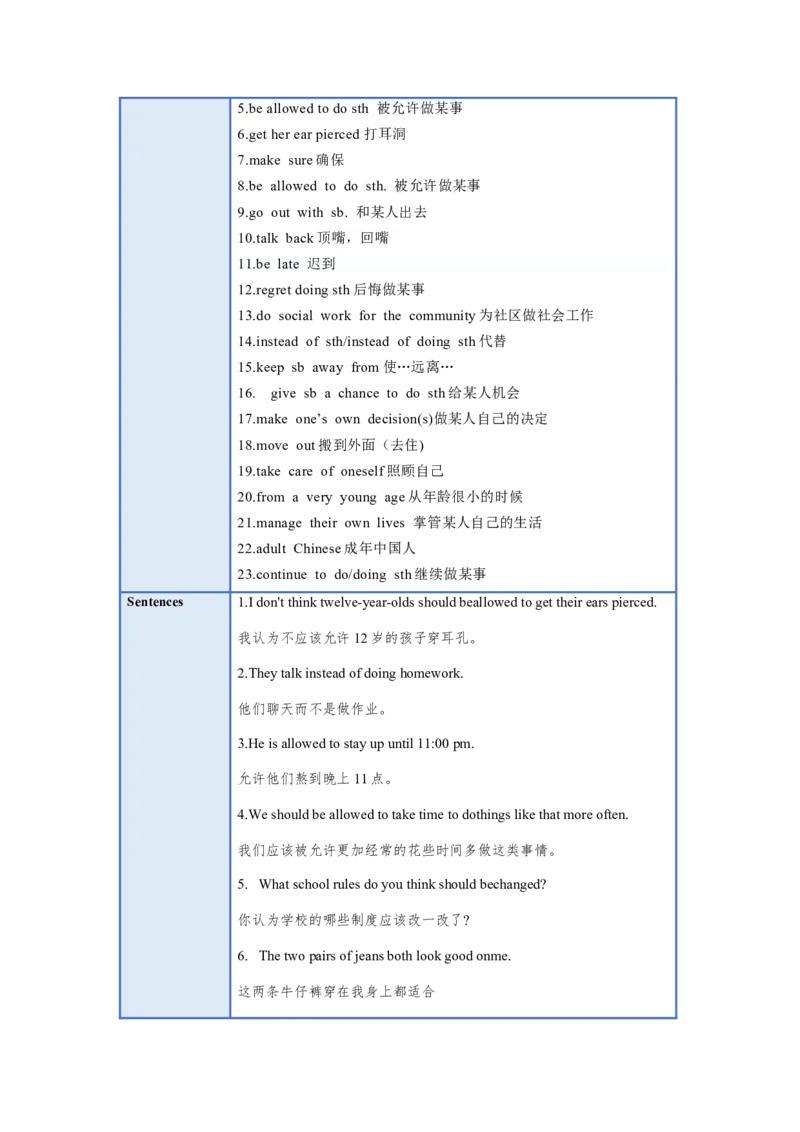
4.I don’t think我不认为5.be allowed to do sth 被允许做某事
6.get her ear pierced 打耳洞
7.make sure确保
8.be allowed to do sth. 被允许做某事
9.go out with sb. 和某人出去
10.talk back顶嘴,回嘴
11.be late 迟到
12.regret doing sth后悔做某事
13.do social work for the community为社区做社会工作
14.instead of sth/instead of doing sth代替
15.keep sb away from使…远离…
16. give sb a chance to do sth给某人机会
17.make one’s own decision(s)做某人自己的决定
18.move out搬到外面(去住)
19.take care of oneself照顾自己
20.from a very young age从年龄很小的时候
21.manage their own lives 掌管某人自己的生活
22.adult Chinese成年中国人
23.continue to do/doing sth继续做某事
Sentences 1.I don't think twelve-year-olds should beallowed to get their ears pierced.
我认为不应该允许12岁的孩子穿耳孔。
2.They talk instead of doing homework.
他们聊天而不是做作业。
3.He is allowed to stay up until 11:00 pm.
允许他们熬到晚上11点。
4.We should be allowed to take time to dothings like that more often.
我们应该被允许更加经常的花些时间多做这类事情。
5. What school rules do you think should bechanged?
你认为学校的哪些制度应该改一改了?
6. The two pairs of jeans both look good onme.
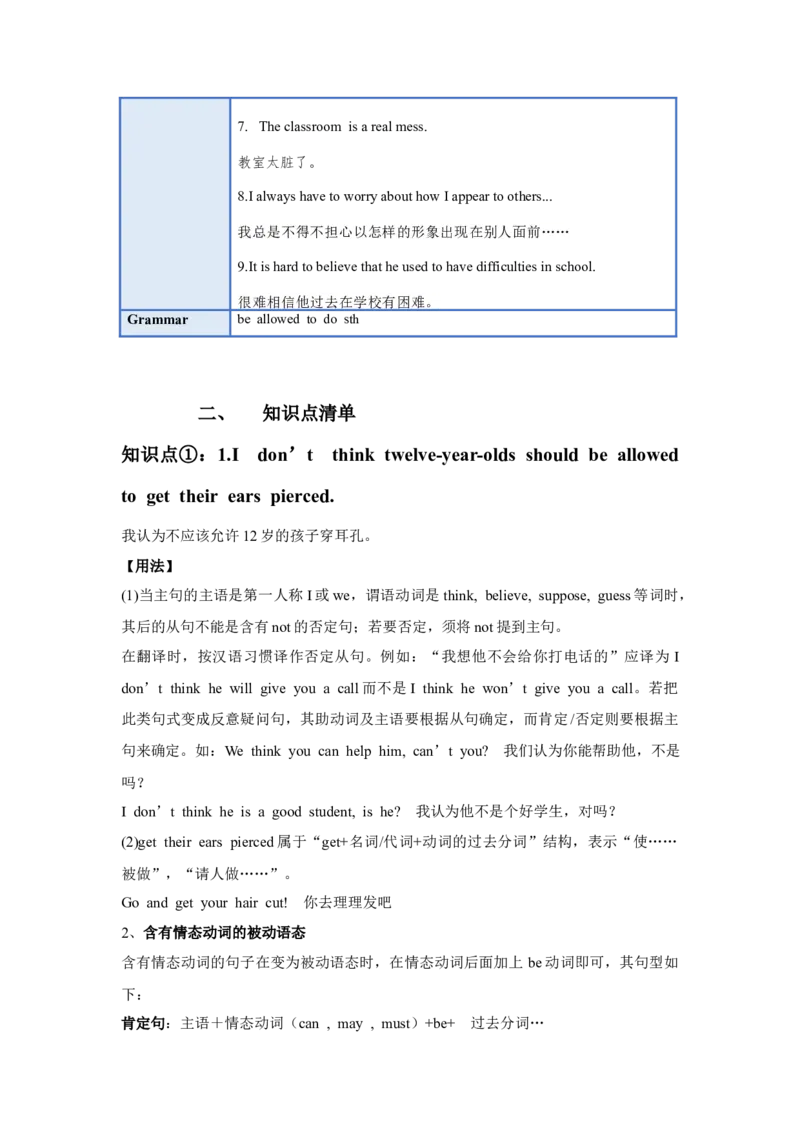
这两条牛仔裤穿在我身上都适合7. The classroom is a real mess.
教室太脏了。
8.I always have to worry about how I appear to others...
我总是不得不担心以怎样的形象出现在别人面前……
9.It is hard to believe that he used to have difficulties in school.
很难相信他过去在学校有困难。
Grammar be allowed to do sth
二、 知识点清单
知识点①:1.I don’t think twelve-year-olds should be allowed
to get their ears pierced.
我认为不应该允许12岁的孩子穿耳孔。
【用法】
(1)当主句的主语是第一人称I或we,谓语动词是think, believe, suppose, guess等词时,
其后的从句不能是含有not的否定句;若要否定,须将not提到主句。
在翻译时,按汉语习惯译作否定从句。例如:“我想他不会给你打电话的”应译为 I
don’t think he will give you a call而不是I think he won’t give you a call。若把
此类句式变成反意疑问句,其助动词及主语要根据从句确定,而肯定/否定则要根据主
句来确定。如:We think you can help him, can’t you? 我们认为你能帮助他,不是
吗?
I don’t think he is a good student, is he? 我认为他不是个好学生,对吗?
(2)get their ears pierced属于“get+名词/代词+动词的过去分词”结构,表示“使……
被做”,“请人做……”。
Go and get your hair cut! 你去理理发吧
2、含有情态动词的被动语态
含有情态动词的句子在变为被动语态时,在情态动词后面加上 be动词即可,其句型如
下:
肯定句:主语+情态动词(can , may , must)+be+ 过去分词…否定句:主语+情态动词+not + be + 过去分词…
疑问句:情态动词(Can , May , Must )+主语+be+过去分词+….
知识点②.no way 不行
这是英语口语中一个直接拒绝对方的用语,强调不能按照他人的要求去做某事或不允
许别人做某事。
No way will she agree to you leaving early.
她不可能同意你早点离开的。
[拓展]英语口语中还常用There’s no way ...这样的惯用表达来陈述某人不可能做某事。
* There is no way to measure these effects, and the chances are it did some good
没办法衡量这些效果,可能它起到了一些作用
知识点③:be worried about 担心·····
be worried about是固定短语,其中worried作形容词,意为“担心的;担忧的;发愁的”。
相当于worry about /over。
* I am worried about his health.我担心他的健康
* They are worried about prospective changes in the law他们担心即将修改法律。
知识点④.safety n.安全;安全性
for safety 为了安全起见
the safety of··· 的安全
in safety( safely) 安全地
.* The inhabitants have been removed for safety
为安全起见,居民已被疏散。
* The captain cares the safety of both the crew and the passengers.
船长为船员和旅客们的安全担心。
* They crossed the road in safety他们安全地穿过了马路
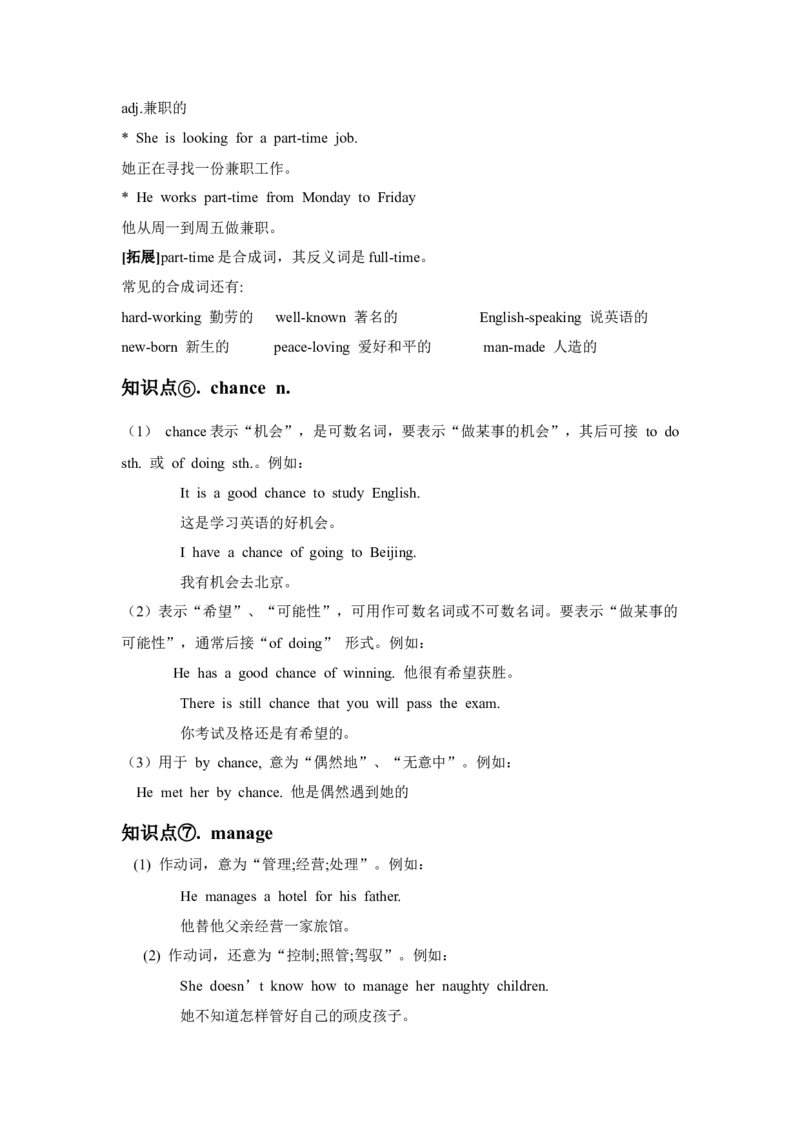
知识点⑤. part-time n.安全;安全性
adv.兼职adj.兼职的
* She is looking for a part-time job.
她正在寻找一份兼职工作。
* He works part-time from Monday to Friday
他从周一到周五做兼职。
[拓展]part-time是合成词,其反义词是full-time。
常见的合成词还有:
hard-working 勤劳的 well-known 著名的 English-speaking 说英语的
new-born 新生的 peace-loving 爱好和平的 man-made 人造的
知识点⑥. chance n.
(1) chance表示“机会”,是可数名词,要表示“做某事的机会”,其后可接 to do
sth. 或 of doing sth.。例如:
It is a good chance to study English.
这是学习英语的好机会。
I have a chance of going to Beijing.
我有机会去北京。
(2)表示“希望”、“可能性”,可用作可数名词或不可数名词。要表示“做某事的
可能性”,通常后接“of doing” 形式。例如:
He has a good chance of winning. 他很有希望获胜。
There is still chance that you will pass the exam.
你考试及格还是有希望的。
(3)用于 by chance, 意为“偶然地”、“无意中”。例如:
He met her by chance. 他是偶然遇到她的
知识点⑦. manage
(1) 作动词,意为“管理;经营;处理”。例如:
He manages a hotel for his father.
他替他父亲经营一家旅馆。
(2) 作动词,还意为“控制;照管;驾驭”。例如:
She doesn’t know how to manage her naughty children.
她不知道怎样管好自己的顽皮孩子。(3) 作动词,还指“设法做到”。例如:
How did you manage to get their approval?
你怎么得到他们的同意的?
【拓展】辨析:manage to do 与try to do
manage to do… 则表示“设法做某事而且成功了”。
try to do… 意为“尽力做某事”,但是不一定做成。例如:
He managed to pass the examination. = He succeeded in passing the examination.
他成功地通过了考试。
He tried to get the work done with little help.
他尽量在没有什么帮助的情况下完成工作。
知识点⑧. choose
1.choose作动词,意为“选择,挑选”,后接宾语,常用搭配如下:
choose sth. for sb. 为某人选择某物;
choose sb. to do sth. 选择某人做某事;
2.choose + wh从句(where,what,when等引导的特殊疑问句)例如:
We has chosen a birthday present for you.
我们已经为你选择了一个礼物。
I’d like to choose Jim to go there with me.
我选择吉姆和我一起去。
Our teacher will let us choose where we should have our picnic.
我们老师要我们选择哪儿野炊。
知识点⑨. support
(1)support用作动词,意为“支撑、负担重量”。例如:
Is the bridge strong enough to support heavy lorries?
这个大桥是足够结实支撑这个重的货车吗?
(2)support用作动词,意为“养(家);维持(生活);负担(费用)等”。例如:
It’s difficult for him to support himself on such a small salary.
对于他用这么低的薪水养家很困难。
They encouraged me, and they supported me with money.
他们不仅鼓励我,而且与我以金钱上的支持。(3)support用作动词,还表示“支持,赞成”。例如:
His family supported him in his decision.
他的家庭支持他的决定。
(4)in support of 表示“支持,证明 (作状语)”。例如:
He spoke in support of the plan.
他发言支持这项计划。
知识点⑩. enter
(1)enter作动词,意为“进入”。等同于go into, come into。注意enter后面不能跟
into。例如:
She entered the room quietly. = She went into the room quietly.
她悄悄地进入屋中。
(2)enter还可意为“参加,加入;使参加;开始从事;登陆,将……输入”。例如:
The United States did not enter the war until April 19, 1917.
美国直到一九一七年四月十九日才参战。
They entered their child at a private school.
他们让他们的孩子在一所私立学校就读。
He showed me how to enter data into the computer.
他告诉我如何将数据输入计算机。
知识点11. hurt
1.hurt为普通用语,既可指肉体上的伤害,也可指精神上、感情上的伤害。例如:
You hurt her feelings when you said she was fat.
你说她胖,伤害了她的感情了。
I hope you haven’t hurt yourself. 但愿你没有受伤。
【拓展】表示人体某部位“痛”时的几种结构:
(1)have a + 身体部位名词后加-ache构成。例如:
have a headache 头痛
have a toothache 牙痛
have a stomachache胃痛
(2)have a sore + 身体部位名词。例如:have a sore throat 喉咙痛
have a sore arm 胳膊痛
(3)身体部位 + hurt/ache。例如:
My eyes hurts. 我眼睛痛。
My legs ache. 我腿疼。
(4)have a pain in/ on + the + 身体部位。例如:
I have a pain in the arm. 我胳膊痛。
(5)There is something wrong with + one’s + 身体部位。例如:
There is something wrong with your eyes. 你的眼睛有毛病。
知识点12. achieve
(1) achieve作及物动词,意为“完成,实现”。例如:
You will never achieve anything if you spend your time that way.
你若总是这样消磨时间,就永远不会有所成就。
Everybody should be given the chance to achieve their aims.
要让每个人都有机会实现自己的目标。
No one can achieve anything without effort.
谁也不可能不努力而有所作为。
(2) achieve作及物动词,意为“达到,赢得”。例如:
The actor achieved fame when he was only nineteen.
那位演员十九岁时就成名了。
She achieved no success. 她有没获得成功。
【拓展】achievement作名词,意为“成就,成绩”。例如:
The invention of the computer is a great achievement.
发明电脑是一大成就。
知识点13. dream
dream意为“做梦”,作不及物动词,常用于短语 dream of/about doing sth.意为“梦
想/梦见做某事”。例如:
He often dreams at night. 他在晚上经常做梦。
She often dreams of / about her grandmother.
她经常梦到她的奶奶。Many young people dream of/about becoming famous basketball player.
许多年轻人都梦想成为有名的篮球运动员。
三、 语法清单
知识点:被动态.
语法概述
含有情态动词的被动语态的基本构成是:情态动词+ be +及物动词的过去分词。常见的情态
动词有: should,could /can,must,may/might;need,dare等含有情态动词的被动语态的
句式结构
肯定句:主语+情态动词+ be +及物动词的过去分词(+ by +宾语)
否定句:主语+情态动词+not + be +及物动词的过去分词(by+宾语)
一般疑问句:情态动词+主语+ be +及物动词的过去分词(+ by +宾语)?
1、情态动词的被动语态结构为:情态动词+be+过去分词; 其时态及句型的变化仅由情态
动词完成,“be+过去分词”部分不变。
Tables can be made of stone. 桌子可由石头制造。
Tables could be made of stone at that time. 那时桌子可由石头制造。(一般过去时)
Can tables be made of stone? 桌子能用石头制造吗?(疑问句)
2、含有情态动词的被动语态变为否定句时,应在情态动词后面加 not;变为一般疑问句
时,应将情态动词移到句首。
Waste paper should not be thrown here. 废纸不应该扔在这里。
Should it be done by Li Ming?这件事应该是李明干吗?
3、含有情态动词的主动语态变为被动语态时,要把主动语态中的宾语变为被动语态中的
主语;主动语态中的谓语动词变为“情态动词+助动词be+过去分词”;主动语态中的主
语变为介词by 的宾语,放在句尾(如果不强调动作的执行者,by短语常可省略)。
Parents should allow fourteen-year-olds to choose their own clothes.
→Fourteen-year-olds should be allowed to choose their own clothes(by parents)
父母应该允许十四岁的少年选择他们自己的服装。.