文档文本内容
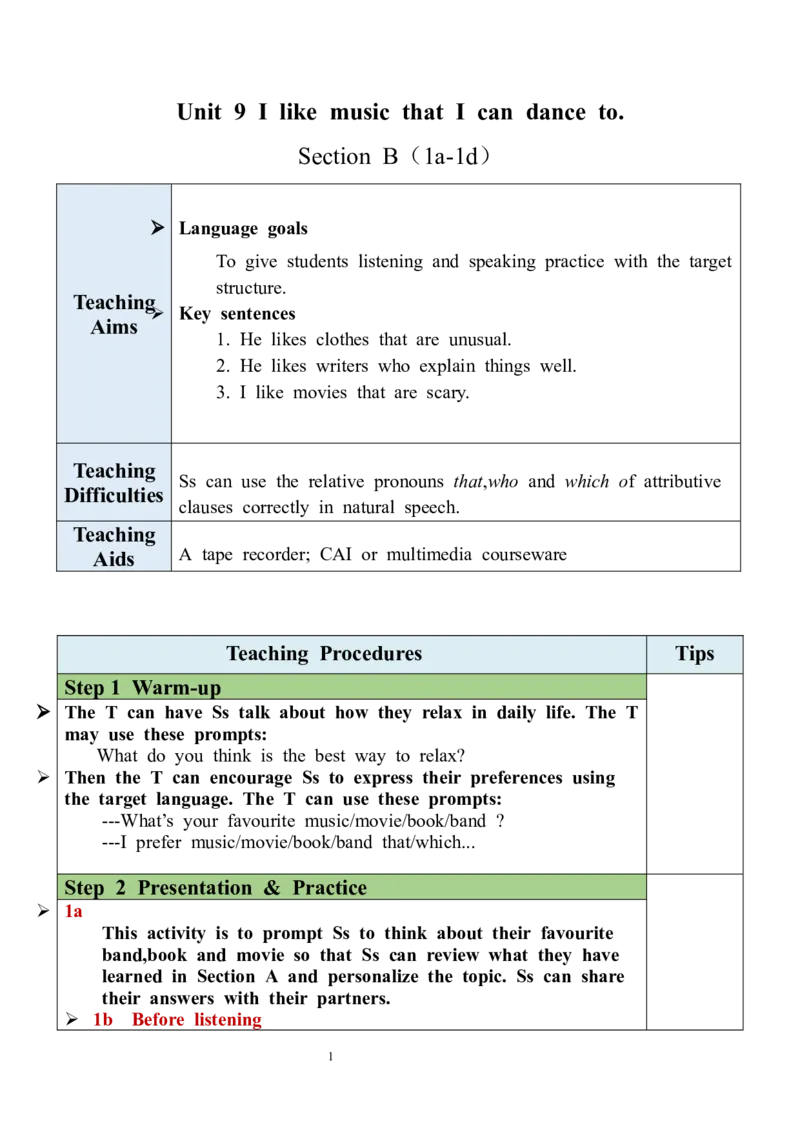
Unit 9 I like music that I can dance to.
Section B(1a-1d)
Language goals
To give students listening and speaking practice with the target
structure.
Teaching
Key sentences
Aims
1. He likes clothes that are unusual.
2. He likes writers who explain things well.
3. I like movies that are scary.
Teaching
Ss can use the relative pronouns that,who and which of attributive
Difficulties
clauses correctly in natural speech.
Teaching
Aids A tape recorder; CAI or multimedia courseware
Teaching Procedures Tips
Step 1 Warm-up
The T can have Ss talk about how they relax in daily life. The T
may use these prompts:
What do you think is the best way to relax?
Then the T can encourage Ss to express their preferences using
the target language. The T can use these prompts:
---What’s your favourite music/movie/book/band ?
---I prefer music/movie/book/band that/which...
Step 2 Presentation & Practice
1a
This activity is to prompt Ss to think about their favourite
band,book and movie so that Ss can review what they have
learned in Section A and personalize the topic. Ss can share
their answers with their partners.
1b Before listening
1The T may lead in to the activity by asking Ss to describe
what
they see in the picture. Prompt Ss to guess the relationship
between
the two people. Draw their attention to the chart and have Ss
work
in pairs to predict the answers. These predictions may be
written
on a separate piece of paper and checked against the actual
answers after activities 1b and 1c are completed.
1b While listening
The T can play the recording and Ss finish the task in 1b.
Then the T can invite some Ss to share answers to check.
Answers: jacket, book, movie poster
1c While listening
This activity is to give Ss practice in listening for details. The
T can encourage Ss to recall what they heard in activity 1b
and attempt activity 1c without listening to the recording
again. When Ss have filled in their answers, the T can play
the recording for Ss to check their answers.
Answers:
1. He likes clothes that are unusual .
2. He likes writers wh o explai n thing s wel l.
3. He likes movies tha t ar e scar y.
Teaching Tip:
The conversation begins with Ali commenting that Michael
has a lot of “cool” things. The word “cool” has several
meanings. Do Ss know what “cool” means in the context of
the conversation? Used in this context, it is an informal
expression of approval. It is used to say that something
/someone is interesting, attractive or fashionable without
having to be specific about the qualities that make them so.
1d
The activity is to give Ss the opportunity to use the target
language to talk about things they like. The T may want to
encourage Ss to go beyond music and movies and talk about
other subjects like clothes, food, hobbies,etc.
Examples:
I dislike food that is spicy.
I love tea that has a fruity taste.
I like cookies that are not too sweet.
I enjoy shopping in malls that are not crowded.
2I love clothes that are loose and comfortable.
I don’t like hobbies that take up a lot of time.
...
Step 3 Summary & Homework
The
Summary The T can encourage Ss to summarize the key points homework
of this class to help Ss consolidate the knowledge. can vary
Homework: with the
Preview the passage in Section B 2b. specific
Do the exercises in students’ book. conditions
.
The design of activities before listening(Activities1a) is very important.
The purpose is to activate the memory in students' brain, recall the learned
words, phrases and sentence patterns, and pave the way for listening
activities. At the same time, students' response process is also to learn and
consolidate language knowledge in application. The role of teachers in this
Teaching link is also very important. They should be good at providing topics and
Reflection mastering the rhythm and difficulty levels of the discussion and
adjusting the discussion atmosphere. We should not only encourage
excellent students to express actively, but also pay attention to the students
with average or weak foundation and give them the opportunity to express,
even if they are just asked to repeat the statements of other students or
express whether they agree with others.
3