{#{QQABSYQQggAIAJJAABhCQQ2YCkIYkBEAAKgOREAcMAAAwBNABAA=}#}{#{QQABSYQQggAIAJJAABhCQQ2YCkIYkBEAAKgOREAcMAAAwBNABAA=}#}{#{QQABSYQQggAIAJJAABhCQQ2YCkIYkBEAAKgOREAcMAAAwBNABAA=}#}{#{QQABSYQQggAIAJJAABhCQQ2YCkIYkBEAAKgOREAcMAAAwBNABAA=}#}{#{QQABSYQQggAIAJJAABhCQQ2YCkIYkBEAAKgOREAcMAAAwBNABAA=}#}{#{QQABSYQQggAIAJJAABhCQQ2YCkIYkBEAAKgOREAcMAAAwBNABAA=}#}{#{QQABSYQQggAIAJJAABhCQQ2YCkIYkBEAAKgOREAcMAAAwBNABAA=}#}{#{QQABSYQQggAIAJJAABhCQQ2YCkIYkBEAAKgOREAcMAAAwBNABAA=}#}{#{QQABSYQQggAIAJJAABhCQQ2YCkIYkBEAAKgOREAcMAAAwBNABAA=}#}{#{QQABSYQQggAIAJJAABhCQQ2YCkIYkBEAAKgOREAcMAAAwBNABAA=}#}金华十校 2025-2026 学年第一学期期末调研考试
高一英语答案
第一部分 听力(共两节,每小题1.5分,满分30分)
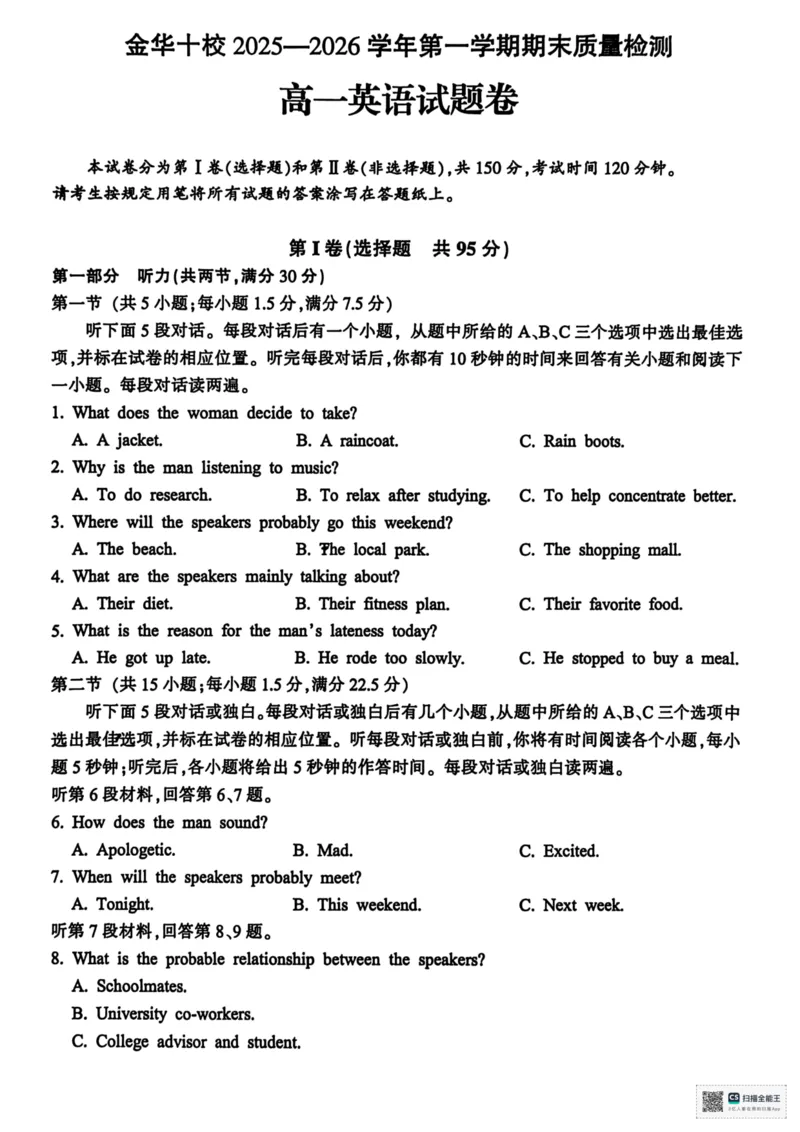
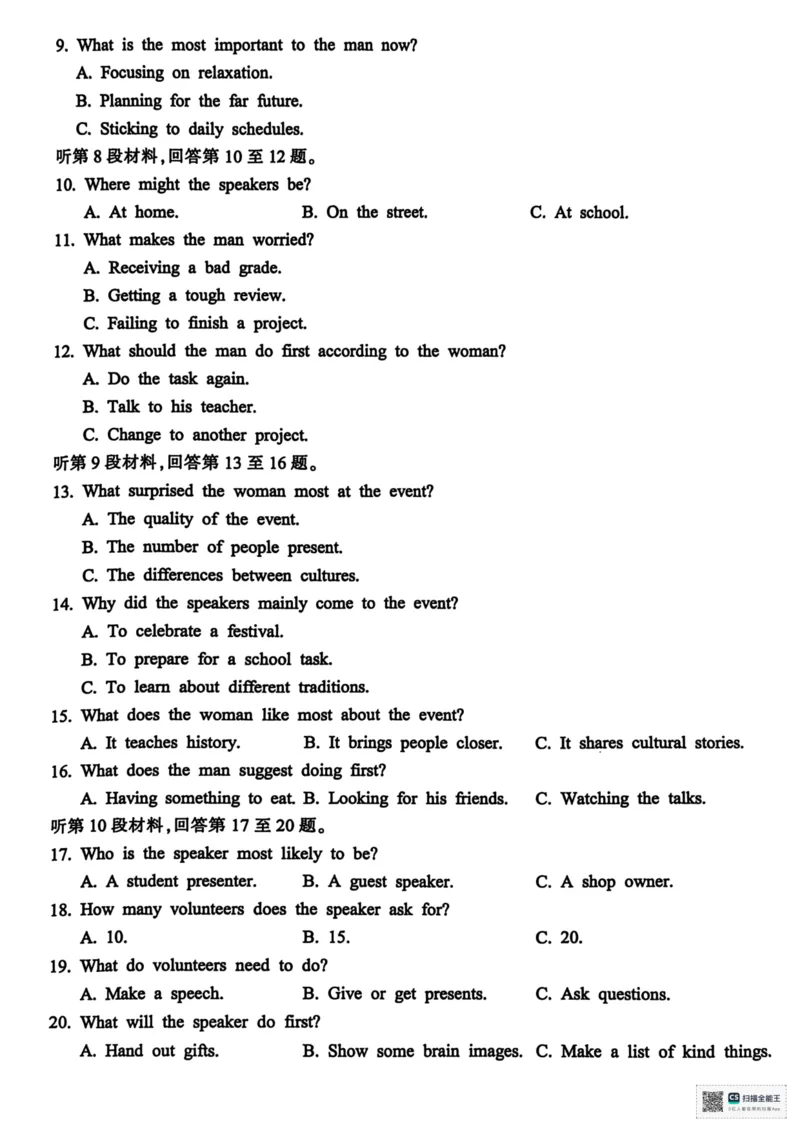
1-5:ACBAC 6-10:ACAAB 11-15:BABBB 16-20:ABCBB
第二部分 阅读理解(共两节,满分50分)
第一节(共15小题:每小题2.5分,满分37.5分)
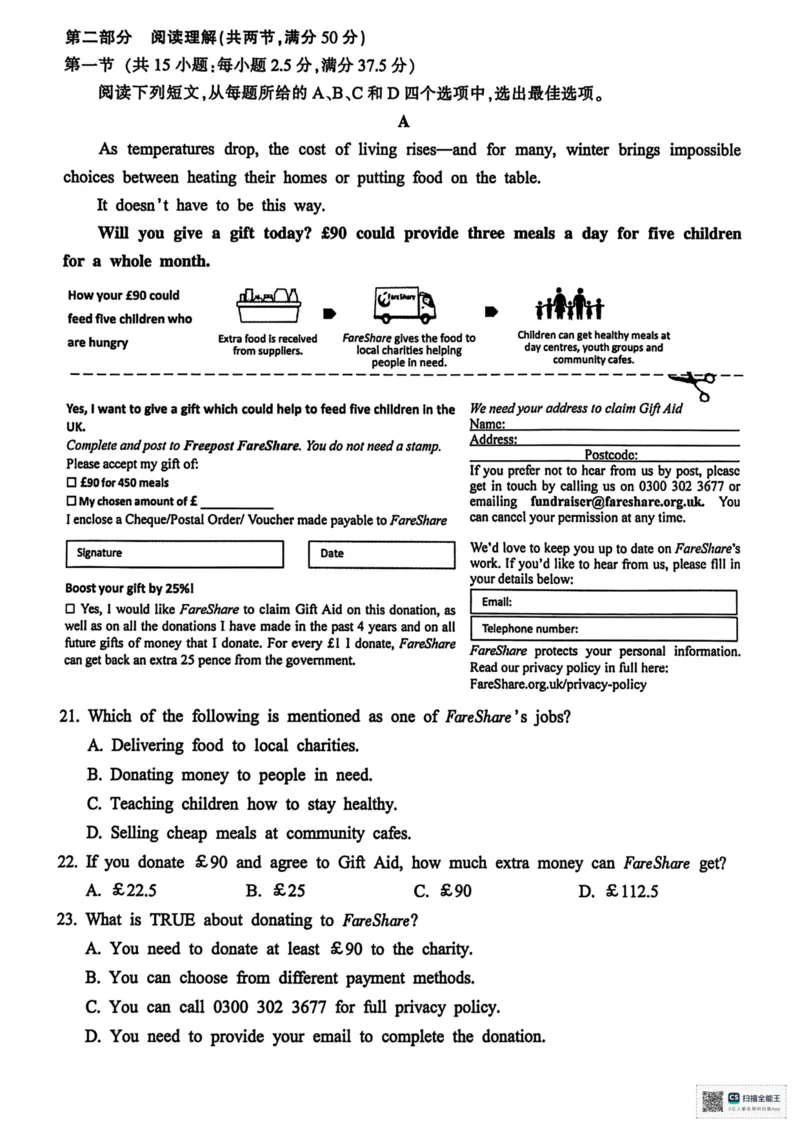
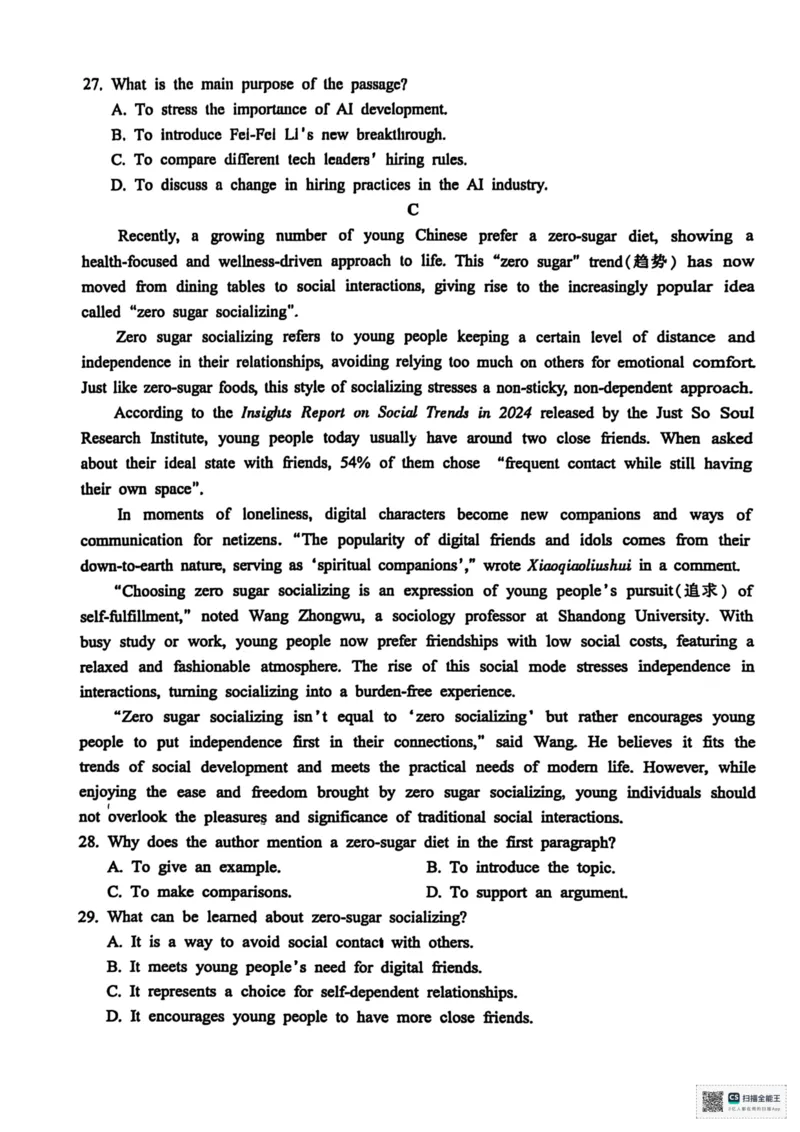
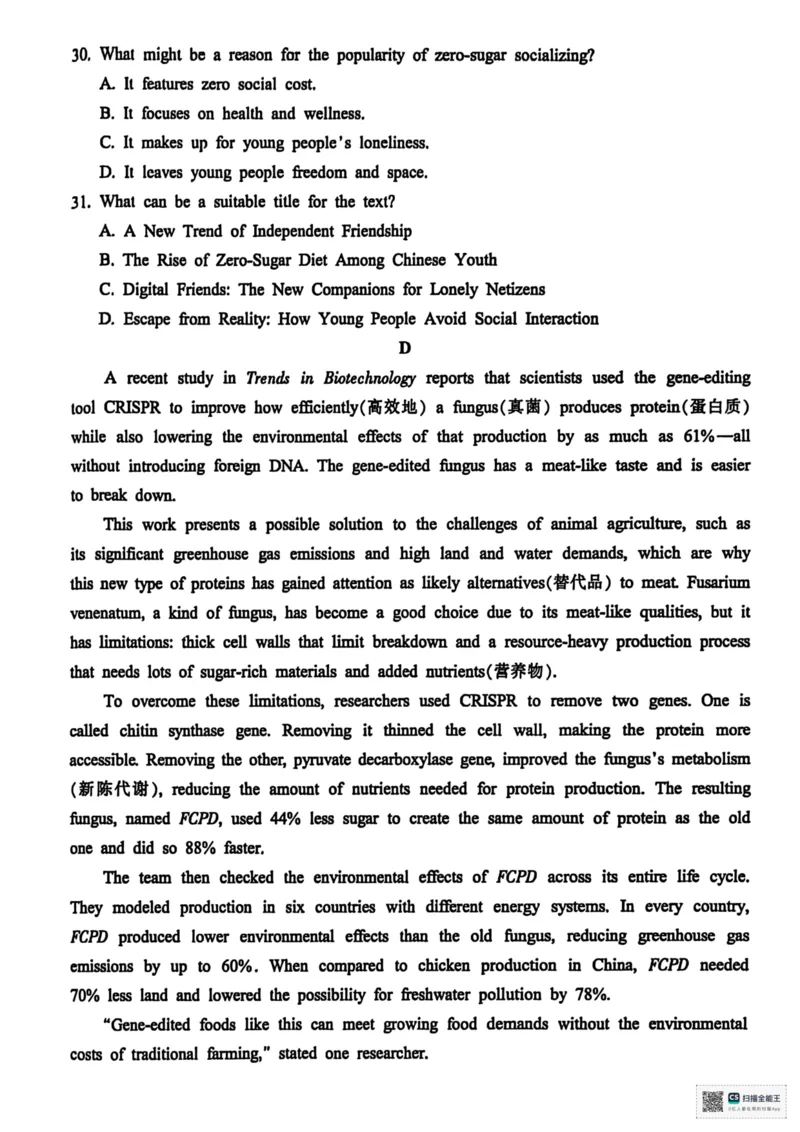
21-23:AAB 24-27:ABCD 28-31:BCDA 32-35:ACAD
第二节 (共5小题;每小题2.5分,满分12.5分)
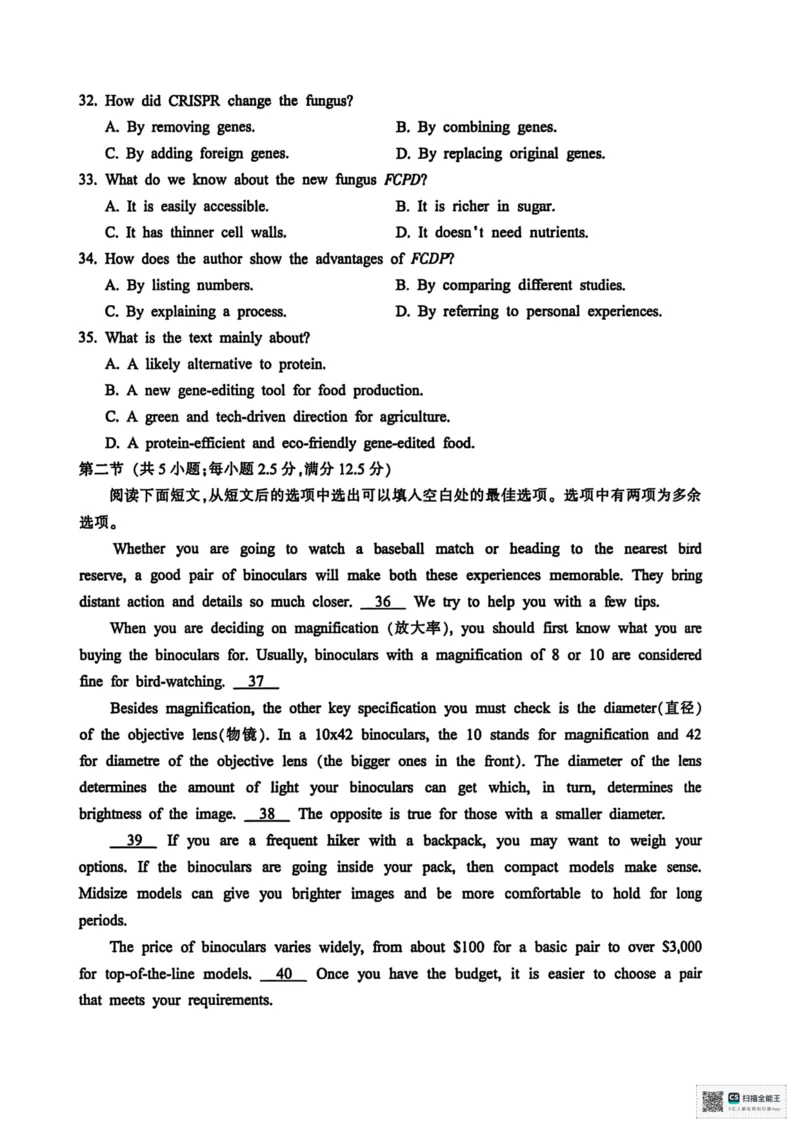
36-40:FDABC
第三部分 语言运用(共两节,满分30分)
第一节(共15个小题;每小题1分,满分15分)
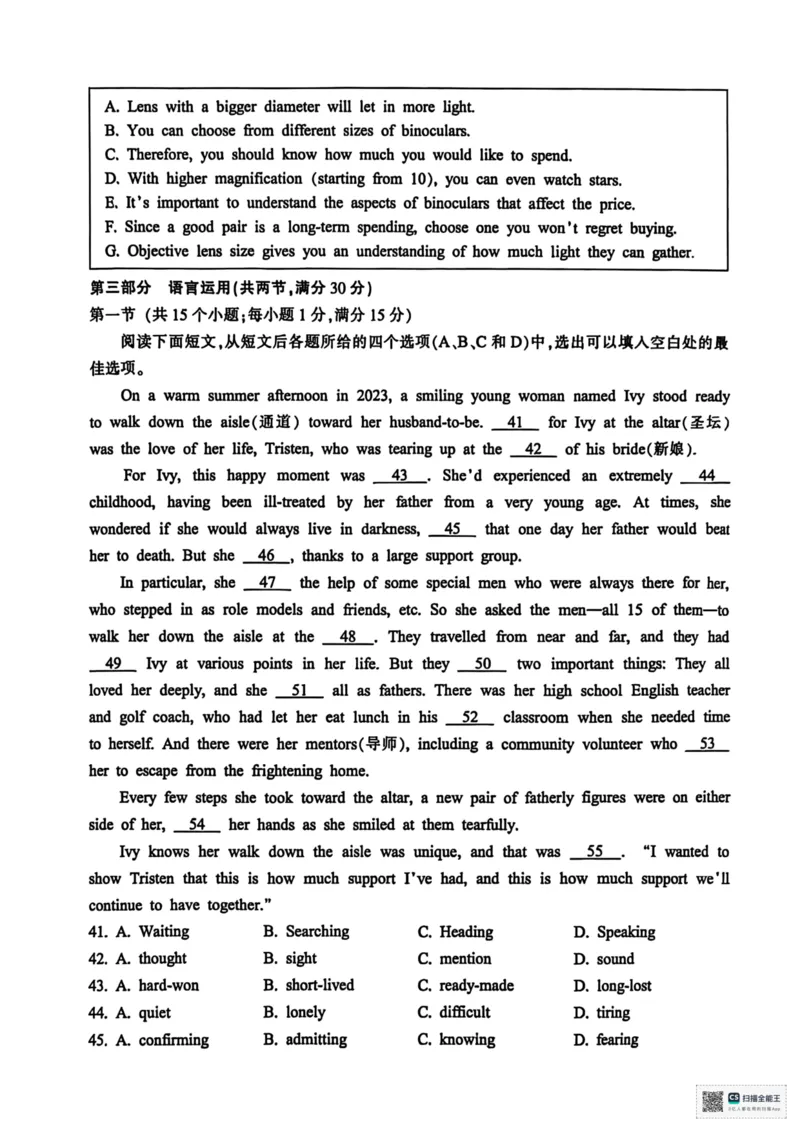
41-45:ABACD 46--50:BDCAA 51--55:BCDAB
第二节(共10小题;每小题1.5分,满分15分)
56.wasfilled; 57.who; 58.editor; 59.developed; 60.and;
61.in; 62.creative; 63.a; 64.allowing; 65.willtour
第四部分 写作(共两节,满分 40 分)
第一节 单句翻译(共5小题;每小题3 分,满分15 分)
66.Theseendangeredspecies(1’)arebeingthreatened(1’)byillegalhunting(1’).
67. The (Chinese) dragon/The Loong (1’) has long been regarded as (1’) an important/essential/a
significant/akey/crucial/vitalsymbolofChineseculture(1’).
Since ancient times/For ages/For centuries/Throughout history, the (Chinese) dragon/the
Loong(1’) has beenregarded as (1’)an important/essential/a significant/key/crucial/vital symbol
ofChineseculture(1’).
68. The statue which was built/constructed/erected (1’) in memory/honor of a soldier(1’) dates
backtothe1950s(1’).
The statue which was built/constructed/erected(1’) to commemorate a soldier(1’)datesbackto
the1950s(1’).
69. There is a wide variety of student clubs in our school (1’), most of which (1’) organize
activitieseverysemester/term(1’).
Therearevarietiesof/variousstudentclubsinourschool(1’), 同上.
Ourschoolhasagreatvarietyof/varietiesof/variousstudentclubs(1’), 同上.
70. Whatiftheaccommodation(1’)for(on)thistrip/onourjourney/onthistour/duringourstay/in
ourtravelarrangements(1’)isnotcomfortableenough/islesscomfortablethanwehoped(1’)(? 英
国英语)
What if the accommodations (1’) for(on) this trip/on our journey/on this tour/during our
stay/inourtravelarrangements(1’)are...(1’)?(北美英语)
第二节 应用文写作 (满分25分)
【审题重点】
明确交流场景为社交媒体平台小红书(RedNote)的留言区,沟通对象是美国高中生Alex。
留言需符合平台语境,语气自然、真诚,可融入得体口语化措辞。
{#{QQABSYQQggAIAJJAABhCQQ2YCkIYkBEAAKgOREAcMAAAwBNABAA=}#}写作核心需围绕 Alex学习中文的具体困惑展开,完成两块内容:表达观看vlog的感受;
提出切实可行的针对性建议。其中困惑与建议需具体可感,忌空泛表述。
此外,留言需具备完整结构:开头礼貌打招呼并关联 vlog 内容,结尾可表达鼓励或进
一步交流的意愿。
【内容要点】
(1)首段可以先呼应Alex的vlog内容,引出他学习中文的困惑及你对该困惑的关注,共
情并表达真挚感受。
(2)中间段首先应精准锚定Alex提出的某一具体困惑,如语言体系本身的难点(声调、识
记与书写、同音字、量词等)、语言处理与技能挑战(听力理解、口语表达流利度等)、文
化差异(成语、敬语或者礼貌用语等)、缺少使用机会等。
具体困惑例子如下:
Linguisticdifficulties:differentwritingsystem(e.g.numerousChinesecharacters;character
learning relies heavily on repetition and visual recognition); tonal pronunciation (e.g. a tonal
language, be completely foreign to English speakers; four distinct tones); different grammar
rules(e.g.wordorderflexibility)
Language processing & skill gaps: real-time listening comprehension (e.g. difficulty
understanding natural-speed speech, e.g. decoding connected sounds); speaking fluency(e.g.
mentaltranslationlag,strugglingtorespondquickly).
Cultural difficulties: rich in chengyu (four-character idioms) (e.g. come from historical
stories, myths, or classical texts; cannot be understood by literal translation); a complex
systemofhonorificsandpolitelanguage
Limitedexposureandpracticeopportunities:lackofanimmersiveenvironment
(以上例子仅供参考。合理即可。)
其次,所给建议与所写具体困惑应形成对应关系,避免给出“多背多练”、“加油努力”
等泛泛而谈的建议。此外,所给建议贴合日常学习场景,可操作性强。
例如,具体困惑如果是strugglewithtones, 相关建议可以是:WhynotfollowChinese
songsandpracticesinginglinebyline? 或者Considerusingaphoneapptorecordyour
pronunciationandcompareitwiththestandardaudio.
同时可在建议后简要补充1-2句给出相关建议的理由,如Becauselearningthroughsongs
allowsyoutocatchtheflowoftonesmoreeasilyandmakesmemorizationlessdifficult. 来增强
说服力。
(3)结尾段可简要添加鼓励性表述,无需落款。如:Ifyoukeepitup,youwilldefinitelymake
progress!
【评分原则】
本题总分为25分,按5个档次给分。评分时,先根据审题、内容和语言初步确定其所属档
次,然后以该档次的要求来衡量、确定或调整档次,最后给分。
Onepossibleversion:
HiAlex!Ireallylovedyourhonestvlogaboutthechallengeofcatchingnative-speedChinese
conversations.AndItotallygetit,astryingtodecodefastEnglishconversationsusedtomake my
headspin,too.
What turned things around for me was switching to a chunked listening approach. Instead of
trying to catch every single word, I learned to listen to whole phrases as single units of meaning.
{#{QQABSYQQggAIAJJAABhCQQ2YCkIYkBEAAKgOREAcMAAAwBNABAA=}#}Forexample,justtreat“你好吗”asonephraseratherthanthreeseparatewords.
Tobuild this skill, you can start with short, clear audio from learning apps or slow podcasts.
Listen carefully and repeat aloud, focusing on matching the rhythm and tone. Another great
method is to watch Chinese shows you enjoy: watch them first with subtitles to understand, then
withouttochallengeyourear.Afunandeffectivewaytolearn,isn’tit?
This is all part of the process! Stay consistent with your listening, and progress will follow.
Lookingforwardtoyournextupdate.
Anotherpossibleversion:
Hi, Alex! Just watched your vlog on Chinese measure words. So impressive! And I could
totally relate to your struggle with them! It took me right back to my own battle with English
prepositions.
Here’sastrategythatmighthelp:trylearningmeasurewordsinfixed“chunks”withthenoun.
Insteadofmemorizing“张” (zhāng) byitself,always pair itas“一张纸”(yīzhāngzhǐ,apieceof
paper) or “一张桌子” (yī zhāng zhuōzi, a table).Toboostits effect, turn your space into a visual
guide with sticky notes, like “一把椅子” on your chair. By seeing them in context daily, you’ll
startabsorbingthemalmostautomatically,withoutextraeffort.
This is a classic learning hurdle, and you’re already on the right path to clear it. Just keep
practicing.Lookforwardtohearingaboutyourprogressinthenextupdate!
听力原文
Text1
W:ShouldIwearmyraincoatandbootstoday?
M: Don’t worry. The weather app says it’ll stay cool and dry with no sun. Rain isn’t expected until
tomorrowevening.
W:I’lljustbringawarmjacketthen.
Text2
W:AreyoulisteningtoMozartwhiledoingyourhomework?
M:Yeah.Icameacrosssomeonlineresearchsayingclassicalmusiccanimproveconcentration.
Text3
W:Ourfamilybeachtripiscanceled!Iwishwecouldgetourfriendstogetherthisweekend.
M: How about riding bicycles around downtown and exploring local parks near the shopping
mall?
W:Great!
Text4
W:Ican’timagineyoueatsaladsforluncheveryday.Isn’tthatboring?
M:Notreally.Ibalanceitwithbigdinners,likebeeforricedishes.Whataboutyou?
W:Sandwichesornoodles,mostly.
Text5
M:Irodemybiketoschooltoday.
W:That’sgreat!It’sagoodwaytosavemoneyandstayfit.
M:Yeah. I got up on time and rode pretty fast, but I was still late as I bought breakfast on the
way.
{#{QQABSYQQggAIAJJAABhCQQ2YCkIYkBEAAKgOREAcMAAAwBNABAA=}#}Text6
M:Hey,sis.I’msorry.I’mafraidwecan’tmeettoday.Canwereschedule?(6)
W:Oh?Whatisit?
M:Workhas beencrazy lately.Ihopeyou’re notmad, andI promise we’ll dosomething exciting
soon!
W:Don’tworry!Honestly,I’mprettybusytoo.
M:I’dlovetomeetthisweekend,butI’llbeoutoftownuntilMonday.
W:NextMondaynightisgood,then.
Text7
W:Haveyoutalkedtoyouruniversityadvisorrecently?
M: Not yet. I’ll contact him after summer break. Now, it’s our chance to relax after just
completinghighschool!Don’tyouwanttomakeitunforgettable?
W:Sure,butit’salsoagreattimetomakeafutureplan.Let’sdoit—justforfun!
M:ButIwanttoenjoythemomentsbeforemakingaspecificplanforthefarfuture.
W:The main idea is to reach for the stars! It’s not about daily schedules — it’s about setting big
goals!
Text8
M:Thanksforwalkingmehome,Mom.
W: I love walking you home from school whenever I get off work early. Let’s get off this busy
roadandgointothepark.
M:OK.Ididn’tdowellonmywritingproject,soI’vebeenanxiouslately.
W:Didyougetabadgrade?
M:Nope.It’sjustthatthecommentsweretough.Ourgradeshaven’tbeendecidedyet.
W:Dear,thisisavaluablereviewfromyourteacher.It’smeanttohelpyouimprove!
M:Iguess,butitmademefeellikeafailure.
W:You learn more from mistakes than successes. Let’s redo this project before starting the next
one.Then,bringittoyourteacherforfurtherreview.
Text9
M:Wow, there are so many people here!Wewon’t find John and Diego in this crowd.They love
culturalevents,sotheymusthavegottenhereearly.
W:You’re right.There’s no pointlooking for them now.Let’s just explore the event. I’m shocked
somanypeopleshowedup!
M:Yes.And don’t forget why we’re here. Mrs. Smith said we need to hand in the report about it
bynextMonday.
W:What I like most is how these events connect people by celebrating our different cultures and
thethingswehaveincommon.
M:Icouldn’tagreemore.Thesearen’tjustabouthistoryorfamilytraditions;they’reaboutbringing
groupscloser.
W:Exactly.Thespeechesarestartingsoon.
M:Let’sgetaquickbitebeforefindingagoodseattowatchthetalks.
W:Great.
Text10
Today, we’ll have a very special workshop. I’ve been a guest at many schools. In every
classroom, I show that helping others makes life better. This isn’t a regular lesson or a typical
{#{QQABSYQQggAIAJJAABhCQQ2YCkIYkBEAAKgOREAcMAAAwBNABAA=}#}speech.Todayyouwillbeactive,sogetready!
Most of our activities will let us see how kindness works through giving. I need 10 students
to give gifts and another 10 to receive these gifts. Volunteers, please come forward! Once we’re
finished,you’llanswersomequestionsabouthowyoufeltduringtheexperience.
But before we start giving gifts, I’ll show you some brain pictures. These medical pictures
showthebrainactivityduringactsofgiving.
Today’sactivitieswillprovethatgivingmakesyouevenhappierthanreceiving!Ifwehavea
fewminutesleftattheend,we’lllistkindthingstododaily.
{#{QQABSYQQggAIAJJAABhCQQ2YCkIYkBEAAKgOREAcMAAAwBNABAA=}#}