文档内容
为本套教材的教与学提供服务
服务电话:010-5978 5973 传真:010-5978 5972
服务网址:www.bjmti.com
E-mail: bjmti@bjmti.com
主 编 马 承 李世虬
[ 英] Heather Inwood
副 主 编 王传伟 安宏侠
美术设计 炽热风美术工作室
审 校 [ 美] Betty Marple
法律顾问 唐国玺
责任编辑 邓 文
责任校对 王勤杰
责任印制 马宇晨
法律顾问 宋润君
英语. 六年级下册 / 北京市现代教学研究所编著. —北京 : 科学普及出版社,2016
( 义务教育教科书)
ISBN 978-7-110-09264-4
Ⅰ. ①英… Ⅱ. ①北… Ⅲ. ①英语课-小学-教材 Ⅳ. ①G624.311
图书在版编目(CIP) 数据
中国版本图书馆CIP 数据核字(2015) 第272752 号
同学们好!
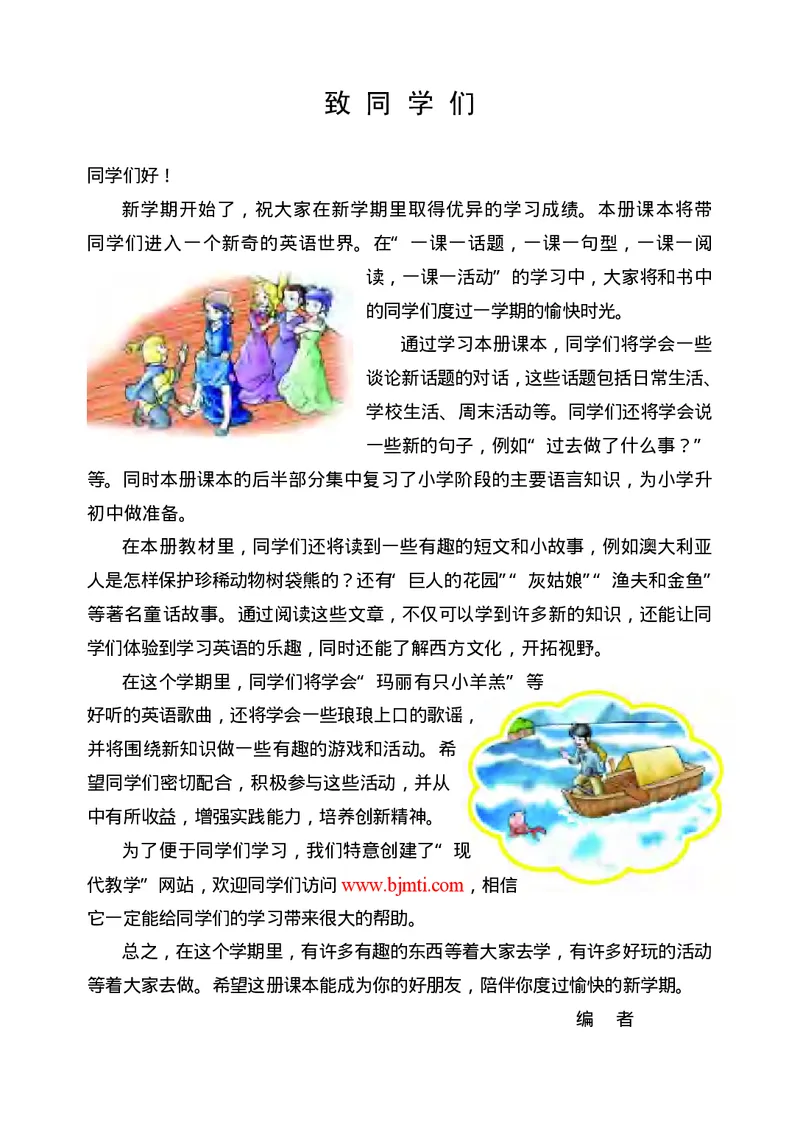
新学期开始了,祝大家在新学期里取得优异的学习成绩。本册课本将带
同学们进入一个新奇的英语世界。在“一课一话题,一课一句型,一课一阅
读,一课一活动”的学习中,大家将和书中
的同学们度过一学期的愉快时光。
通过学习本册课本,同学们将学会一些
谈论新话题的对话,这些话题包括日常生活、
学校生活、周末活动等。同学们还将学会说
一些新的句子,例如“过去做了什么事?”
等。同时本册课本的后半部分集中复习了小学阶段的主要语言知识,为小学升
初中做准备。
在本册教材里,同学们还将读到一些有趣的短文和小故事,例如澳大利亚
人是怎样保护珍稀动物树袋熊的?还有“巨人的花园”“灰姑娘”“渔夫和金鱼”
等著名童话故事。通过阅读这些文章,不仅可以学到许多新的知识,还能让同
学们体验到学习英语的乐趣,同时还能了解西方文化,开拓视野。
在这个学期里,同学们将学会“玛丽有只小羊羔”等
好听的英语歌曲,还将学会一些琅琅上口的歌谣,
并将围绕新知识做一些有趣的游戏和活动。希
望同学们密切配合,积极参与这些活动,并从
中有所收益,增强实践能力,培养创新精神。
为了便于同学们学习,我们特意创建了“现
代教学”网站,欢迎同学们访问www.bjmti.com,相信
它一定能给同学们的学习带来很大的帮助。
总之,在这个学期里,有许多有趣的东西等着大家去学,有许多好玩的活动
等着大家去做。希望这册课本能成为你的好朋友,陪伴你度过愉快的新学期。
编 者
致 同 学 们
Lesson 1
I’m not feeling well 2
Lesson 2
Did you play basketball yesterday? 8
Lesson 3
Did you go boating last Sunday? 14
Lesson 4
What did you do last Saturday? 20
Lesson 5
Revision 26
Lesson 6
Is there a library near here? 32
Lesson 7
Where do the tigers come from? 38
Contents
Contents
Lesson 8
Who are you going to play? 44
Lesson 9
I helped a deaf man to get home 50
Lesson 10
Revision 56
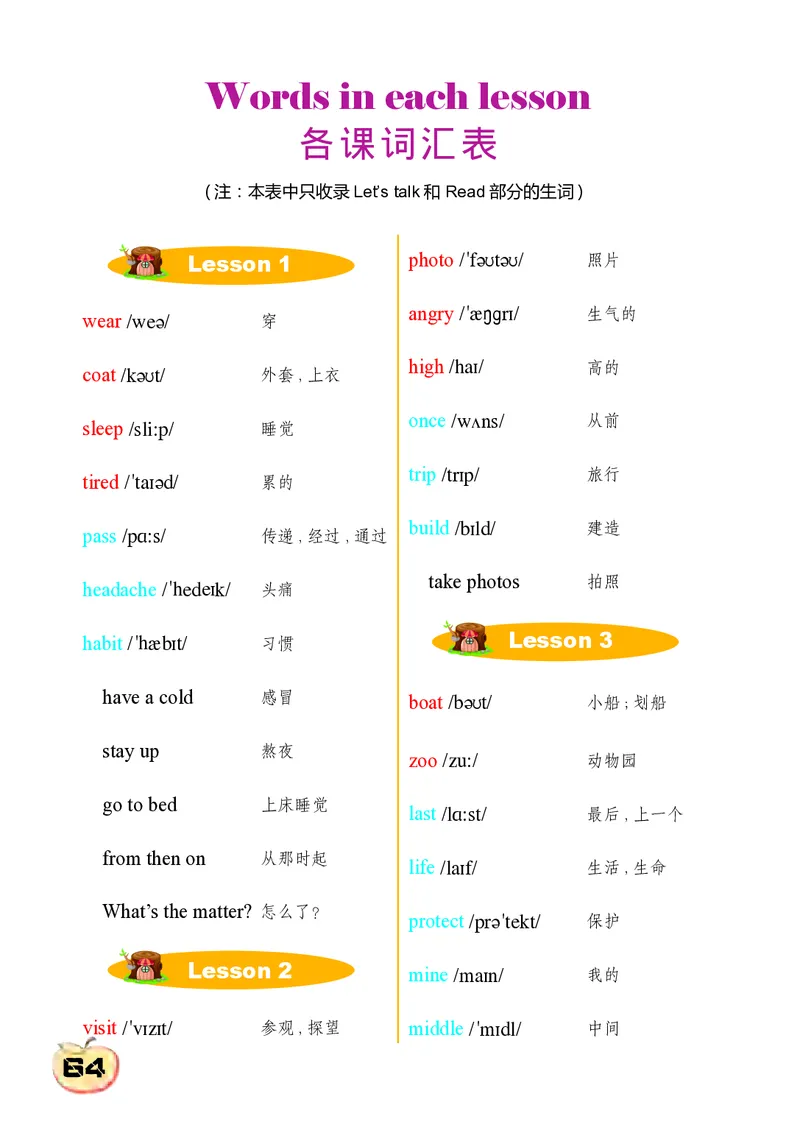
Words in each lesson 64
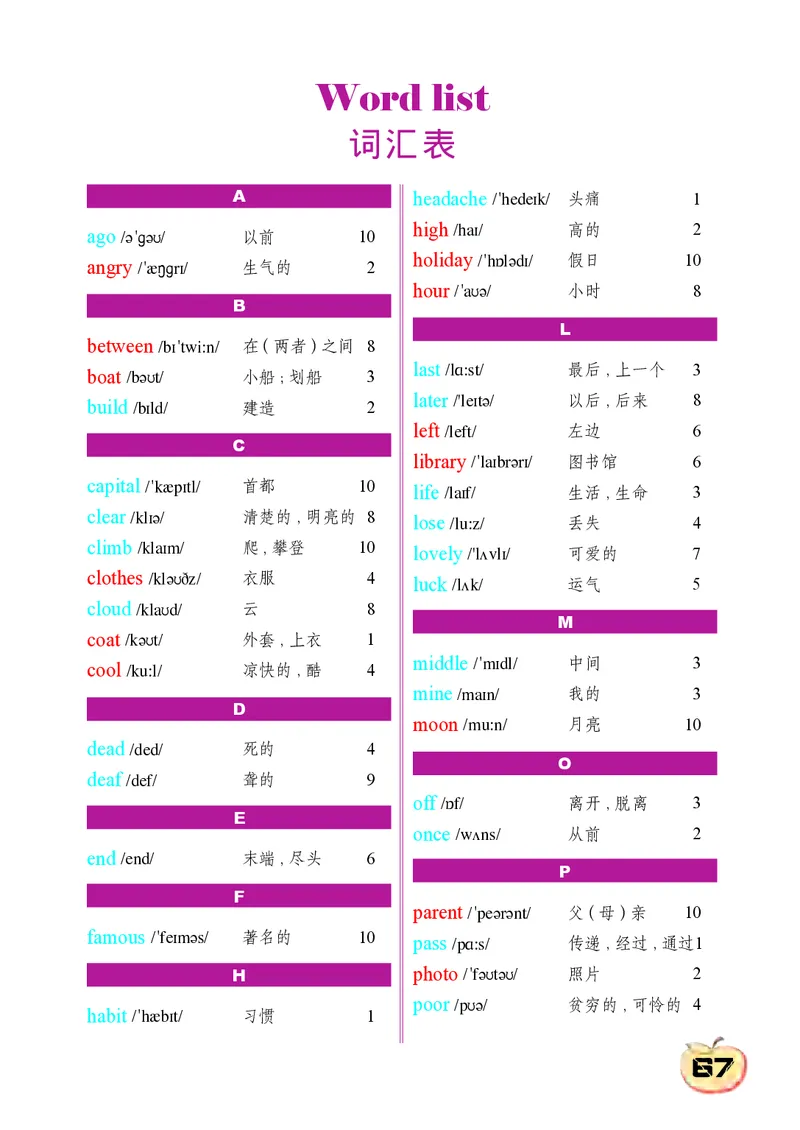
Word list 67
Word families 70
Irregular verbs 69
Additional word list 73
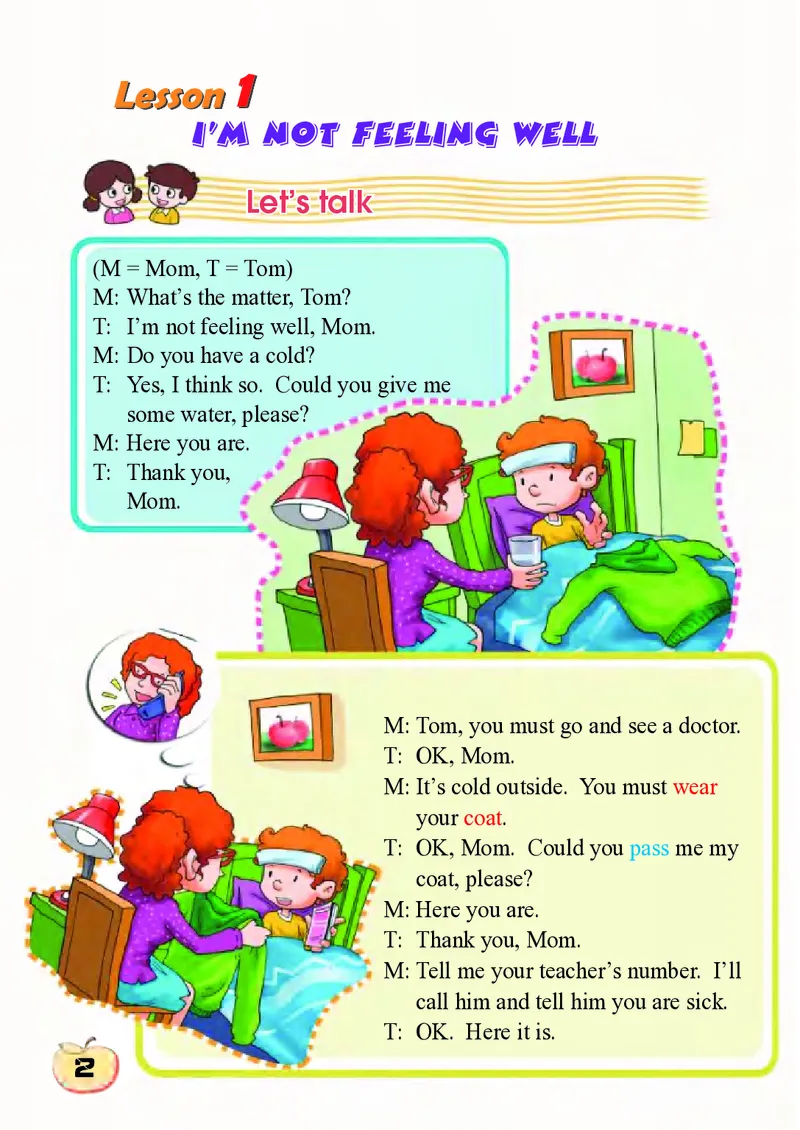
(M = Mom, T = Tom)
M: What’s the matter, Tom?
T: I’m not feeling well, Mom.
M: Do you have a cold?
T: Yes, I think so. Could you give me
some water, please?
M: Here you are.
T: Thank you,
Mom.
M: Tom, you must go and see a doctor.
T: OK, Mom.
M: It’s cold outside. You must wear
your coat.
T: OK, Mom. Could you pass me my
coat, please?
M: Here you are.
T: Thank you, Mom.
M: Tell me your teacher’s number. I’ll
call him and tell him you are sick.
T: OK. Here it is.
Let’s talk
I'M NOT FEELING WELL
Lesson 1
2
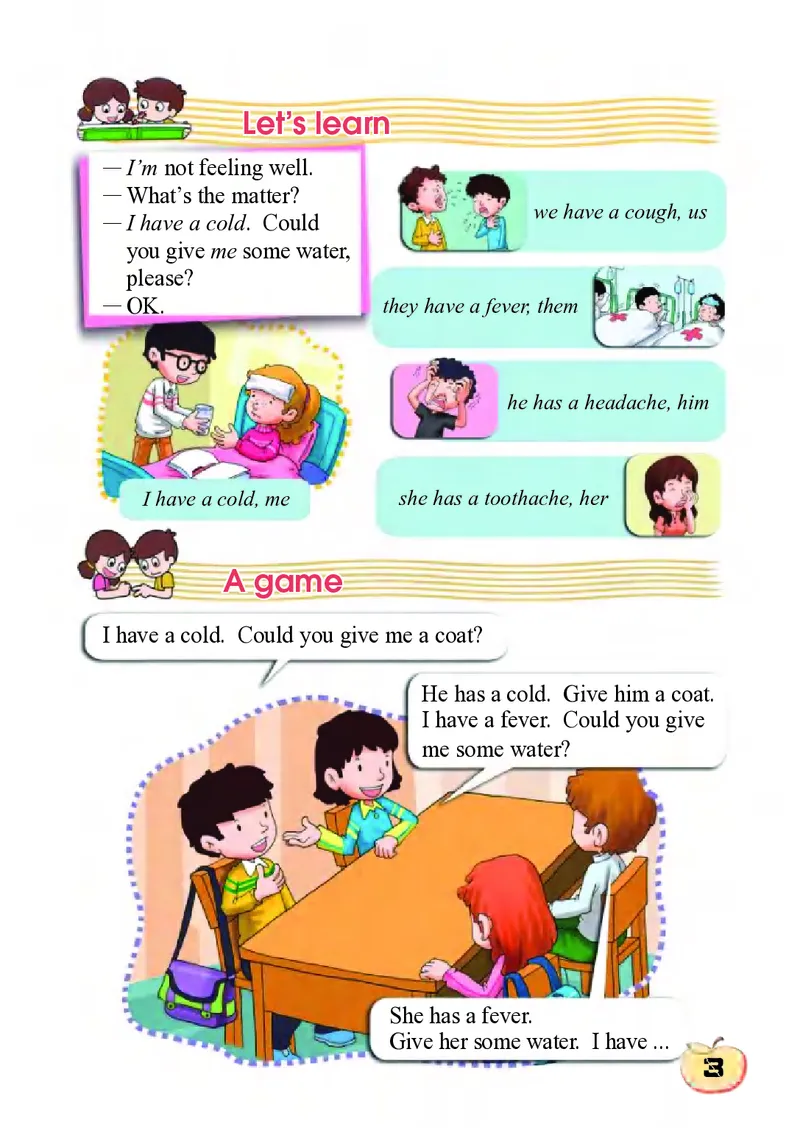
— I’m not feeling well.
— What’s the matter?
— I have a cold. Could
you give me some water,
please?
— OK.
we have a cough, us
he has a headache, him
I have a cold. Could you give me a coat?
He has a cold. Give him a coat.
I have a fever. Could you give
me some water?
She has a fever.
Give her some water. I have ...
they have a fever, them
she has a toothache, her
Let’s learn
A game
I have a cold, me
3
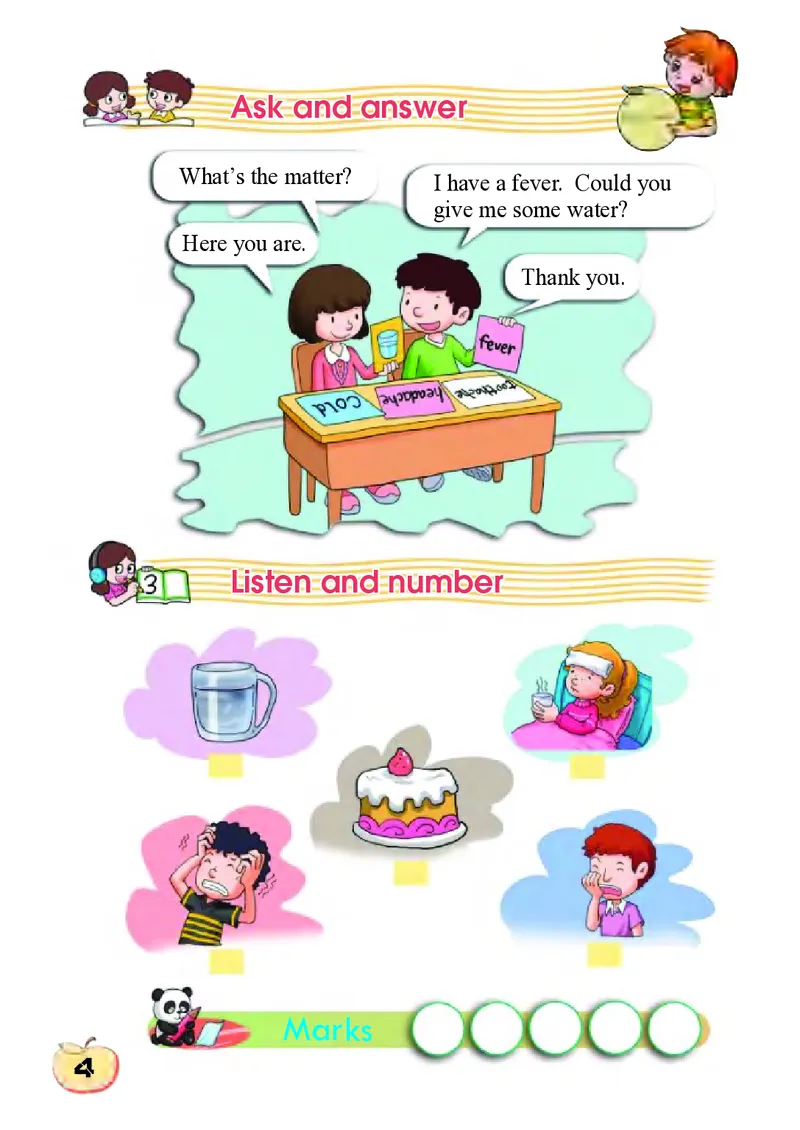
What’s the matter?
I have a fever. Could you
give me some water?
Here you are.
Thank you.
Ask and answer
Listen and number
Marks
4
Listen and say
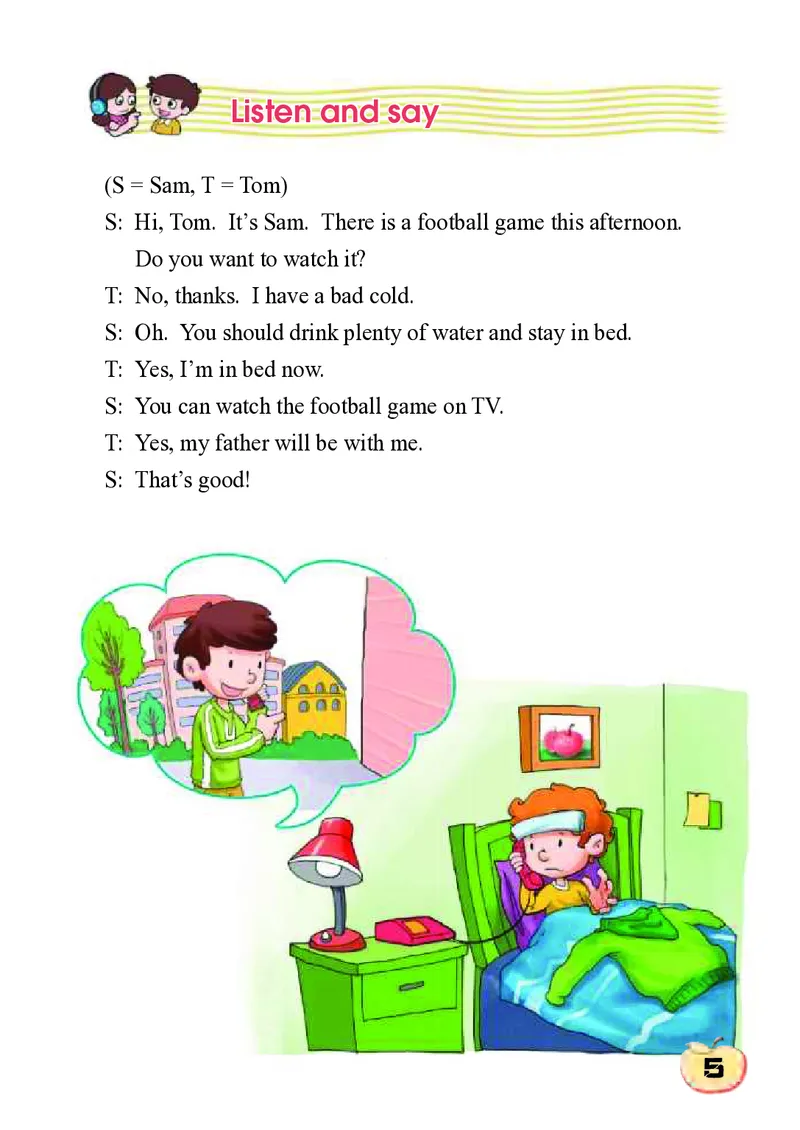
(S = Sam, T = Tom)
S: Hi, Tom. It’s Sam. There is a football game this afternoon.
Do you want to watch it?
T: No, thanks. I have a bad cold.
S: Oh. You should drink plenty of water and stay in bed.
T: Yes, I’m in bed now.
S: You can watch the football game on TV.
T: Yes, my father will be with me.
S: That’s good!
5
Read
A good habit
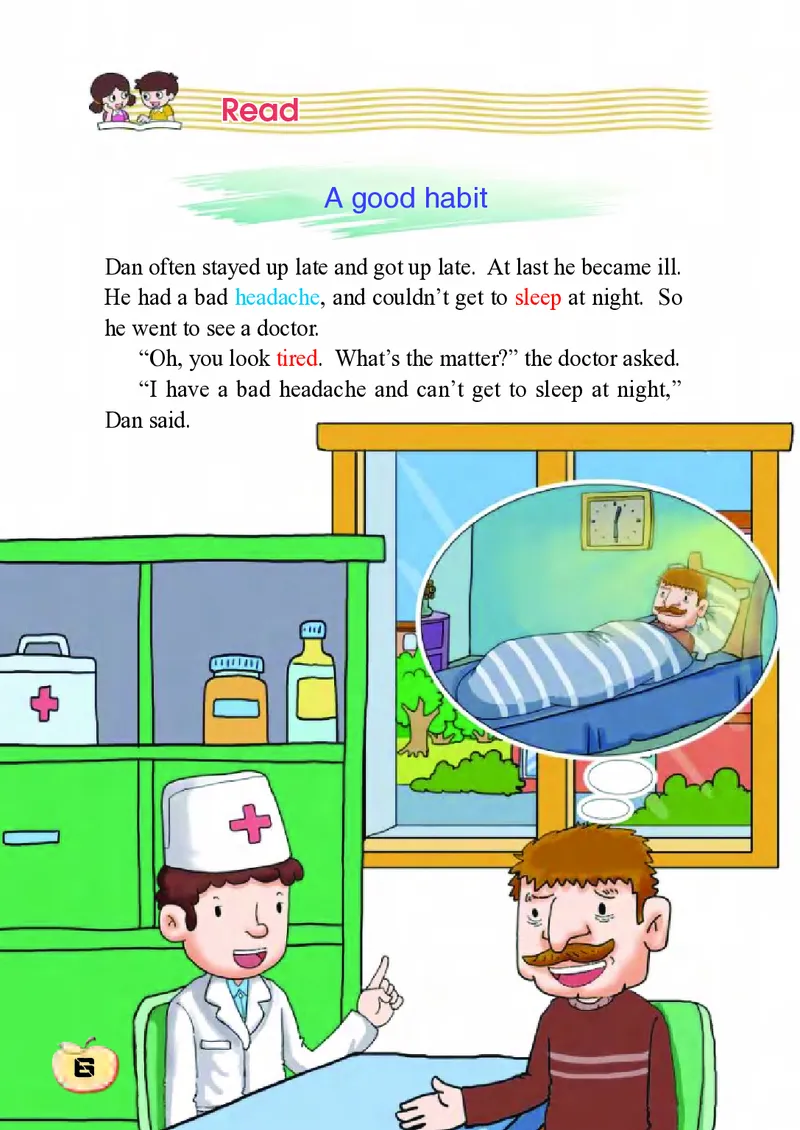
Dan often stayed up late and got up late. At last he became ill.
He had a bad headache, and couldn’t get to sleep at night. So
he went to see a doctor.
“Oh, you look tired. What’s the matter?” the doctor asked.
“I have a bad headache and can’t get to sleep at night,”
Dan said.
6
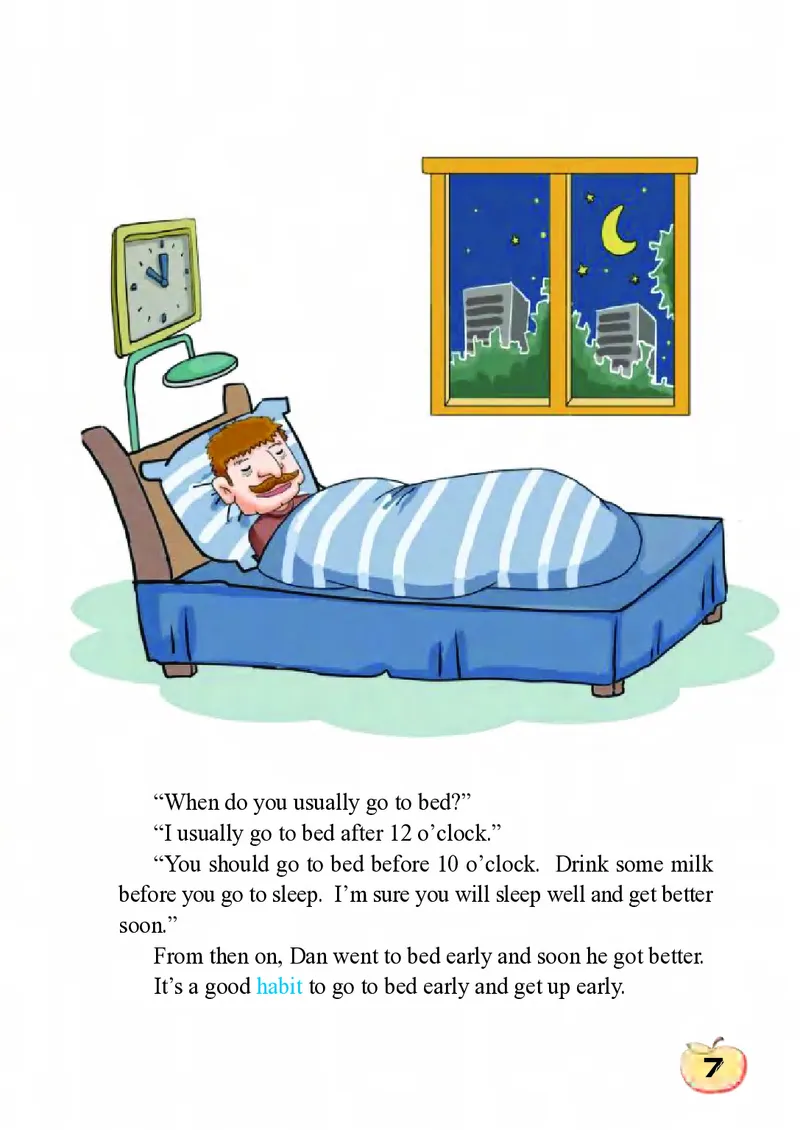
“When do you usually go to bed?”
“I usually go to bed after 12 o’clock.”
“You should go to bed before 10 o’clock. Drink some milk
before you go to sleep. I’m sure you will sleep well and get better
soon.”
From then on, Dan went to bed early and soon he got better.
It’s a good habit to go to bed early and get up early.
7
8
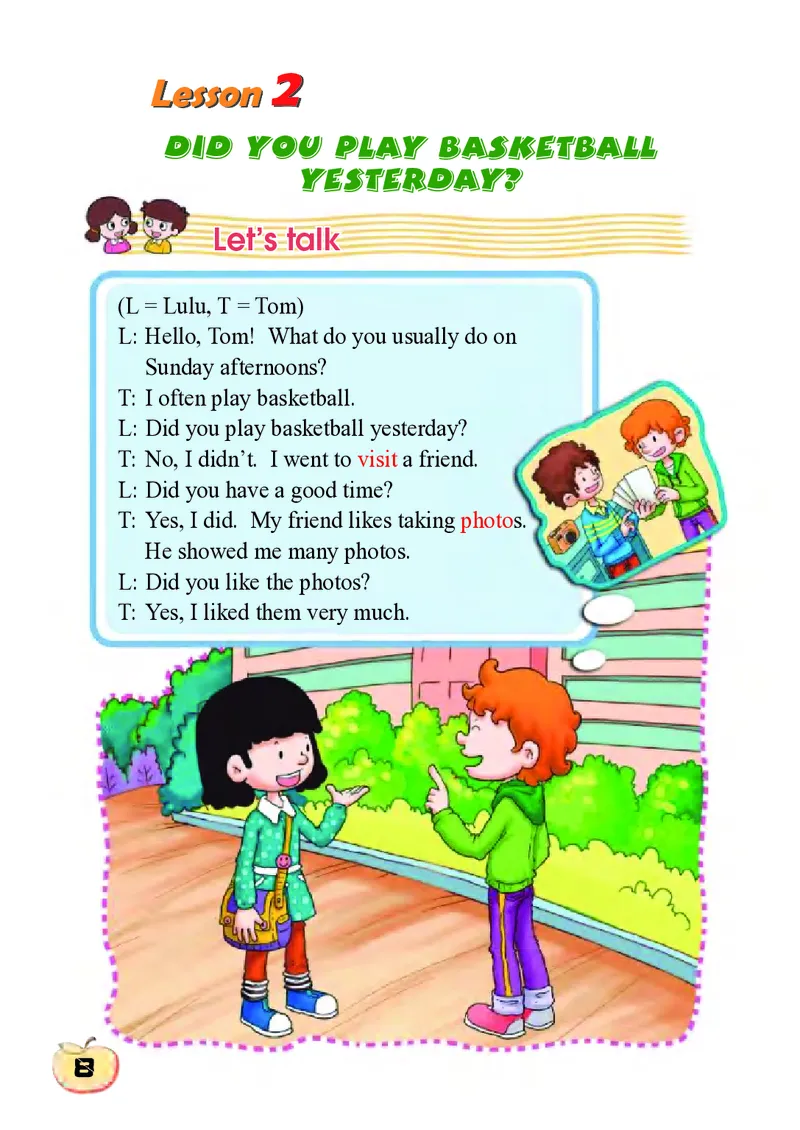
(L = Lulu, T = Tom)
L: Hello, Tom! What do you usually do on
Sunday afternoons?
T: I often play basketball.
L: Did you play basketball yesterday?
T: No, I didn’t. I went to visit a friend.
L: Did you have a good time?
T: Yes, I did. My friend likes taking photos.
He showed me many photos.
L: Did you like the photos?
T: Yes, I liked them very much.
Let’s talk
Lesson 2
Did you play basketball
yesterday?
O, look at the moon!
She is shining up there.
O, mother, she looks
like a lamp in the air.
Last week she was smaller,
and shaped like a bow.
But now she is bigger,
and round as an O.
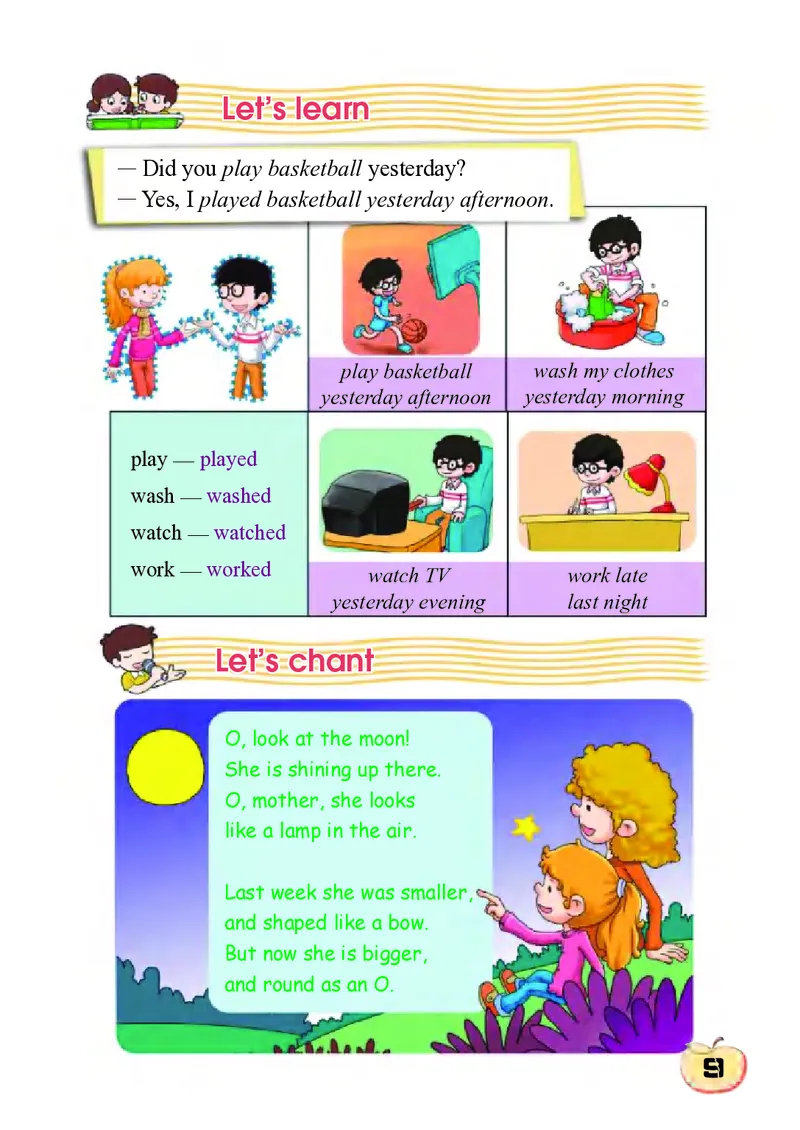
wash my clothes
yesterday morning
play basketball
yesterday afternoon
— Did you play basketball yesterday?
— Yes, I played basketball yesterday afternoon.
work late
last night
watch TV
yesterday evening
play — played
wash — washed
watch — watched
work — worked
Let’s learn
Let’s chant
9
10
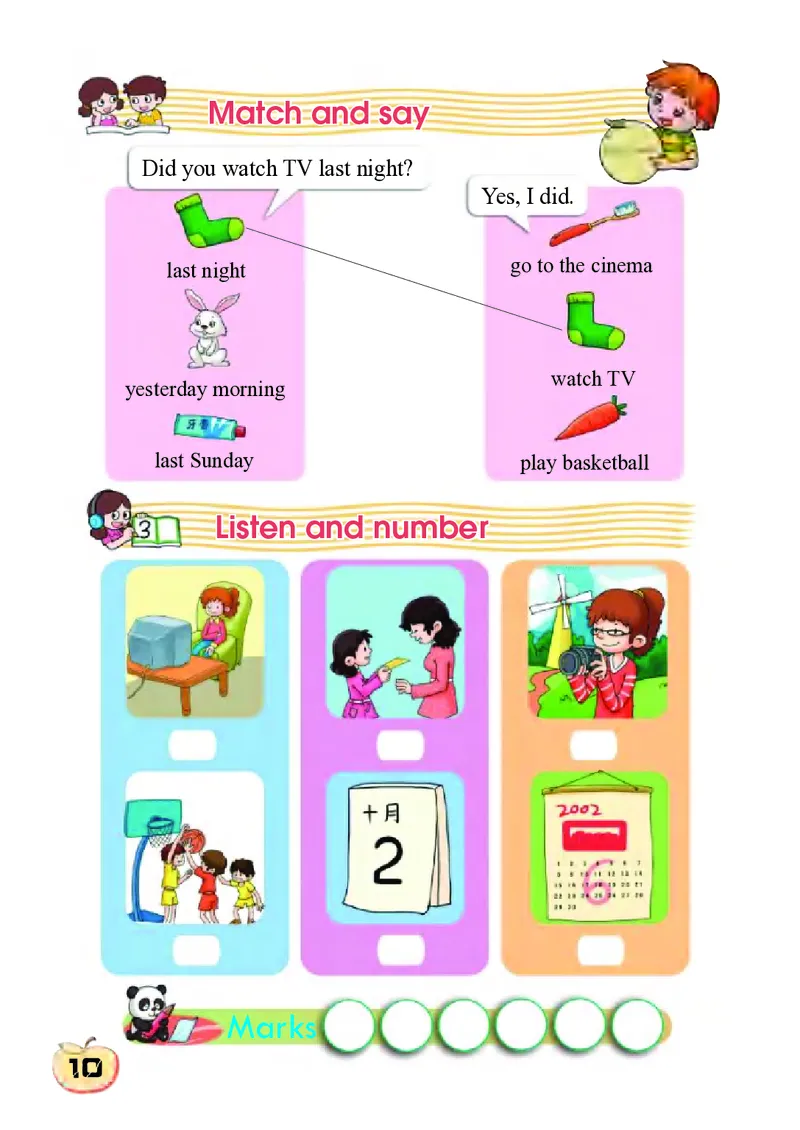
Did you watch TV last night?
Yes, I did.
Match and say
Listen and number
last night
yesterday morning
last Sunday
go to the cinema
watch TV
play basketball
Marks
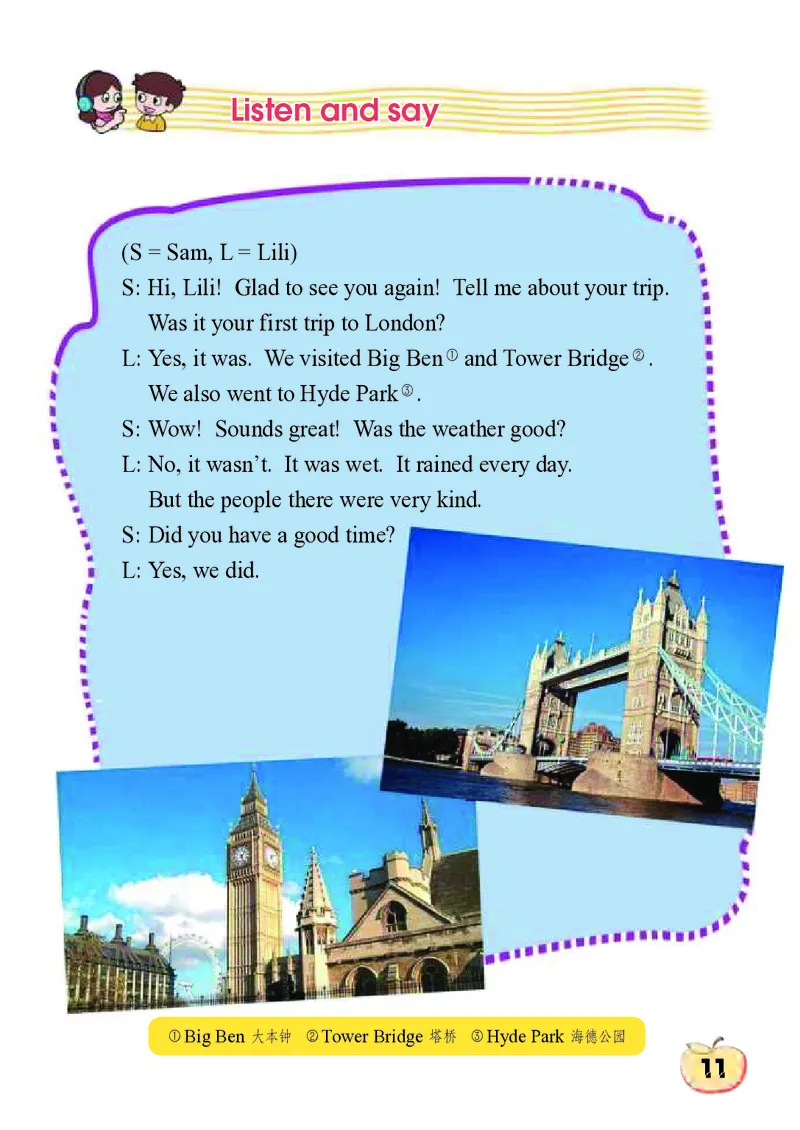
(S = Sam, L = Lili)
S: Hi, Lili! Glad to see you again! Tell me about your trip.
Was it your first trip to London?
L: Yes, it was. We visited Big Ben ① and Tower Bridge ②.
We also went to Hyde Park ③.
S: Wow! Sounds great! Was the weather good?
L: No, it wasn’t. It was wet. It rained every day.
But the people there were very kind.
S: Did you have a good time?
L: Yes, we did.
Listen and say
11
①Big Ben 大本钟 ②Tower Bridge 塔桥 ③Hyde Park 海德公园
12
Read
The giant’s garden
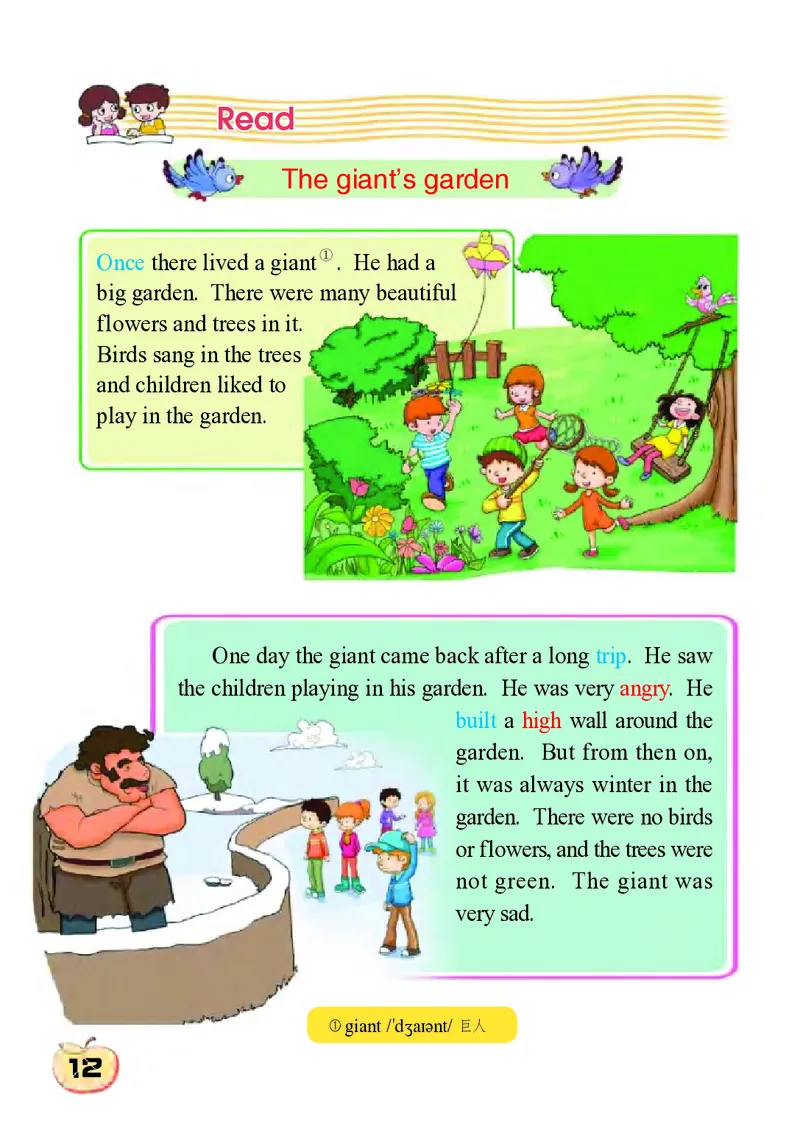
Once there lived a giant ①. He had a
big garden. There were many beautiful
flowers and trees in it.
Birds sang in the trees
and children liked to
play in the garden.
One day the giant came back after a long trip. He saw
the children playing in his garden. He was very angry. He
built a high wall around the
garden. But from then on,
it was always winter in the
garden. There were no birds
or flowers, and the trees were
not green. The giant was
very sad.
①giant /?dWaIEnt/ 巨人
13
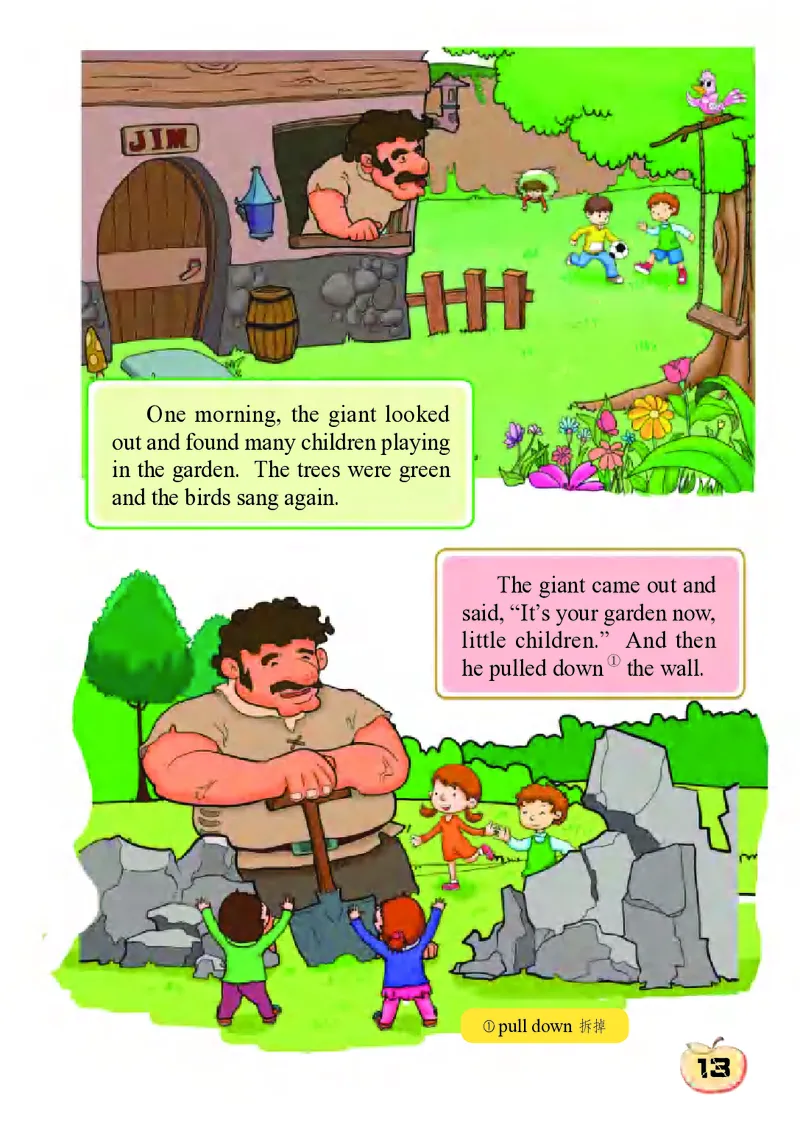
One morning, the giant looked
out and found many children playing
in the garden. The trees were green
and the birds sang again.
The giant came out and
said, “It’s your garden now,
little children.” And then
he pulled down ① the wall.
①pull down 拆掉
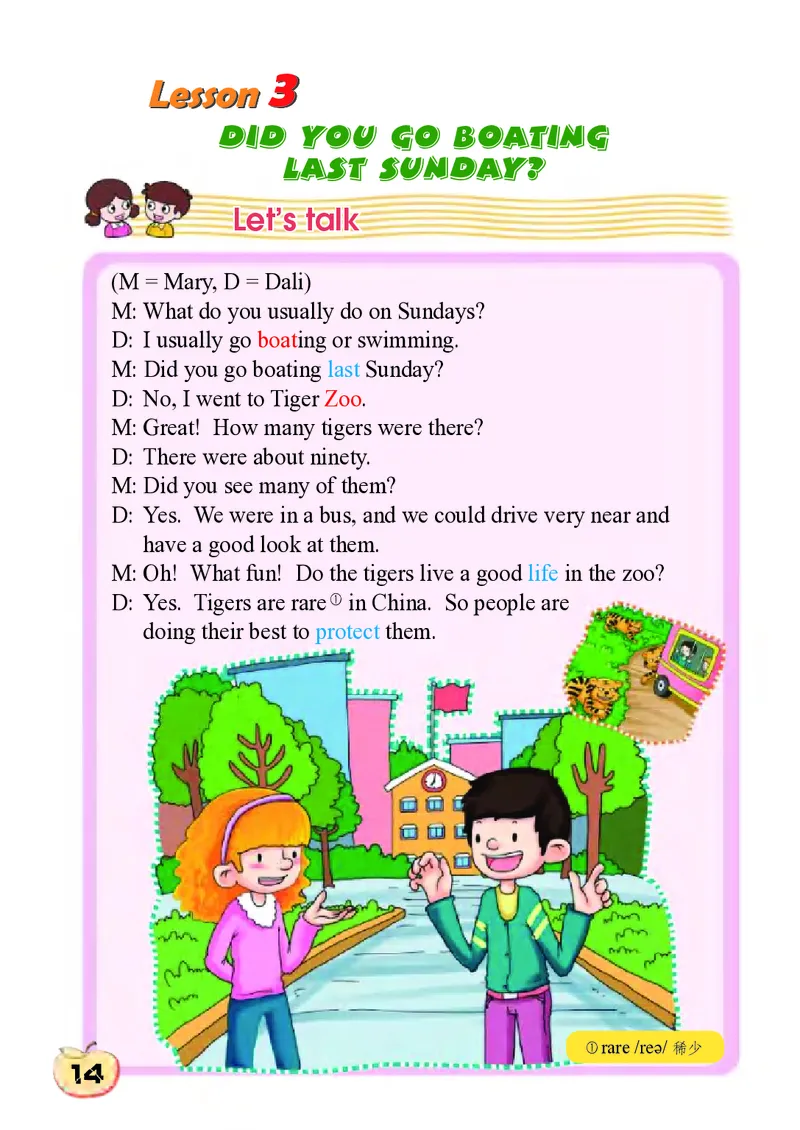
(M = Mary, D = Dali)
M: What do you usually do on Sundays?
D: I usually go boating or swimming.
M: Did you go boating last Sunday?
D: No, I went to Tiger Zoo.
M: Great! How many tigers were there?
D: There were about ninety.
M: Did you see many of them?
D: Yes. We were in a bus, and we could drive very near and
have a good look at them.
M: Oh! What fun! Do the tigers live a good life in the zoo?
D: Yes. Tigers are rare ① in China. So people are
doing their best to protect them.
Let’s talk
①rare /reE/ 稀少
Did you go boating
last sunday?
Lesson 3
14
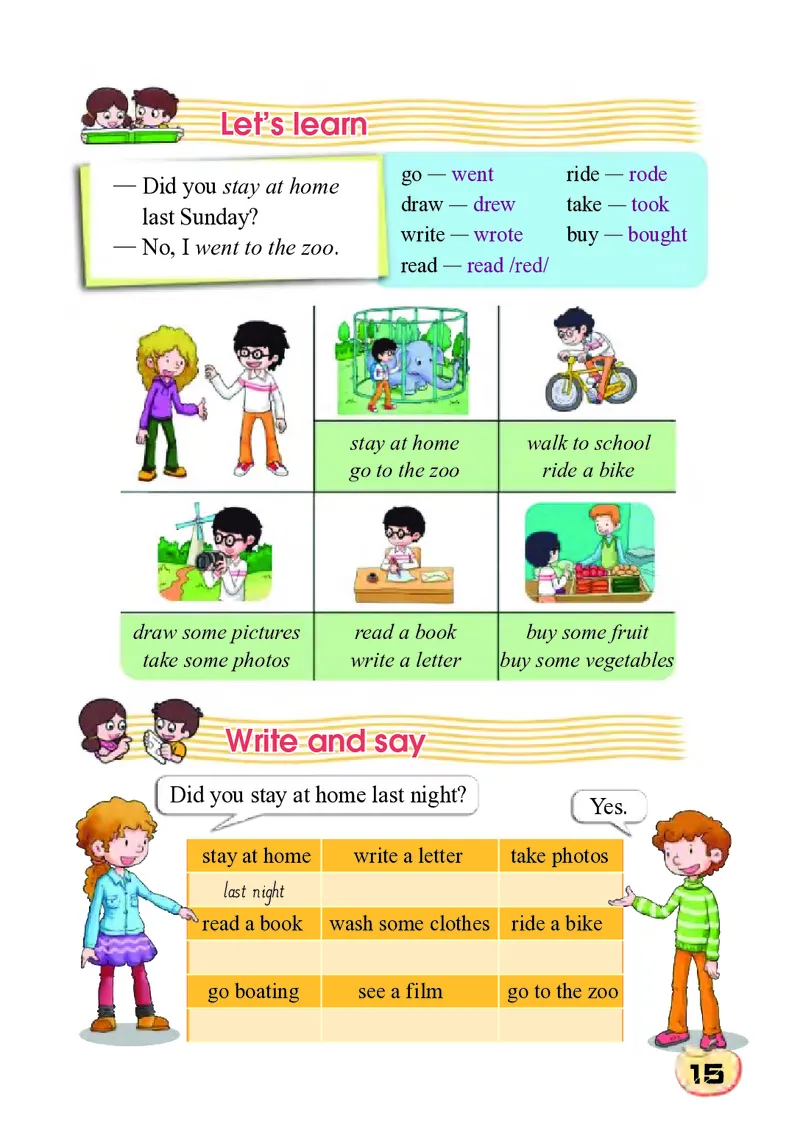
— Did you stay at home
last Sunday?
— No, I went to the zoo.
walk to school
ride a bike
stay at home
go to the zoo
buy some fruit
buy some vegetables
draw some pictures
take some photos
go — went
ride — rode
draw — drew
take — took
write — wrote
buy — bought
read — read /red/
read a book
write a letter
Did you stay at home last night?
Let’s learn
Write and say
Yes.
15
stay at home write a letter take photos
last night
read a book wash some clothes ride a bike
go boating see a film go to the zoo
16
Lulu
Eve
Rob
Bob
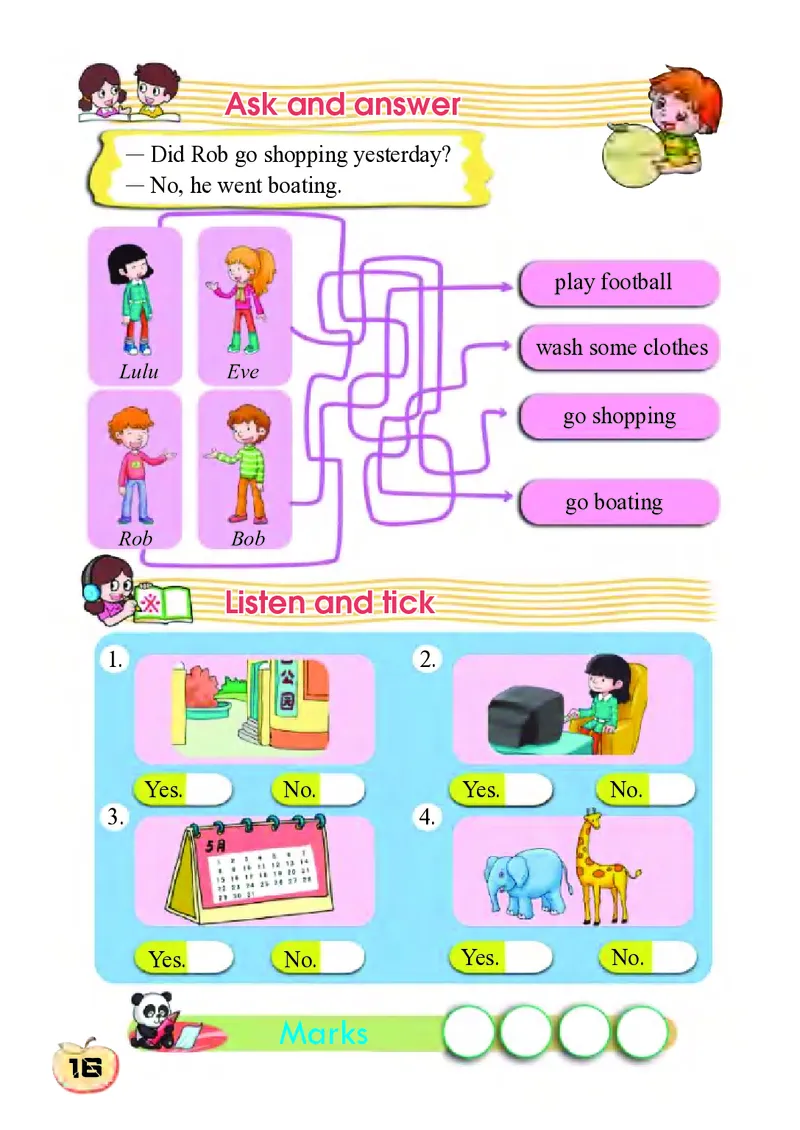
— Did Rob go shopping yesterday?
— No, he went boating.
play football
wash some clothes
go shopping
go boating
Ask and answer
Listen and tick
Yes.
No.
Yes.
No.
Yes.
No.
Yes.
No.
1.
2.
3.
4.
Marks
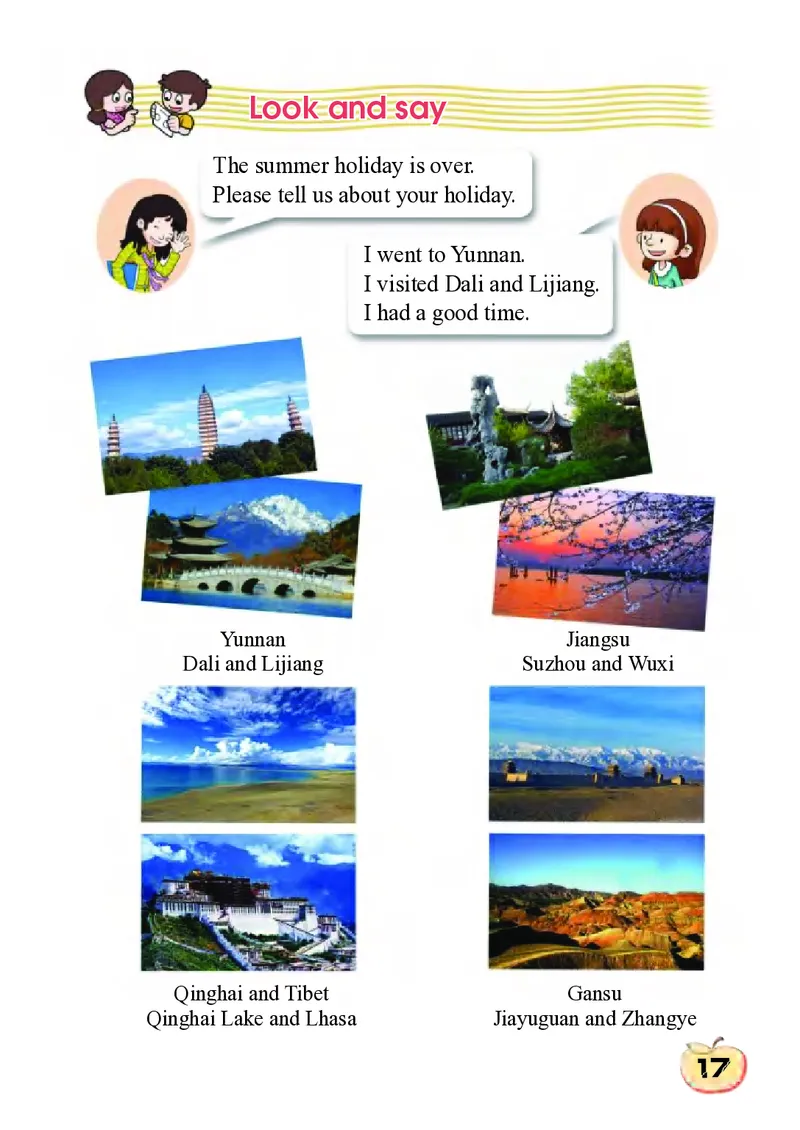
Look and say
Yunnan
Dali and Lijiang
Jiangsu
Suzhou and Wuxi
Qinghai and Tibet
Qinghai Lake and Lhasa
Gansu
Jiayuguan and Zhangye
The summer holiday is over.
Please tell us about your holiday.
I went to Yunnan.
I visited Dali and Lijiang.
I had a good time.
17
18
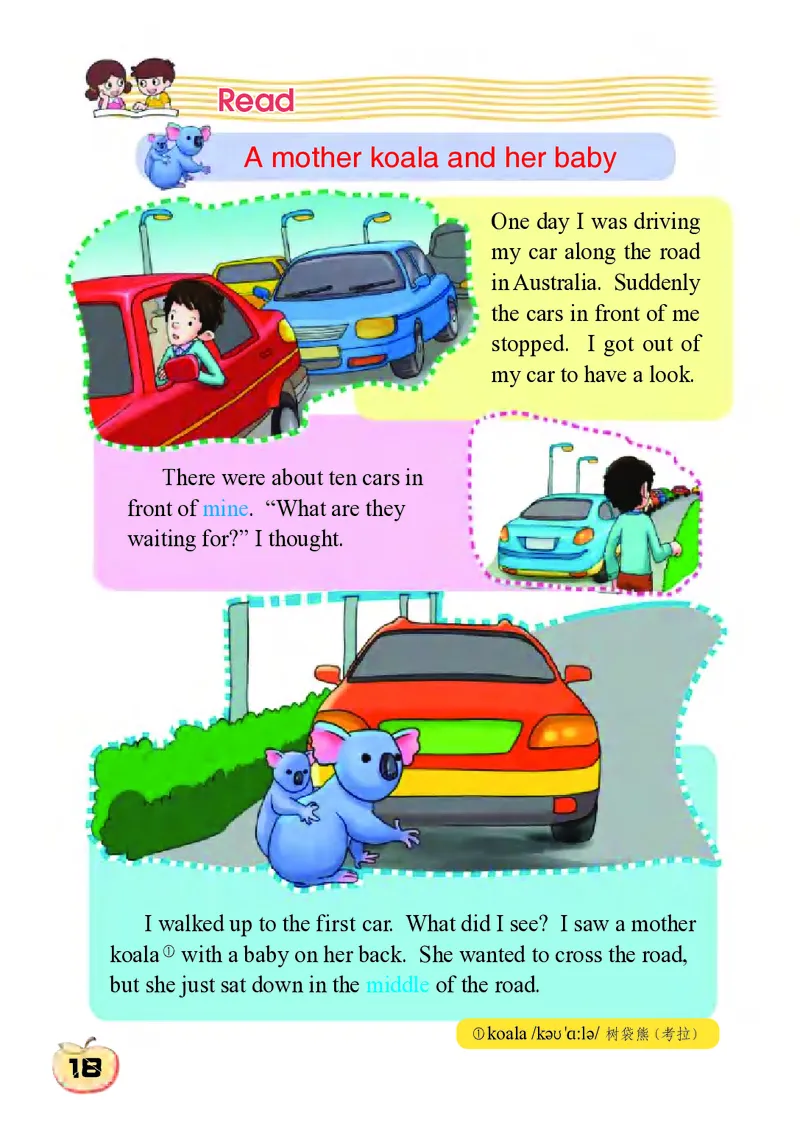
There were about ten cars in
front of mine. “What are they
waiting for?” I thought.
One day I was driving
my car along the road
in Australia. Suddenly
the cars in front of me
stopped. I got out of
my car to have a look.
I walked up to the first car. What did I see? I saw a mother
koala ① with a baby on her back. She wanted to cross the road,
but she just sat down in the middle of the road.
Read
A mother koala and her baby
①koala /kEH?A:lE/ 树袋熊(考拉)
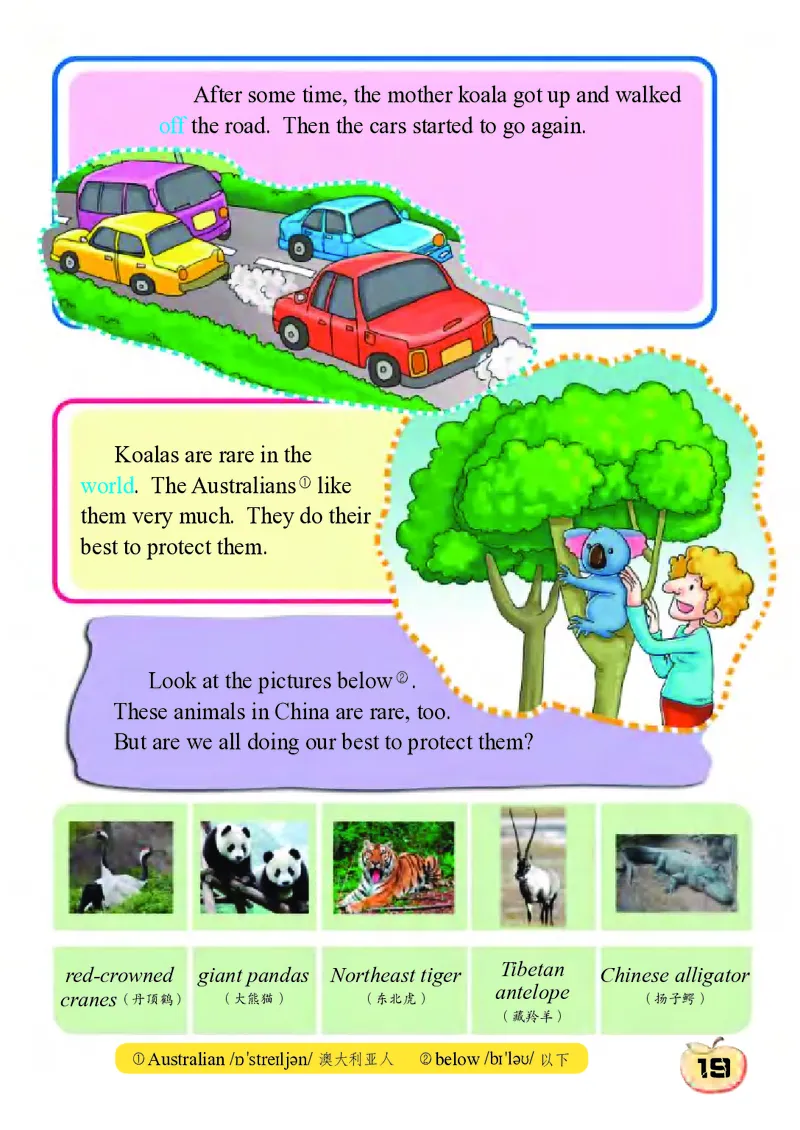
After some time, the mother koala got up and walked
off the road. Then the cars started to go again.
red-crowned
cranes ( 丹顶鹤)
Look at the pictures below ②.
These animals in China are rare, too.
But are we all doing our best to protect them?
giant pandas
( 大熊猫)
Tibetan
antelope
( 藏羚羊)
Chinese alligator
( 扬子鳄)
Northeast tiger
( 东北虎)
Koalas are rare in the
world. The Australians ① like
them very much. They do their
best to protect them.
①Australian /F?streIljEn/ 澳大利亚人 ②below /bI?lEH/ 以下
19
20
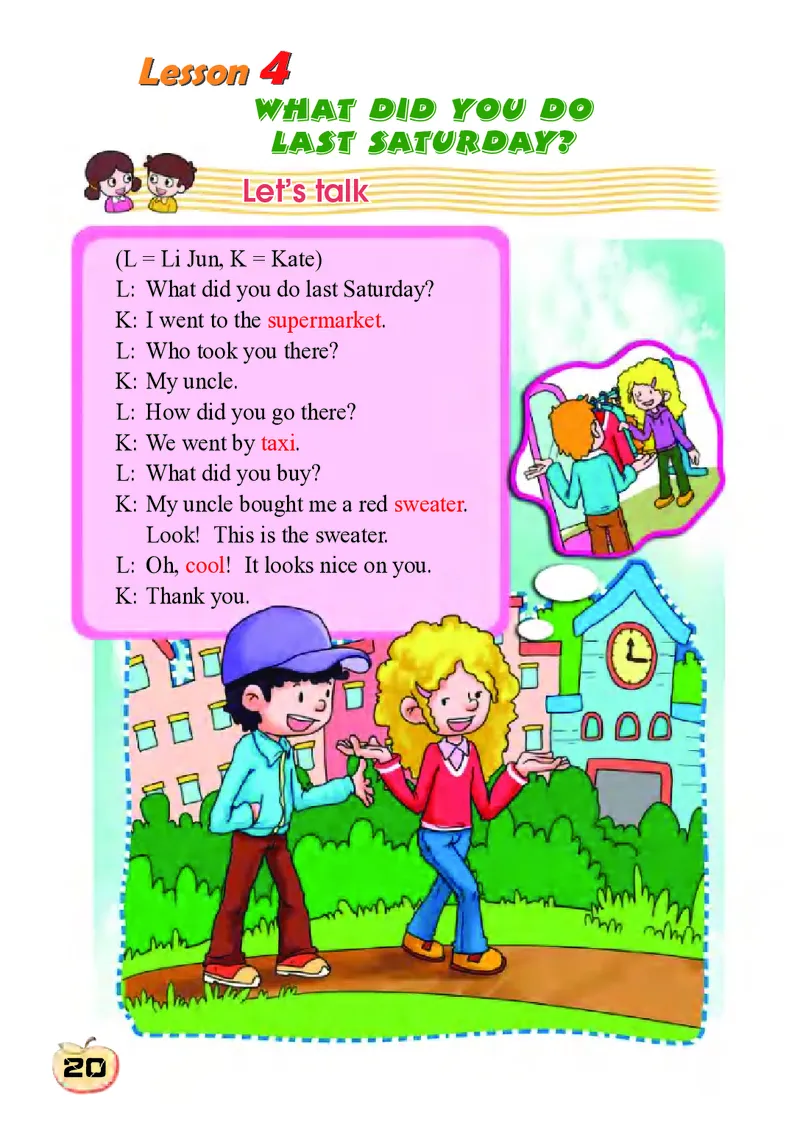
(L = Li Jun, K = Kate)
L: What did you do last Saturday?
K: I went to the supermarket.
L: Who took you there?
K: My uncle.
L: How did you go there?
K: We went by taxi.
L: What did you buy?
K: My uncle bought me a red sweater.
Look! This is the sweater.
L: Oh, cool! It looks nice on you.
K: Thank you.
Let’s talk
What did you do
last saturday?
Lesson 4
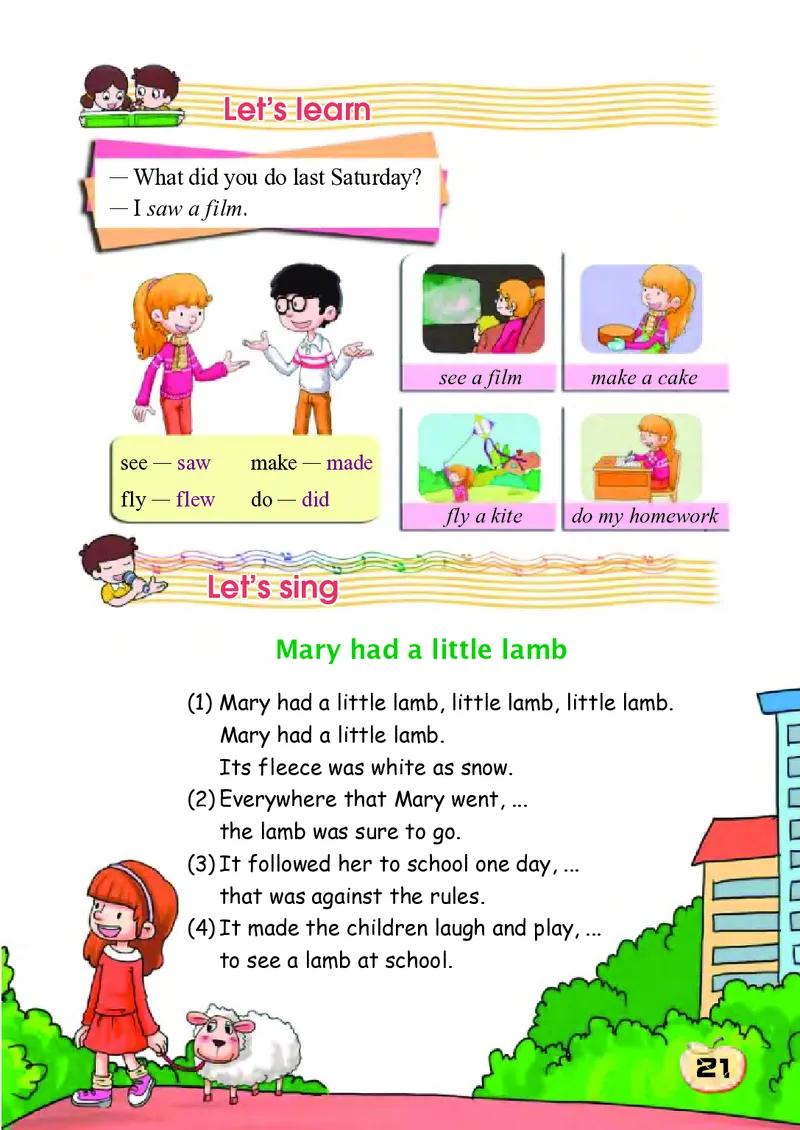
see a film
fly a kite
do my homework
make a cake
Mary had a little lamb
— What did you do last Saturday?
— I saw a film.
see — saw
make — made
fly — flew
do — did
Let’s learn
Let’s sing
(1) Mary had a little lamb, little lamb, little lamb.
Mary had a little lamb.
Its fleece was white as snow.
(2) Everywhere that Mary went, ...
the lamb was sure to go.
(3) It followed her to school one day, ...
that was against the rules.
(4) It made the children laugh and play, ...
to see a lamb at school.
21
22
A
B
A
B
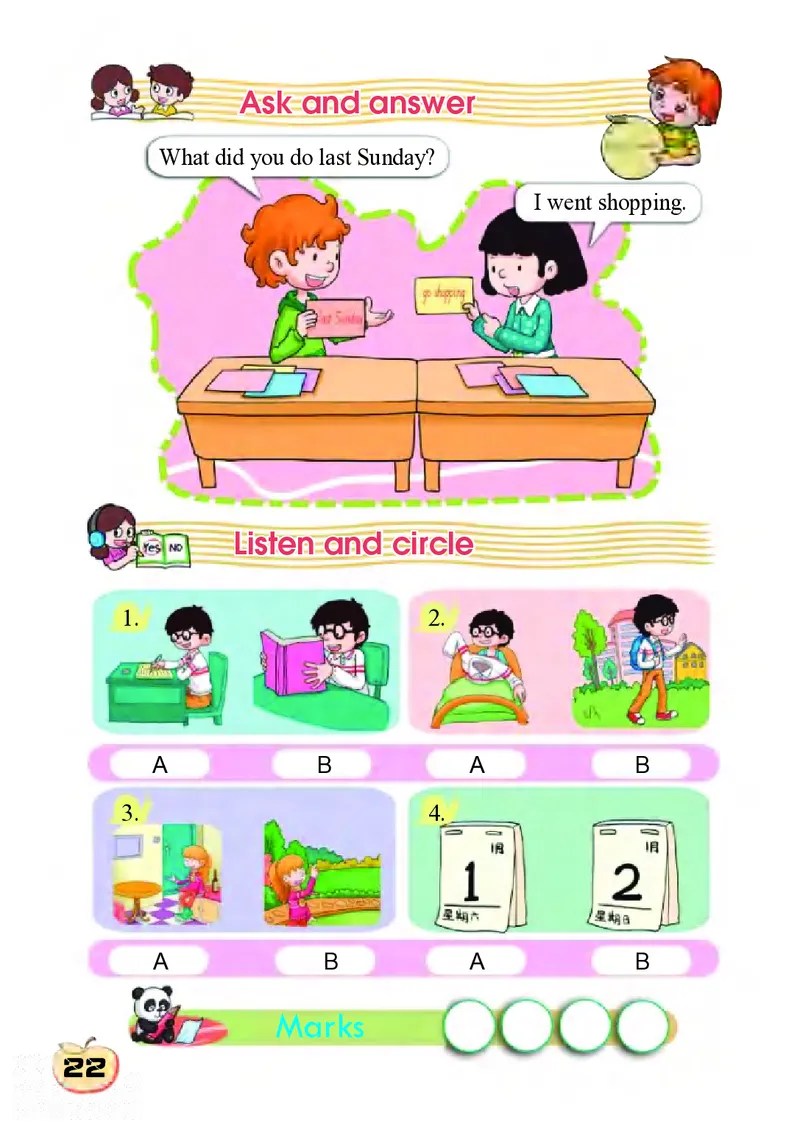
Listen and circle
1.
2.
3.
4.
What did you do last Sunday?
I went shopping.
A
B
A
B
Marks
Ask and answer
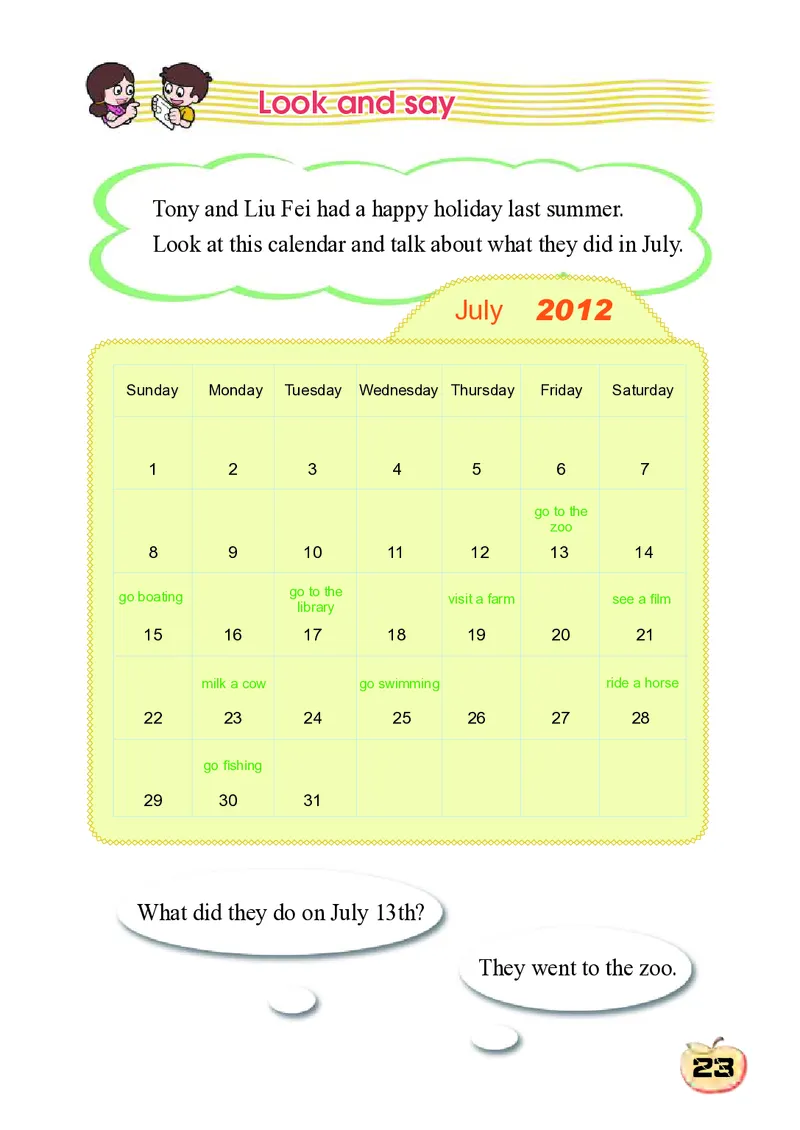
Look and say
Sunday Monday Tuesday Wednesday Thursday Friday Saturday
go boating
ride a horse
July 2012
Tony and Liu Fei had a happy holiday last summer.
Look at this calendar and talk about what they did in July.
go swimming
1 2 3 4 5 6 7
8 9 10 11 12 13 14
15 16 17 18 19 20 21
22 23 24 25 26 27 28
29 30 31
go fishing
milk a cow
What did they do on July 13th?
They went to the zoo.
go to the
zoo
go to the
library
see a film
visit a farm
23
24
Read
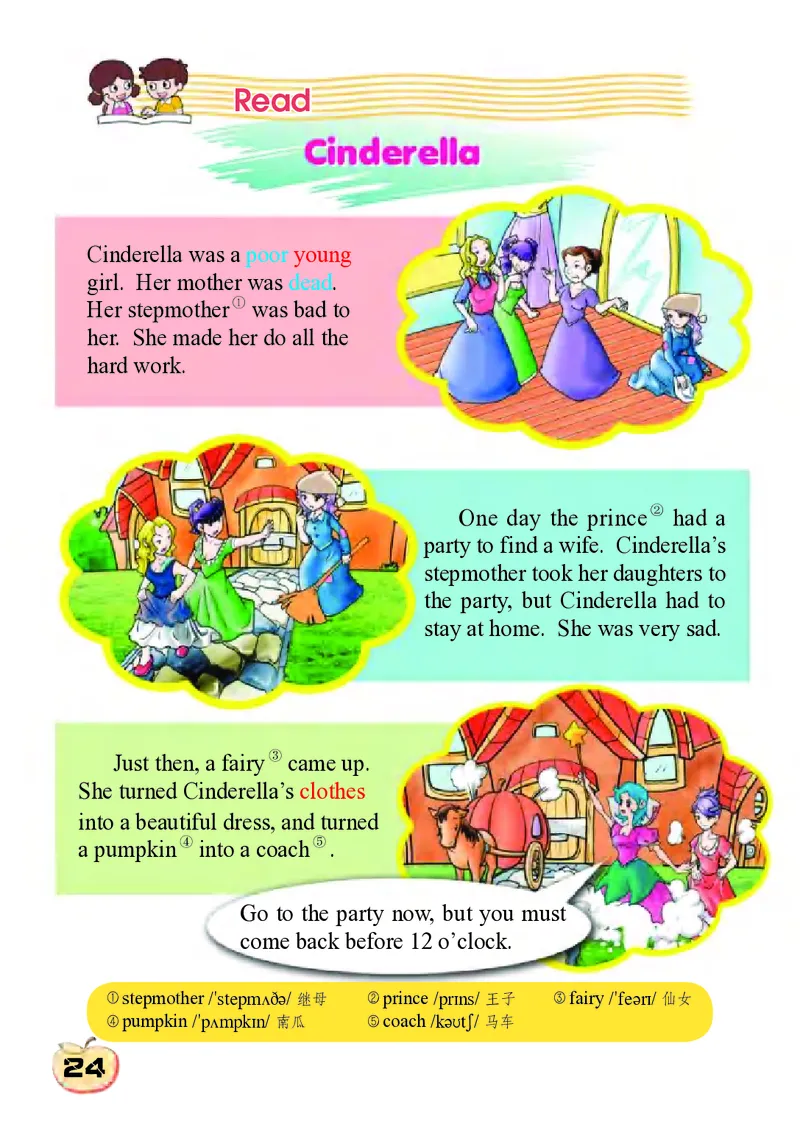
Cinderella was a poor young
girl. Her mother was dead.
Her stepmother ① was bad to
her. She made her do all the
hard work.
One day the prince ② had a
party to find a wife. Cinderella’s
stepmother took her daughters to
the party, but Cinderella had to
stay at home. She was very sad.
Just then, a fairy ③ came up.
She turned Cinderella’s clothes
into a beautiful dress, and turned
a pumpkin ④ into a coach ⑤.
①stepmother /?stepmVDE/ 继母
②prince /prIns/ 王子 ③fairy /?feErI/ 仙女
④pumpkin /?pVmpkIn/ 南瓜
⑤coach /kEHtS/ 马车
Go to the party now, but you must
come back before 12 o’clock.
25
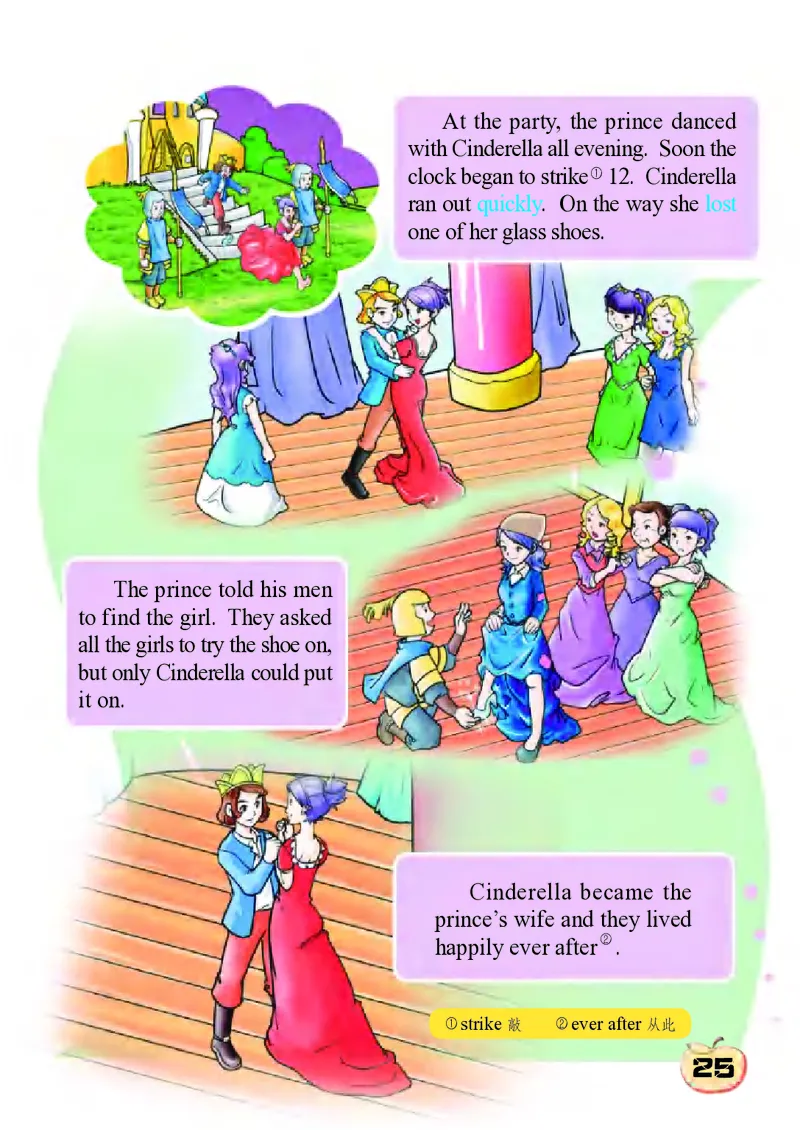
At the party, the prince danced
with Cinderella all evening. Soon the
clock began to strike① 12. Cinderella
ran out quickly. On the way she lost
one of her glass shoes.
The prince told his men
to find the girl. They asked
all the girls to try the shoe on,
but only Cinderella could put
it on.
Cinderella became the
prince’s wife and they lived
happily ever after
②.
①strike 敲
②ever after 从此
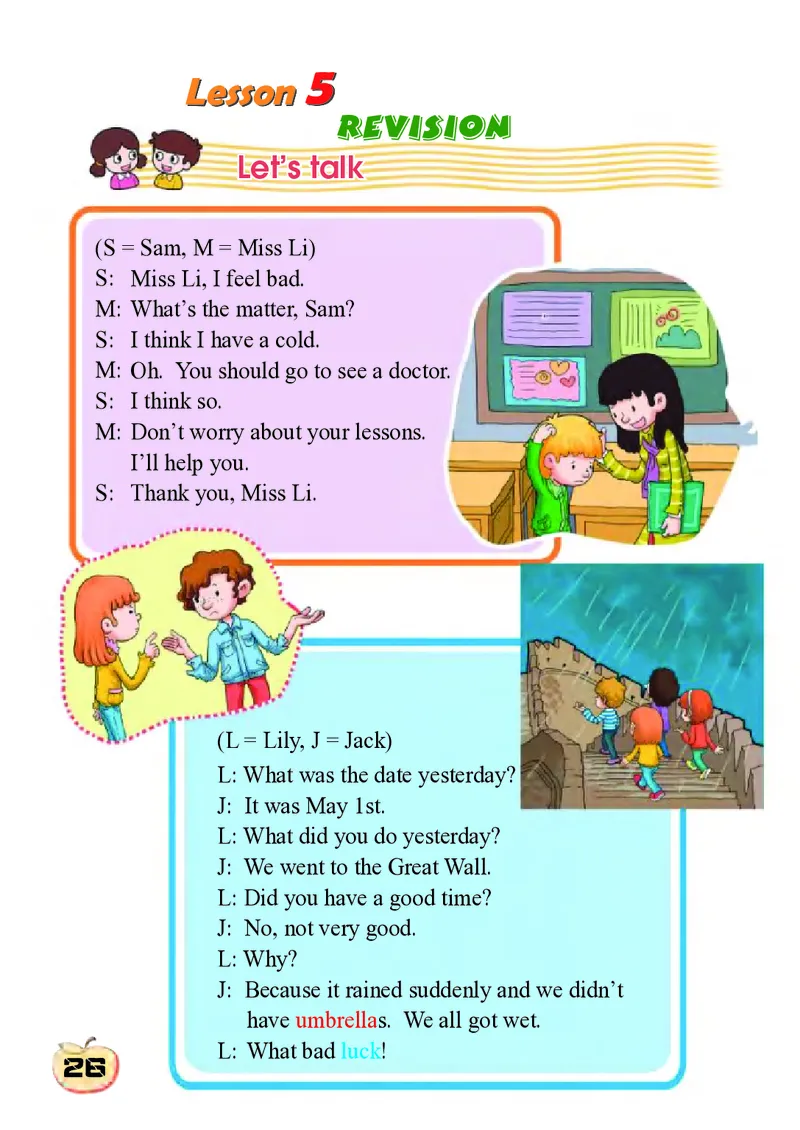
(L = Lily, J = Jack)
L: What was the date yesterday?
J: It was May 1st.
L: What did you do yesterday?
J: We went to the Great Wall.
L: Did you have a good time?
J: No, not very good.
L: Why?
J: Because it rained suddenly and we didn’t
have umbrellas. We all got wet.
L: What bad luck!
Let’s talk
Revision
Lesson 5
26
(S = Sam, M = Miss Li)
S: Miss Li, I feel bad.
M: What’s the matter, Sam?
S: I think I have a cold.
M: Oh. You should go to see a doctor.
S: I think so.
M: Don’t worry about your lessons.
I’ll help you.
S: Thank you, Miss Li.
27
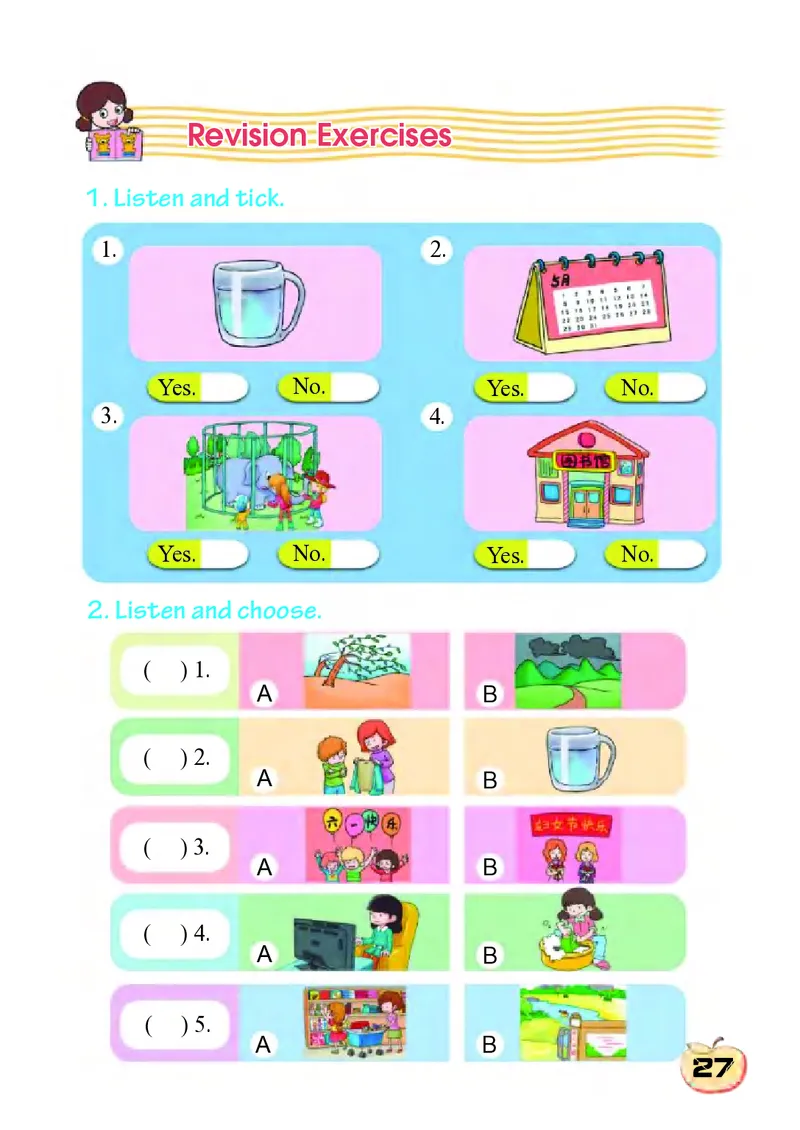
1. Listen and tick.
2. Listen and choose.
Revision Exercises
Yes.
No.
1.
2.
3.
4.
( ) 1.
( ) 2.
( ) 3.
( ) 4.
( ) 5.
A
B
A
B
A
B
A
B
B
A
Yes.
No.
Yes.
No.
Yes.
No.
28
3. Put the words into the right group.
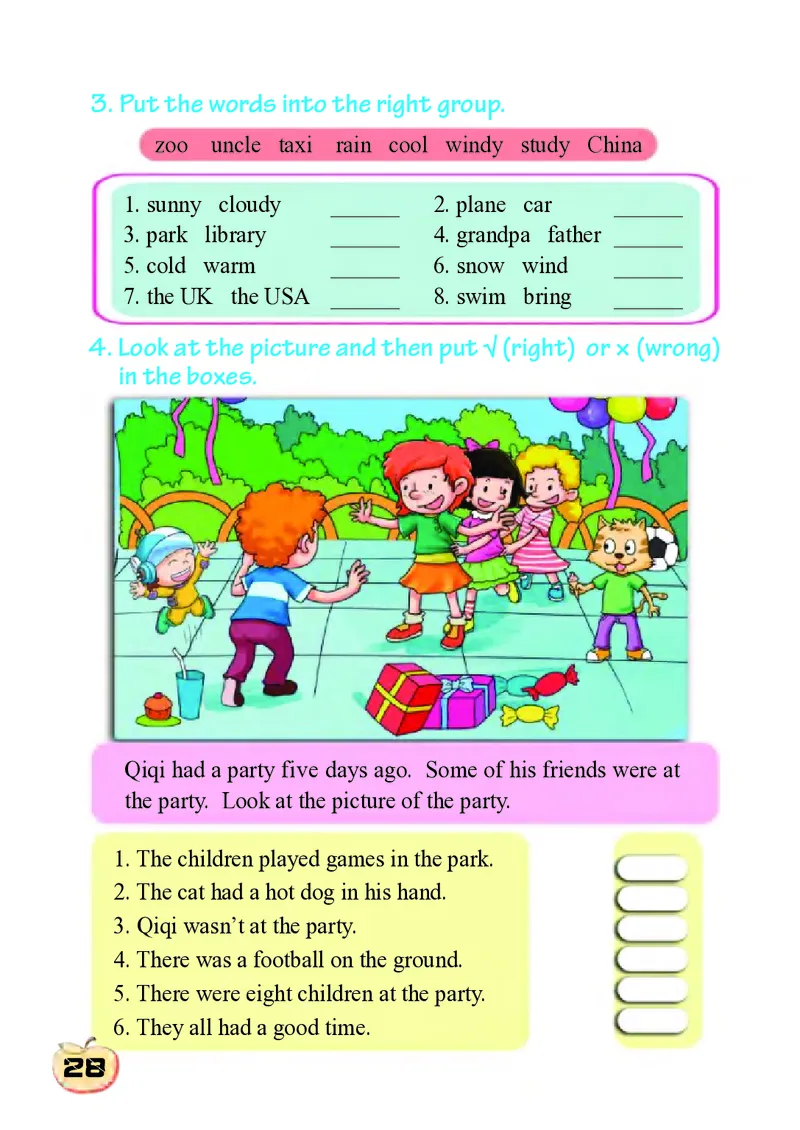
Qiqi had a party five days ago. Some of his friends were at
the party. Look at the picture of the party.
1. The children played games in the park.
2. The cat had a hot dog in his hand.
3. Qiqi wasn’t at the party.
4. There was a football on the ground.
5. There were eight children at the party.
6. They all had a good time.
4. Look at the picture and then put √ (right) or × (wrong)
in the boxes.
zoo uncle taxi rain cool windy study China
1. sunny cloudy
______
2. plane car
______
3. park library
______
4. grandpa father ______
5. cold warm
______
6. snow wind
______
7. the UK the USA ______
8. swim bring
______
29
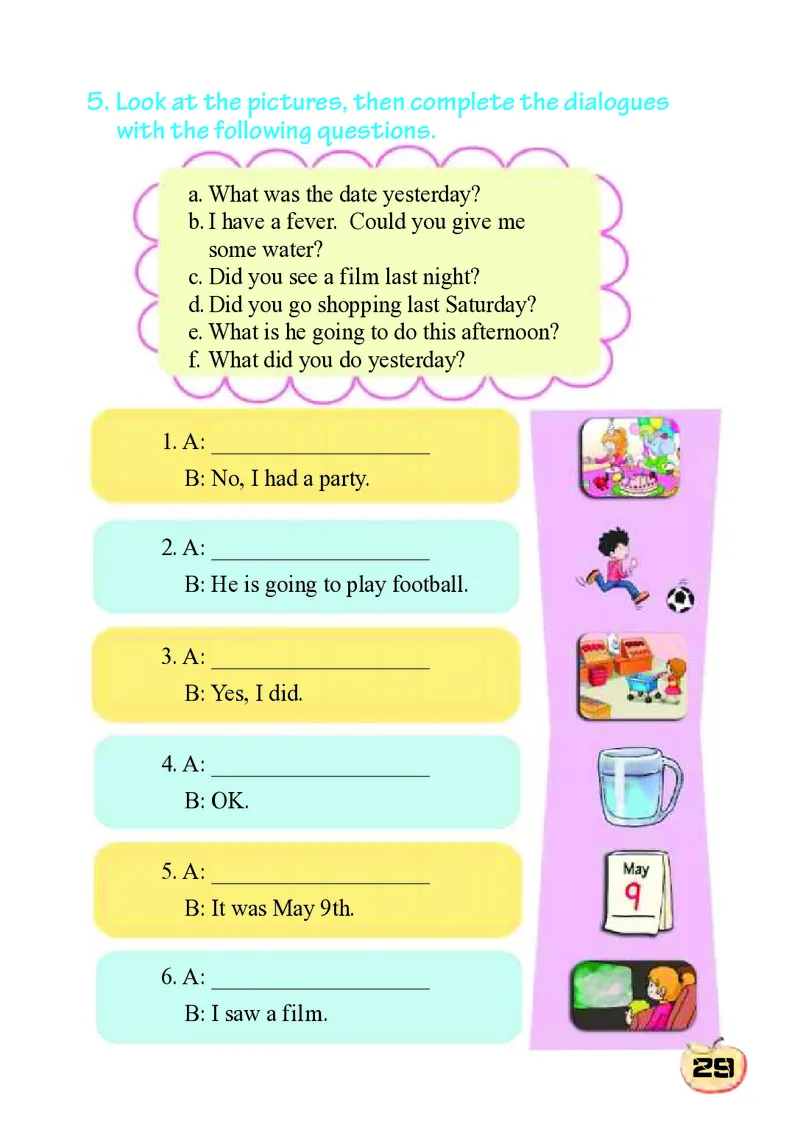
a. What was the date yesterday?
b. I have a fever. Could you give me
some water?
c. Did you see a film last night?
d. Did you go shopping last Saturday?
e. What is he going to do this afternoon?
f. What did you do yesterday?
5. Look at the pictures, then complete the dialogues
with the following questions.
1. A: ___________________
B: No, I had a party.
2. A: ___________________
B: He is going to play football.
3. A: ___________________
B: Yes, I did.
4. A: ___________________
B: OK.
5. A: ___________________
B: It was May 9th.
6. A: ___________________
B: I saw a film.
30
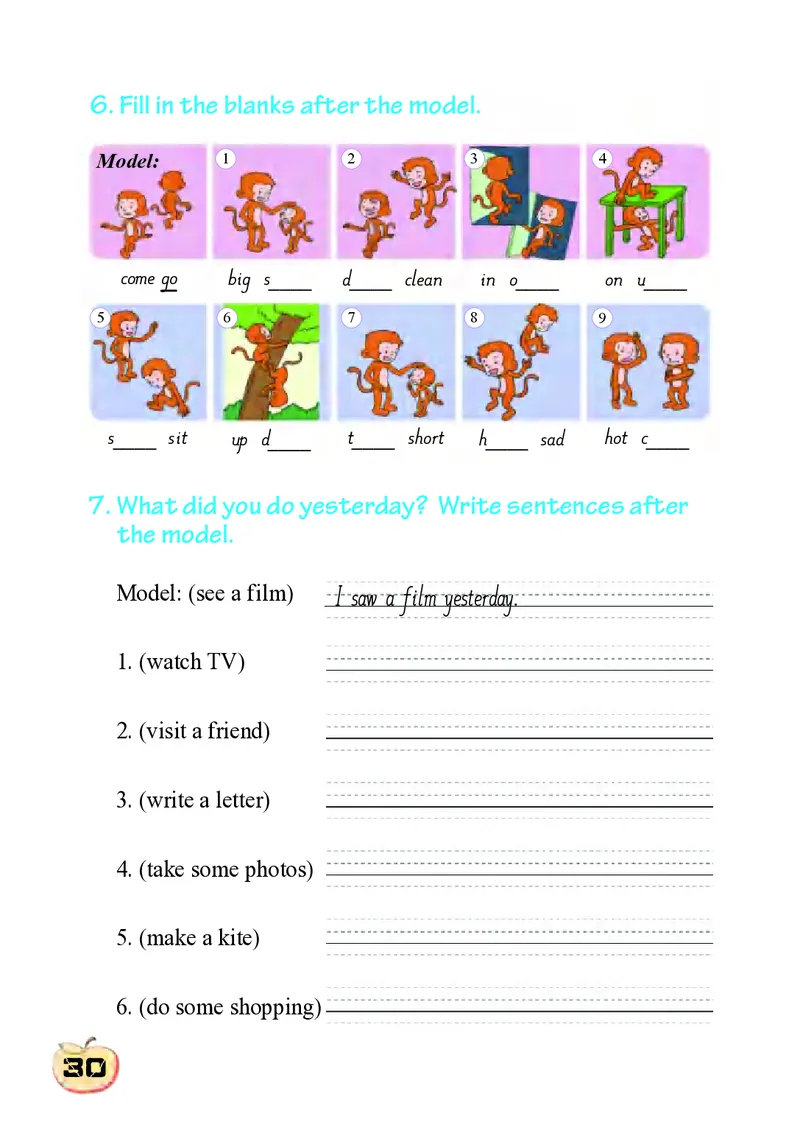
6. Fill in the blanks after the model.
come go
big s____ d____ clean
in o____
on u____
s____ sit
up d____
t____ short
h____ sad
hot c____
7. What did you do yesterday? Write sentences after
the model.
Model: (see a film)
1. (watch TV)
2. (visit a friend)
3. (write a letter)
4. (take some photos)
5. (make a kite)
6. (do some shopping)
I saw a film yesterday.
Model:
1
2
7
6
5
3
8
4
9
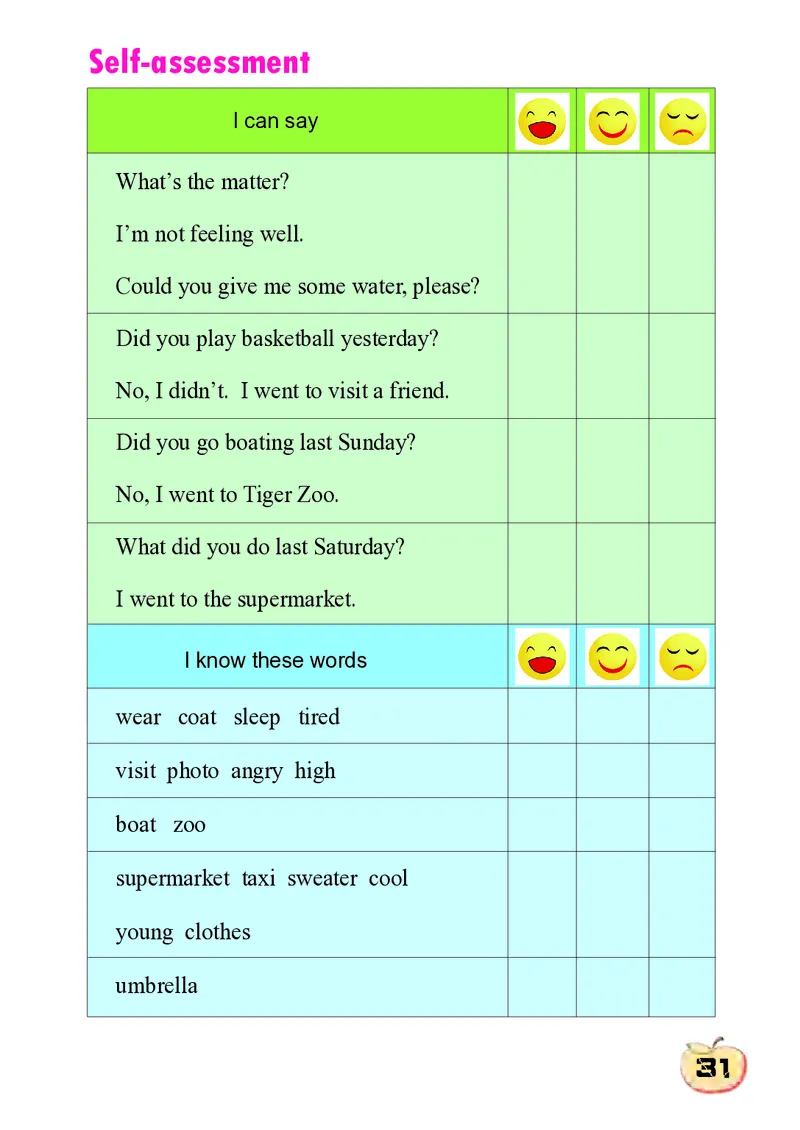
I can say
Self-assessment
I know these words
I can say
I know these words
What’s the matter?
I’m not feeling well.
Could you give me some water, please?
Did you play basketball yesterday?
No, I didn’t. I went to visit a friend.
Did you go boating last Sunday?
No, I went to Tiger Zoo.
What did you do last Saturday?
I went to the supermarket.
wear coat sleep tired
visit photo angry high
boat zoo
supermarket taxi sweater cool
young clothes
umbrella
31
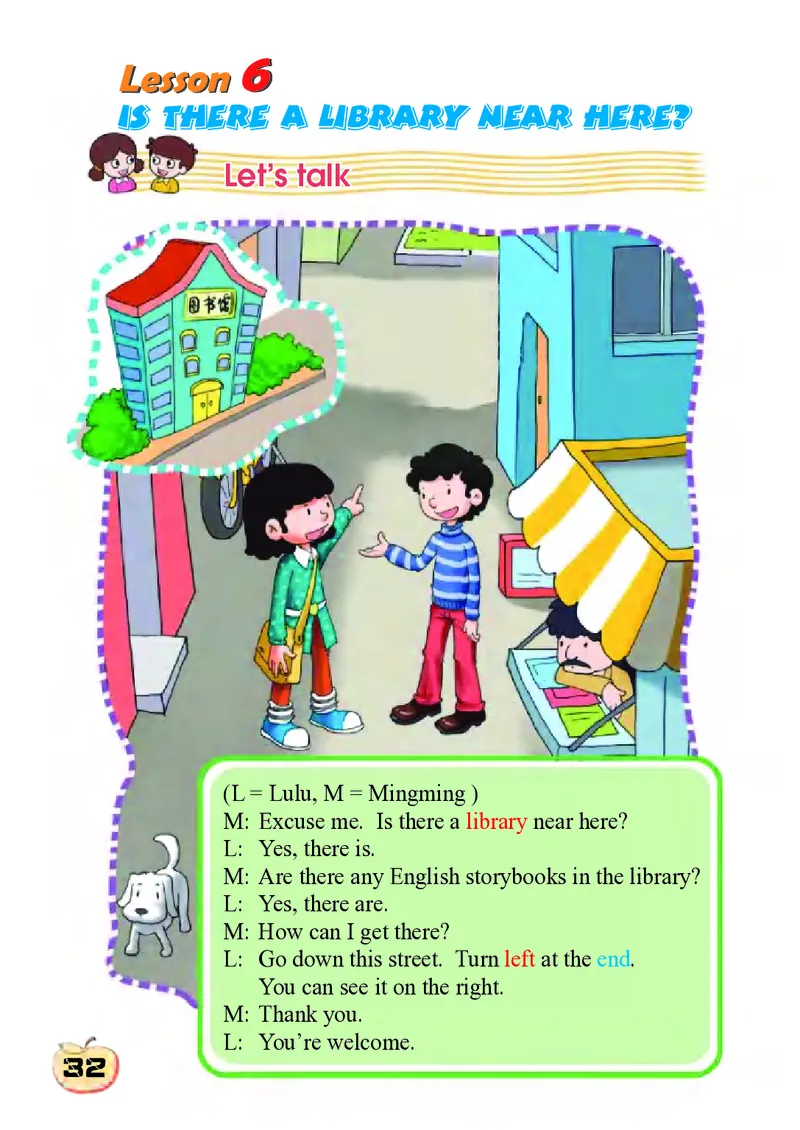
(L = Lulu, M = Mingming )
M: Excuse me. Is there a library near here?
L: Yes, there is.
M: Are there any English storybooks in the library?
L: Yes, there are.
M: How can I get there?
L: Go down this street. Turn left at the end.
You can see it on the right.
M: Thank you.
L: You’re welcome.
Let’s talk
Is there a library near here?
Lesson 6
32
Let’s sing
Bingo
There is a farmer (who) has a dog.
And Bingo is his name, sir!
B-I-N-G-O, B-I-N-G-O, B-I-N-G-O.
And Bingo is his name, sir!
33
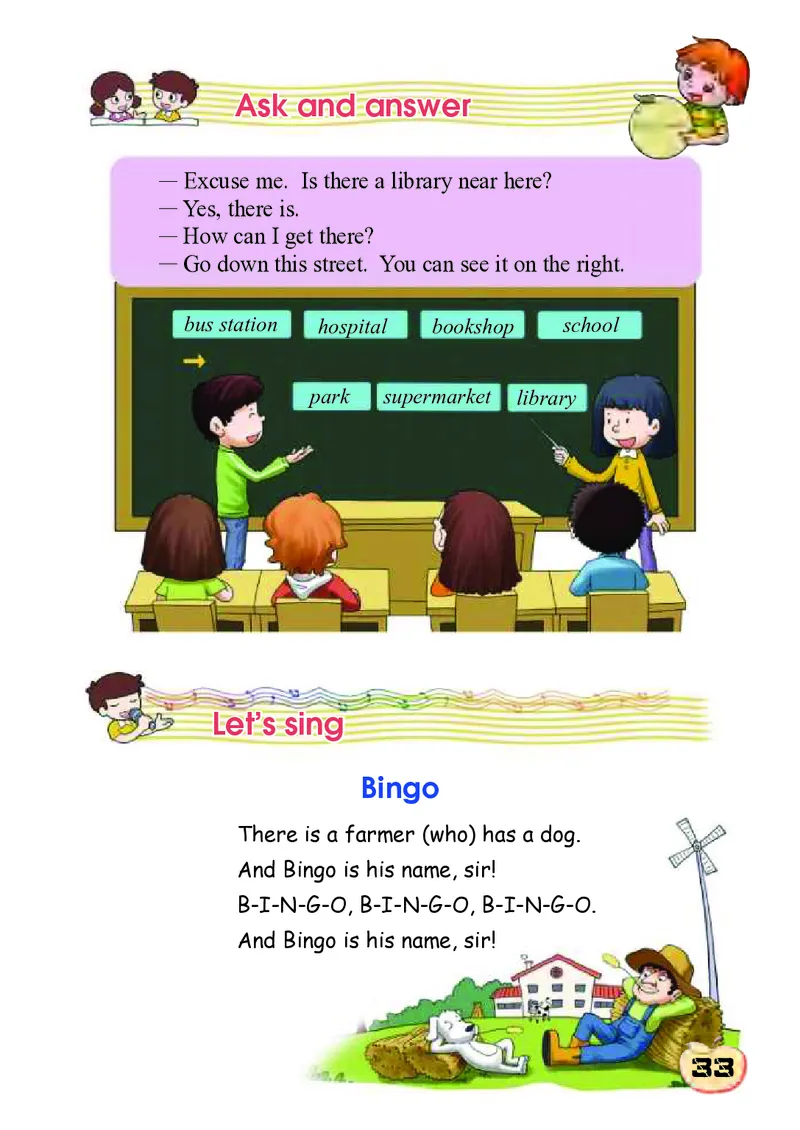
— Excuse me. Is there a library near here?
— Yes, there is.
— How can I get there?
— Go down this street. You can see it on the right.
bus station
hospital
bookshop
school
park
supermarket
library
Ask and answer
Are you still looking for that place?
Read
①London /?lVndEn/ 伦敦
34
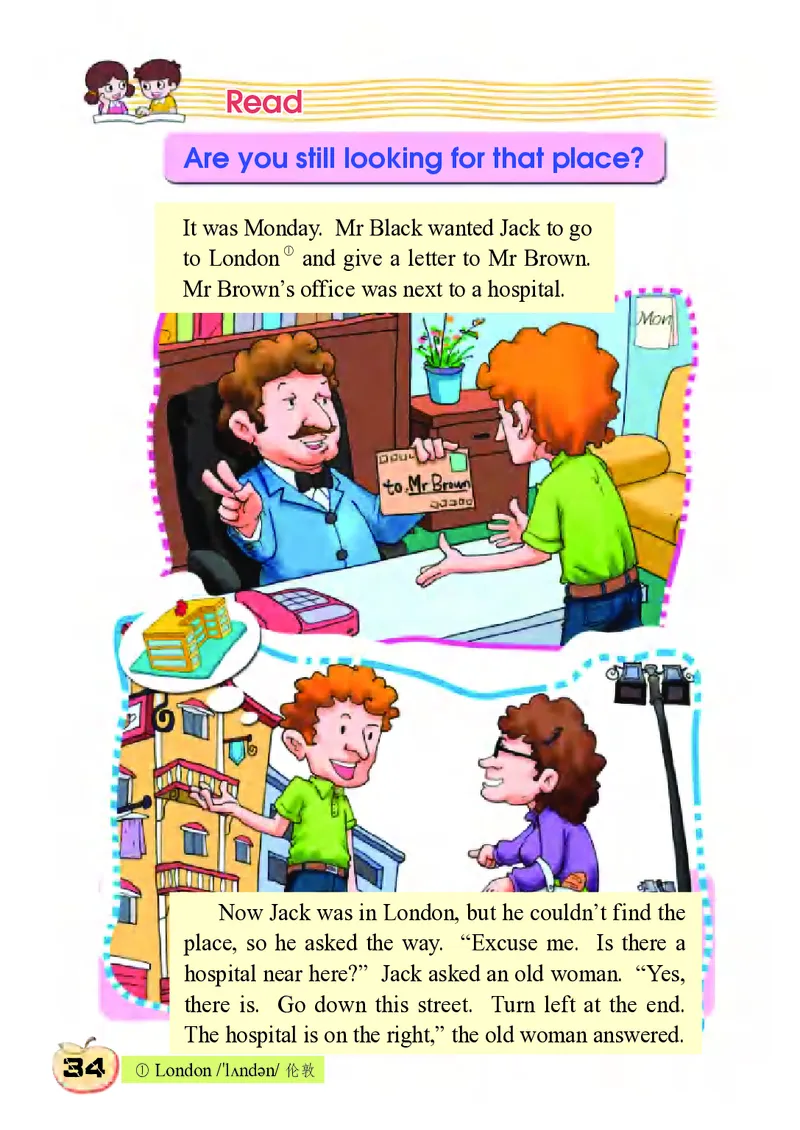
It was Monday. Mr Black wanted Jack to go
to London
① and give a letter to Mr Brown.
Mr Brown’s office was next to a hospital.
Now Jack was in London, but he couldn’t find the
place, so he asked the way. “Excuse me. Is there a
hospital near here?” Jack asked an old woman. “Yes,
there is. Go down this street. Turn left at the end.
The hospital is on the right,” the old woman answered.
35
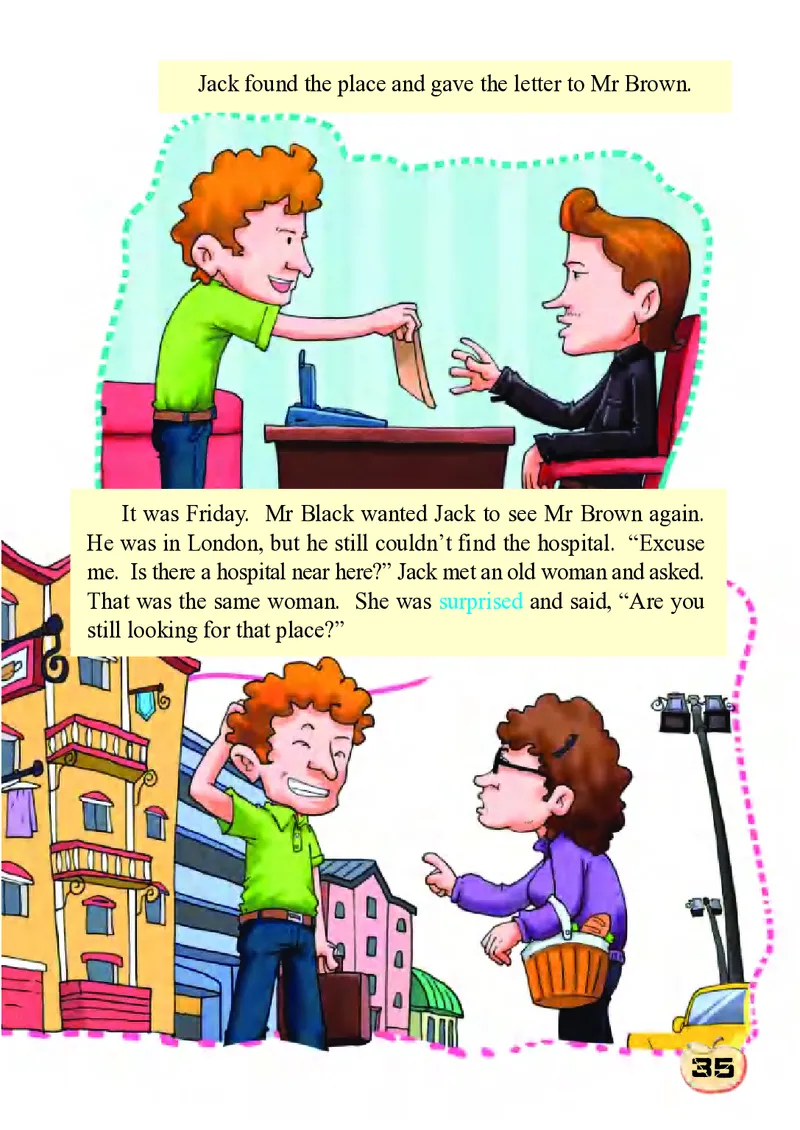
Jack found the place and gave the letter to Mr Brown.
It was Friday. Mr Black wanted Jack to see Mr Brown again.
He was in London, but he still couldn’t find the hospital. “Excuse
me. Is there a hospital near here?” Jack met an old woman and asked.
That was the same woman. She was surprised and said, “Are you
still looking for that place?”
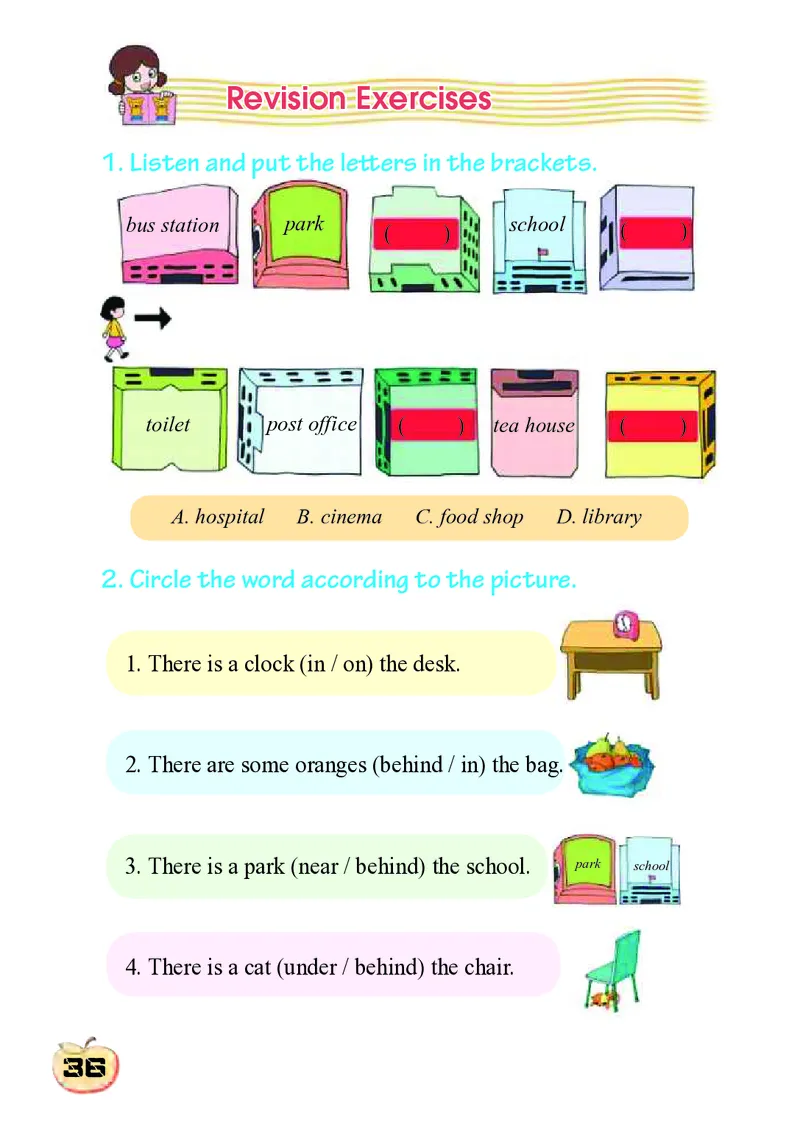
1. Listen and put the letters in the brackets.
2. Circle the word according to the picture.
Revision Exercises
school
school
park
park
toilet
bus station
post office
tea house
A. hospital B. cinema C. food shop D. library
1. There is a clock (in / on) the desk.
2. There are some oranges (behind / in) the bag.
3. There is a park (near / behind) the school.
4. There is a cat (under / behind) the chair.
36
( )
( )
( )
( )
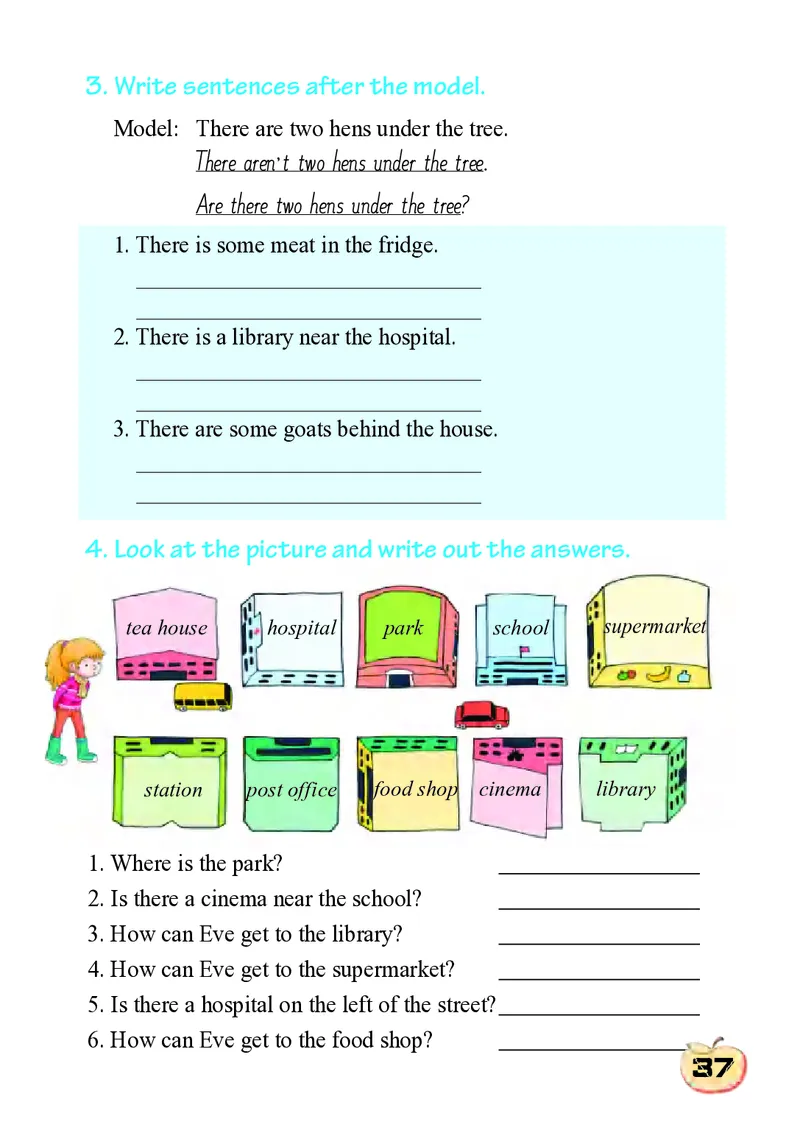
school
tea house
post office
station
food shop
park
supermarket
library
cinema
hospital
4. Look at the picture and write out the answers.
1. Where is the park?
2. Is there a cinema near the school?
3. How can Eve get to the library?
4. How can Eve get to the supermarket?
5. Is there a hospital on the left of the street?
6. How can Eve get to the food shop?
3. Write sentences after the model.
Model: There are two hens under the tree.
There aren’t two hens under the tree.
Are there two hens under the tree?
1. There is some meat in the fridge.
______________________________
______________________________
2. There is a library near the hospital.
______________________________
______________________________
3. There are some goats behind the house.
______________________________
______________________________
37
_________________________
_______________________
,
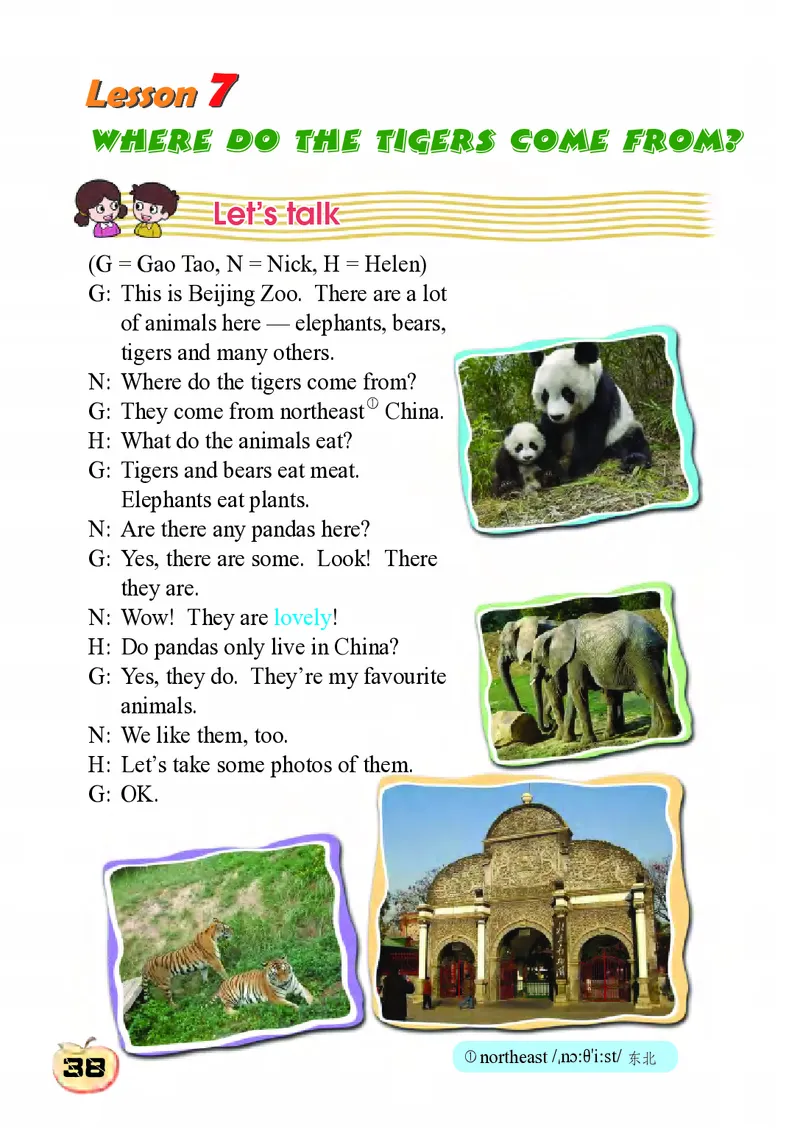
(G = Gao Tao, N = Nick, H = Helen)
G: This is Beijing Zoo. There are a lot
of animals here — elephants, bears,
tigers and many others.
N: Where do the tigers come from?
G: They come from northeast
① China.
H: What do the animals eat?
G: Tigers and bears eat meat.
Elephants eat plants.
N: Are there any pandas here?
G: Yes, there are some. Look! There
they are.
N: Wow! They are lovely!
H: Do pandas only live in China?
G: Yes, they do. They’re my favourite
animals.
N: We like them, too.
H: Let’s take some photos of them.
G: OK.
Let’s talk
Lesson 7
Where do the tigers come from?
38
①northeast /LnC:O?i:st/ 东北
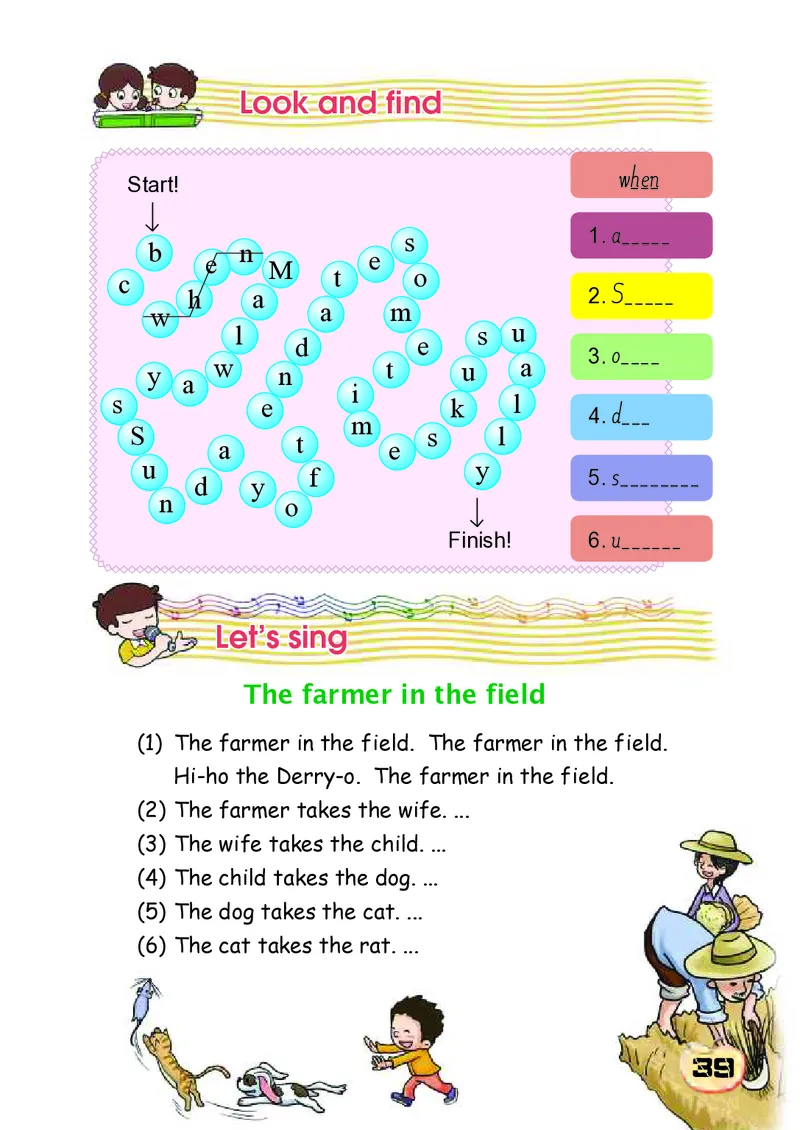
39
The farmer in the field
Let’s sing
Look and find
(1) The farmer in the field. The farmer in the field.
Hi-ho the Derry-o. The farmer in the field.
(2) The farmer takes the wife. ...
(3) The wife takes the child. ...
(4) The child takes the dog. ...
(5) The dog takes the cat. ...
(6) The cat takes the rat. ...
b
c
w h
e
M
a
n
l
w
a
y
s
u
n d
a
y o
f
t
e
n
d
a
t
e
s
o
m
e
t
i
m
e
s
k
u
s
u
a
l
l
y
S
Start!
Finish!
1. a_____
2. S_____
3. o____
4. d___
5. s________
6. u______
when
___
40
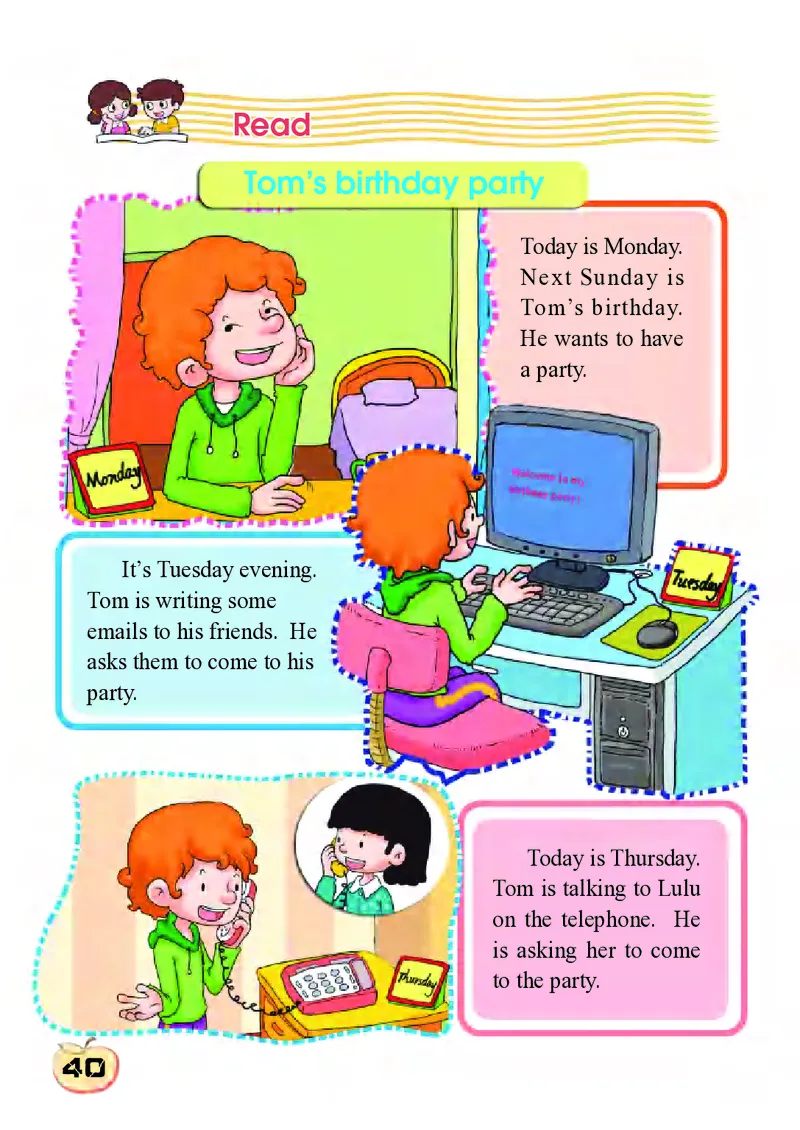
Today is Monday.
Next Sunday is
Tom’s birthday.
He wants to have
a party.
It’s Tuesday evening.
Tom is writing some
emails to his friends. He
asks them to come to his
party.
Today is Thursday.
Tom is talking to Lulu
on the telephone. He
is asking her to come
to the party.
Read
Tom’s birthday party
40
41
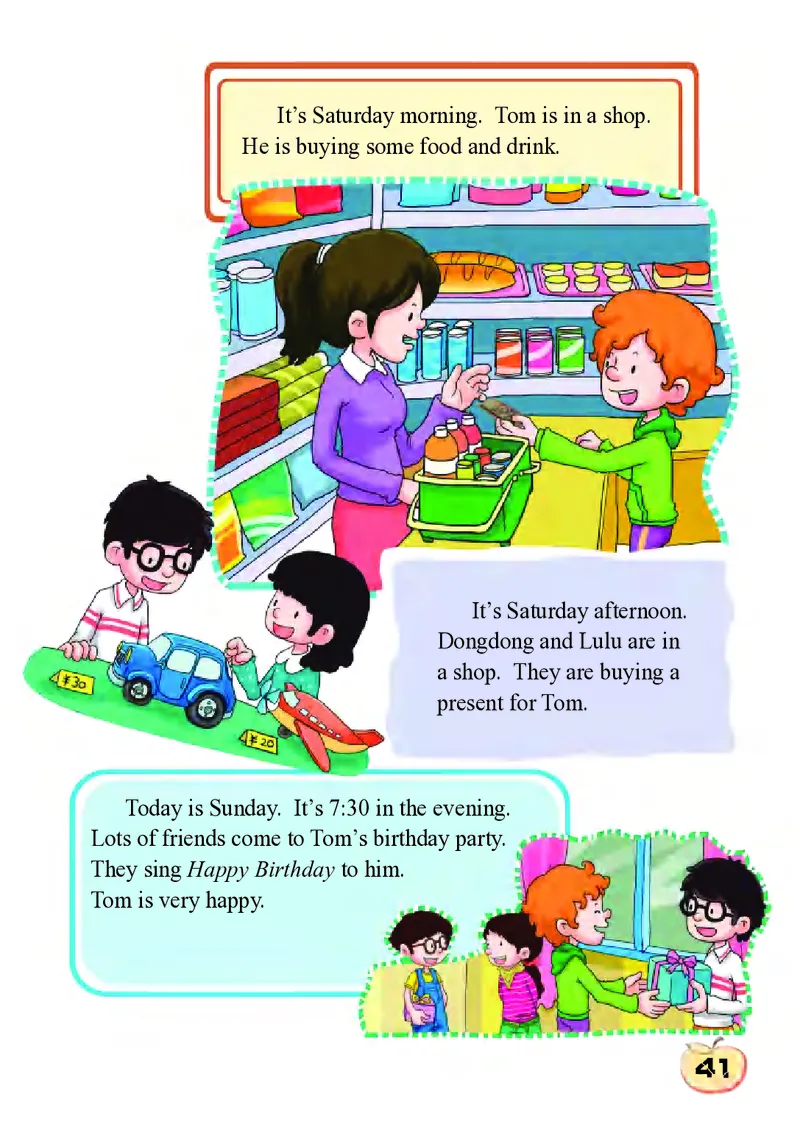
It’s Saturday morning. Tom is in a shop.
He is buying some food and drink.
It’s Saturday afternoon.
Dongdong and Lulu are in
a shop. They are buying a
present for Tom.
Today is Sunday. It’s 7:30 in the evening.
Lots of friends come to Tom’s birthday party.
They sing Happy Birthday to him.
Tom is very happy.
41
42
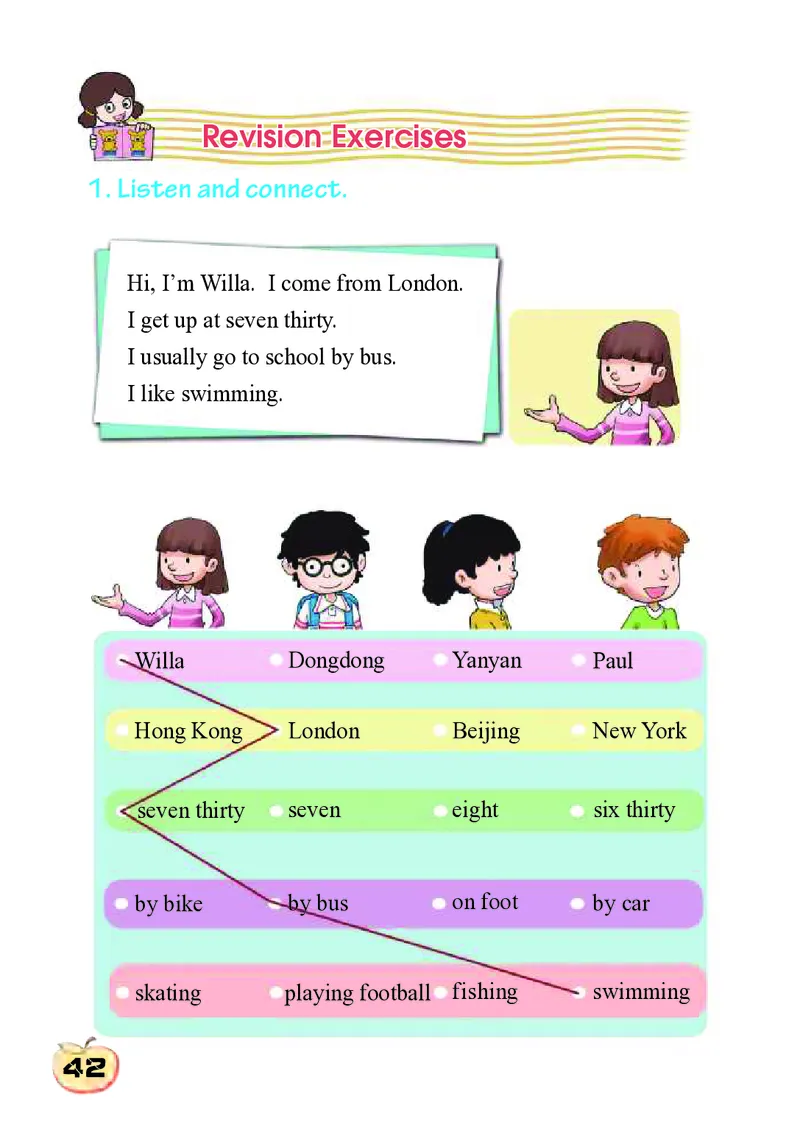
1. Listen and connect.
Willa
Dongdong
Yanyan
Paul
Hong Kong
Beijing
New York
London
by bus
on foot
by car
by bike
swimming
playing football
fishing
skating
Revision Exercises
Hi, I’m Willa. I come from London.
I get up at seven thirty.
I usually go to school by bus.
I like swimming.
seven thirty
seven
eight
six thirty
43
1. What does your father do?
2. Does your friend have big eyes?
3. Where do you come from?
4. Does Jim like playing ping-pong?
A. Yes, he does.
B. He is a teacher.
C. No, he likes playing basketball.
D. I come from the USA.
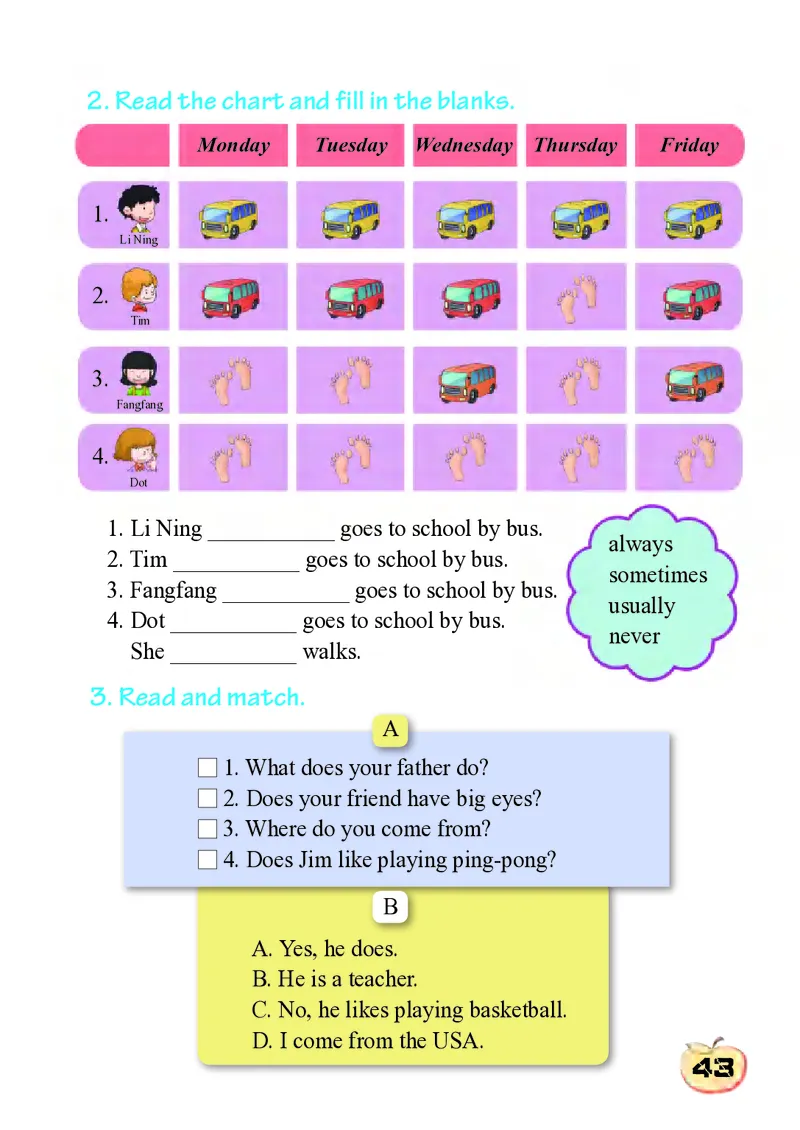
2. Read the chart and fill in the blanks.
1. Li Ning ___________ goes to school by bus.
2. Tim ___________ goes to school by bus.
3. Fangfang ___________ goes to school by bus.
4. Dot ___________ goes to school by bus.
She ___________ walks.
Monday
Friday
Tuesday
Wednesday
Thursday
always
sometimes
usually
never
4.
3.
2.
1.
3. Read and match.
A
B
Li Ning
Tim
Fangfang
Dot
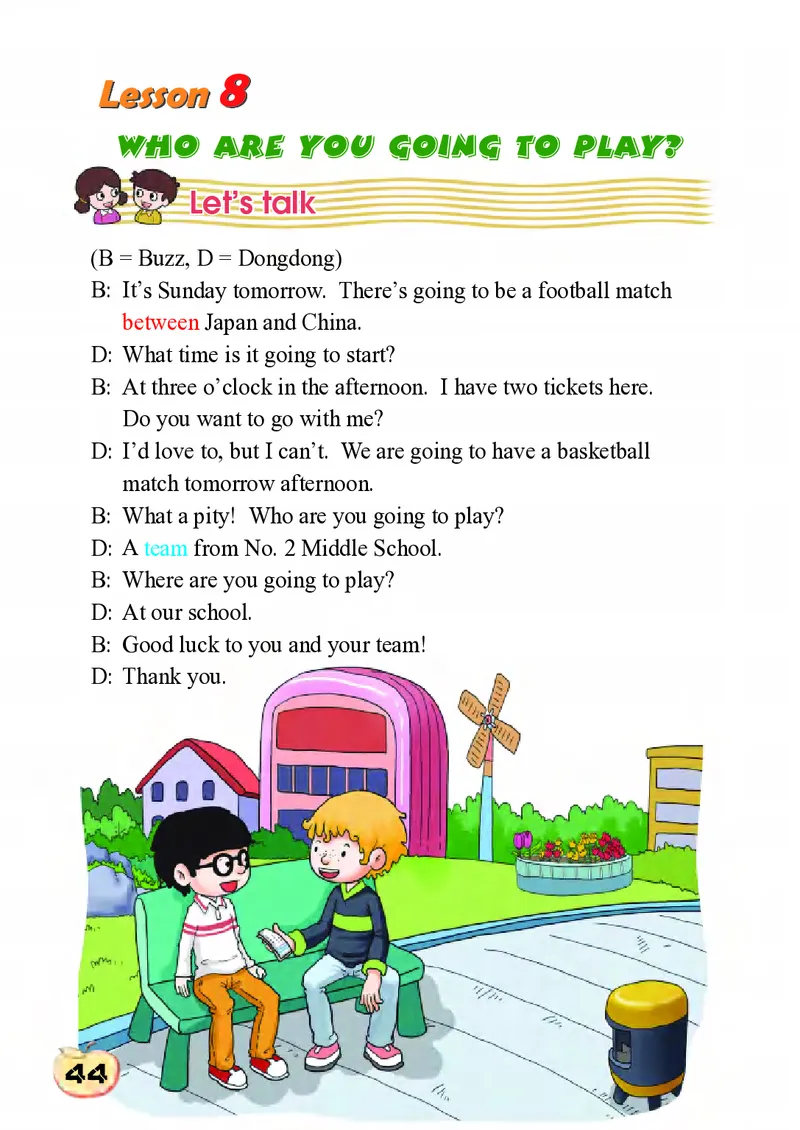
(B = Buzz, D = Dongdong)
B: It’s Sunday tomorrow. There’s going to be a football match
between Japan and China.
D: What time is it going to start?
B: At three o’clock in the afternoon. I have two tickets here.
Do you want to go with me?
D: I’d love to, but I can’t. We are going to have a basketball
match tomorrow afternoon.
B: What a pity! Who are you going to play?
D: A team from No. 2 Middle School.
B: Where are you going to play?
D: At our school.
B: Good luck to you and your team!
D: Thank you.
Let’s talk
Who are you going to play?
Lesson 8
44
45
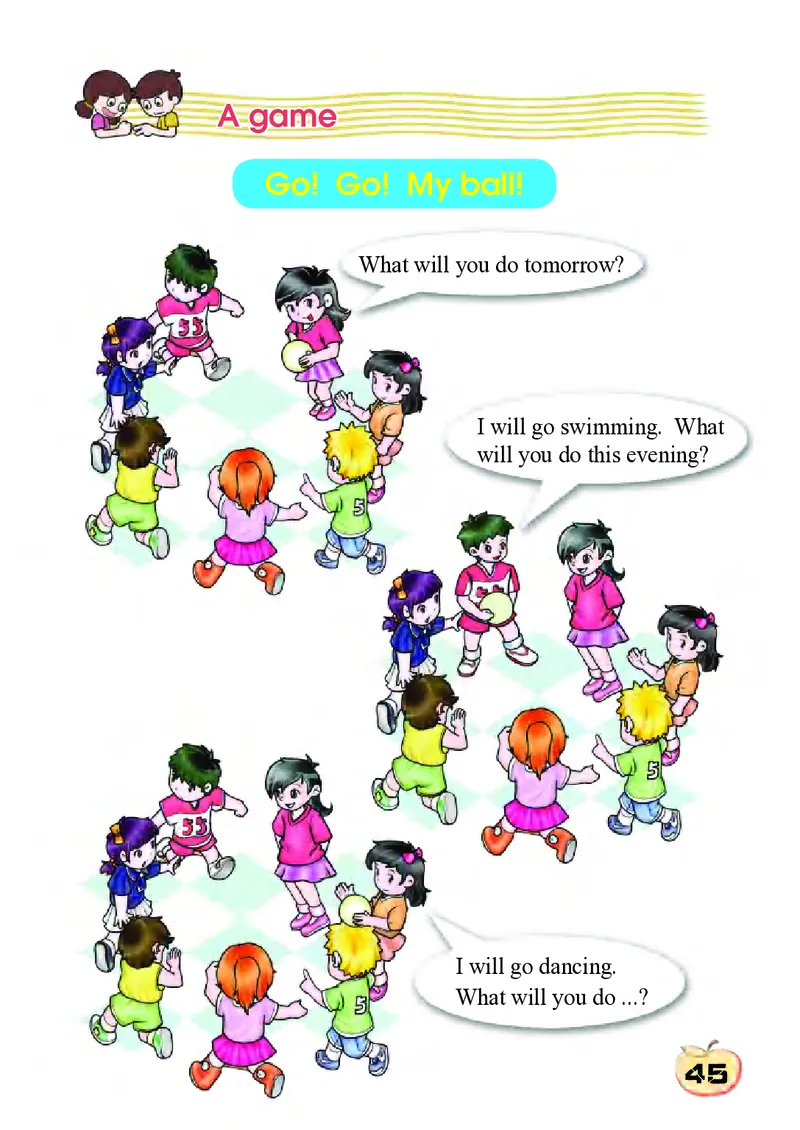
A game
What will you do tomorrow?
I will go swimming. What
will you do this evening?
I will go dancing.
What will you do ...?
Go! Go! My ball!
Read
46
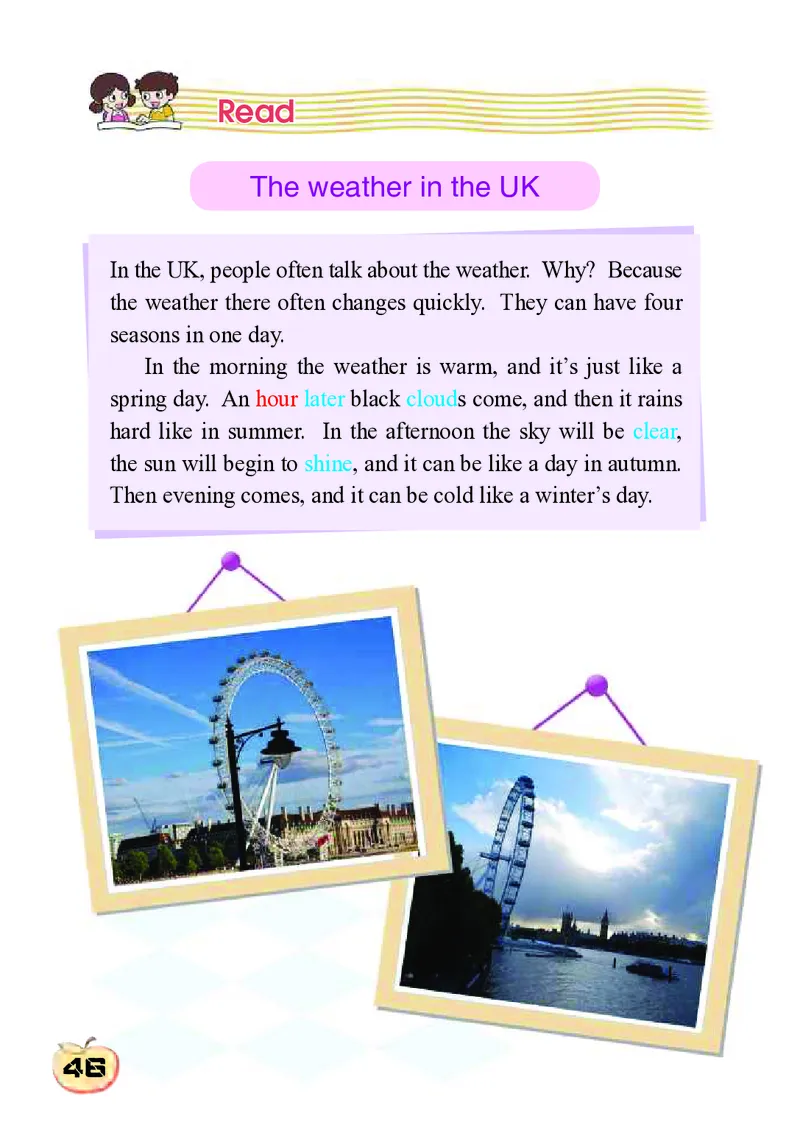
The weather in the UK
In the UK, people often talk about the weather. Why? Because
the weather there often changes quickly. They can have four
seasons in one day.
In the morning the weather is warm, and it’s just like a
spring day. An hour later black clouds come, and then it rains
hard like in summer. In the afternoon the sky will be clear,
the sun will begin to shine, and it can be like a day in autumn.
Then evening comes, and it can be cold like a winter’s day.
47
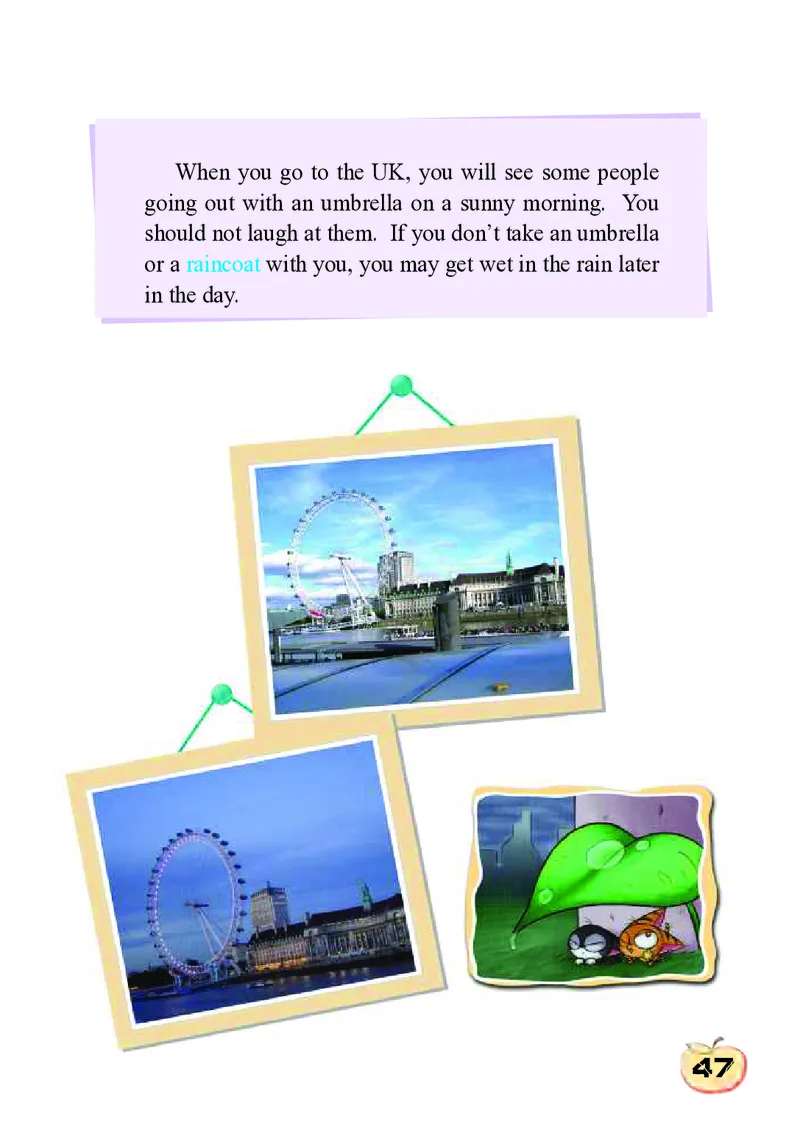
When you go to the UK, you will see some people
going out with an umbrella on a sunny morning. You
should not laugh at them. If you don’t take an umbrella
or a raincoat with you, you may get wet in the rain later
in the day.
48
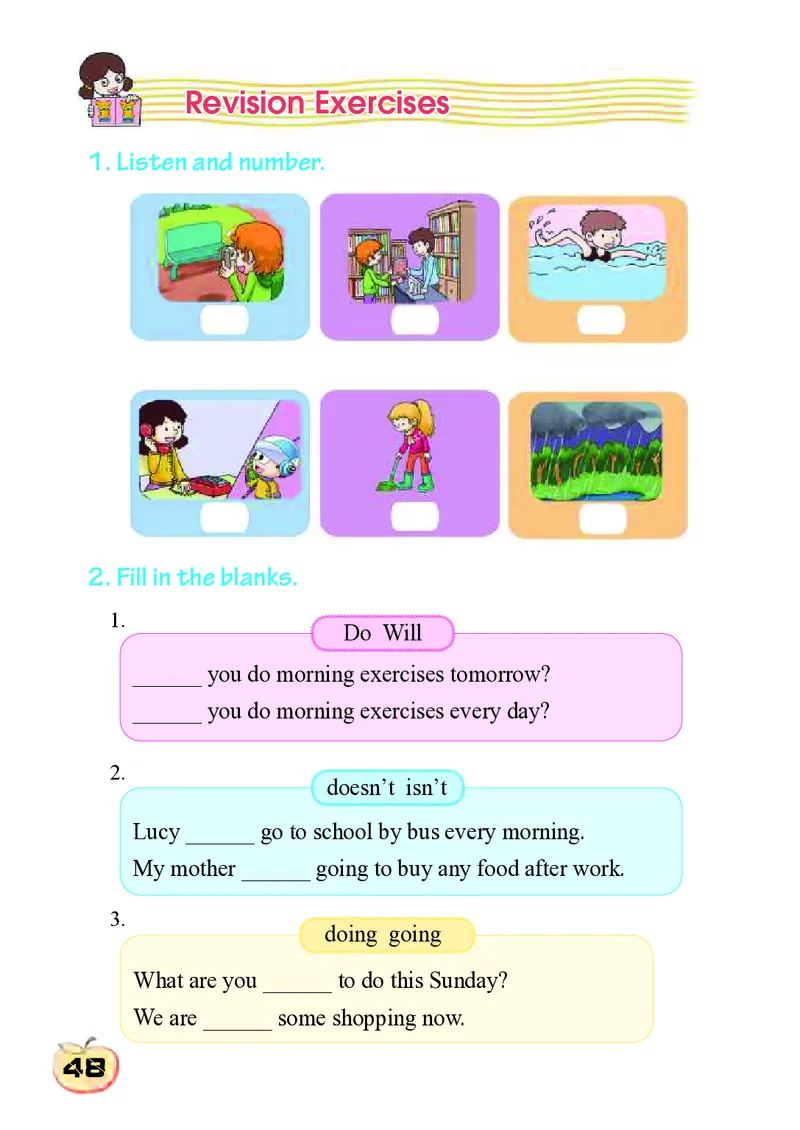
1. Listen and number.
2. Fill in the blanks.
Do Will
doesn’t isn’t
doing going
______ you do morning exercises tomorrow?
______ you do morning exercises every day?
1.
2.
Lucy ______ go to school by bus every morning.
My mother ______ going to buy any food after work.
3.
What are you ______ to do this Sunday?
We are ______ some shopping now.
Revision Exercises
49
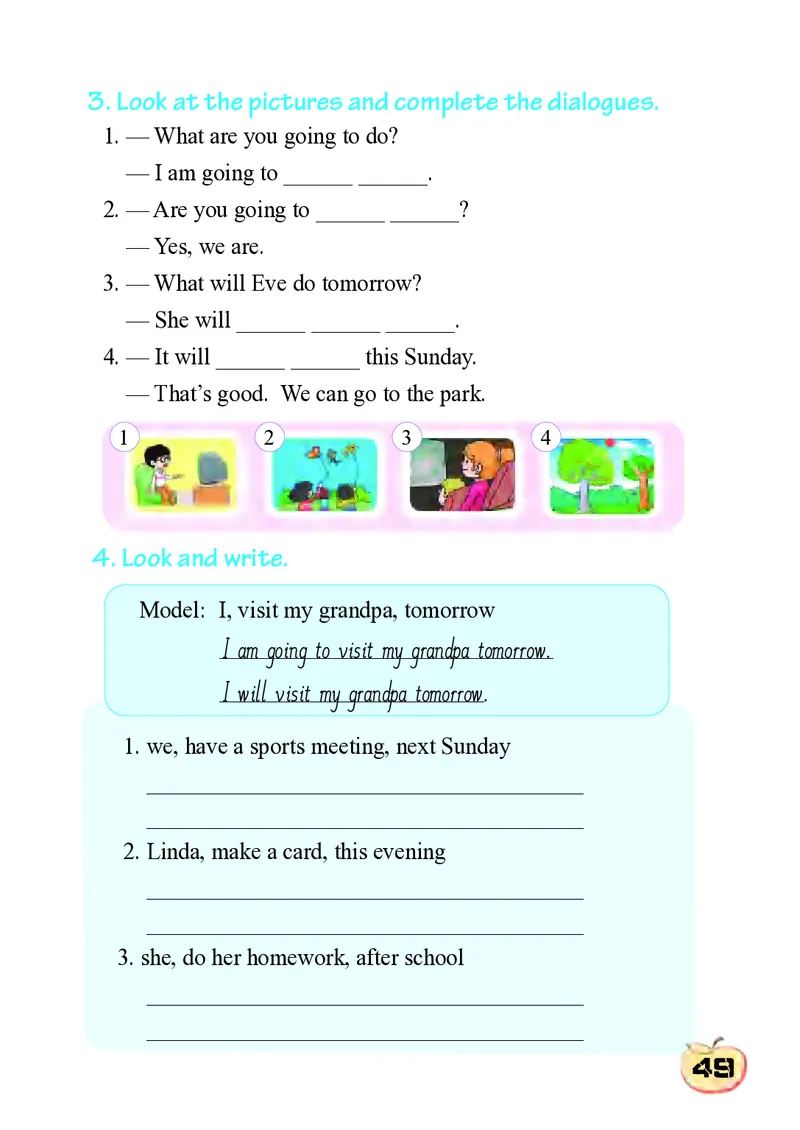
3. Look at the pictures and complete the dialogues.
1. — What are you going to do?
— I am going to ______ ______.
2. — Are you going to ______ ______?
— Yes, we are.
3. — What will Eve do tomorrow?
— She will ______ ______ ______.
4. — It will ______ ______ this Sunday.
— That’s good. We can go to the park.
4. Look and write.
Model: I, visit my grandpa, tomorrow
I am going to visit my grandpa tomorrow.
I will visit my grandpa tomorrow.
1. we, have a sports meeting, next Sunday
______________________________________
______________________________________
2. Linda, make a card, this evening
______________________________________
______________________________________
3. she, do her homework, after school
______________________________________
______________________________________
1
2
3
4
_____________________________
_______________________
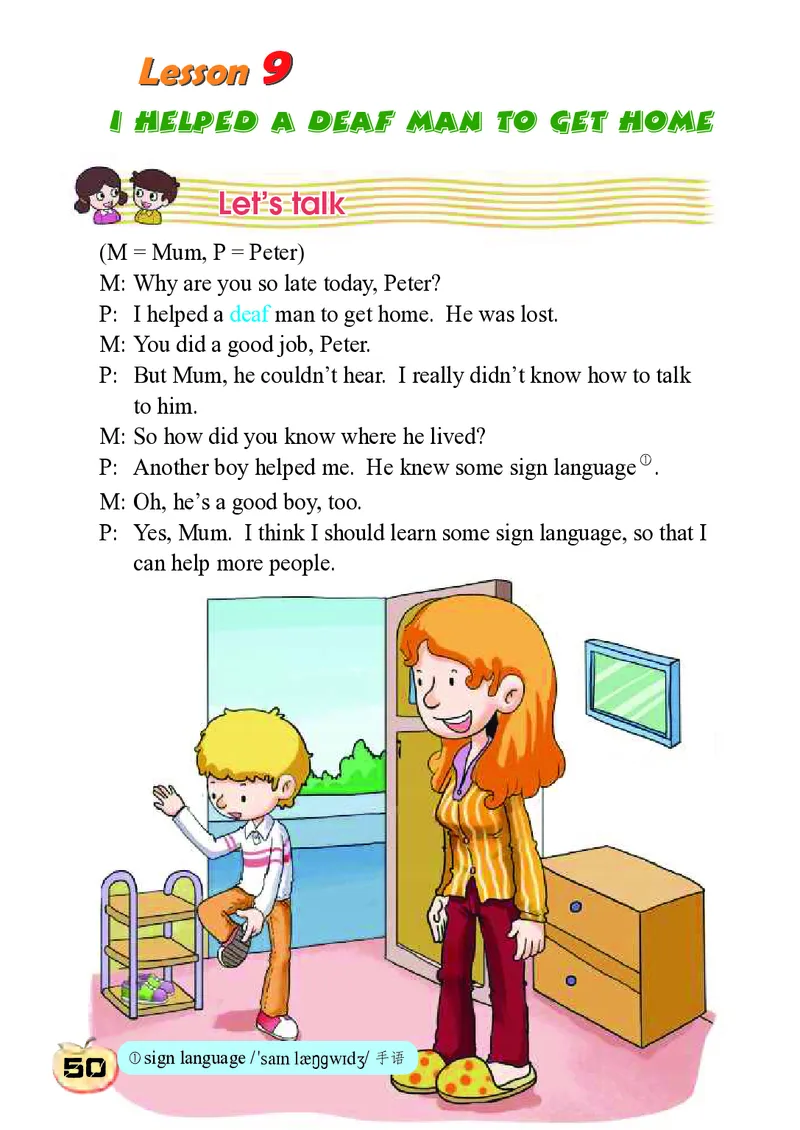
(M = Mum, P = Peter)
M: Why are you so late today, Peter?
P: I helped a deaf man to get home. He was lost.
M: You did a good job, Peter.
P: But Mum, he couldn’t hear. I really didn’t know how to talk
to him.
M: So how did you know where he lived?
P: Another boy helped me. He knew some sign language
①.
M: Oh, he’s a good boy, too.
P: Yes, Mum. I think I should learn some sign language, so that I
can help more people.
Let’s talk
i HELPED A DEAF MAN to GET HOME
Lesson 9
50
①sign language /?saIn lZYGwIdW/ 手语
BOOKSHOP
51
Question Answer
What’s your name?
When is your birthday?
What’s your birth place?
Who was your English teacher last term?
What did you do yesterday evening?
Who did you visit last Sunday?
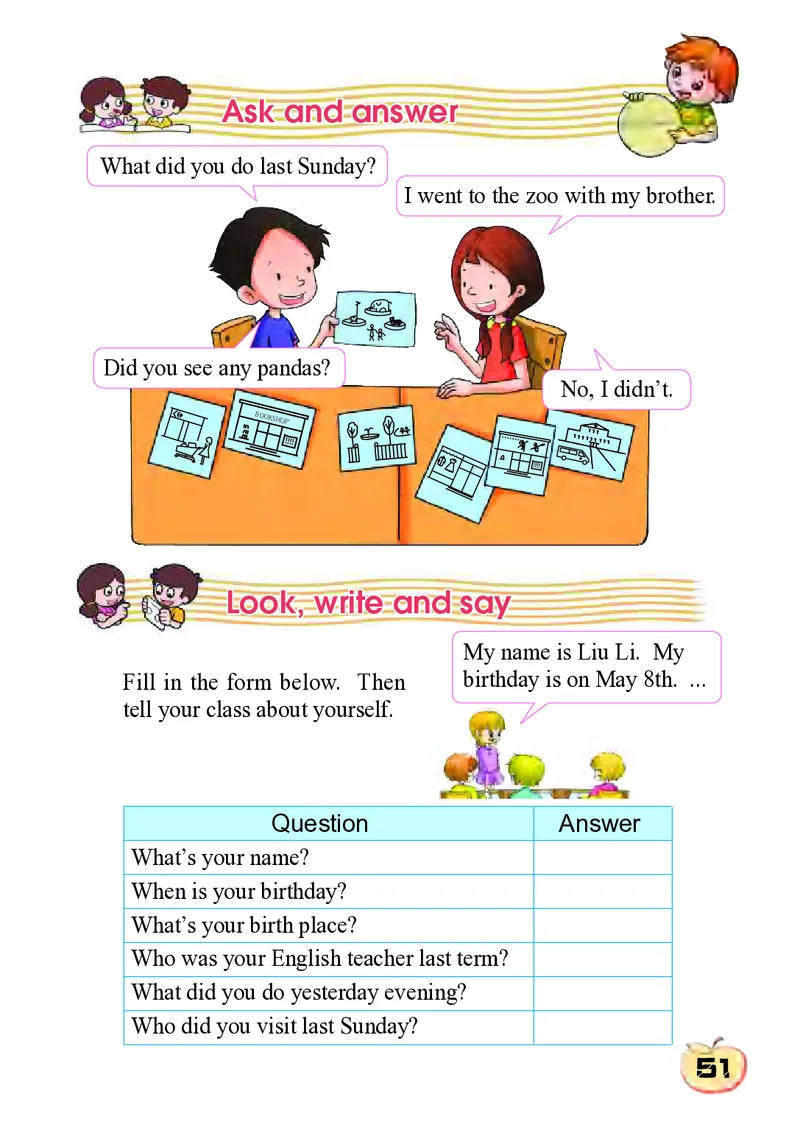
Ask and answer
What did you do last Sunday?
I went to the zoo with my brother.
Did you see any pandas?
No, I didn’t.
Look, write and say
Fill in the form below. Then
tell your class about yourself.
My name is Liu Li. My
birthday is on May 8th. ...
Read
52
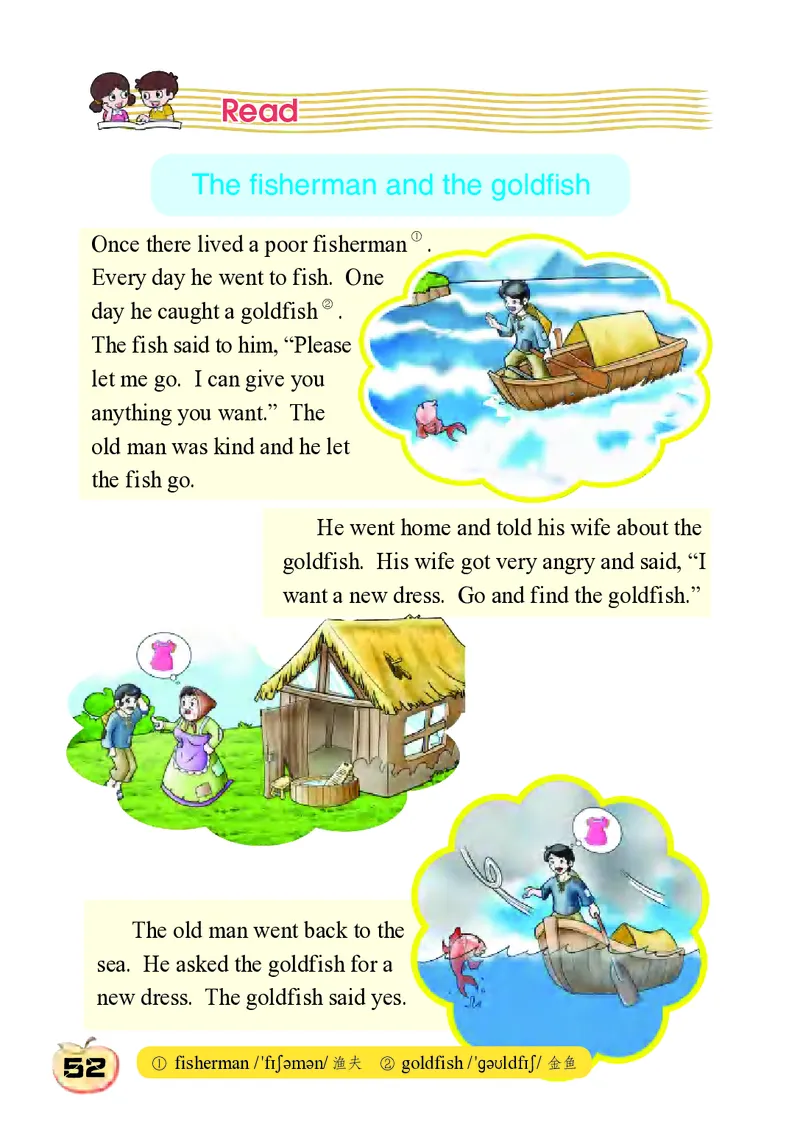
The old man went back to the
sea. He asked the goldfish for a
new dress. The goldfish said yes.
Once there lived a poor fisherman
①.
Every day he went to fish. One
day he caught a goldfish
②.
The fish said to him, “Please
let me go. I can give you
anything you want.” The
old man was kind and he let
the fish go.
He went home and told his wife about the
goldfish. His wife got very angry and said, “I
want a new dress. Go and find the goldfish.”
The fisherman and the goldfish
① fisherman /?fISEmEn/ 渔夫 ②goldfish /?GEHldfIS/ 金鱼
53
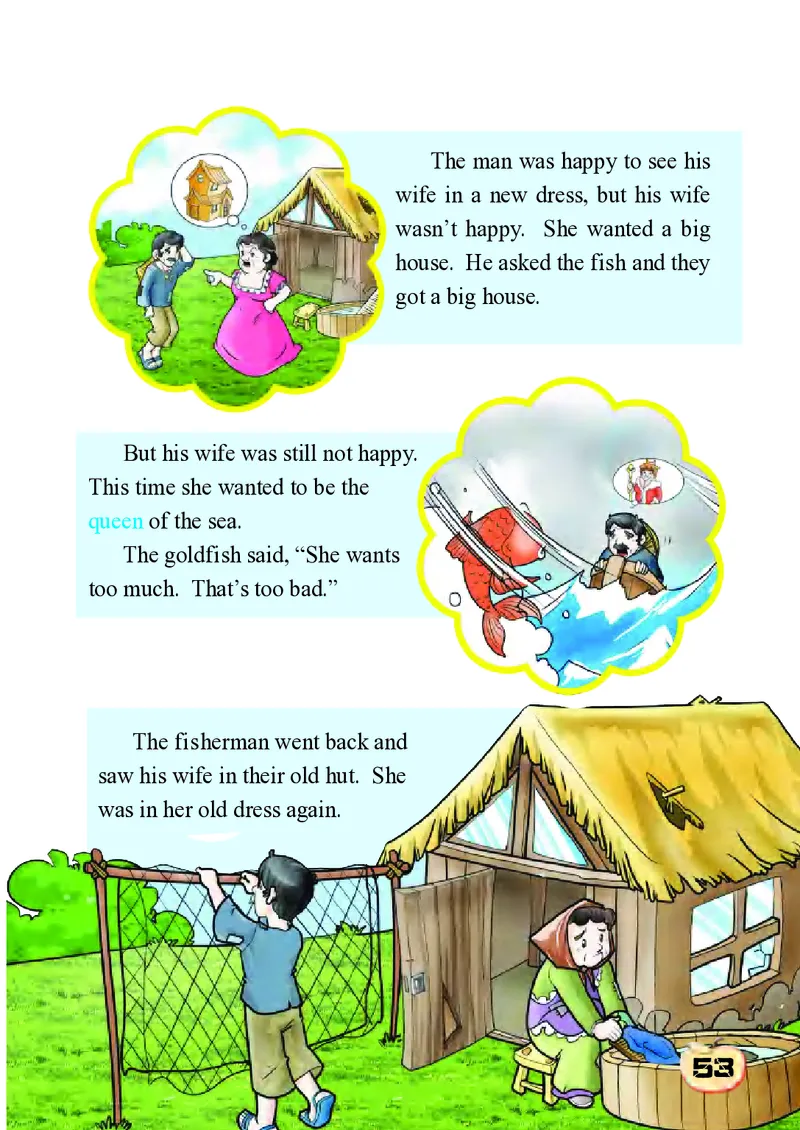
The fisherman went back and
saw his wife in their old hut. She
was in her old dress again.
The man was happy to see his
wife in a new dress, but his wife
wasn’t happy. She wanted a big
house. He asked the fish and they
got a big house.
But his wife was still not happy.
This time she wanted to be the
queen of the sea.
The goldfish said, “She wants
too much. That’s too bad.”
54
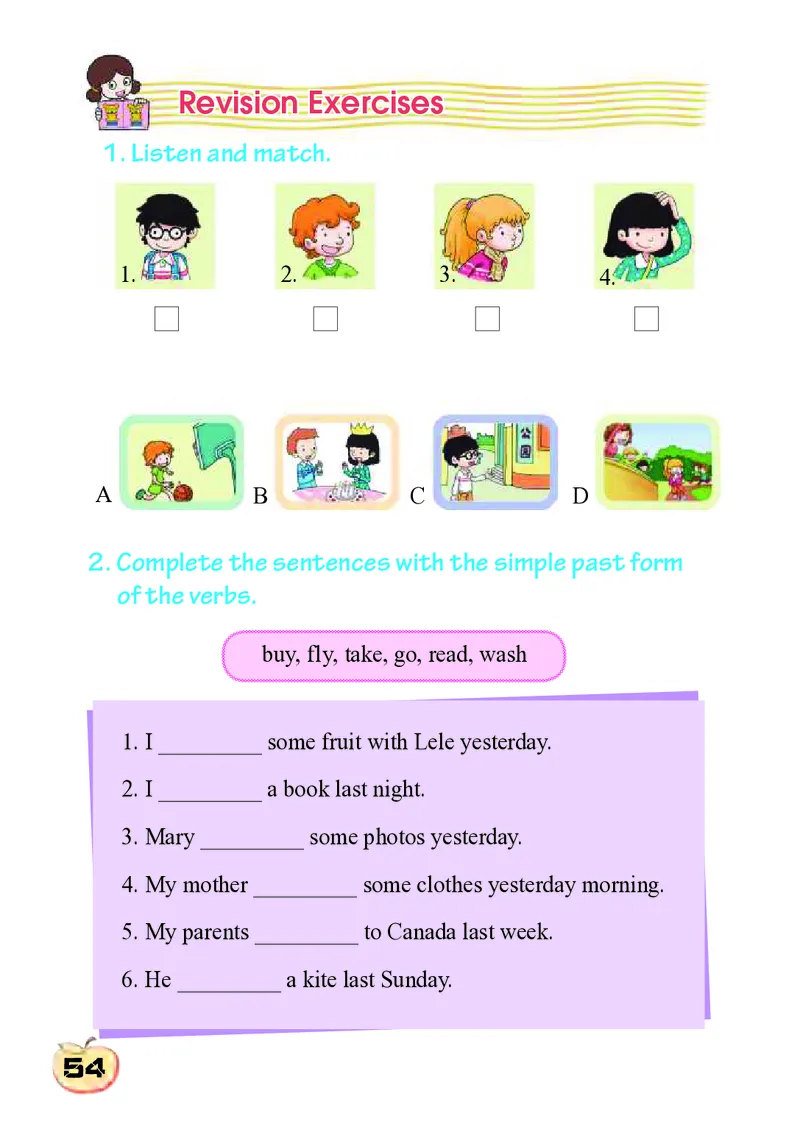
1. Listen and match.
2. Complete the sentences with the simple past form
of the verbs.
Revision Exercises
buy, fly, take, go, read, wash
1. I _________ some fruit with Lele yesterday.
2. I _________ a book last night.
3. Mary _________ some photos yesterday.
4. My mother _________ some clothes yesterday morning.
5. My parents _________ to Canada last week.
6. He _________ a kite last Sunday.
1.
2.
3.
4.
A
B
C
D
55
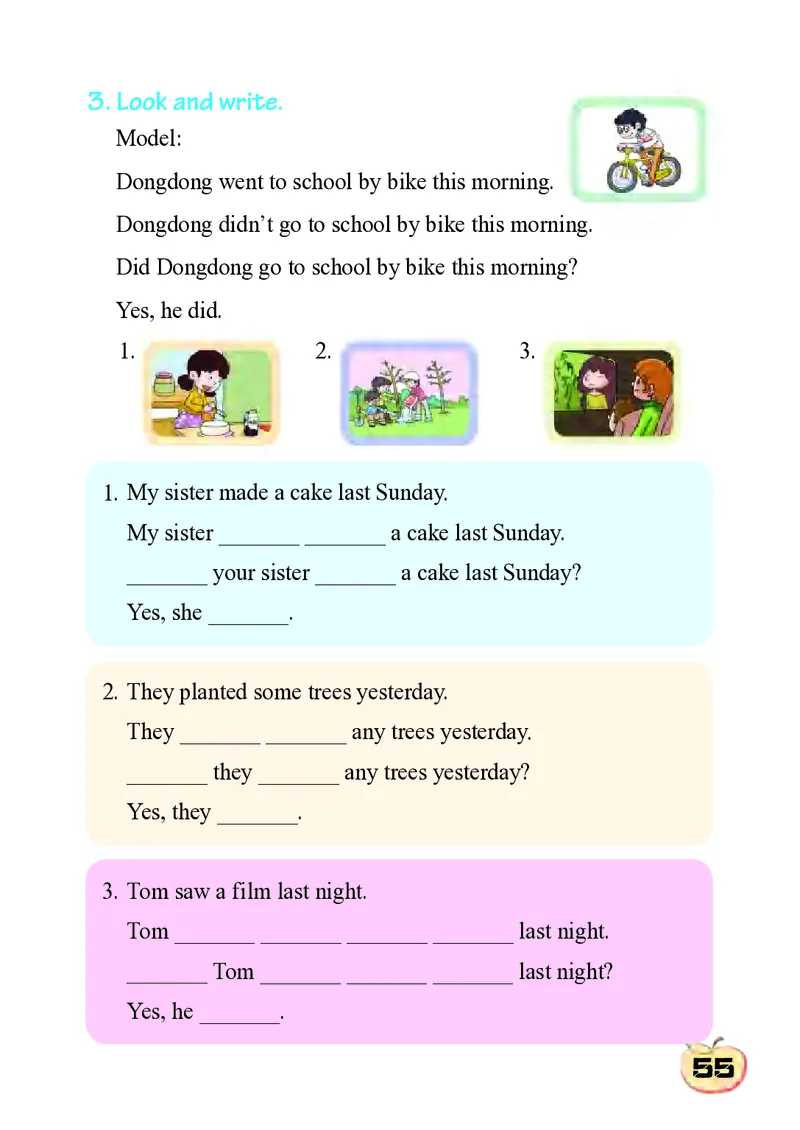
3. Look and write.
Model:
Dongdong went to school by bike this morning.
Dongdong didn’t go to school by bike this morning.
Did Dongdong go to school by bike this morning?
Yes, he did.
1. My sister made a cake last Sunday.
My sister _______ _______ a cake last Sunday.
_______ your sister _______ a cake last Sunday?
Yes, she _______.
2. They planted some trees yesterday.
They _______ _______ any trees yesterday.
_______ they _______ any trees yesterday?
Yes, they _______.
3. Tom saw a film last night.
Tom _______ _______ _______ _______ last night.
_______ Tom _______ _______ _______ last night?
Yes, he _______.
1.
2.
3.
Let’s talk
Revision
Lesson 10
56
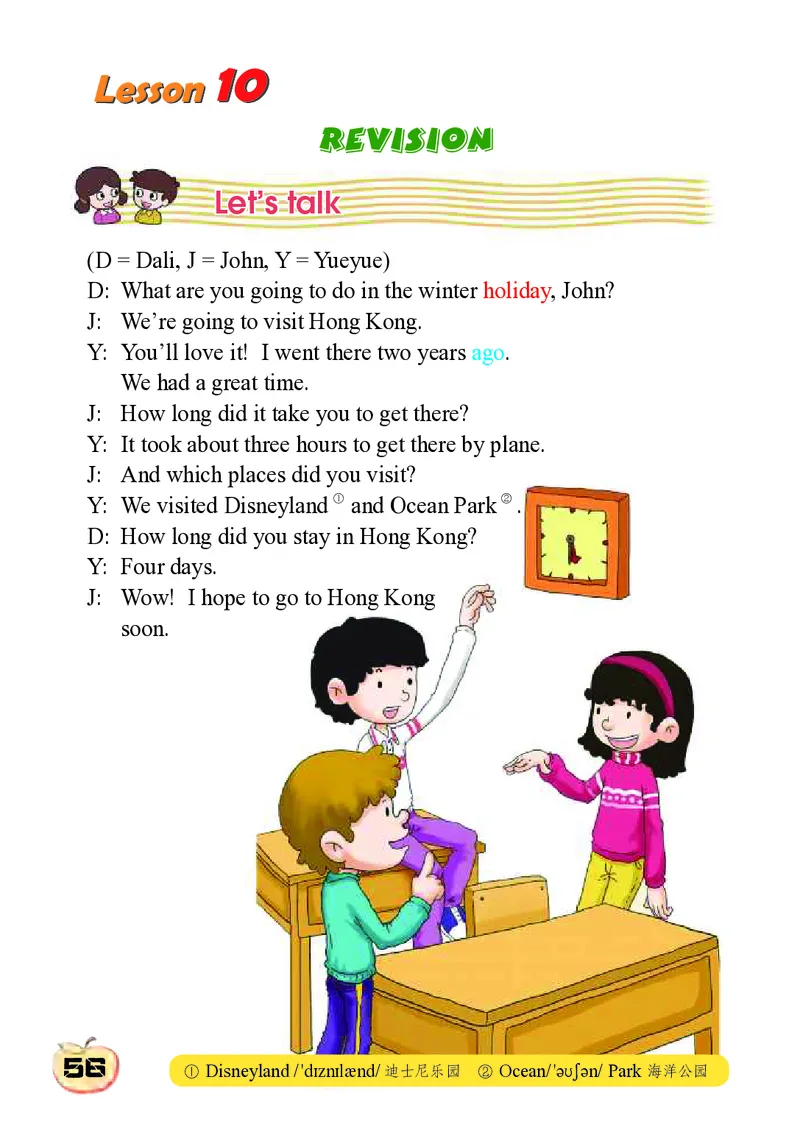
(D = Dali, J = John, Y = Yueyue)
D: What are you going to do in the winter holiday, John?
J: We’re going to visit Hong Kong.
Y: You’ll love it! I went there two years ago.
We had a great time.
J: How long did it take you to get there?
Y: It took about three hours to get there by plane.
J: And which places did you visit?
Y: We visited Disneyland
① and Ocean Park
②.
D: How long did you stay in Hong Kong?
Y: Four days.
J: Wow! I hope to go to Hong Kong
soon.
①Disneyland /?dIznIlZnd/ 迪士尼乐园 ②Ocean/?EHSEn/ Park 海洋公园
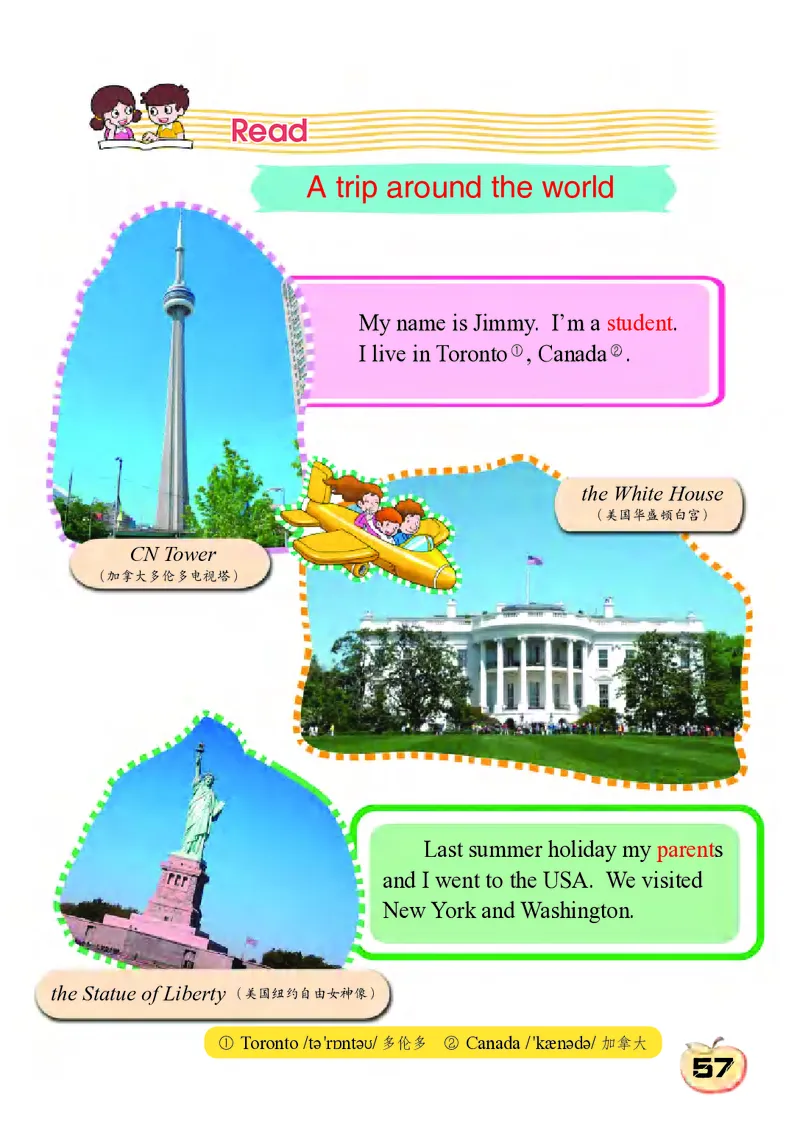
A trip around the world
the White House
(美国华盛顿白宫)
CN Tower
(加拿大多伦多电视塔)
My name is Jimmy. I’m a student.
I live in Toronto ①, Canada ②.
Last summer holiday my parents
and I went to the USA. We visited
New York and Washington.
the Statue of Liberty (美国纽约自由女神像)
Read
①Toronto /tE?rFntEH/ 多伦多 ②Canada /?kZnEdE/ 加拿大
57
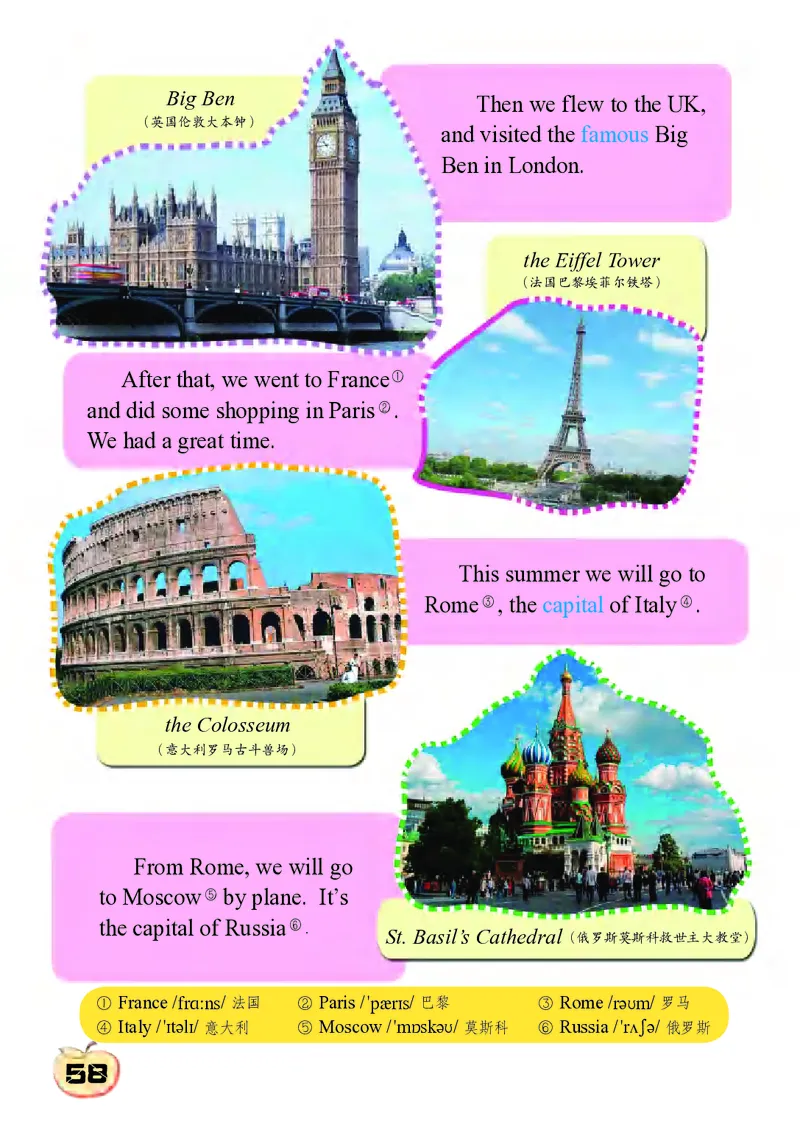
After that, we went to France①
and did some shopping in Paris ②.
We had a great time.
This summer we will go to
Rome ③, the capital of Italy ④.
From Rome, we will go
to Moscow ⑤ by plane. It’s
the capital of Russia ⑥.
the Colosseum
(意大利罗马古斗兽场)
St. Basil’s Cathedral(俄罗斯莫斯科救世主大教堂)
Big Ben
(英国伦敦大本钟)
Then we flew to the UK,
and visited the famous Big
Ben in London.
the Eiffel Tower
(法国巴黎埃菲尔铁塔)
①France /frA:ns/ 法国
②Paris /?pZrIs/ 巴黎
③Rome /rEHm/ 罗马
④Italy /?ItElI/ 意大利
⑤Moscow /?mFskEH/ 莫斯科
⑥Russia /?rVSE/ 俄罗斯
58
59
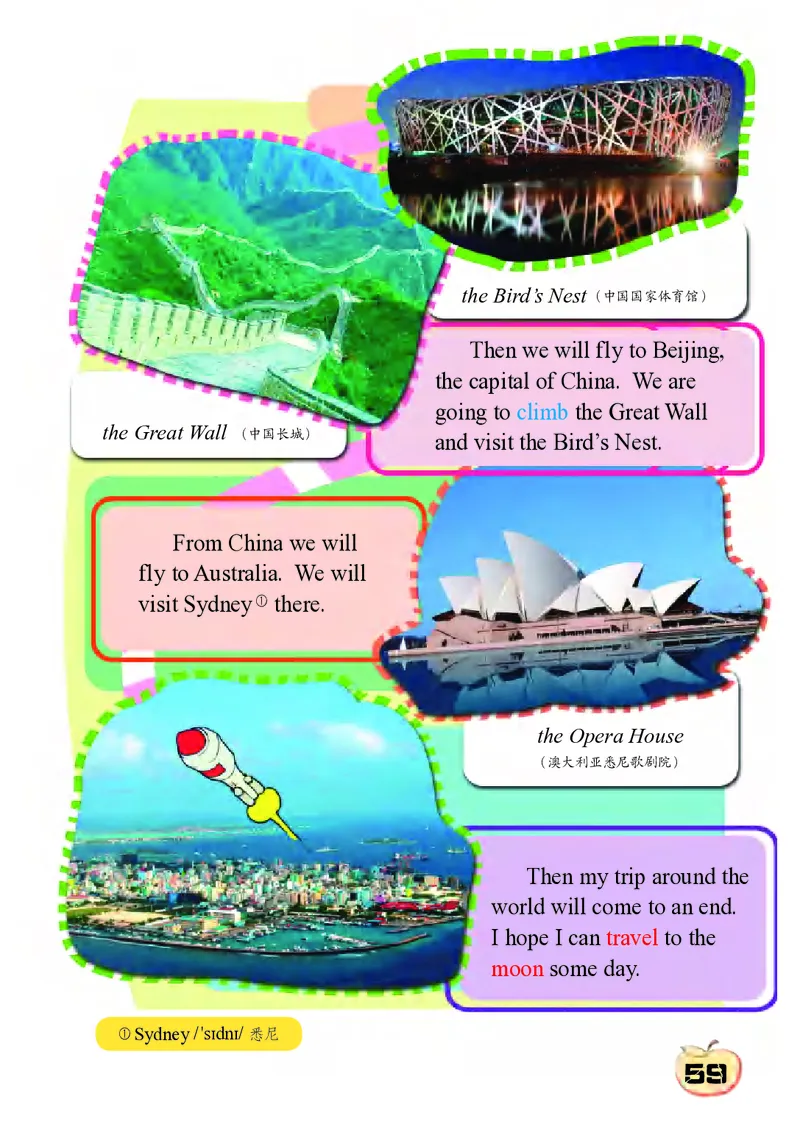
Then we will fly to Beijing,
the capital of China. We are
going to climb the Great Wall
and visit the Bird’s Nest.
From China we will
fly to Australia. We will
visit Sydney ① there.
Then my trip around the
world will come to an end.
I hope I can travel to the
moon some day.
the Great Wall (中国长城)
the Opera House
(澳大利亚悉尼歌剧院)
①Sydney /?sIdnI/ 悉尼
the Bird’s Nest(中国国家体育馆)
60
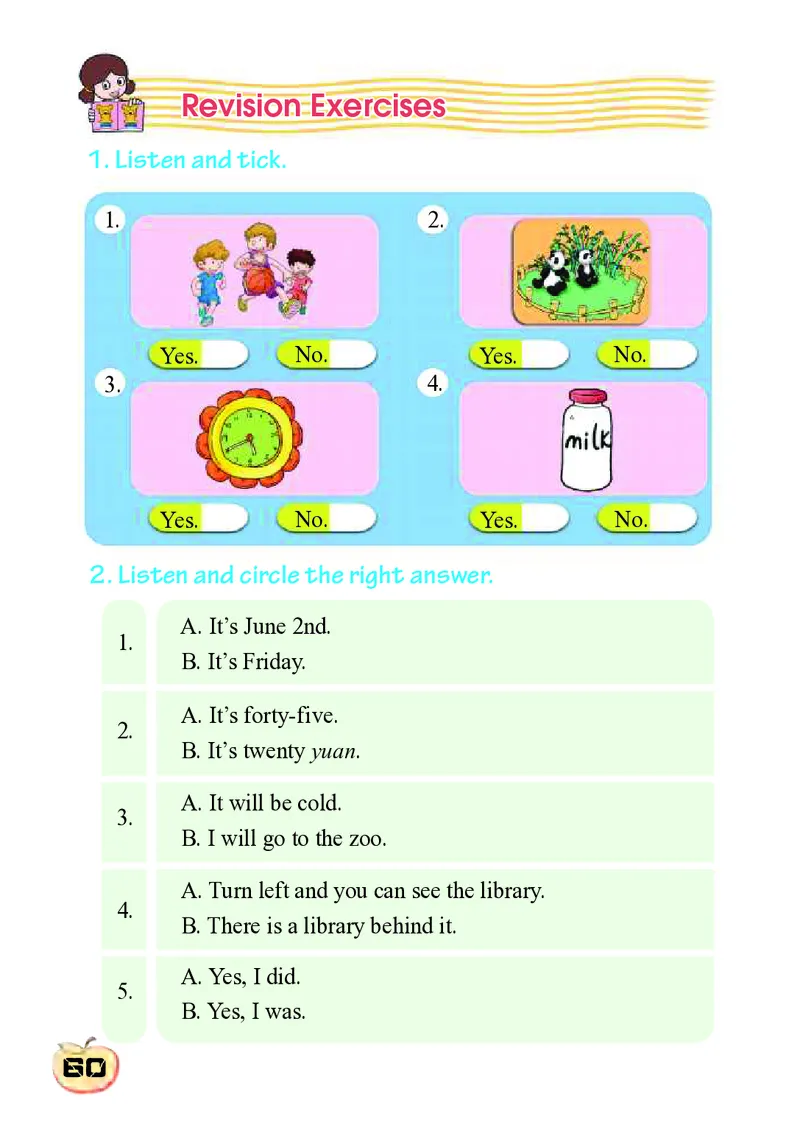
1. Listen and tick.
2. Listen and circle the right answer.
Revision Exercises
1.
2.
3.
4.
5.
A. It’s June 2nd.
B. It’s Friday.
A. It’s forty-five.
B. It’s twenty yuan.
A. It will be cold.
B. I will go to the zoo.
A. Turn left and you can see the library.
B. There is a library behind it.
A. Yes, I did.
B. Yes, I was.
Yes.
No.
1.
2.
3.
4.
Yes.
No.
Yes.
No.
Yes.
No.
61
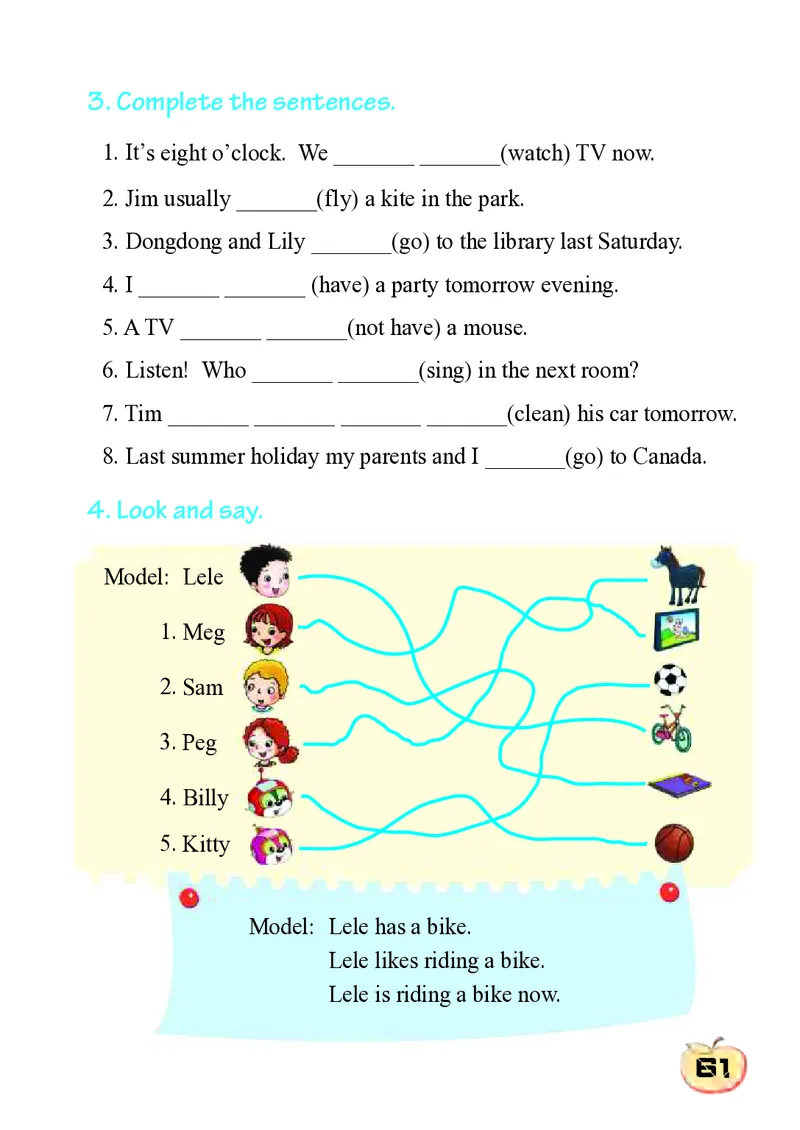
3. Complete the sentences.
1. It’s eight o’clock. We _______ _______(watch) TV now.
2. Jim usually _______(fly) a kite in the park.
3. Dongdong and Lily _______(go) to the library last Saturday.
4. I _______ _______ (have) a party tomorrow evening.
5. A TV _______ _______(not have) a mouse.
6. Listen! Who _______ _______(sing) in the next room?
7. Tim _______ _______ _______ _______(clean) his car tomorrow.
8. Last summer holiday my parents and I _______(go) to Canada.
4. Look and say.
Lele has a bike.
Lele likes riding a bike.
Lele is riding a bike now.
Model:
Lele
Meg
Sam
Peg
Billy
Kitty
Model:
1.
2.
3.
4.
5.
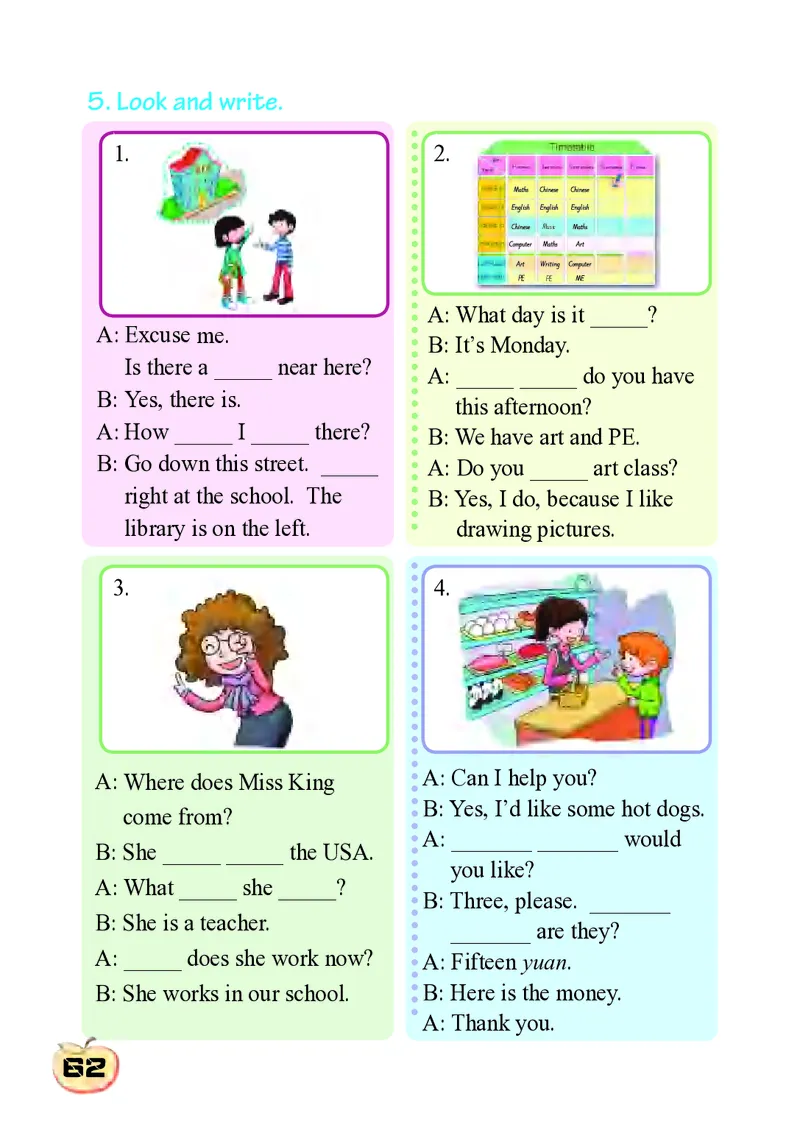
A: Excuse me.
Is there a _____ near here?
B: Yes, there is.
A: How _____ I _____ there?
B: Go down this street. _____
right at the school. The
library is on the left.
A: Where does Miss King
come from?
B: She _____ _____ the USA.
A: What _____ she _____?
B: She is a teacher.
A: _____ does she work now?
B: She works in our school.
A: Can I help you?
B: Yes, I’d like some hot dogs.
A: _______ _______ would
you like?
B: Three, please. _______
_______ are they?
A: Fifteen yuan.
B: Here is the money.
A: Thank you.
A: What day is it _____?
B: It’s Monday.
A: _____ _____ do you have
this afternoon?
B: We have art and PE.
A: Do you _____ art class?
B: Yes, I do, because I like
drawing pictures.
62
5. Look and write.
Music
PE
1.
3.
2.
4.
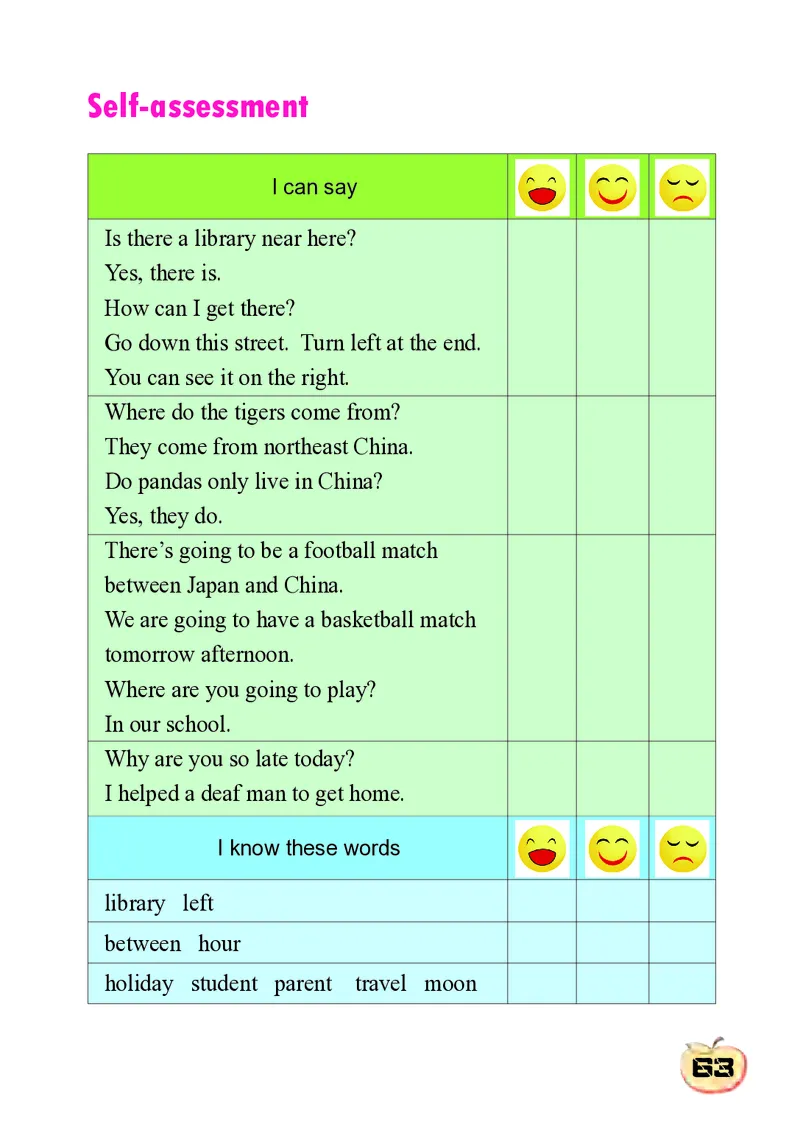
I know these words
I can say
Self-assessment
I can say
63
Is there a library near here?
Yes, there is.
How can I get there?
Go down this street. Turn left at the end.
You can see it on the right.
Where do the tigers come from?
They come from northeast China.
Do pandas only live in China?
Yes, they do.
There’s going to be a football match
between Japan and China.
We are going to have a basketball match
tomorrow afternoon.
Where are you going to play?
In our school.
Why are you so late today?
I helped a deaf man to get home.
library left
between hour
holiday student parent travel moon
各课词汇表
Words in each lesson
Lesson 1
wear /weE/
穿
coat /kEHt/
外套, 上衣
sleep /sli:p/
睡觉
tired /?taIEd/
累的
pass /pA:s/
传递, 经过, 通过
headache /?hedeIk/
头痛
habit /?hZbIt/
习惯
have a cold
感冒
stay up
熬夜
go to bed
上床睡觉
from then on
从那时起
What’s the matter? 怎么了?
Lesson 2
visit /?vIzIt/
参观, 探望
photo /?fEHtEH/
照片
angry /?ZYGrI/
生气的
high /haI/
高的
once /wVns/
从前
trip /trIp/
旅行
build /bIld/
建造
take photos
拍照
Lesson 3
boat /bEHt/
小船; 划船
zoo /zu:/
动物园
last /lA:st/
最后, 上一个
life /laIf/
生活, 生命
protect /prE?tekt/
保护
mine /maIn/
我的
middle /?mIdl/
中间
( 注:本表中只收录Let’s talk 和Read 部分的生词)
64
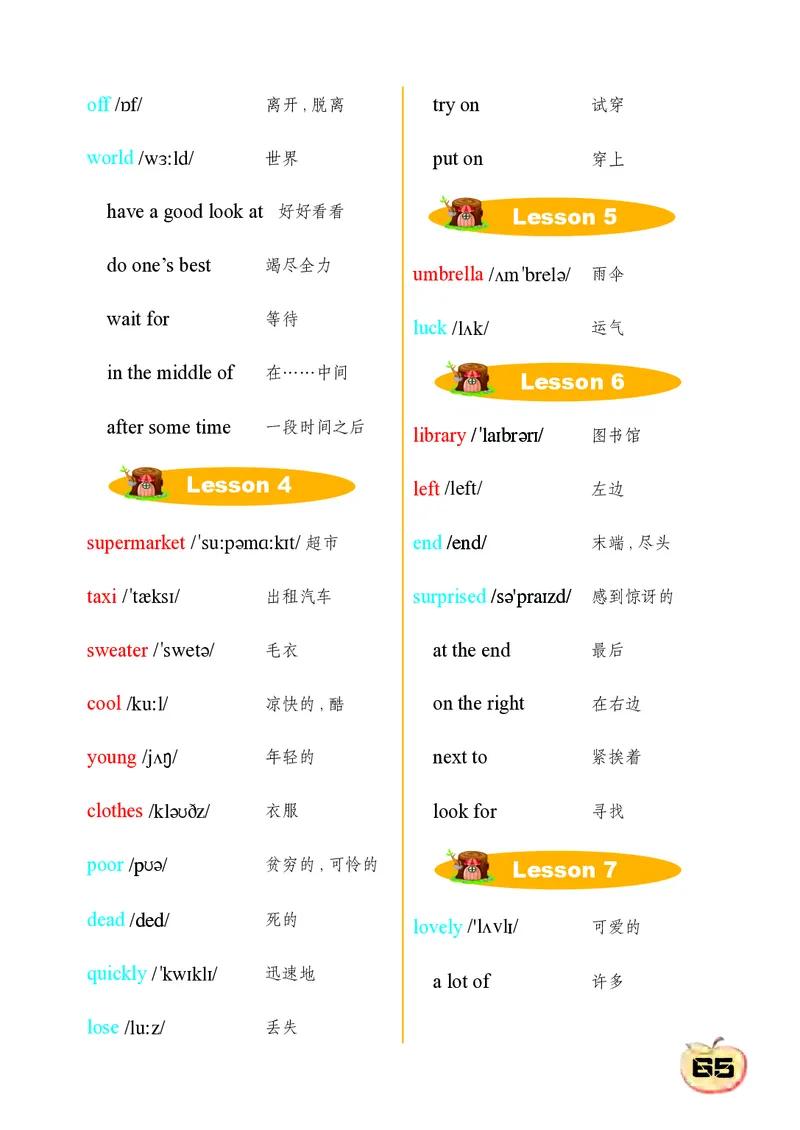
off /Ff/
离开, 脱离
world /wB:ld/
世界
have a good look at 好好看看
do one’s best
竭尽全力
wait for
等待
in the middle of
在……中间
after some time
一段时间之后
Lesson 4
supermarket /?su:pEmA:kIt/ 超市
taxi /?tZksI/
出租汽车
sweater /?swetE/
毛衣
cool /ku:l/
凉快的, 酷
young /jVY/
年轻的
clothes /klEHDz/
衣服
poor /pHE/
贫穷的, 可怜的
dead /ded/
死的
quickly /?kwIklI/
迅速地
lose /lu:z/
丢失
try on
试穿
put on
穿上
Lesson 5
umbrella /Vm?brelE/ 雨伞
luck /lVk/
运气
Lesson 6
library /?laIbrErI/
图书馆
left /left/
左边
end /end/
末端, 尽头
surprised /sE'praIzd/
感到惊讶的
at the end
最后
on the right
在右边
next to
紧挨着
look for
寻找
Lesson 7
lovely /'lVvlI/
可爱的
a lot of
许多
65
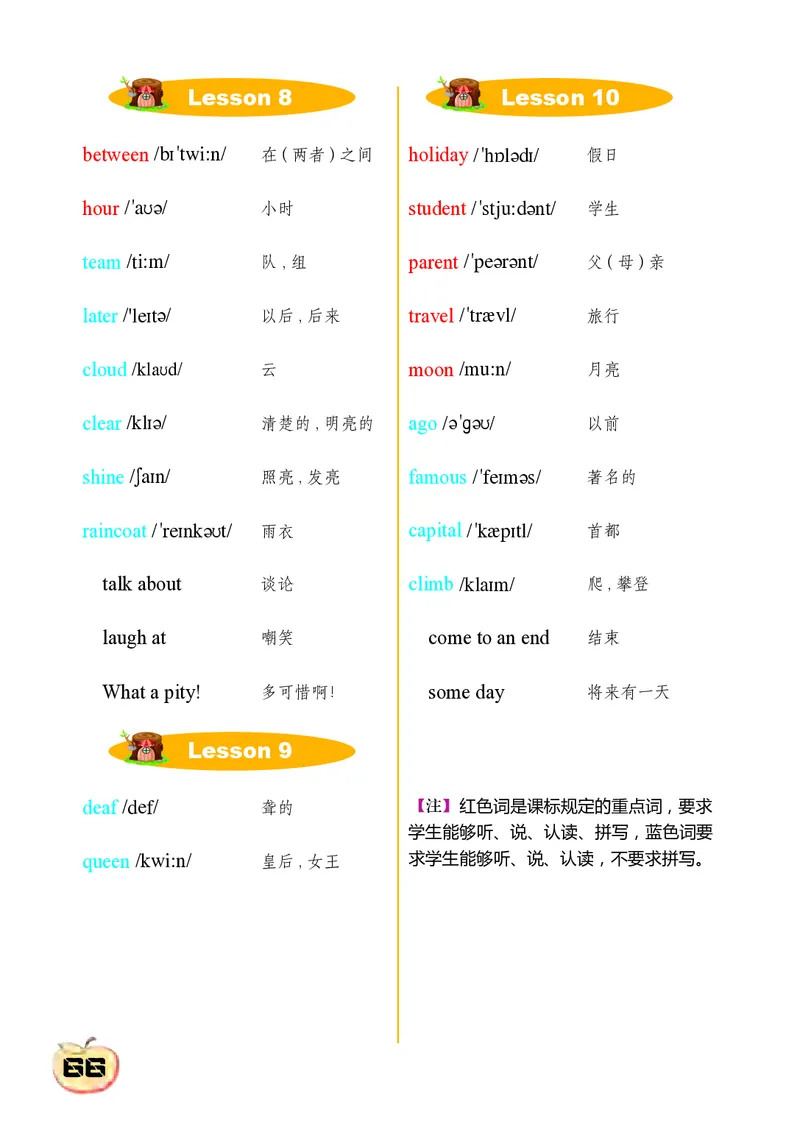
Lesson 8
between /bI?twi:n/
在( 两者) 之间
hour /?aHE/
小时
team /ti:m/
队, 组
later /'leItE/
以后, 后来
cloud /klaHd/
云
clear /klIE/
清楚的, 明亮的
shine /SaIn/
照亮, 发亮
raincoat /?reInkEHt/
雨衣
talk about
谈论
laugh at
嘲笑
What a pity!
多可惜啊!
Lesson 9
deaf /def/
聋的
queen /kwi:n/
皇后, 女王
Lesson 10
holiday /?hFlEdI/
假日
student /?stju:dEnt/
学生
parent /?peErEnt/
父( 母) 亲
travel /?trZvl/
旅行
moon /mu:n/
月亮
ago /E?GEH/
以前
famous /?feImEs/
著名的
capital /?kZpItl/
首都
climb /klaIm/
爬, 攀登
come to an end
结束
some day
将来有一天
66
【注】红色词是课标规定的重点词,要求
学生能够听、说、认读、拼写,蓝色词要
求学生能够听、说、认读,不要求拼写。
A
ago /E?GEH/
以前
10
angry /?ZYGrI/
生气的
2
B
between /bI?twi:n/ 在( 两者) 之间 8
boat /bEHt/
小船; 划船
3
build /bIld/
建造
2
C
capital /?kZpItl/
首都
10
clear /klIE/
清楚的, 明亮的 8
climb /klaIm/
爬, 攀登
10
clothes /klEHDz/
衣服
4
cloud /klaHd/
云
8
coat /kEHt/
外套, 上衣
1
cool /ku:l/
凉快的, 酷
4
D
dead /ded/
死的
4
deaf /def/
聋的
9
E
end /end/
末端, 尽头
6
F
famous /?feImEs/
著名的
10
H
habit /?hZbIt/
习惯
1
headache /?hedeIk/ 头痛
1
high /haI/
高的
2
holiday /?hFlEdI/ 假日
10
hour /?aHE/
小时
8
L
last /lA:st/
最后, 上一个
3
later /'leItE/
以后, 后来
8
left /left/
左边
6
library /?laIbrErI/
图书馆
6
life /laIf/
生活, 生命
3
lose /lu:z/
丢失
4
lovely /'lVvlI/
可爱的
7
luck /lVk/
运气
5
M
middle /?mIdl/
中间
3
mine /maIn/
我的
3
moon /mu:n/
月亮
10
O
off /Ff/
离开, 脱离
3
once /wVns/
从前
2
P
parent /?peErEnt/
父( 母) 亲
10
pass /pA:s/
传递, 经过, 通过 1
photo /?fEHtEH/
照片
2
poor /pHE/
贫穷的, 可怜的 4
词汇表
Word list
67
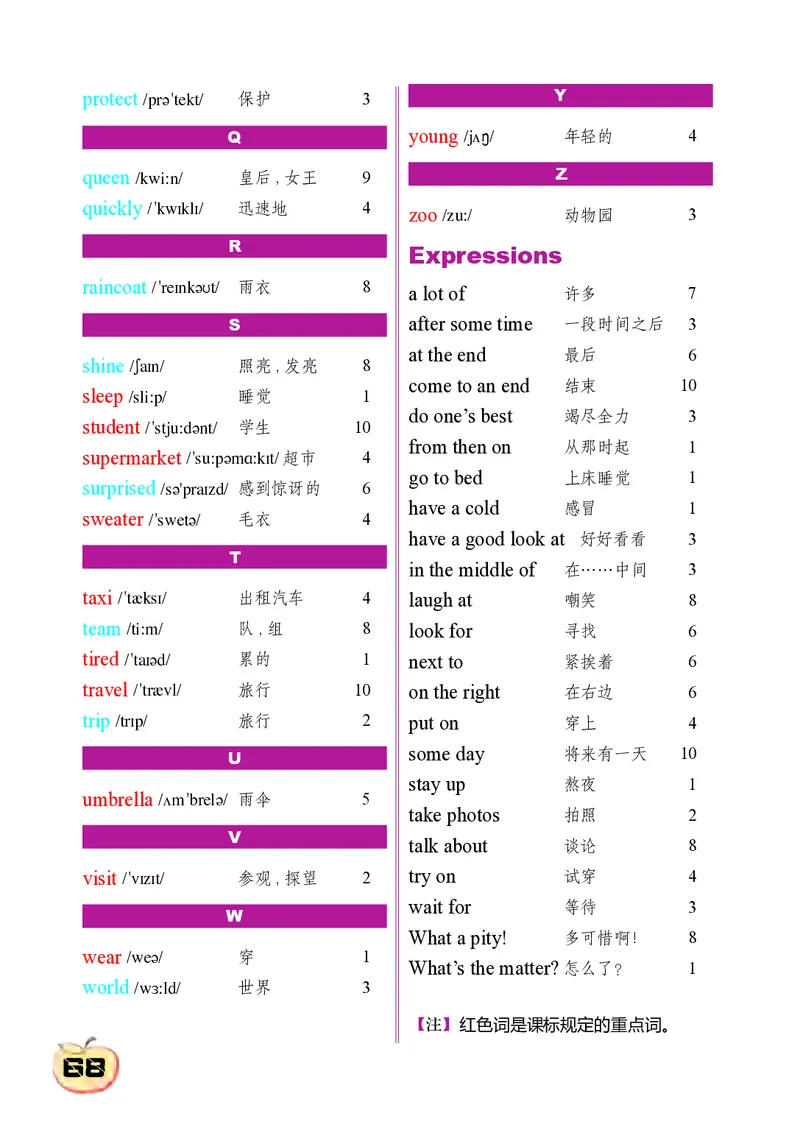
protect /prE?tekt/ 保护
3
Q
queen /kwi:n/
皇后, 女王
9
quickly /?kwIklI/
迅速地
4
R
raincoat /?reInkEHt/ 雨衣
8
S
shine /SaIn/
照亮, 发亮
8
sleep /sli:p/
睡觉
1
student /?stju:dEnt/
学生
10
supermarket /?su:pEmA:kIt/ 超市
4
surprised /sE'praIzd/ 感到惊讶的
6
sweater /?swetE/
毛衣
4
T
taxi /?tZksI/
出租汽车
4
team /ti:m/
队, 组
8
tired /?taIEd/
累的
1
travel /?trZvl/
旅行
10
trip /trIp/
旅行
2
U
umbrella /Vm?brelE/ 雨伞
5
V
visit /?vIzIt/
参观, 探望
2
W
wear /weE/
穿
1
world /wB:ld/
世界
3
Y
young /jVY/
年轻的
4
Z
zoo /zu:/
动物园
3
Expressions
a lot of
许多
7
after some time
一段时间之后
3
at the end
最后
6
come to an end
结束
10
do one’s best
竭尽全力
3
from then on
从那时起
1
go to bed
上床睡觉
1
have a cold
感冒
1
have a good look at 好好看看
3
in the middle of
在……中间
3
laugh at
嘲笑
8
look for
寻找
6
next to
紧挨着
6
on the right
在右边
6
put on
穿上
4
some day
将来有一天
10
stay up
熬夜
1
take photos
拍照
2
talk about
谈论
8
try on
试穿
4
wait for
等待
3
What a pity!
多可惜啊!
8
What’s the matter? 怎么了?
1
【注】红色词是课标规定的重点词。
68
69
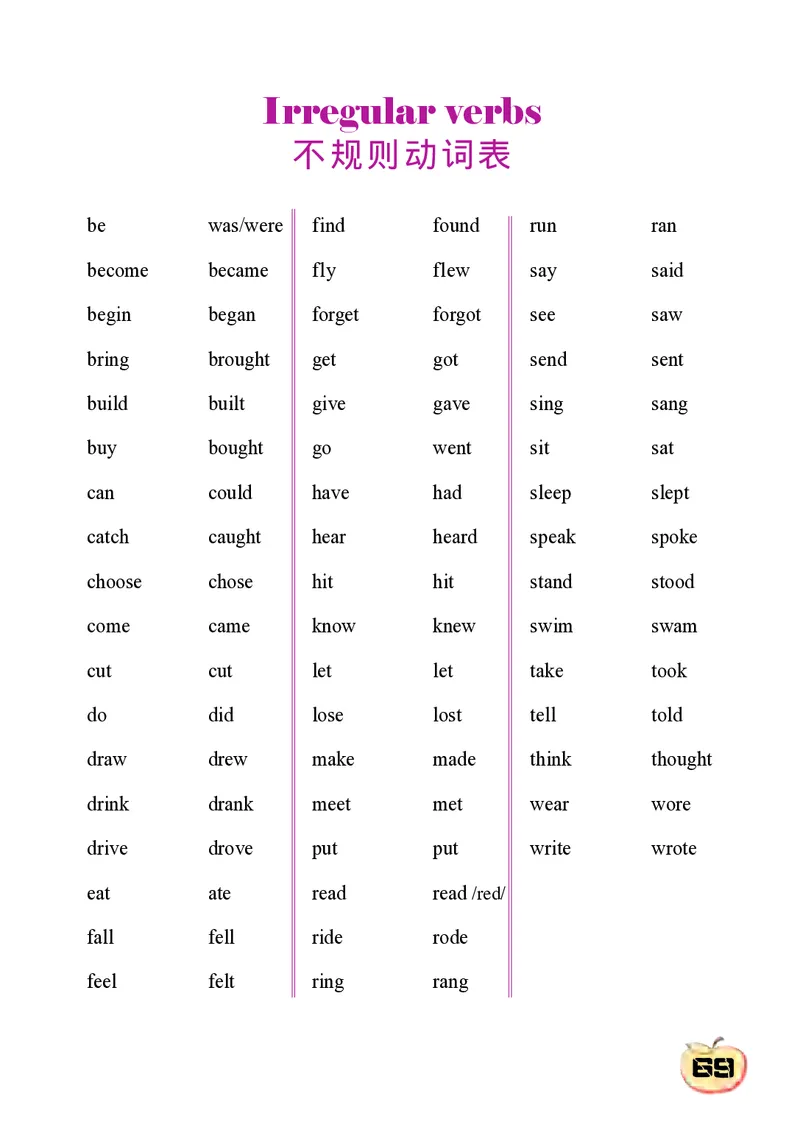
Irregular verbs
不规则动词表
be
was/were
become
became
begin
began
bring
brought
build
built
buy
bought
can
could
catch
caught
choose
chose
come
came
cut
cut
do
did
draw
drew
drink
drank
drive
drove
eat
ate
fall
fell
feel
felt
find
found
fly
flew
forget
forgot
get
got
give
gave
go
went
have
had
hear
heard
hit
hit
know
knew
let
let
lose
lost
make
made
meet
met
put
put
read
read /red/
ride
rode
ring
rang
run
ran
say
said
see
saw
send
sent
sing
sang
sit
sat
sleep
slept
speak
spoke
stand
stood
swim
swam
take
took
tell
told
think
thought
wear
wore
write
wrote
J
K
C
B
A
D
G
F
E
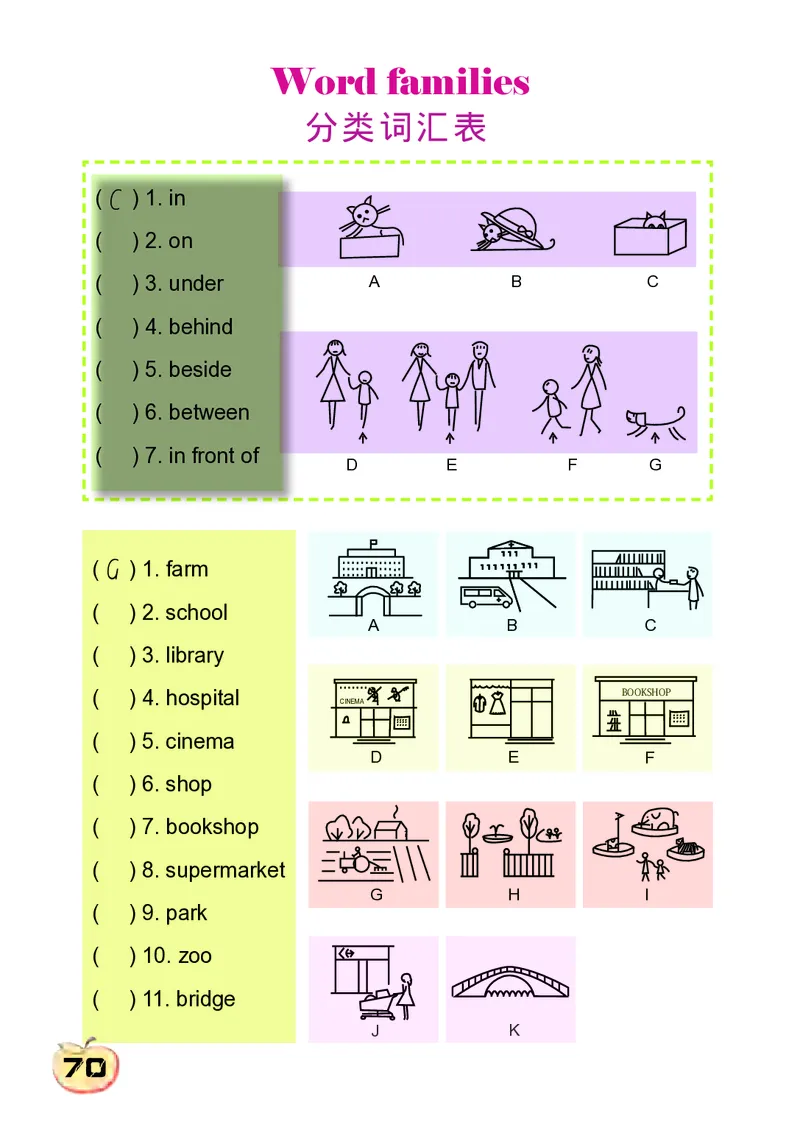
Word families
分类词汇表
( ) 1. in
( ) 2. on
( ) 3. under
( ) 4. behind
( ) 5. beside
( ) 6. between
( ) 7. in front of
C
G
( ) 1. farm
( ) 2. school
( ) 3. library
( ) 4. hospital
( ) 5. cinema
( ) 6. shop
( ) 7. bookshop
( ) 8. supermarket
( ) 9. park
( ) 10. zoo
( ) 11. bridge
C
B
A
I
H
G
BOOKSHOP
D
E
F
CINEMA
70
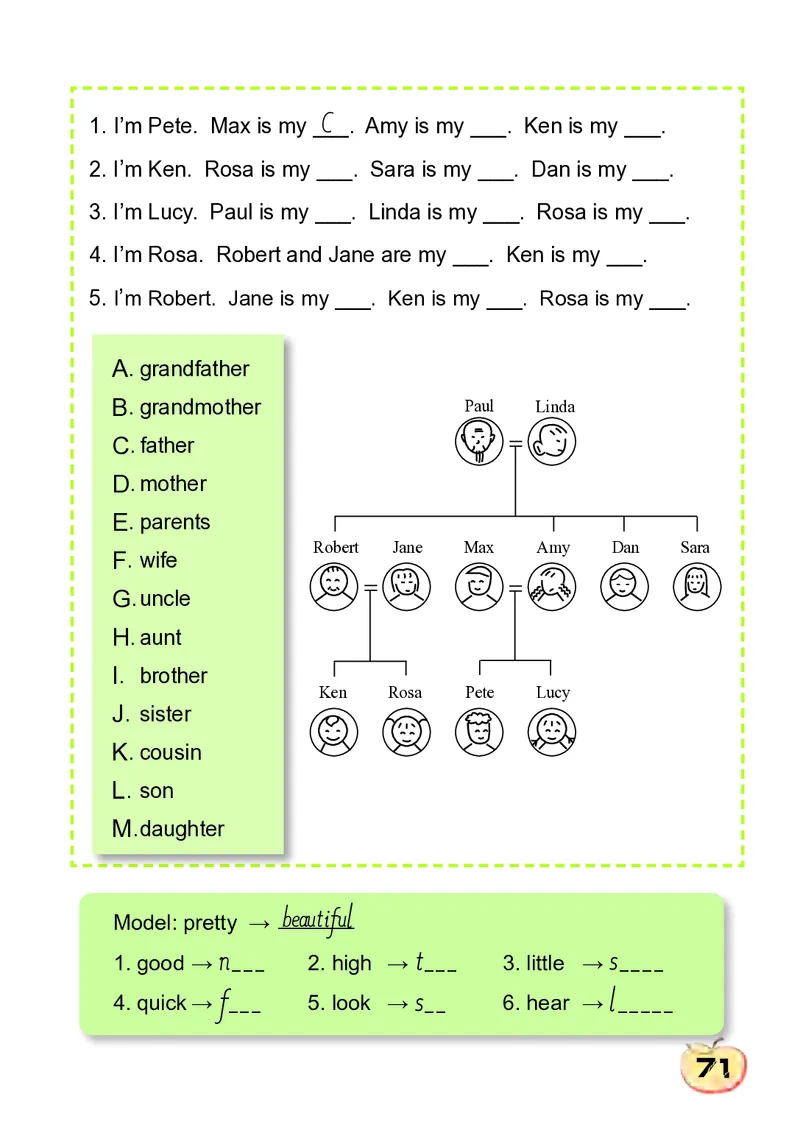
1. I’m Pete. Max is my ___. Amy is my ___. Ken is my ___.
2. I’m Ken. Rosa is my ___. Sara is my ___. Dan is my ___.
3. I’m Lucy. Paul is my ___. Linda is my ___. Rosa is my ___.
4. I’m Rosa. Robert and Jane are my ___. Ken is my ___.
5. I’m Robert. Jane is my ___. Ken is my ___. Rosa is my ___.
C
Robert
Ken
Jane
Rosa
Max
Pete
Amy
Lucy
Dan
Sara
Linda
Paul
Model: pretty → beautiful
1. good → n___
2. high → t___
3. little → s____
4. quick → f___
5. look → s__
6. hear → l_____
A. grandfather
B. grandmother
C. father
D. mother
E. parents
F. wife
G. uncle
H. aunt
I. brother
J. sister
K. cousin
L. son
M. daughter
71
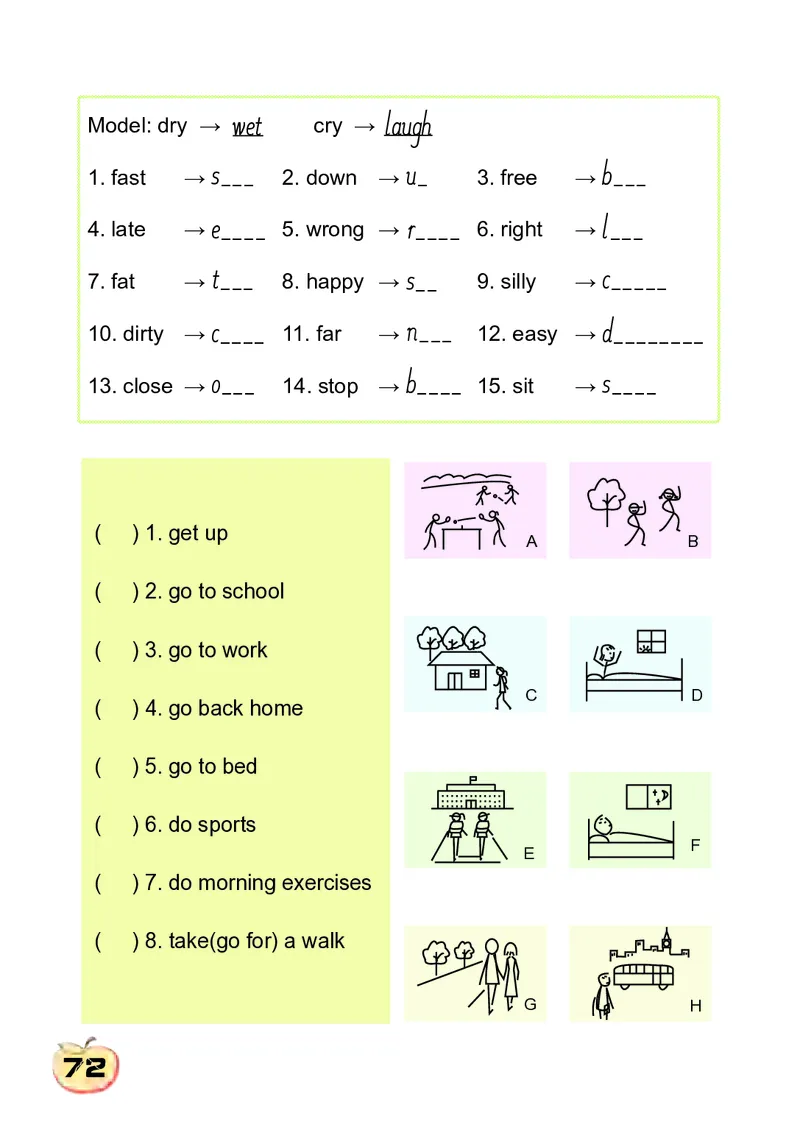
Model: dry → cry →
1. fast
→ s___ 2. down → u_
3. free
→ b___
4. late
→ e____ 5. wrong → r____ 6. right → l___
7. fat
→ t___ 8. happy → s__ 9. silly
→ c_____
10. dirty → c____ 11. far
→ n___ 12. easy → d________
13. close → o___ 14. stop → b____ 15. sit
→ s____
laugh
wet
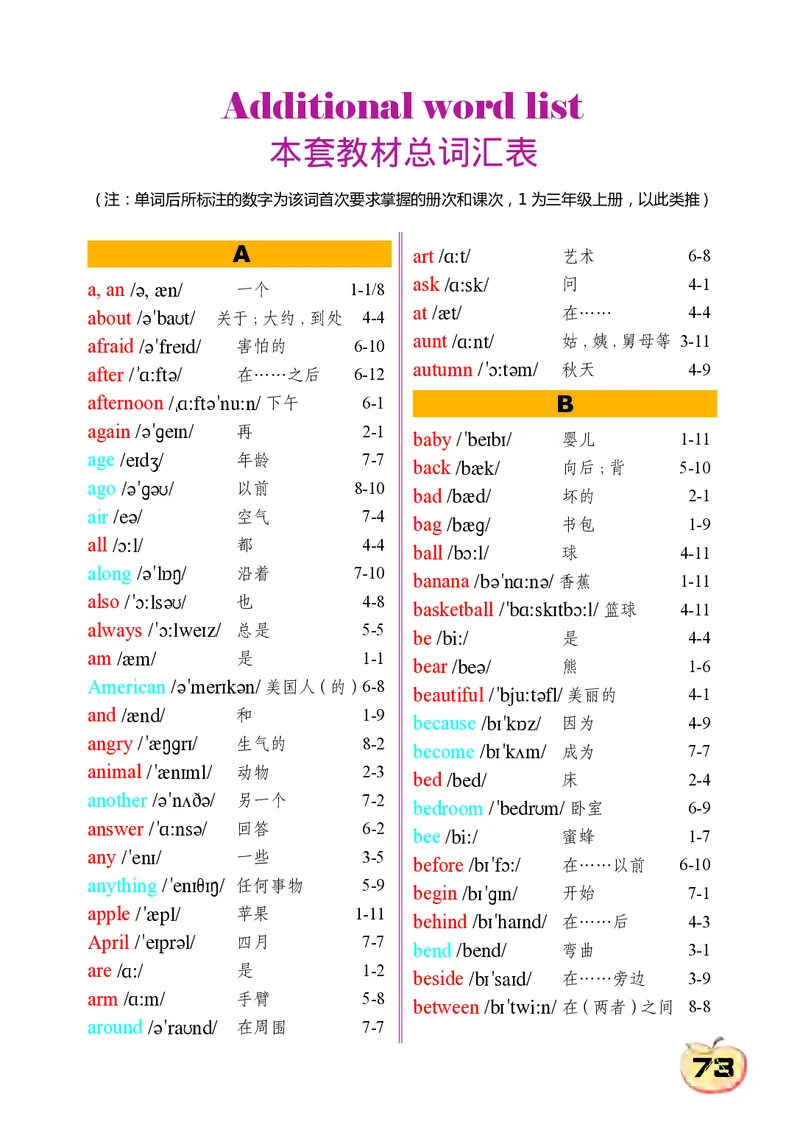
( ) 1. get up
( ) 2. go to school
( ) 3. go to work
( ) 4. go back home
( ) 5. go to bed
( ) 6. do sports
( ) 7. do morning exercises
( ) 8. take(go for) a walk
A
B
C
D
E
F
G
H
72
本套教材总词汇表
Additional word list
( 注:单词后所标注的数字为该词首次要求掌握的册次和课次,1 为三年级上册,以此类推)
A
a, an /E, Zn/
一个
1-1/8
about /E?baHt/ 关于; 大约, 到处 4-4
afraid /E?freId/
害怕的
6-10
after /?A:ftE/
在……之后
6-12
afternoon /LA:ftE?nu:n/ 下午
6-1
again /E?GeIn/
再
2-1
age /eIdW/
年龄
7-7
ago /E?GEH/
以前
8-10
air /eE/
空气
7-4
all /C:l/
都
4-4
along /E?lFY/
沿着
7-10
also /?C:lsEH/
也
4-8
always /?C:lweIz/ 总是
5-5
am /Zm/
是
1-1
American /E?merIkEn/ 美国人( 的) 6-8
and /Znd/
和
1-9
angry /?ZYGrI/
生气的
8-2
animal /?ZnIml/
动物
2-3
another /E?nVDE/ 另一个
7-2
answer /?A:nsE/
回答
6-2
any /?enI/
一些
3-5
anything /?enIOIY/ 任何事物
5-9
apple /?Zpl/
苹果
1-11
April /?eIprEl/
四月
7-7
are /A:/
是
1-2
arm /A:m/
手臂
5-8
around /E?raHnd/ 在周围
7-7
art /A:t/
艺术
6-8
ask /A:sk/
问
4-1
at /Zt/
在……
4-4
aunt /A:nt/
姑, 姨, 舅母等 3-11
autumn /?C:tEm/
秋天
4-9
B
baby /?beIbI/
婴儿
1-11
back /bZk/
向后; 背
5-10
bad /bZd/
坏的
2-1
bag /bZG/
书包
1-9
ball /bC:l/
球
4-11
banana /bE?nA:nE/ 香蕉
1-11
basketball /?bA:skItbC:l/ 篮球
4-11
be /bi:/
是
4-4
bear /beE/
熊
1-6
beautiful /?bju:tEfl/ 美丽的
4-1
because /bI?kFz/
因为
4-9
become /bI?kVm/ 成为
7-7
bed /bed/
床
2-4
bedroom /?bedrHm/ 卧室
6-9
bee /bi:/
蜜蜂
1-7
before /bI?fC:/
在……以前
6-10
begin /bI?GIn/
开始
7-1
behind /bI?haInd/ 在……后
4-3
bend /bend/
弯曲
3-1
beside /bI?saId/
在……旁边
3-9
between /bI?twi:n/ 在( 两者) 之间 8-8
73
can /kZn/
能
1-12
candle /?kZndl/
蜡烛
2-12
candy /?kZndI/ 糖果
7-8
cap /kZp/
便帽
1-9
capital /?kZpItl/ 首都
8-10
car /kA:/
小汽车
3-11
card /kA:d/
卡片
5-4
carrot /?kZrEt/
胡萝卜
5-7
carry /?kZrI/
携带,搬运
4-11
cat /kZt/
猫
1-1
catch /kZtS/
抓住
4-12
centre /?sentE/
中心
5-1
certainly /?sB:tnlI/ 当然
6-1
chair /tSeE/
椅子
3-10
change /tSeIndW/
改变
7-3
chick /tSIk/
小鸡
1-11
chicken /?tSIkIn/
鸡, 鸡肉
5-9
child /tSaIld/ 儿童( 复children) 5-10
China /?tSaInE/
中国
7-2
Chinese /LtSaI?ni:z/ 汉语, 中国人( 的)
4-4
choose /tSu:z/
选择
6-5
Christmas /?krIsmEs/ 圣诞节
7-8
cinema /?sInImE/ 电影院
6-12
city /?sItI/
城市
7-10
class /klA:s/
班级
4-3
classroom /?klA:srHm/ 教室
5-1
clean /kli:n/
弄干净; 清洁的 4-10
cleaner /?kli:nE/
清洁工
6-5
clear /klIE/
清楚的, 明亮的 8-8
clever /?klevE/
聪明的
5-9
climb /klaIm/
爬, 攀登
8-10
clock /klFk/
钟
3-2
close /klEHz/
关
2-10
big /bIG/
大的
1-12
bike /baIk/(bicycle) 自行车
2-9
bird /bB:d/
鸟
1-7
birthday /?bB:OdeI/ 生日
2-11
black /blZk/
黑色的
1-9
blackboard /?blZkbC:d/ 黑板
6-3
blue /blu:/
蓝色的
1-9
boat /bEHt/
小船; 划船
8-3
body /?bFdI/
身体
4-8
book /bHk/
书
3-3
bookshop /?bHkSFp/ 书店
7-4
bottle /?bFtl/
瓶子
5-7
box /bFks/
盒子
1-9
boy /bCI/
男孩
2-8
bread /bred/
面包
3-12
breakfast /?brekfEst/ 早餐
6-7
bridge /brIdW/
桥
7-10
bright /braIt/
明亮的
7-10
bring /brIY/
带来
7-1
brother /?brVDE/
兄弟
2-8
brown /braHn/
棕色的
3-6
build /bIld/
建造
8-2
building /?bIldIY/ 大楼
7-6
bun /bVn/
馒头
1-8
bus /bVs/
公共汽车
3-11
busy /?bIzI/
忙的
4-9
but /bVt/
但是
2-2
buy /baI/
买
5-7
by /baI/
乘( 车等)
6-11
bye /baI/
再见
1-3
C
cake /keIk/
蛋糕
2-7
call /kC:l/
打电话, 叫
4-7
74
clothes /klEHDz/ 衣服
8-4
cloud /klaHd/
云
8-8
cloudy /?klaHdI/
多云的
7-3
coat /kEHt/
外套, 上衣
8-1
coke /kEHk/
可乐
2-11
cold /kEHld/
冷的
2-10
colour /?kVlE/
颜色( 美color) 1-9
come /kVm/
来
2-11
computer /kEm?pju:tE/ 计算机
4-12
cook /kHk/
厨师; 煮, 烧 4-10
cool /ku:l/
凉快的, 酷
8-4
could /kHd/
可以
5-8
count /kaHnt/
数
7-7
country /?kVntrI/ 国家
7-4
cousin /?kVzn/
堂/表兄弟姐妹 6-2
cow /kaH/
奶牛
3-9
crayon /?kreIEn/
蜡笔
7-2
cross /krFs/
穿过
6-2
cry /kraI/
哭, 喊
5-8
cup /kVp/
茶杯
3-2
cut /kVt/
切, 砍
3-12
D
dad /dZd/
爸爸
1-10
dance /dA:ns/
跳舞
3-1
date /deIt/
日期
7-7
daughter /?dC:tE/ 女儿
6-11
day /deI/
白天
2-5
dead /ded/
死的
8-4
deaf /def/
聋的
8-9
dear /dIE/
亲爱的
3-10
December /dI?sembE/ 十二月
7-8
deep /di:p/
深的
6-7
deer /dIE/
鹿
4-8
desk /desk/
书桌
3-2
difficult /?dIfIkElt/ 困难的
7-4
dinner /?dInE/
正餐, 晚餐
7-7
dirty /?dB:tI/
脏的
6-3
do /du:/
做
3-12
doctor /?dFktE/
医生
3-7
dog /dFG/
狗
1-1
doll /dFl/
洋娃娃
2-4
donkey /?dFYkI/
驴
4-8
door /dC:/
门
2-6
down /daHn/
向下
1-4
draw /drC:/
画
4-10
dress /dres/ 连衣裙, 女服; 打扮 2-2
drink /drIYk/
喝; 饮料
5-7
drive /draIv/
驾驶
7-10
driver /?draIvE/ 司机
7-9
drop /drFp/
掉落
6-3
dry /draI/
干的
7-3
duck /dVk/
鸭子
1-6
E
ear /IE/
耳朵
5-3
early /?B:lI/
早的
6-9
earth /B:O/
地球
7-3
easy /?i:zI/
容易的
6-5
eat /i:t/
吃
3-12
egg /eG/
蛋
1-8
eight /eIt/
八
3-8
either /?aIDE/
也不
5-11
elephant /?elIfEnt/ 大象
2-3
eleven /I?levn/
十一
3-9
else /els/
其它的
5-9
email /?i:meIl/
电子邮件
5-3
end /end/
末端, 尽头
8-6
75
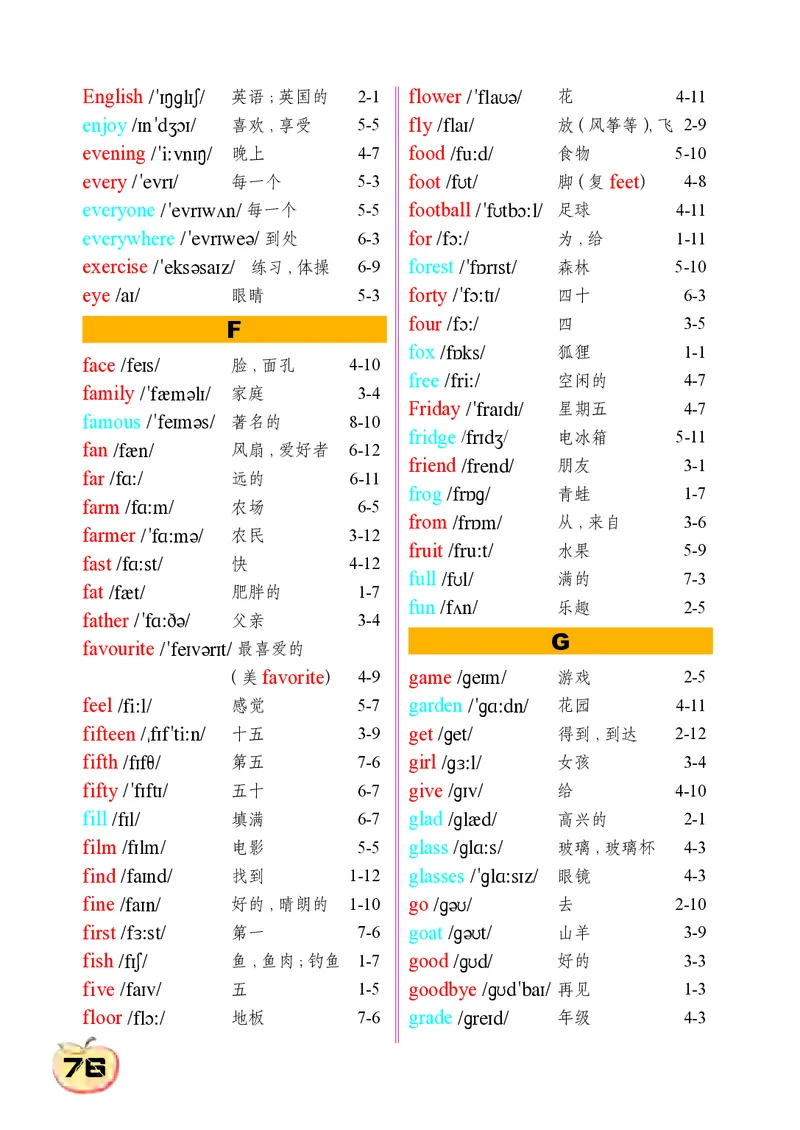
English /?IYGlIS/
英语; 英国的
2-1
enjoy /In?dWCI/
喜欢, 享受
5-5
evening /?i:vnIY/
晚上
4-7
every /?evrI/
每一个
5-3
everyone /?evrIwVn/ 每一个
5-5
everywhere /?evrIweE/ 到处
6-3
exercise /?eksEsaIz/ 练习, 体操
6-9
eye /aI/
眼睛
5-3
F
face /feIs/
脸, 面孔
4-10
family /?fZmElI/ 家庭
3-4
famous /?feImEs/ 著名的
8-10
fan /fZn/
风扇, 爱好者
6-12
far /fA:/
远的
6-11
farm /fA:m/
农场
6-5
farmer /?fA:mE/
农民
3-12
fast /fA:st/
快
4-12
fat /fZt/
肥胖的
1-7
father /?fA:DE/
父亲
3-4
favourite /?feIvErIt/ 最喜爱的
( 美favorite)
4-9
feel /fi:l/
感觉
5-7
fifteen /LfIf?ti:n/
十五
3-9
fifth /fIfO/
第五
7-6
fifty /?fIftI/
五十
6-7
fill /fIl/
填满
6-7
film /fIlm/
电影
5-5
find /faInd/
找到
1-12
fine /faIn/
好的, 晴朗的
1-10
first /fB:st/ 第一
7-6
fish /fIS/
鱼, 鱼肉; 钓鱼 1-7
five /faIv/
五
1-5
floor /flC:/
地板
7-6
flower /?flaHE/
花
4-11
fly /flaI/
放( 风筝等), 飞 2-9
food /fu:d/
食物
5-10
foot /fHt/
脚( 复feet)
4-8
football /?fHtbC:l/ 足球
4-11
for /fC:/
为, 给
1-11
forest /?fFrIst/
森林
5-10
forty /?fC:tI/
四十
6-3
four /fC:/
四
3-5
fox /fFks/
狐狸
1-1
free /fri:/
空闲的
4-7
Friday /?fraIdI/ 星期五
4-7
fridge /frIdW/
电冰箱
5-11
friend /frend/
朋友
3-1
frog /frFG/
青蛙
1-7
from /frFm/ 从, 来自
3-6
fruit /fru:t/
水果
5-9
full /fHl/
满的
7-3
fun /fVn/
乐趣
2-5
G
game /GeIm/
游戏
2-5
garden /?GA:dn/
花园
4-11
get /Get/
得到, 到达
2-12
girl /GB:l/
女孩
3-4
give /GIv/
给
4-10
glad /GlZd/
高兴的
2-1
glass /GlA:s/
玻璃, 玻璃杯
4-3
glasses /?GlA:sIz/
眼镜
4-3
go /GEH/
去
2-10
goat /GEHt/
山羊
3-9
good /GHd/
好的
3-3
goodbye /GHd?baI/ 再见
1-3
grade /GreId/
年级
4-3
76
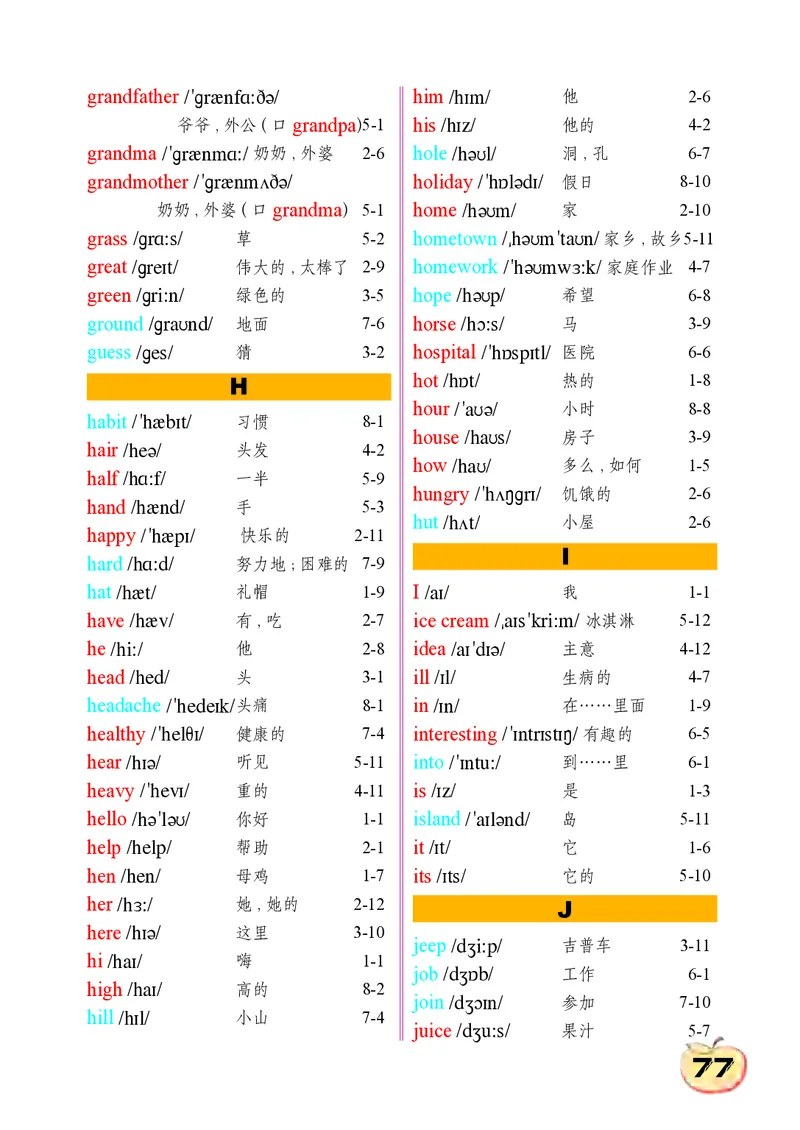
grandfather /?GrZnfA:DE/
爷爷, 外公( 口grandpa) 5-1
grandma /?GrZnmA:/ 奶奶, 外婆
2-6
grandmother /?GrZnmVDE/
奶奶, 外婆( 口grandma) 5-1
grass /GrA:s/
草
5-2
great /GreIt/
伟大的, 太棒了 2-9
green /Gri:n/
绿色的
3-5
ground /GraHnd/ 地面
7-6
guess /Ges/
猜
3-2
H
habit /?hZbIt/
习惯
8-1
hair /heE/
头发
4-2
half /hA:f/
一半
5-9
hand /hZnd/
手
5-3
happy /?hZpI/
快乐的
2-11
hard /hA:d/ 努力地; 困难的 7-9
hat /hZt/
礼帽
1-9
have /hZv/
有, 吃
2-7
he /hi:/
他
2-8
head /hed/
头
3-1
headache /?hedeIk/ 头痛
8-1
healthy /?helOI/
健康的
7-4
hear /hIE/
听见
5-11
heavy /?hevI/
重的
4-11
hello /hE?lEH/
你好
1-1
help /help/
帮助
2-1
hen /hen/
母鸡
1-7
her /hB:/
她, 她的
2-12
here /hIE/
这里
3-10
hi /haI/
嗨
1-1
high /haI/
高的
8-2
hill /hIl/
小山
7-4
him /hIm/
他
2-6
his /hIz/
他的
4-2
hole /hEHl/
洞, 孔
6-7
holiday /?hFlEdI/ 假日
8-10
home /hEHm/
家
2-10
hometown /LhEHm?taHn/ 家乡, 故乡 5-11
homework /?hEHmwB:k/ 家庭作业 4-7
hope /hEHp/ 希望
6-8
horse /hC:s/
马
3-9
hospital /?hFspItl/ 医院
6-6
hot /hFt/
热的
1-8
hour /?aHE/
小时
8-8
house /haHs/
房子
3-9
how /haH/
多么, 如何
1-5
hungry /?hVYGrI/ 饥饿的
2-6
hut /hVt/
小屋
2-6
I
I /aI/
我
1-1
ice cream /LaIs?kri:m/ 冰淇淋
5-12
idea /aI?dIE/
主意
4-12
ill /Il/
生病的
4-7
in /In/
在……里面
1-9
interesting /?IntrIstIY/ 有趣的
6-5
into /?Intu:/
到……里
6-1
is /Iz/
是
1-3
island /?aIlEnd/
岛
5-11
it /It/
它
1-6
its /Its/
它的
5-10
J
jeep /dWi:p/
吉普车
3-11
job /dWFb/
工作
6-1
join /dWCIn/ 参加
7-10
juice /dWu:s/
果汁
5-7
77
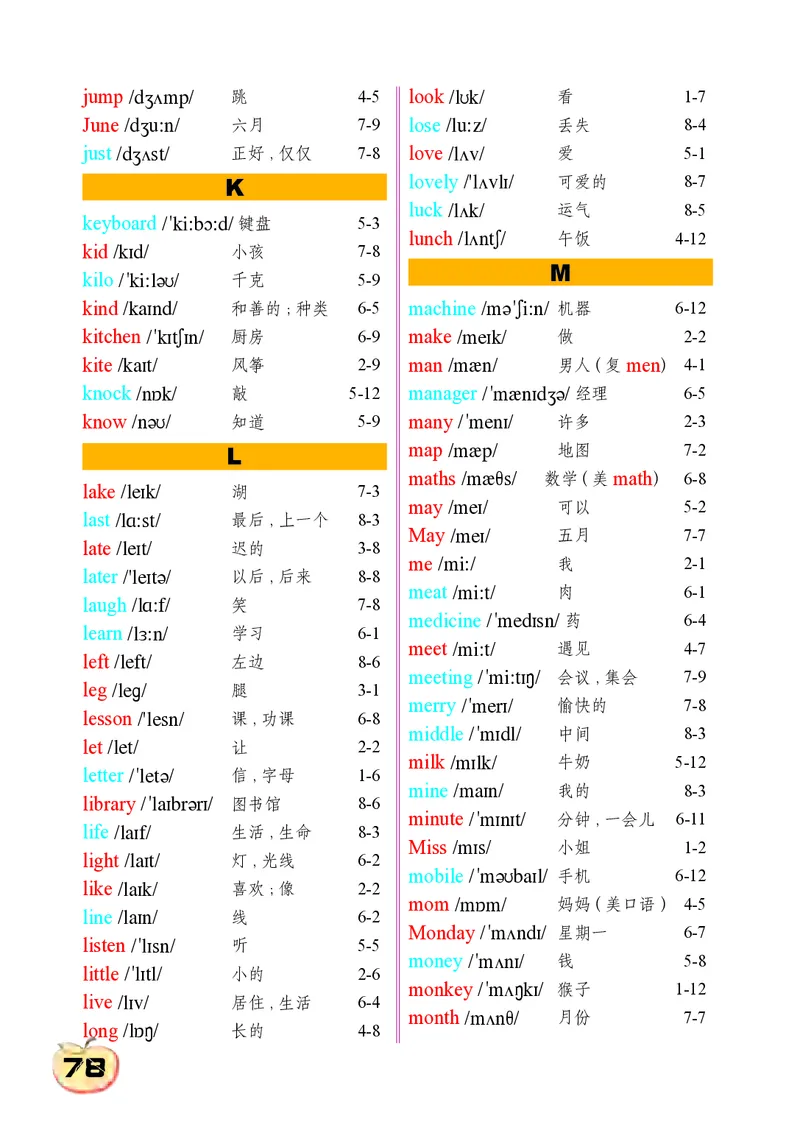
jump /dWVmp/
跳
4-5
June /dWu:n/ 六月
7-9
just /dWVst/ 正好, 仅仅
7-8
K
keyboard /?ki:bC:d/ 键盘
5-3
kid /kId/
小孩
7-8
kilo /?ki:lEH/
千克
5-9
kind /kaInd/
和善的; 种类
6-5
kitchen /?kItSIn/
厨房
6-9
kite /kaIt/
风筝
2-9
knock /nFk/
敲
5-12
know /nEH/
知道
5-9
L
lake /leIk/
湖
7-3
last /lA:st/
最后, 上一个
8-3
late /leIt/
迟的
3-8
later /'leItE/
以后, 后来
8-8
laugh /lA:f/
笑
7-8
learn /lB:n/
学习
6-1
left /left/ 左边
8-6
leg /leG/
腿
3-1
lesson /'lesn/
课, 功课
6-8
let /let/
让
2-2
letter /?letE/
信, 字母
1-6
library /?laIbrErI/ 图书馆
8-6
life /laIf/ 生活, 生命
8-3
light /laIt/
灯, 光线
6-2
like /laIk/
喜欢; 像
2-2
line /laIn/
线
6-2
listen /?lIsn/
听
5-5
little /?lItl/
小的
2-6
live /lIv/
居住, 生活
6-4
long /lFY/
长的
4-8
look /lHk/
看
1-7
lose /lu:z/
丢失
8-4
love /lVv/
爱
5-1
lovely /'lVvlI/
可爱的
8-7
luck /lVk/
运气
8-5
lunch /lVntS/
午饭
4-12
M
machine /mE?Si:n/ 机器
6-12
make /meIk/
做
2-2
man /mZn/
男人( 复men) 4-1
manager /?mZnIdWE/ 经理
6-5
many /?menI/
许多
2-3
map /mZp/
地图
7-2
maths /mZOs/ 数学( 美math) 6-8
may /meI/
可以
5-2
May /meI/
五月
7-7
me /mi:/
我
2-1
meat /mi:t/
肉
6-1
medicine /?medIsn/ 药
6-4
meet /mi:t/
遇见
4-7
meeting /?mi:tIY/ 会议, 集会
7-9
merry /?merI/
愉快的
7-8
middle /?mIdl/
中间
8-3
milk /mIlk/
牛奶
5-12
mine /maIn/
我的
8-3
minute /?mInIt/
分钟, 一会儿 6-11
Miss /mIs/
小姐
1-2
mobile /?mEHbaIl/ 手机
6-12
mom /mFm/
妈妈( 美口语) 4-5
Monday /?mVndI/ 星期一
6-7
money /?mVnI/
钱
5-8
monkey /?mVYkI/ 猴子
1-12
month /mVnO/
月份
7-7
78
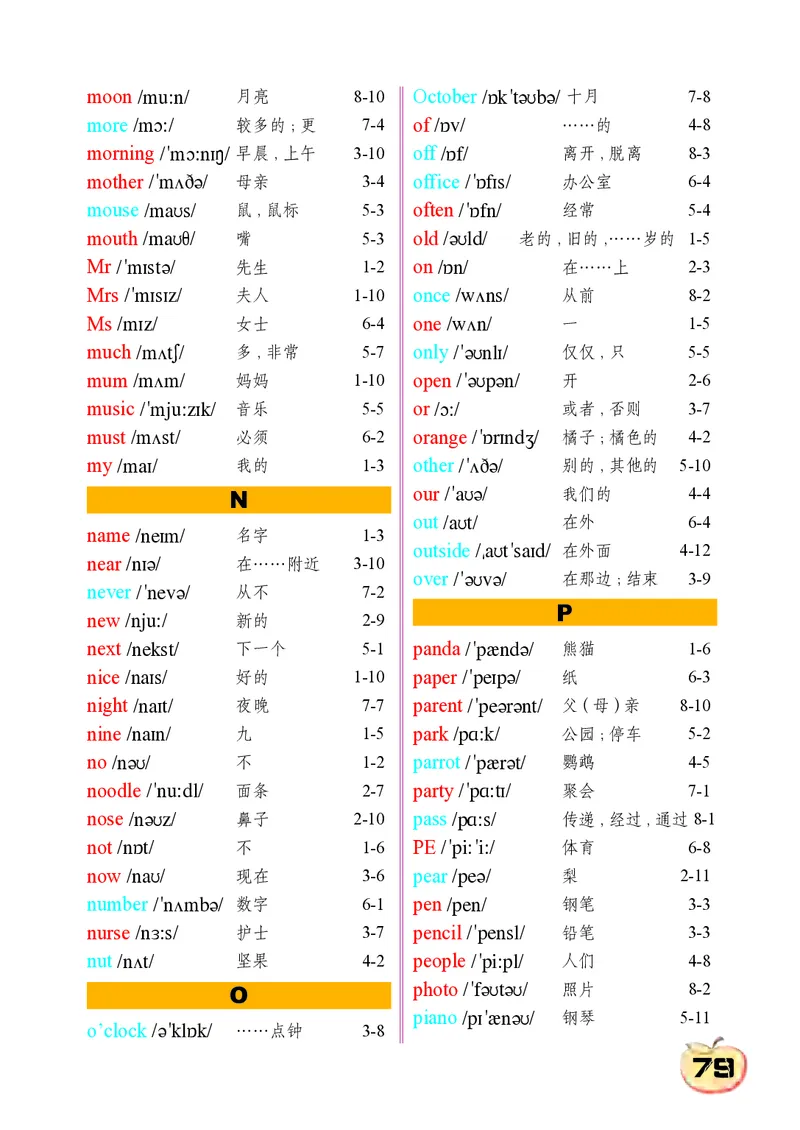
moon /mu:n/
月亮
8-10
more /mC:/
较多的; 更
7-4
morning /?mC:nIY/ 早晨, 上午
3-10
mother /?mVDE/
母亲
3-4
mouse /maHs/
鼠, 鼠标
5-3
mouth /maHO/
嘴
5-3
Mr /?mIstE/
先生
1-2
Mrs /?mIsIz/
夫人
1-10
Ms /mIz/
女士
6-4
much /mVtS/
多, 非常
5-7
mum /mVm/
妈妈
1-10
music /?mju:zIk/
音乐
5-5
must /mVst/
必须
6-2
my /maI/
我的
1-3
N
name /neIm/
名字
1-3
near /nIE/
在……附近
3-10
never /?nevE/
从不
7-2
new /nju:/
新的
2-9
next /nekst/
下一个
5-1
nice /naIs/
好的
1-10
night /naIt/
夜晚
7-7
nine /naIn/
九
1-5
no /nEH/
不
1-2
noodle /?nu:dl/
面条
2-7
nose /nEHz/
鼻子
2-10
not /nFt/
不
1-6
now /naH/
现在
3-6
number /?nVmbE/ 数字
6-1
nurse /nB:s/
护士
3-7
nut /nVt/
坚果
4-2
O
o’clock /E?klFk/
……点钟
3-8
October /Fk?tEHbE/ 十月
7-8
of /Fv/
……的
4-8
off /Ff/
离开, 脱离
8-3
office /?FfIs/
办公室
6-4
often /?Ffn/
经常
5-4
old /EHld/ 老的, 旧的,……岁的 1-5
on /Fn/
在……上
2-3
once /wVns/
从前
8-2
one /wVn/
一
1-5
only /?EHnlI/
仅仅, 只
5-5
open /?EHpEn/
开
2-6
or /C:/
或者, 否则
3-7
orange /?FrIndW/ 橘子; 橘色的
4-2
other /?VDE/
别的, 其他的
5-10
our /?aHE/
我们的
4-4
out /aHt/
在外
6-4
outside /LaHt?saId/ 在外面
4-12
over /?EHvE/
在那边; 结束
3-9
P
panda /?pZndE/
熊猫
1-6
paper /?peIpE/
纸
6-3
parent /?peErEnt/ 父( 母) 亲
8-10
park /pA:k/
公园; 停车
5-2
parrot /?pZrEt/
鹦鹉
4-5
party /?pA:tI/
聚会
7-1
pass /pA:s/
传递, 经过, 通过8-1
PE /?pi:?i:/
体育
6-8
pear /peE/
梨
2-11
pen /pen/
钢笔
3-3
pencil /?pensl/
铅笔
3-3
people /?pi:pl/
人们
4-8
photo /?fEHtEH/
照片
8-2
piano /pI?ZnEH/
钢琴
5-11
79
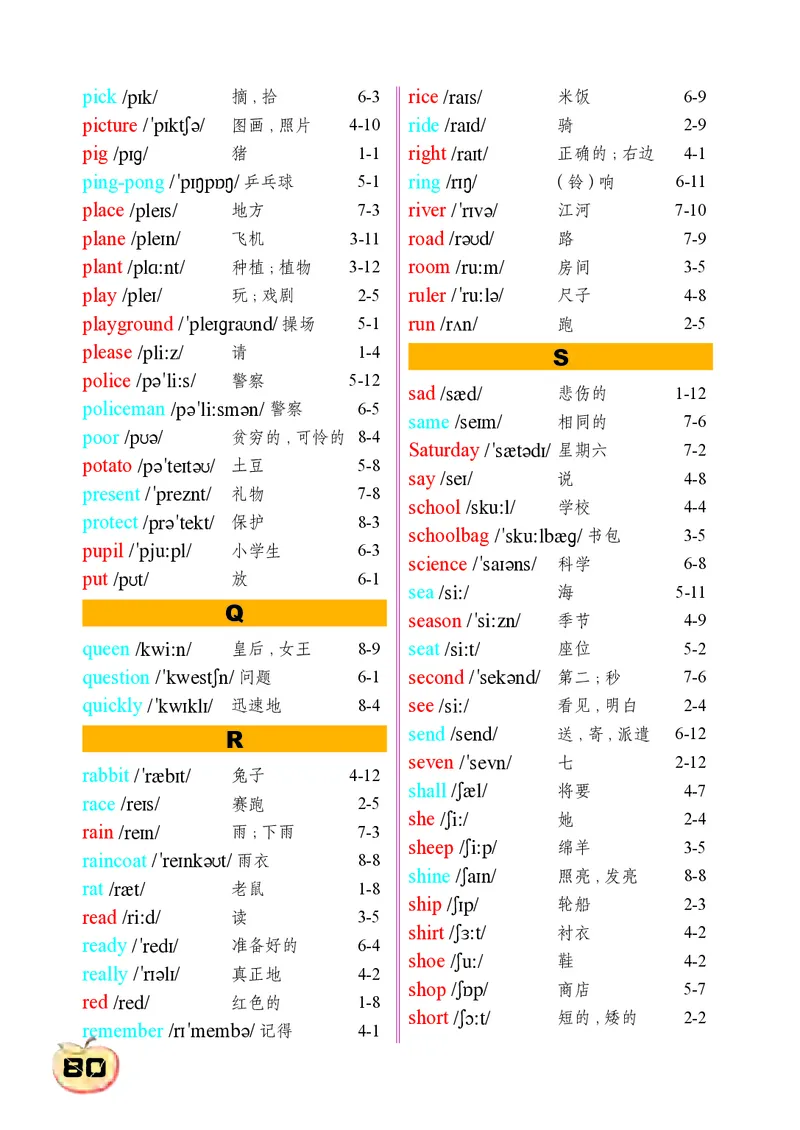
pick /pIk/
摘, 拾
6-3
picture /?pIktSE/ 图画, 照片
4-10
pig /pIG/
猪
1-1
ping-pong /?pIYpFY/ 乒乓球
5-1
place /pleIs/
地方
7-3
plane /pleIn/
飞机
3-11
plant /plA:nt/
种植; 植物
3-12
play /pleI/
玩; 戏剧
2-5
playground /?pleIGraHnd/ 操场
5-1
please /pli:z/
请
1-4
police /pE?li:s/
警察
5-12
policeman /pE?li:smEn/ 警察
6-5
poor /pHE/
贫穷的, 可怜的 8-4
potato /pE?teItEH/ 土豆
5-8
present /?preznt/ 礼物
7-8
protect /prE?tekt/ 保护
8-3
pupil /?pju:pl/
小学生
6-3
put /pHt/
放
6-1
Q
queen /kwi:n/
皇后, 女王
8-9
question /?kwestSn/ 问题
6-1
quickly /?kwIklI/ 迅速地
8-4
R
rabbit /?rZbIt/
兔子
4-12
race /reIs/
赛跑
2-5
rain /reIn/
雨; 下雨
7-3
raincoat /?reInkEHt/ 雨衣
8-8
rat /rZt/
老鼠
1-8
read /ri:d/
读
3-5
ready /?redI/
准备好的
6-4
really /?rIElI/
真正地
4-2
red /red/
红色的
1-8
remember /rI?membE/ 记得
4-1
rice /raIs/
米饭
6-9
ride /raId/
骑
2-9
right /raIt/
正确的; 右边
4-1
ring /rIY/
( 铃) 响
6-11
river /?rIvE/
江河
7-10
road /rEHd/
路
7-9
room /ru:m/
房间
3-5
ruler /?ru:lE/
尺子
4-8
run /rVn/
跑
2-5
S
sad /sZd/
悲伤的
1-12
same /seIm/
相同的
7-6
Saturday /?sZtEdI/ 星期六
7-2
say /seI/
说
4-8
school /sku:l/
学校
4-4
schoolbag /?sku:lbZG/ 书包
3-5
science /?saIEns/
科学
6-8
sea /si:/
海
5-11
season /?si:zn/
季节
4-9
seat /si:t/
座位
5-2
second /?sekEnd/ 第二; 秒
7-6
see /si:/
看见, 明白
2-4
send /send/
送, 寄, 派遣
6-12
seven /?sevn/
七
2-12
shall /SZl/
将要
4-7
she /Si:/
她
2-4
sheep /Si:p/
绵羊
3-5
shine /SaIn/
照亮, 发亮
8-8
ship /SIp/
轮船
2-3
shirt /SB:t/
衬衣
4-2
shoe /Su:/
鞋
4-2
shop /SFp/
商店
5-7
short /SC:t/
短的, 矮的
2-2
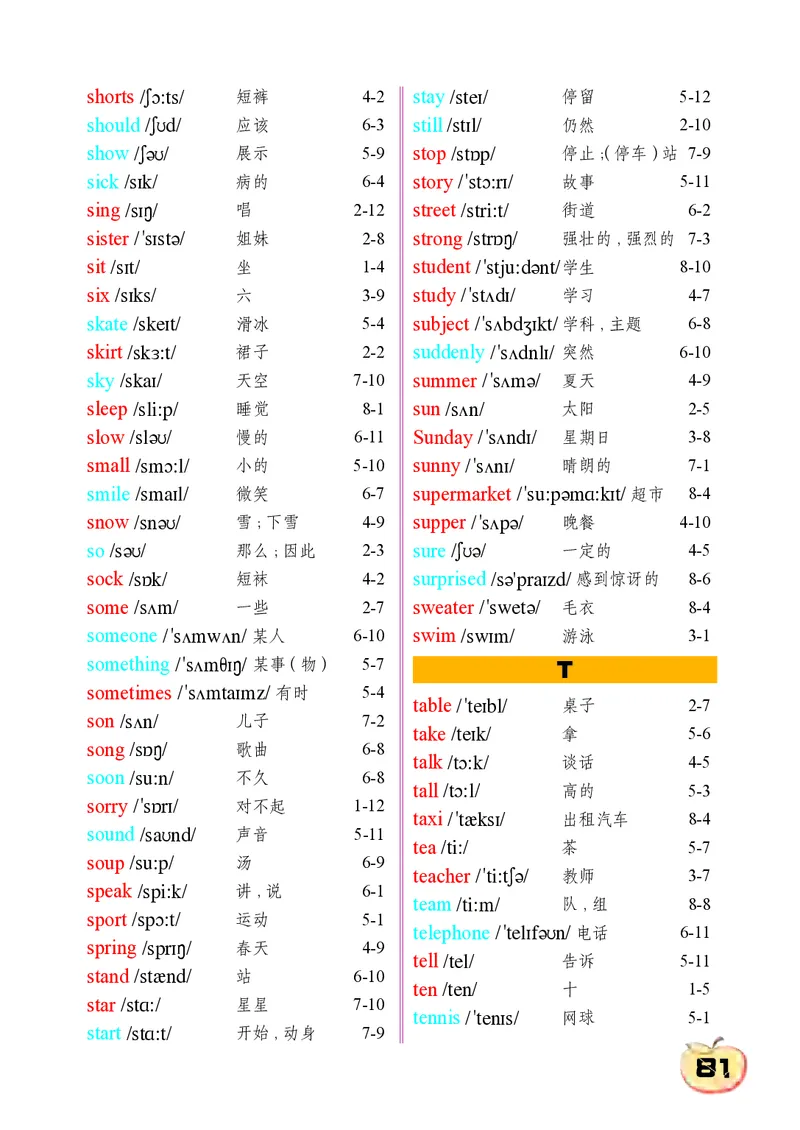
80
shorts /SC:ts/
短裤
4-2
should /SHd/
应该
6-3
show /SEH/
展示
5-9
sick /sIk/
病的
6-4
sing /sIY/
唱
2-12
sister /?sIstE/
姐妹
2-8
sit /sIt/
坐
1-4
six /sIks/
六
3-9
skate /skeIt/
滑冰
5-4
skirt /skB:t/
裙子
2-2
sky /skaI/
天空
7-10
sleep /sli:p/
睡觉
8-1
slow /slEH/
慢的
6-11
small /smC:l/
小的
5-10
smile /smaIl/ 微笑
6-7
snow /snEH/
雪; 下雪
4-9
so /sEH/
那么; 因此
2-3
sock /sFk/
短袜
4-2
some /sVm/
一些
2-7
someone /?sVmwVn/ 某人
6-10
something /?sVmOIY/ 某事( 物)
5-7
sometimes /?sVmtaImz/ 有时
5-4
son /sVn/
儿子
7-2
song /sFY/
歌曲
6-8
soon /su:n/
不久
6-8
sorry /?sFrI/
对不起
1-12
sound /saHnd/
声音
5-11
soup /su:p/
汤
6-9
speak /spi:k/
讲, 说
6-1
sport /spC:t/
运动
5-1
spring /sprIY/
春天
4-9
stand /stZnd/
站
6-10
star /stA:/
星星
7-10
start /stA:t/
开始, 动身
7-9
stay /steI/
停留
5-12
still /stIl/
仍然
2-10
stop /stFp/ 停止;( 停车) 站 7-9
story /?stC:rI/
故事
5-11
street /stri:t/
街道
6-2
strong /strFY/
强壮的, 强烈的 7-3
student /?stju:dEnt/ 学生
8-10
study /?stVdI/
学习
4-7
subject /?sVbdWIkt/ 学科, 主题
6-8
suddenly /?sVdnlI/ 突然
6-10
summer /?sVmE/
夏天
4-9
sun /sVn/
太阳
2-5
Sunday /?sVndI/
星期日
3-8
sunny /?sVnI/ 晴朗的
7-1
supermarket /?su:pEmA:kIt/ 超市
8-4
supper /?sVpE/
晚餐
4-10
sure /SHE/
一定的
4-5
surprised /sE'praIzd/ 感到惊讶的
8-6
sweater /?swetE/ 毛衣
8-4
swim /swIm/
游泳
3-1
T
table /?teIbl/
桌子
2-7
take /teIk/
拿
5-6
talk /tC:k/
谈话
4-5
tall /tC:l/
高的
5-3
taxi /?tZksI/
出租汽车
8-4
tea /ti:/
茶
5-7
teacher /?ti:tSE/
教师
3-7
team /ti:m/
队, 组
8-8
telephone /?telIfEHn/ 电话
6-11
tell /tel/
告诉
5-11
ten /ten/
十
1-5
tennis /?tenIs/
网球
5-1
81
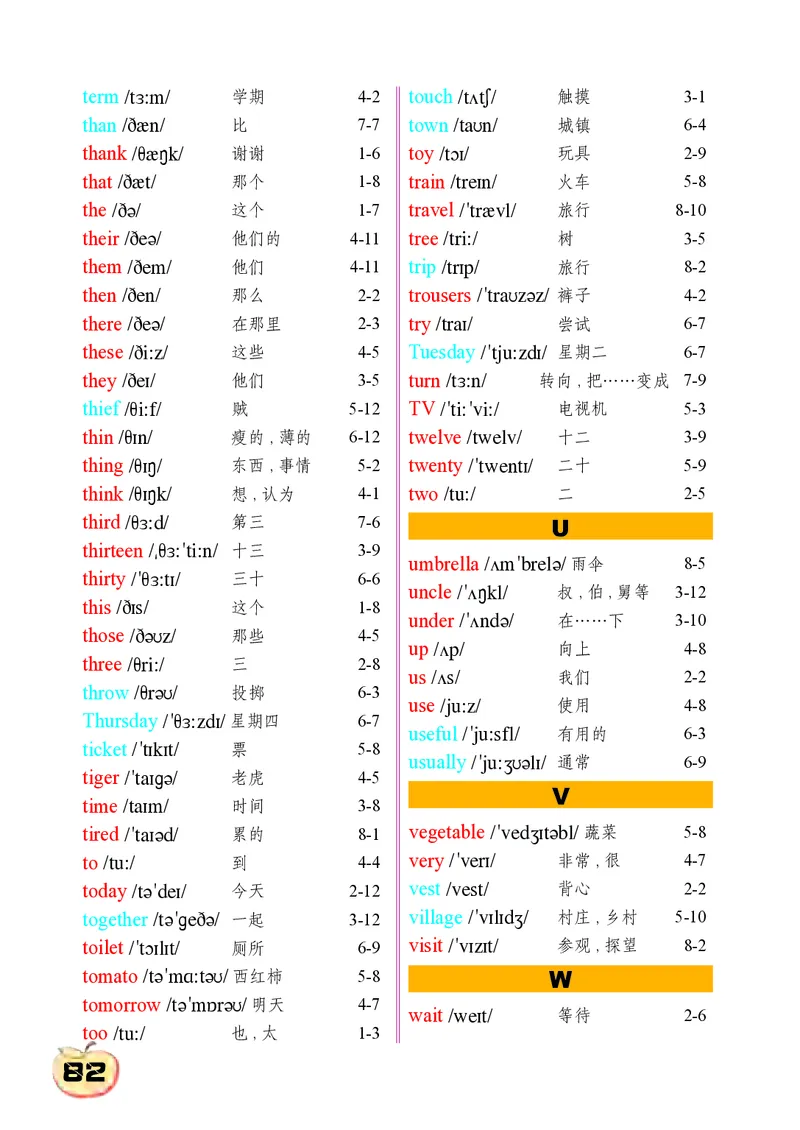
term /tB:m/
学期
4-2
than /DZn/
比
7-7
thank /OZYk/
谢谢
1-6
that /DZt/
那个
1-8
the /DE/
这个
1-7
their /DeE/
他们的
4-11
them /Dem/
他们
4-11
then /Den/
那么
2-2
there /DeE/
在那里
2-3
these /Di:z/
这些
4-5
they /DeI/
他们
3-5
thief /Oi:f/
贼
5-12
thin /OIn/
瘦的, 薄的
6-12
thing /OIY/
东西, 事情
5-2
think /OIYk/
想, 认为
4-1
third /OB:d/
第三
7-6
thirteen /LOB:?ti:n/ 十三
3-9
thirty /?OB:tI/
三十
6-6
this /DIs/
这个
1-8
those /DEHz/
那些
4-5
three /Ori:/
三
2-8
throw /OrEH/
投掷
6-3
Thursday /?OB:zdI/ 星期四
6-7
ticket /?tIkIt/
票
5-8
tiger /?taIGE/
老虎
4-5
time /taIm/
时间
3-8
tired /?taIEd/
累的
8-1
to /tu:/
到
4-4
today /tE?deI/
今天
2-12
together /tE?GeDE/ 一起
3-12
toilet /?tCIlIt/
厕所
6-9
tomato /tE?mA:tEH/ 西红柿
5-8
tomorrow /tE?mFrEH/ 明天
4-7
too /tu:/
也, 太
1-3
touch /tVtS/
触摸
3-1
town /taHn/
城镇
6-4
toy /tCI/
玩具
2-9
train /treIn/
火车
5-8
travel /?trZvl/
旅行
8-10
tree /tri:/
树
3-5
trip /trIp/
旅行
8-2
trousers /?traHzEz/ 裤子
4-2
try /traI/
尝试
6-7
Tuesday /?tju:zdI/ 星期二
6-7
turn /tB:n/ 转向, 把……变成 7-9
TV /?ti:?vi:/
电视机
5-3
twelve /twelv/
十二
3-9
twenty /?twentI/
二十
5-9
two /tu:/
二
2-5
U
umbrella /Vm?brelE/ 雨伞
8-5
uncle /?VYkl/
叔, 伯, 舅等
3-12
under /?VndE/
在……下
3-10
up /Vp/
向上
4-8
us /Vs/
我们
2-2
use /ju:z/
使用
4-8
useful /?ju:sfl/
有用的
6-3
usually /?ju:WHElI/ 通常
6-9
V
vegetable /?vedWItEbl/ 蔬菜
5-8
very /?verI/
非常, 很
4-7
vest /vest/
背心
2-2
village /?vIlIdW/
村庄, 乡村
5-10
visit /?vIzIt/
参观, 探望
8-2
W
wait /weIt/
等待
2-6
82
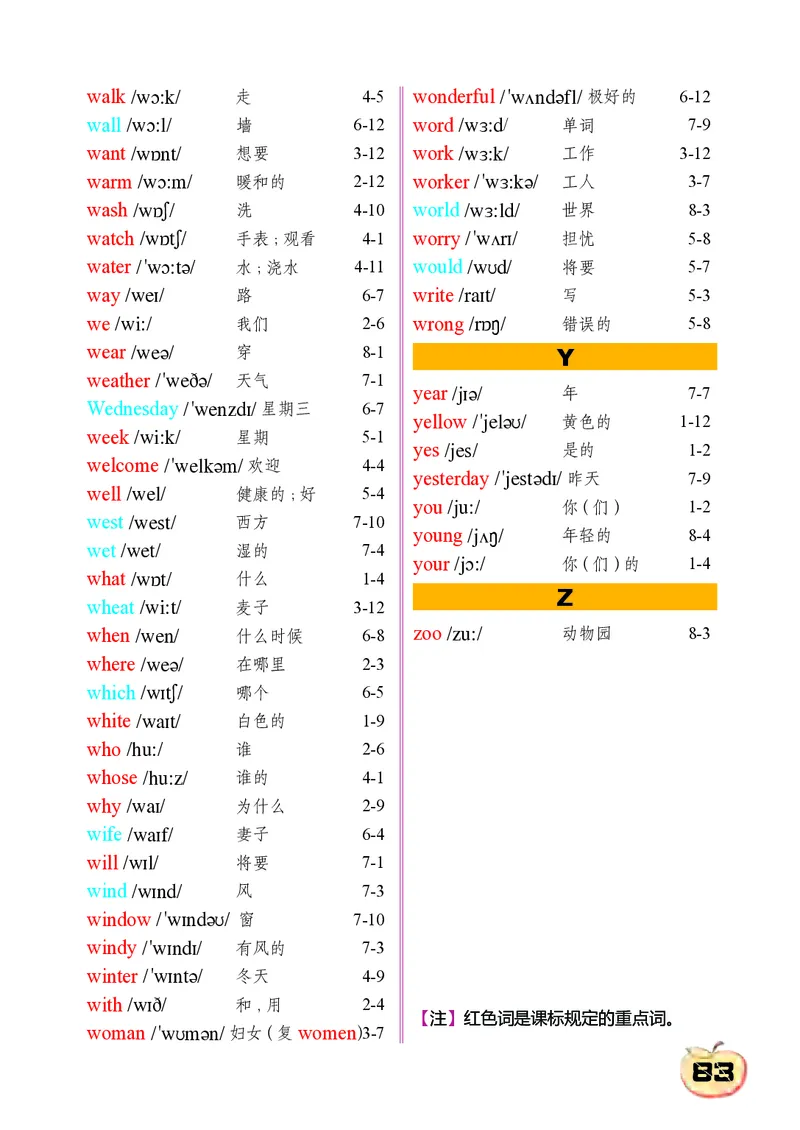
walk /wC:k/
走
4-5
wall /wC:l/
墙
6-12
want /wFnt/
想要
3-12
warm /wC:m/
暖和的
2-12
wash /wFS/
洗
4-10
watch /wFtS/
手表; 观看
4-1
water /?wC:tE/
水; 浇水
4-11
way /weI/
路
6-7
we /wi:/
我们
2-6
wear /weE/
穿
8-1
weather /?weDE/ 天气
7-1
Wednesday /?wenzdI/ 星期三
6-7
week /wi:k/
星期
5-1
welcome /?welkEm/ 欢迎
4-4
well /wel/
健康的; 好
5-4
west /west/
西方
7-10
wet /wet/
湿的
7-4
what /wFt/
什么
1-4
wheat /wi:t/
麦子
3-12
when /wen/
什么时候
6-8
where /weE/
在哪里
2-3
which /wItS/
哪个
6-5
white /waIt/
白色的
1-9
who /hu:/
谁
2-6
whose /hu:z/
谁的
4-1
why /waI/
为什么
2-9
wife /waIf/
妻子
6-4
will /wIl/
将要
7-1
wind /wInd/ 风
7-3
window /?wIndEH/ 窗
7-10
windy /?wIndI/
有风的
7-3
winter /?wIntE/
冬天
4-9
with /wID/
和, 用
2-4
woman /?wHmEn/ 妇女( 复women) 3-7
wonderful /?wVndEfl/ 极好的
6-12
word /wB:d/
单词
7-9
work /wB:k/
工作
3-12
worker /?wB:kE/
工人
3-7
world /wB:ld/
世界
8-3
worry /?wVrI/
担忧
5-8
would /wHd/
将要
5-7
write /raIt/
写
5-3
wrong /rFY/
错误的
5-8
Y
year /jIE/
年
7-7
yellow /?jelEH/
黄色的
1-12
yes /jes/
是的
1-2
yesterday /?jestEdI/ 昨天
7-9
you /ju:/
你( 们)
1-2
young /jVY/ 年轻的
8-4
your /jC:/
你( 们) 的
1-4
Z
zoo /zu:/
动物园
8-3
83
【注】红色词是课标规定的重点词。
后 记
本套教材于2001年8月经国家教育部审查通过。在十余年的使用过程中,
受到了基层学校和广大师生的欢迎。2011 年在教育部的统一部署下,我们
对教材进行了全面修订,使之更具有中国特色、更符合时代特点和更能体现
素质教育的要求。
我们主要从以下几方面对教材进行了修订:①更加注重教材的思想性,
选入了一些新的、有利于少年儿童道德品质教育的材料;②增加了贴近学生
生活实际的听说材料,为学生提供更多的语言实践机会;③加强了知识的复
现,在复习课中增加了Let’s talk 版块和Self-assessment 版块,对学过的
知识进行系统复习;④降低了难度,删去了新课标不要求掌握的教学内容,
修改了较长、较难的阅读文章并删去了部分较难单词;⑤删去了部分较难的
歌曲和歌谣,重新编入了更加新颖有趣的游戏和活动。
本套教材为三年级起点教材,仍保持原教材的编写体例,全套教材共8
册,供小学3 ~6 年级共四个学年使用。本册10 课,其中第5 课和第10 课
为复习课,其余为新课。新课采取“一课一话题、一课一句型、一课一活动、
一课一阅读”的编排方式,结构与功能相结合。通过语言实践学习语言知识,
使学生的语言运用能力得到切实的提高。
本册教材中选用的图片,有一部分未能与作者取得联系,恳请入选图片
的作者与我们联系,以便支付稿酬。
在本套教材的编写过程中,姜雪、孙房雪、刘月平等参与了具体编写和
修订工作。