2026年广东省广州市中考一模英语试卷
一、语法选择
阅读下面短文,按照句子结构的语法性和上下文连贯的要求,从1~15各题所给的A、B、C和D项中选
出最佳选项,并在答题卡上将该项涂黑。
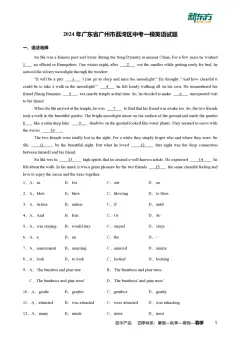
Mike still remembered the morning he first saw the purple pond(池塘). The water looked sick. The top of
the pond was covered 1 paints, chemicals and plastic bags. No flowers grew. No birds came. “How
could this happen?” Mike asked 2 . At that moment, he 3 that the climate problem was not
something far away.
Through books and online articles, Mike learnt that ponds are lifelines in the water system. They 4
help store rainwater for villages during dry seasons and reduce flood risks after heavy rains. They are home to
5 insects, birds and plants.
6 there is far less attention on protecting these small water bodies than on oceans and rivers. The
ponds 7 , though they are just as important. Even when people spend a lot of money 8 ponds,
they often become polluted again without care.
Mike and 9 student from his class decided to start 10 small group called “Pond
Protectors”. They helped villages check their water quality using IT-based sensors and mobile tools. These devices
(设备) could check things 11 temperature, salt, and pH levels. Then they visited schools. They showed
students 12 it is important to protect such water bodies and taught them how to use the devices.
13 a big group of young people became pond protectors. “They now go around themselves and
take the data from the ponds,” said Mike proudly. “Even 14 act can create the largest ripple effect(涟漪
效应)!”
The group also invited people 15 photos of the ponds nearest to them. When people notice, they
start to care. And when they care, they protect!
1.A.with B.for C.on D.of
2.A.he B.his C.him D.himself
3.A.realizes B.realized C.will realize D.has realized
4.A.should B.can C.must D.need
5.A.count B.counter C.countless D.countlessly
6.A.So B.Or C.And D.Yet
7.A.forget B.are forgetting C.are forgotten D.forgot
8.A.clean up B.cleaned up C.cleaning up D.to clean up
9.A.another B.other C.the other D.others
10.A.a B.an C.the D./
11.A.as B.like C.in D.at
12.A.why B.where C.what D.how
13.A.However B.Soon C.Instead D.Besides
初中产品 四季体系:暑假—秋季—寒假—春季 114.A.small B.smaller C.smallest D.the smallest
15.A.posted B.post C.posting D.to post
二、完形填空
阅读下面短文,掌握其大意,然后从16~25各题所给的A、B、C和D项中选出最佳选项,并在答题卡
上将该项涂黑。
Everything changed when my family moved north, where everyone went inside to play ice hockey once
summer ended.
For weeks I made excuses not to play hockey with Anna, my only new friend there. She even began to
think I was 16 her. Actually, I didn’t want to tell anyone I was 17 to skate.
One afternoon, when I was passing the park nearby, I noticed a woman teaching a young girl to 18
. The girl was trying to jump and spin in the air. Over and over, she fell and tried again. My 19 of ice
skating quietly came back to me: the pain, the fear ... Several weeks later, I found that the girl could land on her
feet safely! Her hard work 20 paid off!
That night, alone in my bedroom, I made a big 21 . Every day after school, I joined the girl to
practise. It was 22 at the beginning. Every time I went down, I had to tell myself not to give up. When I
fell, I just picked myself up and started over again. If nothing else, I kept going.
Soon I was able to keep my 23 and skate more confidently. In just a few weeks, I was actually
24 to practise speed skating, fast stops, and quick turns needed for ice hockey. When I finally showed Anna
my newfound skating ability, she was so impressed and told me I should join the local hockey league.
By the end of the season, not only was I part of a winning team, but also I had a group of new 25
, including Anna.
16.A.asking B.avoiding C.supporting D.introducing
17.A.happy B.prepared C.shy D.afraid
18.A.play B.dance C.skate D.run
19.A.memories B.skills C.habits D.choices
20.A.similarly B.usually C.finally D.easily
21.A.effort B.decision C.difference D.mistake
22.A.smooth B.hard C.fun D.lonely
23.A.balance B.attention C.promise D.secret
24.A.ready B.nervous C.silly D.satisfied
2 初中产品 四季体系:暑假—秋季—寒假—春季25.A.classmates B.teachers C.neighbours D.friends
三、阅读理解
Do more with our LIBRARY
Discover all the ways you can use this amazing community resource. Whether you visit often or are new
here, you’ll be amazed to learn how much we can do for you.
Services to offer
Our librarians can help you research a school project or paper, show you how to do an internet search, and
guide you to reliable sources. They can also help you find a book you are looking for even if you can’t remember
the exact title. Librarians can also make great book suggestions. Tell them what books you have enjoyed, as well
as subjects that interest you. They can propose your next read.
Volunteer chances
We welcome volunteer help from you. You can learn valuable skills, such as managing responsibility and
communicating with others. Ask us if you can:
· be a “book buddy” to read to younger children.
· keep our book collections in order.
· read recently published books and write reviews.
· help at our monthly events by guiding visitors and handing out materials.
Upcoming events
This May, come and have fun in our library’s Activity Zone at weekends!
Printing Workshop Culture Corner
Try our hands-on movable-type printing Welcome to our cultural talk on the coming jieqi
activities! Explore the wonder of ancient Chinese “Start of Summer”! Discover the wisdom of solar terms
printing, and create your own printed works! through stories, traditions and healthy eating tips.
Reader’s Theatre Ancient Clothes Club
Perform lively scenes(场景)from Journey to Interested in traditional clothes? Come dress up
the West to improve your speaking skills and and travel back in time! Try designing and making your
experience the magic of this classic story. own piece. We look forward to seeing your piece of art!
26.What does the underlined word “propose” mean in “Services to offer”?
A.Research. B.Suggest. C.Enjoy. D.Remember.
27.What can you do as a volunteer in the library?
A.Create stories for young kids. B.Repair book collections.
C.Write reviews on new books. D.Help design monthly events.
28.Which activities are best for Emma who loves traditional hands-on practice?
A.Printing Workshop and Culture Corner.
B.Culture Corner and Reader’s Theatre.
初中产品 四季体系:暑假—秋季—寒假—春季 3C.Reader’s Theatre and Ancient Clothes Club.
D.Printing Workshop and Ancient Clothes Club.
“Keep up! Ben,” called Amy, the group leader. As she waited for Ben, she also kept an eye on the other two
as they walked through the Planet Earth. When Ben caught up, Amy got Kate and Emi and they continued with
the rest of the class to enter the museum’s Meteor Maze.
Before they entered, Ben tapped Kate and pointed behind her. “Look,” he whispered. “The rock was named
after my favourite band! Fantastic!”
Kate and Emi both turned around to look. Over there, on the wall, hung a huge poster of a famous rock
band. The title read: When Science Meets Music-Exhibition Now Open in Age of Rock.
Amy turned to look too, but all she saw was a flood of visitors pouring out. Then she noticed the back of a
boy’s head moving away from the group. When she looked back, the class was already making their way through
the Meteor Maze. Amy quickly gathered the other two and said, “We’ve got to get Ben! Now stay close!”
They finally caught up with Ben as he was rounding the corner into the Coral Corridor. The four traced
their steps, but when they returned, the Meteor Maze had already been closed for the day. A sign read: Last Tour 1
p.m.
“We’re too late!” sighed Emi.
“Let’s think about how we can find them,” said Amy calmly.
“Remember? Mrs. May said we would visit a rock collection next and leave at 2 p.m.,” said Kate.
“I know where they are!” Ben’s face lit up.
They hurried off toward the Age of Rock, where Ben thought the rock collection would be. However, when
they arrived, a silence welcomed them.
“This is way too quiet for our class,” Emi worried.
“But we only have 20 minutes left,” said Ben, looking down.
“No worries!” Amy comforted.
“Look — a map!” cried Kate.
Amy and Emi quickly worked it out and the group hurried down the stairs. There, through the door, they
could see a hall shining with crystals (水晶) and rocks.
“There they are!” Ben shouted.
Inside the Rocks and Minerals, their classmates were listening attentively. “These crystals start as tiny
minerals in water or rocks,” the guide explained. “For millions of years, they joined as one, little by little, never
letting go. Now they shine like frozen light, timeless and unbreakable...”
“Yeah,” Ben smiled, “I’ve just learnt that,” giving Amy a knowing look.
29.Why did Amy’s group get separated from their class?
A.They visited too many halls to catch up.
B.They lost their way looking for a poster.
C.They couldn’t get into the crowded hall.
D.They had to step away to bring Ben back.
4 初中产品 四季体系:暑假—秋季—寒假—春季30.At what time did the group most likely return to the Meteor Maze?
A.12:45 p.m. B.1:30 p.m. C.1:40 p.m. D.2:00 p.m.
31.What did the group find at the Age of Rock?
A.The hall was already closed for the day.
B.Ben’s favourite band wasn’t playing there.
C.Their classmates were not there in the hall.
D.There were no other visitors walking around.
32.How did Amy solve problems during the whole trip?
A.She let the others take the lead.
B.She got the group to work as one.
C.She pushed the group to be on time.
D.She reminded the others to ask for help.
Artificial intelligence (AI) is technology that allows computers and machines to learn and think like
humans. Today, AI tools can carry out difficult tasks on their own, deciding what information they need and
how to do things step by step. It’s no wonder AI is changing the way we live and learn.
What role should AI play in schoolwork? To help answer this question, we’ve invited several experts to
share their views.
A recent study warns that using AI for schoolwork may weaken teenagers’ ability to think
independently. Researchers watched brain activity during a writing task across three adult
groups: AI users, search engine users, and independent thinkers. The AI users had the lowest
level of brain activity. This is especially worrying for developing brains.
According to global research, the need for AI and big-data (数据) skills in the job market
will jump by 87% over the next five years and spread across more areas. Getting an early start
and keeping up with AI education are important to future careers. That’s why teenagers should
take time to explore the latest AI tools. So perhaps using AI for schoolwork is not a yes-or-no
question, but a how-to one.
Biology study shows that our brain has about 100 billion electrical connections, called
neurons (神经元). They send and receive information from the body to help us understand our
world. The brain grows new neurons when we learn and solve problems. Every time AI does
schoolwork instead of us, our brain misses a chance to practise deep learning and build new
初中产品 四季体系:暑假—秋季—寒假—春季 5connections. While we can ask AI to provide information, give advice or work with data, we
should leave fact-checking, decision-making and creative tasks for ourselves.
Now we invite YOU to tell us what you
33.What is mainly discussed by the three experts in the passage?
A.Why do teenagers need AI education?
B.How is AI changing school education?
C.Can AI help develop teenagers’ brains?
D.Should teenagers use AI for schoolwork?
34.Why does Dr. Smith think the study is a warning for teenagers?
A.Their brains are still growing.
B.They cannot control their AI use.
C.They use AI more often than adults do.
D.Their brain activity was the lowest in the study.
35.According to Dr. Green, which is a proper way to use AI for an art project?
A.Collect facts about painting styles.
B.Decide which painting style to introduce.
C.Make sure the information is correct.
D.Design a poster on the chosen style.
36.What do the three experts all use to support their ideas?
A.Stories and reasons. B.Numbers and examples.
C.Findings from studies or research. D.Comparisons among different groups.
How do you know you are you? Have you ever looked in a mirror and known the person looking back is
you? That is self-awareness, a key sign of cleverness. Most animals, however, do not have this ability. A dog will
most likely bark at its own reflection, and a cat may attack the mirror — both mistaking the image (镜像) for
another animal. In one famous test, known as the “mirror test”, scientists painted two marks on an Asian
elephant’s head. Mark A could be seen in the mirror, while Mark B could not. When the elephant looked in the
mirror, it touched only Mark A on its own head again and again. Only a few other animals, such as great apes and
dolphins, have shown this ability.
That is not all. We all know the saying: “An elephant never forgets.” In the wild, elephants keep track of up
to thirty family members across large areas. They remember where friends are, where water hides and where
danger waits—all key to helping their whole family survive. In one study, Asian elephants remembered tasks they
had learnt eight years earlier without practice in between. Another study found that elephants were able to
6 初中产品 四季体系:暑假—秋季—寒假—春季recognise their mother’s smell after nearly 30 years apart.
In a 2011 study, scientists made a sliding (可滑动的) table with one rope through it. Two elephants had to
pull the rope at the same time to get their own bowl of corn. If one elephant pulled before the other, the rope
slipped out and no one could get the food. After many tries, the elephants learnt to wait for their partners. Then the
scientists made it harder by letting the elephants out at different times. Still, the elephants managed to wait for
each other. Most impressively, when the rope was placed out of reach for one elephant, the other elephant gave up
on the task and didn’t even try to pull.
With all these qualities, it is no wonder elephants are near the top of nature’s cleverest animals. Over the
years, researchers have found creative ways to explore elephant minds. The more we learn about these incredible
animals, the more we realize how much we share with them and how much we still have to discover.
37.What did the “mirror test” show about the Asian elephant?
A.It mistook its image for another animal. B.It disliked having marks on its head.
C.It could recognise itself in the mirror. D.It passed the test like most animals did.
38.What does paragraph 2 mainly tell us about elephants?
A.They have a very good memory. B.They have a great sense of smell.
C.They are good at learning new tasks. D.They like to live in big family groups.
39.What do we know about the elephant who gave up on the task in the 2011 study?
A.It lost interest in the food. B.It was tired of the waiting.
C.It knew a partner was needed. D.It preferred pulling the rope alone.
40.What is the main purpose of the passage?
A.To compare elephants with other animals.
B.To explain reasons to study animal minds.
C.To suggest ways to help elephants survive.
D.To introduce studies on elephants’ cleverness.
阅读短文及文后A~E选项,选出可以填入各题空白处的最佳选项,并在答题卡上将该项涂黑。
What if there is a simple activity that could help you stay healthy and live longer? For many people, that is
gardening. Research shows that daily gardeners have a 36% lower risk of brain diseases, and those who garden
once a week cut their risk of heart attacks by 66%. 41 For students, it offers something just as valuable
—a quiet place where practical skills take root, friendships develop, and confidence grows naturally.
Unlike classroom learning, gardening encourages students to take an active part in hands-on tasks, such as
watering plants, cleaning the soil and picking fruits or vegetables. 42 If a plant gets sick, they learn to
find the problem and keep trying until they succeed. In this way, they not only build useful skills, but also learn to
solve problems.
43 Working side by side in a garden teaches them how to communicate, share tasks, and help one
another. A student watering one row may notice another having trouble carrying heavy tools and step in to help.
These small moments build friendships that can last long after the vegetables are picked.
初中产品 四季体系:暑假—秋季—寒假—春季 7Mary, an eighth-grade student, checks on the vegetables she planted and feeds the small animals that visit
the garden every day. “It’s not just about watching things grow,” she said. “It’s knowing that I helped make this
happen.” When Mary picked her first big red tomato, a quiet sense of pride filled her heart. 44
Looking ahead, more schools and communities will welcome gardens into students’ daily lives. 45
A.Gardening also brings students closer.
B.The benefits, however, do not stop with adults.
C.This kind of satisfaction comes from hard work and nature’s gifts.
D.Each step asks them to work with their hands and think with care.
E.There, young people will discover that in helping life grow, they themselves grow.
四、短文填空
阅读短文,根据上下文和所给的首字母写出所缺单词。注意使用正确形式,每空限填一词。答卷时,要
求写出完整单词。
A colourful lion appeared at the opening ceremony of a new term at a school in Guangzhou. Of course, it
was not a r 46 lion. Instead, it was two students in bright red and yellow lion suits. Following the beat of
the drums, one controlled the head, making it turn and shake, while the other moved the tail. T 47 they
performed jumps and walks to lively music, filling the air with laughter and happiness.
To everyone’s s 48 , the head of the lion was danced by Sam, a foreign student. He joined the
school lion dance club two years ago. “This tradition goes back over a thousand years. I was so amazed when I
first saw it,” said Sam. “Practising lion dance is challenging. It r 49 skills and hard work, but in return, it
teaches me to be brave, to trust my teammates and to bring j 50 to others.”
五、完成句子
51.上周,我们小组计划开展一次项目学习来探寻家族历史。
Last week, our group ________ ________ do a project to explore our family history.
52.我们主要讨论了如何利用人工智能工具让家族老照片重焕生机。
We mainly discussed ________ ________ use AI tools to bring new life to old family photos.
53.我们还把这些珍贵的照片制成了相册,以便留作家庭的永久珍藏。
We also made an album of these precious photos ________ ________ we can save them as lasting family
treasures.
54.谈论这些照片时,家人们既感动又感觉更亲近了。
Everyone in the family ________ ________ and felt closer to each other when talking about these photos.
55.这是一次多么有意义的经历啊!
________ ________ meaningful experience it is!
8 初中产品 四季体系:暑假—秋季—寒假—春季六、书面表达
56.你校英语节将举办“My Photo, My Story”征文活动。请你挑选一张自己的照片,根据以下内容提示写
一篇短文。
·What were you doing in the photo?
·Why would you like to share it?
注意:
1.可在内容提示的基础上适当拓展信息;
2.词数80词左右,文章开头已给出,不计入词数;
3.不得透露学校、姓名等任何个人信息,否则不予评分。
My Photo, My Story
Photos record beautiful memories in our lives.
___________________________________________________________________________________________
___________________________________________________________________________________________
___________________________________________________________________________________________
___________________________________________________________________________________________
______________________________________________________________________
初中产品 四季体系:暑假—秋季—寒假—春季 92026年广东省广州市中考一模英语试卷
参考答案与试题解析
题号 1 2 3 4 5 6 7 8 9 10
答案 A D B B C D C C A A
题号 11 12 13 14 15 16 17 18 19 20
答案 B A B D D B D C A C
题号 21 22 23 24 25 26 27 28 29 30
答案 B B A A D B C D D B
题号 31 32 33 34 35 36 37 38 39 40
答案 C B D A A C C A C D
题号 41 42 43 44 45
答案 B D A C E
1.A 2.D 3.B 4.B 5.C 6.D 7.C 8.C 9.A 10.A 11.B
12.A 13.B 14.D 15.D
【知识点】志愿服务、环境保护、记叙文
【导语】本文主要讲述了Mike因被污染的池塘触动,进而了解池塘的重要性,并和同学组建团队保护池
塘,带动更多年轻人参与环保的故事。
1.句意:池塘表面被油漆、化学品和塑料袋覆盖着。
固定搭配be covered with,意为“被……覆盖”,是固定用法。
2.句意:“怎么会发生这种事?”Mike心里暗想/自言自语道。
ask oneself意为“自言自语、心里暗想”,主语是Mike,对应的反身代词是himself。he(主格),his
(形容词性/名词性物主代词),him(宾格)均不符合语境。
3.句意:就在那一刻,他意识到气候问题并不是一件遥远的事。
前文的remembered、looked、asked都是一般过去时,描述过去发生的事,因此本句也用一般过去时
realized。realizes(一般现在时),will realize(一般将来时),has realized(现在完成时)均不符合语境
时态。
4.句意:它们(池塘)能够在旱季为村庄储存雨水,并在大雨后降低洪水风险。
can表示“能够、可以”,用于说明池塘的功能。should(应该,表建议),must(必须,表强制),
need(需要,表需求)均不符合语境。
5.句意:它们是无数昆虫、鸟类和植物的家园。
空格后是名词insects, birds and plants,需要形容词修饰。countless是形容词,意为“无数的”。
6.句意:然而,与海洋和河流相比,保护这些小型水体受到的关注要少得多。
10 初中产品 四季体系:暑假—秋季—寒假—春季前文介绍了池塘的重要性,本句转折说明人们对它的关注很少,因此用Yet(然而,表转折)。So(所以,
表结果),Or(或者/否则,表选择),And(和,表并列)均不符合逻辑关系。
7.句意:尽管它们同样重要,但这些池塘却被人们遗忘了。
主语The ponds(池塘)和动词forget(遗忘)之间是被动关系,即“池塘被遗忘”,因此用一般现在时
的被动语态are forgotten。其他选项均为主动形式,不符合语境。
8.句意:即使人们花很多钱清理池塘,如果不加照料,它们也常常会再次被污染。
固定搭配spend money (in) doing sth.,意为“花钱做某事”,其中in可省略,因此用动名词形式cleaning
up。
9.句意:Mike和他班上的另一名学生决定成立一个名为“池塘保护者”的小组。
another 表示“另一个(三者及以上中的)”,符合语境中“班上的另一名学生”的表达。other(其他的,
后常接复数名词),the other(两者中的另一个),others(其他的人/物,代词,后不接名词)均不符合。
10.句意:Mike和他班上的另一名学生决定成立一个名为“池塘保护者”的小型小组。
small group是可数名词单数,且small发音以辅音音素开头,因此用不定冠词a。an用于元音音素开头的
单词前,the 表特指,零冠词不符合语境。
11.句意:这些设备可以检测诸如温度、盐度和pH值之类的指标。
like意为“比如、像”,用于举例说明检测的指标。as(作为/当……时),in(在……里),at(在……
点)均不符合语境。
12.句意:他们向学生展示为什么保护这类水体很重要,并教他们如何使用这些设备。
根据语境,此处表达的是“向学生说明保护水体的原因”,因此用why(为什么)。where(哪里,表地
点),what(什么,表内容),how(如何,表方式)均不符合语境。
13.句意:很快,一大群年轻人都成了池塘保护者。
前文描述了Mike和同学组建小组、推广保护理念的行动,本句表示行动带来的结果——很快就有很多年
轻人加入,因此用Soon(很快)。However(然而,表转折),Instead(相反,表替代),Besides(此
外,表递进)均不符合逻辑。
14.句意:“即使是最微小的行动也能产生最大的涟漪效应!”
根据语境,此处用“最小的行动”和“最大的效应”形成反差,来表达“再微小的善举也能产生巨大影
响”的含义,且the smallest修饰名词act,表示“最微小的行动”,the smallest复符合语境。
15.句意:该组织还邀请人们发布上传他们身边最近的池塘的照片。
固定搭配invite sb. to do sth.,意为“邀请某人做某事”,因此用不定式to post(此处结合语境,应理解为
“发布/上传”)。
16.B 17.D 18.C 19.A 20.C 21.B 22.B 23.A 24.A 25.D
【知识点】记叙文、个人经历
【导语】本文讲述了主人公搬家后,因害怕滑冰而逃避朋友,后来受到小女孩的启发,克服恐惧重新练
初中产品 四季体系:暑假—秋季—寒假—春季 11习滑冰,最终加入冰球队并收获友谊的成长故事。
16.句意:她甚至开始觉得我在躲避她。
根据前文“For weeks I made excuses not to play hockey with Anna”,主人公一直找借口不和Anna一起打冰
球,所以Anna会认为主人公在躲避她。avoiding(躲避)符合语境,asking(询问)、supporting(支
持)、introducing(介绍)均不符合逻辑。
17.句意:实际上,我不想告诉任何人我害怕滑冰。
后文提到“the pain, the fear...”,说明主人公对滑冰是害怕的。afraid(害怕的)符合语境,happy(开心
的)、prepared(准备好的)、shy(害羞的)均不符合后文的情绪铺垫。
18.句意:一天下午,我路过附近的公园时,看到一位女士正在教一个小女孩滑冰。
后文提到“The girl was trying to jump and spin in the air”,以及“ice skating quietly came back to me”,说明
女孩正在学习滑冰。skate(滑冰)符合语境,play(玩)、dance(跳舞)、run(跑步)均与后文的滑冰
动作无关。
19.句意:我关于滑冰的回忆悄然涌上心头:那些疼痛、那些恐惧……。
后文提到的“the pain, the fear...”都是主人公关于滑冰的回忆。memories(回忆)符合语境,skills(技
能)、habits(习惯)、choices(选择)均不符合此处语境。
20.句意:她的努力最终得到了回报!
前文提到女孩反复摔倒又尝试,后文说“the girl could land on her feet safely”,说明她的努力最终得到了
回报。finally(最终)符合语境,similarly(相似地)、usually(通常)、easily(容易地)均无法体现过
程到结果的逻辑。
21.句意:那天晚上,我独自在卧室里,做了一个重大的决定。
后文提到“Every day after school, I joined the girl to practise”,说明主人公做出了一个决定,要重新练习滑
冰。decision(决定)符合语境,effort(努力)、difference(不同)、mistake(错误)均无法体现此处的
转折。
22.句意:刚开始的时候非常艰难。
后文提到“Every time I went down, I had to tell myself not to give up”,说明刚开始练习的时候是艰难的。
hard(艰难的)符合语境,smooth(顺利的)、fun(有趣的)、lonely(孤独的)均与后文的挫折不符。
23.句意:很快,我就能保持平衡,滑得更自信了。
后文提到“skate more confidently”,说明主人公逐渐能够保持平衡,滑得更自信了。balance(平衡)符合
语境,attention(注意力)、promise(承诺)、secret(秘密)均与滑冰的动作无关。
24.句意:仅仅几周后,我就已经准备好练习冰球所需的速滑、急停和急转了。
后文提到的冰球技巧说明主人公已经准备好练习这些内容了。ready(准备好的)符合语境,nervous(紧
张的)、silly(傻的)、satisfied(满意的)均不符合此处的状态描述。
25.句意:赛季结束时,我不仅成了获胜队伍的一员,还拥有了一群新朋友,其中就包括安娜。
前文提到Anna是主人公的新朋友,后文“including Anna”说明主人公收获了一群新的朋友。friends(朋
12 初中产品 四季体系:暑假—秋季—寒假—春季友)符合语境,classmates(同学)、teachers(老师)、neighbours(邻居)均与Anna的身份不符。
26.B 27.C 28.D
【知识点】时文/广告/布告、应用文
【导语】本文主要介绍了图书馆提供的各项服务、志愿者机会以及即将开展的特色活动,帮助读者了解
如何更好地利用图书馆资源。
26.在“Services to offer”部分,文中提到“Librarians can also make great book suggestions... They can
propose your next read.”,这里的“propose”与前文中的“make great book suggestions”语义一致,意为“推
荐、建议”。“Suggest”符合语义。
27.在“Volunteer chances”部分,文中明确列出了志愿者工作内容,其中包括“read recently published
books and write reviews”。选项中只有“Write reviews on new books”与原文信息直接对应。
28.Emma热爱传统动手实践活动,文中的“Printing Workshop”(体验活字印刷、创作印刷作品)和
“Ancient Clothes Club”(设计制作传统服饰)都包含动手操作的内容,符合她的兴趣。而Culture Corner
是文化讲座,Reader’s Theatre是戏剧表演,不涉及动手实践。
29.D 30.B 31.C 32.B
【知识点】其他人、记叙文
【导语】本文是一篇记叙文,讲述了Amy和她的小组在博物馆参观时,因寻找掉队的Ben而与班级走散,
最终通过团队合作重新找到班级的故事。
29.原文第4段提到“Amy quickly gathered the other two and said, ‘We’ve got to get Ben! Now stay
close!’”,说明他们与班级走散是因为要回去找Ben。
30.原文第5段提到“A sign read: Last Tour 1 p.m.”,说明下午1点后Meteor Maze就不再接待游客了,而
他们返回时已经关门,结合后文“leave at 2 p.m.”和“only have 20 minutes left”,以及“They hurried off
toward the Age of Rock”,可以推断他们返回的时间最可能是1:30 p.m.。
31.原文第10段提到“They hurried off toward the Age of Rock... when they arrived, a silence welcomed them.
‘This is way too quiet for our class,’ Emi worried.”,说明他们在Age of Rock没有找到同学,那里非常安静。
32.文中Amy在遇到问题时,会召集大家一起想办法,比如“Let’s think about how we can find
them”“Amy and Emi quickly worked it out”,体现了她带领团队合作解决问题的方式。
33.D 34.A 35.A 36.C
【知识点】科学技术、议论文
【导语】本文围绕“青少年是否应该在学业中使用AI”这一话题,呈现了三位专家的观点。
33.原文第2段提到“What role should AI play in schoolwork? To help answer this question, we’ve invited
several experts to share their views”,说明三位专家讨论的核心问题是青少年是否应该在学业中使用AI。
34.Dr. Smith提到“The AI users had the lowest level of brain activity. This is especially worrying for
developing brains”,说明他认为这项研究对青少年来说是警告,因为他们的大脑还在发育中。
35.Dr. Green提到“While we can ask AI to provide information, give advice or work with data, we should
初中产品 四季体系:暑假—秋季—寒假—春季 13leave fact-checking, decision-making and creative tasks for ourselves”,因此在艺术项目中使用AI,收集绘画
风格的事实信息是合适的做法。
36.三位专家都用研究或调查结果来支撑观点:Dr. Smith引用了一项关于大脑活动的研究,Dr. Li提到了
全球市场研究数据,Dr. Green则引用了生物学研究,因此他们都使用了研究或调查的发现来支持观点。
37.C 38.A 39.C 40.D
【知识点】常见动物、科普知识、说明文
【导语】本文是一篇说明文,主要介绍了多项关于大象的科学研究,通过镜子测试、记忆力实验和合作
任务,展现了大象具备自我意识、超强记忆和合作能力,以此说明大象是自然界中极具智慧的动物。
37.第一段提到“When the elephant looked in the mirror, it touched only Mark A on its own head again and
again.”,这说明大象认出了镜中的影像是自己,通过了镜子测试,证明它具备自我识别能力。
38.第二段“An elephant never forgets.”通过多个例子说明大象的记忆能力,原文提到“Asian elephants
remembered tasks they had learnt eight years earlier without practice in between. Another study found that
elephants were able to recognise their mother’s smell after nearly 30 years apart.”,核心说明大象拥有非常出色
的记忆力。
39.第三段提到“Most impressively, when the rope was placed out of reach for one elephant, the other elephant
gave up on the task and didn’t even try to pull.”,这说明它知道只有自己拉无法成功,必须有同伴配合,因
此放弃尝试。
40.全文围绕镜子测试、记忆力实验、合作任务等多项科学研究展开,最后一段提到“With all these
qualities, it is no wonder elephants are near the top of nature’s cleverest animals. Over the years, researchers have
found creative ways to explore elephant minds.”,目的是介绍这些研究,说明大象的高智商,核心主题是大
象的智慧。
41.B 42.D 43.A 44.C 45.E
【知识点】人与动植物、教育、说明文
【导语】本文是一篇说明文,介绍园艺对健康的益处,尤其聚焦对学生的价值。
41.前文讲园艺对成人的健康益处,后文转向“对学生而言,它提供同样有价值的东西”,B项“The
benefits, however, do not stop with adults.”用“however”转折,自然过渡到学生群体,衔接上下文。
42.前文讲园艺鼓励学生参与“动手任务”,D项“Each step asks them to work with their hands and think
with care.”解释动手任务的具体要求,与后文“植物生病时学习解决问题”呼应,逻辑通顺。
43.后文讲“在花园里并肩工作教会他们沟通、分担任务和互相帮助”,A项“Gardening also brings
students closer.”点明该段主题(园艺促进学生间的关系),引出下文的具体例子。
44.前文讲Mary收获第一个西红柿时的自豪感,C项“This kind of satisfaction comes from hard work and
nature’s gifts.”解释自豪感的来源,承接Mary的经历。
45.前文讲“更多学校和社区会将花园引入学生日常生活”,E项“There, young people will discover that
in helping life grow, they themselves grow.”展望园艺对学生的长远影响,呼应文章开头“园艺对学生的价
14 初中产品 四季体系:暑假—秋季—寒假—春季值”,升华主题。
46.real/eal 47.Together/ogether 48.surprise/urprise 49.requires/equires 50.joy/oy
【知识点】中华文化、记叙文
【导语】本文讲述了广州一所学校开学典礼上的舞狮表演,外国学生Sam参与其中,介绍了舞狮这项传
统技艺的挑战与意义,传递了舞狮带来的勇气、团队信任与快乐的故事。
46.句意:当然,它不是一只真的狮子。前文提到“彩色的狮子出现在开学典礼上”,后文又说明是两
个学生穿着狮子服扮演的,因此这不是一只真的狮子,首字母 r 提示,结合语境,应填real(真实的)。
47.句意:他们一起跟着欢快的音乐表演跳跃和走步,空气中充满了笑声和快乐。前文提到两人一人控
制狮头、一人移动狮尾,这里需要一个副词表示两人一起表演的状态。首字母 T 提示,结合语境,应填
Together(一起),表示他们共同完成表演动作。
48.句意:让所有人惊讶的是,狮头是由外国学生Sam扮演的。固定搭配“to one’s surprise”表示“令某
人惊讶的是”,后文提到Sam是外国学生,参与舞狮这件事会让大家感到意外。首字母 s 提示,应填
surprise(惊讶)。
49.句意:它需要技巧和努力,但作为回报,它教会我勇敢、信任队友,并给别人带来快乐。前文提到
舞狮有挑战性,说明这项活动需要技巧和努力。首字母 r 提示,结合主语是It(第三人称单数)和一般
现在时,应填requires(需要)。
50.句意:它需要技巧和努力,但作为回报,它教会我勇敢、信任队友,并给别人带来快乐。前文提到
舞狮表演让现场充满了笑声和快乐,结合语境,这里指舞狮能给他人带来快乐。首字母 j 提示,应填joy
(快乐)。
51. planned to
【知识点】plan、动词短语
【详解】汉语句子中的关键词是“计划”,表示“计划”的动词是plan。常见用法是“plan to do sth.”意
为“计划做某事”。根据时间标志“Last week(上周)”可知,句子是一般过去时,plan的过去式是
planned。
52. how to
【知识点】疑问词+动词不定式
【详解】原句中“如何利用”是关键词,表示“如何做某事”的短语结构是how to do sth.,“疑问词+动
词不定式”结构作宾语。故填how;to。
53. so that
【知识点】so that、so that引导目的状语从句
【详解】原句中“以便”是关键词,“so that”翻译为以便,符合题意,用来引导目的状语从句,故应填
so;that。
54. felt moved
【知识点】feel、moved、形容词作表语、过去发生的动作/状态
初中产品 四季体系:暑假—秋季—寒假—春季 15【详解】原句中关键词为“感动”,在英语中常用feel moved表示“感动”,句中and连接两个并列谓语,
后一个谓语是felt closer(一般过去时),因此前一个谓语也应用一般过去时,动词feel的过去式为felt。
故填felt;moved。
55. What a
【知识点】a、what、What+(a/an)+形容词+名词+主谓
【详解】根据中英文对照可以,此处缺少“这是一次”。根据“meaningful experience it is!”可知,本句为
感叹句。“一次”对应为冠词a或an;meaningful的发音以辅音音素开头,应用a。感叹句的句型为:
“What +名词+主谓!”或者“How + 形容词/副词+主谓!”,此处修饰名词“meaningful experience”,
应该用What。故填What;a。
56.
例文
My Photo, My Story
Photos record beautiful memories in our lives. Look at this photo! It shows a happy day on the beach. In the
picture, I was flying a kite with my father. It was enjoyable to run freely on the soft sand.
I want to share it because my father is usually busy, but he spent the whole afternoon with me. This photo
reminds me of that happy time and his deep love.
Whenever I see it, I feel warm inside. It is meaningful to treasure such family moments.
【知识点】记叙文、个人经历
【详解】写作步骤
[第一步:审题立意]
确定文体:记叙文,主要描述照片背后的故事和感受,时态以一般过去时和一般现在时为主。
明确要点:根据提示,需要回答两个核心问题:1. 照片中你在做什么? 2. 你为什么想分享这张照片?
确定人称:第一人称(I/my)。
注意事项:不得透露真实姓名和学校名称。
[第二步:构思布局]
三段式结构:
开头段:承接已给出的开头句,引出要描述的照片,并点明照片拍摄时的心情。
主体段:详细描述照片内容,并解释分享照片的原因。
结尾段:总结照片带来的感受,升华主题,如珍惜家庭时光。
[第三步:要点展开]
要点一:照片中在做什么?
场景选择:on the beach/in the park/at home/in the schoolyard/in the mountains/on the playground等
活动描述:flying a kite/having a picnic/playing games/celebrating a birthday/making a snowman/reading a book
等
细节补充:the sun was shining brightly/the wind was blowing gently/we were laughing happily/I felt so excited
16 初中产品 四季体系:暑假—秋季—寒假—春季and free等
要点二:为什么分享这张照片?
情感原因:it recorded a happy time/it was an unforgettable moment/it brings back sweet memories/it makes me
smile等
深层意义:it shows the love of my family/it represents our friendship/it marks my growth and progress/it
reminds me of the importance of togetherness等
个人感受:whenever I see it, I feel warm inside/it fills my heart with joy/it gives me strength when I’m sad等
初中产品 四季体系:暑假—秋季—寒假—春季 17