文档文本内容
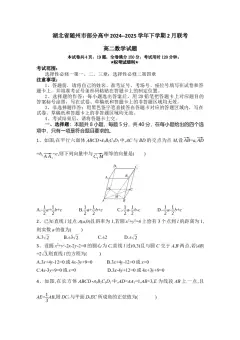
湖北省随州市部分高中2024--2025学年下学期2月联考
高一英语试题
本试卷共10页,全卷满分150分,考试用时120分钟。
★祝考试顺利★
注意事项:
1、答题前,请将自己的姓名、准考证号、考场号、座位号填写在试卷和答题卡上,并
将准考证号条形码粘贴在答题卡上的制定位置。
2、选择题的作答:每小题选出答案后,用 2B铅笔把答题卡上对应题目的答案标号涂
黑,写在试卷、草稿纸和答题卡上的非答题区域均无效。
3、非选择题作答:用黑色签字笔直接答在答题卡对应的答题区域内,写在试卷、草稿
纸和答题卡上的非答题区域均无效。
4、考试结束后,请将答题卡上交。
第一部分 听力(共两节,满分30分)
做题时,先将答案标在试卷上。录音内容结束后,你将有两分钟的时间将试卷上的答
案写到答题栏上。
第一节(共5小题;每小题1.5分,满分7.5分)
听下面5段对话。每段对话后有一个小题,从题中所给的A、B、C三个选项中选出最
佳选项。听完每段对话后,你都有10秒钟的时间来回答有关小题和阅读下一小题。每段对
话仅读一遍。
1.What was Aims Pond originally?
A.A TV show. B.A novel.
C.A movie.
2.What are the speakers mainly talking about?
A.A party.
B.A friend.
C.A concert.
3.What does the man say about Joey?
A.He'll take over the family business.
B.He always listens to his father.
C.He follows his own heart.
4.Why does the girl want to quit taking the lessons?
A.She finds it too difficult.
B.She isn't interested in it.
C.She thinks it costs too much.
5.What does the man mean?
A.The car is too expensive.
B.He dislikes the car.
C.He will take the car.
第二节(共15小题;每小题1.5分,满分22.5分)
听下面5段对话或独白。每段对话或独白后有几个小题,从题中所给的A、B、C三个
选项中选出最佳选项。听每段对话或独白前,你将有时间阅读各个小题,每小题5秒钟;
听完后,各小题将给出5秒钟的作答时间。每段对话或独白读两遍。
听第6段材料,回答第6、7题。
6.What did Jack do last night?
A.He went to a party.B.He studied in the library.
C.He prepared for a report.
7.What will Jack have next week?
A.A meeting.
B.A test.
C.A report.
听第7段材料,回答第8、9题。
8.What do we know about the man?
A.He likes living at home.
B.He lives with his parents.
C.He likes doing housework.
9.How can we describe the man?
A.Lazy.
B.Independent.
C.Understanding.
听第8段材料,回答第10至12题。
10.How is the weather now?
A.Cloudy. B.Sunny.
C.Snowy.
11.What does the woman think of the man's suggestion?
A.Practical. B.Crazy.
C.Shameful.
12.What does the woman say about the Black Run?
A.It is very dangerous.
B.It is easy for skiing in the area.
C.It is very good for exercising legs.
听第9段材料, 回答第13至16题。
13.What's the probable relationship between the speakers?
A.Colleagues.
B.Boss and customer.
C.Interviewer and interviewee.
14.Why does the man want to leave his present job?
A.To get a fulltime job.
B.To go to school.
C.To get a higher salary.
15.What does the man like best?
A.Traveling.
B.Doing sports.
C.Speaking Spanish.
16.What is the man concerned about in the end?
A.The number of the positions.
B.The result of his application.
C.The answer to the school test.
听第10段材料,回答第17至20题。
17.Who has got a parttime job at a bakery?
A.Simon. B.Tim.
C.Rebecca.
18.When did Rebecca return home?A.Last Wednesday.
B.Last Saturday.
C.Last Sunday.
19.What happened to Kim?
A.She won a competition.
B.She was ill in hospital.
C.She wrote a text.
20.Why did Danny put up a notice about the show?
A.To show his dancing skill.
B.To give a brief summary of it.
C.To ask people to play parts in it.
第二部分 阅读(共两节,满分50分)
第一节(共15小题;每小题2.5分,满分37.5分)
阅读下列短文,从每题所给的 A、B、C 和 D 四个选项中,选出最佳选项,并在答
题卡上将该项涂黑。
A
The Charles Dickens Museum in London is the world's most important collection of
material relating to the great Victorian novelist and social commentator (评论员).The only
surviving London home of Dickens (from 1837 until 1839) was opened as a museum in 1925 and
is still welcoming visitors from all over the world.On four floors,visitors can see paintings,
rare editions,manuscripts,original furniture and many items relating to the life of one of
the most popular and beloved personalities of the Victorian age.
Opening Hours:
The Museum is open from Mondays to Saturdays 10:00-17:00; Sundays 11:00
-17:00.
Last admission is 30 minutes before closing time.
Special opening times can be arranged for groups,who may wish to book a private
view.
Admission Charges:
Adults:£5.00; Students:£4.00; Seniors:£4.00; Children:£3.00;Families:
£14.00 (2 adults & up to five children).
Group Rates:For a group of 10 or more ,a special group rate of £4.00 each
applies.Children will still be admitted for £3.00 each.
Access:
We are constantly working to improve access to the Museum and its collection.Our
current projects involve the fitting of a wheelchair ramp (活动坡道) for better access,a
customer care kit and an audio tour for visitors with impaired vision.Our Handling Sessions
are also suitable for the visually impaired.The Museum has developed an online virtual tour
through the Museum.Click here to visit all the rooms in the Museum online.
Hire the Museum:
The Museum can be hired for private functions,parties and many other social
occasions.
Find Us:
The Museum may be reached by using the following buses:7,17,19,38,45,
46,55,243.And by these underground services:Piccadilly Line; Central Line.For amap,please click here.The British Museum and the Foundling Museum are within walking
distance.
21.How much will they pay if a family with two adults and three children go to the Museum
together?
A.£10.00. B.£14.00.
C.£19.00. D.£22.00.
22.What can be learned from the passage about the Museum?
A.Individuals cannot hire the Museum for parties.
B.Visitors with poor vision can enjoy the Museum.
C.In no case can people visit the Museum after 17:00.
D.Visitors can see rare editions of many Victorian novelists.
23.Where does this text probably come from?
A.Website. B.Magazine.
C.Newspaper. D.Guidebook.
B
Mark asked,“Do you think they'll let me play?” Mark's father knew that few boys
would want someone like Mark,mentally and physically disabled,on their team,but the
father still approached to ask the boys if Mark could play.They exchanged glances with
each other and said,“We'll try to put him in to bat.”
Mark struggled over to the team's bench and his father had a small tear in his eye
and warmth in heart.The boys saw the father's joy at his son being accepted.
In the bottom of the final inning,Mark was scheduled to be at bat.Everyone knew
that a hit was almost impossible.The first pitch (投) came and Mark missed.The pitcher again took
a few steps forward to throw the ball softly towards Mark.As the pitch came in,Mark swung at
the ball and hit a slow ground ball right back to the pitcher.
The pitcher could have easily thrown the ball to the first baseman,but he just threw the
ball right over the head of the first baseman,beyond the reach of all teammates.The
audience and the players from both teams started screaming,“Mark,run to first!”
Never in his life had Mark ever run that far but made it to first base,wideeyed and shocked.
By the time Mark rounded towards second base,the smallest guy on their team,
who had a chance to be the hero for his team for the first time,understood the pitcher's
intentions and he too intentionally threw the ball high and far over the third baseman's head.
All were screaming.“Mark,run to third.” As Mark rounded third,all were on
their feet,crying,“Mark,run home!” Mark ran to home,stepped on the home base
and was cheered as the hero who won the game for his team.Tears rolled down the father's cheeks.
That day,the boys from both teams helped bring true love and humanity into this
world.
24.Why did Mark's father,not expecting much,still asked if Mark could join the
team?
A.Because he noticed some of the boys on the field were friendly.
B.Because he knew some of the boys on the field knew Mark well.
C.Because he understood Mark did need a feeling of being accepted.
D.Because he guessed Mark's disability would affect the boys' decision.
25.What does the underlined word “intentions” in Paragraph 5 refer to?
A.The pitcher wanted to help Mark win the game.
B.The pitcher pretended to throw the ball high and far.
C.The pitcher looked forward to winning the game for his team.D.The pitcher had intended to throw the ball to the first baseman.
26.Which has nothing to do with Mark's becoming the hero for his team?
A.Some of the opposing players ran to help him.
B.The pitcher did not throw the ball to the first baseman.
C.The opposing players failed to stop his running to home.
D.The audience and the players from both teams cheered for him.
27.What is the theme of the story?
A.True human nature could be realized in the way we treat each other.
B.Everyone can develop his team spirit in sports and please his parents.
C.The results of the game should not be the only concern of the players.
D.Everyone has his own strength even if mentally or physically disabled.
C
When robots and humans interact in a shared environment,it is important for them
to move in ways that prevent conflicts or accidents.To reduce the risk ,roboticists have
developed numerous techniques that monitor an environment,predict the future actions of
humans,identify safe trajectories (轨迹) for a robot and control its movements accordingly.
Predicting human behavior and movements , however , can be incredibly
challenging.Determining the future movements of a robot,on the other hand,could be far
easier.If human users could anticipate the movements of robots and the effects these will
have on the surrounding environment,they should then be able to easily adapt their
actions in order to avoid accidents.
With this in mind,researchers at Kyushu University in Japan recently created a near-
future perception system named Previewed Reality that allows human users to forecast future
changes in their environment,which could then inform their decisions and guide their
actions.This system compiles a dataset containing information about the position of
objects,humans and robots within the same environment,to then produce simulations (模
拟) of events that could take place in the near future.These simulations are presented to human
users via Virtual Reality (VR) or Augmented Reality (AR) headsets.
To collect information about the position of different objects,robots,and humans in
a shared environment,the researchers used a number of strategically placed sensors,
including optical trackers that monitored the movements of objects or robots,and a RGB-
D camera which mainly tracked human actions.The data gathered by the sensors was then
fed to a motion planner and a dynamics simulator.Combining these two system components
allowed the researchers to forecast changes in a given environment and synthesize (合成) images
of events that are likely to occur in the near future , from the viewpoint of a specific
human.Human users could then view these synthesized images simply through a VR headset or an
AR display.
“This system provides humanfriendly communication between a human and a robotic
system,” the researchers explained.In their next studies,they plan to expand and
simplify the perception system,for instance by creating a lighter and more affordable
version that can be accessed on smartphones or other portable devices.
28.Why did the researchers develop the system?
A.To predict future changes in human behavior.
B.To record developments in the field of robotics.
C.To enhance safety of humanrobot interactions.
D.To make good use of virtual reality technology.
29.What is special about Previewed Reality?
A.It simulates nearfuture events via VR headsets.B.It enables human users to perceive future events.
C.It guides robots to track humans' movements easily.
D.It helps determine the location information of objects.
30.What is Paragraph 4 mainly about?
A.Functions of various sensors.
B.New ways to synthesize images.
C.The structure of Previewed Reality.
D.The working process of Previewed Reality.
31.What might the researchers do in the future?
A.Promote the new version through advertising.
B.Test this perception system with smartphones.
C.Apply some new techniques to robotic systems.
D.Make the system accessible on portable devices.
D
There are some things money can't buy.Education,however,does not appear to be
among them—at least as measured by performance on international exams.A new study by
Harvard University offers strong evidence that the wealth of a country affects exam results just as
much as the wealth of a pupil's household does.On average,pupils in wealthy countries obtain
vastly higher test scores than those in developing ones.
Evaluating test scores around the world is harder than it sounds.Although pupils in the rich
world mostly take one of a few big international exams,many developing countries rely on
regional tests,making applestoapples comparisons impossible.
Researchers organized an exam in 2016 for 2,314 children in India,which included
both questions from the leading tests and ones taken from smaller exams.Using answers
from the same pupils on the same day to questions from different tests,they built a
statistical model they called a “Rosetta Stone”.It can translate scores from a range of exams
—such as one used only in west Africa—into an equal mark on other common international tests.
They then used these equations (等式) to estimate how pupils in 80 different countries
would fare on the benchmark (基准) Trends in International Mathematics and Science Study
(TIMSS).Their data show that the wealth of a student's country and family have similar impacts
on test scores—meaning that big gaps in GDP per person matter more than small ones in
household income do.For example,pupils from families that are very poor by richworld
standards—those earning $5,000 a year—are expected to score around 500 out of 1,
000 on the TIMSS in America,and 560 in Japan.In contrast,those whose parents make
$10,000 a year in an uppermiddle income country can only get the equivalent (等价物) of a
475.
The influence of parental earnings is not constant.Rich people tend to educate their
children privately in places where wealth is concentrated,such as Brazil.However,in
countries with relatively flat income distributions,like Croatia,pupils from different social
classes are more likely to attend the same schools.This could reduce the impact of family
wealth on test scores.
32.Why is it hard to evaluate the exam scores on a global level?
A.Because the types of exams vary with countries.
B.Because many rich countries refuse regional tests.
C.Because the wealth of a country affects exam results.
D.Because no international exam is available to poor areas.
33.Why did the researchers establish a “Rosetta Stone”?
A.To integrate different exams into a common one.B.To evaluate different exams with distinct approaches.
C.To fix the standard of the exams in different countries.
D.To turn scores of different exams into an equivalent mark.
34.What can we learn from the last two paragraphs?
A.Poor students tend to be academically superior to rich ones.
B.Students from rich families will definitely get higher grades.
C.The influence of family income on students is related to circumstances.
D.People with high social status are more likely to educate their children privately.
35.What is the text mainly about?
A.Education is something money can't buy.
B.The wealth of a country matters for education.
C.Family income plays an important role in education.
D.A statistical model helps to evaluate the exam scores.
第二节(共5小题;每小题2.5分,满分12.5分)
阅读下面短文,从短文后的选项中选出可以填入空白处的最佳选项。选项中有两项为
多余选项。
My heart went out to the drama teacher I read about in a recent news item.Each
parent from her class insisted that she cast their own child as Snow White.This reminded me of
my seventh grade musical—“The Adventures of Tom Sawyer.” I desperately wanted to play the
role of Becky,the female lead who was Tom's girlfriend. 3 6
For starters,Becky had to sing numerous solos,and I couldn't carry a tune.I also
didn't have long blonde curls like pretty Linda Wright who won the part.
I was assigned the nonsinging role of Miss Watson,the Maid.I had to wear an ugly
dress.And I had only one line to learn,“That's what I say.” 37 Miss Watson was
onstage in quite a few scenes,and got to repeat “That's what I say” throughout the play.
At last,our production was put onstage.Imagine my surprise when Miss Watson
made the audience laugh out loud each time I piped in with “That's what I say.” I hadn't
known that she—or I—could be funny,or that her character was important in moving the
plot along. 3 8
That night,I began to understand that being the star may not be any more fun than
being a standout in a supporting role.Each person,onstage and backstage,is essential in
theater.Without everyone doing their part,the play would be dull as dirt. 39 If
everyone's a star then nothing gets done.It's all noise and chaos.
And so I believe all children should get the opportunity to play Miss Watson,to become
someone they didn't know they wanted to be. 4 0
A.So it is in life.
B.It was not to be.
C.It was an important part.
D.My Miss Watson turned out to be a hit.
E.It took the entire cast to make a good show.
F.There was an advantage,in my opinion,though.
G.I would hope all children could be a hit in life.
第三部分 语言运用(共两节,满分30分)
第一节(共15小题;每小题1分,满分15分)
阅读下面短文,从短文后各题所给的 A、B、C 和 D 四个选项中,选出可以填入空白处的最佳选项,并在答题卡上将该项涂黑。
The plants my mother tended were hearty and had been there for many years.But after my
mother was diagnosed with Alzheimer's disease (阿尔兹海默症) and was in hospital,the
plants in our house began to die and the leaves were 4 1 .During that time,I had been
so focused on the increasing demands of her own 42 that her beloved plants had 43
my notice.
Later,I 44 her job and poured water into the thirsty soil every day.Gradually I
understood her sacred job.Unlike children or pets,house plants 45 nothing.They wait
quietly,no matter how 46 for attention.To undertake the care of a plant during a long
period of time requires 47 for a living thing.Actually it 48 entirely on you for
survival,but can't even ask for help.
Even as Alzheimer's disease 49 so much of her momenttomoment memory,the
inborn act of caring lasts.After she left hospital and went back home,sometimes I would
guide her down the steps to 5 0 the plants herself.Each time,she smiled up at me with
51 ,because being able to care for something is still what brings her the greatest
joy.Whatever she may 52 moments later,while she is with them,she is fully 53
.Her devotion to the plants has no limit and no end.
I look at plants differently these days.I see them as my mother does:quiet reminders
of the need for deep 54 and love for every living thing.It is clear to me that the things we
spend a lifetime cultivating are never truly 55 ; the kindness she has planted in me still
blooms.
41.A.blooming B.swinging
C.growing D.dropping
42.A.care B.health
C.business D.condition
43.A.got B.escaped
C.deserved D.changed
44.A.took over B.applied for
C.participated in D.kept on
45.A.promise B.prove
C.demand D.complain
46.A.ready B.eager
C.necessary D.grateful
47.A.wisdom B.courage
C.diligence D.patience
48.A.focuses B.decides
C.insists D.depends
49.A.reflects B.improves
C.steals D.refreshes
50.A.sell B.water
C.admire D.observe
51.A.satisfaction B.gratitude
C.praise D.curiosity
52.A.mention B.regret
C.share D.forget
53.A.popular B.involved
C.concerned D.active
54.A.consideration B.cautionC.affection D.conservation
55.A.lost B.developed
C.found D.gained
第二节(共10小题;每小题1.5分,满分15分)
阅读下面短文,在空白处填入1个适当的单词或括号内单词的正确形式。
A new adaptation of Chinese mythological stories has won the heart of audiences
with its distinctive style.The animation series,Yao—Chinese Folktales, 56.__________
(gain) more than 110 million views online since it was released.
The series,coproduced by Shanghai Animation Film Studio and a video site,is
57.__________ collection of 20minute short films,consisting of eight separate stories
58. (feature) monsterlike characters , or yao in Chinese.The collection ,
59.__________ ranges from ancient stories to science fiction,from emotional connection
with hometowns to romantic love 60.__________ from life themes to questions for
humanity,presents Chinese culture and philosophy.For example,the first episode,named
“Nobody”,tells a pig monster's story 61.__________ (base) on the classic Chinese
novel Journey to the West.The creative team put the perspective on the little monsters
who used to have blurry faces and didn't even have names in the story.
Li Zao,general producer,said it was impossible 62.__________ (predict) what the
eventual outcome would be at first.Now,the 63.__________ (favor) comments exceeded the
expectations of the creative team.These contained both the audience's 64.__________
(recognize) of the work and their hopes of Chinese animation.Besides adapting 65.
the taste of the masses,the team also wanted to guide them to appreciate different types of
work.
第四部分 写作(共两节,满分40分)
第一节(满分15分)
假定你是学生会干事李华,你校将举办一场主题为“Artificial Intelligence (AI) and
Modern Education”的讲座,请你用英文为校宣传栏写一则通知,内容包括:
1.讲座内容;
2.讲座时间和地点;
3.欢迎积极参加。
注意:
1.词数80左右;
2.请按如下格式作答。
Notice
___________________________________________________________________________
___________________________________________________________________________
___________________________________________________________________________
___________________________________________________________________________
___________________________________________________________________________
___________________________________________________________________________
___________________________________________________________________________
___________________________________________________________________________
___________________________________________________________________________
___________________________________________________________________________
______________________________________________________________________________________________________________________________________________________
___________________________________________________________________________
The Student Union
第二节(满分25分)
阅读下面材料,根据其内容和所给段落开头语续写两段,使之构成一篇完整的短文。
On the first day of school,I stared in awe at the huge buildings.This high school was
definitely bigger than the one I had previously attended.
This was my second year of high school,but my first year of school in St.Louis.I
had decided the night before that I would be much happier in a new school if I made friends
that were socalled “popular”.Getting in with the right group of people would make my life a
whole lot better.I even bought a new outfit and had my hair styled just so the first day would be
perfect.
Scared,yet anxious to begin my new life,I walked up the stairs to the front
door.The halls were packed with kids yelling and laughing and telling stories of their
summer adventures.My first class was geometry,but where was that?
I was standing in the hall looking confused,when a short,blond girl wearing glasses
came up and asked,“Are you new? You look lost.Do you need help? My name is
Diane.What's yours?” Even though she seemed a bit strange,definitely not the kind of
person I wanted to be associated with,I decided to answer her anyway.I was,after all,
lost.
After exchanging names.I followed her up the stairs and down a hallway on the
right , making polite conversation the whole way.When we reached my room she
said,“Well,here you are.Welcome to JFK,and I hope your day goes all right.”
I said thanks and waved goodbye.Once inside the classroom,I saw one big group of
people huddled around someone who seemed to be telling some sort of story.I walked
over and got close enough to overhear.All eyes were glued to the guy in the middle of the
circle who was wearing a letter jacket covered with patches.I decided that this guy was popular,
so I managed to get a seat right next to him.I said,“Hi,my name is Lisa and I'm
new here.” He said,“Johnny.”
注意:
1.续写词数应为150左右;
2.请按如下格式作答。
At the end of the class,I turned to him and asked,“I'm not sure where my next
class is , could you help me ? ”
_____________________________________________________________
___________________________________________________________________________
___________________________________________________________________________
___________________________________________________________________________
___________________________________________________________________________
___________________________________________________________________________
Just at that time,someone came up and tapped me on the shoulder. _______________
___________________________________________________________________________
___________________________________________________________________________
___________________________________________________________________________
______________________________________________________________________________________________________________________________________________________
___________________________________________________________________________