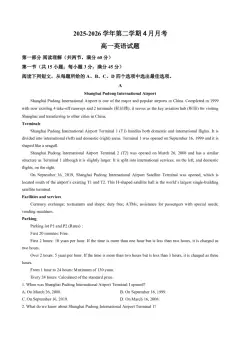
2025-2026 学年第二学期 4 月月考
高一英语试题
第一部分 阅读理解(共两节,满分 60分)
第一节(共 15 小题;每小题 3分,满分 45分)
阅读下列短文,从每题所给的 A、B、C、D 四个选项中选出最佳选项。
A
ShanghaiPudongInternationalAirport
Shanghai Pudong International Airport is one of the major and popular airports in China. Completed in 1999
withnowexisting4take-offrunwaysand2terminals(航站楼),itservesasthekeyaviationhub(枢纽)forvisiting
ShanghaiandtransferringtoothercitiesinChina.
Terminals
Shanghai Pudong International Airport Terminal 1 (T1) handles both domestic and international flights. It is
dividedinto international(left) anddomestic (right) areas.Terminal1 wasopenedon September16,1999anditis
shapedlikeaseagull.
Shanghai Pudong International Airport Terminal 2 (T2) was opened on March 26, 2008 and has a similar
structure as Terminal 1 although it is slightly larger. It is split into international services, on the left, and domestic
flights,ontheright.
On September 16, 2019, Shanghai Pudong International Airport Satellite Terminal was opened, which is
located south of the airport’s existing T1 andT2. This H-shapedsatellite hallis the world’s largest single-building
satelliteterminal.
Facilitiesandservices
Currency exchange; restaurants and shops; duty free; ATMs; assistance for passengers with special needs;
vendingmachines.
Parking
ParkinglotP1andP2(Rates):
First20minutes:Free.
First 2 hours: 10 yuan per hour. If the time is more than one hour but is less than two hours, it is charged as
twohours.
Over2hours:5yuanperhour.Ifthetimeismorethantwohoursbutislessthan3hours,itischargedasthree
hours.
From1hourto24hours:Maximumof130yuan.
Every24hours:Calculatedofthestandardprice.
1.WhenwasShanghaiPudongInternationalAirportTerminalIopened?
A.OnMarch26,2008. B.OnSeptember16,1999.
C.OnSeptember16,2019. D.OnMarch16,2008.
2.WhatdoweknowaboutShanghaiPudongInternationalAirportTerminal1?
学科网(北京)股份有限公司A.ItisshapedliketheletterH.
B.ItwascompletedonSeptember16,2008.
C.Itmainlyhandlesdomesticflights.
D.ItisalittlebitsmallerthanTerminal2.
3.Howmuchdoesitcosttoparkforoneandahalfhours?
A.10yuan. B.15yuan. C.20yuan. D.25yuan.
B
Thomas was a well-known wise man. One day, he wandered in a beautiful small town. Because of his fame,
peoplefromnearbytownswhoheardofhisarrivalallcametovisitandseekhisadvice.
Many who came sought help with difficulties in daily life, and Thomas, unable to bear turning them away,
patientlyofferedsuggestions.Wordspreadquickly,andmoreandmorepeoplecametoseeThomasforguidance.
One day, dozens of people crowded outside Thomas’s door, all clamoring (大声地要求) that their problems
were the most serious and urgent, each insisting that Thomas address their concerns first, with no one willing to
yield(让步).
After a moment of thought, Thomas took out some paper and a pen and said, “I can’t hear clearly with
everyonetalkingatonce.Howabouteveryonewritingdownyourproblemonapieceofpaperandplacingitinthis
basketbesideme?”
Once everyone had placed their notes in the basket, Thomas shook the basket and said, “Please each takes a
pieceofpaperfromthebasketandreadswhatitsays.”
As everyone read a note from someone else, they all realized that indeed, eachperson has their own troubles,
and every household has its own challenges. Then Thomas spoke up, “Now, whose problem is the most urgent to
solve?” Hearing that question, no one spoke again, because now no one dared to claim that their problem was the
mostsevere.
Often, we are bound by our immediate feelings. When difficulties and problems strike, it feels as though we
arecaughtinavortex ofpain.Butif weshiftourfocusfromourselvesandlooktowardsothers,wemightdiscover
that the problems we face are not so significant. Perhaps others are the ones who need help more urgently, or
maybethereissomethingwithinourpowerthatwecandoforthem.
4.WhydidpeoplevisitThomas?
A.Foradvice. B.Forameeting. C.Foracompetition. D.Forintroductions.
5.HowdidThomashandlethecrowd?
A.Heignoredthem.
B.Helistenedtoeachoneindividually.
C.Heprioritizedtheproblemshimself.
D.Heaskedthemtowritedowntheirproblems.
6.Whatdidreadingothers’problemsshowtothepeople?
A.Thecomplexityoftheirdifficulties. B.Thesimilarityoftheirsituations.
C.Theirneedformoreadvice. D.Theirlivingconditions.
7.WhatlessondidThomasteach?
学科网(北京)股份有限公司A.Competition. B.Sympathy. C.Prioritization. D.Self-confidence.
C
Many people will never forget their campus life, for it gave them something important for their career. Even
though it is very difficult nowadays to attend a college or university after graduating from high school, there are
stillalargenumberofreasonstogotocollege.
In general, college graduates make more money than people who only have a high school degree. Besides
higher pay, college graduates also experience better jobs than those who haven’t graduated from college. Many
employers expect their employees to have a college degree. College programs provide students with peculiar
trainingthatonlyhighereducationcanoffer,givingthempopularandvaluablequalifications(资格证书).
To deal with heavy college study, you have to be organized. Finishing several different classes is not an easy
task, considering that each class covers plenty of materials. If you’re unable to stay organized, there are teachers,
advisers and professors there to help you. The organization skills you’ll learn in college will help you succeed in
future jobs. Whether you’re solving a math-based problem or make out the main idea of a novel, college classes
trainyourbraintosolvedifficultproblemsandwillprepareyouforproblemsintheworkplace.
Whetheryou grew upin asmalltownorinNew YorkCity, beingadmittedinto acollege oruniversity means
that you will meet a great number of new people. Your social skills will improve by communicating with them,
whichcouldhelpyouwhenyouenterintothejobmarket.Whenyoutakepartinclassroomactivities,studygroups
andschoolclubs,youare introducedtointelligentpeoplewithwhomyou couldonedaystarta companyorform a
life-longfriendship.
Study-abroad programs are offered by most colleges and universities and are seen as one of the most
meaningful experiences offered during four years of college life. In addition to learning more about a foreign
culture,studentsarerequiredtocompletetheirstudies.
8.Whatdoestheunderlinedword“peculiar”inParagraph2probablymean?
A.Special. B.Common. C.Limited. D.Traditional.
9.Whatcanwelearnaboutthecollegedegree?
A.Itismoreimportanttoruralstudentsthanurbanstudents.
B.Itmakesyoubecomeemployersindifferentfields.
C.Ithelpsincreaseyourearningpower.
D.Itisamusttobecomerich.
10.Whatisthethird-paragraphmainlyabout?
A.Thefunctionsoforganizationandproblem-solvingskillsincollege.
B.Thedifficultproblemsanddifferentorganizationsincollege.
C.Heavycollegestudyandwork.
D.Collegeclassesandprofessors.
11.Whatcanbeinferredfromthetext?
A.Itisnousegoingtocollegeoruniversity.
B.Collegehelpsstudentsimprovetheirhumanrelationship.
C.Theaimofstudy-abroadistohelpendstudents’collegeclasses.
学科网(北京)股份有限公司D.Workexperienceislessimportantthanaqualificationinthejobinterview.
D
If a stranger knocked on your door asking for using your phone, would you help? How about lending them
fivedollarsforthebus,iftheysaidthey’dreturnandpayyouback?
Nowadays, many people find it hard to trust strangers. A recent study found that our ability to trust strangers
maybemore thanjustasocialorpsychologicalcharacteristic —itcouldberootedin ourDNA. This is important,
as it turns out that trusting people might actually live longer and healthier lives compared to more skeptical (怀疑
的)people.
Two main theories have appeared to explain why some people are more trusting than others. One suggests
trust is a stable characteristic shaped by early life experiences. The other thinks it’s influenced by a person’s
ongoing evaluation of the social environment. We can easily imagine that the answer to the question “Would you
say that most people can be trusted?” would depend on whether you’d been robbed the day before orif you’d had
yourmissingwalletreturned.
This is wheretherecentresearchcomes in.AprofessorofLundUniversity, Edgertonandhiscoworkers have
been doing research about trust. In their most recent study, involving 33882 Danish blood donors, they found a
singlegene(基因)—PLPP4,strongly associatedwith thepersonalityoftrustingothers,andthatthePLPNP4gene
explained 6%ofthedifference insocialtrustwithin thestudypopulation. If you take two peoplewhohave similar
education and life experiences, this gene alone could account for 6% of the difference in how much they trust
others.
TheybelievethatthePLPP4genemaysomehowsoftenour“fight-or-flight”survivalresponse.Ifourfight-or-
flight system is less strong when we meet new people, it makes sense that trusting others could have huge health
benefits.Indeed,iftrusting othersactsassomethingagainststress, itmaylower theriskofcardiovascular(心血管
的)disease.
As people continue to uncover the mysteries of trust, one thing is clear: understanding its genetic roots may
holdthekeytodevelopinghealthiercommunitiesintheworld.
12.Whatmightaffectpeople’strustlevelsaccordingtothetwomaintheories?
A.Childhoodhabits. B.Personalabilities. C.Socialexperiences. D.Communicationskills.
13.Whatdoestherecentstudyfocuson?
A.Thementalcauseoftrust.
B.Thewaystodevelopsurvivalability.
C.Thecharacteristicsofdifferentgenes.
D.Theconnectionbetweentrustandagene.
14.Whatdoesthepassagesayabouttrustingothers?
A.Itcouldbringhealthbenefits.
B.Itreducesthestrongstressinwork.
C.Ithelpstodeveloptheworldfaster.
D.Itcausesquickersurvivalresponse.
15.Whatmightbethebesttitleforthepassage?
学科网(北京)股份有限公司A.AGeneInfluencesHowTrustingYouAre B.ExperiencesMakeYouGrowDependable
C.ALinkBetweenBiologyandSocialScience D.TheoriesThatExplainWhyYouAreTrusted
第二节 七选五(共5小题;每小题 3分,满分 15分)
阅读下面短文,从短文后的选项中选出可以填入空白处的最佳选项。选项中有两项为多余选
项。
Areyouspendingyourholidayssittingaround(无所事事的)?Don’twasteyourdaysoff. 16 Youcanfind
manyfunthingstodo,eitherinsideyourhomeoroutside.Youcanuseyourimagination,getcreative,orjusttakea
walkwithotherpeople.
17
Simpleoutdoorhappinessis oftenignored.Getting outofthehousenotonlybrings lots ofhappiness,butitis
also a great chance for exercise. If you have been thinking of getting healthy, then go jogging, walking, or do any
outdooractivityyoulike.Awalkinnaturecanalwayscheeryouup.
Goonanadventurewithafriend.
18 Visit a town you have never been to, or go for a walk in the forests. When you go to a new place,
remembertobesafeandbringaphonewithbattery.
Getchores(琐事)andtasksoutoftheway.
Holidaysareagoodtimetofinishthingsyou’venotfinishedforawhile.Ifyouhavenootherthingswithfami
lyorfriendstodo,considerspendingyourtimetofinishtasksthatyouhaven’tdoneforalongtime. 19 Otherg
oodideasincludecleaningyourclothes,sortingoutyourbookshelf,andwashingyourcar.
Makenewfriends.
Ifyoudon’thaveanyonetogooutwith,don’tworry. Youcanmeetnewpeopleatclubsorconcerts.Don’tbe
shytotalktoothers.Don’tbeafraidtoapproach(接近)andtalktopeopleyoumeet.
20
A.Gooutdoorandenjoythehappiness.
B.Trysomedifferentthings.
C.Newfriendshipsstartwithatalk!
D.Herearesomewaystohelpyouforget.
E.Youcanaskafriendtrytoexploresomecoolplaces.
F.Herearemanywaystokeepbusy,evenduringlongholidays.
G.Forexample,ifyouhaven’tcleanedyourroom,takeanafternoontocleanit.
第二部分 语言运用(共两节,满分 50分)
第一节(共 15 小题;每小题 2分,满分 30分)
阅读下面短文,从每题所给的 A、B、C、D 四个选项中选出最佳选项。
After months of preparation, my husband Bill and I flew to China to welcome our new daughter, our 18-
month-old angel “Shirley”. But when we picked her up, Shirley missed her Chinese mother so 21 that she
学科网(北京)股份有限公司would barely look at Bill and me. Instead, she’d stand at our hotel room door and 22 for the only mother she
hadknown.
I wassoembarrassed thatlunchin arestaurantwas outofthe 23 . Iwas afraidpeoplewouldthinkI wasa
“badmother”.SoI 24 ourmealsfromroomservice.
OnetimeIchosethenoodleplateandtriedtousechopsticksfortheveryfirsttime.Thenoodleskept 25 of
fmychopsticks.Atthistime,Shirley’sscreamingsuddenlystopped.
Peekingoutofthecornerofmyeye,Isawhersittingintheroomcorner 26 meattentively.Andinnotime,
a tiny hand came into 27 and took the chopsticks from my big hand. As I looked up, Shirley—with the
chopsticksskillfullyarrangedinherlittlefingers—beganexpertlyfeedingmenoodles,without 28 asingleone.
I lookedatBill,who waswide-eyedwith 29 .“Do you thinkshewould 30 me?” hewondered 31 .
So, trembling with 32 , I asked, “Shirley, will you feed your daddy now?” and 33 to Bill. She nodded and
said“yes”withabigsmileonherface!
That meal was definitely a(n) 34 experience. Shirley must have felt that we would 35 without her
assistance!
21.A.intensely B.happily C.calmly D.gently
22.A.wait B.scream C.fight D.care
23.A.option B.solution C.problem D.question
24.A.shared B.cooked C.ordered D.delivered
25.A.slipping B.skipping C.sliding D.warding
26.A.examining B.testing C.watching D.seeing
27.A.scene B.view C.effect D.spot
28.A.seizing B.losing C.dropping D.missing
29.A.relief B.fear C.disappointment D.surprise
30.A.serve B.feed C.guide D.support
31.A.anxiously B.hesitantly C.hopefully D.silently
32.A.agreement B.excitement C.embarrassment D.disappointment
33.A.explained B.laughed C.referred D.pointed
34.A.bonding B.engaging C.attaching D.involving
35.A.suffer B.settle C.struggle D.starve
第二节(共 10 小题;每小题 2分,满分 20分)
阅读下面短文,在空白处填入一个适当的单词或括号内单词的正确形式。
Ryan, a six-year-old Canadian schoolboy, was very shocked when he knew that the 36. (major) of
peopleinAfricancountriescouldn’tgetenoughcleanwater duetowater37. (short). YoungRyan thought
life washardforthosepeopleandthatheshouldoffer them38. (assist) without39. (hesitate). At
first,hisplanwastoearnmoneytobuildawellsomewhereinAfrica.Heearned$70byworkingforhisfamilyand
neighbors.However, whenhegavethe40. (donate)toacharity,hewastoldthatitactually cost$2,000to
buildawell.Ryandidn’tgiveupandstartedtoaskforhelpfromhisclassmatesandneighbors.
学科网(北京)股份有限公司Tohisgreat41. (relieve),afterseveralmonths,Ryanhadraisedthe$2,000,withwhichawellwasbui
ltnearaprimaryschoolinUganda.Thechildrenthereweregratefultohimforhisgenerous42. (contribute)
andinvitedhimtovisit.InUganda,whenRyansawthefinishedwellandthehappystudents,hebrokeintoajoyfu
lsmileandwasdeterminedtotakemore43. (effect)measurestohelp.Thesix-year-oldboyeventuallymad
ehisdreama44. (real).Today,over800,000peoplein16countriesacrossAfricahavebenefitedfromthel
ife-changinggiftofclean,safewater,whichisagreat45. (achieve).
第三部分 写作(共两节,满分 40分)
第一节(满分 15分)
46.假定你是李华,你校英语俱乐部将举行主题为“Music andLife”的演讲比赛。请你写一篇演讲稿参
赛,内容包括:1.音乐的作用;2.音乐对你生活的影响(写三个影响);3.呼吁大家多听好音乐。
注意:1.写作词数应为80个左右;2.请按如下格式在答题卡的相应位置作答。
3.提示词汇:陷入麻烦beintrouble;克服困难:getoverdifficulties
Hello,everyone.
Thankyou!
第二节 (满分 25分)
阅读下面材料,根据其内容和所给段落开头语续写两段,使之构成一篇完整的短文。
Asadwasa13-year-oldboywhowasveryhonestandhardworking.Recently,hehadenteredanewschool,so
hehadnofriendsyet.OnMondaymorning,hewasnearlylateforschool.Thenightbefore,hisfamilyattendedhis
cousin’sweddingandreachedhomelate,whichwaswhyhecouldn’tgetupontimeasusual.
Atschool,Asadcouldnotpayattentiontoanythingandwantedthebelltoringsothathecouldbuysomething
toeat.Afterafewhours,whenthebellrang,Asadquicklyopenedhisschoolbagtofindhismoney,butjustthenhe
rememberedthathehadleftforschoolinahurryinthemorningandforgottentotake money. Helookedunderhis
books,hopingtofindsomemoneybuttherewasnothing.
Notknowing whatto do,hewalked outofthe classroom andsat ona benchin frontof thecanteen.He sawa
fewofhisclassmatesthere,amongwhomwasFahad.Hewasoneoftherichestkidsinhisclass,buthewasavery
arrogant (傲慢的) boy who thought everyone else was a loser. But as Asad was new, he didn’t know much about
Fahad.
When he went towards Fahad and asked if he could borrow some money for his lunch, Fahad laughed a lot
and said, “I knew you were a loser, maybe a beggar?” Fahad laughed out so loud that other kids also heard and
madefunofthesituation.Hedidn’tanswerFahad,andslowlywalkedbacktowardsanemptybench.
学科网(北京)股份有限公司When he reached the bench, he noticed something lying near it. It was a wallet. He picked it up and
recognized it as Fahad’s, as he remembered Fahad showing it to his friends and telling that his uncle bought it for
himfromtheUK.Therewasquitealotofmoneyinsideforakid.
Atfirst,AsadwantedtokeepitasecretandpunishedFahad.
ThenFahadsaid,“Whyareyougivingback?”
学科网(北京)股份有限公司学科网(北京)股份有限公司