绝密★考试结束前
高二英语练习
考生须知:
1. 本试题卷共8页,满分150分,考试时间120分钟。
2.答题前,在答题卷指定区域填写班级、姓名、考场号、座位号及准考证号。
3.所有答案必须写在答题卷上,写在试卷上无效。
4.考试结束后,只需上交答题卷。
第Ⅰ卷
第一部分听力(共两节,满分30分)
第一节(共5小题:每小题1.5分,满分7.5分)
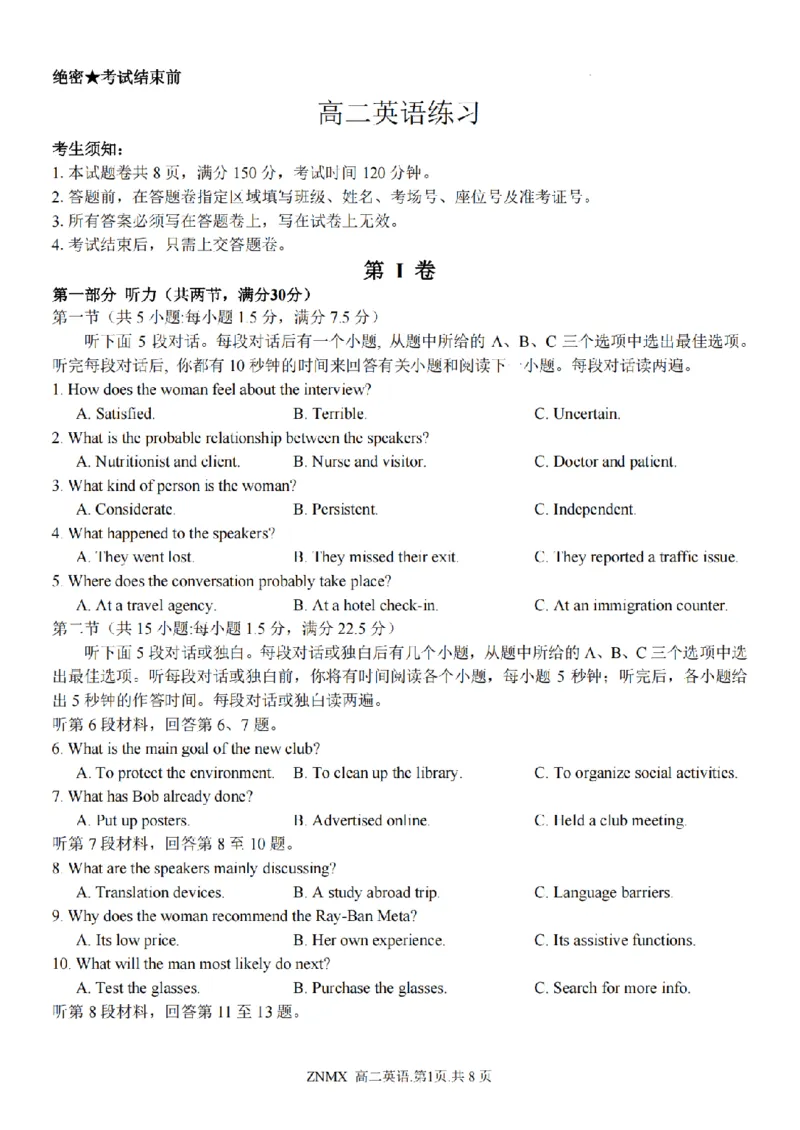
听下面5段对话。每段对话后有一个小题,从题中所给的 A、B、C三个选项中选出最佳选项。
听完每段对话后、你都有10秒钟的时间来回答有关小题和阅读下一小题。每段对话读两遍。
1. How does the woman feel about the interview?
A. Satisfied. B. Terrible. C. Uncertain.
2. What is the probable relationship between the speakers?
A. Nutritionist and client. B. Nurse and visitor. C. Doctor and patient.
3. What kind of person is the woman?
A. Considerate. B. Persistent. C. Independent.
4. What happened to the speakers?
A. They went lost. B. They missed their exit. C. They reported a traffic issue.
5. Where does the conversation probably take place?
A. At a travel agencу. B. At a hotel check-in. C. At an immigration counter.
第二节(共15小题:每小题1.5分,满分22.5分)
听下面5段对话或独白。每段对话或独白后有几个小题,从题中所给的A、B、C三个选项中选
出最佳选项。听每段对话或独白前,你将有时间阅读各个小题,每小题5秒钟;听完后,各小题给
出5秒钟的作答时间。每段对话或独白读两遍。
听第6段材料,回答第6、7题。
6. What is the main goal of the new club?
A. To protect the environment. B. To clean up the library. C. To organize social activities.
7. What has Bob already done?
A. Put up posters. B. Advertised online. C. Held a club meeting.
听第7段材料,回答第8至10题。
8. What are the speakers mainly discussing?
A. Translation devices. B. A study abroad trip. C. Language barriers.
9. Why does the woman recommend the Ray-Ban Meta?
A. Its low price. B. Her own experience. C. Its assistive functions.
10. What will the man most likely do next?
A. Test the glasses. B. Purchase the glasses. C. Search for more info.
听第8段材料,回答第11至13题。
ZNMX 高二英语第1页.共8页11.Why is private mode suggested?
A. To screen new followers. B. To limit data visibility. C. To reset account settings.
12. What should Bella avoid online?
A. Direct talk. B. Private settings. C. Mean comments.
13. What does Bella agree to do?
A. Limit phone use. B. Keеp 9:30 schedule. C. Reach more followers.
听第9段材料,回答第14至16题。
14. What do both noodles have in common?
A. Rice as base. B. Ethnic roots. C. Cooking heat.
15. What shapes Guangxi noodles?
A. Mixed influences. B. Local customs. C. Indian spices.
16. What makes Southeast Asian noodles unique?
A. Pickled beans. B. Meat topping. C. Bold seasonings.
听第10段材料,回答第17至20题。
17. What does the route pass by?
A. Iconic city landmarks. B. Private sports tracks. C. Quiet countryside parks.
18. Why did the runners join the London marathon?
A. To gain public fame. B. To help personal causes. C. To run national charities.
19. What do we know about Sarah?
A. She ran for her daughter. B. She is a professional. C. She is a busy student.
20. Why does the speaker give the talk?
A. To give race advice. B. To highlight the event. C. To recruit more runners.
第二部分阅读理解(共两节,满分50分)
第一节(共15小题:每小题2.5分,满分37.5分)
阅读下列短文,从每题所给的A、B、C、D四个选项中选出最佳选项。
A
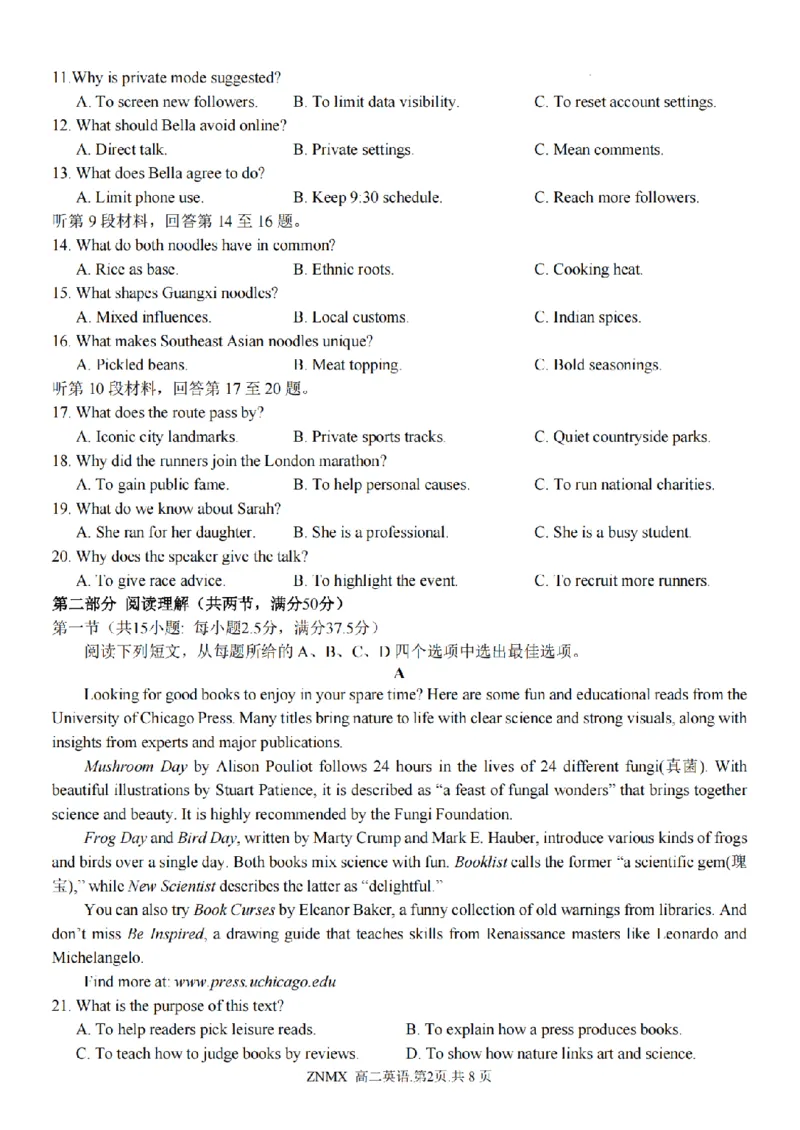
Looking for good books to enjoy in your spare time? Here are some fun and educational reads from the
University of Chicago Press. Many titles bring nature to life with clear science and strong visuals, along with
insights from experts and major publications.
Mushroom Day by Alison Pouliot follows 24 hours in the lives of 24 different fungi(真菌). With
beautiful illustrations by Stuart Patience, it is described as "a feast of fungal wonders" that brings together
science and beauty. It is highly recommended by the Fungi Foundation.
Frog Day and Bird Day, written by Marty Crump and Mark E. Hauber, introduce various kinds of frogs
and birds over a single day. Both books mix science with fun. Booklist calls the former “a scientific gem(瑰
宝),” while New Scientist describes the latter as “delightful.”
You can also try Book Curses by Eleanor Baker, a funny collection of old warnings from libraries. And
don't miss Be Inspired, a drawing guide that teaches skills from Renaissance masters like Leonardo and
Michelangelo.
Find more at: www.press.uchicago.edu
21. What is the purpose of this text?
A. To help readers pick leisure reads. B. To explain how a press produces books.
C. To teach how to judge books by reviews. D. To show how nature links art and science.
ZNMX 高二英语.第2页.共8页22. Which book combines science and visual appeal?
A. Frog Day B. Bird Day C. Book Curses D. Mushroom Day
23. Where is this text most likely taken from?
A. A science journal. B. A gallery brochure.
C. A publisher's catalog. D. A library newsletter.
B
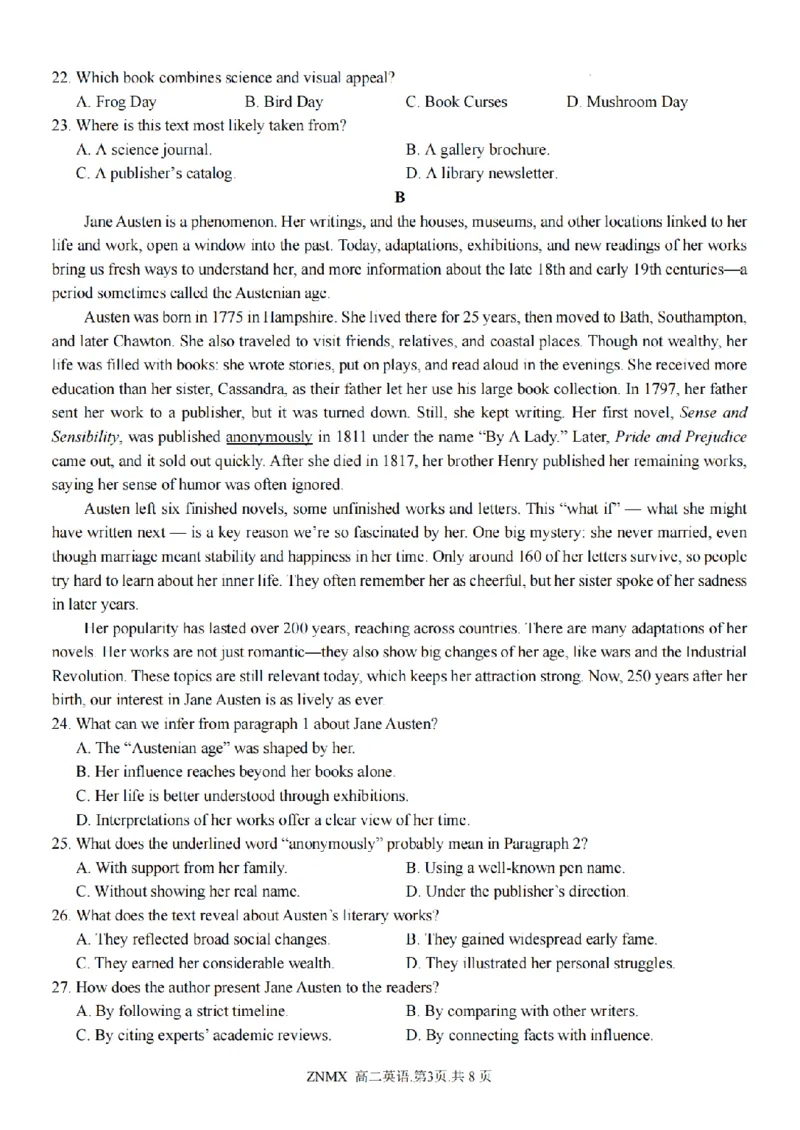
Jane Austen is a phenomenon. Her writings, and the houses, museums, and other locations linked to her
life and work, open a window into the past. Today, adaptations, exhibitions, and new readings of her works
bring us fresh ways to understand her, and more information about the late 18th and early 19th centuries-a
period sometimes called the Austenian age.
Austen was born in 1775 in Hampshire. She lived there for 25 years, then moved to Bath, Southampton,
and later Chawton. She also traveled to visit friends, relatives, and coastal places. Though not wealthy, her
life was filled with books: she wrote stories, put on plays, and read aloud in the evenings. She received more
education than her sister, Cassandra, as their father let her use his large book collection. In 1797, her father
sent her work to a publisher, but it was turned down. Still, she kept writing. Her first novel, Sense and
Sensibility, was published anonymously in 1811 under the name "By A Lady." Later, Pride and Prejudice
came out, and it sold out quickly. After she died in 1817, her brother Henry published her remaining works,
saying her sense of humor was often ignored.
Austen left six finished novels, some unfinished works and letters. This "what if' what she might
-
have written next - is a key reason we're so fascinated by her. One big mystery: she never married, even
though marriage meant stability and happiness in her time. Only around 160 of her letters survive, so people
try hard to learn about her inner life. They often remember her as cheerful, but her sister spoke of her sadness
in later years.
Her popularity has lasted over 200 years, reaching across countries. There are many adaptations of her
novels. Her works are not just romantic-they also show big changes of her age, like wars and the Industrial
Revolution. These topics are still relevant today, which keeps her attraction strong. Now, 250 years after her
birth, our interest in Jane Austen is as lively as ever.
24. What can we infer from paragraph 1 about Jane Austen?
A. The "Austenian age” was shaped by her.
B. Her influence reaches beyond her books alone.
C. Her life is better understood through exhibitions.
D. Interpretations of her works offer a clear view of her time.
25. What does the underlined word “anonymously" probably mean in Paragraph 2?
A. With support from her family. B. Using a well-known pen name.
C. Without showing her real name. D. Under the publisher's direction.
26. What does the text reveal about Austen's literary works?
A. They reflected broad social changes. B. They gained widespread early fame.
C. They earned her considerable wealth. D. They illustrated her personal struggles.
27. How does the author present Jane Austen to the readers?
A. By following a strict timeline. B. By comparing with other writers.
C. By citing experts' academic reviews. D. By connecting facts with influence.
ZNMX 高二英语.第3页.共8页C
Many children try to make their parents proud. But in some families, a child's success is always "on
show". Parents want praise from others, and the child may feel like a performer, not a person.
The term "peacock parenting" comes from the idea of being "as proud as a peacock". Here it means a
self-centered style of parenting. A peacock parent may show off a "perfect family" in public, yet criticise the
child behind closed doors when the child fails to meet high expectations. Over time, the child may learn that
love is conditional. They may hide their real feelings, stop exploring their own interests, and start to believe,
"I am not worthy."
Experts describe three common signs. The first is psychological control. When the child sets a boundary
or feels upset, the parent may say, "You're too sensitive," and turn the blame back onto the child. This often
creates a sense of guilt. The second is unpredictable mood swings. The parent can be warm one day and cold
the next, making the child feel like they are "walking on eggshells". In adulthood, this may lead to people-
pleasing and weak boundaries. The third is role reversal. Some parents fail to provide proper care and
attention, or even expect their child to look after the s a result, the child may
grow up too fast and miss out on a normal childhood.
Healing takes time, but it is possible. The first step is to be kinder to yourself and reconnect with your
own interests. Supportive friends, groups, or professional help can provide the care that was previously
missing. Clear boundaries can also make a relationship safer, and if contact continues to cause harm, limiting
contact may be necessary. After all, there are many places to find warmth, and not all of them are under a
parent's roof.
28. What is the purpose of paragraph 1?
A. To raise an issue. B. To describe a study.
C. To explain the causes. D. To offer the solutions.
29. What does "peacock parenting" in paragraph 2 mainly focus on?
A. Public approval. B. Unconditional love. C. Independent growth. D. Honest self-expression.
30. Which sign best matches "role reversal" in paragraph 3?
A. The parent praises the child in public. B. The child tries to win others' approval.
C. The parent relies on the child for support. D. The child avoids setting any boundaries.
31. What can be inferred from the last paragraph?
A. Distance ensures safety. B. Self-care is the final step.
C. Healing requires parental effort. D. Support exists beyond the family.
D
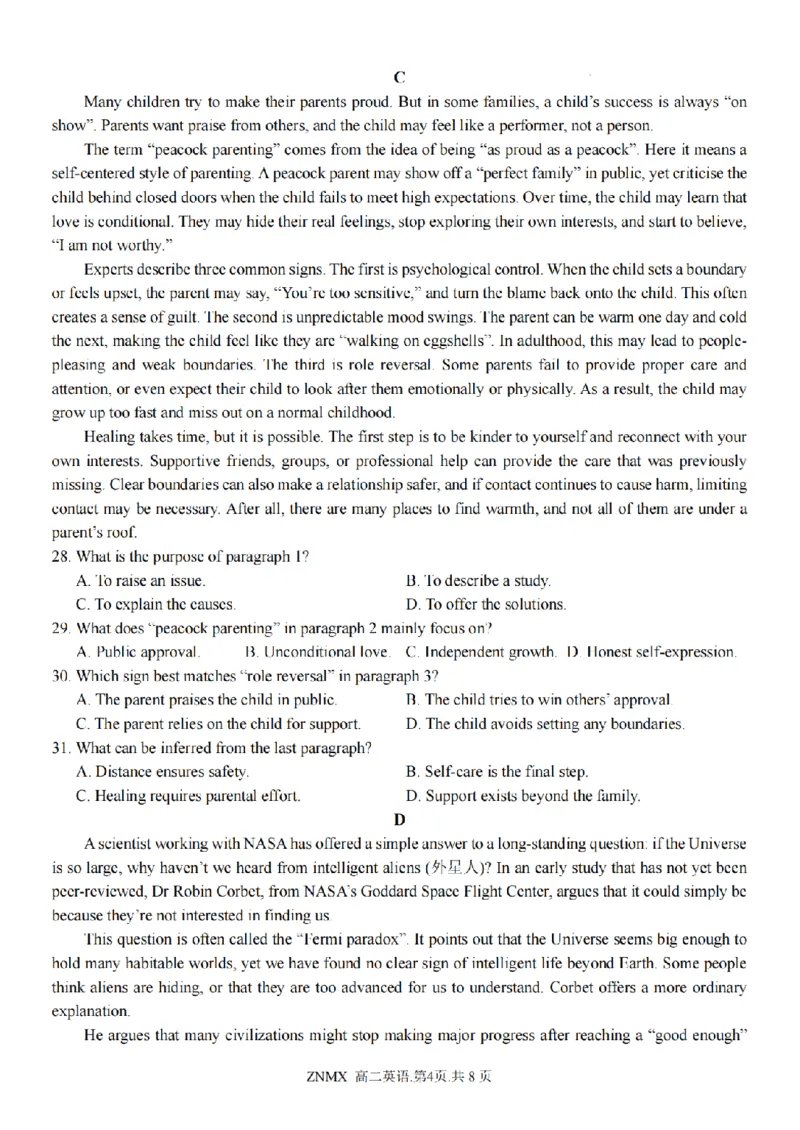
A scientist working with NASA has offered a simple answer to a long-standing question: if the Universe
is so large, why haven't we heard from intelligent aliens (外星人)? In an early study that has not yet been
peer-reviewed, Dr Robin Corbet, from NASA's Goddard Space Flight Center, argues that it could simply be
because they're not interested in finding us.
This question is often called the "Fermi paradox". It points out that the Universe seems big enough to
hold many habitable worlds, yet we have found no clear sign of intelligent life beyond Earth. Some people
think aliens are hiding, or that they are too advanced for us to understand. Corbet offers a more ordinary
explanation.
He argues that many civilizations might stop making major progress after reaching a "good enough"
ZNMX 高二英语.第4页.共8页level of technology. Once life becomes comfortable, curiosity may fade. Even if travel between stars is
possible, a civilization might explore for a time and then decide there is little new to discover. Each journey
could bring fewer surprises, so the cost of exploration no longer seems worth it.
Corbet compares this to getting used to something: when the same experience happens again and again,
it feels less exciting. If most civilizations reach such a limit, sending messages across space may start to seem
pointless. In that case, our radio searches might pick up only weak "leakage" signals-radio waves that
escape by accident-rather than deliberate messages. Corbet adds that a detection could happen someday,
but it might not lead to a big jump in our technology. The Galaxy, he suggests, may be full of life-just not
life that finds us especially important.
32. What does Corbet's study mainly try to explain?
A. The absence of clear alien contact.
B. The idea of aliens' hiding from humans.
C. The abundance of habitable worlds iinn space.
D. The lack of humans' interest in finding aliens.
33. What does paragraph 3 suggest about the motivation to explore further?
A. Comfort may renew curiosity about exploring.
B. Star travel may keep curiosity alive for a time.
C. A settled life may weaken the drive to explore.
D. New discoveries may make exploration worthwhile.
34. Why does the author mention "getting used to something" in the last paragraph?
A. To account for weak "leakage" signals.
B. To show why messages might seem pointless.
C. To explain why exploration may lose its appeal.
D. To suggest a detection may bring little progress.
35. What might be the best title for the text?
A. When the Stars Stop Calling B. Life Out There, Silence Here
C. Why the Galaxy Isn't Empty D. Clear Signals, Fading Curiosity
第二节(共5小题:每小题2.5分,满分12.5分)
阅读下面短文,从短文后的选项中选出可以填入空白处的最佳选项。选项中有两项为多余选项。
Trust helps relationships grow, but it doesn't come equally easily to everyone. 36 Instead, it is
shaped by our experiences, our personality, and the way we have been treated in the past. That's why people
may trust in different ways.
Trust sits at the heart of daily life. When you take a taxi, you trust the driver to get you home safely.
When you pay a worker to fix something, you trust him to do the job well. Typically, at school or work, you
trust people to keep promises and respect basic rules. 37 Without trust, many everyday activities
would feel risky.
However, once trust is broken, rebuilding it can be hard. When we meet someone new, we naturally pay
closer attention to the setting and the person's behaviour. We carry earlier lessons with us, too: many of us
were taught as children not to talk to strangers. 38 This protective instinct naturally carries over into
our everyday social life.
39 Sometimes we get a "feeling" about whether someone is safe to rely on. Yet a first impression
ZNMX 高二英语.第5页.共8页is not the same as a final judgement. If we've been burned before, we may question our ability to read people
and situations. We may then hold back even when someone means well.
The good news is that trust can be developed. Start by knowing your values and setting clear boundaries.
Take your time, communicate worries honestly, and let trust grow through small actions. 40 If
emotional pain is deep, professional help may be needed.
A. The same goes for first impressions.
B. It is more than a dictionary meaning.
C. That habit can shape our first judgement of others.
D. People may respond very differently to the same event.
E. Over time, these steps can help build trust more steadily.
F. Consequently, it is easy to stay cautious until we see the full picture.
G. We even trust strangers when we travel to and from school or work.
第三部分语言运用(共两节,满分30分)
第一节(共15小题:每小题1分、满分15分)
阅读下面短文。从每题所给的A、B、C、D四个选项中选出可以填入空白处的最佳选项。
Lily, a determined writer, stared at her blank computer screen. She had reached ten thousand words, yet
she felt 41 in a desert of silence. Doubt began to take hold, whispering that she was 42 to
believe she could ever finish a novel. To 43 these bitter thoughts, she stepped out into the snowy
woods, hoping the cold air would clear her mind.
At the store, the weight of others' expectations felt like a 44 When asked about her book, Lily
forced a smile, though in her heart she 45 ever sharing her dream. On her way out, she accidentally
46 a rude man named Patrick. They exchanged sharp words, leaving Lily feeling even more 47
However, fate stepped in; Patrick appeared just as Lily later slipped on the ice, pulling her up and, seeing her
shaken, offering her a lift home.
During the drive home, the tension between them slowly 48.P atrick shared his own past-he
had once been an architect but 49 his career to care for his sick father. "Sometimes love means
putting others first," he advised, "Write what your character 50 feels, not just what she does."
His words acted like a key, unlocking Lily's 51 She realized her story wasn't just about a single
character, but about the shared 52 for those we love. Back at her desk, she began typing 53
the words flowing like a river. Months later, her draft became a published 54.Looking at the book,
Lily realized that the rude man she once met by chance had gifted her something priceless: the _ 55 to
tell a truth that mattered.
41. A. bored B. settled C. trapped D. confused
42. A. foolish B. lucky C. wise D. brave
43. A. read B. share C. feed D. escape
44. A. gift B. joke C. mirror D. burden
45. A. regretted B. imagined C. admitted D. suggested
46. A. zoomed past B. knocked into C. came across D. heard from
47. A. ashamed B. disappointed C. miserable D. embarrassed
48. A. faded B. returned C. spread D. deepened
49. A. gave up B. mapped out C. kicked off D. messed up
ZNMX 高二英语.第6页.共8页50. A. slowly B. truly C. ultimately D. intensely
51. A. impression B. ambition C. motivation D. imagination
52. A. honor B. interest C. sacrifice D. expectation
53. A. slowly B. wildly C. quietly D. carefully
54. A. offer B. outlook C. reality D. success
55. A. act B. chance C. wisdom D. vision
第卷
第二节(共10小题:每小题1.5分,满分15分)
阅读下面短文,在空白处填入1个适当的单词或括号内单词的正确形式。
The Dunhuang Culture & Art Exhibition has returned to Beijing for its second season, running through
November 2026. This year's edition offers an attractive display, featuring the 12 Chinese zodiac animals
subtly 56 (see) in ancient objects.
57 a focus on the "return" of Dunhuang Library Cave items, the exhibition showcases 11 new
replicas(复制品), which are currently held abroad. Highlighting the importance of 58 (culture) return,
this section 59 (include) copies of the earliest known medical documents. Other highlights include
beautiful artworks such as the “Thousand-Armed Guanyin" painting.
60 (Build) on the success of its first season, the current exhibition traces the story of its 61
(discover) and global spread through historical photos. So vivid are the interactive displays 62 the
heritage is truly brought to life.
A creative activity 63 (arise) from the exhibition tour is a special "Dunhuang Coffee" experience.
Here, safe-to-eat rice paper melts into steaming coffee, creating a unique mix of art and taste. 64
(current) held at the Beijing Exhibition Center, the event invites art 65_(enthusiastic) to explore
China's treasures.
第四部分写作(共两节,满分40分)
第一节(满分15分)
假定你是李华。你校近期举办了“云端漫游”周,同学们戴上 VR 头显(headsets)即可足不出
户探索世界。校英文报“未来生活”专栏现以“Virtual Travel: A Window or a Wall?”为题向你约稿,
请你写一篇短文投稿,内容包括:
1. 你的观点:
2. 理由分析:
3.你的展望或建议。
注意:
1.写作词数应为80左右。
2.请按如下格式在答题卡的相应位置作答。
Virtual Travel: A Window or a Wall?
ZNMX 高二英语.第7页.共8页第二节(满分25分)
阅读下面材料,根据其内容和所给段落开头语续写两段,使之构成一篇完整的短文。
Eva started her new job at a small charity called "Caring for Carers." While checking the shared
campaign folder, a name caught her eye: Adam Turner.
Memories suddenly flooded back. Adam had been her major opponent at school-a boy who always
carried a leather briefcase while everyone else had backpacks. He was extremely talented at maths, while
Eva excelled in English and history. They once failed a group project because they spent all their time arguing,
unable to combine his logic with her creativity.
When the office door opened, a tall, handsome man walked in. It was Adam. He smiled broadly, "You
do remember! Conker!"h e teased, using her old nickname. Eva glared, but Adam quickly turned professional.
"The Simpson Foundation is offering funding. If we make a convincing speech next Friday, they'll pay for
the whole campaign."
As they worked together, the old disagreement remained. Adam was buried in precise budgets, while
Eva insisted on using "creative" ideas to move the funders. Eva complained that he was too obsessed with
figures, while Adam responded that her ideas were too impractical. They seemed to be back in their school
days, fighting over every detail.
However, as the deadline approached, their relationship began to shift. Eva made an effort to understand
his financial tables, and Adam started to appreciate the emotional power of Eva's storytelling. One afternoon,
they discovered some old black-and-white photos of people the charity had helped. Eva suggested using these
to tell real stories, and Adam's eyes lit up. He realized he could back those stories with data to prove their
impact.
The day of the presentation finally arrived, which was also the final day of Eva's trial period. Standing
outside the boardroom, Eva felt her heart pounding. This wasn't just about the funding; it was about whether
she and her old opponent could finally succeed as a team.
注意:
1.续写词数应为150左右:
2.请按如下格式在答题卡的相应位置作答。
Taking a deep breath, Eva and Adam stepped into the boardroom together.
As they walked out of the room, Joanna, their manager, was waiting for them with a bright smile.
ZNMX 高二英语.第8页.共8页