辽宁省实验中学 28 届高一下学期期初测试
英语科试卷
注意事项:
1. 答卷前,考生务必将自己的姓名、准考证号填写在答题卡上。
2. 回答选择题时, 选出每小题答案后, 用铅笔把答题卡上对应题目的答案标号涂黑。
如需改动,用橡皮擦干净后,再选涂其它答案标号。回答非选择题时,将答案写在
答题卡上,写在本试卷上无效。
第一部分 听力 (共两节, 满分 30 分)
做题时, 先将答案标在试卷上。录音内容结束后, 你有两分钟的时间将试卷上的答案
转涂到答题卡上。
第一节 (共 5 小题; 每小题 1.5 分, 满分 7.5 分)
听下面 5 段对话。每段对话后有一个小题,从题中所给的 A、B、C 三个选项中选出
最佳选项, 并标在试卷的相应位置。听完每段对话后, 你都有 10 秒钟的时间来回答
有关小题和阅读下一小题。每段对话仅读一遍。
例: How much is the shirt?
A. £ 19.15. B. £ 9.18. C. 9.15 .
答案是 C。
1. What does the man want to know?
A. The address. B. The time. C. The participants.
2. What happened to the woman’s computer?
A. It’s broken. B. It’s dark. C. It’s dead.
3. Why does the man apologize to the woman?
A. He tore her coat. B. He dirtied her coat. C. He bought her a coat.
4. What benefits does online teaching bring to the woman?
A. She needn’t make lots of video calls.
B. She needn’t tidy a classroom.
C. She needn’t drive to work.5. What information was misunderstood by the woman?
A. The time. B. The location. C. The phone number.
第二节 (共 15 小题; 每小题 1.5 分, 满分 22.5 分)
听下面 5 段对话或独白。每段对话或独白后有几个小题, 从题中所给的 A、B、C
三个选项中选出最佳选项。听每段对话或独白前,你将有时间阅读各个小题,每小
题 5 秒钟;听完后, 各小题将给出 5 秒钟的作答时间。每段对话或独白读两遍。
听第 6 段材料, 回答第 6、7 题。
6. How long has the woman been in swimming racing?
A. Four years. B. Eight years. C. Ten years.
7. What does the woman worry about?
A. Her scholarship. B. Her future university. C. Her parents.
听第 7 段材料,回答第 8 至 10 题。 公众号:高一高二高三试卷
8. Where are the speakers?
A. At a school. B. At the man’s office. C. At a doctor’s office.
9. What does the man urgently need to do according to the woman?
A. Quit his current job.
B. Change his habits and lifestyle.
C. Attend meetings with the woman.
10. How much will the man pay for the phone call each week?
A. $25. B. $100. C. $400.
听第 8 段材料,回答第 11 至 13 题。
11. What color of wrapping paper does the man choose?
A. Blue B. Pink. C. Yellow.
12. What is the man dissatisfied with about the mirror?
A. Its price. B. Its quality. C. Its packaging.
13. Where are the speakers probably?
A. At home. B. At a store. C. At a post office.
听第 9 段材料,回答第 14 至 16 题。14. When is the woman supposed to finish her essay?
A. By next Friday. B. By next Monday. C. By this Saturday.
15. Why is the woman behind with her writing class?
A. She was a bit cold.
B. The course is too difficult.
C. She missed some lessons.
16. What does the man think of his college life?
A. Busy. B. Boring. C. Colorful.
17. What is the woman probably going to do on the 28th?
A. Visit an exhibition. B. Attend a party. C. Watch a play.
听第 10 段材料,回答第 17 至 20 题。
18. Where did the man come from?
A. India. B. A country in the South Pacific. C. The Andaman Sea.
19. How does the man want to leave the island?
A. By finding a way to fix his boat.
B. By seeking the help of local people.
C. By getting rescued by an airplane.
20. What is the man most frightened about?
A. Being attacked by sea robbers.
B. Running out of food and water.
C. Being trapped on the island forever.
第二部分 阅读(共两节,满分 45 分)
第一节 (共 13 小题; 每小题 2.5 分, 满分 32.5 分)
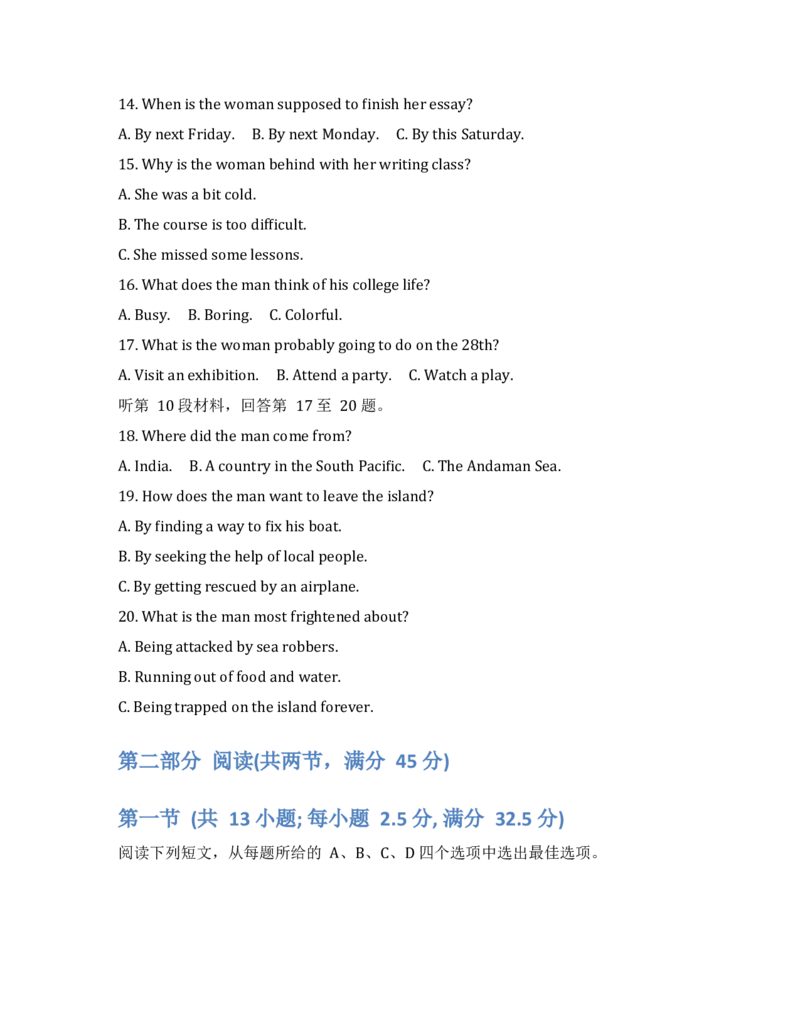
阅读下列短文,从每题所给的 A、B、C、D 四个选项中选出最佳选项。21. Which of the following highlights Letter 1?
A. We Found a Fix.
C. Run Over by a Speedboat.
22. Who forgave the driver after an accident?
A. Annette Wolfe.
C. Carter Viss.
23. What do these four letters have in common?
A. They are notes on past issues.C. They are remarks about human virtues.
B. Dealing with Eye Problems.
D. So Nice You Have to Read It Twice.
B. Pam Snellgrove.
D. Leander Jones.
B. They give advice on how to read.
D. They offer information about health.
B
In 2004, when my daughter Becky was ten, she and my husband, Joe, were united in
their desire for a dog. As for me, I shared none of their canine lust.
But why, they pleaded. "Because I don’t have time to take care of a dog." But we’ll do
it. "Really? You’re going to walk the dog? Feed the dog? Bathe the dog?" Yes, yes, and
yes. "I don’t believe you." We will. We promise.
They didn’t. From day two (everyone wanted to walk the cute puppy that first day),
neither thought to walk the dog. While I was slow to accept that I would be the one
to keep track of her shots, to schedule her vet appointments, to feed and clean her,
Misty knew this on day one. As she looked up at the three new humans in her life
(small, medium, and large), she calculated, "The medium one is the sucker in the
pack."
Quickly, she and I developed something very similar to a Vulcan mind meld (心灵融
合). She’d look at me with those sad brown eyes of hers, beam her need, and then
wait, trusting I would understand- which, strangely, I almost always did. In no time,
she became my fifth appendage (附肢), snoring on my home-office couch as I
worked, cradling against my feet as I read, and splaying across my stomach as I
watched television.
Even so, part of me continued to hate walking duty. Joe and Becky had promised.
Not fair, I’d balk (心不甘情不愿) silently as she and I walked. "Not fair," I’d loudly
remind anyone within earshot upon our return home.
Then one day- January 1, 2007, to be exact - my husband’s doctor uttered an
unthinkable word: leukemia (白血病). With that, I spent eight to ten hours a day
with Joe in the hospital, doing anything and everything I could to ease his
discomfort. During those six months of hospitalizations, Becky, 12 at the time,
adjusted to other adults being in the house when she returned from school. My work
colleagues adjusted to my taking off at a moment’s notice for medical emergencies.
Every part of my life changed; no part of my old routine remained.
Save one: Misty still needed walking. At the beginning, when friends offered to takeher through her paces, I declined because I knew they had their own households to
deal with.
As the months went by, I began to realize that I actually wanted to walk Misty. The
walk in the morning before I headed to the hospital was a quiet, peaceful time to
gather my thoughts or to just be before the day’s medical drama unfolded. The
evening walk was a time to shake off the day’s upsets and let the worry tracks in my
head go to white noise.
When serious illness visits your household, it’s not just your daily routine and your
assumptions about the future that are no longer familiar. Pretty much everyone you
know acts differently.
Not Misty. Take her for a walk, and she had no interest in Joe’s blood counts or bone
marrow test results. On the street or in the park, she had only one thing on her
mind: squirrels! She was so joyous that even on the worst days, she could make me
smile. On a daily basis she reminded me that life goes on.
After Joe died in 2009, Misty slept on his pillow.
I am grateful- to a point. The truth is, after years of balking, I’ve come to enjoy my
walks with Misty. As I watch her chase after a squirrel, throwing her whole being
into the here-and-now of an exercise that has never once ended in victory, she
reminds me, too, that no matter how harsh the present or unpredictable the future,
there’s almost always some measure of joy to be extracted from the moment.
24. Why didn’t the writer agree to raise a dog at the beginning of the story?
A. She was afraid the dog would get the family into trouble.
B. It would be her business to take care of the dog.
C. Her husband and daughter were united as one.
D. She didn’t want to spoil her daughter.
25. Which of the following is the closest in meaning to "The medium one is the
sucker in the pack." (Paragraph 3)?
A. "The middle-aged person loves me most."
B. "The medium-sized woman is the hostess."
C. "The man in the middle is the one who has the final say."
D. "The woman is the kind and trustworthy one in the family."
26. It can be inferred from Paragraph 3 that_____
A. Misty was quite clever B. Misty could solve math problems
C. the writer was a slow learner D. no one walked Misty the first day27. The story came to its turning point when_____
A. Joe died in 2009.
B. Joe fell ill in 2007.
C. The writer began to walk the dog.
D. The dog tried to please the writer.
28. Why did the writer continue to walk Misty while Joe was in hospital?
A. Misty couldn’t live without her.
B. Her friends didn’t offer any help.
C. The walk provided her with spiritual comfort
D. She didn’t want Misty to be others’ companion.
29. What is the message the writer wants to convey in the passage?
A. One should learn to enjoy hard times.
B. A disaster can change everything in life.
C. Moments of joy suggest that there is still hope ahead.
D. People will change their attitude toward you when you are in difficulty.
C
For anyone connected with a school, the last couple of weeks should have been a
pile-up of plays, choir performances, and talent shows. But a report found
alarmingly, that 53% of primary schools and 53% of secondary schools that
normally held a festive concert at the end of the first term did not do so.
It is deeply troubling that music is no longer being taught to 11- to 14-year-olds in
more than half of state secondary schools. And some children get as little as one
day’s music lesson a year. If this situation is allowed to continue, music-making will
become the preserve of those who can afford it. And the intense competition for
better academic performance has only sped up this trend. A survey published this
month of more than 1,300 music teachers found that a third of British primary
schools are not singing, while a quarter have ceased instrumental lessons. Almost
three-quarters of primary schools and two-thirds of secondary schools have
cancelled extracurricular music. Though a sharp decline of music provision is due to
various social factors, Ofsted (教育标准局) appeared to put this down to schools
themselves, rather than pointing the finger at the government’s silence to educators’
appeal.
This is very sad and shortsighted. On the most basic level, music aids academic
achievements. Research suggests that music-making improves speech and literacy.But academic progress is too narrow a standard of success. In her book, Joan Koenig
argues that music is fundamental to a well-functioning society.
Besides that, music-making nurtures sympathy and belonging. "People stand a much
better chance of finding meaning and happiness in their lives if they feel that they
belong," as Koenig puts it. "Studies show that group musical practice can create and
enhance this feeling. It is when people don’t have a sense of belonging that things go
wrong."
In this time of uncertainty and fear, ensuring that all children can access music-
making is a cause deserving meaningful support and attention from ministers.
30. What does Paragraph 2 mainly talk about?
A. Educators are appealing for investment.
B. Schools merely value academic achievements.
C. Music lessons are nearly absent from classrooms.
D. Parents cannot afford students’ music lessons.
31. According to Ofsted, who is to blame for the affected music provision?
A. The schools. B. The educators.
C. The government. D. The researchers.
32. What does the underlined word" nurtures" in Paragraph 3 probably mean?
A. Promotes. B. Deserves.
C. Symbolizes. D. Worsens.
33. What does the author mainly convey in the last paragraph?
A. Music education is optional.
B. Music education calls for backup.
C. Music-making is tough.
D. Music-making makes sense.
第二节:(共 5 小题, 每小题 2.5 分, 满分 12.5 分)
根据短文内容, 从短文后的选项中选出能填入空白处的最佳选项。选项中有两项为
多余选项。
According to a 2024 attention study by King’s College London, 49% of the UK public
are experiencing "popcorn (爆米花) brain", a mental state featuring divided
attention and wandering thoughts. 34 In response to the findings, psychologist TinaChummun gives her top tips.
Adopt the mind map method. To manage a distracted (分心的) mind, write down
everything, like appointments, worries and to-dos, without organizing it initially.
Once everything is on paper, group these into life areas like work or emotional
wellbeing. 35 _______This creates order and gives your brain permission to
concentrate.
Every time you feel your thoughts wandering, give yourself three seconds - breathe
in, name what you’re feeling, and redirect your focus. 36 _______ By doing so, you may
turn down the heat when your brain is working overtime.
Minimizing tech is also the key to getting back on track in your daily life. A full
digital withdrawal is unrealistic. 37 _______ Then it could be followed by a five-
minute screen time reward. It teaches your brain to tolerate stillness without feeling
punished.
38 _______ At first, you may feel bored, as popcorn brain likes being ’go go go’ to feel
safe. "Go for a walk without music, or simply stare out your window," suggests Tina.
"Sit in silence and observe your thoughts. Let your brain breathe. It is sometimes
exactly what your nervous system needs."
So, are you ready to quiet the mental popcorn and get your focus back?
A. Allow space in your day for doing nothing.
B. So, what’s making our brains pop like popcorn?
C. Instead, go totally screen-free for 25-30 minutes.
D. Starving distractions and feeding focus is a nice idea.
E. Then ask yourself: what matters now and what can wait?
F. They feel their attention less focused and deep thinking rarer.
G. This practice enables you to slow down and manage emotions.
第三部分:英语知识运用(共两节,满分 50 分)
第一节 完形填空 (共 20 小题; 每小题 1 分, 满分 20 分)
阅读下面短文,掌握其大意,然后从各题所给的四个选项(A、B、C、D)中选出最
佳选项。
There are many different ways of seeing a town for the first time. One of them is to
walk around it, guide-book 39 _______ hand. Of course, we may 40 _______ with our
guide-books the history and 41 _______ developments of a town and get to know
them. 42 _______ then, if we take out time and 43 _______ in a town for a while, we may
get to know it better. When we_____ 44_____ it as a whole, we begin to have some 45_______, which even the best guide-books do not answer. Why is the town just 46 this,
this shape, this plan, this size? Why do its streets_____ 47_____ in this particular way,
and not in any 48 _______ way?
Here even the best guide-book 49 _______ us. One can’t find in it the information
about how a town has developed to the 50 _______ appearance. It may not describe
the original (最初的) 51 _______ of a town. However, one may get some idea of what it
__52__ look like by walking around the town.
One can also imagine 53 _______ the town was first planned and built. Then one can
learn more about in what direction the town 54 to develop.
What is the 55 _______ of studying towns in that way? For me, it is 56 _______ that one
gets a greater depth of pleasure by visiting and seeing a town with one’s own eyes. A
__57__ visit to a town may help one better understand why it is attractive 58 _______
just reading about it in a guide-book.
39. A. in B. at C. by D. on
40. A.write B. study C. tell D. remember
41. A.strange B. similar C. separate D. special
42. A. But B. Before C. Since D. Until
43. A. march B. work C. stay D. wait
44. A. look at B. look after C. look for D. look up
45. A. ideas B. opinions C. feelings D. questions
46. A. of B. for C. like D. as
47. A. open B. run C. begin D. move
48. A. one B. more C. other D. such
49. A. helps B. tricks C. fails D. satisfies
50. A. old B. normal C. first D. present
51. A. capital B. meaning C. design D. change
52. A. used to B. seemed to C. had to D. happened to
53. A.what B. how C. when D. where
54. A.stops B. appears C. starts D. continues
55. A.Deput B. view C. problem D. difficulty
56. A nearly B. simply C. generally D. hardly57. A. costly B. formal C. group D. personal
58. A. from B. than C. through D. with
第二节 课文单词填空 (共 20 小题; 每小题 1.5 分, 满分 30 分)
注意:已给首字母的请根据汉语意思在答题纸上相应位置写出完整单词;其他题考
查及答题方法同高考语法填空题型。未在答题纸上作答的成绩无效。
I came across s_____59_____ (臭的) tofu, a horrible grey thing that looked and smelt
like a_____ 60 (burn) sports shoe.
– But I gathered all my courage to take a bite and was amazed_____ 61_____ (find) it
wasn’t so bad. – Is there any truth behind the saying "You are 62 you eat."?
– Cooking together gives us a chance to relax and c_____63_____ (打听, 别后叙谈) up
on each other’s days.
– I often end up 64 _____(save) part of my meal for the next day.
– No family meal is complete_____ 65_____ some form of meat.
– The letter was also beautifully i_____66_____ (配插图); each must have taken
Tolkien a long time to complete.
– She’d put t_____67_____ (象征,标志) in some dumplings: candies for a sweet life
and some peasants for a long and healthy one.
– The o_____68_____(场合)is more enjoyable without all that tiring cooking.
– One of the most wonderful migrations in nature is_____ 69_____ of the North
American monarch butterfly.
– The butterflies manage to travel around 4,000 kilometers south and find their way
to California or Mexico. However, until recently no one 70_____ (know) how they did
this.
– The solution_____ 71_____ the mystery of the monarch’s amazing ability comes at a
time when it is in serious trouble.
– As the world’s first national park, Yellowstone is famous for the 72 _____(vary) of
its wildlife. – While I was c_____73_____(专注)on photographing this amazing scene, I
suddenly had a feeling that I was being watched.
– Imagine mountains 74_____ (wrap) in silver water, shining in the spring sun.
– The flat terraces catch the rainwater and prevent the soil from 75_____ (wash)
away.
– "If you look the right way, you can see that the whole world is a g_____76_____.
– While many Brits like nothing better than spending their Sunday cutting the grass,some are happy just 77_____ (sit) under the branches of the trees and enjoy the
beauty of the world around them. – What other free-time activity allows you to be
at_____ 78_____ with nature and create more beautiful living things?
第四部分 读后续写(满分 25 分)
阅读下面材料,根据其内容和所给段落开头语续写两段,使之构成一篇完整的故
事。
The crowd roared as I took off from the starting line in The Big Race. Through the
cheers, I heard Mom shouting, "Run, Sammy, run!" I knew without looking that she
was smiling from ear to ear and clapping her hands for me.
I kept my eyes straight ahead running as fast I could. "Run, run, run," I chanted to
myself in my mind as I passed my friend Justin. I saw Justin’s red face out of the
corner of my eye and wondered if my own face was that red too?
"Run, run, run." I was on fire, passing Sarah, leaving her in my dust.
The coach was waiting for me at the finish line, holding the medal, for the fastest
runner in kindergarten. I would wear that blue and white ribbon, around my neck
when we go out for ice cream to celebrate and then hang it in my room. Last night I
took the collection of caps off the hook on my wall leaving it ready for my shiny new
medal. I couldn’t wait to see it every day when I woke up.
Dad was there in the crowd also and would pick me up and put me on his shoulders
to carry around. "My son!" He would tell the other fathers, "My son won the race!"
I was going to win! Faster than Sarah, I came up behind Mikey, giving my legs that
extra burst of energy to pass him by. The winner, Sammy! All that running in the
park was worth it!
Just as I heard the roar of the crowd welcoming me to the finish line, I saw a blur out
of the corner of my eye. What? There was Justin with his tomato cheeks running as
fast as humanly possible, huffing and puffing like he was going to blow the house
down. And then he was in front of me. I was behind tomato face Justin. Crossing the
finish lie, I heard the voice over the loudspeaker boom,
"Congratulations to the winner, Justin!"
Congratulations to Justin?
Congratulations to Justin.
注意:
(1)所续写短文的词数应为 150 词左右;
(2)请按如下格式在答题卡的相应位置作答。Paragraph 1
I stood there frozen as Justin was handed his medal._____
Paragraph 2
Suddenly, strong hands lifted me onto Dad’s shoulders._____
28 届高一下期初测试 英语试题参考答案
听力(共 20 小题;每小题 1.5 分,满分 30 分)
1-5 ACBCA 6-10CBCBA 11-15BCBAC 16-20 CBBAC
阅读理解(共 18 小题; 每小题 2.5 分,满分 45 分)
21—23 BCA 24—29 BDABCC 30—33 CAAB 34—38 FEGCA
完形填空 (共 20 题; 每小题 1 分, 满分 20 分)
39-43 ABDAC 44-48 ADCBC 49-53CDCAB 54-58 DABDB
课文填空 (共 20 小题; 每小题 1.5 分,满分 30 分)
59. stinky; 60. burnt; 61. to find; 62. what; 63. catch; 64. saving;
65. without; 66. illustrated; 67. tokens; 68. occasion; 69. that; 70. knew;
71. to; 72. variety; 73. concentrating; 74. wrapped; 75. being washed; 76. garden;
77. to sit; 78. one
读后续写(满分 25 分)One Possible Version:
I stood there frozen as Justin was handed his medal. His tomato-red cheeks glowed
brighter than ever, and the blue ribbon around his neck felt like a punch to my gut.
Him? The kid who tripped over his own shoes during practice? How could he be the
fastest? My legs burned from all those afternoons sprinting in the park, yet here I
was, empty-handed. The crowd’s cheers for Justin buzzed in my ears like angry bees.
I imagined Mom’s smile crumbling, Dad’s proud shoulders slumping. What if they
were ashamed of me? Tears blurred my vision as I stared at the ground, wishing it
would swallow me whole. Loser, loser—the word hammered in my head. Would
everyone laugh at me tomorrow?
Suddenly, strong hands lifted me onto Dad’s shoulders. "My son!" he boomed, as if
I’d won. Confusion tangled with shame. Didn’t they see that I lost? Mom squeezed
my hand. "You ran like lightning," she said. "And lightning doesn’t quit," Dad added.
Noticing my sadness, Dad comforted, "Even if you think you fail, fail best." Their
words floated around me, soft but stubborn. That night, the empty hook on my wallmocked me. I traced its outline, swallowing hard. Then Dad’s voice echoed: Fail best.
My breath steadied. Maybe winning wasn’t just ribbons. Maybe it was lungs
screaming, legs pushing, eyes locked ahead - not glancing sideways at Justin. The
race hadn’t been about speed alone. It taught me to focus, to fight even when dust
filled my mouth. I fell asleep knowing this loss was its own kind of medal, heavy but
honest.