













文档内容
2025 年十堰市六县市区一中教联体 3 月联考
高一英语试卷
第一部分 听力(共两节,满分30分)
第一节:(共5小题;每小题1.5分,满分7.5分)
听下面5段对话。每段对话后有一个小题,从题中所给的A、B、C三个选项中选出最佳选项,
并标在试卷的相应位置。听完每段对话后,你都有10秒钟的时间来回答有关小题和阅读下一
小题。每段对话仅读一遍。
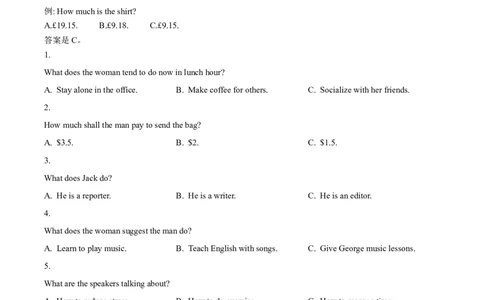
例: How much is the shirt?
A.£19.15. B.£9.18. C.£9.15.
答案是C。
1.
What does the woman tend to do now in lunch hour?
A. Stay alone in the office. B. Make coffee for others. C. Socialize with her friends.
2.
How much shall the man pay to send the bag?
A. $3.5. B. $2. C. $1.5.
3.
What does Jack do?
A. He is a reporter. B. He is a writer. C. He is an editor.
4.
What does the woman suggest the man do?
A. Learn to play music. B. Teach English with songs. C. Give George music lessons.
5.
What are the speakers talking about?
A. How to reduce stress. B. How to do exercise. C. How to manage time.
第二节:(共15小题;每小题1.5分,满分22.5分)
听下面5段对话或独白。每段对话或独白后有几个小题,从题中所给的A、B、C三个选项中
选出最佳选项,并标在试卷的相应位置。听每段对话或独白前,你将有时间阅读各个小题,
每小题5秒钟;听完后,各小题将给出5秒钟的作答时间。每段对话或独白读两遍。
听下面一段较长对话,回答以下小题。6. What is the relationship between the speakers?
A. Family members. B. Teammates. C. Neighbours.
7. What is the man going to do this evening?
A. Prepare a present. B. Make some food. C. Buy balloons.
听下面一段较长对话,回答以下小题。
8. What made the woman begin to take exercise?
A. A good app. B. Her friend’s advice. C. A newspaper article.
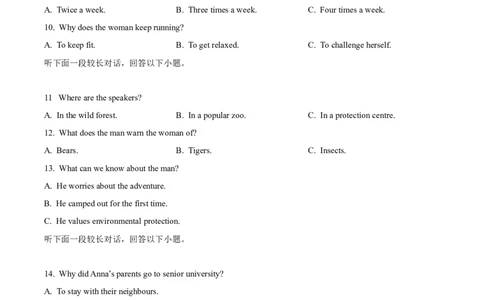
9. How often does the man do weight training?
A. Twice a week. B. Three times a week. C. Four times a week.
10. Why does the woman keep running?
A. To keep fit. B. To get relaxed. C. To challenge herself.
听下面一段较长对话,回答以下小题。
.
11 Where are the speakers?
A. In the wild forest. B. In a popular zoo. C. In a protection centre.
12. What does the man warn the woman of?
A. Bears. B. Tigers. C. Insects.
13. What can we know about the man?
A. He worries about the adventure.
B. He camped out for the first time.
C. He values environmental protection.
听下面一段较长对话,回答以下小题。
14. Why did Anna’s parents go to senior university?
A. To stay with their neighbours.
B. To keep their minds lively.
C. To make some new friends.
15. When does Anna’s father attend classes?
A. On Mondays and Wednesdays.
B. On Mondays and Fridays.
C. On Wednesdays and Thursdays.
16. What class does Anna’s mother take?A. History. B. Photo-taking. C. Singing.
17. What did Anna’s father do after he went to senior university?
A. He volunteered in the community.
B. He set up a club with others.
C. He invited other parents to join.
听下面一段独白,回答以下小题。
18. What is the speaker doing?
A. Hosting a program. B. Holding a meeting. C. Giving a lesson.
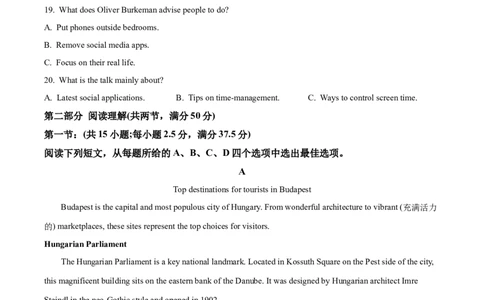
19. What does Oliver Burkeman advise people to do?
A. Put phones outside bedrooms.
B. Remove social media apps.
C. Focus on their real life.
20. What is the talk mainly about?
A. Latest social applications. B. Tips on time-management. C. Ways to control screen time.
第二部分 阅读理解(共两节,满分50分)
第一节:(共15小题;每小题2.5分,满分37.5分)
阅读下列短文,从每题所给的A、B、C、D四个选项中选出最佳选项。
A
Top destinations for tourists in Budapest
Budapest is the capital and most populous city of Hungary. From wonderful architecture to vibrant (充满活力
的) marketplaces, these sites represent the top choices for visitors.
Hungarian Parliament
The Hungarian Parliament is a key national landmark. Located in Kossuth Square on the Pest side of the city,
this magnificent building sits on the eastern bank of the Danube. It was designed by Hungarian architect Imre
Steindl in the neo-Gothic style and opened in 1902.
Castle Quarter
The Castle Quarter is a district of Budapest located within the defensive walls of the Buda Castle complex.
The site includes Buda Castle, Matthias Church and Fisherman’s Bastion. The best time to visit is just before sunset
and visitors can see the city light up as it makes its colorful transition from day to night.
Central Market Hall
The market features an abundant choice of fruit and vegetables, sausages, cheese, and pickles. Visitors can
also find local folk art and embroidery (刺绣) there. The red-brick building with its striking yellow and green roofis also a big draw for architecture lovers.
Heroes’ Square
Heroes’ Square is known for its iconic Millennium Monument with statues of Hungarian national heroes and
leaders. In the center rises a column with the Tomb of the Unknown Soldier below. On each side of the square stand
two neoclassical temple-like buildings-the Museum of Fine Arts and the Kunsthalle.
21. What do we know about Hungarian Parliament?
A. It used to belong to Imre Steindl. B. It’s a famous European landmark.
C. It stands very close to the Danube. D. It’s the oldest neo-Gothic building.
22. What can tourists do in Central Market Hall?
.
A Listening to Hungarian folk stories. B. Having their portrait drawn for free.
C. Seeing figures of the fallen soldiers. D. Enjoying a diversity of local food.
23. What do the four sites have in common?
A. They were designed by the same man B. They are suitable for architecture fans.
C. Their visitors flow reach peak at sunset. D. Their history dates from a century ago.
B
Nima Rinji Sherpa has become the youngest climber to reach the top of the world’s 14 highest mountains. The
18-year-old from Nepal completed his goal on 2024 October 9 by climbing the 8,027-meter Mount Shishapangma
in Tibet.
The 14 mountains Nima climbed are known as the “8,000ers”. That’s because each of them is at least 8,000
meters tall. Climbing all 14 is such a difficult and dangerous challenge that only a few dozen people have managed
to complete it.
Nima is a Sherpa. Sherpas are a group of people from Nepal who are famous for their climbing skills. They
often work as guides, helping climbers from other countries. They guide climbers, carry heavy loads, and set up
safety equipment. Foreign climbers often get most of the attention for completing the climbs while Sherpas do
much hard work in the same dangerous conditions. Nima is hoping to bring some of that attention back to the
Sherpas.
Nima comes from a family of climbers. His father is a famous climber, and his uncles were the first brothers to
both climb all of the 8,000ers. That has given Nima a strong support group. But even so, Nima didn’t start climbing
seriously until he was 16 years old. He climbed his first 8,000er, Mount Manaslu, in August of 2022. Nima climbed
Mount Everest, the world’s tallest mountain, earlier this year.
Last year, Nima chose to leave Mount Shishapangma as his last 8,000er. This year, Nima completed his
challenge. Nima says he hopes his successes will make people more aware of how important Sherpas are toclimbing. But he aims to be more than a guide. He says he wants to show that Sherpas are as good as climbers from
any other country. “My dream is simple,” Nima says. “It’s just to be one of the best athletes in mountaineering.”
At just 18 years old, he’s well on his way. Nima is now the youngest person to climb all 14 of the 8,000ers.
Nima’s success has been confirmed by Nepal’s government. It will take a while longer for Guinness World Records
to make it official.
24. What is the purpose of Paragraph 3?
A. To compare Sherpa with foreign climbers. B. To present a brief introduction to Sherpa.
C. To explain the reason for Nima’s climbing. D. To show the challenges of mountaineering.
25. What can we know about Nima?
A. He reached the top of Mount Everest at 16. B. He wasn’t interested in Shishapangma at first.
C. He is a skillful, helpful and excellent climber. D. He won support for climbing except his mother.
26. What does “it” underlined in the last paragraph refer to?
A. Nima climbed Shishapangma successfully.
B. Sherpas are as excellent as foreign climbers.
C. Nepal’s government admitted Nima’s success.
D. Nima is the youngest to reach 14 of the 8,000ers.
27. What message may the text convey to readers?
A. Success isn’t determined by age. B. Chances always lie in difficulties.
C. He who laughs last laughs best. D. Actions speak louder than words.
C
Scientists said that electrically stimulating a particular region in the brain could help people with injured spinal
cords (脊髓) walk more easily.
The new technique is intended for people with spinal cord injuries where the connection between their brain
and spinal cord hasn’t been totally severed, and who still have some movement in their legs.
The research was conducted by a Swiss team that has pioneered several advances. This time they wanted to
figure out which region of the brain was responsible for recovering from spinal cord injuries.
Using 3D imaging techniques to map out the brain activity of mice with these injuries, the team were surprised
to find the region they were looking for was in the lateral hypothalamus (外侧下丘脑), a regulator for arousal,
feeding and motivation. A particular group of neurons in this region “appears to be involved in the recovery of
walking after spinal cord injury,” neuroscientist Gregoire Courtine said.
Next, the team sought to amplify the signal from these neurons using a procedure called deep brain
stimulation, which is commonly used to treat movement problems. It involves a surgeon implanting electrodes inthe brain region, which are connected to a device implanted in the patient’s chest. When switched on, the device
sends electrical pulses to the brain.
First, the team tested their theory on mice, finding it immediately improved walking. The first human
participant of the trial was a woman who has an incomplete spinal cord injury. Neurosurgeon Jocelyne Bloch said
when the women’s device was turned on for the first time, she said: “I feel my legs.” When they turned up the
electrical current, the women said, “I feel the urge to walk.” The woman’s goal was to walk independently without
a walker. “She reached the goal,” Bloch said.
However, more research is still needed. Because this technique depends on boosting the brain’s signal to the
spinal cord, it depends on how much signal was getting through in the first place.
28. Why did the researchers perform the study this time? ________
A. To see the link between brain and spinal cord. B. To further confirm several previous advances.
C. To learn which part in the brain helps recovery. D. To show how 3D imaging techniques are used.
29. What does “amplify” underlined in Paragraph 5 probably mean? ______
A. Weaken. B. Control. C. Display. D. Strengthen.
30. What is Paragraph 6 about? ________
A. How the team carried out their experiment. B. What results the trial on humans produces.
C. Why the woman was chosen as a participant. D. How brilliant and successful Jocelyne Bloch is.
31. What will the scientists be most likely to focus on in the coming study?_
A. The quantity of input electrical signals. B. The expansion of males in the research.
C. The follow-up observation of the woman. D. The application for the first place winner.
D
Scientists say newly examined data from a Chinese rover on Mars adds to evidence that the planet once had a
large ocean.
The rover began its data collection mission in an area known as Utopia Planitia in May 2021, and stopped
operating about one year later, with mission planners saying the power system was affected by sand and dust. But
the rover still outlasted its planned mission of three months.
Scientists said all the evidence appeared to show that Utopia Planitia had geological features suggesting an
ancient ocean coastline. The features included troughs (波谷) and channels that may have been formed by flowing
water. Earlier research that examined data of similar surface features suggested they might have been created by
,
mud volcanoes which likely formed where there had been water or ice.
Scientists based the conclusion above on data from the rover with observations from past satellites orbiting
Mars. Bo Wu was involved with the study. He is a planetary scientist at Hong Kong Polytechnic University. Wusaid, “We estimate the flooding of the Utopia Planitia on Mars was billions of years ago. The ocean surface was
likely frozen in a geologically short period.” The search for water on Mars is closely linked to the search for signs
of possible life. Evidence of a past ocean raises the possibility that the planet may have supported microbial life.
Scientists said the data shows that the ocean seems to have disappeared by about 3.42 billion years ago. The
study suggests the water that likely filled the Martian ocean was “heavily silted (淤塞的),” study co-writer Sergey
Krasilnikov said. Krasilnikov added during the period when the Martian ocean would have been active, the
planet“… probably had a thick, warm atmosphere.” Then, “microbial life was much more likely,” he said.
Wu said the new findings do “provide further evidence to support the theory of a Martian ocean.” However, he
noted the study doesn’t claim that our findings definitively prove there was an ocean on Mars. Such proof, he said,
would require a future mission to bring Mars materials back to Earth for closer research.
32. What do we know about the rover?
A. It obtained power from sand and dust. B. It worked in volcanoes and icy water.
C. It found sea features in Utopia Planitia. D. It operated on Mars until August 2021.
33. How did the scientists draw their conclusion?
A. By integrating new data and old data. B. By proving the previous assumption.
C. By demonstrating a geological model. D. By gathering the same result of papers.
34. What attitude did Bo Wu take to the new finding?
A. Unsatisfied. B. Indifferent. C. Confident. D. Cautious.
35. What is conveyed in the last paragraph?
A. There are some drawbacks about the study. B. More study needs doing on Mars samples.
C. Scientists should explore life on Mars next. D. Living conditions will be created on Mars.
第二节:(共5小题;每小题2.5分,满分12.5分)
阅读下面短文,从短文后的选项中选出可以填入空白处的最佳选项。选项中有两项为多余选
项。
Ways-to Build Stronger Relationships
We all have relationships. ____36____ However, for a large percentage of us, many of these relationships are
simply not satisfying. They are unsatisfying because they lack (缺少) real strength, and they lack real strength
because they lack real depth.
I’d like to show you how to build stronger relationships and make your social life a lot more meaningful.
◎Meet more people.
You go out a lot, you meet a lot of new people and you keep widening your social circle. ____37____ These
people can probably become your good friends, dependable partners, etc.◎Talk about the things that matter to you.
Tell people what you experienced and give others a chance to know what you care about and what you believe
in. If they believe and care in the same things, they’ll eagerly let you know. ____38____
◎Express weakness.
____39____ However, by hiding your imperfections, what you do succeed in is appearing cold. Humans
connect with other humans; not with ideals (完美的人). Keep this in mind. Don’t be afraid to let your weakness
and your humanity show. This is what takes a relationship to the next level.
◎____40____
Connections between people grow stronger, if they can depend on each other for support when it’s needed.
Don’t care whether it means a few kind words or several great actions. Your support will help them practically, and
it will comfort them spiritually.
A. Be there for others.
B. Offer comforting words.
C. Many people try to come off as perfect.
D. But it’s hard for everyone to connect with you.
E. So you’ll find common ground and you’ll feel more connected.
F. We have relatives, classmates, neighbors and probably some friends.
G. Thus, you’ re much more likely to meet people you match up well with.
第三部分 语言运用(共两节,满分30分)
第一节:(共15小题;每小题1分,满分15分)
阅读下面短文,从每题所给的A、B、C、D四个选项中选出可以填入空白处的最佳选项。
Dr Francis Collins, head of the Human Genome (基因组) Project, is a leading American scientist. Talking
about the ___41___ behind his scientific journey, Dr Collin s remembered an experience from the ___42___ he
attended. On the first day of his first science course, each student ___43___ a box. The boxes were sealed (密封
的) on the outside, containing something within. Collins could ___44___ something rolling around inside as he
turned the box on its side and turned it around. What was its ___45___?
The teacher told the students that their task was to ___46___ what was inside. They could design any kind of
test or ask any kind of question. However, opening the box wasn’t ___47___. That’s what science is, the teacher
explained: being ___48___, and figuring out questions to ask, until you find out the answer. Dr Collins was
___49___. From then on, he decided to spend a life in science, where his job was to ask lots of questions.
This is “____50____ from the inside out”, where internal (内部的) curiosity drives the search for answers.
But all too often, it is a very ____51____ process. The teacher serves as an authority figure that knows all theanswers and teaches them to students, who take a(n) ____52____ role and are responsible for learning them. This
____53____ prevents students from feeling personally connected with the questions. It removes that feeling of
____54____, which comes from the emotion of curiosity. Dr Collins’ early experience suggests that exploring
____55____ on our own might be a better method of learning.
41. A. point B. inspiration C. discovery D. pressure
42. A. meeting B. ceremony C. festival D. school
43. A. received B. packed C. emptied D. decorated
44. A. break down B. search for C. make out D. look at
45. A. purpose B. origin C. pattern D. content
46. A. collect B. determine C. remember D. protect
47. A. functional B. professional C. allowable D. adaptable
48. A. curious B. serious C. patient D. adventurous
49. A. respected B. recognized C. challenged D. affected
50. A. science B. art C. education D. business
51. A. convenient B. different C. gradual D. important
52. A. passive B. tough C. equal D. leading
53. A. technology B. transition C. proposal D. approach
54. A. comfort B. familiarity C. ownership D. partnership
55. A. relations B. answers C. intentions D. opportunities
第二节:(共10小题;每小题1.5分,满分15分)
阅读下面短文,在空白处填入1个适当的单词或括号内单词的正确形式。
World Migratory Bird Day is set to raise awareness and call for worldwide actions to protect migratory birds.
For the first time this year, the theme “Protect Insects, Protect Birds” draws attention to the critical role of insects in
the lifecycle of migratory birds and also to the ___56___ (alarm) decline of insect populations.
Insects are essential sources of energy for many migratory birds and ___57___ (large) impact the timing,
duration and overall success of their migration. The loss of insects ___58___ (threaten) birds’ survival and well-
being. A lack of insects can lead ___59___ weakened immune systems (免疫系统), reduced re-productivity and
increased mortality rates (死亡率).
In 2019, the Biological Conservation journal reported 40 percent of insect species are declining globally and
that a third of them are ___60___ (endanger). In the same year, an article on The Guardian reported the total
mass of insects is falling by 2.5 percent a year, ___61___ suggests they could disappear within a century. The rate
of extinction is eight times faster than ___62___ of mammals, birds and reptiles.The primary ___63___ (factor) of the loss of insects are greater utilization (使用) for agriculture and building
___64___ (develop), climate change and the spread of foreign animal species. To address the question, it is high
time that measures to change the situation should _____65_____ (take).
第四部分 写作(共两节,满分40分)
第一节:(满分15分)
66. 上个星期天,你校组织高一年级学生去当地的一处传统民宅(a traditional civilian residence)参观。返
校后,年级主任请你给学校广播台英文栏目组写一篇新闻稿报道此次参访活动,内容包括:
1.介绍这处传统民宅(位置、历史、特点和保护);2.同学们的反响。
注意:1.写作词数应为80左右;2.请按如下格式在答题卡的相应位置作答。
A Visit to a Traditional Civilian Residence
____________________________________________________________________________________________
____________________________________________________________________________________________
____________________________________________________________________________________________
____________________________________________________________________________________________
第二节:(满分25分)
67. 阅读下面材料,根据其内容和所给段落开头语续写两段,使之构成一篇完整的短文。
My parents want me to sign up for my school’s talent show, but I’m not sure I can do it. I’m not like those
other kids who seem so confident, who step onto the stage like it’s nothing. For me, just the idea of being on the
stage makes my hands shake.
It all started when my mom found out about the talent show. “You should totally sign up!” she said, smiling at
me. “You can sing so well! Remember how you sang that song at Aunt Laura’ s birthday party last summer? You
were amazing!”
,
“I don’t think I could do it in front of all those people.” I muttered (嘟囔). Dad also encouraged me “They’ re
just your classmates, honey. They’ll cheer for you!”
But I didn’t feel ready. The next day at lunch, I sat with my best friend, Emily. She was, of course, signing up
for the talent show. Emily was the complete opposite of me - she was always ready to take on anything. It wasn’t
just singing she could do; she could dance, act, and even play tricks. “Are you signing up?” she asked, taking a bite
of her sandwich.
“I don’t know,” I said, “I’d be way too nervous. What if I mess up?”
Emily laughed. ‘Everyone gets nervous! But you’re really good, Sophie. Besides, you wouldn’t be alone. I’ll
be there, and we can practise together.”
I looked at her, her face lighting up with excitement. It was comforting to have her with me. Maybe we couldface the stage together.
“I don’t know... I’m not sure I can do it,” I said, my voice shaking.
,
She reached across the table taking my hand, “We’ll be brave together, okay? I’ll be right there with you, and
I promise it’ll be fun.”
Something about her words clicked inside me. What if it wasn’t about doing it perfectly? What if it was just
about facing my fear? With Emily beside me, maybe I could do it.
注意:
1.续写词数应为 150 左右;
2.请按如下格式在答题卡的相应位置作答。
That afternoon, I signed up for the talent show.
_____________________________________________________________________________________________
_____________________________________________________________________________________________
_____________________________________________________________________________________________
_____________________________________________________________________________________________
________________________________________________________________________________________
Together, Emily and I stepped onto the stage.
_____________________________________________________________________________________________
_____________________________________________________________________________________________
_____________________________________________________________________________________________
_____________________________________________________________________________________________
________________________________________________________________________________________
2025 年十堰市六县市区一中教联体 3 月联考
高一英语试卷 参考答案
第一部分 听力(共两节,满分30分)
第一节:(共5小题;每小题1.5分,满分7.5分)
听下面5段对话。每段对话后有一个小题,从题中所给的A、B、C三个选项中选出最佳选项,
并标在试卷的相应位置。听完每段对话后,你都有10秒钟的时间来回答有关小题和阅读下一
小题。每段对话仅读一遍。例: How much is the shirt?
A.£19.15. B.£9.18. C.£9.15.
答案是C。
【1题答案】
【答案】C
【2题答案】
【答案】A
【3题答案】
【答案】C
【4题答案】
【答案】B
【5题答案】
【答案】A
第二节:(共15小题;每小题1.5分,满分22.5分)
听下面5段对话或独白。每段对话或独白后有几个小题,从题中所给的A、B、C三个选项中
选出最佳选项,并标在试卷的相应位置。听每段对话或独白前,你将有时间阅读各个小题,
每小题5秒钟;听完后,各小题将给出5秒钟的作答时间。每段对话或独白读两遍。
【6~7题答案】
【答案】6. A 7. B
【8~10题答案】
【答案】8. C 9. B 10. A
【11~13题答案】
【答案】11. A 12. C 13. C
【14~17题答案】
【答案】14. B 15. A 16. B 17. B
【18~20题答案】
【答案】18. A 19. C 20. C
第二部分 阅读理解(共两节,满分50分)
第一节:(共15小题;每小题2.5分,满分37.5分)
阅读下列短文,从每题所给的A、B、C、D四个选项中选出最佳选项。
A
【21~23题答案】
【答案】21. C 22. D 23. BB
【24~27题答案】
【答案】24. B 25. C 26. D 27. A
C
【28~31题答案】
【答案】28. C 29. D 30. B 31. A
D
【32~35题答案】
【答案】32. C 33. A 34. D 35. B
第二节:(共5小题;每小题2.5分,满分12.5分)
阅读下面短文,从短文后的选项中选出可以填入空白处的最佳选项。选项中有两项为多余选
项。
【36~40题答案】
【答案】36. F 37. G 38. E 39. C 40. A
第三部分 语言运用(共两节,满分30分)
第一节:(共15小题;每小题1分,满分15分)
阅读下面短文,从每题所给的A、B、C、D四个选项中选出可以填入空白处的最佳选项。
【41~55题答案】
【答案】41. B 42. D 43. A 44. C 45. D 46. B 47. C 48. A 49. D 50. C 51. B 52. A 53. D 54. C
55. B
第二节:(共10小题;每小题1.5分,满分15分)
【56~65题答案】
【答案】56. alarming
57. largely
58. threatens
59. to 60. endangered
61. which 62. that
63. factors
64. development
65. be taken.
第四部分 写作(共两节,满分40分)
第一节:(满分15分)【66题答案】
【答案】
A Visit to a Traditional Civilian Residence
Last Sunday, our school organized us Senior 1 students to pay a visit to a traditional civilian residence, which
is half an hour away from our school by bus.
Covering an area of about 500 square kilometers, it was established in Qing Dynasty. There are twenty rooms
and each serves a special purpose, such as living and hold ceremonies. A variety of striking pictures can be clearly
seen on the walls and roofs. Evidently, the residence is well preserved.
Students agreed, “Not only did this activity relieve pressure, but also developed passion for local cultural
heritage.”
第二节:(满分25分)
【67题答案】
【答案】作答示例
That afternoon, I signed up for the talent show. Emily’s kind gesture offered me the courage. We decided to have
a singing performance with a folk dance, which required intense practice. But Emily was confident and ensured we
practised together every day after school. Over the following days, we worked tirelessly, pouring hearts into the music
and moving energy in the dance. Throughout the process, my parents cheered us on, offering treats and praises.
Finally, the big day arrived. We showed up early to warm up. Facing the stage, I noticed I was not that nervous.
Together, Emily and I stepped onto the stage. As the stage light shone on us, I felt the weight of the crowd’s
stares. Then I heard Emily’s voice, “Let’s go! Together!” I took a deep breath, and our show began. As the music
filled the air, my nerves slowly disappeared. I found myself lost in the rhythm, singing and dancing passionately.
When we reached the end, the audience burst into cheers. Emily flashed a smile to me. At that moment, I knew that
being brave doesn’t mean being perfect — it means facing fears together and hugging the experience as it comes.