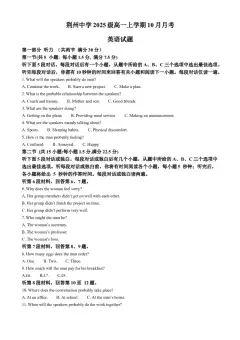
荆州中学 2025 级高一上学期 10 月月考
英语试题
第一部分 听力 (共两节 满分30分)
第一节(共5 小题: 每小题1.5分, 满分7.5分)
听下面5段对话。每段对话后有一个小题,从题中所给的A、B、C三个选项中选出最佳选项。
听完每段对话后,你都有10秒钟的时间来回答有关小题和阅读下一小题。每段对话仅读一遍。
1. What will the speakers probably do next?
A. Continue the work. B. Start a new project. C. Make a plan.
2. What is the probable relationship between the speakers?
A. Coach and trainee. B. Mother and son. C. Good friends.
3. What are the speakers doing?
A. Getting on the plane. B. Providing meal service. C. Making an announcement.
.
4 What are the speakers mainly talking about?
A. Sports. B. Sleeping habits. C. Physical discomfort.
.
5 How is the man probably feeling?
A. Confused. B. Annoyed. C. Happy.
第二节 (共15小题:每小题1.5分,满分22.5分)
听下面5段对话或独白。每段对话或独白后有几个小题,从题中所给的A、B、C三个选项中
选出最佳选项。听每段对话或独白前,你将有时间阅读各个小题,每小题5 秒钟;听完后,
各小题将给出 5 秒钟的作答时间。每段对话或独白读两遍。
听第6段材料,回答第6、7题。
.
6 Why does the woman feel sorry?
A. Her group members didn’t get on well with each other.
B. Her group didn’t finish the project on time.
C. Her group didn’t perform very well.
7. Who might the man be?
A. The woman’s secretary.
B. The woman’s professor.
C. The woman’s boss.
听第7段材料,回答第8、9题。
8. How many eggs does the man order?
A. One. B. Two. C. Three.
9. How much will the man pay for his breakfast?
A.£6. B.£7. C.£8.
听第8段材料,回答第10至 12题。
10. Where does the conversation probably take place?
A. At an office. B. At school. C. At the man’s house.
11. When will the speakers probably do the work together?A. On Monday. B. On Saturday. C. On Sunday.
12. What will the man bring to the woman’s house?
A. Pizza. B. Juice. C. Ice cream.
听第9段材料,回答第13至16题。
13. What is the woman’s destination?
A. Mongolia. B. Russia. C. China.
14. What happened to the woman?
A. She lost her ticket.
B. She missed her train.
C. She got to the wrong platform.
15. What is the man going to fix?
A. A bike. B. A car. C. A train.
16. What is the man giving the woman?
A. A map. B. Some food. C. Some warm clothes.
听第10段材料,回答第 17 至 20题。
17. What does the speaker think of the graduating class?
A. They are hard-working.
B. They are experienced.
C. They are gifted.
18. What is the speaker most likely to be good at?
A. Modern painting. B. Fashion design. C. Photo taking.
19. Who will probably speak next?
A. James Smith. B. Jane Goodman. C. Michael Watts.
20. What is the speaker doing?
A. Giving a class.
B. Awarding prizes.
C. Hosting an exhibition.
第二部分 阅读 (共两节,满分50分)
第一节(共15小题;每小题2.5分,满分37.5分)
阅读下列短文,从每题所给的A、B、C、D四个选项中选出最佳选项
A
Undergraduate (本科) Study—Computer Science
Cambridge was a leader of Computer Science and continues to lead its development. Our course covers all
aspects of modern computer science along with practical skills.
●Subject requirements
You need to have studied high school mathematics (A Level Mathematics).
No previous programming knowledge is needed.
It’s recommended to also study more advanced math (A Level Further Mathematics). If unavailable (不可获得的), try to learn as much pure math and decision math as you can. Doing well in math competitions can help your
application.
Please note, all applicants (申请者) are required to take the Test of Mathematics for University Admission
(TMUA), and you need to register (注册) for it in advance.
●Course costs
Tuition fees (学费)
Home students: £9,250/ year
International students: £39,162/ year
Additional (额外的) course costs
Each year of study: Payment at the beginning of each year is required.
Year Copies of textbooks Cost
1 Part I A courses £150
2 Part I B courses £150—£250
3 Part II courses £150-£250
4 Part III courses £150-£250
For further Computer Science undergraduate admissions information, please click here:
www.cl.cam.ac.uk/admissions/undergraduate.
1. What is a must for applicants for Computer Science?
A. Knowledge of programming. B. A Level Further Mathematics.
C. Top prizes in math competitions. D. Registration for TMUA in advance.
2. How much should a first-year student from China pay?
A. £9,250. B. £9,400. C. £39,162. D. £39,312.
3. Where is this text probably taken from?
A. A website. B. A magazine. C. A textbook. D. A newspaper.
B
Yesterday, my 6-year-old son taught me a valuable lesson that stayed with me for hours. It might sound
surprising, but he taught me a powerful lesson.
A few weeks ago, I had to travel for work, and I couldn’t spend much time with my son. Even though he is a
bit stubborn, he is growing up fast. That’s when the lesson happened. While I was eating dinner, he was in the bath,
and suddenly he started crying. I asked him what happened, and he said, “Shampoo (洗发水) got in my eyes.”
I got really worried and rushed into the bathroom. I tried to help by splashing water on his eyes, but things got
worse when he rubbed his eyes with his soapy hands. I was nervous, telling him not to use his hands.Out of the blue, he said, “Calm down! Dad.” It amazed me. I realized I was making things worse. I stopped
splashing water, washed his hands, and calmly told him to use his hands to clean his eyes while blinking. It worked,
and he felt better.
I’m not sure where he learned to stay calm, maybe from me or somewhere else. But the bigger lesson is that
when we face problems, acting emotionally and quickly might not be best. Staying calm and thinking about the
right solution is better.
In today’s tough job market with many people losing their jobs, it’s easy to feel worried. My son’s lesson
reminded me that staying calm and taking a moment to relax can help us face challenges with a clear mind, more
energy, and better solutions.
4. Why did the author’s son start crying during the bath?
A. He fell down in the bath.
B. He didn’t want to take a bath.
C. He felt uncomfortable in his eyes.
D. His dad splashed water on his eyes.
5. What did the author realize after his son said “Calm down! Dad”?
A. His son was too stubborn to listen to him.
B. His son could solve the eye problem by himself.
C. He needed to call a doctor for his son right away.
D. His own way of helping was making the problem worse.
6. What can we infer about the author from the passage?
A. He gets angry with his son too often.
B. He spends most of his time with his son.
C. He taught his son to stay calm on purpose.
D. He used to act emotionally when facing problems.
7. In which situation can we use the lesson the author learned?
A. When we are watching a movie.
B. When we are shopping in a mall.
C. When we are facing a tough exam.
D. When we are working out with friends.
C
Paige McClanahan, a journalist and travel writer, is much too clever to phrase it this way, so allow me to be
straightaway: you’re the reason why locals so often dislike tourists. “Travel has become a consumerist exercise where
the goal is to get our money’s worth out of a place,” McClanahan says in a phone interview from her home in France.“We need to wake up. Paris owes you nothing.”
The tourist-local tension (矛盾) has been around since before Marco Polo, but in her first book, The New
Tourist, McClanahan shows us just how bad things have gotten. Globally, travellers will record some 1.5 billion trips
abroad by the end of 2024 — the largest movement of people the planet has ever seen. In a handful of years, that
number could reach 1.8 billion. Despite the sustainable travel, locals from Athens to Zermatt have had enough of us.
Some Hawaiians have requested that we stay home. Romans fine tourists up to $280 for blocking the Spanish
Steps.
McClanahan has plugged (投入) her journalistic pen into this serious problem with sympathy (同情), not by
shaming or lecturing anyone. Instead, McClanahan uses the voices of locals negatively (负面地) affected by tourism
to inspire us to travel with more curiosity, modesty (谦逊), and appreciation for how our holiday can be harmful to
local residents. Above all, she wants us to know that we have the power to make travel a force for good.
“Even if you’re a low-budget traveler, you can still be a high-value visitor,” McClanahan says. Becoming one
isn’t hard. It means visiting Iceland in the off-season or trading the line at the Louvre. You can insist on supporting
local guides and locally owned hotels, restaurants, and food stands.
“None of us can change the behaviour of millions of other people, but each of us can be that change.”
8. What can we learn about travel from the first two paragraphs?
A. It aims to make money. B. It is a type of exercise.
C. It becomes increasingly popular. D. It is warmly welcomed by the locals.
9. How does McClanahan encourage responsible travel?
A. By giving the visitors a lecture. B. By presenting the locals’ opinions.
C. By analyzing the tourist-local tension. D. By showing sympathy to local residents.
10. What is McClanahan’s attitude toward relieving tourist-local tension?
A. Optimistic. B. Doubtful. C. Uncertain. D. Uninterested.
11. What does McClanahan’s words imply in the last paragraph?
A. Do as others would be done by. B. Everyone can make a difference.
C. A man can do no more than he can. D. When in Rome, do as the Romans do.
D
Parents of teenagers often view their children’s friends with doubt, worrying that their children will be pushed
by their peers (同龄人) into doing something silly or even dangerous. Their worries make sense. In a previous
study, psychologist Laurence Steinberg found that a teenage driver with a same-age passenger in the car is at higher
risk of traffic accidents than one driving alone or with an adult.
In the following years, Steinberg examined why teens were more likely to take risks in the company of otherteenagers. In a later study, by scanning (扫描) the brains of 40 teens and adults, Steinberg found the brains of
teenagers, but not adults, showed greater activity in two parts related to rewards (奖赏) when they were being
watched by same-age peers. The reward systems of the brain start working whenever people experience something
rewarding, like eating a nice-tasting food, which makes them feel good. In this case, rewards are greater for teens,
which makes them want to seek higher-risk experiences.
But Steinberg thought peer pressure might also have its positive side. In the latest study, Steinberg’s team used
a card game to research how peers influence the way young people gather and apply information. It included 101
teenage boys who played either alone or with three peers. They chose cards from four decks (牌堆): two decks had
“good” cards, and two “bad” ones. Players with peers were more willing to take risks, trying to figure out which
decks could help them to win. The results showed that teens playing with their peers do more exploratory behavior,
learn faster and achieve better performance on the task than those playing alone.
Now some experts are suggesting that we should take advantage of the teens’ strong sensitivity (敏感性) to the
presence of friends to improve education. “Risk taking in an educational setting is a very important skill that
,
enables progress and creativity ” wrote Sarah Jayne Blakemore, a professor at University College London.
12. What does the author want to say by mentioning Steinberg’s study?
A. Parents’ worries are reasonable. B. Teens drive more carelessly with peers.
C. Adults are better drivers than teens. D. Peer pressure only brings harm.
13. What is the reason behind teens’ dangerous behavior?
A. Inability to tell right from wrong. B. A sense of satisfaction.
C. Eagerness to follow their friends. D. Lack of social experience.
14. How does risk-taking influence teens in the latest study?
A. It starts fights between them. B. It inspires them to question.
C. It weakens their independence. D. It helps them to learn better.
15. What does Blakemore think of involving peers in learning?
A. Helpful. B. Unnecessary. C. Risky. D. Challenging.
第二节(共5小题;每小题2.5分,满分12.5分)
阅读下面短文,从短文后的选项中选出可以填入空白处的最佳选项。选项中有两项为多余选
项。
The main thing about studying well is to study smartly. But studying smartly doesn’t mean staying up all night
before an exam. ____16____ Besides this, here are other tricks of studying smartly.
____17____ Actually, relating what you are studying to your everyday life is not always easy. However, this is
a skill that you can improve over time. You can spend some time using your imagination to relate what you’re studying
to your life.Rewrite your notes. Some people may find it painful because they have already spent a fair amount of time
taking notes in class. But it is helpful to your study. You can rewrite your notes by adding more information to the
notes that you have taken during the class. Please remember not to just write down your notes mindlessly. Using
some learning materials like a textbook or a workbook to help you. ____18____ In this way, you can rewrite your
notes better .
Plan your study time. Different people like to work and read at different parts of a day. Try to find out when
you’re most productive. Some students study more effectively in the morning, while some may find it more beneficial
to study at night. ____19____
Have a good space to study. You need a desk or a table with a certain amount of space. Besides, you will also
need good lighting. Students often say that listening to music, having the TV on, or keeping their phone out helps.
____20____ So you’d better study in a quieter space. However, a different situation is that you can listen to some
relaxing music if you can’t study in silence.
A. Understand what you are learning.
B. It all depends on your schedule and habits.
C. Instead, it requires preparation ahead of time.
D. Create connections with what you are studying.
E. Actually, it is not a reasonable schedule for them.
F. But these things can take your attention away from study.
G. This is a good way to study because it requires you to think.
第三部分语言运用(共两节,满分30分)
第一节(共15小题;每小题1分,满分15分)
阅读下面短文,从每题所给的A、B、C、D四个选项中选出可以填入空白处的最佳选项。
If time is truly the most valuable thing, then maybe we should be surprised at how much we ____21____
it. I’ve heard that when smokers kick the ____22____ of smoking, their lungs (肺) begin to ____23____ themselves
almost right away. So could it also be true of our brains, which have been slowed by long time of phone use?
One day, it hit me that I needed to make some ____24____. I decided to kick my phone addiction in an attempt to
make up for all those ____25____ hours spent doing seemingly nothing on my phone.
A complete break was ____26____. My new rules allowed for basic uses like texting, calling and checking the
news when necessary. I ____27____ aimless surfing and online shopping. My No. 1 rule was simple: Do not
____28____ the phone as a way to get rid of boredom.
Just a few weeks after that, I’ve read two books. I’ve ____29____ 20 minutes to improve my health every day,
and I have had more ___30___ for writing tasks in these few weeks than I had throughout last year.Coincidence (巧合)? Maybe. But more ____31____, I’ve also had more communication with strangers, whether
it’s giving out a greeting or laughing at something ____32____ together.
We’ve given the little computers in our hands far more of our time and ____33____ than we should. They’ve
become crutches (拐杖), ____34____ us the whole time. But the funny thing is, when we put them down, there’s
no ____35____ that we’ll find other ways to fill our time and make our life more colorful.
21. A. waste B. spend C. own D. check
22. A. goal B. habit C. door D. ball
23. A. show B. imagine C. enjoy D. repair
24. A. design B. strategies C. changes D. contact
25. A. lost B. real C. annoying D. awkward
26. A. surprising B. enjoyable C. impossible D. exciting
27. A. learned B. ordered C. began D. quit
28. A. put up B. pick up C. take up D. hold up
29. A. worked out B. made out C. handed out D. dropped out
30. A. experiments B. adventures C. ideas D. responsibilities
31. A. hopefully B. unluckily C. sadly D. interestingly
32. A. funny B. dangerous C. boring D. important
33. A. trouble B. care C. attention D. help
34. A. praising B. recording C. supporting D. watching
35. A. comment B. doubt C. view D. focus
第二节(共10小题:每小题1.5分,满分15分)
阅读下面短文,在空白处填入1个适当的单词或括号内单词的正确形式。
Welcome to our school. As ____36____ exchange student in Grade Two, I can’t wait to describe to you
____37____ senior high school life is like. It is full of challenges: a new environment, new knowledge and new ways
of thinking. However, for those with a positive mind, opportunity lies in each challenge. When you rise to the
challenges, you will have the chance ____38____ (gain) great knowledge and enjoy personal growth. Most
importantly, your time and effort at senior high school will open the door to your potential.
As Laozi wisely said, “A thousand-mile journey ____39____ (begin) with the first step.” You need to make a
____40____ (continue) effort to train your mind and develop your character. Senior high school will help you learn
and grow, yet you alone are responsible ____41____ realizing your great potential. Be confident, do your best and
make us proud.
As for me, I enjoy most of the classes, but some of them are quite ____42____ (challenge). Technology classesare fun. I even made a clock to take home. The teacher helped me put the parts together. I like it so much
____43____ I still use it as my alarm. However, ____44____(learn) in English is difficult for me. There are a lot of
difficult English words, especially in geography and biology. Class discussion is very important in the UK, but I can’t
make a great contribution because sometimes I am not able to express ____45____ (me) clearly in English. I will
work hard to improve my spoken English.
第四部分 写作(共两节,满分40分)
第一节(满分15分)
46. 假定你是李华,你的美国朋友Ben寒假想来北京旅游,请你帮他制订一个旅游计划。请根据以下要点
用英语给他写一封信。内容如下:
1. 时长:15天;
2. 活动:参观北京的一些知名旅游景点,欣赏中国国粹京剧,在北京胡同和当地人一起欢度春节;
3. 其它建议(如:时间安排、食宿等等)。
注意:
1. 词数100左右;
2. 文章的开头和结尾已为你写好,不计入总词数;
.
3 可以适当增加细节,以使行文连贯
参考词汇:京剧Peking opera 胡同 Hutong
Dear Ben,
____________________________________________________________________________________________
____________________________________________________________________________________________
____________________________________________________________________________________________
____________________________________________________________________________________________
____________________________________________________________________________________________
_______________
Yours Sincerely,
Li Hua
第二节读后续写(满分25分)
47. 阅读下面材料,根据其内容和所给段落开头语续写两段,使之构成一篇完整的短文。
Each Role Matters
The annual English play was an eagerly awaited event at the senior school. This year, the drama club decided
to put on A Midsummer Night’ s Dream and among the actors was a freshman named Alex, who had always
dreamed of being the star of the show.
From the very beginning, Alex struggled with the mind of being a supporting actor. He was given the role ofPuck, a character he viewed as less exciting than the leads. “Why can’t I be one of the main characters?” Alex sadly
told his friend, Jamie, who was the drama club president. “I have talent, and I want to shine!” Jamie tried to
comfort Alex, explaining the importance of every role in a play. “Each character serves a purpose, Alex. Puck is
charming and playful. He adds depth to the story. Without him, the play wouldn’t be the same.”
Despite Jamie’s words, Alex remained unpleasant during the early rehearsals. He played without any
excitement, which caught the attention of the director, Ms. Parker. She decided to talk to him and called him aside.
“Alex, you’re talented, but you’re not giving your best.” she said. “You’re part of a team, and every member is
important. Value your role and make the most of it.”
This conversation gave rise to a change in Alex. He began to look at the script differently, studying Puck’s
character more closely. He noticed the importance of Puck’s interactions with the other characters. Slowly, Alex’s
attitude changed. He started to take his role more seriously, attending every rehearsal full-heartedly.
On the night of the big day, Alex stood backstage , in eagerness.
____________________________________________________________________________________________
____________________________________________________________________________________________
____________________________________________________________________________________________
____________________________________________________________________________________________
_____________________________________________________________________________________
When the play ended , Ms. Parker gave Alex a bear hug.
____________________________________________________________________________________________
____________________________________________________________________________________________
____________________________________________________________________________________________
____________________________________________________________________________________________
_____________________________________________________________________________________